Blog Archives
Deadpool & Wolverine (2024)
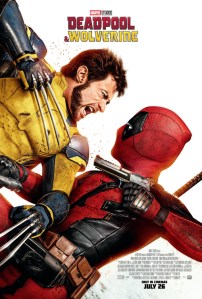 Thanks to some release shuffling, there was only one Marvel movie being released in 2024, the fewest since 2012 (excluding the COVID punting of 2020). There’s been a lot of ink spilled over “superhero fatigue,” especially the recent downturn of certain Marvel movies like Quantumania and The Marvels, though as I’ve written before, I don’t think audiences have become sick of superhero cinema, they have become more demanding from mediocre superhero cinema. Audiences just want something more than the same old same old. Enter Deadpool & Wolverine, resurrecting one of the greatest Marvel heroes and transplanting the first new Fox hero into their new corporate landscape. It’s the least serious Marvel movie yet by design and, judging by its runaway box-office success, that was what the people wanted in a summer blockbuster that made them remember the escapist joys of men in tights with anger issues.
Wade Wilson (Ryan Reynolds), a.k.a. the merc with the mouth Deadpool, is a man out of time. His universe is scheduled for elimination by the Time Variance Authority (TVA) because of the demise of Logan (Hugh Jackman) who served as an anchor being. Apparently, for reasons that don’t seem to make sense if you think of universes lasting longer than one human lifespan, once the anchor being goes, the universe dies out. Wade is thus in search of another Wolverine, but the one he finds is “the worst Wolverine,” a tragic hero drowning his sorrows and refusing to help. The two bickering mutants get cast to a dimensional dumping ground where they run into all sorts of castoffs and forgotten figures, chief among them Cassandra Nova (Emma Corrin), the twin who ate Professor Xavier in the womb rather than the other way around. She holds dominion in this strange realm, and Wade has to appeal to her, or eliminate her, to get out of this ashy purgatory and convince this wounded Wolverine to be a hero.
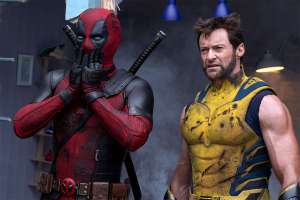 The Deadpool half of the title means that this movie is interested in serving as a meta-satire of superhero cinema, which means its breezy, surface-level charms can feel after a while like a fanboy sugar high. It’s hard to maintain the novelty of a fourth-wall breaking vulgar superhero with the third movie, but now we have Deadpool closing the book on the Fox era of twenty-first century superhero cinema as well as getting to play in a new sandbox of pop-culture references and superhero cliches. Welcome to the Marvel Cinematic Universe (MCU), Wade Wilson, though, as stated on-screen, you’re entering at a bit of a low point. For a while, at least, the movie can get by by having its resident prankster mug his way through the MCU catalog, fawning like the biggest fanboy (he did unsuccessfully audition for the Avengers). The opening sequence literally involves Deadpool digging up the adamantium corpse of Logan and using his unbreakable bones to inflict bloody carnage. It’s quite an attention-getter as well as something of a promise: we’re not going to undo the dramatic conclusion of 2017’s Logan, and even though this is the MCU, this movie isn’t going to go soft as it wades in its signature off-color comedy and bloody chaos.
Your mileage will vary depending upon what the hit-to-miss percentage is with the comedy. I found a lot of the homoerotic/homophobic banter to be dull and repetitive, but this kind of comedy ethos has been present from the first movie, the more-is-more approach. There’s an extended series of cameos that are fun castoffs from Fox comics universes, and the actors are definitely having a blast reliving their characters, or in one very special case, getting to live it once and for all. I wish there was more specific MCU commentary, but I cackled loudly when Reynolds turns to Jackman and taunts, “Disney’s going to make you keep doing this until you’re 90!” I really wish there was an extended critique of the state of post-credit scenes introducing new characters that we all know will never be seen again (remember Harry Stiles or Brett Goldstein?). Deadpool could have gotten stuck in an endless loop of end credit sequences. I enjoyed that a car’s product placement was subject to constant abuse and destruction, while still trying to maintain that sleek car commercial framing. The angry/shouty dynamic between Wolverine and Deadpool makes up for a lot, so even if the jokes are less than stellar, the cranky buddy dynamic still delivers.
 However, much like the 2022 Multiverse of Madness, the actual multiversal trips are quite few and quite disappointing. There’s a silly montage of Wade approaching the different Wolverines of different universes (no Dougray Scott, huh?) but almost all of the movie is spent between a dusty netherworld and a subway station. Again, with the promise of great possibility, these movies seem to say, “Will you settle for maybe TWO gray locations?” I was let down by the main setting reminding me of 2009’s Land of the Lost dumping ground for the nexus of discarded universes. When this whole multiverse phase comes to its inevitable conclusion, it’s going to feel like a promised epic family vacation that went about an hour down the road, visited two gas stations, a McDonalds, and then hastily turned around.
On the other side of the titular ampersand, Jackman is acting in a completely different movie, perhaps giving one of his most dramatically rich performances as the superhero. This is a different Wolverine than the one we saw in 2017’s Logan, so it allows Jackman the freedom to be able to hit some of the essential elements of the character while also getting a new opportunity to follow a different direction. This is a Wolverine haunted by his own sense of cowardice and blaming himself for the death of his X-Men. This is less the grumpy antihero we’ve grown to love over twenty years and more akin to the main character in 2023’s Godzilla Minus One, a war veteran who folded under pressure and attempts to live through their guilt and shame, ultimately finding solace in seeking the noble sacrifice but on the bigger stage now. This is a genuinely traumatized character working through the different dimensions of his trauma, and Jackman doesn’t for a second treat it like a joke. He’s set up to be the cranky straight man to Reynolds’ chatty goofball, and there is comedy to be had with that dynamic, but Jackman is so convincing with his portrayal, again twenty-four years into this character, that he made me tear up at a few points. That’s right, dear reader, Hugh Jackman is so great in his role, that he almost made me cry. Yes, in a third Deadpool wankathon movie. And that is why Jackman is such an incredible actor. The attempt at heart has never felt authentic for me with Deadpool, no matter how many side characters he collects and assures us that they “mean something.” However, by including Wolverine, the filmmakers allow the viewers to import our decades of accrued feelings onto him. It’s a cheat, but it works with an actor of Jackman’s caliber. Plus, who wouldn’t want to see more of this man in the role that he defined for a generation?
 Look, the movie operates more so than any other MCU enterprise on an expectation reflection system, likely supplying what you want out of a project like Deadpool & Wolverine. If you’re looking for a darker, sillier jaunt, there’s probably enough to serve as a diversionary change-of-pace. If you’re looking for a low-stakes reset, you’ll likely find it, though much depends on Where We Go From Here. If you’re looking for the same brash sense of humor and vulgarity from the two previous Deadpool movies, you’ll be satisfied. If you’re looking for something a little more thematically rich and rewarding, well this is the third Deadpool movie and I would ask why that’s a priority, but Jackman practically delivers just that. If you’re looking for a movie that rewards impish fan service, then here’s your winner, rewarding viewers who can even recall the vague minutia of the rise and fall of studio projects of old. I’ll always wish that more of the jokes hit their marks, or that the action could be a little more stylish, or that Reynolds and company had more trenchant satire for their corporate overlords rather than an occasional naughty tweaking that feels pre-approved, like writing a roast of a host. I would say it’s no more than the sum of its parts, but it almost made me cry and ended in such a jubilant fashion that I didn’t really care about the wishy-washy timey-wimey nonsense that the movie barely wants to pay attention to as well. Deadpool & Wolverine is an unexpected elegy for the Fox universe but also a reminder of the appeal of both of its titular stars.
Nate’s Grade: B
Share this:

American Fiction (2023)
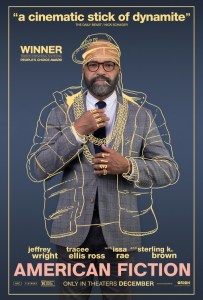
Cord Jefferson’s hilarious, inflammatory, and insightful comic fable can be boiled down to the question of what exactly does it mean to be a “black writer” in this day and age? According to the main character, English professor and middling writer Thelonious “Monk” Ellison (Jeffrey Wright), he would pointedly argue that he is a black writer and thus his novels, never ones to climb a best-seller chart, should qualify as black literature. The publishing industry seems to think differently. Their conception of a “Black story” is one defined through poverty, guns, drugs, gang violence, degradation, and all sorts of depressing stereotypes of socioeconomic disadvantage. If there are stories of triumph, they will usually be relegated to the same familiar settings of struggle: slavery, the Civil Rights era, and modern ghettos. A simple slice-of-life about a middle-class family isn’t necessarily seen with the same level of acceptance. With American Fiction, Jefferson and Monk push through, trying to exploit a system of exploitation at its own game, and the results are biting and hilarious and a condemnation of the low expectations that can govern the supposedly open-minded values of others when it comes to celebrating authentic minority stories.

The movie really takes off once Monk decides to, as a sarcastic lark, give the publishing world what it seems to crave, a novel (My Pafology) that plays into every urban stereotype. He adopts a nome de plume, “Stagg R. Leigh,” and riffs that he’s currently a fugitive from the law. The intention was to make fun of the limited black literary stories that he despises, and yet the incendiary manuscript becomes a hot commodity. They’re already talking about turning it into a movie. Monk is aghast but the money is very appealing, so he puts his moral superiority aside to see how far he’s willing to pander if the check is right. His alter ego is deemed more authentic and compelling when he doesn’t even exist and is only a combination of the same worn-out and destructive stereotypes. It becomes an ongoing game for Monk to see where exactly a line can be drawn. He actively tries to make his manuscript objectively worse, and at every step it only seems to have the opposite reaction among white editors and agents and producers salivating to celebrate it. There’s a very telling scene where Monk is part of a literary award body scouring through manuscripts for potential worthy award-winners. He and another prominent black author (Issa Rae), the best-selling author of We’s Lives in Da Ghetto, are critical of My Pafology and its adherence to harmful stereotypes, but the white liberals won’t hear it and want to reward it. “It’s really important that we listen and uplift black voices,” one of them says obliviously. Of course, if they knew the truth that the author was really an upper middle-class East Coast academic, there wouldn’t be the same rush to elevate this “brave and inspiring” story of the streets. To Monk’s ire and chagrin, there is no bottom when it comes to the appetite for degrading stories that neatly fit into a pre-existing mold.
Jefferson’s screenplay, based upon the 2001 novel Erasure by Percival Everett, is bristling with biting intelligence. This extends beyond the identity crisis of Monk in the world of publishing to his personal life, and the time spent with his fractured family is just as illuminating as the time spent in publishing. Monk’s need for money is driven less from his own desire to live large and more about caring for his ailing mother who needs to be placed in a costly assisted living home as she plunges further into dementia. His shared moments with his mother can be heartbreaking as well as informative. His relationship with his brother, Clifford (Sterling K. Brown), who is embracing his black sheep status as a now openly gay middle-aged man, is a regular point of reflection for both characters who feel their identities are in free fall. Their conversations about being accepted as you fully are help reinforce the major themes mirrored through Monk’s publishing odyssey with his alter ego. The Hollywood satire is best encapsulated by Adam Brody’s shallow movie producer, a good white liberal who is sold on the project after he perceives that Monk leaves their meeting after hearing police sirens. His every appearance is a gift. Not everything in Jefferson’s adaptation feels as exceptionally well integrated. I don’t think the romantic subplot quite works but Jefferson is smart enough to frame that as possibly the larger point, an offshoot that presents an alternative of happiness for our bitter protagonist that he will inevitably decline.

This is also a deserving showcase for Wright (Westworld, The Batman), one of our best character actors who rarely gets the plaudits he deserves. He’s a brilliant actor when it comes to consternation and exasperation, and his unexpected journey of discovery and success allows him to assess how much he’s willing to go along with a deceptive narrative in a ludicrous industry of perception. Wright’s performance is equal parts amusement, like a conman who can’t believe he keeps getting away with his ruse, and head-shaking anger at being marginalized unless he erases the complicated, unique parts of himself.
I also want to celebrate the very ending of American Fiction that goes even harder on industry satire. Jefferson gets extra meta and presents a series of possible endings for Monk’s story, from Monk’s preferred ending that leans more ambiguous and open-ended, to the Hollywood happy ending and other versions, each their own condemnation on the studio system and the larger demands of mass audiences for tidy endings. It’s a level of comic bravado that American Fiction hasn’t really fully channeled until that moment and its absence makes this conclusion, a choose your own adventure of bad endings, hit even harder. He’s been saving his full satirical might until the very end and it was worth it.
Who exactly gets to qualify what constitutes the black experience? Certainly not I, a 41-year-old white guy writing on the Internet. Even though the source material is over twenty years old, the struggles of identity and acceptance and the lens of which we subject others’ experiences through are still relevant in an increasingly hostile cultural environment for different attempts at diversity. American Fiction is hilarious and smart and produces as many thought-provoking questions as solid belly laughs. It’s a cutting satire but with characters that are compelling beyond their connection to larger satirical points. This is more than a message movie, and it’s a statement debut film for Jefferson as a filmmaker and primarily as a storyteller. Jefferson began as a journalist and has worked on several critically-acclaimed TV shows, winning an Emmy for an extraordinary episode of HBO’s Watchmen. He is a talent, and American Fiction is proof that he has a voice and the confidence to carry it through into one of the best films of 2023.
Nate’s Grade: A-
Share this:

Scream 6 (2023)
 When horror franchises dramatically shift their locations to somewhere new, like New York City, it’s usually a bad sign that the series is desperately looking for new creative life. Not every franchise can rebound like a Leprechaun in Space. Most of them just become another Jason Takes Manhattan, where now instead of Character Group A running and dying from the masked killer, it’s now Character Group B running and dying from the same masked killer. It’s more reminiscent of cartoons where the backgrounds might change but the on screen events are stuck in the same drab routines. The Scream franchise was rebooted with 2022’s satisfying fifth installment, so I hoped that a sixth Scream could at least exceed where so many others have failed. Those hopes were quickly fulfilled in what I consider to be one of the best sequels of the seminal slasher series with all of its air-quote irony.
There are more than a few entertaining new turns as the bloody hi-jinks head to the Big Apple. It feels bloodier and gorier than most of the Scream movies, but it also has well-developed suspense sequences that work extremely well at making you squirm. Every brutal burst of violence elicited a “oomph” exhalation from me, and I found myself tensing up as the initial scene constructions transformed. I was quite enjoying myself from set piece to set piece. Take for instance an escape that requires the characters to flee from one high-rise window to another across an alley via a rickety ladder. Or take a subway escape packed with masked Halloween revelers to make you paranoid who among the many Ghostfaces might be the potential killer (I enjoyed the other costumes of horror old and new – I saw you Midsommar May Queen). Even a hide and seek sequence inside a convenience store can be thrilling. All credit to returning Scream 5 directors Matt Bettinelli-Opin and Tyler Gillet, the same pair that delivered 2019’s wonderfully twisted Ready or Not. These gentlemen have proven that they know how to squeeze the most tension from any scenario no matter how bizarre. I loved that the opening kill (Ready or Night alum Samara Weaving) goes in a different direction, revealing the culprit right away, and then it goes in even another direction. There are still some new cool tricks to be had with the sixth installment in a 27-year-old horror series.
 I was asked if you had to watch any of the prior Scream movies to enjoy Scream 6, and while it’s not necessary, you will be missing out on some of the larger connective tissue and themes. You should definitely have familiarity with Scream 5 since it’s a direct sequel and continuation of the core (four) characters. I was surprised how much more emotional resonance I found with the Carpenter sisters than any of the other characters, new or legacy, from the earlier movies. I think it was smart having Sam (Melissa Barrera) be the daughter of the first Ghostface as was her seeing visions of her late father, this time as an adult Skeet Ulrich, which might have been the wrong choice considering the character never lived to be this age (is her imagination doing one of those age approximations you see for runaway kids?). Our lead heroine is trying to navigate where her instincts are taking her, which might be a darker path that she feels trepidation about ignoring for only so long. Sam’s therapist balks when he discovers her actual parentage, which makes him maybe the worst therapist. Her relationship with her younger sister Tara (Jenna Ortega) is more complex than any of the close friendships of Sydney Bristow. Even with all the carnage and bloodshed, Scream 6 still finds breather moments to let the sisters react realistically to their dilemma and how it affects their own relationship. I’m glad these characters returned because they serve as the emotional focal point of an otherwise famously glib franchise.
The biggest drawback from Scream 6 is the tacit understanding that this will not be the final film in the franchise given its box-office success, the first film to cross the $100 million-dollar threshold since 1997’s Scream 2. This feels like a culminating climax as the characters now view their lives not as their own but as part of a “franchise,” which means the stories will keep going on beyond them and that nobody is safe, not even the “leads.” For a series entrenched in heavy meta-textual irony, it feels like it’s reaching the end of its genre self-awareness cycle when the movie acknowledges itself as its own IP. The scope of the movie is retrospective, not just reaching back and acknowledging the history of where things began for the legacy characters but for every movie. Each one of the former Ghostfaces is being collected and commented upon, with murder nerd Easter eggs left at each crime scene or in its contextual arrangement. It’s the kind of totality that I would expect from a movie franchise coming to an end, and nodding at its various twists and turns, finding places to even include elements from the lesser beloved Scream sequels. There’s even an unspoken satirical jab at the number of characters that miraculously survive, as if the film is throwing up its hands and saying why not, as if this is the last movie and the rules of who survives and who dies are inconsequential because we’re subverting expectations, as we’ve been explicitly told, so expect the unexpected.
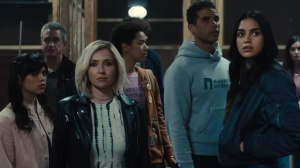 The other aspect of this drawback involves some slight spoilers but I’ll try and tread lightly. After our genre-savvy movie geek explains the stakes of this new episode, the characters start to review one another as potential suspects, and the new supporting characters even cast an accusing eye on the returning characters saying they could have cracked from their trauma. There’s emphasis on the drive to subvert expectations and break away from the patterns of old.
And here is where I’ll venture into some light spoilers so if you want to skip ahead to the next paragraph, please do so, dear reader. There is an ongoing thread where an Internet subculture has re-framed the Carpenter sisters as the real villains of their own horrendous story, and it’s an intriguing element that brings the echo chambers and confirmation bias and novice sleuths-in-the-making of the Internet to further examination. It’s reminiscent of any bottom-feeding conspiracy that asks people to pick apart their reality for “the real story” magically hidden in plain sight. The Scream franchise is famous for its fun guessing game of who the real killers could be from our gallery of suspects, and Scream 6 is no exception. However, the subversion that could have really separated this Scream from its elders is by having the killers actually be… nobodies (the Rian Johnson twist). What if the mask comes off and it’s a brand new character? I’m sure many viewers would feel like they had been betrayed, but then the point emerges that it’s simply some conspiracy theorist who has gone full-tilt crazy into the cult and taken matters into their own hands, attempting to hold “the real killers” to account or to prove they were truly guilty. And the larger point is that the “fake news” has already won out. It doesn’t matter what happens from here, what news coverage should stamp out ignorance, because you can’t pull every cult member out of their self-inflicted cocoon of delusion, which means there will always be more to take their place. That’s the legacy of what has transpired, that there will never be a real escape any longer. I thought that would be such a jarring and thematically intriguing and summative ending.
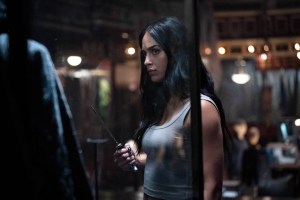 For the many fans of the slasher series, I believe Scream 6 retains plenty of the same pleasures of its prior movies while stretching out into new and interesting directions. It helps that I cared about the central sisters, at least enough by the low bar of horror movie standards. It’s bloody, fun, twisty, and satisfying enough that it could have served as a capper for the entire franchise. But it won’t be. I look forward to this new creative team re-evaluating trilogies better than Scream 3 did. In the meantime, this is a bloody good time to be had for long-term fans and newcomers from the 2022 reboot alike.
Nate’s Grade: B
Share this:

Scream 5 (2022)
 The fun of the Scream franchise has been its meta-textual commentary, wry jabs at horror, and the guessing game of who the killer culprit(s) could be, and Scream 5 or Scr5am (what it SHOULD be called) is a good-fun B-movie that knows precisely what it wants to be and plays to the strengths of the franchise. We haven’t had a Scream sequel since 2011, and the landscape of horror has changed as well as the landscape of multi-media entertainment. There are new satirical horizons to be targeted. This is the first Scream after the death of legendary horror director Wes Craven, but it’s in good hands with the directors and writer of 2019’s bloody excellent Ready or Not. The fun, knowingly goofy elements are retained, and the filmmakers clearly have love for what they’re sending up. There’s a sequence of languishing shots of a character opening fridge doors and pantry doors and I felt everyone in my theater tense for the eventual reveal of the killer on the other side. Moments like these are the good kind of tension-release giggle that Scream can get away with. The plot is sufficient to gather the “legacy characters” back to the site of the original murders for a new stab at rewriting the movie franchise. There’s even some plot elements that are surprisingly resonant and deeper for a satirical slasher franchise, like tear-filled discussions over loss, abandonment, mental illness, and personal responsibility. There’s a sister-to-sister reconciliation that plays like a straight drama, and it plays well. There’s nothing terribly gruesome or memorable about the kills, and some of the meta-commentary can feel like talking in circles, especially as characters knowingly enact scenes from the original. It’s a copy of a copy, meant to mock Hollywood’s reboots, but it’s still a copy of a copy. Sometimes the knowing winks are obvious, like a shower sequence recreating Hitchcock’s angles, and sometimes the potential homage feels lost in translation. Still, Scream 5 is a fun, ironic, bloody hoot of a movie, and for fans of the franchise a more welcomed return to the creative heights of the original movie.
Nate’s Grade: B
Share this:

Cherry (2021)
 Between 2014 and 2019, the Russo brothers directed four Marvel movies with a combined worldwide box-office of over six billion dollars, so for their first foray from the world of super heroes and magic space gems, the brothers had carte blanche to pick whatever project they desired and Cherry was it. Watching all 140 minutes of this true-life tale, you get the feeling it’s less a story about loss and redemption and more an overly extended excuse for Joe and Anthony Russo to use every stylistic trick they’ve ever wanted to employ to make their own inferior Goodfellas (or Casino). Free of MCU oversight, these guys are practically going full Tony Scott or Darren Aronofsky with the multitude of their visuals tricks and gimmicks. We’re talking different aspect ratios, color washes and spotlights, heightened fade outs, fourth wall breaks and freeze frames, chapter titles complete with prologue and epilogue, in-your-face subtitles, tracking shots, and even oblique angles such as a point of view from inside Tom Holland’s inspected rectum. Cherry is aggressively flashy to compensate for how little substance there is with its story and humdrum characters. It’s based on a true story about Nico Walker (Holland), an Iraq War veteran coming back to Ohio, getting hooked on drugs, and resorting to robbing banks The trauma of his war experiences leads him to seek help and the system fails him and pushes opioids on him, turning him into another addict among too many who is desperate to do anything for cash. On paper, that sounds like it would be interesting, and the shocking part is that for all these identifiable dramatic elements and stylistic flourishes, Cherry is kind of dull. Everything feels like it’s kept at a surface-only level. Walker is just not that interesting even though interesting things happen to him. You would think it’s about PTSD, the opioid crisis, economic anxiety, and while these elements are present they are not really explored with any sustained nuance or theme. The level of social commentary stops at Fight Club-level snarky sight gags, like the names of the banks being “The Bank” and “Shitty Bank.” There’s too much bloat with the plot and running time. By far the most interesting section of the movie was his descent into addiction and the criminal excursion, but Walker doesn’t even exit the war until over an hour in. We did not need all the fluff before the war to properly set up this limited character. The real drama of the movie is post-war, and there’s an hour of setup that could have been cleaved away. You leave this stuff in as “texture” if you’re building something rich in atmosphere and character but I can only tell you what has happened to Walker externally. He’s perfectly unremarkable. The movie is too shallow for its own possible ambitions, and it ultimately feels like cribbed notes and homages to other movies the Russos enjoyed, like Goodfellas or Requiem for a Dream or Boogie Nights. It only reminds you of other, better movies, and one I was reminded of was Roger Avary’s Rules of Attraction. I appreciated the flash and style of that 2002 movie because it was about empty characters living empty lives striving for something they were incapable of, so the excessive and prioritized visual artifice worked. With Cherry, the visual trickery is distraction from the underwritten characters who the movie very much wants us to see favorably through their struggles. I enjoy Holland (Spider-Man: Far From Home) as an actor immensely but he is miscast here. He’s too boyish and charming and genial to ably perform dark and gritty antiheroes. You sense he’s eager to try these “darker roles” to prove himself but he doesn’t need to. Ciaria Bravo (Wayne) plays the girlfriend/infatuation object/junkie partner and she looks so young that see feels like an unsupervised child onscreen. Maybe that works with her as a symbol of innocence. Cherry is a movie that left me indifferent and shrugging throughout all its excesses and meandering. It feels like a movie the Russos needed to get out of their system, one of creative indulgence charging into familiar territory when more restraint, nuance, and contemplation would have sufficed, and maybe their next movie will be more mature and fulfilling and worthy of 140 minutes.
Nate’s Grade: C
Share this:

Moondance (2020)

I didn’t even plan on writing this review. I knew of the indie musical Moondance because I was familiar with several crew members who worked on the $500,000 project and watching their pictures on social media, but when I discovered it had been filmed entirely outside the state of Ohio, primarily in Kalamazoo, Michigan, I decided to exclude it from my mission to professionally review Ohio-made indies. As of this writing, it was available on the website Tubi for free with ads, so I started it on a whim to show my girlfriend what I had intended to watch, and then I kept watching, and then I didn’t want to continue but I felt compelled to, and now I feel compelled to dissect this movie as best as I can, even with its tangential connection to the Ohio indie film scene. Moondance is a confounding experience for a lover of big screen musicals because it’s a musical that doesn’t really want to be a musical, a comedy that doesn’t know how to do comedy, and a drifting drama bereft of characters to root for and reasons to cheer.
The story is familiar. We have our boy, in this instance Oscar (Jonah Robinson), a composer suffering writer’s block, and he meets our girl, Abby (Carolyn Rabbers), a dancer. Oscar is instantly smitten and tries tracking Abby down, while his “best friend” Pat (Sam Jones) schemes with his very David Rose-esque assistant Sean (Brandon Stewart) to have her for his own. In between these shenanigans, Cooper Flannigan (credited as “Self”) appears to be a hipster friend of Oscar but also the god of this universe as he routinely breaks the fourth wall and is played by the actual writer/director.
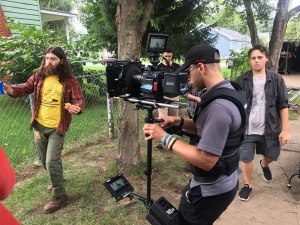
I have to give credit for anyone having the gumption to try and create a low-budget musical. That’s a tall creative order and unfortunately Moondance can’t quite match its toe-tapping ambitions. There are only four songs in the entire musical before the end credits (I’ll get to those later). By the 45-minute mark, I had only experienced one legitimate song-and-dance number and I was wondering if the reality of this movie had simply abandoned being a musical. There are a couple additional dance numbers as one would expect with Abby being a dancer, some set to performances from musicians, but for the first hour there are only two honest-to-goodness moments where characters break out into song. Why is there no opening musical number that introduces the different characters and their different perspectives, stations, plights, goals? That would be an economical way to establish the world and its players. There seems to be real hesitancy onscreen with embracing its musical identity. The musical numbers are meant to give us insight into the characters who can’t help but blurt out their feelings, and yet during the requisite boy-and-girl-on-the-outs part, there is no musical number. There isn’t even a musical number for their growing affection for one another. We’re missing a love theme, and for a romance-heavy musical that’s meant to evoke the feeling of Old Hollywood, that seems like a massive oversight.
The staging and performance of the musical numbers, when they do appear, can also be underwhelming and counter-productive. From a choreography standpoint, much more emphasis is placed on the background players including a superfluous “intermission” dance. There is one number where the key characters do little more than literally ride a bicycle in a circle, and I would argue this is the best number in the film. There is more dancing than singing and that seems the primary reason why Rabbers was chosen as the lead female role. She certainly has talent as a dancer. As a singer is another matter. I feel unkind even articulating this but for a musical it needs to be said: Moondance would have been better off dubbing Rabbers. Her singing voice is just not there. I don’t see any harm to the production if the filmmakers had dubbed her singing. Another issue is that Abby’s dancing feels a bit too chaotic and chaotically edited. There’s a moment of sorrow where she dances out her feelings, but the choreography isn’t conveying the emotions of the scene any differently than a previous dance for us to compare with, and the editing isn’t helping, until it concludes with her pounding a wall in frustration and falling into a crumple on the floor. The camera could have locked onto her face, so as she moved and performed the emphasis was on her emotional state and what the dancing signifies. Whether it’s the lackluster songs, singing, and the nascent choreography that needs to communicate more personality for the big players, Moondance stumbles as a musical.

From a comedy standpoint, let me focus on one small scene that I think exemplifies the pitfalls of comedy construction that Moondance suffers from throughout. We start a scene with Oscar and Cooper at an ice-skating rink watching a curling team practice. Oscar opens the scene by declaring, “22 dance studios!” to tell us he has struck out trying to find Abby, and then for good measure he repeats the line to better establish his bafflement. “What am I supposed to do now?” he asks Cooper, who asks whether Oscar has considered the possibility his dream girl doesn’t exist. “No, I haven’t considered the possibility she doesn’t exist,” Oscar replies, weirdly echoing the exact wording just to hammer this home for the audience. He sees Cooper distracted, sighs, and says, “I’m going to go to the bathroom, or the parking lot or… something.” He then leaves and then Cooper addresses the camera and informs us on the mechanics of the sport of curling. This will never come up again in the entire movie. So, dear reader, let’s deconstruct this scene. It begins with Oscar stating his futility. He repeats his line twice. His friend offers no help, makes a reference to Oscar’s mental state, not a joke but a reference, to which Oscar simply repeats the assertion rather than supply a joke response or anything that can be constituted a response. Because of this, Cooper has nothing funny to build off from, so he asks a simple “what next” and rather than supply a joke that showcases Oscar’s pitiful state, he offers two suggestions, neither of them funny, then doesn’t even provide a third suggestion, instead giving up and not even following the age-old comedy rule of three. From there, Cooper informs us about something that will not matter and is not funny. Why does this scene even need to exist if even the characters can’t be bothered to come up with jokes?
I was dumbstruck by the ineffectual comedy throughout Moondance. This is the kind of movie that has characters devise a stakeout and disguise themselves in bear costumes for no reason. Do they do anything in these costumes? No. The joke, I assume, is that they’re in funny costumes. This is akin to a character walking into a room with a silly hat, and the director saying, “Hey you, look at this comical hat being worn. Isn’t it so unlike normal hats? A normal person would never wear a hat like this. What a cut-up to wear this hat. Are they going to do anything differently because of this hat? Well, no, but what a silly hat, right? Please laugh.” Just stopping at this conception and doing nothing else is not comedy. There need to be setups, payoffs, subversion, running jokes, subversion of running jokes, something, anything. There is a stark sense of desperation throughout Moondance when it comes to its sense of humor. Take for instance a dinner where the group is hob-knobbing but then the girls meet below the table to share their real thoughts under the excuse of retrieving a fallen fork. Why not repeat this setup, making it more outlandish and obvious as you go? Why not present one perception, above table, of the girls, and one below where they are their true selves and confessing distaste? There are moments where it feels like the writer/director just had little grasp on humor and lost track of opportunities. The jokes are rarely accessible; it feels like you’ve entered into a private conversation and are left to put the pieces together. Sean is definitely slotted as “comic relief” but he feels overexposed. I was confused what his relationship was supposed to be with Pat. Is he the assistant, lover, or friend? Eventually I learned that he was Pat’s brother, but why did I have to fight so hard to understand this fact? The writing doesn’t make it easy for the audience to follow along, and this extends to its comedy writing. The fourth wall breaks are tone-breaking but, again, not funny. They feel included just as a fun way to include the crew in the movie, which, again, feels like a private party indulgence. The comedy of Moondance is primarily dormant. It’s over-compensating a lack of funny on the page by asking its actors to dial up their performances, so all the unfunny dialogue and antics now just seem like they’re being performed by crazy people on illicit substances.

If this movie was going for satire, I think it missed it by a wide margin. I don’t know why we have a character with godlike powers and this is treated like a lame party trick. Why not refocus the entire movie from this perspective and have Cooper be the god of a rom-com musical universe, and he’s the only one who knows he’s in a movie, and he’s pulling out every stop to get his chosen guy and chosen girl to get their big happy ending. That way it would play upon our knowledge of genre tropes and bring something fresh, while utilizing the fourth wall breaks as essentially strategy planning and introducing a team of helpers that would see through his efforts. Instead, we get the jovial character of Cooper who strolls around and offers few insights into the nature of romance or the nature of romance movies and our association of them. He feels like a magic hobo. I sense the homage to the Old Hollywood musicals and the big band accompaniment for all those jazz hands and hoofing, but it’s more intention than actuality. It’s going through the motions, and without enjoyable characters and an engaging story, it’s an homage that ends up empty.
My final criticism might be the one that made it the hardest for me to embrace Moondance, and this is how aggressively unlikable nearly all of the characters come across. In a romantic musical, you can have less than stellar singing, dancing, and even songs but your audience needs to care about the people onscreen. You need to feel the desire for them to get together, find their happiness, and at a basic level, you have to enjoy spending time with your core group of characters. Otherwise you’re stuck, and dear reader, stuck is what I felt with these people. I never cared about Abby and Oscar getting together because I never found them to be remotely interesting. Oscar is a bland protagonist. The only thing we know about him is that he writes symphonies. He immediately becomes obsessed with Abby to the point that, even before he ever speaks his first word to her, he declares Abby “his girl” in a creepy act of possession. He’s in love with her but cannot explain why. Would have been perfect for a song there to articulate his new feelings, right? We know even less about Abby. She’s a dancer and wants to save an old dance studio, but anything else? Well during a scene where she lunches with a friend, she has a giant burger as her meal. Does she eat it? No, but just being seen with this pound-plus of beef is meant to do the work the screenplay hasn’t and imbue useful characterization. She’s not some prim “just east a salad” kind of girl, oh no, give her a honking burger. To my best estimation, Abby and Oscar go on two dates (one of which she apparently has harassed a waiter, and this is supposed to be endearing?) so when they part ways before Act Three, this short-lived breakup doesn’t exactly feel as earth-shattering as the characters try to convince us. We’re simply not invested. Rabbers and Robinson (Jack Jonah) don’t have strong chemistry together but it’s not their fault. The script gave them nothing to work with and no points of characterization to better define them as people or make either of them interesting to watch.

The character of Pat is pompous and entitled and I don’t know how anyone would remotely take his involvement in what is angled as a love triangle with any seriousness. He is a terrible character and a terrible person and he just seems to exist in a daydream of privilege. What does he do all day? He buys expensive paintings for his… Rubens parties (again, another point of accessibility made challenging for the audience when this is referenced without context and it took my third stab at understanding what it meant to gain clarity). Later in the film, he monologues to his paintings before setting them ablaze, and it’s played like the mental break of a serial killer, and it’s so tonally off to induce whiplash. Pat’s the cartoonish fop character that would be presented as the rich buffoonish bad boyfriend in any other movie, and yet here he’s supposed to be the best friend to Oscar, yet we see no behavior that communicates their close personal relationship. This is a trenchant problem throughout Moondance, the screenplay constantly having to tell you of something rather than show you. It’s like watching characters thrown into an improv game and grasp for any fragile means of escape from scene to scene.
With all of these words spent in constructive critique, it might seem like Moondance is without notable artistic merit and that is not the case. The photography by Greg Kraus (The Curse of Lilith Ratchet) is well lit and at its best when it has plenty of movement to give a sense of energy that is usually flagging from the page and performances. The smoky jazz number makes fun interplay with shadow to better establish an evocative mood. The musical productions are heavy with big band sounds and brass instruments, enough so that I started wondering if anyone has done a ska indie original musical. The opening segment involves a band performing in a studio space and it was a pleasant experience to set a tone. The musical performances are solid. The musical compositions are competent if unmemorable. I don’t know why the production didn’t just fully go the jukebox musical route with local artists if we were only getting four original songs (though the titular “Moondance” song lyrics were a bit childish, reminding me of the Hokey Pokey). Hey, they got TV’s Adam Conover (Adam Ruins Everything) to be a brief narrator, a role that seems even less necessary when Cooper is breaking the fourth wall repeatedly as a would-be guide for the audience since he’s already our stand-in god.

Moondance ends on a two musical numbers, the first a kind of curtain call on a theater stage that allows every character, including the dry cleaner guy, to get a sendoff and also break the fourth wall. Afterwards, Cooper addresses the audience and acts as emcee through the various departments and crew members who worked on the movie, with the camera moving in and out of rooms with an impressively agile tracking shot, and ending on several spirited dances, one of which serves as the still image on the Tubi page. The problem is that this is, easily, the most involved musical number and it’s reserved for the end credits. I can imagine Cooper and the filmmakers thought they were ending on a high note to say a fun goodbye to their audience, but by reserving it for the end credits that roll over the scene, it makes it harder to read the credits that are spaced so far apart and it makes it harder to pay attention to the song and dance because of the rolling credits. Why not go split-screen? For me, this sums up the misapplied application of Moondance and its throwback ambitions. It’s not whimsical. It’s not charming. It’s not funny at all. There aren’t characters to care about. The musical numbers are too few and far between. The potential hook to separate this, its satirical behind-the-scenes god at play in a musical world, is not incorporated in a vital and clever manner. Moondance is a strange passion project because it’s hard to feel any passion for this story and characters. It pains me to be as blunt as I am but there are too many issues to go ignored. I wish everyone with the production good luck in the future. This will stand as an artifact of bewilderment for me. See it for yourself on Tubi and whether it casts a bewitching spell on you, dear reader, or leaves you just as confused and disappointed.
Nate’s Grade: D+
Share this:

Birds of Prey (2020)
 Not really a Birds of Prey movie, not really a Suicide Squad sequel (see you in 2021), this is really more of a Harley Quinn solo spinoff that’s fun, colorful, bonkers, edgy, and a smile-inducing delight… when Margot Robbie is onscreen as Harley. Robbie is a charming, hyperactive live wire that commands your attention, and giving her the reigns of the storytelling, quite literally in some Deadpool-esque meta storytelling tweaks, is the best decision the filmmakers make. I enjoyed the frivolity, visuals, and narrative trickery, but I noticed something whenever Harley took a powder off screen. None of the other supporting characters are that interesting. I don’t know anything about Cassandra Cain (Ella Jay Bosco), the plot device that everyone is after because of the prized diamond she swallowed. She’s more attitude than person. There’s also Black Canary (Jurnee Smollett-Bell) who doesn’t do much and has a super power she doesn’t use until the end. Renee Montoya (Rosie Perez) provides the police angle and references to cop movie cliches (a hat on a hat). Huntress (Mary Elizabeth-Winstead) is almost a self-parody as the young girl growing up to be an elite assassin to avenger her murdered family and the movie treats her like an also-ran. The only other person of interest is the villain, Roman Sionis a.k.a. Black Mask (Ewan McGregor), because the performance is campy while also being menacing. Birds of Prey suffers absent Robbie because its additional pieces cannot carry the movie on their own. The vacuum of charisma is too noticeable. The fight choreography is impressive and with plenty of longer takes to fully appreciate the cool moves. I enjoyed how every action sequence was different from the last and director Cathy Yan makes excellent use of her environments; a police lock-up is a fantastic place for an action scene with all the evidence/props to utilize. A romp inside a fun house also keeps things fresh even though the goons never bring guns to their big fight. Birds of Prey works very hard with quirk and narrative shuffling, and it feels like a decided attempt to dazzle as well as distract, because there’s not much to this movie. It’s style and personality over substance, and that’s fine, but it does make the second half feel a bit like coming down from a sugar rush. I know there will be plenty that celebrate a group of strong women taking ownership of their own stories and fighting together against toxic men. I know there will be plenty of my friends that love this movie. For me, it was an enjoyable experience that made me realize just how much I enjoy Robbie as an actress, as this character, and when given extra room to roam with an R-rating. Birds of Prey is the kind of tasty junk food you just crave from the cinema every now and then, but without Robbie it’s decidedly less flavorful.
Nate’s Grade: B
Share this:

The Dead Don’t Die (2019)
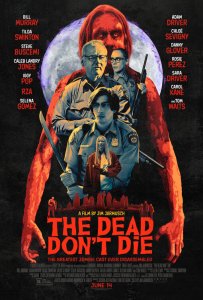 If you’re a Jim Jarmusch fan, you can probably stop reading now. I encourage you to continue but I don’t know if anything will be of help for you from here on out because, frankly, I don’t understand you. Jarmusch is a longtime staple of indie film and I’ve watched three of his films (Only Lovers Left Alive, Broken Flowers, Ghost Dog) and disliked all three to varying degrees, and that’s fine. There are plenty of hallowed names in filmmaking that are just beyond me, like Terrence Malick and Nicolas Refn, but I can at least partially understand what the fans of those auteurs value, an immersive visual, sensory experience at the sacrifice of narrative and coherency. When it comes to Jarmusch, I just don’t understand the appeal whatsoever. This is a man who found a way to make vampires crushingly boring, and now he finds a way to do the same with zombies. The Dead Don’t Die is the widest release of his career and it might be the worst movie I’ve seen in a theater all this year. It certainly feels like the longest.
In a sleepy small Ohio town, the police force consists of Chief Robertson (Bill Murray), Ronnie (Adam Driver), and Mindy (Chloe Sevigny). They’re going about their typical day, warning Hermit Bob (Tom Waits), listening to the alarmist worries of Farmer Frank (Steve Buscemi), and picking up supplies at the hardware store run by Hank (Danny Glover) and Bobby (Caleb Landry Jones). There’s a traveling group of students, lead by Zoe (Selena Gomez), as well as a group of kids in a juvenile detention center. Then the dead come back and small-town life will never be the same.
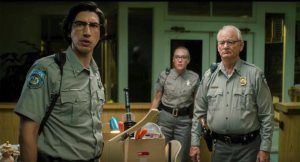 Anyone walking in expecting a zany comedy from the premise and cast, not to mention marketing materials, will be sorely disappointed, because what The Dead Don’t Die better resembles are the humorless anti-comedies of late-night Adult Swim blocs. It’s not so much that there are jokes, it’s more the absence of jokes, and somehow that might be the joke? The humor is stuck in one mode throughout the film. A character will slowly say something understated or obvious (Example: “That’s not good”) and then the reaction of others will be delayed, and then after that nobody will say anything for several painful seconds later. That’s about it, folks. It’s hard to find humor with that. The deadpan jokes are too obvious and too uniform to really strike any potent comedy targets. The consumer “satire” is brittle to the point of breaking. Various zombies will shamble around and say one-word items of whatever was important to them, ranging from “Coffee,” to, “Fashion,” to, “Chardonnay.” It’s like the one-word utterances are the entire joke (Hey, this dead guy liked fishing, isn’t that a riot?). It’s not satire and it’s not funny. How about the characters of Rosie Perez and Tilda Swinton being named Posie Juarez and Zelda Winston? Is that the kind of humor that sounds appealing? How about Tilda Swinton flexing a samurai sword to slice and dice the undead. Is that supposed to be cool? Is it supposed to be funny? Is it supposed to be funny that it’s trying to be “cool”? What is anything?
Later, the film inserts a new comedy element with meta asides where people seem to know they’re in a movie, and yet again the jokes are obvious and uniform, except now it’s even lazier, relying upon the meta recognition to simply stand in the place of a joke. If anything can happen in the small town, especially toward its crazy end, then why do these things have to happen? Or better yet why don’t better things happen? Because of the deadly pacing it makes every attempted bad joke feel that much more unbearable.
This movie is only 105 minutes but it felt so much longer. the pacing not just as a whole but scene-to-scene and even line-to-line from conversations is deadly still. Every moment feels stretched out but it doesn’t ever feel like you’re going anywhere. Characters will be introduced and given meet-cute moments and little indicators they might be significant players later, and then we’ll just find them dead. Other characters will be introduced and then never leave their locations, having no bearing on the larger story. It’s rare that I could honestly say there are entire supporting swaths of this movie that could be cut completely and not impact the story at all. It makes the many storylines we hopscotch across feel like they don’t matter and are generally wasting our valuable time.
 Then there’s the ending where Jarmusch just instructs Tom Waits to unleash a torrent of narration bemoaning how society deserves whatever downfall it incurs and that we’re all just zombies anyway. It’s so clumsy and overbearing and unearned after an entire movie where the cultural criticism amounted to a racist saying he doesn’t like his coffee black and then pointedly staring at the only black man in the movie. Even if we got more moments like that I might say some of the ending vitriol is justified, but the commentary gets muted in the middle until Waits has to finally tell us what the point is. There are scant political and environmental references but they feel like tossed asides themselves.
I don’t blame the cast for any of this although I can’t say what on the page must have seemed attractive. Murray is always going to be an amiable screen presence and Driver is a fun partner, slipping into a skillful deadpan and straining to find humor where there is precious little. Everyone feels wasted on screen because even if you’ve never seen these actors before you know, instantly and instinctively, that they have been far better.
The Dead Don’t Die is further proof that I am not a Jim Jarmusch fan. I can’t fathom how someone can actually be a fan of this writer/director. I was tempted to walk out at several points but I held in there. The jokes are too obvious and barely jokes, the pacing is awfully slack, and the whole movie is reprehensibly boring. Even when it has moments of weirdness it finds ways to make it boring. The structure does little to nothing with a large ensemble of very good actors. The movie and premise had potential. The idea of a zombie outbreak in a small town where everybody knows everybody is ripe for comedy and tragedy. Ultimately The Dead Don’t Die feels like one egregiously long in-joke that the audience isn’t privy to. The joke’s on us, folks.
Nate’s Grade: D
Share this:

The Lego Movie 2: The Second Part (2019)
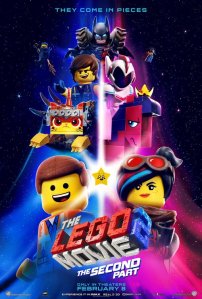 Everything might not be awesome but it’s still pretty great for this creative, heartfelt, and hyperactive family franchise that is better than it has any right to be thanks in part to returning writers Phil Lord and Chris Miller. It’s not quite as fresh and clever as the first go-round but it manages to better its predecessor in some key ways. Now that we know the colorful and zany antics of the animated Lego characters are also simultaneously the imaginative play of a real-world family, it provides a deeper thematic subtext with the unseen nature of siblings in conflict. I remember my own younger sister wanting to play with me and my toys, and me rebuffing her, and the film struck home some key emotional points about the inclusion of cooperative play. The different styles of play are on display as our characters are abducted by a shape-shifting space queen (voiced by Tiffany Haddish) who is determined to marry Batman and possibly rule the universe. A fantastic running joke is how transparently malevolent the queen is, which leads to an even better payoff. There are more songs and each is pretty well constructed, relevant to the story, and assuredly catchy, like “Catchy Song” used to brainwash people through pop, and a mournful version of “Everything’s Not Awesome” that becomes genuinely inspirational and uplifting by its climax. The life lessons are easily digestible and the sense of breezy fun is still alive and well. I was laughing throughout, sometimes quite hard, and the brother/sister subtext had me wondering if I owed my younger sister a decades-late apology for my behavior (sorry, Natalie). Lego Movie 2 is a worthy sequel that finds new and interesting ways to build off the irreverent original’s model. Bring on the Toy Story 3-style ending where our grown-up owner says goodbye to his childhood toys and friends. At this point, Lord and Miller can do anything and imbue it with wild wit, whimsy, and unparalleled mass entertainment (except Star Wars, I suppose).
Nate’s Grade: B+
Share this:

Vice (2018)
 If Oscar-winning funnyman Adam McKay can take the arcane, convoluted world of finance and spin it into one of the most entertaining, accessible, and enraging films of that year, then just imagine what he could do with the life of Dick Cheney?
We follow Dick Cheney (Christian Bale) from his early days as a college washout, to Washington intern to Donald Rumsfeld (Steve Carell), to youngest chief of staff in a White House administration, to Wyoming Congressman, and eventually Vice President to George W. Bush (Sam Rockwell) where Cheney redefined the VP role as a defacto second president. This is the story of his 60 years shaping the annuls of political power.
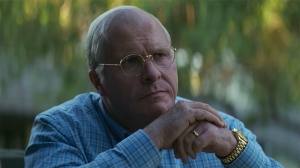
 If you have one reason to watch Vice, it’s the staggering performance by Bale (Hostiles). As is custom, the man completely transforms himself into his subject, gaining weight, building muscle in his neck to simulate the Cheney shoulder hunch, and going unrecognizable in startling older age makeup. He doesn’t just look the spitting image of Dick Cheney but he sounds like him too, exhibiting his cadences and mannerisms, and fully inhabiting the man every second he’s onscreen. It’s a compelling, captivating turn that ranks up there with Bale’s best. He’s beyond great but strangely nobody else is. Amy Adams (Arrival) plays Lynne Cheney, Dick’s wife and shrewd political partner, and her worst acting moment is her introductory scene where she lays into the young Cheney. It’s like an audition where the actor is hitting the wrong notes too strongly. Adams regains herself as the film carries on but never has a standout scene. Nobody else other than Bale is given the material to stand out. Rockwell (Three Billboards) and Carell (Beautiful Boy) are enjoyable and aided by impressive makeup, especially old Rumsfeld, but they’re given one note to play. Their roles become more impression than performance and both men drop out of the movie for long periods of time. The next best actor might by Tyler Perry (Gone Girl) as Colin Powell, and maybe that’s because Perry is used to brokering nonsense with his own array of nonsensical characters. He’s already the weary adult.
The meta interludes and fourth wall breaks that helped The Big Short succeed conversely are part of the problem with Vice. Most Americans know a decent amount about the Iraq War and its documented fallout, so there’s less need to have celebrities interject and explain complex scenarios and institutions (the absence of Margot Robbie in a bubble bath will always be felt). The narration by Jesse Plemons (Game Night) doesn’t feel necessary, and his ordinary identity becomes a guessing game for most of the film, trying to link him with Cheney. I was thinking he would be an Iraq War soldier and get killed later on, that way establishing a stand-in for the thousands of men and women who are no longer walking this Earth as a direct result of Cheney’s misguided action. Nope. When his identity is finally revealed you’ll go, “Oh,” and that’s it. Because he wasn’t really a character, he was a narrative device and one that didn’t stand for anything larger. The visual metaphors can also be very, very obvious. There are consistent cuts to Cheney fly-fishing in a river, meant to evoke him luring others into his desired machinations. Even the end credits feature fly-fishing imagery, in case you had forgotten about this enduring metaphor. The conclusion literally involves a heart being removed and the sequence cut along a more figurative betrayal, and you can feel McKay vigorously pointing at the screen and yelling, “See, it’s because he’s heartless, get it? Do you get it?” We get it. The documentary-style and comedic techniques that allowed The Big Short to be as entertaining and accessible, and one of the best films of 2015, are paradoxically the things that seem at odds with Vice.
 The meta breaks are meant to provide a degree of comedy to the picture, which is generally absent comedy otherwise, unless you count the rise of Cheney’s reign as the darkest of comedies. I suppose Cheney’s nonchalant recognition of his heart attacks (he’s had five) could be a potential comedic lifeline if you’re being generous. One second we’re told people don’t speak in Shakespearean soliloquies in real life, and the next second the Cheneys are talking in Shakespearean verse. When it looks like the Cheneys will drop out of public office to spare their gay daughter Mary (Alison Pill) the inevitable storm of harassment, the movie has a fake-out end credit sequence to sum up their hypothetical lives. To demonstrate Cheney’s knack for making the most ridiculous statement sound statesmen, he recommends that the Oval Office team put miniature beards on a part of their anatomy and perform an adult puppet show, which draws solemn nods of approval from the others. It’s a joke that feels too glib, like the intended point is being lost by the lewd nature of the comedic aside. The only meta aspect that feels earned is the final one, where Cheney turns to the camera and directly addresses the audience, acknowledging he can feel their contempt but refuses to apologize for his actions in order to keep people safe. Because he’s having the final say, because he’s offering a rebuff to his movie, it feels more earned and fitting, and it would have had even more power if it were the only break in the movie rather than the last. It’s hard to call this a comedy; it’s more an incredulous indictment looking for its mob.
I honestly think a straightforward biopic might have been the better route for Cheney. The first half of the film is more interesting and successful because it is the more illuminating half. I never knew that Lynne Cheney’s father likely killed her mother. That’s a pretty bold charge on behalf of the filmmakers. The early Cheney years are the moments the majority of Americans don’t know about, whereas the later years have been well documented by a slew of hard-hitting documentaries, books, and journalistic exposes. There are whole movies about topics like the Valerie Plame leaking (Fair Game), the mounting mistakes after the invasion of Iraq (No End in Sight), the administration’s policy on torture (Taxi to the Dark Side, Standard Operating Procedure), the drumbeat to the war and snuffing out of critical journalism (Shock and Awe, Lions for Lambs), the missing WMDs (Green Zone, Body of Lies), the Bush deferment memos (Truth), the long-term consequences for those servicemen who survive (The Hurt Locker, The Messenger, Stop-Loss, Last Flag Flying, In the Valley of Elah, American Sniper, Thank You For Your Service) and anything that Michael Moore sets his sights on. This list is not exhaustive by any means. Because of that the film seems to become a rudimentary montage once the Iraq War kicks off, sprinting through the rest as an intended tableau of hubris as Cheney’s star and influence falls. I would rather have learned more about Cheney’s early years in the Nixon, Ford, and H.W. Bush administrations and gleaned more personal insights into the man before he becomes this shadowy, mythic figure that seems downright Machiavellian in his control of government. It’s interesting to watch Cheney and his cohorts plot their unchecked executive power behind the back of President Bush, but then what?
 It’s the “then what?” question I keep revisiting with McKay’s film, trying to figure out the larger intended message, themes, and dire warnings. I feel like because of the expanse of time covered, and the meta quirks applied, that the film too often feels like it’s just scratching the surface of Cheney, providing a slight gloss to a political caricature. The biggest takeaway is the slippery slope of the “unitary executive theory,” a term you’ll hear often, that basically follows Nixon’s own words: “If the president does it, it’s not illegal.” This questionable interpretation of Article II of the Constitution gives the president powers that approach a monarch, which seems antithetical the Founders’ intents. McKay warns that any president could take advantage of this theory to do whatever he or she (sad trombone noise… sigh) desires. This is clearly meant to draw a line right to President Trump, but it’s not like the 45th president needs sketchy legal cover to do his misdeeds. The idea that the Justice Department memos would be a lurking danger is quaint. A bad man with power is not going to look for the rules to allow him or her to break them. The idea that a president could be above the law is also a legally specious argument and one I don’t believe our courts would readily back, even with the “unitary executive theory” (at least I hope so). With that in mind, Vice becomes a cautionary tale about the expenditure of power but lacks the adequate follow-through.
Vice is a tricky biopic for a tricky subject and I wonder if it would have worked better being stripped of its prankster, meta interjections and tricks. It’s a condemnation of Dick Cheney but it doesn’t feel like it goes far enough if McKay’s eventual thesis is that the current world problems began, or were grossly exacerbated, by the actions of Cheney. Climate change warnings going unheeded, ISIS formations going ignored, the generational consequences for unsettling the Middle East, and laying the foundation for an authoritarian strongman to be an acceptable political position for millions of Americans. These charges are clearly intended to be a denunciation of Cheney’s legacy, but the end results play out somewhat differently, like a slap on the wrist. I think Dick Cheney could even watch this movie and nod in appreciation. That seems like a mistake. McKay is still a talented writer and filmmaker that knows how to keep his movie flowing and entertaining, buoyed by an outstanding performance from Bale. It’s a movie with great components but seems to clumsily get in its own way with its presentation. If you’re going to expose Dick Cheney as a heinous manipulator of power that has wrecked havoc for billions, then maybe you don’t want to dilute your message.
Nate’s Grade: B-


 nathanzoebl
You must be logged in to post a comment.