Blog Archives
Play Dirty (2025)
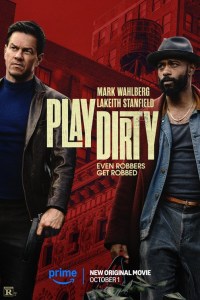 Shane Black is one of the best known writers in Hollywood across three-plus decades. His brand of witty, self-referential genre writing became its own appealing sub-genre of action cinema from the 1980s into the 90s. He resurrected Robert Downey Jr.’s career with Black’s directorial debut, the rollicking and immensely entertaining Kiss Kiss Bang Bang. Downey returned the favor by getting Black the gig writing and directing Iron Man 3. It’s been eight years since Black’s last directing effort, 2018’s messy and ultimately disappointing Predator reboot (Black actually had a small acting role in the original film). Shane Black movies are never ever boring even when they’re not completely working. Play Dirty is based on the Parker book series, a character portrayed by six other actors including Mel Gibson, Jason Statham, and Jim Brown. There are 26 of these Parker books, but after watching Play Dirty, by far Black’s worst movie, I don’t even understand what the appeal would be. This character just plain sucks.
Parker (Mark Wahlberg) is a slick professional criminal trying to score big and get his revenge. In the opening sequence, one of his heist crew, Zen (Rosa Salazar), betrays the group, steals the money, and kills everybody except Parker. He tracks her down and she’s in the middle of an even bigger scheme, one involving billions of dollars from uncovering literal sunken treasure on the ocean floor. He doesn’t like her or trust her but he sure could use his cut of a billion dollars. He taps old colleagues from other old jobs, the colleagues who haven’t been killed, and they must all work together to get their next big score.
 I was blown away by how powerfully unlikable the main character comes across. I don’t need characters to all be beholden to my opinion of likeability, but deficits in this matter are typically offset by writing the character with some degree of personality, menace, or intrigue, something that makes you want to keep watching them onscreen even if you don’t agree with everything they’re doing. However, this Parker guy, as portrayed by Wahlberg, is a big dumb guy who doesn’t recognize he’s a big dumb guy. As a result, he’s beholden to impulsive decisions that come across as cruel to the point of being sociopathic. Again, we’re used to criminal characters being flippant or prone to violence in other stories, but the introductory presentation of this character simply befuddles me and rubbed me the wrong way throughout.
Take for instance the literal opening minutes of Play Dirty. It’s in the middle of a heist but the story doesn’t start us off with the perspective of our thieves collecting their loot. It starts instead with a security guard stumbling onto their heist. He’s with his wife and child in the car and decides, rather than intervening, he’s going to use this opportunity to steal himself some of their ill-gotten loot. Right there, we’re starting with a character making a consequential choice, and our perspectives are not aligned with the robbers but with the robber of the robbers. I wanted him to get away, and frankly, following his story could have proven compelling as well, as someone who gets in over their head and tracked down by professional criminals who want what was taken. Parker gives chase through a race track and eventually shoots this man dead in front of his wife and child. Lest you think Parker is an irredeemable, unfeeling cretin, he takes stock of this woman’s grief and trauma and offers her ten thousand dollars of their loot, to bribe her silence and make amends for the murder of her spouse (that’s not even a good life insurance payout). I don’t know why Black wanted us to begin empathizing from the perspective of some guy who was only intended to be unceremoniously killed, in front of his wife and child. This move made me immediately dislike Parker, and then his little gift for the wife’s trauma felt completely insulting.
 This incident isn’t the only example of Parker being a shoot-first-ask-questions-never brute of limited intelligence. When he reunites with Zen, she’s talking with some guy who planned her new big scheme. Parker doesn’t know anything about this guy other than his physical proximity to Zen. He shoots him dead. For what reason? I don’t know what he was trying to accomplish except an expression of his impatience and hatred for life. I wonder if an elderly nun had been standing next to Zen at this moment and would Parker have committed the same rash act of violence. What about if it was his own mother? To make matters even worse, Parker accompanies Zen to break the news to the dead man’s boyfriend, and it’s in this moment of shock and grief that Parker harasses this bereaved man that Parker berates for crying. He seems to take amusement in how bluntly he informs the other man that his love is never coming back, though leaving out the key part where he carelessly murdered the man. He also shoots Mark Cuban in the leg while he dines in a restaurant for no reason other than being near the guy that he wanted. Again, much of this could be workable if the character of Parker was… anything. He’s not funny, he’s not charming, he’s not really clever or good with plans; he’s just a big dumb guy prone to violence, scowling, and deep sighs. Wahlberg looks bored throughout the whole movie and it makes the character even harder to entertain. If this guy doesn’t want to be here, can we select someone else to be our requisite protagonist?
We might have a leaden dud of a lead, but what about the rest of our enterprising team of thieves and conmen? Do we have any winners here to compensate? Sadly, the team is just as listless. Take Grofield (Lakieth Stanfield) who fraternizes as a theater owner, one who is constantly losing money. That setup has some interest, a criminal who possibly longs to be more of a professional actor, perhaps that eagerness even pushes him into suggesting different covers and roles he could play in their heists. Perhaps he might even see himself above the others since he feels like he is trying to promote the arts. There’s all kinds of ways this introduction could better shape his personality, interests, and contrasts with the other crew. For the rest of the movie, Grofield is just another guy on screen, just another guy driving a car or shooting a gun. There is one brief moment that takes advantage of his interest in acting as he poses as a drunk on a rooftop threatening to jump. After a security guard arrives on the scene, he and Parker subdue the guard, coat him in the same outfit Grofield was wearing, and then toss him off the roof to his death (ho ho). There’s a husband and wife team of crooks (Keegan-Michael Key, Claire Lovering) and that could be interesting, especially if they’re mixing professional and romantic squabbles, or maybe working together is the thing that keeps their spark going, the showcase for their real teamwork. They have one scene with some passing bickering but otherwise they too are just more indiscriminate people onscreen, another person to hold a gun or drive a car. Even the bad guys are boring. Who should I actually care about? I was rooting for that grieving mother and the one guy’s sad boyfriend to team up and punish Parker’s crew.
 Part of the fun of heist crews and con artists are the colorful personalities, the peculiarities, the intra-group conflicts and dynamics, but this movie gives us so little. It’s almost as if the characters are merely meant to trick the brain of a viewer barely paying attention, providing an assurance, “These are the guys,” without forcing thinking over differentiation. It’s like the film equivalent of not wanting to arouse like your elderly grandfather with conflicting evidence contrary to his memories. It’s like accepting defeat.
So the characters are lousy, are there any outstanding or fun caper or action scenes? Black is known for his snappy style and pulpy sensibilities across genres. He hasn’t made a boring movie yet, so I had hoped that even if Play Dirty ultimately proved lackluster, at least it would provide some flash and fun. Nope. Many of the action scenes are Parker and company just throwing caution to the wind and shooting a bunch of guys. There’s one sequence in the middle that involves actually planning and steps to draw our interest, it’s a ridiculously over-the-top plan that shows once again the crew’s disregard for collateral damage. Their valuable cargo is being shipped through the city on an elevated train, so the team decides to derail the train in the middle of the city. Not in a deserted area unpopulated by civilians, in the middle of town. As expected, the train careens off the tracks and through the city, likely causing the deaths of dozens of innocents we’ll never know because their existence is unworthy of the movie’s attention, much like the suffering of that widow and child in the opening sequence. The sequence is the equivalent of killing a mosquito with a flamethrower, and while overkill can certainly be cinematic and pleasingly entertaining, just ask Michael Bay or James Wan, it needs to exist in a world where that overkill is normalized. Otherwise, it just stands out as excessive and causes us to poke holes at the baseline reality.
Play Dirty is astoundingly dull and witless, lacking any of the spark and personality flair I expect from a Shane Black vehicle. Mark Wahlberg’s somnambulist performance is the best symbol for this entire enterprise, a crime thriller going through the motions but with its mind elsewhere. I know I certainly felt my mind going elsewhere while watching. Not just dull and tedious, Play Dirty is also just an uncomfortable experience because we’re stuck watching a group of unrepentantly amoral characters endanger and kill innocent lives in the pursuit of ill-gotten gains, but these characters aren’t intriguing, complex, memorable, or even cool, so the whole movies feels like you’re watching a pack of dude bros just randomly terrorize anecdotal characters out of sheer detached boredom and nihilism. It’s not fun, it’s actually quite the opposite of fun, and I wish Black had put more of himself into this enterprise (hey, the Christmas setting is present). Who wants to play with characters this boring and repulsive for two hours?
Nate’s Grade: C-
Share this:

Uncharted (2022)
 The successful Uncharted series (2007-2016) are some of the most movie-ready video games for big screen adaptation. While playing the globe-trotting, puzzle-solving, treasure-hunting action-adventures, it feels very much like you’re already in the middle of a big-budget Hollywood blockbuster. The game was in development for so long that the producers have finally ditched Nathan Fillion, the celebrity doppelganger in look and attitude of the game’s swashbuckling protagonist Nathan Drake, and resorted to everyone’s favorite web-slinger Tom Holland as a younger version of the hero. He’s a brainy bartender who is looking for some hidden Magellan treasure, and maybe his missing older brother too, and is aided by Victor “Sully” Sullivan (Mark Wahlberg), an Army vet with a shared goal of retrieving the gold before his rival, wealthy industrialist Santiago (Antonio Banderas). It’s a race against time and while it doesn’t reinvent the action-adventure wheel, Uncharted is a perfectly diverting piece of entertainment. The banter is fun between Holland and Wahlberg, the action set pieces are brisk, and the third act in particularly is just a showstopper of big action bravado. The visuals are eye-grabbing and the action sequences are inventive and exciting. That’s what Uncharted gets the most right, that sense of fun the games have built into their core, while keeping things moving smoothly with colorful characters and large-scale action. You’ve seen some combination of this movie before, but even genre masterpieces are built from their influences, so being derivative is not a fatal flaw as long as the filmmakers get the essentials of storytelling and action cinema right, and they do here. The world of video game movies is already one where the bar is fairly low for quality, but it seems like Hollywood has started raising its game, like with the new Tomb Raider, Detective Pikachu, Sonic the Hedgehog, and the upcoming Last of Us prestige HBO series. Count Uncharted as the Saturday morning popcorn spectacle that knows exactly how to deliver a good time in only 105 minutes.
Nate’s Grade: B
Share this:

Infinite (2021)
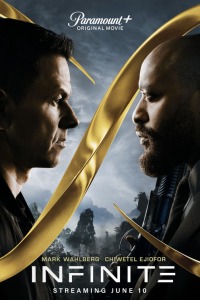
The cast and crew of Infinite were taken by surprise when their corporate overlords decided to shuttle the big-budget action movie to its fledgling streaming service, Paramount Plus. Fortunately for me, I had just purchased a yearlong subscription plan because I wanted to watch Bar Rescue whenever I pleased, so I was one of the lucky ones to gain access to this first “Paramount Plus Original Movie” as it quietly premiered. It might be for the best after all. Infinite is a high-concept action movie by committee that feels so lacking in just about every critical department.
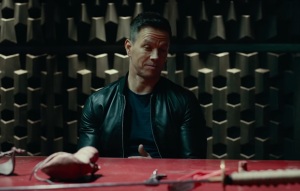
Evan McCauley (Wahlberg) is a man suffering from schizophrenia, or so he believes. He has strange visions in his head from past historical time periods and he instinctively knows how to forge a samurai sword. He’s interrogated by Bathurst (Chiwetel Ejiofor) who recognizes Evan as an ancient foe that he has fought through multiple past lives. Bathurst wants to kill Evan before he can remember who he is and stop Bathurst’s evil scheme. Evan is rescued by Mora (Sophie Cookson, Kingsman) who informs him that he is one of the Believers, a group of immortals who get reincarnated after each death. They’re waging a secret war against the Nihilists, lead by Bathurst, who want to obliterate the world rather than be reborn into it again. Evan must relearn his many pasts and help the Believers recover a hidden doomsday weapon his past self hid.
You’d be forgiven if you thought you had watched Infinite before, perhaps in a past life, because it’s so highly derivative. The story runs on two very well-worn tracks of science fiction storytelling, the Chosen One plot and the Secret War plot. You’ve seen variations on both in plenty of familiar sci-fi action movies, comic books, and the central pillars for countless Young Adult titles. Think about being told this statement: “Your ordinary life has been merely an elaborate cover, and you’re no ordinary person but secretly a powerful and important [fill in the blank] and there’s been a war going on in the shadows between [fill in the blanks] and you’re the key to solving this ages-old conflict.” I bet many of you can already think of similar titles that apply. There’s Harry Potter and Highlander and The Matrix and the Assassin’s Creed series and even more specific examples like Wanted, where it too features a sexy woman rescuing our lead in a sexy car and fending off bad guys while she informs him of his secret true calling. Even Ejiofor was in a strikingly similar movie just last year, 2020’s The Old Guard. It’s all so vaguely familiar at every moment that you’ll question whether it’s all built from spare parts.
Then there’s the added reincarnation angle, where people have amazing skills that they never knew they possessed (The Matrix, Wanted) and souls going from host body to host body (Cloud Atlas). In fact, David Mitchell, the author of Cloud Atlas, essentially wrote this very story in his 2014 novel, The Bone Clocks. In that novel, we learn that there are two factions of immortals who are reborn after every death, one group that preys upon the souls of mankind and another trying to defend the innocents. That book explores a lot more in the realm of identity (characters are reborn in different genders and races), time, and purpose than with Infinite, which settles for a recycled B-movie doomsday plot that even video games are getting tired of now. If past lives and reincarnation is just another disposable gimmick for super powered beings duking it out over a cataclysmic MacGuffin, then why bother with the existential possibility of the premise?

For a movie that takes so much time to spit out clunky exposition, Infinite is fairly incoherent and, occasionally, self-defeating. When you’re entering any new territory, there’s going to be a learning curve. Imagine how Neo learned about his misconception of reality, the war and history with the machines, and his capabilities he was opening himself up to. Exposition is best done in portions equally spaced out and tied to action, so our characters can learn through doing and failing and then succeeding. With the gimmick of past lives, it could open up such intrigue and possibility about human potential as well as the difficulty of these immortals finding one another across the globe for centuries, restarting with every rebirth (a fact explored in The Bone Clocks). It also would lend itself to characters being reckless with action movie stunts because, at worst, they die and take a twenty-year or so timeout before getting back into the action. Nothing of real interest happens with the past lives gimmick. The movie treats it as a shortcut to give its characters superpowers, and by tapping into those memories, now they have all these crazy super abilities that no mortal could accomplish in merely a single lifetime (sorry Bruce Lee). Imagine if in The Matrix, instead of Neo learning and training that they just uploaded everything into a Chosen One 3.0 security patch they downloaded (yes, he downloads skills, but we see the process demonstrated as visual progression). It’s boring to watch. The movie even could have explored more about these past lives, experiences, and lessons learned rather than in kaleidoscopic flashbacks. For the entire premise, Infinite seems so strangely limited in scope.
Then there’s the plot device that destroys the scheme of the villains. The Nihilists are tired of the eternity of being reborn and stuck with the accumulation of their memories. Bathurst says when he begins anew in the womb, he is a fully cogent adult brain and it’s nine months of torture. This, ladies and gentlemen, is the only interesting component in the entire movie that relates to the reincarnation premise. The Nihilists want to destroy all life so then they can never be reborn again, though this still seems theoretical. They have also developed a special device that will store a person’s consciousness onto a computer hard drive or microchip, supposedly stopping that consciousness from being reintegrated into a new host body. If this is the case, why isn’t Bathurst and his Nihilist fellows taking advantage of this? They’ve already developed a solution that works and doesn’t involve the destruction of all life on the planet. I don’t even know why Infinite introduces this absurd plot mechanic considering the damage it does. I guess it was an attempt to raise the stakes with immortals where death isn’t permanent, but for the purposes of the movie, a death means they are taken out of this present fight for the fate of the world. The stakes are still there. The implications are also nebulous, as they talk about souls as currency but can human souls be downloaded onto a portable technological deice? This entire plot device is silly in conception and even worse in execution, with big swirly bullets that also glow as they zip along.
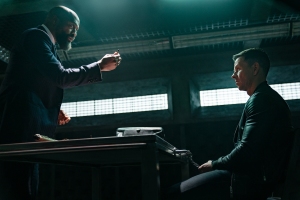
Wahlberg (Spenser Confidential) is on autopilot for the entire movie. He’s laconic and nonplussed and without any hint of humor or fun to be had. His under-performance is compensated by the overacting of Ejiofor (Doctor Strange) in a disastrous dynamic that reminded me of the 2011 Oscar hosting performance by the tandem of James Franco (under performing) and Anne Hathaway (over performing). At least Ejiofor is holding my attention with his high energy level and a maniacal glee that reminded me of James Bond villains. The problem is that nobody else is delivering this same arch level of camp. Everyone else in the cast is trying to play things so icy cool and nonchalant, and it just makes all the characters feel like boring robots.
And yet all of this could be forgiven if Infinite had some memorable and exceptionally exciting or well-developed set pieces to entertain. Much can be excused or mitigated if an action movie delivers upon its action. Alas, Infinite cannot escape the orbital decay of its lack of imagination. The derivative nature extends to the action, which consists of a series of rote chases and gunfights. There is one sequence that had promise for the scale of its destruction, a car chase through the different floors and levels of a police building. It’s viscerally entertaining to watch all of the many things gets smashed while raising the question just how fragile concrete walls are constructed to be in downtown metropolitan architecture. This is also the moment that Evan is brought into the new world, which means it’s all downhill from here. Antoine Fuqua (The Equalizer) is an action genre veteran and can be counted on for some degree of style to jazz up the proceedings, but he can only do so much with sequences lacking points of interest and tension. Infinite would play better as campy nonsense, but it won’t acknowledge this identity.

Given how derivative everything appears, it’s surprising Infinite is based on an original work, the self-published 2009 novel The Reincartionist Papers by D. Eric Maikranz. The author offered his readers ten percent of his advance for whoever helped get him to sell the film rights to Hollywood (true to his word, Maikranz paid out in 2019). Already, this is more entertaining to me than anything provided in the 106 plodding and incoherent minutes of Infinite as a movie. The high-concept premise is reduced to a lazy shortcut for superpowers for a group of know-it-alls trying to act cool and strut while delivering exposition by the truckload. The action is stifled, the characters are dull, and the world feels so sprawling but without needed definition. This could have been any combination of Chosen One and Secret War story elements. What about Harry Potter battling the bullet-curving killers from Wanted? Or what about Neo facing off against the ancient society of werewolves and vampires in sleek lather catsuits? Or an immortal special ops crew that must track down other immortals before they can do lasting harm? This mix-and-match formula belies how truly interchangeable the story elements are with Infinite. It closes on voice over by Wahlberg that genuinely made me guffaw. Looking to the future, he says, literally, “Well the possibilities are… infinite.” For this hopeful film franchise, I strongly doubt that.
Nate’s Grade: C-
Share this:

All the Money in the World (2017)
 All the Money is the World used to star Kevin Spacey as the prolific oil billionaire John Paul Getty, that is until director Ridley Scott elected to reshoot the part, replacing Spacey with Christopher Plummer after Spacey’s unsavory history of sexual assault came to light. In only ten days, Scott changed his movie with only a month to spare before its release. It’s an amazing feat, especially when you consider Plummer is in the film for at least a solid half hour. He’s also the best part as the mercurial, cruel, penny-pinching magnate who refuses to pay his grandson’s ransom even though he’s the richest man who ever lived. In 1973, John Getty III (Charlie Plummer, no relation) was kidnapped by Italian criminals. With the miserly grandfather offering no help, Gail (Michelle Williams) tries to negotiate with the criminals and her father-in-law to secure the release of her son. I didn’t know anything coming into this film, but afterwards I felt like it focused on the wrong characters. The mother stuck in the middle is not the most interesting protagonist here and seems like a go-between for the two more immediate and intriguing stories, the elder Getty and the youngest Getty. Williams (Manchester by the Sea) is acceptable as the strong-willed, put-upon mother, though her mid Atlantic accent made me think I was watching Katherine Hepburn. Mark Wahlberg (Daddy’s Home 2) is completely miscast as a former CIA agent that helps Gail. He succeeds in converting oxygen to carbon dioxide and that’s about it. The central story is interesting enough, though there are points that scream being fictional invented additions, like a last act chase and a kindly mobster who undergoes reverse Stockholm syndrome. John Paul Getty is an interesting character, and Plummer is terrific, though I am quite curious what Spacey’s performance would have been like under octogenarian makeup (Plummer already happens to be in his 80s). All the Money in the World is an interesting enough story with decent acting but I can’t help but entertain my nagging sense that it should have been better even minus Spacey.
Nate’s Grade: B-
Share this:

Transformers: The Last Knight (2017)
 Unlike many of my critical brethren, I do not view Michael Bay as the devil incarnate. I think the man has definite talent and is one of the finest visual stylists working in the realm of film. I’ve enjoyed about half of the Transformers franchise and don’t consider it the end-all-be-all of modern American cinema. Transformers: The Last Knight is exactly what the detractors have railed against from the start: a cacophonous ejaculation of incomprehensible nonsense. The charge has often been made against Bay’s long filmography that his stories are unintelligible, but Transformers 5 proves to be the new measuring point for incensed incredulity. This isn’t only the worst Transformers entry in a seemingly never-ending franchise (thanks product placement, merchandising, and toy sales) but an early contender for worst film of 2017.
Cade Yeager (Mark Wahlberg) is hiding out with other Autobots in a South Dakota junkyard awaiting the return of Optimus Prime (voiced by Peter Cullen). Prime ventured into space to find the remnants of the Autobot home world, Cybertron. Once found, he’s brainwashed by the Cybertron goddess Quintessa (Gemma Chan) into being her servant. She’s after an ancient staff that will prove to be the key to restarting Cybertron. It was last seen on Earth during the Dark Ages and rumor has it was given to Merlin. Cade is enlisted by a centuries-long secret society to help find the staff before the evil forces at bay get hold of it.
 It feels like the Transformers 5 writers were on a week-long cocaine bender when they cobbled together this impenetrable narrative. Let me give you but a taste of the confusing, muddled, and overall mind-numbing plot as it exists. There’s a magic staff from the robot world that will recharge the robot world, and it just so happens 12 robot knights, which form a giant robot dragon, landed on Earth and gave it to Merlin, played by a soused Stanley Tucci who was already a different character in the fourth Transformers movie, who then established a secret order that would keep the giant alien robots secret even as they were doing things as high-profile as literally killing Hitler, and the members of this secret society include Frederick Douglass and Queen Elizabeth and Shia LeBouf, and this staff needs to be retrieved from an underwater spaceship under Stonehenge by Merlin’s blood progeny and will be aided by an alien talisman that forms an alien sword that does something, and the evil alien robots are going to recharge their planet by scraping the Earth’s crust, which has horns protruding from it that once aligned with Pangaea, and there’s an evil alien robot goddess who brainwashes Optimus Prime to retrieve her magical items on demand and then Megatron is being hired the U.S. government and a team of special ops are trailing him to get to the staff and… I’m sorry; did your brain start bleeding out your ears? I looked over to my friend Ben Bailey during the screening and saw him slumped over in his chair and thought, for a fraction of a second, that the movie had literally killed him (he had just fallen asleep for the third time). What an ignoble end.
The movie is a nonstop barrage of yelling and movement, an assault on the senses that leaves you dumbfounded and dazed, and without anything to moor onto. Almost every single actor is on screen for one of two purposes: quips or exposition. These are not characters but devices for words that ultimately don’t make sense. Wahlberg has two different female sidekicks. For the first half, he’s got a plucky teen that serves as a surrogate daughter figure. Izabella (Isabella Moner) is a kid with attitude and carefully arranged strands of hair that always fall over her face in every single shot in the entire movie. Izabella’s introduction actually might be the highlight of an otherwise soul-crushing experience. Then Wahlberg leaves for England and he adopts a new sidekick, this time the hot smart woman who changes into a more comfortable outfit but literally keeps her heels. Vivian (Laura Haddock) is pretty much the next in a long line of highly sexualized, tawny female characters under Bay’s alluring gaze (I wrote about the second film: “Women don’t seem to exist in the Michael Bay world, only parts and pieces of women.”). Her mother doesn’t care about the end of the human world, or her daughter’s many academic credentials, and instead pesters her about getting herself a man. This leads to one of the film’s worst comedic moments, as Vivian’s mother and friends giggle and eavesdrop on her and Wahlberg trashing a library as a spontaneous bout of sexy time. Wouldn’t it be weird for anyone’s mother to take pleasure in listening to your escapades and offer a play-by-play?
 But the strangest characters are Anthony Hopkins’ Sir Edmund Burton and his 4-foot robot ninja (voiced by Jim Carter). You can clearly tell that Hopkins didn’t care at all what he was saying. He uncorks ungainly monologues with relish and then transitions into strained comedy as a doddering old man. The robot butler begins as a C3PO-esque prim and proper servant with a disarming fighting ability, and it works. However, as the movie progresses, the robot butler gets downright belligerent and seemingly drunk. It’s truly bizarre, as if this robot is acting out to be seen like he’s one of the cool kids, but whom exactly is he trying to impress? At one point, he tells Wahlberg that he is “on my shit list” and torpedoes out of a submarine, brings back fish, prepares a sushi dinner for the humans while supplying ingredients that were totally not found on a WWII-era sub that was parked as a tourist locale up until 20 minutes ago. The character makes no sense and seems to bounce around behavioral extremes. Take this passage late into the film:
Robot Butler: “Of all the earls I’ve served-“
Me: “You were the greatest?”
Robot Butler: “-You were the coolest.”
Me: “Whaaaaaaaa?”
Another confusing part of the film is the setting of its story. We’re five movies in to an alien civil war taking place on Earth, so you would assume that normal life shouldn’t feel normal after so many catastrophes. Egypt was destroyed in the second film (only Six Wonders of the World left in your punch card, Bay), Chicago was decimated in the third film, and China was blown up in the fourth film. It’s about time that people started paying attention to these things and behaving differently. A new government agency is tasked with hunting down Transformers and there are war zone portions of the world that are quarantined, but that’s about it. I initially thought this fifth movie was going to take place in a somewhat post-apocalyptic Earth where human beings have to struggle to survive. That’s not Transformers 5 at all. It seems all too easy to ignore reality; Wahlberg’s daughter is away at college. After four movies, the world of this franchise needed a jump in its stakes. Bay’s films have always possessed an alarming sense of urgency but it rarely feels earned. Characters yelling, running, and explosions going off like fireworks isn’t the same thing as genuinely developed stakes.
 Another confusing aspect of Transformers 5 is Bay’s jumbled aspect ratios (i.e. how wide the frame of the movie is presented). Sizeable portions were shot on IMAX, which has become all the rage for action movie directors since Nolan’s The Dark Knight. I expected that. What I didn’t expect was three different aspect ratios that jumped from shot to shot. Two characters will be having a conversation and the aspect ratio will cycle and it rips me out of the movie every time (there are SIX credited editors). The Dark Knight’s IMAX sequences worked because they were sustained sequences. I expect the higher-grade IMAX film stock for the expansive action or picturesque landscapes to take in the natural splendor. What I wasn’t expecting was measly interior conversations to be filmed in IMAX. Did I really need to watch a conversation with Vivian and her mother in IMAX to fully appreciate their bookshelf? Like much else in this perfunctory movie, this game of pin-the-tail-on-the-aspect-ratio makes no sense.
I don’t normally like to quote myself, but reading over my concluding paragraph of 2011’s Dark of the Moon, I was struck by how much of my assessment could equally apply to the fifth film, even down to the exact running-time: “Transformers: Dark of the Moon is likely everything fans would want from a franchise built around the concept of robots that fight. There’s wanton destruction, a plethora of noisy explosions, and plenty of eye candy both in special effects wizardry and pouty, full-lipped women. But at a colossal 150-minute running time, this is a Transformers film that punishes as much as it entertains. There’s really no reason a movie about brawling robots should be this long. There’s no reason it should have to resort to so much dumb comedy. There’s no reason that the women should be fetishized as if they were another sleek line of sexy cars. There’s no reason why something labeled a ‘popcorn movie’ can’t deliver escapist thrills and have a brain too.” Take this assessment and times it by ten for The Last Knight. The incomprehensible plotting, infantile humor, nonchalant misogyny, empty action bombast, and dispiriting nature of the film are enough to suck the life out of you. I was bored tremendously and contemplated walking out on the movie (I stayed for you, dear reader). It feels like the screenplay was put into a blender. Transformers 5 is exhausting and exhaustively mechanical, and if this is the first start in a larger Expanded Transformers Cinematic Universe (ETCU?) then resistance may be futile. Still, it’s worth fighting against brain-dead spectacle that only moves you to the exits.
Nate’s Grade: D
Share this:

Deepwater Horizon (2016)
 Peter Berg is becoming the go-to director for inspirational true-life thrillers following the heroic exploits of everyday Americans thrust into danger. It began with Lone Survivor, it will continue this year with the Boston bombing drama Patriot’s Day, and in between there is Deepwater Horizon about the oil rig drillers and the culminating explosion that lead to the worst environmental disaster in U.S. history. It’s a sober and reverent movie, with Berg and his screenwriters taking great care to educate the audience on the science of drilling, the technology, the geography of the floating rig, and just exactly why things went as badly as they did that fateful night. The windup lasts about half the movie but that’s because when the explosion hits there isn’t much plot left (the movie is barely 100 minutes). Deepwater Horizon becomes a full-tilt disaster movie by that point with Mark Wahlberg stalking hallways and looking for injured survivors. The tension prior to the blown pipeline can get genuinely powerful, and the action that follows is suitably rousing as the rig resembles a snapshot of hell. Flames and heat consume the rig and escape seems nigh impossible. The sound design is sensational. The characters are mostly stock roles, with Wahlberg as our blue-collar everyman, Kurt Russell as the irritable boss fighting for his workers, and John Malkovich as the villainous penny-pinching BP representative. Malkovich’s campy performance almost needs to be seen to be believed. It’s like he’s visiting from another planet, the garbled Cajun representative. The lack of politics and curiously narrow focus (nothing about Halliburton, nothing about BP consequences, no environmental effects) does hamper any greater impact the film could have had. It’s a respectful slice-of-life drama that humanizes some of the lives lost that day but only by keeping to formula and stock action character development. It’s like a Towering Inferno-style Hollywood disaster movie, except one that treats its subject with stiff-lipped seriousness. In this new docu-action sub-genre, Berg and Wahlberg are kings.
Nate’s Grade: B
Share this:

Entourage (2015)
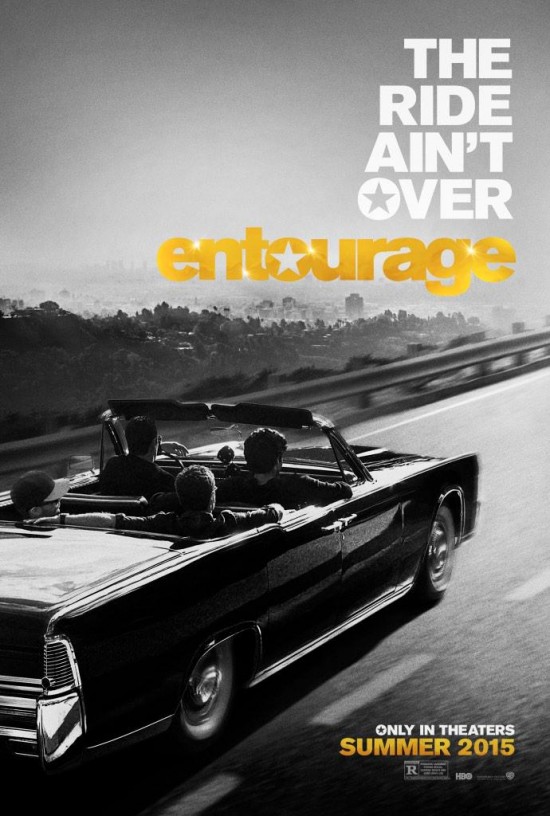 When Entourage first aired on HBO in 2004, it felt like a fun peak behind the glamorous world of Hollywood. A group of four friends were doing their best to navigate the land of dreams while staying true to themselves. For the first four seasons, Entourage felt fresh, fun, and engaging. And then it kept going for another four seasons, overstaying its welcome and proving to have worn out all credible story material several seasons before it went off the air in 2011. Creator Doug Ellin just didn’t want to leave the party, enough so that four years after finally leaving he’s back with his boys, co-writing and directing an Entourage feature film, answering all of the burning questions left unanswered. Does Ellin justify the move to the big screen, especially when you realize that the TV show already had gratuitous nudity and celebrity cameos?
Vincent Chase (Adrian Grenier) is nine days removed from his honeymoon where he and his wife decided they really weren’t meant to be, so they amicably split but not before having awesome sex one last time (oh yeah!). Back on the scene, Vinnie is hungry to direct and his debut is a $100 million adaptation of Jekyll and Hyde starring Vinnie and his older brother/desperate actor, Johnny Drama (Kevin Dillon). The problem is that Vinnie feels he needs more money to finish his masterpiece before he can show it to the studio. Ari Gold (Jeremy Piven), formerly Vinnie’s agent and now the head of the studio, has a lot on the line if this movie is a hit or a flop. He checks in with a financier for more money but the Texan moneyman insists his son Travis (Haley Joel Osment) go along to Hollywood and act as go-between. It’s not long before Travis is demanding drastic changes to Vince’s movie (oh no!). Here to help is Turtle (Jerry Ferrara), who works a business and a romantic angle with MMA fighter Ronda Rousey, and Eric (Kevin Connolly, who is weeks away from becoming a father with longtime girlfriend Sloan (Emmanuelle Chirqui). Can Vinni save his movie? Can Ari save his job? Can Turtle seal the deal with Ms. Rousey? Can these bros get any bro-ier (oh yeah)?
 The plot of the movie is almost insulting with how little conflict there is and when there is any how easily it all wraps up into lazy wish fulfillment. The main conflict of the film is that Vinnie wants more money for his directorial debut, even after blowing through $100 million. He needs just a pinch more for his movie to be able to be complete. Rather than having a disaster on their hands, which would be far more interesting and provide a wealth of conflicts with how to salvage what is there, the biggest perceived problem with Vinnie’s debut is whether it will be a box-office blockbuster and earn awards. Everyone sings the movie’s praises, though the concept sounds ridiculous and the little footage we see looks ridiculous as well. A Jekyll/Hyde DJ who fights “the system” and spreads his magic elixir at his club concerts… does that sound like the formula for Oscars? If Entourage were still functioning as an industry satire, there might be added commentary on how something so flatly terrible would be hailed as an awards darling, but entourage stopped being a satire midway through its television run. It’s just a consistent reward system for characters that stumble from one good thing to another. Even though Vinnie has never directed before everyone can’t help themselves but talk about what a superstar he is and how great the movie will be. Will he get tons of money, acclaim, and have sex with an attractive woman, or will he get tons of money, acclaim, and have to wait to have sex with another attractive woman? What a pressing conflict for a feature film. With that established, it’s no wonder then that Travis makes such an ineffectual antagonist. I was actually enjoying his hostility toward Vince and his dumb movie. Eric might have wanted to punch him in the face but I wanted to pat him on the back.
Another significant problem is that these guys are just too old to be going through these same tired arrested development routines. I think it says everything about Entourage the TV show that after eight seasons the characters were basically the same people except each had become more successful. Their shtick was already getting tiresome on TV. Flash forward four years, though the movie takes place months after the end of the TV show, so that means we’re in 2012 I think. Anyway, these guys should have accumulated some sort of personal growth as characters and they just haven’t. Except for Turtle’s weight loss, which becomes a running joke, it feels like they’re all the same. This is also featured in the Eric/Sloan relationship, which was an exhaustive subject on the TV show. As the series ended, they were together and having a baby, and as we pick up with the movie they’re, shocker, apart again just so they can get back together. The inevitability of this storyline offers a glimpse at what Ellin felt he had to squeeze in for Eric, which amounts to sleeping with two hot women and having a crazy mix-up. When it appears like there will be actual conflict here and Eric will be held accountable for his behavior, the movie instantly shrinks away and lets him off the hook. Every character’s interaction with women is regrettable, as women are served up as easy comforts. Ronda Rousey at least takes a stand but then retreats yet again under the supposed charm of these dolts.
The humor is low-grade and often missing, substituting references and celebrity cameos for well-developed comedic scenarios. There’s some humor in how self-deluded these guys are, especially the increasingly unhinged antics of Johnny, but they’re far too bland to generate consistent laughs. Except for Johnny, the other guys aren’t even given opportunities for comedy, which makes their storylines all the more painful. Do we really need to see Turtle’s courtship of Rousey, and what does she see in this guy? None of the cameo appearances are even used beyond just a ten-second-reference point with no greater impact than on the ten seconds of that very scene. Take for instance the cameo of Mark Wahlberg and his hometown buddies. He’s an executive producer on Entourage the TV show, based upon his own experiences coming to Hollywood. He’s shilling his own reality TV show he produces in the move based upon his old HBO show. That’s like product placement/plug inception. The problem is that Ellin has confused cameos as punch lines, which was also an issue with the original show. Just because I see someone famous doesn’t mean there’s a joke attached. Oh look, it’s Pharell and he’s wearing that big hat. Thanks for showing up, Pharell. Now go cash that check, you won’t be required for any other work on this set. Scene to scene, it feels like some sort of party that the filmmakers expect you to be grateful for attending. It’s not even a fun party.
 The most entertaining person is the movie is still Ari Gold and Jeremy Piven has always played him to the hilt, winning multiple Emmys in the process. I desperately wish this was more Ari’s movie, or told more from his studio perspective, because he’s the infinitely more interesting and entertaining character than the super relaxed and super boring Vince. Even though Ari’s vulgar outbursts have grown tiresome, he’s still the most exciting character because he’s transparent about his passion but also, more than any other character in this expanded TV universe, he works for his goals. Ari doesn’t just sit by and let good stuff fall into his lap, he’s working all angles to get the desired outcome, and that’s always more interesting than watching the life of a vacant actor go from great to even better. The subplot with Ari’s former assistant Lloyd getting married feels like setup for a comic set-piece that never materializes. It does, however, provide a cameo for George Takei to officiate the wedding. Hooray, more cameos.
If you were a fan through all eight bro-tastic seasons of the TV show, chances are you’ll probably find the movie easy-going and enjoyable. If you’re like me and grew tired of their boorish antics, the repetitive humor and plotting, and the casual misogyny, then a big-screen version where the boys get to continue their ways and get more rewards, where everything works out for everyone, will be highly fatiguing. Entourage the movie doesn’t aspire for much but its stunted ambitions and minor conflicts never allow the movie to be anything other than a particularly meandering and dull extended episode. Much like the main characters, it has confused mediocrity with success and being amiable with being interesting. Ellin said in interviews that he hoped this would be the start of an Entourage trilogy of movies. Thanks to the low box-office returns, at least I can credit America with stopping that plan. If this is indeed the last ride for Vince and the boys from Queens, well they went out pretty much like they did four years ago, and isn’t it great to still be a rich white guy in Hollywood? Oh yeeeeeah. Oh yeeeeeeah.
Nate’s Grade: C
Share this:

Transformers: Age of Extinction (2014)
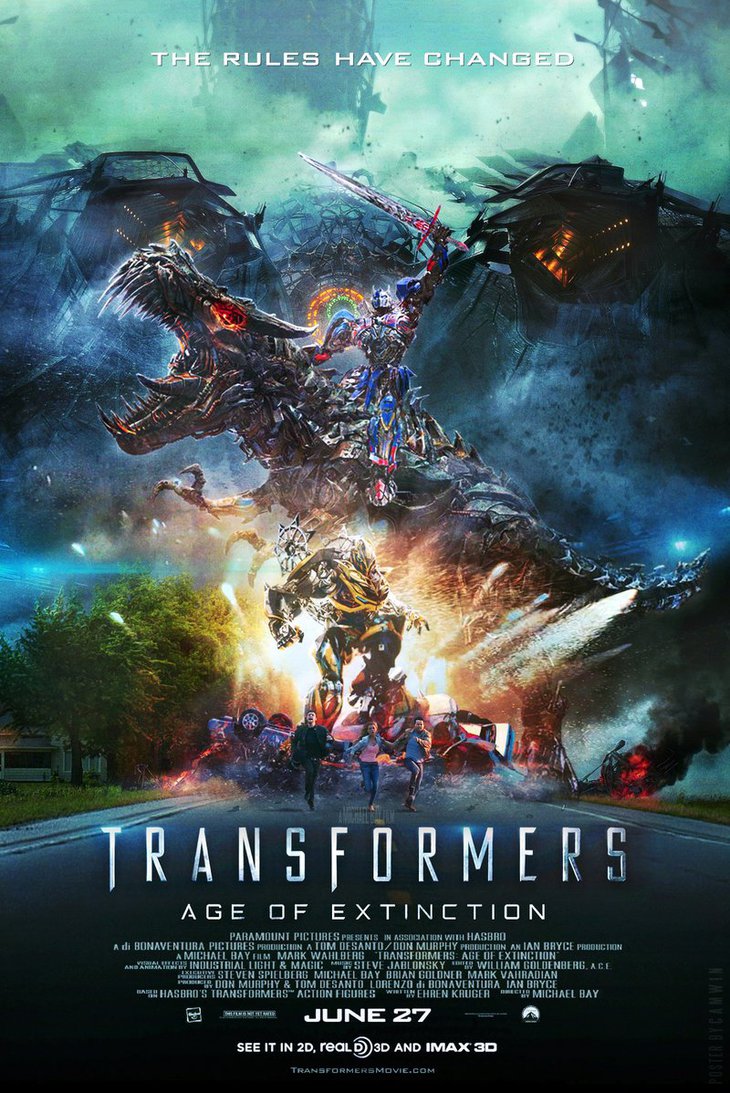 Four movies in, at this point you can either fall back on the old criticisms of Michael Bay as a filmmaker or simply let down your guard and look for any simple pleasures offered by the Transformers franchise, a series mostly known for chaotic plotting and action. Age of Extinction is probably the best Transformers film since the first one (take that for what you will) but it still has all the hallmarks of the obtuse and convoluted plotting, absurd and obnoxious characters, juvenile humor, intense product placement, and often incoherent action. Gone are the characters from the first three films and in their stead is Mark Wahlberg (upgrade) as a Texan inventor named, get this, Cade Yeager. He and his teen daughter come into contact with Optimus Prime and are on the run from multiple forces. Apparently a bounty hunter is looking to target Prime. The U.S. has a black ops team tracking down Transformers in hiding. And Stanley Tucci plays a business tycoon who wants to make his own Transformers via their magic substance “Transformium.” Reading all of that, you realize the pieces still don’t really make sense, and that’s before the robot dinosaurs come into play. And yet Bay and his team have fine-tuned the entertaining aspects of the franchise and better consolidated them in the fourth film. A badass alien bounty hunter/collector is a great addition, adding the government as an adversary, Titus Welliver (TV’s Lost) as a cocksure special agent, Tucci as a corporate blowhard, and robot dinosaurs, it all sort of works on its own terms. Again, if you try and logically connect the pieces, it won’t happen. By this point, if you’re not a fan of the series, there’s no real reason to continue watching, but if you’ve found any semblance of enjoyment then there should be enough to keep your attention with the fourth film, robot dinosaurs and all.
Nate’s Grade: C+
Share this:

Lone Survivor (2013)
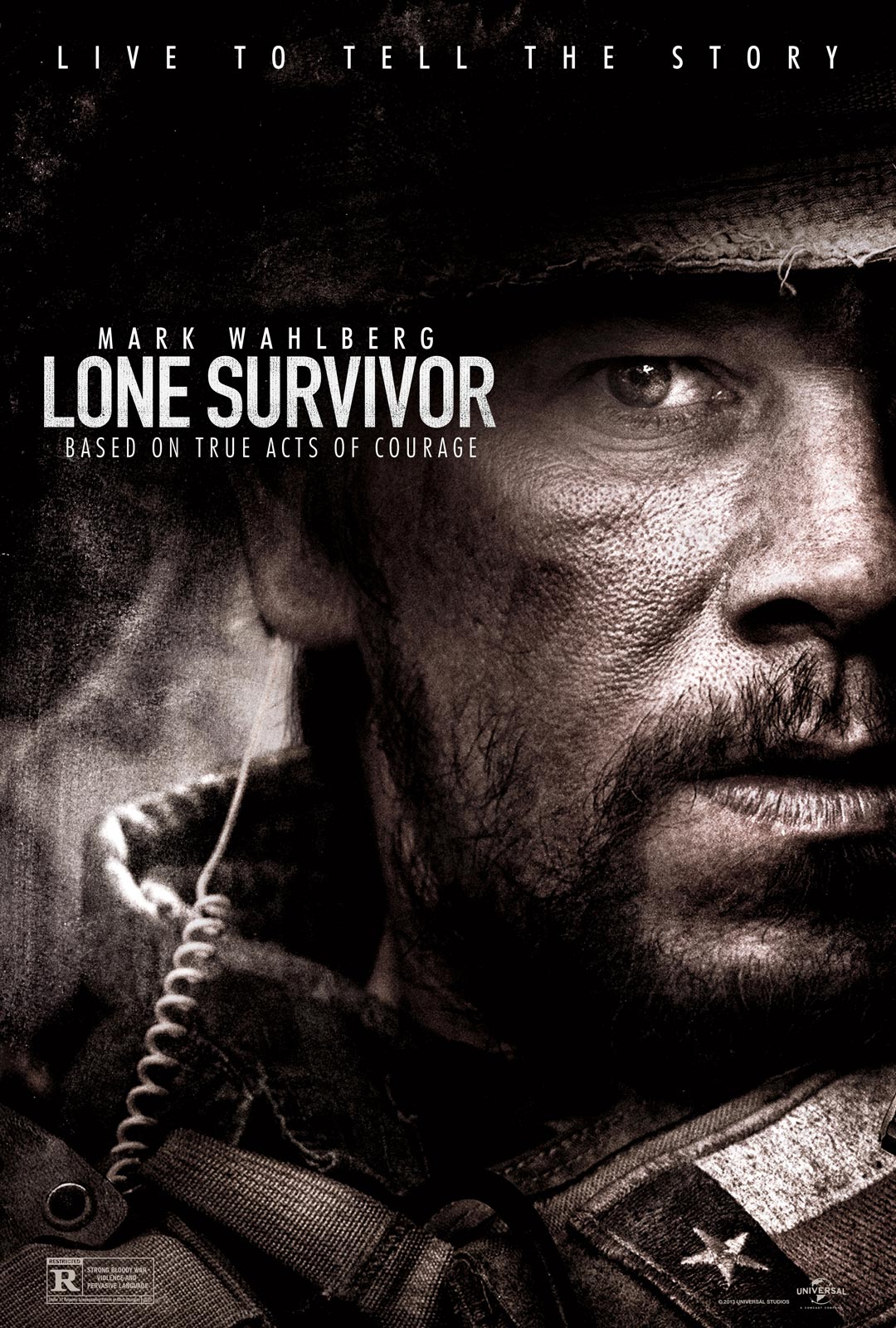 What do you do when the title of a movie is a spoiler? That’s the question with director Peter Berg’s reverential military action film, Lone Survivor. It’s the true story of a team of Navy Seals who had their mission compromised by a pair of unlucky Afghan goat herders. After deciding to set them free, rather than snuff them out, the Seals retreat to an extraction point, with a hundred Taliban fighters hot on their heels. When the action is firing, Berg is right at home, placing the audience in the middle of a visceral firefight that’s bloody and hardcore and pulse pounding. The rocky terrain of the country is just as deadly as the Taliban, as the Seals bounce around like ragdolls. The performances are all grizzled and finely attuned to keeping the terror of the moment at bay. Ben Foster (The Messenger) is the standout, which is a statement that’s been said with most Foster performances. At the end, I’m left wondering what is the film’s greater message. It’s retelling a military episode few people know about, illuminating the courage and bond between soldiers under fire. But in the end, all of these lives were lost because of one moral though arguably bad decision. Couldn’t they have just tied up the goatherds and gotten a better head’s start? Will the movie convince an audience that those innocent Afghan goatherds should have just been collateral damage? Does the movie critique the futility of America’s ongoing presence in Afghanistan? The futility of war itself? I doubt it, especially with Berg’s fervent appreciation of the armed forces putting their lives on the line (the opening credits themselves glorify the toughness of the Seals while also setting up an explanation why they could survive so many gunshots, injuries, etc.). Lone Survivor isn’t the heedless jingoistic propaganda piece that others critics have feared, but in the end it’s simply a sober and respectful tribute to the fallen, and that’s it. For many, this will be enough. For me, I was thrilled by the heroics but looking for more.
Nate’s Grade: B
Share this:

Pain & Gain (2013)
 I think the audience for Pain and Gain is going to know exactly who they are, and I count myself amongst that number. The latest from director Michael Bay, often treated tantamount to Satan in many critical circles, has the based-on-a-true-story hook but really it’s the big stars, stylish violence, peculiar criminal antics, and overall overflowing machismo of the picture that will draw its audience. I knew after one watch of the trailer that I wanted to see it, though I was somewhat ashamed of the level of my interest (don’t want to taint your critical credentials with too much sympathy for the devil, after all). Pain and Gain is a trashy and entertaining jaunt, just as I hoped it would be, but it overstays its welcome and may leave you fatigued and possibly dejected (so… a typical Michael Bay movie? Still got it).
In 1995, three Miami, Florida goons enacted one of the most bizarre and sordid criminal schemes, a story that could supply a tabloid with enough juicy exposes for a year. Daniel Lugo (Mark Wahlberg) and his co-worker Adrian Doorbal (Anthony Mackie) are personal trainers at Sun Gym. Their days consist of pumping iron and hitting on ladies. One of Lugo’s clients is Victor Kershaw (Tony Shalhoub), a wealthy businessman with a nasty temper. Lugo and Doorbal, with the help of an ex-con and ex-junkie (Dwayne “The Rock” Johnson), kidnap Kershaw, hold him hostage for weeks, torture him, and eventually get him to sign over his assets to them. Afterwards they try to stage his “accidental” death, though like most things, it does not go according to plan. Penniless and broken, Kershaw seeks out help from a retired private eye, ED DuBois (Ed Harris), to provide validation for his case. The Miami police are laughing off his claims. Kershaw is concerned that the Sun Gym gang will strike again when their lavish lifestyle dips, and he’s right. Lugo and company get into even more trouble and the body count rises.
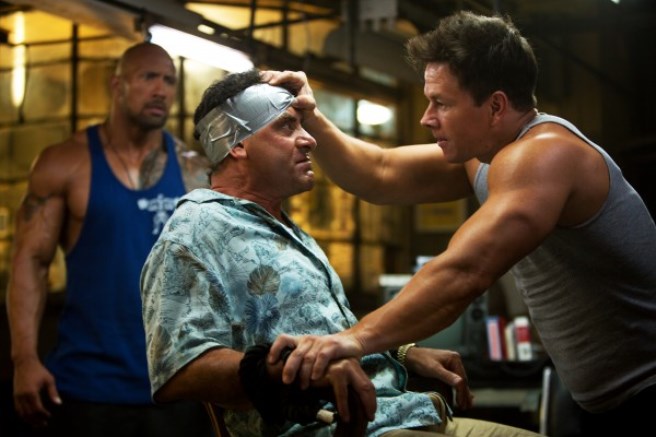 The results on screen are often entertaining in an over-the-top fashion, sustaining a rubbernecking captivation much like a horrendous car wreck. You just have to see how much crazier this thing gets, all the while muttering to yourself, “This was a true story?” It even gets to the point where the movie will remind you, via onscreen text as a man barbecues a batch of severed hands, that yes this is still a true story. Naturally there have been fictional inventions, character composites, and some details have been dropped to fit into the confines of a film narrative, but online research shows me that most of the larger plot beats are accurate, thus making the film even more compelling and disturbing. When the film is on, it feels manically alive with intrigue and absurdity. The problem is that it cannot keep this manic tone alive forever especially when actual innocent bodies start piling up (more on that later). There’s a certain uncomfortable tonal incongruity as the film develops and the comedy picks up a distasteful resonance. I love a well-executed dark comedy but just because something is macabre or unexpected does not automatically make it funny. Still, the movie has enough high-energy antisocial antics to keep you planted in your seat, laughing through bafflement.
Pain and Gain isn’t subtle in the slightest and yet it’s easily the most nuanced film of Bay’s career. Of course there are still the sleek cars, sexy babes, emphasis on style, and wanton destruction that are hallmarks of the man’s career, but the perspective is given a satirical prism, dropping us into the deluded, sub-American Psycho perspective of Lugo, a man with a very cracked view of the American Dream. The moral message reminds me of Marge Gunderson’s concluding musing in Fargo, telling a captured criminal, “There’s more to life than a little money, you know.” There’s some slight social commentary on wealth and the dirty tricks of capitalism, but really it’s the narcissistic delusions of a jacked-up criminal who believes he can succeed because he’s “seen a lot of movies.” You may even find yourself sympathizing with some of these knuckleheads, that is, until things get way out of hand. The screenplay by Christopher Markus and Stephen McFeely (Captain America: The First Avenger) is briskly paced and packed with bizarre details and even jumps into six different characters for voice over (Wahlberg, Johnson, Mackie, Shalhoub, Harris, and Bar Paly). For some characters it works as a great insight into their twisted logic but for others it’s just an easy set up for ridicule. The juvenile humor (did we really need a visual pubic hair joke?), candy-coated film palate, and sugar-rush, roid-rage plotting feel like a suitable match for the talents of the bombastic Bay.
The last thirty minutes of the movie will test your sensibilities of good taste. I’m all for having unlikable central characters just as long as the writer makes them interesting (what good is likeable but boring, the “friend zone” of characterization?). Some of movie history’s most fascinating characters have been scumbags and psychos. However, with that being said, I need my unlikeable characters to at least progress. When I’m stuck with a bad dude who keeps making the same bad mistakes, it can grow tiresome, and that’s where Pain and Gain ultimately lost me. Bay can’t quite keep up the charade of ironic bemusement forever, and a saggy second half starts to tread water, forcing the characters to act even more outlandish and inept. Did we need The Rock losing his big toe and then inexplicably giving it to a dog? It feels like the movie is filling time until the accidental murders come into being, raising the stakes. For a movie that’s 130 minutes, there should not be any need to fill time. During that long sad stretch, you start to feel disquiet, like the movie has lost its sense of perspective and the jokes have gotten too mean, too ugly, too outlandish. It doesn’t feel funny any more, and maybe that’s ultimately the point, but by the end Pain and Gain has soured. It overstays its welcome and then some.
 Its tone and connection to the real world raises an interesting and thorny question over whether something like this is appropriate. Should a story that involved the murders of innocent people end up becoming an over-the-top, stylized, lavishly glamorized Hollywood crime comedy? It has been over 15 years since the events of the Sun Gym gang, but is there a statue of limitations on good taste? Are we eventually destined for a vulgar film tackling the poor lives of the victims of 9/11? The answer is almost certain. What is off limits, or more pressingly, should anything be off limits to a comedic narrative? Is anyone really furious with Trey Parker and Matt Stone over their first film, Cannibal the Musical, transforming nineteenth century murder into song and dance? I doubt it, and yet there was something very off-putting about 2011’s 30 Minutes or Less, an unfunny comedy based around the true story of a pizza guy strapped with a bomb and ordered to rob a bank. The guy was blown to bits in real life (ha ha?). I guess I, as well as audiences, would have been more forgiving if the movie had been funny. I’m sure there would be fewer objections if Bay’s film had been more of a sober, contemplative drama on the sad acts of a bunch of desperate criminals, but with all the hyperbolic elements, machismo, and so-crazy-it-must-be-true plot turns, how could you turn this story into a serious drama? Not from the perspective of the nitwit criminals, at least. I don’t think the movie is ever positioning these guys as anti-heroes or excuses their excess.
Wahlberg (Ted) broke out as an actor thanks to a similar role as a wannabe star whose ambitions exceeded his grasp, and the man does dumb as good as just about anyone in Hollywood. It’s a specific kind of dumb, the angry, arrogant, pissy, self-involved kind of dumb that makes it acceptable to ridicule his character to no end. Johnson (G.I. Joe: Retaliation) gets to explore some interesting range as an actor, pacing around the demons of his character before just going hog-wild with the excess. Mackie (Gangster Squad) is arguable the most sympathetic of the group but also with the most to lose. Compared to his peers, he’s practically mild-mannered even though he takes injections into his penis. Shalhoub (TV’s Monk) is amusingly apoplectic and just enough of a jerk that you excuse his misfortune, at least for a little while. Ken Jeong (The Hangover) and Israeli model-turned-actor Bar Paly give the exact performances you would expect them to deliver. The best actor in the whole movie, though truth be told there isn’t a stinker in the bunch, is Emily Rutherford (Elizabethtown, TV’s The New Adventures of Old Christine) who plays Dubois’ wife. She has this calming, down-to-earth presence that seems to bring a small sense of peace to the madcap antics. She doesn’t have a lot of screen time but you’ll wish she had lots more.
Perhaps I’m being unfair to a movie that clearly isn’t intending to be anything but naughty, tacky, and gleefully excessive. In a way Pain and Gain reminds me of Tony Scott’s Domino, loosely based upon a true story but crushed to death by narrative kabuki and Scott’s characteristic excess. If I wanted to defend the much maligned Michael Bay, I’d argue what the real difference is between his excess and the excess of the more critically lauded Scott? Bay doesn’t have a slate of movies to his credit the likes of Top Gun, Crimson Tide, or True Romance. But isn’t flashy, artistic excess all the same when in the name of empty storytelling? Domino is also an apt comparison because it’s ultimately tiresome and far overstays its welcome, losing its audience with an endless array of odd sidesteps and moronic, deviant characters. While Pain and Gain has enough quirk and style to justify consideration, you may not respect yourself once it’s over.
Nate’s Grade: C+


 nathanzoebl
You must be logged in to post a comment.