Blog Archives
The Good Girl (2002)
 Jennifer Aniston, a Friends favorite, has been getting attention for her less than attractive turn in adultery with The Good Girl. However, the movie’s biggest flaw is Aniston herself. The Good Girl can try and make her look as disheveled as they can, and they can try and make her wear as much unflattering baggy clothing as possible, but in the end we’re still watching Mrs. Brad Pitt groan about the purgatory that is Middle America. An actress of better caliber could likely pull off the rub, but alas, Aniston is not quite that actress yet.
Aniston narrates the disenchantment as Justine with her dead-end job working at a Wal-Mart-esque chain store and her dead-end marriage to perennially stoned house painter Phil (John C. Reilly). She longs for an escape and a change of pace from a grind where there appears none. Then one day a new teenage co-worker named Holden (Jake Gyllenhaal) comes into her life and seems to represent the danger and vitality Justine has felt missing in her life for so long. Her affections are at first stalled in apprehension, but soon Holden and Justine are ducking into motels and finding excuses to get busy in the stock room. But soon enough the honeymoon ends. Justine learns more distressing items about the emotionally dependent and unstable clerk, like his real name is Tom (“Tom is my slave name” he tells her). What once seemed exciting is now becoming more perilous to cover up.
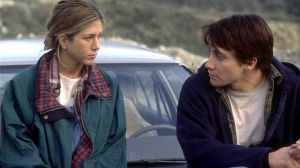 The Good Girl then descends into blacker territory with some unexpected turns, but also some more unbelievable moments. When confronted by Phil’s best friend Bubba (Tim Blake Nelson) about her infidelity she is given a rather unpleasant ultimatum that she gives in too way too easily. The longer the affair and messy cover up continues the more audience loyalties shift toward the victim, Phil. He admits he isn’t the smartest man or the best husband, but his feelings are authentic for his wife. And the more the audience views him the more they see that he truly does love Justine.
And again, we have to come black to that road block of a lead. A more accomplished actress could pull off this bittersweet role with aplomb and believability. A better actress could have slowed down the audience shift in loyalty away from her unfaithful protagonist. The supporting cast of The Good Girl has a lot more bite to them. Gyllenhaal (Donnie Darko) now seems to be an expert in the disturbed youth. Reilly starts off as a loaf but transforms into a sympathetic character that has his own touching moments of unannounced affection to Justine. Nelson gives the film some of its funniest moments along with the lethally deadpanned Zooey Deschanel. The lone stereotype in the bunch is played by Mike White (who wrote the film) as an overly enthusiastic Christian do-gooder.
It’s a pity The Good Girl has its anchor around the neck of Aniston and willing to go as far as she will take it, because The Good Girl is indeed a good film with some wicked moments of comedy and a well-written story. It’s just that Aniston’s acting limitations gravitate what could have been a better film.
Nate’s Grade: B
Share this:

My Big Fat Greek Wedding (2002)
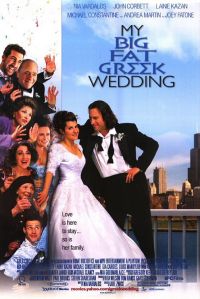 Toula Portokalos (Nia Vardalos) opens by telling us that as a Greek woman she has three responsibilities, “1) Marry a Greek boy. 2) Have lots of Greek children. 3) Make lots of food.” Toula works in her family’s restaurant letting life pass her by, while her father pleads with her to get married even though she is already “old” at 30. It doesn’t seem like that day will ever come for Toula, nor is she looking forward to it, until a handsome stranger (John Corbett, Aidan from Sex and the City) catches her eye in the restaurant. Through more encounters the two seem to have sparks flying off from the heat they generate. He pops the question and Toula happily says yes. There’s only one slight problem – he’s not Greek.
My Big Fat Greek Wedding isn’t anything provocative or innovative but it does have its charming moments and engaging humor. These “ethnic family comedies” are really a double edged sword to work with. You see, they will exaggerate the cultural eccentric-ness of the characters to the point of gross parody but then rely on them to become endearing lovable characters who the audience appreciates for the very same reasons it’s laughing at them. And while Greek Wedding can be found guilty of this notion as well it really does take someone from the inside to come up with this stuff, so there must be some love there to start with.
Vardalos, who also wrote the script, is a perfect casting choice exactly because of her everyday looks. This isn’t someone like Jennifer Aniston trying to pull off being poor and un-pretty; this is a normal looking gal pulling off normal. It works exceptionally and Vardalos certainly knows how to hit a joke. The supporting cast of goofy yet lovable Greeks is played with admirable gusto by the many assembled players. A favorite of mine is the elderly grandmother who continues to try and escape from their home. And yes, an N’SYNC member is in this movie. Why I will never know. Is he even Greek? Is “Fatone” a Greek name?
My Big Fat Greek Wedding is a big helping of family comedy and easy to see why it’s become as crowd pleasing as it is. It’s nothing new or extravagant, but hey, I’d easily go see this again than ever venture close to a theater showing XXX or Blue Crush or Pluto Nash or The Master of Disguise or…
Nate’s Grade: B
Share this:

Kissing Jessica Stein (2002)
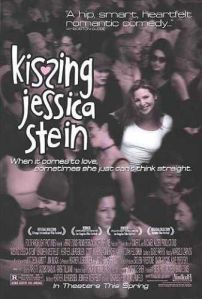 Kissing Jessica Stein stars Jennifer Westfeldt as the perfectionist title heroine searching for true love in the Big Apple. She answers a personal ad sent by Helen (Heather Juergensen), an art gallery manager trying her hand at women for the first time. What begins in comedic awkwardness turns to the fires of passion. Which leads to much more awkwardness as Jessica attempts to keep her secrets and the true identity of her “friend” from her mother.
Juergensen and Westfeldt wrote the script based on characters they have nurtured for several years, and their comfort level with the material shows. Each gives a wry and charismatic performance, with Westfeldt proving herself an acting revelation. It must be nice for her to have something else to her résumé than being one of the “girls” in Two Guys, A Girl and a Pizza Place.
Kissing Jessica Stein tiptoes a fine line with some characters possibly becoming gay or Jewish stereotypes; however, they never do fall into the abyss of Caricature Land. Tovah Feldshuh, playing Jessica’s mother, might make you wince at the thought that she’d be mired as a Mike Myers “Coffee Talk” portrait. But she has scenes where she shows real tenderness that is very affective.
At times the movie feels a bit too wrapped up in its own precocious-ness. There’s even a standard montage of bad dates that becomes annoying much sooner than it ends. Those looking for deep lesbian issues needn’t apply here. Kissing Jessica Stein hits its targets on a surface level, which can be deemed appropriate for an innocuous romantic comedy. The downer closing 10 minutes seems to come from nowhere and betray the feel of the movie.
The film plays by conventional rules for the most part but these don’t diminish the healthy humor in the least. Kissing Jessica Stein is a charming and fun experience and would serve as a good date movie for prospective couples.
Nate’s Grade: B
Share this:

Sexy Beast (2001)
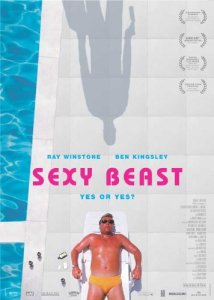 Never, under any circumstances, do you want to piss off Gandhi. Sexy Beast is a British crime story where the ferocious mad dog Don Logan (Ben Kingsley) is trying to recruit a retired hand (Ray Winstone) into one last job back in London. Winstone is enjoying the sun of California with his middle-aged ex-porn star wife who he loves dearly. But Don does not take “no” for an answer. Kingsley is the true focal point of the film and is astounding and brutally terrifying as the wound up gangster. He gives an electrifying performance that is the polar opposite of India’s non-violent leader. When Kingsley vanishes from the screen Sexy Beast suffers and becomes a variation of the old crime film, except a very short one at that being under 90 minutes of running time. Video director Jonathon Glazer has done a fine job for his debut but there isn’t much to this tale without Kingsley’s memorable efforts.
Nate’s Grade: B
Share this:

In the Bedroom (2001)
 In the Bedroom hits all the right notes of agonizing pain, devastation and loss. The heart of the film is on the grief encompassing Matt and Ruth Fowler (Tom Wilkinson and Sissy Spacek) over the loss of their son. The Fowlers are well regarded in their cozy New England town. Matt is a flourishing local doctor and Ruth teaches a chorus of local high school girls.
In the Bedroom opens with Frank Fowler (Nick Stahl) chasing his older girlfriend Natalie (Marisa Tomei) across an open grassy field. Frank is a budding architecture student home for the summer and thinking of prolonging his time so he can stay together with Natalie. Frank and Natalie have a distinct age divide but also seem to have been given different lots in life. She has a pair of boys from her abusive husband Richard (William Mapother) that she is finalizing a divorce from. Richard is hopeful he can reconcile with Natalie if he just gets another chance, but Natalie is stern in her refusal.
 Ruth sees the relationship as a detriment to her son’s future. She’s even more upset that Matt is so casual with their son dating an older, working-class mother. Frank rushes over to calm Natalie after another of Richard’s outbursts of violence has left her house in shambles. She rushes her children upstairs just as Richard returns back. He manages to sneak in through a back door and confronts Frank in their kitchen, shooting and killing him. What should seem like a clear-cut case begins to unspool. Natalie admits she didn’t actually see the gun fire and the charges are dropped from murder to manslaughter. Richard is released on bail and free to stroll around occasionally bumping into the grieving and outraged Fowlers.
The majority of the film is the aftermath of the murder and the strain it puts upon Matt and Ruth and their marriage. Beforehand jealousy, anger, and bitterness would simply sit but slowly the tension begins to bubble to the surface. Ruth holds resentment and blames the leniency of Matt for the death of their son. Matt tries to get out of the house as much as possible, even if it means sitting in his car in their driveway at night.
One of the most harrowing scenes of In the Bedroom is also its emotional and acting centerpiece. After the mounting frustration with justice, Ruth and Matt explode into an argument that had slowly been building long before their son’s death. This is the first time they have truly talked about the whole situation and accusations fly like bullets in their first emotional confrontation. In the Bedroom could have easily fallen into the area of sticky made-for-TV land, but the exceptional performances all around by the cast and the deft and studied direction never allow it to falter.
Spacek (Carrie, Coal Miner’s Daughter) can begin writing her Oscar acceptance speech right now. Her portrayal of Ruth displays the pride and seething anger, but keeps her human throughout. She exhibits pure, raw emotion that strikes directly inside you leaving a knot in your stomach and in your throat. Her performance is truly breathtaking and so emotionally visceral to watch. Wilkinson (The Full Monty) plays Matt with passive-aggressive doubt and repression. He dominates in any scene he is in and takes the audience on a wide range of emotions. He has a commanding presence and compliments Spacek’s Ruth nicely. Perhaps the greatest thing Tomei (My Cousin Vinny, Slums of Beverly Hills) was known for was miraculously winning an Oscar and dumbfounding a nation. With ‘In the Bedroom’ she is given the ubiquitous “And” credit at the end of the opening cast list. She has less to work with and less screen time to work it, fully earning the “And”‘ credit she has.
 Todd Field is an actor-turned-director and has appeared in such a wide array of films from Twister to Eyes Wide Shut. Field has layered his film with rich symbolism and an intelligent, patient pace. Most of the action in movies is centered on what is going on in a scene, but the most telling moments of In the Bedroom are what are not going on in the scenes. Field creates such an intimate portrait that the camera almost turns into another character, catching the lingering silences and the burgeoning inner turmoil. Field also adapted the screenplay from a short story by Andre Dubus, whom he dedicates the film to.
In the Bedroom is not going to be for everyone. Some will find it slow and some might even find it boring. As it stands, it is a powerful film on the study of loss that grips you and refuses to let go. You will feel all the blame, jealousy, anger, and pain of this family and for such emotions to resonate from the screen to the audience is a great achievement.
Nate’s Grade: A
Reviewed 20 years later as part of the “Reviews Re-View: 2001” article.
Share this:

The Man Who Wasn’t There (2001)
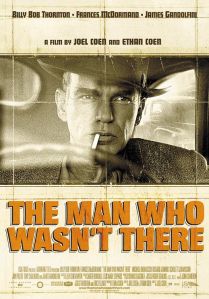 The Coen brothers dark, twisty entry to the world of film noir looks mind-blowing with its black and white lensing. And the story is great too. Billy Bob Thronton plays a barber who gives new definition to the word passive. One day a customer lets him in on an up-and-coming financial project and if Thronton were to provide some dough then surely he would rake it in. As with most film noir, the normal man is thus pulled into the web of intrigue and crime. The ball gets rolling after Thornton blackmails his wife’s tryst (James Gandolfini), who also happens to be her boss and his friend. Things get far more complicated from there and nothing seems to go right as Thornton makes one bad decision after another. The Man Who Wasn’t There is an engaging and smart drama with game bits of comedy strewn at key moments. The Coen brothers are a pair not very easily topped when it comes to excellence in films, and this latest entry is a wonderful addition to their resume.
Nate’s Grade: A-
Share this:

Haiku Tunnel (2001)
 Josh Kornbluth plays Josh Kornbluth, super temp in the world of office politics and incompetent corporate superiors. He’s a working man’s hero (well, a secretary’s hero) as a round ball of puffy passive-aggressive professionalism. When asked to go permanent for a tax attorney (“We’ll even cover your
psychotherapy”) is when Josh’s world begins to enter into comedic haywire. He’s more adept at creatively finding ways around work then at actually accomplishing it. Kornbluth is a terrific comedic and a truly memorable figure. He co-wrote and co-directed the film with his brother from their stage play. Haiku Tunnel often channels the spirit of the wicked satire Office Space (a film that only gets funnier every time I watch it), but has enough of a feel all its own to be distinguishable. The film has some great lines and some imaginative characters to boot. Haiku Tunnel is witty and often times hilarious, not to mention dead-on with its precision like satiric strikes. Kornbluth is a definite entertainment find and Haiku Tunnel is a gem of a film worth looking for.
Nate’s Grade: B+
Share this:

Mulholland Drive (2001)
 Mulholland Dr. has had a long and winding path to get to the state it is presented today. In the beginning it was 120 minutes of a pilot for ABC, though it was skimmed to 90 for the insertion of commercials. But ABC just didn’t seem to get it and declined to pick up David Lynch’s bizarre pilot. Contacted by the French producers of Lynch’s last film, The Straight Story, it was then financed to be a feature film. Lynch went about regathering his cast and filming an additional twenty minutes of material to be added to the 120-minute pilot. And now Mulholland Dr. has gone on to win the Best Director award at Cannes and Best Picture by the New York Film Critics Association.
Laura Harring plays a woman who survives a car crash one night. It appears just before a speeding car full of reckless teens collided into her limo she was intended to be bumped off. She stumbles across the dark streets of Hollywood and finds shelter in an empty apartment where she rests. Betty Elms (Naomi Watts) is a young girl that just got off the bus to sunny California with aspirations of being a big time movie star. She enters her aunt’s apartment to find a nude woman (Harring) in the shower. She tells Betty her name is Rita after glancing at a hanging poster of Rita Hayworth. Rita is suffering from amnesia and has no idea who she is, or for that fact, why her purse is full of thousands of dollars. Betty eagerly wants to help Rita discover who she is and they set off trying to unravel this mystery.
 Across town, young hotshot director Adam Kesher (Justin Theroux) is getting ready to go into production for his new film. He angers his mob producers by refusing to cast their chosen girl for his movie. After some harassment, threats, and a visit by an eyebrow-less cowboy assassin (God bless you David Lynch), he relents.
In the meanwhile, people are tracking the streets looking for Rita. Betty and Rita do some detective work and begin amassing clues to her true identify. As they plunge further into their investigation the two also plunge into the roles of lovers. Rita discovers a mysterious blue box and key in her possession. After a night out with Betty she decides to open it, and just when she does and the audience thinks it has a hold on the film, the camera zooms into the abyss of the box and our whole world is turned upside down.
David Lynch has made a meditation on dreams, for that is at the heart of Mulholland Dr. His direction is swift and careful and his writing is just as precise. The noir archetypes are doing battle with noir expectations. The lesbian love scenes could have been handled to look like late night Cinemax fluff, but instead Lynch’s finesse pays off in creating some truly erotic moments. Despite the population of espresso despising mobsters, wheelchair bound dwarfs, and role-reversal lesbians, the audience knows that it is in hands that they can trust. It’s Lynch back to his glorious incomprehensible roots.
Watts is the true breakthrough of Lynch’s casting and she will surely be seen in more films. Watts has to play many facets of possibly the same character, from starry-eyed perky Nancy Drew to a forceful and embittered lesbian lover.
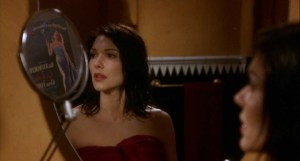 One scene stands out as a perfect example of the talent Watts possesses. Betty has just been shuffled off to an audition for a film and rehearsing with Rita all morning. She’s introduced to her leathery co-star and the directors await her to play out the audition scene of two kids and their forbidden love. As soon as the scene begins Betty vanishes and is totally inhabited by the spirit of her character. She speaks her lines in a breathy, yet whisper-like, voice running over with sensuality but also elements of power. In this moment the characters know, as the audience does, that Betty and Naomi Watts are born movie stars.
It’s not too difficult for a viewer to figure out what portions of the film are from the pilot and what were shot afterwards. I truly doubt if ABC’s standards and practices allows for lesbian sex. The pilot parts seem to have more sheen to them and simpler camera moves, nothing too fancy. The additional footage seems completely opposite and to great effect. Mulholland Dr. has many plot threads that go nowhere or are never touched upon again, most likely parts that were going to be reincorporated with the series.
The truly weirdest part of Mulholland Drive is that the film seems to be working best when it actually is still the pilot. The story is intriguing and one that earns its suspense, mystery, and humor that oozes from this noir heavy dreamscape. The additional twenty minutes of story could be successfully argued one of two ways. It could be said it’s there just to confound an audience and self-indulgent to the good story it abandons. It could also be argued that the ending is meticulously thought out and accentuates the 120 minutes before it with more thought and understanding.
Mulholland Dr. is a tale that would have made an intriguing ongoing television series complete with ripe characters and drama. However, as a movie it still exceeds in entertainment but seems more promising in a different venue.
Nate’s Grade: B
Reviewed 20 years later as part of the “Reviews Re-View: 2001” article.
Share this:

Hedwig and the Angry Inch (2001)
 John Cameron Mitchell directed, adapted from his stage play and stars as the sexually confused rock mega-star Hedwig. Hedwig was a boy trying to escape from the constraints of soviet occupied East Germany. His lucky ticket came in with a GI who agreed to marry Hedwig and take him out of the country with him, but Hedwig had to go under the knife and become a proper lady before their escape was to ensue. When the sex change operation is botched it leaves Hedwig with a single nub-like inch left causing gender confusion (“Six inches forward, five inches back”). Dumped by his GI Hedwig turns to song and befriends a lonely and confused boy Tommy Gnosis (Michael Pitt). Their courtship seems to be going fine until Gnosis steals all of Hedwig’s songs and uses them for his own superstardom on MTV. Hedwig’s defense is to pack up a traveling band and to perform at various salad bars and trucker diners in the same town Gnosis travels to. It’s during these performances that Hedwig dishes about her unusual life.
Unlike most plays turned into films, Hedwig has been adapted for the medium of cinema. Animations, clever camera tricks and sing-alongs follow our story, making it an exhilarating film going experience. Hedwig is excitingly original and spilling over with passionate energy that can’t help but transfer to the audience. Mitchell proves himself a born filmmaker, but also a rock star. Many of the songs of Hedwig are quite listenable and could be found on some music channels. Hedwig is a trans hero for all of us and Mitchell delivers a fresh and resoundingly funny, sad, and technical achievement of a movie.
Nate’s Grade: A
Share this:

Freddy Got Fingered (2001)
 The beauty of Tom Green (if you’ll cal it such) works in the realm of television. His bizarre humor and meddling nuisance on the streets worked in a “Can’t believe he’s doing this” way. He thrives in this environment where he can wreck havoc amongst the unknowing. Take him out of this environment into a scripted venture where people are acting against him, and the reality is killed along with why it was funny in the first place. It’s not so much funny that Tom Green can hump dead animals on camera, it’s so much funny that he’ll do it in front of bystanders.
As it stands, Freddy Got Fingered is plot-less. It is basically Green doing one weird and bizarre antic after another with little relation to anything. It’s basically a meandering mess, almost like an abstract artist’s work if that artist were insane. Freddy Got Fingered is Green’s attempt at cinematic gross-out stardom. Sure, he does things that would be considered in poor taste but they are scripted and lose their appeal. Green guts an animal and wears its skin like a poncho, he bites the umbilical cord of a birth, he even eroticises a horse and aids in its… release. But all the charm is gone when it’s Green just doing zany things in a closed environment. What is the fun of seeing people do scripted reactions to Green’s antics? He needs to be in the real world, he needs to piss people off, he NEEDS reality. A movie will do no justice to Tom Green and this one surely does not.
Nate’s Grade: F
Reviewed 20 years later as part of the “Reviews Re-View: 2001” article.


You must be logged in to post a comment.