Blog Archives
Dirty Pretty Things (2003)
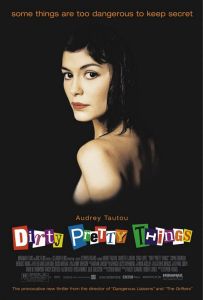 Director Stephen Frears (Dangerous Liaisons, The Grifters) has shown an unflinching eye at the fringe elements of society. In the new thriller Dirty Pretty Things the focus is on the struggling lives of illegal immigrants in over their heads.
The London that Frears displays is the sordid underbelly, the type that hasn’t seen the light in ages. These people are treated like theyre disposable. Those with whatever menial amount of power, even if its a single step higher, prey on these immigrants. ”How come I haven’t seen you before?” one character asks another. ”Because we are the people who are not seen,” he replies.
The heart of the film (you’ll get the pun soon) follows the lives of two immigrants. Okwe (Chiwetel Ejiofor) is from Nigeria and works days as a cab driver and nights as a front desk clerk at a hotel. Senay (Amelie’s Audrey Tatou) is a Turkish housekeeper at the same sleazy hotel trying to stay one step ahead of immigration police. Okwe is instructed to ignore all the salient comings and goings of the hotel. People come to us to do dirty things, says the creepy hotel manager Mr. Sneaky (yes, that is his name). Its our job to make things pretty the next morning. Things get more complicated when Okwe discovers a human heart clogging a room toilet. It seems that for some who check into the hotel, they dont check out. Okwe and Senay become entangled in a bloody scheme that threatens their lives and their immigration status.
Dirty Pretty Things is never boring, sometimes compelling, and more thrilling than you would believe with a plot concerning immigration. The characters earn our attention and emotions with Senay’s vulnerability to Okwe’s tenderness and resolute integrity. They draw us in and we genuinely care what happens as they are snared into the creepy clutches of Mr. Sneaky.
 It’s here that I feel obliged to mention that Steven Knight, the writer of Dirty Pretty Things, is the co-creator of Who Wants to Be a Millionaire?. Just consider the possibilities of future game show creators-turn-thriller screenwriters: Merv Griffin’s hard hitting thriller on the lives of firemen, anyone? It could have the corny tagline, ”There’s only one rule of firefighting – never fall in love.” Maybe this only fascinates me.
Frears’ direction is rock solid. He plays to the best aspects of thrillers, like a suffocating feeling of paranoia but doesn’t suffer the thriller flaws because of such resonant and buoyant characters. Frears is confidant to not overcompensate with his storytelling and lets the grimy locations create his stark mood for him. You can almost taste the stale air.
The acting is exceptional. Ejiofor is amazing. He gives a stellar performance rich in complexity, anxiety, uncertainty, and just plain goodness. He seems to be the last honest man in all of London. There are several scenes you can feel the debate of emotions raging inside him. Tatou, in her first English language role, gives a strong performance, though I’m curious as to where her Turkish accent went. With her penetrating dark eyes and elfin smirk, Tatou is still one of the most adorable actresses on either side of the pond.
Dirty Pretty Things is a searing look at the faceless underprivileged seeking a new life, and those who would deviously prey upon them. The film is a smart, superbly directed, and wonderfully acted thriller. It’s a thriller without weird kids who see ghosts, or lesbians with ice picks, but Dirty Pretty Things is a film thatll stay with you long after the lights go up in the theater.
Nate’s Grade: A
Share this:

Thirteen (2003)
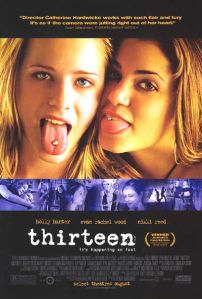 No one said being a 13-year-old was easy. Tracy (Evan Rachel Wood, a dead ringer for a young Jennifer Garner) is a straight-A student living with her mother Melanie (Holly Hunter, nominated for an Oscar). Her family fights to get by with Melanies at-home hair salon. People, usually accompanied by wee kids, stroll in and out of their house like it was a bed and breakfast. Melanie’s previous boyfriend Brady (Jeremy Sisto) has sobered up and settled back into her life, despite Tracy’s wishes.
Evie (Nikki Reed, who co-wrote the film with the director) is that cool girl at Portola Middle School. Tracy desperately wishes to join Evies inner sanctum of friends, enough that shell steal the pocketbook of a stranger to impress Evie. Tracy is taken under Evies wing and learns how to flirt, dress, dance, kiss, and terrify her mother. Melanies concern is a slow simmer, but she cant ignore all the signs of what is happening momma’s little girl. The girls revel in bared midriffs, body piercing, and gallons of shiny make-up. Evie lives with her guardian Brooke (Deborah Kara Unger), herself a sad woman ravaged by booze and pills. When she tells Melanie that Brooke beats her, the maternal instincts overpower her concern. She invites Evie to stay with her family. Evie even calls Melanie mom. More disintegration of Tracy follows.
 Thirteen does exhibit a rare maturity in the displaying of teenage emotions, namely the pull to belong. It also pays incisive attention to our consumer society marketing teen sexuality and the implicit effects. Thirteen creates a more realistic teenager by showing the vulnerability that’s inherent in growing up.
Wood gives a strong performance as her character descends from goodie-good to teen vamp. Her square jaw and lanky frame are physically perfect at displaying a natural young awkwardness. She looks like a teenager I’d see on my block, not what Hollywood is trying to tell me. Wood gets a tad drunk on her characters emotions, like a scene where she tries to scare her mother by lurching forward and cooing, “No bra. No panties.”
Hunter’s depiction of Tracy’s mother is out to lunch about her daughter. This makes the character seem earnest yet stupidly naïve, and after the 200th request of we need to talk is met once again with a closed door, the audience begins to think that Melanie has some deep-seated issues herself.
The direction by first timer Catherine Harwicke starts off as annoying with self-gratifying camerawork. The handheld camera swoops in and out attempting to establish a fluid realism. She also utilizes muted or exaggerated colors to express Tracys highs and lows. What started as self-congratulatory direction actually warmed me over, and I began to take notice of how lovingly Hardwicke stuffs her frame and utilizes lighting. It seems like she could have a career ahead of her as a director.
Though the acting is strong and the direction grows on you, Thirteen never really rises above its ilk of cautionary tale. It’s your basic story set-up of good girl meets bad influence, gets bad, distances family and old friends, experiences highs and then crashing lows, usually capped off with some kind of lesson learned. This is Thirteen in a nutshell. Tracys change from good girl to pubescent trash occurs at an unbelievably fast speed.
 You could make an argument that the film is trying to be daring and shocking, but this whole ”what’s wrong with kids today” routine has been done better in lesser films, like Larry Clark’s Kids. Even though Clark has a fixation for lingering on nubile bodies, his film portrays wayward teenagers and their hedonistic behavior without the constraints of trying to frame sympathetic characters. Thirteen hedges its resources; it cant be fully shocking if it keeps trying to make us like the characters, thus giving glimpses of remorse and doubt. In today’s world, I dont think its shocking anymore to see 13-year-olds engaged in drugs and sex, especially after witnessing kids killing kids in the brilliant City of God earlier last year.
Thirteen is a noble effort but fails in any attempt in functioning as preemptive wake-up call. The acting is quite capable (Wood appears to be headed for junior star status) but the film is ultimately unimpressive. Perhaps the only way to be shocked by this movie is if you’re a negligent parent with a disposable income. It would be worth a rental, but there’s nothing overpowering enough in the film to justify full movie ticket price. While I was watching Thirteen I kept recalling a piece of dialogue the grandfather in Fargo said: You let him go to McDonalds at this hour? They do more than drink milkshakes, I guarantee you that. In the end the message of Thirteen is simply this: one bad apple can spoil the bunch.
Nate’s Grade: C+
Share this:

28 Days Later (2003)
 Zombies have generally seemed one of the little brothers of the horror genre. Certainly not as complicated or Freudian as Frankenstein or Jekyll and Hyde, and no where near as seductive as vampires and werewolves. Zombies are stumbling, bumbling cement-shoe wearing monsters. Theyre usually conduits for some kind of social message, like George Romeros classic Night of the Living Dead and Dawn of the Dead. The scary part of zombies is the methodical eventuality they exhibit. They may be stupid, they may be slow, and they may be really stupid, but theyll keep coming. They’re dead and they got no where to be. And there’s the pull – that they will eventually get you. You’ll give in, something will happen, and they’ll seize upon that unfortunate misstep (I did an extensive paper on the symbolism of zombies in Romero’s films and the connections between religion and horror. I think I deleted it though, so this is the best analysis you’re gonna get). Now there’s director Danny Boyle’s indie horror flick, 28 Days Later, which gives the zombie genre a few good shocks to the system.
We open up with stark television clips of violence, genocide, and all around mayhem around the world. Its basically what the cable news stations are now, except in this case, the viewership of these broadcasts are monkeys. Yes, it seems that the British government is experimenting on the nature of rage by strapping monkeys onto slabs and forcing them, A Clockwork Orange style, to watch all kinds of icky video. Animal rights activists break into the facility and plan on freeing the primate prisoners. A lab assistant tries to deter the monkey theft. He says alarmingly that the animals are infected with rage (as are most drivers it seems), and that this infection is highly contagious. The animal rights activists scoff at his concern and open the cages to the primates. For their altruistic virtues the activists are instantly attacked, bitten, mauled (can one be mauled by monkeys? It just seems like bears and lions have a monopoly on this verb) and infected with this deadly rage disease. This is likely the worst PR set-back for the animal rights activists since PETA clubbed baby seals. Look it up.
 Flash to the titular 28 days later. Jim (Cillian Murphy) comes to in a hospital bed, and like previous films, Boyle finds an outlet to shoehorn in some full-frontal male nudity. Its almost like a directors trademark. Jims a bike messenger and has been in a coma for about, oh, lets just say for the sake of it, 28 days. Jim wanders through the vacant hospital calling out for anyone. He hits the streets of London to find them startlingly empty, like some Twilight Zone episode. City kiosks are papered with numerous pictures for missing relatives or good-bye letters. A scattered newspaper says London has been evacuated. Jim meets two other survivors, Mark (Noah Huntley) and Selena (Naomie Harris). They wax chunky exposition to tell us what we already know: the virus got out, spread rapidly, is transmitted through the blood. Selena does have more unsettling news about the nature of the disease. It turns out that once infected a person has about 10-20 seconds of rational thought left before they fully turn into the rabid, crazed not-dead zombies. Jim demands to see his parents and the two agree to lead him to his home in the morning.
The next morning the surviving trio trek through the empty streets and residential areas. Jim enters his home calling out for his parents. He immediately has to cover his nose with his shirt sleeve. He walks into his parents bedroom to find both curled up next to each other long dead. On the nightstand are a bottle of wine and a slew of pills. His mother holds a picture of Jim as a child. On the back Jim reads: “We left you sleeping. Now we’ll be with you again.” At the bottom it says, ”Don’t wake up.” Jim is devastated.
They find refuge in the apartment building of a Frank (Brendan Gleeson) and his daughter Hannah (Megan Burns). The two have been surviving since the outbreak. Frank is delighted to find other survivors. He shares a radio message he picked up. The message, though slightly garbled, is from a military base a ways away. They say they have discovered the answer for infection and will provide shelter for any survivors. The foursome pack up their belongings in Franks car and head for the military base with a new sense of hope.
 The cinematography of 28 Days Later is wonderful. It’s the best I’ve ever seen digital video. The choice of shooting on that medium also amplifies the horror and creates a more immediate sense of danger. The musical score could have been written by one of those popular Brit-rock bands. It’s propulsive, effectively building, and wonderfully sonic.
Harris is the star of the film, whether the makers know this or not. Shes one tough cookie but also reflects great moments of vulnerability as she opens up to the group and starts kindling some feelings for Jim. Gleeson is one of the best character actors out there, as evidence by a great turn in Scorsese’s Gangs of New York. Acting is never the strongest suit for horror flicks but 28 Days Later has some nice exceptions to this norm.
28 Days Later has a resonating sense of truth to it, if that can be said about apocalyptic cinema. When one character regrettably becomes infected they order their fellows to stand back, but before succumbing they say, Just know that I love you. This felt so genuine to me. Like if a comet was hurtling to decimate the planet within seconds, and your loved ones were around you, would you not act the same way? How does one compress all their feelings and appreciation and love in closing seconds? Something tells me its something like what is displayed in 28 Days Later.
Boyle, as has been ingrained into me from the blurb-heavy ads, has indeed reinvented zombie horror. However, what you may not know is that zombie horror doesn’t exactly have many titles to it. I think I’ve already mentioned most of them. Boyles zombies aren’t dead, just infected human beings. They don’t move at that lumbering drag-your-feet speed of classic zombie lore, no these not-so-undead move with great velocity and ferocity, like rabid junkyard dogs. The new touches here and there provide some interesting dynamics to the genre.
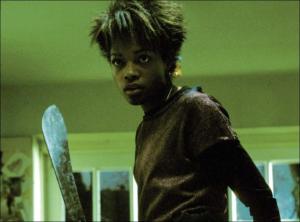 Perhaps what is different than most zombie films is that the audience grows to like the characters and root for their survival. In most horror films the characters are either too stupid or sketchy that it allows the audience to wait in amusement for their eventual horrific deaths. Its simple: we want to see these people die because its titillating (Maybe I was wrong about all the zombie analysis I still had in my head).
Boyle does service a slight message in his zombie film when the group gets to the military base. Perhaps, he muses, our military and trusted leaders are no better than those rabidly wandering the streets. The idea of a thriller set against a biological pandemic also feels very timely and relevant. The film kind of drags in the middle during the stretch between London and the military base. And the end was a bit too much Die Hard for my taste, but is suitably climactic.
Boyle has crafted a creepy, smart, and engrossing piece of entertainment. I hope people dont confuse this film with that Sandra Bullock clunker, 28 Days. They may be spending the entire time wondering where shirtless Viggo is and when Bullock will start her endless pratfalls (You knew I was going to talk about that movie somewhere).
Nate’s Grade: B
Share this:

Spellbound (2002)
 The field of super spellers heading to Washington D.C. is more varied than you could possibly imagine. What is truly amazing, and equally heart-rending, are the scenes showing working-class families encourage their children to excellence. Angelas parents fled Mexico to give a better life for their family in Texas. Her father has been a rancher for 30 years and does not speak a word of English. Its incredible to see the amount of pride her parents have when they see her compete. She says she’s doing it for them. Ashley lives in the projects outside of Washington D.C. She exudes confidence as she makes long treks from school to the cramp apartment her family lives in. Her mother had never expected her child, from her background, to compete for spelling contests but becomes her biggest and most vocal cheerleader.
Spellbound also shows the fanatical level of commitment some of these kids have. Neils father pushes his son to the extremes and the two go over 4,000-8,000 words a day. Neils parents even hire a spelling coach and he gets instruction from his schools foreign language teachers on the history and spelling of foreign words. The commitment most of these kids show is jaw-dropping and obsessive. Ted is the exact opposite. Hes so nonchalant about the spelling bees that it almost seems like hes battling complacency in his small town. His younger brother has the films best line: “It was so exciting. If I had blood pressure it would be through the roof!”
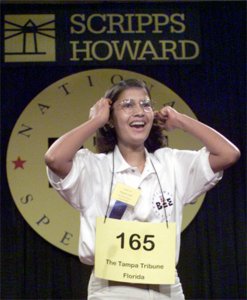 My favorite speller is April. She and her parents live in a dying town. Her father worked in a asbestos factory until it was shut down. He now operates a tavern across from the decaying factory. The family struggles to get by but has so much visible love for their daughter, so much undying support for April. I saw April’s parents as the type you might be embarrassed to say something weird to your friends (“Mom, you are so out of it, geez.”) but the same type that you secretly thank everyday you have. April declares herself a pessimist and doubts the distance she’ll go in the national bee. This is the kind of instantly likeable and compelling character Hollywood has forgotten how to create.
With Spellbound we get to know our hopefuls so well that were saddened before the national bee even begin because, at best, only one of them will win. And, as corny as it sounds, they are all exemplary examples of winners.
Spellbound is the most thrilling movie I’ve seen in ages, totally walloping the heady pretensions of certain action movies. This film will make your palms sweat and then some. Your heart races wildly when it isn’t in your throat. Several films like The Sweet Hereafter or American History X have brought me to tears through their adept expressions of sadness; Spellbound may be the first film thats ever brought me to tears (about five times) just for pure vicarious happiness and joy. To see these kids achieve will, and I know this is so cheesy and blurb-y, but it will make your spirit soar and want to cheer. I’ve since watched the film several times on DVD, and I must report how surprised I am that I end up crying every time, though at different spots. This is a joyous movie, pure and simple.
Spellbound is an uplifting movie for everyone that is guaranteed to have some lasting, triumphant resonance. If you cant feel for these kids I suggest you check if your heart is defective. This is a great example of what film can do, what the American dream can mean for people, and the great diversity an academic competition can inspire. Spellbound is thrilling, heartwarming, and sunnily satisfying. You’ll fall in love with these kids and their hopes and dreams.
E-X-C-E-L-L-E-N-T. Excellent.
Nate’s Grade: A
Share this:

Better Luck Tomorrow (2002)
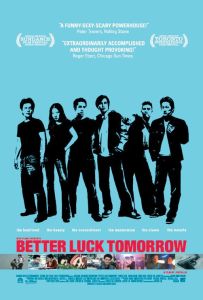 This film shows a fascinating side to the underbelly to suburban malaise. The story centers on a group of Asian-American friends that are social delinquents and petty criminals that can get away with it because theyre star students. Its an interesting dichotomy in Justin Lin’s directorial debut. The cast is strong and the pacing is brisk. The opening five minutes yanks you into this world and places you in the hands of a confidant voice. Familiar elements abound like unrequited love, jealousy, crashing lows, but Better Luck Tomorrow gives them a mildly fresh spin. The films familiar territory gets the better of it in a languid final act, but the ride is still an enjoyable and entertaining one at that.
Nate’s Grade: B
Share this:

The Hours (2002)
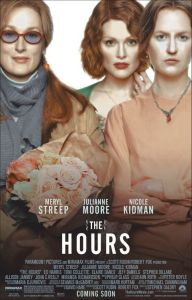 Okay, after watching the Golden Globes award show and seeing The Hours crowned with the highest prize, and hearing incessantly about Nicole Kidman’s fake prosthetic nose in the movie, it was time to venture into that darkened theater and see how good the awards-friendly The Hours was. Little did I fully realize what I was getting myself into.
Nicole Kidman plays Virginia Woolf, who is in the midst of writing her novel Mrs. Dalloway, where she proposes to display a womans entire life through the events of a single day. Julianne Moore plays Laura Brown, a housewife in 1951 having difficulty adjusting to a domestic life that she feels ill equipped for. Meryl Streep plays Clarissa Vaughan, a gay copy-editor in 2001 planning a party for a poet and former lover (an emaciated Ed Harris), who is suffering from the late stages of AIDS. These three storylines will be juggled as the film progresses, with each womans life deeply changing before the end of the day.
The Hours is a meandering mess where the jigsaw pieces can be easily identified. The attempt at a resolution for an ending, tying the three storylines together, is handled very clumsily. The film spins on and on that you start to believe the title may be more appropriate than intended. What this movie needed was a rappin kangaroo, post haste! The film is wrought with victimization and screams ”Give me an award already!” Before you know it youre being bludgeoned to death with what is profoundly the most over serious Lifetime network movie ever assembled. And there’s nothing fundamentally wrong with Lifetime movies but The Hours does not share the sensibilities of its TV brethren.
 Kidman, nose and all, gives a strong performance displaying the torture and frailty of a writer trapped within her own mind but too often relies on wistful staring or icy glares. Moore is effectively demoralized but cannot resonate with such a shallow character. Streep is the least effective of the three and fizzles among an over-stuffed assembly of characters.
The supporting cast is unjustly left for dead. The characters are seen as parody (Toni Collette as Moore’s un-liberated homemaker neighbor), extraneous (Claire Danes as Streep’s daughter, Allison Janney as Streep’s lover, Jeff Daniels as Harris ex-lover, you know what, almost anyone in the Streep storyline), one-note (the workmanlike John C. Reilly who plays yet another doting and demystified husband) or merely obnoxious (Moore’s brat child that refuses to separate from her). It appears The Hours is the three lead actress game, and everyone else is not invited to play along.
Stephen Daldry’s direction shows surprising stability and instinct after his art-house pandering Billy Elliot showed little. The technical aspects of The Hours are quite competent, especially the sharp editing and musical score, which just points out further how slickly hollow and manufactured the film is.
The Hours is an over-glossed, morose film that is too self-important for its own good. It sucks the life out of everything. And for all its doom and gloom and tsunami of tears, the only insightful thing The Hours is trying to pass off onto the public is that women are more depressed than you think.
Nate’s Grade: C
Share this:

The Rules of Attraction (2002)
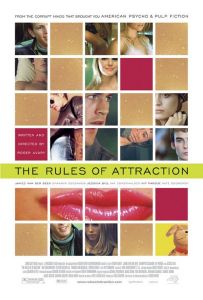 The Rules of Attraction is based on Bret Easton Ellis’ hedonistic 80s novel about boozing coked-out, aloof teenagers and their rampant debauchery. Roger Avary was Quentin Tarantino’s writing partner for years, with an Oscar sitting at home for co-writing Pulp Fiction. As a director Avary lays the visual gloss on thick utilizing camera tricks like split-screens and having entire sequences run backwards. While Ellis’ source material is rather empty, echoing the collegiate friendships bonded over substances or social lubricants, Avary does his best to represent the dazed world of college.
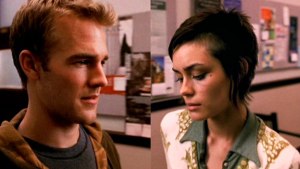 We open with Lauren (Shannyn Sossamon) getting raped by some drunk “townie” while the film buff she had her eyes on videotapes it. She’s just broken up with the bisexual and apathetic Paul (Ian Somerhalder), and both are interested in the sociopath Sean Bateman (James Van Der Beek), a self-described emotional vampire. Lauren keeps a picture book of venereal diseases to ward her from her wayward sexual urges. Her roommate Lara (Jessica Biel) needs no such book. Our introduction of Lara has her dancing down a hall, liquor bottle in each fist, bedding an entire sports team. Some attractions connect, many don’t, but the fun is watching the characters interact in their own seedy yet often hilarious ways.
The best thing that The Rules of Attraction has going for it is its about-face, against-type casting. The film is populated with the WB’s lineup of clear-skinned goody-two-shoes getting a chance to cut loose. Van Der Beek broods like a predatory hawk and bursts with spontaneous rage. Biel sexes it up as a cocaine-addicted harlot who asks if she’s “anorexic skinny” or “bulimic skinny.” Even Fred-Wonder-Years-Savage shows up briefly to shoot up between his toes! The adults of this world are no better than the kids. Eric Stoltz has an extended cameo of a duplicitous professor offering a higher GPA if any coeds are willing to go down on their morals. Swoosie Kurtz and Faye Dunaway show us that pill-popping ditherheads may likely breed drug-addled teenagers.
 Attraction may have the most disturbing suicide I’ve ever witnessed in film. After having her advances rejected a woman slips into the bathtub, razor in hand. The scene is as unsettling as it is because the camera hangs on the poor woman’s face every second and we gradually see the life spill out of her as the music becomes distorted, not letting us escape the discomfort.
Some of Avary’s surface artifice works perfectly, like Victor’s whirlwind account of an entire semester in Europe. Some of the visual fireworks are distractions to the three-person narrative but the film is always alive with energy, even when it’s depressing you. What The Rules of Attraction does get right is the irrational nature of attraction. Each character is trying to fill an inaccessible void with what they think is love but will often settle for sex, drugs, or both. The Rules of Attraction is made up of unlikable, miserable characters that effectively do nothing but find new ways to be miserable. It constantly straddles the line of exploitation and excess but maintains its footing. The movie is entirely vapid but it is indeed an indulgently fun yet depraved ride. If you’re looking for degeneracy instead of life-affirmation, then The Rules of Attraction is your ticket.
Nate’s Grade: B
Share this:

Secretary (2002)
 Secretary is a new romantic comedy with a few kinks to it. Its actually the most romantic S&M movie ever. It’s the first S&M romantic comedy since maybe Garry Marshall’s disastrous 1994 Exit to Eden. Im still trying to get the image of Rosie O’Donnell in a bondage mask out of my ongoing nightmares.
Lee Halloway (Maggie Gyllenhaal) is fresh from a stop at a mental institution for her hazardous habit of cutting herself to feel relief. Her overbearing mother stashes the entire kitchen cutlery in a locked cabinet. The sheltered Lee resorts back to a kiddy make-up box stashed under her home bed. Instead of colorful brushes and arrays of lipstick, she has a selection of sharp objects. Lee goes job hunting to step back from her habit, and is hired as a secretary to E. Edward Gray (James Spader). He is a rigid taskmaster who delights in pointing out typographical errors with his red marker, his weapon of choice. Gray enjoys his dominance and Lee complies, even if its routing through garbage. He ticks away Lee’s flaws like a checklist of annoyance but also appears to have genuine concern for her. When he notices her wounds Gray confronts her and convinces Lee to stop cutting herself.
The turning point arrives when Gray orders Lee into his office one afternoon. He commands her to bend over his desk and then delivers a sound spanking. Lee stares at her purple rump with fascination, like something has been awakened inside her. Soon enough Lee purposely makes typos so she can re-assume her spanking position.
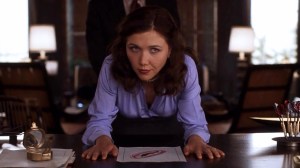 Maggie Gyllenhaal is a cinematic find with a fearless and breathtaking performance that is at once delicate, nervous, self-controlled, seductive and delightful. Gyllenhaal, with her heart-like face and pert lips, radiates star quality. She allows the audience into Lee’s head and we quickly fall in love with this peculiar yet charming heroine. If there is any justice in this world Gyllenhaal should at least get an Oscar nomination (she didn’t). Spader can do this left-of-center creepy character stuff in his sleep.
Secretary on the surface may seem like a fetish flick but it’s no different than boy (sadist) meets girl (masochist) and falls in love. Director Steven Shainberg treads carefully around serious subject matter, like Lee’s self-mutilation, to focus on these two very special characters. Secretary isn’t making any loud statements on sadomasochism or post-feminism, it’s just showing us that S&M is the route these two people take to find true love. It doesn’t judge them for their unconventional tastes and neither should we. This is one of the finest romances in recent memory and it seems to come from one of the most unlikely places.
Sadomasochism has been predominantly shown involving pain or some leather-masked madman evoking torture. Secretary may be the film that shows there can be pleasures with pain. Some people regard what Lee and Edward do as sick, perverted, or downright wrong. Secretary is a foot in the door to get people to understand what willing sadomasochism really is about. We all have fetishes and interests, and S&M is the number one fetish truth be told. This isn’t your everyday romance.
Obviously, this is a movie that will not appeal to everyone. The relationship between our leads is surprisingly complex but gentle and even sweet (if thats the proper word for an S&M romantic comedy). Secretary shows that it truly takes different strokes and, despite an overly silly ending, is the most pleasing romance of the year. Youll never look at red felt pens the same.
Nate’s Grade: A
Share this:

One Hour Photo (2002)
 Do we regularly invite strangers to view the picturesque and personal moments of our life like marriages, celebrations, and maybe even a handful of hastily conceived topless photos? Well we all do every time we drop off a roll of film for development.
Robin Williams continues his 2002 Tour of the Dark Side (Death to Smoochy, Insomnia) as way of Sy, your friendly photo guy working at your local Sav-mart superstore. Sy takes an intense artistic pride in the quality of prints he gives. He knows customers by name and can recite addresses verbatim. One family in particular Sy has become fond of is the Yorkins, mother Nina (Connie Nielsen), father Will (Michael Vartan) and nine-year-old Jake. The Yorkins have been coming to Sav-mart and Sy for over 11 years to have their photos developed. He tells Nina that he almost feels like Uncle Sy to the family. For Sy, the Yorkins are the ideal postcard family with perennially smiling faces and the happiest of birthdays. He fantasizes about sharing holidays with them and even going to the bathroom in their posh home.
 Sy is an emotionally suppressed and deeply lonely man caught in his delusions. In one of the eerier moments of the film we see that Sy has an entire wall made up of hundreds of the Yorkin’s personal pictures. When Sy attempts to become closer to the objects of his infatuation that’s when things begin to unravel at a serious pace. The more Sy learns that the Yorkins are not the perfect family he yearns for the more he tries to correct it and at any cost.
One Hour Photo is an impressive film debut by music video maven Mark Romanek (best known for the NIN “Closer” video). Romanek also wrote the darkly unrepentant story as well. One Hour Photo is a delicate voyage into the workings of Sy’s instability with lushly colorful metaphors. Romanek’s color scheme is a lovely treat, with vibrant colors popping out and Sy’s life being dominated by cold, sterilized whites. His direction is chillingly effective.
This may be the first time we can truly say Robin Williams has not merely played a version of Robin Williams in a movie. Sy’s thick glasses and thinning peroxide-like hair coupled with an array of facial pocks allow us to truly forget that the man behind the mask is Mork. His performance is unnerving and engrossing. The supporting cast all work well. Nielsen (Gladiator) is a sympathetic wife even if her hair looks like it was cut with her eyes closed. Vartan (Vaughn on ABC’s wonderful Alias) plays understandably wary of Sy’s friendliness. The great Gary Cole has a small role as Sav-mart’s manager who grows tired of Sy’s outbursts and peculiarities.
 One Hour Photo is rife with nervous moments and titters. Williams almost has an uneasy predatory feel to him when left alone with Jake. The greatest achievement the film has is that is depicts the scariest person youll ever see, sans hockey mask, and by the end of the film you actually feel degrees of warmth for this odd duck.
Not everything clicks in Romanek’s dark opus. A late out-of-left-field revelation by Sy feels forced and needlessly tacked on. The Yorkin family photos all appear to be taken by a third party, since the majority of them involve all three of them in frame. The climax to One Hour Photo also feels anything but climactic.
A compellingly creepy outing, One Hour Photo is fine entertainment with beautiful visuals and a haunting score. And maybe, in the end, it really does take an obsessive knife-wielding stalker to make us realize the importance of family.
Nate’s Grade: B
Share this:

The Good Girl (2002)
 Jennifer Aniston, a Friends favorite, has been getting attention for her less than attractive turn in adultery with The Good Girl. However, the movie’s biggest flaw is Aniston herself. The Good Girl can try and make her look as disheveled as they can, and they can try and make her wear as much unflattering baggy clothing as possible, but in the end we’re still watching Mrs. Brad Pitt groan about the purgatory that is Middle America. An actress of better caliber could likely pull off the rub, but alas, Aniston is not quite that actress yet.
Aniston narrates the disenchantment as Justine with her dead-end job working at a Wal-Mart-esque chain store and her dead-end marriage to perennially stoned house painter Phil (John C. Reilly). She longs for an escape and a change of pace from a grind where there appears none. Then one day a new teenage co-worker named Holden (Jake Gyllenhaal) comes into her life and seems to represent the danger and vitality Justine has felt missing in her life for so long. Her affections are at first stalled in apprehension, but soon Holden and Justine are ducking into motels and finding excuses to get busy in the stock room. But soon enough the honeymoon ends. Justine learns more distressing items about the emotionally dependent and unstable clerk, like his real name is Tom (“Tom is my slave name” he tells her). What once seemed exciting is now becoming more perilous to cover up.
 The Good Girl then descends into blacker territory with some unexpected turns, but also some more unbelievable moments. When confronted by Phil’s best friend Bubba (Tim Blake Nelson) about her infidelity she is given a rather unpleasant ultimatum that she gives in too way too easily. The longer the affair and messy cover up continues the more audience loyalties shift toward the victim, Phil. He admits he isn’t the smartest man or the best husband, but his feelings are authentic for his wife. And the more the audience views him the more they see that he truly does love Justine.
And again, we have to come black to that road block of a lead. A more accomplished actress could pull off this bittersweet role with aplomb and believability. A better actress could have slowed down the audience shift in loyalty away from her unfaithful protagonist. The supporting cast of The Good Girl has a lot more bite to them. Gyllenhaal (Donnie Darko) now seems to be an expert in the disturbed youth. Reilly starts off as a loaf but transforms into a sympathetic character that has his own touching moments of unannounced affection to Justine. Nelson gives the film some of its funniest moments along with the lethally deadpanned Zooey Deschanel. The lone stereotype in the bunch is played by Mike White (who wrote the film) as an overly enthusiastic Christian do-gooder.
It’s a pity The Good Girl has its anchor around the neck of Aniston and willing to go as far as she will take it, because The Good Girl is indeed a good film with some wicked moments of comedy and a well-written story. It’s just that Aniston’s acting limitations gravitate what could have been a better film.
Nate’s Grade: B


 nathanzoebl
You must be logged in to post a comment.