Blog Archives
X-Men: Days of Future Past (2014)
 Ever since Marvel’s Avengers destroyed the box-office in 2012, every studio with super hero franchises has been looking to follow suit. It’s not just about comic book franchises; it’s about building a comic book universe. It’s been a long dark period for the X-Men ever since the regrettable 2006 debacle The Last Stand, which callously killed characters, butchered others, and botched the most famous storyline in the history of the comic. In 2011, Matthew Vaughn proved there was still life to be found in the franchise with his terrific 60s-era prequel, X-Men: First Class. Now, post-Avengers, Fox is salivating at combining the past X-Men and the present X-Men into one colossal movie with a colossal budget. Back on board is director Bryan Singer, the director of the first two X-Men films and the man who helped kickstart the modern superhero era. If that wasn’t enough riding on the film, X-Men: Days of Future Past also follows the second most famous storyline in the history of the comic.
In the horrible future, killer robots known as Sentinels hunt down mutants. These are the invention of Dr. Boliver Trask (Peter Dinklage), a military scientist who was killed back in 1973 by the vengeful shape-shifting mutant, Mystique (Jennifer Lawrence). The murder convinced humans to subsidize Trask’s killer robot plan of defense. Thanks to experiments replicating Mystique’s mutant ability, the Sentinels have the ability to adapt to any power, turning them practically indestructible. In the future, the Sentinels are eradicating all mutants, mutant sympathizers, and eventually human beings. Magneto (Ian McKellen) and Professor Xavier (Patrick Stewart) have teamed up with a small band of surviving mutants, including Wolverine (Hugh Jackman). Thanks to the phasing powers of Kitty Pryde (Ellen Page), they can send Wolverine’s consciousness back to 1973 so that he can prevent the Trask assassination. The only ones who can help Wolverine is the younger Xavier (James McAvoy) and Magneto (Michael Fassbender), former mentors to Mystique. Except Xavier is a recluse and strung-out on drugs to dull his powers and Magneto is locked away underneath the Pentagon.
 The X-Men films have always had a topical advantage to them that provided a weightier sense of drama than your typical story about a reluctant soul blessed with amazing powers. The mutant allegory automatically applies to any sub-group facing oppression mostly through fear and ignorance. What other superhero franchise has two opening scenes in a German concentration camp? The stakes are even larger with this movie because of the Horrible Nightmare Future that must be prevented. Now we all assume said Nightmare Future will be avoided by film’s end, so the movie provides a proverbial reset button that the filmmakers can have fun with, and they do (look out future mutants). Excluding the Nightmare Future framing device that becomes an unnecessary parallel storyline, the majority of the film takes place in 1973. If X-Men: First Class tapped into the groovy optimism and “take me for what I am” sense of social justice of the time, then this film certainly taps into the disillusionment of the 1970s, where the promise of reform and hope morphed into anger and cynicism (hey, that’s like us today!). This loss of innocence is typified in Mystique, who becomes the central figure of the movie in many ways. Her seething desire for vengeance is what animates her, as well as the pain of betrayal from the men closest in her life, as well as the world who once held such promise. Also, Jennifer Lawrence (The Hunger Games) has become one of the biggest female stars on the planet, so it makes sense to bolster her role. The central conflict is stopping an assassination, one domino that leads to many others, but it’s emotionally about Mystique having to confront her feelings of hate. It’s another platform for the ongoing conflict of perspectives between Xavier (restraint, tolerance) and Magneto (strong defense, eye for an eye). But as I found in First Class, it’s hard not to agree with Magneto as human overreaction leads to rash and thoughtless actions, like Horrible Nightmare Future.
That’s not to say that X-Men: Days of Future Past fails to deliver when it comes to the popcorn thrills and action highs we crave in our finest summer blockbusters. The action set pieces are large without dwarfing the characters, playful and imaginative without losing a sense of edge and danger. I loved how the character Blink (Bingbing Fan) would utilize her mutant power of opening portals as a fighting strategy. It makes action sequences so much more inventive and visually exciting to throw a series of portals. The pacing is swift short of the second half of Act Two, gearing up for the climactic showdown in D.C. that dominates Act Three. The time travel story starts with a lot of exposition but it gets smoothed out as it goes, the rules of the story fall into place. Every action sequence hits, some admittedly better than others, but it’s the small touches that Singer injects that made me smile most. I enjoyed Magneto pointing a gun, being toppled, but still using his power to have the gun fire in midair. I enjoyed the animalistic nature of the Beast/Wolverine brawl. Jackman is looking even veinier than usual in his bulked out form. Thankfully the fish-out of-water timeline jokes are kept to a minimum. Wolverine is the perfect glue to hold both timelines together. And then there’s that standout Pentagon prison break sequence (more on that later). Singer might not have the most natural instincts developing and staging action, but the man is a surefire talent when it comes to staging eye-catching visuals (I would say the same about Christopher Nolan). Even his unfairly maligned Superman Returns is proof of the man’s cinematic gifts. As far as entertainment value, this is right up there with X-Men 2. I still view Vaughn’s savvy First Class as the best X-film of the bunch, which has only gotten better the more I’ve watched it.
 And if that wasn’t enough, Singer’s new film does what every fan has been hoping for: (spoilers) it erases all the crummy X-Men movies, namely 2006’s Last Stand and the first Wolverine solo effort, from the official timeline. It’s time to start anew, toss out the old stuff nobody liked, and forge ahead with a new unified timeline. There can be two parallel X-Men franchises, one present/future and one with the prequel casts, and they can go on forever as desired, or until the prequel cast prices itself out. In one fell swoop, Singer and company have reset the mother franchise and given fans new hope about the possibilities. Make sure to stick around to the very end of the credits for a scene that indicates directly who the next major villain will be in the 2016 sequel.
Let me take time to single out just how expertly Evan Peters (TV’s American Horror Story) steals the entire mutant-heavy movie. First, he’s the most comically attuned character, which is a nice break from how serious, and rightly so, every character is so often. Quicksilver provides a whole new jolt of entertainment, and when he checks out after the prison break sequence you’ll dearly miss him. The character is a rapscallion (as my late grandmother might have termed) that enjoys using his super speed powers to mess with people, to test his limits, to see what he can get away with, and a Pentagon jailbreak is right up his alley. Ignore the silly yet period appropriate outfit and ignore what initially seems like Peters’ smirking self-involvement from trailers and ads. When this character is onscreen the movie has a joyful sense of irreverence. He is instrumental to freeing Magneto and the onscreen depiction of his super speed is the best illustration of the power ever conceived in film and TV. There is a segment sent to Jim Croce’s “Time in a Bottle,” and some wonderful special effects, which is just so playful, so giddy, and so cool that it very well might be my favorite moment in any superhero movie… ever. It is definitely an applause-worthy moment and my audience responded in kind. Quicksilver is a perfectly utilized supporting player in a movie stuffed to the gills with characters.
The time travel geek in me has a few quibbles with the parallel lines of action from past and present. Wolverine’s consciousness is sent back in time but he film plays out like it’s happening simultaneously to the events of the future. So if Wolverine is pulled out in the middle of the movie, he’ll have failed his mission to change the future, even though by going back in time he’s already, blah blah blah butterfly effect. Anyway, I understand how they want to make the future story have a sense of urgency but it’s not like waking Wolverine from a dream; the times are not happening concurrently. He’s in the past, meaning that the moment he goes back there, the future will already be altered due to the consequences of his actions, for better or worse. There is no race against time to keep his consciousness back in time until he complete his mission. I can see why they went this route for a summer blockbuster, but that doesn’t quell the quibbles.
 X-Men: Days of Future Past is a time-hopping, unabashedly fun time at the movies; well as fun as preventing nightmarish futures built from the consequences of oppression and prejudice can be. With Singer back in the saddle and the bridging of the two X-Men universes, the series is back on track and once again the promising font of stories and characters. The newest X-film is one of the most entertaining, funny while still being dramatic, and while burdened with the largest cast of any super franchise, finds notable moments for its characters big and small to remind us that these people matter. While less philosophical and funky than First Class, this is one of the best films in the franchise, on par with X2. The action sequences and visual eye-candy are great fun with some inventive and memorable touches. It’s also nerdy fun getting to watch the past and present interact, and for many this is their first return since 2006’s crappy Last Stand. It’s not a perfect movie; I wish there was more early Sentinel action, I wish Dinklage had much more to do, and I wish that the plot didn’t so transparently hinge on Xavier not having his powers. The slate is clean and all X-Men fans can breathe a sigh of relief. The future is once again rosy. The X-Men, and not just Wolverine, are relevant once again.
Nate’s Grade: B+
Share this:

Prisoners (2013)
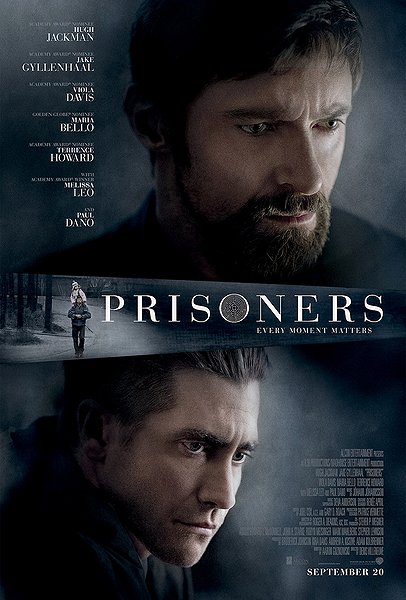 One rainy Thanksgiving day, two little girls go missing. Keller and Grace Dover (Hugh Jackman, Maria Bello) and their neighbors, Franklin and Nancy Birch (Terrence Howard, Viola Davis), discover their two young daughters have gone missing. A manhunt is underway for a suspicious RV, spearheaded by Detective Loki (Jake Gyllenhaal). The RV is found with Alex Jones (Paul Dano) inside. The problem is that there is no physical evidence of the missing girls inside the RV and Alex has the mental capacity of a ten-year-old. He’s being released and Keller is incensed. He’s certain that Alex is guilty and knows where his missing daughter is being held. One night, Keller kidnaps Alex and imprisons him in an abandoned building. He beats him bloody, demanding Alex to tell him the truth, but he only remains silent. Loki has to deal with finding the girls, finding a missing Alex, and trailing Keller, suspicious of foul play.
This is a movie that grabs you early and knows how to keep you squirming in the best ways. The anxiety of a missing child is presented in a steady wave of escalating panic. The moment when you watch the Dover and Birch families slowly realize the reality of their plight, well it’s a moment that puts a knot in your stomach. Prisoners is filled with moments like this, that make you dread what is to come next. The crime procedural elements of the case are generally interesting and well handled to the point that they feel grounded, that these events could transpire, including police mistakes. The central mystery sucks you in right away and writer Aaron Guzikowski (Contraband) lays out clues and suspects with expert pacing, giving an audience something new to think over. At 153 minutes, there is a lot to chew over in terms of plot developments and character complications. It’s a compelling mystery yarn and shows such promise, though the last half hour cannot deliver fully. Fortunately, Prisoners is packed with terrific characters, a real foreboding sense of Fincher-esque chilly atmosphere from director Denis Villeneuve (Incendies) and greatest living cinematographer Roger Deakens (Skyfall). The film’s overall oppressive darkness is also notable for a mainstream release. The darkness doesn’t really let up. It’s hard to walk out feeling upbeat but you’ll be thankful for those punishing predicaments.
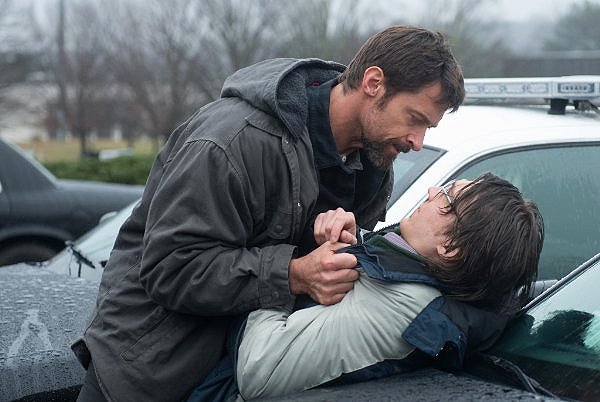 By introducing the vigilante torture angle, Prisoners is given a dual storyline of suspense and intrigue. How far will Keller go? Will he get caught? What will his friends think? Will they be supportive or will they crack? How does this change Keller? That last question is the most interesting one. Others tell us how Keller is a good man, and he’s certainly a devoted family man, but does a good man imprison and torture a mentally challenged man? Does a good man take the law into his own hands? If it meant the difference between your child being dead or alive, how far would you go? These are the questions that bubble up and the movie makes you deal with them. The torture segments are unflinching and challenge your viewer loyalty. You will be placed in an uncomfortable moral position. Then there’s just the what-would-you-do aspect of the proceedings. Could you torture someone, possibly to death? Fortunately most of us will never have to find out. I do wish, however, that the movie had gone further, complicating matters even more severely. It becomes fairly evident halfway through that Alex is innocent. It would have been even more interesting to intensify Keller’s legal troubles. If the police have their man, what does Keller do with Alex? Does he let him live after everything Keller has done? I think it would have worked as a logical escalation and put the audience in an even more uncomfortable position, forcing us to question whether Keller deserves to get away with what he did or pay a price.
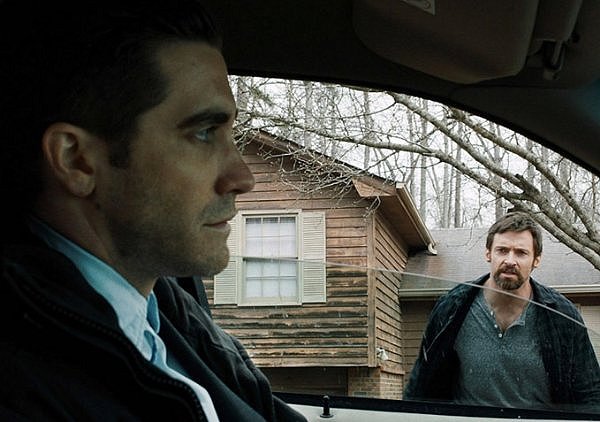
What separates Prisoners from other common thrillers, and what must have appealed to such an all-star cast, is the raised level of characterization on display. Jackman’s (Les Miserables) intensity is searing, as is his character’s sense of pain and futility. By all accounts, this is the best acting work Jackman has done in his career. Keller’s determination is all consuming, pushing away his doubts with his reliable pool of anger. Everyone is failing him so he feels he must take matters into his own hands, and the film does a fine job of relating his frustrations and urgency. But Keller is also in danger of derailing the ongoing investigation, becoming a liability to finding his daughter. This predicament pushes Loki into the tricky role of having to defuse parental intrusion, pushing him into a role he loathes, having to tell a harrowed father to back off. Loki is also consumed with the case, causing plenty of internal tumult and chaffing with the inefficiency and miscommunication of the police force. Gyllenhaal (End of Watch) doesn’t play his character big; he keeps it at a simmer, with hints of rage below the surface. His character is certainly richer than the Driven Cop we’ve often seen. His character is given less moral ambiguity but you feel his frustration working within the system and hitting dead ends. These two performers are both ticking time bombs.
The rest of the supporting cast has a moment or two to shine, though the characters are given less to work with. Bello (Grown Ups 2) is hastily disposed of from a plot standpoint by making her practically comatose with grief. Davis (The Help) knows how to make the most of limited screen time (see her Oscar nominated performance in 2008’s Doubt as evidence), and she’s heartbreaking in her moments of desperate pleading. Howard (Lee Daniels’ The Butler) is meant as the foil to Keller, a voice of moral opposition, but Howard lets the gravity of his involvement in horrible acts hit you hard. Dano (Ruby Sparks) has the toughest part in many ways because of his character’s brokenness and the fact that he’s being tortured so frequently. It’s hard not to sympathize with him even if part of you suspects his guilt. Naturally, Dano is adept at playing weirdos. Melissa Leo (Olympus Has Fallen) is nearly unrecognizable as Alex’s older aunt caring for him. She’s prepared for the worst from the public but has some nice one-on-ones where she opens up about the difficulty of losing a child herself.
 Prisoners is such a good mystery that it works itself into a corner to maintain it, ensuring that no real answer or final reveal will be satisfying, and it isn’t. I’m going to tiptoe around major spoilers but I will be delving into some specifics, so if you wish to remain pure, skip ahead. The culprit behind the child abductions, to put it mildly, is underwhelming and rather obtuse in their wicked motivation. The specified reason is to test people’s faith and turn them into monsters by abducting their children. This comes across as an awfully nebulous philosophical impetus, and it’s a motivating force that I find hard to believe even in the grimy, dark reality the movie presents. It just doesn’t feel grounded, more like a last-ditch conclusion to a TV procedural. However, what makes this ending worse is the false turns and red herrings that Prisoners utilizes. Every mystery requires some red herrings but they need to seem credible, and if executed properly, the characters will learn something useful through the false detour. The issue with Prisoners is that it establishes a secondary suspect that is so OBVIOUSLY the guilty guy, compounded with plenty of incriminating evidence including the missing children’s clothing covered in blood. When this suspect comes undone, his sketchy behavior starts to become a series of contrivances. They introduce a character that is too readily the guilty party, and then they just as easily undo him. And here’s another character of questionable motivation. Plus, there’s the central contrivance of having two characters that remain mute under all torturous circumstances unless the plot requires them to say something that can only be interpreted in an incriminating manner. These mounting plot contrivances, and an ending that wants to be ambiguous but in no way is, rob Prisoners of being the expertly crafted thriller it wants to be. It still hits you in the gut, but you’ll be picking it apart on the car ride home.
Grisly, morally uncomfortable, and genuinely gripping, Prisoners is a grownup thriller that isn’t afraid to go to dark places, with its characters and its plot. It hooks you early and keeps you on the hook, pushing its characters to make desperate decisions and asking you to think how you would perform under similar pressure. It’s a fascinating meta game and one that also adds extra intrigue to a rather intriguing mystery. It may not be revolutionary, but Prisoners is an above-average thriller with strong suspense and characterization. Where Prisoners stumbles is how it brings all this darkness to a close. The ending is rather perfunctory and not terribly satisfying; perhaps no ending would have been truly satisfying given the setup, but I’d at least prefer an alternative to the one I got, especially since it feels less grounded than the 140 minutes or so beforehand. It’s an ending that doesn’t derail the movie, but it certainly blunts the film’s power and fulfillment. Then again perhaps a word like “fulfillment” is the wrong term to use on a movie that trades in vigilante torture and the cyclical nature of abuse. In pursuit of perceived justice, what are we all capable of doing? The answer is likely surprising and disheartening for many, and Prisoners deserves credit for pushing its audience into uncomfortable positions and reflections.
Nate’s Grade: B
Share this:

The Wolverine (2013)
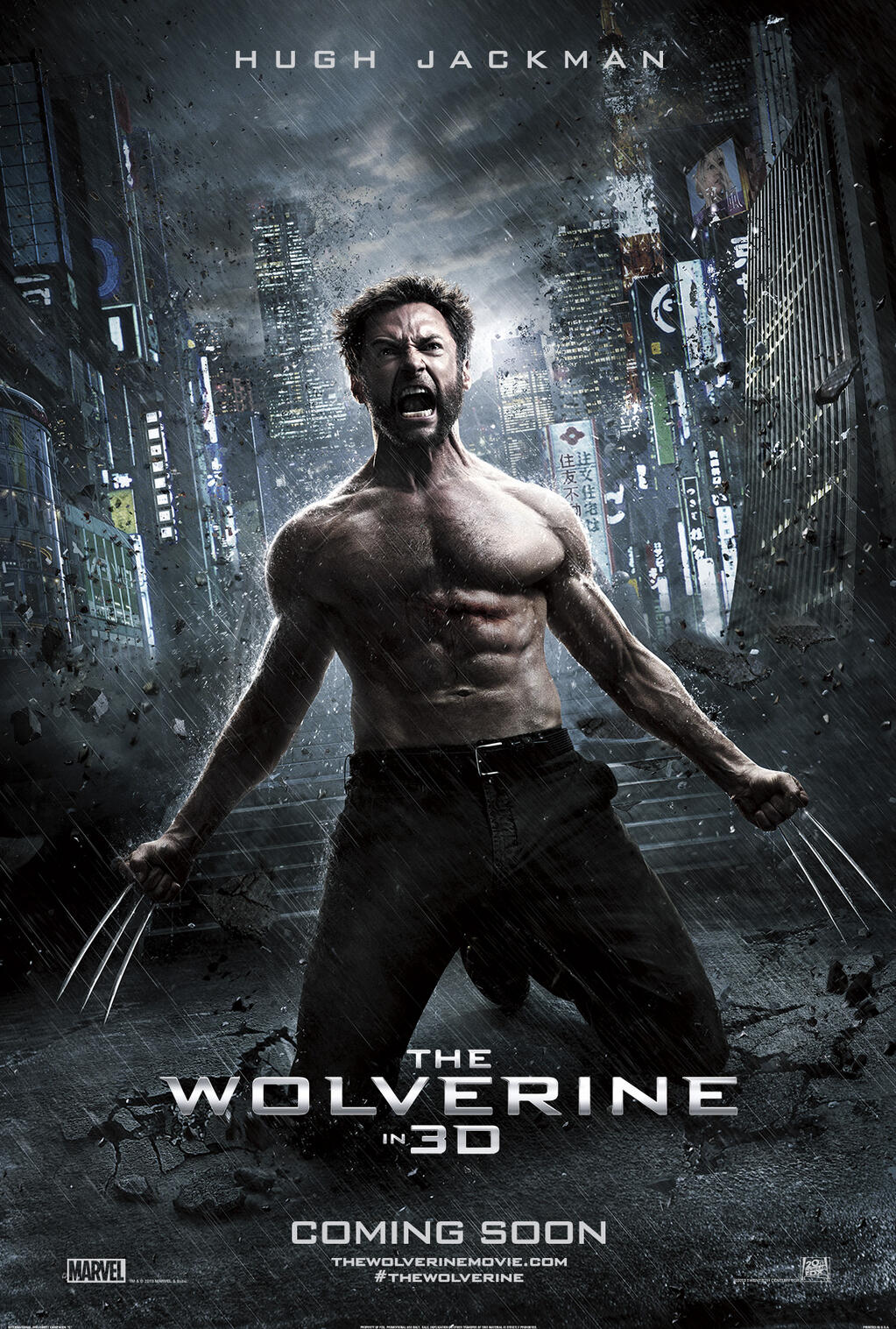 For a character universally beloved by comic and movie fans, Wolverine has fallen on some hard times. It’s hard to find too many supporters for either 2006’s X-Men 3: the Last Stand or 2009’s X-Men Origins: Wolverine. He had a fun cameo in 2011’s retro X-Men First Class, but other than that we’ve gone almost a decade without a respectably good movie starring Wolverine. It looked like Darren Aronofsky was going to be the answer to that drought of quality. The Black Swan director, who worked previously with Jackman on the intensely personal The Fountain, spent six months developing a Wolverine film set in Japan. Then Aronofsky dropped out, making this the second superhero franchise he missed out on (he was tapped to reboot Batman before Christopher Nolan landed the job). James Mangold (Knight and Day, Walk the Line) stepped into the director’s chair and now we have the directly titled semi-sequel, The Wolverine. It’s a step up quality-wise but even that comes with qualifiers.
Many years after the events of X-Men 3, Logan (Hugh Jackman) is living a solitary life amid the Canadian wilderness. He’s looking to lay low and he’s haunted by visions of his lost love, Jean Grey (Famke Janssen), the woman he was forced to kill to save the world. Yukio (Rila Fukushima), a mutant with the ability to foresee people’s deaths, finds him for her employer. He’s invited to Tokyo at the request of a wealthy and dying businessman, Yashida (Hal Yamanouchi). Back during World War II, Logan saved Yashida’s life, shielding him from the atomic blast that wiped out Nagasaki. Yashida has an offer for Logan. He can make him mortal again and take away his advanced healing ability. Thanks to a sketchy mutant, Wolverine loses that ability and goes on the run to protect Yashida’s granddaughter, Mariko (Tao Okamoto), from gangs and rival businessmen.
 Benefiting from low expectations, The Wolverine is a solid summer superhero tale that’s more interesting in its divergences from… summer superhero movies than it is when it follows that basic script. I appreciated that here is a superhero movie that actually doesn’t have to be wall-to-wall action. It allows a story to take place. Now, that story has its problems most certainly, but at least it has room to breathe. Also, there are barely any mutants in this movie at all. Excluding the title character, we get two super-powered mutants though neither really has a power that lends itself well to combat. I appreciated that there was hardly any gunplay at all in the movie. Mangold allows the hook of Wolverine, the hand-to-hand combat, to flourish amidst teams of adversaries following the ways of the samurai. I also appreciated the lack of familiar faces. While Jackman and Janssen will be recognizable to fans, I doubt too many others have a deep familiarity with a wide selection of Japanese actors. Then there’s an excellent post-credits scene that sets up the forthcoming X-Men universe crossover, Days of Future Past, arriving summer 2014. For all of these reasons, and some decent action, I’d say The Wolverine is worth seeing especially by fans burned by the character’s last two starring ventures.
With that said, this is a movie that still feels like it has problems that stop it from reaching its potential. The crux of the plot hinges on Wolverine losing his healing ability, thus becoming mortal. I understand that it’s hard to make an indestructible man vulnerable, but his friends and loved ones aren’t. The loss of powers doesn’t seem to raise the stakes because there isn’t a noticeable difference in the dude’s actions. He still acts the same except he recoils a bit longer from punches. The guy gets shot a bunch of times and stabbed and even clings to dear life atop a bullet train (more on this later), but he never really seems fazed. There’s also the nitpicky comic book nerd criticism that, if removed of his healing ability, there’s no way his body could sustain an entire skeleton made of metal. I’ll overlook it. This storyline seems even weaker when Wolverine (spoilers) gets his powers back for the third act (is that really a spoiler?) so he can fight the giant bad guys. The movie needs him back at full strength. It doesn’t feel like much was accomplished narratively or with the character to rob him of his invulnerability. That storyline could work, as it has in the comics before, but it just doesn’t seem like the ramifications are really explored beyond the surface.
Then there’s also to the issue with how cluttered the plot is with characters. There are far more characters in this than necessary, many of whom contribute very meagerly or could have been combined. The entire Yashida corporate storyline is just overburdened. There’s Mariko’s gruff father, there’s her mysterious boyfriend, there’s her would-be fiancé who works as a justice officer, there’s a snake-like mutant who really doesn’t add anything but poison samples. And you don’t really care about any of them. Whenever the story takes too many steps from its core (Wolverine protecting Mariko, getting his power back) is when the movie loses your interest. The final showdown and the participant involved should also be obvious, especially since Yukio point blank tells the audience about a red herring. Speaking of Yukio, I think she was easily the best addition to the movie. She forms a buddy relationship with Wolverine, a notorious loner, and watching them spar is just fun. Plus she’s a badass with a soul. Her mutant power also curses her with knowing how every loved one, every dear friend, every family member will die. She must see it, live it, all the while knowing what is to come. And that’s all you ever see – people’s deaths. That is some heavy stuff, and the movie treats it with sincerity, showing how haunted Yukio can be with these unsolicited peaks into the future. I would have greatly preferred more screen time for Yukio, who ducks out for far too long for my tastes. Plus the actress has a very striking, unique look to her. I don’t know if there are plans to continue her character into Days of Future Past, but I hope they do.
 Then there are moments that strain credibility even for a summer superhero movie. It’s funny, because if you’re being entertained, your brain will ignore these moments. Well there’s one action sequence that stands out that seems to break every law of physics. I know we’re dealing with mutants, I know we’re dealing with superheroes, and I know it’s a summer action movie, but my God this bullet train sequence just does too much. There is a fight scene between Wolverine and a standard Yakuza thug atop the speeding top of a bullet train zipping by at 300 miles per hour. It’s actually the most memorable action piece in the film, but it’s also memorable for wrong reasons. Wolverine is using his claws to pin himself to the top. The Yakuza thug is using a standard knife. Are the tops of the bullet train this easily penetrable? I’d worry, Japanese commuters. Then they hop over signs and ledges, still landing atop the train. This isn’t a Western with a locomotive that one could feasibly keep their footing atop. This is a train going 300 miles per hour. You think you can jump onto something going that speed and keep your balance? Think you can hold onto something while you speed at 300 miles per hour? How can a human arm maintain that sort of physical exertion? It’s too ridiculous to enjoy. If the rest of the movie had a similar over-the-top tone, then this sequence would be acceptable. However, The Wolverine plays itself so seriously that moments like this truly negatively stand out.
Jackman (Les Miserables) is a perfect fit for this character. I agree with my friend and colleague Ben Bailey; while the X-Men movies have faltered in quality, Jackman never has. He’s played this role six times now and it’s still a pleasure to watch. There is a question of how much longer the man can keep this up, though. Even at 45, the man can still get jacked with the muscles; just look at Stallone, or don’t. The real problem is presented in the mythology of the character developed in the first Wolverine solo outing, namely that the man is close to immortal. He doesn’t stop aging; he just ages very slowly. This is the same problem with twenty-somethings playing vampires, or Arnold as a timeless robot (why would they make slightly older looking models?). Age catches up to all of us, though Jackman’s own constricts the use of the character in the future. Regardless, this man can play this part until he’s in a nursing home and I’ll be happy.
There are elements that work, particularly Wolverine’s thematic relevance to the samurai of old and the feudal system of honor, and I enjoyed his buddy relationship with badass-in-training Yukio. The action is serviceable, there are some sweeping visuals with referential touches to Kurosawa, and Jackman is still a strong and capable hero. There’s just so much more this film could have been. The setting could have been fleshed out, the characters pared down to essential storylines, and the plot of Wolverine losing his powers could have actually mattered rather than just play out like a momentary setback. There’s just as many things I enjoyed as I didn’t, so this is a tough call for me. The Wolverine is clearly a step above the previous two movies, but those were both fairly bad films, the solo one poisoning the well for future X-Men solo bids. If you enjoy the character and want something slightly different but recognizable, then The Wolverine will pass the time acceptably. It’s hard for me to work up much passion for this film, and I’ll be surprised if any hardcore fans feel otherwise. Here is a superhero movie that lands right dead center between bad and good. I suppose most would call that mediocrity, but given how poor X-Men 3 was and Origins, I think I’ll call it progress.
Nate’s Grade: B-
Share this:

Movie 43 (2013)
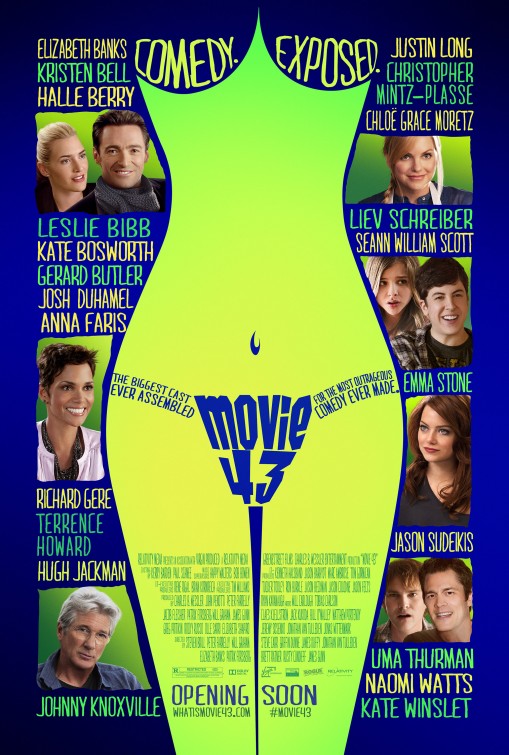 There were two driving reasons why I chose to go see Movie 43, the collection of 13 comedy sketches from different writers and directors. First, the red band trailer made me laugh, so I figured it was worth a shot. If one sketch didn’t work, there was always another ready to cleanse my comedic palate. The other reason is that I have been compiling sketches written by myself and my friends with the intent to make my own sketch comedy movie in 2013. Part of me was also concerned that something so high-profile might extinguish my own project; maybe we came up with similar material with sketches. After watching Movie 43, a tasteless, disconnected, and ultimately unfunny collective, I have renewed hope for my own project’s success.
Like most sketch comedy collections, Movie 43 is extremely hit or miss. This ain’t no Kentucky Fried Movie or even the Kids in the Hall flick. Rating this worth viewing depends on which side racks up the most. Unfortunately, there’s more terribleness than greatness on display, but allow me to briefly call out the film’s true highlights. The best segment in the movie, the one that had me laughing the longest, was a bizarre fake commercial that does nothing more than presuppose that machines, as we know them, are really filled with small children to do the labor. Seeing little urchins inside a copy machine or an ATM, looking so sad, with the faux serious music welling up, it made me double over in laughter.
 With the actual vignettes, “Homeschooled” and “Truth or Dare” where the standouts that drew genuine laughter. “Homeschooled” is about a mother and father (real-life couple Naomi Watts and Liev Schreiber) giving their son the total high school experience, which amounts to degrading humiliation. Dad makes fun of his son’s penis in the shower. Mom and Dad throw a party with the cool kids but don’t invite their son. Dad tapes his son to a flagpole. The kid gets his first awkward kiss thanks to his mom. It’s outrageous without falling victim into being crass for the sake of crass, a common sin amongst many of the vignettes. “Truth or Dare” starts off innocuously enough with Halle Berry (Cloud Atlas) and Stephen Merchant (Hall Pass) on a blind date. As the date progresses, they get into an escalating game of truth or dare that each has them doing offensive acts, like blowing out the candles on a blind kid’s birthday cake. This segment knows when to go for broke with it silliness and it doesn’t wear out its welcome, another cardinal sin amidst the other vignettes.
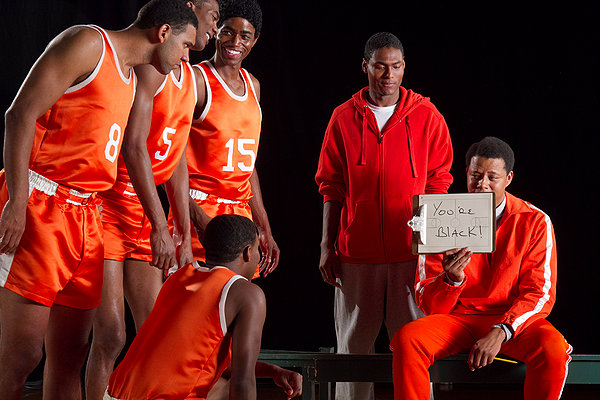
But lo, the unfunny sketches, or more accurately the disappointing sketches, outnumber the enjoyable. Far too often the sketches are of the one joke variety and the comedy rarely leaves those limited parameters. So a sketch about a blind date with a guy who has testicles hanging from his chin (Hugh Jackman) is… pretty much just that. There’s no real variation or complications or sense of build. It’s just that. A commercial about an iPod built to model a naked lady is… exactly that and nothing more. A speed dating session with famous DC superheroes like Batman (Jason Sudeikis), Robin (Justin Long), Supergirl (Kristen Bell) and others should be far cleverer than what we get. While I laughed at the sports sketch “Victory’s Glory,” it really all boils down to one joke: black people are better than white people at basketball. That’s it. “Middleschool Date” starts off interesting with a teen girl (Chloe Grace Moritz) getting her period on a date and the clueless men around her freaking out that she is dying. However, this is the one sketch that doesn’t go far enough. It really needed to increase the absurdity of the situation but it ends all too quickly and with little incident. “Happy Birthday” involves two roommates (Johnny Knoxville, Sean William Scott) interrogating an angry leprechaun (Gerard Butler) for his gold. It pretty much just sticks to slapstick and vulgar name-calling. That’s the more tiresome aspect of Movie 43, the collective feeling that it’s trying so desperately to be shocking rather than, you know, funny.
The worst offenders of comedy are the scathingly unfunny “Veronica” and “The Proposition.” With “Veronica,” Kieran Culkin tries to woo his lady (Emma Stone) with a series of off-putting sexual remarks, delivered in an off-putting “bad poetry delivery” manner, while the film is off-puttingly shot with self-conscious angles that do nothing for the comedy. It’s a wreck. “The Proposition” is just one big poop joke. It’s far more gross than gross-out.
 The frame story connecting the varied vignettes is completely unnecessary. Well, I suppose there is one point for its addition, namely to pad out the running time to a more feature-length 94 minutes. The wraparound storyline with Dennis Quaid pitching more and more desperate movie ideas never serves up any good jokes. Its only significance is to setup an ironic counterpoint that gets predictable and old fast. Example: Quaid says, “It’s a movie with a lot of heart and tenderness,” and we cut to a couple that plans on pooping on each other. See? You can figure out its setup formula pretty quick. I don’t understand why the people behind Movie 43 thought the perfect solution to pad out their running time was a dumb wraparound. These sketches don’t need a frame story; the audience is not looking for a logical link. For that matter why is the guy also pitching commercials? I would have preferred that the frame story was completely dropped and I got to have two or three more sketches, thus perhaps bettering the film’s ultimate funny/unfunny tally.
There will be a modicum of appeal watching very famous people getting a chance to cut loose, play dirty, and do some very outrageous and un-Oscar related hijinks. The big name actors do everything they can to elevate the material, but too many sketches are one joke stretched too thin. I suppose there may be contingents of people that will go into hysterical fits just seeing Hugh Jackman with chin testicles (I think the Goblin King in The Hobbit beat him to it), just like there will always people who bust a gut when a child or an old person says something inappropriate for their age, or when someone gets kicked in the nuts (the normal ones). I just found the majority of Movie 43 to be lacking. It settles far too easily on shocking sight gags and vulgarity without a truly witty send-up. It wants to be offensive, it gleefully revels in topics it believes would offend the delicate sensibilities of an audience, but being offensive and being funny are not automatically synonymous. You have to put real work into comedy. Movie 43 isn’t it.
Nate’s Grade: C-
Share this:

Les Miserables (2012)/ Rock of Ages (2012)
 I have no qualms with my heterosexual nature to make the following statement: I love a good musical. Why shouldn’t I? None other than Martin Scorsese said any true film lover is a fan of horror movies and musicals, two genres uniquely suited to the visual flourishes of cinema. My tastes tend to run toward the more offbeat, like Avenue Q and Hedwig and the Angry Inch and Sweeney Todd and Dancer in the Dark. My favorite movie musical of all time is 1952’s Singin’ in the Rain, but that’s probably because I’m a movie lover first and foremost. A well-done movie musical can sweep you off your feet. The polarizing Moulin Rouge! is still my favorite film of 2001; I love every messy, ambitious, transporting second of it. And that’s what the best musicals and, in general, best films achieve: they transport us to another realm. Since the success of 2002’s Chicago, there’s been a run of hit-or-miss movie musicals proliferating the big screen. It’s hard to think of any longstanding Broadway hits that have yet to make the leap (you’ll get your turn, Book of Mormon). Of course it also works the other way, with plenty of movies being adapted into Broadway musicals, like Shrek, Elf, Ghost, Catch Me if You Can, Newsies, A Christmas Story, Sister Act, Legally Blonde, Bring it On, and Tony-winner for Best Musical, Once. Then you get movies turned into musicals and back into movie musicals, like The Producers and Hairspray. It seems like Broadway and Hollywood are stuck in a loop, feeding off one another’s spoils.
In 2012, two high-profile musicals got the big screen treatment: Rock of Ages and Les Miserables. The former is from 2009 whereas the latter is one of the most successful Broadway shows of all time, beginning in 1980 and spanning continents. Rock of Ages was savaged by critics and bombed at the box-office, whereas Les Miz is soaring this holiday season and is seen as a major Oscar contender. Of course one of these films is about the outrage of the lower classes being exploited by an unfair system that benefits the rich, and the other has Tom Cruise and a monkey named “Hey Man.” Having seen both films recently, and Les Miserables more than once, I think they present an interesting discussion on the pitfalls of adapting a popular theatrical show to film. You won’t have to wait long to figure out which movie succeeds and which falters badly.
 Les Miserables, based on Victor Hugo’s novel, is set in early 19th century France. Prisoner Jean Valjean (Hugh Jackman) is nearing the end of his twenty-year sentence for stealing a loaf of bread. Inspector Javert (Russell Crowe) is convinced Valjean will never reform and go back to a life of crime. After help from a kindly bishop, Valjean flees his parole and sets up a new life as a businessman. Fantine (Anne Hathaway), one of Valjean’s workers, gets thrown out and tumbles down a chain of regrettable circumstances. She becomes a prostitute to support her young daughter, Cosette. Valjean recognizes poor Fantine on the street and, horrified at his own neglect leading her to this path, takes it upon himself to care for her and her daughter. Years later, the teenaged Cosette (Amanda Seyfried) has fallen for the young revolutionary Marius (Eddie Redmayne). Marius enlists his good friend Eponine (Samantha Barks) to help find out who Cosette is, all the while ignorant that Eponine is clearly in love with him. The young people of France are riled up about class abuses and exploitation, and the spirit of revolution is in the air. Javert is also becoming suspicious of Valjean’s true identity, so Valjean feels the need to flee once again. However, Cosette’s love and the bravery of the young revolutionaries makes Valjean decide to stop running from his past.
Oscar-winning director Tom Hooper (The King’s Speech) made the ballsy but ultimately brilliant decision to have his performers sing live. Every line, every note, every performance is captured in the moment; there is nary a second of lip-synching. I cannot overstate how blessed this decision was. It places the emphasis on the performances, and that’s exactly what something as big and deeply felt as Les Miserables required for the big screen. Look, Hollywood actors are never going to be able to outdo trained and professional theatrical singers. What I expect from movie stars is movie-star level performances, and Hooper understands this. These actors aren’t playing to the cheap seats, belting the tunes with power and over exaggerated dramatics (note: there is absolutely nothing wrong with this style given the theatrical setting). In many ways, this is a more intimate Les Miserables, and it still maintains its charms and magic. There is no choreography, short of perhaps the more jovial “Master of the House” number, and Hooper puts us right in the muck of life in a 19th century impoverished slum. This is one dirty movie with lots of grimy period details, creating a reality that can only be implied on stage. The more visceral version of Les Miserables demands performances that are more naturalistic and less bombastic, to a degree. I am a cinephile first but I genuinely prefer my musicals with trained actors to trained singers. A great actor can add so much inflection and personality through the prism of song, whereas a great singer is concentrating on the notes first and foremost. I value performance over nailing the mechanics, and more movie musicals should follow Hooper’s path. This, ladies and gentlemen, is how to do the movie musical experience right.
 I don’t know if Hooper was exactly the right man for the job but he certainly does the beloved stage show justice. Hooper’s visual tics are still present. The man loves to film in close-ups and at all sorts of tilted Dutch angles; he also loves filming a conversation between two people where neither one will be in the same shot. It’s a peculiarity that I never really warmed up to. However, Hooper generally has the best interests of his movie at stake, capitalizing on the large outpouring of feeling. This is a Big Musical with big emotions, and it’s easy to be swept up in its exuberant earnestness and humanism. It even has a famous concluding line, “To love another person is to see the face of God.” It’s the kind of stuff you roll your eyes at under lesser circumstances. Now, thinking back, you’ll realize that many of these people were simply painfully naïve and that there was a slew of death for no good reason. Purists may chafe at some altered lyrics and truncated songs, but really this is pretty much the closest version of the famous stage show you’ll ever see adapted. Not one of the songs has been cut (in fact a new one was written for the film by the original composers), and at a lengthy 157 minutes, it’s practically as long as the stage show, and just about sung through every moment. There are probably ten total lines that are merely spoken. I predict hardcore Les Miz fans will lap up every second.
Les Miserables also boasts some fortuitous casting (Taylor Swift at one point was rumored to be up for a role… shudder), none more than Anne Hathaway (The Dark Knight Rises). She is nothing less than perfect as Fantine. There isn’t a false note during any of her acting. Her performance of “I Dreamed a Dream” is so powerful, so breathtaking, so intensely felt, that it ranks up there with some of the best moments in all of 2012 movies. And oh can this woman sing her ass off too. You feel every flicker of anger and devastation, the grain in her voice, on the verge of tears and fury. This woman deserves every accolade they can come up with this year. This woman is a total lock for Best Supporting Actress. She’s wonderful during every moment of her screen time and the lengths and emotional ferocity of her performance, and subsequent pitfalls the character endures, left me reaching for the tissues at several points.
The other standout amidst a pretty stellar cast is Barks. This is her first film work though she has plenty of experience with her character, portraying Eponine in the 25th anniversary run of Les Miserables. Her singing is terrific, as you’d imagine, but her acting is just as strong. Her rendition of “On My Own” is a showstopper of a number. Barks naturally transitions to the demands of film. I was completely on Team Eponine and found her to be an infinitely better catch than Cosette. After people get a glimpse of this woman, she is going to get plenty more acting offers, and a few concerned inquiries into the size of her waist, which at times looks like it might be the size of The Rock’s neck. Hooper also has the good sense to film both “I Dreamed a Dream” and “On My Own” in unbroken takes; focus tightly pinned on our outstanding actresses, letting the skill of their performances sell the big emotions.
 Of course the crux of the tale rests on two men, Valjean and Javert, and the rest of the cast does kind of get saddled in underdeveloped roles made more apparent as a movie. It seems blasphemous to say I was a little disappointed with both lead actors. Crowe (Robin Hood) is easily the weakest singer of the cast but that doesn’t mean he’s bad. He has a lower register and sings his parts like a rock musician rather than a Broadway player. Fans of the stage show will have to adjust their expectations for a more subdued Javert. Still, having an actor of Crowe’s talents is definitely a plus even if his singing is adequate. Jackman (Real Steel) is a Tony-winning thespian, so I held him to a higher standard. He’s got a lot of heavy lifting to do as Jean Valjean, and Jackman does an admittedly fine job with the bigger emotional parts. I just expected more from his vocal abilities but it’s not a major detraction. As my mother noted, it’s not too difficult to spot the classically trained singers in the cast. Also, for eagle-eyed Les Miz fans, look for the original Jean Valjean, Colm Wilkinson, as the Bishop in this movie.
There is the tricky nature of translating a Broadway production into some variance of period reality. There’s plenty of relevance with the class struggle illustrated in the second half of the movie (Bane would approve). It’s an obvious statement but film is a different medium than the theater and affords different opportunities. The depressing reality of lower class life and the vultures that preyed on others is striking, yes, but sort of conflicts with the comic relief characters represented by the scheming Thenadiers (Sacha Baron Cohen, Helena Bonham Carter). When the seriousness of the period is inflated, they feel like they sort of belong in a different movie. Then there’s just the conflict between stage reality and film reality. On the stage we’ll accept Marius falling madly in love with Cosette at first sight. When it’s on film, the guy comes across as a callous chump, oblivious to Eponine’s pining. He ignores the friend he’s had for years for some blonde in a bonnet. And the final number, reuniting all the dead cast members, works better as a curtain call than a finale to a film. These are just the quirks of theater one must just accept. I wouldn’t say the songs and music is in the same category as Sondheim or Webber, but there are definitely some hummable tunes here made all the more swooning. You’ll have a fine pick of songs to get stuck in your head for days (mine: “Look Down”).
 Earlier this year, Rock of Ages came and quickly left the box-office, failing to make a splash with the American public despite a healthy enough run on Broadway and touring the country. The stage show is a jukebox musical set to the head-banging tunes of 1980s hair metal. Adam Shankman, the director behind the bouncy and thoroughly entertaining 2007 Hairspray movie musical, was tasked with bringing Rock of Ages to the screen with the same finesse. Cherie (Julianne Hough) a hopeful singer just off the bus from Oklahoma, meets up with Drew (Diego Boneta), a nice kid who gets her a job at The Bourbon Room, a rock club running afoul with the mayor (Bryan Cranston) and his moral crusading wife (Catherine Zeta-Jones). The club owners (Alec Baldwin, Russell Brand) are relying on fickle, burned-out, taciturn, and overall mysterious rock legend Stacy Jaxx (Tom Cruise) to save their club from financial ruin. Along the way, Cherie and Drew look for their big breaks, fall in love, get pulled apart, and reunite in time for one final sendoff to leave the audience tapping their toes.
 Allow me to elucidate on my main problem with the rise in jukebox musicals: I find them to be, with rare exception, exceedingly lazy. The musical number is meant to advance the narrative and give insights into character and situation, just like any other aspect of plot. You’ll find great original tunes that do this. When you’re dealing with pop songs that the public is well familiar with, then your job becomes even harder, and I find many are just not up to the task. Too often jukebox musicals are designed to merely string together a pre-packaged and time-tested number of hit songs, utilizing the faintest of narrative threads to get from one song to the next. The appeal of jukebox musicals lies not with the story or characters but waiting for the next recognizable song and wondering how it will, poorly, fit into this new context. You’ll notice that these jukebox musicals seem to have twice as many song numbers. They know their selling point, and more singing means less time spent developing characters and story. And so my impression of the jukebox musical is one of a cynical cash grab following the bare minimum of narratives to achieve the status of musical so it can be resold with low risk. I’m simplifying things in my ire, yes, but there’s a definite reason that jukebox musicals have sprouted like mad in the past few years. They don’t require as much work and the audience seems to hold them to a lesser standard. Much like the worst of Friedberg and Seltzer (Disaster Movie, Meet the Spartans), it seems just recognizing the familiar has become the core draw of entertainment.
And this is one of the main problems with Rock of Ages. I’ve never seen the stage show, but my God for something that purports to live the rock and roll lifestyle, it’s certainly so tame and scrubbed clean of anything dangerous. This feels like your grandparents’ idea of what “modern” rock music is. After a cursory search online, I’ve found that the movie makes some significant changes to convert a story about rock and roll hedonism into sanitized family friendly fare (spoilers to follow, theatergoers): apparently in the stage version, Cherie and Jaxx had sex, Jaxx remains a creep and flees the country on statutory rape charges, though before that he and Cherie share a lap dance/duet to “Rock Me Like a Hurricane,” the family values crusader characters were new inventions, the Rolling Stone reporter (Malin Akerman, the best singer in the film) is considerably beefed up to provide Jaxx his happy ending, and they don’t even use the song “Oh Cherie.” I’m not a stickler for adaptation changes, but clearly it feels like Rock of Ages had every edge carefully sanded down to reach out to the widest array of mainstream filmgoers (Shankman says he cut Cherie’s lap dance number because it tested poorly with mothers). The funny part is that the movie lambastes a slimy manager (Paul Giamatti) for playing to demo numbers, shooting for pandering mass appeal rather than the art, man. Feel the hypocrisy.
 The first hour of Rock of Ages is mildly passable mostly because of the goofy supporting cast, but then the movie just keeps going, getting more and more tedious with every protracted minute. The second half involves Cherie and Drew apart and finding new lows; for him it’s selling his soul to join in a boy band, and for her it’s selling herself, working as a stripper. Let’s look back at that sentence. One of those life choices is not nearly as upsetting as the other. Nothing against the hard-working strippers in this country, but Cherie taking to the pole is definitely more of a moral compromise for the character than whatever the hell Drew endures. It’s this leaden second hour that made me lose faith that Rock of Ages would even provide a morsel of cheesy entertainment. It has the misfortune of two of the blandest leads I’ve ever seen in a musical. Hogue (Footloose) and Boneta (Mean Girls 2) are both physically blessed specimens of human genetics, but oh are these kids boring boring boring. Their love story is completely malnourished and you couldn’t scrape together one interesting thing about them combined. The fact that Rock of Ages further strips away any interesting personality from Cherie (see above) makes them even more disastrously boring. To be stuck with these two for another hour of vapid griping, only to magically get back together, is interminable. Thank God they pumped up the side characters because that is the only time when Rock of Ages even challenges for your attention. Cruise isn’t the best singer but he’s pretty good belting out 80s rock hits, and the man has his natural charisma and stage presence to spare.
So I guess where Rock of Ages goes wrong, and where Les Miserables succeeds, is thinking of how best to translate the experience of the stage to the medium of film. Shankman does a pitiful job staging his musical numbers, with lackluster choreography that rarely takes advantage of the sets and characters. Worse, Shankman feels like he strays from the tone and angle of the stage show, sanitizing the rock and roll lifestyle and looking for ways to squeeze in bland happy endings. In other words, he doesn’t capture enough of the essence of the original stage show to please neophytes and fans of the Broadway show. With Les Miserables, I think most fans of the stage show, and they are legion, will walk away feeling satisfied with the results, content that real artists treated the long-running musical with justice. Hooper opens up the world of the stage show, utilizing the parameters of film, and the emphasis on performance over singing mechanics maximizes the unique power of film. Les Miserables is a grand movie musical smartly adapted to the opportunities of film. Rock of Ages is a sloppy, neutered, criminally boring mess poorly developed and poorly translated to the silver screen. Let this be an educational resource for future generations. Take note, producers, and learn from the mistakes of Rock of Ages and the accomplishments of Les Miserables. Oh, and guys, if you see Les Miserables, it will get you super laid with your girlfriend (I have anecdotal evidence).
Nate’s Grades:
Les Miserables: B+
Rock of Ages: C-
Share this:

Rise of the Guardians (2012)
 Dreamworks animation has long existed in the mighty shadow of Pixar, but as of late the studios might be at a creative crossroads. After the excellent Kung Fu Panda films and How to Train Your Dragon, suddenly Dreamworks animated movies matured beyond feverish, pop-culture explosions and into character-driven, colorful, and genuinely heartfelt family films. I don’t think we’ll be getting something as dismal as Shark Tale again with the current path the studio is blazing. Rise of the Guardians looks like the pilot for a new lucrative Dreamworks family franchise. It’s easy to see the appeal for a superhero assembly of fantasy figures, though is every region going to have working knowledge of the Tooth Fairy? The movie just looked too silly to function for me, but I was optimistic after raves from a few trusted friends. Perhaps my own childlike sense of wonder is permanently replaced with a heart of stone, but I found Rise of the Guardians to be a somewhat entertaining but mostly stilted, intellectually and emotionally, journey.
The guardians are an ancient group of holiday-themed characters entrusted with keeping the sense of wonder alive in children. There’s Santa Claus, a.k.a. North (voiced by Alec Baldwin), and his army of yetti workers, the tooth Fairy (Isla Fisher), and her own collection agency of tooth-gathering fairies, the Sandman, in charge of the sweet dreams of children, and the Easter Bunny (Hugh Jackman), an Australian jack rabbit with a bit of a chip on his bunny shoulder. The world is threatened by Pitch (Jude Law), a bogeyman who desperately desires children to fear him again, because belief is what powers the Guardians. To stop Pitch and his array of nightmare creatures, the Guardians must add another member to their outlet, Jack Frost (Chris Pine). Except Jack has no interest in joining this fuddy-duddy group and would rather do his own thing, which usually involves wrecking havoc. Jack’s desperate to find out his past and figure out why he was chosen for his immortal role and what it will take to make kids believe in him.
 Ultimately, I just couldn’t really get into this movie. It’s set up like an Avengers team of children’s fantasy figures, but I felt like the movie failed to make me emotionally connect with their plights. The Jack Frost protagonist was another tired variation on the selfish, plays-by-his-own-rules cowboy character that needs to learn a dash of personal responsibility and putting others first. But his goal is essentially to be… seen. He’s worried kids will never see him because they won’t ever believe in him. That’s a fairly abstract existential crisis for your main character to have, and one that I found too odd to care about. The entire core of the movie revolves around children’s sense of belief, and unless you’re twisting this into some general statement about the purpose of faith (the Man in the Moon = God?), then I find it all to be silly considering we’re talking about the Tooth Fairy and Easter Bunny. I mean, the main kid (Dakota Goyo) has to be eight or nine years old and still fervently believes in these mythical creatures, to the point that he is literally the only person on the planet who believes at one dour point (sheesh, talk about how easily disillusioned kids can get these days). We’re celebrating a kid going into adolescence believing in these things. That just smacks me as a little weird if you stop and think about the film’s implications. This kid is going to grow up socially warped. Then again his beliefs are proven right, so maybe it’s just the rest of us cynical bastards out there who need to adapt. I guess I’m going to go accept my fate and be a crotchety old man now.
The plot feels too airy for my liking, too frenetic to get to the next set piece or chase sequence. It doesn’t feel like it ever takes the time to settle down and develop its characters or story. As a result, we’re left with a fairly middling backstory for Jack Frost that should be easy to figure out, but we’re also stuck in a world that doesn’t feel like the rules have been sufficiently explained. Case in point: the Tooth Fairy keeps all those baby teeth in one huge archive because, you see, the teeth hold memories. I guess. But then Jack’s after his own teeth to retrieve his forgotten past (yes folks, we have an amnesiac protagonist). I’m okay with this so far though it’s a tad forced, but when Jack does get those teeth, he’s presented with memories at the age of 18. I know people suffered through poor dental hygiene hundreds of years ago, but you cannot expect me to believe that Jack is still losing baby teeth. This is just one example where the movie didn’t come across as fully formed. The Guardians all seem to possess different super powers involving space-time travel, but then they don’t seem to do anything with these abilities that matters by the final battle. Pitch has the ability to craft nightmare creatures and all he does is end up making wispy evil-looking horses. That seems like a waste. There are not enough payoffs here with all the imaginative possibilities.
Rise of the Guardians has some enjoyable moments but it practically relies upon you to supply all the work as far as character empathy. We’re familiar with these magical figures, and so the movie gets by because we put in the emotional connection to Santa and the Easter Bunny, but the characters just don’t register on the page, at least with this story. I don’t know if David Lindsay-Abaire (Rabbithole, Inkheart) was the best candidate for the job, but he doesn’t give me enough reasons to engage with the movie. The characters are lackluster, their conflicts feel too abstract, the conclusion feels superfluous, and the world feels poorly defined, developed, and unsatisfying.
 I like Chris Pine (Unstoppable) as an actor, but the man brings absolutely nothing to the table when it comes to voice acting. Baldwin (Rock of Ages) and Jackman’s (Real Steel) performances are defined by their respective accents. I feel like Hollywood needs some sort of seminal moment to go back to genuine voice artists rather than hiring whatever celebrity. Yes we all enjoyed Robin Williams as the Genie in Aladdin, but are you going to tell me that Pine’s vocal work was so exceptional he had to be cast? It’s like having celebrities provide the voices for the helium-sounding Chipmunks. The best voice actor in the film is clearly Law (Sherlock Holmes) who does such a good job I felt more sympathy for him than I did Jack Frost. I know it’s commonplace in movies for the hero and the villain to have some duality, but I wasn’t probably supposed to jump ship as far as loyalty. Maybe I just found the actual kids in the movie to be annoying so I didn’t mind a magical creature preying upon their collective childhood fear. It reminded me of the space cloud villain from 2011’s Green Lantern flop, where I wondered if this fear-sucking cloud sought out the delicacy of children’s fears first.
To top it all off, I found myself left rather cold by the visual aesthetics of the movie. It has this overly androgynous, big-eyed anime feel, and I kept getting the sense that the whole movie looked like an extended video game cut scene. This movie even had Guillermo del Toro (Hellboy) and the brilliant cinematographer Roger Deakens (Skyfall) as producers or visual consultants, so I’m even more baffled at how visually poor I found the movie. The colors are so muddy and the visuals felt so limited for me, especially considering the imaginative parameters of the characters and their respective worlds. I thought Pitch seemed oddly similar in visual approach to Hades in Disney’s underrated Hercules. The action sequences had some nice visual panache to them as far as choreography, but I couldn’t stop thinking how cruddy and dreary everything looked.
Rise of the Guardians is based upon a series of yet-to-be published books by famed author William Joyce, who won an Oscar himself the previous year for the animated short, The Fantastic Flying Books of Mr. Morris Lessmore. I feel like that short was a better representation of magic and imagination than this film. The humor, the life lessons, the character development, it all felt so stilted to me. I thought the conflicts were too abstract and hard to care about (oh no, people have stopped believing in the Tooth Fairy!) and the world and rules felt too amorphous, poorly explained and creatively handicapped. If you’re going for a fantasy setting with larger-than-life figures, each with certain gifts and powers, hen I want the promise of that setup to be fulfilled. Rise of the Guardians isn’t a bad movie by any means but it left me cold and indifferent. It’s meant to strike at my childish sense of wonder, but I felt too often like a cynical adult, picking apart the frailties of its storytelling and muddy visual designs. It felt like it was missing the best magic of all: gifted storytelling. You’ll probably have more fun than I did, but that’s just because I probably have no soul.
Nate’s Grade: B-
Share this:

Real Steel (2011)
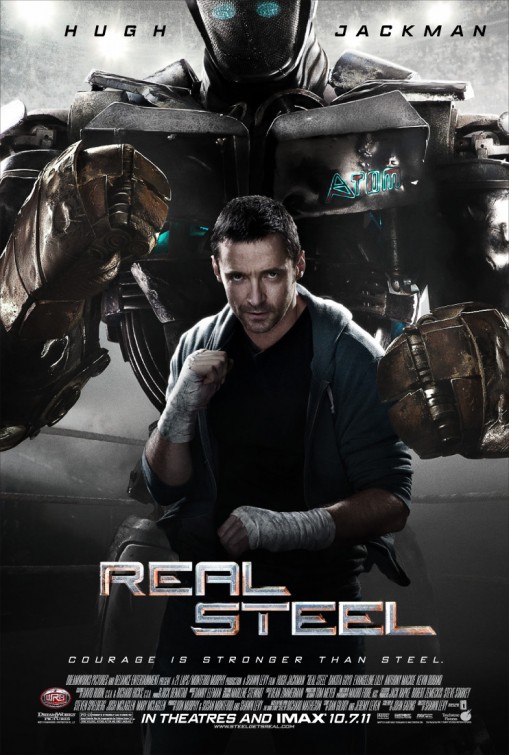 In the future world of Real Steel, set in 2020, robot boxing has become a huge sensation. It seems that audience bloodlust was not being satisfied with flesh and blood hitting the canvas, so robot brutality will do. Whatever happened to mixed martial arts, a sport arguably more popular than boxing in this day and age, popular enough it even got its own uplifting sports drama earlier this year (the overlooked Warrior). I strongly doubt that in only nine years we’d have giant fighting robots and that this “sport” would be nationally recognized. Did anyone see Comedy Central’s mechanical Coliseum showdown, Battlebots? There’s your answer, America.
In this future world where trucks have glass panels to show the world your feet (why? Because it’s “futuristic” you fool), Charlie Kenton (Hugh Jackman) is a has been. He enjoyed a fleeting career as a professional boxer before the mechanical men came into popularity. Now he goes from town to town trying to scrounge up some petty money with small-market robot boxing rings. His only pal is Bailey (Evangeline Lilly), his former flame and the owner of the boxing ring/chop shop that Charlie calls home. Charlie owes plenty of money to plenty of not nice people. His solution arrives in the form of his 11-year-old son, Max (Dakota Goyo). Charlie ran out on Max and his mother when Max was a baby, but now mom’s dead and custody is being discussed. Mom’s aunt (Hope Davis) and her rich hubby want Charlie to sign away his parental rights, which he agrees to do for the right price. Max spends one last/first summer with his estranged father before going off to live with his auntie. The two bond when Max discovers a beat-up old sparring robot when father and son are skimming parts illegally at a junkyard. The old bot, which Max names Atom, becomes a champion fighter. Father and son ride the success all the way to a championship bout with Zeus, a legendary robot that destroys all challengers. Can they stun the world? Can father and son bury the hatchet? If these answers are in doubt, I advise you to see any sports movie ever released.
J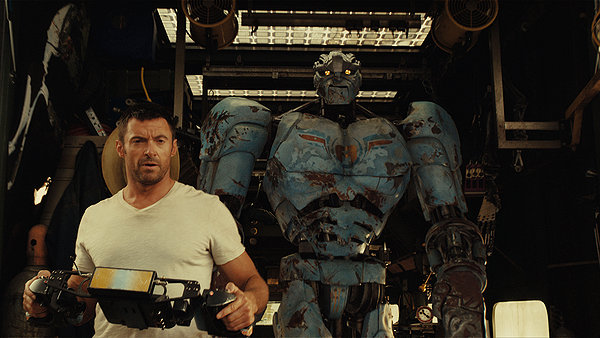 ust in case you stood clueless and slack jawed at the film’s storytelling prowess, you’re in luck because every character will take great pains to explain the significance of plot points, key metaphors and symbols, and personal motivations. Usually this stuff is tucked away as subtext, but Reel Steal decided that it would rather rub the audience’s nose in the architecture of its screenplay. Characters will just go around speaking blurting out their feelings in the most transparent way possible: “I can’t be with you again, I’m afraid of being hurt again, and seeing you in that ring is like seeing my father again in that ring, and fighting this fight is your attempt to regain redemption and prove yourself wrong, and the robot is old and busted but still has some fight in it left, just like you Charlie…” It gets tiresome. Max squeals, “All I’ve ever wanted was for you to fight for me!” Your dad’s kind of a lout, kid. You’d be better off being adopted by your preposterously rich aunt, which is really the moral we learned from Annie. Who talks like these people? It’s astounding how blatant the film is about explaining its sotry mechanics so that the dumbest common denominator in the audience can walk away feeling like Roger Ebert (“Did you notice how the robot was a metaphor for Charlie? I did.”).
Never in my life would I have anticipated that someone would watch Over the Top and say, “What if we added robots?” This movie essentially is a souped-up version of Sylvester Stallone’s 1987 flick where a dad fights for the custody of his kids through the weirdly court-approved process of the gentleman’s game of arm wrestling. First off, who in their right mind would make a movie about professional arm wrestling? There’s a reason this specific sports genre still stands with one entry. Charlie finds redemption over one summer spent with the kid he abandoned and then sold. The strange thing is that Max knows from the start that he’s more a commodity than a valued son. Yet he still bonds with dear old dad though he’s still going off to live with his rich aunt by the end. The father/son relationship becomes the heart of the movie, but what good can come from two annoying characters learning to get along? They’re still too annoying for me.
Charlie’s fight to become a better father is hampered by the fact that I wanted to strangle his kid. There was rarely a moment that passed where I didn’t want to punt this little brat. From the moment he first steps on screen, Max is surly and aggravating. Given that he’s meeting the father who abandoned him, I’d expect some confrontation but this little twerp cops a bratty attitude throughout. He hops on the boxing ring mic and walks around with a phony swagger and challenges the biggest baddest robot. The kid seems like a chip off the ole block, falling victim to hubris just like dead. When Goyo (Thor) screams it becomes a high-pitched caterwaul that caused me to writhe in physical pain. The subplot of Max teaching the robot how to dance is just embarrassing. You better believe the kid teaches his metal friend how to do the robot. The young actor deserves a fair share of the blame. Goyo flounders, overselling every emotion and hovering at a persistant petulant level of acting. I do not advocate the endangerment of children, obviously but I’d be lying if I failed to admit that I would have slept soundly had Max tumbled to his death in the robot junkyard. Goyo is so powerfully awful that he may well be the tarred as the Jake Lloyd of this decade (Lloyd infamously played the twerpy kiddie Darth Vader in the first of the regrettable Star Wars prequels). It’s hard for me to root for the reunion of father and son when I’d rather see father bury son in the ground.
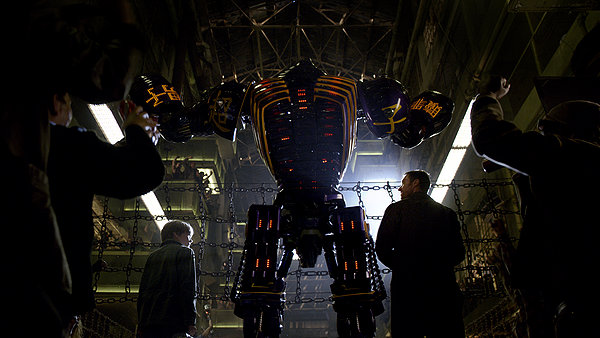 Real Steel is littered with nonsensical or dropped subplots, the worst offense being Atom’s secret. It’s revealed midway into the film that Atom is not just a sparring robot but a sentient being. It’s faking that it can only shadow human movement. When Charlie “teaches” Atom how to box he really is teaching the robot, though conveniently Atom seems to keep this knowledge to itself. Even when it’s being battered mercilessly, Atom doesn’t employ the skills it’s been taught. Maintaining his cover is more important than self-preservation, so suck on that Asimov. The fact that Atom is sentient is the filmmaker’s desperate attempt to add empathy to the robot. Without sentience, the robot is just a junky avatar that can be scrapped. It’s a piece of equipment but if sentient it becomes a character we can feel for. You don’t share empathy with a coffee maker. I kept waiting for this secret to somehow get out because it’s kind of a monumental deal. But it never does get out. The story never once revisits this gigantically important revelation. What does this mean about other robot boxers? Are they too sentient? What do they think about destroying each other for sport? There are important questions here that are ignored. What’s the point of making Atom sentient if you never do anything with it? It’s only a ploy to drum up empathy, but at no point does Atom feel like a character, only a collection of parts. It’s a coffee maker on steroids.
The movie borrows liberally from other sports movies, taking the emotional beats from Rocky and the family drama from a film like The Champ, though loses the downer ending. Everything is too recognizable, too formulaic, as if it was assembled on a factory floor. The only points of surprise are when Real Steel just carelessly drops plotlines, as mentioned above. What’s the point of introducing a plot point like the robots can malfunction if hit correctly in Act One and not have it resurface in Act Three? Jackman (X-Men) acts with all the power his neck veins can afford. He seems to be constantly growling or on the precipice of said growling. The romantic subplot with Bailey is an undeveloped thread only meant to tie back together into a pretty bow at the plot’s earliest convenience. Lily (TV’s Lost) plays the “girl,” which means all she’s given to do is remind the hero of his potential and be the warm body waiting in bed. But this is a family film, so we stop at late-night cuddling. Then Max ends up being a savant at mechanical engineering and electronics because… he plays video games? Give me a break. And it just so happens that every character we’ve been introduced to will be in attendance for the big fight, even the Texas bookie (the great and underutilized Anthony Mackie). Wouldn’t Detroit bookies take umbrage to this?
Do you like reaction shots? Real Steel is chock full of them: people wincing, people yelling and clapping at TVs, people muttering under their breath the optimistic instructions, “C’mon, c’mon, c’mon.” You accept some reaction shots as part pf the terrain of the sports movie, but when they’re presented in excess then it becomes a crutch, the director reminding the audience what to feel with the subtlety of a sharp stick to the eye. Then again subtlety was never the forte of director Shawn Levy, he of Date Night and Night at the Museum fame. The special effects are strong and the boxing sequences even have some livened suspense to them, though why would anyone build a robot boxer with two heads? What advantage does that offer other than two things to hit? Levy gets lost in the special effects and treats the actors with the same indifferent level of care that the humans show the robots.
Real Steel wants to be a rousing, family-friendly crowd pleaser; it just won’t ever let you forget that this is its primary function. This outlandish sports flick is much like its robotic pugilists: big, dumb, loud, and prone to malfunction. The film has no faith in its audience’s intelligence so every feeling and symbol is plainly explained with unwanted diligence. The characters are unlikable or underwritten, the story is shackled by lockstep devotion to formula, and Goyo’s wretched performance makes it damn near impossible to sympathize with the father/son reunion. Filled with unresolved plot setups and a mystifying similarity to Over the Top, Real Steel is just like every other boxing movie on record except this one has robots. I’m fairly certain the screenwriters were robots too. Why else would they make a robot becoming sentient seem like no big deal? Obviously this is propaganda to lull us into complacency before the impending robot war. Real Steel is a classic example of a movie done by committee; it feels like it was crudely assembled from the spare parts of other, better movies.
Nate’s Grade: C
Share this:

X-Men: First Class (2011)
 Marvel’s X-Men franchise had some serious damage it needed to undo. The once mighty superhero series had been harmed by that age-old foe – bad sequels. The collective stink from 2006’s X-Men: The Last Stand and the 2009 Wolverine debacle, the franchise had lost some serious luster. While the recovery was not nearly as deep and cataclysmic as what the Batman franchise had to deal with in the wake of 1997’s Batman and Robin, a film that flirted with salting the earth, the X-Men needed some kind of facelift. Enter director Matthew Vaughn (Kick-Ass, Stardust), the man who was going to save the series back in 2006 when original director Bryan Singer flew away to direct a different man in tights. Vaughn was originally tapped to direct Last Stand but he dropped out and was replaced by the hack Brett Ratner (Rush Hour). Thus began the slide toward mediocrity. Now Vaughn is back to tidy up unfinished business, taking the series back to its historical roots in the 1960s. It seems that a trip back in time was just what was needed to make the X-Men fresh.
Back in 1944, Erik Lehnsherr is a prisoner in a Polish concentration camp when Dr. Schmidt (Kevin Bacon) discovers the young boy’s great potential. When enraged, Erik can control anything metallic. In upstate New York at the same time, young Charles Xavier discovers a young shape shifter named Raven. She’s blue from head to toe and afraid. They’re delighted to find one another, fearing they were the only ones “different” in the world, children of the “atomic age.” All three of these people are headed for a collision course. In 1963, Charles (James McAvoy) has become an Oxford professor, Raven (Jennifer Lawrence) has followed him to England, and Erik (Michael Fassbender) has been systematically hunting down the Nazis responsible for his pain and suffering. Dr. Schmidt has now become Sebastian Shaw, a younger-looking playboy with the intent to push the Soviets and Americans to nuclear war. Shaw has his own team of mutant henchmen, including telepath Emma Frost (January Jones, proving once again that she can really only ever be good as Betty Drapier) who walks around in white lingerie the whole movie. Together with CIA agent Moira MacTaggert (Rose Byrne), Charles and Erik assemble their own team of young mutants to thwart Shaw.
Similar to 2009’s Star Trek, this film provides the opportunity to reboot a franchise by going back in time. It transports the series back to the beginning of the friendship between Charles and Erik, and spends the next 130 minutes filling in the rationale for the “why” of their varying personal philosophies. By dialing back, we’re able to play around with 40 years of back-story and histories. While we know the end results, that these two giants will become enemies, that Charles will lose the ability to walk, and that Raven/Mystique will eventually side with Erik, that doesn’t mean there isn’t pleasure to be had in watching the journey. There are all sorts of self-aware in-jokes for fans and a few nifty cameos that left me howling with glee. The script, credited to Vaughn, his writing partner Jane Goldman (Kick-Ass), and four others, smartly moves the film forward; no scene seems at a waste. Even better, the film strikes a tone that manages to take its real-world implications seriously (nuclear brinksmanship, Holocaust, and fighting for equality and acceptance) without diminishing its popcorn thrills.
As a summer movie, X-Men: First Class has enough razzle-dazzle to compliment its intelligent social pontification. Vaughn and his screenwriters have composed action sequences that neatly incorporate the mutant abilities of its subjects while building the tension and smartly utilizing the contours of geography. I hate action sequences that don’t play to the potential of location and subject. An evil teleporter (Jason Flemyng) finds a fiendishly clever way to dispatch 20 CIA agents. Magneto efficiently takes out former Nazis residing in Argentina in one chilling sequence (“I’m Frankenstein’s monster,” he tells one man). Shaw makes for an actual formidable opponent for our fledgling heroes. The personal connection he has with Erik, on top of Bacon’s devilish glimmer of villainy, makes Shaw a strong antagonist that the audience can rally against. Vaughn has a splendid reveal with Shaw. Back when he was a Nazi doctor, he asks young Erik to move a coin with his abilities. The shots consist entirely from one side of his office, showcasing it to be a bookish study. Then when Shaw calls the Nazi guards to bring in Erik’s mother for a little more direct incentive, the camera flips position. We see the opposite side of the room, a medical station on the other side of large glass panels. Inside is a torturous display of medical cutlery. It’s a fantastic reveal that kicks up the tension while adding to the terrifying character of Shaw. The action highpoint, a mutant vs. mutant battle amidst the Soviet and American naval fleets, provides plenty of parallel action to follow that keeps the movie alive and kicking.
The film mixes a frothy, James Bond-esque spy thriller feel in production design and whatever-goes plot savvy, but then recomposes real life events as mutant enhanced. Alert the history textbooks, because the Nazi scientists experimented on mutant children and that mutants averted World War III. Some will chafe at the alternative history approach, but I find it to be more interesting, suspenseful, and a natural fit with the overall Cold War paranoia feel of the setting. Melding the X-Men into history makes for a more intellectually stimulating adventure, tipping its hat at various historical revisions that payoff as small rewards for a well-informed audience. I’m not saying that the movie is like Noam Chomsky’s take on X-Men by any means, but it’s certainly the most heady film in the series since the departure of Bryan Singer (he serves as producer on this flick). Indeed, this is a rather talky X-Men adventure with plenty of philosophical debates and speeches. But then it’s got naked women in blue too. But you see, it’s not just naked women in blue, it’s that a naked woman in blue can become a political statement – man!
And it’s on that note I’d like to say a few words. Mutants have always been a central metaphor for the oppressed, be they Jews, African-Americans, homosexuals, whatever minority group you’d like to slot in. That’s been one of the secrets to the continued success of Marvel’s flagship series – anybody can identify with the fear of being judged, feared, and despised because of who you are. That’s why the character of Raven/Mystique, short of Magneto, is the most fascinating character in the movie. Her true form, scaly and blue, is what keeps her feeling like an outcast. She doesn’t have an invisible power like her surrogate big brother, Charles. She constantly disguises herself in order to fit in, albeit her disguise is the alluring natural figure of Jennifer Lawrence (Winter’s Bone). “Mutant and proud,” she says in disdain when she stares at her bluish reflection in the mirror. It is through Erik hat she begins to believe in this mantra, gaining pride that “blue is beautiful” and she need not even wear clothes to cover who she is up. Raven/Mystique is the figure torn between the two philosophies argued by Charles and Erik. She is the central figure that has to struggle with reality vs. idealism. It’s also a little funny that a movie piggybacking the civil rights movement of the 60s (mutant rights!) also trades in the casual misogyny of the 1960s (women in lingerie as outfits, regularly practiced sexism). I suppose some of this is intentional. I guess the women’s movement will be saved for a sequel.
While the retro setting ties in nicely with the series’ core metaphor about being different/disenfranchised, the dichotomy of ideas presented by Charles and Erik are not given equal measure. That’s because, quite frankly, Erik is a much more powerfully interesting character and more sympathetic than a rich kid who can read people’s minds. Charles Xavier and Magneto have always represented a comic book version of Martin Luther King Jr. and Malcolm X when it came to the ideas of integration, equality, and representation. Charles believes that mutants should assimilate and that humanity will accept in time; peaceful and hidden. Magneto, on the other hand, takes a more militant stance and feels that mutants need not hide who they are out of fear or shame, that they are the dominant species and should not be threatened by the weaker Homo sapiens. But where X-Men: First Class runs into some trouble is that the ideological deck is completely stacked in Magneto’s favor. He’s the one who suffered through concentration camps, Nazi experimentation; he’s seen the worst of what mankind of capable of. He’s a tormented man seeking vengeance, which is character motivation that is easy for an audience to fall behind. Then, even after the mutants save mankind’s bacon during the Cuban Missile Crisis (the first person who tells me this is a spoiler gets a history book thrown at them), they still get treated as the enemy. Almost everything that plays out onscreen aligns with Magneto’s ideology, which makes it hard not to be on Team Magneto as the movie draws to a close. I suppose the film utilizes our knowledge of future events to counterbalance Magneto’s pessimistic world philosophy.
The other issue that lends more credibility to Magneto than perhaps the filmmakers were hoping for is the fact that he’s the most interesting character in the movie, easily. The X-kids are a pretty bland bunch of boys and gals. This is the first class the filmmakers chose? Did they have recruiting violations at the school? Havok (Lucas Till), a goy who can shoot energy beams, Banshee (Caleb Landry Jones), a guy who can scream loudly and fly, somehow, Angel (Zoe Kravitz), a gal with fairy wings and an acid tongue, and then Darwin (Edi Gathegi), a guy who… adapts? Darwin’s power is so obtuse to explain, it’s no wonder he doesn’t last long in service to his country (it’s a bit tacky that when one character says “slavery” the edits have to cut back to the one black mutant for a reaction shot). Each one of these teenagers has a different reaction to their powers. Some are ashamed, some are afraid, others proud or apathetic. But they are all singularly uninteresting. Once they establish their power, they become less a character and just another piece on a game board to be positioned. And Lenny Kravitz’s kid in fairy wings? Plus she spits little fireballs? I’m sorry but that should have been the first thing removed from rewrites. This crew makes it sure that we empathize even more with Magneto as he refines his powers to reach his personal vengeance, which is the film’s pre-designed payoff. We’re not really looking for the team to band together, which they inevitably do, but we’re awaiting that splash of vengeance. And when it does come, it’s satisfying, stylish, and dramatically fitting (“At the count of three, I’m going to move the coin.”). The fact that the movie still has like 15 minutes of material afterward is almost inconsequential.
Vaughn certainly delivers the spectacle, it’s the actors that produce the real fireworks. This is a vehicle for McAvoy (Atonement, Wanted) and Fassbender (Ingloruious Basterds, Jane Eyre), and both men provide admirable gravitas. McAvoy’s role offers a more jocular performance, showing Charles to be a bit of a lady’s man in his younger years, harnessing his telepathic powers to bed him some beauties. Then again, as I’ve been told from my female friends, looking like McAvoy will certainly also help matters. But this is Fassbender’s show. He has a chilly intensity to him, rather than just being cold and indifferent like January Jones. His performance captivates you from the start, and his slow-burning hatred consumes the man. It’s a dramatically rich performance given the material. After being discriminated against for being a Jew, than a mutant, he has to sell that his character, haunted and rage-filled, would ironically follow the same social Darwinism that his Nazi tormentors evoked. And Fassbender sells every bit of an iconic Marvel villain coming into his destiny. However, his Irish accent slips out in the film’s final reel, and I’m really curious why the studio couldn’t have shelled a few bucks to fix that with ADR. Rushed for time, or revealing that Magneto has unheard of Irish lineage?
Going back in time manages to open up all sorts of possibilities for the X-Men franchise. There could be a whole slew of sequels that play around with the rich, complex back stories of the X-Men without having to serve the aging stars of the original trilogy. Vaughn keeps the proceedings amazingly fluid, stylish without being overtaken by visual artifice, and the swinging 60s provides a groovy backdrop. The action delivers when needed, the smart script doesn’t downplay the clash of ideas to go along with the clash of fists, and the special effects are relatively up to snuff as summer escapism goes. The movie is not without its misses, including a cadre of lackluster junior mutants. But Vaughn has re-energized a flagging franchise and given hope for a future (past?). In the pantheon of X movies, I’d place X-Men: First Class as an equal to X2, the best in the series. It may not be at the head of the class, but this superhero flick earns is stripes with a solid effort and strong potential.
Nate’s Grade: A
Share this:

X-Men Origins: Wolverine (2009)
 X-Men Origins: Wolverine has been slashed from all sides. First, the movie has not been able to shake bad buzz, from extra reshoots to rumors about conflicts between the studio and the director. There was even one rumor that the head of 20th Century Fox Studios ordered a wall repainted a happier color. Then in early April it got even worse. A DVD-quality print of Wolverine was leaked onto the Internet and spread like crazy, and once something finds itself inside the realm of cyberspace it cannot be put back. The reaction to the leaked copy was mixed, at best. The studio went into damage control mode, stating that the leaked copy was an unfinished work print, that they too were not thrilled with this version and paid millions for reshoots, and the final version that would be released in theaters had 20 minutes of new stuff and 10 minutes additionally edited out. But guess what? The wolverine’s out of the bag, it’s the same exact version minus some completed special effects shots. What amuses me about this whole situation is that the studio is on record trashing the movie, saying they were unhappy with this version, and yet this is the final release. After having seen Wolverine, at least I can say that those Fox execs know mediocrity when they see it.
We get to witness the storied history of Wolverine (Hugh Jackman), which goes all the way back to the pre-Civil War era. Born James Logan, and a mutant, the kid had the unusual ability to produce three jagged bone claws from his knuckles. Logan also had the ability to miraculous heal like his older brother, Victor “Sabertooth” Creed (Liev Schreiber). The two of them make use of their primal, animal instincts and near invulnerability by fighting in every major U.S. war, from Civil to Vietnam. Eventually that kind of thing gets noticed, and General Stryker (Danny Huston) recruits the brothers to be apart of a mutant mercenary group. The group also includes the likes of William “Deadpool” Wade (Ryan Reynolds), “The Blob” (Kevin Durand), and some other unimportant mutants (one of them played by a Black Eyed Pea, will.i.am). Wolverine walks away from the group when he decides that he isn’t cut out for a cutthroat life.
The man finds a quiet place to live along the Canadian Rockies. He’s found a hard-working job, lumberjack, and a good woman, Kayla (Lynn Collins), who loves him. All of this is ruined when Sabretooth comes back around, intent on eliminating the former mercenary members one by one. Stryker appeals to Wolverine to apply for the Weapon X program. He says he can give Logan the tools for his revenge. Wolverine then undergoes the famous procedure that bonds his skeleton with adamantium, an unbreakable metal, and his bone claws become extra sharp metal. Stryker has other plans, naturally, and Wolverine breaks out of the facility. Stryker tells his assassin, “Bring me back his head.” Sorry pal, but you’re the one that just spent half a billion dollars giving Wolverine an unbreakable spinal column.
 Is this origin tale worth telling? Short answer: no. The mysteries behind Wolverine’s back-story aren’t too involving and the answers make the character less interesting. I don’t really care why Wolverine got his metal skeleton or how he came to be an amnesiac, I just accept that the man has some mystique to him. I care even less that one of the answers to those mysteries is a murdered lover. The plot is incredibly thin; Wolverine meets one mutant who tells him to meet another mutant who tells him to meet another mutant, etc. Eventually the film heads for a mutant showdown that plays out like a lame video game, specifically the mid-90s Mortal Kombat (the Final Boss super villain resembles the blade-handed Baracka). What are Gambit (Taylor Kitsch) and Emma Frost doing in this? That?s not the end of the mutant cameos, either. I feel like the only thing we learn about Wolverine is that his super sense of smell cannot detect the difference between real blood and stage blood. The filmmakers think character development involves someone saying no to slaughtering innocents, and then other characters keep telling him, “You’re not an animal.” The movie meanders from one unimaginative special effects set piece to another, stopping at points to shove in various mutants that serve little purpose to the story other than diehard comic fans will be more forgivable.
Oh, but what to do when your main character is indestructible, your main villain is also indestructible, and your other lead villain cannot be killed because he?s due for an appearance in X-Men 2? Why you bring in a third, nigh indestructible being into the stakes, however, this being doesn’t already play into the established X-Men onscreen mythos, so this guy’s okay to kill off, that is, until he too gets a movie built around his character and then that movie has to backtrack to fill in on time before its capped ending. We already had a healing ability mutant with super claws vs. a healing ability mutant with super claws smackdown in X-Men 2, where Lady Deathstrike fought Wolverine. That fight was brutal and well staged. The fights in Wolverine’s big show are uninspired; how much stabbing can you watch between people who instantly heal? Also, apparently another side effect of the Weapon X program is that these metal claws are self-cleaning, because every single damn time Wolverine stabs someone there isn’t a droplet of blood to be found on his claws. It?s hard to get emotionally involved in characters that are fearless and have little at stake. Which, of course, is why Logan had to be given a cruddy romance where he gets to hold his dead lover?s body in his arms and bellow to the heavens for what feels like the 80th time. Seriously, twenty percent of all the dialogue in this movie is some combination of growling, spitting, and bellowing.
 Wolverine isn’t a terrible movie but it’s rather shoddy and thoroughly mediocre. I never thought I’d see this character do the beyond-cliché action movie motif of strutting in slow-mo while an explosion sizzles in the background. This is the kind of film that involves a super team standing shoulder-to-shoulder to walk down like they’re from The Right Stuff. This is the kind of movie that opens with a needless family squabble about Logan finding out the pointless identity of his real father. What was that about? (After killing his father, I remarked to myself, “I guess that he gets that whole healin’ thing from his mother’s side of the family.”) This is the kind of movie that hires Ryan Reynolds and then disarms the man of his greatest asset, his smart mouth. This is the kind of movie that theorizes the only thing to kill an adamantium-skeleton man is with an adamantium bullet, like a sort of werewolf. This is the kind of movie that sends a super assassin, with super bullet-bending powers, out to kill Wolverine but does not arm the super assassin with those special adamantium bullets. Why not shoot this guy in the eye? That is an open body cavity. This is the type of movie where the final super villain is controlled by, get this, key commands like “Engage.” This is the kind of movie where an assortment of characters refrain from killing super bad murderers out of the morally pretentious idea that they, too, would be no different from the super bad murderers. Excuse me, executing super bad murderers would be doing the world a favor here. This is the type of movie that fills the running time with pained dialogue like, “You wanted the animal, you got him,” and, “Nobody gets to kill you but me,” and the best line of them all: “I thought you were the Moon and I was your Wolverine. Turns out you’re the Trickster and I’m just the fool who got played.” Top that, screenwriters.
Whatever the budget was for this movie, well, apparently it wasn’t enough. The adamantium effects looked perfectly reasonable in the first X-Men film and that was nine years ago, so I cannot understand why the claws look astoundingly fake this go-round. They look like direct animation, like Wolverine is holding cartoon claws a la Who Framed Roger Rabbit? When did they become so thick too? These claws are like the size of the steak knives you get at restaurants.
Jackman deserves some of the blame here since he is listed as a producer and he hand selected director Gavin Hood (Tsotsi, Rendition) who does not have the interest or the eye for this kind of material. Hood lacks the finesse and vision to stage exciting action sequences, which explains why he falls back on tired genre tropes like the slow-mo strut in front of fireballs. I am dead certain that this stupid super assassin was pushed into the movie after film producers saw how much money the bullet-curving Wanted made the previous summer. The movie borrows heavily from recent Marvel Origin comics, or so I’m told, which is where the whole “Wolverine through the ages” storyline comes from. Personally, I don’t much care for the idea that Wolverine’s healing ability also deters aging until you hit that agreeable, desirable Hugh Jackman age range, but fine, whatever. The movie takes great effort to showcase Jackman’s flawless physique, and this dude is ripped to the point that you can see bulging veins. I just wished Jackman made more use of his acting muscles in this movie. He snarls and glares, and even has a softer moment or two with Collins, but rarely does Wolverine get to prove why he is such a beloved comics character.
 Thank goodness for Liev Schreiber (who actually also co-starred with Jackman in the forgettable romantic comedy, Kate & Leopold) because this man entertained me from start to finish, which is more than I can say about his movie. Schreiber has fun with his role and totally buys into the character’s animal instincts. He relishes the kill. The bizarre sibling rivalry between he and Wolverine is the best part of the movie, and the interplay between the two actors is when the movie has its few moments of life. Like Watchmen, the film finds its creative peak during the opening credits, as we watch Jackman and Schreiber claw and bite their way through American battlefields.
Here’s an easy solution to the Wolverine amnesia issue that doesn’t involve the use of admantium bullets. Kayla (Silverfox) has the power of hypnosis through touch, so why not in the emotional climax have her touch her dear lover Wolverine and wish, “Forget me. Forget all about me.” There, problem solved, and this way it works emotionally and organically with the story. It took me an hour after seeing X-Men Origins: Wolverine to come up with a better ending, so just imagine what more time will allow. Jackman and company are lost thanks to a mediocre script that sacrifices character for action beats, and even then the action is fairly mundane. There are a handful of cool moments, like Wolverine propelling himself onto a helicopter from an exploding car, but after four movies nothing has come close to producing the adrenaline rush that was the X-Men 2 sequence where Logan unleashes his berserker rage on the commandos in the mansion. By the end of his first solo outing, Wolverine is left without any memory. I won’t say we should all be so lucky but the X-Men filmmakers would be better off paying little attention to this origin tale, unless they want to bring Schreiber back, which they should do at all costs.
Nate’s Grade: C
Share this:

Deception (2008)
 Is there a more tired and pathetic genre of filmmaking than that of the erotic thriller? Deception is just about as lazy and bland as its title. The casting director got every role wrong. Ewan McGregor is an accounting nerd that befriends a swanky playboy (Hugh Jackman) and they accidentally switch phones. Of course this leads to people mistaking an accounting nerd for a swanky playboy, and McGregor is introduced to an underground web of anonymous sex (hasn’t anyone heard about Craig’s list?). I suppose the rich would rather take a chance on a stranger than have their handlers recruit some tail. Michelle Williams is completely wrong as the femme fatale who OF COURSE is in on the scheme. Deception plays out exactly as you could predict, and it even bears a somewhat strong resemblance to 2005’s Derailed, another mediocre thriller of little thrills. The chilly cinematography by Dante Spinotti is way too good for this kind of film. It seems that erotic thrillers have graduated from soft focus close-ups of copulating couples set to saxophone music to soft focus close-ups of copulating couples set to electronica beats. I suppose that’s progress for a genre defined by ridiculous plots, unrealistic characters acting like idiots, and, oh yeah, boobs.
Nate’s Grade: C


 nathanzoebl
You must be logged in to post a comment.