Blog Archives
Heretic (2024)/ Conclave (2024)
Recently, two religious-based, single-location thrillers have emerged from the confines of indie cinema, and this combination is so rare that I felt a unique opportunity to review them both.
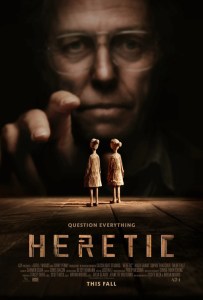 Heretic is a chamber movie about two teen Mormons (Sophie Thatcher, Chloe East) proselytizing to a middle-aged man (Hugh Grant) one dark and stormy night. He invites them in and seems kind and welcoming, but looks can be very deceiving. He has some very strong opinions when it comes to the nature of belief, and he will test both of these young Mormons on the faith of their convictions as he puts them through a series of trials and lectures. That last part might stun people, but Heretic is actually at its best during its lengthy lecture sequences. It might remind people of a nattering Reddit atheist being unleashed, but the movie really comes alive when Grant is challenging the roots of their belief systems as well as the historical contexts of religions. The Mormon ladies push back as well, countering some of the arguments so it’s not so one-sided. There’s a clear point of view to the movie but I wouldn’t say it’s didactic. The thrills ratchet as the two women start to fret about what this man has in store for them, how they might escape from his labyrinthine house, and how to signal for help. Unfortunately, the revelations can never quite match the fun of the mystery of motivations, and once it gets into a really convoluted place of switcheroos, then I think it loses momentum. The performances are all outstanding, led by Grant’s magnetic about-face turn as a snide villain. The same self-effacing charms he worked so well in the realm of rom-coms have a new eerie manipulative quality, luring his prey into his fiendish trap. The end attempts to go a bloodier and more ambiguous route that I don’t know it earns, but by that time, even after stalling out for the last act, Heretic won me over by virtue of its creepy convictions.
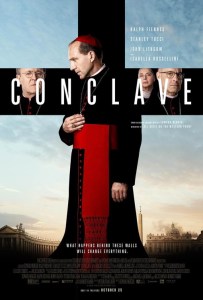 Conclave is an electioneering movie that places the viewer in the middle of the fraught voting process to determine the next pope of the Catholic Church. Ralph Fiennes plays a cardinal tasked with leading the conclave, the gathering of Catholic cardinals who will stay until a nominee has won a majority of their secret votes. Except it’s all not so secret as multiple candidates are openly campaigning for votes, trying to persuade different factions to support their candidacy. Each round of voting without a winner resets the field of play and leaves sides scrambling to reclaim footing. The movie is surprisingly very easy to get into, a crackling political thriller about the behind-the-scenes machinations and politicking for the highest office in the Catholic Church. There is a bevy of twists and turns and plenty of juicy revelations and betrayals, as these holy men start acting a little less holy to eliminate their competition or sully their chances. The constant churning is enough to keep things unsettled and intriguing, but there’s also a larger question for our protagonist, a man of faith who told the prior pope that he wished to leave his faith only to be denied by the pontiff for reasons we aren’t quite sure. Why did this pope specifically pick him for this position? The movie also asks deeper questions about the nature of power and leadership, namely are the people actively seeking it the right candidates for the right reasons? The very end of the movie knocked me out with a twist that I dare say nobody will rightly see coming, but it made me want to applaud. Conclave is an intelligently crafted thriller with weighty ideas and engaging performances.
Nate’s Grades:
Heretic: B
Conclave: B+
Share this:

Unfrosted (2024)
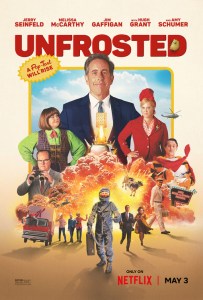 What to make of a movie like Netflix’s Unfrosted. It’s Jerry Seinfeld’s directorial debut, working off a screenplay he co-wrote, his first foray into film writing and acting since 2007’s Bee Movie. His eponymous sitcom “about nothing” was a 1990s mainstay and popularized an ironic meta form of comedy that still continues to dominate comedic tastes. Making a movie about the pseudo history of the invention of Pop Tarts, and the corporate rivalry between the major cereal brands, seems like a further exercise in that realm of humor, potentially satirizing a burgeoning sub-genre of late, the Biopic of Products (Air, Tetris, Flamin’ Hot, Blackberry). Except this supposed “biopic about nothing” is really a head-scratcher. Its humor feels pained and stale, the satire feels missing or glancing at best, and it seems like an expensive lark, wasting the nigh-infinite money of Netflix to purposely make a stupid comedy with all his friends.
Set in the mid 1960s, we follow two households, both alike in dignity, in fair Battle Creek, Michigan where we lay our scene. Kellogg’s has been the dominant cereal-brand for years but its chief rival, Post, is set to launch a new product that will revolutionize breakfast mornings. Bob (Seinfeld) is the head of development for Kellogg’s and reaches out to his old colleague, Donna (Melissa McCarthy), when it becomes evident that Post stole their unused research to develop a pastry treat designed to be cooked in one’s toaster. The warring CEOs, with Jim Gaffigan as Edsel Kellogg III and Amy Schumer as Marjorie Post, are desperate to one-up one another and be seen as more than an inheritor of their family’s wealth. It’s a race to see which company can get their treat to market first and capture the hearts, minds, and sweet teeth of America’s youth.
 I’d be lying if I said I didn’t laugh at points through Unfrosted, which operates like a spoof movie on a slower jokes-per-second pacing guide. There are zany sight gags amidst broadly drawn characters treating the silly straight, though occasionally you’ll have wisecrackers commenting on the inherent absurdity of moments, mostly confined to the stars making asides to the audience. Sometimes it’s lazy jokes that rely upon our foreknowledge, like when Bob coins a NASA beverage by saying it has a “real tang” (get it?). The movie frequently intensifies into goofy escalation when Kellogg’s impanels a team of mascots and inventors as a breakfast brain trust. Every one of these wacky characters is here to provide the exact same joke they will provide throughout the movie, and their inclusion is already suspect. Having the Schwinn bicycle guy (Jack McBrayer) comment on why he should be there is not enough. The hit-to-miss ratio will vary per everyone’s personal sense of humor, but overall I just felt mystified why this project would tempt Seinfeld from his comedy repose. What about this idea excited him? Was it just his lifelong love of cereal and Pop Tarts, a topic from his standup act decades ago? I ate a lot of cereal as a teenager too but I don’t want to make a movie about the Lucky Charms advertising campaign teaching children to beat and pillage the Irish (maybe Ken Loach could direct – to the three people on the Internet who appreciate this joke, I want you to know I appreciate you also).
It can be fun to simply watch dozens of famous people take their turns being silly in what is unquestionably a “dumb comedy.” When you have comedians of this quality in your movie, they’ll find ways to make even so-so jokes hit a little better, and that’s the case here. There’s an entertainment value in just wondering who will show up next, as many characters are only onscreen for a single scene or an abbreviated moment. Unfrosted becomes an example of Seinfeld’s industry power as he empties his Rolodex to fill even the tiniest of roles. Look, it’s James Marsden as Jack LaLanne. Look, it’s Bill Burr as JFK and Dean Norris as Kruschev (double Breaking Bad). Peter Dinklage as the head of the nefarious milkmen cartel? Why not? If you set your expectations low, maybe lower than what you were accounting for, there can be a mild amusement scene-to-scene just seeing who might show up next, almost like a modern-day version of those anarchic big ensemble comedies like It’s a Mad, Mad, Mad, Mad World.
 There is one segment that fell so flat for me that I was in utter amazement, and that was the unexpected January 6th insurrection parody. In a movie that has sustained a surreal and offbeat version of our universe, it evokes one of the most startling days of recent history. I think the humor is meant to derive from simply seeing a bunch of mascots in big colorful costumes as a mob running havoc, but there’s no jokes about like the challenges of a mascot costume in a fight, or say someone tipping over and being unable to get back up like a helpless turtle. There are jokes that can be had with this scenario, but instead Seinfeld is relying on the ironic juxtaposition of the ridiculous with the serious, and I don’t think it ever works as a joke. My sinking feeling began when Hugh Grant’s embittered mascot character wore a headdress resembling the QAnon shaman. It feels tacky and strange and the longer it persists the more I kept wondering what Seinfeld was doing with this. Why include this especially as the only form of relatively topical political humor, beyond, I guess, the depiction of business elites being complete morons? Why this? Again, it would be different if it was funny in execution, like the Saving Private Ryan D-Day parody from Sausage Party. This just isn’t funny, and its inclusion feels so odd compared to the stale nature of its other comedy.
As an admittedly silly enterprise, one that doesn’t even pretend to be accurate even as it flirts with the truth, Unfrosted is a successfully stupid comedy that feels a little too aimless, a little too edge-less and safe, and a little too dated and stale in its approach to comedy (lots of 1960s Boomer nostalgia ahoy). It’s hard to work up that much risible anger over a 90-minute movie that features a living ravioli creature. Clearly this movie wasn’t trying to be anything other than a gleefully stupid comedy, but I wanted more pep from its jokes and whimsy and general idiocy. I think the way to go may have been all the way in the other direction, treating the formation of a toaster pastry like international nuclear secrets and playing the corporate espionage completely straight while also making it patently ridiculous. Unfrosted did, however, make me want a Pop Tart that I ate afterwards, although it was my local grocery store’s generic brand, so I guess that doesn’t directly benefit Kellogg’s. This movie exists as a Seinfeld curiosity that ultimately left me hungry for more.
Nate’s Grade: C
Share this:

Wonka (2023)
 Was there anyone out there wondering how a young Willy Wonka could have gotten his start as a cutting-edge candy maven? It’s an unnecessary back-story for a kooky character that most will just accept as is. The invented story of Wonka is one of an upstart entrepreneur (Timothee Chalamet) proving a danger to the established corporate oligarchy’s vice-grip on the local confectionery industry. They use the levels of corrupt power to scheme and block Wonka from getting started, but his charms and optimism are just too much, and he wins over the town with his candied delights that provide revelry to the people’s humdrum lives. As a candy-colored musical following an underdog triumphing from the power of friendship and integrity and imagination and good will, it mostly works on a fizzy cloud of its own manufactured whimsy. It’s all highly silly stuff and working very hard to be light-footed and whimsical. There are moments that made me smile and tohers that made me chuckle, like one rich man who gags whenever somebody ever says the word “poor.” The new songs are fairly forgettable except when they’re making you remember the dreamy 1971 numbers. I also think Chalamet (Bones and All) is painfully miscast as our young Wonka. I don’t think his broody-moody acting style works shifting over to manufactured quirk. His performance is just so off from the beginning. Wonka would have been exceedingly better as an original musical without trying to retrofit into the world of Willy Wonka, although that would mean losing Hugh Grant as our first specimen of Oompa Loompa, and he is a droll delight. It’s just weird for a movie to work this hard to tell us how Wonka got his start and to end on uplift when we know in the future he grows up to be a sad middle-aged loner who has to resort to a scam to find a successor, as well as the town becoming an impoverished slum to Wonka’s oppressive factory. My pal Ben Bailey reasoned it would be like a prequel to Death of a Salesman where a younger Willy Loman starts his career as a door-to-door salesman, so chipper and eager to make a name for himself. Wonka is a sugar rush designed as an origin story.
Nate’s Grade: B-
Share this:

Dungeons & Dragons: Honor Among Thieves (2023)
 As required for every film critic before discussing the new Dungeons and Dragons movie, subtitled Honor Among Thieves, I must tell you my personal history with the seminal tabletop game. Well, I don’t think D&D is for me. Many of my friends are heavily involved in D&D, several as the quest-fashioning dungeon masters, and I’ve even sat in for a few games, but there’s something about the group improv experience that I never feel comfortable while playing, like my mind just runs into imagination roadblocks trying to come up with options in a near limitless space. Plus I think character creation is one of my lesser storytelling skills; I typically build characters more out of plot and concept and theme. Also, the demanding time commitment to play a game that can take possibly months or years to conclude makes me hesitant. I already think Monopoly lasts too long and has a habit of ruining friendships (if I was ever paid to write a Monopoly movie, that would be my starting point, not bringing to life Mr. Moneybags).
Anyway, D&D has had something of a cultural renaissance the last decade, reaching new levels of wider acceptance partly thanks to its prominent placement in Stranger Things. Pretty good for an ever-evolving 50-year-old game system that was at one point blamed for luring impressionable youth into the ways of Satanism and insanity (see the ridiculous 1982 movie Mazes and Monsters starring a young Tom Hanks as a student who cannot distinguish between reality and the game world to murderous effect). It’s such a substantial fantasy property that it was only a matter of time for movies to follow. There was an abysmal D&D movie from 2000 co-starring Thora Birch and a go-for-broke Jeremy Irons that isn’t worth your time. I wasn’t excited for a new Dungeons and Dragons movie until I saw that its directors and co-writers were Jonathan Goldstein and John Francis Daley. I was a big fan of 2018’s Game Night, their last directing effort, and they’ve been a dependable comedic writing duo. It was with them that I placed my faith and that faith was fully rewarded when my wife and I watched Honor Among Thieves and had a delightful time. This is a wildly fun D&D movie for every viewer.
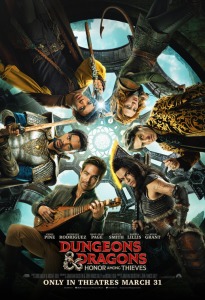
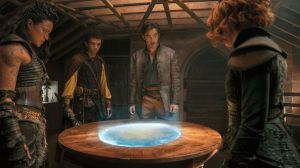 In the world of owl bears and sorcerers, Edgin (Chris Pine) and his trusted partner, Holga (Michelle Rodriguez), are looking to settle the score. They’ve broken out of prison and are trying to gather their old team back together but everyone has a grudge. Forge (Hugh Grant) has betrayed the group for power and especially riches, serving as the city’s reigning lord. He’s recommissioned a gathering of games and sport, drawing crowds back to the city, and with games comes betting and with betting come large sums of money from the rich. Edgin plans to rob from the treasure hold for the games and with that score he can regain his daughter and possibly reclaim a magical totem that can bring his dearly departed wife back.
I have no prior understanding of anything relating to the world and lore of D&D, and I found it to be extremely accessible and engaging. That’s because Goldstein and Daley have put the emphasis of their movie not on its lore or history or locations but on its characters. I appreciate that here is a major work of IP for a studio that is attempting to tell one very good and accessible story for the masses rather than set up a cinematic universe and ready it for possible sequel bait. Get the movie right and have that make me desire more movies rather than establishing a world that has potential but otherwise goes unfulfilled. The very concept of Honor Among Thieves helps to keep things light-hearted and moving. My pal Ben Bailey and I have been clamoring for years for a heist movie set within a fantasy world. It was ready-made to satisfy with the genre structure of heists, and putting a team together that rolls with unexpected adversity, and the cleverness of incorporating fantasy abilities and elements into heist genre familiarities. Thankfully, Goldstein and Daley realized how entertainingly plentiful this combo can prove.
The fun characters are what help to make the movie so enchanting. Rather than settling on a subsection of class representation (one dwarf, one elf, one wizard, etc.), the characters are more about what they bring to the team and what motivates them for character arcs. We have a shapeshifter (Sophia Lillis) who is trying to protect the kingdom’s encroachment on her kind. We have a shaky wizard (Justice Smith) who is battling for his own self-confidence and respect. Nobody feels like a token appointment. Even characters that would seem like a D&D player’s dream, a powerful paladin played by the dashing Rege-Jean Page (Bridgerton), are given more purpose. He serves as a contrast to our hero’s journey back to respectability, and the character is so noble and serious that it’s yet another shade of comedy to explore. His obliviousness to irony and sarcasm reminded me of the very literal-minded Drax (Guardians of the Galaxy). This is a character that would appear in standard fantasy epics, and yet he’s played for laughs just through sheer juxtaposition without ever mocking the reality of this world. At no point will characters condescend to their reality, saying self-aware critiques like, “Well that’s a very inconvenient and stupid place to put a castle,” etc. There is a cameo where the gag is that this person is much smaller. The appearance is played for goofy laughs and yet it’s also shocking in its emotional sincerity. If you removed the size differential, this would be a dramatic and eventful scene (I did enjoy the unspoken preference of this individual when it comes to a romantic partner). The movie is very funny and very skilled at being funny without reliance upon meta genre riffs.
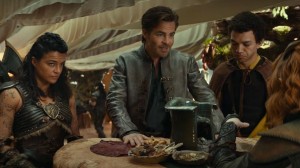 Elevating an already great movie, Pine (Don’t Worry Darling) is robustly charming as a bard/secret agent. He secured my loyalty within two minutes of the movie when he gave up on his prison knitting project and said, summarily, “I’m just gonna make a mitten. Who am I trying to impress?” Pine has long been one of our most effortlessly charming leading men, and playing a rakish heist leader who also sings will only magnify the man’s innate appeal to the masses. He works even better alongside Rodriguez (any Fast and Furious movie after 6) who becomes the real physical presence. This is a career-best performance with Rodriguez sliding right into exactly the comedy wavelength she’s needed for – the gruff and cynical worldview of the weary warrior. They make for a great bantering lead duo.
The set pieces are also tailored to the character arcs while still being memorable and entertaining. This is a movie that doesn’t get complacent over its 134 minutes. Each sequence must stand out, whether it’s because of creative and intuitive fight choreography that makes keen use of geography and circumstance, or a graveyard Q&A with very constrained magical rules to follow that leads to a lot of digging to find the right corpse with the right information, or escaping from an obese dragon (with its “widdle wings”) that resembles a chonky cat, or a dangerous trip through a maze that abruptly reconfigures itself, or a prison escape that doesn’t quite go as you expect, nor at the characters expect. Every scene has a purpose. Every magical item has a specific use, and every set piece sets itself apart visually and from a story standpoint.
Goldstein and Daley have excelled as writers, but they’re also proving to be visually adept directors. With the emphasis on characters, it’s not CGI spectacle for spectacle’s sake. There’s a pleasing physicality to this world. The budget is in the $150-million range, which is quite a show of confidence for the directors, but the emphasis is on what best elevates the moment. There’s a thrilling escape performed as a tracking shot with a zooming camera tracing the escape of our shapeshifter from harm, and there’s fantastic visual inventiveness with a magic portal and its application for the film’s equivalent of a rollicking stagecoach robbery. There’s a noted intention here with the shots and scenes and visual arrangements, so Honor Among Thieves feels like a studio film with vision.
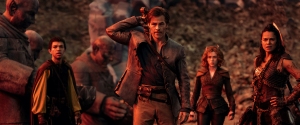 Allow me to take one very fleeting moment to digress just how much care Goldstein and Daley put into even the smallest of details. After we’ve met the last core member of our crew, he confidently leans backwards and falls into a pit leading to an underground cavern. The rest of the crew creep toward the opening and stare down below with trepidation. Simon then says, “I’m going last.” We then cut to the group at the bottom of the cavern. It’s such a small detail, but the previous scene ends on a character-appropriate punchline for Simon reconfirming his squeamishness, but then by transitioning to the entire collected crew together, we know he was last and so we’re ready to move forward. Again, it’s a small detail but it’s a microscopic example that proves, to me, how much thought and care the directors have given.
As a novice to the famous role-playing world, I found Dungeons & Dragons: Honor Among Thieves to be an exhilarating and highly entertaining fantasy adventure where fun is the chief priority. It’s not at the expense of great characters, good humor, and satisfying payoffs with well-developed setups strewn throughout. It’s a reminder how enjoyable and escapist blockbusters can be when you have the right artists using the expansive box of paints. It’s great for all ages and families too. I don’t have any personal connection to this sword-and-sorcery universe but now I want many more adventures if this is kind of quality they’re offering.
Nate’s Grade: A-
Share this:

The Gentlemen (2020)
 I’ve been hoping, wishing, praying for Guy Ritchie to return back to his screwball Cockney crime pictures of his splashy beginning, but the further and further I get from 2001’s Snatch, the more I think it’s a luxuriously madcap exception. The Gentlemen is a closer return to form than 2008’s RocknRolla, but it’s still a long way off from early Ritchie. The recognizable elements are there, from the convoluted story with twists and turns, the non-linear storytelling lapping and overlapping itself, the comical brushes with sudden violence, the colorful array of criminal characters, and a sense of style that seems all over the place. We follow Matthew McConaughey as a marijuana titan looking to get out of the business, though there are threats old, new, and “just business” that are trying to take his empire from him before his exit. The biggest problem with The Gentlemen is how clever it feels like it needs to be and how few characters there are to find interesting. Snatch, by contrast, forever contrast, was practically a Dick Tracy rogues gallery of all its memorable and unpredictable characters. These feel pretty rote, even our heroes, and the minority characters get even shorter shrift. The plot is also more complicated than it needs to be with an extended meta-textual layer of a lecherous Hugh Grant tabloid journalist pitching the story like it was a movie (irony: it is a movie!). It took maybe 45 minutes before I felt like the story was finally picking up momentum and stakes, and by the end, it felt like Ritchie was just extending his story with another twist and wrap-up, and then another twist and wrap-up, like the outer edges of the movie cannot be contained and somehow it’s still even going. It’s like Ritchie doesn’t know when to walk away from his own party. Because of these things the pacing is wonky and there are more than a few tedious stretches. Colin Farrell has some amusing moments but should have been the main character as a boxing trainer who takes a shine to try and reform local hoodlums. McConaughey’s character is too boring and always wins too easily, which makes him more boring. The Gentlemen is a C-level rendition of Ritchie’s best material, and Snatch only shines even brighter with each new miss.
Nate’s Grade: C+
Share this:

Bridget Jones’ Baby (2016)
 Coming 12 years after the last Bridget Jones outing, I was pleasantly surprised to discover how warm my feelings still were for this plucky, feisty heroine. Now in her mid/late 40s, Bridget is contemplating a life never becoming a mother when, surprise, she gets very pregnant and has two possible fathers: billionaire love guru Jack (Patrick Dempsey) or her newly available on-again off-again beau, Mark Darcy (Colin Firth). It’s a frothy plot contrivance but the screenwriters (including author Helen Fielding and co-star Emma Thompson) are able to produce fun comic scenarios that fully embrace the premise and its soapy conflicts. Bridget has two pretty appealing options, and when both men finally discover the possibility of the other, it becomes an entertaining game of one-upsmanship. The requisite romantic comedy elements don’t forget to be funny too, including an ending rush to the hospital that achieves some inspired slapstick. The film is swiftly paced and filled with zingers, and I just sat back for the two-plus hours and enjoyed the company of these silly yet realistic human beings. I enjoyed the adult humor and conversations that rarely get as much development in this genre. With all her self-sabotaging ways, you come to realize how much of a prize Miss Bridget is, and Zellweger slips right back into the role like no time has passed. However, plenty will grumble about Zellweger’s much-publicized plastic surgery, or the fact that she didn’t pack on the pounds for this picture, but I don’t see why any of that greatly matters in the interpretation of this character. The personality of Bridget is more than the alignment of her facial features. For fans of the series, Bridget Jones’ Baby is a welcomed return to form from 2004’s Edge of Reason and an extra dose of enjoyable fan service, tying up its tidy happy ending with a bow. Here’s something to chew over: my father had no prior knowledge of the Bridget Jones series, decided to see this movie, and enjoyed it thusly. Give Bridget Jones and her baby daddy drama a chance and you too may be surprised.
Nate’s Grade: B
Share this:

The Man from U.N.C.L.E. (2015)
 Guy Ritchie’s big screen reboot of the 1960s TV show is the right kind of fizzy summer escapist entry that goes down smooth and entertains with just enough swanky style to pass the time. The Man from U.N.C.L.E. is equal parts spy thriller and straight-laced genre satire, hewing closer, and more successfully, to a marriage between Ritchie early cockney gangster flicks and his big-budget Sherlock Holmes action franchise. It’s often fun and surprising at how well it holds its tone between comedy and action; it almost feels like a screwball romance with guns and bombs. The trio of leads, Henry Cavill as the American agent, Armie Hammer as the KGB agent, and Alicia Vikander (Ex Machina) as the German asset, make an engaging group with plenty of conflicts to explore. It’s surprisingly more character-based than driven by its action set-pieces. Cavill shows far more life and personality than I’ve ever seen from him on screen. Vikander and Hammer have an amusing chemistry together and the movie allows them to roughhouse without pushing either character in a direction that feels too safe. Their series of will-they-won’t-they near misses will drive certain portions of the audience mad. The movie gets into danger when Ritchie and his co-screenwriter Lionel Wigram get too cute, especially with a narrative technique where the movie doubles back or highlights action that was in the background at least four times. The world of this movie is also another asset, as the period costumes, soundtrack, Italian locations and production design are terrific and further elevate the swanky mood. It’s an ebullient throwback that serves up enough entertainment with its own cock-eyed sense of throwback charm.
Nate’s Grade: B
Share this:

Pirates: Band of Misfits (2012)
 Delightful from beginning to end, Aardman’s stop-motion animated caper Pirates: Band of Misfits is hands down the best animated film of the year. Its wry British humor is mixed with inspired slapstick and a child-like sense of folly as the Pirate Captain (voiced by Hugh Grant) and his motley crew try to prove themselves to their pirate peers. Then they run into Charles Darwin, discover their parrot is really the last remaining dodo, and have to face off against a double sword-wielding Queen Victoria. The imagination on display is remarkable. Even the puns are funny. The pacing is swift, with gags flying so fast you’ll likely want a second viewing to catch them. The voice acting is spot-on and Grant anchors the film with his gleeful impulsivity. The story is simple but well executed and fun. I absolutely loved this movie. Its action sequences are well orchestrated, its comedic sensibilities are silly but often satisfying (a monkey butler who speaks in pre-written cards, a member of the crew that is merely a fish with a pirate hate on), it’s self-aware without being too self-conscious, and the animation is wonderful. There’s something about stop-motion that other animations cannot replicate, a physicality to its world that can make it so rich and immersive in the right hands. Kids will miss the references to, among others, Darwin, Jane Austen, and John Merrick, but adults will appreciate the nods. Pirates: Band of Misfits is a wildly entertaining family-friendly animated adventure that has it all.
Nate’s Grade: A
Share this:

Cloud Atlas (2012)
 Most people regarded David Mitchell’s 2004 sprawling novel Cloud Atlas was unfilmable. It has six different stories each set in a different time period, slotted into a different genre, and each a variation on storytelling. Mitchell’s tome was structured like a series of nesting dolls, each narrative pulling back to reveal a character reading the previous manuscript, and eventually the direction was reversed. We go from the mid-nineteenth century to post-apocalyptic and back again. I read the book over the summer and found it to be enthralling, especially because each storyline was written so distinctively in a different writing style. The post-apocalyptic linguistics definitely took some getting used to. How could you turn this unwieldy book into a workable movie?
The Wachowski siblings, Andy and Lana, teamed up with German director Tom Tyker (Run Lola Run) to try and find a way. They decided to split up the stories into a musical syncopation, with stories blending into one another. As a result, Cloud Atlas is six different movies for the price of one but it’s far more than the sum of its parts. Cloud Atlas coalesces, bleeds, and bends, becoming a Mobius strip of causality and courage and love. The trio of directors, who shot simultaneously with two separate film crews, has done the impossible and translated Mitchell’s brilliant novel into a soaring, compelling, and multifaceted epic on hope and humanism.
Where to begin with this one? Well, in 1849, Adam Ewing (Jim Sturgess) is traveling across the Pacific back to his home in San Francisco. He’s fallen ill on the ship and keeping the secret of a stowaway in his chamber, a Moriori slave named Autua (David Gyasi). In 1931, Robert Frobisher (Ben Whishaw) is a penniless gay musician looking for refuge. He offers his services to the aged but still famed composer, Vyvian Ayers (Jim Broadbent). Ayers will dictate and Frobisher will assist in writing. In 1971, Luisa Rey (Halle Berry) is a reporter investigating a series of murders tied to a nuclear facility and a report the head honcho (Hugh Grant) doesn’t want exposed. In 2012, Timothy Cavendish (Broadbent) is a small-time publisher who mistakenly checks himself into a nursing home that won’t allow him to leave. In 2140, a new working class is grown from the lab. Somni 451 (Doona Bae) is one of these fabricants. With the help of a revolutionary (Sturgess), she escapes her confines and learns the horrors of the totalitarian world and becomes part of the rebellion. And 100 winters after “The Fall,” mankind has descended into agrarian tribes. Zachry (Hanks) is a goat herder who reluctantly agrees to take Meronym (Berry) to a hallowed mountain. Meronym belongs to the last group of technology-abled civilization, the Prescients, and Zachry mistrusts her and is tempted to kill her to protect his people. Just describing this stuff is tiring and could take up two reviews.
 This is going to be a very divisive movie, this much I can tell. It’s so powerfully earnest that you either embrace its mushiness and ambitions or you smirk and mock its New Age philosophy and optimism. There will be no middle ground with this film. We’re talking about transmigrating souls over the course of 500 years, Tom Hanks as a post-apocalyptic goat herder, and an evil presence known as Old Georgie, who looks like the forgotten cousin to the Wicked Witch of the West. There is some stuff in this movie that is plenty goofy, especially when seen on the surface. It takes a while to ease into the film, adjust to its tempo and accept the context of those goofy elements. But once that’s established then it feels like you can handle anything. There’s such an overflowing of feeling in this movie that it’s easy to make fun of it, to dismiss it under the safety of ironic detachment. It would be easy to decry the Cloud Atlas team for being self-indulgent or pretentious. What they are doing is far from normal, but the achievement of Cloud Atlas is the graceful way it finds to connect the rhythms of a deeply felt humanity. It has its stirring moments and memorable scenes, but when compacted and collected into a beautiful whole, that’s where the movie transcends. When an authoritative character barks, “You are but a drop in an ocean,” and our hero responds, “What is an ocean but a series of drops?” you either roll your eyes or you cheer. This is an earnest movie that wears its humanism on its sleeve. You either roll with that or you don’t, and I decided to embrace the big, messy, mushiness of the whole project and was swept away.
For a three-hour movie, the time flew by, and by the end I knew I had to see Cloud Atlas again. The first viewing requires much in the way of processing. You’re stringing together the disparate strands of the narrative, you’re listening hard to decipher the post-apocalyptic tongue of Zachry and company, and then you’re also keeping track of what actors are playing what characters, crossing lines of race and gender. The disguised actor factor is something of a fun ”who’s who” party game throughout the movie; initially distracting and somewhat questionable (especially the cross-racial makeup). I think seeing Cloud Atlas a second time will allow me to immerse myself further, finding new depths and connections. The pacing is surprisingly swift for a three-hour movie. You barely notice the time is gone, and honestly I could have done with even more movie, especially during the Neo Seoul segment. Given the six segments, some stories are going to be more compelling than others. I don’t think too many people are going to be as compelled with Frobisher’s creative sessions as they are Somni’s escape from enslavement. Initially, you’ll be scratching your head what they all have in common, and the lighthearted segments seem to clash with the more severe segments of systemic abuses. But then the big picture starts to eventually emerge and you see the parallel themes of oppression, bondage, rebellion, sacrifice, abolition and the yearning for freedom at all costs. The filmmakers find clever ways to thematically link their different tales. The movie starts to become a musical experience, much like Frobisher’s central melody, the overlapping notes of repetition and the swelling movements of human life in minor and major.
 As anyone who endured the Matrix sequels will attest, the Wachoswkis are film theologians and Cloud Atlas is unabashedly spiritual. The filmmakers openly favor examining the spiritual side of Mitchell’s novel rather than the political. I found the results to be intriguing but short of profound. From a philosophical/theological standpoint, Cloud Atlas is not breaking new ground or even going into great depth. We’ve got some basic Eastern notions like reincarnation and trying to improve upon one’s soul through various lifetimes. There’s also the notion that death is just a transitional phase and not the end. The film is also very interested in the transcendentalist interconnections of human history. “With each crime and each act of kindness, we give way to our future,” says Somni at one point. I like this; it’s essentially karma in its purest form but it also denotes that every choice gives ways to multitudes of possible futures (perhaps pedestrian but I still like it). I feel that human kindness is long-reaching and casts out many ripples, and Cloud Atlas is a film all about the ripples, seeing the long-reaching effects to causes, and discovering that individuals can become movements and movements can become inspiration. I also like the relatable debate over religious belief in the far-flung future; the Valley people worship Somni as their gracious Goddess, but the more advanced Prescients view her as a person, noble and with strong and important ideas but flesh and blood. And yet the film doesn’t look down on Zachry and his people for their beliefs; Somni inspires them to do good. Do the details matter when the results are positive? Cloud Atlas has plenty of intriguing questions roiling around, moments of pause worthy of post-screening debate. It’s not too deep but it’s far from shallow (the Wachoswkis love their Christ-like imagery, don’t they?).
From a filmmaking craft standpoint, Cloud Atlas is often breathtaking. In some respects it feels like something radically new, a $100 million dollar art film. The visuals are wonderful and the different time periods all come across handsomely mounted, perfectly realized, the details vivid and period appropriate. The future worlds are easily the most engrossing just because of how different they are. You’re never spoon-fed the answers in this movie, so we’re left to put together what lead to each future. I would have loved to have gotten even more details about Somni’s world, a time where democracy has been replaced by “corpocracy,” a world run by corporations. The ambitious story structure of Cloud Atlas could have easily become confusing, but the filmmakers smartly give each segment its own little undivided period to set up that world and its unique tone. They even provide date stamps. Then things get more spliced together, the different storylines cascading and braided together. Some of the storylines have to wrap up early and others are saved for heartbreaking finales of tragic resonance. The elliptical romances spanning centuries provide nice counterpoints and satisfying out-of-time conclusions for storylines that don’t always end cheerful. The movie is often thrilling, intellectually stimulating, disturbing, and poignant, though to be fair it comes up short when it comes to emotional involvement. Like the stunted depth of its philosophy, the movie has a way of drawing you in but never fully; it’s all about a wealth of human feelings and the nature of humanity yet it quixotically comes up short emotionally.
With up to six roles to play, the actors are given plenty to work with. It would be redundant to say you’ve never seen many of these actors like they are in Cloud Atlas (has anyone ever seen Berry in whiteface?). Every actor gets to play heroes and villains, saints and sinners. Only Weaving (The Matrix) and Grant (The Pirates! Band of Misfits) play antagonists in just about every story, and when you have Weaving at your disposal you have to give the man a role with menace. Grant gets to play a post-apocalyptic marauding cannibal. You won’t see him eat anybody’s face in one of those Bridget Jones movies. Like the filmmakers, the actors display full commitment to their varied roles no matter how silly some of the future diction may sound (“for true-true”). Hanks instantly anchors your empathy as Zachry and grounds a storyline that has the biggest danger of slipping into silliness. Readers will know I’m not the biggest Berry fan, and that is probably being charitable. However, I was truly impressed with her work in Cloud Atlas and would easily classify this as her best work since her Oscar-winning turn in Monster’s Ball. Her portrayal of Luisa Rey has such fire and her Meronym has such melancholy. Broadbent (The Iron Lady) is still highly enjoyable as a pompous sort, I’m always happy to see Keith David, and Weaving is delightful in his venomous villains, as a devil, a hit man, and most vividly as the Nurse Ratchet-style sadistic head nurse antagonizing Cavendish. The real breakaway star is Bae (The Host), who also benefits by having the most involving storyline. Her gradual awakening is just about note-perfect, alternating between curiosity, horror, amazement, and finally anger. All of those emotions need to be free of histrionics but if too underplayed then Somni seems like a walking zombie. Bae finds the right somber middle ground and her journey is the most emotionally rewarding.
 In the end, there’s so much to unpack, dissect, discuss, debate, and contemplate with this movie, and every hour I think of some new connection that dovetails the plots. Cloud Atlas is a thrillingly artistic mosaic, a giant puzzle that begs for closer examination. Unlike the films of Terrence Malick, this is a dense, challenging work that is also accessible and, here’s the heretical part film snobs, entertaining. We get a kaleidoscope of the human experience told in beautiful flourishes. There are a lot of demands with Cloud Atlas, and ultimately it may demand multiple viewings to completely sort out one’s opinion on this gigantic picture of gigantic feeling. I’m still uncertain whether I really enjoyed it or loved it, nagging doubts concerning the limited emotional attachment to consider. I’m curious what a second viewing, stripped of analyzing which actor is in what body, will allow me to further appreciate the scale and scope of the film’s achievement.
The individual stories of Cloud Atlas may not be terribly profound but collectively this movie is something special. I anticipate it will be trendy to mock its sincerity and ambition and New Agey spirituality (not that a negative opinion is automatically invalid). We live in a cynical world. It’s rare to find a movie that has so many things to say with such intense earnestness. It’s even more rare for that movie to be good. Due to the sci-fi elements and time hopping, The Fountain and 2001 will be natural film comparisons, but In some ways Cloud Atlas reminds me more of another divisive film, 2001’s Moulin Rouge!. Both were sincere movies about the genuine power of love and human connection, told with such artistic flair, drive, and ambition, and both attempt to transform the traditional tropes of storytelling and drama into a brave new 21st century collage of sight and sound and sprawling spirits. Simply put, you’ll never see a movie like Cloud Atlas again. So do yourself a favor and see it already, then find someone to talk about it and compare how fast the time goes. Then, if you’re like me, see it again.
Nate’s Grade: A
Share this:

Music and Lyrics (2007)
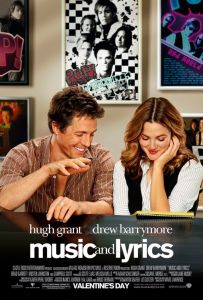 As bland and flavorless as the 1980s pop pap it hopes to skewer. For die-hard fans of the romantic comedy genre, there may be some minor level of enjoyment, but for the rest of us (those without ovaries) Music and Lyrics is predictable to the end and Hugh Grant and Drew Barrymore don’t elicit any semblance of chemistry. The songwriting is noticeably a cut above thanks to Fountain of Wayne’s bassist Adam Schlesinger writing them, but even the participation of one of my favorite bands can’t make Music and Lyrics worth seeing. The Duran Duran-esque music video that opens the film is a hoot and it all goes downhill from there, especially if you find it difficult to accept long durations of the cutesy baby act of Barrymore.
Nate’s Grade: C


 nathanzoebl
You must be logged in to post a comment.