Blog Archives
Donnie Darko (2001)
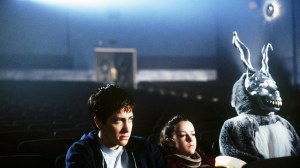
 Donnie Darko (Jake Gyllenhaal) is your normal malcontent teenager in late 1980s Reagan America. He bickers with his older sister, worries over the right moment he’ll kiss his new girlfriend, and tries to ignore the advice of many imprudent adults. Donnie’s your typical teenager, except for his imaginary friend Frank. Frank is a sinister looking six-foot tall rabbit that encourages Donnie into mischief and gives a countdown to the impending apocalypse. And I haven’t even gotten to the time travel yet.
One night as Donnie wanders from his home at the behest of Frank, an airline engine mysteriously crashes through the Darko home and lands directly in Donnie’s room. The airlines are all at a loss for explanation, as it seems no one will take responsibility for the engine or knows where it came from. Donnie becomes a mild celebrity at school and initiates a relationship with a new girl, Gretchen Ross (Jena Malone). One of his classes consists of watching videos of self-help guru and new age enlightenment pitchman Jim Cunningham (Patrick Swayze). His school has even, under the persistence of self-righteous pain Kitty Farmer, persuaded Cunningham to speak and try to help students conquer their “fears.”
 Donnie is also seeing a therapist for his emotional problems and taking medication for borderline schizophrenia. Around this time is when Donnie starts to inquire about a strange old woman, obsess over the possibilities of time travel, as well as see weird phosphorescent pools extend from people’s chests. He also floods his school at the urging of Frank. This is no Harvey type rabbit.
The longer Donnie Darko goes on the more tightly complex and imaginative the story gets. First time writer-director Richard Kelly has forged an excitingly original film that is incredibly engaging with charm and wit. He masterfully mixes themes of alienation, dark comedy, romance, science fiction, and a sublime satire of high school. Donnie Darko is the most unique, head-trip of a movie unleashed on the public since Being John Malkovich. Kelly has a created an astonishing breakthrough for himself and has ensured he is a talent to look out for in the future.
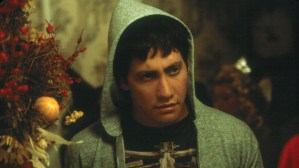
 Gyllenhaal (October Sky) is superb as disenchanted Donnie, a Holden Caulfield for middle suburbia. His ghastly stare conveys the darkness of Donnie but his laid-back nature allows the audience to care about what could have merely been another angst-ridden teenager. Swayze is hysterical as the scenery-chewing Cunningham. The rest of the cast is mainly underwritten in their roles, including stars Drew Barrymore (who was executive producer) and ER‘s Noah Wyle, but all perform admirably with the amount they are given. Not every plot thread is exactly tidied up but this can easily be forgiven.
Donnie Darko is a film that demands your intelligence and requires you to stay on your toes, so you can forget any bathroom breaks. The film is one of the best of 2001 but also one of the funniest. You’ll be honestly surprised the amount of times you laugh out loud with this flick. The theater I saw this in erupted every half a minute or so with boisterous laughter.
Donnie Darko is a film of daring skill and great imagination. You don’t see too many of these around anymore.
Nate’s Grade: A
Reviewed 20 years later as part of the “Reviews Re-View: 2001” article.
Share this:

Dogma (1999)
 In a time where simply having faith in anything, let alone religion, is scoffed at, Kevin Smith daringly and passionately expresses his personal search for answers and understanding. But while the zealots decree Dogma as blasphemy, what they truly miss is the biggest commercial for faith and God that American audiences have seen in decades of cinema.
The story of the religious epic causing all the hubbub begins with a pair of fallen angels (Ben Affleck and Matt Damon) spurned from the pearly gates of Heaven and banished to Wisconsin. One discovers a re-dedication of a church imploring a little used Catholic practice of plenary indulgence allowing whoever to enter through the church’s arches to have their slate cleaned of all sin. The two seize this opportunity of a dogmatic loophole to sneak back into heaven. The only slight problem is that by doing so they reverse a decree of God and disprove the Almighty’s unfallability, and thus will wipe out all of existence. The voice of God (Alan Rickman) recruits a lapsed Catholic named Bethany (Linda Fiorentino) for a Holy Crusade to halt the scheming angel’s plans for the good of the universe. Along the way she is aided by two unlikely prophets (the dynamic duo of Jay and Silent Bob), an racially discredited 13th Apostle (Chris Rock), and a shapely strip-teasing muse (Salma Hayek) as they engage with demons, seraphims, angles, and all sorts of celestial “who’s who” to stop the end of existence.
 Smith’s direction has taken strides since the point-and-click days of his earlier works; however, there’s still an awkward flatness to his framing and action. Fiorentino plays the role of a grounded character well. Rickman as the bitter Brit shows why he can still take anyone toe-to-toe for acting chops. Affleck and Damon have terrific chemistry together and play off one another for great comedy. Jason Mewes has never been funnier as the terminally stoned and foul mouthed Jay. Rock shows he can restrain his abrasive personality. Salma shows… well she shows she can dance. Jason Lee as an air conditioning-adoring demon and George Carlin as a used car salesman type Catholic Cardinal are so commanding in their presence and excellent in their performances that it’s a sin most of their scenes were cut during editing. Even Alanis Morrisette works as a humanly childish God. She’s given no lines but expresses great feeling and humor anyway.
Dogma is rambunctiously hilarious and a never ending joyride of fun as it jumps from jokes about demons made of excrement to “Buddy Christs” to insightful and sensitive thoughts on religion. Rarely does it bore even with the large plot it must always keep in successive movement. The only drawback Dogma suffers from is the amount of religious points it desires to make. The characters will reach a subject, chat, then directly move on to the next. The sporadic nature can easily keep an audience’s head spinning, but is brought back down to gentle rest from Smith’s Divine wit and sharp writing. Some of the opus’ many characters appear for only brief stretches as Hollywood’s A-list battle for valid screen time among each other.
 Smith is not one to shy away from controversy, or his quota of sexual innuendos and profanity. But the protestors for this film attacking its vulgarity are beyond missing the point; Dogma is reaching people the church hasn’t and can’t. It may be an audacious tweaker of a flick, but ultimately it’s bringing up religion into open debate and discussion amongst the masses where there was none before. And isn’t that in itself glorifying some type of achievement?
It would do well the opponents of Dogma to venture into a darkened theater sometime to see the movie and realize it is a humorous affirmation of faith and beliefs. The story of a crisis of faith is relatable to a society too jaded and cynical. Smith’s wrestle with theology is the public’s gain, and his halo only glows a little brighter for having the courage to do so.
Nate’s Grade: A-


You must be logged in to post a comment.