Blog Archives
Away We Go (2009)
 Away We Go sort of came and went in the blink of an eye over the summer. Some critics dinged the indie production as being insufferable, hipster, smug, and unlikable. I agree that the plaintive guitar-strumming score grates, and the costumes have that trying-hard-not-to-be-hip coolness, which can be insufferable, but Away We Go is more than just faulty hipster packaging. There is a moving and entertaining drama inside here. The problem is, you have to sift through some of the junk to reach it.
Burt (John Krasinski) and Verona (Maya Rudolph) are in their early thirties and about to have a baby. They aren’t exactly hipsters but they have been living a somewhat fringe existence; Verona even points out that they have a cardboard window. Their existence has been mostly ramshackle and now its about to change forever. Burt and Verona decide to journey across the country and reunite with family and old friends. They’re studying widely different family units across the country to discover not just what kind of parents they will be but what kind of family they will be.
Just by the fact that nobody dies at the end, this is a big departure for director Sam Mendes (American Beauty, Revolutionary Road). This low-key road trip comedy is quite different from the meticulous prestige pictures associated with the Mendes name. Away We Go is a scruffy, small, and disarming little picture that wants to say something. I was taken aback at how affecting I found moments of Away We Go, though it is only moments. Burt and Verona are not exactly the best equipped to start a family right now, which makes them anxious and nervous, and anxious about not being more nervous. They haven’t exactly matured much since graduated college years ago. But amidst their search for the definition of a “working family” they must accept the uncertainty of life. Burt and Verona have a comfortable interaction, from his upbeat sarcasm to her grounded realism. There’s a great running gag where Burt tries to raise the baby’s heart rate, so his goofy bouts of fake agitation will be immediately followed by a stethoscope and an adorable grin of satisfaction. They are a compatible couple and it is refreshing to see a movie couple that compliments each other in personality. They actually love each other, are good for one another, and are not beset with contrived conflicts. In fact, the movie ends up pretty much exactly where it began, only with a smattering more of wisdom. The lesson learned in Away We Go is that it doesn’t matter what the bumps in life may be, it’s all about who you have as your co-pilot.
 Screenwriters and married partners, Dave Eggers and Vendela Vida, mix in small moments of weight and an overall tone of genial sweetness. The drama and the comedy are given equal share of the script, though the elements don?t mix that often. The funniest moment, by far, is when a little boy tells his mother exactly what he knows about babies (I won’t spoil the guffaw-inducing surprise). There are some quiet yet weighty moments of human observation here. There was a tender exchange between Verona and her sister Grace (Carmen Ejogo) that had me on the verge of tears. The sisters reminisce about their parents, long dead, and then Grace says that having this baby keeps their parents alive; the sisters can see parts of their mother in the baby’s face. Verona is giving back life to her dearly departed mother and keeping her parents’ legacy ongoing. This lovely thought struck me with such sudden force that I felt overcome with emotion. It could be dismissed as a common sense fact of genetic proliferation, but I had never thought of the birth of a child as a means of keeping the past alive and honored. To me, this is a simple yet wonderful and powerful statement. Another great moment is when Burt and Verona make lifelong promises to each other on a trampoline. Verona doesn’t want to marry, so the scene is the equivalent of the two lovebirds exchanging vows. It’s heartfelt and sincere and well within the bounds of the characters.
What?s frustrating to me is that the movie?s poignancy is undercut by its excisions with grotesque cartoon versions of bad parents. Burt and Verona visit different imperfect family units, but it isn’t until the end of the movie where we see anything resembling a semi-authentic brood. Alison Janney plays an obnoxiously loud parent who berates her children for laughs and accepts the brokenness of children; to her, she can’t fight against genetics and thus gives up parenting. On the flip side, Maggie Gyllenhaal plays a narcissistic earth mother who still nurses her children and condemns the very idea of strollers (“I love my babies. Why would I want to push them away?”). In each case, the depicted family is a caricature and readily ridiculed for some easy and snide laughs. Even Burt’s parents (Jeff Daniels, Catherine O’Hara) are figures set to be mocked for their self-absorbed bourgeois values. In some ways, Away We Go started to remind me of that awful movie North, where a young Elijah Wood travels the globe in search of new parents. At each stop, Wood encounters broad caricatures of different family units. In Away We Go, half of the movie is spent palling around with repulsive idiots who overstay their welcome fast. What’s even more frustrating is that the script becomes locked into a pattern, meaning that we spend the same amount of time (10-15 minutes) with each family. This is not helpful when Burt and Verona finally reach the relatable families, in Montreal and Miami, then the movie shortchanges the palpable drama. In Miami, Burt’s brother has had his wife run out on her family, abandoning their daughter. We’ve finally reached interesting and complex character, each with an aching sadness just below the surface about the hardships of parenthood, and the movie has to keep on moving because we spent too much time with the crazies for easy laughs. You’re supposed to spend more time with the good stuff, not the bad.
 The noisy, exaggerated supporting characters are balanced by the believably baffled Krasinki (TV’s The Office) and Rudolph (Idiocracy). He’s effortlessly charming and Rudolph plays her character with subdued texture, uneasily taking everything in for due consideration. Both actors are likable and we grow in empathy with them as they go from stop to stop. The couple is so charismatic that it makes the drama-free reality of functionality forgivable. The rest of the cast play their parts to the hilt, but special consideration should go out to Melanie Lynskey (The Informant!, Heavenly Creatures) who plays the mother of a large adopted clan of kids in Montreal. Her problem is that she cannot conceive and she’s endured five horrible miscarriages. Her slow and melancholy dance around a stripper’s pole is heartbreaking, and that?s something I thought I would never write in my life.
Despite some missteps, Away We Go is a sweet and affectionate little movie that fights against being overly twee and precious. It’s definitely not sentimental but at the same time it rejects cynicism and detached irony, embodied by the compatibility of a couple that truly love each other. At the same time, the movie can be annoying with its loud side characters that act as distractions. The best moments in Away We Go are the small ones centered on Burt and Verona. It’s those handful of small moments that pierce your heart. It’s strange but after writing this review, I realize that I like the good moments even more and the bad moments even less. It’s like Away We Go has become more entrenched in my mind. This is a sometimes promising, sometimes frustrating, drama that knows enough about life to not settle for easy answers. If only it didn’t settle for easy jokes with stupid characters.
Nate’s Grade: B+
Share this:

State of Play (2009)
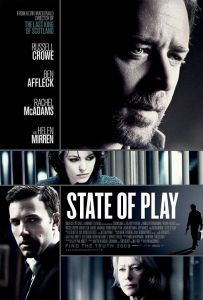 This is a solidly engaging mystery with some twists and turns that don’t come out of left field. Russell Crowe is a journalist investigating the murder of a Congressional aide, who just happened to be having an affair with Ben Affleck, his old friend. There are strong performances all around by the cast, though Rachel McAdams seems superfluous as a blogger-turned-sidekick except for allowing the movie to barely touch upon the idea of print journalism dying. The biggest issue is the pacing. The movie stays at a constant simmer, which works for grabbing your interest but then the final plot blows feel lacking because the narrative has not risen in tension. In fact, I’d say the conclusion to one of the two main mysteries is downright disappointing the way it fails to dovetail with the other, larger mystery. There is a lot more that could be said over the state of modern newspapers and the inherent biases that need be kept at bay. State of Play is an intelligent thriller but ultimately too limited by the condensed framework of its script. This movie feels like it has more ideas to share, ethics to chew over, questions to tease out, characters to ripen, and that’s probably because State of Play is based upon a 2003 BBC miniseries that gave sufficient time for these elements to flourish. Still, I can’t knock this relevant, political, old-fashioned conspiracy thriller. It’s too rare these days that Hollywood churns out smart movies like this for adults.
Nate’s Grade: B
Share this:

Couples Retreat (2009)
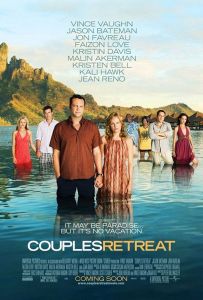 Vince Vaughn is a likable scamp. He’s generally played the same quick-witted, charming, motor-mouth lout in every movie since 2005’s smash, Wedding Crashers. He’s been working fairly nonstop since then and has, by all accounts, become something of a box office draw, which seems bizarre if you think about it long enough. So the best thing I can say about Vaughn’s new comedy Couples Retreat is, hey, at least he’s making sure his pals can pay the bills.
I think it was that famed poet Pat Benatar who said love is a battlefield. She never went through marriage counseling (note: maybe she did, I don’t care to actually research this). The movie centers around four dysfunctional couples that take a vocational to a tropical island resort. Dave (Vaughn) has trouble prioritizing his wife, Ronnie (Malin Akerman). Joey (Jon Favreau) and Lucy (Kristin Davis) have been together ever since she got pregnant in high school. They’re at each other’s throats and secretly looking to cheat on each other. Jason (Jason Bateman) and his way younger wife, Cynthia (Kristen Bell), are unable to conceive a baby. They’re very organized about their life and cannot handle life’s deviations. Finally, Shane (Faizon Love) has been dumped by his wife and is taking the loss hard. He’s found comfort in a flighty twenty-year-old girl (Kali Hawk) that he can barely keep up with. The vacation is interrupted when the couples learn that they must participate in the resort’s relationship therapy sessions or leave. The couples must stick it out to in order to save failing relationships and ride those nifty Jet skis.
 Couples Retreat sure doesn’t feel like any vacation for the audience. Directed by Peter “Ralphie” Billingsley (longtime friend and producing partner for Vaughn and Favreau), the pacing is leaden and the movie feels like its coasting without any momentum. Structurally, the plot is not your series of escalating events but more a relentless parade of tiny plot speed bumps, seemingly indistinguishable from the last. Many scenes just bump right into each other with little transition. Billingsley does not show that he comprehends the rhythms of comedy. Even at a mere 107 minutes, this movie felt twice as long to me. Like Peter Jackson’s King Kong, it just takes way too damn long for these people to get to the freaking island. I don’t need a half hour of setup for stock characters. Many scenes will go on too long and then just sort of come to an abrupt end, like Vaughn and his friends were saying, “Well, we’ve taken this as far as we can go. The scenes don’t end in climaxes or revelations or punch lines, they just end. So after a while I felt like Couples Retreat was one long draggy middle of a mediocre movie stretched out interminably. It’s the equivalent of an eternity of waiting in a doctor’s office.
The character work is haphazard at best. You would think with the premise involving introspection and communication that the screenplay might offer up some deeper characters. You would be mistaken. Each character is given one note/generalized conflict to work, and they stay exactly within that narrow field of play. The male-female dynamics are Joey and Lucy have been together since high school and now they each have wandering eyes. Of course this kind of waffling infidelity is played for such sophomoric yuk-yuks like Joey getting caught masturbating and Joey getting an erection during a massage. You see a trend there? Cynthia and Jason are too anal retentive about their lives and the fun has died out. Sounds like room for some comedy. Oh, and they are also having trouble conceiving, which is way too serious a topic for this kind of movie. It’s somewhat amusing to think of Vaughn as the most stable character in a family comedy; it’s sort of like when Christopher Walken was the voice of reason in 2004’s equally bad, Man on Fire. What is Vaughn’s problem exactly anyway? He’s a “video game seller” who spends too much time… selling video games? The particulars of his job are too nebulous; does he work at a large chain, does he work at a software production company, what does he do that he can’t bother helping out his wife for one afternoon? You could almost certainly eliminate Faizon Love’s character completely. He’s just in the movie to crank out obligatory “older guy with too young girl” jokes, and his resolution is so hackneyed and reliant upon ridiculous coincidence (surprise, his ex-wife has tracked him down to the resort!) that it hurts the brain.
The movie has the benefit of being made in one of the most gorgeous places on earth. I’m sure the cast and crew had a great time making this movie. Too bad it doesn’t translate well to the paying customers. I was surprised at how stodgy the overall film is. I expected it to look down on hedonism, and I appreciated the movie treating marriage as a serious commitment that constantly needs to be engaged, but what is up with how stuffy this message comes across? The people who aren’t in relationships are seen as little party animals looking for their next carefree fix. Sure marriage is going to look better to the masses when you make the alternative so irresponsible. However, prolonging unhappy, extremely dysfunctional couples who can no longer stand each other isn’t helping either. Can’t some dysfunctional couples just grow apart? Why must there be reprehensibly forced happy endings all around? Couples Retreat, after awhile, kind of feels like your grandmother lecturing you about your relationships.
 There’s much potential for laughs with Couples Retreat, but you’ll do no better than scattered chuckles. This is definitely a case where all the good jokes were highlighted in the trailer. Couples Retreat squanders so much talent, mostly consisting of a boy’s club and giving the actresses little to do or play off of. Akerman (The Heartbreak Kid), Bell (Forgetting Sarah Marshall), and Davis (Sex and the City) are all very capable comedic actresses; Kali Hawk quickly becomes irritating with what she’s been given. The island therapists include the hilarious John Michael Higgins (The Ugly Truth) and Ken Jeong (The Hangover), who must be contractually obligated to appear in every movie this year. I would have thought that eccentric therapists plus the natural conflicts of couples counseling would have provided a wealth of funny material. It’s a shame then that the counseling scenes are kept short. It would be a better asset for this movie if it spent more time in therapy and less time doing goofy, trust building exercises by island guru Jean Reno. Seriously, swimming with sharks is supposed to help a deteriorating marriage how? There are comic setups that look like they’re going to lead to something juicy, and then they just fizzle, like a Guitar Hero battle that goes from silly to lame all too quick. A buff and tan yoga instructor (Carlos Ponce) gets a little too in touchy-feely with his female pupils. But then it stays at a distance, hammering home the same PG-13 safe sight gags. It’s like watching people dry hump for laughs. As I expected, the funniest parts are the naturally combative interplay between Vaughn and Favreau. Part of that may be because they’ve been friends for over a decade and part of that might be that both are credited as screenwriters, along with producer Dana Fox (What Happens in Vegas).
Let’s look at how I’ve described Couples Retreat in this review. Waiting in a doctor?s office. Listening to your grandmother condemn your relationship. Doesn’t sound like much of a good time, does it? The comedy consists of mostly one-liners with a whole lot of dead space in between. The characters are so limited, the actors are shamefully wasted, and the comic set pieces are too meandering to be amusing. Somewhere there’s an edgier, R-rated version of this movie that got scrubbed clean to fit a PG-13 mandate. You see glimpses of the naughtier movie Couples Retreat might have been. This is a movie in need of some serious counseling of its own.
Nate’s Grade: C
Share this:

Sunshine Cleaning (2009)
 This mordant family drama has an intriguing premise, sisters who start a business cleaning up after messy crime scenes, but the film suffers from a crippling passivity. It’s nicely acted all around, especially Emily Blunt as the more troubled, wild child sister. The dysfunctional characters are established with momentary glimpses to back-stories, mostly tragic, but the narrative just sort of nudges them along. Sunshine Cleaning is a little too removed and clinical for its own good. The working-class characters are rundown but that doesn’t mean the movie has to feel the same way. Subplots and characters will be abandoned or left with no resolution. Alan Arkin’s scheming grandfather character never seems related to the plot, and he feels like he was lifted from another movie with a wackier veneer. It also makes time for cute sentimental elements that don’t jibe with the film’s tone, like using a CB radio to talk to loved ones in heaven. Sunshine Cleaning is sweet and sincere drama with some dark humor mixed in and it comes across as affable entertainment. Still, this movie had much more promise, if only it was less reserved and afraid to get its hands dirty.
Nate’s Grade: B-
Share this:

(500) Days of Summer (2009)
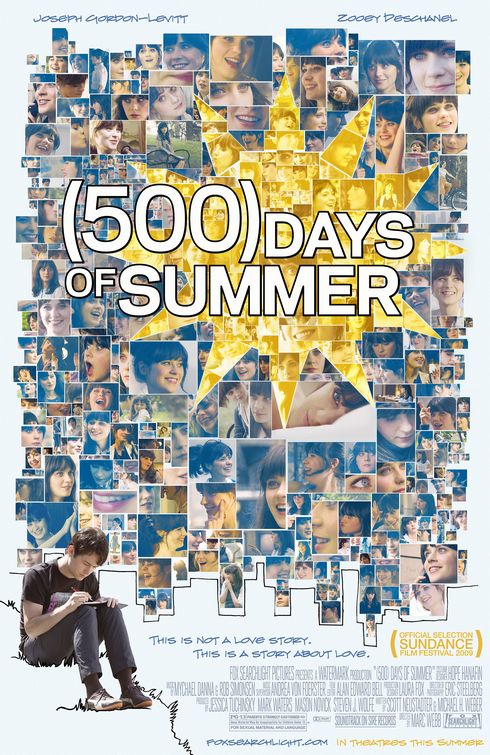
It doesn’t take long before you realize that (500) Days of Summer is a different kind of romantic comedy. In fact, to slap that genre title onto it does a disservice. I’ve watched plenty of romantic comedies (a notable rise in viewership since getting married in 2006), and the traditional Hollywood romantic comedy exists in a world not our own. It is a sitcom world where people blurt out their feelings, interact in bizarre manners, and get into wacky hijinks and contrived misunderstandings. These tales also exist in “movie world”; (500) Days of Summer, on the other hand, is refreshingly recognizable. Granted the characters still have fantastic if slightly off kilter jobs (writer of greeting cards), and the characters live in fabulous and gigantic apartments. Excusing those contextual quirks, the movie is upfront about its intention. “This is a story of boy meets girl,” a narrator intones, “but it is not a love story.”
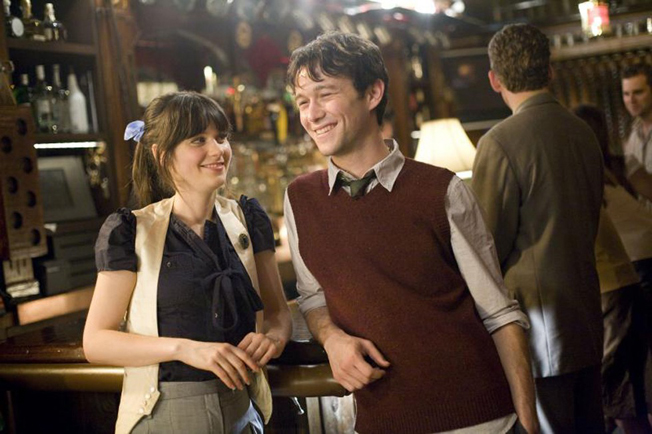
Tom (Joeseph Gordon-Levitt) recounts the 500 days he has spent with his ex-girlfriend, Summer (Zooey Deschanel), the girl he aches over because he feels her to be his “one.”
This is a movie about love and relationships but it has such a wider scope. It’s perceptive and insightful in the way that human beings engage in coupling. Tom ping-pongs between memories, tying together happy moments and the failed recapturing of those exact happy moments later. I enjoyed how reflexive the film can be with romance. When Tom is infatuated with Summer he lists her attributes: “I love her smile. I love her hair. I love her knees. I love how she licks her lips before she talks. I love her heart-shaped birthmark on her neck.” And then when he is frustrated with Summer, he lists her faults: “I hate her crooked teeth. I hate the way she smacks her lips. I hate her knobby knees. I hate that cockroach shape splotch on her neck.” I appreciate a movie that tries to tackle the complexities of love in a manner that doesn’t seem trite or sensational. A movie doesn’t have to say anything new about romance (is it even possible to scoop the Romantic poets?), but it can still say something true and revealing. It is a story about love, but not a love story.
 It also helps that the characters are meaty and are played by capable actors. Tom is a smart enough guy, though a bit of a foolish romantic. He buys into the love that is talked about in pop songs and greeting cards; he’s not naïve per se but plenty vulnerable enough to get his heart broken in the real world. Summer is an independent woman who says at the start that she is not looking for a boyfriend. She doesn’t wish to be constrained by a relationship and wants to enjoy the carefree days of youth. Yet Tom persists thinking he can wear her down or win her over, waiting for Summer to cave and find solace in Tom’s embrace. He fancies Summer as the “girl of his dreams,” though everyone else isn’t so sure. His little sister argues, “Just because she likes the same bizzaro crap you do doesn’t mean she’s your soul mate.” One of Tom’s friends has a really nice monologue describing his “perfect girl,” and these descriptions noticeably differ from that of his long-term high school sweetheart. But then he stops, reflects, and says that’s what his “perfect girl” would be like, but his current girlfriend, well, she’s better than his imaginary version of a perfect girl. But Summer isn’t a fantasy of romantic perfection, she’s a person. She has her own desires, her own insecurities, her own ambitions, and her own life to lead. These two feel like actual human beings and not stock players, though (500) Days of Summer does carry its own share of stock parts like the square boss (Clark Gregg) and the goofy, horny friend (Geoffrey Arend).
The saying “the camera loves” somebody seems outdated, old fashioned, and liberally applied. But when it comes to actress Zooey Deschanel, well, the camera just loves her. It’s hard not to fall in love with this blue-eyed beauty. She’s adorable, but not in an overly quirky way, and she’s smart, but still approachable, and altogether lovely. She is the face of unrequited love. She can be cold and aloof and jubilant. Deschanel plays the complications and complexities of an enigmatic woman who refuses to abide by labels. Her last conversation with Tom manages to be both crushing and inspirational. Her chemistry with Gordon-Levitt feels entirely naturalistic and pleasant. Gordon-Levitt has been cranking out strong performances in indie films like Brick, Mysterious Skin, and The Lookout. He’s quite possibly becoming one of the premier young actors working today. He has an everyman capability but he also can turn on the charm in a way that doesn’t seem forced, like Shia LaBeouf. Gordon-Levitt is the anchor of this movie and we see the world and Summer through his eyes. He brings great vulnerability to his role and we feel each step of his emotional journey. Both actors deliver terrific performances that don’t stoop to playing by the conventions of the romantic comedy.
 The nonlinear story structure seems like a gimmick until you realize that the writers, Scott Neustadter and Michael H. Weber, have cleverly freed themselves from the contrivances of movie romance time. MRT, for those who prefer their nomenclature in the shorthand, is that unbelievable breadth of time where the characters fall head over in heels in love with each other. It always feels so fast and far too fleeting, so that when complications have to arise late in the second act they too feel rushed. You could apply a healthy dose of montages to signify massive time passages, but those get old unless you’re Sylvester Stallone training to fight another boxing match. (500) Days of Summer tells you right away that this story takes place over a year and a half, and Day One isn’t when boy got girl but when boy met girl. By skipping around to specific dates, Neustadter and Weber are hitting only the highpoints, the memorable moments, and leaving out the unforeseen groundwork. All those mundane yet essential moments of pulling together a successful relationship are there, they are just now implicit. They are implied in the time jumps. The relationship between Tom and Summer, therefore, exists in an expanse of time that feels believable. The nonlinear structure also belies the way our memories work. Human beings don’t remember everything in a straight line, especially in matters of the heart.
There’s a lot of drama to be mined here with the breakup territory, but the movie is also playful and funny. Director Marc Webb, he of the video music world, pokes fun at other filmic expressions of love. At one point, Tom struts down the street and becomes the center of a lively choreographed dance sequence complete with animated blue birds. At another point, during Tom’s heartbreak, the movie descends through Bergman and Fellini visual tropes. It simultaneously communicates Tom’s emotional highs and lows and satirizes the histrionic nature of his feelings. Truly, when one’s in love you couldn’t feel better, or worse, but upon retrospect you can see how silly such in-the-heat-of-the-moment proclamations can be. There’s also a scene later in the film where Tom attends a party that Summer invited him to. The screen cuts in half, and on one side we see Tom’s expectations of what will happen that night and on the other side we see what actually occurs. The visual symmetry is interesting and a great glimpse inside the mind of a hopeful romantic.
 (500) Days of Summer manages to be breezy, moving, delightful, perceptive, charming, and just a great time at the movies. It’s a story about falling in love for the right reasons with the wrong girl. Summer isn’t the villain of the piece but her own woman, and she can be fickle and frustrating but she is not cruel or indifferent. Tom is desperately in search for his “one true love” but he’s playing by a checklist he’s drawn up from movies, TV, and love songs. All of this could have been sticky and formulaic (in fact, the dynamic vaguely resembles the characters from the abysmal Ugly Truth), but the filmmakers and the talented actors make the movie feel honest and relatable. The nonlinear narrative allows the movie to simultaneously be more playful, believable, and actually easier to understand, linking selective memories. No matter your current romantic situation, (500) Days of Summer is a slick antidote to Hollywood’s rom-com factory line.
Nate’s Grade: A
Share this:

The Time Traveler’s Wife (2009)
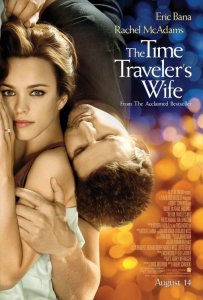 You think your romantic foibles are complicated? Based on Audrey Niffenegger’s best-selling novel, The Time Traveler’s Wife, we follow the life of Henry (Eric Bana), a librarian stricken with the unique genetic disorder of uncontrollable time travel. He first discovered this condition when he was six years old and disappeared out of his mother’s car, only to rematerialize and watch her die from afar. An older version of Henry happened to also be on hand and fill in his younger self on the details. Henry will randomly move backwards and forwards through time, and there’s nothing he can do to stop it. One of the side effects of spontaneous time travel is, naturally, nudity, as Henry travels in the buff a la the Terminator. So usually the first thing he must do when he winds up some place new is find some clothes. Henry seems destined to be a sad and lonely man, but then one day Clare (Rachel McAdams) enters his life, confessing that she’s known Henry for years and been waiting for this exact moment to arrive. She asserts herself and asks Henry for a dinner date that’s been in the works for some time. They fall in love, or fall further in love in Clare’s case, and try to make a relationship work despite Henry’s hiccups through time.
There’s a tenderness to the movie, though I found it tricky to fully engage in the characters. Much of the movie concerns the plot complications that befall such a strained and unique relationship. The flick gives new meaning to cold feet when Henry literally vanishes during his wedding, only to reappear as a mid-40s version of himself (hey makeup department, you couldn’t do more to effectively age Bana than add a dash of grey?). There is a great mind-bending section where Clare cheats (?) on Henry with… a younger version of himself. I was interested in the subdued proceedings and I felt underpinnings of empathy for Henry and Clare, but then my mind wandered into something a little darker and pessimistic. Now, The Time Traveler’s Wife is a polished traditional romance despite the sci-fi trappings but I started thinking about if what I was witnessing was actual romance? Henry first visits Clare as a child, telling her he will be her eventual husband. She falls in love with him in that moment and rejects all other suitors, knowing with absolute certainty that she will marry Henry. She just has to find him. And when adult Clare does meet Henry the librarian, he has never seen her before up to that point (it’s not as confusing as it may sound). She’s been waiting years to see his face again and she tells him that they are destined to get married. You see what’s at play here? The romantic plot is a loop where each character supplies the other’s conviction. Henry locked Clare into a life of looking for him and said they would marry, but then the adult Clare is the one who convinces Henry that they will indeed marry, and he tells young Clare this who will then convince Henry, etc. Is there any free will at play here, or is each partner in this relationship being manipulated by the certitude of the other? It’s sort of a metaphysical chicken/egg scenario.
 The best portion of the movie comes across during the second half when the movie focuses more on the emotional consequences of Henry’s condition. Early on Henry’s uncontrollable time traveling is played for laughs and some forced and somewhat trivial conflict (oh no, he missed another dinner!). Henry has a chilly relationship with his father (Arliss Howard) until, well, I’m not quite sure, but things improve. In the second half of The Time Traveler’s Wife, the drama gets more serious and intriguing when Clare and Henry attempt to conceive. Henry’s genetic disorder gets passed down to the baby fetuses, which means little babies are vanishing out of the womb and perishing before being zapped back inside. That’s a rather disturbing image and yet it is a thoughtful and plausible problem given the premise. As a result, Clare suffers through several traumatizing miscarriages. But they keep at it because Henry has seen his future lineage, also a time-traveler, and he knows that one of these pregnancies will go full term and become their eventual daughter, Alba (Tatum McCann). It was this storyline that stopped my mind from occasionally wandering and hooked my interest. Perhaps it’s cheap sentiment, but it’s hard not to feel for this loving couple when they endure pregnancies fraught with danger. The movie misses out on a dynamite dramatic opportunity with Alba. If I were adapting this to the screen, I would make sure to include Alba as a grown 30-something woman visiting her father on his deathbed, tearfully informing her dear dad on all the eventful moments that he won’t be around to experience. Picture an adult Alba talking about her own children to her dying father. There wouldn’t be a dry eye in the house. Hollywood, if you’d like to tack on an extra emotional ending to this movie, there’s still time. Call me.
It is here that I must address some key scenes that may pique curiosity. During Henry’s travels, he frequently visits the young child version of Clare. The first time Clare meets her future husband she is a little girl sitting in a meadow on the boundary of her family’s palatial estate. Henry, as he does every time he becomes unstuck through time, arrives in the nearby woods without a stitch on. Director Robert Swentke (Flightplan) and screenwriter Bruce Joel Rubin (an Oscar-winner for Ghost) work diligently to make sure the movie walks a very fine tone, and I confess that the scenes between loving child and naked time-traveling man escape creepy pedophilic overtones. Take that blurb for what you will in a romance: “Hey, no pedophilic overtones!”
 There are some other complications when it comes to this matter of unexpected time traveling. Firstly, the rules seem to be flexibly applied. At one point Henry is talking about how he cannot prevent his mother’s deadly car accident. The movie professed a destiny-entrenched approach to time travel, meaning every action you think you’re engaging out of free will was predetermined (the TV show Lost also subscribes to this theory). It cuts out time paradoxes. But then in another moment Henry uses his knowledge of the future to win the lottery. So which is it? Are the filmmakers trying to convince me that it was destiny for Henry and Clare to win the lottery, because I’m not buying it. Having a time-traveler for a boyfriend takes out some of the natural drama o relationships when one party can peak ahead. Relationships have danger and excitement and uncertainty to them, but when Henry can just matter-of-factly say, “We’re gonna be fine. We’re still together and in love fifteen years later, I saw it,” well it may make for good romance for some, but it makes for rather inert drama. How can you hope to win arguments? Naturally, the hefty book has been streamlined as much as possible for a mainstream moviegoing audience, which means that Henry’s scope of time traveling is scaled back. At one point he quantum leaps beyond his own lifetime, and because this has never happened before and is really only done to introduce a ticking death clock. I suppose there will always be inconsistencies when it comes to breaking the space-time continuum.
McAdams (The Notebook) is a great choice for the romantic center of the movie. She’s glassy-eyed and smiles so hard in her early sequences you think her dimples are going to explode off her cheery face. She is such a winning presence and her warm-hearted glow powers the character and the movie. Unfortunately, she doesn’t have very good chemistry with her onscreen mate. Henry is a victim of an existential cruel joke. Bana (Munich) is light-footed and makes Henry more than a space-time martyr. He’s somewhat amorphous as a character, a collection of niceties and genial, puppy-dog affection, which means that Henry is routinely upstaged by his genetic condition. However, when Henry faces the specter of his impending death is when the character gets a lot more attention and Bana is able to work his considerable talents. He gets ample opportunities to showcase his time-traveling buttocks. I don’t think too many women out there would be that put off if a naked Eric Bana magically materialized in their bedroom.
 The Time Traveler’s Wife is mildly reminiscent of The Lake House, and not just because of the time travel romantic complications. Deep down, these are traditional Hollywood romances with a fresh sci-fi coat of paint. The movie is best if you set the logic portion of your brain off so that inconsistencies and potential contrivances don’t distract from an intriguing story that presents some nice developments. There’s a tender love story here, though the characters don’t leave as much of an impression as they could have with such a plot-heavy romance. It finishes strongly and the mood throughout has a somber bittersweet quality, hammering home the “enjoy the time you have” message. McAdams is darling, Bana gets in the buff, their chemistry isn’t great, and the filmmakers refrain from the material getting overly sentimental or solipsistic. In a summer of relative disappointments, a tricky, clever approach at traditional romance is welcome amidst the explosions and wacky studio comedies.
Nate’s Grade: B
Share this:

Seven Pounds (2008)
 “Do not touch the jellyfish.” Wise words to live by. Will Smith stars in this heavy-handed drama about a man trying to make amends for his role in a fatal traffic accident. Smith is an IRS man on a mysterious personal mission. He’s interviewing several glum people waiting on organ transplant lists. If you cannot connect the pieces already, don’t worry because Seven Pounds will hammer every last point with forceful melodrama. The story structure is needlessly fractured, hoping to add more style to a fairly banal redemption tale. Naturally, Smith falls for a woman (Rosario Dawson) in desperate need of a heart transplant, complicating his scheme. And yet the movie sort of works on its own syrupy terms until those final moments involving that jellyfish. It is a jaw-dropping misguided move, one that rips you right out of the film. Just as Seven Pounds reaches its climactic emotional crescendo, you’re left scratching your head and laughing at the utter absurdity. It’s like tripping face-first right before the finish line. The jellyfish-infused ending is simply astonishing. Seriously, when was the last time an invertebrate sea creature played so prominently in a high-profile movie? In what would otherwise be an overwrought and unmemorable drama, the jellyfish gives Seven Pounds a certain bizarre immortality.
Nate’s Grade: C
Share this:

He’s Just Not That Into You (2009)
 Based upon the best-selling nonfiction book, the movie follows the interconnected lives of a cadre of characters trying to get lucky in love. As with any ensemble piece, some storylines are better than others, notably Ginnifer Goodwin (HBO’s Big Love) as a naïve and hapless gal confused by the ever-changing rules and rituals of contemporary courtship. Her scenes with Justin Long, as her dating coach, are the movie’s high-point. The two actors have a light, charming chemistry and their scenes get at the heart of the male/female dating dysfunctionality without feeling trite. But in between, you get a lot of hackneyed yakking about the stereotypical differences between men and women, how dumb men are, how crazy women can be, etc. It’s all been covered to death by other romantic comedies to the point that it feels like common knowledge, which makes it tiring to sit through. Some of the drama feels overly manufactured, like Jennifer Aniston pushing to get married because she her little sister got engaged, there are characters that are just annoying people, like Kevin Connolly continuing to nip at the heels of Scarlett Johansson for some scraps, and Some of the material is weirdly dated, like Drew Barrymore talking about being “Myspace-ed” by a prospective date (Hello, it’s all Facebook all the time now). Naturally, it’s all rather predictable as well, however, this is not the fun date movie it may seem. It hits some rough dramatic patches, like the pains of infidelity, losing trust in a spouse, manipulating people, and occasionally there will be a moment that comes across as genuine and heartfelt, like when Ben Affleck wins over Aniston simply by being thoughtful and doing the dishes. It’s in these sporadic moments that He’s Just Not That Into You feels like it’s tapped something a little deeper and more meaningful than scraping the barrel of romantic comedy clichés.
Nate?s Grade: C+
Share this:

Moon (2009)
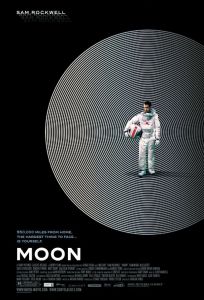 David Bowie’s son, Duncan Jones, directs two Sam Rockwells in this steely mood piece. Rockwell plays a lunar astronaut about to complete his three-year tour of duty when he finds another him. Is he hallucinating? Is this other Rockwell a clone? Who is the clone? The mystery unravels at a nice pace and Rockwell a pair of great performances, fully giving each character a different personality. Jones uses his small space to great use, multiplying the feeling of cabin fever more so than claustrophobia. Some will chafe that Moon doesn’t spell everything out, but the movie is smart enough to leave other things to the imagination. Moon tells a very specific, very select story and it does so with great economy that serves the story. This is Rockwell’s showcase and he carries the movie and nails the nervous breakdowns. For people let down by Hollywood’s slate of sci-fi duds, here is a satisfying small-scale sci-fi story told with intelligence and subtlety.
Nate’s Grade: B+
Share this:

Funny People (2009)
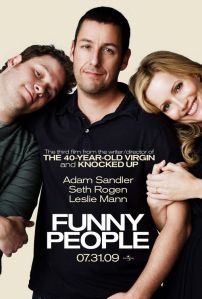 In two short years, Judd Apatow has become the king of comedy. He’s co-written and directed two bona fide hits that will go down as comedy classics (40-Year-Old Virgin, Knocked Up), and produced gut-busters with heart, like Superbad and Forgetting Sarah Marshall. The Apatow brand of comedy centers on characters and less on contrived set pieces. He’s built up enough comedy capital in Hollywood that he felt he could write and direct a project less ideally commercial, something tagged as being more personal and serious like in the James L. Brooks mold. Funny People is the mixed results. I applaud Apatow for trying to grow as an artist, but as the saying goes, if it ain’t broke don’t fix it. Funny People is a broken movie that isn’t funny enough to be fully redeemed.
George Simmons (Adam Sandler) is a famous comedy actor that has made several hit Hollywood comedies. He may live in a giant mansion but his life is extremely isolated and lonely. He has no real close friends and years ago he drove away the love of his life, Laura (Leslie Mann). He has no one to comfort him in his time of need. This prickly man has been informed that he has a terminal blood disease. Simmons decides to go back to his comedy roots, to stand-up, and it is there that he meets the young comedian Ira Wright (Seth Rogen). Ira has grown up with the comedy of George Simmons, so he is flabbergasted when the man himself asks Ira to write jokes for him. Ira’s roommates, fellow stand-up comic Leo (Jonah Hill) and crappy sitcom actor Mark Taylor Jackson (Jason Schwartzman), can’t believe his dumb luck. Ira and Simmons build an unorthodox friendship, and Ira is the only person George has confided in about his disease and his fear of dying. And then something amazing happens. George Simmons gets better. He’s got a new lease on life and he aims his attentions on the girl that got away. Laura is married to Clarke (Eric Bana), a handsome Australian businessman, and she has two adorable kids (Apatow’s own girls), which makes it a very poor time to restart her romance with George.
 Funny People is the first Apatow-helmed film that feels sadly incomplete, even at two and a half hours. The movie is staggeringly sloppy when it comes to plot structure and character work. First off, when a character is informed that he has a terminal illness at minute three, it doesn’t have the impact that it would if the audience got to know and feel for that individual. In fact, the first half of this movie feels like, and this may get confusing, the second half of another movie. It centers on a selfish character coming to grips with his choices in life, mostly wrong, and beginning to reconnect with people once more, building a mentor friendship and finding the “one that got away.” But there are segments during this first half of Funny People where the impact just cannot be felt because the dramatic legwork has not been achieved. Watching Simmons’ estranged family berate him through tears doesn’t have much of an impact when they discover the news. Seeing George Simmons spend his potential last days jamming with Jack White and other musicians is cool, but it doesn’t come across as anything but another indication that the fake George Simmons is famous in this alternative Los Angeles. It doesn’t have setup, like Simmons talking about one of his life’s pleasures is strumming the guitar or playing before things got complicated. So it’s basically just another celebrity cameo snapshot. While I’m on the topic, the multitudes of celebrity cameos are strangely unfunny, save for a bit where Sarah Silverman describes her lady parts.
This is also the first Apatow comedy where it feels like twenty percent of what I saw promised from TV spots, trailers, making-of specials (there was a good one on Comedy Central to check), the advertising unit if you will, was not in the movie. This gave me the distinct impression that even at a lengthy 150 minutes that Funny People feels misshapen, that there are swaths of material on the cutting room floor that would have assisted the narrative and sad amount of underwritten supporting characters. I’m not saying Funny People would necessarily be a better movie at three hours length, but it would at least feel more fully formed and satisfying.
 The main problem with the film, outside of the reverse plot structure, is that everything just goes slack during the uneven second half. George and Ira spend about an hour of the movie with Laura and her family, and it feels like one long uncomfortable detour. Part of the squirmy feeling is intentional, as the audience is supposed to be in Ira’s shoes and see George’s homewrecking as the bad decision train wreck it is. But I also felt uncomfortable because George kept extending his stay day after day and I was getting impatient. I wanted these characters to head back to L.A. and deal more with the Ira/George relationship. During this second half, Ira becomes a background figure that is good for nervous reaction shots. This stalls all the character work that had been done up to this point and Ira goes to pause mode for an hour. This second half section isn’t particularly funny, it isn’t romantic, and it gives little insights into the past between George and Laura. She has established a nice living for herself, with two cute kids and a hunky husband who seems to be a good father when he’s around. In fact, despite the movie’s insistence that Clarke is a cheater (thus ensuring the movie law that it is then acceptable to cheat on him), I found myself liking the hyperactive and sensitive lout. Every plot movement in this second half feels wrong, some of it intentional, but it makes Funny People feel like it has been hijacked and taken hostage. Where did the movie I was kinda liking go? What happened here? This hour feels like a separate movie and one that Funny People would have benefited from simply being dropped entirely.
Perhaps I’ve been watching too much Mad Men in anticipation of its third season, but this movie also disappoints by failing to delve into the creative process of comedians. Despite its running time and subject matter, there isn’t that much standup witnessed. Usually the movie will display about one line or one bit and then cut back to the characters offstage again. We don’t get to see the evolution of comedy or the professionals talking shop about what makes a good joke. There isn’t even much collaboration, so we don’t get to see multiple minds banging out jokes together. There’s a comedian named Randy (Aziz Ansari) who is popular with audiences because he’s loud and spastic, and all the other comedians hate him, but then the movie doesn’t return to this. Go back to this topic. I want to hear more about the divisions within the comedy world, the people that feel like they are more pure or textured in their funny compared to the people that play to the crowd and lap up the easy yuks. Ira’s character work is mostly explored through his changing standup persona, where he seems to gain more confidence and a voice. But there’s this whole other storyline where Ira is a “joke thief” and takes other people’s material and repackages it as his own. This is an interesting story and provides conflict and glimpses into the character of Ira as an insecure and ethically challenged opportunist in a competitive field. It makes him a more dynamic character. I saw more of this storyline in the making-of special for Funny People, and sadly it is only hinted at in the final product. The other comedy players, like Ira’s roommates and his quasi-love interest (Aubrey Plaza), are barely explored as people and professionals.
Apatow comedies are notable for being character-based, but Funny People doesn’t seem too concerned with establishing characters that you want to be around. I found little reason to care. I found most of the characters to not be engaging; some were unlikable but most were simply flat. George Simmons is supposed to be a selfish man, though there’s something inherently selfish about being famous in Hollywood. Comedy itself is inherently selfish, where individuals guard their observations and exploit personal stories for the endorphin highs of audience approval. Is successful comedy linked to selling out? Funny People occasionally visits the dark recesses that comedians utilize for material, like self-lacerating humiliation and family trauma that gets aired out as a means of therapy. Simmons is a selfish and lonely guy and the point of the whole movie is that even after a near-death experience, he’s still selfish and lonely. He’s said he’s changed but has he really? That seems to be the movie’s cosmic joke. This is clearly a personal movie for Apatow, which might explain why it has less resonance for an audience that isn’t as steeped in the history of comedy or the rigors of fame. I just don’t have the same point of interest.
 Sandler revealed his acting talent in 2002’s beguiling Punch-Drunk Love, and in Funny People he plays a completely different character than his other adolescent roles. He doesn’t pander to be likable at any point, and he’s generally standoffish from beginning to end. He hasn’t done a lewd, crude movie in over ten years, and this return to raunch rekindles the Sandler I remember listening to constantly in the mid 1990s. This role isn’t as taxing for him as an actor, nor is he given too many chances to reveal deeper layers to George Simmons. I think this is by design from Apatow. Rogen is less his charming self and during the second half of the movie he pretty much shifts his eyes and makes pained faces. He feels at ease in the stand-up sequences, probably because Rogen performed stand-up comedy when he was 13. Mann gets her biggest acting role in years and cries enough, but it made me realize that she works best as an actress that can steal scenes rather than an actress who has scenes built around her. I think Bana (Star Trek) actually comes off the best. He showcases an exuberance for comedy not seen before, and when his character gets emotional it still manages to be funny and believable.
In the end, Funny People just isn’t that funny. There aren’t any particularly clever comedic setups, the characters don’t get many chances to be humorous even as comedians, and the movie just goes slack during its uncomfortable and uneven second half. The Hollywood satire lacks bite, and the best bits are saved for the scathingly unhip and formulaic “Yo, Teach!” sitcom of Schwartzman’s. Apatow is more interested in purging a personal tale onto the screen rather than fashioning a relatable mainstream comedy. I feel that the salutations that Funny People is “more challenging” and “serious” are unwarranted. This is certainly a different movie but is it any more serious than navigating the uncertainty and awkwardness of an unplanned pregnancy or beginning sexuality at middle age? I don’t think so. Beyond this, the movie doesn’t establish its plot well and spends far too much time in side diversions, failing to round out characters and ignoring intriguing premises and storylines. Even the camaraderie, usually a hallmark of Apatow productions, feels lost as the characters have much more friction. On a personal note, I saw this movie while I was on vacation in the Outer Banks. On our car ride back to our beach house, my then-partner and I got into a car accident. We were both physically fine but her little Ford Focus was totaled. I will now forever associate Funny People with a car accident. If that isn’t enough of an on-the-nose metaphor, while we waited along the hot road for police and tow trucks, I thought to myself, “I just wish the movie was worth this.” It wasn’t.
Nate’s Grade: C


You must be logged in to post a comment.