Blog Archives
The Room (2003)

I consider myself to be a connoisseur of crappy cinema, thanks in large part to growing up on the fabulous TV series Mystery Science Theater 3000. To me, truly bad movies can be just as enjoyable to witness as great, competent works of filmic art. So imagine my surprise when it I had never heard of a little flick called The Room until a month ago. I was reading an Entertainment Weekly article about this tiny 2003 movie that has developed a rabid cult following. I felt betrayed. How did I go five years without ever hearing about this movie? The Room is writer/director/star Tommy Wiseau’s magnum opus. It must be seen to be fully believed.
To watch The Room is truly a life-altering experience. This movie goes beyond bad. It’s so bad that it almost seems like Wiseau is a mad genius. This movie is bad on multiple levels and hooks you from the beginning, instantly daring the audience to stick around to see if it gets worse. And it does in the most wonderful ways. If I was stranded on a deserted island and could only bring five movies, right now The Room would be one of them (I may even be tempted to just bring five copies of this movie). Wiseau’s film cannot displace Manos: The Hands of Fate as the worst film of all time, but The Room easily belongs in the upper echelon of craptacular cinema among the likes of The Land of Faraway and Lady Terminator and Bulletproof Monk. I am simultaneously appalled, bewildered, fascinated, delighted, and comforted by this movie, comforted by the fact that something this singularly inept could still sneak through the system. But this film is so perfectly inept on a multitude of levels that it feels like it could never be recreated again, like the human race benefited from this chance artistic encounter. The only way I can fully describe my unhealthy appreciation for this cinematic slice of the absurd is to simply list off my list of loves.
 1) The film’s plot involves a love triangle with the three least personable people imaginable. Johnny (Wiseau) is a broad shouldered, marble-mouth Austrian who supposedly works at a bank, we’re told. Lisa (Juliette Danielle) stays in their apartment doing very little, though she says that she shouldn’t have gotten into the computer business because it’s “too competitive.” Lisa declares in damn near every scene that after five years together (though the characters say seven at the end of the film) she no longer loves Johnny. She now loves Mark (Greg Sestero), Johnny’s best friend. And if you forget that key point then Mark will assist you because one third of his dialogue is declarations of “Johnny’s my best friend.” Another third of his dialogue might as well be, “What are you doing?” Mark is one of the thickest dolts in history. Even after Lisa has sex with him twice, calls him repeatedly, and leads him to places where they can be alone and intimate, he looks at her dumbfounded and says, “What are you doing?” like a kid who will never comprehend that 2 + 2 = 4. This is the basis of the plot and yet so much of the movie is gloriously repetitive and involves characters sitting around, saying the same things over, without ever really advancing the plot.
2) The Room hooks you from the start, and it’s all thanks to the weird neighbor kid/surrogate son Denny (Philip Haldiman). This supposed student is an orphan that Johnny has taken a shine to; Denny has his rent and tuition generously paid for by Johnny. In the very opening scene Johnny gives Lisa a slinky red dress as a gift. She tries it on and both Denny and Johnny make favorable remarks. Johnny says he’s a bit tired and leads Lisa by the hand up the stairs. The camera stays on Denny, who, instead of taking the hint and leaving, remains standing, grabs an apple, takes a bite out of it, then slowly walks up the stairs after the amorous couple. He then hops on their bed and joins in on their pillow fight foreplay. The characters have to literally spell it out to the guy that they want some privacy for sex. “I know, I just like to watch you guys,” Denny responds. What? Denny confesses to Johnny about experiencing weird feelings for Lisa. This kid is supposed to be in college but he acts like he’s developmentally challenged. A friend has a theory that Denny has a confusing gay crush on Johnny, but I believe that would be way more deep and subtle than the movie seems capable of.
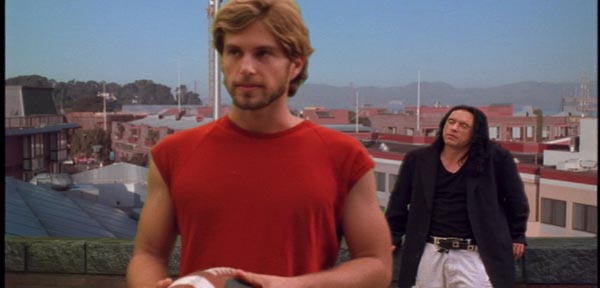 3) The movie is littered with subplots that come out of nowhere and never resurface again. All of a sudden Lisa’s materialistic mother (Carolyn Minnott) announces she has breast cancer. This is never commented upon again. All of a sudden Denny is confronted by an angry drug dealer who wants his money, which means he’s also the world’s worst drug dealer if he’s willing to give out drugs on credit. The characters all collect on the roof and yell. This is never commented upon again. Lisa makes up a story that Johnny hit her. He publicly denies it. This is never dealt with again in any capacity. Lisa lies to Johnny that she’s pregnant, just to “make things interesting.” Her rationale is that they’ll eventually start trying to have a baby anyway, which conflicts with her frequent statements that she doesn’t love Johnny and wants to leave. This fake baby is never commented upon again. About thirty minutes into the movie, another couple sneaks into Johnny’s apartment to have sex. Why I cannot fathom. When Lisa and her mother intrude upon this scene, the mother asks astutely, “Who are these characters?” Exactly madam. The movie keeps going over the same material because nothing new ever sticks.
4) The line readings are astoundingly inauthentic. Half of the film seems to be dubbed, especially Johnny’s lines. Much of the dubbed dialogue fails to match up with the actor’s mouth movements. There is one sequence in a flower shop that is nothing but dubbed dialogue and it happens so quick. The scene itself lasts like 10 seconds but it still manages to squeeze in this entire conversation: “Oh hey Johnny, I didn’t see you there.” “Yep, it’s me.” “Here are the flowers you wanted.” “How much?” “18 dollars.” “Here ya go. Keep the change. Hi doggy.” “You’re my favorite customer, Johnny.” “Byeee.” It happens so rapidly with so little breath in between. Wiseau’s quick changes in temperament with consecutive lines will amaze you. He goes directly from, “I did not hit her! I did not! I did naaaaaaaut,” to a very casual, “Oh hey, Mark,” in a nano-second flat. The speech patterns rarely approach realistic human cadences.
5) Lisa is routinely told by the several male characters that she is exceptionally beautiful and lovely, but this woman’s personality is like a dead plant. Danielle is a fine enough looking woman, though the hair and makeup people do her no help with those thick eyebrows, but as a beauty that could manipulate multiple men? I don’t think so. Danielle has a bit of a tummy to her, which is fine by my standards of beauty, but from a Hollywood perspective a woman that lacks a concave stomach is considered “fat.” Lisa’s friend Michelle (Robyn Paris) is in fact a more attractive female and might have served as a better Lisa. I think perhaps Danielle was willing to do nudity and Paris was not, but really, if you’re a struggling L.A. actor and you’re willing to agree to be apart of something like The Room, surely you’ve already ignored any internal misgivings. What possible hang-ups could there be left?
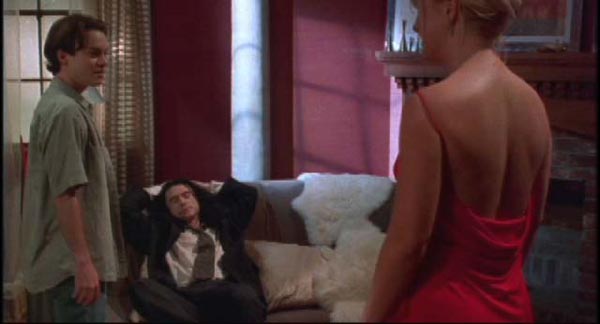 6) The film is structured like the soft-core porn that dot the late hours of premium cable channels. There are four lengthy sex scenes in the first hour, though one of them is composed almost entirely with recycled footage from the first bout of lovemaking between Lisa and Johnny. The sex scenes are deeply un-erotic and consist of several camera angles that make it impossible to see what is actually happening. There is nothing sexy about watching Wiseau’s pasty posterior humping the hips of Danielle (seriously, the body alignments are way off here). When Lisa and Mark have sex on top of a spiral staircase, Wisuea can barely frame the action coherently. Why would anyone want to have sex on a spiral staircase? That’s just asking for chronic back pain. Mark fails to even take his pants off. For such lengthy sex scenes, Wiseau does so little with the talent on display. What makes all the sex scenes even better is that they each get a wretched pop song as a soundtrack. It’s all mid 1990s R&B with some growling sex guitar, and it’s all awful. There’s one song that repeats the phrase “you are my rose” like nine times in a row. If you fail to cringe and howl from the sex scenes then the songs ought to do it.
7) Wiseau makes the most mysterious decisions as an artist. He sticks to a minimum of locations and one of them happens to be the roof of Johnny’s apartment complex. The sensible thing would be to film on an actual roof. Wiseau decided to film on a roof set and use an ineffective green screen backdrop that makes San Francisco look like it inherited Los Angeles’ smog. The film keeps cutting back to exterior stock footage of the city that signifies the passage of hours, a day, or no time whatsoever. When Denny is confronted on the same rooftop about his sudden drug disclosure, Lisa berates him. As she cries and shrieks and overacts, you cannot see it because Wiseau’s camera has cut her facial reactions out of frame. The scene cuts back and forth between Denny facing the camera and the left side of Lisa’s head. At another point Lisa is talking about her cheating ways with her pal Michelle, who seems way too giggly to be disapproving. During this scene Lisa has angled her body in such a manner that when she speaks it appears like a subcutaneous alien is about to burst forth from beneath her neck. Wiseau did not catch this unnerving and distracting sight. The film’s lone idea of male bonding involves tossing a football together. So Mark and Johnny will go out running in a park and toss a football back and forth, all the while having a faint conversation that gets drowned out by an overly anxious score. There will be swaths of the film where the score just competes with the onscreen dialogue.
8) There’s like a whole other level of offhand dialogue throughout, where characters will stand around and Johnny or someone else will mumble to no one in particular. The actual dialogue is full of other memorable head-scratchers, such as:
Random disapproving guy to Mark: “Keep your stupid comments in your pockets!”
Same disapproving man: “It feels like I’m sitting on an atom bomb that is going to explode!”
Michelle using chocolate candies as a means of foreplay: “Chocolate is a sign of love.”
Lisa’s mother: “Nobody ever listens to me.”
Lisa: “You’re probably right about that, mom.”
Johnny’s profound wisdom: “You know, if more people love each other the world would be a better place.”
Johnny refers to someone as a chicken and then proceeds to make this accompanying sound: “Cheep, cheep, cheep, cheeeaaaaaaaaiiiiiiiiiip.” This bizarre chicken impression will be repeated no less than three times.
 This brief exchange at a coffee shop between Mark and Johnny:
Mark: How was work today?
Johnny: Oh pretty good. We got a new client… at the bank. We make a lot of money.
Mark: What client?
Johnny: I cannot tell you. It’s confidential.
Mark: Oh come on. Why not?
Johnny: No I can’t. Anyway, how is your sex life?
And finally, the signature line, where Johnny has had enough of Lisa’s mental games and he roars, “You are tearing me apart, Lisa!”
I could keep citing further evidence of The Room‘s cinematic shortcomings, but listing the faults of one of the worst films ever made can be pointless after a while. The staggering amount of faults in Wiseau’s film is also its combined strength. Most bad movies have a finite level of badness, like a poor plot or some troublesome acting. The Room is a movie composed of nothing but 99 complete minutes of badness at every facet of filmmaking. I am a more complete person having seen this remarkable film. I highly recommend gathering a group of friends around and holding a viewing party; the movie plays to even higher levels of enjoyment with a group atmosphere. The Room is Tommy Wiseau’s accidental masterpiece and, to me, proof that a loving God exists.
Nate’s Grade:
Artistic Merit: F
Entertainment Value: A+
Share this:

Harry Potter and the Half-Blood Prince (2009)
 Not every film franchise gets to a sixth installment, although Police Academy and Friday the Thirteenth managed to. After over twelve hours of storytelling, is it even possible for non-fans to enter the Harry Potter world (only an idiot would begin a film series at number six)? I am a willful Muggle to this universe. I am content to wait for the movies, and it drives the readers nuts. “The books are so much better,” they all say. Then they tell me what was left out of the movies, and honestly it’s usually a good thing. Harry Potter and the Half-Blood Prince echoes the increasing darkness of the later books by author J.K. Rowling, but now I can finally walk out of a Potter film and know, without a shadow of a doubt, that the book must have been superior. Half-Blood Prince is a film adaptation that spends too much time in all the wrong places.
Lord Voldermort (Ralph Fiennes, seen only for literally a split-second) is back with a vengeance, and his followers, Death Eaters, are branching out and attacking the Muggle world as well. Headmaster Dumbledore (Michael Gambon) has asked Harry (Daniel Radcliffe) for help in recruiting a former Hogwarts professor. Horace Slughorn (Jim Boradbent) used to be an esteemed potions professor, and one of his bright students was none other than a young Voldermort (Hero Fiennes-Tiffin, Fienne’s real-life nephew). Dumbledore and Harry explore liquid memories that belong to the Dark Lord in hopes of learning how to defeat him. In the meantime, the kids are under attack not by Voldermort but by hormones. Harry’s friend, Ron (Rupert Grint) and Hermione (Emma Watson), are secretly in love but neither has the heart to say something. Ron uses his star Quidditch status to “snog” with the eager Lavender Brown (Jessie Cave), who’s infatuated with Ron. This infuriates Hermione and she seeks comfort in a studly student herself. Harry is starting to feel his heart go pitter-patter for Ron’s sister, Ginny (Bonnie Wright), which requires Harry to be very delicate in negotiating the “Can I snog your little sister?” portion of male friendship. Oh yeah, and apparently Harry is also using a potions textbook that used to belong to some whiz kid known as the Half-Blood Prince.
 The further I get away from Half-Blood Prince the more certain I am that it is the least involving film of the series. The plot is somewhat nebulous and unclear, and so much of the story is dominated by boring teenage romance. I understand that Hogwarts is swimming in hormones, but these kids spend the whole time making shifty doe-eyes at each other than doing anything substantial. That makes for a boring romance, and when the movie is dominated by this stuff for two hours it doesn’t make the movie too engaging. I understand that the Ron/Hermione courtship has been setup for some time, but it takes forever to move even incrementally closer to that coupledom. The Harry/Ginny material is lacking at best. She’s such an empty presence and they do so little with her character that I have no idea what would warrant Harry’s affections. There is no spark, no heat, no sexual tension, and no interest. I was actually relieved when Half-Blood Prince drops practically every storyline with twenty minutes left. Seriously, these plotlines aren’t resolved or capped or even addressed, they just don’t exist once Harry learns the word “horacrux.” And let’s talk about that subject just for a moment. Dumbledore lures Professor Slughorn back to Hogwarts so Harry can learn Voldermort’s secret of eternal life, a secret that Dumbledore already knows because he’s been taking leaves to locate and destroy Voldy’s horacruxes. I felt detached and disenchanted throughout Half-Blood Prince.
There are other plot holes and irregularities, and I wonder if writer Steve Kloves (who took the fifth movie off) is merely serving up 153 minutes of plodding prologue for the big finish. The drama is becoming more static and the supporting characters of previous installments reappear and do little but stand with hands in their pockets; they have nothing to do. The flashbacks to Voldermort as a child reveal relatively nothing new; only indicating her was a creepy kid. The two action sequences squeezed in are not from the book, meaning Kloves was trying to add some excitement to what is a rather sleepwalking storyline. The action sequences mean little; the opening attack on London’s Millennium bridge offers some nice sights but little consequence, and the destruction of the Weasely house comes across like Kloves was grasping for greater conflict. Too much of his film is the young love foibles with the occasional sideways glance at Draco (Tom Felton) brooding in the shadows. The ending, with its notable death, still strikes an emotional cord but it also comes across as rushed and without depth and resolve.
 What is the significance of the Half-Blood Prince in this adaptation? The mysterious figure was good in potions class and his old textbook helps Harry in class. That is it! The late reveal of the identity of the Half-Blood Prince is so incidental and off-the-cuff, that the actor practically has to say, “Hey, remember that whole Prince thing like an hour ago? That’s me. Yep. So see ya.” It’s such an indifferent plotline handled with such indifference. I had to ask my Potter-versed wife why Rowling would even bother naming the book after such a minor, irrelevant plot footnote. Kloves’ adaptation feels lost and mostly like filler.
So why does a slower, less coherent, less interesting Harry Potter rank better than the first two films? Because director David Yates takes an artistic step forward and this addition has style to spare. Returning to the Potter director’s chair, Yates has a stronger feel for the world and creates striking film compositions with the added help of noir cinematography by Bruno Delbonnel (Amelie, Across the Universe) and the foreboding production design by Stuart Craig. The sets have a grand Gothic appeal and help compensate in tone for what is lacking in the screenplay. The opening bridge attack allows for soaring flights through London and then into the magic world, and it’s a great opening visual rush. The memory flashbacks have splendid visual artistry to them as we watch inky brush strokes coalesce into solidified images. It’s a fantastic special effect and it is welcomed every time. This isn’t one of the more special effects heavy installments but the effects are as good as ever especially when seen through Delbonnel’s lens.
It’s interesting to have watched the three main actors grow up in their roles, which also gives them the ability to revert to autopilot when the movie lags. In the Half-Blood Prince, the trio burrows back into previous acting episodes. Radcliffe gets talked to a lot so much of his acting in this jaunt seems to involve intense bouts of nodding. He does have one sequence of exaggerated comedy when he swallows a luck potion, and the actor feels delightfully unrestrained. Grint gets the most screen time he’s had in ages and continues to dial up the daffy humor. As I stated with my review of Order of the Phoenix, I think Watson began as the best actor of the trio and is now on a fast-paced downward slide. Her character gets to experience jealousy and heartache, and Watson shows some ability to convey mixed emotion. The most interesting actor of all the kids is Felton, who I found to be surprisingly empathetic. He’s tortured over his fate, a mission given to him by the Dark Lord. He’s torn apart by moral indecision and a sense of duty. That’s way more interesting than watching Ron and Hermione try to make each other jealous. Why didn’t Kloves devote more time to the anguish of Draco? That’s where the drama is. There just isn’t much room for character growth and acting in the rest of Half-Blood Prince. The best acting award goes to Broadbent (Moulin Rouge, Hot Fuzz). He conveys the regret of Slughorn with every manner and gesture. His sad, poignant confession is oddly the emotional highlight in a movie that includes a momentous death later.
 Harry Potter and the Half-Blood Prince feels like a half-hearted adaptation, with way too much time spent on tepid teen romance. This is the most visually arresting Potter film next to 2004’s Prisoner of Azkaban, but it just fumbles the storytelling. The sixth film is too often boring and inconsequential. Too much of the film feels like it was purely made for the die-hard Potterheads, and if any Muggles have questions of clarity they are required to seek out a friend to ask. This is just sloppy writing. It feels like everyone is just busying themselves before the sprint to the big finale. We’re just about at the end of the long winding road that is Harry Potter, though I’m sure the fact that the producers are splitting the final book into two movies likely will not mean that the individual movies can finally have a two-hour running time. Half-Blood Prince would have greatly benefited by being shorter, more precise, and more significant; the 16-year-old romantic squabbles seem so slight in the backdrop of Voldermort and his army on the rise. I’ll give everyone the benefit of the doubt, but this is not a Potter venture I’ll likely return to again. It just doesn’t measure up when it comes to movie magic.
Nate’s Grade: B-
Share this:

My Sister’s Keeper (2009)
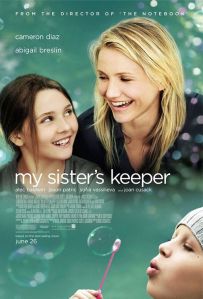 How could a movie about dying children be so schlocky? The best-selling Jodi Picoult novel, My Sister’s Keeper, is awash in drama but it never tipped the scales into absurd and tone-deaf melodrama. How does one botch a tear-jerker? You need only watch the big screen version of My Sister’s Keeper for a primer on how to turn a complicated, challenging book into maudlin mush (hint: make sure to have a sizeable budget for obtaining music rights for endless montages).
Kate (Sofia Vassilieva) is dying from cancer. Her little sister, Anna (Abigail Breslin), was conceived by her parents, Sara and Brian (Cameron Diaz, Jason Patric), to be a genetic match. Anna was born so that she might be “spare parts” for her ailing big sister. Jesse (Brennan Bailey), is the oldest child, and his needs have been overlooked because of Kate’s illness. Anna’s life has been one of prodding and pricking and testing and operations. Then one day, Anna consults with high-powered lawyer Campbell Alexander (Alec Baldwin). She wants to sue her parents for the rights to her own body. She’s tired of undergoing numerous medical treatments. She wants a life of her own, something more than being “spare parts.” Needless to say, Sara and Brian are horrified. Anna clearly loves her sister but by refusing to donate a kidney she is signing her sister’s death notice.
 The movie strikes one false, heavy-handed note after another. There is rarely a moment that feels authentic or genuine; everything comes across as powerfully manipulative and cloying and contrived and like a tuneless melodrama. Things are cranked to such a high degree of overkill. I swear to you that, no joke, at least seventy percent of the scenes in this movie involve somebody crying. People don’t argue, they flail and shout until they go hoarse. There is nothing subtle to be found here. I didn’t feel emotionally invested in these characters and one of them is a freaking teenage girl suffering with cancer! The first half of the movie feels far too rushed, and the majority of scenes last under two minutes, meaning that the plot lurches forward but the film fails to round out and establish its central characters. The movie’s idea of covering up its screenwriting shortcomings and lackluster character development is to produce an extended music montage. There are over five music montages (I lost count) and it possibly takes up a fifth of the movie’s total running time. I don’t know about you, but watching characters smile and laugh set to music that is so painfully on-the-nose literal does not make due. After so many matching lyrics, I was waiting for a song to literally describe everything I was watching on screen, like, “Heaven/We’re all gonna go/You’re gonna go sooner/Because you’re a little girl with cancer/Don’t you think your mother’s crazy?/So what’s on TV?” Is it better drama to hear a somber cover of Cyndi Lauper’s “Girls Just Want to Have Fun”? It’s just one of several flimsy filming decisions that rip you out of the story and make it perfectly obvious that you are watching a movie, and a poor one at that.
There is just way too much material here for it to succeed as a streamlined, two-hour weepie. There are complicated moral issues here about exploiting one child in efforts to save another. Grief can transform the nucleus of a family in small ways. This requires a delicate adaptation and this movie is certainly not it. This is an adaptation that alternates between syrupy music montages and falling anvils. My Sister’s Keeper is beset with convoluted flashbacks, and I often was confused as to where in the timeline several of the scenes were taking place. Is this before or after Sara shaved her head in solidarity? Is this before or after she Katie starts chemo? There are multiple characters that share voice over duties, often just offering up a line or two. What’s the point of having Jesse announce in voice over, “I wondered how much trouble I was gonna be in,” when he sneaks into his house late at night? Could we not communicate this effectively without the added voice over? And only for a single line? This is just shockingly lazy writing and proof that the filmmakers have no trust in their audience. In fact, Jesse as a character is entirely pointless. He adds nothing to the story except to make things more confusing. Why does he sneak out at night to drink milkshakes in downtown L.A.? Why are judges unclear why a lawyer of such fame and stature as Campbell Alexander has a helper dog? There are intriguing dramatic setups that just get overlooked. What kind of life goes on in a family home when one child is suing their parents? Show me this stuff.
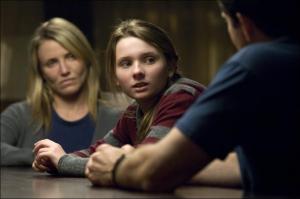 By far, the only believable part of this mawkish mess is a lengthy flashback to Kate’s boyfriend, Taylor (Thomas Dekker, sporting a good-looking dome if you ask me). This is the only segment that’s allowed to breathe and feel naturally developed. It is during this tender sequence where Kate feels like a character instead of a broadly drawn sketch of Cancer Girl. The interaction between Kate and Taylor is sweet and relaxed, until an obvious conclusion that has to spoil Kate’s small hold on happiness. The supposed twist ending is predictable and nullifies the court battle, which makes the ethical struggle of bio-engineered babies just a plot gimmick. In the end, I got the overwhelming impression that the screenwriters, Jeremy Leven (The Notebook) and director Nick Cassavetes, are projecting. We conclude on one character’s voice over, remarking, “I don’t know why she died. I don’t know why what happened happened. I don’t know why we did the things we did.” It’s like a thinly layered confession by the screenwriters that they were clueless. Any tears that manage to squeeze out are unearned and are only the byproduct of such gloomy material.
The acting is typical of such hyperactive melodrama. Diaz fares the worst as the overprotective mom who fights tooth and nail to save her daughter at the expense of everybody else. She’s abrasive and grating even when the movie tries to make her sympathetic. Diaz can do drama and can even manage understatement, as she showcased in the criminally underappreciated 2005 film, In Her Shoes. Cassavetes only knows how to direct actors when they’re being histrionic and unrestrained, as Alpha Dog and John Q. prove. The rest of the cast slogs through the overwrought material with plenty of tears to bailout the Kleenex industry. The lone bright spot amongst the cast is Vassilieva (TV’s Medium) who makes you feel her pain and manages to, at times, cloud your mind that you’re being shamelessly manipulated.
 My Sister’s Keeper is supposed to be one of those moving, heart-tugging episodes that allows us all to re-evaluate life. The movie, in actuality, is a maudlin and overstuffed melodrama (cancer kids, dysfunctional families, court disputes, secret schemes, last wishes, etc.) that is so poorly executed that it manages to make Lifetime movies look like grand art. Cassavetes grounds down all the tricky ethical questions and tortured feelings down into simplistic soap opera gunk. Nothing feels genuine or honest, everything comes across as incredibly forced and contrived, and enough with the music montages. Hitting the soundtrack button does not erase screenwriting deficiencies. My Sister’s Keeper is a malformed, overwrought, clunkily insensitive excuse to empty audience tear ducts. I suppose indiscriminate fans of the weepie genre will find the material forgivable, though fans of Picoult’s novel will find the changes to be unforgivable. I like my emotions to be earned and not strangled to death.
Nate’s Grade: C-
Share this:

The Hurt Locker (2009)
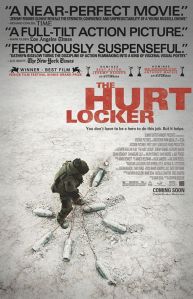 The Hurt Locker is an action movie on a very human scale. Sure there is a time and place for your Michael Bay-esque action vehicles, the type that scorch square miles and leave recognizable world cities in ruins. However, those kinds of action movies are never the kind where storytelling ever enters the fray beyond a meager question of how to get from Point/Explosion A to Point/Explosion B. In fact, Bay openly admits to planning the story of Transformers 2 by working on various action sequences during the 2007 writer’s strike and then tasking screenwriters to connect the dots. The Hurt Locker exists in a frighteningly believable world. This isn’t a movie about explosions but about the extinguishing of explosions. It follows the Explosives Ordinance Disposal (EOD) unit, tasked with detecting and detonating bombs and other improvised incendiary explosives (IED) in the field of combat. You will not be restless for loud “booms” while watching The Hurt Locker. In fact, you will be on pins and needles hoping that you never hear another loud “boom.”
Delta Company are the men responsible for protecting the other soldiers by disposing of bombs. The new team leader, Staff Sgt. William James (Jeremy Renner) has defused over 800 bombs during his tour of duty. He knows he’s the best and he’s addicted to the thrill of being so close to death. He will make occasionally reckless decisions putting himself, but not his fellow company men, at higher risk. This does not sit well with Sergeant JT Sanborn (Anthony Mackie), a by-the-book type that doesn’t appreciate his officer chasing a thrill. The other EOD unit member, Specialist Owen Eldridge (Brian Geraghty), is a man more accustomed to taking orders than giving them, and his indecision may have actually cost the life of the former head of the EOD. Both Sanborn and Eldridge worry that their new team member is going to get them all killed.
 Director Kathryn Bigelow (Near Dark, Point Break) has been directing male-centered action flicks for over two decades; it’s been seven years since her last feature, the regrettable Harrison Ford submarine flick, K-19: The Widowmaker. The Hurt Locker is her finest work to date by far. Her action sequences are visceral and downright agonizing to sit through. She is masterful at setting up the geography of the set piece, ratcheting up the suspense, adding organic obstacles and complications, and then makes sure with her camera and editing that an audience knows exactly what’s happening to whom for every minute that ticks off the clock. Bigelow takes her time to establish the particulars of her locations and sequences, allowing the audience to, surprise, understand what is happening and better engage in the movie. Bigelow chose to shoot the movie in Jordan, the neighboring country to Iraq, and the locations and actual refugee extras add an unvarnished sense of realism. The movie goes without music during much of the action, which makes it all the more uneasy. There isn’t any over eager composer telling you how you should feel, no direction that now things will get even more hairy. You will feel every second of danger, and Bigelow crams in a whole lot of danger. Things can go wrong very, very quickly.
There’s nothing to action cinema quite like the bomb that’s only a few tick-tocks away from doing its dirty work. Do you cut the yellow wire or the green wire? Never cut the red wire. The bombs found in Iraq are a stark range of death. There’s the crude incendiary device just wrapped up in garbage, but then there’s also the fiendishly clever devices with multiple charges and there are grotesque devices as well. At perhaps the film’s most guttural and shocking moment, Staff Sgt. William James finds the corpse of an innocent stuffed with explosives. The easiest thing would be to simply detonate the bomb, but that would also desecrate the body of someone we have come to know. Watching James snip open the crude stitching and dig inside the chest cavity, if we didn’t know then we know now, Bigelow has made sure that The Hurt Locker is the most emotionally resonating contemporary war film in memory.
 Bigelow and screenwriter Mark Boal, an Iraq War journalist, create a vivid sense of dread, antipathy, and most of all, paranoia. Is that a kite flying in the air or is that a signal? Is that a nondescript observer with a cell phone or is that a terrorist with a remote detonator? Is that child being friendly or collecting intelligence? Your mind will race through all these possibilities because Bigelow teases out her action sequences to an unbearably taut level. The audience cares about these soldiers and wants to see them make it back home (we’re informed how many days Delta Company has left on their tour throughout the film), which Bigelow uses to her advantage at every turn. What happens matters. My nerves were frayed during several sequences, including one where the soldiers are pinned down by distant enemy gunfire. The moment turns into a duel and a chess game, as each side tries to adjust their gaze in the searing heat and measure their long-range shot before the other side beats them to it. Then the sequence turns into a waiting game. This is the kind of movie that keeps you poised on the edge of your seat fearful that at any moment something disastrous will suddenly happen. Every time Staff Sgt. William James went back out to defuse another bomb, my sense of dread intensified. I began to doubt everything that I would ordinarily take for granted in other movies.
While being a top-notch action movie, Boal (In the Valley of Elah) has also crafted a great character study. In between the bomb episodes we learn more about these men, which makes it all the more hard to see them then head out to defuse another explosive. The film opens on a quote equating war as a drug, and we explore this notion through the character of Staff Sgt. William James and the weight his unique duty bears. It takes a special person to volunteer for defusing roadside bombs. The defuser must be extremely intelligent, be extremely cool under pressure, and be able to work in a giant suit that makes them look like a chubby astronaut, while enduring debilitating desert temperatures of 110 degrees. It sounds like a suicide mission. James is an adrenaline junkie and war is his drug. He exudes a Zen-like calm in the heat of the moment and this is now the only life for him. Shopping for cereal back home has lost its meaning. Being a husband has lost its meaning. His life now has one purpose. Renner (28 Weeks Later, North Country) gives a stirring performance laced with cavalier confidence and resignation. Mackie (Eagle Eye, We Are Marshall) is also another standout in the pared down cast. When he laments about the dishonor of having no one to remember you in death, you feel the man’s existential sorrow.
 Ignore the political cranks that decry The Hurt Locker as another partisan anti-war film from Hollywood. The American public has been mostly indifferent to any contemporary movie that aims to tackle our current military conflicts in Iraq and Afghanistan, but The Hurt Locker eschews the politics of war to focus on the realities and dangers of its characters. These guys are more concerned with surviving the next bomb than the politics of why they’re in the Middle East. The public has voted with their wallets and does not want to see the reality of war onscreen, or at least the Hollywood version of war reality, but I pray that those same people give The Hurt Locker a fighting chance. There is no preaching to be found here. The Hurt Locker could just have easily taken place during other wars, though the current Iraq War allows for added cultural dissonance (Is the central goal of bomb-defusing a metaphor for our conflict in the region?). This is a film that transcends politics and genre.
The Hurt Locker is more than an action movie, more than a war movie, more than a psychological study; this is an outstanding movie. This movie is a drug to the adrenaline senses and I need another hit. This is one of the finest films of the year and as it expands across the nation, I highly encourage everyone to seek out The Hurt Locker.
Nate’s Grade: A
Share this:

Last Chance Harvey (2009)
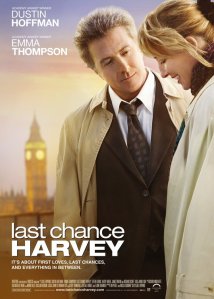 There aren’t too many movies that feature a middle-aged romance. That’s really the sole draw here. Harvey follows the titular dad (Dustin Hoffman) as he travels overseas to his daughter’s wedding. His life is in shambles and he strikes up a friendship with a downtrodden woman (Emma Thompson) that eventually percolates into romance. The interaction between Hoffman and Thompson is relaxed and charming but the storyline is too slight and predictable. This whirlwind courtship spans one single day, so the movie feels too brief. We’re just getting to know these characters and enjoying their chemistry when the movie just limps to a close. Last Chance Harvey feels less like a movie and more like the first act of a movie. The plot is predictable and hits all the resolution points it needs to, which means get ready for tear-jerking wedding toasts from men who’ve changed and grown wiser over the course of 24 hours. Last Chance Harvey is a mildly pleasant diversion with two talented actors making the most of a shopworn and abbreviated story.
Nate’s Grade: B-
Share this:

Reservation Road (2008)
 This movie beguiles me. I watched it over a month ago and I am still turning it over in my brain, and not just for the fact that I get it confused with the similar sounding yet also disappointing Reservation Road. It’s another movie that presents the suburbs as a prison of bourgeoisie social moirés about how men and women are expected to live to be happy. The movie looks magnificent thanks to skilled cinematography by Roger Deakens, even if it falls back on redundant visual metaphors (look, the windows are shaped like prison bars!). The acting by Leonardo DiCaprio and Kate Winslet, the unhappily 1950s married couple Frank and April Wheeler, is mostly impressive. Michael Shannon deservedly was nominated for an Oscar as an unhinged realtor’s son who cuts through all the troublesome and fake niceties. It is a terrific performance and jolts the movie with much-needed energy, somewhat like Renee Zellweger’s role in Cold Mountain. I think that’s where my biggest area of concern is: the movie is just kind of placidly dull. Watching people be miserable for most of a two-hour running time isn’t a deal-breaker, but the movie needs to have some life to it. Revolutionary Road feels just as morose and restrained as its assortment of doomed married couples eeking out an existence. Perhaps that is an achievement to be heralded for director Sam Mendes. Then again, perhaps it just means I felt purposely remote and directionless and just waited for the movie to expire.
Nate’s Grade: B-
Share this:

Tell No One (2008)
 Now this is a thriller made with surgical precision. This French film traces a doctor trying to uncover the mysterious murder of his wife, who may be alive after all. The doc needs to stay one step ahead of the police, who still think he’s responsible for his wife’s murder, and he has to also watch out for other shady figures who may be responsible for his wife’s disappearance. This engrossing thriller is character-based and while the twists and turns could induce whiplash, nothing feels totally out of place or unbelievable. This is a movie that holds up upon reflection. All the pieces fit together. Tell No One is exciting, intellectually stimulating, and it keeps you guessing, and yet the movie has a deep emotional core and resonates with palpable feeling. This is a terrific movie that should appeal to just about everybody with a pulse.
Nate’s Grade: A
Share this:

Street Fighter: The Legend of Chun-Li (2009)
 It’s not every day that Jean Claude Van Damme gets some marginal level of redemption. The original 1994 Street Fighter film took the classic arcade fighting game and took it as seriously as possible, which meant it was incredibly silly. Van Damme was Colonel Guile and entrusted to rescue hostages from the evil dictator, Bison (Raul Julia). The big screen adaptation rewrote entire characters but managed to keep the stuff fans really care about, like catchphrases, costumes, and super moves. God forbid that audiences see Cammy (Kylie Minogue, yes that Kylie Minogue) make the wrong victory pose. It’s always the unimportant things that somehow matter the most to execs. Street Fighter is a campy blast. How could you despise a movie that has its villain say, “For you, the day Bison graced your village was the most important day of your life. But for me… it was Tuesday.” Though the movie does have the depressing distinction of being Julia’s last film before he died. Let this be a lesson to all actors looking to take a paycheck role. Years later, in the wake of a writer’s strike, the execs at Fox thought they could pump new blood into a Street Fighter franchise. Street Fighter: The Legend of Chun-Li purports to tell the back-story of one of its most popular fighters, the diminutive fireball-tossing lass with Princess Leia’s haircut. This movie proves that you don’t need a Van Damme to make a boring and mediocre action movie.
Chun-Li (Kristin Kreuk) is trained to be a master pianist and also a master martial arts warrior. You don’t realize the kinds of dangers classical pianists constantly run into. Her father is kidnapped by the crime lord Bison (Neal McDonough) for some reason or other. Three years later, a mysterious scroll falls into her possession. She travels to Bangkok to find her father. Bison has the ingenious plan of buying waterfront property, introduce high levels of crime, and then making money on lowered property values, which is simultaneously confusing and stupid. Bison has a few evil henchmen, notably the giant boxer Balrog (Michael Clarke Duncan) and the masked warrior Vega (Taboo from the Black Eye Peas), who help wipe out his criminal competition. In Bangkok, Chun-Li is mentored by Gen (Robin Shou, who played Liu Kang in two Mortal Kombat movies) and together they attempt to thwart Bison and his dastardly real estate scheme.
 For a movie about streets and fighting, well there’s a clear shortage of the latter. Much of the movie is structured around Chun-Li conducting her own private investigation and achieving some level of inner peace. She decides to try and make it on the streets of Bangkok. There are forgettable training exercises with forgettable platitudes disguised as wisdom (“You’re hurting me,” “No, you’re hurting yourself”). There are a handful of lackluster fights and chases, some of them through streets even, but the movie has a scarce amount of action until it revs up for a climactic showdown. The action is also poorly shot and poorly edited, distracting the senses and making it downright impossible to understand. The choreography is nothing special. When the movie suddenly introduces a supernatural element the other characters don’t even bat an eye. Screenwriting neophyte Justin Marks has too much revenge-seeking father drama and real estate scheming and not enough brawling. The Legend of Chun-Li has zero respect for the intelligence of its audience. It has flashbacks to flashbacks that just aired minutes earlier. How hard would it have been to just actually base a Street Fighter movie on a fighting tournament?
Director Andrzej Bartkowiak (Doom, Romeo Must Die) shoots the movie in such a dull manner that the fight sequences fail to even elicit any interest. There’s one scene in the middle of the film that serves as a testament to the lack of care put into this movie. Chun-Li has battled a Bison henchwoman in a women’s bathroom. The bathroom set design includes partition walls with portholes. Chun-Li is on one side and the henchwoman tries to punch her through the porthole. Chun-Li grabs the woman’s arm and squeezes. The camera angle is from the side of the actresses, so it would make the most sense to have the henchwoman’s right arm caught, that way her expression could be seen. Nope. Chun-Li is gripping the woman’s left arm, meaning that her raised arm and shoulder block any view of the woman’s face, and yet she talks through this scene. How difficult would it have been to just switch arms? Why purposely obscure an actor’s face, especially in a scene that doesn’t require a stunt double?
 Here’s a curious item. Chun-Li has always been a full-blooded Chinese woman in the history of the video game. When we see her as a child, baby Chun-Li and child Chun-Li are very obviously Chinese in features. Flash forward a few years and she’s transformed into looking like Kreuk, who is half-Chinese. Apparently, one of the less common side effects of trauma is becoming less Chinese looking as you age. Along these same strange ethnic lines, we’re told that Bison was the child of Irish missionaries and was left behind in Bangkok. And yet, the child grown up completely in Southeast Asia manages to sport an Irish accent. Anybody want to explain that particular linguistic loophole?
Kreuk (TV’s Smallville) is one of the film’s biggest handicaps. The script saddles her with great amounts of pointless voice over, to the point that half of her performance is listlessly explaining what is literally happening on screen. Kreuk is a dead-eyed robot in this movie; she displays some glimpses of human emotion, like sadness and rage, but they never feel remotely credible, like someone who only knows the definitions of emotions and not proper application. Her lesbian seduction dance is a small moment of absurdity. She thrashes on the dance floor and her “dancing” reminded me more of a bird’s mating dance without the excessive plumage displaying. Kreuk can run and flex well enough, which is also a nice benefit for a martial arts action flick.
The acting is terrible but there is one bright spot in a most unexpected location. Ladies and gentlemen, I present to you the best worst performance of the year, brought to you by Chris Klein (American Pie). Klein plays Interpol agent Charlie Nash who is conducting a parallel investigation into Bison’s Bangkok activities. He’s partnered up with a local gangland homicide detective (Moon Bloodgood) who takes extra care to showcase her cleavage thanks to work outfits with plunging necklines. Klein is awful to a powerful degree but here’s the thing — I’m fairly certain it’s one hundred percent intentional. Being a conosoire of trashy cinema, I feel that I’ve adopted the skill of being able to deduce when an actor is hopelessly serious or just goofing off. Klein comes across like a self-aware man; he knows this is a crummy movie with crummy dialogue, so he’s going to have as much fun as possible. His performance is all forced swagger, from the way he constantly swivels his head to the way he cannot purposely walk in a straight line. He overemphasizes lines, chewing over the faux hard boiled detective talk and spitting it out in a singsong delivery. He grimaces and furrows his brow, widens his eyes to comical levels, and when he crouches in a gunfight the man spreads his legs as far apart so that he looks like he could have effectively doubled as a backup dancer in an MC Hammer music video. It’s obvious that Klein has given a staggering performance, but the observant will note that this is not an inept performance. This man knows exactly the kind of movie he’s in. I always tabbed Klein as a wooden actor that came across like Diet Keanu Reeves, but I must credit him for making a bold acting choice to knowingly dig deeper when it comes to being bad.
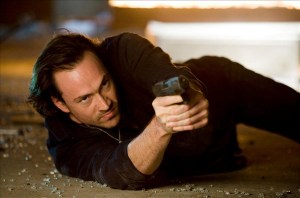
Hero of this movie, Chris Klein.
Readers know that I am skeptical and dismissive about the prospect of a good movie ever being born from a video game adaptation. Games call for interactivity and movies passivity. But if you’re going to make a movie called Street Fighter than stick to the script. This borefest wants to be a gangland drama with a tacked-on buddy cop side plot. Street Fighter: The Legend of Chun-Li is an awful work partially redeemed from the sheer amount of unintentional hilarity. Kreuk is extremely miscast as a warrior woman. The acting is bad, the direction is bad, the writing is bad, and Chris Klein tries to outdo them all in badness, and I admire the chap for trying something different in an admittedly abysmal movie. To be fair, I was never a big fan of the original video game. The special moves always seemed much more tricky to pull off. How many different incarnations of Street Fighter II were there before they eventually mastered basic math and released Street Fighter III? These are the things I was thinking about wistfully whenever Klein or Bloodgood wasn’t on screen.
Nate’s Grade: D
Share this:

Up (2009)
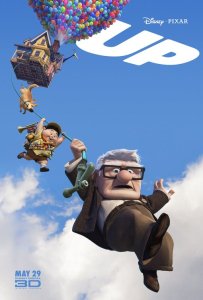 With every new movie Pixar re-establishes itself as the most creatively reliable studio in the business. And every year some critics beat the drum that THIS is the movie that will break free from the animation ghetto and earn a Best Picture Oscar nomination. If anyone out there would like to tell me how The Reader could be a superior film to WALL-E, by all means enlighten me. Pixar has been producing engrossing and complex entertainment, not merely cute cartoons. But if WALL-E failed to score a nomination in a so-so film year, then I doubt that Pixar’s latest, Up, will fly into the winner’s circle.
Carl Frederickson (voiced by Edward Asner) is a cantankerous 78-year-old man who wants nothing more in life than to be left alone. He lives in a house he built with his late wife, Ellie. They met when they were kids and bonded over a shared love of thrill-seeking adventure, like their hero, explorer Charles Muntz (Christopher Plummer). Ellie’s dream is to eventually travel to Paradise Falls in South America, but she never lives to see it. Carl is about to be thrown into a retirement center and have his home demolished, so the geezer hatches an escape plan. The former balloon salesman attaches thousands of balloons to his house and floats away headed for Paradise Falls. Carl is ready to enjoy the quiet when he gets a knock at his front door. He has a stowaway. Russell (Jordan Nagai) is an overweight eight-year-old determined to get his last Wilderness Scout badge, which involves helping the elderly. Together, they journey through the jungles of Venezuela and find remarkable discoveries and constant danger, including the presence of a sinister and still very-much-alive Charles Muntz.
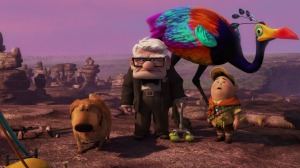 Up is the colorful tale of a dreamer who longs for escape, and you feel the same rush of excitement to be unbound and take off. Naturally, there will be bonding between the grouchy old man and the earnest kid. Up really becomes an altogether different movie once it lands in Venezuela. It transforms into an unconventional adventure story replete with talking dogs and giant birds. I loved the Dug character and was bemused at hearing the scattered thought patterns of man’s best friend (“I have just met you and I love you”). The side characters somewhat steal the show and, at the same time, feel overextended. With that said, I’ll probably end up buying my wife a talking stuffed Dug. The last act soars with about 20 minutes of thoughtful, exciting, well-constructed action weighted by an emotional connection to character. At the same time, Up tackles some major issues and does so without getting mired in sappy sentimentality. Carl is dealing with loss and has hardened against a world he feels indifferent to. Up almost had me in tears within the first 10 minutes during its elegant wordless montage charting the courtship and marital life of Carl and Ellie. It’s a fabulous moment and greatly economical, packing an emotional punch unequaled by the rest of the film.
The visual storytelling is still top of the line entertainment. The animation is superb as usual. The flying house is an explosion of colors and instantly brought a smile to my face. Carl’s character design looks like he was a Lego character that was brought to life. He’s all square and boxy whereas Russell is round to the point of being an Easter egg with legs (is Russell Asian-American or biracial, or is it just a character design that I’m reading too much into?). The South American jungles are lush and filled with inventive creatures. I saw the movie in a conventional theater but the option is out there to catch the movie in Disney 3-D, but I don’t think it will add much to the whole experience.
The central image is lovely and instantly iconic: the house floating through the clouds thanks to thousands of colorful balloons. It’s a beautiful image and a perfect metaphor for the memory of Carl’s deceased wife. They built that house together and lived a full life inside, he refers to the house as “Ellie,” and at one point Carl even ties the floating house to his back, tethering her memory to Earth while simultaneously carrying his grief with him at every step. The idea of a flying house tickles the imagination and yet never once demands more critical examination. We accept that Carl has rigged the house to take flight and never once stop and question the extreme engineering improbabilities. The flying house is just the mode of transportation for the characters to complete their story, but it is not the whole story. Think of it as a more comfortable mode of family flying than a queen-sized mattress that included Angela Lansbury (1971’s curious Nazi-fighting family flick, Bedknobs and Broomsticks). The rest of the movie never quite matches the directness and depth of that visual metaphor.
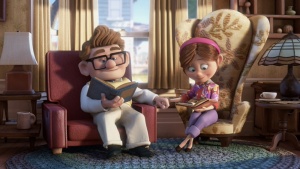 Up ducks out on making its tale more of a feeling, living movie, something more than striking visuals and some fun set pieces and odd characters with a dash of sentiment. Up establishes its strange story elements but then doesn’t plausibly make much more out of them. The story becomes a somewhat constricted rescue caper to return a Mama bird to her babies and keep her out of the hands of a Bad Man. Charles Muntz is a fairly weak villain. I’ve also got a burning question: if Carl is 78 years old, how old exactly is his childhood hero, Muntz? It’s a bit simplistic and that’s fine, and it’s still an enjoyable conclusion, but the movie doesn’t ascend from the sum of its parts like the finest works of Pixar, like WALL-E and The Incredibles. This one’s just missing some of that Pixar magic. Yeah, there’s the overall arc of Carl overcoming the loss of his wife and softening his hard exterior, but tell me what exactly else happens that matters? The kid makes a friend? It’s about human connection but how exactly is that best served by giant birds and talking dogs flying biplanes? Up also isn’t as visually arresting or creative as previous Pixar flicks, aside from that floating house. As far as Pixar films go, this is about square down the middle (between Monster’s Inc. and Finding Nemo, better than Cars and A Bug’s Life). But even that statement is prefaced by the fact that Pixar’s output is generally head and shoulders above every other studio in technical precision, creative ingenuity, and emotional heft.
Up takes some fancy flights of imagination and has plenty of humor and charm to make it a family-friendly winner. I have some reservations with the movie and its plot, but there’s no question that Pixar knows how to construct a movie that manages to appeal to everyone, even if it involves cranky old men as unlikely action heroes. I feel like perhaps Up is suffering because it has the rotten luck of following the release of WALL-E, a timeless masterpiece that I have since watched probably over 30 times. Up is a warm-hearted and engaging film even if it never reaches the creative and emotional heights of other Pixar masterworks. Still, a “pretty good” Pixar movie has a legitimate shot at being the best movie I see this summer.
Nate’s Grade: B+
Share this:

Rachel Getting Married (2008)
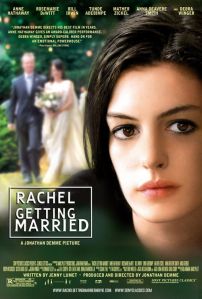 Jonathan Demme’s dark comedy is a movie at battle with its context. At heart, there is a fantastic and engrossing family dysfunction that rears its ugly head and re-opens old wounds. Watching Rachel (Rosemarrie DeWitt, who didn’t get nominated for an Oscar why?) unleash years of repressed pain upon the likes of her toxic, needy, narcissistic little sister Kym (Anne Hathaway), just fresh from drug rehab, is enthralling because of how raw and hurtful the emotions are. You can feel the sting of the words. Through the arguments, a picture emerges of this family’s tragic history and he emotional tug-of-war between the siblings. This is the great stuff, but then the setting of the movie overpowers the drama and sidelines it. Rachel Getting Married will make you feel like you are apart of this martial extravaganza, so we see about fifteen minutes of toasting from EVERY PERSON, because, really, much of this is all exposition from characters who won’t be heard from again. We also see about 15-20 minutes of eclectic musical performances, dancing, and all the rest that comes at the close of a reception. While the wedding/reception is an interesting multicultural blend, it feels like an unyielding intermission from the terrific family drama. Hathaway is as good as advertised and soaks up the troubled life of a notorious problem child defined by little else than her problems. DeWitt is outstanding as the big sister tired of being pushed aside. Demme’s handheld camerawork, and the extensive ensemble of slightly eccentric characters, made me feel like this was an Oscar-serious version of one of the Christopher Guest mockumentaries like Waiting for Guffman. There is succulent family misfortune here, with great acting, but I wanted less wedding and more Rachel and friends.
Nate’s Grade: B


You must be logged in to post a comment.