Blog Archives
Any Given Sunday (1999)
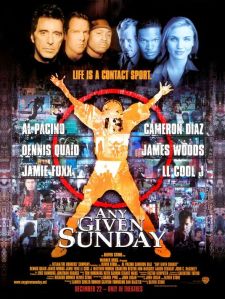 Oliver Stone is a seamstress of visuals and visceral noise. Any Given Sunday is perfect as he delves into the professional world of football and how it becomes a dance of testosterone and fury. But after awhile all the audience feels is a pounding and a ringing in its ears.
The biggest stumbling block may actually be its focal point – there’s too much football! The games last as long as actual games and there are multiple games through out. Though Stone captures the essence nicely that these spandex-clad athletes are the gladiators of today playing in a ballet of chaos, he just throws too many jangled cuts, quick shots, and extreme angles flashing around to hyper-decibel soundtrack fodder. After a while the viewer becomes dizzied by the rush of noise and flash of lights buzzing around their precious skull. It’s enough to cause a concussion simply from watching.
]Most of the action in Any Given Sunday actually happens off the field with some meaty drama delivered by multiple players. Stone focuses in on the people behind the catches and blocks and how the game can control or transform their lives. Finally a drawn-out story that covers football with respect. Diaz and Pacino get into screaming matches for roughly most of the movie, but it’s exciting to see two great actors throw the acting medicine ball back and forth trying to out-duel the one before. The supporting characters all have stories suitable to the game and interesting enough to warrant attention. Jaime Foxx has a nonchalant magnetism that keeps the audience pulling for him even after he vomits for the third time on camera.
Stone lets the viewer into the game of football in a manner truthful yet exaggerated. But with all the whiz-bang he throws out in Any Given Sunday one can’t help but have wished for more constraint in the excess and more minutes for the drama in between.
Nate’s Grade: B-
Share this:

Bicentennial Man (1999)
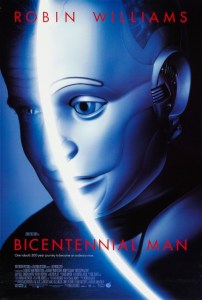 I shed a tear for what the great comedian Robin Williams has become. Once the quickest and sharpest of minds just cascading with outrageous and fanciful wit has been turned into the holiday gift-giver of schmaltzy pull-from-the-heartstrings sap.
The story of Bicentennial Man is set in the not-too-distant future, so not-too-distant that it looks like it’s just next week – with the addition of flying cars. The future seems to lack outbursts, crime, and even minorities. Seems like not everyone has a future I guess. In this world of marvels you can buy a shiny metal man for your home life and/or atrociously neglectful parenting needs. Enter walking trash receptical robo-Robin as Sam Niell’s family nanny and solution for not getting his children a dog. Through the 200 years robo-Robin learns to laugh, and love, and what the true meaning of humanity is and heart. Put some scrubs on him and this entire thing is basically Patch Adams in Space.
As the film lags on it grows increasingly more annoying until the point where it might cause audiences to bleed from the ears. If you thought a dentist appointment was painful just wait until the euthanasia comedy kicks in here.
Williams yet again throws on his usual holiday blubbery dough eyes and message of good will. But this time the pill is much harder to swallow, especially coming from an actor encased in silver foam rubber. The movie aims for a deep message of what makes us human, but comes away more likely with the message of “Wait an hour for Williams to get this crap off then do his schtick.” If you’re trying to find out what makes people human, it certainly ain’t this flick. Williams has such unparalleled comic ability that one wonders why he is wasting his time on sappy films like these when he needs to flee back to his zany comedic roots. Anyone could be a robot in this, judging from the acting for a start, but no one can do the things Williams does – and that’s why his uniqueness is being utterly wasted.
The real heart breaker isn’t in this movie, it’s seeing Robin Williams fade into mediocrity and seem content with it.
Nate’s Grade: D
Share this:

Man on the Moon (1999)
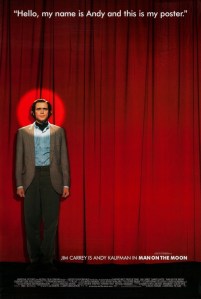 After many years the big screen biopic of one of comedy’s greatest figures of recent finally emerges to the awaiting public. Many never knew what to make of Kaufman or what he was attempting to do, and the movie displays this attitude to its core.
First things first, there is no Jim Carrey in this picture, only Andy. Carrey’s performance is pitch-perfect and swarming and enthralling that he becomes the glue of an otherwise sticky movie. Carrey IS Andy Kaufman, it’s like seeing dear Andy alive and well back on screen still terrorizing the easily duped. It almost brought a tear to my eye. Carrey takes the sheep skin and pulls off an incredible career best performance that demands attention come award time.
But without Carrey’s masterful performance Man on the Moon is not worth venturing out of the home for. The movie never delves beneath the surface to discover who the true Andy Kaufman was or why he did the things he did. And if the point is that there was no true Kaufman but merely a stage character then fine, but did we need a movie? Without any inner depth the flick becomes a shapeless reassembling of TV stints and clips Andy pulled. If I wanted to see this I’d watch Comedy Central at odd hours of the night.
Courtney Love pops her head in late into the running time to establish herself as the love interest, but her character like everyone else, is never fleshed out. Love just becomes a hollow foil to Kaufman’s antics in some vain attempt to add heart to the madness. The most lingering problem is that of the relationship between Kaufman friend and co-conspirator Bob Zmuda never being shown beyond communal frat brothers. Man on the Moon gives the reigns of the picture to Carrey, and rightfully so, but then seems to believe Carrey as Kaufman is the only substantial character in the story.
Man on the Moon is for the most part an entertaining retelling of the rise and fall of Kaufman, and his indifference all the way. Director Milos Foreman and his two Larry Flint scribes try their hand at uncovering the man behind the curtain, but stumble along the way. Maybe this is the film Kaufman would have wished, one that doesn’t answer any questions or is forced to entertain its patrons. But me thinks that the Hollywood version of Andy stays true to his stubborn nature, but trips its feet towing the mystery that was one of comedy’s most peculiar influences.
Nate’s Grade: C+
Share this:

Toy Story 2 (1999)/ Princess Mononoke (1999)
 There is a false prejudice circulating the land of merry movie goers as they skip from one theater to the next. This assumption is that animation is a kids only event, that’s it’s something to appease the screaming masses under three feet of height. Lately movies are giving more credit to the cause that animation can be a wonderful escape and isn’t just for the kids.
Animation can take people to worlds that otherwise could not have existed, and so is true with Princess Mononoke the 1997 Japanese import with a fresh English dubbing. Mononoke speaks of the battle between harmonious nature and forging industrious man. Often the film displays such scenes of visual passion that it seems like an animated love letter to those wishing to venture out to find it. The story is vivid and non-judgmental, you see the stories and reasons behind both warring forces and not everything is easily black and white. The English dub does not distract from the overall enjoyment as many professional actors yield their vocal talents to this masterpiece. Princess Mononoke leaves a spellbinding impression of intense ecological thought and aching beauty. The best anime has to offer.
 At the other end of the animation spectrum lies Toy Story 2, the kid friendly three-dimensional quest of action figures and plush dolls. What is amazing about Toy Story 2 is how it not only matches its ground breaking predecessor but even surpasses it both in visuals and story. Story is packed with sly humor not just for kids, and it contains a poignant message about mortality and what one seizes with the opportunities they are given. The animation is mesmerizing and the humor is fast and fierce. Toy Story 2 proves that not all sequels are bad ideas.
Fresh from the gate are two examples of the great gifts animation has to offer. Couple these with the wonderful The Iron Giant, a ferociously funny South Park movie, an okay Tarzan, and the upcoming Disney redux Fantasia 2000 and it appears to be a solid time for animation. Go out and see some.
Nate’s Grade: Both movies A
Share this:

Dogma (1999)
 In a time where simply having faith in anything, let alone religion, is scoffed at, Kevin Smith daringly and passionately expresses his personal search for answers and understanding. But while the zealots decree Dogma as blasphemy, what they truly miss is the biggest commercial for faith and God that American audiences have seen in decades of cinema.
The story of the religious epic causing all the hubbub begins with a pair of fallen angels (Ben Affleck and Matt Damon) spurned from the pearly gates of Heaven and banished to Wisconsin. One discovers a re-dedication of a church imploring a little used Catholic practice of plenary indulgence allowing whoever to enter through the church’s arches to have their slate cleaned of all sin. The two seize this opportunity of a dogmatic loophole to sneak back into heaven. The only slight problem is that by doing so they reverse a decree of God and disprove the Almighty’s unfallability, and thus will wipe out all of existence. The voice of God (Alan Rickman) recruits a lapsed Catholic named Bethany (Linda Fiorentino) for a Holy Crusade to halt the scheming angel’s plans for the good of the universe. Along the way she is aided by two unlikely prophets (the dynamic duo of Jay and Silent Bob), an racially discredited 13th Apostle (Chris Rock), and a shapely strip-teasing muse (Salma Hayek) as they engage with demons, seraphims, angles, and all sorts of celestial “who’s who” to stop the end of existence.
 Smith’s direction has taken strides since the point-and-click days of his earlier works; however, there’s still an awkward flatness to his framing and action. Fiorentino plays the role of a grounded character well. Rickman as the bitter Brit shows why he can still take anyone toe-to-toe for acting chops. Affleck and Damon have terrific chemistry together and play off one another for great comedy. Jason Mewes has never been funnier as the terminally stoned and foul mouthed Jay. Rock shows he can restrain his abrasive personality. Salma shows… well she shows she can dance. Jason Lee as an air conditioning-adoring demon and George Carlin as a used car salesman type Catholic Cardinal are so commanding in their presence and excellent in their performances that it’s a sin most of their scenes were cut during editing. Even Alanis Morrisette works as a humanly childish God. She’s given no lines but expresses great feeling and humor anyway.
Dogma is rambunctiously hilarious and a never ending joyride of fun as it jumps from jokes about demons made of excrement to “Buddy Christs” to insightful and sensitive thoughts on religion. Rarely does it bore even with the large plot it must always keep in successive movement. The only drawback Dogma suffers from is the amount of religious points it desires to make. The characters will reach a subject, chat, then directly move on to the next. The sporadic nature can easily keep an audience’s head spinning, but is brought back down to gentle rest from Smith’s Divine wit and sharp writing. Some of the opus’ many characters appear for only brief stretches as Hollywood’s A-list battle for valid screen time among each other.
 Smith is not one to shy away from controversy, or his quota of sexual innuendos and profanity. But the protestors for this film attacking its vulgarity are beyond missing the point; Dogma is reaching people the church hasn’t and can’t. It may be an audacious tweaker of a flick, but ultimately it’s bringing up religion into open debate and discussion amongst the masses where there was none before. And isn’t that in itself glorifying some type of achievement?
It would do well the opponents of Dogma to venture into a darkened theater sometime to see the movie and realize it is a humorous affirmation of faith and beliefs. The story of a crisis of faith is relatable to a society too jaded and cynical. Smith’s wrestle with theology is the public’s gain, and his halo only glows a little brighter for having the courage to do so.
Nate’s Grade: A-
Share this:

The Bone Collector (1999)
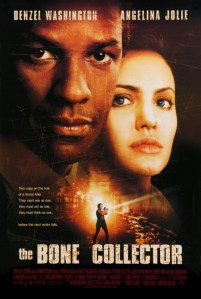 Another serial killer movie? Didn’t we as an audience learn our lesson already with Kiss the Girls? Apparently not with this latest adaption of standards and predictability that does nothing more then reinvent the old blaming the butler routine. And may I affimingly add that whoever the critic who gasped that this is on par with the masterpieces of Silence of the Lambs and Se7en either is lying through their teeth or has their children’s college education payed exclusively by Universal.
The Bone Collector has fancy gloom, grit, and gore, but it has no substance whatsoever. The script has the feel of being pasted together from leftovers of earlier better movies. It takes one illogical shift after another until the supposedly “surprise payoff” ending comes charging in but echoes more of a unified feel of rip-off instead. Contrivances are in abundance with every scene, and further prove the superiority of Lambs and Se7en in how well they achieved perfectly tuned thrills. The Bone Collector‘s biggest disappointment is in its utter lack of substantial entertainment when the core of the movie is Angelina Jolie getting dirty in dark places wielding a flash light. This kind of stuff may have worked at summer camp around the fire to scare people, but on the big screen the only ones to cower in terror will be the extensively naive.
Not to lambast this clunker too much, because there is some credible acting from the star leads. Denzel Washington at least makes his role non-laughable which is saying a lot in respect, and Jolie looks like she is a fresh talent but this ain’t her vehicle to hitch on to. Her “gifted” police specialist at finding evidence doesn’t seem to special to me with the easily found clues that anyone could trip over.
The suspense in The Bone Collector boils down to flashes of gore and jumps to frighten instead of the meticulous psychological and intense battles in Lambs and Se7en. The serial killer genre is at a glut again, and The Bone Collector is merely the fat of that over-extension that would serve best to be cut loose.
Nate’s Grade: C-
Share this:

Being John Malkovich (1999)
 I think I’ll simply surmise the emphasis of this review in one opening sentence: The most refreshingly and exhilarating original movie in years. MTV music video chief royale Spike Jonze directs a modern day fable that is a hallucinatory trip through the looking glass and into man’s thirst for celebrity. While Malkovich is stuffed with enough brilliant gags to kill the Austin Powers franchise, it is also a deeply articulate and insightful piece about the longing for love and fame. The movie is often thought-provoking while side-splitingly hilarious.
I will not spill one lick of Charlie Kaufman’s plot to ensure the viewing audience the pleasure of astute surprise, and there is plenty. Malkovich is the first film in a long time to have just as many unexpected twists and turns in the final 30 minutes as it does in the first 30 minutes. The acting is wonderful consisting of John Cusack’s greasy puppeteer loser, to Cameron Diaz’s frumpy animal loving wife, to Catherine Keener’s man-eating ice queen, to even a wonderful inspired parody of John Malkovich as himself playing himself.
Being John Malkovich isn’t afraid to tackle weighty subjects such as gender identity or the hunger to be somebody, but it never looks down upon the characters or the audience but instead treats each with nurturing respect. The movie is a breeze of fresh air in a field cluttered with too many formulaic fluff appealing to mass audiences and consumer goods. Malkovich is destined to become a cult classic and deservedly so. The flick is a spurt of creative madness bordering on genius that one wonders how it ever made it into release with today’s society and studio heads. God bless you Spike Jonze and you too Charlie Kaufman. Fare thee well.
Nate’s Grade: A
Share this:

Jakob the Liar (1999)
 In the fickle entertainment industry, little can be as detrimental to a film’s success as bad timing. And the latest Robin Williams’ weepy not only suffers from poor timing, it cuts its own throat with the careless mistake. Coming hot on the heels of another World War II comedy/drama known affectionately as Life is Beautiful would have proved much better if the foreign film had stayed in the art house screens and quickly come and gone. Instead Roberto Benigni’s touching film made its way to big screens, broke the record for best receipts of a foreign film in America, and went on to steal the nation’s hearts and pick up three Oscar statuettes. The Hollywood version of Benigni’s Holocaust fable proves what happens when people take something that was a miracle it worked once before, and so well, and try catching lightening in a bottle again.
Jakob the Liar is never truly any form of comedy, unless you thought Hogans Heroes was in dire need of a big screen adaption because all the other Holocaust movies did not accurately portray the wackiness that was Nazi Germany. Most of the jokes are so grim and morbid that you’ll be gritting your teeth more than smiling.
The story can be very hamfisted and forceful at times, interesting considering there’s not much driving any story. And the end is scene-for-scene exact with Benigni’s flick. Most of the performances are marginal, with many appearing to be weary that they’re even in the movie. The story’s addition of a little girl that Williams’ takes under his wing for guidance is more of a distracting subplot taking attention away from the common thread of one man giving hope to the hopeless. Minus one charming scene with Williams’ improvising a radio broadcast with kitchen utensils she’s mainly a pointless addition.
The splinter in the paw of this movie is Robin Williams himself. Anyone out there remember when he used to do comedy, not schmaltzy bittersweet tug-from-the-heart-strings melodrama? Though his mugging is restrained for the most part, the sentimentality burns thin rather quickly. The movie tries to manipulate you and letting the floodgates loose with those tear ducts, but it’s so clear it’s not going to make you feel but manipulate that you can very easily see the strings as they’re being pulled.
Jakob the Liar does have a good director at its helm to show the Holocaust as the grim reality it was and not sugarcoat anything. A great deal of gratitude should go to the director for at least partially saving Jakob from being worse than it could be. Though I’m of the mind that I’m positive audiences will love it and most likely bash me, I just want everyone to know that Roberto Benigni did it earlier and better and I’d stress seeing that movie instead.
Nate’s Grade: C
Share this:

American Beauty (1999)
 American Beauty balances between dark comedy and moving drama not only well but tremendously on target. It’s a slice of life showing the dark side of a faceless and cold suburban life. The deterioration of a family and the escape of one man as he realizes the trivial nature of the things that get in the way of seizing life. American Beauty is not a rose for everyone but it’s one standing out from the pack screaming to be picked.
Kevin Spacey plays Lester Burnham, the husband and father of our story’s family. Life has been sucked dry from his system and he’s lost interest in everything he holds around him.
Annette Benning plays Carolyn Burnham, mother and wife. She breaths the mantra, “To be successful one must present an image of success at all times.” like she was beating a Bible until it bled. She’s a woman whom image is everything, and looking good is all that matters. She has become so detached from her family and life that she has actually lost her humanity in the hunt for success while waving her cheerful smile as a mask that eludes to the superficial inside. Carolyn is a woman who refuses to let herself fail or have weakness, and those around her to make her seem weak.
 Thora Birch, of Alaska and Now and Then fame, is the estranged daughter to Spacey and Bening. She feels alienated from her parents, and despises them from easily seeing through each. Thora discovers new ways to feel contempt for her parents with each day. She is a repressed child who is looking for an outlet of understanding and help. Enter pot dealing creepy new neighbor Wes Bentley. He sees true beauty where no one could, and is the escape and shoulder that young Thora has needed all her life from her monstrously neglectful parents. Wes videotapes everything in an effort to keep the memories of beauty alive to venture back and relive the moments. He shares his prized image with Thora one day, that of a plastic bag inflating and deflating with the autumn breeze as it swirls around almost balletic dancing. The image is mesmerizingly hypnotic and you understand that Wes is a character who looks beneath the surface and most likely the most noble in the entire movie.
Mena Suvari switches from sweet choirgirl from American Pie to ditzy teen vamp. She is a person who feels such insecurity for herself that the only happiness she can arrive is from being wanted by other people. She must have acceptance in some form or another, and “ordinary” to her is a worse word than “ugly.” She acts like a teen nympho but in the end reveals that she is really an innocent young girl desperately wanting to be liked and wanted.
There are other characters that round out the cast; a brief appearance with Scott Bakula who makes a quantum leap into a gay neighbor, Allison Janney as the mother to Wes and the silent hollow image of a wife she has become to socially hide her husband’s secret, Chris Cooper again as an abusive father who’s maliciously homophobic but hiding a devastating secret deep within, even Peter Gallagher with the biggest eyebrows you’ve ever seen as a suave real estate mogul that knows how to cater to Carolyn’s thematic problems.
 The basis of the story hinges on Lester’s reawakening. He is a man going through the motions of life like a walking dead man. A man who tells people that even he wouldn’t remember himself. Lester is an unhappy cog until viewing his daughter’s friend Angela (Suvari) at a high school basketball game. At first glimpse she becomes the intense object of his desire and obsession, and his focus on life centers around this young gal. But with that moment Lester’s life is broken, and his eyes are opened for the first time in a very long time. He sees the trite redundancy with the day-to-day grind of ordinary suburbanite life. Lester breaks free and does what he wishes, he is a free man. Free of his job, his nagging ice queen of a wife, free of all worries and fears.
As far as Oscar races go, all others don’t even bother filling out an application for an invitation – Spacey has Best Actor locked. He might as well start clearing a space on his shelf next to the one he got for The Usual Suspects. Spacey is so wonderfully wry and self degrading that he transforms into an actually likeable almost laid back hero for the audience. They know his tragic fate and feel good when he gets the most he can with each day, and not letting himself be pushed around anymore. Benning is also delightful and wickedly hilarious in her materially overzealous soccer mom. Birch is excellent showing the pains of alienation and showing that despite what her character thinks she is really the last person on earth who needs a boob job. Director Sam Mendes’ first feature after touring the theater circuit shows his devotion to characters and actors with subdued symbolism layered between every frame of film. I say Oscars should go all around and this movie deserves a good swapping of gold statuettes.
I could go on talking about the depth and characters for hours but I’ll just stop here and say that you won’t see a more engaging, compelling, and brutally honest and sadly funny film in the entire year of 1999. One of the best films not only of this year but of the entire decade.
Nate’s Grade: A
Share this:

A Simple Plan (1998)
 Not as simple as one would be led to believe. A Simple Plan offers great ensemble performances, never-ending suspense, and great execution at telling its tragic fable–all the while making a statement as one of the best films of 1998.
The core and real punch of the picture comes from its two main characters linked by blood but not by much else. The trouble all begins when the bothers and a buddy come across a downed air plane in the forest. with $4 million inside. The idea arises that they should all keep the money and hide their secret from all others. Hank resists at first but the promise of the money draws him in to becoming apart of the plan.
You could say the film’s like a Treasure of the Sierra Madre meets Fargo but this gives disservice to director Sam Raimi. The man famous for splatterfest horror outings shows great maturity in pulling something off like this so well.
The acting is some of the finest of the year, well I guess it would be last year. Paxton gives his best performance of his career, and Billy Bob Thornton does for backwater townsfolk what DeNiro did for psychos. My favorite would have to be the Lady MacBeth wife of Hank, played chillingly by Bridget Fonda. Her moral high ground disappears at the sight of the money and she drastically turns into a brooding and malicious character. In bed she whispers plans for her husband to hide his tracks or set up his partners to take the fall. That’s where A Simple Plan turns into a devious game of each other suspicious of the next, and falling victim to their own greed. The money brings out all the true feelings each has for the other that had remained buried inside.
Add a haunting score by master maestro Danny Elfman and you have yourself one fine feature.
Nate’s Grade: A


 nathanzoebl
You must be logged in to post a comment.