Blog Archives

Along Came a Spider (2001)

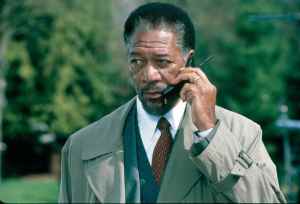
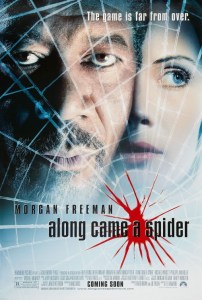
Anybody not tired of the serial killer genre yet? To that one out of the millions who raised their hand in the far back – you’re in luck! Enjoy Kiss the Girls? That same one in the back is even more fortunate. Here comes Along Came a Spider and its banality will knock you off any tuffet. Is that a word even used anymore? Spider is a continuation of the characters in Kiss the Girls (even though Spider was written before Girls). Morgan Freeman returns as Alex Cross, a hard-nosed police detective and best-selling novelist on criminal profiling. He’s suffering from Cliffhanger syndrome: the amassing of guilt from seeing someone close die in the line of duty and blaming themselves for it. See Morgan lost a female partner in a botched sting that opens the film with the worst CGI scene I’ve ever seen. He has a scene of regret then moves on to the case at hand, only to inevitably have the situation come up again and be the test of his nerves. It’s all standard cliche.

The crime that draws all our characters in revolves around the kidnapping of a Senator’s daughter at a lofty private school in Washington D.C. This is no serial killer movie, no, it’s a kidnap movie. Whatever the crime this flick centers on it still follows the superfluous serial killer movie rules to a grizzled T.

Monica Potter plays a Secret Service agent assigned to protect the girl who becomes involved with the case with her extensive knowledge of the kidnapper, Professor Sonje (Michael Wincott). Potter has previously been seen as the sad wife in Con Air, the dead chick in Patch Adams, and the girl who stars next to the guy whose acting is all about flat-lining in Head Over Heels. So in these terms Along Came a Spider is a step up. Her character is pedestrian and un-involved. She has no edge or depth and every time she’s on screen.

Freeman, God love him, needs to start learning how to say “no” to any serial killer (kidnap film) offered to him. He’s a great actor but the Alex Cross solves killers (kidnappers) franchise isn’t one to tie his rope around. Freeman does his best and brightens the film when it sags, but even he can’t save it. And his Executive Producer credit seems all the more ominous.

Naturally, an audience is left to disbelieve some of the absurdities of the genre but Along Came a Spider piles them too high and too fast to disbelieve. The kidnapper disguises himself as a plump British history teacher for a whole two YEARS in preparation for his act. Two years?! What would happen if she ever transferred? The worst part is his name – Sonje. Every time I hear the name it makes me giggle a bit. I cannot take anything seriously when the bad guy is named Sonje (“We’ll do whatever you want Sonje, just don’t harm the girl!”). Sprinkle unintentional laughter throughout. And for kidnappers and criminals these have got to be the dumbest since Colonel Klink. There is a scene where the kidnapper gives the detained child a meal… with a fork and knife! It’s like going to a prison and giving certain members scissors and leaving them alone for two hours.

If you are having a serial whatever movie you must make your serial whatever man intriguing or turn the flick into a guessing game until the end credits. The serial killer (I’m saying this now because he does kill multiple people – so there!) in Along Came a Spider is bland as can be, despite the wonderfully rich and venomous voice of Wincott. How as an audience are we to be enthralled with a whiny adversary that bores us?

There are numerous other head-smacking absurdities. Like when our ace Morgan Freeman looks to a computer belonging to a suspect and instantly remembers an off-hand remark in one conversation that of course is the password. And he even spells it correctly with an inclusion of a symbol!

The movie is based on James Patterson’s novels all seeming to have nursery rhyme style titles. Directed by Lee Tamahori (Mullholland Falls, The Edge), it has moments of briskness that at least keep the pacing alive. On its whole the film still does not work. It feels like reheated serial killer (kidnapper) movie just out of a Tupperware container. Along Came a Spider is nothing new, nothing different, and nothing truly entertaining. Pray for Morgan Freeman please.

Nate’s Grade: C-

Panic (2000)

The story behind Panic goes something like this. The film was dropped by Artisan because they got test screening results back and apparently it wasn’t what they wanted. After this set-back it was going to be dumped to the wasteland of direct-to-cable like so many other troublesome pictures studios feel would not earn a buck if they were bleeding on the side of the road. After some fighting, particularly from critic Roger Ebert, a production house decided to distribute Panic in a very limited release. So what does this cinematic game of musical chairs mean? It means if you have a chance see this film.

Panic is a story about characters first and foremost. William H. Macy plays the son end of a father-son team of hitmen, with Donald Sutherland as the oppressive patriarch. Macy is a man who is never truly happy, almost like it is an impossibility for him at this point in his life. His wife (Tracey Ullman) is flaky and gives into her paranoia of her hubby having an affair with a younger chickadee. Macy meets an attractive and mysterious ingenue (Neve Campbell) while waiting for therapy. He begins on an obsession he can’t explain and fantasizes about her as the escape and ticket to happiness that is outside his reach.

The acting is as rich as the characters. Macy plays low-key but suits the subservient ghost that his character has become. Sutherland is haunting as the controlling father figure and the flashbacks between him and young Macy are disturbing as he plants his seed of control. Even at age six Macy’s character is referring to his father with “sir” tagged to the end of every sentence.

Neve’s character is the most in depth she’s ever been dealt, though her runner-up is a girl constantly chased by men in black robes with knives. Ullman is a nice presence and the audience really can sympathize with her. The child who plays the son of Macy and Ullman is one of the most adorable child actors I have ever seen. He lights up the screen every time he is present.

The story is brisk at a mere hour and a half. It is written and directed by a former writer of ‘Northern Exposure’ and ‘Homicide’ and the attention to characters shows. The film moves not through plot occurrences but through characters acting. When Macy discovers that the final hit he has to do is on his own therapist (John Ritter) his journey is one involving everyone around him in his life. The strains and pulls on this man are encompassing to watch.

Panic is a glimpse at a quiet movie told about the life of a man caught in his father’s grasp. Macy is a man conditioned to saying “he’s sorry” even if it is not deserved. His character is rich and Panic is a strongly acted gem if you can locate it.

Nate’s Grade: B+

Snatch (2001)

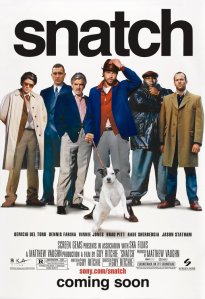
Snatch is really more of the same for writer/director Guy Richie as he retreats back to his magical land of London gangsters with Dick Tracy-esque names and thick cockney accents intermixing in comically violent and ironic ways. He’s like a more stylized version of Tarantino, if Tarantino ever got to have sex with Madonna. So if you like the niche Richie has trapped himself in for the moment (like myself) then you’ll like Snatch. The film is coursing with energy to spare and never loses its sense of fun, which carries over into audience smiles (at least for me and my gal it did). Brad Pitt is a riot as the hardly intelligible Irish gypsy and part time boxer.

Nate’s Grade: B+

Crouching Tiger Hidden Dragon (2000)

Ang Lee’s mythical tale of ancient… (Taiwan?) is full of visual marvels and plenty of moments of awe that make the audience believe in the power of cinema to transport once again. However, upon further viewings and more butt pain because of the large length, the film is not “one of the best ever made” as has been praised. When you get down to it and think the film really isn’t about anything but retrieving a sword and feminist roles. The visuals are striking poetry and the action is exciting and top-notch and that’s what really counts in the end.

Nate’s Grade: B

Shadow of the Vampire (2000)

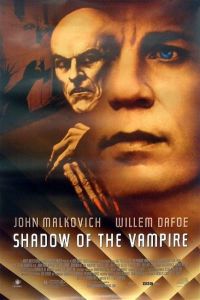
Darkly comical with great stabs of satire at the film industry (bloodsuckers in the movies anyone? Hmmmmmm). Willem Dafoe retains his title as Creepiest Actor Alive and goes for broke with a tour de force performance that should have you checking under the bed. Shadow of the Vampire is alive, to use the term sparingly, with wit and a slow but maturely steadied pace. Dafoe deserves an Oscar and your fear.

Nate’s Grade: A

Thirteen Days (2000)

Another Kevin Costner film?! I’d rather suffer uncontrollable urination problems!” you could be saying to yourself. After Costner’s recent track record, hearing that he’ll have full Bostonian accent in hand seems a little nerve-racking. But despite Costner’s beantown speech 13 Days is a real surprise in just how much tension it actually wrings from the true story of the Cuban Missile Crisis.

Though 13 Days will suffer from the same problem Titanic did, people know their history and know how it ends. Though we all know we weren’t obliterated in nuclear war (At least I hope the majority of us know) 13 Days shows us the suspense through back-door politics as a fly on the wall in the White House. The audience sees all the political wrangling and power struggles in this cat-and-mouse game that made two nations hold their breathes in a high stakes stare-down. Bruce Greenwood, mainly known for beguiling Tommy Lee Jones in an assortment of flicks, plays our Commander in Chief John F. Kennedy. Costner seems to be a presidential advisor that could easily be mistaken for JFK’s imaginary friend the amount of time they spend together alone. Steven Culp plays Bobby Kennedy, and the fab threesome make up the core team that handled this bombastic situation. Of course there are dozens of other individuals involved within varying degrees, with the military leaders wanting procedures to lead them to inevitable war with Communist Soviets.

The warhawks recommend a Cuban invasion whereas the option of a quarantine hangs in sight as well. Through the next trying thirteen days stress will accumulate as options become more clear as deadlines become clearer. The political maneuvering makes for a gripping story, though a tad punched up at certain areas. It proves time and again that history makes the best stories.

Let’s get down to what’s on everyone’s mind: how much is the suck-ratio zooming on Kevin Costner in this picture? Well, his accent is very very jarring to begin with but you kind of get used to it after ten minutes of wear and tear. Costner does an alright acting job but the real spotlight is on the Kennedy brothers. Greenwood and Culp turn in star-making performances that gives human glimpses to the already prolific Kennedys. Culp is outstanding as Bobby, showing that the superiors discount him because of his young age but that he’s a shrewd and thoughtful politician. Greenwood doesn’t exactly sound like JFK but he adds particular dimension to the man behind the center of the crisis.

13 Days is a prime example of showing how intense and frightening fiction can be. Director Roger Donaldson uses black and white interludes for no real reason, but his final product is one of nail-biting suspense.

Nate’s Grade: B+

The Gift (2000)

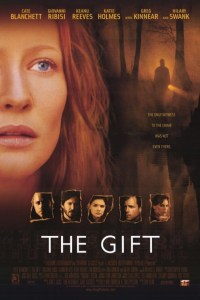
Sam Raimi is a slick director and is maturing smoothly. The Gift is a nice ensemble pot-boiler in the South. Cate Blanchett gives a remarkable performance that was, as most were that were nominated, better than Julia. Keanu Reeves finds a role he can actually excel with in that of a wife beating redneck; he’s actually quite scary in it. Giovanni Ribisi gives the best performance of his career as a mentally challenged mechanic. The film coasts on some good atmosphere and direction by Raimi, but it is too easy to figure out the final turns in the end.

Nate’s Grade: B

Cast Away (2000)

Strand Tom Hanks on a desert island for years? Sounds too good to be true to many a disgruntled movie goer. Such is the state in Cast Away, Robert Zemeckis’ existential meditation on man, nature, FedEx and their product placement checks, and of course… volleyballs.

Hanks is yet another everyman, except he’s a real stickler for time and order as a FedEx supervisor. His girlfriend (Helen Hunt) is pushing for marriage but hey – they’ve got all the time in the world, right? So Tom boards a FedEx flight headed for the Southern Pacific that hits a nasty collision with a powerful storm. The plane goes down abruptly in what is likely the most terrifying plane crash ever performed on film. Hanks washes ashore onto a mysterious deserted island after drifting alone in the vast ocean. Without civilization and without human contact he must start all over just to survive the day. So becomes the Odyssey of Island Tom.

Cast Away hits one out of the park with its near dialogue free middle act with Tom’s first days upon his new island home. Hanks struggles to do everyday things from finding food to creating a makeshift shelter. As Hanks goes through these daily troubles the audience is with him every moment and learns as he does. Cast Away‘s middle is fascinating to watch. After a few days some packages from the crash wash ashore including a volleyball that Tom turns into his best friend. “Wilson” is Hanks’ companion and is totally understandable how one would branch out for contact under the circumstances. Plus, Wilson’s a dynamite celebrity of his own right now.
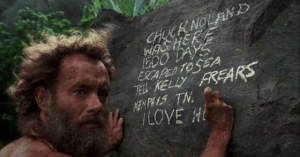
Hanks’ acting is his usually above average output, but his whole role seems more like a showcase for his method acting than the acting itself. The first half of Cast Away was shot then they took a year off so Hanks could become scruffy, thin Caveman/Unibomber Hanks. The transition is fun to watch and remarkable for an actor to devote themself completely to their role. But the part itself, and Hanks’ show, seem more spectacle than substance. Helen Hunt pops up in the beginning and end proving that she can somehow manage to be in every film in December. Pretty much the next actor in the film would be… well, a volleyball. Cast Away is basically a one-man show.

Despite a wonderful middle ‘Cast Away’ is suffering from the opposite syndrome of Saving Private Ryan: strong middle, weaker beginning and end sandwiching it. Our opening plays like an extended commercial for FedEx, complete with the dazzling FedEx package POV cam (coming soon!). The end plays like a thank you card to FedEx. The ending also suffers from extreme let-down from multiple climaxes that don’t end the film but just give way to another climax. By the time the movie does end you’re exhausted.

Zemeckis lends a skilled hand toward the direction, the script plays to the strengths of the tale good enough, and Cast Away has its moments but becomes too heavy-handed at certain periods. Still, the volleyball is good. Go for the volleyball.

Nate’s Grade: B

(For fun, count the amount of times FedEx is mentioned or seen in the film. Hell, do it with this review too. I’ll even help you out – FedEx, FedEX, FedEx, FedEx, FedEx, FedEx, FedEx, FedEx, FedEx, FedEx, FedEx, FedEx, FedEx, FedEx, FedEx. Oh fun.)

Reviewed 20 years later as part of the “Reviews Re-View: 2000” article.
Vertical Limit (2000)

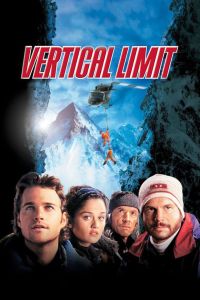
New heights are explored in the mountain climbing expedition that is Vertical Limit. A group of climbers must perform a rescue mission on the second highest mountain in the world or risk losing the lives of their friends and loved ones. With a set-up like this you would assume it would have a lot of great action. Well, yes and no.

Limit stars Bill Paxton (talented but has poor film choices) as the usual corporate villain, Chris O’Donnell (untalented with poor choices) as the tortured rock climbing hero, and Robin Tunney as the overly ambitious climbing sister to O’Donnell. This isn’t all the subplots though — oh no! We get a pair of wise cracking pot head brothers, a religious Pakistani serviceman, a military base, and a grizzled loner that everyone thinks is crazy until we finally realize he’s the best mountain man of them all. By the time it takes to establish all of these subplots, plus others I’ve failed to mention, we haven’t even gotten to the damn mountain yet. Rule #1 of a mountain climbing movie: Get on the bloody mountain within an hour of the movie starting!

The plot is overly cornball and excessively redundant. By the time you actually see the loner’s long lost wife frozen in a wall of ice and looking like a figurine from the Mattel Barbie catalog you will know the ends this film will go.

The experts of rock climbing are all young and seemingly frat house rejects. Why in every film must the experts in any field of scientific research be frat house party animals? How about some realism there and make them all middle aged balding white males. Well… I guess that would be less of a draw.

Director Martin Campbell (GoldenEye) has a great knack for establishing tight thrills and strong suspense. Campbell is clearly the strong point of this picture. When the action is running it’s plumb with excitement and great visceral visuals of the scenery. The only problem is that the action scenes are separated by long stretches of characters coughing or wheezing and terribly cheesy dialogue. If the story is technically built around the action sequences why do we have to devote so much time to it then? It’s a waste of Campbell, a true action talent.

Limit is rigid with expendable cut-outs designed to be its people. The characters are shoe-string and so is the plot but the action, when allowed to actually happen, is first rate. However, I do exclude a series of scenes where Tunney and Paxton are trapped in an ice cave that resembles more of your grocer’s freezer than a Himalayan peek. The 12 year-old behind me kicking my seat figured it all out good enough. I think that says enough.

Nate’s Grade: C-

Proof of Life (2000)

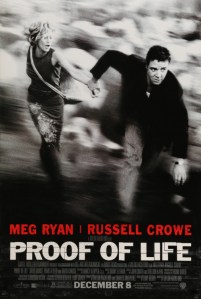
Proof of Life is more an interesting idea than an intelligent or well done thriller. The whole concept of the politics involved in K&R (kidnap and rescue) are duly fascinating. But Proof decides to build a different film around this premise and detours into mediocrity. The film ends with the standard take-down in the jungle I’ve seen many times over except I have the pleasure of seeing David Caruso do it this time.

David Morse is an environmentalist hired by an oil conglomerate to build a dam in a small fictional Ecuador looking country. He gets kidnapped by some radical revolutionaries and is held for ransom. Russel Crowe steps in as the hired K&R expert from Morse’s insurance agency.

The supposed romance on set between Crowe and Ryan is beyond my guess. On screen they have little chemistry and any romance bubbling rates a DOA on Dr. Love’s scale. Meg Ryan betrays herself as an actress and wanders the film minus a bra and constantly sniffling.

During play is a long going friction between Morse, who starts to look like he was auditioning for Cast Away, and some revolutionary hot-headed youth. It’s almost laughable the more it goes on. The will-they-or-won’t-they romance gets snuffed every time we cut back to Ryan’s husband enduring hardships. The editing and the concept ruin whatever sexual tension is supposed to build. The flick also has an unsettling theme that if you aren’t an English speaking white person you can’t be trusted.

The film starts off well with Crowe tangled in Russia but shifts into the mundane rather fast. Proof of Life is proof that what transpires off camera doesn’t always connect on camera.

Nate’s Grade: C+