Blog Archives
Hedwig and the Angry Inch (2001)
 John Cameron Mitchell directed, adapted from his stage play and stars as the sexually confused rock mega-star Hedwig. Hedwig was a boy trying to escape from the constraints of soviet occupied East Germany. His lucky ticket came in with a GI who agreed to marry Hedwig and take him out of the country with him, but Hedwig had to go under the knife and become a proper lady before their escape was to ensue. When the sex change operation is botched it leaves Hedwig with a single nub-like inch left causing gender confusion (“Six inches forward, five inches back”). Dumped by his GI Hedwig turns to song and befriends a lonely and confused boy Tommy Gnosis (Michael Pitt). Their courtship seems to be going fine until Gnosis steals all of Hedwig’s songs and uses them for his own superstardom on MTV. Hedwig’s defense is to pack up a traveling band and to perform at various salad bars and trucker diners in the same town Gnosis travels to. It’s during these performances that Hedwig dishes about her unusual life.
Unlike most plays turned into films, Hedwig has been adapted for the medium of cinema. Animations, clever camera tricks and sing-alongs follow our story, making it an exhilarating film going experience. Hedwig is excitingly original and spilling over with passionate energy that can’t help but transfer to the audience. Mitchell proves himself a born filmmaker, but also a rock star. Many of the songs of Hedwig are quite listenable and could be found on some music channels. Hedwig is a trans hero for all of us and Mitchell delivers a fresh and resoundingly funny, sad, and technical achievement of a movie.
Nate’s Grade: A
Share this:

Glitter (2001)
 It must be seen to be believed. A new college crap-fest drinking game has begun. Begin the Glitter midnight shows! A new age is upon us! Here are a few handful of Glitter‘s bon-mots it serves up to its audience:
-Mariah Carrey is shown leaving her real mom at age 8 with her kitten. Somewhere through Glitter she has a fight with her boyfriend and takes her cat (yes the very same immortal cat that must have been pushing 20) and leaves.
-She has a fight with said boyfriend and they both try and write a love song to show their remorse. Except they BOTH come up with the EXACT same song word for word, note for note, and NO ONE thinks this is the creepiest thing ever.
-The movie freakin’ ends with Carrey’s boyfriend getting shot and killed. Yes, this is truly how the thing ends. Oh, like any of you cared about plot spoilers anyway.
-Da Brat is in it for “comic relief.”
-The movie is inexplicably set in the 1980s for no reason.
Anyone would have to be crazy thinking Glitter ever remotely resembled art. It’s so bad it’s awesome to watch. Bring some friends over, open up some alcohol, and let the fun times begin.
Nate’s Grade: F, like it matters though
Reviewed 20 years later as part of the “Reviews Re-View: 2001” article.
Share this:

The Others (2001)
 Nicole Kidman has saved the summer of 2001 – it is now official. In what would have been deemed a pit of mediocrity and nightmares consisting of Angelina Jolie as some raider of tombs or Marky Mark making dough-eyes at attractive apes, has now been bookended by two terrific Kidman films. First Moulin Rouge ushered us in and now The Others is leading us the way out.
The Others is the tale of Grace (Kidman) trying to take care of her two ailing young children shortly after the end of World War II. Kidman is waiting for the return of her husband from the war and is all alone in a giant Gothic mansion. Her two children suffer from a rare allergy to sunlight that is so severe that if exposed long enough their bodies will develop markings and they will asphyxiate to death. To accommodate this illness the entire Kidman household is in the dark and grounded in stern rules. No door is to be unlocked without locking the last, like trapping water in compartments of a sinking ship.
 Grace discovers that she does need help and accepts three mysterious strangers that have said they were caretakers to this house once before. Before long the children start reporting odd events occurring that resemble ghosts; a door is opened when it shouldn’t be, someone is making noise where there is no one, and the children report having interaction with otherworldly spirits. Grace scoffs at any notion of the paranormal and goes back to instructing her children with the Bible and its accounts of penance and hell. The incidences begin to build further and further until The Others becomes a full-fledged ghost spectacle.
Spanish writer/director Alejandro Amenábar’s first English feature film is one of carefully textured craft and effective mood. The Others follows the points of ghost stories closely from dark hallways to the creepy and slightly dilapidated house closely. Every move, though, is so well in tune that they are highly effective in creating actual suspense and spookiness. One may have seen the same items numerous times before, however The Others utilizes them so gracefully that it achieves the full desired impact each can bring. Amenábar has created a ghost story that is genuinely creepy and at times scary.
Kidman shines as the dutiful and determined mother. Her performance is one of great dedication and she just consumes whole-heartedly the distress, confusion, and fear of this lonely mother. She is a true anchor for a film. Watching every moment of her on screen is amazing as well as invigorating. This role may lead to possible Oscar buzz come the end of the year but that is just speculation for now.
 The rest of the acting is very thorough and well handled by the few other cast members. James Bentley and Alakina Mann portray Kidman’s afflicted children and have much of the movie hinging on their performances. Not to worry, these two excel and give credence to being two of the more gifted child actors in a while. Their efforts greatly induce sympathy as well as great scares at key moments.
The story of The Others by Amenábar may seem simplistic, or even predictable, but the more I thought of the structure and the order of events the more well oiled and calculated it became. This is a delicate story told with great precision with a fantastic knockout ending that had me reworking everything. The Others is an example of why screenwriting is not yet dead in Hollywood.
The Others is a wonderfully brooding film with real scares and great performances, as well as terrific turns in writing and directing by Amenábar. Nicole Kidman has thankfully done it again, and if anyone dares doubt the power and newfound importance of her then see the rest of the summer of 2001’s offerings.
Nate’s Grade: A
Reviewed 20 years later as part of the “Reviews Re-View: 2001” article.
Share this:

O (2001)
 “I did what I did and that is all you know. From here on out I say nothing.”
The story behind O has become more infamous than the film itself. The film has had twelve different release dates and was actually finished in 1999. It had the dubious nature of having the themes of jealousy and violence set in high school around the time Columbine had polarized the nation. Miramax subsequently kept pushing the film back until it finally jettisoned it over to Lions Gate films, the same people who rescued ‘Dogma’ when Miramax felt it was too hot to handle for corporate parent Disney. Finally now O is getting the release it has waited for.
O is the modern update of Othello but is by no means in the same brethren of the bubbly Shakespeare ripped teen comedies proliferating the screen big and small. O is a serious tale told with earnestness in its portrayal, and with its conviction and refusal for exploitation, executes the best modern day transition of Shakespeare to date. What better setting for lust, jealousy, love, betrayal, murder and tragedy than a high school? It is almost chilling how well the tale translates to the high school setting, particularly with the notices of race and jealousy.
Odin James (Mekhi Phifer) is the only black student at an all white prep school in Charleston, South Carolina. Odin is the senior leader of the school’s basketball team and an all-star in the making. Odin, or “O” as the crowd chants at games, is dating Desi (Julia Stiles), the daughter of the dean. She’s a spitfire but they love one another with great intensity. Everything seems to be going well for Odin with school, his relationship, and his team entering into the state playoffs. His coach (Martin Sheen) proclaims his love for Odin like a son at a pep rally with the denizens in the stands cheering along. Everyone appears to be cheering for their popular hero, except for Hugo (Josh Hartnett).
 Hugo is the coach’s son and perennially looked over on the basketball team. He looks at Odin and is fueled with jealousy for the admiration and love his father would rather bestow on him than his own son. Dinner at home is a more a cold silence than a family activity. Hugo is jealous of all the things Odin has that he cannot have and some that he will never have. So he sets forth in motion a plan to bring the downfall of the popular kids he despises. Hugo enlists the aid of gullible Roger (Elden Henson) who’s picked on heavily from the same people Hugo wishes to topple. Hugo coaxes Mike (Andrew Keegan), ousted form the basketball team after a staged fight with Roger, that the best way to regain the good will of Odin and his father is to cozy up to Desi and convince her. He then plants the seeds of doubt in Odin with Desi. He draws Desi’s roommate Emily (Rain Phoenix) into the scheme by seducing her into stealing a rare handkerchief that Odin had given Desi as a show of love and commitment.
With every pawn somehow moving in the directions Hugo wishes the jealousy boils, love turns to heartbreak, and the game ultimately ends violently. It isn’t called “tragedy” for nothing folks.
Othello is, at its heart, the tale of a villain and his masterminding. The center figure is not on our hapless Moor or his lovely Desdemona, but on the treacherous Iago as he plots the tragedy of those around him with woeful precision. Shakespeare’s Othello has quite possibly the greatest villain in all of literature with Iago. He is a man who positions an elaborate staging of jealousy, insecurity, mistrust, and ultimately murder – and all this time he is given center stage to propel his masterwork. And it’s exciting, giving genuine evil a face, a name, and more importantly than anything else, a vicious intelligence to play out. This is why Othello transcends its problems in story staging and character turning points, because it is a tale told from the hands of its most essential leg: the villain.
Hartnett takes the reigns of the picture and gallops with them with great care. Though shot and filmed years before many of his latest pictures, O shows Hartnett in his most methodical and enticing acting turn. He portrays Hugo smoothly giving equal shades of bitterness and envy with his sullen performance. Harnett is so invigorating as the villain that one almost sides with him, but that is the attraction of evil. O decides to pump more motivation for its villain than Shakespeare had included, and it works in a startlingly believable way. A student plotting the demise of a more popular and athletic student and seeking the love of an inattentive father – maybe this is why Miramax shelved it for two years. The motivation in this setting is totally believable to a chilling point.
 Phifer is a charming presence and reflects the descent of Odin with good emotion. One can feel the rage just resonating from him during a slam dunk contest which he brings down the backboard and sternly glares at Desi in the stands. His final declaration with all the chaos that has swarmed around him is almost heart breaking. Stiles, on the other hand, is not given too much to work with but seems to make decent use out of her part. Sheen blusters about like the spawn of Bobby Knight, but shows a more frightening side in his ambivalent relationship to his son.
O is deftly directed by Tim Blake Nelson who might be more well known as the “other” chain gang member in O Brother where Art Thou? Nelson periodically adds little touches of great artistic exchanges that elevate O into something more than another teen film. It even achieves a certain level of poignancy and power as Hartnett is led away and speaking reflective about his deeds to the audience. The script from debut screenwriter Brad Kaaya drops Shakespeare’s prose but for the best. The film has a greater sense of realism and authenticity when the main characters aren’t talking in iambic pentameter.
The film isn’t perfect by certain means. Hugo’s plot seems a tad too elaborate and easily achieved, and Odin seems to fall for some questionable pieces of doubt. I mean, what else will an old hanky be used for in a modern film? But these faults can be blamed on Shakespeare as much as the principals involved behind the film. Despite these minor stumbles O is indeed a great film that deserves to be seen and thought over afterwards.
Nate’s Grade: B+
Share this:

Jurassic Park III (2001)
 Jurassic Park 3 – or – How I Stopped Worrying About Plot and Started Loving Dinosaur Mayhem
As we last left Dr. Alan Grant (Sam Neill) he is still making the rounds to financially support his ailing archeological digs in Montana. A couple (William H. Macy and Téa Leoni) ask the good doctor to be their guide as they have chartered a plane to fly over the island of Isla Sorna (or Nublar, I forget which, they’re both really Hawaii anyway). Grant hesitates at first but when their checkbook comes out he begrudgingly accepts – proving again like the first two, that no matter what the danger, archeologists will do whatever for grants. The truth is that the couple is searching for their lost boy (Trevor Morgon) who was stranded on the island when he partook in an idiotic para-sailing sight seeing adventure by the island. Of course the plane gets destroyed and they must all fend for themselves.
Jurassic Park 3 makes no bones about what it really is – a dino thrill ride. There’s no opportunities to flesh out characters, there’s no time for set-up, it’s just straight to the island and constant running from peril from there. The pacing of the film and structure is like an amusement park; the people are on one ride that thrills, then they quickly move to another within minutes, and repeat for an afternoon of fun. To boil it down it’s dinos chase humans, stir, and bake for 90 minutes.
 It seems that in every Jurassic movie we have some kind of new scientific theory being explored and eventually vilified. In the first it was dinosaurs behaved more like birds and perhaps evolved into them, the second had something to do with maternal behavior and parenting. And now in Jurassic Park 3 the new scientific dig is that raptors could communicate verbally to one another – in essence talk. There’s even a sequence late into the flick where they basically “talk” straight for something like a minute. I was hoping Dr. Doolittle would waltz in at any moment and start singing, but, despite my best hopes and wishes, it was not to be.
The effects and animatronics have gotten better than ever, and they were stellar to begin with. There are moments of great thrills and fun, but too often then not, it all feels routine. What should be an awesome sight of dinosaurs roaming is now blasé. What should be fearsome coming face to face with the familiar predators like T. Rex and the raptors now seems, well… too familiar. The only true moment of great awe and freshness is when the group is walking along a rickety walkway only to discover they’re inside a giant aviary complete with hungry pterodactyls.
 Acting in a Jurassic Park film usually consists of a healthy scream and some fast legs. Everyone is okay by those standards, but Leoni’s character is just far too annoying. I would’ve enjoyed the flick more if she had been eaten. In another stroke of sure luck, all of the major Hollywood cast members survive yet all the extras or unknowns perish. Call it the Poseidon Adventure syndrome (Thank you Ebert for writing this first so that I might rip you off in the future).
Director Joe Johnston (The Rocketeer, Jumanji) inherited the dino franchise from master guru Spielberg and has done a fairly capable job with his efforts. The action is fast and there are a couple of particularly nice visual set-ups sprinkled through out the film. The marvel that was in Spielberg’s touch is the most missing however. The “script” (and I use this in a very loose sense) is actually co-credited to Alexander Payne, which is a rather interesting morsel. The most interesting one though has to be that the young Morgon has actually starred in another dinosaur picture before in his short career – Barney’s Great Adventure.
For action fans in this bleak summer release period Jurassic Park 3 will serve a fine dish at 90 minutes of fast dinosaur attacks and squeals. Hopefully though the ‘Jurassic Park’ franchise will be stopped before the wonder it used to have turns passé. Because right now it’s teetering on the brink.
Nate’s Grade: C+
Share this:

The Score (2001)
 Marlon Brando, Robert De Niro, Edward Norton, three of the greatest actors of three generations. This draw alone warrants a stroll to view The Score one would assume. But not so fast my friend. If you venture out to witness this movie chances are you will fall asleep within the first hour.
The plot runs through the all too familiar terrain of so many crime capers and heist flick predecessors. There’s the old pro who wants to retire (Robert De Niro) who gets pulled into a risky heist planned out by a young pup with some bite (Edward Norton). Will the old pro forgo his plans of retiring on a beach side with little umbrella drinks for one last shot at the big score? If you have to think about this question then you need to get out more. The scheme is to break into the Montreal Customs building and steal a scepter that could be worth as much as 30 million dollars. Stealing a scepter from French Canadians? Was this idea written on the back of a napkin at a bar?
This is in essence the plot of The Score. The characters are mere shells and never fleshed out. With any heist picture there should be the scenes where the characters engross themselves with the ins and outs of their scenario, the rehearsing and practicing, and finally the big move. The Score decides to lightly touch the first, skip the second, and barely give the audience much of the third. The film just isn’t playing by the rules it gives.
 The Score is muddily directed by famed puppeteer Frank Oz. He has directed comedies over the past few years but his first foray into drama, or action, or whatever you want to call it, is downright embarrassing. The entire film waddles in muggy darkness, as if they didn’t have enough money to light the damn picture. After so many scenes of watching the outlines of actors or making out just their faces it just becomes fruitless to even watch. Maybe some of the money should have been poached from the stars’ hefty salaries to make sure that they were adequately lighted.
The beginning hour of The Score may very well be the worst time I’ve had in a theater all year. It’s drawn out beyond its own bounds to establish a set-up that could have been done properly with only a few minutes. This half of the film is leaden and wallowing in boredom, and it feels like it’s never going to end. I think I was actually contemplating suicide at one point.
The structure of The Score is easy to diagram. The first half has to do with the superfluous set-up, then we have ten minutes of the actual heist sequence, and then… it’s done. The film actually ends about three minuets after the heist complete with the now requisite twist ending that anyone with a functional brain will see coming a mile away. What needed to be done is to consolidate that slow-as-a-glacier beginning into something like twenty minutes, then double the length of the heist sequence and actually give it tension. Finally then have the rest of the movie play as a cat-and-mouse game of who has the upper hand with their burgled prize. This would have played with the actors more and at least keep the audience guessing and awake. As it stands, The Score is an incredibly unsuccessful effort when it comes to story structuring. This could be a future classic example of how not to tell a story.
 Norton is the only real punch of intensity in the movie. When Norton reappears onscreen it’s as if The Score regains a sense of renewed life. He’s great to watch, either as the young ambitious hotheaded criminal or as his mentally retarded janitor cover. De Niro must be getting a good long distance plan because he phones in yet another performance. He plays his character too smooth that the audience can never fear that he is actually in any danger. Brando is basically for comic relief, that is, if you can understand him through his garbled mumbles. Did this man have a stroke or something? Angela Bassett is useless in this film and wasted. Her role is the frequently off camera girlfriend who urges her man to settle down and let this last one go.
The Score is a lousy heist picture and a lousier attempt at entertainment. It lacks tension, proper story structuring, and even basic movie fundamentals like proper lighting. The Score is a wasted ensemble of a great cast that could only echo the silly cartoon that was Con Air. See The Score if you dare, but make sure to take some NoDoz for the first half.
Nate’s Grade: C-
Share this:

Final Fantasy: The Spirits Within (2001)
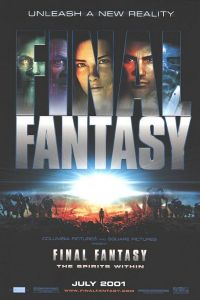 Final Fantasy is an exciting venture in the history of animation. It’s the second video game to be turned into a feature film this summer, though exponentially better than Tomb Raider. It took the makers of Final Fantasy four years and the creation of new technology to capture what will be a benchmark in animation for years to come.
The story concerns a future Earth where aliens have crashed and invaded long ago. These “phantoms” are slightly invisible energy creatures of different size and roam around various areas with the ability to suck the life force or soul from a human being. General Hein (James Woods) is trying to convince the Earth council to allow him to fire a satellite called the Zeus Cannon to obliterate the alien menace. In opposition to Hein is Dr. Sid (Donald Sutherland) who believes with his adventurous pupil Aki Ross (Ming-Na) that the Zeus Cannon will obliterate the “spirit” of Earth. Their solution it to collect eight spirits in whatever forms they might be including plants and small animals to gather together and… do something that will send the alien life force repelling.
 Now I know Hein is supposed to be the bad guy as he’s a military man complete with the evil looking black leather cloak, but I couldn’t help but find myself agreeing with his logic. He wants to use something that has already been proven to kill the aliens whereas these two new age scientists want to collect a bunch of plants and animals and have their collective spirits ward off the interplanetary menace. I’d stand in my chair and say thank you to Hein when he dismisses the doctor’s plot. I know that Aki and Sid are the heroes and of course whatever theories they have will be proven true, but hell, I found myself agreeing more with General Hein than these two.
Complicating matters Aki is infected with a piece of the alien phantom that is slowly taking control over her body. Along in her quest to discover the final spirits is aided by a military commander Grey (Alec Baldwin) and his company of men. Turns out Grey and Aki are former sweethearts, so of course expect them to reconcile before the end credits.
The plot consists of something that could be an average episode on Star Trek: Voyager but does meander along at times. The dialogue is typical sci-fi buzzwords like “Fire in the hole” “The perimeter’s been breached” and the sort. Final Fantasy does have great excitement to it and some terrific action sequences better than most anything this summer. The ending is a disappointment as all the action hinges on two globs of energy propelled against one another. Globs or energy are not exciting. I thought we would have learned this by now.
 Final Fantasy is a landmark in animation. Never has so much detail been put into a movie and pulled off so amazingly well. To the nit-pickers out there the animation isn’t exactly the Holy Grail of photo-realism, but it’s closer than anything ever before. At times the characters come off as too plasticy (like Jude Law in A.I.) and tend to move too much, notwithstanding that their mouths don’t always follow the words coming out of them. Put aside these small grievances and what you have is stunning animation that makes one constantly forget it is animation. There are numerous moments of eerie precision like when a character’s nostril flares and their nose scrunches up in response, and the movement of every one of Aki’s 60,000 strands of gorgeous hair, to even a kiss between two characters. Even inanimate objects like a crumbled wall, a glass of alcohol, or a gun and its rounds are given startling accuracy. Backgrounds and scenic vistas are beautifully rendered with great care. There has been nothing ever like Final Fantasy before and it is the first movements toward an exciting area in animation.
The discussion must be raised can actors be phased out by computers now and will they ever? No, never. Actors can portray nuances that computers will never be able to master. Despite some actors best attempts to prove otherwise, we will always need actors. Now that you have the near photo realism one might be led to question what is the greatness of creating a fully realistic looking CGI tree when one can just be shot on film for millions of dollars cheaper. The all CGI world will not replace the real world of film making.
The mediocre story can be excused by the awe-inspiring animation. Despite the clunker of a plot Final Fantasy is entirely enjoyable because it always gives the viewer something to sit in wonder and take in. There’s always something to mesmerize the eyes on screen.
Nate’s Grade: B
Reviewed 20 years later as part of the “Reviews Re-View: 2001” article.
Share this:

A.I. (2001)
 A.I. is the merger of two powerhouses of cinema – Stanley Kubrick and Steven Spielberg. The very mysterious film was given to Spielberg by Kubrick himself who thought ole’ Steven would be a better fit to direct it. The two did keep communication open for like a decade on their ideas for the project until Kubrick’s death in March of 1999. What follows is an imaginative futuristic fairy tale that almost grabs the brass ring but falls short due to an inferior ending. More on that later.
In the future technological advances allow for intelligent robotic creatures (called “mechas”) to be constructed and implemented in society. William Hurt has the vision to create a robot more real than any his company has ever embarked on before. He wants to make a robot that can know real love. Flash ahead several months to Henry and Monica Swinton (Sam Robards and Frances O’Conner) who are dealing with their own son in an indefinite coma. Henry is given the opportunity to try out a prototype from his company of a new mecha boy. His wife naturally believes that her son could not be replaced and her emotions smoothed over. Soon enough they both decide to give the boy a try and on delivery comes David (Haley Joel Osment) ready to begin new life in a family. David struggles to fit in with his human counterparts and even goes to lengths to belong like mimicking the motions of eating despite his lack of need to consume. Gradually David becomes a true part of the family and Monica has warmed up to him and ready to bestow real love onto their mecha son.
 It’s at this point when things are going well for David that the Swinton’s son Martin comes out of his coma and returns back to his parents. Sibling rivalry between the two develops for the attention and adoration of their parents. Through mounting unfortunate circumstances the Swintons believe that David is a threat and decide to take him away. The corporation that manufactured David had implicit instructions that the loving David if desired to be returned had to be destroyed. Monica takes too much pity on David that she ditches him in the woods and speeds off instead of allowing him to be destroyed.
David wanders around searching for the Blue Fairy he remembers from the child’s book Pinocchio read to him at the Swinton home. He is looking for this magical creature with the desire she will turn him into a real boy and his human mother will love him again. Along David’s path he buddies up with Gigolo Joe (Jude Law), a pleasure ‘bot that tells the ladies they’re never the same once he’s through. The two traverse such sights as a mecha-destroying circus called ‘Flesh Fairs’ complete with what must be the WWF fans of the future, as well as the bright lights of flashy sin cities and the submerged remains of a flooded New York. David’s journey is almost like Alice’s, minus of course the gigolo robot of pleasure.
There are many startling scenes of visual wonder in A.I. and some truly magical moments onscreen. Spielberg goes darker than he’s even been and the territory does him good. Osment is magnificent as the robotic boy yearning to become real, but Jude Law steals the show. His physical movement, gestures, and vocal mannerisms are highly entertaining to watch as he fully inhibits the body and programmed mind of Gigolo Joe. Every time Law is allowed to be onscreen the movie sparkles.
 It’s not too difficult to figure out which plot elements belong to Spielberg and which belong to Kubrick, since both are almost polar opposites when it comes to the feelings of their films. Spielberg is an idealistic imaginative child while Kubrick was a colder yet more methodical storyteller with his tales of woe and thought. The collaboration of two master artists of cinema is the biggest draw going here. A.I.‘s feel ends up being Spielberg interpreting Kubrick, since the late great Stanley was dead and gone before he could get his pet project for over a decade ready. The war of giants has more Spielberg but you can definitely tell the Kubrick elements running around, and they are a gift from beyond the grave.
I thought at one point with the first half of A.I. I was seeing possibly the best film of the year, and the second half didn’t have the pull of the first half but still moves along nicely and entertained. But then came the ending, which ruined everything. There is a moment in the film where it feels like the movie is set to end and it would’ve ended with an appropriate ending that could have produced lingering talk afterwards. I’m positive this is the ending Kubrick had in mind. But this perfect ending point is NOT the ending, no sir! Instead another twenty minutes follows that destroys the realm of belief for this film. The tacked on cloying happy ending feels so contrived and so inane. It doesn’t just stop but keeps going and only gets dumber and more preposterous form there. I won’t go to the liberty of spoiling the ending but I’ll give this warning to ensure better enjoyment of the film: when you think the movie has ended RUN OUT OF THE THEATER! Don’t look back or pay attention to what you hear. You’ll be glad you did later on when you discover what really happens.
The whole Blue Fairy search is far too whimsical for its own good. It could have just been given to the audience in a form of a symbolic idea instead of building the last half of the film for the search for this fictional creature’s whereabouts. The idea is being pounded into the heads of the audience by Spielberg with a damn sledge hammer. He just can’t leave well enough alone and lets it take off even more in those last atrocious twenty minutes.
A.I. is a generally involving film with some wonderfully fantastic sequences and some excellent performances. But sadly the ending really ruins the movie like none other I can remember recently. What could have been a stupendous film with Kubrick’s imprint all over turns out to be a good film with Spielberg’s hands all over the end.
Nate’s Grade: B
Reviewed 20 years later as part of the “Reviews Re-View: 2001” article.
Share this:

Pearl Harbor (2001)
 It turns out we went to war in 1941 not because of Japanese aggression, Hitler’s dominance in Europe, or the protection of freedom and democracy. Sorry kids. The real reason we went to war was to complicate and then clear up Kate Beckinsale’s love life. At least that’s what director Michael Bay and screenwriter Randall Wallace would tell you with their indulgent epic Pearl Harbor.
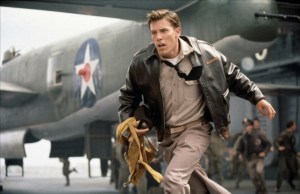
We open in Tennessee in the 20s with two boys who dream of being pilots. Rafe (Ben Affleck) and Danny (Josh Hartnett) grow into strapping young lads who flash their hot dog flyin’ skills at basic training, which brings them chagrin from superiors but admiration from peers. Rafe falls in love with a young nurse named Evelyn (Kate Beckinsale), who goes against ARMY rule and passes Rafe in his eye exam portion when he has a slight case of dyslexia. But he’s just so cuuuute. The romance builds but Rafe feels like he’s grounded when all he wants to do is fly, and volunteers to fight in the RAF over in Europe. He promises he’ll be back to see his lovely Evelyn. Of course he gets into an accident and everyone assumes that poor dyslexic Rafe is fertilizing a lawn somewhere with his remains. Hence Danny slowly but surely develops something for Evelyn in their periods of mourning, and the two consummate their puppy love with a tango in parachute sheets.
All seems well until Rafe returns back from the dead throwing a wrench into Evelyn’s second date parachute plans. Thus the Hollywood favorite of the love triangle endures until the end when the two fly boys enlist in the Doolittle attack against Japan, months after the ferocious attack on Pearl Harbor. The real purpose of the Doolittle attack was not militarily, but merely for morale. The real purpose it serves in the movie is to shave off an end on our love triangle.
 Pearl Harbor allows us to follow a group of youthful and innocent starry-eyed kids from training to combat. Each seems pretty much exactly the same to each other. It’s near impossible to distinguish which character is which. It’s like the screenwriter didn’t even have the gall to resort to cliche supporting character roles, and he just made one character and duplicated it. The only one who was noticeable for me was the character of Red (Ewen Bremner, julien donkey boy himself), but that was simply because the man had a speech impediment. We also have our handful of young nurses alongside Beckinsale, and I had an easier time distinguishing between them; everyone had different hair colors.
]If you look in the pic, or the credits, you’ll see that two of the nurses would turn out to be Jennifer Garner (Alias) and Sara Rue (Less than Perfect), both stars of ABC shows, and ABC is owned by, yep, Disney. Coincidence? Probably. When they ran this on TV they actually advertised Jennifer Garner above Kate Beckinsale. That reminded me of when Seven ran on TV shortly after Kevin Spacey had won his well-deserved 1999 Best Actor Oscar for American Beauty, and they gave him second-billing in the advertisement over Morgan Freeman, the movie’s true main character.
Affleck has a hayseed Southern twang, but seems to mysteriously disappear for long stretches. Hartnett seems to talk with a deep creak, like a door desperately trying to be pushed open. Beckinsale manages to do okay with her material, but more magnificently manages to never smear a drop of that lipstick of hers during the entire war. We could learn a lot from her smear-defying efforts. Gooding Jr. is pretty much given nothing to work with. I’m just eternally grateful he didn’t go into a usual Cuba frenzy when he shot down a Zero.
Michael Bay has brought us the ADD screenings that are the past, loud hits of The Rock and Armageddon. Teamed up with his overactive man-child producer Jerry Bruckheimer once more, Pearl Harbor is less Bay restrained to work on narrative film as it is Bay free-wheeling. His camera is loose and zig-zagging once more to a thousand edits and explosions. Bay is a child at heart that just loves to see things explode. When he should show patience and restraint he decides to just go for the gusto and make everything as pretty or explosive as possible. This is not a mature filmmaker.
Despite the sledge hammer of bad reviews, Pearl Harbor is not as bad as it has been made out to be. The love story is inept and the acting is sleep-inducing, unless when it’s just funny. It doesn’t start off too badly, but twenty minutes in the movie begins sinking. The centerpiece of the film is the actual Pearl Harbor bombing that clocks in after ninety minutes of the movie. The forty-minute attack sequence is something to behold. The pacing is good and the action is exciting with some fantastic special effects. The movie is bloated with a running time a small bit over three hours total. Maybe, if they left the first twenty minutes in, then gave us the forty minute attack sequence, followed by a subsequent five minute ending to clear up our love triangle’s loose ends… why we’d have an 80 minute blockbuster!
 Pearl Harbor doesn’t demonize the Japanese, but it feels rather false with their open-minded attempts to show both sides as fair minded. It gets to the point where they keep pushing the Japanese further into less of a bad light that it feels incredibly manipulative and just insulting. It seems like the producers really didn’t want to offend any potential Pacific ticket buyers so the picture bends backwards to not be insulting. The only people who could be offended by Pearl Harbor are those who enjoy good stories. Oh yeah, and war veterans too.
The cast of Pearl Harbor almost reads like another Hollywood 40s war movie where all the big stars had small roles throughout, kind of like The Longest Day for the Pepsi generation. Alec Baldwin plays General Doolittle and is given the worst lines in the film to say. Tom Sizemore shows up as a sergeant ready to train the men entering Pearl Harbor. He has five minutes of screen time but does manage to kill people in that short window. Dan Akroyd is in this for some reason or other, likely because Blues Brothers 3000 has yet to be green lighted. John Voight is easily the most entertaining actor to watch in the entire film. He gives a very authentic portrayal of President Roosevelt. I still find trouble believing it was Voight under the makeup.
The blueprint for Pearl Harbor is so transparent. They took the Titanic formula of setting a fictional romance against a disaster, with the first half establishing characters and our love story, and then relegating the second half to dealing with the aftermath of the disaster. It worked in Titanic (yes, I liked the film for the most part), but it doesn’t work here. Pearl Harbor is a passable film, but the mediocre acting, inept romance, square writing, and slack pacing stop it from being anything more. Fans of war epics might find more to enjoy, especially if they don’t regularly have quibbles over things like “characters” and “plot.” To paraphrase that know-it-all Shakespeare: “Pearl Harbor is a tale told by an idiot. It is full of sound and fury, signifying nothing.
Nate’s Grade: C
Reviewed 20 years later as part of the “Reviews Re-View: 2001” article.
Share this:

Blow (2001)
 The tale of Blow follows a kid named George Jung (Johnny Depp) as he travels to the sunshiny coasts of California. Here he finds everyone with a David Cassidy haircut and an insatiable appetite for pot. He strikes a small scale dealing business with some help from a flamboyant hair dresser (Paul Rubens) and rocket in riches. They eventually discover the powers of cocaine, a.k.a. blow to the uninitiated, and set it loose upon 1970s America. Jung becomes the top trafficker of cocaine and practically single-handily leads to its explosion. And of course, these good times can’t last as Jung’s life falls apart as the 80s go.
 Blow is too stylistically similar to earlier 70s epics of violence and music like Boogie Nights and Goodfellas. The same moves and looks are evident, even the same overall tone, but it is missing all of the feel. Blow moves along and feels like something is missing as it continues to ape the flavor of those earlier excellent films. There’s a distinct feeling while viewing that you aren’t viewing something complete. The sense of loss permeates the screen with Blow.
Depp uses a subtle acting approach making Jung one real mellow dude man. One can never feel a connection for any of the characters because the plot is not interested in the characters and only a masochistic orchestra of bad events that happens to Depp. You feel unattached to the characters as a whole, but you do manage to feel a level of sympathy for Jung. His mother is a card to watch, and it seems history repeats itself when it comes to family squabbles.
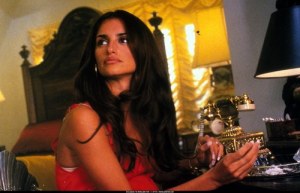
Penelope Cruz plays one spoiled hell-cat of a drug lord’s girl, who later becomes Depp’s wife. Cruz’s character is possibly the most horrible love interest I have ever seen on film. She shrieks about money and wealth, acts apathetic to their innocent daughter, and single-handily gets Depp busted a few times without guilt. Upon deeper reflection she seems (if she happened not to actually exist, which she does) like a cheap foil to make the audience sympathy sway dramatically to our “tryin’ to do good” flawed hero in Jung. It almost seems insulting.
 Ray Liotta (who was IN Goodfellas by the way) gets the pleasure of aging through the years with makeup, which basically consists of slapping gray and more skin to his neck. It’s rather humorous that Liotta is playing Depp’s father in the flick when in reality they are roughly the same age. Though I guess it’s better for Liotta to age after seeing Depp’s character age drastically and gain twenty pounds all in his neck. Older Depp looks like a zombie Ludwig von Beethoven.
Blow is written and directed by Ted Demme and is based on the memoirs of Jung while in prison. It is fairly entertaining in its own right but you can’t help but feel you’ve seen it all before and better. Still, with this lackluster year as it is Blow is a decent pic to sit down and chew through a box of overpriced popcorn. Any movie with Franka Potente (my titular hero in Run Lola Run) and Paul Ruebens is worth the price of admission.
Nate’s Grade: B-


You must be logged in to post a comment.