Blog Archives
Zack Snyder’s Justice League (2021)
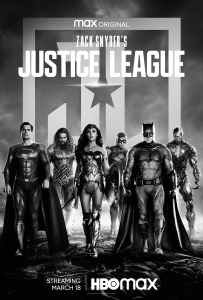
Zack Snyder had a unique situation that many filmmakers would never get close to fulfilling. He departed the 2017 Justice League movie in the wake of a family tragedy, Joss Whedon was hired to direct and rewrite extensive reshoots that totaled an estimated additional $30 million dollars, and the world was given the strange amalgamation of two different filmmakers, along with the nightmare-inducing CGI baby lip to replace actor Henry Cavill’s mustache. The 2017 theatrical release of Justice League was meant to be a significant milestone for the DCU, launching an all-star assembly of superheroes and setting up future solo adventures and franchises. It was meant to be a major kickoff and it was simply a major shrug. The general public was indifferent to the 2017 League, and it seems like the DC brass is positioning for a cinematic universe do-over, retaining the elements they liked (Jason Momoa, Gal Gadot) and jettisoning the other pieces to start anew. In the ensuing years, fans have been petitioning for the fabled “Snyder Cut,” a theoretical version of Justice League that was closer to Snyder’s original artistic vision before the studio intervention and interloping of Whedon. It became a joke on social media and then one day it became real. Warner executives, seeing opportunity with the rabid fanbase, decided to give Snyder an additional $70 million to finish his version of Justice League. It would be an exclusive to their new streaming platform, HBO MAX, and Snyder could complete his version without artistic compromise. The resulting four-hour version, titled Zack Snyder’s Justice League, is less a movie than a mini-series, and a rare chance for a director to complete the story they wanted to tell without artistic compromise. After having watched the full four hours, along with re-watching the 2017 version again for comparison, The Snyder Cut just feels like the original version only longer. I would actually advise people that if they haven’t watched either Justice League to simply catch the 2017 version. At least its mediocrity is half your time investment.
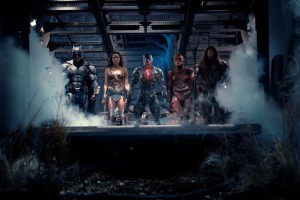
Once again, months (?) after the death of Superman (Cavill), Bruce Wayne (Ben Affleck) is traveling the world and recruiting a very specific group of job candidates. He needs serious help to combat an oncoming alien adversary, Steppenwolf (voiced by Cirian Hinds). The cosmic Big Bad is looking for three special boxes, a.k.a. mother boxes, to destroy the world and make way for his master, Darkseid. Wonder Woman (Gal Gadot) helps Batman convince the half-man/half-machine hybrid Cyborg (Ray Fisher), underwater dweller Aquaman (Jason Momoa), and hyperactive speedster Flash (Ezra Miller) to form a league of sorts to thwart Steppenwolf.
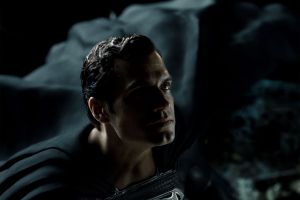
I think it’s unfair to judge the 2017 film to the Snyder Cut as a movie simply because this version never would have been released in theaters. No studio would have released a four-hour version. The two edicts that Whedon was given by the studio when coming aboard the project was that it could not be over two hours and to lighten it up. Imagine what the 2021 Snyder Cut would look like if Snyder was then tasked to cut it down to a more manageable two-hour running length. I predict many of the same scenes being eliminated or dramatically trimmed down. That’s the main takeaway from the Snyder Cut, that there is more room for everything, and quite often too much room. I swear a full hour of this movie might be ponderous slow-motion sequences. Plot-wise, Zack Snyder’s Justice League is pretty close to what was released in theaters in 2017. The action sequences are extended longer (Steppenwolf’s attack on the Amazons has increased from six minutes to a whopping twelve minutes) but I don’t know if they’re dramatically improved. Instead of two punches there’s four; instead of one chase, there’s two. It’s that kind of stuff, filling out the sequences but not really elaborating on them in an exciting fashion that reorients the moment. I liked some additions, like the inclusion of blood during the underwater Atlantis fight because it added a neat visual flair, but the added action is often obscured by visual decisions that dis-empower the experience (more on that later). I found myself growing restless with the movie. All that added time allows some sequences and plot beats to breathe better, but it also allows Snyder to meander to his greater indulgence (more on that later as well, notably on the multiple epilogues). The four hours feel like Snyder’s kitchen sink approach, and with the benefit of years of hindsight from the critical and fan reception of the 2017 version, he’s able to spend tens of millions to correct mistakes and improve a flawed film.
I hate how this movie looks for multiple reasons. The most obvious difference is that the aspect ratio has been altered to a 4:3 ratio more reminiscent of pre-widescreen television. Why is this the case? Snyder has said he cropped his movie to this boxy format so that it could be played on IMAX screens. That’s fine, but why crop your movie now months if not possible years before it will ever play on IMAX screens? When it comes time to adjust for the IMAX screen, adjust then. Why must every viewer see this limited version now on their widescreen televisions at home? It’s just so bizarre to me. It would be like if Quentin Tarantino reasoned that his movies will eventually play on airplanes, so he better get ready and cut back his widescreen into a flat, pan-and-scan mode, and he might as well include alternate takes and scenes to cover for those that would be deemed too profane or intense for the all-ages captive audience of an airplane, and then that version was the one he released to all audiences and we were stuck with it. Snyder had millions of dollars to reshoot his epic and he lopped off the edges, meaning you’re getting more movie but also less (at least the footage predating the new reshoots) in every second because of the framing. The grandeur of the superhero saga is also extremely hampered by the drab color palette. Snyder has always preferred muted colors to his movies but his Justice League drains all life and vibrancy. Everything is literal shades of grey. Color is not allowed to exist in this universe. A sunset is almost comical. Apparently, there’s going to be an official black-and-white version but we’re already practically there. Some could argue the oppressive grey is meant to evoke the grief and heaviness of the picture, and I’ll give you some leeway with that, but the drab colors also nullify the visuals. It’s simply harder to see everything that’s happening even during the daytime, and then you tack on the ugly CGI that makes everything look like a fuzzy video game. For a movie that has cost potentially over $350 million dollars combined, Justice League looks so phony. Maybe that’s part of Snyder’s overall stylized look, he’s never really been one to visually ground his operatic action spectacles, but I feel like the aspect ratio and color palate just make it worse. For those four hours, this is often a very visually unappealing movie to watch.
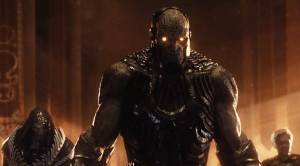
With the added time, there are definite benefits and characters that are lifted by the extra attention. Chief among them is Cyborg, a character that felt like a Swiss army knife in the original who was just there to perform whatever techno jazz the movie required at a moment’s notice. With the Snyder Cut, the character becomes more engaging and given a fuller arc relating to the relationship between father and son. The father’s placement in the story actually matters and Cyborg has more of a personal journey coming to terms with his new abilities. There is a back-story with his frayed relationship with his father, his accident that caused him to become the creature he is, and a reoccurring theme of a son blaming his father and the father trying to reconnect with the son he refused to part with. I still think Cyborg ranks low on the list of superheroes, but the additional scenes give the character more weight, more tragedy, and more intrigue. Another added benefit is that Steppenwolf’s motivation is improved as well as his look. He’s now outfitted with a herring-bone armor that twitches over his body. It’s a more intimidating look than what he had going on in 2017. I also appreciated that he now has more motivation other than “conquer the universe” because now it’s “conquer the universe to get back in the good graces of the boss.” Steppenwolf is trying to repay a debt and make amends, and that makes him slightly more interesting than his generic motivation in the original theatrical cut.
However, not all the new editions are as smooth or as helpful. The added time with the rest of the Justice League doesn’t seem to have added anything to their characters. Each one’s arc is more or less the same from the 2017 version, except now we have even more scenes of Wonder Woman wondering whether she needs to get off the sidelines and be more involved (the events of WW84 conflict with this timeline) and Aquaman rejecting his call to adventure from the Atlanians. Neither is a richer portrayal and the scenes are redundant. Take Wonder Woman finding out about Steppenwolf’s attack. In the 2017 version, her mother lights an arrow and it sails into Greek ruins, signaling her daughter, who knows what this means. In the Snyder cut, the arrow still lights the Greek ruins, but now Wonder Woman visits the ruins, she gathers a stick, she wraps a cloth around it, she dips it in kerosene, she lights it on fire, she enters a secret room because of the arrow, she jumps down a cliff, she finds a hidden temple with hieroglyphics warning about Steppenwolf and the mother boxes and Darkseid. Even if you really wanted the end where she sees those hieroglyphic warnings, why did we need these many steps to get there? The opening hostage/bank heist scene is given far more attention, with multiple scenes of hostages being terrorized, and then Wonder Woman literally vaporizes the chief terrorist. A little girl looks at her, likely traumatized for life by the whole experience, and says wistfully, “I want to be like you when I grow up.” She wants to be a murderer? In Snyder’s universe, Superman kills people, Batman kills people, so why not Wonder Woman too?
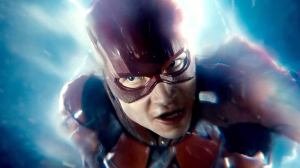
The revised introduction of Barry Allen is also regrettable. He’s applying for a dog walking job and a car accident occurs and he saves the day, but not before slowing down time in a frustrating manner. This is because he seems to be dawdling while the rest of the world is frozen, which makes the event seem less special. His movements seem less urgent than Quicksilver in the X-Men films when he would perform the same memorable slow-mo set pieces. I disliked that the Flash’s big involvement in the final showdown was literally running around in a circle, a repeat of what he had done prior. Also making the slow-mo save introduction less special is the fact that the Flash picks up a hotdog floating in midair for silly reasons. It’s drawn out with interminable slow-motion and the song choice is baffling, a common theme throughout Snyder’s movies. I think he’s been smarting ever since he painfully paired Leonard Cohen’s “Hallelujah” with a sex scene in 2009’s Watchmen, and now we must al endure similar awkward auditory pairings. Every song inclusion just feels wrong here. As Aquaman is drinking and walking along a pier, in slow motion, we hear “There is a Kingdom” by Nick Cave, and it just doesn’t pair right, especially in contrast with the hard-rocking guitar riffs from The White Stripes in the 2017 version. For good measure, Snyder even includes another “Hallelujah” cover by the end for good measure, as if he’s still fighting this same battle over musical taste.
And then there’s the barrage of epilogues, each the start of a story never to be continued, and it approaches the realm of self-parody (spoilers to follow). We get three endings, the first an extension of the post-credit scene from the 2017 version where Lex Luthor (Jessie Eisenberg) suggests the formation of a Legion of Doom for villains. He even shares with Deathstroke (Joe Manganiello) that Bruce Wayne is Batman. Well, that could be an interesting next step, but we know it’s not to be so it becomes just a teasing preview. The next ending cuts forward in time to the dusty, apocalyptic vision that Batman had in Batman vs. Superman, and he’s got a crew including an older Flash, Meera (Amber Heard, why does she have a British accent now?), and even Jared Leto’s Joker. They’re facing off against a villainous Superman who has been driven mad by the death of Lois Lane (Amy Adams), which is pretty much the plot of the Injustice games. The Joker is antagonizing Batman with some references to killing someone close to the Dark Knight, and this whole sequence amounts to Snyder basically saying, “Hey, here’s where I wanted to go with things but you’ll never see it.” Then there’s a third ending, because the second is revealed to be another dream/vision for Batman, where he meets Martian Manhunter, a character that, other than diehard comic aficionados, no one cares about and has been given any reason to care about. The guy just introduces himself and Batman is like, “Oh, cool,” and that’s the ending Snyder decides to close his four hours with. There is a literal half-hour of epilogues and false endings to finish with and I was exhausted. I owe Peter Jackson an apology.
In my original review of the 2017 Justice League, I wrote, “I think I might have actually preferred Joss Whedon not being involved and simply releasing the full Zack Snyder cut. It would have been stylistically more coherent. Much of the Whedon reshoots do not feel like they are for the better. To be fair, he came in late and this franchise behemoth had already gone too far to fully alter its fate. There are small moments that work but the big moments are what fail. This movie is missing setups, payoffs, and character arcs. It’s missing pathos and emotion. It’s missing memorable action sequences that are exciting and varied. It’s missing basic internal logic. It’s missing a greater relevance.” Some of those issues are resolved with the four-hour Snyder cut and too many others still remain. At the end of the day, this is still just a longer, bloodier version of a mediocre superhero movie, except now we get stuff like Batman saying the F-word, so I guess that’s cool. I have more of an artistic appreciation for what Whedon had to pull off to even wrangle this beast into two hours. I’m happy Snyder was able to fulfill his complete vision and that HBO MAX offered a platform that would provide such a rare opportunity of expensive art unencumbered by studio meddling. I can’t say it’s worth your four hours, nor can I say it’s dramatically better than the 2017 version because whatever benefits it offers are weighed down by the extraneous, the redundancies, and the length. As it stands, I feel I have no choice but to grade Zack Snyder’s Justice League the same as the 2017 Justice League.
Nate’s Grade: C
Share this:

Wonder Woman 1984 (2020)
 Big, colorful, and brimming with optimism easy to scoff at, Wonder Woman 1984 (WW84) is finally here to save Christmas and maybe movie theaters and it’s an escapist treat. It won’t register among the best of superhero cinema but will likely keep a smile on your face.
In 1984, Diana (Gald Gadot) is working at the Smithsonian Museum in Washington D.C. and fighting crime as her costumed alter ego. She’s never quite moved on from the death of Steve Trevor (Chris Pine) back in WWI and she dearly needs some friends. Barbara (Kristen Wiig) is a mousy co-worker who comes across a mystical artifact, a rock that magically grants wishes. Barbara wishes to be strong like her boss/idol Diana and she gains new intoxicating power. Max Lord (Pedro Pascal) is a wannabe TV pitchman and an empty suit, fleecing investors and barely keeping ahead of his own Ponzi scheme. He learns of the magic rock and wishes himself to become the rock itself, turning him into a living genie. From there, Max’s wishes are spinning out of control, placing the world in greater crisis. Diana is torn because, before Max absconded with the wish rock, she wished for her heart’s desire, the return of Steve. Stopping Max and reversing the effect of the wishes means having to say goodbye to Steve all over again.
The original Wonder Woman was a break from the pallid doom and gloom motifs that Zack Snyder established, and the sequel goes even further with its candy-colored recreation of the 1980s. I was wondering if there would be a good reason to set the movie specifically during the 80s, and it’s mostly for the Cold War and Yuppies. I was pleasantly surprised that Jenkins and company don’t overdo the 80s nostalgia or the fish-out-of-water comedy for Steve Trevor. I thought this was going to be the entire reason for the throwback setting, and this time instead of Diana marveling at a modern world she did not understand it would be Steve. If you’ve watched the film’s trailer, then you’ve seen all of those jokes at Steve’s expense. That’s it. WW84 can manage to surprise you, mostly in a pleasant manner. Its sincerity is its biggest virtue. It’s a movie about plenty of goofy things but at its core it’s about relatable desires and struggle.
 WW84 is an improvement over the original in the action department. Returning director Patty Jenkins feels freed of emulating Snyder’s house style and brings a welcomed sense of levity and playfulness to the action. The fight choreography makes significant use of Diana’s lasso, opening up the playing field for her to swing around wildly, at times even literally riding the lightning. At points the lasso seems to have a mind of its own and able to divide into fragments. It’s something that helps separate WW84 from the glut of other superhero movies and it offers pleasing visual variance for the fights. There’s a car chase midway through the film where Diana has to leap from speeding truck to speeding truck, dodging goon gunfire. It’s an exciting and sustained action sequence, yet even across the Middle East, chase clichés will reappear, like dumb kids playing in the street ignorant to any emerging noise like a caravan of speeding vehicles. Jenkins seems even more adept behind the camera for the action, delivering big stunts and memorable spectacle ready to make a splash on a big screen. However, some of the CGI can be shockingly dodgy for a big-budget blockbuster and a final confrontation with a CGI-hybrid creature unfortunately reminded me of the lamentable Cats.
The magic wish rock setup shouldn’t be any harder to believe than, say, a secret island of immortal female warriors or just about anything in the absurd and absurdly entertaining 2018 Aquaman feature film. If I can accept a drumming octopus, I can accept a magic wish rock. WW84 hinges on the concept of the drawbacks of creating your own false reality where every wish comes with a cost and an increasing flood of alarming consequences. It it better to just accept the comfort of lies or accept hard truths? The characters even name-check the classic short story The Monkey’s Paw recognizing the ironic trap. That doesn’t stop characters from struggling with the pull of their burning desires, and it makes for an agreeable return for Steve Trevor. Ever since it was revealed that Pine’s character was returning, I was worried what the possible explanations could have been, pessimistic it would be satisfying. Is he going to be a clone? Reincarnation? The grandson who happens to look identical? The screenplay by Jenkins, Geoff Johns, and Dave Callaham finds a way to make it work by bringing him back through magic but with restrictions. In a very Source Code sort of style, Steve is operating in someone else’s body, but only Diana sees Steve. It’s a decision that frames the return in a personal way that also reminds us what is eating at her. It’s been 70 years and she hasn’t moved on from the man she loved, which can be viewed as sad, romantic, and unquestionably unhealthy. It’s a familiar character arc, having to move on from a loved one and accept grief, but it still works, and it humanizes this mighty Amazon warrior woman. It’s a worthwhile development that opens up these living gods into emotional, vulnerable beings.
 With the wish plot comes some gripes and lingering questions. I kept asking, “Is everyone simply not seeing what’s happening?” or, “Is everyone forgetting what has happened?” The scale of the wish consequences is substantial and very public but it never feels like the world is registering just how fantastic these supernatural shenanigans are. In 1984, Wonder Woman is fighting crime as a hobby but still not a named and identified hero. The world does not seem aware of the presence of super beings and amazing powers living among us. So as Max continues his wish-granting ways there are immediate consequences of huge staggering scale, but nobody seems to register how weird and not normal things are, like a giant 50-foot wall suddenly appearing in Egypt. People should be asking what is going on or what others are doing. Therein lies the lingering problem with setting this movie in the past. Much like the 80s-set X-Men: Apocalypse, the events presented generate questions to why future-set movies seem to be ignorant of these same events. If Wonder Woman comes forward and addresses the world, why is she still hiding her identity in 2016’s Batman vs. Superman? And if she learns more about her own super abilities, why does she not make use of these very helpful skills in 2017’s Justice League? These sound like quibbles, and they mostly are, but the movie would have benefited from being a little more judicious with its rules and applications because I started wondering if everyone was oblivious.
I was genuinely surprised how much screen time and consideration was afforded to the primary villain. No, I’m not talking about Barbara/Cheetah, who could have been completely cut from the film. I’m talking about Max Lord. He’s arguably in the film as much as Diana. He’s a con man trying to be a successful TV pitchman and oil tycoon but really he’s trying to be a “somebody” to make his son proud. The problem is that his goal always seems to be just out of reach no matter what is gained. This part confused me. After successful wishes with power and money, Max seems to desperately continue searching for more. I suppose it could just be a general “power-hungry corruption” explanation but I kept asking when enough was enough, and that’s likely the point. I don’t know if Max Lord is a character deserving of this much consideration, but the approach appeals to the film’s empathetic mentality that no one is beyond reach. Rather than the villain having to be physically defeated, WW84 rests on emotionally appealing to a broken man’s sense of self. It makes for a more intriguing conclusion in a superhero realm than merely out-punching the CGI antagonist, like the clunky, lumbering finale from the prior Wonder Woman movie.
The conclusion of WW84 rests upon millions having to make a personal sacrifice for the greater good, which is a lovely sentiment that we could all use at this point after a dispiriting 2020. However, this year has also proven for me that the conclusion of WW84 is pure escapist fantasy. Throughout a deadly pandemic, the United States has been beset by too many people refusing to endure inconveniences in the name of protecting others and saving lives from COVID-19. The cost-benefit doesn’t add up for many if they can’t see the results, never mind the harsh yet sterile reality of over 300,000 dead Americans and counting aided by this selfish obstinance.
 Gadot might not ever escape the long shadow of playing a famous superhero but she’s settled into the role nicely and even gets to flex some untapped acting muscles. I was skeptical of Gadot early when she was hired but became a believer in 2017. She definitely has an unmistakable presence onscreen. Gadot’s best moments aren’t even the punching and kicking, which she does with gusto, but the moments where she has to make grand appeals and hard decisions. There are a few emotional moments where Gadot’s familiarity with the character blends together and she and the filmmakers are not afraid to show strength in other ways other than brawn. Gadot still has a very enjoyable chemistry with Pine (Hell or High Water) that makes them a winning pair. One of the film’s highlights is a personal flight through fireworks that delivers sheer joy for Steve Trevor. His awe about the future and getting one more spin with life itself is heartwarming. Pascal (The Mandalorian) is going big and hammy with his performance that reminded me of the Richard Donner Superman movies. Wiig (Ghostbusters) is the big miss for me. She’s not convincing as a threatening foe and her early scenes as a klutzy, put-upon dweeb feel overdone and yet insufficient. We needed more establishment of Barbara’s life before her wish to better recognize why she would never want to go back. One reoccurring street harasser doesn’t cut it.
Wonder Woman 1984 is fun, splashy, and doesn’t lose sight of its characters and their emotional states even as it elevates the world-annihilation stakes. It’s a movie that seems more confident in its identity than the first film. It accepts that it can be silly, it can be sincere, it can be exciting, it can be smaller and more personal, it can be hokey, it can appeal to your best self. It’s overly long (the opening flashback of young Dianna in the Amazon Games could have been ditched entirely) and not everything works, but the problems are easier to digest and forgive with what does work. It might be the last blockbuster for some time given the uncertain theatrical landscape so I’ll take it. WW84 isn’t the swaggering solo venture the first film proved to be, but I would say it still makes for a mostly satisfying and fun experience that plays to the strength of the creative team.
Nate’s Grade: B-
Share this:

Birds of Prey (2020)
 Not really a Birds of Prey movie, not really a Suicide Squad sequel (see you in 2021), this is really more of a Harley Quinn solo spinoff that’s fun, colorful, bonkers, edgy, and a smile-inducing delight… when Margot Robbie is onscreen as Harley. Robbie is a charming, hyperactive live wire that commands your attention, and giving her the reigns of the storytelling, quite literally in some Deadpool-esque meta storytelling tweaks, is the best decision the filmmakers make. I enjoyed the frivolity, visuals, and narrative trickery, but I noticed something whenever Harley took a powder off screen. None of the other supporting characters are that interesting. I don’t know anything about Cassandra Cain (Ella Jay Bosco), the plot device that everyone is after because of the prized diamond she swallowed. She’s more attitude than person. There’s also Black Canary (Jurnee Smollett-Bell) who doesn’t do much and has a super power she doesn’t use until the end. Renee Montoya (Rosie Perez) provides the police angle and references to cop movie cliches (a hat on a hat). Huntress (Mary Elizabeth-Winstead) is almost a self-parody as the young girl growing up to be an elite assassin to avenger her murdered family and the movie treats her like an also-ran. The only other person of interest is the villain, Roman Sionis a.k.a. Black Mask (Ewan McGregor), because the performance is campy while also being menacing. Birds of Prey suffers absent Robbie because its additional pieces cannot carry the movie on their own. The vacuum of charisma is too noticeable. The fight choreography is impressive and with plenty of longer takes to fully appreciate the cool moves. I enjoyed how every action sequence was different from the last and director Cathy Yan makes excellent use of her environments; a police lock-up is a fantastic place for an action scene with all the evidence/props to utilize. A romp inside a fun house also keeps things fresh even though the goons never bring guns to their big fight. Birds of Prey works very hard with quirk and narrative shuffling, and it feels like a decided attempt to dazzle as well as distract, because there’s not much to this movie. It’s style and personality over substance, and that’s fine, but it does make the second half feel a bit like coming down from a sugar rush. I know there will be plenty that celebrate a group of strong women taking ownership of their own stories and fighting together against toxic men. I know there will be plenty of my friends that love this movie. For me, it was an enjoyable experience that made me realize just how much I enjoy Robbie as an actress, as this character, and when given extra room to roam with an R-rating. Birds of Prey is the kind of tasty junk food you just crave from the cinema every now and then, but without Robbie it’s decidedly less flavorful.
Nate’s Grade: B
Share this:

Joker (2019)
 There has been a lot of discussion over Joker, a new dark R-rated spinoff unrelated to other comic book movies and directed by the man who gave the world The Hangover films. Director/co-writer Todd Phillips desired to tell a character-driven drama that explored how Batman’s most notorious villain, and perhaps the most widely known villain of all pop culture, became exactly the clown he is. Some people said the Joker didn’t need a back-story, others said that Phillips had no place dabbling into the realm of superhero cinema, and there were plenty of others who expressed unease that the movie might inadvertently serve as an inspiration for disaffected loners looking for encouragement to make others feel their pain and suffering. After all those think pieces and cultural hand-wringing, Joker, as the actual movie, isn’t quite the transgressive experience that others feared and that the movie very much wants you to believe.
Arthur Fleck (Joaquin Phoenix) is a quiet, pathetic man who is being ground down by the forces in his life. He has a unique medical condition that causes him to break out in hysterical laughter when he’s nervous or upset, which only makes others feel nervous and upset. It’s hard for him to keep his job as a for-hire clown and his therapy and medicine are being eliminated thanks to budget cuts. He cares for his elderly mother (Frances Conroy), crushes on an attractive neighbor (Zazie Beetz), and dreams of being a stand-up comic who will one day grace the set of his favorite late-night talk show host, Murray Franklin (Robert De Niro). Arthur’s life changes from one night of extreme violence and how it shapes his concept of himself and society. He’s tired of feeling bad for who he is and he’s going to realize his true potential on the biggest stage.
 There’s something, excuse the modern parlance, quite “edgelord” about the film and its artistic approach. It’s very eager to be dangerous, edgy, disturbing, and there are certainly extended moments where it achieves these goals, notably thanks to Phoenix’s performance. However, I was cognizant of how eager the film was to be gritty, and dark, and different, to the point that it felt like the whole enterprise wasn’t just trying too hard to be different but wanted you to know it was trying. After a while, you just have to shrug and say, “Hey, movie, I get it.” This guy’s life ain’t too hot. The first 45 minutes could probably be condensed in half. The first two acts feel redundant as they establish the many trials and tribulations of this man on the edge of a broken society that has abandoned him. Because of this, Joker can be an entertaining experiment in solo superhero stories but there is a critical absence of depth that keeps the film from going beyond a stellar lead performance. It’s a Martin Scorsese hodgepodge, a cover song for a famous villain.
This is the kind of movie where subtlety is rarely used, which increases the sensation that it’s trying too hard because it seems like it’s saying all of its points with exclamation marks. Even in the opening minutes, while Arthur is applying his clownish makeup, we hear a voice over narration from a TV newscaster who is essentially screaming to the audience all of the important social contexts for the setting (Things are bad! People are mean! The economy is bad! People are getting desperate! What has the world come to?!). There’s a fantasy experience where the characters are just openly explaining their desires. The visual metaphors are pretty simple, like the idea of hiding behind a mask (don’t we all wear masks, man?) and the intimidating set of stairs ascending to Arthur’s apartment that he must climb. So many supporting characters act like mouthpieces for larger collective groups, like a paid therapist who tells Arthur that the people with money don’t care about her or Arthur, the little people caught in the machinery of runaway capitalism, or Thomas Wayne as the callous and cold business elite who seems disdainful about any sort of empathy for others that challenge his responsibility to a larger society. De Niro’s talk show host feels like an amalgamation of a lot of different themes, like daddy issues, the media, but also the representation of ridicule as comedy and mass entertainment. There aren’t so much supporting characters as there are ideas, and in a weird way this could have worked, as if each figure represents some different level of psychosis for Arthur, almost as if it was repeating the 2003 movie Identity and everyone really is a reflection of Arthur’s damaged personality. The inclusion of Beetz (Deadpool 2) is more a plot device meant to humanize Arthur, but the entire premise feels like it’s missing development to make it believable, and ultimately this is the point of her character but it’s a long wait for a reveal for a character that is superfluous at her core. It’s the kind of movie that thinks we need to yet again see the definitive formative act of every Batman movie.
 The movie does pick up a momentum when Arthur starts to get set on his way toward becoming the clown prince of crime. When the Joker gets his first taste of violence, in self-defense, the clown vigilante becomes a symbol for a reactionary contingent of Gotham’s lower classes. The groundswell of support provides a welcomed sense of community for a man who has been secluded for his idiosyncrasies, but it’s a celebration of a loss of morality, and so to fully embrace this tide of supporters he must give away the last of vestiges of his soul. This downfall allows for the movie to feel like it’s finally committed to something, where the setups are finally starting to coalesce around a character who is now driving his story rather than being the recipient of misfortune. The violence becomes more shocking and Arthur stops caring about hiding who he really is, and that’s when the movie becomes the full force it had been promising. I was tapping nervously throughout the final thirty minutes because I was anticipating bad things for anybody on screen. Phillips can use this anxious anticipation for unexpected comedy too, like where a character was trapped due to their unique circumstances and whether they too were in mortal peril. I wish Phillips had pulled back because there’s a perfect visual to conclude his movie, that brings the entire self-actualization and loss of morality full circle, and yet the movie gives us another two-minute coda.
Joker certainly feels like Phillips’ version of a Scorsese movie, for better and for worse. If you’re going to imitate anyone, it might as well be one of the greatest living filmmakers whose crime dramas have reshaped the very language of the movies and how we view violent crooks. The go-to response I’ve seen is that Joker is a combination of Taxi Driver and The King of Comedy. I’ll readily agree with the Taxi Driver comparisons. It’s everywhere. We have a disaffected loner who is turning sour on an increasingly hostile and unstable society he views as beyond repair. Even the shot selections, camera movements, and 1970s era set design evoke that influence. The King of Comedy is more a facile comparison, as Arthur is a disturbed man trying his luck at standup comedy, failing, and becoming more unhinged. The real reason reviewers seem to be making this connection is the inclusion of Robert De Niro, and it feels like that is the only reason he’s actually involved, to ping back to King of Comedy. The idea of a stiff actor like De Niro being a glib talk show host, even in the 1970s, seems like a bad fit. The other real film influence I don’t see getting as much recognition is Network. This is a tale of one man tapping into a vent of anger and starting a movement that ripples out beyond them into something uncontrollable.
 Phillips is best known for his comedy work but I could feel his leaning to do a straight genre picture. In other reviews, I’ve cited Phillips’ keen eye for noir-flavored visuals (think of the car traveling across the desert as seen through the reflection of sunglasses in The Hangover). He had the chops to tell a straight genre crime thriller, so it’s not surprising that Joker is a slickly made, unsettling, and effective movie when it counts. This is a grimy-looking New York City, I mean Gotham City, where the garbage piles high (another not so subtle visual metaphor) and the city feels like a maze all its own crushing our main character. The cinematography is great with several strong moments that amplify the mood of unrest and distaste. The crafty costumes by Mark Bridges (Phantom Thread) lend to the overall authenticity of the period. The cello-heavy score by Hidur Guonadottir (HBO’s Chernobyl) is very evocative and ominously conveys the turmoil bubbling below the surface in a manner that doesn’t feel like pandering. This is a good-looking production made by talented technicians and Phillips has enough skill to pull it all together, even if that aim is really to recreate a style of another filmmaker and the time and place of his films.
I’ve purposely saved the best for last, and that’s Phoenix as the titular character. He is mesmerizing as a broken man trying to find his place in society and flailing wildly. His uncontrollable cackling is so unsettling that when he broke into laughing fits, I could feel myself getting more and more unnerved. At first it was the awkward sympathy of watching a man struggle to get through his disability, trying to compose himself, and embarrassed for the discomfort he was projecting. The very sound of the cackling trying to be contained, as a friend and co-worker Jason credited, watching the laughter catch in his throat, it had such an immediate, almost physical reaction in me. Later in the movie, I cringed because it made me worry what was going to happen next because I know it’s a precursor to bad feelings. When he’s becoming more comfortable with his impulses and dark thoughts, you notice the cackling starts to ebb away. There’s a small moment that I loved where after he flees from his first murder he runs into a bathroom, and once his breathing calms, it’s almost like his body is commanded by some spiritual serenity as he begins to dance. Phillips allows the scene to breathe and play out, to invite the audience to join. This little motif probably appears a few too many times, but it’s a beautiful little moment of physicality that expresses the chaos becoming harmony within a man. Phoenix lost 50 pounds for the role and his gaunt, haunted frame reminds you how much of a shell of a human being this character feels like. He even tells his therapist that he questioned whether he was even a person or not. Phoenix burrows deep into the character and unleashes a committed intensity that is impressively communicated through his sad, reedy, sing-songy voice, his slippery stances and body language, and the madness that seems to resonate from his bulging eyes. Even when the movie is repeating its steps and tricks, it’s Phoenix that constantly gives back to the audience. It’s a performance certainly worthy of Oscar attention and plaudits, though in my mind it’s still a step or two below the instantly iconic, and Oscar-winning, performance from Heath Ledger.
 Joker is a movie and should not be held responsible for the actions of others and what they may read from the film. I don’t sense Phillips and his team condoning their protagonist’s lawless actions, and the violence is often undercut so that it feels more disturbing than triumphant and exhilarating. When Arthur does get his first kill, the audience has likely been silently rooting for him to fight back, to punish the wrongdoers, but the movie draws out the scene in a manner that’s akin to a wounded animal panicking as it scrambles for its life and a cold execution. It’s not meant to be cool. Phoenix’s performance elevates the entire enterprise and will unnerve as much as it ensnares. It’s not a subtle movie at all, and it hugs the works of Scorsese a little too closely, both in tone as well as visual symmetry. It’s trying very hard to be nihilistic, edgy, and provocative (this isn’t your “normal comic book movie” it wants to scream with every frame). Arthur just wanted to make people laugh, the movie tells us, but the joke was on him after all (subtlety). If anyone is inspired from this movie, I hope it’s to seek out other Scorsese movies.
Nate’s Grade: B
Share this:

Shazam! (2019)
 It seems like the secret to the success of the DC movie universe is making fun, lower stakes adventures with the characters the public has the least knowledge about. Shazam actually begun as a “Captain Marvel,” and now comes on the heels of the MCU’s Captain Marvel. We follow Billy Batson (Asher Angel), a teenage orphan trying to find his missing mother. He stumbles into a wizard’s realm and is given a special power whereupon he turns into a square-jawed, broad-shouldered superhero (Zachary Levi) by saying “Shazam.” What follows is like a superhero version of Big and it’s goofy, charming, and reminiscent of an 80s Amblin movie, where children’s movies were allowed to be a little creepy and weird. The movie is light, cheerful, and heartfelt with its doling out of family messages to go along with the slapstick and personal growth. It’s very much envisioned from a young boy’s fantasy perspective of being a super-powered adult, where the first things to be done include buying beer, going to a “gentleman’s club,” in between testing out bullet invulnerability and flight. Levi (TV’s Chuck) is excellent at playing an adult version of a kid. I was initially dismissive of his casting but he’s perfect for this part. There’s a satisfying sense of discovery for Shazam and his excitable foster brother (Jack Dylan Grazer) that doesn’t get old. The movie is more concerned with how the superpowers are affecting Billy’s relationships and sense of self than any larger, planet-destroying danger. The film even sets up its villain (Mark Strong) by giving him a decent back-story and opening the movie to explain his crummy family. It’s not a three-dimensional villain by any means but the attention given to make him something more is appreciated. The other foster kids in Billy’s new family are more archetypes but amusing, and their involvement in the final act raises the joy level of the finale. Shazam! is a movie where people are genuinely excited to be superheroes or associated with them, and that gleeful, buoyant revelry is downright infectious.
Nate’s Grade: B+
Share this:

Aquaman (2018)

It’s hard not to talk about the fledgling DCU without grading on a curve. Wonder Woman was a great success and a definite step in the right direction but it still had clear Act Three problems. However, when your previous movies are the abysmal Suicide Squad and Batman vs. Superman, anything in the right direction is seen as enlightenment. There are currently no planned Superman films, no planned Batman films, and it looks like the teetering DCU is banking its future on the success of Wonder Woman and Aquaman. If you had told me that the future of an interconnected series of franchises would rest upon the shoulders of a man who talks to fish, I would have laughed. Enter director James Wan, best known for the Conjuring franchise and plugging into Furious 7 without missing a beat. Warner Bros. desperately wanted Wan’s stewardship to get a notoriously difficult comics property to float in the modern market. The early marketing was not encouraging but I held out a slim degree of hope that Wan would make it work. While Aquaman as a whole has its share of problems, Wan has done it. He’s made a big screen Aquaman movie that is fun, visually immersive, weird, and packed with great action. I was just as surprised as you, dear reader, but the smile on my face was evident.
Arthur Curry (Jason Momoa) is heir to the undersea throne of Atlantis. His mother (Nicole Kidman) fled her arranged marriage and had a son with a human lighthouse keeper. She retreated back into the ocean to prevent further harm to her shore side family. Arthur is approached by princess Meera (Amber Heard) to return to Atlantis and claim his birthright to the throne, currently occupied by Arthur’s half-brother, King Orm (Patrick Wilson). The reigning king is planning to unite the seven sea kingdoms to launch an attack against the surface-dwellers. Arthur must go back to the people who reportedly killed his mother and challenge his half-brother for supremacy. Along the way he’ll have to venture across the globe with Meera for a series of adventures to reclaim lost artifacts, while also dodging Black Manta (Yahya Abdul-Mateen II), a pirate gifted with underwater technology who swears vengeance against Arthur for letting his father die.

Make no mistake, there is definitely a ceiling capped for Aquaman. The characterization is pretty standard stuff with little added nuance. It’s a dash of Chosen One destined to bridge communities, a dash of Prodigal Son outcast trying to make amends and duty, and there’s the general pledged vengeance that reappears again and again for motivation. The plot is reminiscent of a video game, structured so that Arthur and Meera have to travel from one stage to another, finding an important artifact and then going to the next stage. Sometimes there are mini-bosses at these various video game stages. The antagonists are acceptable but without much in the way of depth or charisma. You might even find yourself agreeing with King Orm as far as his pre-emptive strike over mankind (the latent racism of “half-breeds” maybe not as much). The leads are also given little. Momoa (Justice League) is a naturally charismatic actor but his range is limited; he basically has two modes, off and on. This might have been one reason why the screenplay resolves to merely push him toward his “call to action,” which I thought was his Justice League arc. Still he’s an affable and handsome presence even with lesser material. Heard (London Fields) is struggling to find her character’s place in the story. She’s a romantic interest, quest cohort, and there are attempts to push through more feminist agency but it’s too murky. It feels like she’s trapped by her character and her giant Halloween store red wig. If you cannot get over these deficits, it’s going to feel like a relentless 143-minute video game.
And yet the movie works thanks to the talents of Wan and the overall abundant sense of exuberant fun. Wan has become a first-class chameleon, able to adapt his skill set to whatever genre he attaches himself to, be it high-octane car chase thriller, slow burn horror to grisly torture porn, or now splashy superhero blockbuster. Early on, I knew we were in good hands when Wan showcases a destructive fight scene between Kidman and a group of aqua storm troopers in long takes and wide angles, letting the choreography speak for itself and allowing the audience to fully take in every smash and crash. The action is consistently interesting and filmed in ways to highlight its best points. An underwater brotherly battle takes the movement within water into account, adapting fight choreography to add this new dimension. That’s what good action movies should be doing, applying their unique settings into the action development. There isn’t a boring action moment in the film. Even when we get to the big CGI armies duking it out, Wan instinctively knows to pull back to avoid overkill. Even the otherwise normal hand-to-hand combat is clever and consistently entertaining. The highlight of the movie is actually on land, an extended chase through the villas of Tuscany. Arthur and Meera are battling Black Manta but they’re also divided, and Wan’s camera will zoom back and forth between the two, connecting each on their parallel tracks. They jump from tiled roof to tiled roof, escaping danger. There’s one super aqua storm trooper who takes a more direct approach and just runs through room after room, and the camera follows him on this direct line of destruction. There’s even a payoff where Meera uses her powers in a wine shop to her great advantage. It’s moments like this where Wan is clearly having fun and demonstrating that he and his team have put good thought into their action.

The visuals are wildly immersive and amplify the sense of fun the film has to offer. There are plenty of cinematic reference points of influence here, from George Lucas to James Cameron, but Wan and his team do an excellent job of making this universe feel full. We visit many different undersea realms and people, including seahorse people, crab people, and just taking ownership of the weirdness without irony is refreshing. With the exception of Momoa’s need to undercut moments with quips, the film feels genuine and proud of its old-fashioned mentality, taking the ridiculousness and treating it with sincerity. That doesn’t mean there aren’t campy and absurd moments that are enjoyable precisely because of their camp and absurdity. There are people riding great white sharks and battling crab people to the death. How can that not be silly? There’s one group of creatures that feel plucked from Pitch Black, a band of feral monsters vulnerable to fire. There’s a fun and effective sequence where Arthur and Meera must dive to escape with their lit flare and we see the full totality of their situation, a literal sea of these monsters breaking apart just so as they dive. It’s a creepy moment made even better by Wan’s visual choices, which always seem to correspond to what’s best for the experience. The special effects are uniformly great and the attention to the undersea worlds is pristine.
Ultimately your view of Aquaman will come down to what you’re willing to forgive in the name of fun spectacle. Its best Marvel Cinematic Universe (MCU) equivalent are the pre-Ragnarok Thor films. There are definite deficits with the minimal characterization and the familiar hero’s journey plot arc, but the execution level and the sheer energetic entertainment are enough to rise above. The action sequences are routinely thrilling, eye-catching, and wonderfully alive and clever thanks to Wan. They’ve found a way to make Aquaman cool and fun, which is what rules the day when it comes to the film version. Aquaman is another step in the right direction for the notoriously gloomy DCU. If Wan was attached for a sequel, I’d genuinely be interested. This is nothing you haven’t seen before in any number of movies (just now underwater), it’s not exactly intellectually stimulating or emotionally involving, and yet the sheer success of the visuals, action orchestration, and the sense of fun override the rest of the detractions for me. It reminds me of the Fast and Furious franchise. I don’t care a lick for any non-Rock/Statham characters; I’m just there for the physics-defying stunts and set pieces. It provides the goods when it comes to action spectacle, and so does this movie. If you’re looking for a 90s throwback to big, fun action movies, then take the dive with Aquaman.
Nate’s Grade: B
Share this:

Justice League (2017)
 The story behind the Justice League movie is one of turmoil and turnover. Zack Snyder has been the cinematic voice for the DC film universe (DCU) and, if you listen to enough critics and fans, the weight holding down the franchise. Justice League began filming in the spring of 2016, which means they had a considerable lead time before release. Either they went into production with a script they were unhappy with or they learned it. A year later, in the spring of 2017, Snyder bowed out of his directorial duties to spend more time with his family in the aftermath of his daughter’s suicide. Enter Joss Whedon, the wunderkind behind Marvel’s record-breaking Avengers. The studio was unhappy with Snyder’s rough-cut, deeming the footage “useable,” and tapped Whedon to make drastic reshoots. He rewrote the film enough to earn a writing credit from the WGA. Complicating the already pricey reshoots was star Henry Cavill’s mustache, a holdover from the filming of Mission: Impossible 6. He wasn’t permitted to shave his ‘stach, and so Warner Bros. was forced to pay likely millions… to digitally erase Cavill’s facial hair (DCU is 0-2 when it comes to mustaches this year). The final product is being met with great fanfare, hope, and curiosity. If anybody could save this project it’s Whedon, right? Well Justice League could have been renamed Super Hero Fatigue: The Movie.
Months (?) after the death of Superman (Cavill), Bruce Wayne (Ben Affleck) is traveling the world and recruiting a very specific group of job candidates. He needs serious help to combat an oncoming alien adversary, Steppenwolf (voiced by Cirian Hinds). The cosmic Big Bad is looking for three special boxes, a.k.a. mother boxes, to destroy the world. Wonder Woman (Gal Gadot) helps Batman convince the half-man/half-machine hybrid Cyborg (Ray Fisher), underwater dweller Aquaman (Jason Momoa), and hyperactive speedster Flash (Ezra Miller) to form a league of sorts to thwart Steppenwolf.
 Aggressively bland, lazy, and unmemorable, I was genuinely left questioning whether Justice League was somehow worse because it wasn’t worse. It’s not the aggravating stew that was Batman vs. Superman or Suicide Squad, but those weren’t exactly difficult hurdles to clear. To put it in another colorful analogy: while it may not be a flaming dumpster fire, it’s just a dumpster, something you wouldn’t give any mind to because, hey, it’s just a normal dumpster, and why would you even want to spend time looking at that anyway? That’s Justice League for you, a DCU super hero film that’s better by default and still disappointing to the point that you wish it would be mercy killed to spare us a prolonged death rattle. This movie is ground down to the raw pulp of a super hero movie. It lacks personality. Stop me if you’ve heard this one before from a modern super hero film. An ensemble of poorly developed characters must band together to stop a dumb villain from world annihilation with a giant energy portal in the sky. There have been now five DCU films in this sputtering cinematic universe and three movies fit that formulaic description. Even the 2015 Fantastic Four remake followed this. The draw of this film is its mythical heroes, yet they are so lazily developed that we rarely feel any sense of awe or reverence with them. The cast chemistry is relatively strong and the actors have been well chosen, but let’s go person-by-person in this league to determine just how poorly the story serves them.
Batman has become the Nick Fury of this new post-Superman world, taking charge assembling a team to combat a more dire, powerful alien threat. He’s the least super in many regards and has fleeting moments contemplating his mortality, but just when you think they might give the older Batman some depth, they pull back. His biggest relationship is with Wonder Woman and their central conflict feels contrived. He’s angry at her for not getting more involved (hey, Wonder Woman, you got out there for WWI but sat out the Holocaust?). It feels like a strange managerial tiff. Affleck (Live by Night) seems to have gotten more growly and smug. Gadot (Keeping Up with the Joneses) scowls and scoffs. Considering they’ve each lead a DCU movie, we should be more attached to them in this story. He’s not fun to be around and neither is she. The new members have some degree of promise.
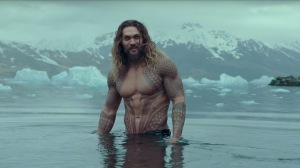 Aquaman is a gruff, shaggy, tattooed loner embodied by Jason Momoa, and his performance works better than the character does. Momoa (Game of Thrones) is charismatic as a wild man but he comes across as a fraternity jock. His cocky, carefree persona and aesthetic are trying too hard to re-imagine Aquaman as a sexy superhero for today. The underwater action scene in Atlantis is so cumbersomely filmed and staged that I think I realized, in that moment, how visually dreary underwater fight scenes are. There goes any last shred of interest in the solo Aquaman film coming in 2018. Cyborg is basically a modern Frankenstein story and should have had affecting characterization about the battle over reclaiming his humanity. Instead he becomes the plot equivalent of a Swiss army knife, able to open any locked device or technological obstacle.
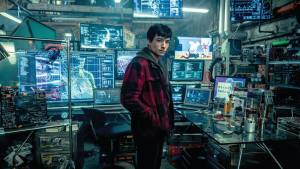
The Flash/Barry Allen is the best part of the film by default (a familiar term in this review). Miller’s (Perks of Being a Wallflower) extra jubilant performance feels like a course correction from the criticism of how unflinchingly gloomy BvS was. He’s the stars-in-his-eyes rookie who is also a fanboy first, geeking out about getting to work with legends. It’s not just that the fanboy-as-hero angle was already tackled better by Marvel in Tom Holland’s newest edition of Spider-Man, it’s also that the film doesn’t know when to stop. Barry Allen has to quip for every occasion. While some belie his insecurity and nervousness about being promoted to the front lines of hero work, several are forced. The coolest thing he can do is run so fast time slows down, yet we’ve already seen this displayed better and with more witty panache in the recent X-Men films with Quicksilver. Flash is the only character with anything resembling an arc, and this amounts to little more than not being as terrible at fighting and getting a job. He makes his dad proud… by getting a job, and this is sadly the best example of a character arc in Justice League.
Another course correction was ditching overly complicated plotting for simplification, which can be a virtue. With Justice League, simplicity gives way to a dispirited lack of ambition and effort. The plot is thusly: Batman has to recruit a team to stop a Big Bad from getting three boxes buried around the world. Perhaps some will characterize this as a facetious oversimplification, but that’s really all that’s going on for two hours. The only other significant plot turn is the resurrection of Superman. The concluding image of BvS was the dirt hovering over Clark Kent’s casket, heavily implying he was coming back, so this really shouldn’t be a spoiler. The heroes suddenly decide the mother boxes can bring Superman back, and they know how to do it, and then just do it, without any setup. If it had been Cyborg who came up with this plan since he shares the alien technology that could have made some degree of sense. No, it’s Bruce Wayne who comes up with this idea, a man with no experience with alien technology. The heroes use one of the magic mother boxes to bring Superman back from the dead and then, inexplicably, leave it behind for our villain to capture. Literally the characters look over their shoulders and, whoops, a giant energy vortex has sucked up the final item needed to destroy the world. Maybe one of you should have had somebody watching that important thing.
 There are other moments that speak to the troubles of simplicity leading to laziness. The opening sequence with Wonder Woman involves a group of criminals taking hostages in a bank. Oh, these are sophisticated bank robbers you might guess. No, these are, in their own outlandish words, “reactionary terrorists,” and they’re here to set off a bomb. Why did you have to enter the bank, let alone take hostages, and call attention to yourselves then? Would a bevy of car bombs not get the job done? These guys are on screen just to be dispatched by Wonder Woman, but at least put some effort into them. Here’s another example of the effects of oversimplification. Steppenwolf’s base of operations is an Eastern European/Russian bloc city in the wake of an abandoned nuclear facility. We see one desperate family fret over the flying Steppenwolf hench-demons and barricade themselves in their home. We then keep cutting back to them again and again. Will they have a greater importance? Is the final mother box to be found underneath their home? No, they are merely an on-the-ground a perspective and offer no insights, complications, or interest. We just keep checking in with them as if they are the most irrelevant war correspondent. When the climactic battle ensues, they’re the sole lives we see in danger from the epic fighting.
The villain is also a severe liability, as Steppenwolf feels plucked from a mid 2000s video game. He feels like a mini-boss from a God of War game. Not a boss battle, a mini-boss. His entire character design is ugly and resembls a goat. He may be twelve feet tall or whatever he is but he is completely unremarkable and nonthreatening. He wants to bring about the end of the world by collecting his three world-destroying MacGuffins and making them cross the streams. His back-story happens midway through the film and is shockingly a rip-off of the Cate Blanchett-narrated prologue from The Lord of the Rings. All the races of the world and beyond teamed up against this dumb dude and then they took possession of his source of power, the three boxes to rule them all, and divided them up among the different races for safety. They’re even dressed like Middle Earth fantasy characters. They foolishly split up the boxes in a way that the bad guy would know exactly where they are if he ever came back. This lame villain is also hampered with a lame back-story. I don’t understand what about this character makes him invincible in the first half and what changes to make him beatable in the second half. His powers and potential weaknesses are ill defined and you too will struggle to work up any interest for what may be one of the most boring and useless villains in super hero film history. According to my pal Ben Bailey, Steppenwolf makes Malakeith (Christopher Eccleston) of Thor 2 look like Loki (Tom Hiddelston) in Thor 2.
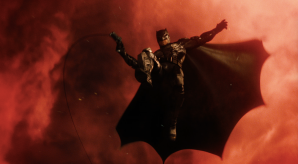 Justice League feels like two movies indelicately grafted together, and if you have a trained eye for cinematography you’ll easily be able to spot the difference between the Snyder parts and the Whedon parts (final product looks 70 percent Snyder, 30 percent Whedon). Snyder is much more the visual stylist so his camera arrangements are far more dynamic, and his cinematography also makes more use of space within the frame, especially from the foreground and background. His scenes also have a more crisp, filmic look. By contrast, the Whedon scenes feel overly clumsy and with too much strained humor. The Whedon humor holds on a beat longer, as if it’s waiting for a canned laughter response to clear. Lois Lane (Amy Adams) remarks about how Superman smells, Martha Kent (Diane Lane) drops a malapropism about her son calling Lois the “thirstiest reporter,” Barry Allen’s inability to grasp what is brunch, which is the only thing shoehorned into the middle of Snyder footage. Then the brunch joke is brought up again in the first post-credit scene, which had me convinced that Whedon was going to produce some sort of meta moment with the Justice League final post-credit scene mirroring The Avengers, with the team out enjoying a casual meal together. Not only do I think I enjoyed the Snyder parts better but I think I also enjoyed the humor of the Snyder parts better.
The color correction is also completely different. Check out the Justice League trailers and you’ll see two different climaxes, one before Whedon that takes place in Snyder’s typical landscape of diluted grays and blues, and another after Whedon that looks to be set on Mars. An unintended consequence of altering the color correction so decisively is that the costumes suffer. These outfits were clearly designed for the landscape of colors for Snyder’s darker vision. Whedon’s brightening up makes the costumes look like discount cosplay. It’s not that the Snyder parts are that much better, it’s that the Whedon parts aren’t that great.
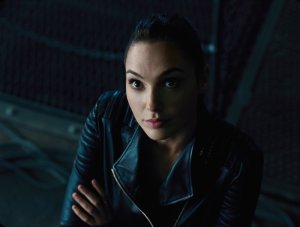 The action sequences are just as unmemorable as the rest of the movie. Action sequences need variation, they need mini-goals, and they need multiple points of action. There’s a reason many film climaxes involve different pairs or groups fighting different villains. It keeps the action fresh, involves all of the characters in meaningful ways, and provides more payoffs. The action becomes more dynamic and complex and simply entertaining. The action in Justice League is thoroughly underwhelming. With the exception of Cyborg being a hacker plot device, none of the characters use their powers in integral ways. All they do is punch and jump. When that happens the heroes are too interchangeable. They also don’t seem to do anything different in the third act nor does the climax require them to do anything different, so their victory as a team feels perfunctory and arbitrary. The special effects feel unfinished and unpolished for a $300 million movie. A sequence set on Wonder Woman’s home island looks like it was taken from a cheesy Dynasty Warriors video game. A montage during the conclusion has shockingly bad CGI of the Flash running in a goofy, gangly, leg-failing way that made me doubt Whedon’s eyesight. The most hilarious special effect, possibly of all time, is the fake Superman upper lip. It kept me analyzing every Cavill mouth I saw. His upper lip looked too waxy with shine and indented too widely. We are not there yet my friends for realistic mustache removal technology. We’ll just have to go back to old-fashioned razors and rue this primitive existence of ours.
Batman vs. Superman and Suicide Squad have already conditioned audiences to expect the worst, and the fact that Justice League is better may make some mistakenly believe this is a good super hero adventure. It’s not. While not the spectacular failure of its predecessors, this is extraordinarily forgettable and thoroughly underwhelming from top to bottom. I think I might have actually preferred Joss Whedon not being involved and simply releasing the full Zack Snyder cut. It would have been stylistically more coherent. Much of the Whedon reshoots do not feel like they are for the better. To be fair, he came in late and this franchise behemoth had already gone too far to fully alter its fate. There are small moments that work but the big moments are what fail. This movie is missing setups, payoffs, and character arcs. It’s missing pathos and emotion. It’s missing memorable action sequences that are exciting and varied. It’s missing basic internal logic. It’s missing a greater relevance. The villain is just an obstacle to be overcome without any larger thematic relevance. I struggled to care about what was happening. Ultimately, the finished product feels like Zack Snyder’s garage sale (“Here’s all the stuff you’re used to and maybe you’re tired of but I’m not gonna put that much effort into this so maybe we can haggle”). And then Joss Whedon bought it all, repackaged it, and sold it back to you, America. As dreadful as the previous movies were they at least had moments that stood out, many of them for the wrong reasons, admittedly. Justice League isn’t as bad and yet is paradoxically less watchable.
Nate’s Grade: C
Share this:

Wonder Woman (2017)
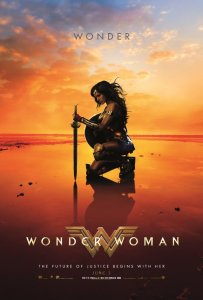 I owe Gal Gadot an overdue apology. When the news first broke that the Israeli model-turned-actor had won the role of Wonder Woman, I was quite dismissive. My heart had been set on Gadot’s Fast and Furious 6 costar, Gina Carano, a former MMA fighter who displayed a natural screen presence. I apologize for not thinking the relatively slim Gadot had what it takes to fill out Diana Prince’s wonder boots. I just couldn’t see it, and that’s an error of imagination on my part. When Gadot made her debut in 2016’s otherwise abominable Batman vs. Superman, she was one of the few high points, granted she was only there for like fifteen minutes. My concerns were abated but could she hold her own film? After 140 minutes of consideration, I can declare that Gadot is a star and a terrific Wonder Woman. The rest of the film is pretty good though not up to her wonder level.
Diana (Gadot) is an Amazonian princess living on a mysterious hidden island ruled by ageless female warriors like Hippolyta (Connie Nielsen) and Antiope (Robin Wright). One fateful day a downed airplane crashes close to their shore. Diana rescues the pilot, Steve Trevor (Chris Pine), and is fascinated to learn he is a man. The Amazonians are distrustful of a man in their land. He warns them about the “war to end all wars” going on that threatens the greater world. The Germans are developing a powerful chemical weapon thanks to the treacherous Dr. Poison (Elena Anaya) and Luddendorff (Danny Huston). Diana decides she cannot stay idle. She leaves her home and travels with Steve to London and eventually the the European Front. Diana is certain the one responsible for the global conflict is none other than the god of war Ares, who will stop at nothing to annihilate mankind.
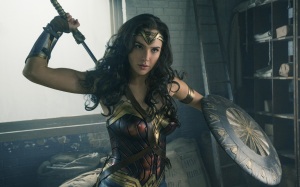 Wonder Woman is an entertaining, empowering, and engaging Golden Age superhero throwback that manages to be the best the DCU has had to offer. This is the movie many fans have been waiting for. Wonder Woman’s structure and tone feels like what would happen if you crammed together Marvel’s Thor and Captain America: The First Avenger. It’s got the ancient mythological society that is separate from mankind. It’s got the fish-out-of-water comedy of a god traveling to the world of man and trying to make sense of our clothing, customs, and backwards gender norms. It’s also set during a world war far in the past and resonates with handsome period-appropriate production values. The comedy aspects are surprisingly restrained; the fish-out-of-water jokes are mostly deployed during Diana’s first encounter with Steve’s secretary, Etta (Lucy Davis). The humor goes a long way to help coalesce the varied tones, tying the campier elements with the more serious war backdrop. It’s a movie that recognizes, at long last, that the DCU can actually be fun. The lighter tone works as well to establish the charming dynamic between Diana and Steve. There’s a screwball comedy feel that gracefully comes in and out, allowing Pine (Star Trek Beyond) to be simultaneously amazed and flat-footed at his ever-increasing crush’s agency. They make a winning pair and there are several moments that are funny, touching, and lovely between them that made me smile.
Gadot (Keeping Up with the Joneses) is a wonderful lead and delivers a star-making turn. She draws you in immediately. Gadot succeeds as a cultural icon come to colorful life. She succeeds as a comic actress bemused and wary at the era’s gender politics. She succeeds as a dramatic actress able to convey the emotions of doubt and torment. But most significantly she succeeds as a person overcome with the sheer thrill of self-discovery. There’s a moment where Diana takes a flying leap to grab a stone tower’s ledge. She grabs it but the ledge breaks and she starts sliding down the face of the tower. She stops her downward plummet by punching her own handhold. She then punches another. Gadot’s face lights up, taking in the sheer scope of her personal possibility. She launches herself up the face of the tower, more determined and blissful than before. Gadot’s greatest strength is her capacity of expressing Diana’s growing sense of self. Her ongoing declaration of agency is given a welcomed and fitting action-movie cool treatment.
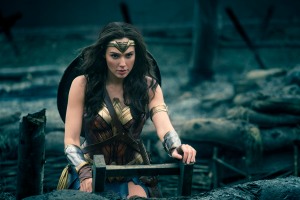
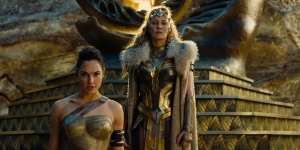 Director Patty Jenkins (Monster) acquits herself impressively in the world of big-budget action. The first action sequence involves ancient Greek femme warriors against German soldiers, and it’s awesome. Watching the galloping horses and gilded warriors confidently mow down the enemy soldiers is a primal joy. Jenkins pleasingly frames her action sequences and uses judicial cuts, keeping an audience oriented through the duration. It’s action you can comprehend and relish. Jenkins has a great command of her visual space and how to sell the bigger moments. We don’t see Diana in her full Wonder Woman regalia until an hour in but when it comes it feels like a big screen moment decades in the making. Diana gets her deserved heroic entrance. Jenkins color palate follows the gun mettle grays of Zach Snyder’s pre-established diluted color scheme, but the less oppressive tone makes it feel less dreary. Something of interest is also how little her camera sexualizes Gadot, who is by all accounts a stunning human being. Given Wonder Woman’s costume, her creator’s kinky origins, and the generally prevalent practice of the male gaze, I would have assumed there would be certain moments to highlight Gadot’s physical assets. The movie does so but it highlights her strength and fortitude rather than her curves. Her femininity isn’t tied into how her body looks to appeal to men. It’s about what her body can do and often to the immediate threat of men. She does get a couple killer evening gowns to wear but her sword is tucked away behind her shoulder blades, a powerful reminder that she’s no man’s sexual object.
With all that said, the praise is a bit over pronounced for Wonder Woman, because while it is clearly head and shoulders above the other DCU films, it’s still only an overall good film and not a great one. I understand that many will celebrate a big-budget action showcase for an idol of female empowerment, but I don’t want to ignore problems either. The biggest issue for Wonder Woman is just how simplistic its characters and themes are. Diana is an interesting character but she’s not that deep. She’s following a common hero’s journey and learning about the possibilities of man, good and bad. She’s trying to understand the inherent contradictions of life, civilization, and war. There isn’t any major test she has to overcome besides a broad accepting of one’s destiny. Steve falls into the love interest/damsel role primarily reserved for women in these sorts of things. His scenes with Diana are some of the best in the movie but he’s still underwritten too. The themes of responsibility and inaction are fairly broad and kept that way. There isn’t much room for nuance. Example: Steve brings Diana into the trenches on the Front and says their destination is on the other side of No Man’s Land, the stalemate between enemy trenches. He then says “no man” two more times, as if the audience doesn’t quite get it and needs it underlined (get it: Diana is “no man”). There’s also the idea that Ares is responsible for men warring with one another to make a point about man’s nature. Minor spoilers here but, shocker, Aries is eventually vanquished and the German soldiers all act like a magic spell has been broken. They’re much more chummy and not as interested in fighting. Doesn’t this then assume that the next war, the one with the Holocaust, was all mankind’s responsibility? Aren’t we proving Ares’ point about our very volatile nature?
 The supporting characters are pretty stock even by stock standards. There’s the charming Arabic soldier (Said Taghnaoui) who dreamed of being an actor, the Scottish sharpshooter (Ewen Bremner) who is unable to shoot any more, and the expat Native American (Eugene Brave Rock) looking to make a profit from war. None of these characters are given a moment to shine nor do they impact the plot in any way. Each one is given a minor characterization note but they don’t come back to them. They are robbed of payoffs. Why give the sharpshooter a PTSD-like trauma if he doesn’t rise to the occasion or explore that trauma? You literally don’t see him shoot anyone from a distance, meaning that his specialty he brings to the group is null and void. The Arab wannabe actor doesn’t get a chance to use his skill set either. Why introduce these characters and provide an angle for them if they’re ultimately just going to be an interchangeable support squad? I know they’re meant to be supporting characters but it goes to the lack of development, and less developed characters that are kept more as background figures offer a less realized world with less payoffs and a somewhat lowered ceiling of potential entertainment.
The third act is also where Wonder Woman becomes another in the tiresome line of CGI overkill. Beforehand Jenkins had done well enough to play into the already established visual stylings of the Snyderverse but the movie is eventually swallowed whole, becoming indistinguishable from the noisy, calamitous, and altogether boring climax of Batman vs. Superman. It’s another CGI monster fight with lots of explosions, flying debris, and the Snyder staple of slow-motion-to-fast speed ramps. The final battle between Diana and Ares doesn’t really alter its dynamics. They take turns punching, throwing things, and taunting one another. There’s no real variation to the fighting. This is supposed to be the ultimate showdown, a battle of the gods, and it feels so detached. Part of this is also because the film keeps the identity of Ares cloaked, which keeps the ultimate bad guy as more a philosophical presence for too long. I think the film also errs by having the actual actor onscreen for the fighting. It would have been best for Ares to have just been a CGI monster rather than what we ultimately get. I’m also unclear exactly what Wonder Woman’s powers are because all of a sudden she just seems to do stuff. This all leads to a final standoff that goes on far too long and feels anticlimactic.
 There is also a moment with a mustache that needs highlighting for its sheer hilarity (oblique spoilers). There is a flashback to a thousands-year-old story, and a certain character retains a large, bushy mustache, and it took all my power not to bust out laughing at the absurdity of the image. This could have been preventable. They could have hired any younger actor. The audience would still have known who the onscreen figure was since they were narrating their own tale. They could have also just shaved the stach. Is it possible that the villain’s powers are completely linked to this item of facial hair? Is this a modern-day Samson, a cruel joke practiced by Zeus, who never could have foreseen an age where anachronistic facial hair would be celebrated with undue irony (hipsters will be the death of us all)?
Wonder Woman is going to make a lot of people happy, especially those who have been yearning for a worthy showcase not just for the character but for a strong heroine who doesn’t need romantic entanglements or a man’s approval. Celebrate the big screen outing befitting the biggest female superhero in comics’ canon. Gadot is a genuine star and has a charming and capable sidekick with Pine. The action is enjoyable, the humor keeps things light enough to blend the different tones, and the stylistic choices from Jenkins keep the movie fun for all ages and genders. It’s a celebration of a woman’s might and not necessarily how she looks in her star-spangled mini-skirt. It’s a relative bright spot for the otherwise dreadful, dark, and dreadfully serious DCU, though I still cannot muster any hope for Wonder Woman’s next appearance, Snyder’s Justice League. With all of its virtues and entertainment, Wonder Woman still suffers from some poor development decisions and a lousy final act that hold it back from true greatness. It’s a good movie, but walking away, I couldn’t help feeling that even the best DCU movie (thus far) was about lower middle-of-the-pack compared to the mighty Marvel Cinematic Universe. Wonder Woman is a considerable step forward in the right direction but there’s still many more left to go.
Nate’s Grade: B
Share this:

Suicide Squad (2016)
 After watching the debacle that was Batman vs. Superman, I said it had killed my hope for the larger DC film brand. Thanks to writer/director David Ayer, and by extension Zack Snyder’s ongoing influence, Suicide Squad reconfirms every bad step they’re down on this bad road of anti-entertainment.
Amanda Waller (Viola Davis) is worried about national security in a world where a certain Kryptonian has upended our sense of priority. She wants to assemble a team of bad guys who can do some good. Rick Flag (Joel Kinnaman) is placed as the commander of a “suicide squad,” a black ops team of super villains that are injected with devices to make their heads go kablooey if they disobey. Among the ranks is Deadshot (Will Smith), a paid assassin who never misses, Harley Quinn (Margot Robbie), the former psychiatrist and lover to The Joker (Jared Leto), an Aussie named Boomerang (Jai Courtney), Diablo (Jay Hernandez), a guy with the ability to control fire, a human-crocodile hybrid named appropriately Killer Croc (Adewale Akinnuoye-Agbaje), and the Enchantress (Carla Delevigne), a thousands-year-old spirit inhabiting the body of Dr. June Moone, who also happens to be Flag’s girlfriend. Assisting Flag is Katana (Karen Fukuhara), a masked swordfighter with a tragic and mystical past. The Squad is thrown into harms way and have to work together as a group if they plan on surviving.
The tone and structure of the movie is like an unholy marriage of Stephen Sommers’ (The Mummy) sense of careless plotting and archetypes, mish mashing tones, and Joe Carnahan’s (Smokin’ Aces) sense of wanton violence, killer cool killers, and militaristic fetishism. It’s a problematic pairing of tone that almost sort of works in the opening twenty minutes as it sets up the various bad guys with their requisite little slices of backstory. Primarily Deadshot and Harley Quinn are the spotlight characters, and it helps that the two most charismatic actors play them. The first twenty minutes doesn’t exactly push the narrative forward in a meaningful way as it involves Davis digressing with an armada of high-energy flashbacks, but it’s almost forgivable. Her pitch to the government for a black ops team of super villains seems credible enough in this anxiety-ridden world, so Ayer has at least started off not quite well but well enough. And then it all goes downhill so fast into a vortex of suck and cannot recover.
 It was at the first act break that I knew this movie wasn’t going to recover and get better. You see the advertising has been very secretive about who the true antagonist is for this movie, which is none other than the Enchantress. The introduction of this Jekyll/Hyde character and her power is initially interesting, though she certainly stands out in a world of meta-humans. The problem is that this character is obviously far more powerful than everyone else in the movie, as evidenced by Waller’s “show off” moment having the Enchantress teleport and bring back nuclear secrets from a hostile foreign nation. I think Ayer realizes this and so he quickly, and I mean quickly, positions the character as the Big Bad of the film. Dr. June Moone whispers the word “Enchantress” and she appears, and then she whispers it in her sleep and, oh no, the wicked witch lady is out and nobody seems to have any contingency for this. How has nobody thought about the risk of her accidentally saying this one word? Should she be sleeping with some sort of gag?
Enchantress steals the other ancient idol containing the spirit of her brother, which is just hanging around for some unknown reason, and the two of them are distraught that mankind, which once worshiped them, has moved on. They’re going to destroy the world by making a vague world-destroying machine, which basically comes across as a giant energy portal. The brother becomes the primary villain, a giant heavy with dumb tentacle weapons, and the two of them take human beings and turn them into a faceless army of disposable soldiers thank to the power of Enchantress kissing them. It’s at this point that the movie reminded me of Sommers’ Mummy Returns sequel where the goofy tone and careless development swallowed the movie whole, shrugging and saying, “What more did you want from us?” The villains are quasi-Egyptian gods who want to destroy the world. The last act finally positions the Enchantress as the one to topple, and our anti-heroes are attacking her with guns and baseball bats. It’s just laughable and not in the good way. The entire Enchantress as villain storyline is a swirling CGI mess and her army of faceless henchmen inspire no interest or dread.
You would rightfully think that a movie about a ragtag team of kooky anti-heroes would be darkly comic and have a whimsical sense of fun, much like what James Gunn achieved with Guardians of the Galaxy. I walked out of Suicide Squad dumbfounded and muttering to myself, “How… how do you screw this up?” I think the movie has confused snark with humor. There is precious little that comes across as funny. The characters have some one-liners but that’s about it, and they grow tiresome after a while. Suicide Squad is a classic example of trying too hard; it’s all empty posturing and posing, asking for plaudits about how edgy this cut-and-dry PG-13 movie must be with its mall Goth aesthetic and irreverent sense of good and evil. It tries so hard to be edgy that you can see the onscreen flop sweat. Case in point: the avalanche of music selections. In the first ten minutes or so it feels like there is one needle-drop music selection mere seconds after another, and Ayer chooses a mixture of artists for their on-the-nose lyrics. “You Don’t Own Me” for Harley Quinn especially, “Come Baby Come” just for a scene involving a bat with the choice lyrics, “swing batter batter batter,” a cover of Nirvana’s “Lithium” because it has “friends in my head” as a lyric, “Sympathy for the Devil” for many obvious reasons, “Spirit in the Sky” when the gang is airborne, “Seven Nation Army” when the gang is put together, and so on. If there were a handful of on-the-nose music selections, it would be passable, but it’s almost like the overzealous music director worked overtime to provide as many selections as possible to cover-up the movie’s empty sense of fun.
 No character symbolizes the film’s ethic of trying too hard more than Leto’s (Dallas Buyers Club) rendition of the Joker. Admittedly Heath Ledger’s performance was iconic and cannot be replicated, but Ayer’s script doesn’t even justify the character’s presence. There is no standout or memorable scene with the Joker to help signify just what kind of character he is, how he’s far different and more dangerous than your everyday psychopath. If you called this guy a different name you would swear it’s a different character because they fail to make his inclusion meaningful. We see Joker in flashbacks relating to Harley Quinn, and it’s in these short moments that the character plays best, in particular a high dive into a vat of chemicals all in the name of twisted love. Through Harley, we get a fleeting sense of a Sid and Nancy sort of courtship that could be interesting. However, alone, Leto’s Joker is a wash, intimidating guards with lackluster “crazy talk” and maniacal giggles. There’s a shot of him lying on the ground surrounded by a carefully constructed circle of weapons. It’s a small moment but it makes him seem more OCD than scary.
Joker’s storyline is trying to free his girl from prison, but the larger problem is that Harley Quinn is a worse character when she’s with her “puddin'” Mr. J. She loses her independence and just becomes arm candy and settles into The Girlfriend in Short Shorts. She elevates him and he drags her down. That’s a direct problem with characterization. The Joker is a distraction to the other characters and his small scenes tracking her down do not excuse the detour. Leto snarls and struts but it feels over conscious and dull. There is a better way to use the Joker: make him the target of the Squad. That pushes Harley Quinn directly into the center of the story and provides plenty of internal conflict for her to wrestle with her tortured psyche and sense of adoration for a man who had tortured her and abandoned her. That would be more interesting. In the Snyder universe, we have a Batman who has no compulsion against killing his enemies, so why the hell is the Joker still alive to terrorize? It seems bizarre that Affleck’s Batman would let this guy go unless the fan conspiracy theory that the Joker is secretly a disturbed Jason Todd, a former Robin, was accurate. That would make the character instantly more intriguing and provide some needed depth to what is a shallow character that is all exaggerated attitude. He’s the worst modern Joker but not the worst part of the movie.
The characters are just not that interesting and the far majority of the Squad teammates are meaningless background players. Killer Croc, Boomerang, Slipknot, and Katana are utterly useless in this movie. They fill out space and kill some faceless bad guys, but their plots could just as easily been attached to the other Squad members. Katana in particular is another one that feels like she’s been pulled in from a different movie entirely. She’s introduced as this killer assassin and Flag says, offhand to the point of hilarity, that her sword captures the souls of the men it kills. There’s a later moment where she’s swearing her love to the trapped soul of her husband in the glowing blade, and I just couldn’t hold back and started laughing. I’m sure this point is directly taken from the comics, but it’s thrown in without any care, any setup, and its tone is directly conflicting with the snarky nogoodniks. Diablo is given a boring and predictable arc but he at least has a dollop of characterization outside “zany” or “menacing” because he wants to not use his fire-starting powers. These characters just don’t matter to the story, and the actors aren’t given anything close to resonant character moments to make them matter to us. The Batman cameos are completely superfluous as well. There’s no reason that our criminals couldn’t have been brought in from other circumstances. Batman also has a creepy moment where it seems like he’s forcing himself on Harley Quinn to give her mouth-to-mouth resuscitation. It’s such an off-putting and curious moment I kept waiting for Bruce Wayne to wake from another dream sequence.
I think back on Captain America: Civil War again and how the filmmakers were able to deftly integrate a bevy of heroes and make them matter, giving each one a small moment to be fleshed out, providing arcs, and incorporating them in exciting and satisfying ways into combat that would let them show off their stuff. Suicide Squad is not that.
 There isn’t one good action sequence in this whole movie, and with the Enchantress army of monster goons, it starts to feel like an extended episode of the Power Rangers but with an oversight of firearms. What’s the point of bringing in a bunch of weird characters with super powers if all they get to do is one gunfight after another? Once the Squad lands in Raccoon City, er, I mean whatever city ground zero is, the movie is one long slog to eventually confront the Enchantress. It’s one abandoned street filled with goons to get shot down after another. Repetition settles in and Ayer doesn’t use the opportunity to have his characters do something fun or different. The action doesn’t excite and the characters don’t excite, and everyone trudges, head down, to their dire destination in the sky. It feels like a shadowy warzone without a clear objective, direction, or understanding of the threat. There is one interesting aspect of the action that’s never developed as it should be, and it’s the Squad’s vulnerability to losing Flag. Not only does he have the control to make their heads burst, if he is killed in action then the Squad dies too. Deadshot realizes that the team has to defend Flag and out-rightly rescue him a couple of times. It reminds me of a video game escort mission but Ayer never really does much more than having his characters recognize this dynamic. As much thought is put into the action as put into the antagonists, which is to say little. Some of the action is so poorly edited and choreographed that I just hit my head against the back of my chair and waited for it to be over.
There are a few bright spots in the film, mostly provided by the lead actors. Smith (Focus) is still one of the world’s most charismatic actors even if he’s saddled with the rote “I wanna see my daughter” storyline to humanize his remorseless assassin. Smith relishes his anti-authority figure and settles into a comfortable and appealing groove. Robbie (The Wolf of Wall Street) is delightful and her character’s zany non-sequiturs are more often funny than grating. You can tell Ayer is also a fan, as his camera lovingly oogles her body. It’s a performance that whets your appetite for more Harley Quinn that the movie doesn’t seem to be able to deliver, especially when it starts to go down a route that presents her almost sentimentally. Davis (The Help) does a fine job selling her badass tough guy moments as the leader of the program. I don’t quite buy the “government/jailers are the real bad guys” angle the movie consistently presents to elevate its Dirty Dozen. The “worst of the worst” can’t be all that bad considering we’re working under the mandate of a mainstream PG-13 rating. They’re villains with gooey centers and moral codes.
It’s not at the punishing level of disaster that Batman vs. Superman wrecked, but this is a movie that is plenty bad, and not in the good way, or the fun way, just in the bad way. Even things that should be saving graces for a comic book movie about antiheroes, the fun personalities and visuals, are lacking. Ayer doesn’t know what to do with his overabundance of characters once he gets them assembled and he doesn’t have the visual dynamism of a Snyder. Ayer has talent with writing machismo characters and can even be a fine director of action as he proved with the sturdy WWII tank movie, Fury. It certainly feels like this movie got away from him. If this is trying to be an over-the-top B movie, it fails. If it’s trying to be a flashy and stylish diversion, it fails. If it’s trying to be a subversive take on super heroes, it fails. It just doesn’t work. It wants to thumb its nose at super hero movies and dance to its own anarchic, nihilistic beat, but you never believe the movie’s own convictions. It feels like empty posturing, confusing attitude and costuming for edge. It felt like some film exec pointed at Guardians of the Galaxy and said, “Make us one of those.” The sad thing is that Batman vs. Superman wasn’t good but it was at least ambitious, having to set up multiple franchises, serve as a sequel and reintroduce Batman. Suicide Squad had to do considerably less with the easy task of making a group of crazy anti-heroes as popular entertainment, and it flounders. It’s going to be a long wait until 2017’s Wonder Woman, the next DC movie in their larger plan to compete with the Marvel big boys, and the howls from dissatisfied moviegoers will echo until then, providing a pessimistic landscape for every new scrap of footage and trailer. Remember that the Suicide Squad trailer looked mighty good too and the actual movie is well and truly awful. Sometimes the packaging is the best part and sometimes it’s the only part.
Nate’s Grade: C-
Share this:

Batman vs. Superman: Dawn of Justice (2016)
 Batman and Superman have been a collision course for a while. The two most famous superheroes were once scheduled to combat in 2003. Then the budget got a tad too high for Warner Brothers’ liking and it was scrapped. Flash forward a decade and now it seems that money is no longer a stumbling point, especially as Batman vs. Superman: Dawn of Justice cost an estimated $250 million dollars. I wasn’t a fan of director Zack Snyder’s first take on Superman, 2013’s Man of Steel, so I was tremendously wary when he was already tapped to direct its follow-up, as well as the inevitable follow-up follow-up with 2017’s Justice League. You see DC has epic plans to create its own universe of interlocked comics franchises patterned after Marvel’s runaway success. Instead of building to the super team-up, they’re starting with it and hoping one movie can kick off possibly half a dozen franchises. There’s a lot at stake here for a lot of people. That’s what make the end results all the more truly shocking. Batman vs. Superman isn’t just a bad movie, and I never thought I’d type these words, it’s worse than Batman and Robin.
Eighteen months after the cataclysmic events of Man of Steel, Metropolis is rebuilding and has an uneasy relationship with its alien visitor, Superman (Henry Cavill). Billionaire Bruce Wayne (Ben Affleck) is convinced that an all-powerful alien is a threat to mankind, especially in the wake of the dead and injured in Metropolis. But how does man kill a god? Enter additional billionaire Lex Luthor (Jessie Eisenberg) and his acquisition of a giant hunk of kryptonite. Bruce runs into a mysterious woman (Gail Gadot a.k.a. Wonder Woman) also looking into the secrets held within Luthor’s vaults. Clark Kent is pressing Wayne for comment on this bat vigilante trampling on civil liberties in nearby Gotham City, and Wayne is annoyed at the news media’s fawning treatment over an unchecked all-powerful alien. The U.S. Senate is holding hearings on what responsibilities should be applied to Superman. Lois Lane (Amy Adams) is worried that her boyfriend is getting too caught up in the wrong things. Lex Luthor is scheming in the shadows to set up one final confrontation that will eliminate either Batman or Superman, and if that doesn’t work he’s got a backup plan that could spell their doom.
 I think it’s only fitting to tackle each of the particular heavyweights in this huge showdown and devote time to dressing down why exactly the movie fails them.
Let’s start with Batman because quite frankly he’s the character that the American culture prefers (his name even comes first in the title for a Superman sequel). Ben Affleck (Gone Girl) was at the bad end of unrelenting Internet fanboy-fueled scorn when the news came out that he was going to play the Caped Crusader, but he’s one of the best parts of this movie, or perhaps the better phrasing would be one of the least bad parts. He’s a much better Bruce Wayne than Batman but we don’t really get much of either in this movie from a character standpoint. There isn’t much room for character development of any sort with a plot as busy and incomprehensible as Batman vs. Superman, and so the movie often just relies upon the outsized symbolism of its mythic characters. We have a Batman who is Tough and Dark and Traumatized and looking for (Vigilante) Justice. We only really get a handful of scenes with Batman in action, and while there’s a certain entertainment factor to watching an older, more brutal Batman who has clearly given up the whole ethical resolve to avoid killing the bad guys, under Snyder’s attention, the character is lost in the action. The opening credits once again explain Batman’s origin story, a tale that should be burned into the consciousness of every consumer. We don’t need it, yet Snyder feels indebted to what he thinks a Batman movie requires. So he’s gruff, and single-minded, and angry, but he’s never complex and often he’s crudely rendered into the Sad Man Lashing Out. He’s coming to the end of his career in tights and he knows it, and he’s thinking about his ultimate legacy. That’s a great starting point that the multitude of live-action Batman cinema has yet to explore, but that vulnerability is replaced with resoluteness. He’s determined to kill Superman because Superman is dangerous, and also I guess because the Metropolis collateral damage crushed a security officer’s legs, a guy he’s never met before. The destructive orgy of Metropolis is an excellent starting point to explain Bruce Wayne’s fear and fury. I don’t know then why the movie treats Wayne as an extremist. I don’t really understand why there’s a memorial for the thousands who lost their lives in the Metropolis brawl that includes a statue of Superman. Isn’t that akin to the Vietnam Wall erecting a giant statue of a Vietcong soldier stabbing an American GI with a bayonet? This may be the most boring Batman has ever been onscreen, and I repeat, Ben Affleck is easily one of the best parts of this woefully begotten mess.
Next let’s look at the other titular superhero of the title, the Boy Scout in blue, Superman. The power of Superman lies with his earnest idealism, a factor that has always made him a tougher sell than the gloomy Batman. With Man of Steel, Warner Brothers tried making Superman more like Batman, which meant he was darker, mopey, theoretically more grounded, and adopted the same spirit of being crushed by the weight of expectations and being unable to meet them. Cavill (The Man from U.N.C.L.E.) was a Superman who didn’t want to be Superman, where dear old Pa Kent advocated letting children drown rather than revealing his powers (Father’s Day must have been real awkward in the Kent household). It wasn’t a great step and I wrote extensively about it with Man of Steel. The problem is that Superman and Batman are supposed to be contradictory and not complimentary figures. If one is brooding and the other is slightly more brooding, that doesn’t exactly create a lot of personal and philosophical conflicts now does it? It clearly feels that Snyder and everybody really wanted to make a Batman movie and Superman just tagged along. Superman clearly doesn’t even want to be Superman in the Superman sequel, often looking at saving others with a sigh-inducing sense of duty. He’s still working as a journalist and making moral arguments about the role of the media, which seems like a really lost storyline considering the emphasis on blood and destruction. He wants Superman to be seen as a force of good even if others deify him. That’s a powerfully interesting angle that’s merely given lip service, the concept of what Superman’s impact has on theology and mankind’s relationship to the universe and its sense of self. Imagine the tectonic shifts acknowledging not only are we not alone but we are the inferior race. We get a slew of truly surprising cameos for a superhero movie arguing this debate (Andrew Sullivan?) but then like most else it’s dropped. Clark is trying to reconcile his place in the world but he’s really just another plot device, this time a one-man investigation into this bat vigilante guy. The other problem with a Batman v. Superman showdown is that Superman is obviously the superior and would have to hold back to make it thrilling. We already know this Superman isn’t exactly timid about killing. The climax hinges on a Batman/Superman connection that feels so trite as to be comical, and yet Snyder and company don’t trust the audience enough to even piece that together and resort to a reconfirming flashback.
 Arguably the most problematic area of a movie overwhelmed with problems and eyesores, Eisenberg’s (Now You See Me) version of Lex Luthor is a complete non-starter. He is essentially playing his Mark Zuckerberg character but with all the social tics cranked higher. His socially awkward mad genius character feels like he’s been patched in from a different movie (Snyder’s Social Network?) and his motivation is kept murky. Why does he want to pit Batman and Superman against each other? It seems he has something of a god complex because of a nasty father. He is just substantially disappointing as a character, and his final scheme, complete with the use of an egg timer for wicked purposes, is so hokey that it made me wince. If you’re going with this approach for Lex then embrace it and make it make sense. Late in the movie, Lex Luthor comes across a treasure-trove of invaluable information, and yet he does nothing substantive with this except create a monster that needs a super team-up to take down (this plot point was already spoiled by the film’s marketing department, so I don’t feel guilty about referring to it). If you’re working with crafty Lex, he doesn’t just gain leverage and instantly attack. This is a guy who should be intricately plotting as if he was the John Doe killer in Seven. This is a guy who uses his intelligence to bend others to his will. This Lex Luthor throws around his ego, nattering social skills, and force-feeds people Jolly Ranchers. This is simply a colossal miscalculation that’s badly executed from the second he steps onscreen. The movie ends up being a 150-minute origin story for how Lex Luthor loses his hair.
The one character that somewhat works is Wonder Woman and this may be entirely due to the fact that her character is in the movie for approximately twenty minutes. Like Lois, she has little bearing on the overall plot, but at least she gets to punch things. I was skeptical of Gadot (Triple 9) when she was hired for the role that should have gone to her Furious 6 co-star, Gina Carano (Deadpool). She didn’t exactly impress me but I’ll admit I dropped much of my skepticism. I’m interested in a Wonder Woman movie, especially if, as reported, the majority is set during World War I. There is a definite thrill of seeing the character in action for the first time, even if she’s bathed in Snyder’s desaturated color-corrected palate of gloom. Realistically, Wonder Woman is here to introduce her franchise, to setup the Justice League movies, and as a tether to the other meta-humans who each have a solo film project on the calendar for the next four years. Wonder Woman gets to play coy and mysterious and then extremely capable and fierce during the finale. One of the movie’s biggest moments of enjoyment for me was when Wonder Woman takes a punch and her response is to smile. I look forward to seeing more of her in action and I hope the good vibes I have with the character, and Gadot, carry onward.
 The last act of this movie is Snyder pummeling the audience into submission, and it’s here where I just gave up and waited for the cinematic torment to cease. The action up to this point had been rather mediocre, save for that one Batman fight, and I think with each additional movie I’m coming to the conclusion that Snyder is a first-class visual stylist but a terrible action director. The story has lacked greater psychological insights or well-rounded characters, so it’s no surprise that the final act is meant to be the gladiatorial combat Lex has hyped, the epic showdown between gods. In essence, superheroes have taken a mythic property in our pop-culture, and Batman and Superman are our modern Mt. Olympus stalwarts. This showdown should be everything. The operatic heaviness of the battle at least matches with the overwrought tone of the entire movie. It’s too bad then that the titular bout between Batman and Superman lasts a whole ten minutes long. That’s it, folks, because then they have to forget their differences to tackle a larger enemy, the exact outcome that every single human being on the planet anticipated. I’m not even upset that the film ends in this direction, as it was fated. What I am upset about is a climax that feels less than satisfyingly climactic and more like punishment, as well as a conclusion that no single human being on the planet will believe. Snyder’s visual style can be an assault on the senses but what it really does is break you down. The end fight is an incoherent visual mess with the screen often a Where’s Waldo? pastiche of electricity, debris, smoke, fire, explosions, and an assortment of other elements. It’s a thick soup of CGI muck that pays no mind to geography or pacing. It’s like Michael Bay got drunk on Michael Bay-filmmaking. What the hell is the point of filming this movie in IMAX when the visual sequences are either too hard to decipher or something unworthy of the IMAX treatment? Do we need an entire close-up of a shell hitting the ground in glorious IMAX? The Doomsday character looks like a big grey baby before he grows his spikes. I was shocked at how bad the special effects looked for a movie that cost this much money, as if ILM or WETA said, “Good enough.” Once it was all over, I sat and reflected and I think even Snyder’s Sucker Punch had better action.
Another problem is that there are just way too many moments that don’t belong in a 150-minute movie. There’s an entire contrivance of Lois disposing of a valuable tool and then having to go back and retrieve it that made me roll my eyes furiously. It’s an inept way of keeping Lois involved in the action. How does Lois even know the relevancy of this weapon against its new enemy? Then there’s her rescue, which means that even when the movie shoehorns Lois into the action to make her relevant, she still manages to become a damsel in needing of saving. She feels shoehorned in general with the screenplay, zipping from location to location really as a means of uncovering exposition. Then there’s the fact that there is a staggering THREE superfluous dream sequences, and we actually get a flashback to one of those dumb dream sequences. The most extended dream sequence is a nightmarish apocalyptic world where Batman rebels against a world overrun by Superman and his thugs. There’s a strange warning that comes with this extended sequence of future action but it doesn’t involve this movie. Batman vs. Superman suffers from the same sense of over-extension that plagued Age of Ultron. It’s trying to set up so many more movies and potential franchises that it gets lost trying to simply make a good movie rather than Step One in a ten-step film release. In the age of super franchises that are intertwined with super monetary investments, these pilot movies feel more like delivery systems than rewarding storytelling. Payoffs are sacrificed for the promise of future payoffs, and frankly DC hasn’t earned the benefit of the doubt here.
 I must return to my central, headline-grabbing statement and explain how Batman vs. Superman is a worse movie than the infamous Batman and Robin. I understand how loaded that declaration is so allow me to unpack it. This is a bad movie, and with that I have no doubt. It’s plodding, incoherent, tiresome, dreary, poorly developed, and so self-serious and overwrought to the point that every ounce of fun is relinquished. It feels more like punishment than entertainment, a joyless 150-minute exercise in product launching. By the end of the movie I sat in my chair, defeated and weary. Here is the most insidious part. Batman vs. Superman: Dawn of Justice obliterates any hope I had for the larger DC universe, let alone building anything on par with what Marvel has put together. If this is the direction they’re going, the style, the tone, then I don’t see how any of these will work. What’s to like here? “Fun” is not a dirty word. Fun does not mean insubstantial nor does it mean that larger pathos is mitigated. If you’re going to have a movie about Batman and Superman duking it out, it better damn well be entertaining, and yes fun. It’s not a Lars von Trier movie. The Marvel movies are knocked for not being serious, but they take their worlds and characters seriously enough. They don’t need to treat everything like a funeral dirge, which is what Batman vs. Superman feels like (it even opens and closes on funerals). This movie confirms all the worst impulses that Man of Steel began, and because it gutted all hope I have for the future of these oncoming superhero flicks, I can’t help but lower its final grade. Batman and Robin almost killed its franchise but it was in decline at the time. As campy and innocuous as it was, Batman vs. Superman goes all the way in the other direction to the extreme, leaving a lumbering movie that consumes your hopes. The novelty of the premise and seeing its famous characters standing side-by-side will be enough for some audience members. For everyone else, commence mourning.
Nate’s Grade: D


 nathanzoebl
You must be logged in to post a comment.