Blog Archives
You’re Next (2013)
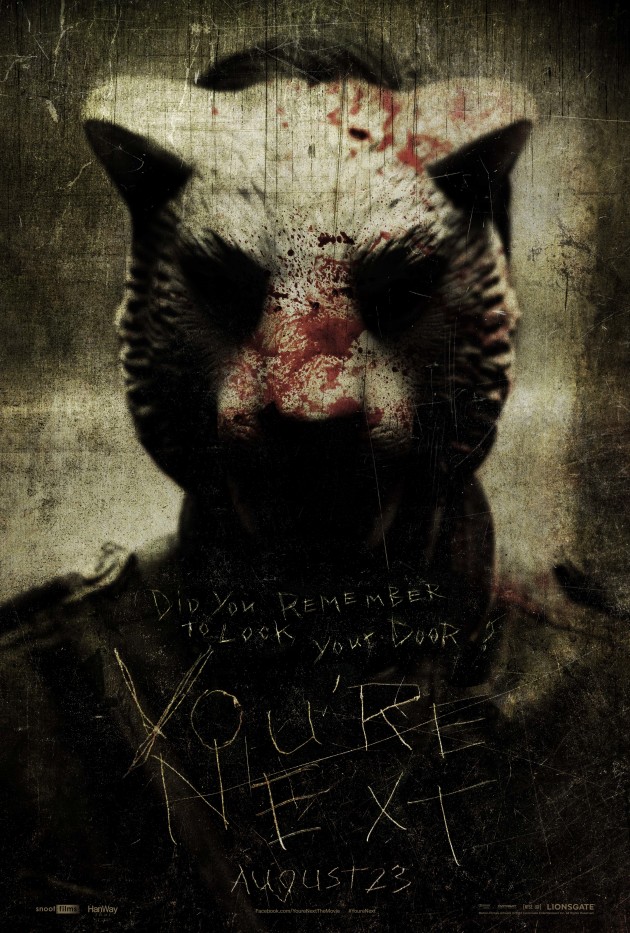 There has been a notable rise in home invasion thrillers in recent years but I am doubtful we’ve hit the crest just yet (this may also be hope speaking since I co-wrote one). Perhaps in an age of real-life anxiety on the news, the invasion of our personal sanctuary strikes an even more horrific chord. Whether you argue the upswing began with Panic Room, or Funny Games, or even the old Audrey Hepburn feature Wait Until Dark, the message is universal: nobody likes having their stuff messed with. This year we’ve already had The Purge make a splash at the box-office, and I’m sure Lionsgate is hopeful that their indie horror flick, You’re Next, which has been reaping great buzz along the festival circuit for years now, will make a similar splash. For me, You’re Next checked every box I would want in an effective horror film: good thrills, good humor, and a good ending. That adds up to one hell of a good time at the movies.
Crispian (AJ Bowen) is traveling all the way upstate for a family reunion at his parent’s palatial mansion in the woods. He’s also going to introduce his new girlfriend, Erin (Charni Vinson), an Australian graduate student that used to work as his teaching assistant at his college. Crispian’s rich family includes his excitable younger sister, his obnoxious older brother, his youngest detached brother, everyone’s boyfriend and girlfriend, and mom and dad. In between a lively family discussion/argument at the dinner table, arrows start flying through their window. Three mean wearing ominous animals masks are stalking outside, armed, and with every intent to kill everyone inside. The masked killers leave ominous messages painted in blood, noting, “You’re next” (I know they’re senseless murderers, but points for using the correct form of “you’re”). Erin snaps into survival mode and assembles a system of defenses but there are more threats than anyone imagined.
 To take nothing away from the artistic merits of You’re Next, the biggest selling point, and its greatest attribute, is that it knows how to properly work over an audience. While nowhere near the genre deconstruction that was last year’s Cabin in the Woods, nor as clever, here is a movie that knows it’s a horror movie, knows you’ve seen these movies before, and knows what you’re looking for as an audience member. And once the killing starts, the movie also gains a delightfully macabre sense of humor, an impish darkness that will leave you chuckling. I heartily recommend seeing this movie in a packed theater because the collective response will add to your enjoyment, or at least it did mine. Never have I experienced a movie where the audience cheered the plugging in of an ordinary kitchen appliance with such reckless enthusiasm. Thanks to director Adam Wingard and screenwriter Simon Barrett, the movie packs great payoffs in its second half, as our prototypical Final Girl outflanks her attackers. There are enough twists and turns to keep things interesting and the pacing swift. Once those arrows pop, this thing just flies by, moving at a speed that keeps you satiated with scares, thrills, and humor. In essence, You’re Next knows how to have fun with an audience, and for whatever reason, with the glut of dank home invasion horror thrillers, this is a surprise. With all the family trauma and killing, watching their loved ones cruelly slip away in horrific fashion, it’s worth praise that Wingard and Barrett find a happy tonal middle-ground that doesn’t blunt the horror or the comedy. The laughs don’t feel out of place with the screams. They make this work. And there are some really sick laughs to be had too.
My only familiarity with Wingard is from his involvement in the horror anthology series V/H/S and The ABCs of Death. It’s also somewhat entertaining to note that all three movies, both V/H/S and its sequel, have been released before You’re Next, a film that was completed two years prior. His anthology segments didn’t point to the same level of promise on full display with You’re Next. Wingard does a great job of orienting his audience to the geography of the play area, so to speak, while juggling different simultaneous threats and maintain a sense of clarity. He knows when to hold back, and he knows when the audience needs a peak of something gruesome. Initially, with the animal masks and the attack on the wealthy, I thought the film was gearing up for a dose of environmental social commentary, as if the killers were extreme defenders of Mother Nature. I’m actually relieved that the film never picks up any ham-handed political subtext.
 As a horror movie, it’s far more effective than most genre deconstructions that will undercut the terror for the chance at a good joke. Even Cabin in the Woods was like this. Again, You’re Next can be riotously funny, especially in the last act, but it can also, and often is, quite suspenseful as well. Once the game get sunder way, you start playing along as well, guessing which of our participants will indeed be next. They place themselves in precarious positions often, especially early, which makes it all the more suspenseful, because you’re suspecting anything can happen at any time. You’re lying in wait, and Wingard does an excellent job of drawing out that tension to a peak level before hitting the horror or gore. There are some gruesomely bloody moments in the film but it doesn’t lovingly linger on the deconstruction of the human body. And just when it seems like the number of housemates fighting for their lives has gotten so low that the thrills would have to be successfully all wrung out, You’re Next supplies a twist that changes gears, introducing a new threat and a new level of dramatic tension. When Erin assembles an ax to smash into the skull of whoever opens the front door, you’re eagerly waiting for that Chekov’s gun to fire (Can we rename it Chekov’s Ax to the Face?). The fact that the movie is almost designed as a Home Alone for demented adults is ingenious.
The acting is a bit hit or miss but the standout, by far, is Vinson (Step Up 3D). She’s our lead heroine, yes, but she takes charge in a way usually reserved for men in these types of movies. She has all sorts of crafty experience with wilderness survival and setting up traps, plus she is able to marshal the family from a bunch of WASPs screaming their guts out into something of a fighting force. And plus, Vinson just has an awesome screen presence to her. It’s a great role for her but credit the actress for knocking it out, giving the audience a strong, extremely capable, and empathetic hero. It’s satisfying to watch the masked killers be outfoxed by their prey. Many of the actors in the film are filmmakers themselves (Joe Swanberg, Ti West, Amy Seimetz), and they’ve collaborated on numerous projects, including other lo-fi horror features, the new Splat Pack if you will.
If you’re looking for a fun horror movie with a dark sense of humor, then You’re Next should be next on your list. It’s savvy, scary, and knows how to goose an audience at just the right moments. Wingard and Barrett know how to give an audience what they want without pandering, and that’s what elevates You’re Next from its peers. This is a horror film that can scare you one minute, make you laugh uncomfortably the next, and then ultimate leave you cheering the vengeful dismemberment of human life with kitchen appliances. It is a more than effectively put together horror thriller from beginning to end.
Nate’s Grade: B+
Share this:

Pain & Gain (2013)
 I think the audience for Pain and Gain is going to know exactly who they are, and I count myself amongst that number. The latest from director Michael Bay, often treated tantamount to Satan in many critical circles, has the based-on-a-true-story hook but really it’s the big stars, stylish violence, peculiar criminal antics, and overall overflowing machismo of the picture that will draw its audience. I knew after one watch of the trailer that I wanted to see it, though I was somewhat ashamed of the level of my interest (don’t want to taint your critical credentials with too much sympathy for the devil, after all). Pain and Gain is a trashy and entertaining jaunt, just as I hoped it would be, but it overstays its welcome and may leave you fatigued and possibly dejected (so… a typical Michael Bay movie? Still got it).
In 1995, three Miami, Florida goons enacted one of the most bizarre and sordid criminal schemes, a story that could supply a tabloid with enough juicy exposes for a year. Daniel Lugo (Mark Wahlberg) and his co-worker Adrian Doorbal (Anthony Mackie) are personal trainers at Sun Gym. Their days consist of pumping iron and hitting on ladies. One of Lugo’s clients is Victor Kershaw (Tony Shalhoub), a wealthy businessman with a nasty temper. Lugo and Doorbal, with the help of an ex-con and ex-junkie (Dwayne “The Rock” Johnson), kidnap Kershaw, hold him hostage for weeks, torture him, and eventually get him to sign over his assets to them. Afterwards they try to stage his “accidental” death, though like most things, it does not go according to plan. Penniless and broken, Kershaw seeks out help from a retired private eye, ED DuBois (Ed Harris), to provide validation for his case. The Miami police are laughing off his claims. Kershaw is concerned that the Sun Gym gang will strike again when their lavish lifestyle dips, and he’s right. Lugo and company get into even more trouble and the body count rises.
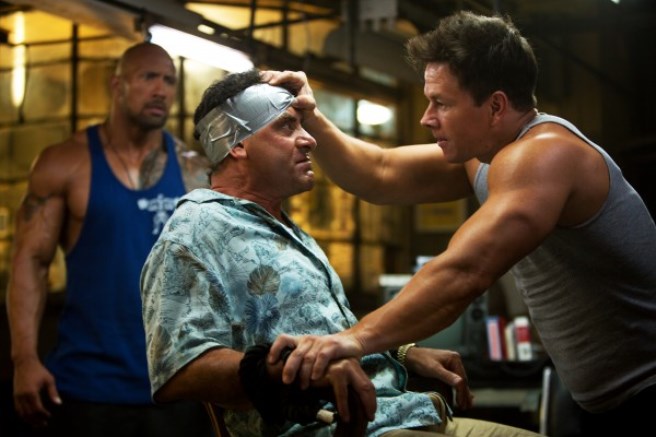 The results on screen are often entertaining in an over-the-top fashion, sustaining a rubbernecking captivation much like a horrendous car wreck. You just have to see how much crazier this thing gets, all the while muttering to yourself, “This was a true story?” It even gets to the point where the movie will remind you, via onscreen text as a man barbecues a batch of severed hands, that yes this is still a true story. Naturally there have been fictional inventions, character composites, and some details have been dropped to fit into the confines of a film narrative, but online research shows me that most of the larger plot beats are accurate, thus making the film even more compelling and disturbing. When the film is on, it feels manically alive with intrigue and absurdity. The problem is that it cannot keep this manic tone alive forever especially when actual innocent bodies start piling up (more on that later). There’s a certain uncomfortable tonal incongruity as the film develops and the comedy picks up a distasteful resonance. I love a well-executed dark comedy but just because something is macabre or unexpected does not automatically make it funny. Still, the movie has enough high-energy antisocial antics to keep you planted in your seat, laughing through bafflement.
Pain and Gain isn’t subtle in the slightest and yet it’s easily the most nuanced film of Bay’s career. Of course there are still the sleek cars, sexy babes, emphasis on style, and wanton destruction that are hallmarks of the man’s career, but the perspective is given a satirical prism, dropping us into the deluded, sub-American Psycho perspective of Lugo, a man with a very cracked view of the American Dream. The moral message reminds me of Marge Gunderson’s concluding musing in Fargo, telling a captured criminal, “There’s more to life than a little money, you know.” There’s some slight social commentary on wealth and the dirty tricks of capitalism, but really it’s the narcissistic delusions of a jacked-up criminal who believes he can succeed because he’s “seen a lot of movies.” You may even find yourself sympathizing with some of these knuckleheads, that is, until things get way out of hand. The screenplay by Christopher Markus and Stephen McFeely (Captain America: The First Avenger) is briskly paced and packed with bizarre details and even jumps into six different characters for voice over (Wahlberg, Johnson, Mackie, Shalhoub, Harris, and Bar Paly). For some characters it works as a great insight into their twisted logic but for others it’s just an easy set up for ridicule. The juvenile humor (did we really need a visual pubic hair joke?), candy-coated film palate, and sugar-rush, roid-rage plotting feel like a suitable match for the talents of the bombastic Bay.
The last thirty minutes of the movie will test your sensibilities of good taste. I’m all for having unlikable central characters just as long as the writer makes them interesting (what good is likeable but boring, the “friend zone” of characterization?). Some of movie history’s most fascinating characters have been scumbags and psychos. However, with that being said, I need my unlikeable characters to at least progress. When I’m stuck with a bad dude who keeps making the same bad mistakes, it can grow tiresome, and that’s where Pain and Gain ultimately lost me. Bay can’t quite keep up the charade of ironic bemusement forever, and a saggy second half starts to tread water, forcing the characters to act even more outlandish and inept. Did we need The Rock losing his big toe and then inexplicably giving it to a dog? It feels like the movie is filling time until the accidental murders come into being, raising the stakes. For a movie that’s 130 minutes, there should not be any need to fill time. During that long sad stretch, you start to feel disquiet, like the movie has lost its sense of perspective and the jokes have gotten too mean, too ugly, too outlandish. It doesn’t feel funny any more, and maybe that’s ultimately the point, but by the end Pain and Gain has soured. It overstays its welcome and then some.
 Its tone and connection to the real world raises an interesting and thorny question over whether something like this is appropriate. Should a story that involved the murders of innocent people end up becoming an over-the-top, stylized, lavishly glamorized Hollywood crime comedy? It has been over 15 years since the events of the Sun Gym gang, but is there a statue of limitations on good taste? Are we eventually destined for a vulgar film tackling the poor lives of the victims of 9/11? The answer is almost certain. What is off limits, or more pressingly, should anything be off limits to a comedic narrative? Is anyone really furious with Trey Parker and Matt Stone over their first film, Cannibal the Musical, transforming nineteenth century murder into song and dance? I doubt it, and yet there was something very off-putting about 2011’s 30 Minutes or Less, an unfunny comedy based around the true story of a pizza guy strapped with a bomb and ordered to rob a bank. The guy was blown to bits in real life (ha ha?). I guess I, as well as audiences, would have been more forgiving if the movie had been funny. I’m sure there would be fewer objections if Bay’s film had been more of a sober, contemplative drama on the sad acts of a bunch of desperate criminals, but with all the hyperbolic elements, machismo, and so-crazy-it-must-be-true plot turns, how could you turn this story into a serious drama? Not from the perspective of the nitwit criminals, at least. I don’t think the movie is ever positioning these guys as anti-heroes or excuses their excess.
Wahlberg (Ted) broke out as an actor thanks to a similar role as a wannabe star whose ambitions exceeded his grasp, and the man does dumb as good as just about anyone in Hollywood. It’s a specific kind of dumb, the angry, arrogant, pissy, self-involved kind of dumb that makes it acceptable to ridicule his character to no end. Johnson (G.I. Joe: Retaliation) gets to explore some interesting range as an actor, pacing around the demons of his character before just going hog-wild with the excess. Mackie (Gangster Squad) is arguable the most sympathetic of the group but also with the most to lose. Compared to his peers, he’s practically mild-mannered even though he takes injections into his penis. Shalhoub (TV’s Monk) is amusingly apoplectic and just enough of a jerk that you excuse his misfortune, at least for a little while. Ken Jeong (The Hangover) and Israeli model-turned-actor Bar Paly give the exact performances you would expect them to deliver. The best actor in the whole movie, though truth be told there isn’t a stinker in the bunch, is Emily Rutherford (Elizabethtown, TV’s The New Adventures of Old Christine) who plays Dubois’ wife. She has this calming, down-to-earth presence that seems to bring a small sense of peace to the madcap antics. She doesn’t have a lot of screen time but you’ll wish she had lots more.
Perhaps I’m being unfair to a movie that clearly isn’t intending to be anything but naughty, tacky, and gleefully excessive. In a way Pain and Gain reminds me of Tony Scott’s Domino, loosely based upon a true story but crushed to death by narrative kabuki and Scott’s characteristic excess. If I wanted to defend the much maligned Michael Bay, I’d argue what the real difference is between his excess and the excess of the more critically lauded Scott? Bay doesn’t have a slate of movies to his credit the likes of Top Gun, Crimson Tide, or True Romance. But isn’t flashy, artistic excess all the same when in the name of empty storytelling? Domino is also an apt comparison because it’s ultimately tiresome and far overstays its welcome, losing its audience with an endless array of odd sidesteps and moronic, deviant characters. While Pain and Gain has enough quirk and style to justify consideration, you may not respect yourself once it’s over.
Nate’s Grade: C+
Share this:

Spring Breakers (2013)
 Harmony Korine is the kind of filmmaker who I typically avoid. I haven’t liked a single one of the movies the man has written or directed. This list includes Kids, Julien Donkey-Boy, Trash Humpers, and the detestable 1997 film, Gummo, possibly one of my most hated films. The man has become an expert on depicting juvenile delinquents and the excesses of youthful folly, so I wasn’t surprised that his latest writing/directing effort, Spring Breakers, followed suit. I was surprised at the names he was able to attract to the film. Former Disney Channel starlets Selena Gomez and Vanessa Hudgens, as well as ABC Family’s Ashley Benson, join Rachel Korine as a foursome of gals who long for the pleasures of a spring break getaway. They scrimp and save for months, plus also rob a restaurant, and take their sojourn to the sunny beaches of Florida. The girls run afoul of the law and are bailed out by rapper and wannabe gangster Alien (James Franco). Living large, and with handy access to a plethora of weapons, the girls get involved in the crosshairs of a turf war, but they won’t let anything bring down their good times.
When you break it down to its trashy molecular core, Spring Breakers is like an exploitation film as directed by Terrence Malick. Allow me to explain, dear reader. Much like that hallowed art house filmmaker, the plot in Spring Breakers is really a wispy, abstract concept, and the film is prone to repetition and redundancy, a triptych for the senses. There’s plenty of overlapping dialogue that circles back and repeats itself, images that bleed into one another, and a plot that generally takes its cues from MC Skat Kat, namely moving two steps forward and then two steps back (is this reference too dated?). The rote dialogue, when not indifferently profane and nonsensical, is usually variations on, “Spring Break. Spring Break forever.” I’ve just given you about a fifth of the entire movie’s dialogue. It may have just been my theater’s sound system, but I found much of the dialogue hard to hear and decipher. Perhaps it was Korine admitting that the things his characters say weren’t worth straining to hear. As expected, this can get rather frustrating to sit through. It’s not so much a movie as an experience meant to wash over the audience. Hence the nonstop dubstep score, provided by Skrillex, and the crashing imagery of tawny exposed flesh, gyrating bodies, neon lighting, fellating gun barrels, and excessive inebriation, all meant to bring the spring break experience to the consumer, that is, if most people’s spring breaks involved lots of illegal activity. If Malick’s movies are meant to serve as religious experiences, then consider Spring Breakers to be the equivalent of ingesting GHB.
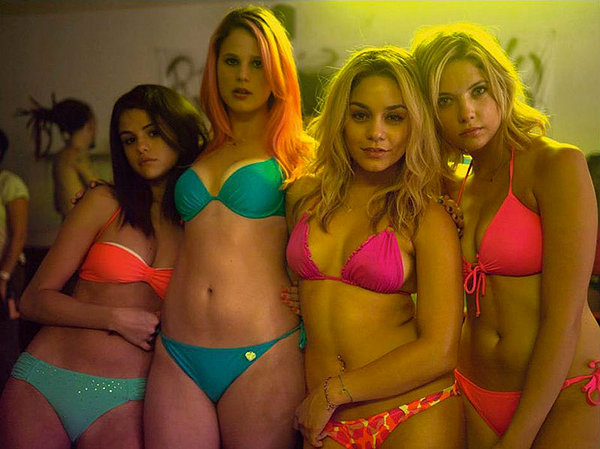 Let’s talk about that paucity of characterization. Besides Faith (Gomez), a name a bit too on-the-nose for this sort of enterprise, there is zero I can say about ANY of the other three girls. They are completely interchangeable. They have no defining characteristics beyond their simple geographic placement within the camera frame. That’s it. When Faith ditches the movie at the halfway mark, having the good sense to realize her supposed friends might not be the best influence, I wanted to go with her. I didn’t want to be left with these vacuous and annoying characters. It’s pretty clear the contempt that Korine has for his own female characters, constantly serving them up for ridicule. It makes the whole movie even less appealing. We’re not supposed to like our heroines but it gets uncomfortable when the director seems to be constantly shaming them, rubbing our faces in how awful they are as people. With an absence of characters you care about, and a plot that feels like it keeps circling back, there’s precious little to hold onto before you become anesthetized to Korine’s exploitative navel-gazing.
After Oz the Great and Powerful I didn’t think I would utter these words, but thank God for the presence of James Franco. The man is so fully committed to his gonzo portrayal of a white trash wannabe gangster that you are downright thankful when he takes over the movie halfway in. At least we don’t have to spend as much time with our empty-headed trio of ladies. Franco, perfecting an ominous drawl, is a cartoon of misplaced machismo, living the “gangsta” life he’s seen parroted in pop culture (he has Scarface running on a constant loop on his TVs). He provides a jolt of energy to the movie, a second wind, and thankfully pushes the girls into greater conflict than part-to-party binges. He brings a real sense of danger to the film, and the descent into a criminal path couldn’t have come soon enough for me. It’s such an enjoyably whacked-out performance that I wouldn’t be surprised if Franco may even be considered for some Best Supporting Actor nominations.
There’s something just so tiring and depressing about watching people trying to chase a hedonistic high rather than, you know, live their lives. In this warped sense of thinking, the all-encompassing term of “partying” is meant to be the divine state of being and anything else falls by the wayside of significance. I understand the movie is exposing a shallow and empty way of life but it can still be tiring to watch nonstop. You become numb to the onscreen antics. You become numb to the free-flowing spirits, profanity, and gratuitous nudity (there were literally six topless ladies onscreen before a word was spoken). Watching Spring Breakers, you have two options: give yourself over to the trance-like, self-destructive youthful fever-dream or sit solemnly, objectively observing how the outrageous become routine, and become dead inside.
As much as it pains me to admit, being a non-fan of Korine’s movies, there are a few moments in the movie that are actually surprisingly effective. The first is a hasty robbery of a small restaurant. We stay in the passenger seat of the slow-moving car as it spins around the building, and in the background we see the escalation of events, the girls smashing breakables and terrorizing the few patrons. It’s one of the few visual decisions that felt, and here’s a word you won’t find anywhere else in relation to this movie, artistically restrained. There’s also plenty of forced irony in the movie where a character’s positive words will be counterbalanced by a visual contrast. Faith phones her grandmother and talks about her great time, even promising next year that she wants to take dear old granny along with her. Meanwhile, as the words play out, which will happen again at several redundant points, we see the girls engaging in behavior that would most likely not be granny-approved. Even if forced, and often redundant, it’s still effective, as is Korine’s hypnotic visual sensibilities. If nothing else, Spring Breakers is a good-looking movie with many pleasing visuals.
 I think I understand why my critical peers have lavished as much praise upon Korine’s bacchanalia. They see a satire of this empty, nihilistic, party-all-the-time, damn-the-consequences lifestyle, the idiocy of youthful hedonism. The problem is that there’s only a handful of moments in Spring Breakers where I felt that Korine actually achieved satire, one of them being a montage of robberies set to a Britney Spears song (beforehand we saw girls holding guns by the barrel and dancing in a circle). Those moments that struck me as satire were few and far between, because what I mostly left with was just another exploitation film. If this were meant to be satirical, the girls would not get away with it all in the end. Korine may intend to stand back in some ironic judgment of his own movie, providing himself an excuse for the lackluster plotting and characters. Here’s the point: even if it was done intentionally, it still makes for a lackluster plot and characters. Saying, “I meant that all along,” is not an excuse when the rest of the film fails to live up to your stated satirical intents.
Allow me a moment to talk about the somewhat disconcerting treatment of, for lack of a better description, the sluttiest of our gals, Cotty, played by Rachel Korine. When I saw the last name of Korine I thought, “Is that the director’s daughter?” Harmony Korine has been in the film industry for almost 20 years, so it was a possibility, and oh what a disturbing thought that was. Some cursory research proved that Rachel Korine was in fact Harmony’s wife; there’s a thirteen-year age difference. It’s still uncomfortable that Korine would slot his own wife to portray one of the titular spring breakers, the only one from our posse who goes nude onscreen too (sorry skeevy Disney Channel and ABC Family fans). So when he’s slut shaming these girls, mocking them with contempt, directing their gratuitous exploitation, he’s also including his own wife in this distasteful characterization, making sure the camera has multiple opportunities to take in her exposed flesh. It’s like he’s serving up his own wife to the gods of spring break (a.k.a. young male ticket-buyers), and it just seems icky.
When Spring Breakers came to a merciful close, the college-aged guy behind me remarked, “That’s the weirdest movie I’ve ever seen.” I replied, “Then you haven’t seen a lot of movies, have you?” Korine’s abstract, aimless salute to self-indulgence is a depressing experience that celebrates the worst in human beings, but weird it is not. I’m just tired of Korine’s schtick. He presents trashy characters, prods us to ridicule them, and then gives them a lot of empty space to do dumb things for an hour and half, ultimately going nowhere and accomplishing little. It just so happens that Spring Breakers, his most commercial and accessible film, has attractive, nominally famous actresses partaking in the nastiness this time. I suppose there will be some appeal to a small swath of filmgoers to see former squeaky-clean Disney Channel gals cutting loose, behaving badly, and playing against (manufactured) type. For me, the very casting of these ladies was another sign of Korine’s artistically bare ambitions. If he wanted to hold up the entire escapist spring break pleasure-seeking lifestyle for satire, then he needed to push harder. What’s on the screen is rarely satire. Instead, it’s just another careless exploitation film, replete with moronic characters we don’t care about and a plot that would be charitably described as, well, a plot. Even Franco’s calculated weirdness cannot save this film. Spring Breakers is a trip best avoided.
Nate’s Grade: C-
Share this:

Seeking a Friend for the End of the World (2012)
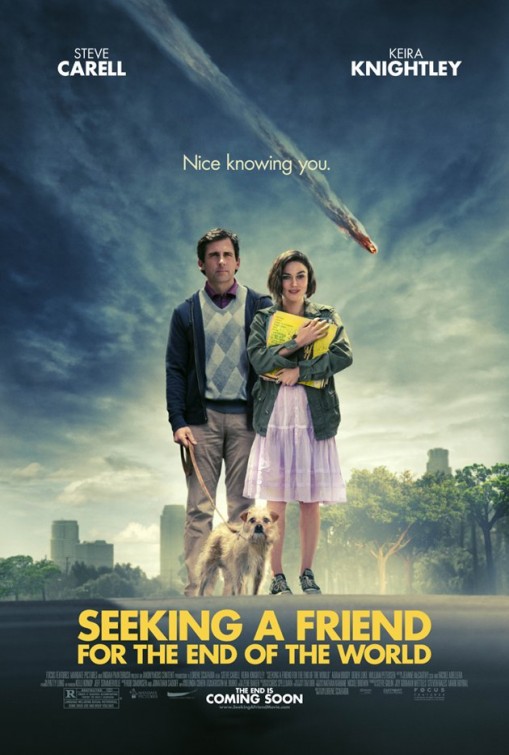 It’s the end of the world as we know it and I oddly felt fine… which is not a good sign for your apocalyptic movie. Seeking a Friend for the End of the World is a peculiar thing, all right. It takes place in the last three weeks of the human race. And lest you think the film wimps out on the promise of its title, think again. I was bemused for the first forty minutes, where writer/director Lorene Scafaria indulges in a series of one-scene vignettes of how humanity comes to terms with the certainty of annihilation. There’s an adult party where people joyfully try heroin, a hit man-for-hire service to bring back some of the mystery of death, and a restaurant where all the workers are spaced out on Ecstasy. I found each of these moments to be funny and a well though-out extension of the premise. But then the film’s diversions give way to the rom-com of our main characters, played by Steve Carell and Keira Knightley as your standard manic pixie girl. And the more time I spent with them the more I found myself not getting engaged. My emotional empathy was kept to a minimum; they’re nice people and all but I didn’t find them that interesting. The resulting movie feels like one of the weakest avenues given the premise. I credit Scafaria for not wimping out in the end, but as these characters faced oblivion together, I felt little emotional stirrings in my chest.
Nate’s Grade: C+
Share this:

Piranha 3DD (2012)
 Wow, I was not expecting the follow-up to the so-bad-it’s-excellent Piranha 3D to pretty much just inhabit the “so bad” spectrum, though I ignored warning signs at my own risk. I found the 2010 Piranha to be a sheer blast of campy entertainment, with some world-class gore effects and a game cast. I was actually terribly excited about a sequel; I’m ashamed to admit it now. Where did things go so horribly wrong? Much like Expendables 2, the movie’s tone shifts from tongue-in-cheek 80s throwback to meta self-awareness. The movie becomes more of a lousy comedy with some absurd violence rather than a horror movie with a nasty sense of humor. The entire premise is so labored, that a water park would become piranha-infested, and the characters are so unlikable; to dub them one-dimensional is to be too kind. The acting is abysmal even by bottom-of-the-barrel B-movie standards. The celebrity cameos feel wasted, with David Hasselhoff soaking up every second of desperation. The tension is next to nil and the gore effects are pretty cheesy, trading gallons of blood for ingenuity (many character deaths occur off screen, like Gary Busey’s). Then once the piranhas strike, the movie just completely abandons any sense of reality and becomes a gonzo comedy of the absurd, with characters behaving like idiots from another dimension. There’s even one character that gets decapitated by a simple string of flags. It’s at this point that Piranha 3DD drops any slapped-together sense of purpose. And yet this ghoulish mess can only barely make it to a scant 70 minutes (good luck getting through the abominably unfunny end credits outtakes). Reportedly, 3DD had almost the same budget of 3D. Where the hell did that money go? Piranha 3DD completely misfires on every level, failing as a horror movie, a horror-comedy, a comedy, a gore movie, hell, as a suitable movie. Whatever the metric, this movie blows. If you’re hard-pressed for gratuitous nudity soaked in blood, watch the superior 2010 Piranha film instead. I’m going to start drinking heavily and forget I ever looked forward to this monstrosity on taste.
Nate’s Grade: D
Share this:

Seven Psychopaths (2012)
 Writer/director Martin McDonagh only has one movie to his name but the man has already accrued legendary status in some circles. The 2008 dark comedy In Bruges didn’t create much of a blip at the box-office, but its blend of absurdist comedy, dark drama, shocking violence, and languid contemplation found a rabid cult following. I have several friends who regard In Bruges as the best film of 2008 (WALL-E still reigns supreme for me but I quite enjoyed In Bruges).McDonuagh’s latest, Seven Psychopaths, reminds me of Barton Fink: both are about struggling writers, both are satires of the film industry, and both have sudden splashes of violence and a serial killer who pushes the protagonist to artistic completion. In other words, Seven Psychopaths is a fun film and a great time at the movies.
Marty (Colin Farrell) is experiencing some killer writer’s block. He’s stuck on his new screenplay titled “Seven Psychopaths.” His buddy Billy (Sam Rockwell) is eager to help out. The guys run afoul of another psychopath, mob boss Charlie (Woody Harrelson), due to Billy’s side business. He kidnaps rich people’s dogs and then his partner, Hans (Christopher Walken), returns them and collects a reward. Billy and Hans have kidnapped the wrong shih tzu, and now Charlie and his muscle is going to make them pay.
 The refreshing thing about the bloody, wickedly entertaining Seven Psychopaths is that it constantly surprises you. This is such a rarity with modern movies, particularly Hollywood movies that attract as notable a cast as this one. McDonagh is wonderfully adept at throwing narrative curveballs. There were a few surprises where I literally jumped in my seat. You constantly think you have the movie figured out, and then it goes down a different alley and becomes more interesting. One of the pleasures of having psychopathic lead characters is that they are impulsive and do not have to follow the normal purview of logical decision making. They might just call the bad guys and divulge where they are hiding. They can do anything at any moment, and part of that unpredictability is what makes the movie feel so electric, so creatively alive. I must stress that McDonagh surprises in ways that feel satisfying and yet believable given the world he’s concocted. Part of the fun in the first half is just figuring out who the seven psychopaths will be. It’s not like it’s some laconic chamber piece mystery but the psychopaths are an eclectic mix from the real to the fictional to real characters doubling as inspiration for fictional ones. I think in the end there may only be six psychopaths, unless McDonagh is counting himself amongst the numbers.
McDonagh also has a blast deconstructing the very kind of movie that he’s providing. Marty bemoans writing another rote psychopathic killer movie where the violence is fetishized and the bad guys are mythologized into idols. You think the film is headed in one direction, in the Guy Ritchie-style standoffs and shootouts, and then it takes a less traveled path, one where it criticizes these sorts of movies and ponders existential questions about the nature of self-expression and death. It began as a care-free movie about thugs and writers and transformed into a movie that manages to have something to say about life, philosophy, and the cyclical nature of vengeance. Two of our three main protagonists are pacifists and remain so to their imperilment. At one point, a character narrates how this story as a proper movie would end, and it covers all the nihilistic clichés of vengeance and epic body counts. But then Marty, and McDonagh as well, wants to turn away from the expected, from violence for the sake of violence, from the exploitation of stylized suffering. McDonagh doesn’t forget to entertain while he’s making you think in between those handfuls of popcorn. The female characters in the movie (Abbie Cornish, Olga Kurylenko) are generally wasted, in different senses, but McDonagh uses this as another charge against this type of film (a boy’s night out of carnage). This is an accessible movie that can be enjoyed on a whole other meta level. I loved the various gear changes. For me it took the pulpy action material and elevated it to another level of genius.
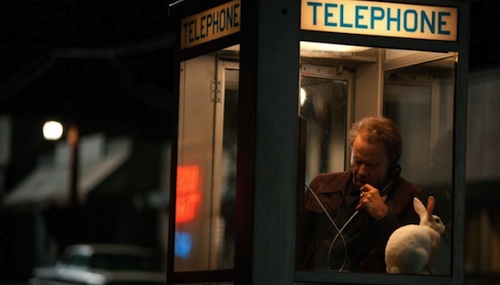 McDonagh still maintains his darkly sardonic streak of humor that made In Bruges such a riot. I was laughing throughout Seven Psychopaths; chortles, snorts, giggles, big belly laughs. With its heedless violence, obviously this will not be a film that runs on every person’s wavelength of funny. The very opening involves two mafia hitman debating whether shooting somebody in the eye takes actual precision or just dumb luck. It’s the sort of mundane conversation you’d see in a Quentin Tarantino movie, and also the precursor to something nasty and ironic. McDonagh’s sense of humor is similar to Ritchie or the Coen brothers, but the man establishes his own sense of wicked whimsy. The absurdist dialogue is always a hoot and can generate serious malice, especially when delivered by stern psychopaths. Rockwell (Moon) in particular is outstanding and delivers a virtuoso performance of the unhinged. The man just radiates energy. You’ll feel jacked up just watching him. I keep waiting for this underrated actor to break out with each star-making turn, and his comedic zing is played to perfection in Seven Psychopaths. In contrast, Walken (Hairspray) is rather reserved as he underplays his character, one of the saner men he’s played. It feels like the passing of the torch from the older generation of psychopath to the newer generation.
Being a colorful movie about colorful bad guys, and girls, you’d expect there to be some grade-A oddballs, and McDonagh does not disappoint. Some of the psychopaths in question have little bearing on the story plot-wise. There’s Zachariah played by the impeccable Tom Waits (The Imaginarium of Doctor Parnassus). He answers an ad that Billy set up for psychopaths to share their stories to Marty. His tale involves cross-country spree killing of serial killers, rabbit petting, and the love of his life, and partner in crime, leaving him. As far as plot, this little aside has little significance to the plot other than setting up a superb joke to end the movie with. But the character is so interesting, multidimensional, and played with equal parts aloofness and sincerity by Waits, that you can’t imagine the movie without him. Several of these psychopaths could have been the stars of their own movie, from the vigilante killing mob thugs to the tale of one father’s long path to vengeance. Even the fictional psychopath, the Vietnamese man (Long Nguyen) seeking vengeance against G.I.’s, could have enough weight to carry a feature film. The amazing part of the movie is that you don’t feel like any of these characters are shortchanged. McDonagh finds ways to emotionally ground his characters, allowing the audience to empathize amidst the bloodshed and loony characters. We care about Hans and his ailing wife; we care about the friendship between Marty and Billy. It’s real for these characters and so it feels real to us, despite the hyper-real flourishes of the movie.
If you’re a fan of In Bruges, or just dark comedies mixed with sudden violence, then you’ll probably find something to enjoy with Seven Psychopaths. You don’t have to be nuts but it helps. McDonagh has crafted another winner with sharp dialogue, a twisty plot full of surprises, incisive commentary on movies and movie expectations, as well as some sincere soul-searching and poignancy. This baby has it all, folks. Above all else, it’s just a blast of fun. the actors all seem to be having the times of their lives, notably Rockwell, and the morbid laughs and off-kilter thrills should cement another McDonaugh film for cult status. Seven Psychopaths is a palyful movie along the lines of Kiss Kiss Bang Bang and even Adaptation. It’s bursting with ideas and comments and jokes. when you leave the theater you almost want to get back in line and start the ride all over again.
Nate’s Grade: A-
Share this:

Frankenweenie (2012)
 Tim Burton’s stop-motion remake of his own 30-minute short is a cute movie, even with the creepy subject matter. It’s the story of a boy and his dog and coming to terms with loss, although that seems to get stalled since the kid brings his dog back to life. Frankenweenie is, as my pal Eric said, Burton’s love letter to the Universal monsters of old, as other kids resurrect their pets into mummies, vampires, werewolves, etc. As a story, it’s pretty plain and seems thin and padded out. The animation is fun to watch but I couldn’t shake my questions about the character design. It feels like the only parts that move on these bulky faces are their tiny mouths. It’s a strange design that undercuts the animators’ efforts, and I couldn’t help comparing it to the superior and expressive animation from ParaNorman. I’d say this is the weakest stop-motion film with Burton’s name attached to it, but by no means is Frankenweenie a bad film. It’s got some fun jokes and any story about the loss of a beloved pet is going to have plenty of heart. There are some pretty solid jokes but they all seem to pool in the first act. I enjoyed Sparky the dog’s romance with the neighboring poodle, more so than any of the human relationships. Beyond the kid/dog aspect, I found it hard to engage with the movie. If you have to see one stop-motion animated film about the supernatural, check out ParaNorman instead.
Nate’s Grade: B-
Share this:

ParaNorman (2012)
 The gorgeously animated stop-motion film ParaNorman is a terrific sight for the eyes. There’s a certain magic to stop-motion, the tangible nature of it all, the knowledge that these intricate worlds actually existed. Like Coraline, the previous film by the same animation house, I thoroughly enjoyed immersing myself in this handcrafted world. The animation is so fluid, so sprightly, and displays a rich artistic tone. The story, about a kid who can see ghosts, is noticeably less ambitious. The characters are a tad one-dimensional (bratty older sister, dimwitted jock, socially awkward chubby best friend, etc.) and the plot is fairly predictable, but what really elevates ParaNorman is its sense of humor. I was laughing heartily throughout the movie, not just a giggle or a chortle but good, solid laughs. ParaNorman has an irreverent sense of humor with some surprisingly adult-oriented gags (nothing to worry about parents). With these virtues, the movie becomes an entertaining horror comedy aimed at young teens and older adults. It’s a fun movie, short of a saggy second act, and the animation is aces.
Nate’s Grade: B
Share this:

Killer Joe (2012)
 This is one nasty, alarming, but very involving movie that wallows in darkness and plays it up for laughs. Killer Joe is a dysfunctional family drama, a crime thriller, and a mesmerizing character study when it comes to the lessons of amorality. Based on the play by Tracy Letts (August: Osage County), Joe (Matthew McConaughey) is a crooked cop who works as an assassin on the side. A weasely loser (Emile Hirsch) and his family hire Joe to kill their mother for the insurance money. Things get out of hand in frequent measure, with splashes of brutal violence, healthy amounts of sex and full-frontal nudity, and a disturbing sexual act with chicken that more than earn this film its adults-only NC-17 rating. What makes the movie rise above base exploitation is its depraved, deep-fried sense of humor. There is plenty of uncomfortable laughter and guffaws. The end of the film, during a fever-pitch of violence, is so sudden, so kooky, so debauched, that my friend and I burst out laughing. Without its wicked sense of humor, and its sharp ear for working-class dialogue, the movie could be accused of wallowing in the muck. There’s also the terrific acting, chiefly from McConaughey. He gives a hypnotic performance, chilling, unpredictable, and deeply committed to retribution. When he zeroes his cold eyes on you, boy does the flesh crawl. It’s an intense performance and arguably the best of the man’s career. Directed by William Friedkin (who also directed the 2006 adaptation of Letts’ play, Bug) with brutish élan, Killer Joe is one nasty piece of work, but given the right audience, it could prove to be a perverse entertainment.
Nate’s Grade: B
Share this:

Hobo with a Shotgun (2011)
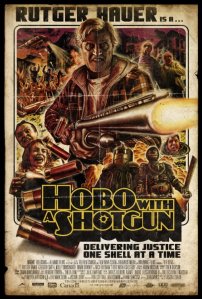 Consider the ultraviolet, gleefully vulgar movie Hobo with a Shotgun is the SECOND feature-length film that began life as a fake trailer for the 2007 exploitation opus, Grindhouse. Except this film began as a fan-made trailer to win a Grindhouse contest. Director and co-writer Jason Eisener’s winning entry followed a homeless defender of the streets, a hobo who found himself thrust into greatness thanks to oen fortunate shotgun. The two-minute fake trailer became a viral hit, was even attached to Canadian prints of Grindhouse, and Eisener was asked to extend his bloody trailer into an actual movie. He scored Rutger Hauer (Bladerunner, The Hitcher) as the star. finally, an actor from the 1980s who begs for change – on purpose! Hauer’s hobo rides the rails into a very Canadian city (the hookers say “aboot” – it’s cute) discovering an urban landscape overrun by scum. Drug dealers, gangs, pedophiles, crooked cops, all under the thumb of crime boss, the Drake (Brian Downey) and his two sons, Slick and Ivan (Nick Bateman and Gregory Smith). Can one hobo, shotgun in hand, inspire a city to stand up?
Hobo with a Shotgun is a movie that lives up to its very title. It’s a gleeful, jubilantly violent, colorfully over-the-top genre exercise that doesn’t push your nose in its campy excesses. But it is excessive, and to what effect? If you stop to catch your breath, you’ll start to realize that there isn’t a whole lot holding the film together. It barely covers 80 minutes and that’s with a lot of wheezing to get to the finish. The plot is mostly a series of beheadings, stabbings, and, of course, gunshots. Sure it’s a fun throwback and meant to be entertaining due to its homage to awful exploitation films, but it’s a one-joke movie that’s pretty hollow at its center. He’s a hobo, he’s dispensing justice (“one shell at a time” a newscaster reports), that’s about all there is, not that I expect a film with a title like Hobo with a Shotgun to tackle weight philosophical topics (the titular hero seems like a figure that would give Ayn Rand fits). If somebody wants to go to the effort of making the hobo some metaphorical everyman, lashing out at a society he feels impotent and angrily displaced by, then by all means. This is not a film with commentary in its blood. It lacks the creative consistency of a Black Dynamite or the narrative pulse of a Planet Terror, or the genre-rattling re-purposing of a Tarantino effort (have your pick). But the violence is often brutal and sickeningly clever, sating base appetites.
 This is a movie chiefly about grotesque characters, grotesque violence, and grotesquely dark and demented laughs. Luckily, the film has a finely attuned sense of humor that elevates what otherwise might be static genre exercises. The film is fully aware of its outrageousness. One of the Drake’s thuggish sons literally walks around with ice skates on before confronting the hobo of fame. He declares somebody’s going to be “skate raped.” He then uses these unorthodox shoes as an unorthodox weapon. A hooker (Molly Dunsworth) with a heart of gold saves the hobo. He remarks, without a hint of irony: “You’re smart. You should be a teacher.” He then refers to her as a teacher for the rest of the film. They develop a bizarre relationship that involves the shared desire to see a bear in a zoo (no joke). A cop reasons, “Well at least he’s only shooting the dirty cops,” in reference to the hobo, to which the chief responds, irony-free, “We’re all dirty cops!” A pedophile is dressed up as Santa Claus and abducts children, including one who bangs on the back windshield of a car as it drives by our hobo. The fact that it happens not a second later than two or three other incidents of crime, creating a melange of overrun criminality, made me giggle. And some of the jokes in this movie are dark; I’m talking scorched earth dark, but I was howling throughout. Now you know where my sense of humor lies. The newspaper headlines decrying the vigilante uprising have a frenzied penchant for rhyme and overly serious statements that are often hilarious (“Hobo Refuses Money, Demands Change”).
Eisener takes care to make his film look like a relic from the 1970s, from the low-budget mayhem, to the ominous synth-laden score, to the highly saturated film colors that advertise being phony “Technicolor.” His camera is antic, constantly swooping to find its intended target, and the cinematography feels grimy, constantly lit by strong neon colors like Joel Schumacher was a paid consultant. Eisener would do best to settle down a bit at times. His direction is a little too erratic, a little too antsy, like he’s constantly afraid that his audience will turn on him. Hobo with a Shotgun is a loving yet messy and uneven homage to the schlock movies of old, and your enjoyment level of this flick will depend greatly on whether or not you appreciate movies aim low on purpose. The crazy nature of the film, its frenetic pacing, and its strong sense of humor will delight fans of trashy cinema. The rest of the audience will probably just view it as trash.
 Hauer is a classic movie tough that actually has a bit of a soul inside those steely blue eyes. He’s an actor that’s been giving small, quietly menacing performances over the last decade. He plays the character completely straight, which makes him far funnier and even somewhat surprisingly sympathetic and less sociopath than a Travis Bickle-esque figure that wants to cleanse society through blood. His dream is to own a lawnmower, which he loftily dreams of opening his own lawn care company. He’s spat on, beaten, and treated without a shred of respect. To many, the hobo is just a nuisance at best and a subhuman lecher at worst. Hauer doesn’t even have to say a word, just hang onto his weary grimace and it says enough about the character. The hobo character makes for an interesting dispenser of justice, though the character is little more than a concept with legs. However, Hauer makes this hobo one for the ages. Way better than the creepy magic hobo from The Polar Express.
The movie is more fun than it should be and at the same time the movie is nothing more than the power of its admittedly awesome title. This seedy, blood-soaked is destined to be an acquired taste for a select few, however, I doubt anyone will randomly stumble into something as provocatively titled as Hobo with a Shotgun. This is a self-aware B-movie celebration of the grindhouse canon while giving is a gentle parody nudge; enough to capture a wink without going into camp. It has enough of a chaotic energy and cracked sense of humor to make up for its narrative deficiencies. Hauer somehow finds a soul inside his cartoon hobo, which is more than I can say about any of the other actors. But when you’re in a movie with burning school children, pedophilic Santas, oddball lines like, “When life gives you razors… make a baseball bat filled with razors,” and a hero who dreams of owning a push mower, well, you’re not expecting Shakespeare.
Nate’s Grade: B


 nathanzoebl
You must be logged in to post a comment.