Blog Archives
The Girl Who Played with Fire (2010)
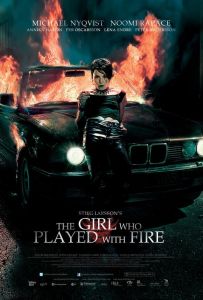 So in the few short months since The Girl with the Dragon Tattoo opened in the spring, the book series has catapulted to even new reaches of fame. It even appeared on the cover of Entertainment Weekly under the headline, “The hottest books on the planet.” I’ll take their word on that one. The Girl Who Kicked the Hornet’s Nest, the third book in late Swedish author Stieg Larsson’s series was finally released stateside, and depending upon when you read this, is probably still on the best-seller list. Larsson’s trilogy of novels is a global publishing phenomenon. The first film in the series made over $10 million dollars in the United States and was the top-grossing film in Europe last year. That says something about a 150-minute Swedish thriller with no-names attached. The Girl Who Played with Fire is the second film in the series and naturally couldn’t live up to expectations after the first smash movie. The second film is good, not great, but really whets the appetite for the concluding movie to come.
It’s been one year since the events of Girl with the Dragon Tattoo. The titular tattooed-girl, Lisbeth Salander (Noomi Rapace), has been living abroad. Her ally and one-time lover, Mikael Blomkvist (Michael Nyqvist), has been trying to get in contact with her but to no avail. Blomvist is about to publish a damning report about sex trafficking with some pretty high-profile names attached as members. The authors of the article are then executed and Lisbeth’s fingerprints are found on the gun left at the crime scene. Salander’s court-appointed guardian, the one who viciously raped her in the previous film, is also found murdered. Blomkvist is certain his companion is innocent and goes about investigating who is truly responsible. Salander comes out of hiding and back to Sweden where she tries to clear her name the best way she knows how. All roads seem to lead to a figure known as “Zala,” a Soviet spy who defected to Sweden ages ago but who has been carrying on in the shadows ever since.
 The focus with Fire in on Lisbeth Salander, which is exactly the character the audience wants to spend the most time with. Salander split duty with Blomkvist in the first film. They were equals, but a crusading journalist just isn’t as interesting as a five-foot Gothic ass-kicking computer hacker. As I wrote: “Mikael isn’t a blah character by any means but he seems to serve as an expository device, the guy who uncovers the secrets and gets to be the helpless foil to Lisbeth. I suppose for maximum narrative effect a straight man would be required to be paired with Lisbeth.” She is the star of the series so it’s a great pleasure to watch her receive oodles of screen time. The second film is significantly devoted to the history of Salander, her back-story, her father, what she did to get locked away in a mental ward (which was hinted at before). The sex trafficking murders are merely a narrative smokescreen. Being framed for the murders puts Lisbeth on defense, but the sex trafficking stuff and the high-profile johns quickly dissolve in the wake of a standard investigation into the mysterious “Zala.” The mystery of this film is really the mystery of Salander’s back-story and family tree. However, being focused primarily on Lisbeth Salander also means that everybody else gets sidelined. She’s on the run and trying to clear her name, but that doesn’t give much room for other people to contribute to the narrative. Blomkvist gets to pensively look at his computer screen a lot and always show up one step behind our heroine. The two are kept apart for nearly the entire movie.
Rapace is still the best reason to see the series. She inhabits the character with tremendous intensity and skill. If you stripped away all the aesthetics, the Goth trinkets, you would still have a vital character. As I wrote before: “There’s much more to this girl than a dragon tattoo and a spiked collar. Rapace doesn’t let the outfits overwhelm her. There’s a certain joyful recklessness to her character hidden beneath a veneer of steely coolness.” Because of her mysterious nature and painful past, Rapace must play all emotions through a prism of emotional reserve. Even though we get a lot more of Salander’s past explained, I felt like we got to know her as a character better in the first flick where she could breathe and behave “normally.” Thanks to being on the run for murder, it’s hard to argue that Lisbeth ever gets a chance to simply be her complicated self, which robs the audience of an appealing character. We project the interest we felt for her from the first film to the Salander stand-in represented in the second film. She’s still a resourceful, loyal, and cavalier presence, but the plot corners her into being a creature of action. She becomes the fantasy bisexual ass-kicking protagonist that was merely hinted at previously. That sounds like a good thing, but trust me, it does the audience a disservice to box in such a fascinating character.
 Girl Who Played with Fire is nowhere near the complete film experience that the first film offered. This movie feels like one half and the continuing half, The Girl Who Kicked the Hornet’s Nest, won’t be out until later in the fall. As such, it’s hard to fully analyze certain storylines at play. I imagine that the sex trafficking storyline will carry on with the third film because of the tease that high-profile figures in government and police offices were involved. It already establishes a conflict and a set of antagonists ready for the third film. Then again, I may be too hopeful and the storylines of interest in Part Two may be completely dropped or mishandled by Part Three (see: Matrix sequels, Pirates of the Caribbean sequels). Girl Who Played with Fire does a decent job of setting up a narrative base and establishing a one-shot villain, somebody to be dispatched by episode’s end. But the movie feels far from complete, and sadly I won’t know until later whether that incomplete feeling is from breaking up a continuing storyline or from deficits of filmmaking. There are too many loose ends with Girl Who Played with Fire for it to feel complete, and thus it cannot help but suffer in comparison to its predecessor.
Where the movie goes haywire is in its adoption of action tropes. The Girl with the Dragon Tattoo was more of a slow-burning thriller with some nasty flashes of violence. The second in the trilogy seems to take place more in the realm of action cinema, which means that things get a little preposterous. There are a lot more car chases, henchmen, fistfights, shootouts, and it almost unravels at the end. Slanader seems to transform into the Bride, sharing two key abilities from Uma Thurman?s character in the Kill Bill series (that’s about as spoilery as I want to get). Salander just becomes like a pint-sized Terminator; she’s indestructible and capable of amazing feats. It’s like the Swedes took the Hollywood edict that every sequel had to be bigger and better than the original. There’s even a lesbian love scene before the 20-minute mark, in case the audience was already getting bored (presented like something out of Cinemax late-night TV). I appreciated that the original film respected the intelligence of the audience, giving a deluge of information and characters to sort and trusting that in time we could follow along. The Girl Who Played with Fire is far less complicated in scope. In fact, it’s a fairly rote detective story that only dishes out clues when the characters need to progress. The first film actually utilized good detective work; the second film just has everything fall into people’s laps at predetermined points of need. The tension doesn’t manifest as ferociously as it did in Dragon Tattoo. For goodness sake, the chief antagonist has a hired goon that is actually a rip-off of a James Bond villain from The World is Not Enough, which was an awful Bond movie! The end focuses too much on the bloody confrontation between Lisbeth and a chief antagonist and an axe that apparently fails to mortally wound people when swung at their craniums.
 I think the switch in directors, from Niels Arden Oplev to Daniel Alfredson, has something to do with the slip in quality. To American audiences, this might not ever register, but the films have completely different tones. The turnover feels less abrupt thanks to the cast reappearing. The direction feels less focused, more casual and pedestrian, relying on that grimy green/orange cinematography that Dominic Sena (Gone in 60 Seconds) always favored so much. Here’s another thing I learned. When it’s not a snowy winter, Sweden looks pretty much like Canada. Seriously, the landscapes do nothing in this movie to distinguish it.
Now that sounds like a lot of quibbles, like I’m quibbling Girl Who Played with Fire to death. In short, it’s not as good as the first one, and the final 20 minutes proves it, but it is still a finely entertaining movie. Even with a less complicated plot, the movie manages to be smarter than most of its Hollywood brethren. It’s more an action movie than a dark, lurid thriller like its predecessor, which means there will be certain limitations on the use of your brain. But the movie plays off our residual good will from the last one, it’s interesting enough, and Lisbeth Salander is rightly the star, so it’s enough to forgive. We’ll see in the fall whether The Girl Who Kicked the Hornet’s Nest can provide a satisfying close to the popular series. As proven, never count Salander out.
Nate’s Grade: B
Share this:

Eclipse (2010)
 This may be an obvious statement but I will never be a teenage girl. Shocking news to anybody who never knew of the existence of my Y chromosome. Regardless, it’s hard for me to empathize with the madness that surrounds the cultural juggernaut that is the Twilight series. I cannot work myself into a frenzy. I cannot get madly passionate about the merits of Team Jacob vs. Team Edward (though full disclosure: I lean more toward Jacob). I cannot even understand the appeal of the main character and why she’s worth every human, vampire, and werewolf fighting over her. I just can’t walk in the same shoes of the Twilight faithful and their devotion to author Stephenie Meyer’s series. I get the appeal because its adolescent wish fulfillment with the flashes of danger muted by the overall security of traditional values (the vampire wants to wait until marriage before they have sex). I fully acknowledge my divorce from this conjured reality of the Twilight series. But that doesn’t mean I can’t judge the films on their merits. The first film worked for what it was, the second one was resoundingly bad, and now the third film, Eclipse, manages to reheat the same love triangle squabbles and call it something fresh.
Bella Swan (Kristen Stewart) is about to graduate high school and, presumably, graduate from the human race. Her vampire boyfriend, Edward Cullen (Robert Pattinson), has pledged to grant her wish and make her a vampire so they can truly be together forever. Bella’s friend/werewolf/ab model Jacob (Taylor Lautner) is vehemently against this plan. He wants Bella to be with him instead. He’s the safer choice and she doesn’t have to become dead for a happily ever after. Bella is torn between her two romantic options, again. However, Victoria (Bryce Dallas Howard) is out their plotting vengeance against Bella and the Cullen clan of “vegetarian” vampires. She’s creating an army of newborn vampires in Seattle. The army is so powerful that the Cullens reach out to the werewolves for an alliance. Mortal enemies comes together, including feuding paramours Edward and Jacob, to protect Bella and vanquish Victoria once and for all.
 For starters, stuff actually happens in the third Twilight movie. I know that’s a fairly damning comment in itself that one must wait until the third movie for action. But here’s the thing: the plot fails to advance more than an inch. At the end of New Moon, Bella pretty much made her choice when she decided to whisk to the other side of the earth at the very utterance of Edward’s name, leaving poor Jacob high and dry. In Eclipse, she solidifies her choice. In New Moon, Bella implores Edward to turn her into a vampire, which he agrees to do after she graduates from high school (what a bizarre academic motivation strategy). In Eclipse, Bella further implores Edward to turn her into a vampire, which he is reluctant to do, but eventually he agrees. In New Moon, the werewolves and vampires don’t like each other. In Eclipse, that’s about the same, but they form an uneasy alliance to protect Bella, the most important girl in the whole wide world. The third film feels like a student’s paper revision; characters now add supporting evidence to explain their decision-making. Bella now gets to expound in further detail why she should be turned into a vampire (hint: she doesn’t feel like she fits in), Jacob adds to a budding Master’s thesis on why he is the better romantic option for Bella, and Edward gets plenty of opportunity to be the wet blanket, whether he’s turning down a horny Bella (no action there) or warning her about the dire lifestyle of today’s modern vampiric American. Much of Eclipse is people sitting around and chatting about their decision-making, verbalizing stuff that Meyer has no ability to place as subtext. By the end of the movie, at least you feel satisfied that everybody has weighed their options, even if they keep making the same dumb mistakes.
Speaking of action, Eclipse greatly benefits from having an external threat throughout the movie. The first two films felt prosaic and self-involved partially due to the fact that an antagonist was never introduced until the final act of each movie. The first two movies were two hours of brooding and making cow-eyes at each other, followed by a requisite climactic fight that felt anything but climactic.
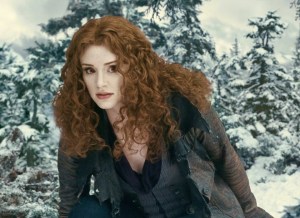
 With Eclipse, we have Victoria building her army of newborn vampires, and we see that army form, wreck havoc on the streets of Seattle, and for once the Twilight series feels like it has a real threat. That’s because Victoria has never ever felt like a threat. I don’t know how she’s represented in Meyer’s books, but in three movies, this curly-haired vampire has always come across as woefully unintimidating. She feels like a Kate Hudson romantic comedy character with fangs. It just doesn’t work no matter how fast the filmmakers show she can run through forests. The Cullen clan will occasionally chase after her, that is, when they’re not lining up like they’re making superhero posse poses. Victoria has never cut it as a villain, so it’s a good move for her to amass an army of super vampires that will do her bidding. The audience is repeatedly told, rather than shown, how serious the newborn vampires are because, you see, newborns still have some human blood in them. Never mind that the Twilight movies have never made mention of this power before. What’s puzzling is that Victoria has been building up her base of bloodsuckers for over a year, so why aren’t there like a ton more? The army of newborns consists of like twelve vampires. I understand the logistics of having to feed and house multiple vampires, but if I was planning for a brutal assault I’d want as many of these super vampires as I could sire.
Let me rephrase some of what I just said. New Moon did have an antagonist and her name was Bella Swan. She was sullen, whiny, self-involved, casually hurtful, and she led around Jacob on a leash. The dude is obviously in love with her, and even tells her face-to-face in Eclipse. Bella toyed around with her self-described “best friend” for whatever she needed and then she screwed him over for her sparkly vampire. In Eclipse, she starts to repeat this same pattern of behavior. Every movie makes it emphatically clear that Bella and Edward are destined to be together, and yet every movie has Bella engage in this annoying, wishy-washy “Maybe I’ll be with you, maybe I won’t” dance to make the boys fight over her one more time and thus validate her existence. I’ve seen this type of behavior before; it’s loathsome. She’s less unlikable and callous in Eclipse. Bella is absent any defining characteristic so that the millions of Twilight readers can insert themselves into the story as the girl everybody wants to fight over. Edward practically hounds her at every turn to marry him, which also seems like another case of wish fulfillment. Bella seems defined by whatever man she has at the current time. I’m surprised more of Meyer’s readers don’t find this fact insulting. Well, in Eclipse Bella doesn’t magically sprout a personality so you’re stuck yet again with the Bella bores.
 Director David Slade (Hard Candy, 30 Days of Night) was an interesting choice to handle all this teenage melodrama. The visual aesthetic is much more refined and accomplished, and the pacing is infinitely better. New Moon was 130 minutes but felt eight times that long because of all the repetitious plotting and brooding, not to mention the gratuitous beefcake shots. Eclipse is only six minutes shorter than its predecessor and yet it moves along at a steady jaunt thanks to the immediate external threat. It still has to fit in all those beefcake shots to make the soccer moms swoon, but at least the movie maintains that pulpy teenage synergy from the first Twilight movie. The special effects have greatly improved as well, which makes the wolves vs. vampire fight scenes more entertaining to witness for the right reasons.
The screenplay for Eclipse includes all sorts of extras to round out the Twilight universe, though they are tangential to the plot at best. Jasper (Jackson Rathbone) and Rosalie (Nikki Reed) get their back-stories revealed, which means flashbacks with costumes! While each is momentarily diverting, why am I getting time taken out from the movie to flesh out the lives of what are, essentially, background characters? At least Slade doesn’t just let the actors jaw away with exposition; he shows the audience their pre-vampire lives. Screenwriter Melissa Rosenberg has adapted every movie so far and she seems well aware of what her audience expects. Eclipse has the exasperating habit of not leaving anything implied. When Rosalie warns Bella about choosing to become a vampire, Bella promises she’ll never want anything more than Edward. “There’s one thing more you’ll want,” Rosalie says. And then, because the audience is perhaps too thick to pick up that subtlety, she adds, “Blood.”
Our threesome of young actors all seem to have their parts well memorized at this point. One part pouting, one part glowering, and two parts yearning. This is the meatiest film yet for the actors as they all get to assemble heir cases. Jacob argues that he’s best for Bella and tries to convince Edward that if he truly loves her, he won’t let her become a vampire. Edward knows the heartache that comes with transforming into a monster and watching as everybody you love dies while you seem to be standing still. Oh, and there’s that whole insatiable desire to drink blood thing, which is just gross. Bella realizes she’s in love with two guys at the same time. She also realizes that in order for her relationship with Edward to last, she will inevitable have to be turned into a vampire. It’s the fork in the road every “girl who dates vampire” story must ultimately lead.
 Stewart and Pattinson give serviceable performances, though Stewart seems like she’s doing you the favor of acting, like she’d rather be elsewhere. Once again, Lautner, who seems to have the most fun with his role, upstages them. There’s a sequence where the threesome share a tent in the mountains, and Bella is freezing and the ice-cold Edward cannot warm her. A plan is hatched: Jacob will crawl into the sleeping bag with Bella and warm her with his body heat. The ridiculousness of the scene is pierced by Lautner deadpanning, “Well, I am hotter than you” (which left my packed theater screaming in approval). Even though he’s saddled with quasi-stalker dialogue like “You love me, you just don’t know it yet,” Lautner makes the most of his wolf-boy licking his wounds.
Here’s another revelation thanks to Eclipse: vampires are apparently made of porcelain. When a vampire is destroyed in the Twilight world, they literally can have limbs snapped off like it’s nothing. They look like dolls getting ripped apart. Occasionally someone will have their head beaten and the vampire cranium will just shatter into thick pieces, much like a porcelain doll. Weirdest of all, whenever a vampire gets hit they are accompanied by this rattling sound effect, like inside the vampires are filled with rolls of nickels and dimes. It’s bizarre and distracting. I don’t ever remember this happening to vampires in the previous two installments. Why not go the Buffy route and just have dead vampires turn into ash? It doesn’t have to be as violent and nauseating as vampires getting staked on HBO’s superior True Blood, but I expect more than vampires just breaking. These are the creatures of the night. They should not be fragile little porcelain dolls. I know Slade and the producers went this route so that they could ramp up their bloodless action and get away with more onscreen.
The fact that something other than two-hours of lovey-dovey romantic declarations and intense, self-indulgent brooding happens means this is by far the most action-packed film in the Twilight series yet. It’s still not that good but it is a vast improvement over the dour suckfest that was New Moon. In fact, since Eclipse repeats many of the same plot points there really is no reason to ever watch New Moon. Skip it altogether. Once again, little of consequence happens in the film but at least Bella isn’t insufferable and we get some nice supernatural fight scenes out of it. The appeal of the series has failed to be translated on the big screen. It’s all about the swoon, and Eclipse will keep the Twi-hards swooning as they take in their male sex objects brought to visual life. Once again, I will state that the Twilight series comes across like a tedious teenage soap opera scrubbed clean of teenage hormones. Eclipse is probably the most guy-friendly of all the films so far, but even that isn’t enough to keep old material interesting the third time it’s reheated.
Nate’s Grade: C+
Share this:

Precious (2009)
 I can’t tell whether or not I liked this movie or if it simply beat me into submission. The heavy-handed tale of extreme suffering comes across like watching somebody get beaten for two hours. WAM! Your father rapes you. WAM! Your mother doesn’t intervene, in fact, she molests you too. WAM! You’re pregnant with your second kid from dear old dad. WAM! You have AIDS. The material is so unrelentingly dark that the constrained happy ending leaves you with feeling wholly naïve. Precious (Oscar-nominee Gabourey Sidibe) goes from having a hellish existence to having a 10% less hellish existence. It’s hard to find any light of hope within. Thank God that the movie is so well-acted all around, from Mo’Nique’s ferocious Oscar-winning turn as Precious’ monstrous mother, to Sidibe’s heart-wrenching portrayal of an abused and ignored soul, to even a makeup-free Mariah Carrey as a no-nonsense social worker (lack of makeup being the universal sign an actress wants to be taken seriously). Director Lee Daniels lays out the melodrama with the subtlety of a sledgehammer. You feel beaten down by the conclusion. I can’t decide if the fantasy sequences Precious flashes to as a coping mechanism are insightful or just embarrassing. I found Precious’ stoicism worth rooting for, but the movie seems to stop short of finding a way to make me care about her as a character rather than a victim. Her role is mostly impassive but she manages to find her character’s dignity, which is what the film asks us to ultimately fight for. By the end, I felt like I was watching an urban equivalent of A Serious Man, only it wasn’t intended for me to laugh at the misery.
Nate’s Grade: B-
Share this:

The Girl with the Dragon Tattoo (2010)
 Heating up the art house cinemas, The Girl with the Dragon Tattoo is two and a half hours, Swedish, in subtitles, and is absent any familiar faces, and audiences can’t seem to get enough. Based on the international best-selling novel, this independent thriller was the highest grossing European film for 2009 and deceased author Stieg Larsson’s two sequels, The Girl Who Played with Fire and The Girl Who Kicked the Hornet’s Nest (sounds like a lot of risky behavior for this girl) have also been made into movies with the same cast. So now that America is caught in the midst of Dragon mania, we all won’t have to wait long for the ongoing adventures of the journalist and the Gothic investigator. Both sequels are planned for release this summer, meaning that the entire trilogy will unwind in theaters over the course of only a few brief months. That’s one thing that has to please American audiences — instant gratification. For those unhip to the world of Lisbeth Salander, get ready to take notes because she’s likely to become an indie film icon, at least for an older, well-read demographic (think: your parents).
Mikael Blomkvist (Michael Nyqvist) is an investigative journalist sentenced to jail for 6 months after losing a libel case against a large shady corporation. Before he serves his prison sentence, Mikael is approached by a wealthy businessman, Henrik Vagner (Sven-Bertil Taube), convinced that his niece, Harriet, was murdered and her murderer is still taunting him 40 years later. Henrik Vagner lives with various other family members on a remote island. The mysterious clan has some serious skeletons in their closet, and Henrik believes ones of his family members, apart of the powerful Vagner Group, is guilty. Mikael takes refuge on the island and begins to comb over old police documents looking for any overlooked clues. Meanwhile, Lisbeth Salander (Noomi Rapace) inserts herself into the case. She’s an expert computer hacker and hired by Henrik Vagner to compile a background check of Mikael. But her interest did not end with her assignment. She has hacked into Mikael’s computer and furtively spies on Mikael’s progress. She e-mails him some key breaks in the case and joins Mikael on the island. Together they make rapid progress finding out what happened to Harriet all those years ago, and a serial killer makes note of their encroaching progress.
 Thankfully, The Girl with the Dragon Tattoo is a thriller that respects its audience’s intellect by not having to spell out every damn detail, and people, there are a lot of damn details. While the movie feels complete, it still leaves much to the imagination to fill in character back-stories, connect the plot dots, and interpret all those silent glances and meditative stares (granted, it might all get filled in following two sequels). A prime example is when Mikael covets Lisbeth’s photographic memory, telling her what a terrific advantage that must be, and a small pensive look from Lisbeth says all we need. It’s enough to make us re-examine what we think we know concerning her background, and the rest of the movie follows this model. I also appreciated that every break in the case came from good detective work and not some swishy super computer stuff. Though Lisbeth is an expert hacker, nothing these characters do is out of the realm of reality unlike other tech-heavy detectives. The plot is tied in knots and we have all sorts of various suspects and angles. The central mystery needs to be interesting for this movie to work, and it is … after it gets into a second gear. A girl’s disappearance 40 years ago isn’t enough to grab you until the more sinister and sordid elements come out into the fray. It also hurts that there’s a clear disparity when it comes to character interest. Mikael isn’t a blah character by any means but he seems to serve as an expository device, the guy who uncovers the secrets and gets to be the helpless foil to Lisbeth. I suppose for maximum narrative effect a straight man would be required to be paired with Lisbeth.
Lisbeth is an unorthodox choice for a researcher given the fact that she’s pierced, punky, and full of attitude and ink, including a certain titular dragon tattoo. But she’s also fiercely intelligent, resourceful, intuitive, and wounded, which makes her a fairly fascinating character. She’s an exciting mystery of a character. She’s wounded and defensive but cavalier and intentionally confrontational at the same time, an exciting conflict. Her attitude is roughly, “So what if I dress as I do? So what if I have a healthy sexual appetite? So what if I am a woman? I demand to be treated with respect.” Lisbeth commands attention even though she feels uncomfortable being gazed at. She’s more than some female fantasy protagonist, though a punky, bisexual ass-kicking gal will fit the bill for some, she is a full-bodied character and a terrific break from the traditional investigative heroes of mysteries.
 I asked myself midway through if the aesthetics were standing in for character; if you stripped away all that punk rock glamour and the shock value of a “Goth PI” than would there be anything compelling left (I was sort of thinking of the Gothic lab tech on America’s quizzically #1 TV show of the moment, the alphabet soup-friendly NCIS)? The answer, I found, was a resounding yes. There’s much more to this girl than a dragon tattoo and a spiked collar. Rapace doesn’t let the outfits overwhelm her. There’s a certain joyful recklessness to her character hidden beneath a veneer of steely coolness. Rapace has to play many different elements through a specific prism of emotional reserve, which makes her character, and her performance, less showy. It makes for a very good performance but ultimately leaves the final judgment of Rapace in question. Despite the international acclaim, Lisbeth isn’t exactly a star-making role. Yet, at least.
The story is awash in details, which is both a positive and negative reflection of the screenplay. There’s likely too many plot details for one screenplay and several elements feel like they may be integral when they really turn out to be incidental, like Nazi ancestry and the lone bridge off the island. Don’t get me all excited with Nazi ancestry and then have it become incidental to the plot. Nonetheless, it takes a good deal of time to process and familiarize all the numerous expository groundwork of the case, and time is what The Girl with the Dragon Tattoo has to offer. At 150 minutes, the movie follows a pretty languid pace and doesn’t get moving until an hour in when our two leads join forces. Echoing that deliberate sense of pacing are the sparse and snowy landscapes of Sweden communicating isolation and looming danger. I can pretty much guarantee that the Hollywood adaptation in the works will not be nearly as leisurely with its pacing. The film’s resolution is very drawn out but that’s due to the many niggling plot threads that need to be attended to. It makes for a satisfying albeit mildly exhausting conclusion.
 The book’s original title was “Men Who Hate Women” and that seems apt given what occurs on screen. Sure there’s a serial murderer on the loose but that’s par for the course. Even the grisly ritualistic killing stuff. But Lisbeth encounters a lot of malice and hostile male aggression, some of it very sickening. There’s a startlingly extended rape sequence, followed by some sadistic, if justifiable, revenge. It all contributes to an overall tone of queasy misogyny that seems to waver between intentional and unintentional. I’m not sure tone-wise whether the movie ever creeps into unsettling voyeurism at the behest of women in explicit sexual peril, but it certainly is a distraction. It can get pretty hard to watch at times in this disturbing Swedish thriller. I hope the eventual sequels don’t follow this same queasy, upsetting tone but I also worry that this may be unfortunately part of the books/movies appeal.
The Girl with the Dragon Tattoo is an arresting and entertaining thriller that occasionally ducks a little too low into the gutter for my tastes (I’m really taken aback at how rape-heavy it is). The mystery works, though it’s more complicated thanks to an excess of detail and not necessarily a complex narrative. The characters, in particular Lisbeth Salander, are what make this movie work. Lisbeth is a captivating lead character and only promises to get more interesting in those future sequels. In many ways, this is a mystery for grown-ups, not just in content but also in approach, with the relaxed pace, subtlety, and moral ambiguity. Having never read the books, I can now see what all the fuss is about, and most of it is warranted. Still, I’m holding out my final judgment until those other two editions of the Adventures of Lisbeth and Crew hit theaters. The movie adaptation of The Girl with the Dragon Tattoo is an exciting opening entry into the world of Lisbeth Salander, international woman of extreme ass kicking in fine fashion to boot.
Nate’s Grade: B+
Share this:

Green Zone (2010)
 I have noticed that I’ve really been dragging my feet when it comes to writing a Green Zone review. I’ve prioritized it only to have something more necessary (catching up on VH1 reality shows) come to the forefront of my attention span. It’s not like the movie is bad. It may have been misleadingly advertised as Jason Bourne’s tour of Iraq, bringing back together Matt Damon and director Paul Greengrass (The Bourne Supremacy), but it’s not bad. It’s a perfectly fine movie, except in this instance, given the politically explosive and monumentally relevant subject matter, “perfectly fine” sounds like a missed opportunity. This movie should be incendiary, shocking, aggravating, enlightening, and if it happens to be entertaining then that ain’t bad either. The subject matter –the false rationale for war, WMDs– deserves a sober examination. Green Zone is not that movie. Green Zone is about uncovering and righting the mistakes of the Iraq War, and I believe I figured out what keeps Green Zone from being a better, more powerful, more engaging movie — it fictionalizes a story that is already wroth telling. This is a true story that could have stood well on its own merits.
Shortly after the fall of Baghdad in 2003, Chief Warrant Officer Roy Miller (Damon) is on the hunt for those weapons of mass destruction (WMD), the chief argument for invading Iraq. His team investigates suspected weapons sites but they keep coming up empty. The intelligence appears to be in sharp contrast with the reality on the ground. Miller butts heads with shady government officials (Greg Kinnear) and finds aid in a state department realist (Brendan Gleeson) and a reporter (Amy Ryan) who put her reputation at stake parroting the government intelligence as fact. The Iraqi army is disbanded and now the former generals under Saddam Hussein are conferring what the next steps should be. General Al Rawi (Yigal Naor, who played Saddam in a TV mini-series) is waiting for the Americans to extend a hand, and if not then they will become an insurrection. Miller is racing to track down Al Rawi because he knows the truth in the lead up to the war, which is why those shady government officials are also trying to kill him.
 Based upon reporter Rajiv Chandrasekaran’s book Imperial Life in the Emerald City: Life Inside the Green Zone, the filmmakers have resorted to a fictional narrative informed by the real events. My biggest gripe is this: the true story is far more interesting, complicated, and relevant than concocting a story about one military man’s search for answers. The film is laid out like a conspiracy thriller, where our hero gains a small sliver of information that leads to another piece, and another and another, until finally a picture emerges. I get it. With Damon as a soldier, the audience has an obvious rooting point, a protagonist who we can easily be labeled as good. And then when he uncovers the truth, and alerts the media, it provides a tidy, satisfying end for the movie. Except that’s not what happened. In the real world, the hunt for those phantom WMDs carried on for months, and the news trickled drip by drip. There were no smoking guns, no white knights to shine the light of truth (Joe Wilson and Valerie Plame might be the closest in consideration), and there wasn’t anything as conclusive as a military officer writing a report and sending it the mainstream media.
Green Zone attempts to craft a satisfying close to the WMD hunt and likewise the war itself. This is nothing more than revisionist wish fulfillment, wanting to insert a hero of conscience and ability during a time where we had a malaise of responsibility from those in the realms of higher command. And just to make sure they don’t make too many waves, Greengrass and screenwriter Brian Helgeland (Mystic River) wrap their crusading character in the uniform of America’s finest, making it difficult to criticize his noble hunt, striping away politics. The trouble is that the Bush Administration rarely made apolitical decisions; everything was steeped in politics, even the truth about weapons of mass destruction. So Green Zone does the audience a disservice by trying to play nice, setting up a villainous fictional straw man, and forgoing naming the names of those that led this country astray. Because of placing the film’s point of view squarely with Miller, we never get to examine the bigger picture, the manipulations and machinations that led to war. We are stuck in a very limited focus of finding the WMDs.
 Now, I must ask whether or not I’m unfairly judging the movie. Hollywood has often taken fascinating and momentous true-life stories and redirected them toward fiction. Green Zone is certainly a technically proficient film. Greengrass’ trademark shaky camera is ever vigilant, always roving and looking for the action; although in a realistic war setting, the kinetic handheld camerawork can come across as potentially hyperactive. Conversations between two people can come across like intense linguistic battles. Walks down hallways can appear to be speedy jaunts brimming with purpose and anxiety. The tension just doesn’t materialize. Without a nervy story, the Greengrass visual staple can seem over the top, antsy, nervous, and also annoying. This is one narrative for Greengrass that could have improved by the dedicated use of a tripod.
Green Zone is not Bourne at all. The Universal marketing team was trying to hoodwink the public into seeing an Iraq War movie. Damon isn’t as polished and in command as Bourne. Those who argue that Green Zone is anti-American or anti-troops are grossly missing the point. Reactionary, bellicose rhetoric, without a wit of substance, is part of the reason the U.S. is currently in Iraq. You can argue against policy, including war policy, and still be considered a patriot. Patriotism is not synonymous with warmongering. It’s too bad that the filmmakers felt that the true story wasn’t good enough to be told, instead settling for a decent if unmemorable political thriller. This adaptation takes the most significant foreign policy event in modern American history, one where the ramifications will be felt for over a generation, and clears all the hard-boiled details to attach a conventional one-man-fights-for-truth tale. It’s hard to get self-righteous when the movie keeps trying to cover its own ass.
Nate’s Grade: B-
Share this:

Repo Men (2010)
 It’s not unheard of for different writers to independently create similar projects. Remember back in 1998 when there were two animated bug movies and two apocalyptic asteroid flicks? Granted, those were big budget studio movies and the final films had little in common other than concept or premise. Repo Men takes place in a world where people open contracts on new organ transplants, but if the buyer is late on the payment then a repo man will come and take back the merchandise. This gory premise might sound familiar for fans of the Goth opera, Repo: the Genetic Opera, which was released a whole 18 months earlier. The makers of Repo Men and Repo have engaged in a he-said/she-said argument over who originated the idea. Repo Men‘s screenwriters claim they came up with the concept in 2003, though the book the film is based was only released in 2009. The Repo team point out that their funky little musical began as a theatrical show that was first performed in 2002. The songwriters behind Repo say that the idea itself goes back to 1999 and began as a 10-minute opera experiment. I suppose we’ll never know who really had the idea first, though I’m inclined to side with the Repo musical fellas because they can back up their claims with evidence. It seems like a whole lot of squabbling over so little, but hey, that’s Hollywood for you.
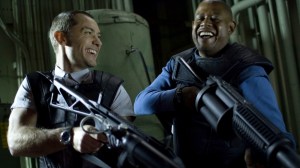
In the not-too-distant future, one corporation, The Union, seems to hold sway in the world of organ transplants. Remy (Jude Law) is an expert repossessions officer who will slice open anybody 90 days late on his or her payment. His wife wants him to transfer to sales; it’s less messy. Remy’s partner (Forest Whitaker) is an old childhood friend and doesn’t want to lose his butcher buddy. One night, Remy is sidelined by some malfunctioning equipment that fires his heart. He has no choice but to get his own organ transplant. Following the operation, Remy finds that he no longer has the stomach for his old line of work. Remy’s newfound moral compass comes at a cost. He quickly falls behind in his payments and his old bosses plead for Remy to refinance. Reluctantly, they sic the repo men, including Whitaker, on Remy to retrieve company property.
 Repo Men takes some nice commentary on predatory lending, pushing the hard sell knowing that the customer can never stay ahead of the mounting fees and payments. The allegory has some sharp moments. However, the movie would have benefited from being pushed further in pretty much every regard. The side characters are horribly shallow. I’m fairly certain that Carice van Houten (electrifying in Black Book), as Remy’s beleaguered wife, could have been replaced with a cardboard cutout boasting a disapproving look. She gets to glare and complain and talk about family issues and then she’s gone, replaced entirely by Beth, a mysterious organ replacement junkie. Beth could have an intriguing back story, and the concept of surgery addiction could dwell upon the human cost of beauty and “upgrading,” but alas, her real purpose is to become an oddly implacable love interest for Remy. She gets to hold his hand while they run. That’s her main contribution (except for one key scene detailed below).
The entire concept of a future world held hostage by a greedy health care corporation could use more contemplation. What is happening with society? No epidemic is ever mentioned, so why do people start contracts on million dollar organs? Do the heavy debts pass on to the next of kin? What is the legality of organ repossession? What level of competition is there out there in the market? What does the government have to say about all this? Does this mighty company supersede the U.S. government? How come Remy can’t even get an employee discount on the merchandise? Has anybody had enough surgeries to become the six million dollar man? There is a wealth of questions born from this premise, but the movie only scratches the intellectual surface and sets its standard change-of-perspective morality storyline into gear. I actually would have found the life of an organ salesman to be more dramatically appealing. What kind of ethical rationalizations take place in the mind of a man who makes his living signing saps into modern indentured servitude? I find that story direction to be more compelling than following the guys who bring back the company merchandise.
But then something weird happens. The movie gallops to a satisfying close, and then it somehow gets even better in its closing moments. I was certain that I was going to write off Repo Men but then 4 things happened to make me sit up straight in my chair (I’ll refrain from any large spoilers):
1) In a film relentlessly aping the visuals of other, superior dystopian films, there’s not much new to look at. You’ve seen this future society thing before, just with more flying cars or jet packs. I came to terms with this; it’s not every movie that reinvents how we interpret the future short of some calamity. Then when Remy breaks into the Company HQ, which is awfully easy by the way, he stumbles into the genetic organ hatchery, if you will. Rows and rows and rows of scientists tinker with organ replacements. The entire environment is a strikingly sterile white, including the scientists wrapped in bulky white biohazard suits. Then Remy and Beth make a run for it, and they are covered head to toe in black. It’s a fabulous visual image, watching the color contrasts. It’s debut director Miguel Sapochnik’s high point.
2) Once Remy and Beth move beyond this laboratory, they get caught in a hallway, and Remy proceeds to take out a mob of employees. The fight sequence is several minutes long and a clear nod to the memorable extended hallway fight in Oldboy (Remy takes out a hammer as his final weapon). Weirdly, Remy’s opponents are suit types, middlemen, office employees, numbers crunchers, but they all leap into battle to take out the corporate intruder. The fight sequence is bloody and stylish enough to please the senses, like when Remy swings a hacksaw and we get Swinging Hacksaw POV as characters duck out of the way lest their jugulars get sliced.
 3) Following this, Remmy and Beth must deposit their corporate-licensed organ replacements. This involves cutting each other open, taking a bar code scanner (think a grocery check-out), and digging inside each other to get those subcutaneous scans. What’s amusing is that the scene is blatantly juxtaposed as a sex scene; Remmy and Beth intimately penetrate each other, the editing cuts to close-ups of moaning, and the other tries to soothe the pain with physical assurances, and it’s all set to a slow jam. It’s something of a bizarre sequence, especially upon further review (how effective can scanning for bar codes be inside the gook-filled human body?), but man is it interesting.
4) Just as I had come to terms with the movie settling for a conventional conclusion, the movie pulls the rug out from under you. It offers up a last-minute ending that upends the conventional framework, and, actually, presents the easy coast to a conventional stop in a new light. This is one of those rare instances where a last-minute ending twist actually improved the film. More often than not, a last-second twist is forced and the nail in the coffin of lasting entertainment.
Repo Men is a competently looking, competently entertaining sci-fi thriller that miraculously stumbles into a final act that not only works, it elevates the rest of the movie. My mild boredom vanished and I started wondering why they made me wait so long for the good stuff. Repo Men is a mixed marriage of overall tone. One second it will be darkly humorous, the next it will be satirical, the next it will pine for serious drama, and occasionally it goes for Guy Richie-styled slapstick. A sequence where Remy describes the three occasions he’s been knocked out, with visual interludes, feels like a deleted scene from an entirely different movie. The movie never really settles, touching upon a lot of areas but mostly poorly. The script desperately needed to be fleshed out to make any lasting impact. Now that I’m living in a two-Repo world, I’ll probably stick with the campy musical fun of Repo: the Genetic Opera. At least that movie left you humming.
Nate’s Grade: C+
Share this:

Alice in Wonderland (2010)
 Director Tim Burton seems like the perfect candidate to take on the imagery of author Lewis Carroll. I would argue that, short of Dickens’ Christmas Carol, Alice in Wonderland is the most reproduced piece of literature in modern history. It’s going to take a keen vision to make these old characters interesting (the macabre American McGee video game sure felt like it could have been born from the mind of Tim Burton). Unfortunately, Burton and some 3-D wizardry are not enough to compensate for a story that only works in one dimension.
Alice (Mia Wasikoswki) is now a teenager girl who can barely remember her jaunt to Wonderland in her youth. She’s assigned to marry a simpering lord because in Victorian England that’s how women took care of their futures. Alice is more interested in taking over her dead father’s trading company. So when the time comes for her lord to ask for her hand in marriage, Alice stammers, says she needs some air, and chases after what looks like a rabbit with a pocket watch. She falls down a rabbit hole and winds up back in Wonderland, however it’s really known as Underland. It’s been 13 years since Alice visited this magical world, and in the meantime the Red Queen (Helena Bonham Carter) has ruled as a tyrant quite fond of removing the bond between head and neck. Her sister, the White Queen (Anne Hathaway), was deposed and lives in exile. The (W)underland residents live in hope that an Alice will return and free them as an old prophecy foretells. She’ll have to rely on old friends, like the Cheshire Cat (Stephen Fry) and the Mad Hatter (Johnny Depp) to fulfill her destiny, and, why not, slay the Red Queen’s fearsome dragon, the Jabberwocky.
 You would think that the combination of Burton, Depp, Lewis Carroll, and 3-D would produce an irrefutable masterpiece, at least from a visual and entertainment standpoint. I’m compelled to argue that the finished results are pretty much a mixed bag. The world of (W)underland seems fairly drab. Sure it was some big stuff and some weird stuff but from a color standpoint everything comes across as washed out, like Burton took one look and said, “Bright colors equate happiness. We can’t have that.” I understand the world wanting to convey a dispirited mood, but this isn’t any regular Burton film, this is Alice in Wonderland and we need a sense of, wait for it, wonder. Instead, we get an overwhelming feeling of drabness. Now, full disclosure, I didn’t catch the 3-D version of this movie for two reasons: 1) my then partner’s head was hurting and she couldn’t take 90 minutes wearing nose-pinching, eye-hurting glasses that play with her depth of field, and 2) the 3-D shows were all sold out. I could tell which elements where intended to pop in a 3-D environment, namely the Hare always throwing objects as a calling card and the materialization of the Cheshire Cat. The tone isn’t too dark to scare the Disney families but at the same time there’s a bit more menace to the proceedings. The Red Queen’s bulbous, disproportionate head makes for an eye-catching visual that doesn’t get stale. (W)underland is a more hostile world but at the same time it’s not too threatening. Pretty much all the villains have some moment of redemption that makes them less threatening. The weirdest motif in the movie is eye gouging, which happens twice thanks to the same diminutive character.
Having said that, this is a visual decision that I could live with if the story engaged my senses more. Alice is now an older 19-year-old girl that has to defend (W)underland by fighting a dragon and suiting up in armor. She has to accept her destiny and be THE Alice and save the kingdom. The mystery of whether Alice is the one true Alice, look no further than the title, folks. He doesn’t remember anything from her first encounter in (W)underland and yet she has no sense of awe or curiosity. Also, why now do the residents of (W)unerland seek out Alice to rescue them? They never thought about reaching out in the 13 years the Red Queen has been ruling?
 The plot is a fairly pedestrian “hero’s quest” that ends in a fairly pedestrian battle sequence where the armies of good and evil clash in CGI combat. The problem is that the original Alice in Wonderland source material really didn’t have much of a plot to it; it was really more a satire of the times, which featured Alice essentially going from one oddball to the other. The appeal was more the language than the story. It’s not the easiest piece of literature to adapt, to find a through line for a plot, so I guess making it about a hero’s destiny seems like the easiest, laziest path. The screenplay by Linda Woolverton (Beauty and the Beast) assembles all the memorable characters but gives them little else to do, other than act mad. You may start to feel Alice’s sense of frustration after a while. Because of the threadbare story, you know exactly where the movie is going to be headed (wow, unintentional pun). In some ways this movie functions as a sequel and in some ways this movie functions as a remake, meaning that the plot is pretty much stuck trying to decide where to go next in a standard fantasy narrative device.
And then there’s the dance scene. Oh, the dance scene. How do I approach this gingerly? The climax that’s established is not Alice slaying the dragon, accepting her destiny, and (W)underland triumphing over the Red Queen’s tyranny. The climax is Depp break-dancing. You read that right, though the residents refer to his crazy legs movement as “futterwackin,” which sounds suspiciously naughty. It’s a moment so goofy, so tonally inappropriate that it shatters the entire notion of suspension of disbelief. It rips you out of the movie and all for a cheap laugh. It’s bizarre. I acknowledge that, given the fantasy framework, that the ending ought to stay in touch with the fantastical setting. But break-dancing? Would The Wizard of Oz have ended better if the Tin Man and the Scarecrow started break-dancing? At least the Tin Man could effectively perform the Robot. It’s a real-world artifact that has no place in the world of fantasy.
 Depp is usually such a valued performer, digging deep into his character and reveling in their eccentricities. He’s the strangest and most exciting character actor that has become a box-office star. But that doesn’t mean he’s immune from giving a rare bad performance. While nowhere near as off-putting as his Willy Wonka, Depp’s Hatter is more distraction than anything. He comes across like a figure grappling with post-traumatic stress, causing him to mutter incomprehensibly in a Scottish brogue. He’s tiresome after a while. Carter (Sweeny Todd) can be pretty shrill, playing the same overwrought note time and again, but she still manages to give the best performance in the movie. Hathaway just sort of acts flighty and raises her arms, waltzing around like she’s trying to imitate Depp’s Jack Sparrow. She’s entirely wasted. Stephen Fry (V for Vendetta) is a delight as the voice of the Cheshire Cat, and our heroine, Wasikowska (HBO’s In Treatment) has a striking Grecian presence, even if her performance is more dour than it needs to be given the fanciful environment.
Tim Burton and Johnny Depp usually make for an unbeatable creative team, but I think Disney was the key figure in this arrangement. Alice in Wonderland wants to thrill without getting too scary, wants to delight without getting too original, and wants to dazzle without getting too weird. Burton’s visual inventiveness manages to make the movie entrancing at times and bewildering when the rest of the movie fails to live up to those fleeting moments. Truth be told, I actually enjoyed the real-world Victorian scenes more than many of the ones in (W)udnerland. The film is just too disjointed and uneven to fully embrace, regardless of the 3-D upgrade. There are moments that I adored and moments that I could have lived without — like the break-dancing finale. The finished product isn’t a terrible night out at the movies, and there are plenty of enjoyable elements to savor. However, Alice plays like a familiar fantasy that takes Lewis Carroll’s creatures and rearranged them into a watered-down Lord of the Rings hybrid.
Nate’s Grade: C+
Share this:

Dear John (2010)
 Best-selling author Nicholas Sparks is probably a perfectly reasonable human being. I’m sure he’s great at parties and that people love him. He may even have a dynamite recipe for sugar cookies. But I don’t know what happened to Sparks to turn him into the romance genre’s angel of death. His novels have followed a familiar practice of big Third Act deaths that usually deny readers their cherished happy endings. Is the motive to push people to make the most of our preciously little time spent on Earth? Is Sparks just sadistic and has found the secret to eternal life — the tears of millions of housewives and teenager girls. Whatever his rationale, another commonality for Sparks is that the film adaptations of his books are pretty corny and dreadful. A Walk to Remember, Nights in Rodanthe, Message in a Bottle; all about romance ultimately denied, none coming close to watchable. Dear John can at least be called watchable; however, watching should be limited to the confines of your living room TV when there’s nothing else on.
It’s the spring of 2001, and John Tyree (Channing Tatum) is enjoying his two-week leave from the military. He’s out surfing the fine North Carolina beaches when he rescues the handbag of Savannah (Amanda Seyfried) from being washed away. They two of them casually chat and soon those chats lead to barbecue invitations, parental visits, and kisses in the rain (a romantic movie tradition). Savannah takes an interest in John’s eccentric father (Richard Jenkins) because she recognizes his condition as autism. She’s been helping to watch her neighbor’s autistic child. Savannah would like to start her own horse camp for the autistic (sounds like an insurance nightmare). Life seems so full of promise and John promises to be back as soon as his military commitment expires in six months. Then 9/11 happens. John re-enlists and extends his tour another two years. This places great strain on his relationship with Savannah, but they write each other countless letters that manage to find John no matter what far-flung village he’s stationed at. Can their love exists on a series of hand-written letters? Well, look no further than the classic implications from the film’s title.
 Dear John goes through all the traditional Nicholas Sparks waterworks trademarks: young love leads to yearning, which leads to heartbreak, which leads to more yearning, which then inevitably leads toward one of the leads dying and everyone learning some sort of shallow profound meaning about life, blah blah blah. There are plenty of heightened melodramatic elements thrown into a fairly traditional, unspectacular love story, but all potent potential moments of drama feel underwhelming pretty much because the audience doesn’t care. John and Savannah are perfectly nice people and their love has that hopeful bloom, but their relationship is no more involving than watching a pretend couple in a commercial for greeting cards or life insurance. These people are vanilla. It makes it astounding, then, that such highly charged elements like cancer autism, and 9/11 fail to leave any impact. Dear John confuses listing dramatic events as drama itself. The dramatic stakes feel entirely too mellow and the film generally has a detached feeling, like it’s purposely distanced from the material for fear of getting too involved. This is a relationship movie that has its own commitment issues.
The military angle is respectfully explored, though not in much depth. John is torn apart by the pull of returning to his beloved but also of serving his country and, more personally, keeping his band of brothers in arms together. It’s a complicated scenario but the military commitment is another item in a list that should grab your interest but fail to do so. 9/11 isn’t given any deeper consideration other than the fact that it serves as a roadblock between our two lovebirds. If you want to see a more nuanced, complicated, and empathetic view of today’s overburdened military, check out the movie Stop-Loss, which also stars Tatum.
 The film drops any facade of being a romantic drama about midway through when Seyfried gets completely sidelined. She’s less a character and more an agreeable plot device; she’s self-aware and kind and knowing and receptive yet also naive. This makes her sudden character shift rather jarring, which seemingly paints Savannah as extremely co-dependant. Dear John then transforms into a serviceable father/son drama. There are some nice and moving moments between John and his father; this should have been the real focal point of the movie. Jenkins acts circles around everybody in this movie. It’s wonderful seeing a grown-up in these kind of movies show the kids ho this acting thing is done. Tatum actually might become a pretty good actor. He convincingly plays the more emotional moments well. He may very well prove to be the Patrick Swayze of his generation. Tatum can dance (Step Up), make the girls cry, and also handle some rock-socking action (G.I. Joe, Fighting, most of Tatum’s other movies). I think there’s an actor buried beneath that daunting physique waiting to blossom. Don’t disappoint me, Channing.
Dear John is a formulaic romance trained to seek pre-programmed audience responses (“Now you will laugh. Now you will cry. Now you will cry again. Now you will once again continue to cry…”). Lasse Halstrom (What’s Eating Gilbert Grape, Cassanova) directed this movie but you’d never be able to notice. I don’t want to be too harsh on the film because the acting is pleasant the story isn’t repulsive and does have some good moments, but mostly the movie comes across as bland and remote. The romance seems absent a beating heart to keep things moving. It’s all too lifeless. The character of Savannah best summarizes Dear John as a whole: mild pretense of wisdom, pretty to look at, genial, but fairly bland and difficult to convince is worth your valuable time.
Nate’s Grade: C
Share this:

Cloudy with a Chance of Meatballs (2009)
 Thanks to a rambunctious comedic spirit and some delightfully colorful visuals, Cloudy with a Chance of Meatballs is absurdly amusing from start to finish. I was relieved when this animated family film stuck by its own manic comic sensibilities instead of pandering with scatological humor and bizarre and instantly dated pop culture references. The story has the familiar “believe in yourself” elements but it takes it another tasty level. Writer/directors Phil Lord and Chris Miller (MTV’s vastly underrated Clone High) pack the story with jokes of all levels, running gags with surprising payoffs, puns that manage to be funny, satirical one-liners, imaginative visual gags, and inventive action sequences when the film becomes an all-you-can-eat buffet of disaster movies. The pacing is frenetic and the eclectic vocal cast (Bruce Campbell as the villainous mayor! Mr. T as sheriff! Neil Patrick Harris as a talking monkey!) really, as the film says, “carpe some diem.” This isn’t an emotionally engaging movie whatsoever but it’s one of the best comedies of 2009 and certainly one of the most jam-packed, fun 90 minutes you could ask to sit through. Just prepare to be extremely hungry afterward.
Nate’s Grade: A-
Share this:

An Education (2009)
 In 1961 Britain, Jenny (Carey Mulligan) is a 16-year-old schoolgirl plowing away at her education. She?s on track to enroll at Oxford “reading English” and her parents (Alfred Molina, Cara Seymour) have overscheduled the girl with hobbies and clubs to help build her academic portfolio. Then one rainy night she meets David (Peter Sarsgaard), a thirty something man who offers to give her and her cello a ride. This enchanting man keeps coming back around to see Jenny, sweeping her off her feet. He invites her to go to concert recitals with his older friends Danny (Dominic Cooper) and Helen (Rosamund Pike), trips to the country, and even a fabulous getaway to Paris. “You have no idea how boring my life was before you,” she confesses to David. But David is coy about how he can pay for such extravagances. Jenny’s grades begin to suffer and it looks like she may miss out on being able to enroll at Oxford. She has to make a decision whether to continue seeing David or going back to her primary school education.
An Education is a handsomely recreated period drama that manages to be very funny, very engaging, and very well acted. It’s also rather insightful and does an exquisite job of conveying that strange wonderful heartsick of love, maybe better than any movie since My Summer of Love. You can practically just drink in all of Jenny’s excitement. Jenny isn’t a silly girl prone to naivety. She’s a smart and clever girl, and not just because other characters say so or we see her stellar test grades destined for prime placement on the fridge. You witness her intelligence in how she interacts through different social circles. Since the movie is entirely Jenny?s story, we need to be convinced that she’s smart in order to believe her willingness to be duped. She has reservations about David’s habits but doesn’t want to risk going back to a dull life of books and family dinners. She has to be a smart, vibrant girl anxious to keep a good thing going, willing to ignore certain warning signs that otherwise might cause her pause. Even Jenny’s parents get caught up in the seduction, swooning over David and his upper class connections and comforts.
 The teen-girl-with-older-male aspect might make us squirm, but in the realm of 1961 Britain, it’s acceptable. Jenny and David don?t need to hide their affair in dank hotel rooms and avoid any suspicious eyes. We don’t get any agonizing inner turmoil over dating a teenage girl, mostly because it’s from Jenny’s perspective and that everybody else seems okay with it all. This acceptance means that the drama for An Education can focus on something less seamy. That doesn’t mean that everybody approves. While Jenny’s friends think she hit the jackpot, and hang from her every word about her amazing sophisticated boyfriend, her literature teacher (Olivia Williams) sees through David?s whirlwind of charms. This isn’t the tale of some girl being drawn into the dark side, turning into an unsavory, rebellious teenager flouting the law and good manners. Jenny is not that kind of gal.
Mulligan is fantastic and delivers such a sumptuous performance that you feel like a human being is coming alive before your eyes. She lights up with the dawning realization that a charming and worldly man is courting her, and you feel every moments of her swirling delight and awe. Mulligan even goes so far as to get even the small details right, like the way Jenny opens her eyes to peak during a kiss to make sure it’s all not just some passing dream, or the way she has to look away at times and break eye-contact because she’s just so happy, with those twinkling eyes and a mouth curling like a cherry stem. She’s bashfully coquettish in her physical attraction to David, though in my praise it also sounds like I, too, have fallen for the girl. Much ink has been spilled declaring Mulligan as a rising Audrey Hepburn figure, mostly because she sports that famous short bob of a haircut that many girls had in 1961. To me, Mulligan gives a stronger impression as being the luminescent little sister to Emily Mortimer (Lovely & Amazing, Match Point). Mulligan is a fresh young actress that delivers a performance of stirring vulnerability. It’s a breakout performance that will likely mean that Hollywood will come calling when they need the worrisome girlfriend role for the next factory-produced mass-market entertainment (she’s finished filming the Wall Street sequel, so perhaps we’re already there).
 Adapted by Nick Hornby (About a Boy) from a memoir by Lynn Barber, An Education follows the coming-of-age track well with enough swipes at class-consciousness. But man, I was really surprised how funny this movie is. An Education is routinely crackling with a fine comic wit, and Jenny and her father have the best repartee. Molina is an unsung actor and he dutifully carries out the role of “uptight neurotic father” with more than a stiff upper lip; the man puts his all in the role. While he can come across as hysterical at times, Molina is paternal with a capital P. It’s refreshing just to listen to smart people banter at an intelligent level.
The movie’s theme ponders the significance of education. There’s the broader view of education, learning throughout one’s life from new and enriching experiences. She gets to learn a bit more of the way of the world, and Jenny feels that she can learn more and have fun with David than sitting through lectures and slogging through homework. She values what David has to teach her above what she can find in a textbook. Jenny’s father stresses the virtues of learning and thinking but once Jenny has a chance to marry an upper class, cultured male then education no longer matters. She is now set for life through David. All that learning to become a dutiful housewife in a lovely, gilded cage. Is that the real desired end to personal growth: to snag a husband? The school’s headmistress (Emma Thompson in practically a cameo) doesn’t serve as a great ambassador to higher learning: she stresses the lonely hardships, internal dedication, and she herself is openly anti-Semitic, proving that an intelligent mind is not the same as being open-minded. To her, Jenny is jeopardizing her lone chance at a respectable life.
 Jenny rejects the traditional route of education and chooses to pursue a life with David, that is, until the third act complications beckon. Jenny finds out about David’s secret rather too easily, I’m afraid (secret letters should never be hidden the glove compartment). While the end revelations are somewhat expected, what is unexpected is that every character pretty much escapes consequences by the end of the film. No one is really held accountable for his or her decisions. Pretty much everyone is exactly where he or she left off just with a tad more street smarts. It’s the equivalent of learning not to trust every person after getting ripped off.
Despite all the hesitation, and the age difference, An Education is an actual romantic movie. It’s a coming-of-age charmer with all the preen and gloss of an awards caliber film. You feel the delight in the sheer possibility of life for Jenny. The story unfolds at a deliberate pace and allows the audience to feel every point of anxiety and bubbling excitement for Jenny. Mulligan gives a star-making performance and practically glows with happiness during the movie’s key moments, making us love her even more. The plot may be conventional but the movie manages to be charming without much in the way of surprises. Still, An Education is a breezy, elegant, and clever movie that flies by, even if its biggest point of learning is that age-old chestnut that something too good to be true must be.
Nate’s Grade: A-


You must be logged in to post a comment.