Blog Archives
A Single Man (2009)
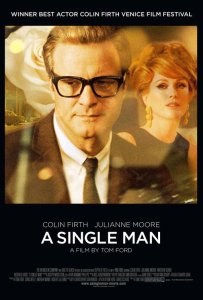 Tom Ford is a rare human being. He seems to be good at everything. The prominent fashion designer has never been averse to risk. He left work in America to toil for Gucci, a faltering European luxury brand. He became the creative director from 1994-2004, eventually leaving to form his own company. And after decades of success in the world of fashion, Ford decided to make the jump into movies. From fashion mogul to film director, nobody else has done it, let alone done it with such acclaim right out of the gate. A Single Man has been met with rich praise and Ford has been touted as a natural filmmaker. Perhaps Ford’s odyssey into moving pictures will inspire others to drop their needle and thread and pick up a camera instead. Who wants to see a Project Runway/Project Greenlight crossover?
In the early 1960s, George Falconer (Colin Firth) is a 50-year-old English professor still recovering from the loss of his love. Jim (Matthew Goode) and George had been together for over 16 years, that is, until Jim died in a car accident one rainy night. George has never fully recovered since that awful night. He doesn’t intend to waste any more time waiting for a reunion; at the end of the day, he will kill himself. He lays out his suit, empties his safety deposit box, and writes letters to his remaining friends and family. This will be George Falconer’s last day in Los Angeles, but perhaps in the meantime he’ll discover more reasons to give life another chance.
 Ford comes from the world of high fashion and here he proves that he should be taken seriously as a filmmaker. He has a sumptuous eye for visuals. A Single Man looks great in every scene. The costumes and period details are impeccable and may even give the historical consultants from Mad Men some due pause. The cinematography by Eduard Grau can become irritating because the colors go from drab to vibrant, reflecting the main character’s changing moods (lifted spirits = brighter colors!). At first it’s a neat visual gimmick but as it persists it becomes a crude blinking light, inelegantly summing up what the movie feels it cannot communicate. At times it just feels like piling on. I don’t need the color to drain from the screen to understand that George is sad.
Ford’s adaptation skills, on the other hand, could use some more polish. He and David Scearce spent years adapting the 1964 novel by Christopher Isherwood. They even added the whole suicide angle, which becomes their narrative crutch. There is a refreshingly funny sequence where George tries to act out his suicide position and goes from the shower to his bed, finally deciding upon shooting himself inside a zipped sleeping bag to cover the ensuing mess. This little five-minute stretch is like an oasis of humor in the super serious desert that is the rest of the film. The second half of the film is dominated by a will-he-or-won’t-he flirtation with a good-looking lithe college student (Nicholas Hoult, the boy all grown up from About a Boy). The kid shows definite interest. The romantic angle syncs up with George’s lost love and proves to be a welcomed distraction to George’s dejection. However, their connection is extremely thin, with Hoult making flirty eyes and inquisitively tilting his head for an hour. The romantic story exists as a means of making sure the narrative can mend George’s broken heart.
The story meanders for too long with a few revealing flashbacks, but honestly how hard is it to wring pathos from a suicidal man? How hard is it to write a middle-aged man taking stock of his life, getting his affairs in order, and saying his fuzzy goodbyes to people who don?t realize the significance. Everything gains magnitude under that prism; every pause, every inhalation, every wistful glance becomes riddled with deeper subtextual meaning, or so we are lead to believe. Every moment can unlock a new memory or secret, like when he sniffs a stranger’s dog and recalls his former beloved pet he shared with Jim. Under this guide, it is hard to tell whether the movie is doing any actual dramatic lifting. So much is supposed to be interpreted in the blankness, which the audience is entrusted to craft meaning to the character’s nostalgic pit stops. “Oh, he must be taking in the scent of the ocean one last time,” or, “Oh, he must be thinking about… something. But he’s gotta definitely be thinking about something. Something deep.” Can you see how this might get tedious after a while?
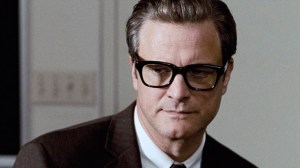 A Single Man could have afforded more peaks into George’s background and less of Julianne Moore. She plays an old boozy Brit friend of his from back in the day. Her moments onscreen, while limited, are a chore to get through because Moore just consumes her characters sadness. She gets drunk on the one emotion she’s been hired to play. She’s certainly not embarrassing herself like in 2006’s Freedomland, but this isn’t a performance for her illustrious highlight reel. I don’t care if she does get nominated for a supporting actress Oscar, as seems all but certain; I expect more from Moore.
Firth is the whole movie so it’s a relief that he turns in the performance of his career. He gives a complex portrayal that doesn’t nicely fit into the typical Firth cinematic creature: priggish, clever, dry, ultimately a good guy. Here you can practically see the gears in his head processing the last moments of life. The extent he can convey with his eyes or simply the corners of his mouth are exquisite. He provides so much of what the narrative does not. He’s a sad creature mired in one long day of existential grief, but I need more from this character than what Ford affords.
George Falconer gives a dandy speech about the fear of the minority, almost outing himself to his college class, but for a flick about an older gay male passing through life to be an invisible member of society, Ford adopts a “don’t ask, don’t tell” approach to narrative. He buttons up his characters emotions. Understatement is lovely when there’s enough to work with. That’s the issue with A Single Man. Ford hasn’t given himself enough to work with, instead forcing the audience to make up the work by inserting meaning into every furtive brow and pained expression. This is a meditation on a life in passing, told through a series of small vignettes. I need more than a melancholy man listening to the clock strike seconds off his soon-to-be-ended life. If I wanted to watch that movie I’d check out the latest Gus van Sant art house masturbations.
Nate’s Grade: B-
Share this:

The Lovely Bones (2009)
 The Lovely Bones, based upon Alice Sebold’s 2002 best-selling blockbuster, is about some heavy stuff. It’s told entirely from the point of view of a dead teenage girl. She was raped and murdered by a skeevy neighbor, and now she gets to watch her family get torn apart through grief. For most filmmakers, this material would not be considered a “breather,” but then most filmmakers are not Peter Jackson (to my knowledge, only one is). The man known for epic fantasy adventures and lavish special effects applies his skills to bringing Sebold?s beyond-the-grave drama to life. The Lovely Bones has enough skill and craft to its merit, but Jackson’s rep as a filmmaker cannot save this poor adaptation. Who would have thought that the lord behind those Rings pictures could be felled by a teenage girl?
“I was fourteen years old when I was murdered,” Susie Salmon (Saoirse Ronan) informs the audience. In 1973, young Susie Salmon (like the fish, we will be told many times) is walking home from school one night. Mr. Harvey (Stanley Tucci) approaches her and asks her to be the first kid in the neighborhood to see his underground clubhouse he built. She follows inside and will never make it back out alive. The police discover Susie’s knit hat and massive amounts of blood in the earth but no body. Susie’s family is a wreck. Jack Salmon (Mark Wahlberg) consumes himself with the mission of finding his daughter’s killer, alienating his wife, Abigail (Rachel Weisz). Mr. Harvey watches the stalled police investigation with growing pleasure, knowing he has gotten away with yet another child murder. As the years pass, he sets his sights on Susie’s younger sister, Lindsey (Rose McIver). But Susie is not completely absent during this period of time. She awakens in a magical, CGI-attuned spiritual realm known as the “in-between.” It is here that she spies on her family and her murderer and tries to pass time.
 Since most of this story is told after her death, and because Susie died when she was a blossoming teenager, apparently she’s doomed to live the rest of her quasi-afterlife in that awkward visage. Imagine being a 14-year-old for eternity, and the only clothes you have to wear are ugly mustard-colored corduroy pants? That sounds more like hell than heaven. So Susie gets to interact in an afterlife built upon the mind of a teenager, which means that the afterlife involves pretending to be on magazine covers and dancing to disco music (again, heaven or hell?). I know that Jackson was asking for trouble by even attempting to interpret the ethereal, but his candy-colored version of Susie’s afterlife comes across like a bright, shiny doctor’s waiting room (“God will be with you in just a few minutes. Please enjoy our magazine selection in the meantime.”). It’s like you have to find peace before going through them pearly gates. Heaven doesn’t want your negativity so you are forced to chill in a screensaver.
There’s going to be some natural disconnect in trying to showcase a realm beyond human comprehension. I accept that, but why does Susie even bother staying in this “in-between” world? She spies on her family in grief through the years but she has no power to change things; that is, until she does for some inexplicable reason. And what does she do with that inter-dimensional power? She inhabits some girl’s body so she can snag her first kiss that her murder denied her. She passed up heaven and chose not to tell people about her body being disposed of. That doesn’t sound like she really reached any sense of enlightenment. But I digress. Why would Susie stay in this “in-between” when it only makes her sad? She’s fairly powerless and, honestly, does anybody really want to delay entering into heaven? Why does Susie get to pal around with all the other Mr. Harvey murder victims like some celestial support group? None of this can be explained because we’re dealing with a topic that defies rationale explanations. However, this “in-between” spiritual land feels like a visual leftover from the 1998 film, What Dreams May Come. That was another movie where I could never explain why anything happened.
 Actually, the entire movie lacks any cause-effect continuity. The Lovely Bones feels bereft of any connective tissue. Characters will make huge decisions or be granted epiphanies because the plot demands it. I have no idea why Jack suddenly figures out that Mr. Harvey responsible for his daughter’s death. He thinks back to a memory and then all of a sudden everything makes sense, but only for his character. For me, none of it made sense. The entire investigation of Mr. Harvey doesn’t really hold up upon reflection. Jack personally looks into every shifty person in town but somehow overlooks the creepy loner across the street that builds meticulous dollhouses for fun? Mr. Harvey also likes to sketch out his murder pits, but just stop and think about Susie’s deathly hobbit hole. The man digs an entire underground lair in a cornfield. Wouldn’t it take hours if not days to refill the whole thing to cover his tracks? For a prolific serial killer, Mr. Harvey seems to be somewhat careless about leaving behind evidence (a safe filled with your victim’s remains?). I guess this is why Susie has to tell us at the onset that people were ignorant to all this unpleasantness in 1973 (I guess that means common sense was acquired in 1974). Why does Abigail all of a sudden desert her family? She can’t take the grief, so she ditches her two other younger children to live the life of a migrant worker. And why does she come back? How can two brown-eyed, brown-haired parents have three blue-eyed, blonde-haired kids? The entire movie lacks vital coherency and context.
From a tonal standpoint, The Lovely Bones never quite settles down and figures out what film it?s going to be. It veers from sentimental melodrama, to thriller, to headache-inducing camp (Sarandon’s boozy grandmother is terrible at housework — hilarious!). Jackson and crew jettison large amounts of Sebold’s text, leaving behind a New Age-y heaven and a fairly lame murder mystery where we already know the guilty party. The drama then pretty much boils down to whether or not Mr. Harvey will get caught.
You can tell that the serial killer segments grabbed Jackson’s interest the most because every sequence with Mr. Harvey feels more predicated and textured, like Jackson is applying more skill to showcase the twisted mind of a sick man. Jackson exerts far more energy into exploring the dark reaches of Mr. Harvey than he does the mourning of the Salmon family. We are denied the complexity of grief and remembrance. As presented, the Salmon family gets to weep and shout but nobody really tackles the issues or moving forward and acceptance of loss. Instead, we watch Mr. Harvey twitch and squirm and plot his next move. Tucci is appropriately scary, aided by an ominous comb-over. The segment when a ghostly Susie stumbles into Mr. Harvey’s bathroom is the best moment of dread. The bright white room is splattered in trails of dirt and streaks of hardened, dark blood, while Mr. Harvey rests in his bath with a washcloth covering his face. It seems like Jackson decided that what fans really wanted from a Lovely Bones movie was more serial killer screen time. If the family drama was going to be this boring, then I say devote the whole movie to the creep.
 The acting is another curious detraction. Ronan (Atonement) fits the part but Jackson forces her to speak in this annoying, pseudo-spiritual whisper, like once you?ve attained the knowledge of the afterlife you become very soft-spoken. She shows a decent range of emotions but even she can?t quite figure out her character. Wahlberg seems miscast in his role and pretty limited in his depiction of obsessive grief. Weisz gets to cry her eyes out the most but then her character sits out the second half of the flick. Sarandon is only playing the role she was given, so I’ll be fair in my criticism, but her brassy, alcohol-swilling grandmother is like an unwelcome party crasher. She’s broad and loud and mostly cartoonish. I understand Sarandon was serving as comic relief amidst all the heavy drama, but it doesn’t count as relief when you wince at her presence. Tucci gives the mot layered, nuanced performance. He tries to relive each kill but soon enough the memory fades, and he feels the unstoppable impulse to feed his demons. Tucci is deeply scary, though he kind of talks like the roof of his mouth is stuffed with peanut butter.
Heavenly Creatures showed the world that Jackson could do so much more than campy, splattery gore and crude humor. It beautifully dealt with the scary, bewildering world of fantasy and budding feminine sexuality. Now after four grandiose movies, The Lovely Bones was supposed to be a trip back to that smaller, character-driven territory that Jackson first charted in Heavenly Creatures. Now I wonder if Jackson has the ability to return to smaller scope pictures. He and his screenwriting brain trust, Philipa Boyens and Fran Walsh, have softened the harder elements from the novel, completely eliminating any sexual emphasis. This PG-13 take is heavy on ponderous acid trip visuals and light on coherence, and when you can?t understand why things are happening after a while you stop caring why. After a while, I just stopped caring about Susie Salmon (like the fish).
Nate’s Grade: C
Share this:

Food Inc. (2009)
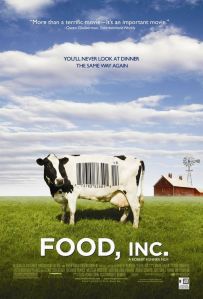 Food Inc. is informative and occasionally jarring, but unless you have no common sense and/or political acumen, nothing here should seem like much of a surprise. The food industry, like most, is about finding faster, cheaper ways to turn higher profits, so it seems natural that the fast-food style system would be integrated into industrial factories. Our current eating lifestyle as a nation is unhealthy and heading toward disaster. But this is old news. Food Inc. makes a mostly compelling case except when it comes to organics. An organic farmer addresses the argument that worldwide organic farming cold never feed enough people, and tosses it aside as “specious.” I’m sorry, global hunger is not a specious argument, and Food Inc. glosses over the facts that organic farming requires a massive amount more land to produce crops, it only uses natural fertilizer which means its more prone to breaks of E. Coli, and, most damning, is more prone to infection because they only use natural pesticides, ignoring decades of scientific improvement, which naturally makes their crops more prone to being wiped out by insects. Which billion people get to be told their hunger doesn’t matter? The film’s most interesting section is when giant food companies control a market and squeeze the legal system to keep it that way, like Monsanto’s near 90 percent hold on soy beans. They hire former military men to spy on farmers and scare them. They engage in frivolous lawsuits because they can afford the legal fees, but a poor farmer can’t, so they admit guilt and settle. The Monsanto dismantling of family farms is scary, way scarier than the hidden camera footage of animals at a slaughterhouse (it’s sad, I’m not a monster, but as long as it’s humane, does a cow really care how it dies?). Food Inc. is an interesting, galvanizing little documentary that makes several good, albeit familiar, points.
Nate’s Grade: B
Share this:

Up in the Air (2009)
 Up in the Air is the kind of movie that slyly sneaks up on you. This charming comedy is much like George Clooney’s character, a man paid by cowardly bosses to fire their employees. He’s so good at his job that his skills appear effortless, but at the same time he can take heavy subject matter and make you feel better and thankful afterwards. The topical backdrop of corporate downsizing and layoffs could produce plenty of easy pathos, but Up in the Air works expertly on several layers; it’s a brisk, clever comedy with revealing repartee; it’s an adult romance that blissfully lets them behave like mature adults; and it’s a moving character piece about people realizing what they have gained and lost due to their lifestyle choices. When Clooney is fighting back tears from a crushing disappointment over being overlooked to walk his sister down the aisle, it may be the most compactly perfect moment of acting in his career. Throughout director Jason Reitman’s script (he co-wrote the adaptation of Walter Kirn’s 2001 novel), the human element is debated in our technological age. Clooney’s young cohort (Anna Kendrick) wants to simplify by firing people over the Internet. What is the cost of losing our human connection? Reitman doesn’t resort to a stolid happy ending, which is somewhat of a relief. The movie doesn’t present easy answers or pretend that life can be tied up with a bow. Up in the Air is a bristling comedy with an understated emotional current running alongside. It’s racking up tons of awards and deserves many of them, though I won’t get t the point of calling this the best film of 2009. However, Reitman has delivered another deeply entertaining, charismatic, and involving comedy that sprinkles in potent human drama.
Nate’s Grade: A
Share this:

Julie & Julia (2009)
 Meryl Streep is as she always is, which means to say she’s terrific as famous jubilant chef Julia Child. She’s got the sing-songy voice down cold, and Julia comes across like a spigot of joy, yelping with delight like a child. It’s hard to not find it adorable, and her husband (Stanley Tucci) is a kind, caring man who complements her well. The scenes between the Childs can be heartwarming and delightfully comic. However, for some weird reason, the Julia Child section is only half of this movie. Writer/director Nora Ephron decided to frame the movie with the biography of Julie Powell (Amy Adams) writing a blog in 2002. Huh? Powell wants to prepare all 500 recipes from Child’s best-selling book on French cuisine in one year. As you might expect, this whole section turns into a lot of narration over food preparation and Powell becoming increasingly narcissistic about her blog fame. The only real purpose this modern storyline serves is to add perspective to the Julia Child storyline, giving historical context to what we see Streep and Tucci struggle over. The real resonance is with Streep as the larger-than-life cooking personality and her upward climb to be taken seriously as a chef and as an author. I don’t care about Julie Powell. She keeps interrupting a better storyline. Apparently the real Julia Child didn’t care for Powell either, because late in the movie Powell discovers that the real Child (who died in 2004) thinks the whole blog thing is a gimmick. And isn’t it? Then again, isn’t having Streep as Julia Child a gimmick of casting? Julie and Julia would have been better served if it had completely carved off the Julie section.
Nate’s Grade: B
Share this:

New Moon (2009)
 Admittedly, I am not a fan of the Twilight series. I have never read one of the books but I didn’t hate the first Twilight movie. I thought it kind of worked on its own merits even if it wasn’t for me. However, New Moon is a crushing bore and a mess.
Bella Swan (Kristen Stewart) is celebrating her eighteenth birthday with her vampire boyfriend, the 119-year-old Edward Cullen (Robert Pattinson). She accidentally cuts her finger and the sight of blood sends one of the Cullen vampires crazy with instinct. Edward concludes that his love would be safer without him. He bids her goodbye and promises, “This is the last time you will ever see me,” forgetting that there are two more books to go. Bella is heartbroken and spends months in a stupor. She finds solace with Jacob (Taylor Lautner), her friend of many years. Jacob’s people are indigenous Native Americans to the area, and he holds a secret as well. Turns out that Jacob is a werewolf. Now Bella has to decide between a vampire or a werewolf (does a Frankenstein monster enter the romantic fray later?). Edward mistakenly believes that Bella has died, so he too wants to die and will seek execution at the hands of the illustrious Vultari, the ruling vampire clan in Italy. Bella must decide between her two loves.
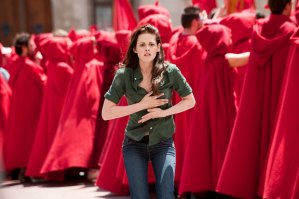 I can precisely indicate where everything goes wrong for the abysmal New Moon — the character of Bella Swan. For the majority of this sequel, I didn’t just detest and dislike her I downright hated her. I hated her. I understand her appeal to the millions of Meyer’s literary acolytes, but man does she come across as a self-centered, casually cruel, messed up girl who spends most of her time being whiny, mopey, and sulky. It’s not just that she has a guy interested in her, it’s the absurd notion that every man cannot get enough of this sullen gal. As presented in New Moon, Bella is such a dour and lifeless personality. I cannot see whatsoever why she is worth such effort. This criticism may be tracked all the way to Meyer’s source material, making Bella absent in defining character dynamics expressly so pre-teen readers can insert themselves as the character and swoon over being the object of universal desire. It is insultingly thin wish fulfillment that this girl has every man, vampire, and werewolf fighting over her in the Pacific Northwest. After Edward leaves, she shuts herself out and rejects all her friends. We see in one camera pan that she spends literal months in a stupor. I understand that teenagers think everything is the end of the world, but she and Edward were together for, what, a few months? Then again, heartache is something that knows no exact time frame for healing, so consider this but a quibble. Bella seems to push others away except when she needs a set of ears to whine.
It is post-Edward where Bella becomes insular, self-centered in her pursuit of danger placing herself in stupidly reckless scenarios, and hurtful. Where Bella really infuriated me is her treatment of her lifelong friend, Jacob. Obviously the big guy has a thing for his her and she knows this, which allows Bella to string Jacob along for almost a whole movie. She leads this little doggie along, teasing him with a “Maybe I will be with you, maybe I won’t” dance that becomes irritating and rather loathsome. Jacob is a swell guy who has looked out for Bella from day one, accepted her coupling with a vampire, sworn enemy of werewolves, and he’s been the best listener to all her self-involved drama. Plus this guy is ripped and has hip flexors that could cut glass. And he is there for her and didn’t abandon her like Edward. So Bella toys with her self-described “best friend” until she can hear the word “Edward” and then she can think about nothing else, even after months of complete separation. I understand that Edward has the sexy, brooding, bad boy appeal, where women think they will magically be the key ingredient to change the troubled man for the better. But on the flipside, Jacob thinks he?’ the key ingredient to finally get Bella to commit to a healthy relationship, and he gets screwed. Seriously, what’s the worse thing about dating a werewolf? You may have to take him for more walks. I suppose this makes me sound like I’m on Team Jacob, as the fans call themselves. I’m really on Team Bella Deserves to be Alone.
 I don’t want to sound unduly harsh. I don’t necessarily have an inherent dislike for characters that make bad decisions or who are, at their core, unlikable. I could forgive the sins of Bella Swan if she had even a hint of subtext. Bella Swan is a void of personality. I cannot recall if this was the same with Twilight, which I haven’t seen since I watched it on opening day in the theater a year ago.
What also sinks New Moon is how it repeats the same plot from Twilight. Once again Bella feels alone, she finds comfort in a boy that says they can’t be together, this intrigues her and pushes her into action, she’s warned of danger, and then finally she settles in with a pseudo relationship with a supernatural stud who makes blanket promises like “I’ll always protect you,” and, “I’ll never let anything happen to you.” It’s not complex folks; Meyer is just feeding pre-teen girls their fantasy of a male romantic interest. Because of this repetitious plot structure, very little of substance happens during the overlong 130 minutes of New Moon. Bella kinda sorta almost gets involved with a werewolf, there’s some lousy Romeo and Juliet allusions, and thanks to a delightfully hammy Michael Sheen (Frost/Nixon, The Queen), we learn a little bit about what makes Bella special to the world of vampires (it’s telling that her “specialty” is her lack of reaction). Beyond that, this is two hours of posturing and some gratuitous beefcake shots of shirtless men. My theater was sold out and packed with the Twilight faithful who swooned when they saw Edward strutting in slow-mo and openly hollering in approval when Jacob first whipped off his shirt. For supernatural creatures, they do more brooding than anything.
Director Chris Weitz (The Golden Compass, About a Boy) replaces Catherine Hardwicke to steer the second movie. I actually think Hardwicke had the right sensibilities for this franchise and she brought a youthful, rambunctious spirit that gave the first film a teenage synergy that made the romance feel pulpy. Weitz does away with this and makes the movie feel more ornate and chaste and dull. The execs spent major money to film in Italy for the vampire Volturi clan, but as near as I can tell some sets would have done the trick. Note to filmmakers: if you spend money to film in an exotic location, show it. As far as I can tell, Weitz was hired because of the bump up in special effects for this picture. Gone are goofy vampire baseball sequences and now we have cheesy wolf battle sequences, which come across like a less refined version of the polar bear brawl from Golden Compass. The special effects have improved but that doesn’t mean they?re good.
 This isn’t exactly the kind of movie that asks for much from its actors, and screenwriter Melissa Rosenberg distills Meyer’s text to the point that the actors pout and yearn. Stewart is an actress I have liked for years since Panic Room, so imagine how I would feel about the Bella character with a less capable actress. Pattinson is absent for almost the entire movie and it’s hard to say that his presence was missed. The best actor of this weird love triangle is Lautner who at least seems to have some fun with his role. He has an amiable spirit that penetrates all the gloom. He’s come a long way from being Shark Boy in 2005?s The Adventures of Shark Boy and Lava Girl.
The plot is a shadow of the first film, and the main character is annoying and hard to sympathize with, there?s so little of consequence that happens, it?s way too long, and, oh yeah, did I mention how much I disliked Bella Swan? At this point, the Twilight franchise is a juggernaut that cannot be contained (as I write this it’s poised to make over $70 million on opening day) and the Twi-hards will find the movie to be catnip, swooning at the visualized male sex objects. For anyone outside the cult of Twilight, the movie version of New Moon will fail to communicate the appeal of the series. The movie feels bloodless. Twilight is like a tedious soap opera scrubbed clean of teenage hormones. I think I’ll stick with HBO’s True Blood, a more nuanced, adult, sexy, and just plain fun series following vampire-human love. Bella could learn plenty from Sookie Stackhouse.
Nate’s Grade: D+
Share this:

The Blind Side (2009)
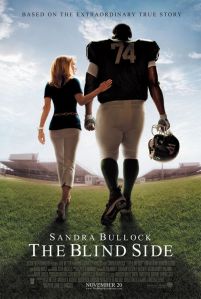 Based on a true story, The Blind Side tells the true-ish story of Michael Oher (Quinton Aaron) who was a lost, homeless black youth in Tennessee. He was adopted s a teenager by the Tuohy clan, a rich White family led by no-nonsense matriarch Leigh Anne (Sandra Bullock). Her husband (Tim McGraw) is a restaurant franchise owner, so they don’t have to worry about money or food budgets for Michael’s large appetite. The gentle giant is grateful but wary. He’s admitted into a private school because of his football potential, but at first they envision the hulking teenager on defense. Leigh Anne is the one who sees his protective instincts and assists in the switch to offensive tackle, whose job is to protect the quarterback’s blind side. With Leigh Anne’s steady influence and a stable home environment, Michael begins to feel like he has a loving family. Eventually Michael Oher becomes an All-American player in college and was drafted by the Baltimore Ravens in the first round of the 2009 NFL Draft.
The Blind Side might just sneak up and, forgive me, blindside you. Well, that?s not accurate, because this movie will not sneak up on anyone. There is not a single moment of surprise to be had. Michael Oher is portrayed as a gentle giant who is very tight-lipped. Much of his performance is in body movement and those dark, sad eyes of his, which means that the audience has to intuit a lot from the character. That might be why the most affecting moments come from Oher’s stunned, grateful reactions. It’s hard not to be affected by such an outpouring of earnestness. Stay during the end credits, watching the photos of the real family at the 2009 NFL Draft and try not to feel a smidge of their happiness.
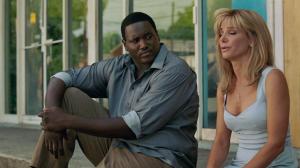 Bullock seems like a natural fit for this character and this material, and she does give the Southern spitfire life. She’s the heart of the movie and pretty much the driving force for the film, so it helps that Bullock taps her natural charms to make the character feel less like a cartoon and more like some approximation of a person. She’s formidable and brassy and pretty much gets her way on everything. The movie has the faulty belief that Leigh Anne saying anything folksy is funny, which is not the case. However, Bullock makes the character likeable and embraceable, and plus, she doesn’t fall down once. It must be a first for a Sandra Bullock movie.
Every scene is played into a moment of uplift and eventual triumph, which can be tiring but also has a respectable batting average for success. Structurally, the movie doesn’t have any overarching sense of conflict, which seems bizarre given the circumstances of an insanely wealthy white family adopting a troubled black youth in Tennessee. You might think Michael would take some adjusting, or that the students of privilege might not fully accept someone so different, or that the Tuohy children might need more convincing to suddenly add a new member. There are a few raised eyebrows and some slight hesitation, but the characters just barrel forward like what they are doing is common. The family is just resoundingly good-hearted and full of such moral clarity, though the husband seems to be content to be a powerless pawn to his vociferous wife. There is no real internal conflict within this family despite the burdens they tackle, and even worse the movie doesn’t really show any change occurring. At a lunch with her rich girlfriends, Leigh Anne remarks that Michael is changing her life. How? She seems like the same kindly woman from the beginning. Instead, the movie is packed with tiny little conflicts that get easily resolved and then move along. Will Michael feel at home? He does. Will he get his grades up? He does. Will he figure out the game of football? He does. Will he play well in a game? He does. Will he graduate? He does. Will he get a scholarship? He does. Will he reject the lifestyle of crime? He does.
Big Mike is sidelined in his own story by the firecracker of a character that is Leigh Anne. The saintly Tuohy family is yet another example of Hollywood feeling the need to tell a compelling African-American story framed as the story of helpful, White characters. Why can’t he film’s emphasis be on Michael instead of Leigh Anne, especially since she remains the same good Christian woman from the start? It’s probably because Oher, as portrayed on film, doesn’t have much of a personality. He’s a nice if soft-spoken kid but he mostly just shuffles his feet. Off the football field, he is written merely to take up space. He serves as the ongoing results to Leigh Anne?s teaching experiments.
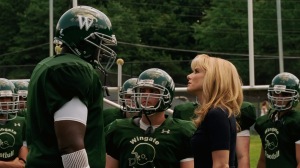 If you peel away the movie’s sentiment, it does have some niggling, potentially troubling aspects to the story. It sings the praises of insanely rich Southern Christians and makes us say, “How nice and rich of them.” Leigh Anne is the kind of woman with enough mettle to venture into the ghetto and even stand up to taunting gang members. She even threatens to shoot one of them. Every one of these “ghetto” sequences feels transparently written by somebody whose only understanding of an urban environment is from movies and TV. I wasn’t expecting The Blind Side to be as accurate as The Wire, nor would I normally care about the inaccuracy, but when it’s in the service of comparison (the comfy world of rich White people vs. the hopeless existence of poor blacks) the portrayal becomes ham-handed and morally questionable. Just to rub it in how good Michael’s got it, the movie resorts to ending with a montage of newspaper reports detailing gang slayings in Oher’s old neighborhood, highlighting every character we saw onscreen. The movie says they had no choice to end up as criminals because they could not escape the nightmares of the ghetto. If only those unfortunate black youths could have found rich families to adopt them.
Perhaps the funniest moment for me, as an ardent college football fan (go Bucks!), was a montage of South Eastern Conference coaches trying to recruit Oher in 2005. He’s visited by the head coaches for South Carolina (since retired), Tennessee (since fired), Auburn (since fired), Arkansas (since fired, now coach of Ole Miss), Louisiana State (left for NFL, now coach of Alabama), Auburn (since fired), and Ole Miss (since fired). The turnaround in just a four-year period is astounding for a major college conference. The coaches look like they’re having fun in the movie, probably because they get to pretend to be coaches again.
The Blind Side is a straight-down-the-middle genre picture that plays every expected note, it?s manipulative and formulaic for a sports drama, but I’d be lying if it didn’t get to me from time to time. If you go into The Blind Side under the right frame of mind, which means essentially ignoring the flagrant manipulations, then this movie will work on its sentimental sports genre sensibilities.
Nate’s Grade: B-
Share this:

A Christmas Carol (2009)
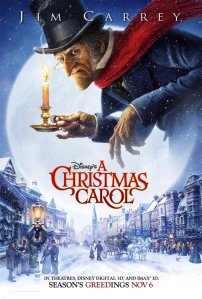 I still am at a loss over the appeal of the motion-capture system that director Robert Zemeckis fancies as of late. The creative mind that gave us classics Back to the Future and Who Framed Roger Rabbit? has embraced a technology that straddles the middle between live-action and outright animation. Motion-capture attaches electronic nodes to actors and digitizes their movements and facial features to later be conceptualized by computer wizards. And to this I say… so what? It seems like a whole slew of unnecessary work that adds little else than a vague starting point. Why not let the animators start from scratch? Why hamstrung creative professionals because Cary Elwes was feeling like making a certain gesture as “Portly Gentlemen #1?” I just don’t get it. To me, the motion-capture system is stranded in some artistic netherworld where it isn’t live-action and it isn’t animation. Zemeckis has cranked out his third mo-cap baby this decade, a retelling of Charles Dickens’ famous Christmas Carol. Why Zemeckis thought an old holiday chestnut would work best in this format, I’ll never know.
Cold-hearted Scrooge (Jim Carrey) is set to be visited by three spirits on a very magical Christmas Eve. The old man goes through Christmas past, present, and future to reevaluate his life and the true meaning of “peace on earth and good will toward men.” You know the drill, folks.
I like A Christmas Carol. I do. So do plenty of nice people. There’s a reason this oft-told tale still manages to resonate with generation after generation and that?s because it’s a good story. Of course it’s also an extremely familiar story to just about anyone outside of a womb at the moment. I expected Zemeckis and his crew to use their technology to jazz up the old story and give it a fresh new life on the big screen. Despite a handful of excursions flying through ye olde London, the extra slathering of special effects doesn’t enliven this holiday tale. I remember having great fun with Zemeckis’ previous motion-capture movie, 2007’s Beowulf (which does not play nearly as well in 2-D). That movie played around with the 3-D environment to great effect and made you feel apart of the experience. In contrast, A Christmas Carol does shockingly little with its depth of field, rarely placing distance between the foreground and the background. It’s a fairly lackluster 3-D experience. Maybe I wasn’t relaxing my eyes the right way, though I did notice how conscious I was of trying to elevate the 3-D experience myself. My disappointment is magnified by the fact that Zemeckis has been a pioneer for the 3-D playbook that Hollywood has now dubbed as the savior of the theater going experience.
 I wonder if Disney execs imposed limitations on the use of the 3-D immersion, not wanting to scare children by making them feel like they’re in the middle of a ghost story (there are some spooky moments already). The whole draw of motion-capture, and animation, is to transport an audience untethered by the limits of traditional practical filmmaking. This newest incarnation of A Christmas Carol fails to justify its existence. Why should I pay to see the most familiar story of modern day if there isn’t any new offering? At least The Muppet Christmas Carol gave me something different. And it had Muppets.
When I was younger in the mid 90s I was a huge fan of Carrey’s rubber-faced antics. I quoted Ace Ventura verbatim with my fellow seventh graders in 1995. So I understand the attraction of having him play multiple parts, but why exactly in a Dickens story? It’s not a comedy unless it’s adapted into one, and Zemeckis hews very close to Dickens and mostly recites the tale word-for-word. Scrooge isn’t funny, the ghosts aren’t funny, so why hire a renowned comedian to portray them all? This is a straight-laced adaptation and as such not the best use for Carrey’s talents. Is the move any better because Carey played all three ghosts? Is the movie any better because Gary Oldman gets to play Bob Cratchett and voice Tiny Tim? Is the movie any better because Elwes is credited for five inconsequential roles? Celebrity vocal casting is rarely effective in animation and so it seems the same in motion-capture.
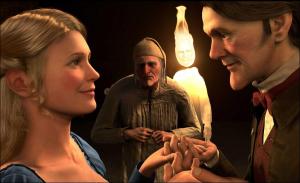 The technology has improved from the dead-eyed zombie children days of Polar Express, but it still seems like little more than less refined animation to my eyes. The movements are more fluid but the color palate is subdued into amber hues and candlelit locales. It doesn’t exactly use all the technological tools in the toolbox. It’s like a five-star chef toasting a Pop Tart: a waste of potential. I didn’t care for the skewed proportions on people either. Scrooge has a wiry frame with long spidery limbs and a triangular torso, and his character design kept reminding me of Jack Skellington. It’s too otherworldly considering nobody else comes across as a garish caricature in design form. The character designs for the three spirits are also fairly underwhelming. The Ghost of Christmas Past is a wispy flame. The Ghost of Christmas Future is nothing but a shadow. Is there a connection here? Otherwise, a shadow is pretty lame for the one ghost that can get really inventive and scary. Really, a shadow? I can do that myself without the aid of computers. And was it Carrey’s shadow to make it officially motion-capture? Because God forbid no other shadow could do or give the same performance of being draped over shapes.
I actually had to vehemently fight the urge to nap during A Christmas Carol. Maybe it was my poor sleep from the night before, maybe it was the fact that the 3-D glasses make everything darker (they still manage to hurt my eyes after prolonged use), but it was likely due to the fact that Zemeckis added a coat of polish to a holiday classic but declined to find purpose for doing so. Does this story get better with zooms through London, or Scrooge being shrunk and chased by demonic horses? It all seems like folly to me, like somebody’s idea to goose literary classics. Can you imagine Jane Eyre being shrunk and climbing through the walls of her Victorian era home? It all seems like an annoying distraction. Zemeckis? A Christmas Carol is exactly what you’d expect, which means you’d be just as well to flip through the TV channels and find any number of Christmas Carol versions. The Muppet Christmas Carol might even be on. Give that one a try instead. It even has some nice songs. And it’s got Muppets.
Nate’s Grade: C
Share this:

Where the Wild Things Are (2009)

Studio execs are always seen as the bad guys, right? They meddle in the affairs of artists, more concerned about dollar signs and marketing potential than in lasting, authentic artistic achievement. Director Spike Jonze, the most lauded video music director of all time, has gone through five years of trials to bring the adaptation of Where the Wild Things Are to the big screen. He’s had his funding cut, he’s been dropped by one studio, and the second studio contemplated starting over from scratch after seeing an early cut of the movie. The studio heads were worried that Jonze’s take was too sullen and too scary for children. They asked for something a tad more uplifting about a boy that runs away to have adventures with giant monsters. Jonze and co-screenwriter Dave Eggers (Away We Go) insisted on their vision and stuck it out, and 18 months later, that vision is what made it to theaters. Having now seen Where the Wild Things Are, it pains me to accept that maybe those studio honchos had a point all along. Jonze’s film is eclectic and visually wondrous but this is not a children’s movie; this is a movie about childhood intended for thirty-something adults and film critics. And man, it’s a downer.
Based upon Maurice Sendak’s masterful 1963 book about an unruly child “sent to bed without supper,” we follow Max (Max Records), a nine-year-old on a tear through life. His older sister is growing up and hanging out with older friends, his dad is absent, and his mother (Catherine Keener) is trying to juggle work, kids, and having a life her own. One night she has a man over (Mark Ruffalo, in cameo form) and Max gets upset. His mother isn’t giving him the attention he feels he’s owed. So he acts out, bites his mother, and when she responds with genuine terror, he runs away. He finds a small boat and sails away across the ocean to a mysterious island. It is here that he encounters the titular wild things, giant beasts that act out in very similar ways. Max declares himself the king of the beasts and they accept. Carol (voiced by James Gandolfini, a fabulously warm performance) is the happiest to have somebody new to play and listen. There’s also the small goat-creature Alexander (Paul Dano), the eagle Douglas (Chris Cooper), the elusive KW (Lauren Ambrose), and the married monster couple, the pushy Judith (Catherine O’Hara) and the subdued Ira (Forest Whitaker). Together they form an unorthodox family that still falls prey to in fighting and jealousies.

First off, Jonze does a magnificent job of creating the world of the wild things. The cinematography by Lance Acord (Lost in Translation) uses a lot of handheld cameras to trail after Max, communicating the kinetic energy of youth. The movie looks gorgeous but doesn’t resort to a self-conscious gloss. Acord makes the wilderness look inviting and dangerous. The wild things are amazing creatures to watch, brought to startling life by Jim Henson’s creature shop and seamless CGI artistry to provide facial expressions. If these creatures were purely computer generated, they would lose a sense of magic. Watching the furry suits interact with the real world brings so much more enjoyment to the movie. These giant creatures look real and intimidating. I liked the fact that there’s one character, The Bull, who just stands in the background alone, and the other wild thing monsters make a point of not noticing him. He’s the weird disaffected kid on the outside. I also appreciated that the movie doesn’t pander to make the monsters cute and cuddly. They continue to be scary. At one point Carol even chases after Max with the intent to eat him. Jonze and Eggers have made a movie about childhood that doesn’t coddle children. The production design by K.K. Barrett (Marie Antoinette) is nicely imaginative, though it only deals with a handful of stick huts. The fort that the wild things construct is fantastical, like an alien structure but made completely out of twigs.
Jonze and Eggers have made a movie all about the feelings of childhood; however, it seems that almost all of those feelings are negative. Sure Max bounces around with youthful energy, and his imagination goes to exuberant places, but the movie paints a broad picture of how painful and disappointing childhood can be. The movie doesn’t capture the wonder and excitement and possibilities of childhood; it focuses on the somber realities of what it’s like to be misunderstood, lonely, and incapable of changing anything. What about the pleasures of childhood? Even when Max engages in his fantastic creativity it usually leads to destruction and hurt feelings; everyone ends up in a worse place. A great example is in the opening sequence where Max tries to snare his older sister and her friends into a snowball fight. He gets them to play along and then everything is great, until the older kids accidentally take it too far and Max is left embarrassed, hurt, scared, and incredibly angry, which leads to lashing out, which then leads to regret and attempts to rationalize it as not his fault. This pattern is repeated throughout, where Max will get scared or confused and this triggers bouts of physical violence, like literally biting his mother. You might think his time on the island would be an escape, but really all of the monsters are manifestations of Max’s fractured psychology. KW represents his older sister’s approval so deeply longed for; Judith represents his defensiveness; Alexander represents his feelings of marginalization and helplessness; and Carol most closely resembles Max’s id, concerned that his family is falling apart, prone to jealousy and sudden violent outbursts when he doesn’t get his way. It all can make for an interesting psychoanalytical experience but it also can get tiresome. Listening to needy, whiny, morose monsters can be exasperating after awhile when there isn’t anything else resembling a plot. Where the Wild Things Are feels somewhat like Jonze and Eggers are subjecting everyone to their own therapy.

This shaggy, somewhat draggy movie has little else going on, so we watch Max boss around the monsters, commission colossal forts, run around, sleep in a big pile, and more or less try and hold a family together when they are moving in different directions. Things slow down a lot on this island. Max himself is a polarizing figure. Some people find him relatable, his pain and fears, and still others find him to be a wild brat. His behavior seems to go beyond that of a normal child acting out. I’m not going to prescribe the kid but me thinks there may be something else amiss with Max (am I alone in my diagnosis, people?). My friend thought Max was an insufferable and unsympathetic brat who learned nothing by the end of the movie. I feel that Max has to have learned something, since his entire time spent on the island was him working out his troubles to gain a little more perspective. Records is a real find as a child actor, and he’s the only human onscreen for like 90 minutes. I thought he carried the movie ably enough and finely displayed the conflicting emotions of being nine years old.
Will you like Where the Wild Things Are? That’s difficult to surmise. It may depend upon whether you can identify with Max; I couldn’t for the most part. This is a much easier movie to admire than to like. There’s very little fun to be had. The movie has an implicit sense of loss and melancholy throughout. Children’s movies don’t need to be all happy endings and feel-good lessons, but then again they don’t also have to be densely Freudian. Childhood isn’t all innocence and rainbows, but it’s also not all rain clouds and emotional meltdowns and feelings of impotence. The movie presents childhood as an unyielding hell. I know other people love Where the Wild Things Are, and I respect that artistry Jonze and his crew brought to this movie, but I doubt I’ll ever watch this movie again in my life. For once, the studio execs had it right.
Nate’s Grade: B-
Share this:

The Time Traveler’s Wife (2009)
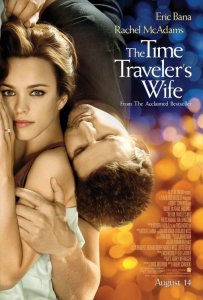 You think your romantic foibles are complicated? Based on Audrey Niffenegger’s best-selling novel, The Time Traveler’s Wife, we follow the life of Henry (Eric Bana), a librarian stricken with the unique genetic disorder of uncontrollable time travel. He first discovered this condition when he was six years old and disappeared out of his mother’s car, only to rematerialize and watch her die from afar. An older version of Henry happened to also be on hand and fill in his younger self on the details. Henry will randomly move backwards and forwards through time, and there’s nothing he can do to stop it. One of the side effects of spontaneous time travel is, naturally, nudity, as Henry travels in the buff a la the Terminator. So usually the first thing he must do when he winds up some place new is find some clothes. Henry seems destined to be a sad and lonely man, but then one day Clare (Rachel McAdams) enters his life, confessing that she’s known Henry for years and been waiting for this exact moment to arrive. She asserts herself and asks Henry for a dinner date that’s been in the works for some time. They fall in love, or fall further in love in Clare’s case, and try to make a relationship work despite Henry’s hiccups through time.
There’s a tenderness to the movie, though I found it tricky to fully engage in the characters. Much of the movie concerns the plot complications that befall such a strained and unique relationship. The flick gives new meaning to cold feet when Henry literally vanishes during his wedding, only to reappear as a mid-40s version of himself (hey makeup department, you couldn’t do more to effectively age Bana than add a dash of grey?). There is a great mind-bending section where Clare cheats (?) on Henry with… a younger version of himself. I was interested in the subdued proceedings and I felt underpinnings of empathy for Henry and Clare, but then my mind wandered into something a little darker and pessimistic. Now, The Time Traveler’s Wife is a polished traditional romance despite the sci-fi trappings but I started thinking about if what I was witnessing was actual romance? Henry first visits Clare as a child, telling her he will be her eventual husband. She falls in love with him in that moment and rejects all other suitors, knowing with absolute certainty that she will marry Henry. She just has to find him. And when adult Clare does meet Henry the librarian, he has never seen her before up to that point (it’s not as confusing as it may sound). She’s been waiting years to see his face again and she tells him that they are destined to get married. You see what’s at play here? The romantic plot is a loop where each character supplies the other’s conviction. Henry locked Clare into a life of looking for him and said they would marry, but then the adult Clare is the one who convinces Henry that they will indeed marry, and he tells young Clare this who will then convince Henry, etc. Is there any free will at play here, or is each partner in this relationship being manipulated by the certitude of the other? It’s sort of a metaphysical chicken/egg scenario.
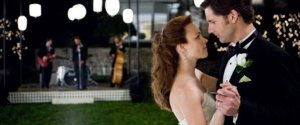 The best portion of the movie comes across during the second half when the movie focuses more on the emotional consequences of Henry’s condition. Early on Henry’s uncontrollable time traveling is played for laughs and some forced and somewhat trivial conflict (oh no, he missed another dinner!). Henry has a chilly relationship with his father (Arliss Howard) until, well, I’m not quite sure, but things improve. In the second half of The Time Traveler’s Wife, the drama gets more serious and intriguing when Clare and Henry attempt to conceive. Henry’s genetic disorder gets passed down to the baby fetuses, which means little babies are vanishing out of the womb and perishing before being zapped back inside. That’s a rather disturbing image and yet it is a thoughtful and plausible problem given the premise. As a result, Clare suffers through several traumatizing miscarriages. But they keep at it because Henry has seen his future lineage, also a time-traveler, and he knows that one of these pregnancies will go full term and become their eventual daughter, Alba (Tatum McCann). It was this storyline that stopped my mind from occasionally wandering and hooked my interest. Perhaps it’s cheap sentiment, but it’s hard not to feel for this loving couple when they endure pregnancies fraught with danger. The movie misses out on a dynamite dramatic opportunity with Alba. If I were adapting this to the screen, I would make sure to include Alba as a grown 30-something woman visiting her father on his deathbed, tearfully informing her dear dad on all the eventful moments that he won’t be around to experience. Picture an adult Alba talking about her own children to her dying father. There wouldn’t be a dry eye in the house. Hollywood, if you’d like to tack on an extra emotional ending to this movie, there’s still time. Call me.
It is here that I must address some key scenes that may pique curiosity. During Henry’s travels, he frequently visits the young child version of Clare. The first time Clare meets her future husband she is a little girl sitting in a meadow on the boundary of her family’s palatial estate. Henry, as he does every time he becomes unstuck through time, arrives in the nearby woods without a stitch on. Director Robert Swentke (Flightplan) and screenwriter Bruce Joel Rubin (an Oscar-winner for Ghost) work diligently to make sure the movie walks a very fine tone, and I confess that the scenes between loving child and naked time-traveling man escape creepy pedophilic overtones. Take that blurb for what you will in a romance: “Hey, no pedophilic overtones!”
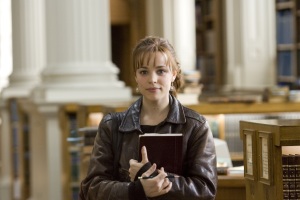 There are some other complications when it comes to this matter of unexpected time traveling. Firstly, the rules seem to be flexibly applied. At one point Henry is talking about how he cannot prevent his mother’s deadly car accident. The movie professed a destiny-entrenched approach to time travel, meaning every action you think you’re engaging out of free will was predetermined (the TV show Lost also subscribes to this theory). It cuts out time paradoxes. But then in another moment Henry uses his knowledge of the future to win the lottery. So which is it? Are the filmmakers trying to convince me that it was destiny for Henry and Clare to win the lottery, because I’m not buying it. Having a time-traveler for a boyfriend takes out some of the natural drama o relationships when one party can peak ahead. Relationships have danger and excitement and uncertainty to them, but when Henry can just matter-of-factly say, “We’re gonna be fine. We’re still together and in love fifteen years later, I saw it,” well it may make for good romance for some, but it makes for rather inert drama. How can you hope to win arguments? Naturally, the hefty book has been streamlined as much as possible for a mainstream moviegoing audience, which means that Henry’s scope of time traveling is scaled back. At one point he quantum leaps beyond his own lifetime, and because this has never happened before and is really only done to introduce a ticking death clock. I suppose there will always be inconsistencies when it comes to breaking the space-time continuum.
McAdams (The Notebook) is a great choice for the romantic center of the movie. She’s glassy-eyed and smiles so hard in her early sequences you think her dimples are going to explode off her cheery face. She is such a winning presence and her warm-hearted glow powers the character and the movie. Unfortunately, she doesn’t have very good chemistry with her onscreen mate. Henry is a victim of an existential cruel joke. Bana (Munich) is light-footed and makes Henry more than a space-time martyr. He’s somewhat amorphous as a character, a collection of niceties and genial, puppy-dog affection, which means that Henry is routinely upstaged by his genetic condition. However, when Henry faces the specter of his impending death is when the character gets a lot more attention and Bana is able to work his considerable talents. He gets ample opportunities to showcase his time-traveling buttocks. I don’t think too many women out there would be that put off if a naked Eric Bana magically materialized in their bedroom.
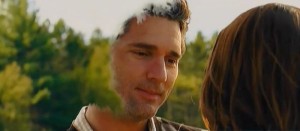 The Time Traveler’s Wife is mildly reminiscent of The Lake House, and not just because of the time travel romantic complications. Deep down, these are traditional Hollywood romances with a fresh sci-fi coat of paint. The movie is best if you set the logic portion of your brain off so that inconsistencies and potential contrivances don’t distract from an intriguing story that presents some nice developments. There’s a tender love story here, though the characters don’t leave as much of an impression as they could have with such a plot-heavy romance. It finishes strongly and the mood throughout has a somber bittersweet quality, hammering home the “enjoy the time you have” message. McAdams is darling, Bana gets in the buff, their chemistry isn’t great, and the filmmakers refrain from the material getting overly sentimental or solipsistic. In a summer of relative disappointments, a tricky, clever approach at traditional romance is welcome amidst the explosions and wacky studio comedies.
Nate’s Grade: B


You must be logged in to post a comment.