Blog Archives
The Spectacular Now (2013)
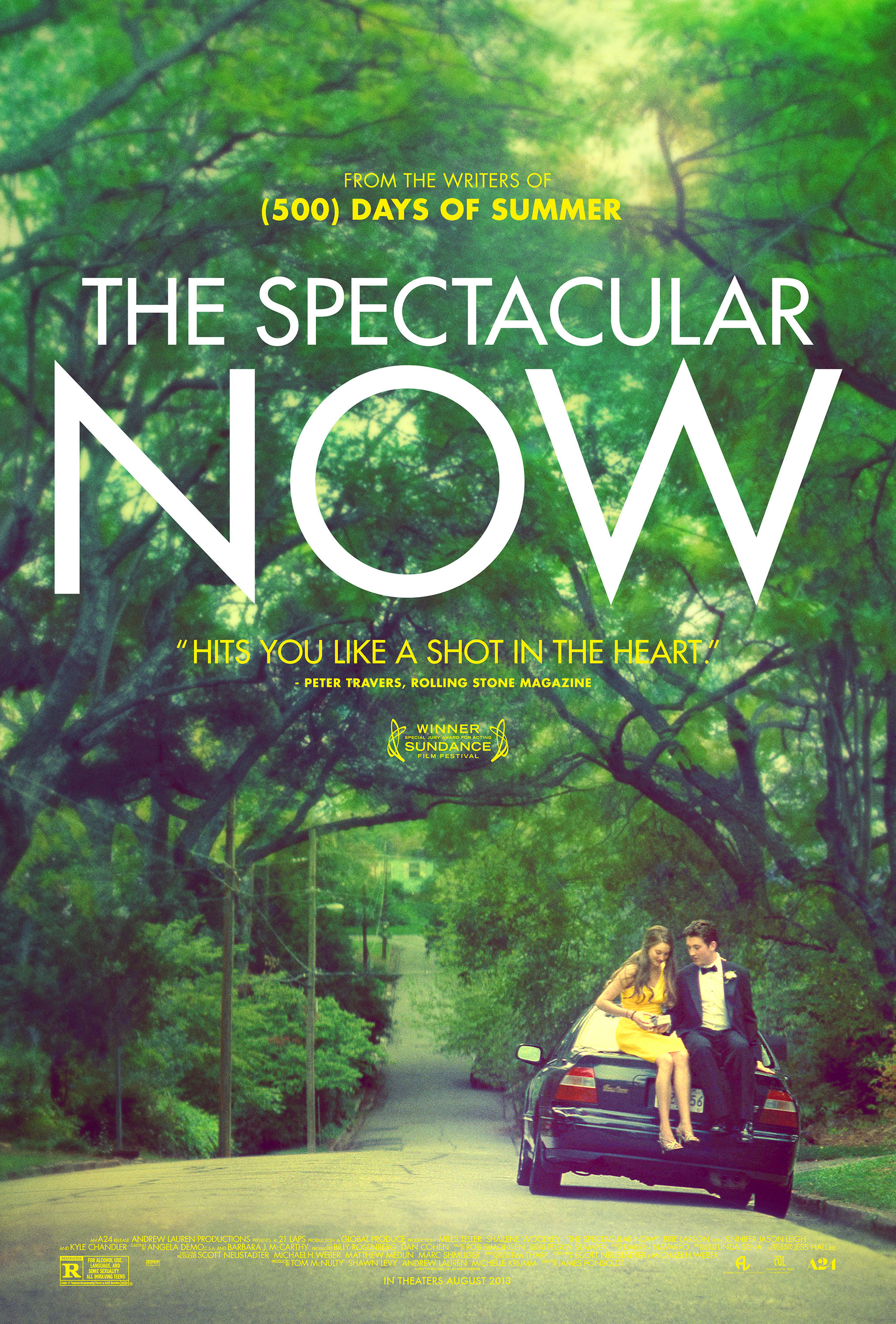 I say this as a fan but John Hughes was probably the best and worst thing that happened to the modern teen movie. He certainly brought an extra level of pathos and relatability to the genre, but then again he also dealt in stereotypes, often languishing his characters to stock archetype ghettos (the Jock, the Prep, the Nerd, etc.). In the ensuing decades, it’s been hard to break as many teen films, of those aimed at teenagers, have casually dealt in these easy labels. That’s why something like The Spectacular Now is such a welcomed respite. Here is a teen movie that aims to tell a story about people and their problems, not simply a regurgitation of high school cliques and clichés. This isn’t a film where all the pieces magically come together; this is a high school movie that more closely approximates real life. This is more Cameron Crowe than John Hughes material.
Sutter (Miles Teller) is the most popular guy in school, or so he’d tell you. He’s the life of every party, the kind of guy who everyone enjoyed, and the guy who could charm the pants off any girl. He’s recently broken up with his girlfriend Cassidy (Brie Larson), though still harboring serious feelings for her. Of course the best way to get over the old girl is with a new one, and Sutter sets his sights on Aimee (Shailene Woodley). She’s a smart, somewhat quiet gal that immediately takes a shine to the spotlight that is Sutter’s affections and attention. He’s not entirely over his old girlfriend, still angling to get back together, but also Sutter’s whole perspective could be summed up as an extreme case of carpe diem. The kid is partying like there’s no tomorrow because he’s convinced he has no real future, so he’s going to live it up while he can.
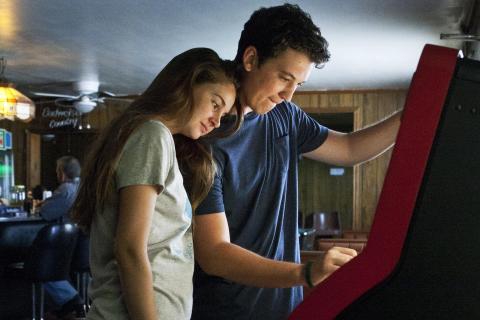 You’ve easily seen this movie before but it’s rare to see it given so much depth, maturity, and care. At heart, this is the story of Sutter learning he’s a screw-up and getting his life back in order, learning some self-control and responsibility, and winning over the good girl. But The Spectacular Now is so much more than that, and it’s especially sadder than you may have expected with its wise-talking, charming protagonist. This is the story of a teen coming to grips with parental abandonment, gaining insight into his own delusional detours to avoid pain, and the horrible realization that he is, in his present reckless condition, a bad influence dragging down the future of the girl he genuinely cares for. That’s a lot of heavy emotional drama and none of it revolves around the clichéd staples of teen movies, like those checkpoints such as prom and the Big Test. This is the story about one damaged man coming to terms with the state of his damage and gaining the courage to change his direction. He’s an alcoholic but the movie doesn’t ever put the narrative on hold for soapbox preaching. If anything, Sutter’s alcoholism is handled so subtlety, with most character silently acknowledging but unsure or indifferent to act, that it may strike a few chords with audience members. Then there’s the fact that none of this is heavy-handed; the filmmakers have done a fabulous job of giving each character credibility. They behave like real human beings. Even the easily slotted antagonists, namely Cassidy and Sutter’s deadbeat dad, are given shades of recognizable humanity and depth. Even though Cassidy waffles in her feelings for her ex, I cannot dislike her because her character portrayal is so honest. She’s struggling with her feelings for a screw-up with redeeming qualities. That’s fairly relatable, even if she’s not our winsome romantic lead. The filmmakers drag a typical teen movie story into our real world setting, adding depth and telling observance. You will recognize many of these characters.
There are few superlatives to describe the cuteness of the blossoming relationship between Sutter and Aimee. It’s so smooth and relaxed yet completely believable, and the two actors have such a warm and natural chemistry with one another, enough that I seriously contemplated if they dated outside the film (rumored but nothing conclusive). You feel their budding affections, the sweet swoon of young love, and the hiccups along the way. Woodley (The Descendants) does an outstanding job with her mannerisms and affectations; her awkwardness around her feelings is adorable, but not in that prefabricated cutesy way often ascribed to the oft-mentioned Manic Pixie Dream Girl roles. She’s a fairly normal teenager on the fringes of high school, keeping her nose down and looking ahead. In movie terms, you couldn’t readily classify a gal like Aimee, and that’s because she’s a real character fully fleshed out by the screenwriters and the actress. Woodley’s performance is near invisible of acting tropes and constraints. She just dissolves into the character as all exceptional actors do.
But this is Sutter’s movie and, in accordance, Teller’s (Rabbit Hole) film. The young man puts on an acting camp in this film, shedding the various layers of armor from his sad clown of a character. As I said, we’ve seen this character before, but Teller and the screenplay are able to give Sutter such extraordinary depth. The carefree life-of-the-party character is turned into an introspective character study, essentially examining the darker side of Ferris Bueller. He’s using alcohol and his blithe attitude to blunt the pain that he fears he’ll end up like his old man, that his life has already peaked and he’s not even out of high school. Teller is such a successful charmer that he already wins you over to his side despite some boorish behavior because we see that the guy has a good heart. In the film’s opening, he’s propping up his friend to finally get the guy a girl, and the ensuing mess ends Sutter’s own relationship. The last act involves Sutter coming to grips with the negative impact of his actions, notably on Aimee. Teller is so effective at giving you glimpses of the sadness eating him whole. His concluding scenes when he finally breaks down feel like a hard-fought victory for the character as he confronts his doomed fate. At every turn, Teller impresses, and compounded with Woodley, they form an unbeatable team of sterling young acting talent.
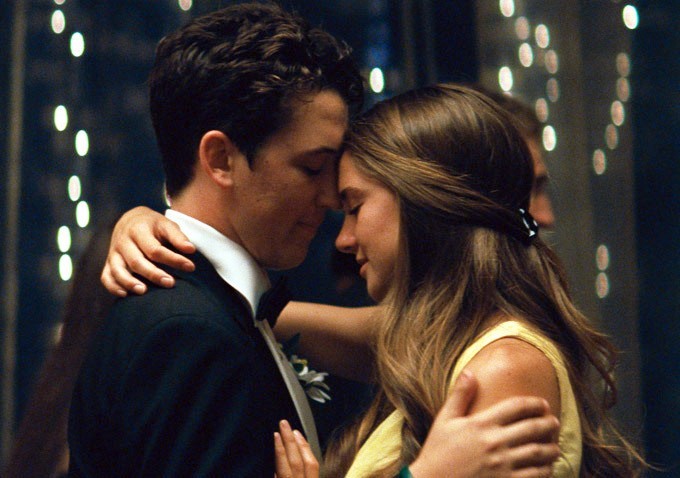 Special mention to Kyle Chandler (Super 8) for his pivotal walk-on roll as Sutter’s bad dad. He’s so pathetic and so desperate and so wonderfully realized by Chandler. He doesn’t get a Big Scene, he doesn’t get a Big Speech, he doesn’t even do anything out of the ordinary for a shifty, unreliable, selfish drunk, but those few minutes he’s onscreen, it all becomes so deeply sad and clear where Sutter’s life is headed without intervention.
The only depiction that I had trouble believing was Sutter’s almost consistent drinking and driving. Throughout the film, he has his trusty Styrofoam Big Gulp cup with him, spiked with booze. The man hasn’t graduated high school yet and is already a high-functioning alcoholic. Because of this I can believe that people would not be alarmed seeing him drive after imbibing a few drinks. However, the man is constantly drinking while behind the wheel of an auto and several times he appears completely trashed. I find it alarming as well as a bit far-fetched that not one character, not even Aimee, would raise objection to Sutter’s continued dangerous behavior. We also witness several scenes of Sutter drinking in bars. It’s conceivable he has a fake ID at his disposal, and it’s even more conceivable that he could talk his way into any establishment, but it’s more food for thought. Then again maybe this is just one of those towns where nobody cares about innocent lives being snuffed out by drunk drivers.
The Spectacular Now is an earnest film that doesn’t overdo it, providing challenging life lessons to fully formed, complex, believable characters. It doesn’t sugarcoat the heartache and harsh reality out there for vulnerable teens. It’s a charming romance tied up with an insightful character study of one young man hiding his sadness and anxiety of life’s disappointments with humor and booze. Thanks to the tremendous acting of its onscreen pair, you root for Sutter to turn his life around because you see value in him as a person, even if he doubts it himself. You’re on his side from the start, and you know how nicely he matches up with Aimee. You want this movie to pull off the spectacular, and for long stretches it feels just as if that will happen. The ending aims for ambiguity but is far more hopeful than its source material. I was charmed thoroughly by this film and its lead characters but even more I was thoroughly engaged in their dilemmas, moved by their struggles, and encouraged by their perseverance and growth. The Spectacular Now (extra points for never even having a character spout the title) is a funny, warmhearted, measurable restrained, knowing film that could open eyes. It may not be spectacular to some, but it’s surely a great film.
Nate’s Grade: A-
Share this:

Safe Haven (2013)
 For a solid two acts, I couldn’t hate Safe Haven, the latest in the bland, paint-by-numbers coastal romances based on a novel by Nicholas Sparks. It was chiefly inoffensive but predictable at every step, but I didn’t mind. At this point, Sparks is a brand and you know what you’re getting. Julianne Hough (Rock of Ages) plays a woman on the run from a corrupt Boston cop. She may or may not have killed a man. She hides out in a North Carolina fishing village and comes to love a hunky widower (Josh Duhamel) with a pair of annoying kids. Their coupling is somewhat restrained given the sudsy context; they don’t kiss until close to an hour in. What benefited the film was having a dangerous external threat, the corrupt cop, circling in. This alone raised the stakes of what ordinarily would be a pleasant but mostly mild romance between two pretty people. However, it is that third act, the concluding half hour, where Safe Haven just loses its mind. One twist is a given, though it makes the Boston PD look either incompetent or collusive, but the final twist comes out of nowhere, bringing in a supernatural factor that left me gob smacked. All I kept repeating was, “What?” It’s such a contrived, immediately stupid twist ending, trying to bridge a simple romance with something like The Sixth Sense. I can’t say whether the twist existed in Sparks’ source material, but wherever it originated, I can predict you won’t find a dumber twist ending to a film all year. Safe Haven is two parts of a good-looking albeit mediocre movie with a final dash of half-baked lunacy.
Nate’s Grade: C-
Share this:

World War Z (2013)
 No movie this summer has had such a dark cloud of bad buzz like Brad Pitt’s World War Z. Based upon Max Brooks’ 2006 novel, it’s a global zombie action adventure that Pitt, as producer, has developed for years. He hired director Marc Forster (Finding Neverland, Monster’s Ball) and after a very protracted shoot, according to reports, neither was on speaking terms. A Vanity Fair article highlights the fascinating challenges World War Z endured, the biggest being a third act that, while filmed, did not work. The movie’s release date was pushed back twice, from summer 2012 to December 2012 to finally summer 2013. That sort of talk usually raises critic hackles, anticipating a bomb that all parties are trying their best to salvage some investment. It’s something of a small miracle then that the finished film actually kind of sort of mostly works. It still feels lacking and under developed but World War Z is not the fiasco many had feared.
Gerry Lane (Brad Pitt) is an ex U.N. inspector pulled back into the field to do nothing less than possibly save humanity from the undead. The world is under siege by a new sort of pandemic, one that reanimates the dead. Gerry and his family barely escape Philadelphia alive and find refuge on a U.S. aircraft carrier offshore. Gerry bids his family goodbye and zips around the globe looking for Patient Zero. If he can crack the mystery of how it all began perhaps mankind can develop a cure.
 For fans of the book, it’s best to come to terms with the fact that the only thing World War Z has in common with its source material is the fact that there are zombies. There is one reference to Israel’s response to zombie rumors, but that’s it. Believe me, I know the book is excellent but allow me to play devil’s advocate here. Would a strict adaptation of Brooks’ book work as a movie? Perhaps, but it takes place years after the titular World War Z. I understand the producers’ wishes to set the movie in the middle of the crises, adding urgency and an immediate sense of suspense. Once you go that route, there are certain limitations to your storytelling. Unless you were going to go the Crash-style ensemble route, you’re going to need a central character/hero to tie it all together, and that too limits your storytelling options. Gerry can hop around the globe but we’re still only following one man’s personal experiences. While in the air, we see in the distance below a mushroom cloud rising. Who detonated an atomic bomb and why? We never know, and it’s that sort of in-the-moment fog of war madness that helps the movie operate. I enjoyed watching the small moments of society breaking down. Factoring in all that, I’d say that the big-screen edition of Brooks’ book is a passable starter, an appetizer that gets you hungry for more.
This movie is one of the first global-scale zombie outbreak films I can recall. Usually the zombie subgenre is told in confined spaces, remote locations, intimate settings. Danny Boyle had some larger London set pieces with 28 Days Later but that was still a film about dark corridors and small places. The scale of World War Z is what sets it apart. There is a degree of fascination watching the world come apart, and watching it fall apart in so many places adds to that. Gerry hops from one hotspot to the next in his quest and we watch as each new location goes to hell. It gives a greater sense to the dire threat out there. In the information age, and with Gerry’s U.N. connections, he can get global reports, and to learn that nowhere is safe helps maximize the pandemic threat and sense of urgency. I didn’t even mind Forster’s decision to present the teeming armies of the undead like there were a swarm of bees, rolling and tumbling over one another, forming formidable human pyramids. It’s a fairly spooky image and relates back to the nature-undone alchemy that makes zombies tick, plus it gives an extra sinister edge to the zombies. High-walled structures are not the sanctuaries we might have assumed. The true terror afforded by zombies, beyond the fact that the monster is us, is its inevitability; it doesn’t matter what you do, they will get you. There are more of them, and they don’t require food, water, sleep, and have only one goal. Adding to that sense of doom I think is a good move, and the raging sea of human bodies also helps Forster keep the PG-13 rating the studio dictated. I didn’t really miss the blood/gore, though one sequence where Gerry slices off a soldier’s infected arm seems a bit too clean and precise.
I criticized Forster’s skills directing action after 2008’s deeply disappointing Bond misfire, Quantum of Solace. The man showed no real feel for action sequences. Perhaps the man found a greater appeal to World War Z because there are some genuinely thrilling action and suspense sequences here and Forster deserves credit. The Israel sequence degenerates at a horrifying speed, and I loved the touch of caged passageways being erected through streets as a last-second defense from falling zombies. The initial stop in South Korea is at night and in the rain, thwarting Gerry and his team from seeing too far into the distance. It makes for a rather suspenseful sequence that makes good use of darkness and cover. The zombie actors in this movie deserve some recognition. They really get into all their clicks and clacks and add some creepy authenticity to the proceedings. Then there’s the airplane attack, zombies on a plane, that is all over the film’s advertising blitz. It’s a rather entertaining sequence, though one can’t help but provide some class subtext when the first class passengers barricade themselves while the coach passengers are torn apart. I still think Forster would be more at home with smaller dramas but he shows much more prowess for larger material.
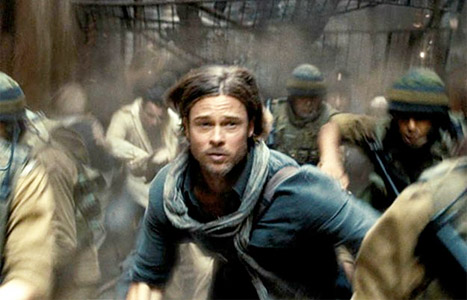 The reshot third act, thanks to added writers Damon Lindelof (TV’s Lost, Prometheus) and his pal Drew Goddard (The Cabin in the Woods), drastically scales down the scope of the pandemic. After two acts of all-out global chaos, we retreat back to the zombie film roots: a small, secluded place. The third act is almost like its own little separate movie. Partly because it’s something different, more horror/suspense than action, as well as being in the confined space, but also because Lindelof and Goddard do a fine job of structuring this concluding chapter. When Gerry gets to a World Health Organization outpost in Wales, he has a simple goal: get from one end of a lab to another. Oh, there are zombies all over the lab. Its narrative simplicity, as well as the clear focus, is a satisfying way to close out a movie that was sort of all over the place. Forster seems to really enjoy the suspense setups that he gets to have fun with in the third act, things like ducking around corners, avoiding zombie detection. The very end provides a ray of hope for humanity… until you fully think out what the consequences are for that hope (the first line of defense shall be hookers). Anyway, it sets up a sequel where mankind can begin fighting back. How do I know this? None other than Gerry’s closing lines are: “This is only the beginning. This war isn’t over.” A bit of hope on Pitt’s part as well there.
And yet with the world falling apart and Pitt our savior, I found myself from the outset very emotionally unengaged with the film. Pitt’s performance is perfectly suited for the material. It’s just the whole family man angle that doesn’t work. I understand it gives Gerry some personal stakes in doing his job but wouldn’t, I don’t know, saving the world be enough when it comes to motivation? It’s your standard reluctant hero’s tale, but the family stuff just kept dragging down Gerry’s character. To begin with, a man looking like Brad Pitt who voluntarily makes pancakes for his kids every morning… sounds like the stuff of fantasies for many. However, it almost keeps him away from his mission, the greater good, and there’s actually a sequence in South Korea where his family literally endangers Gerry’s life by making a phone call. Then the movie keeps cutting back to their existence on an aircraft carrier like I have equal interest in this storyline. One storyline involves Gerry flying the world over and escaping zombies. The other storyline involves whether Karin and the kids will be kicked off the ship. Which would you rather spend time with an as audience member? I didn’t really care about Gerry’s sad wife, played by Mireille Enos from the sad TV show The Killing. I had more invested in the Israeli soldier (Daniella Kerteesz) Gerry teams up with. My father even wanted them to run off together by the end and ditch Karin. I won’t even speak to the awkward storyline where Gerry’s family unofficially adopts a Hispanic kid after his parents die. If only those poor souls had listened to the knowledgeable white man who they took care of.
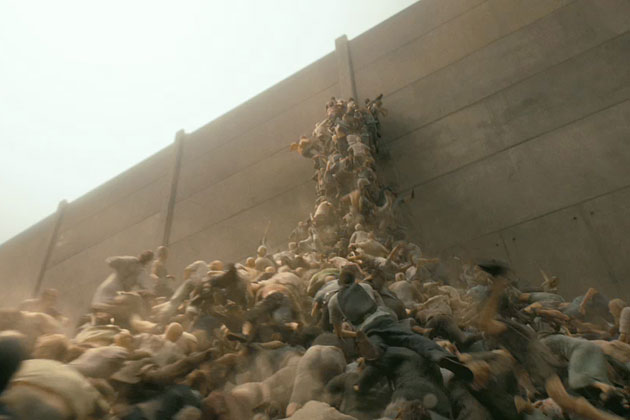 The big-screen version of World War Z bears little resemblance to the book of the same name, and that’s okay. Some adjustments are necessary in adapting, like bringing the actions of the story into the present, centering on a major character. As a book fan, I was somewhat disappointed in the unfulfilled potential presented, but as a movie fan I’m more disappointed by the film’s overall execution. There’s a lot of money in this production, the most expensive zombie film of all time, and a lot of talent on both sides of the camera. And yet after even pulling off a mostly effective ending, World War Z is more middling than it ever should be. Brad Pitt is saving the world from zombies; that should be enough, but it’s not. The movie shows flashes of intelligence, of socio-politico commentary, of something greater, but those moments are fleeting and ground down to make way for a mass-appeal action blockbuster. There’s nothing wrong with those sorts of movies (Roland Emmerich does them exceptionally well), but World War Z doesn’t have the brain-headed flair to pull it off. It’s thrilling, in spurts, interesting, in spurts, and entertaining, in spurts, but it fails to coalesce into something truly worthwhile. My allegiance to the book, as well as zombies in general, guarantees I’ll be there for more if World War Z spawns sequels. Hopefully there will be more because there are so many great stories from the book yet to be told (namely, everything).
Nate’s Grade: B-
Share this:

What Maisie Knew (2013)
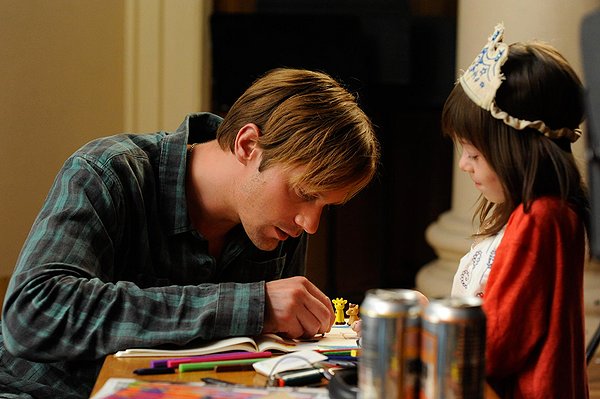
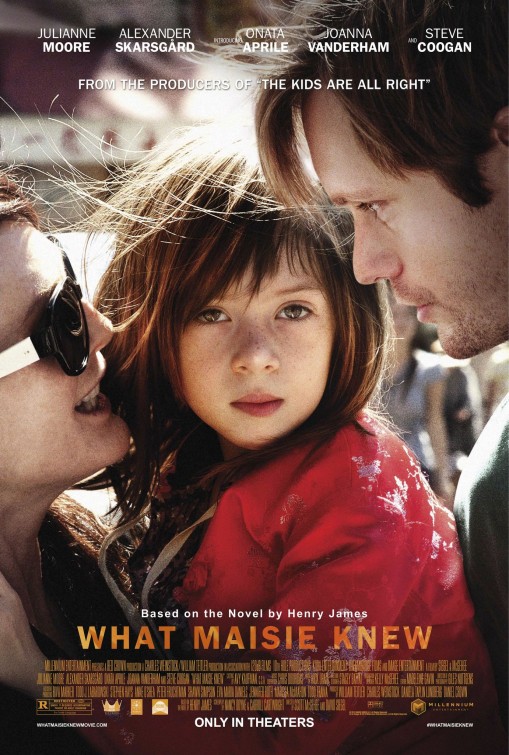 Did you know that What Maisie Knew is based on a novel by Henry James that was published in 1897? I sure didn’t, but then again my knowledge of Mr. James is somewhat limited. James’ tale of negligent parents passing off their daughter back and forth was controversial when the novel was first published. Updated to modern-day New York City, seven-year-old Maisie (Onata Aprile) is the pawn in her parents’ contentious divorce. Her father, Beale (Steve Coogan) is an art dealer who is constantly on his phone and making out-of-country trips. Her mother, Susanna (Julianne Moore), is an aging lead singer for a 90s alt rock band who also likes to party. Beale remarries Margo (Joanna Vanderham), a young woman who previously served as Maisie’s nanny. Not to be outdone, Susanna remarries Lincoln (Alexander Skarsgard), an affable bartender who’s somewhat clueless around kids. Everyone is trying to navigate the tricky new relationships and what they think is best for Maisie, though Lincoln and Margo seem to be the only ones who actually care.
 When it comes to divorce dramas, the easy way is to go big, to ramp up the emotions of such an emotionally distraught experience, and to tip into the overwrought territory of melodrama. I can already imagine the animated shouting fests and crying fests. Then there’s the impulse to go the bitterness route, like 2005’s The Squid and the Whale, where the movie takes a cue from its feuding parents and infuses the film with a dark, overpowering sense of acrimony. I credit directors Scott McGehee and David Siegel (The Deep End, Bee Season) for making arguably one of the most subdued movies about divorce I’ve ever seen. It’s certainly not flippant in the slightest, treating the subject, and mainly the toxic effect on Maisie, with sincerity and good taste. But as far as overblown shouting matches, they’re kept to a minimum and mostly comprise the first fifteen minutes of the movie, establishing the inevitable divorce of Susanna and Beale. The movie ignores the sensational and focuses on the ordinary, little moments of complete believability that serve to build, like brick by brick, the overall reality of the story. You’ll watch the film and think to yourself that, even with parents with completely outlandishly rich professions, that everything in this movie could realistically happen. Weird to think that James wrote his tale over 100 years ago and yet how relatable his conflicts still are to this day. However, because of this subdued, naturalistic approach, What Maisie Knew can’t quite find a proper ending. The one presented seems a tad too pat and tidy for this movie. It almost approaches a“happy ending,” though not quite. Still, knowing how thick-skulled both Susanna and Beale are, it’s hard to think that they will ever come to their senses and do what’s in the best interest of Maisie.
This can be an uncomfortable movie to watch because Maisie’s mom and dad are so destructively neglectful and self-involved. There’s a perverse rubbernecking draw to seeing the antics of truly awful parenting. You’ll find yourself getting very mad at how terrible these people are at being human beings. Susanna and Beale interrogate their daughter for ammo they can use against the other, twisting and manipulating the kid that we wonder if either truly cares about. Dad’s always full of excuses and mom’s looking to flee from responsibility at a moment’s notice, dumping her daughter on her latest boyfriend. You’ll find yourself easily sympathizing with Lincoln and Margo, the two people who love Maisie most and would make the best parents for her. I began rooting that they just abduct Maisie and start a new life as a family in a different country. The unchecked narcissism of both Susanna and Beale could serve as a clinical study. It’s a wonder that Maisie seems like a bright, playful, and relatively normal kid. For now.
Another aspect of McGehee and Siegel’s joint direction that I really enjoyed was how the movie takes on the perspective of little Maisie; she is our eyes and ears, and often the camera framing will instinctively mirror her own point of view, cutting off adults. It’s an interesting visual approach but it also further tethers us to this girl, forcing us to think even deeper about Maisie’s perspective, and how she’s interpreting the angry words. I suppose there is a valid argument to be had that a seven-year-old child is going to be a rather limited perspective on such a contentious conflict. There’s also the nature of Maisie. She’s a relatively quiet child, given to poking her head around corners and staring with those big glassy eyes of hers. Given the fact that she’s a child, and processing a painful life experience, don’t expect her to divulge too much about her thoughts and feelings. She’s an opaque presence and I realize that that can get frustrating for some. She’s not the kind of kid that’s going to burst into tantrums. This girl is internalizing all the pain and confusion. Having a passive prism for your movie might be akin to telling a love story from the point of view of a potted fern. Literally anchoring the camerawork to Maisie (I don’t want to oversell this as if it’s a stylistic gimmick) forces us to constantly think of every action through its impact upon Maisie. It’s not exactly a coming of age or loss of innocence tale but more a combination of the two.
 If you’re going to have a child be the star of your movie, you better choose wisely. I’ve found that as I grow older I have less tolerance for poor child actors. Perhaps it’s my inner Scrooge. Good thing that little Aprile (Yellow) is so effortlessly heartbreaking as she tries to find her way amidst her changing home life. One day she has a mom and dad, then she’s splitting time, then her daddy has a new mommy, who happens to be her old nanny, and then mommy has a new husband as well (Susanna admits she got remarried simply to improve her court standing). Aprile nicely underplays her character’s innate vulnerability while still reminding you of her youth. She’ll get scared and ask to go home, crying alone in her bed, and your heart will ache. I cannot say whether the strength of Aprile’s performance lies more with her legitimate skills as an actress, good direction, or the general reticence of the character, and thus the lesser demands for a child.
Moore (The Kids Are All Right) and Coogan (The Trip) give surprisingly textured performances, at least more so than the opening fifteen minutes would have you believe. They can both be monstrous and callously indifferent to their daughter’s well being, but as the movie concludes, each one of them has a small moment where they realize the damage they are inflicting upon their child, how poor a parent they have been (Susanna even lashes out at Lincoln’s encouragement to Maisie as “undermining her as a parent”). It’s much more than I was anticipating and both actors do good work at being unlikable without going overboard. Fans of TV’s True Blood might just swoon a little harder thanks to Skarsgard’s good-natured, humble, and mildly affecting performance as a man who becomes profoundly attached to Maisie. He may not know what he’s doing but isn’t that parenting as a whole? Skarsgard and the charming Vanderham make a great onscreen pair and their genuine affection for Maisie provide the most uplifting moments.
When it comes to parenting, there are no magic instructions to insure a responsible, loving, thoughtful, and independent human being. It’s a leap of blind faith. However, it’s much easier to predict the events that can screw up an impressionable child (do not misconstrue this as my declaration that children of divorce are, at heart, broken somehow). The thought of collateral damage is fresh in our minds as we track little Maisie trying to survive the reach of her terrible parents. The terse arguments can be painful but even more painful is the overall negligence of her rich and mostly absent, self-involved parents. What Maisie Knew isn’t a downer of a movie and its subject matter is given proper seriousness and reflection. You’ll likely cringe at points, may even grumble under your breath, but in the end it ends on a hopeful note, the possibility that Maisie, under the right guidance, could turn out to be the bright kid we see glimpses of at her school. There’s something quite moving about the resiliency of a child. This is, of course, just one interpretation of the movie, but What Maisie Knew is an emotionally engaging, subdued, sincere, and poignant film that trades on naturalistic waves of human interaction rather than cartoonish bluster, all the while forgoing cheap sentimentality or unpleasant bitterness. For the performances, the deft handling of sensitive material, and the quality direction, give What Maisie Knew a chance when able.
Nate’s Grade: B+
Share this:

The Great Gatsby (2013)
 It seemed like some sort of educational mandate that every child in the United States was forced to read F. Scott Fitzgerald’s novel, The Great Gatsby, when they were in high school. In my highly unscientific number crunching, it appears that those who actually enjoyed the book are in the minority. I recall loathing it, but then again, when you’re fifteen, you sort of loath everything. Enter Australian director Baz Luhrmann, the showman who exploded the screen in razzle-dazzle run amok with Romeo and Juliet and Moulin Rouge!. Not exactly the kind of filmmaker one would fathom helming an adaptation of a classic of American literature, but the man’s style of excess seems like a suitable match for Fitzgerald’s tale of high-class overindulgence.
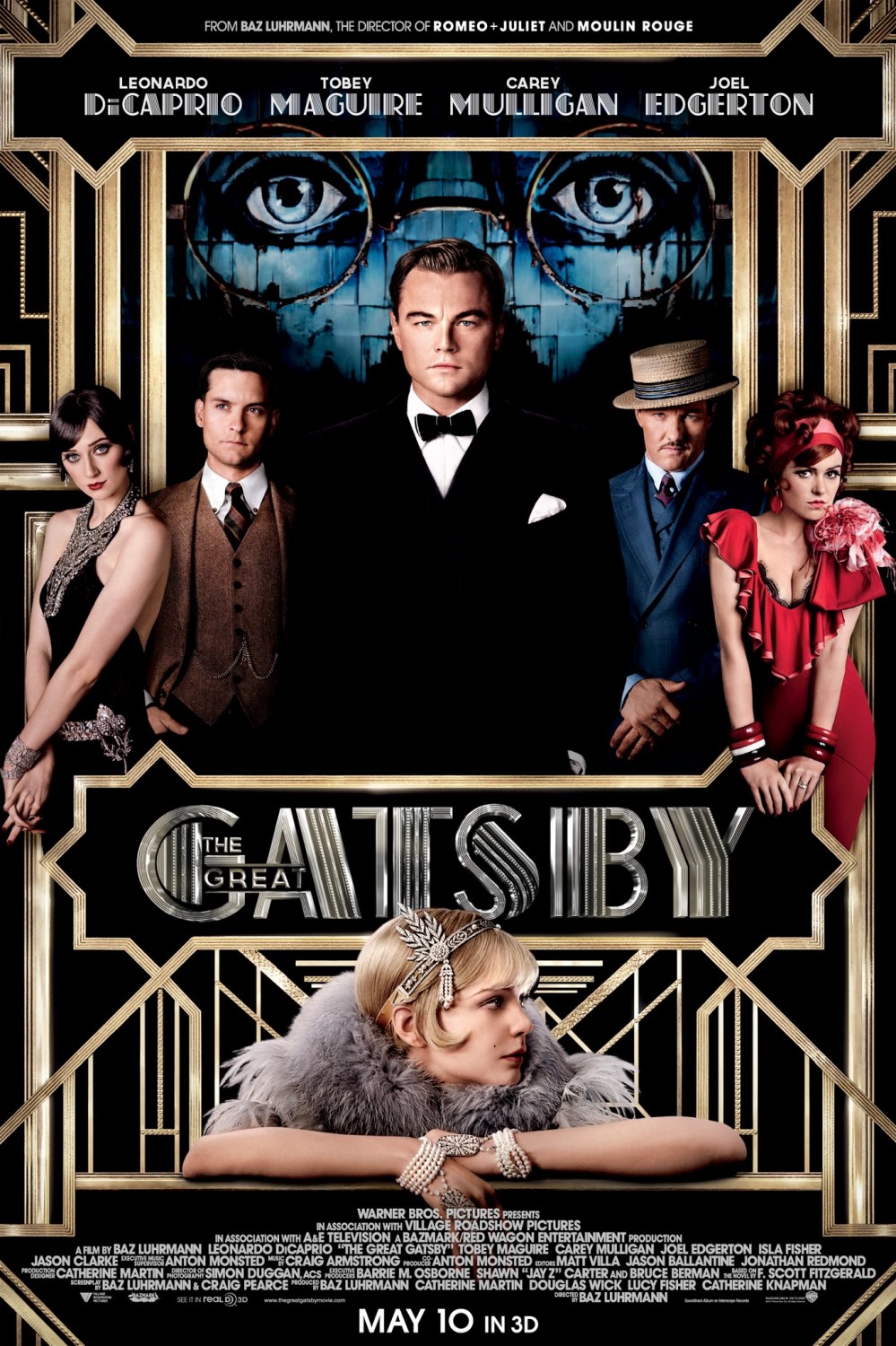
In 1922, young Nick Carraway (Tobey Maguire) moves to the hustle and bustle of New York City, living close to his cousin Daisy (Carey Mulligan) and her rich husband Tom Buchanan (Joel Edgerton). He’s also the neighbor to the mysterious and newly rich Jay Gatsby (Leonardo DiCaprio), a reclusive man who opens his mansion up to prolific bacchanals. Rumors persist in who he is and how he accrued his enormous fortune. He’s an old flame of Daisy’s and is secretly hoping she’ll attend one of his raucous soirees. He enlists Nick to help arrange a reunion for them, and soon enough Gatsby is already planning their happy future together again. Trouble is, Tom isn’t willing to lose his wife without a fight.
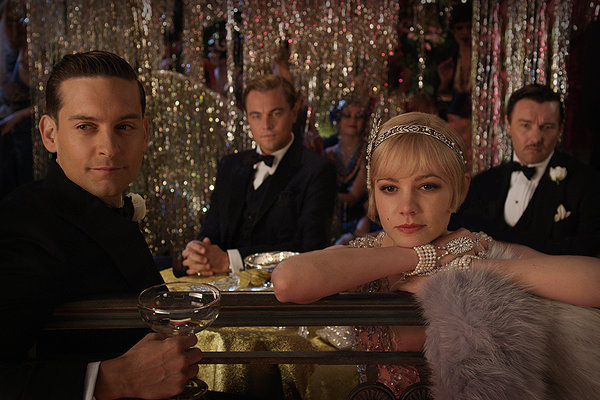 Luhrmann’s helming of The Great Gatsby gave me exactly what I desired and expected. The movie is convulsing with energy and the first hour just moves; be it the camerawork or people onscreen, for long stretches there always seems to be some degree of onscreen movement. Luhrmann’s signature theatrical visual atmosphere is vibrant, joyous, and a perfect translator of the lavish lifestyles of the noveau rich in the Roaring ‘20s. The man brings to startling life the sensations of being young, privileged, and carefree, and the use of anachronistic music, while not nearly as textured and thematically relevant as Moulin Rouge!, adds to the fun. I quite enjoyed a low-key, jazzy rendition of Beyonce’s “Crazy in Love.” Luhrmann’s style treks in excess but it’s a much more pleasant, dreamy, and altogether beguiling form of artistic indulgence than, say, Michael Bay or Tony Scott and their respective macho visual fetishes. Luhrmann’s campy sense of style doesn’t come across as overly suffocating or distracting, at least to my eyes, and instead the man injects his movies with tremendous energy, immersing you into a new world of old and modern. This is what Luhrmann was meant for. While other canonical classics of American literature may not survive a glitzy Lurhmann treatment, it’s a good match for the extravagant excess of Fitzgerald’s setting. Lurhmann’s visuals are glorious, and the 1920s era is brought to glamorous life. You get the sense it was one giant party without any lasting consequences (if you were rich enough).
The second half of the movie slows down considerably after the amped-up introduction. We’re caught up in the characters at this point, as we should be, and the Gatsby/Daisy reunion dominates the plot. I suppose there are only so many Busby Berkeley numbers and confetti explosions one can encounter before the plot has to set in. Lurhmann and company stick pretty faithfully to Fitzgerald’s plot (rest easy, lazy high school students of today and tomorrow). Interestingly, they are far more explicit about Gatsby’s securities fraud, knowingly making a fortune off junk bonds, all in the name to impress Daisy. There’s a genuine sense of respect for the source material even with Luhrmann’s visual flourishes; at several points, Fitzgerald’s text floats onscreen. The problem is that Luhrmann’s Gatsby is almost entirely focused on the romantic coupling of its title figure and Daisy. Gone is the class criticism, the indictment of the follies of the rich, the examination of the dark side of the American Dream, and the subtext. You’ll get plenty of shots of that famous green light, 20th century literature’s most famous and unsophisticated symbol (pay attention kids: green means go), but there’s little time for complexity. It’s not a screen romance worth this much attention, which is kind of the point, but when the movie clocks at over 2 hours and 20 minutes, drawing out a lackluster romance can become rather grating.
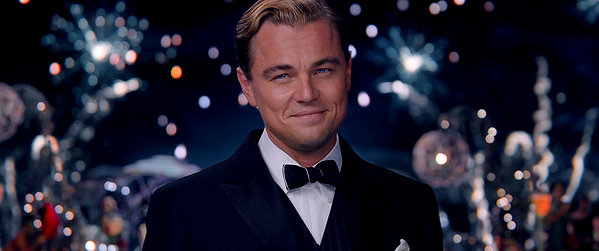 If I were top cite one major fault in Luhrmann’s incarnation, it’s that it adopts Nick’s fawning perspective and treats Gatsby as this tragic romantic figure. I acknowledge with every adaption there is a degree of interpretation, and romantic hero is certainly one facet of Gatsby, certainly how he sees himself, but by the end of Fitzgerald’s novel, Gatsby is really more a naïve man who really only sees Daisy as trophy, a prize for his reinvention and jumping up to the storied moneyed class. Daisy herself is certainly weak-willed but her emptiness (she says there’s nothing better than for a girl to be a “beautiful, young fool”) is part of the appeal to Gatsby because he can remake her however he wants. He’s not interested insomuch as her as a person. I don’t think that the Gatsby/Daisy escapades fall into the ranks of Great Tragic Couples of Literature, but that’s how Luhrmann interprets the novel, transforming Gatsby into a revered, honorable, and heartbreaking romantic we’re meant to shed a tear for. I suppose since we’re reliving the story through Nick’s perspective that events could be colored differently. Beyond just a simplistic analysis, it also misses the greater and more futile tragedy of a man trying to escape his past by obsessively recreating it.
The acting is fairly good all around, though the standout is certainly not whom you’d expect. DiCaprio (Django Unchained) is a good fit for the handsome social-climber, but the movie only asks him to play a limited range of emotions, rarely breaking free to show glimpses of the darker, less polished side of Gatsby’s carefully crafted image. He doesn’t exactly exude the charisma you would think necessary for the man, plus his use of “old sport” is so overly abundant it approaches farce. Maguire (Brothers) is a bit too earnest even for his role. It becomes readily clear within minutes that Maguire does not possess a voice for narration. The man is also a bit too old, at 37, to play the naïve, stars-in-his-eyes Nick Carraway. Mulligan (Shame) is given the least to work with since Daisy is meant to be rather opaque but she brings an extra amount of sympathy for a character trapped by her indecision and the demands of men. Easily the best actor in the bunch is Edgerton (Warrior). It would be easy for the guy to simply be the brutish heavy, the angry husband and easy to hate antagonist. Edgerton showcases a surprising depth, and you may find yourself feeling some smidge of sympathy for the lout.
Much like Luhrmann’s Moulin Rouge!, it’s an easy prediction that his Great Gatsby will be equally divisive. There will probably be as many critics decrying Luhrmann’s blitzkrieg of confetti and style as a campy cannibalization of an American classic as there will be celebrating the mad energy and obsequious reverence exhibited in a handsomely mounted, big-budget adaptation. The movie is even being presented in 3D, and did you ever think you’d hear the phrase “The Great Gatsby in 3D” in your life? I enjoyed Luhrmann’s gaudiness and indulgences, painting the screen with his vivid imagination. The impressive production design, costumes, visual effects, and overall visual aesthetic of the movie are a feast for the eyes. Now there are plenty of indulgences and excesses in the movie, particularly the emphasis on grand romance, but Gatsby entertains with few lags. Having read the book once and disliked it heartily in my youth, I can readily say that here is an example of where the movie is better than the book. Now if someone could go about making an improved version of The Lord of the Flies and A Tale of Two Cities, whatever you have to do, my teenage self will thank you kindly.
Nate’s Grade: B
Share this:

The Host (2013)
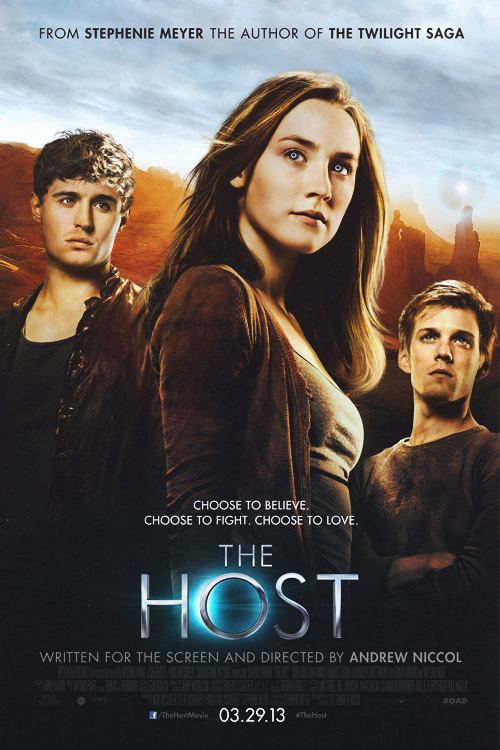 It’s impossible for me to ever separate The Host, a sci-fi would-be romance based upon the best-seller by dubious author Stephenie Meyer, and the demise of famous film critic, and personal influence, Roger Ebert. On April 4, 2013, America’s most prominent film critic, a man who with Gene Siskel changed the face of film criticism and the dialogue with movies, died after his cancer had returned. Upon hearing the news, I was overcome with grief and shed a few tears for the loss of a great writer and a great man who influenced a generation of online film critics like myself. Then I saw what was Ebert’s last published film review — The Host. Knowing his last review on this Earth is this awful movie, that it may be the last new release he ever saw, well it just feels ignoble. The man deserved better and so does anyone else who watches The Host, a movie I saw the very day of Ebert’s death.
Set on earth years after an invading alien race has already conquered, life isn’t too bad. There aren’t any wars or pollution or hunger. The aliens, looking like little glowworms, latch onto the spines of humans and use them as hosts. They control the bodies of the humans but some of us won’t go down willingly. Melanie (Saoirse Ronan) is an 18-year-old gal who fights as part of a resistance movement, led by her Uncle Jeb (William Hurt). The aliens abduct her and Melanie’s body gets a new owner – Wanderer, also referred to as Wanda. Good old Melanie is still in her head, feisty, and goading Wanda into finding Melanie’s family hiding out in the desert with Jeb. Also there is Melanie’s boyfriend, Jared (Max Irons), who is upset that his girlfriend has become “one of them.” Ian (Jake Abel), on the other hand, is adjusting well to the change, as he falls for Wanda and she him. In between these hormonal complications, Wanda is being chased by the appropriately named Seeker (Diane Kruger), who is deadest on bringing some human-style violence to Wanda/Melanie and the resistance fighters.
 The Host, like much of Meyer’s more popular Twilight saga, is a rather dramatically inert story that just seems to exist with little sense of momentum or direction or purpose, beyond providing another bloodless onscreen romance that ceaselessly finds unsettling messages to convey to young girls. Once again it all comes down to a stifling romantic triangle where none of the participants ever seems to work up the necessary passion to garner continual interest. There’s a bit more heavy petting going on but even when these people are having sex dreams, they imagine Melanie with her bra on (such a limited imagination). Please don’t confuse this as some implicit regret on my part that the movie didn’t sexualize its lead heroine (she’ll be turning 19 soon, so fear not pervs). At least the Twilight movies can be seen through the prism of pre-teen wish fulfillment. The Host, on the other hand, is just an Invasion of the Body Snatchers-style sci-fi movie where no one seems that preoccupied with anything too urgent. If the aliens are really that gung-ho to root out the resistance fighters, why aren’t they looking for heat signatures? Why aren’t they studying truck movements? The fighters aren’t very stealth-like in their comings and goings either. Hell, why don’t they even just keep a lookout for people wearing sunglasses, an obvious sign they have something to hide. It’s like the aliens and the humans are simply just going about their business without any danger. That’s because the ultimate fulcrum with which all the plot hinges upon is the romantic whims of a teen girl teaching an alien how to love. Sigh.
The least successful adaptation is likely including Melanie in the action through the use of bratty voiceover. She likes to chime in with snide remarks and pushes Wanda away when she starts getting feelings of her own for another boy. It is simply unbearable. You ever been stuck in the car with a really annoying brat? That’s what it felt like. Now I realize that having the dueling voices was an easier prospect on the printed page, but a similar challenge was tackled with 2003’s Dreamcatcher when an alien possessed Damien Lewis. We had a visual representation of Lewis taking refuge inside his own head. That was better than watching him, and it pains me even now to type it, engage in an argument with himself where the voice of the alien adopts a British accent. Maybe we could have had a better visual representation of Melanie inside Wanda, or maybe something with mirrors, that’s always a good go-to visual for characters of dueling minds. As developed, The Host feels like Melanie’s strapped in next to you, providing incessant and annoying commentary, and all you want to do is tell the kid to shut up.
Given the world-conquering plot elements, I can’t help but think Meyer found one of the least interesting stories to tell within this world. The invasion aspect seems far more compelling a story to tell than one girl stuck in a love triangle. I suppose it’s because Meyer is bringing a different perspective to science fiction, but I found most of this movie to be unbearably boring. And her premise, while flawed, could have been workable. Learning to live a symbiotic relationship with an alien that controls your physical being, there’s plenty of room there to tell an interesting and insightful story. The issues of identity and control could be richly explored. Instead, we get Melanie liking one boy and Wanda liking another, and so Melanie fights from inside to stop Wanda from acting out her exciting new feelings. Given the scope of everything going on, alien invaders and underground resistance organizations, it all feels so slight and myopic and overindulged melodrama. I suppose the whole thing could be a metaphor for puberty, a teen girl whose body is taken over by an alien presence, causing her to act irrationally and deal with swoons of affection she doesn’t know how to properly handle, causing her to act out and alter her perceptions of herself. Then again, I may just be giving Meyer and the movie more credit than they deserve.
The saddest part for me was that Andrew Niccol directed this movie as well as adapted the screenplay. He is responsible for these characters, these plot beats, these samples of dialogue. This is the man who gave us The Truman Show, Gattaca, and Lord of War. Granted, Niccol’s last movie, 2011’s In Time was a great idea in need of a far better script, but I always have high hopes with this man given his track record. From a visual standpoint, he takes a few pages from Gattaca where everything in the world is sleek and shiny and looking like an orgasmic car commercial. The shimmering cinematography by Roberto Schaefer (Marc Forster’s longtime DP) is crisp with plenty of cool colors to signify the mood of our pleasant overlords. There are plenty of nice things to look at, and female fans will likely extend that compliment to the young men duking it out for Melanie/Wanda’s affections. It’s just that everything moves so glacially, so stubbornly slow, that the movie feels like it’s run out of gas long before it’s over. At over two hours, there desperately needed to be some judicious chopping with this movie’s flabby midsection. If you’re not a fan of Meyer’s book, Niccol fails to give you any tangible reason why you should care or keep watching. I even thought about leaving at one point, and that’s an urge I can usually quell, so that’s how monotonous it truly got.
 It’s nice to see Ronan (Hanna) growing into the capable leading lady we all thought she could be, though this movie does her no favors (gone is the gangly awkwardness of The Lovely Bones). I understand that for the majority of the movie she’s playing Wanda, the alien controlling the body of Melanie. There are going to be certain limitations to this portrayal, but Ronan just sounds overly sedated for most of the movie. Then there’s her annoying voiceover, which dips into a Southern accent at several intervals. I guess when Mel gets mad it brings out her roots? Likewise with Meyer’s heroine du jour, Bella Swan, I just don’t see what all the fuss is about over this character. She’s a pretty plain heroine with courageous whims but it’s another example of a film where the supporting characters have to key us in on character traits we just aren’t picking up on our own.
I’m always puzzled when filmmakers decide to make their aliens so, well, alien. Independent evolution in a different star system is going to develop some funky designs, sure, but when you got magical glowworms as your sentient life, I find it hard to believe that they built all that super duper technology to achieve their world-domination. A glowworm made a spaceship? With its glowworm tentacles and its size of about three inches? At least the aliens on Star Trek looked like they knew there way around auto shop. For that matter, we’re in the future where everybody drives a crazy shiny vehicle no matter how off road it gets, but the stupid alien occupiers can’t master the tricky science of contact lenses? And this goes for the human rebels as well. The telltale sign you’re controlled by the aliens or not is the translucent blue ring around your iris, but why hasn’t either side just popped in some contacts to blend in? The aliens can master space travel but get squeamish about things touching their eyes?
The Host is another of Meyer’s poorly plotted, insipid melodrama that manages to be all about teen hormones except those hormones feels so hermetically sealed off. It’s another neutered romance, and this was supposed to be her so-called “adult book”? It’s the same themes and tropes from her non-adult Twilight series, just with a coating of sci-fi rather than supernatural. Even Niccol, admittedly in a bit of a slump, can’t save this picture, and ultimately the overly long, lightly plotted, and tremendously tedious affair lumbers to its predictable conclusion, replete with happy ending (let’s just say that Ian gets a hotness upgrade as far as his lover). The concept of an alien species stripping human beings of free will and living not just amongst us but within us, that’s a solid idea that could make for a compelling story. Meyer found the dumbest story to tell, her bread and butter, a love triangle where both guys have struck her at some point in the film (dwell on that). It pains me that The Host may have been Roger Ebert’s last movie. As far as I’m concerned, this movie murdered Ebert.
Nate’s Grade: D
Share this:

Cosmopolis (2012)
 David Cronenberg is a director that’s full of surprises. The biggest surprise about Cosmopolis, his new film based on the Don DeLillo novella, is how shockingly terrible it is. This may be Cronenberg’s worst film. It’s certainly one of the worst films of 2012.
Eric Packer (Robert Pattinson) is a mega-millionaire currency trader. He’s got so much money he wants to outrightly buy a church just because. We travel with Eric over the course of one day as he travels through New York City in his stretch limo. Along the way, he hosts a colorful array of characters and fears that his high-stakes wagers will be adding up. He becomes more and more self-destructive and looks for new and exciting ways to waste money, talent, and time.
I hesitate to even use the term “film” with Cosmopolis because it’s truly more of an endurance test in didactic, pretentious art house masturbation. The script is really a collection of self-indulgent scenes with very little to connect anything together. Each new scene feels like the movie is starting over. Worse, the dialogue is painfully elliptical, stilted, and monotone, reeking of pseudo intellectual intent, lingering in ambiguity like it’s poetic. It’s not, it’s irritating and obtuse and characters talk in circles without ever really saying anything. It’s the kind of dialogue that reminds me of a pompous student play, something where the particulars involved think they’re making Artistically Daring Statements about Things That Matter. It’s such a mannered way of speaking, so labored in its affectations and superficially drawn to the mistaken belief that obtuse and redundant equals philosophical and thought provoking. The only thoughts I was thinking were of the murderous variety. I felt so pained that I had to check the time and only eleven minutes had passed. It felt like I had spent three times that. I stuck it out for you, dear reader, but otherwise I would have bailed. Here are a handful of dialogue samples to give you an idea:
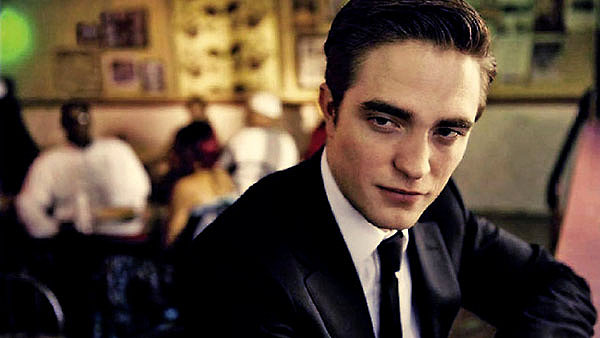 “Why do they call them airports?”
“I have an asymmetrical prostate. What does that mean?”
“Try putting a stick of gum in your mouth and not chew it.”
“Where do limos go to spend the night?”
I feel like I’m even doing a disservice to calling the people onscreen characters. They’re really more just talking heads, mouthpieces for cluttered ideology. The plot introduces new characters but they only last for a scene and then it’s time for someone new. This would be acceptable if it ever appeared that these interactions had any effect, positive or negative, on our protagonist. As it stands, it’s just a gloomy guy running into one meaningless encounter after another. Oh, and if that was the point of the whole exercise, then shoot me now. I literally cheered when the movie was over. Well, right after incredulously barking, “That’s it?”
Plot is another term, much like characters, that has next to no meaning for Cosmopolis. The plot is a wealthy guy who wants to get a haircut. Yes, that is the inciting incident. He stays in his limo as it slowly drifts down the bumper-to-bumper New York City traffic. He has encounters with people, sure, but mostly it’s the story of one man in his pursuit of a haircut. And you know what dear reader, spoilers be damned, but he gets that haircut too. The final half hour of the movie, almost a third of the whole running time, is spent with Paul Giamatti, an intense and angry man who wants to kill Eric. At least Giamatti’s performance kept me awake. The plot, much like the characters, is really a vehicle for the script’s ideas, so it becomes exasperating when the movie tries to pretend, at points, like now all of a sudden we should care about Eric and his journey. The ideas, as presented, are either on-the-nose or impenetrable. For every confusing conversation about death, you’ll get a leaden capitalism = rats metaphor.
 Pattinson (Breaking Dawn Part 2) seems like an apt choice as well as a craven marketing ploy for Cronenberg to get his weird arty movie greater exposure and financing. Pattinson gives a rather cold and detached performance, which I’m sure is also the point but it’s not exactly an outlet to showcase any potential range. I’m sure Pattinson leaped at the chance to work with Cronenberg, but he should have checked out his emotionally vacant character first. Oh I get it that Eric is a guy who seemingly has it all but now feels empty, and I get how it’s meant to be an analogue for the Wall Street set that’s hijacked our capitalism markets (rats!). I get it. It’s just lousy, and Pattinson could have been replaced with just about any young Hollywood hunk. The only enjoyable aspect of this whole movie, and this is simply a theoretical extension, is that plenty of diehard Twilight fans are going to watch this movie and be very very confused.
Cronenberg keeps us locked in that limo, at least for the first half of the film. We get to watch Eric host an array of guests. He gets serviced by a middle-aged woman (Juliette Binoche). He gets a prostate exam while conducting a meeting. He gets up-to-the-minute reports on the millions of dollars he’s hemorrhaging, and he doesn’t care. Money has lost all known value when everything is given to you. Look, I can make vague, self-important statements too. I’ll credit Cronenberg with finding creative ways to play around within the confined space of the limo, making the film less hermetic than it by all means should be. However, bad green screen effect work really proves distracting, so that you’re given another reason to check out when characters drone on as they do.
Strictly put, this was not a story that needed to be turned into a movie. I’m sure DeLillo’s novella has its own weight and power, but the big-screen adaptation of Cosmopolis is all flaccid pontification, empty verbal masturbation, and crushing dead weight. It was a Herculean effort for me to watch this meandering movie to the end and I know I can’t be alone in this regard. If only the characters were really characters, or the plot had any minute sense of momentum, or that the dialogue was less purposely obtuse, or if the movie felt like it was at least going somewhere or had some small recognizable shred of purpose. I won’t go as far to say that you should be worried if any of your friends gushes to you about how great this movie is, but you should probably keep an eye on them or see if they bumped their head. This movie is more like an insufferable lecture by the most boring people who confuse cerebral with impenetrable. If you’re not going to supply me any significant means of entry to engage with your art, then I’ll just go play with somebody else. Cosmopolis feels like the worst and most pretentious student film you’ll ever see. The rub is that a great director like Cronenberg made it.
Nate’s Grade: D
Share this:

Emperor (2013)
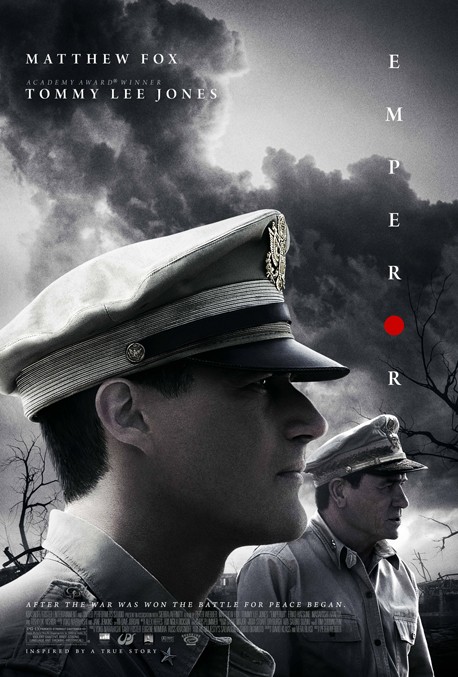 When you’re tasked with retelling an interesting part of history, a story that few are familiar with, it’s best to get out of the way. You don’t need to gussy it up if the history, itself, is interesting enough to warrant a movie. Such is the case with Emperor, a drama set in Japan weeks after their surrender to Allied forces in WWII. General Douglas MacArthur (a stodgy, scenery-chewing performance from Tommy Lee Jones) will rely upon the advice of one man (Matthew Fox) whether to try the Japanese emperor for war crimes for his possible involvement in the Pearl Harbor attack. The country is still recovering from the shock of nuclear bombs, its people could rebel against foreign occupiers, and the future of the country feels precariously on the brink. All of this makes for a good setting for a story, but Emperor doesn’t stick this out. It keeps falling back to a lame love story about Fox’s college days when he was smitten with a Japanese woman. So, now in Japan again, he desperately looks for her, having amber memories to times where he chased her around wooded areas (they must have done this a lot as a couple since it makes up the majority of his flashbacks). You keep thinking, isn’t there a bigger story at work here than one guy’s failed college romance? The rest of the movie is treated so cursory, with stiff-lip TV procedural attention, so that the details are all we get and the people get lost. Ultimately, Emperor is a movie that crushes us with the wrong history, misses out developing all the meaty stuff, and thinks what we truly want is Fox chasing after his lost love. It’s a shame the movie is so boring while the history is not.
Nate’s Grade: C
Share this:

Atlas Shrugged: Part II (2012)
 You’d think after the horrible and horribly boring Atlas Shrugged: Part One that a promised Part Two might just disappear into the ether. If only we could have been so fortunate. Ayn Rand’s cautionary opus about the evils of big government is given another creaky adaptation that fails to justify its existence. I feel like I could repeat verbatim my faults with the first film. Once again we don’t have characters but mouthpieces for ideology, an ideology that celebrates untamed greed. Once again the “best and brightest” (a.k.a. world’s richest) are disappearing and the world is grinding to a halt without their necessary genius. Does anyone really think if the world’s billionaires left in a huff that the world would cease to function? The assumption that financial wealth equates brilliance seems fatally flawed. Once again it’s in a modern setting where America has gone back in time to value railroads. Once again the main thrust of the inert drama is over inconsequential railway economics. Once again people just talk in circles in cheap locations. Once again the government agencies are a bunch of clucking stooges, eager to punish successful business. Once again Rand’s Objectivist worldview is treated as gospel and value is only ascribed to the amount of money one can produce. This time we have a slightly better budget, a better director, and some recognizable actors like Samantha Mathis, Esai Morales, Ray Wise, Richard T. Jones, and D.B. Sweeney as the mysterious John Gault. The story transitions to a ridiculous government mandate that include such incomprehensible edicts like making sure no one spends more money than another person. Can you imagine the paperwork involved? This woeful sequel will only appeal to Rand’s most faithful admirers, and you probably don’t want to hang out with those people anyway. There’s your clue: if you see someone carrying a copy of Atlas Shrugged: Part Two they either lack taste or are far too generous with movies. If there is indeed a concluding Part Three, it will be further proof that Rand’s market-based screeds are not accurate. The market has already rejected two of these dreadful movies.
Nate’s Grade: D
Share this:

The Odd Life of Timothy Green (2012)
 My friend and critical colleague Ben Bailey had warned me about The Odd Life of Timothy Green and he quite eloquently voiced his dumbfounded musings, which I will try my best not to knowingly replicate though I’m sure there will be some carryover. But whatever he wrote could not prepare me for what I ultimately got with The Odd Life of Timothy Green. Ladies and gentlemen, I think this movie broke my brain.
Cindy and Jim Green (Jennifer Garner and Joel Edgerton) are having trouble conceiving a child. One night they write a list of their hopes for a future child, place them in a box, and bury this chest of hopes in their garden. The next day they are shocked to discover a child covered in dirt claiming to be their son, Timothy (CJ Adams). He is the physical manifestation of all those buried hopes and wishes with some leaves attached to his ankles. The Greens take their magical parenthood in stride, trying their best to impart wisdom to their new son. They teach the kid how to play soccer, stand up to bullies, and interact with other human beings. Timothy has a secret he can’t bring himself to tell his new mom and dad, but if you have a hard time figuring out what his leaves falling off means, then there’s nothing I can do for you.
I feel like I just watched a movie where every person on Earth is depicted as being insane. Not goofy, not eccentric, not a little funny, no, we’re talking get the butterfly nets and padded cells. I feel partially insane just having watched the film, obviously still suffering from a contact buzz of insanity. I accept suspension of disbelief and that fantasy-based family films are going to have a whimsical nature to them. We cannot apply every rule of reality and logic to them, and I accept this. But The Odd Life of Timothy Green seems to exist in a fractured, cracked version of our own world, where the most bizarre and fantastical elements are just given a halfhearted shoulder shrug. People react to otherworldly events as if they were doing laundry. Where’s the awe? Or, more so, where is the skepticism? Seriously, if anybody told you they grew a child from a garden, would you accept this notion at face value? Their great piece of proof is that the kid has leaves attached to his ankles. Don’t you think, I don’t know, the parents could have taped those on? Beyond one guy, no one investigates this strange botanical phenomenon or even has the slightest inclination to. Where’s the intellectual curiosity, people? It’s like everyone in town has a lobotomy. Is there not one person in this small town that will dare stand and say, “You know, I think I’m going to require more empirical evidence to buy the story that this kid was formerly plant food.” And then they ran that one man out of town on a rail and salted his land.
 Timothy Green tries to gather a slew of messages and feel-good moments; it’s just that none of them feel coherent or truly earned. The parents don’t feel like responsible or even interesting adults. I understand we’re not going to dwell too much on the disappointments of a couple unsuccessful in conceiving a child (this is becoming an odd trend for Garner), but I expected more than one good cry and a bottle of wine. I want to empathize with these people but the movie makes it impossible time and again with their nonsensical behavior; it’s like they’re adults as envisioned by a child. On that note, I think the movie probably makes more sense from a fantasy point of view to flip the participants. It seems more likely that a child would try and grow new, ideal parents only to learn a lesson about the duds they’re stuck with. The Green family members all work one note, whether it’s the snide sister (Rosemarie DeWitt), the slaphappy grandpappy (M. Emmet Walsh), or the emotionally distant dad (David Morse), it’s all a tiny nub of characterization that gets whittled down to nothing. And then Timothy just seems to step into everyone’s lives and change them forever with little effort. He gets an older girl to fall in love with him, his father to stand up for himself and his family, and all the not nice people in town to be somewhat less not nice. He gets his mom to speak her mind to her bitchy boss (Dianne Wiest), which ends up getting her fired, so it’s a mixed message.
You want a prime example of this film’s collective shared insanity? Take this line from one of the board members from the town pencil factory: “If this boy can have leaves on his ankles, then we can make a pencil out of leaves.” What exactly does one have to do with the other, you may ask? I suppose it’s some claptrap about what is truly possible or whatever. My apologies to Ben Bailey for treading ground he has examined closely, but this cautionary line of dialogue glows with the intensity of 100 neon signs. It’s everything that is wrong and crazy about this movie, and the fact that it is spoken without a hint of irony or humor is all the more galling.
Here’s my problem with Timothy the life-changer: the kid is a dullard. He has no personality, he has no real insights or perceptions into life, he’s not funny, he’s not that interesting, and he eerily stays in the same modulated emotional presence. I found this kid far more unintentionally creepy than endearing. On paper, Timothy Green sounds like it should be a horror film and not the saccharine family slop that it is. Timothy just comes across like a rather bland kid with some weird tendencies, like his repeated inclination to soak up any sunny opportunity to photosynthesize (he gives Scott Stapp a run for his arms-wide-open pose throne). If a character is going to touch people’s lives and change their perspectives on life, then at least make that person fitting of praise. This kid just seems like a hazy mystic that’s playing it as he goes. Come to think of it, did anyone see him do anything superhuman? Cindy and Jim didn’t even find him in the garden, only inside their home covered in dirt. Who’s to say that young Timothy Green wasn’t a con artist this whole time?
 Then, likely as a defensive means to soothe my ailing brain, I started coming up with my own version of where Timothy Green should have gone. The ability to write down a bunch of general attributes and then grow a child seems too good to pass up. I desire more of this unique child cultivation process. For instance, Cindy and Jim want their kid to rock out as a musician, but they simply write “rocks” on their slip of paper before burying it. How is the magical entity that raises mutant plant kids going to be able to understand what the family intends with this vague entry? What if Timothy Green was born with rocks in his head? I wanted the film to simply turn into a comical version of The Monkey’s Paw, where every new version of Timothy Green would go horribly wrong. The first was born and then immediately suffocated because Cindy and Jim forgot to write “working lungs.” Then there would be the Timothy born with a “hunger for life” and become a cannibalistic plant zombie. Or the Timothy born with “his mother’s heart” and then upon his birth Cindy’s heart would go missing. What I wanted was a macabre trial and error game where the would-be parents had to refine exactly what they were asking for with the nondescript magical being in charge of answering hopeful parents. I want The Odd Lives and Deaths of Timothy Green and I want Cindy and Jim to have to bury all the malfunctioning prototypes in the same garden. Then, when they do perfect their perfect kid, the police find a yard littered with the corpses of children and haul them away.
The movie is told through the framing device of the Greens telling their story to the adoption agency, and why this adoption agency continues to listen after, “We grew a boy in our yard,” is beyond my guess. In a film breaking every boundary of believability known to mankind, this aspect to me seems the most incredulous. This is an adoption agency with standards and rules to follow, and to think they would allow a couple to drone on and on about their magical child that grew from a garden and changed people’s lives, instead of calling security and having them escorted from the premises, followed home, and then have their home exhumed for human remains of this child, is beyond me. And then, spoiler alert, they get a kid in the end. What adoption agency could reasonably and responsibly allow these two people, with no physical shred of evidence about their magical child other than some leaves and testimonies, to care for another human being?
Allow me to also question the sincerity of these two damaged people especially concerning their desire for a child. It sure seems like Cindy and Jim are planning on using their present and/or future child as means of settling some longstanding scores between relatives. When it looks like Timothy is finally going to do well in soccer, that’s when they pounce, airing out their resentments. Cindy brattily unloads against her sister: “I’ve had to listen to your perfect kids, well look at my kid! That’s my kid!” And then Jim finally let’s his distant father have a piece of his mind: “I could have been a good player too, dad. I had skills. If only you would have been more supportive.” Am I supposed to find any of this funny, because it comes across as far more sad. I feel like the reason that Cindy and Jim want a child is to desperately prove to their family that they are superior parents. It feels like one very crazy way of proving a point and one where the child will suffer, especially if he or she cannot live to a degree of excellence to provide mom and dad filial ammunition. Another example: both Cindy and Jim are oddly very jealous over the relationship their pseudo son forms with the slightly older gal, Joni (Odeya Rush). They try and talk him out of spending time with her, arguing there are so many fish in the sea for him to pay attention to. Are you really laying the argument that a 10-year-old should be playing the field? It also seems weirdly petty and controlling for two supposed adults to be jealous that their son chooses to spend part of his waking hours with another human being. So, does that sound like a loving and healthy family?
The Odd Life of Timothy Green is certainly odd but probably not for the reasons that Disney or the filmmakers had in mind. It feels like it exists in an alternative universe where everyone lacks any common sense, curiosity, or relatable human emotions. Nobody acts like a recognizable human being in this film, not for a single second. These people are all zombies, cowed into the cult of Timothy, the magical and, ultimately, messianic figure. But allow me to declare the emperor has no clothes. This Timothy is not worthy of the adulation he receives. He walks around like an ecological Forrest Gump, spitting sappy platitudes and changing lives with the insipid nature of all these easy messages. I wish I could say there was one genuine moment in this movie, but I cannot. It takes a magical premise and suffocates it with unearned solemnity. Why can’t a movie about growing a kid in your garden try and be, you know, fun? Well, I suppose embarrassing music recitals and kids getting hit in the head could be mistaken for fun, but I prefer a well developed story, characters I care about, and a genuine sense of enchantment to go with the supernatural. If we can make a movie about a kid with leaves on his ankles, then we can turn any sort of half-formed maudlin pap into family entertainment. Kids deserve better than The Odd Life of Timothy Green, and, for the record, so do plants.
Nate’s Grade: D


You must be logged in to post a comment.