Blog Archives
Winter’s Tale (2014)
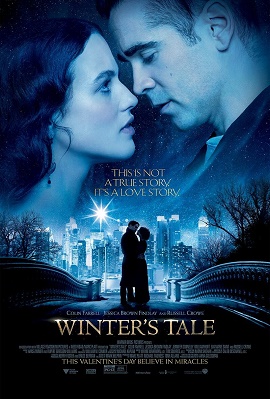 Every now and then you get to witness a special movie that doesn’t so much offend as it inspires, and what it inspires is a question you grapple with during the entirety of its run time, mainly – How did this get made? At any point, did the producers or actors or anyone stop, take a moment to reflect on the movie they were participating in, and think, “Wait, what is going on here?” Bad movies made by hacks are easy to shrug off because, well, hacks don’t know any better but bad movies (see: InAPPropriate Comedy, or better yet, bleach your eyeballs first). With Winter’s Tale, there are people who should know better, people that have been awarded Oscars. These people should resolutely know a terrible movie while they’re making it. Maybe they did. Look deep into their eyes.
In 1918, Frank Lake (Colin Farrell) is an orphan long abandoned by his family so he could have a better life in America. He hasn’t taken this message to heart. Frank worked as an expert safecracker under the employ of local crime boss Pearly (Russell Crowe), and Pearly hasn’t taken kindly to Frank leaving. Frank is able to escape Pearly’s goons and finds love with Beverly Penn (Jessica Brown Findlay), a wealthy heiress afflicted with consumption. Pearly doesn’t want Frank to get away because Pearly is really a demon in the employ of the Devil (Will Smith, yes you read that right). In the battle of good versus evil, Frank and Beverly appear to be at the focal point.
 I have to give writer/director Akiva Goldsman some credit for making an unabashedly earnest movie in an era of irony and ready-made snark. His goopy romantic fantasy longs to exist in a simpler era, but even then Winter’s Tale would fall apart on many levels. Its sheer unbending corniness is both a blessing and a curse. Magic realism is one thing (check out 2001’s Amelie as a how-to guide), but what Goldsman seems to be going for is a modern fairy tale (our maiden locked away in her tower, true love’s kiss, etc.). The film wants the audience to fall under its spell but instead will likely elicit numerous unintentionally hilarious moments; I was laughing to myself throughout, trying to comprehend all of the hokum and poor decision-making (Will Smith as the devil?).
Let’s begin with the fact that the movie is an obtuse fantasy that feels like it makes up its plot and its rules as it goes along. Bleeding fantasy and fantastical creatures into the everyday world is a marvelous conceit but it needs finesse and careful rule building. Otherwise it doesn’t so much feel like a story with a sense of internal logic as it does a bedtime story that can always just create a new shortcut or extension. The very first few minutes of the film will already push your credulity to the test. We see an adult Peter on the run from Pearly and his goons and all of a sudden he runs into… a white horse. Ah, but this is no ordinary horse, this is a magic flying horse, and Peter flies away to live another day. Yep, within minutes, we’re given a magic flying horse. No groundwork. Worse, the horse just randomly appears when the plot demands, and I think the horse is supposed to represent the side of God in this cosmic battle between good and evil. Whatever, there is a magic flying horse. From there the film gets even cornier. It’s the type of movie that posits the stars are really human beings, and so, in the end, rather than having our hero ride off into the sunset he (spoilers be damned) flies off into space on his magic flying horse and he BECOMES a new star, resting beside the star meaning to represent his beloved (never mind that these stars would be millions of light years apart). If you can read that sentence without rolling your eyes then congratulations are due.
Another problem is this massive time leap that creates far more plot holes. After Beverly succumbs to her illness, which I might add happens literally SECONDS after she’s done having sex for the first time (Colin Farrell killed her with his penis), the film leaps forward to present-day. However, Peter was given immortality through Beverly’s miracle. I suppose you could view miracles as a byproduct of sex. At first glance, this almost seems like a cruel gift; your love is dead and now you have to live forever without her. For no discernible reason, Peter also suffers amnesia, because, really, why not? All he does day after day, presumably for… 90 years, is sketch the same image of a redheaded girl in public places. In the intertwining years, why hasn’t evil Pearly picked up on the fact that Peter is still alive? He’s only been sketching the exact same image. Also, how does Peter even support himself? How does he feed himself? Who are his friends? These are the questions that arise when you take this foolish route with the plot. It could have been avoided with a simply Rip Van Winkle-style hibernation or time jump. Another problem is that Peter grew up with the 90 years of history, meaning he should know what things like the Internet and library cards are. He’s not a man out of time. The solution to Peter being confirmed is to seek out the still-living Willa (Eva Marie Saint, nice to see you again). The problem with this is that Willa should at least be over a hundred years old if you do the math. If the purpose of the leap forward was to just save another character we hadn’t seen previously, why does it have to be 2014? Why couldn’t it just have been 1940 or any other earlier period?
And the central romance between Frank and Beverly is just so boring you wish Frank would move on to someone new. Presumably they fell in love at first sight, which just so happened to be when he was in the process of robbing her home. Ah, but you see, her love redeems him because that’s really the whole role of the sick love interest in movies, to make the other figure a better person through this shared experience of grief. So in this regard it’s no surprise that Beverly lacks defining characteristics outside of her ailment. She plays the piano and falls fast for Farrell’s bushy eyebrows, but that’s all we got here. The entire second act of the film follows their abbreviated courtship, but there’s no real moment where you buy into their romance. Like most of the film’s storytelling, we’re told something is and expected to buy into it 100 percent without flinching. They’re in love, what more do you need? Well, some interesting characters would be a start.
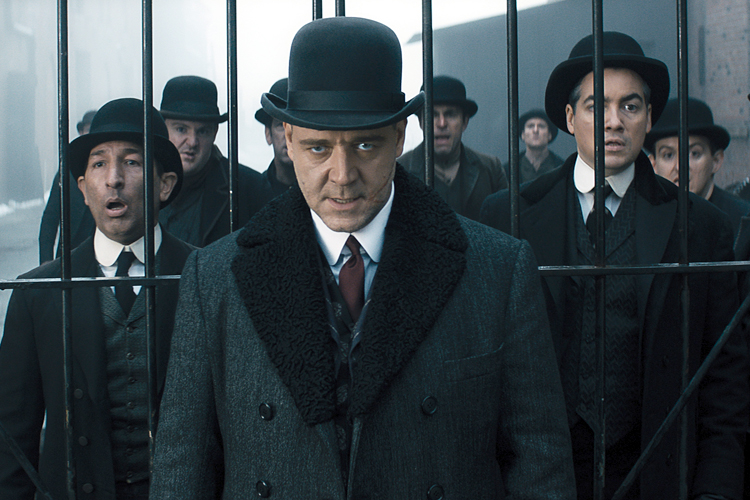 I’m fairly certain that all of these actors were doing Goldman a favor by appearing in this nonsense, but only Farrell (Saving Mr. Banks) walks away favorably. He is the best person onscreen who burrows into their character, ignoring the absurdity of every moment, yearning so hard that you almost want to give in. You won’t. Many will best remember Findlay as the Lady Sybill on TV’s Downton Abbey (she was also the reoccurring ghost on the BBC’s Misfits). Here she gets little else to do but smile and give those knowing looks that all afflicted characters give, as if their illness has opened up the secrets to the universe for them. Crowe’s performance will likely draw up comparisons to his maligned work in Les Miserables, a performance that wasn’t as bad as advertised theater snobs. This performance, however, is as bad, as his Irish brogue seems to overtake him and he comes across like a hotheaded big bad wolf. Jennifer Connelly’s appearance isn’t even worth mentioning as it is that slight beyond the fact that she’s the mother of a terminally ill child (you really thought the movie had any sense of restraint?). The film has numerous well known actors for flashes, like Kevin Corrigan, Kevin Durand, Graham Green, Matt Bomer as Frank’s immigrant father. One suspects their brief time was either a sign that the screenplay evolved as production went or that they were repaying a debt.
I will say the only saving grace in this entire blunder is the cinematography by Caleb Deschanel (The Passion of the Christ). Even when the cheesy special effects take flight, Deschanel makes sure the images are worth watching, having a special skill with the cool hues of the wintry color palette. I wanted to at least credit one redeeming aspect.
The inconsistent plotting and rules, the corny and overly wistful characterization, the overwhelming silliness of every single moment, Winter’s Tale will spark far more guffaws and derision than plaudits. It’s a movie that bludgeons you with its unrelenting maudlin nature disguised as romantic fantasy. The source material is beloved by some but it all comes across as nonsensical twaddle onscreen. Goldsman’s screenwriting credits run the gamut from award winning (A Beautiful Mind, Cinderella Man), to big budget to notorious stinkers (Batman & Robin, Lost in Space). It’s hard to judge the man’s talents with such a wide range of quality. However, I can question the finished results of Winter’s Tale and openly wonder what in the world convinced Goldsman to cash in all his Hollywood cache to direct this dreck. I’m almost tempted to encourage people to watch Winter’s Tale just to try and make sense of it themselves, to try and take in 118 minutes of earnest bad decisions. Whether it’s the magic flying horse, the 100-year-old news writer, or the fact that we’re dealing with a bad guy named Pearly, or Will Smith as Lucifer, but sometimes Hollywood unleashes a disaster that begs to be seen.
Nate’s Grade: D
Share this:

The Monuments Men (2014)
 An all-star cast, a true-life tale that incorporates a treasure hunt, a race against time, Nazis, and fish-out-of-water tropes as non-soldiers are placed in harm’s way, plus the skills of George Clooney behind the camera; in short, how could this go wrong? With that plot makeup and this cast it would take more effort to tell a boring big screen adventure of the real-life Monuments Men (and women). And yet, the movie found a way. It’s by no means a bad film and its heart is in the right place, but allow me to explain why The Monuments Men sadly fails to live up to its mission.
It’s 1944 and Adolf Hitler doesn’t just have his sights on constructing a permanent empire, he wants all the world’s art treasures as well. The Nazis have been plundering famous works of art, and while the war is coming to a close with the Allied invasion, the fate of these priceless works of art may be in jeopardy. Frank Stokes (Clooney) is tasked with putting together a team to save Europe’s art from the Nazis. He puts together an unconventional group of soldiers (Matt Damon, John Goodman, Bill Murray, Bob Balaban, Jean Dujardin, Hugh Bonneville) and search for the hidden loot.
 The film looks like it’s going to be a high-concept heist film when it reality it’s a series of vignettes that do not add up to a solid whole. Early on, the Monuments Men team is scattered to the wind, divided into pairs, and so we have four or five competing storylines that don’t develop as desired. To be fair, there are some very good scenes, well executed and written by Clooney and Grant Heslov (The Men Who Stare at Goats) where the conflict is turned up, but the film cannot escape the fact that it feels more like a series of scenes than a cohesive story. Not all of the stories are equal in their interest as well. The Cate Blanchett (Blue Jasmine) and Damon storyline in France amounts to little else than her stalling for as long as the plot necessitates, then handing over the Very Important Info, then she’s swept aside. The comical asides, notably with Murray and Balaban, feel like scene fillers when there could be stronger material. Once they’re reunited as a group, you wonder why we even needed the time apart. Perhaps it’s an attempt to showcase a wider sampling of stories and perspectives on a complicated war, which is fine, but the characters don’t get the same complicated examination. Despite physical descriptors, these guys are fairly one-note and stay that way, which is a real shame especially when we start losing Monuments Men. The attention is split amongst a bunch of characters lacking proper development. If I felt like we knew these guys on any substantive level, I would feel more at their untimely passing.
Another issue that exacerbates the directionless feeling pervading the film is that it lacks a clear and concise goal. I understand they’re saving and rescuing art, but that’s kept vague until the very end of the film when it becomes more concrete. Until then, the guys are just traveling from place to place, retrieving this piece or that, having comic misadventures, and the movie just feels like it needs a stronger guiding force to corral all these stories, a concise goal that each scene builds onto and where the urgency increases. Late in the film, I got a glimpse of exactly what kind of movie Monuments Men could have been. Once the war is over, the Germans are replaced as antagonists by the Russians (two-for-two with classic American movie villains) and it becomes a race against time to get to the art before the Russians confiscate it. There was always a ticking clock in the film, as Hitler was assembling his art and his command would destroy them in spite of returning them. However, in the very end of the film, the urgency is cranked up, made real, and for once the film emerges with a sense of suspense. I think it would have been a more engaging film experience if the scope of the film were narrowed simply to the material covered in the climax, namely beating the Russians to the art reserves. It practically has a Raiders of the Lost Ark feel with two parties trying to outrace the other to the next precious treasure. How cool would that movie have been?
 Another problem is the film’s seesaw tone never really gels together in a satisfying manner. The film awkwardly switches gears from drama to comedy to action without smooth transitions. Clooney wants his film to be a comical buddy comedy but also a poignant remembrance of the lives lost so that we can enjoy our great treasures. Clashing tones take away from the effectiveness, making us feel that Clooney didn’t feel confidant with either direction to make a movie. Alexander Desplat’s overbearing musical score instructs the audience what they should be feeling at any given moment. It vacillates without similar transitions informing you with little transparency that you should feel whimsical, now sad, and now heroic, now go back to whimsical. The entire film, from a story standpoint to a technical standpoint, cried out for a greater sense of unity.
Then there’s the question of whether art is worth people giving up their lives, and this is a valid question that deserves consideration. I was never in doubt what Clooney and company would say to this ethical query, but it’s as if Clooney has little faith in his own audience. He gives three separate speeches about the significance of art and culture and why it is worth dying for. I expected one hefty speech, but three? It’s like Clooney is afraid his audience will waver when blood starts to be shed, and so we need to be reminded by the professor why art is significant to mankind’s value. The point has been made; it doesn’t need to be belabored. The film even ends on recycling this debate, with Clooney putting one final stamp of judgment before the credits roll.
One gets the sense while watching The Monuments Men that it would make a better documentary than a fictional feature film, at least this incarnation of a fictional film. Hearing from the men who lived it will be far more interesting than watching the comic squabbles of Clooney’s crew through Europe. I was instantly reminded of an engrossing documentary from a few years ago called The Rape of Europa, which looked at the subject of saving the arts from Hitler, not specifically the Monuments Men. That documentary was filled with so many different fascinating stories, I remember thinking that any one of them could have made a stellar movie. Monuments Men is further proof that a sharper, more contained focus would be best rather than trying to tell as many war stories involved on the topic. Clooney has proven himself an excellent director and despite his film’s faults it’s still an entertaining film in spurts. I just think we all expected better given the pedigree of talent involved and the can’t-miss quality of the history.
Nate’s Grade: B-
Share this:

The Hobbit: The Desolation of Smaug (2013)
 Back to another three-hour trip to Middle Earth. While the second Hobbit film is an improvement in just about every way, it’s still a clear example of a franchise stretching to the breaking point. Peter Jackson gets the second installment moving a lot quicker, and there are several standout action sequences that are glorious on the big screen. Unfortunately it still takes almost two full hours to get to the dragon of the title, but when it does, oh does the movie become that much grander. Benedict Cumberbatch gives frightful life to Smaug (pronounced, for whatever reason, as “Smaa-oog”), and the special effects are top-notch. The last forty minutes of the movie are solid gold, as Bilbo and the dwarves work together to battle Smaug in a virtuoso development of imaginative action; it’s wonderful how many moving parts are involved in this action set piece. However, Hobbit 2 still feels needlessly padded to meet out a trilogy. Does Gandalf (Ian McKellen) need to just disappear on his own mission that accomplishes what? Do I care at all about the people of Lake Town let alone their populist revolts? Do I need a parallel storyline about an injured dwarf? And for that matter, do I need a budding lady elf-dwarf romance? J.R.R. Tolkien fans will be in heaven (though maybe just purgatory with all the changes) to gawk at the realm of Middle Earth, but I always feel antsy (“Get on with it already”). Still, The Desolation of Smaug is an entertaining and at times majestic fantasy epic, I just wish Jackson and company didn’t take so many pit stops. Well at least we won’t have to wait so long for the dragon in Hobbit 3.
Nate’s Grade: B
Share this:

The Secret Life of Walter Mitty (2013)
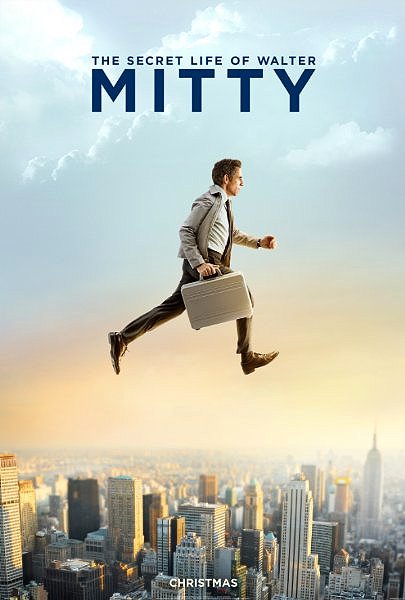 The Secret Life of Walter Mitty, based on James Thurber’s short story, is a property that has long beguiled Hollywood. The idea of escaping one’s ordinary life with fantasy, where we’re the hero. It was turned into a 1947 film starring Danny Kaye, which is rather entertaining, but has yet to be remade in all that time. It’s the kind of attractive project that has attached big name talent at different stages of development, including Steven Spielberg and Jim Carrey. It was never able to get off the ground, that is, until Ben Stiller stepped in, not just as director but also as the lead actor. Given Stiller’s directorial track record, there was suitable reason to anticipate what he could accomplish with Mitty, but the film too often feels like Stiller hamstrung, ably trying to marry a sincere indie sensibility to a mainstream sentimental holiday-released excursion for families. Stiller’s Walter Mitty never quite takes off.
Walter Mitty (Ben Stiller) is a man who has trouble filling out an online profile. He doesn’t have too many experiences or places traveled. It may be why he frequently “zones out,” as his family terms it, escaping into fantastical daydreams. In real life he works as a photography assistant for LIFE magazine, a publication that is transitioning to a digital-only existence. The enigmatic photographer Sean (Sean Penn) has sent a collection of film negatives to Walter, making special note of how Negative #25 is his life’s masterpiece. However, Walter cannot find it and is having trouble getting in contact with Sean, who is overseas on assignment. Without that much-hyped negative/picture, Walter will surely be fired, and then he’ll never have a chance to ask out his co-worker, Cheryl (Kristen Wiig). Walter sets out to Iceland and beyond to find the negative, stop daydreaming and finally live his life.
 The very tone of the movie feels like a miscalculation. It’s the story of a daydreamer, a man who retreats into his head and lives out preferable fantasies that are whimsical and far-fetched. We all knew this going into the film. It’s the same as Thurber’s story. The problem is that when Walter gets the courage to embrace life, his life is full of whimsical and far-fetched moments. He jumps out of a helicopter in shark-infested waters, where the sharks are ravenously active. He also hops into a car and has to outrun an oncoming ash cloud from an exploding volcano. And then in the third act, he travels across a mountain range all by himself and manages to miraculously find one guy. I don’t think this approach works if his real-life adventures are on par with his whimsical fantasies. I suppose one could argue that this serves a point to make real life seem just as appealing as his mental retreats, but I think it harms the very execution of the movie. First, if there’s a parallel, it means that his fantasy sequences aren’t going to be too fantastic, squashing the potential of Walter’s imagination. The only fantasy I enjoyed was a Man of Steel-esque brawl with a bearded Adam Scott (TV’s Parks and Recreation). Secondly, it means that the serious “go get ‘em” message of the movie is occurring within a medium that ordinary citizens have little connection with. Make no mistake, Walter Mitty is clearly meant as a mainstream feature meant to inspire the masses with its sentimental stripes, but is the story of a superhero doing super deeds any more relatable to the common man?
Another problem plaguing Mitty is the illusion of depth. Beyond the simplistic platitude of “get out and live your life,” there really isn’t much more of an idea explored here. It’s not like this idea hasn’t been explored in, oh, hundreds of other stories. Regardless, the film often just becomes a two-step process of Old Walter feeling timid, and then, what’s this, the hip soundtrack with the likes of Arcade Fire and Of Monsters and Men starts pulsating, and Mitty boldly shifts into New Walter, the go-getter, the guy who’s going to take charge of his own life. It’s a strong soundtrack in all senses. This process is repeated throughout the second act of the script where most of Mitty’s overseas journeys take place. Also, it may sound petty, but let’s focus for a moment on the applicability of the movie’s message compared to the practicality of what is onscreen. Live your life, but how many of us can afford to go globetrotting on a whim? I understand the larger canvas meant to evoke Mitty’s growing sense of discovery, so I’ll let it slide. The theme of Walter Mitty isn’t so much developed as it is repeated. There’s not enough substance here. In the end, the movie feels like 100 minutes of a soundtrack and a message in search of a better movie.
Allow me illustrate one of those “go out and live, Walt” moments in the film. Walter is in Greenland (though filmed in Iceland) and needs to get to a fishing vessel. The man next to him is a helicopter pilot. Great. But he’s also drunk, so Walter understandably refuses to fly with the man. This seems like a very rationale decision, but then he fantasizes Cheryl coming through, urging him on through song (through song!), and the soundtrack starts pumping, and Walter runs out and literally jumps inside the ascending helicopter. It’s meant to be portrayed as a triumphant moment of embracing the uncertainty of life’s adventure, but in reality the movie just pressured its title character into getting into a flying vehicle with a drunken pilot. What? That’s irresponsible.
And then there’s just the lackluster characters and plotting. Walter Mitty is a nice enough guy but too milquetoast to be that appealing, relying upon the comic graces of Stiller to provide the filling. The character of Walter is basically a hodgepodge of other Stiller characters in previous movies, but the character feels too restrained for an actor of Stiller’s talent. I understand that the arc has to travel from passive to active, but it feels like the funny Stiller we’re all accustomed to is being held in check thanks to the film’s broad appeal feel-good sentimentality. There’s one brief moment of the anarchic, silly Stiller that we loved so much in Tropic Thunder, and it involves a weird fantasy where Walter suffers the reverse-aging Benjamin Button disorder. It doesn’t fit at all with the tone of the film, and that’s why it stands out. Walter is a nice guy but rather boring. He pins his journey of self-discovery on getting the girl, and then when presented with one minor obstacle at the start of Act Three, rather than speak with her, he assumes the worst and just gives up. The narrative requires one of those eleventh-hour misunderstandings to keep the guy and girl apart, but it’s a frustrating decision that makes me like Walter less.
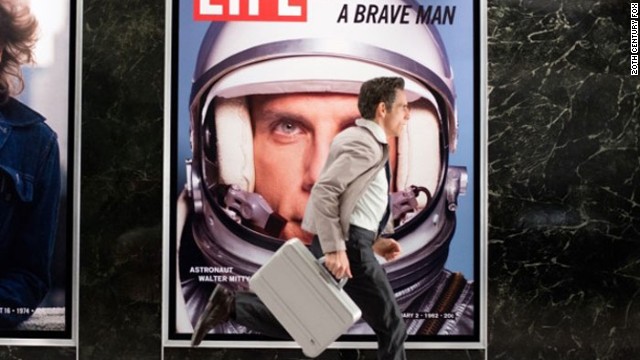 The Secret Life of Walter Mitty is also filled with blunt product placement and some strange plot elements that don’t blend together. I’m not generally offended by product placement in movies when they make it oblivious; hey, a character has to drink something so why not a (insert product here)? But the fact that the Walter Mitty team actually makes Water’s teenage stint at Papa John’s a reveal about his character, and that the very store is meant to stand in as a reminder of his own deceased father, is just wrong. Then there’s the fact that Walter works as a negative corrector (analog job) at a magazine (troubled industry), and that magazine happens to be LIFE (which shuttered in 2000). Why all the analog contexts? Is it meant to convey Walter’s reluctance to change or adapt? The whole notion of the magazine downsizing gives the film a real-life aspect that just doesn’t feel appropriate for the movie. The fact that Walter’s journey is propelled by a quest for a single missing negative feels a tad too facile for the man’s transformation, but it’s made worse when the answer to the location of the negative is so transparently obvious from the get-go. It was so obvious I almost talked myself out of it. Most of the supporting characters in the film serve little effect on any of the events. They’re there just to provide minor details about Walter and that’s it.
The movie is so earnest and you can tell Stiller is trying hard, but The Secret Life of Walter Mitty ends up being a disappointing feel-good message lacking substance and much entertainment. The filmmakers have conviction, I’ll give them that, but it’s misplaced, and the film’s tone has too many distracting elements. The fact that real life mirrors Walter’s fantasy visions seems like a miscalculation from the start. Thurber’s short story didn’t have that much to it to begin with but we need more than this, an office schlub learning to live his life through improbable adventures meant to inspire the rest of us common folk. As a slice of escapist entertainment, it’s not fanciful enough, not creative enough, and not funny enough. As a motivational, heart-tugging ode to living one’s life, it falls into too many traps to feel applicable, insightful, or engaging. It looks beautiful and the people behind the film obviously mean well, but good intentions and nice camerawork are not the same as an effective movie built from the ground up, namely the lackluster story and characters. The Secret Life of Walter Mitty feels like it has as much depth as a glossy, idealistic commercial, and perhaps for some this will suffice, but I found this Walter Mitty’s secret life not worth investigating.
Nate’s Grade: C+
Share this:

Lone Survivor (2013)
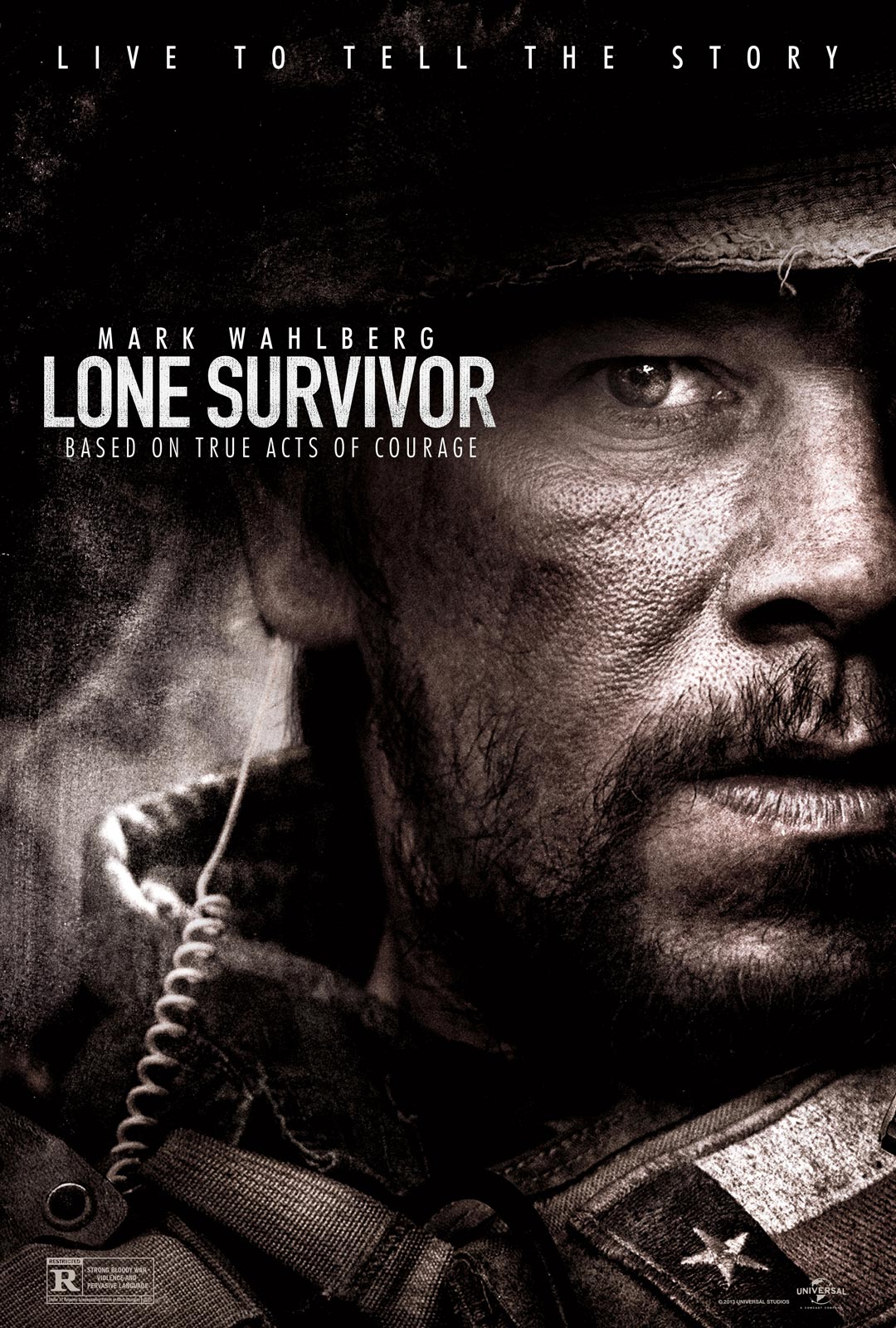 What do you do when the title of a movie is a spoiler? That’s the question with director Peter Berg’s reverential military action film, Lone Survivor. It’s the true story of a team of Navy Seals who had their mission compromised by a pair of unlucky Afghan goat herders. After deciding to set them free, rather than snuff them out, the Seals retreat to an extraction point, with a hundred Taliban fighters hot on their heels. When the action is firing, Berg is right at home, placing the audience in the middle of a visceral firefight that’s bloody and hardcore and pulse pounding. The rocky terrain of the country is just as deadly as the Taliban, as the Seals bounce around like ragdolls. The performances are all grizzled and finely attuned to keeping the terror of the moment at bay. Ben Foster (The Messenger) is the standout, which is a statement that’s been said with most Foster performances. At the end, I’m left wondering what is the film’s greater message. It’s retelling a military episode few people know about, illuminating the courage and bond between soldiers under fire. But in the end, all of these lives were lost because of one moral though arguably bad decision. Couldn’t they have just tied up the goatherds and gotten a better head’s start? Will the movie convince an audience that those innocent Afghan goatherds should have just been collateral damage? Does the movie critique the futility of America’s ongoing presence in Afghanistan? The futility of war itself? I doubt it, especially with Berg’s fervent appreciation of the armed forces putting their lives on the line (the opening credits themselves glorify the toughness of the Seals while also setting up an explanation why they could survive so many gunshots, injuries, etc.). Lone Survivor isn’t the heedless jingoistic propaganda piece that others critics have feared, but in the end it’s simply a sober and respectful tribute to the fallen, and that’s it. For many, this will be enough. For me, I was thrilled by the heroics but looking for more.
Nate’s Grade: B
Share this:

The Wolf of Wall Street (2013)
 Martin Scorsese. The greatest living filmmaker on the planet. Enough said. When his latest, The Wolf of Wall Street, was pushed back due to an editing crunch, the rumor mill started as it normally does. Are there problems? Is it any good? Will it be forgotten this late into the awards season? While I can’t speak for the Academy, but for me The Wolf of Wall Street just about blows every competing movie out of the water this season. It’s brash, exhilarating, uproarious, mesmerizing, and just about every other adjective you can fetch from a dictionary. This is first-class filmmaking from a master, and consider Wolf of Wall Street the white-collar companion piece to Scorsese’s gangster masterpiece, Goodfellas. It’s that good, folks.
Based on his memoirs, Jordan Belfort (Leonardo DiCaprio) rises on Wall Street from a rookie stock trader to the king of his own empire. From the late 80s to the 90s, Jordan assembles a cutthroat team that knowingly sells lousy stocks to gullible investors and stuffing their pockets with hefty commissions. “Better there money was with me. I knew how to spend it better,” he admits. His closest friend and business partner, Donnie Azoff (Jonah Hill), literally quits his job to work for Jordan after spying one of his pay stubs. The guys start their own firm, specializing in high-pressure sales and on penny stock commissions. From there, they expand and expand until they’re making their own noise on Wall Street. The trading floor more closely resembles a frathouse party, complete with chimp, strippers, marching bands in their underwear, midget tossing, and other objectionable behavior. Jordan easily succumbs to the sex and drugs of the high-finance world of money, leaving his plain wife for Naomi (Margot Robbie), a gorgeous underwear model. He’s got a giant estate, a huge yacht, his own helicopter, and more money than he can spend. He’s also got the attention of the FBI and Agent Patrick Denham (Kyle Chandler). With the feds circling in, Jordan has to take extra steps to keep the good times rolling.
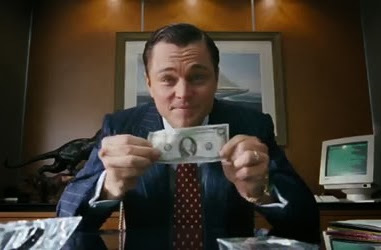 With a running time exactly one minute shy of three hours, it’s easy to call The Wolf of Wall Street self-indulgent and excessive, except that’s exactly the point. The movie is an orgy of unchecked male ego, a perverse bacchanal of Earthly pleasures that Caligula might blushingly admire. They are literally two orgies depicted in the movie and plenty of thrust-heavy sexual congress (I counted eight walkouts in my theater, most of them the little old lady variety). Here is a tilt-o-wheel of madness. These people were living like there was no tomorrow, had more money than they knew what to possibly do with, and would figuratively dance while Rome burns (in this instance, the stability of the U.S. economy). What’s important is to communicate that these individuals were having the time of their lives. It wasn’t just the hedonistic pleasures and the mountains of drugs; it was the power, the uninhibited embrace of a life available via poorly regulated capitalism. Many of those brokers in Jordan’s company were people from ordinary backgrounds. Their self-made success (that wasn’t so much earned as swindled) is a point of pride that fills them with purpose. They are seizing their full potential. There is no doubt in my mind that every broker in this movie would do it all again in a heartbeat. There is no remorse on display anywhere. The only remorse is having the ride unceremoniously end. “Was it obscene? Yeah it was obscene. In the normal world,” Jordan narrates. “And who wants to live there?”
I won’t say that there aren’t scenes and moments that could have been trimmed, but I was enjoying myself way too much to care about the bloat. This is the fastest three hours you’ll ever experience in your life. There’s some fat, yes, but man does this picture just move along like a freight train. The screenplay by Terence Winter (creator of HBO’s Boardwalk Empire) is impeccably drawn. The movie just courses with energy and watching it is often an exhilarating rush, communicating the highs the characters are undergoing. The supporting players are used to great effect to punctuate the comedy moment to moment. I loved Rob Reiner’s exasperated and profane performance as Jordan’s father. Naturally the bad behavior is entertaining in how absurd and over-the-top it can get, but one key sequence ranks up there with the finest sequences Scorsese has ever put to film. It’s the “Lemon” sequence, named after a legendarily potent batch of Quaaludes. It is a sequence of pure movie bliss, brilliantly edited and staged, as Jordan is placed in a precarious position when the drugs kick in, and his comic floundering is riotous. Winter and Scorsese have taken what, in other hands, could have been a modern American tragedy and decided to portray it as a darkly comic fantasia. I laughed long and hard throughout the movie. There are numerous scenes I can think back on and start laughing again. The ridiculous nature of moments, like discussing the logistics of tossing midgets at a dart board (“This is their gift”) is to be expected, but it’s the overall degenerate lifestyle these clowns chase after with impunity that kept me laughing.
I’ve read cantankerous critiques of the film, chastising Scorsese for celebrating the lavish lifestyle and excessive hedonism of his characters. I could not disagree with this appraisal more. The error is assuming that witnessing Jordan behaving badly is akin to celebrating it, as if adopting the perspective of our lead is the same as excusing his actions. Scorsese makes it clear early, and often, that Jordan Belfort is not a good person. Hopefully you don’t need him hitting his wife for this point to stick. This guy is fleecing people out of their life savings, living high off the fat of the land, and openly admitting to the camera how deeply illegal his activities are. But you’re under his spell, much like his brokers that worship him with unflinching zeal. Jordan, especially as portrayed by DiCaprio, is a volcano of energy and single-minded determination. He whips his troops up like a religious revival, manipulating you with every tactic in his employ. Early on, he’s defrauding ordinary middle-class and low-income clients, but because we’re all addicted to the adrenaline rush of the sale, of the con, we push this troubling reality from our minds. When he moves onto wealthier clients, we adopt a similar attitude of Teresa, Jordan’s first wife, mainly that these people can afford the losses and therefore get what they deserve from a silver-tongued shyster. It’s the audience that proves to have a selective memory because we’re drawn to Jordan’s charisma, expertise, and talent, so we ignore the pesky details of who gets stuck with the bill. Don’t pin that on Scorsese. He makes it abundantly clear that Jordan is a bad man, and the depths of his greed is but the tip of the iceberg when it comes to Wall Street. Jordan’s firm was a tiny player. Think of what horror stories Goldman Sachs or Lehman Brothers would offer if ever exposed.
 This is my favorite Scorsese film since Goodfellas, and they have plenty of similarities. It makes sense because these men of finance take their cues from movie gangsters, styling themselves as tough guys. At one point, brokers hold a guy over a building to intimidate him. There’s also certainly as much cocaine as there may have been in Scarface. But like that classic of the gangster cinema, Scorsese propels us into the hidden world of the financial institution run amok, allowing us a backstage pass to the people profiting from wrecking the economy. It’s a fascinating perspective that confirms some of our worst fears about stockbrokers. It’s a misogynistic boys club and the few women that do participate have to play by their hyper masculine, juvenile rules. These are people that find any number of ways to skirt the law, rip off their clients, and live in luxury until they can find another sucker. It’s a system built for the entertainment of the few on the backs of the many, and it’s just as relevant today as it was in the 90s. With Jordan’s inside knowledge, we’re educated on the many corrupt ways of Wall Street.
Marking the fifth collaboration with Scorsese, this may be the finest DiCaprio (The Great Gatsby) performance yet. The man sheds his vanity, easily fitting into the shark that is Jordan Belfort. He’s ruthless in one moment and completely inept in another, at the whim of his vices. DiCaprio taps into Jordan’s leadership qualities with the dynamite sales speeches, but he also shows what an insecure man he is at heart. He’s got a taste for the good life and is reinventing himself, including trading up in wives to attain that proverbial American Dream. He’s living empty pleasure to empty pleasure and he doesn’t care. DiCaprio acts as our ringmaster through his own circus, and you’ll be delighted and horrified by his actions (and also his peculiar, bird-like dance moves). There’s not a bad performance in the whole cast, and this is one huge cast. Hill (This is the End) is a becoming more and more credible as a dramatic actor, though he excels at the blustery outrageousness as Jordan’s number two. He’s a treat. Robbie (About Time) nails her New Yawk accent but more importantly nails the portrayal of a trophy wife who recognizes and eventually resents her lifestyle. And oh does she just exude sexual heat.
I want to focus on the very end of the film, so there will be some mild spoilers in this paragraph but nothing I feel that would ruin the viewing experience. You have been warned, spoiler phobes. As expected, Jordan eventually winds up in jail for his felonious misdeeds. Ordinarily this would be the end of our traditional law-and-order morality tales; the bad guys are locked away to pay for their crimes. Jordan tells us how nervous he was on his first day of prison, that is, until he remembered one very important fact: he’s rich. White-collar prison is not the same as other penitentiaries, and we see Jordan loftily playing tennis. His sentence is only three years as well, which seems like an insult given the thousands of lives he may have instrumentally ruined. But that’s the ultimate condemnation in the end: the system is rigged for people like Jordan, people with money. In the end, he wins. He goes to prison, his family life is torn asunder, and his personal relationships are strained, but the guy wins. He continues his speaking engagements motivating everyday saps how, with his cherished expertise, they too can rake in wealth. The final shot of the movie tells me everything I need to know. It’s a slight pan out to the crowd in attendance of Jordan’s speaking session. We see the collection of faces, each person hanging onto Jordan’s every word, each filled with idolatry. They want to be him. Despite everything, the bad behavior, the crimes, the waste, they all want to be him, and that’s why people like Jordan will always succeed, will always prevail, will always have the last laugh. There will always be a healthy supply of suckers that want to believe whatever nonsense he’s peddling. That’s the point. He won.
 Recently I watched the very good crime caper American Hustle and noted that its director looked to be fashioning a loving Martin Scorsese homage. Well, after watching The Wolf of Wall Street twice (not back to back, mind you; I’m not nuts) I can say that there is no Scorsese like the source. This is vintage Scorsese. This is brilliant filmmaking, a bold movie that practically sings, it flies by with exhilarating force and acumen, daring you to keep watching. The fact that 71-year-old Scorsese could make a movie this highly energetic, this debased, this brash, this borderline indecent, and this awesomely entertaining is encouraging. It’s even more hilarious to me that older Academy members at a recent screening of the film accosted Scorsese, essentially being termed a “debauched scoundrel.” That’s got to count as some badge of honor. Yes, at three hours the movie can get long but it’s never dull or taxing. The propulsive narrative, the hilarious humor, the shrewd characterization, the wanton excess, the filmmaking bravado that hums, it all coalesces into a disturbing and disturbingly enjoyable condemnation of greed and our inherent celebration of this lifestyle. There is not one aspect of this movie that falls flat. The Wolf of Wall Street is an invigorating piece of cinema. The choice of music, the swinging cinematography, the wide ensemble of actors, the feverish editing, it all comes beautifully together to form a whole that surpasses everything else in cinema this year. Dig in.
Nate’s Grade: A
Share this:

Frozen (2013)
 Enough time has passed that a revival of the 1990s Broadway formula that Disney stuck so aggressively to for so long is actually a welcome treat, especially when Frozen is this good of a movie. An extremely loose retelling of Hans Christian Anderson’s The Snow Queen, we follow two sisters and princesses, one of whom, Elsa, is gifted with magic powers controlling ice. She’s lived a life of solitude out of fear and penance for endangering her sister when they were kids. Ana has no idea, having her memory wiped through magic, and so she desperately wonders why big sis gives her the cold shoulder. After another accident, Elsa lets her powers loose, refusing to try and fit into the confines of society no longer. Ana is the only one who can save her and the town. Did you read any mention of a man in that plot breakdown? While there are significant male characters, including romantic suitors, Frozen is the story of a different kind of love, a familial love between sisters. It also generously pokes fun at Disney’s admittedly spotty record of heroines giving up their dreams for the first man they meet. Even the comedic side characters work wonderfully. Josh Gad (Jobs) as a magic snowman had me cracking up throughout with his dopey line reading and enthusiastic inflections. Idina Menzel (Rent) as the voice of Elsa is enthralling, and she gets the film’s “Defying Gravity”-esque showstopper, “Let it Go.” Kristen Bell (TV’s Veronica Mars) is terrific as the voice of Ana, vulnerable, heartfelt, and a little bit goofy, and she sings great. All the actors sing great (look what happens when you hire musical theater alums). Even better, the songs are catchy, well composed, and critical to the plot, short of a silly troll tune that should have been cut. The movie also looks gorgeous, which is surprising considering I thought the color palate would be limited with the film mostly taking place in the snow. But what makes the movie truly enjoyable is how emotionally engaging it is, the somber opening twenty minutes setting up just how much tragedy and misunderstanding there is between Ana and Elsa (the melancholy end to their song killed me). Their eventual reconciliation and the selfless acts of bravery might just make you misty. Frozen is a holiday treat for families, animation aficionados, and those hoping Disney could make a film with positive messages for young girls. In a weak year for animation, this rockets to the top of 2013. Just make sure you get the Disney version for your family and not, you know, the horror movie of the same name about people stranded on a ski lift. Though that’s a pretty good survival thriller itself, so, your call.
Nate’s Grade: A-
Share this:

The Hunger Games: Catching Fire (2013)
 It’s been a year and a half since The Hunger Games broke box-office expectations, gifting Lionsgate studio with a formidable franchise. Based upon Suzanne Collins’ series of young adult novels, the first film was an agreeable adaptation that was occasionally hobbled by poor direction, rushed plotting, and budget limitations. Catching Fire, the second film, improves upon the established groundwork in almost everyway with the chief drawback being a terminal sense of dystopian déjà vu.
In the months after the events of the 74th Hunger Games, the two victors from District 12, Katniss Everdeen (Jennifer Lawrence) and Peeta Mellark (Josh Hutcherson), are traveling across the other districts of Panem as part of their victory tour. What better way to endear yourself than visiting other districts to remind people that their children are dead and you survived? On the tour, there is growing unrest throughout, and the people have turned Katniss as their symbol of defiance against the tyrannical Capitol. President Snow (Donald Sutherland) threatens Katniss to control her media image, to convince the people that she’s madly in love with Peeta and not a fledgling revolutionary. In order to check the power of the victors, Snow introduces a rule change for the 75th games, the Quarter Quell. This year the participants will be culled entirely from previous past victors, meaning that Katniss and Peeta will be plunged back into the deadly games and this time their competition aren’t children.
 What a difference a director with a sense of cinematic visual command can make. Early into pre-production, the original director Gary Ross (Seabiscuit, Pleasantville) decided to bow out for sequels, and so Francis Lawrence (Constantine, I Am Legend) was hired, and goodness does the movie benefit from this change at the helm. Lawrence has a much stronger visual authority, having cut his teeth in commercials and music videos (remember those, kids?) before feature films. The man couldn’t frame a lousy shot if he tried. With a stronger visual lens, the world of the Hunger Games is able to stretch, given a proper budget, and the visual grandeur unfolds around you, especially the largess of the Capitol. The movie doesn’t feel like they had to cut corners with their budget or special effects, and part of that is credited to the skill of Lawrence. And with this new visual stylist comes the demise of shaky cam. Dance and celebrate that Ross’ misapplied docu-drama approach has been abandoned; this time, when there is onscreen action, you can comprehend what is happening. I read the book years ago but even I was feeling twists of tension, notably the start of the Quarter Quell. The action isn’t terribly developed but it’s sufficient, though again the kill-or-be-killed extremity kept to PG-13 safety is starting to chafe. My only visual complaint is that much of the action within the games takes place at dawn/dusk and thus low-light environments. It feels like someone threw on a muddy filter, though perhaps this was just my theater’s light bulb-saving projection setting.
Now that the world of Panem is established, Catching Fire does a nice job of showing the various social conflicts coming to a head, bubbling into uprising. The pre-games victory tour opens up the world, allowing us into other districts and viewing the different strife befalling them. It’s jolting to watch the public defiance met with summary executions and yet the people will not be stopped. Now the class conflicts of the haves and have-nots get pushed to their breaking point. There’s a great contrast provided with a Capitol party so lavish, with food so sumptuous and plenty that the Capitol denizens have cocktails on hand to induce vomiting. That way you can continue eating (historical fact: vomitorium is actually not what you think but instead a passage below a tier of seats for easy exit, like in modern stadiums). The themes and the points aren’t subtle, that’s for sure, but they are effective and intriguing. Katniss, who only wanted to survive, has been thrust as the face of revolt, and now she has to walk a delicate line to again save her loved ones. The fascist politics and media manipulation hinted at in the first film are given more examination, providing a richer narrative. What works in the first Hunger Games is generally expanded upon and what faults the first film had have been, generally, nipped and tucked. There’s nothing as eye-rollingly awful as Peeta’s human rock sculpture camouflage. The burgeoning love story elements again are abbreviated the harshest, but when the world is coming apart, you have to spend more time on revolution than love triangles.
The film also benefits from a slew of new characters that have strong personalities. We’re introduced to other formers winners of Hunger Games past, and they make the most with their limited exposure. Joanna Mason (Jena Malone) is an axe-wielding woman given to speaking her mind with devil-may-care attitude. Her first scene in the film involves her stripping naked in an elevator with Peeta and Katniss. Malone (Sucker Punch) really has fun with the blithe approach of the character and manages to come across as comical while still being a credible badass. She’s a terrific character and you’ll be seeing more of her in the sequels to come. The other famous victor is Finnick (Sam Claflin) who bathes in the celebrity limelight, luxuriating in his media image as a suave playboy. Except there’s more under the surface and you’ll be given peaks throughout the film. I’m not as sold on Claflin (Snow White and the Huntsman) as I am on Malone; he’s got the requisite chiseled physique, but I don’t feel the charismatic pull the character demands. Also, when I close my eyes and listen to him speak I hear James Franco, and I don’t know what to make of that. Then there’s the new head game maker, Plutarch Heavensbee (Philip Seymour Hoffman), who is presented as an enigma. He leans on President Snow to spare Katniss rather than turning her into a martyr for the cause. However his alternatives are sinister and media savvy. Hoffman is one of our best working actors today but he seems to sleepwalk through the role, perhaps because he’s meant to be vague. However it’s played, it’s hard to get a read on Plutarch until the very end.
Strong as ever, Lawrence (Silver Linings Playbook) is the rock of this franchise. The Oscar-winning actress has been on a tear as of late and her acting and overall presence elevates the material. They struck gold when they hired her. There’s more fire to her and more devastation, as she’s going through the PTSD, plagued by nightmares. She’s haunted by the horror she’s escaped but also by the continuation of the threat from Snow, the ongoing charade that she will have to keep up for the rest of her life. There is no time out of the spotlight as a victor let alone a national celebrity like Katniss. Lawrence can convey so much wordlessly and she can convincingly play the different dimensions of her wounded warrior.
 Many of the criticisms one can hurl at Catching Fire are the same from Collins’ book. There is a repetitive plot structure, where the games themselves feel like too much of a retread. It feels forced to serve up what worked the first time. The problem with throwing Katniss and crew back into the Hunger Games is that all the real consequential action is taking place outside of them. We’ve been watching the stirrings of revolt all movie, watching the cracks take shape, and then the movie returns to its deadly TV competition when the audience just wants to leave to see if the revolution will be televised. Breaking free of Katniss’ first-person perspective from the book allows the filmmakers to add scenes fleshing out the world and the characters, with some nicely malevolent conversations between Snow and Plutarch. But that also means we don’t have to be locked into watching Katniss’ every move (I know this sounds like sacrilege). It’s not like the creatively torturous games are boring, but it’s hard to ignore an increasing sense of been-there-done-that. When there are so many larger, wider-reaching consequences happening outside throughout the various districts, you can’t help but feel a bit antsy. Another reason the film doesn’t break free from the games repeat is that it purposely keeps Katniss, and in turn the audience, in the dark about the larger outside machinations. The collective ignorance has a purpose but it also makes the plot frustrating.
Really, Catching Fire is more a setup for the series greater conflict rather than a complete film/story. Things are unraveling in the country of Panem, but if you want resolution you’ll have to wait until 2014 for the next movie, or more likely 2015 for its concluding half. What Catching Fire does is tease out the plot change and then transition to it, but only in the final minute. As my pal and colleague Ben Bailey notes, it ends in similar fashion to 2003’s Matrix Reloaded, and you’re left on a cliffhanger that doesn’t seem like a natural resting point for the story. Again, these critiques can be waged at the book as well as the film is a fairly close adaptation that will satisfy the die-hard fans.
From here on out, the Hunger Games movies are going to get more interesting. With two remaining films to cover the ground in one book, it should allow for greater development of characters, conflicts, dramatic themes, social commentary, or just larger kickass action sequences now that we’re in a larger arena, so to speak. Under the screenwriting expertise of Danny Strong (HBO’s Recount and Game Change) I’m anticipating a more politically astute and intellectual dystopian drama. Francis Lawrence has brought visual dynamism and stability to the franchise, just in time for when things are poised to get really interesting. As a film, Catching Fire is a step above the previous entry, ironing out some of the shortcomings and presenting more subtext when it comes to its social unrest. It introduces a bevy of intriguing new characters, escalates tensions throughout the realm, and promises greater suffering and strife ahead. However, the repetitive plot structure of throwing Katniss back into the games for an hour eats away at time that could be better spent watching the revolution ferment. It’s still a reliably entertaining film with a sharper visual gloss, so fans should go home happy and audiences should be suitably thrilled. The alterations from Collins’ book are all for the better. Catching Fire will slay the box-office with little trouble but I’m most thankful that we’ll be leaving the games behind for good.
Nate’s Grade: B
Share this:

12 Years a Slave (2013)
 In 1841, free black man Solomon Northup (Chiwetel Ejiofor) lives in Saratoga Spring, New York, performing as a trained violinist. Some traveling performers offer him serious money if he’ll play with their circus act in Washington, D.C. Solomon bids goodbye to his family, never knowing he will not see them again for a dozen years. He’s kidnapped, imprisoned, and sold down South to a series of plantation owners. He insists he is a free man, but who will believe him? He’s a black man in chains, and frankly many people just do not care. He learns to adjust to the rules of his new life, finding some companionship with the fiery Patsey (Lupita Nyong’o), and looking for a trusted source to mail a letter to Solomon’s family. It’s a life of daily terror and Solomon could be killed at any moment if word got out that he knew how to read and write.
12 Years a Slave is, as expected, a hard movie to watch at times but it is an essential movie to be seen. A friend of mine literally had this conversation with a movie patron (I wish I was only making this up):
Customer: “Yeah, I don’t think I’ll end up seeing 12 Years.”
Friend: “Oh. Well it is a hard movie to watch.”
Customer: “It’s not that. I’m just waiting for a movie that finally shows all the good slave owners doing nice things. It wasn’t all bad.”
 This brief conversation exemplifies for me why a searing drama like 12 Years of a Slave is still vital in 21st century America. This is a slice of history that cannot be forgotten, but just as sinister is the amelioration of its cruelty. As time passes, and those with direct personal experience are long gone, then the mitigation begins, and you have ignorance consuming people who want to whitewash America’s original sin, like the above movie patron. I’ve even read, simply on message boards for this very film, a dubious prospect I admit, people arguing, “Can’t we just move on already?” and posing false equivalences like, “Well the poor Southerners who worked as indentured servants had it just as bad.” I swear I am not deliberately setting up a straw man argument, these are actual gripes people have. It’s as if acknowledging the totality of the horror of slavery is, in itself, some kind of insult to people today. It’s history and vital history that need not ever be forgotten or mitigated, and we need more films dealing with this subject.
There is zero equivalency to treating people as subhuman property, stripping them of all human rights and dignity, separating them from their families, beating them, raping them, murdering them without consequence, being punished for defending yourself, and kept in a constant state of terror where anything horrible can happen to you at any time without reason. Sorry slavery apologists, but even the notion of a “kindly slaver,” which the movie actually showcases, is erroneous. Whether they don’t beat their slaves as often or addressed them as people, slave owners are still profiting from the institution of slavery, and as such the notion of a “good slave owner” is antithetical to the very insidious nature of plainly owning another human being.
With all that said, 12 Years a Slave is an unflinching look at the cruel reality of slavery but one that demands to be seen. Director Steve McQueen (Shame, Hunger) doesn’t pull his punches when it comes examining the unrelenting misery of slavery. There’s a whipping scene where he are in the safe position of focusing on the faces of those involved, studying their horror, but then McQueen has the camera turn around and you see, in graphic detail, the ravaged back of an innocent woman, the bloody result of every one of those whippings that we watched at a comfortable distance at first. This is a gory example, and the film is rather restrained when it comes to this aspect. This is not simply wallowing in sadism. Hollywood has yet to have a definitive film showcase the traumatic reality of slavery. 1997’s Amistad gave you glimpses, but most of Steven Spielberg’s movie was set in courtrooms arguing the philosophical nature of inherent rights. I wish they would remake the classic miniseries Roots; today’s TV landscape would be more permissible at showing the graphic terror of slavery than 1970s network television. With 12 Years a Slave, there are several uncomfortable moments that will make you gasp, but overall, while retrained on the gore, you feel the overall devastation of a slave’s predicament. Every moment of life was at the whims of another, and a victim could be trapped at every turn. Solomon is beaten soundly, and after he defends himself, he is rounded up to be lynched for his audacity. The aftermath is portrayed with stark tension, as Solomon is left hanging by a noose, his feet barely touching the muddied ground, trying to maintain his stance or else choke to death. And like the long takes in shame, McQueen’s camera just holds us there, trapping the audience in the same strenuous dilemma. The worst goes to Patsey, who is raped by her master and tormented by the master’s jealous wife. Both Solomon and Patsey are damned with every decision. By the end, Solomon is rescued and reunited with his family, but you can’t help but think about all those other unfortunate souls left to mire in slavery. For millions of them, there was no set limit to their desolation.
 From a script standpoint, the movie flows more as a series of scenes rather than a traditional three-act arc. Writer John Ridley (Red Tails, Three Kings) works from Solomon’s own autobiography and does an incisive job of recreating the dimensions of mid-19th century America and the diseased mentality that accepted slavery. No more is this evident than in the frightening character of Edwin Epps, played with chilling absorption by Michael Fassbender, McQueen’s favorite collaborator. Epps is the kind of man who uses selective Scripture to justify his heinous actions. “A man can treat his property how he likes,” he quips with authority. Epps’ plantation is the worst along Solomon’s hellish odyssey. Fassbender (X-Men: First Class, Prometheus) spookily possesses Epps with great ardor, bringing out the snarling dangers of a man and his unsavory convictions. You’ll cringe over all the unwanted lascivious attention he gives to Patsey. He is a weak man through and through, but one who rages against others with his weaknesses. Fassbender is electric and keeps an audience extra alert when onscreen.
The acting is exceptional and infuriating. Ejiofor (Serenity, Salt) is commanding in a performance that stays with you. There is so much the man has to communicate with his eyes, those great orbs of his. Because of his circumstances he must hold back his ire, do what he can to make it another day, and his adjustment to the horrors of slavery are heartbreaking in itself. He must always be cautious, and when he dares to risk trusting a white man, we feel the same tremors of trepidation. There’s a great scene where Solomon, having been betrayed, has to come up with a credible alternative in the moment, with so much riding on his improvisation skills. It’s as suspenseful a moment as most Hollywood thrillers. The most heartbreaking performance, though, belong to Nyong’o, who is making her film debut in a major way. As Patsey, she symbolizes the mounting torment of unremitting victimization, a woman begging for death but too proud to make it happen. She has some intense monologues where not one word feels false. She is a broken woman struggling to find her footing, and watching her get abused in so many different ways is gut wrenching. She’s more than a martyr and Nyong’o shows you that.
Undeniably a good movie, there are still enough filmmaking choices that hold it back for me, and it all comes down to Solomon as the protagonist. The movie’s center was not as strong as it needed to be, and that is chiefly because our focal point, Solomon, is not well developed as a character. I feel pings of something approaching shame just bringing up the subject, but I must profess that Solomon is just not given much to do beyond suffer. As a free man, his adjustment to the absurd cruelty of the institution of slavery is meant to serve as an entry point for a modern audience, to have the safety of our lives suddenly stripped away. But if I had to describe Solomon as a character, I could say that he mostly vacillates between two modes: shock and solemn dignity (“I don’t want to survive. I want to live.”). Strange that Patsey and Epps and even Epps’ wife are shown more dimension than the lead character. I’m not asking for Solomon to suddenly become a more active character and to rise up, Django Unchained-style; the context of slavery limits his opportunities to express himself. I just wanted more to this guy to separate him from the others suffering onscreen. And maybe, ultimately, that’s the point, that Solomon is, at heart, no different than any other slave. I can agree with that in philosophy, however, this approach also nullifies my ultimate investment in the protagonist. I feel for him because he suffers, I feel for him because I want him to find some semblance of justice (an impossible scenario given the circumstances, I know), and I feel for him because he is a good, honorable man. But I do not feel for him because I have an insight into the character of Solomon Northup. Fortunately, Ejiofor does a superb job of communicating as much as he can non-verbally. It just wasn’t enough for me.
 To criticize 12 Years a Slave makes me feel awkward due to the seriousness of its subject matter, but hey, plenty of people make mediocre movies exploring Holocaust atrocities too (does anyone ever dare say, “Get over it,” to Holocaust survivors?). A horrifying historical subject does not give filmmakers cart blanche to slack when it comes to the important elements of storytelling, like story and characterization. 12 Years a Slave, by extension, is an exceptionally made movie with moments to make you wince and cry, gifted with powerful acting and sensitive direction. It is a searing recreation of the many facets of slavery, not just the sheer brutality of the beatings. You will understand on multiple levels the terrorism that was the institution of slavery, a vicious reality that should never be forgotten by a complacent citizenry. I can applaud 12 Years a Slave for its technical excellence, depth of performance, and historical accuracy; however, my personal investment in the protagonist was somewhat limited because Solomon Northup was not developed sufficiently enough. I certainly empathized with the man, but too often I felt like I was watching Solomon as a suffering symbol rather than a character. He’s obviously an interesting figure and I wanted more dimension. While not exactly rising to the level of a Schindler’s List for the institution of slavery (as some have dubbed), 12 Years a Slave is an enthralling movie in so many ways. It’s just a shame that an underdeveloped protagonist would hobble a film so otherwise worthy.
Nate’s Grade: B+
Share this:

Ender’s Game (2013)
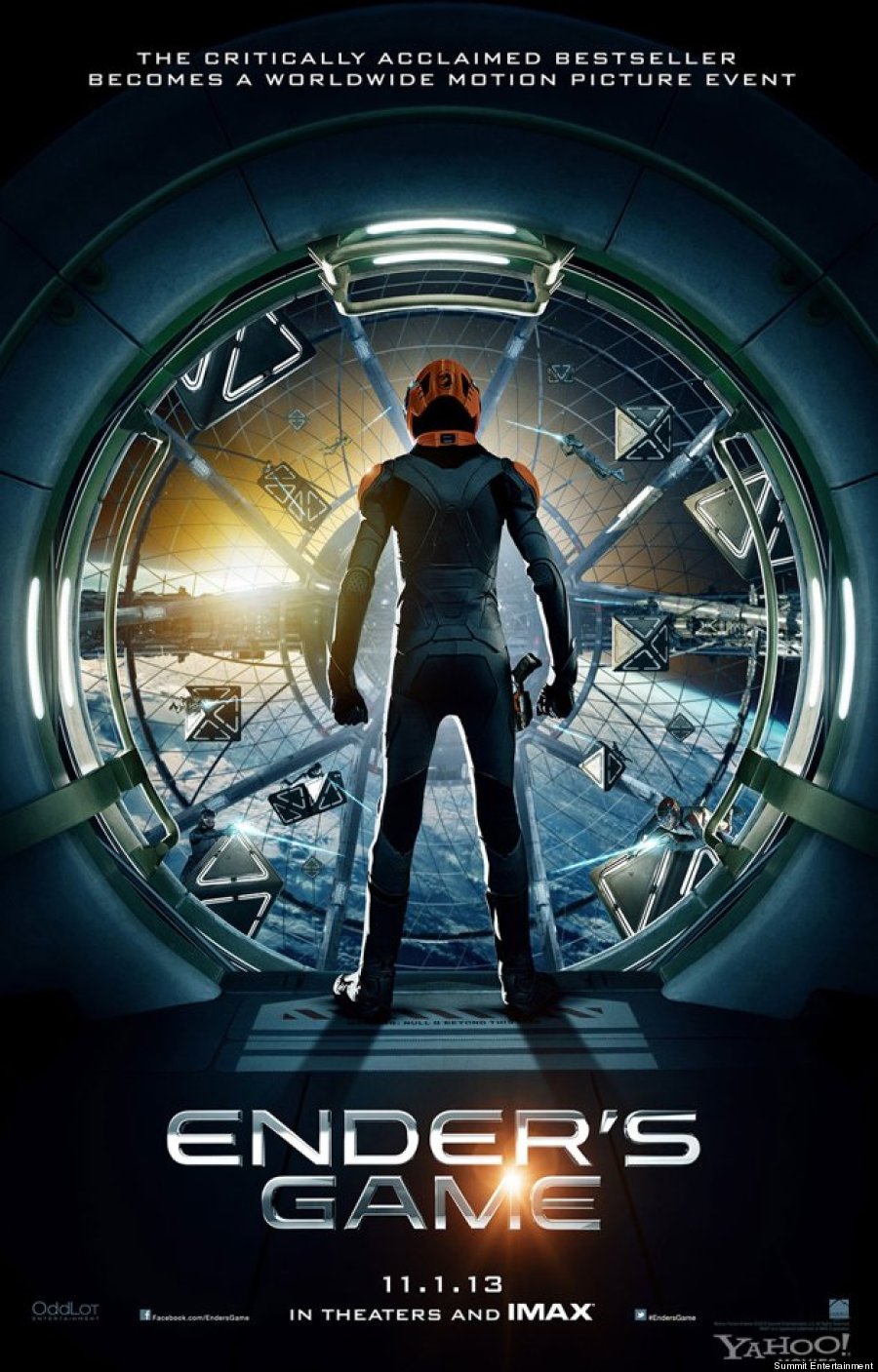 Honestly I know more about Ender’s Game thanks to the swirling rabble about boycotting the film thanks to author Orson Scott Card’s homophobic personal views. I didn’t even know this book existed until I heard about the movie. With my cloud of ignorance, as well as some lingering worries that the director of X-Men Origins: Wolverine was at the helm of this expensive would-be franchise, I was pleasantly surprised at how entertaining I found the movie. It’s set in a future where children are culled and trained to be super soldiers against an alien race that has been in seclusion after a failed invasion of Earth. The emphasis is on strategy and manipulating your opponent, which leads to many military training sequences. At one point I wondered, “Is this whole story going to be training sequences and zero-gravity laser tag?” It’s not, thankfully, but even those sequences are fun. Writer/director Gavin Hood does an excellent job of fleshing out this world while giving enough time in between the games to also flesh out his ragtag group of characters. There’s something inherently satisfying to watching a team come together, and the film has plenty of small payoffs. The visuals are astounding to soak up. The zero gravity fun, backlit by the stars, is dazzling. The acting is strong across the board, with special appreciation that Harrison Ford has a good role that he’s actually well suited for. The pacing does start to slag toward the third act, mostly because the plot feels like an escalating series of games, until it’s not. There’s a measured degree of ethical ambiguity and contemplation to the film that’s admirable. Whether you plan on boycotting Ender’s Game or not, it’s a successful, thrilling, and visually engaging sci-fi flick that deserves to be seen at some point.
Nate’s Grade: B+


You must be logged in to post a comment.