Blog Archives
The Maze Runner (2014)
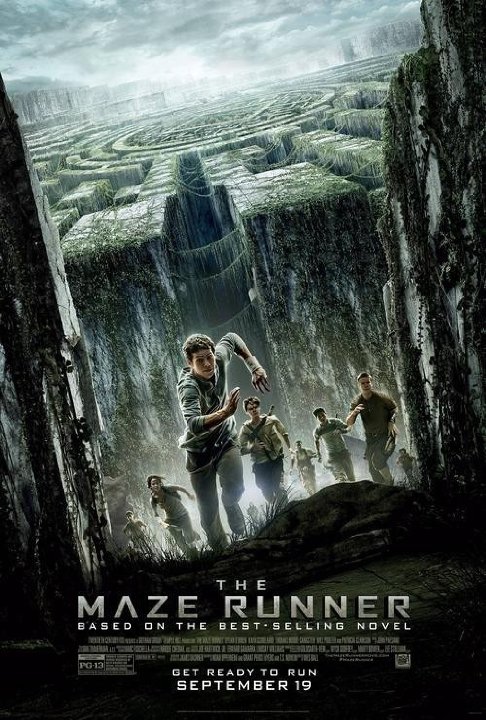 If anyone can reasonably explain to me the end of The Maze Runner in a way that makes some tangible amount of sense, I will give you money. The latest YA-franchise-in-the-making starts off with a storyline that reminded me of Rod Serling. We follow a group of teen boys, memories wiped, as they wake up in the center of a giant mechanical maze. Who put them there? Why? What’s on the other side? As long as the maze and the mystery of it are front and center, the film works, twisting in intrigue. However, when the story veers away to the characters, mostly flat archetypes, and their new society, that’s when I started getting sleepy. You got this awesome huge maze to explore, kids. The film ends up being an exercise in less-is-more restraint when it comes to sustaining a mystery and knowing what points to emphasize and which to skip over. There’s a girl brought into their camp, the first, which they say should be a big idea and change the social dynamics of a group of boys, but it doesn’t. There are silly mechanical spider monsters that scamper through the maze, as if the filmmakers felt a giant maze wasn’t a sufficient enough obstacle and selling point. Scattered flashbacks early on spoil who is responsible for the maze, but when we get to the actual ending, the rationale for who built this large contraption and for what purpose doesn’t add up, like, at all. An explanation wasn’t necessary, but if they needed a quick one I would have accepted, “Aliens did it because.” There’s already a planned sequel in the works. My idea: the kids escape the maze only to discover… they’ve just entered a larger maze. Then they escape that maze only to discover… you get the idea. The Maze Runner is moderately enjoyable. Just don’t expect to enjoy, understand, or even accept the ending and its implications.
Nate’s Grade: B-
Share this:

A Walk Among the Tombstones (2014)
 Scott Frank has only directed one movie, The Lookout, but as a screenwriter his fingerprints are everywhere in Hollywood. The man’s name is all over projects such as Out of Sight, Minority Report, Get Shorty, The Wolverine, Marley & Me, and those are just the ones that made it across the finish line. As any aspiring screenwriter knows, Hollywood is built upon an ever-amassing burial ground of unproduced screenplays. A Walk Among the Tombstones is only his second directing feature, which tells me it must have had significant personal value for this famous scribe. You can definitely tell Frank has an affinity for hard-boiled film noir of old, though the splashes of in-your-face sadism may be too much for certain audiences. It’s a genre movie all right, but it’s also a grisly one that bothers to take its time setting up character, plot, and resolution.
It’s New York City on the cusp of Y2K, and retired cop Matt Scudder (Liam Neeson) is just trying to enjoy his dinner. He’s pulled into a complex kidnapping scenario at the behest of one of his AA peers. Two men have been targeting the city’s drug traffickers, men with big pockets who cannot go to the police. These psychopaths enjoy abducting the trafficker’s wives, ransoming them for hundreds of thousands, and then slicing and dicing their victims anyway. Matt initially turns down the offer, working around the edges f the law, but the viciousness is too much to ignore. He reawakens his old detective habbits, falling back into a routine, and tracking down those responsible.
 Those expecting a regular Liam Neeson afternoon of top-draw face punching may be in for a slight disappointment, because A Walk Among the Tombstones is a gritty detective tale that swims amidst an ocean of moral decay and queasy sexual violence. It’s a detective yarn that unwinds at a casual pace but one that feels like a natural connecting of plot points. Thankfully, this isn’t a movie that treats the identity of the killers as a mystery that needs to be dragged out as long as possible, with the ultimate pained reveal being one of the otherwise harmless characters we’ve previously been introduced. We know who these two psychopaths are after about twenty minutes, so there’s no prolonged guessing game. Rather than linger on who they are we now await the ultimate satisfaction of Matt Scuder finally facing off against our two psychopathic killers, and they are indeed psychopaths. These two are very wicked men, gathering sadistic pleasure from torturing their captive women. The two men are kept as unsettling ciphers; we don’t know much about them except they have an addiction to killing. It’s not about the hundreds of thousands they scam from the drug traffickers; it’s really about the thrill of the hunt. While I wish there was more depth, they were menacing enough. I was itchy with anticipation for them to get some comeuppance. I’ve read reviews indicating that our two remorseless killers are a gay couple; if this is true it’s kept very vague for interpretation. In the age of equality, it could be homophobic to declare, in absolutes, that psychopathic killers couldn’t also be gay or lesbian. That would be… wrong?
With two strong villains, you need a strong hero to bring them down, and Neeson fits the part like a natural. To be fair, the role is somewhat stock from a passing description: the loner former cop with the tragic past, a drinking problem, the gruff style, the over-the-hill age, the man trying to adapt to a new and changing world, sometimes not for the better. It’s a role that feels ripped from the tropes of crime thrillers, a world we’ve also become accustomed to seeing Neeson. The detective role is familiar but, like most within Frank’s film, it’s given more time to breath and a surprising degree of attention. This doesn’t come close to last year’s Prisoners in the realm of character work, but it’s still an above-average entry for a genre too often ignored when it comes to realistic and satisfying characterization. Matt Scudder exists in a New York City that owes a debt to the pulpy noir page-turners of old, but it’s not exactly stylized, and neither is he. The man still uses microfilm and needs the assistance of a street-smart homeless teenager to assist him with this newfangled Internet thing. While it feels somewhat forced, the relationship with Matt Scuder and his young protégée is the strongest in the film, opening up the character’s redemptive arc. It’s always appreciated to watch Neeson get to flex his acting muscles rather than just being given action choreography and trite tough guy bravado.
There’s one other actor I’d like to single out, and I’ll thank my mother for this. Fans of Downton Abbey (like dear old mom) may recall Dan Stevens as the dashing and departed Matt Crawley, but he is almost unrecognizable as the grieving husband/drug trafficker that kicks off our story. For one, the guy lost a decent amount of weight and his gaunt face makes him seem all the more mercurial and intense. The characters plays against type with our expectations for a drug dealer, and you may find yourself, like I did, warming to him and yearning for the man’s vengeance for his wife.
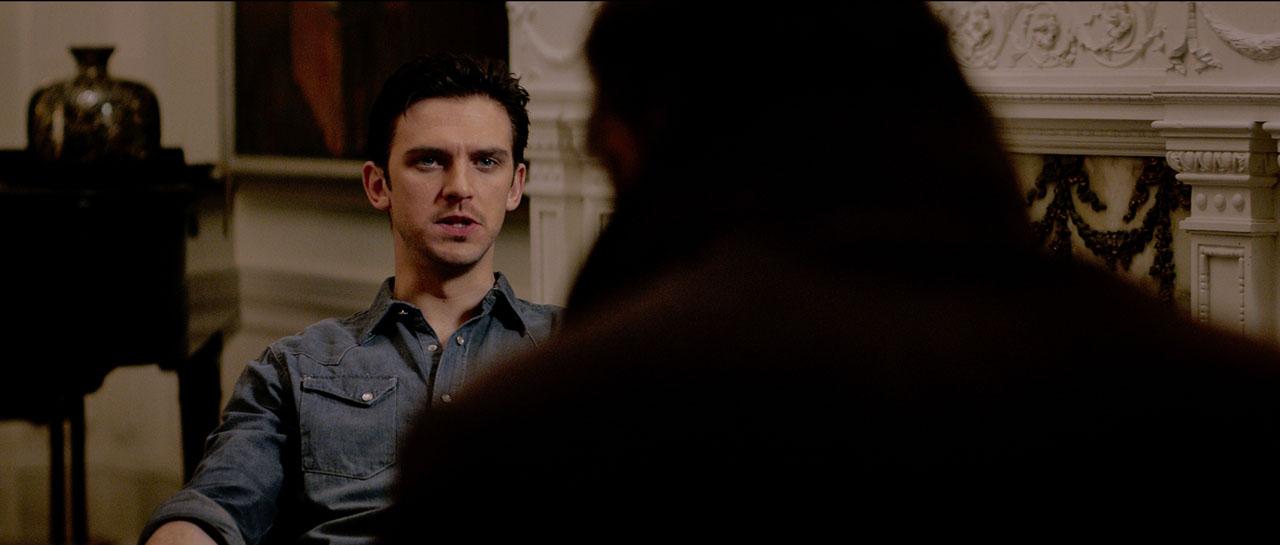 Frank’s direction is awash in the grime and seediness of New York City, with dark shadows washing over his troubled characters, and a sense of style that, while omnipresent in tone, doesn’t distract from the story. The rich cinematography by Mihai Malaimare Jr. (The Master, Tetro) is a great asset. The film noir elements are here in abundance and with due diligence. It rains in just about every scene. Why? All the better for a moody and eerier atmosphere, though the rain does actually factor into a character-based conflict for Matt’s protégée. It’s a moody thriller that is assuredly above average for its genre. Not everything quite works (the third act is too drawn out; a montage of AA 12 steps narration over sequences of violence is more than a little heavy-handed; the explicit Y2K setting doesn’t really have a purpose other than to limit certain technological advances not becoming of the genre) but Frank knows how to draw out the strengths of the genre.
A Walk Among the Tombstones is a gritty genre throwback, but what really jumped out to me was the hook of the premise. Neeson plays a man on the outer edges of the law but a man who still bends toward the justice system he once worked for. What makes this character unique, or at least the promise of, is that he ends up becoming the private detective for the criminal world, and that I find to be fascinating. We think of criminals, especially drug traffickers, are tough men who can handle their own problems with extreme authority. But they are also just people and can get in over their head as well, and when they need someone with private eye skills, who knows how to operate inside the bounds of the law and out of them, that’s where Neeson comes in. He does such a good job that he gets recommended around the New York ring of drug traffickers. He’s like a Michael Clayton-style fix-it guy but for the criminal underworld, and I think this concept it rife with juicy potential. Tombstones is based upon a series of books by Lawrence Block, so there could be further adventures, and I would welcome them, especially if the finished product is as entertaining as this first foray.
Nate’s Grade: B
Share this:

Life Itself (2014)
 I would not be a film critic or even as ardent a lover of movies if it weren’t for Roger Ebert and his towering influence on generations of curious cinephiles. Every film review is likely going to touch upon their own personal relationship with Siskel and Ebert and this one will be no different (full disclosure: I contributed online to make sure this documentary would reach completion. You can find my name last in the end credits “thanks” section. The perks of being a Z-kid). When I was young, I would sneak into my parents’ room and wake them up, eager to watch not cartoons but the latest episode of Siskel and Ebert’s take on new releases. For me, Roger and Gene opened an entire new world for me, and hearing their spirited discussions over the latest Hollywood blockbuster or indie experiment would stimulate my imagination. Therefore, Life Itself, a documentary chronicling the life and death of Roger, including those difficult final months of his fight against cancer, is a tremendously emotional and personal experience for me. Even now it’s hard for me to write this review as I have a wealth of feelings churning. It’s like watching one of your heroes ride off into the sunset; eternally grateful for those years they had on Earth to inspire. It’s fitting that Roger become a part of the movies himself with a documentary that’s one of the year’s best and most poignant films.
This was never meant to be a film about Roger’s death. It was intended to be an adaptation of his 2011 memoir, the titular Life Itself. Filmmaker Steve James, best known as the director of Hoop Dreams (Roger’s #1 film for 1994), tackles the essential biography bits we’d expect tracing the cradle-to-grave approach. What makes this film more interesting is that it too follows Ebert’s own perspective he utilized in his memoir. Rather than writing from the point of view of being in the moment, Ebert acknowledges his age and looks back on the past not as it’s happening but as an older man reflecting upon his life. The thoughts are not so linear, the consideration more meditative, thoughtful, and overall thankful. This is a man looking back and taking stock of his life, grateful for the people that have elevated his experiences. The framing device of the movie happens to be Roger’s last five months of life, going in and out of the hospital and adjusting to the ever-mounting hurdles of his deteriorating health. It can be downright shocking and horrifying to watch this Ebert, his jaw hanging loose like an ill-fitting Halloween mask. Never has the man looked more vulnerable and so mortal. It’s not how you wish to remember him, and Roger is without vanity as he wants the cameras to have access to his day-to-day reality no matter the hardships. As the months pass and Roger’s communication starts fading, everyone has to come to terms with the inevitable, and the viewer is right there too, bidding goodbye with Roger’s grieving family.
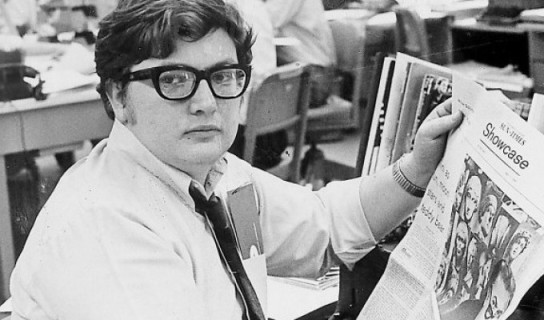 While tears will be shed, do not think of the movie as an elegiac tribute meant to fill your heart with dread for the demise of a great writer and a great man. As the title indicates, it’s a celebration of the man’s life, illuminating a figure that was much larger than his prolific publications (note: not a fat joke). Can you picture Ebert as a skirt-chasing Chicago Sun-Times reporter? How about as a guy who would get drunk and hang from the rafters, causing scenes? Many likely don’t know that Ebert has one screenwriting credit for Russ Meyer’s 1970 camp-tastic Beyond the Valley of the Dolls, a job Ebert likely took on so he could, in his words, “get laid.” There’s even a lengthy bit over their populist film critiques and whether the famous “Thumbs Up/Thumbs Down” model was helpful or harmful to film criticism. Life Itself does a fitting job tracing the roots of the man, with each chapter of his life given due development and consideration. I could have watched a four-hour documentary on the man’s life, but I’m not the general public.
The film is defined by two central relationships: Roger and Gene and Roger and his wife, Chaz. The first is the most famous. We track their initial growing pains taking the leap adapting their styles to the realm of TV. Gene was a natural, Roger less so, which only made Ebert more furious (photos of Gene “ladies man” Siskel gallivanting with Hugh Hefner are a hoot). The impact of their advocacy cannot be overstated. There are plenty of filmmakers that got their big break thanks to special consideration and publicity from these two. No matter the medium, these were the most famous critics of the twentieth century, opening up the world of movies to a new and hungry and appreciative audience. As enjoyable as it is to watch Siskel and Ebert in agreement, there was a special pleasure in watching them disagree because of the unleashed intensity. They really felt like they could convert the other person through sheer force of will. Their egos were both massive and Siskel knew exactly which buttons to push to set his cohort into aggravation. We see TV clips and unused rehearsal video and you feel like they might start a fistfight at any moment. And then that ire and ego forged into a deep admiration and love for one another, a love that Ebert reflects more tenderly of in the years since Siskel’s death in 1999. Gene didn’t want his loved ones to watch the clock, waiting for him to expire, and so he told nobody of his terminal brain tumor until the end. Roger was always wounded by this and vowed to be as open as possible if he suffered severe health setbacks.
The other relationship we get to witness come to a close right before our tear-stricken eyes. Roger met Chaz in AA, a fact she says she’s never publicly admitted before. He was over 50 when he married. He accepted her children as his own, whisking the family on faraway vacations and sharing his love of cinema with his stepchildren and grandchildren. Ebert credits Chaz with nothing less than saving his life, asserting he’d have drank himself to death without her. It’s a love story that forces us to watch the heartbreaking finale, namely Chaz coming to grips with the reality of losing her husband, of letting the love of her life go, something so profound. We’re right with her, wanting to fight on, try the next surgery, always hopeful, though in our circumstances we have the dread of foreknowledge. Then again perhaps Chaz and those close to the Eberts suspected as much as well, especially as his health faded so quickly in the spring of 2013. Just watching her talk about Roger in the past tense, you watch the ripples of pain reverberate through this woman. She’s the unexpected heart of the movie and one of many torchbearers when it comes to the legacy of Roger.
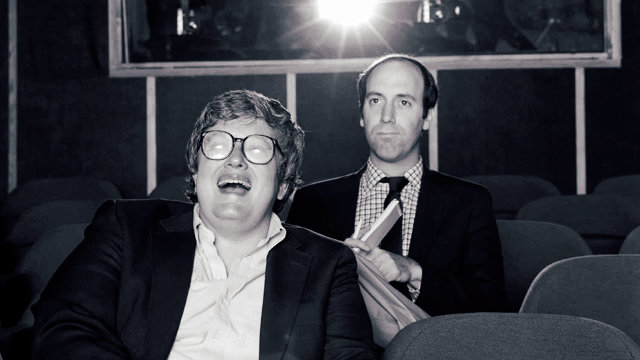 Ultimately, Life Itself is a love story. It’s a love story about two men who go from rivals to close friends. It’s a love story between a man and a woman. It’s also the love story of a man with the movies, a love that he felt eager to share with millions of his readers and television viewers, because in the end (danger: sentimentality approaching) it’s our love and passion that will ultimately outlast us all, and the people we touch are the living embodiment of our legacies. And Roger’s passing has touched many. As fans, those who grew up with him, I think we all felt like he was partly ours. Life Itself is a touching, engrossing, invigorating, and fitting tribute to a man larger than the movies.
Nate’s Grade: A
Share this:

The Fault in Our Stars (2014)
 With a premise involving two teenagers with terminal cancer, you’d be correct to assume that The Fault in Our Stars is a sad experience. It wants to be an unsentimental version of the Big Cancer Weepie, like a more hip version of Love Story. It wants to obliterate your tear ducts but in a way that won’t make you roll your eyes from an overdose of maudlin material. Based upon John Green’s international best-selling young adult novel, the doomed romance of the year has already devastated millions of moviegoers. Is it the feel-bad movie of the summer with a soundtrack Zach Braff would approve?
Hazel Grace (Shailene Woodley) is a 16-year-old girl dealing with lung cancer. She lugs around an oxygen canister to her group therapy sessions, really to everywhere she goes. Her parents (Laura Dern, Sam Trammell) try and give her enough space, try to make her feel like a normal teenager, but they all know what is coming. Then one day at group therapy she meets Gus (Ansel Elgort), a tall, handsome, effortlessly confident young man in remission himself (he had a leg amputated from cancer). Gus hones his sights on wooing Hazel, winning her over. She resist at first but then finds herself falling for the charming fella (“I fell for him like falling asleep; at first slowly, then all at once.”).
 With constant life and death stakes and the certainty of a young life, it would be easy for the film to go overboard with its emotional histrionics, and yet the real grace of the film is its more realistic approach to portraying this life. It just doesn’t seem fair for someone so young to be stricken with a deadly disease that will pluck him or her from the Earth before settling into adulthood, but these things happen. Hazel and Gus are characters that aren’t begging for sympathy or even special treatment; they’re tired of being treated like lab specimens too fragile to be left on their own. It’s easy to lose the person when the outside world completely identifies them as afflicted. The skill of this movie is that it’s heavy with drama and sadness but it doesn’t quite overwhelm, at least until the last act. Until then, much like the characters, the movie finds the moments of happiness, connection, and tenderness with human contact. You feel the bursts of nerves and excitement over the flirty connection between Gus and Hazel. You’ll enjoy the couple-y moments they share, finding their own identity as a pair, like claiming “okay” as their own secret coded language. You’ll feel warm and fuzzy over that first kiss. It’s a winning pairing that produces a steady stream of sweet exchanges and discoveries. This is something of a silver lining movie that can make you ruefully smile through your tears.
But as a Big Cancer Weepie, and with two suffering lovers, there is a definite cloud that hangs over the entire movie. You’re nervously waiting for some sort of turn for the worse. From a storytelling standpoint, I think every ticket-buyer knows with two cancer-stricken leads that at least one of them will be dead before the end credits. And so we wait for the bad news, wait for that other shoe to drop, and this unsettling dread permeates the first half of the movie, tainting all those happy couple moments. Gus and Hazel have several cute moments, but I found myself holding back, waiting for the proverbial hammer to drop on their small shared happiness, and sure enough it will come. The entire third act is dominated by one character’s descent into terminal. For the sake of spoilers I won’t say which, though readers with keen analytical skills can likely guess which of the pair is more expendable from a plot standpoint. It’s at this point when the movie transitions from sad to full-blown weepie, looking to draw out every last tear. With the diagnosis set, our couple heads toward that date with oblivion, and we get all sorts of weight heart-to-hearts, teens grappling with their own legacy, and even a practice funeral for friends to say exactly how much the soon-to-be-departed loved one mattered. Every step is wrung out, even to the point of one last letter/message before death that serves as the closing, considerate voice over. It’s hard to resist the cumulative effect of all these big dramatic plays at your emotions (I got teary at several points but held my ground).
The question arises at what point is this blatant emotional manipulation? The first half of The Fault in Our Stars finds a balance between the heaviness and the levity of first love, grounding its characters and their emotional highs. However, with that aforementioned turn of sullen events, the plot then becomes one long series of Sad Ruminations. What will the friends do without their pal? What will the family do? What does this harsh realization do to other terminal characters and their own family relationships? What about coming to grips with certain death? And then there’s the practice funeral. For a movie and a set of characters that refused to dwell in a pit of sadness, that’s all that the second half of the movie feels like. It also feels like the two-hour-plus plot is overextended to squeeze in one sad ruminating scene after another. In a way, it reminded me of the onslaught of emotional punishment that was the last act of Marley & Me, an otherwise enjoyable movie that devastated every dog owner by its conclusion. It feels a bit much.
 And this leads me to another issue with the adaptation process, namely that Gus is actually a character with little depth to him. He’s a smiling, immensely likeable figure who doggedly pursues Hazel and falls for her hard. But what is he as a person? He’s overly confident, compassionate to others, witty, charming, but these are more superficial descriptions than deeper analysis. I suppose one could argue he’s just decided to embrace life smiling, but for the most part Gus comes across as a prime figure of squishy wish fulfillment. He’s too good to be true, and with a lack of stronger characterization, that’s the way he plays. Now, I certainly liked the character and found Elgort (Divergent) to be a charming lad, but when the film transitioned to sadder territory, my feelings felt blunted. I would have felt more for this couple had Gus felt more like a real person.
It’s a good thing then that Hazel is the protagonist and main point of view, especially when Shailene Woodley as lead actress. I’ve raved about Woodley before, particularly last year’s underrated Spectacular Now, but every new leading performance is further proof that she is one of her generation’s best young actresses. There is no artificiality in this woman’s body. Her performances are master classes in exuding naturalism, blending into the character, finding subtle ways to express a wide range of emotions; seriously, this woman can express so much just with a tilt of her head and the right kind of smile. Woodley is terrific once again, instantly locking in your sympathy. Her trial of love and suffering run the danger of being heavy-handed but Woodley seamlessly anchors the movie, guiding the audience back to her sphere whenever things get too overwrought. When she tears up, I teared up. When she unleashes a howl of grief, I had to fight every impulse in my body to join her. Her chemistry with Elgort is suitable if unspectacular, but Woodley sells every emotion and without a hint of artifice. If she were in a Big Cancer Weepie, you’d never know it given the skill of her performance.
I can’t imagine there will be much surprise for anyone who watches The Fault in Our Stars. Two young lovers with terminal cancer have a way of writing itself. What separates this story from other sappy tearjerkers is its presentation and perspective. This is a movie that flirts between jaded and maudlin, scoffing at the overt sentimentality of grief culture yet finding a middle ground that feels humane and honest and earned. Woodley’s strong, emotive performance helps ground the film even when the long string of manipulation begins. I wish Gus was a stronger character rather than a charming romantic compliment, a dream boyfriend who indeed comes across as too good to be true. I wish the movie also would not get swallowed up by the heavier elements it found balance with before. With all that being said, this is an engaging drama first and an amiable romance second. You may see the end coming from the start, but the same can be said about all of us. We all know how our own story is going to end. The only difference is the people we touch in between the start and the stop. That is our lasting legacy. The Fault in Our Stars is more a journey than a destination, and it does enough right with enough sincerity and intelligence to endure the pain.
Nate’s Grade: B
Share this:

Edge of Tomorrow (2014)
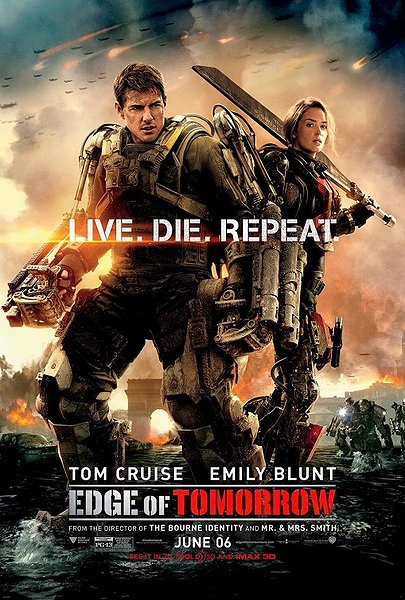 I’ve always been one able to separate the art from the artist, so while Tom Cruise may annoy people in real life because he jumped on a couch one summer, that doesn’t halt my enjoyment of the man’s movies. It seems with every new Cruise vehicle that under-performs at the box-office that I must be in the minority. Cruise hasn’t had a hit to his name since 2011’s suitably awesome Mission Impossible: Ghost Protocol. Both Oblivion and Jack Reacher, perfectly solid action movies, failed to make over $100 million domestically, further calling into question the drawing power of Tom Terrific. It seems that his latest, Edge of Tomorrow, is going to suffer a similar fate. This is a shame. As my critical colleague Ben Bailey said in his own review for the film: “Edge of Tomorrow might just be the most critically acclaimed box-office bomb of 2014.”
William Cage (Cruise) is chiefly an Armed Forces PR flak. He goes on TV to push the talking points of the United States military, which is in a heap of trouble. Aliens have landed in central Europe and spread quickly, proving to be nearly unstoppable. There was one soldier who was able to lead a successful counter attack. The “Angel of Verdun” is Rita (Emily Blunt), a soldier Cage proudly chirps only spent a day in her mechanical fighting suit beforehand yet proved to be so deadly. After vaguely threatening a high-ranking official rather than report for a doomed counter assault, Cage is shipped to the frontlines as a deserter. In hours he and a motley crew of ground forces are flown to the beaches of France, where the aliens will slaughter them. In the firefight, Cage is covered with alien blood and gains their special power. The reason the aliens have won every battle, save one, is because they have the power to reset time. They learn from their errors, which is why they always anticipate humanity’s attacks. Now Cage has this power. Every time he dies, the day resets and he starts over, trying once again to survive. The only person who understands him is Rita, who once had the same power. Together, with some extensive training, they may be able to thwart the alien invaders for good.
 Edge of Tomorrow is the ultimate video game movie, and while I would normally mean this in a pejorative sense, it is actually a compliment. With every death, Cage gets to start over, looking for a way to complete the next stage of the next level, learning from his costly mistakes and hoping to get to the boss battle that usually closes the level. From a structure standpoint, it’s a pure video game, albeit an older sidescroller (remember those, kids?). The visuals and mechanical battle suits also further support the video game comparisons. But really, Edge of Tomorrow is Groundhog Day meets Starship Troopers but brilliantly executed. There is something deeply satisfying about the Groundhog Day formula, namely getting seemingly endless chances to fix one’s mistakes, to try out new paths. It’s also inherently satisfying as an audience member because you watch your hero fail time and after time but they’re still active, they’re still trying to achieve a goal, or a new goal, and thus when they do succeed it’s even more triumphant and gratifying. We get to learn alongside our protagonist. Also, it allows the narrative to explore new material without going stale. In most stories we have one set path, but in films like this one with a time loop, it’s like we get to see all the wheels-within-wheels, the stories just offscreen happening simultaneously. It opens up the world in more interesting and playful ways, providing more payoffs than just one set narrative destination. We get assorted answers to our “what if”’s. Plus we get more screen time with Bill Paxton (2 Guns) as a comically hardass master sergeant. Edge of Tomorrow mines all these areas expertly. This is a movie that embraces the possibility of its sci-fi premise. It’s constantly clever, fast-paced, lively, and expects its audience to keep up with the pace.
It’s great to see director Doug Liman flex his action-thriller abilities again, ineffective or dormant since 2005’s Mr. and Mrs. Smith. The man has an innate ability to orchestrate action without losing sight of character. The beach invasion sequences have plenty going on, enough so that you won’t be bored after multiple trips, and unlike last summer’s disappointing Elysium, this is one movie that knows how to make proper use of a mech suit. These suits don’t look that impressive but they pack some mighty firepower. It’s rather cool when Cage, after a litany of failed trips, has the beats of combat to memory, knowing to shoot in this direction at the right second. It’s like watching a man harness the omniscient power of God (“I said I was a god. Not THE God.”). Under Liman’s guidance, the action is big and exciting and fun, more so than any other Hollywood action movie I’ve seen this year (The Raid 2 is still in a class its own).
The action sequences and special effects are all relatively good, but it’s just the sheer fun of the movie that makes it special for a summer would-be blockbuster. It’s like you get multiple movies smattered together but the eye is always forward to the goal, taking out the alien brain/host. The structure is almost foolproof: by the end of Act 1 he gets the time-tripping powers, and by the end of Act 2, he loses them and the heroics to close the movie have to count for real. I wish the final boss battle didn’t happen to take place in the bowels of a famous landmark/destination, but I suppose Liman and company needed a change of pace from all the beach activity. While the movie covers plenty of ground repeatedly it never feels old or directionless; while it has its share of sticky exposition and silly plot mechanics, it never overwhelms the story or the entertainment factor. The basics of who the aliens are, how they attack, what their magic blood does, what the rules are for utilizing said alien time-repeating power, you would imagine that they would be too silly or bog things down, but they don’t. Except for the very end (the concluding two minutes), the movie plays within its own system of rules. That also means no unrealistic romantic entanglement. Sure we expect movie stars to fall for one another, especially in peril, but for Rita, every day is the first day she’s ever met Cage. He develops feelings for her but she credibly keeps thoughts of romance at bay.
 It’s also a mordantly mirthful movie. Cage can only reset when he dies; if he is just wounded and passes out, he’ll lose his special reset power. So every insurmountable roadblock, wrong choice, or crippling injury must be met with one conclusion, namely Cage being snuffed out. Rita carries out most of the executions in the second half, with a blasé sense of routine duty, like a plumber fixing a clog. It doesn’t really get old and Liman utilizes montage well to give the comedy an extra punch. It lightens a movie more or less centered on human annihilation and mortality. And for the legions of Tom Cruise haters, there’s got to be some degree of entertainment value in watching the man die again and again and again and, well you get the point.
Cruise ably shows again that he is more than capable of carrying an action film (he’s over 50 now too). The man still has enough energy and physical stamina of an action hero in his 30s, and his charisma is still there in spades. It’s also interesting to watch Cruise play a cowardly character. I should have expected it considering that Cage’s arc has to start somewhere before he becomes the super soldier. However, the movie would never have been as good if Cruise didn’t have a strong leading lady, and the surprisingly buff Blunt (Looper) is an excellent match for her costar. She’s tough and can beat the snot out of you. Just her very walk exudes confidence and determination (is it too late for her to be Wonder Woman in the next Superman film?). Having walked in Cage’s shoes before with the time-replay power, she has an extra weariness to her, a certain devil-may-care attitude, especially in battle. The two actors make a winning team and Cage’s recruitment of Rita is another mission with another worthy payoff.
The original title was All You Need is Kill, based on a Japanese graphic novel, and I can’t help but think how much of a better, striking title that is to describe this movie. It’s a wonderfully entertaining movie, with its action spectacle tempered with an intelligence rare for a summer blockbuster that doesn’t have Christopher Nolan’s name attached as director. Here is a playful sci-fi movie that doesn’t downplay its sci-fi, doesn’t dumb down its plot, and explores the richness of its world one dead Cruise at a time. It’s clever and satisfying and brings all the visual fireworks you’d demand. It’s a rotten shame that Edge of Tomorrow appears destined for the cinematic scrapheap. We need more movies like this one. Reverse the tide people and see this movie on the big screen while you can. It’s everything we want in a summer blockbuster fully realized.
Nate’s Grade: A-
Share this:

Labor Day (2013)
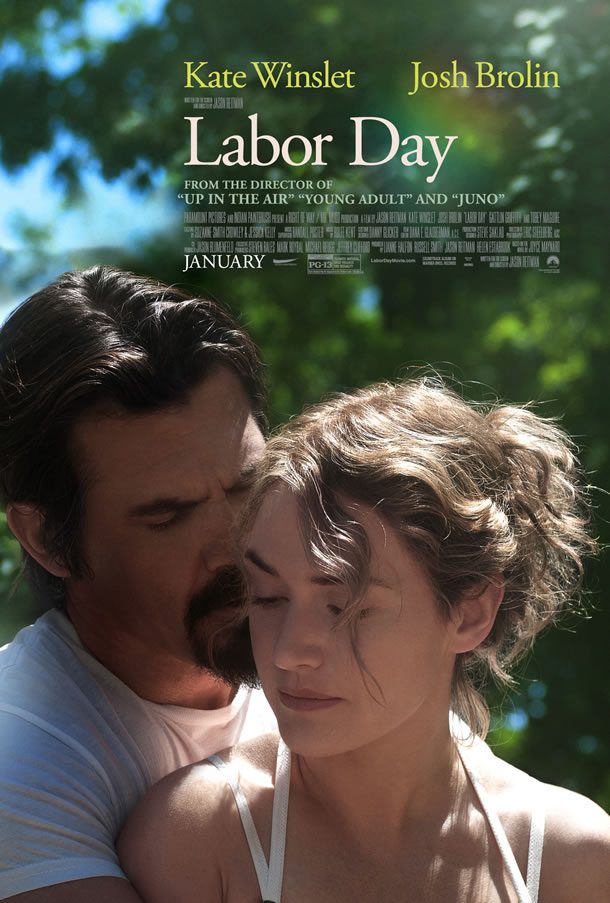 Labor Day, based upon the novel by Joyce Maynard, is the kind of sappy material that you never would have expected director Jason Reitman to attach his name to. Reitman has been accumulating an enviable career of top-shelf dark comedies (Thank You for Smoking, Up in the Air, Young Adult), yet his touch with characters and actors, as well as his delicacy with tone, reminded several of a young Billy Wilder. The stuff of Labor Day felt more like a Lifetime channel original movie. This is just one artistic miscalculation from the start and it doesn’t get better as it goes.
Back over Labor Day weekend in 1987, young Henry (Gattlin Griffith) is living with his grieving mother Adele (Kate Winslet) and performing many of the duties of a husband (don’t get gross). It’s been some time since Henry’s parents divorced but Adele has become a shell-shocked recluse who can barely talk or look others in the eye. While visiting a grocery store, Henry runs into a dangerous man named Frank (Josh Brolin). He’s bleeding from the abdomen and intimidates Adele to give him a ride. Frank is an escaped prisoner and he takes to hiding at Adele’s home. After the initial hostage period, Frank allows Henry and Adele to walk around freely, as long as they don’t tell anyone where he is. As the days pass, Frank helps out around the house, helps Adele get out of her funk, and becomes a surrogate father figure for Henry. The unconventional family must evade the police and skeptical townsfolk to make a run for it.
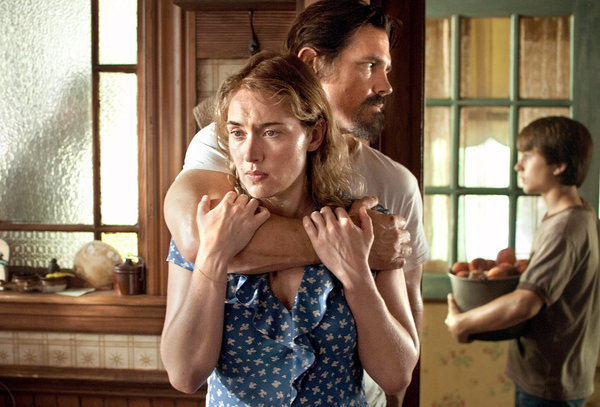 The very premise and its tone are just not a good fit for Reitman. First off, the movie plays out far more like a hostage thriller than any sort of romance. If you were to look deep inside, the romance can be explained as one very emotionally needy woman and her child going through Stockholm syndrome. The entire movie takes place over the titular Labor Day holiday, which means that all these changing feelings have to morph over the time period of three days. I don’t know if I’d call that love, even in Movie Land. Hey, Frank didn’t kill everyone and he helps around the house, isn’t he great? These people should be far more afraid for far longer. It is almost comical how saintly Frank becomes and how many surrogate father activities he squeezes into the abbreviated window of time. He performs handyman jobs all around the house, teaches young Henry how to change a tire, tosses a baseball with the kid, teaches everyone the finer points on pie making, and other such helpful activities. I understand that these two lonely people finally see a replacement man; for Henry a father, for Adele a lover. Again, the three-day time window makes everything appear like the manifestation of Stockholm syndrome. How many of those abducted have uttered, “He’s not that bad. You just don’t know him like I do”? Frank’s back-story is tragic but he is a wanted felon and he has no problem threatening both of these people’s lives in the beginning. Yeah he doesn’t resort to violence or yell in their faces, but why would he against an adolescent boy and his easily cajoled mother? No matter how long Reitman spends showing us the softer side of Frank, especially while preparing delectable dishes of food, he’s no more developed than the common Misunderstood Bad Boy.
Then there are the dawdling coming-of-age moments clinging to young Henry, a boy growing up quickly in a tumultuous holiday weekend. It strikes me as tonally odd to already take a tricky balancing act with the film’s plot and then tossing on a coming-of-age addition. The story is told from Henry’s perspective, and that’s a major problem as well. He’s the least interesting person in this dramatic setup. Being confined to his viewpoint often keeps us distant from the deeper drama going on. I’d rather spend time with Adele and Frank bonding so that the romance can find some traction, but no. Al we hear are the thumps from the other side of the wall and the gentle whisperings between them in stolen glances. It’s a frustrating perspective because quite frankly nobody really cares about this kid’s sexual awakening and his daydreams about the cute girl’s bra. His dad (Clark Gregg) wants to talk to him about the birds and the bees. His mom talks about the same. It’s a somewhat uncomfortable position for the audience with both parents wanting to cover the sex talk. There’s a wanted man hiding in his home! Henry’s personal growing up drama has no equivalency to this. Of the three main characters, doesn’t Henry seem like the worst participant to tell the story? It doesn’t help that Tobey Maguire narrates as older Henry. Have we not learned from The Great Gatsby: Maguire’s voice does not suit narration.
It’s the film’s more tense moments where you get glimpses of the real movie here, the thriller that’s been gussied up and disguised as some strange romance. Whenever someone gets close to discovering what’s really going on in that house, the movie picks up and grabs your interest once more, albeit fleeting. The fear of getting caught is potent but it should have been more omnipresent. The film, through Henry’s perspective, is treated like this nostalgic chestnut of that one summer a convicted killer held us hostage. The police are canvassing for an escaped prisoner but the neighborhood doesn’t seem to be that alarmed, still going about their business bringing desserts and fresh produce to one another’s doorstep. Too much of the film implies the threat, like with a short glimpse of a police checkpoint, but places it on the back-burner so that the romance can take shape. Again, this is a byproduct of being stuck in Henry’s perspective whereas the kid might not have the best understanding of how serious everything is (he’s worried his mom will abandon him and run off with Frank). But in those brief moments of dread and tension, this is where Labor Day works, and Reitman does a great job of turning the screws and building that suspense. It makes you wish the whole thing were a thriller.
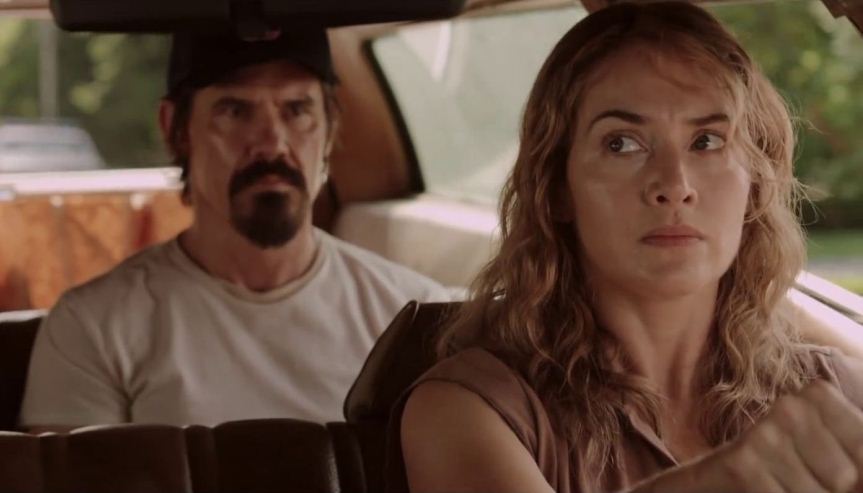 No one is going to question that Winslet (Divergent) and Brolin (Gangster Squad) are great actors, but boy do these characters underachieve. There is one very effective and moving monologue Winslet has about her pregnancy problems that have turned her away from the world, but it’s not enough. For much of the movie, she plays such an anxious and internalized character, so it’s hard to really follow her emotional development. That monologue does the most heavy lifting but it’s pretty wan before and after. Winslet is too good an actress to play essentially a catatonic woman that’s fairly mute. Brolin can play a soulful brute in his sleep. There’s so little to challenge him and so he seems on autopilot. It also hurts that both Frank and Adele have very limited conversations. It’s a romance told in gestures and handclasps (and the rhythmic thumping of walls at night). It’s not their fault that their characters are underwritten and unsatisfying. Griffith (Green Lantern) is a nice young actor but he too is forced to communicate much with little and comes up short. James Van Der Beek (TV’s Dawson’s Creek) is a local cop who appears for one scene, and afterwards you wish he would stick around longer. Look for Reitman good luck charm J.K. Simmons (Dark Skies) as a helpful neighbor.
Reitman is such a talented director that he can almost pull off sequences in Labor Day despite all of its inherent structural, tonal, and perspective flaws. From a technical standpoint, the movie is a gauzy, amber-accented tale with plenty of strong alluring visuals to set you at ease. There are these trembling moments where you almost see what attracted Reitman to the film, but the finished product is just a mushy misfire. It’s earnest without having earned our emotions, and the thriller elements and the romance elements are in constant conflict. We all remember our grandparents telling us that magical moment they knew they had met the one when he tied her up and held her hostage. Much of the drama that comes from the premise is handicapped from the mistake of having Henry as the chief storyteller and point of view. His limited involvement means we’re kept at the peripheral for too many important moments. I have no doubt Reitman will rebound and quickly (he’s already filming his next movie and has optioned a book for his next next movie). Get ready to have Labor Day play every subsequent Labor Day weekend on the Lifetime channel, its true home.
Nate’s Grade: C
Share this:

Devil’s Knot (2014)
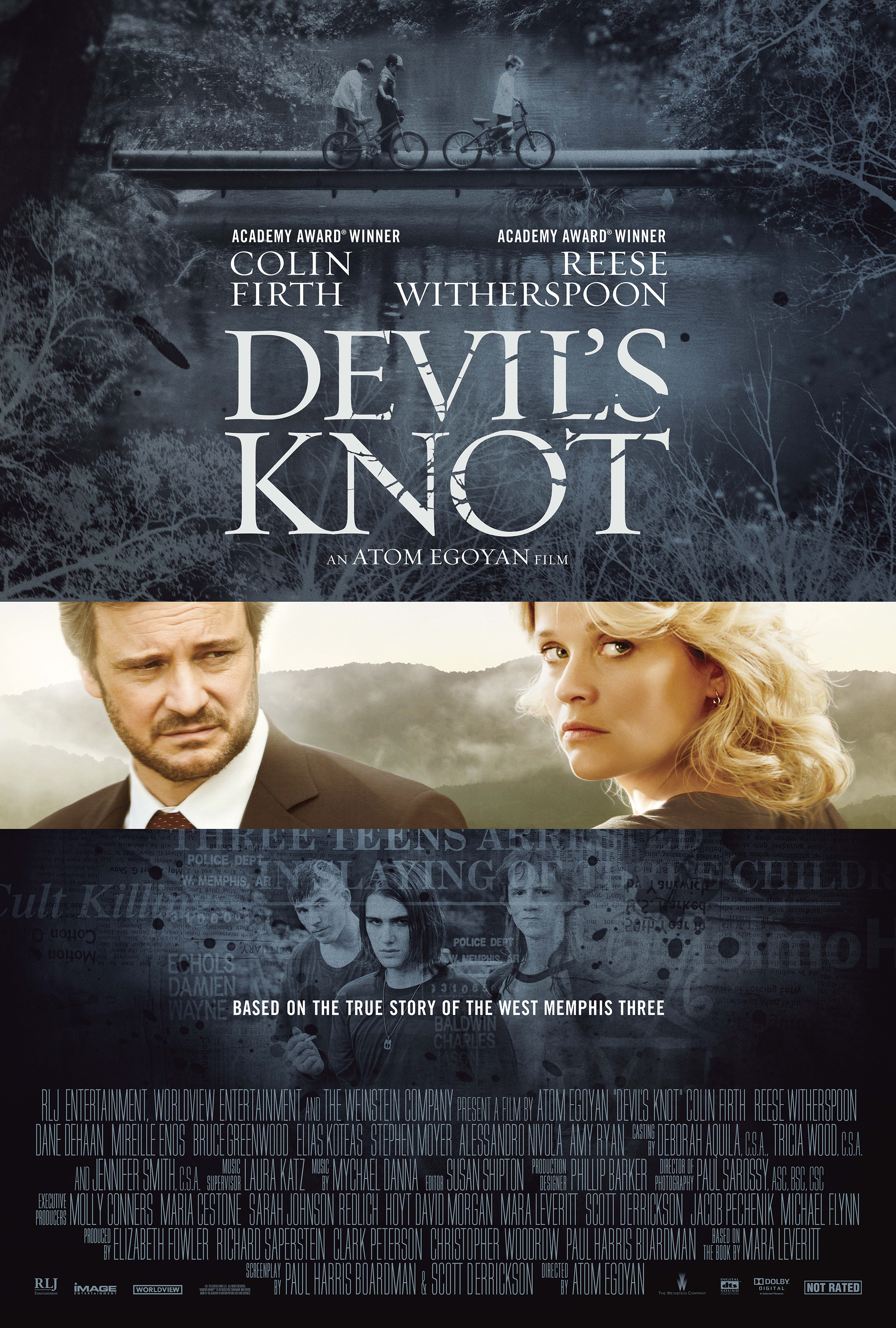 In 1993 in West Memphis, Arkansas, three eight-year-old boys went out late one night to ride their bikes. They were never seen alive again. The ensuing media circus that erupted lead to the conviction of three teenagers (The West Memphis Three) who many believed were innocent of these heinous crimes. Stop me if you’ve heard this story before. It was the basis of three stirring, powerful, galvanizing documentaries by Joe Berlinger and Bruce Sinofsky, two men credited with saving the West Memphis Three. Now after their release from prison, here comes Devil’s Knot, the first fictional film about the notorious case, Hollywood’s first crack at well-tread material. Is there anything new to be found?
Director Atom Egoyan (The Sweet Hereafter, Chloe) and his screenwriters do a credible job of distilling the complicated case against the West Memphis Three to its basics, relying on a modulated tone that shies away from the sensationalism that dominated the case back in 1993. With the benefit of time and hindsight, it’s easy for the movie to point out the erroneous thinking of the prosecution, the jump to conclusions, and the Satanic panic engulfing the community of Arkansas. We’re told by a police officer that they knew this “Satanic cult stuff” would hit town; they’ve just been waiting for the day. To its credit, the movie does a fine job of calmly and objectively pointing out the deficiencies in the police and prosecution’s case against the West Memphis Three. We’re told that from the twelve hours of interrogation with Jessie Misskelley, only 40-some minutes was recorded. The obvious mistakes in his confession, as well as the police coaching and coaxing him to their desired response, is made readily apparent. There’s “witness” Vicki Hutchernson (Mireille Enos of the oft-canceled The Killing) who says she say chief suspect Damien in a Satanic ritual, but the film cuts back from the imaginary to Vicki watching a movie on TV, the real source of her descriptive flourishes. Egoyan’s direction has a calm, objective overview that is reverent and respectful of the dead and the bereaved. It’s rarely boring and the facts of this case are such that any retelling would be somewhat compelling.
 So that brings me to the ultimate question: why even make a fictional movie about this subject? Four lengthy documentaries have covered the intricacies of the legal story, the breakdown in justice, and the personal toll on all sides of the crime. The only thing a fictional movie provides is: 1) the fun/distracting game of seeing relatively famous actors play the real-life people we’ve previously seen, and, 2) as an option for people who hate documentaries. If you’re one of those people who dislikes documentaries and doesn’t view them as “real movies,” then Devil’s Knot is for you, you dismissive filmgoer. Otherwise, literally everything was handled better in the Paradise Lost films. With the West Memphis Three thankfully out of prison, the omnipresent sense of urgency from the documentaries is now absent, replaced with a Monday morning quarterback sensibility pointing out all the obvious bias, judicial hypocrisy, and flaws of the case. And as anyone who has plowed through the powerful and addicting documentaries knows, there are plenty of flaws to point out for harsh scrutiny and incredulity. Movies have a long history of showing us an example of judicial injustice, and this is a prime example. However, Egoyan has put the emphasis of his movie on two outsiders rather than people in the center of this case. The West Memphis Three themselves are barely supporting actors in their own movie. I suppose the filmmakers may have wanted to present a different angle to the case since the Paradise Lost films showed the accused up close and personal. The construction of this plot just doesn’t work under the perspectives of Pam (Reese Witherspoon) and Ron (Colin Firth).
Ron serves as a pro-bono adviser to the defense, but that doesn’t mean he has the same access inside and outside the court. He can gather evidence on his own but really this guy is meant to be a fly-on-the-wall for the planning and frustration of all the legal roadblocks thrown at the defense. Is an added body in the room necessary? Could not one of the defense attorneys have provided the same purpose? Instead, he gets to grumble in the court and out about all the legal shenanigans going on to railroad innocent boys. He is essentially spelling it out to an audience. Pam has even less narrative purpose in the film. Her perspective makes sense early on as the mother of one of the murdered young children. Her panic, her worst nightmare come to life, it all makes for the stuff of major drama, which is why you’d imagine Witherspoon was drawn to the part. But once the case against the West Memphis Three gets going, Pam transforms into our Chief Reaction Shot Provider. Whenever a curious moment happens in court, we cut back to Pam and Witherspoon cocking her head in dawning curiosity and uncertainty. It’s as if she is meant to symbolically represent the entire community that was so fervent in their beliefs that these boys were guilty… until they heard the shaky case and the questionable experts put on the stand. So Pam and Ron end up becoming signals to the audience on how to feel and what to think. The movie doesn’t have enough faith in its audience to keep up with the minutia of the trail, or even the lawyers’ arguments, reducing a complex legal trial down to two nonessential characters nodding or shaking their heads.
 I’ll admit that I had some interest watching the actors inhabit the roles, and there are scads of people involved in this story. Bruce Greenwood (Star Trek) does a valiant job showcasing the head-scratching decisions of the trail judge, David Burnett, and his slimy dismissive nature. Stephen Moyer (TV’s True Blood) is particularly infuriating as John Fogleman, chief prosecuting attorney. Seth Meriwether (Trouble with the Curve) looks eerily like his character, the young and accused Jason Baldwin, and he nails his moral convictions and gentle nature. Dane DeHaan (The Amazing Spider-Man 2) gets to do his troubled youth thing he does so well. Kevin Durand is an actor I normally enjoy but even he can’t do justice to John Mark Byers, step-father to one of the slain boys, and easily the most memorable figure in the Paradise Lost films; the man is so theatrical and larger-than-life, and yet Devil’s Knot treats him like a featured extra, with many of his speaking scenes off camera. There isn’t a bad actor in the extremely large cast, though Firth’s Southern accent isn’t the most refined. If the movie lacks much reason for existing, at least the bevy of good actors respectfully bringing new life to these people, good, bad, and many somewhere in between, is the one credible quality to this movie.
What to make of Devil’s Knot, an example of a decent, modulated, and well acted movie that ultimately has no reason to exist in the wake of three excellent documentaries (Paradise Lost) and one other pretty good one (West of Memphis). The ground has been covered. However, that doesn’t mean that a well-told story can’t be told again, with a different angle, with a different approach, but Devil’s Knot hinges on two characters serving as metaphorical barometers to teach the audience what to think and how to feel. Then there’s the matter that the trail covers the entire 114-minute running time. There’s so much more that happens after the initial trial, so much that the last two minutes of this movie are almost a nonstop barrage of text updating the audience on many of the post-trial developments, including the West Memphis Three being released from prison in 2011. The movie feels too limited; there is so much more depth here, to the details of the case, to the personalities and human drama, to the story after the trial. Egoyan and his cast and crew have made a respectful fictional version of these sensational events, but the problem is that they don’t do enough to justify their own film’s existence. Unless you have an irrational hatred for documentaries, just watch those instead.
Nate’s Grade: C+
Share this:

Heaven is For Real (2014)
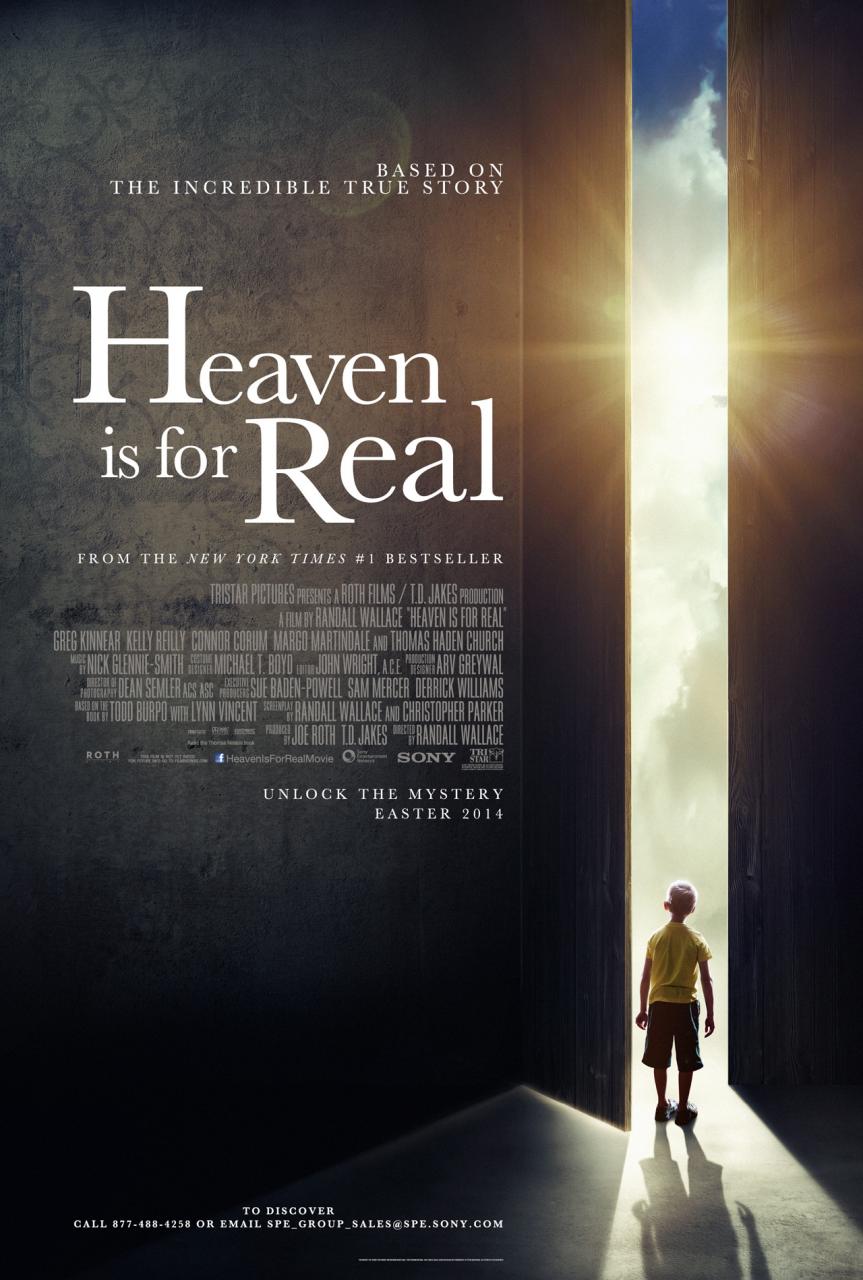 Christian movies have been lighting up the U.S. box-office this year. First there was Son of God, which opened at over $30 million dollars for what is essentially a retread of what people could see for free on TV. Then there was Noah, the Biblical epic given a new life with modern special effects magic. Then the little indie that could, God’s Not Dead, which continues to hang around the box-office, collecting astonishing sums. Now in time for Easter is Heaven is For Real based upon the best-selling book of the same name. Adapted and directed by Randall Wallace (Secretariat, Braveheart), the film manages to be emotional, earnest, and efficient, even despite not really having the elements needed to be called a film.
Todd Burpo (Greg Kinnear) is the pastor for a small town in rural Nebraska. He and his wife Sonja (Kelly Reilly) are struggling to pay the bills and care for their two children, Cassie (Lane Styles) and Colton (Connor Corum). One fateful day, Colton is rushed to the hospital with a burst appendix. He makes it through the operation. Afterwards, he tells his family the amazing news that while unconscious he visited heaven. The Burpos are ready to dismiss their son’s experience as a response common to those who went through near-death experiences, except little Colton never died on the operating table. Todd is unsure what to do with his son’s information, including key knowledge that he has no Earthly way of knowing. The members of Todd’s church worry about trusting the child’s account, and are wary of the media circus, and may just hire a new pastor for all the trouble caused by Colton’s confession.
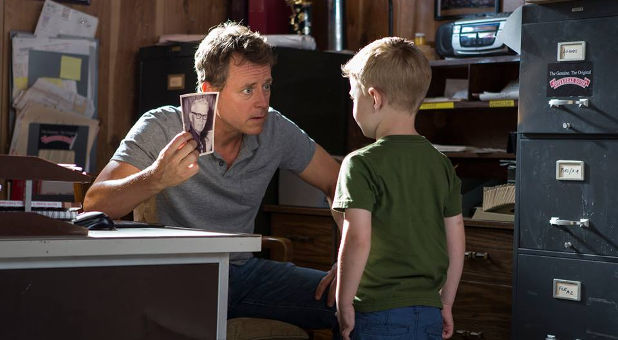 Kinder and gentler, here is a movie that has an inclusive, positive message executed with earnest conviction. The drama isn’t subtle but it can be effective. The music rises, the actors crinkle their faces and get tears in their eyes, and you’re left feeling like there’s something in your own eye. It may be manipulative in some sense but it’s so well executed, and without any hint of pretension or agenda, that I really didn’t mind. It’s a heartfelt movie that could fervently inspire the masses that pack the theater. I’d much rather have any Christian consumers, or the curious, check out this well-meaning movie than the mean-spirited and spurious God’s Not Dead. This movie actually allows its characters to feel like regular people who exist in our world. Todd and Sonja have a sex life, and the Burpo family doesn’t just sing famous Christian tunes in the car, they’ll shout Queen at the top of their lungs. In other words, they’re a fairly normal Midwestern family, and I appreciated that the movie didn’t feel the need to sanctify them. The supporting characters also have dollops of depth to them, at least in the hands of actors like Thomas Haden Church (so wonderfully deadpan) and Margo Martindale (her sorrow fermenting into bitterness). Heaven is for Real is anchored by two strong performances by Kinnear (The Last Song) and Reilly (Flight) as the parents. Both of these actors get a wealth of emotions to play, a few crying scenes, one angry outburst, and they sell it all, never overplaying the emotions of the scene, gently grounding the film with compassion.
I suppose in some capacity this film could be the more religious version of The Sixth Sense. It’s about a gifted child who sees things others cannot and who battles with being taken seriously by the scolding adults. We know that he’s going to say something he should not know, the adults would gasp and say, “How did you know that? There’s no possible way,” and then we’ll repeat this process. It reminded me of when young Haley Joel Osment finally gets through to his mother when he tells her that grandma saw her dance and is proud of her. Just add a dash of non-denominational Christianity.
The problem is that there really isn’t a movie here. Heaven is For Real is comforting and earnest, but there just isn’t a story here that translates into the structure and form of a film, and it shows. First off, there really isn’t much in the way of authentic conflict here. After Colton is saved, the only real conflict is whether to believe what he experienced. This setup could work in the scheme of a movie if his parents were not believers; thus their arc is one that goes from disbelief to belief. However, the movie already begins with the Burpos as good Christian folk. Todd is the town’s pastor for crying out loud, so you’d think he wouldn’t be troubled with his own set of doubts. These are also rather good people. In the opening scenes, despite being behind on bills, Todd refuses to charge someone for his garage-repair services and accepts free carpet instead. In the end, when Todd is preaching and talking about his own journey and how prideful he was back at the start, I’m left wondering what he’s talking about. I suppose he didn’t have to try and run to third base in that church softball game, but is that really all we have to go on? Would staying on second symbolize his lack of faith? What I’m saying is that the Burpos don’t really travel on a character arc, so their squabbles over their son feel forced. More so, the struggles with Todd’s church feel the most inauthentic. I just don’t get it. The pastor’s kid says he went to heaven, and the congregation has members that are mad, but mad at what? Should the pastor, who preaches about heaven for a living, dispute his son, especially when the boy possesses extraordinary knowledge? I don’t understand what the conflict is here and neither does the movie, which doesn’t really adhere to a three-act structure, and just sort of ends without much preparation. People just believe. End. Why did it take this long? It’s not like these people are stone-cold atheists.
 It’s that lacking sense of urgency, let alone goals or a central through line, which makes me question how Heaven is For Real spends its time. Why does the movie choose to spend as much time on scenes that don’t seem to matter? The first act is spent with such dramatic moments as… Todd playing softball and breaking his leg (the one thing that pushes the film into PG material). And from that… a completely unrelated kidney stone infection. Then from there… the family takes a trip to the Denver zoo. I was getting restless myself that this kid was never going to get to heaven. I kept waiting for these moments to have consequence, like how the Burpo kids fall ill after visiting the zoo. Aha, it must be connected to the zoo (monkey pox!). Nope, it’s his appendix rupturing. Very little of the pre-heavenly visit looks to have any bearing on the overall plot, instead providing texture to the family life. I suppose Todd passing the kidney stones was meant to be a comedic excursion (Church says the average is passing 15 stones – that is too insane for me to believe at face value). Why kind of hours does Todd have for his family when he’s a minister, a full-time job, repairs garage doors as a second job, then volunteers as a firefighter AND coaches a high school wrestling team? He’s got way too much on his plate but objects to the idea of his wife getting a job. What purpose does Todd seeing a psychiatrist on short notice serve other than allowing an externalization of his internal doubts? I’ll let that one slide, but they never come back to the psychiatrist. Too much of the movie feels like padding and stalling until the non-conflict reaches its end.
Wallace also shows a lack of faith in his own audience. By choosing to visualize the heavenly sequences, though brief they are, the movie risks being goofy, as whatever man can derive will never be comparable. If the whole movie is about whether or not to accept Colton’s story on faith, why do we have to have dramatizations of his story? Isn’t that cheating? The heavenly sequences don’t really add much oomph to the story any way. Colton goes to church, watches vaguely humanoid angels bathed in light hover and sing. He asks them to play “We Will Rock You.” The angels laugh but they don’t play the classic Queen rock song/universal sports anthem. Is it a matter of taste, angels? Who doesn’t like Queen? Then Jesus shows up and walks Colton outside. Other than a visual glimpse of Colton hugging his dead sister, that’s it. The other issue with depicting heaven onscreen, or something close to it, is that we can start picking it apart. Just ask Peter Jackson and his miscalculated Lovely Bones. If everyone is young in heaven, as Colton observes, then do we get a say in what our prime age is? I personally think George Clooney is a more handsome man as he ages than back in his E.R. days. And why does Jesus have to dress in the standard robes and sandals of 2000 years ago? Couldn’t he wear something more casual? Just imagine: Jesus relaxing in the pajama jeans. Then there’s Colton coming across his departed sister, who died at eight months, but is represented by a 6-8-year-old girl. Does this mean she’s going to be like that for eternity? Does she not get to choose to be an adult? See what I mean about picking it apart?
Its heart is in the right place, its message is inclusive and positive, and ultimately Heaven is For Real preaches about making life on Earth just as significant as the one after, and so I can say that the film is a relatively inoffensive and effective drama. It isn’t enough to say heaven is for real; the movie challenges the audience to do more. It doesn’t go overboard into maudlin territory, though it comes close enough with some of the wistful child acting. There really isn’t much of a movie here, and some of the choices seem to backfire, but it’s saved by its sense of earnestness, compassion, and some above average acting. Amidst the glut of evangelical movies this spring, I’d recommend Heaven is For Real above the rest (I’m excluding Noah from this list). It’s a thoroughly nice movie, and a film that should inspire its core audience, but in a good way, unlike God’s Not Dead. I can’t exactly say that this is a movie that needed to be made, especially from the cut-and-dry source material, but there’s a level of skepticism and reality imposed on what could easily be transformed into a blunt outreach piece. Even though the outcome is never in doubt, there’s an intelligence to the craft here that is much appreciated. Heaven is For Real may not be a great movie, but it works well enough as a movie when it shouldn’t, and that’s enough of a success in my book.
Nate’s Grade: B-
Share this:

Noah (2014)
 Meticulous director Darren Aronofsky gained a lot of creative cache after Black Swan raked in over $200 million worldwide, a Best Actress Oscar, and heaps of critical acclaim, including from myself (not to imply I was a deciding factor). The man had what all artists dream of, a perfect moment to seize whatever creative project his heart desired. And what he chose was to remake the biblical story of Noah for the masses, with an artistic fury and idiosyncrasy the likes of which audiences have never witnessed. The decision left many scratching their heads, wondering why Aronofsky would waste his time with a story already well told, in an outdated genre (Biblical epic), that would likely turn off evangelical ticket-buyers with any deviations and turn off mainstream audiences with any devotion. It looked like a big budget folly with no way of winning. The box-office is still unwritten, though I suspect the effects will net a pretty penny in overseas grosses, but as far as a creative statement, Noah is far more triumph than folly.
Noah (Russell Crowe) is living his life in isolation from the communities of king Tubal-cain (Ray Winstone). Noah and his wife Naameh (Jennifer Connelly), their two older sons Shem (Douglas Booth) and Ham (Logan Lerman), youngest son Japheth (Leo Mchugh Carroll), and adopted daughter Ila (Emma Watson), are living on the outskirts of civilization, aided by a group of fallen angels. Then Noah is given apocalyptic visions of an oncoming flood and the mission to save the world’s animals. After speaking with his 900-year-old grandfather Methusselah (Anthony Hopkins), Noah is convinced what he must do, and it involves a lot of intensive manual labor.
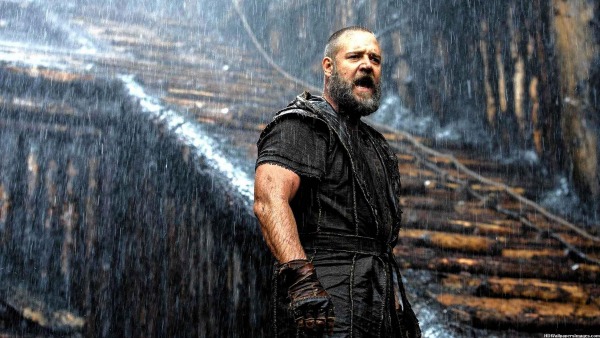 Aronofsky treats Noah and the beginnings like Greek mythology mixed with a Lord of the Rings-style fantasy epic, and it’s madly entertaining. The visuals are stirring, large-scale, and sumptuously memorable (the Earth covered in spiral weather patterns is a standout, along with Noah’s visions and a Tree of Life-style triptych narrating the birth of life). The film has come under fire from conservative critics for its creative deviations from the Bible, but sidestepping a larger conversation, why should a movie be punished because it wants to entertain a wider berth of people than the faithful? Does it truly matter that the people refer to the Big Guy as “The Creator” rather than “God”? Would these people even use the word “God”? This just seems like a petty battle of semantics. It seems like certain critics are looking for any nit to pick. Sure giant rock monsters that were fallen angels might make people snicker, but why should this aspect of the story be any more preposterous than a man and his family gathering two of every biological creature on the planet? I loved the rock creatures, I loved how Aronofsky introduces them, I love how they walk, I love that Aronofsky even finds a way to give them a redemptive storyline, offering an emotional payoff. Seriously, why should these be any harder to swallow for narrative stability?
There were fears that Aronofsky would be less than reverent to the source material with his additions and subtractions bringing it to the big screen; Noah is a Biblical epic for our modern age but also one fervently reverent to the lessons of the tale. First off, a literal version of the Genesis tale would be boring and short. There is going to be some additions and they should be welcomed. What Aronofsky and his co-writer Ari Handel (The Fountain) have done is taken a story filled with casual larger-than-life events and given it a smaller human perspective that is thought provoking. When Noah’s sons ask about wives, it’s personal planning but also a necessary part of, you know, repopulating the planet. They’re being anxious teen males but the small, relatable plot line also finds a way to relate to the larger picture, a tactic Aronofsky frequents. There’s a focus on family, fathers and sons, jealousy, but it really comes down to a personal level, differing perspectives about the overall purpose of man. The human-scale provides a richer context for the Biblical tale’s better-known aspects, like Noah turning to the bottle. As a result, we get the special effects spectacle without sacrificing the potent human drama at work. While the movie may never refer to “God” by name, it’s respectful and reverent.
 Another aspect about what makes Noah so daringly visionary is that it doesn’t blink when it comes to the darkness of the story. Over the years popular culture has neutered the tale of Noah into a cutesy tale about a guy on a boat with a bunch of happy animals. I think we’ve purposely ignored the lager picture, namely how truly horrifying the entire story is. It’s an apocalypse, humanity is wiped out; children and babies are drowning. Everybody dies. The later brilliance of Noah is that it doesn’t mitigate this horror. Once Noah and his family are inside, the floods having arrived, they painfully listen to the anguished wails of those struggling for life in the waters. The movie forces the characters, and the audience, to deal with the reality of a world-destroying cataclysm. Noah’s visions of the ensuing apocalypse are beautifully disturbing. The film takes place eight or nine generations removed from Adam, and God is already willing to take his ball and go home. After watching mankind’s wickedness, you might sympathize with The Creator. Aronofsky’s film has an unmistakable environmentalist stance (how does one tell this story without being pro-nature?), but he also shows you the brutality of mankind. The citizens of Tubal-cain have no respect for life, at one point kidnapping crying young girls and literally trading them for meat to eat. Resources are dwindling and people are pushed to the brink. There’s some sudden and bloody violence, as death is not treated in the abstract or with kid gloves. This is no cutesy story for the little ones. No stuffed animal tie-ins.
Of course once the flood occurs, the story seems like it’s at an end, Noah and his family having only to patiently wait out before starting over. It’s during this second half where the movie becomes even more personal, challenging, and philosophical. Noah believes that his family was spared to save all of those creatures born on Days 1-5, not so much Day 6 (a.k.a. mankind). He accepts this burden with solemn duty, declaring that his family will be the last of mankind to ever walk the Earth. However, spoilers, his own family pushes him to the test of this declaration. His adopted daughter is pregnant. There is hope that mankind can continue if the child is a girl. Noah sticks to his guns, saying that the child will live if a boy but killed if a girl. Now we’ve got a ticking clock, so to speak, while in the ark, and it manages to be a personal test of Noah’s own faith. How far will he go to enact what he believes to be God’s plan? He’s single-minded in this regard but he’s no zealot, more a flawed and troubled man of virtue trying to make sense of an improbably difficult conundrum. That’s the stuff of great drama, finding a foothold in a debate over the nature of man, whether man is inherently evil and shall lead, once again, to the ruination of God’s paradise. Can Noah place the personal above his burden? This looming conflict tears apart Noah and his family, forcing them into hard choices. Even assuming the film wouldn’t end with Noah butchering his grandchildren, I was riveted.
There’s an intellectual heft to go along with all the weird, vibrant spectacle. The film doesn’t exactly break new ground with its fundamental arguments and spiritual questions, but when was the last time you saw a Biblical movie even broach hard topics without zealous certainty? Definitely not Son of God. There’s an ambiguity here to be admired. Noah isn’t a spotless hero. The villain, Tubal-cain, actually makes some good points, though we all know they will be fleeting. Tubal-cain is actually given more texture as an antagonist than I anticipated. He’s a man who interprets man’s mission on Earth differently. Whereas Noah views man’s role as being stewards of the Earth, Tubal-cain views man as having been given dominion. They were meant to reap the pleasures of the Earth. Before marching off to take the ark, Tubal-cain pleads for The Creator to speak through him; he longs for a connection that he feels is missing, and so, perhaps a bit spiteful, he declares to act as the Creator would, laying waste to life. That’s far more interesting than just a slovenly king who wants to live to see another day.
 Aronofsky also benefits from a great cast that sells the drama, large and small. It’s been a long while since Crowe (Les Miserables, Man of Steel) gave a genuinely great performance; goodness it might have been since 2007’s 3:10 to Yuma remake. The man can do quiet strength in his sleep, but with Noah he gets to burrow into his obsession, which just so happens to be sticking to the edict that man does not deserve to spoil the Earth. It’s a decision that challenges him throughout, forcing his will, and Crowe achieves the full multidimensional force of his character. He can be scary, he can be heartbreaking, but he’s always rooted in an understandable perspective. Connelly (Winter’s Tale) overdoes her mannerisms and enunciation at times, like she’s practicing an acting warm-up, but the strength of her performance and its emotions win out. Watson (The Bling Ring) is winsome without overdoing it, Hopkins (R.E.D. 2) provides some comic relief without overdoing it, and Lerman (Percy Jackson) gets to thrive on angst without overdoing it. In short, you’ll want these people to live. Winstone (Snow White & the Huntsman) is always a fabulous choice for a dastardly villain.
Darren Aronofsky’s Noah is a labor of love that maintains its artistic integrity amidst special effects, threats of infanticide, and giant rock creatures. Aronofsky has forged a Biblical epic that reaches beyond the pew, providing added surprise and depth and suspense. The man takes the modern fantasy epic template and provides new life to one of mankind’s oldest tales, staying reverent while opening it up for broader meditation. It’s a weird movie, but the silliness is given a wider context and grounded by the emphasis on the human perspective. It’s a dark movie, but the darkness is tempered with powerful feelings and a sense of hope that feels justified by the end. It’s also a philosophical movie, but the questions are integral, the stakes relatable, and the answers hardly ever easy to decipher. This is a rare movie, let alone an example of a Biblical film, that succeeds by being all things to all people. It’s reverent, rousing, thought provoking, exciting, moving, and a glorious visual spectacle of cinema. Aronofsky’s epic is a passionate and thoughtful movie that deserves flocks of witnesses.
Nate’s Grade: A-
Share this:

Divergent (2014)
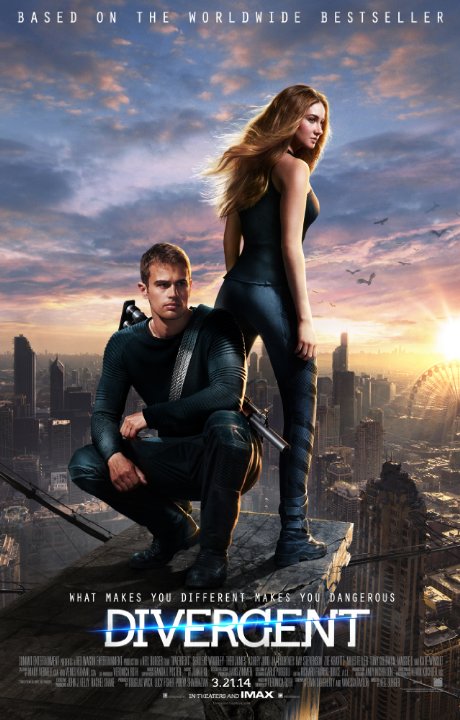 High school for many was a personal version of hell, with its class system and pressure to conform. Divergent built a whole future dystopia around this relatable concept. The problem with the movie is that the source material doesn’t think that much further.
In the future, 100 years after a great war that scarred the world, the survivors have holed up in the remains of Chicago with a large fence as their protection. The government decided to split off into five different factions, each with their important purpose. The five factions (Abnegation, Candor, Erudite, Amity, and Dauntless) work in harmony. Tris (Shailene Woodley) comes from a family of Abnegation, the selfless ones who run the government, though Jeanine (Kate Winslet), the head of Erudite, would like her faction to be on top. At the choosing ceremony, a candidate can select which faction they wish to live within. However, if rejected, that person will be factionless and on the outskirts of society. Rather than choose the comfort of her boring life, Tris decides to join Dauntless, the faction in charge of the security of the city. Before she can say goodbye to her family, she’s off joining a new one, but Dauntless has many tests to weed out the weak. Paramount in her mind is the fact that Tris is told she’s a divergent, one who doesn’t fit neatly into any one of the factions. Divergents are being singled out and executed because they are feared; they can’t be so easily controlled. Tris has to prove herself against tough competition in Dauntless while hiding her true divergent nature.
 Having not read the best-selling Young Adult books, I went into Divergent and walked away entertained enough though questioning the larger appeal. My movie partner told me that the adaptation hews closely to the book, fitting in all the major plot beats; she even said it was a better adaptation than the first Hunger Games, so fans should be relieved. What the movie came down to was one long plot about Tris getting through the Dauntless tests. It’s like a post-apocalyptic Full Metal Jacket, just minus the war half. With this tight focus, the film actually plays better and is easier to digest. The stakes are made clear and the hurdles are easy to understand. In a way it reminded me of the Ender’s Game film where we watch a recruit move up the ranks of their sci-fi training, though Ender’s was better at establishing dimension to its world. I did like the small touch that the Abnegation people won’t allow themselves to see their reflection because they see it as vain. I could have used more touches like that.
There are simple pleasures watching Tris, the plucky underdog, rising to the challenge and besting her snobby peers. The games get more intense and Tris learns from trial to trial, eventually learning how to hide her divergent nature by blending in against her nature. There’s also an intensity to this world that’s appreciated; people will die if they can’t keep up (there is one shocking sequence where a batch of jealous recruits literally try and kill Tris). The physical trials are fun but the mental ones are even more entertaining because they function around the candidate’s fears. It’s a tad lazy to simply broadcast a character’s fear for them to confront in a dream, but it provides some creepy imagery and new wrinkle for Tris to master. Even the requisite romance that every YA property has to have is handled respectfully without overdoing it. The mentor/teacher relationship with Tris and Four is a natural conduit for their budding romantic feelings, though James (Underworld: Awakening) looks way older than Woodley (The Descendants). In reality, he’s 30 and she’s 22, though she’s supposed to be… 17? 18 years old? I don’t know but it just didn’t sit right.
 Where the movie gets into problems is the larger world outside those Dauntless camps. It feels too ill defined and purposely vague. What’s on the other side of the giant electrified fence (hopefully dinosaurs)? I suppose that’s what sequels are for (they’re already filming the second Divergent for March 2015). The world just feels too small even for one city, and the history doesn’t feel integrated into the cultivations of this society. In a sense, the movie doesn’t give you enough to go on with its world building and spends far too much time dragging out its story. At a hefty 142 minutes, a time frame becoming de rigueur with YA adaptations, the film feels laboriously padded. I kept thinking the movie was going to check out at any moment, robbing me of some semblance of a complete ending. Fear not, there is an ending, though one that feels far too definite to continue a franchise. The bad guys are so obviously guilty, that even while still being at large, it’s hard to fathom a scenario that doesn’t unite everyone against the common threat. Does every YA post-apocalyptic mold eventually lead to unlikely heroes becoming the focal points of revolutions? I’m being facetious, but also highlighting just how derivative this movie is. Divergent borrows from its larger influences liberally, having enough story sense to know how to construct a satisfying tale of heroes and villains. It’s a well-polished film thanks to director Neil Burger (Limitless) but it’s also lacking necessary elements to distinguish it from the glut of dystopian imitators and predecessors.
I just can’t wrap my head around the world of Divergent. It lacks the clean clarity of, say, The Hunger Games, where the game is kill-or-be-killed and it’s very much a class warfare allegory. In Veronica Roth’s novel, the post-apocalyptic Chicago is divided into five factions but this isn’t a caste system. The different factions are looked at as equals, meant to cooperate harmoniously. So there goes any sort of class conflict when the factions are presented more as lifelong clubs. The design is that branching people off into five groups will somehow prevent the strife that lead to the unnamed war of the past. This doesn’t really make a lot of sense to me. Why would limiting people’s options for careers and lifestyles eliminate conflict? I understand the not so subtle message about conformity and the strength in controlling others, but it still doesn’t hold. Then there’s the notion that a divergent is a dangerous rogue, but it’s not like the divergent are mutants or genetically different. These are just people who don’t fit neatly into one of the five faction options. If you eliminate the conformity obsession, who cares? It’s only an aptitude test in the end, like what you take in middle school that say, “Hey, you like drawing, maybe you’d like to be a police sketch artist” (true personal anecdote of mine). It’s not something that looks deep into the souls of boys and girls and presages their future. It’s an aptitude test for crying out loud. The world of Divergent also feels strangely unfulfilled, with too many lingering questions about the logistics of how this future Chicago is able to function. There’s a confusing aura around this world and it doesn’t get explained because we spend so much time in Dauntless boot camp.
There was a weird motif I kept noticing throughout the film and that’s the future’s unsafe disregard for medical safety. The Dauntless kids are all about the running, jumping, punching each other in the face, but it all begins at their choosing ceremony. The candidates walk to the front of an auditorium, slice their palm with a ceremonial knife, and then squeeze blood into a bowl representing the faction they select. Of course they reiterate “faction before blood” so it’s a little strange that the ritual involves their blood. Anyway, what I picked up was that every candidate was using the same knife, only with he most perfunctory of wiping the blade. That is just unclean and a way for blood-based disease to spread. Then later during the mental round of testing, Four injects Tris and himself with the same needle. Clearly these post-apocalyptic people have forgotten all about AIDS and other deadly diseases. Why else would Jeanine be so calm as her hand is covered in someone else’s blood? I’m surprised she just didn’t lick it for effect.
 The actors are all well cast for their parts, with Woodley again proving herself as one of the best young actresses today in Hollywood. Her part isn’t anywhere as complex or demanding as her terrific turn in The Spectacular Now, but she’s able to slide in emotion where possible, expressing much through the power of her eyes. She’s a heroine you want to root for, and when she goes into badass mode it feels earned. James is suitably hunky while still being mysterious and broody. Interestingly enough, Miles Teller, Woodley’s onscreen beau in Spectacular Now, is here as a bully and Ansel Elgort, who plays Tris’ older brother, will soon play Woodley’s onscreen beau in The Fault in Our Stars. It’s like this weird cross-section of Woodley’s film history of boyfriends. The adults do fine jobs with their limited time, with Winslet (Labor Day) being a better realized version of what Jodie Foster was possibly going for in Elysium. My favorite adult actor was Jai Courtney (A Good Day to Die Hard, Jack Reacher) who hasn’t found the right fit for his talents, until now (he was great on Starz’s Spartacus TV show). As a no-nonsense Dauntless captain, he’s imposing in many respects and also intriguingly devious. He’s a grade-A heavy and adds a jolt to the scenes he’s in.
Poised to be the next YA breakout franchise, Divergent will likely be a hit with its target audience and reap the rewards at the box-office, though I think its flaws will hold it back from being embraced by a wider audience with no affiliation with the books. It’s an entertaining story with good actors and enough well constructed payoffs, but it’s also confusing, vague, and lacking enough urgency, class conflict, and developments to parlay into a more interesting story once Tris graduates from the Dauntless ranks. As a standalone film, Divergent works enough and duly entertains, thanks again to Burger’s visual sensibilities and the strength of Woodley. I’m just not invested at all in this world or its larger characters to compel myself to find out what happens next. I ravenously tore through the Hunger Games books, but to each their own. As a big screen sci-fi film, it’s strange that Divergent would work best in its smaller moments and settings. It’s too bad the movie doesn’t diverge enough from the pack of YA-modeled adventures. Well there is one thing to look forward to: I’ll see if I get my wish for dinosaurs in March 2015.
Nate’s Grade: B-


You must be logged in to post a comment.