Blog Archives
The King’s Speech (2010)
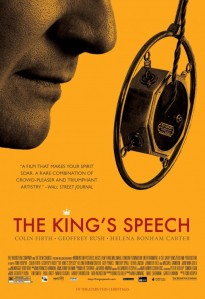 Public speaking is a nerve-racking position. Nobody wants to seem like a fool but it can be hard to do anything else when all eyes fall upon you with expectation. There was a poll a few years ago that asked Americans what their top fears were, and death came in second to public speaking. The Grim Reaper should feel relieved. Now imagine that you’re the leader of a country during a time of duress and you have a speech impediment. That’s the grueling circumstances for King George VI (affectionately known as “Bertie” to family), leader of Britain on the eve of World War II. The King’s Speech tells the inspirational true story of one of the most powerful men in the world finding his own voice.
Before becoming king of his country, Bertie (Colin Firth) was the Duke of York and a man suffering from a debilitating stutter. When stressed, it was difficult for Bertie to even read a statement. This speech impediment is made all the more troublesome now that the world has entered into the radio age; kings and presidents are now expected to speak to their peoples, no longer content to just be a striking figurehead. Elizabeth (Helena Bonham Carter), future Queen Mother, seeks out different speech therapists but the traditional methods are getting her husband nowhere. Then she comes across Lionel Logue (Geoffrey Rush), a self-taught speech therapist who worked with shell-shocked WWI soldiers in his native Australia. His methods are unorthodox but he’s the first to begin to get results with Bertie. The demands of his position get even greater when Bertie’s father, George V (Michael Gambon), dies in 1936 and Bertie’s older brother, Edward VIII (Guy Pearce) abdicates the throne. Now Bertie is expected to lead his nation, that is, if he can string two sentences together in public.
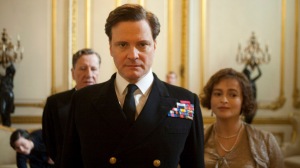 The King’s Speech is really the heartwarming story of the unlikely friendship between a king and a quirky Australian commoner. Their warm, humane friendship allows for several scenes of great humor and great drama. Watching the irreverent Lionel bounce off the proper and isolated Bertie supplies plenty of comedy. It’s essentially an odd couple comedy mixed with a true-life historical drama. There’s great pleasure in watching the chilly relationship between classes thaw, the men grow closer together, and Lionel’s unconventional tactics make progress. Each time Bertie discovers a new practice that removes his stutter, whether it is speaking while listening to music or speaking in the cadence of a song. This is a film that follows the English tradition of understatement even given the dramatic setting, principle characters, and a speech impediment. The characters don’t go around blurting their feelings, leaving the actors room to explore oodles of subtext. There’s a signature scene where Lionel coaxes Bertie into opening up by promising to allow him to paint a child’s model airplane (a treat for a man of title never allowed such toys). As he paints away, Bertie reveals a damaging truth about a neglectful childhood nanny. The truth is so painful that Bertie is forced to reveal it through the cadence of song, which somehow makes the revelation more sad and tragic. Their ongoing relationship is deeply satisfying and emotionally rewarding.
You won’t see a better-acted movie all year, thanks to Firth and Rush. More than following a checklist of gimmicks, Firth inhabits his character from the inside out. He feels like a living, breathing, somewhat broken person instead of a collection of ailments. Firth doesn’t overdo his stutter and treats the character, and the ailment, with a deep sense of compassion. Firth gives what is likely the greatest acting performance by any male in 2010. He is magnificent, commanding, and empathetic in every scene. Likewise, Rush doesn’t overpower as a personality foil. His character manages to be irreverent but without being flippant; he finds a reverent irreverence, if you will. Lionel is treating the future King of England, and the gravity of this stately relationship is not lost on him. Both men hide an inner melancholy, perhaps one of the things that ultimately bonds them together. Rush is flush with vigor and merriment, truly delightful to watch. This is his finest onscreen performance since he won his Oscar in 1996 for Shine.
The enormity of the king’s duties is given due care. You feel the weight of the crown that awaits Bertie and empathize with his quaking hesitation. Ever since childhood, his family looked down on Bertie. His father felt a stern tone would best aid the young stammerer, and his older brother would often belittle Bertie with cruel taunts. You see flashes of this unhealthy dynamic when Edward cuts down his little brother after their father passes.
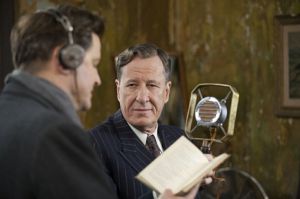 Bertie was seen as unimportant. Edward was the one set up for the throne. And yet Edward is the one who shirks his responsibilities in the name of love (a twice-divorced American woman). Edward refuses to become the leader of his people if the ancient rules forbid him from marrying a divorced woman. Bertie cannot buckle under the tremendous pressure and expectations that wait. Even when the rather passive Bertie lashes out, you feel like his anger is a moment of achievement. King George VI also had to deal with the fact that his brother is still alive and well and an alternative to the throne if Bertie is deemed incapable. Firth makes it easy to feel the remarkable pressure of being a leader not born or elected, merely expected. And even if an audience is clueless about British monarchy history and the rules of royal succession, The King’s Speech is easy to follow and comprehend for a daft American like myself.
Truth be told, The King’s Speech is a little stagy, a little square, and a little too fastidious for its own good. Hooper and crew are too content with making a pleasant moviegoing experience that the film lacks any slight form of edge. It’s all just a little too safe, a little too staid. While rated R, this movie could easily be a PG-13 family film, maybe even a PG one, sans the two sequences where Bertie unleashes a torrent of profanities in frustration (he discovers that he does not stutter while swearing). I feel like a curmudgeon for dinging a movie for being, essentially, too nice and gentle, but it clips the ambition of the movie when crowd-pleaser is the zenith of accomplishment. The fateful speech to the nation, on the eve of war with Germany, is even given an extra oomph thanks to the background music of Beethoven. A larger story of triumph seems reduced to the Oscar favorite storyline of Man Overcoming Physical Adversity. The direction by Hooper has some curious tics to it, like sequences of two people talking where they will never share the frame despite sitting side by side. I assume Hooper is trying to communicate some form of emotional distance or wariness, or perhaps it’s just a nod that different actors had unworkable schedules and could not be filmed together. Hooper is a talented director, as anyone who saw the massive undertaking of the masterful HBO miniseries John Adams can attest. However, like John Adams, Hooper is prone to TV-movie staging. His direction limits the cinematic power of the film. It looks like any ordinary episode of Masterpiece Theater.
The King’s Speech is pretty much everything you’d wish for in a movie groomed for awards consideration. This is prime Oscar bait. You may tear up at points, you’ll probably smile in many places, and your spirit will definitely rise. Plus it features some of the finest acting you’ll witness all year. And yet it’s that conscious need to please, to uplift, that can occasionally distract you from the many charms that The King’s Speech offers. The fact that the story is predictable is not a detriment, but the fact that the film doesn’t push harder, dig deeper, or expect more from its audience is a missed opportunity. The material is so rich, but a terrifically acted, smartly written film isn’t a bad consolation. Especially when that film happens to be one of the most rousing and rewarding theatrical experiences of the year.
Nate’s Grade: A-
Share this:

The Hurt Locker (2009)
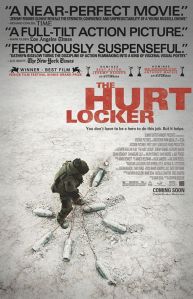 The Hurt Locker is an action movie on a very human scale. Sure there is a time and place for your Michael Bay-esque action vehicles, the type that scorch square miles and leave recognizable world cities in ruins. However, those kinds of action movies are never the kind where storytelling ever enters the fray beyond a meager question of how to get from Point/Explosion A to Point/Explosion B. In fact, Bay openly admits to planning the story of Transformers 2 by working on various action sequences during the 2007 writer’s strike and then tasking screenwriters to connect the dots. The Hurt Locker exists in a frighteningly believable world. This isn’t a movie about explosions but about the extinguishing of explosions. It follows the Explosives Ordinance Disposal (EOD) unit, tasked with detecting and detonating bombs and other improvised incendiary explosives (IED) in the field of combat. You will not be restless for loud “booms” while watching The Hurt Locker. In fact, you will be on pins and needles hoping that you never hear another loud “boom.”
Delta Company are the men responsible for protecting the other soldiers by disposing of bombs. The new team leader, Staff Sgt. William James (Jeremy Renner) has defused over 800 bombs during his tour of duty. He knows he’s the best and he’s addicted to the thrill of being so close to death. He will make occasionally reckless decisions putting himself, but not his fellow company men, at higher risk. This does not sit well with Sergeant JT Sanborn (Anthony Mackie), a by-the-book type that doesn’t appreciate his officer chasing a thrill. The other EOD unit member, Specialist Owen Eldridge (Brian Geraghty), is a man more accustomed to taking orders than giving them, and his indecision may have actually cost the life of the former head of the EOD. Both Sanborn and Eldridge worry that their new team member is going to get them all killed.
 Director Kathryn Bigelow (Near Dark, Point Break) has been directing male-centered action flicks for over two decades; it’s been seven years since her last feature, the regrettable Harrison Ford submarine flick, K-19: The Widowmaker. The Hurt Locker is her finest work to date by far. Her action sequences are visceral and downright agonizing to sit through. She is masterful at setting up the geography of the set piece, ratcheting up the suspense, adding organic obstacles and complications, and then makes sure with her camera and editing that an audience knows exactly what’s happening to whom for every minute that ticks off the clock. Bigelow takes her time to establish the particulars of her locations and sequences, allowing the audience to, surprise, understand what is happening and better engage in the movie. Bigelow chose to shoot the movie in Jordan, the neighboring country to Iraq, and the locations and actual refugee extras add an unvarnished sense of realism. The movie goes without music during much of the action, which makes it all the more uneasy. There isn’t any over eager composer telling you how you should feel, no direction that now things will get even more hairy. You will feel every second of danger, and Bigelow crams in a whole lot of danger. Things can go wrong very, very quickly.
There’s nothing to action cinema quite like the bomb that’s only a few tick-tocks away from doing its dirty work. Do you cut the yellow wire or the green wire? Never cut the red wire. The bombs found in Iraq are a stark range of death. There’s the crude incendiary device just wrapped up in garbage, but then there’s also the fiendishly clever devices with multiple charges and there are grotesque devices as well. At perhaps the film’s most guttural and shocking moment, Staff Sgt. William James finds the corpse of an innocent stuffed with explosives. The easiest thing would be to simply detonate the bomb, but that would also desecrate the body of someone we have come to know. Watching James snip open the crude stitching and dig inside the chest cavity, if we didn’t know then we know now, Bigelow has made sure that The Hurt Locker is the most emotionally resonating contemporary war film in memory.
 Bigelow and screenwriter Mark Boal, an Iraq War journalist, create a vivid sense of dread, antipathy, and most of all, paranoia. Is that a kite flying in the air or is that a signal? Is that a nondescript observer with a cell phone or is that a terrorist with a remote detonator? Is that child being friendly or collecting intelligence? Your mind will race through all these possibilities because Bigelow teases out her action sequences to an unbearably taut level. The audience cares about these soldiers and wants to see them make it back home (we’re informed how many days Delta Company has left on their tour throughout the film), which Bigelow uses to her advantage at every turn. What happens matters. My nerves were frayed during several sequences, including one where the soldiers are pinned down by distant enemy gunfire. The moment turns into a duel and a chess game, as each side tries to adjust their gaze in the searing heat and measure their long-range shot before the other side beats them to it. Then the sequence turns into a waiting game. This is the kind of movie that keeps you poised on the edge of your seat fearful that at any moment something disastrous will suddenly happen. Every time Staff Sgt. William James went back out to defuse another bomb, my sense of dread intensified. I began to doubt everything that I would ordinarily take for granted in other movies.
While being a top-notch action movie, Boal (In the Valley of Elah) has also crafted a great character study. In between the bomb episodes we learn more about these men, which makes it all the more hard to see them then head out to defuse another explosive. The film opens on a quote equating war as a drug, and we explore this notion through the character of Staff Sgt. William James and the weight his unique duty bears. It takes a special person to volunteer for defusing roadside bombs. The defuser must be extremely intelligent, be extremely cool under pressure, and be able to work in a giant suit that makes them look like a chubby astronaut, while enduring debilitating desert temperatures of 110 degrees. It sounds like a suicide mission. James is an adrenaline junkie and war is his drug. He exudes a Zen-like calm in the heat of the moment and this is now the only life for him. Shopping for cereal back home has lost its meaning. Being a husband has lost its meaning. His life now has one purpose. Renner (28 Weeks Later, North Country) gives a stirring performance laced with cavalier confidence and resignation. Mackie (Eagle Eye, We Are Marshall) is also another standout in the pared down cast. When he laments about the dishonor of having no one to remember you in death, you feel the man’s existential sorrow.
 Ignore the political cranks that decry The Hurt Locker as another partisan anti-war film from Hollywood. The American public has been mostly indifferent to any contemporary movie that aims to tackle our current military conflicts in Iraq and Afghanistan, but The Hurt Locker eschews the politics of war to focus on the realities and dangers of its characters. These guys are more concerned with surviving the next bomb than the politics of why they’re in the Middle East. The public has voted with their wallets and does not want to see the reality of war onscreen, or at least the Hollywood version of war reality, but I pray that those same people give The Hurt Locker a fighting chance. There is no preaching to be found here. The Hurt Locker could just have easily taken place during other wars, though the current Iraq War allows for added cultural dissonance (Is the central goal of bomb-defusing a metaphor for our conflict in the region?). This is a film that transcends politics and genre.
The Hurt Locker is more than an action movie, more than a war movie, more than a psychological study; this is an outstanding movie. This movie is a drug to the adrenaline senses and I need another hit. This is one of the finest films of the year and as it expands across the nation, I highly encourage everyone to seek out The Hurt Locker.
Nate’s Grade: A
Share this:

Slumdog Millionaire (2008)
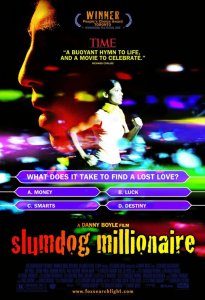 If there is one independent movie that seems to be picking up momentum this awards season, it’s Slumdog Millionaire. The film seems destined to break out into the mainstream, especially in a time where audiences could use a happy story given the ongoing news of economic downturns. Slumdog Millionaire is a highly spirited rags-to-riches tale that marries Hollywood and Bollywood into one fantastic product.
Jamal (Dev Patel) is an 18-year-old kid who grew up impoverished in India’s favellas. He’s also on the verge of winning 20 million rupees on the Indian version of the Who Wants to Be a Millionaire? Game show. The TV host reminds Jamal that lawyers and doctors have never gotten as far as he, a lowly “slumdog” from such humble origins. As each question emerges we discover more about Jamal’s life, from escaping a riot, touring India as a stowaway on a train, conning American tourists at the Taj Mahal, to his assistant work at a call center. Throughout Jamal’s life are two constants: Salim (Madhur Mittal) and Latika (Frieda Pinto). Salim is Jamal’s scheming older brother who has a loose sense of morals. He finds a life of crime as a suitable escape from poverty. Latika is a young orphan girl that Jamal befriended as a child. He declared that she was the “third Musketeer” in their group and has always sworn to love her. This is complicated because Salim’s crime boss wants Latika for a prize, and Salim keeps his younger brother away from Latika. Ultimately, as an entire nation watches with baited breath, Jamal explains that he is appearing on TV because he knew that Latika, his love, would be watching somewhere.
 It’s like City of God and Forrest Gump had a baby that was raised by Oliver Twist. The film is given a dynamic energy thanks to director Danny Boyle’s exuberant camerawork and skillful style. Boyle is a director that knows how to make images jump and Slumdog feels like it is coursing with life. The feel-good fantasy nature of the rags-to-riches plot is offset by some pretty harrowing violence, and Boyle makes great pains to show the realities of living in squalor. At one point a very Fagin-esque local crime lord collects young orphans to be beggars and he has a foolproof scenario to make these kids sympathetic and thus big earners — he blinds them with hot liquid. Despite the fantastical elements, Slumdog is rated R for a reason and that’s because it does show the cruel reality of a life in the slums, granted it’s nowhere near as bleak and formidable as something like City of God. After all, the kid gets to win on a game show, though the movie does open with Jamal being tortured by the police. Boyle has a tremendously natural eye for crafting visuals that delight the senses; he can make his shot compositions feel interesting without ever truly calling attention to being flashy. The views of India are beautiful and fascinating. Plus, having a majority of the movie in a foreign dialect was appreciated (Boyle provides different color background for different character’s subtitles, a nice touch). There’s a magic feeling to the film that definitely takes hold of the audience, an uplift that channels smiles and gasps of joy. While I’ll still credit Millions as Boyle’s best film since Trainspotting, his work on Slumdog is deserving of praise. I don’t know if another director could have made a film with so many contradictory elements (feel-good flick with child prostitutes?) run so smoothly.
The movie is also given a brilliant story structure by screenwriter Simon Beaufoy (The Full Monty). The movie is built around a steady stream of flashbacks linked to the questions Jamal tackles on the game show. So the host will pose a question and then we’ll be treated to a 10-15-minute flashback to Jamal’s life to discover how he knows the answer. The approach is fresh and it reinforces the magical notion that Jamal’s life has all been leading up to this moment of glory. Beaufoy’s script smartly weaves many storylines together to give us an emerging sense of who Jamal truly is. He manages to write an uplifting and hopeful tale that stays clear from easy sentiment. Indeed, Slumdog is an accomplished feat of writing as well as direction. Working from the Indian novel Q&A, Beaufoy has written a modern-day fairy tale in the same fashion as the Brothers Grimm, which means he didn’t skimp on the unpleasantness and hardship. Yet Slumdog is able to find great human spirit amidst the squalor. I doubt I’ll see a climax more rousing and crowd-pleasing all year. Seriously, you’d have to have a pretty hard heart not to feel some excitement and jubilation in the closing moments.
 This unlikely fantasy is aided by sharp performances by a collection of actors. Jamal is an unassuming yet plucky underdog, and Patel nicely handles these elements. He’s a stringy kid but he carries himself with charm and fortitude. As he grows confident he spars with the combative TV host, and it’s fun to watch. Pinto is a swell looking beauty with a great smile but I wish the story had given her more to do as an actress. The young actors who play Jamal, Salim, and Latika as young children actually give the best performances.
And now after all my effusive talk comes the time where I must voice my minor reservations. First off, the structure is ingenious but having Jamal interrogated by the police after the fact seems unnecessary, plus it also tips off the audience from the beginning that this kid has already won it all, which sucks some of the tension out of the game show format. I really think the movie would have been better served just playing out the game show in real time instead. Also, it’s a bit too convenient that every one of the quiz questions triggers a memory in a linear fashion. Jamal can tell his life’s story from beginning to end, but the movie would have been more challenging and interesting if the quiz questions forced Jamal to bounce around in his own memory. That way the script would provide more mysteries that could lead to even more satisfying answers. The Millionaire game show also goes on a commercial break and Jamal is astoundingly allowed to leave and go to the bathroom after he knows one of the high-money questions. In the age of wireless Internet, no game show would ever allow the contestant to leave its sight. Finally, the movie is presented like a Dickensian fable told in chunks, which means I found it hard to fully embrace the central romance that drives Jamal. I will readily follow the romantic notion of locating your true love, however, I will feel more involved in that search if the combined time Jamal and Latika spent together was longer then like a week. Seriously, they see each other every few years for a moment and then are broken apart, only to find each other again for a few moments to be broken apart. She’s more a symbol than a fully translated character, though this did not stop me from rooting for a happy ending.
 Slumdog Millionaire is a thrilling, funny, and triumphant story that courses with lively electricity, thanks to the deft direction of Danny Boyle. This movie is enormously entertaining while still baring a social conscious about the plight of those impoverished, though I hope people don’t get the mistaken idea that all that character-building impoverished life styles will lead to future fortunes like Jamal. The movie is hopeful and uplifting while also balancing tense violence and improbable circumstances. While I’m not on board with the critics calling this the best film of 2008, it has some minor flaws in approach to storytelling and character, Slumdog Millionaire has all the right markings to be a crowd-pleasing sensation. After all, it is destiny. And that’s my final answer.
Nate’s Grade: A-
Share this:

No Country for Old Men (2007)
 Joel and Ethan Coen are two of cinema’s most talented oddballs. Together, they’ve created some of the most intricate, eclectic, and best movies of the last 25 years. Their last two efforts, 2003’s Intolerable Cruelty and 2004’s remake of The Ladykillers, didn’t feel like Coen movies; they felt like they were compromised and missed the artistically deft touch. As a result, both movies were mild failures for filmmakers that have a series of genre-spanning masterpieces to their name. No Country for Old Men is the first time the brothers have adapted someone else’s work, in this instance Pulitzer Prize-winning author Cormac McCarthy’s 2005 novel. Not too shabby if I say so. Fortunately for all lovers of film, the Coens have embraced McCarthy’s blood-soaked tale and crafted an exciting, honest, and intensely provocative modern Western that stands out as one of the greatest films of the year.
In dusty West Texas, Llewellyn Moss (Josh Brolin) is out hunting the lonely plains when he discovers a blood trail. It leads him to four empty cars riddled with bullet holes, dead bodies collecting flies, and a sack containing two million dollars in cash. The signs are all there that this was a drug deal gone badly, and two million will never go unnoticed, but Moss sees this as an opportunity of a lifetime and takes the money. The men in power have hired Anton Chigurh (Javier Bardem) to find their drugs and money and exact retribution. Chigurh’s preferred method of killing involves a high-pressured air canister that can blow out doorknobs and human brains. Chigurh chases after Moss all the while Sheriff Ed Tom Bell (Tommy Lee Jones) is following the trail of death to try and save Moss or any future innocent victims.
 What a fine-tuned, nerve-wracking, and engrossing cat-and-mouse thriller this film is. The action is brief but the buildup can be nearly unbearable to endure. The tension is magnificent. Chigurh chases Moss from hideout to hideout and some of the tensest moments are just waiting. There’s a moment where Moss is calling the front desk of his newest motel and we hear the phone ringing unanswered again and again from the hall, all the while Chigurh’s footsteps inch closer. But it’s the moments of silence that cause the most dread. When Moss is trying to recover his loot, all the while Chigurh is in the opposite motel room, it becomes a balancing act of sound and silence. No Country for Old Men is expertly orchestrated to involve the use of sound as a tool for high suspense. None of our main three characters inhabit a scene together. Sure Moss and Chigurh shoot at one another but even then it’s short and focused on waiting for response and counter response. Moss is no dummy and he sets up some traps for his would-be dispatcher. No Country for Old Men is unnerving, intelligent, near flawless entertainment.
Chigurh, as masterfully played by Bardem, is the stuff of nightmares. I was literally afraid to go home after seeing this movie and it is because No Country for Old Men fashions a villain so methodical, so cold-blooded, and so downright deadly and cunning that I felt as if he could very well be residing under my bed at night waiting. Bardem is hypnotically horrifying and the Coen brothers establish early on how ruthless their cinematic boogeyman is. The very first moment we’re introduced to Chigurh he escapes from police custody and strangles the inattentive officer on duty. He drags him to the floor and chokes the life out of him, but the Coens position the camera not on the last desperate kicks of the officer but on the face of Anton Chigurh, and it is nasty. His eyes are bugged out and his intensity comes across as sadistically jubilant. He seems like a caged animal finally let loose. It’s a scary yet fascinating introduction to a deadly character.
Chigurh is a humorless and determined man, and every scene he steps into instantly changes. A gas attendant casually asks Chigurh about the weather and gets on his bad side and the stone-faced killer in the Dutch boy haircut proceeds to press the poor man with increasing agitation, yet Chigurh always speaks in such a placid tone that makes him far creepier. He’s a maniac that never raises his voice. Chigurh then corrals the man into one of his signatures, having a victim decide their fate by the flip of a coin. Before the man can say anything the coin is flipped, Chigurh intones to “call it,” and the man nervously repeats that he needs to know what he’s at stake to win. “Everything,” Chigurh responds. This scene starts off so innocuous but becomes monumentally unsettling thanks to the rising dread and Bardem’s deeply committed portrayal. Bardem is alarming, ferocious, grimly efficient, mesmerizing, and deserves an Oscar win, not just a mere nomination, for what is his finest performance to date.
 There are many ways to describe Chigurh, but it seems most appropriate to speak of him as nothing short but the full-tilt vengeance of God. He’s a hired killer, yes, but that doesn’t stop him from killing indiscriminately. He murders several innocent victims, he murders his competition sent out to nab Moss just because it insults him, and even after the money no longer becomes a concern, Chigurh still plans to continue his wrath out of sheer moral principle. He made a promise of swooping vengeance and he will stick to it. This means that anyone could die at any moment while onscreen with Chigurh, and No Country for Old Men has plenty of surprises as it toys around with our baited anticipation. When Chigurh gets the drop on his competition he doesn’t shoot the man immediately; instead the scene plays out for an agonizing length even after we listen to the room phone ring several times, and then blam! Chigurh answers the phone and casually raises his boots so the pooling blood doesn’t touch his feet. This is the most memorable incarnation of soulless evil I have seen in the movies since Hannibal Lector came to iconic form in 1991’s Silence of the Lambs.
Brolin is having quite a career year for himself after compelling turns in American Gangster (where he also shoots a dog), In the Valley of Elah, and Robert Rodriguez’s Planet Terror half of Grindhouse. Brolin gives the audience a figure to root for even though he never actually displays true heroism, just survival instincts. Jones serves as a wise and guiding father figure that feels out of place in a world that is becoming increasingly, shockingly violent. It’s a role that Jones has performed before but it’s a role that fits the actor exceptionally well. Woody Harrelson pops up as a charming and laid back handler trying to convince Moss to give up before things get worse. Kelly Macdonald, as Moss’ wife, cuts through the darkness in a refreshing performance.
The technical craftsmanship is on par with previous Coen excellence. Roger Deakins’ cinematography is exquisite, Carter Burwell’s score barely makes its presence felt, and the editing is tight and focused. The sound design, which I’ve already discussed in detail, deserves an Oscar. This being a Coen brothers’ film, it wouldn’t be complete without some dark humor to punctuate the bleakness. They have a perfect ear for local vernacular and Texas shorthand, so the dialogue feels sharp but realistically twangy without being condescending as some had accused Fargo (I do not agree with this accusation).
 What works in the favor of No Country for Old Men may perhaps be its undoing for a mainstream audience. The film works against conventions and this provides for some stellar surprises and upheavals, none of which is bigger than killing a certain character off-screen. No Country for Old Men definitely seems like it’s laying stage for a climactic showdown and then one key figure has been bumped off by a group of ancillary characters that have little overall bearing over the plot (I have read that the same gap happens in McCarthy’s novel). If this doesn’t perturb audiences then the final 10 minutes ought to do it. There’s no sense of closure for the movie and this will frustrate many, but it all fits rather nicely with the movie’s highly nihilistic tone. Like Chigurh’s coin, the film focuses much on the randomness and cruelty of fate. By sticking to this ethic, the Coen bothers are eschewing the traditional Hollywood rulebook and playing around with our expectations for characters and plot. The outlook isn’t too sunny for many involved. It works and demands an audience remain on edge for fear that anything could happen at any moment. However, don’t say I didn’t warn you if you walk out of No Country for Old Men and say, “What was that all about?”
No Country for Old Men is exactly the kind of material the Coen brothers needed to return to form. This is a lean and stirring thriller that plays to their strengths and echoes some of their most riveting and twisty work, like Blood Simple and Fargo. In many ways the film feels like a Western, a high-stakes drama, and a tragedy that takes its time to unravel. It may have taken some time but the Coen brothers are back, baby, and No Country for Old Men is fit to stand beside their hallowed pedigree of cinematic classics.
Nate’s Grade: A
Share this:

The Departed (2006)
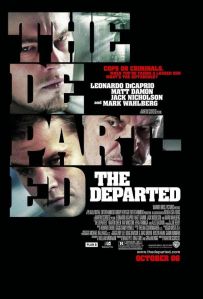 “I don’t want to be a product of my environment,” growls Frank Costello (Jack Nicholson) in the opening seconds of The Departed. “I want my environment to be a product of me.” Without question, the filmmaker that has shaped the environment of movies more than any other in the last 30 years is Martin Scorsese. No one does the cops-and-robbers territory better than Scorsese, and it’s great to have him back on familiar turf. It’s not that Gangs of New York and The Aviator were lacking in directorial skill, it’s just that they felt so labored and reeking of classy awards envy. With The Departed, it all feels so artistically effortless, like Scorsese settled in a zone of brilliant filmmaking. I just hope Marty bangs out more of these excellent gangster flicks before trying again to woo Oscar. In fact, his return to his violent stomping grounds might finally be his long-overdue ticket to the winner’s circle.
The premise is appealingly simple. The Boston State Police Department is desperate to nail local crime lord Costello. They pluck a young recruit, William Costigan (Leonardo DiCaprio), who has a shady family history of small-time crooks. He agrees to infiltrate Costello’s mob and report back to the Boston PD. To make is situation credible, Costigan is expelled from the force and sent to prison to earn a rep. Only two other people know Cosigan’s real identity, the police chief (Martin Sheen) and the head of undercover work (Mark Wahlberg). On the other side of the law, Costello has a mole all his own working inside the Boston State police force. Colin Sullivan (Matt Damon) has quickly risen through the ranks and has a prime position working with the state?s FBI crack force. He’s also an acolyte of Costello’s ever since he was a young Southie kid seeing the draw of power. Now full grown, Sullivan tips Costello and tries to redirect the ongoing investigation to bring the man to justice.
 The real sparks come when both moles try to discover the identity of the other, without compromising their own precarious identities.
The Departed is a bruising, bristling return to form for Martin Scorsese and his most entertaining film since his last Great Movie, 1990’s gangster-rific Goodfellas. This is a movie that crams multiple characters, storylines, and histories into one tight, focused setting, but then the flick glides smoothly on electric storytelling and intense performances. The movie’s twists and turns are, at times, of a knockout variety, and there’s a stretch of late surprises that each feels like a shot to the gut. I was possibly winded from gasping so hard. This is a film so fantastically alive with feeling and vigor that you cannot help but get ensnared. It sets up all the players and back-story before we even get the opening titles set to the blaring wails of the Dropkick Murphies. The thrills are real because we feel the danger, and the onslaught of brutal violence is another rhythmic piece in Scorsese’s masterful conduction. Adding to the feeling is the sure-handed, quick-fire editing of longtime Scorsese collaborator Thelma Schoonmaker and the ominous cinematography of Michael Ballhaus. Even though this film is based on a 2002 Hong Kong film, Scorsese has firmly made The Departed a movie all its own in spirit and personality. No one so easily brings us into the sordid lives of criminals better than this man, who, when in that creative zone of his, brings such palpable energy to his melding of image, song, and consequence, that the results are simply intoxicating. The Departed reminds you why Scorsese is still our greatest living director, no matter what Oscar thinks.
What elevates The Departed from the clutter of other macho men-with-guns crime capers is its studious attention to character. This is a film that works beyond a concept. The movie’s central moral theme is the price of identity. Frank opens the film asking what does it matter who’s holding the gun to your head, cop or crook. Costigan is tormented from wearing too many faces. He’s having trouble justifying his deeds and actions and is scared he may lose his own soul at the price of his lost identity. Sullivan, on the other hand, has gladly sold his own soul for a pittance. He’s a class conscience yuppie that craves power and will cut any throat if it gets him ahead. The movie steamrolls ahead with intrigue but it’s our connections to these characters that elevate the life-and-death stakes. You have a real emotional investment in this story, therefore when things get murky you really feel the danger. My heart was racing with excitement and dread. There may still be impressions from where I was squeezing the movie chair.
 Complimenting these complex characters are brilliant performances. DiCaprio may have been nominated for a Best Actor Oscar for his second Scorsese collaboration, The Aviator, but he turns in his strongest work here. DiCaprio expertly bares a gnawing moral conflict with equal parts desperation and the hunger to do good. He’s trying to finally do right and step out of his family’s criminal past, and DiCaprio brings sharp intensity to this plight. You really feel every stomach churn this guy goes through to do what he does and stay alive. I knocked the boy for being too boyish a gangster in Gangs of New York, and let me say I take back my words. On the flip side, Damon utilizes his angelic, choirboy good looks and masterfully downplays his character’s pragmatic villainy. The character has to hide so much from the outside world, be it the police, his true bosses, his girlfriend, and even himself. Damon goes about his deceitful business with slickly sick ease, tapping a killer’s instinct for self-preservation. You may shudder from how methodically cold and manipulative he comes across. He’s a mesmerizing rat bastard of a human being and yet Damon presents an almost seductive portrait of evil.
Nicholson is equally good though at times can be a distraction to the storytelling. There are a handful of moments where Nicholson seems to go too far off the page, indulging his crazier tendencies. Costello is supposed to be a scary, unpredictable, potentially unhinged man, and Scorsese has plenty of moments that bring home this point. It just feels inappropriate then for Nicholson to, in a few small moments, transform into a goofy cartoon. With that said, it’s great to see Nicholson cracking some heads for Scorsese. He has devilish fun and is insanely watchable while definitely going for broke. After some nice guy roles it’s nice to have back an unrestrained Nicholson to play the film’s abyss of evil.
 The collected supporting players all leave some mark. Baldwin and Wahlerg are perfectly profane hardass characters that you warm up to. Sheen, free from the Oval Office, displays nice touches of weariness and, in one moment, practically breaks my heart with his brave resignation. Breaking up this boy’s club is Vera Farmiga (Running Scared) as a somewhat contrived plot point to connect Costigan and Sullivan as the police shrink to one and the girlfriend to the other. There’s a perceived sadness to her willowy eyes and slender face that she plays to great effect. She?s a captivating new face and gives an extra ladling of emotion to the tale.
It’s been over a week since I’ve seen the movie and I still can’t get it out of my head. There are only a handful of flaws that separates The Departed from Scorsese’s rich pantheon of mythically Great Movies. This is a complex, gritty, amazing crime thriller stuffed to the gills with entertainment. Making the bloody body count resonate are the incredibly intense performances, particularly Damon and DiCaprio. This is a gripping gangster thriller pumping with the blood of a sterling character piece. The unexpected twists and turns will shake you, and the movie goes well beyond a snappy premise. The Departed is a moviegoing experience that will thrill you, stir you, sadden you, exhilarate you, and firmly plant itself in your memory banks. Welcome back Marty.
Nate’s Grade: A
Share this:

Crash (2005)
 A searing look at race relations and a powerful human drama at that. This flick has some of the sharpest memories I’ve had from any movie all year, particularly the relationship between a Hispanic locksmith (Michael Pena) and his daughter and a special invisible cloak. Their first scene, where he talks her out of hiding under her bed, is one of the most beautifully written short scenes I have ever witnessed. A late scene involving the two of them knocked the wind out of me completely and is the most vivid moviegoing moment of all 2005 for me. Every character has at least one great moment, though time is not spaced equally amongst this large ensemble. Crash has the intriguing practice of introducing near every character spouting some kind of racist diatribe, and then the movie spend the rest of its running time opening you up to these characters and getting to like them. Writer/director Paul Haggis has such a natural ear for terse, realistic dialogue that can really define characters with such brevity. A fine movie, despite the overarching coincidences.
Nate’s Grade: B+
Share this:

Million Dollar Baby (2004)
 Million Dollar Baby, much like its fledgling female boxing character, has come out of nowhere and made a considerable deal of noise. This little homespun film directed by Clint Eastwood didn’t have the glitz and sheen of other awards friendly movies, but now it seems that Eastwood?s own baby may clean up come Oscar time. Can Million Dollar Baby tackle the enormous hype surrounding it? Yes and no.
]Frankie (Eastwood) is a hardened boxing trainer too concerned for his fighters’ welfare to allow them to fight in championship bouts. He’s the kind of cynical old man that enjoys pestering a priest and causing him to unleash an F-bomb. Frankie and his longtime friend Scrap (Morgan Freeman) run a rundown gym and talk un-sentimentally about their older days as prize fighters. Then along comes Maggie (Hilary Swank), a 32-year old waitress who’s got nothing to believe in except her possibility as a boxer. She wants Frank to train her into the champ she knows she can be. He refuses saying he doesn’t train girls. She’s so determined she won’t take no for an answer. Frank finally agrees, especially after some help from Scrap, and starts to teach Maggie everything she needs to know to be a star pugilist. The two begin to open up to each other emotionally and Maggie seems destined to become a force in the ring.
 Million Dollar Baby‘s greasiest attribute is its trio of knockout performances. Swank owns every second of this movie. She’s unremittingly perky, conscientious but also dogged, stubborn, and irresistibly lovable. Swank embodies the role with a startling muscular physique and a million dollar smile. Her performance is equal parts charming and heartbreaking. Maggie’s the heart of Million Dollar Baby and Swank doesn’t let you forget it for a millisecond. Come Oscar time, I’m sure she will be walking onstage to grab her second Best Actress Oscar in five years.
No one does grizzled better than Eastwood, and maybe no other actor has made as much of an acting mark by squinting a lot. Million Dollar Baby is probably his best performance to date, though for a good while it sounds like Frank has something lodged in his throat (pride?). Frank has the greatest transformation, and Eastwood brilliantly understates each stop on the journey until landing in a vulnerable, emotionally needy place.
Freeman once again serves as a film’s gentle narrator. There isn’t a movie that can’t be made better by a Morgan Freeman performance. His give-and-take with Frank feels natural and casual to the point that it seems improvised on the spot. Freeman unloads some great monologues like he’s relishing every syllable, chief among them about how he lost his eye. It’s wonderful to watch such a great actor sink his teeth into ripe material and deliver a performance that may net him a long-awaited Oscar (I think he’s due, and likely so will the Academy).
For whatever reason, Eastwood is hitting a directing groove in his twilight years. First came Mystic River, an ordinary police whodunnit made exceptional by incredible acting. Now Eastwood follows up with Baby, an ordinary sports film made extraordinary by incredible acting. Hmmm, a pattern is forming. The cinematography is crisp and makes great use of light and shadow to convey emotion. Eastwood’s score is also appropriately delicate and somber. The boxing sequences are brief but efficient.
Million Dollar Baby is a very traditional story that is at times surprisingly ordinary. Maggie’s the scrappy underdog that just needs a chance, Frank’s the old timer that needs to find personal redemption, and Scrap?s the wise old black man. Once again, an old curmudgeon takes on a rookie and in the process has their tough facade melt away as the inevitable victories pile up. Million Dollar Baby is a very familiar story but then again most boxing tales are fairly the same in scope.
What eventually separates Million Dollar Baby from the pack is its third act twist. You think you know where Eastwood’s film is headed, especially given the well-worn terrain, but you have no clue where this story will wind up. The plot turn deepens the characters and their relationships to each other in very surprising ways. You may be flat-out shocked how much you’ve found yourself caring for the people onscreen. It almost seems like Eastwood and company have used the familiar rags-to-riches underdog drama to sucker punch an audience into Million Dollar Baby‘s final 30 minutes. We’re transported into an uncomfortable and challenging position, and Eastwood won’t let an audience turn away.
 Million Dollar Baby is not the colossal masterpiece that critics have been drooling over. For one thing, the group of antagonists is not nearly as textured as our trio of leads. They’re actually more stock roles that further enforce the ordinary story of Million Dollar Baby. Maggie’s trailer trash family is lazy unsupportive batch of stereotypes. The evil female boxing champ just happens to be a German who doesn’t mind playing dirty. One of the boxers at Frank’s gym is an arrogant showboat just waiting to be nasty while the teacher’s back is turned. Million Dollar Baby excels at showing depth and humanity with its lead trio, yet it seems if you aren’t in that circle you’re doomed to wade in the shallow end.
Eastwood shows that great acting and great characters you love can elevate a common framework. The package may be similar to a lot of films before about scrappy underdogs, but Million Dollar Baby lacks comparison in its genre when it comes to its enthralling acting and characters. The father-daughter bond between Frank and Maggie is heartwarming. The final reveal of what her Gaelic boxing name means may just bring tears to your eyes. The results are a very fulfilling movie going experience, albeit one that regrettably may not live up to such hype.
Million Dollar Baby has been showered with heapings of praise and become a formidable Oscar contender. The story treads familiar waters but its outstanding acting and deep and humane characters elevate the material. The film can’t match the hyperbole of critics but Million Dollar Baby is an ordinary but greatly satisfying ride led by compelling acting. The film hums with professionalism and seems to just glide when everything comes together magnificently, particularly in that last 30 minutes. Eastwood is hitting an artistic stride and it’s actually exciting to see what Clint will do next. Million Dollar Baby may not be a first round knockout but it definitely wins by decision.
Nate’s Grade: B+
Share this:

Lord of the Rings: Return of the King (2003)
 To all those hairy-footed Tolkien geeks that chewed me out for having the audacity to call 2002’s Two Towers, of all things, boring, let me say this: while I still find the second entry of The Lord of the Rings to be disappointing and pretty flawed, the final chapter, Return of the King, is a glorious and satisfying conclusion. Instead of doing a usual review (plot synopsis, strengths/weaknesses, etc.), I’m going to bring back the charges I had against Two Towers and explain why Return of the King does not suffer from these ills. Will the defendant please rise as I read aloud the charges.
Charge Number One: Two Towers has nothing going on for its majority except hyping an oncoming battle.
And I still feel this way. Short of the great Helms Deep battle, there was oh so little going on in Two Towers that they could have easily trimmed an hour away from it. And don’t give me this crap about the whole kingdom of man subplot or Aragorn (Viggo Mortensen) realizing his eventual responsibilities. Whatever. Now, in Return of the King, there is so much going on and the pacing is so tight, that despite being the longest film by far (3 hours and 20 minutes), this is the FIRST Lord of the Rings films that has not put me to sleep in the theaters. The nearly hour-long battle involving the 200,000 Orc army with its huge elephant creatures is mesmerizing and visually stunning. But even after the battle and before, unlike Two Towers, there is plenty going on that actually matters, not just three characters running around endlessly.
 Charge Number Two: Despite nothing going on except waiting for a battle, Two Towers has little characterization of any of its characters.
So even though little is going on, Two Towers still doesn’t use all this free space to deepen characters. But in Return of the King, the characters come through and shine. The hobbits are back to the front burner and the film is better for it. Sam (Sean Astin, in the finest performance of the film) and Frodos journey becomes increasingly important and the strain and deception of Gollum puts a wedge between their friendship. When Frodo (Elijah Wood) looks scornfully at Sam and dismisses him from their journey, it’s heartbreaking. Why? Because after two years we as an audience have come attached to these characters and do feel for their struggle. When Sam, toward the climax, says, “I may not be able to carry the ring, Mr. Frodo, but I can carry you!” I dare anyone to try not choking up. We also get deeper moments of character with peripheral characters, like Faramir realizing he can only satisfy his father by a suicidal mission. Even the smaller characters from the second film, like Eowyn (Miranda Otto) and her kingly father Theoden (Bernard Hill), have wonderful moments where the emphasis is on characterization. Return of the King is filled with rich character moments that remind us how much we enjoy and feel for these people … uh, and hobbits.
Charge Number Three: Most of the characters from Fellowship of the Ring have scant appearances in Two Towers.
This still holds true. Gandalf (Ian McKellen, brilliant) returned from the dead but had about three minutes of screen time. The elves (Liv Tyler, Hugo Weaving, Cate Blanchett) were given the amount of screen time most people would consider cameos. And then the hobbits were left alone for the overlong subplot involving Theoden and his clan. What Two Towers really was was the dwarf, elf, and Aragorn movie. And I like each of those characters but this story is not theirs its the hobbits. So the disproportionate amount of time spent with Gimli (John Rhys-Davies), Legolas (Orlando Bloom) and Aragorn felt like what would happen if, in Star Wars, C-3PO and R2D2 had their own film. It wasn’t as interesting and it wasn’t right. But with Return of the King, the attention is back to the hobbits, and all of the characters in the entire film have at least one stirring moment of quality time. Gandalf is back in a big way and its welcomed. What else is welcomed is the increasing attention Merry (Dominic Monaghan) and Pippin (Billy Boyd) have. They started as merrymakers, but by this trilogys end they are desperate to join the ranks and fight. The shared moments between Merry and Eowyn in battle are great. The moments between Pippin and Gandalf are even better. And even though the elves still get the short end of the stick, they make lengthier appearances that are more satisfying. It appears, though, that Cate Blanchett’s longest amount of time in this whole trilogy was narrating the opening prologue.
 Charge Number Four: Excessive dwarf jokes.
Even if you disagree with me on the previous three charges, you must agree with me that Two Towers had about a million dwarf jokes too many. Return of the King, to my knowledge, doesn’t even have ONE dwarf joke. Fabulous. This is not to say I want less Gimli. The subplot involving the Two Towers trio seeking an army of the dead (a tad deus ex machine) is intriguing, and his competitive banter with Legolas is still ripe (Bah! That still counts as one!).
Return of the King is an amazing experience and one that is a fully satisfying conclusion, unlike say, I don’t know, maybe the last two Matrix films. The danger feels more abundant now that the end is near and the tension mounts. The payoffs are rewarding and the climax is fittingly climactic. However, the 20-minute resolution is a bit drawn out. It seems director Peter Jackson can give us three hours of fast-paced action but cant speed through a medley of hugs. You think its over…. and then theres more, then you think its over…. then there’s more. This is a small quibble for such an epic trilogy, and Return of the King proves that it’s really one large triumphant film, with a bit of a sag in the middle. What? Did you think I’d get through all this Lord of the Rings love-fest and not take one last jab at Two Towers? Though I still prefer Fellowship of the Ring out of the three, Return of the King cements the trilogys cinematic greatness in our time. Oh yeah, and the cinematography, special effects, production design, makeup, and score are magnificent too.
The defendant is cleared of all charges.
Nate’s Grade: A
Share this:

Chicago (2002)
January at the theaters is a tale of two kinds of films. One type are the studio bombs (take Just Married and Darkness Falls, please take them far away). The other type are the prestige pictures expanding their releases in hopes of garnering some of that Oscar magic. A lot of prestige films were released around the holidays and though not every one could be a winner, they were all better than Kangaroo Jack. Well, except for The Hours.
 Chicago (2002)
Premise: Roxie Hart (Renee Zellweger), hungry for fame, finally grasps it when she kills her lover and is put on trial. Silver-tongue lawyer Billy Flynn (Richard Gere) stirs up the media in her defense, as well as for another starlet killer, Velma Kelly (Catherine Zeta-Jones).
Results: A song-and-dance picture thats quite toe-tappin with imaginative numbers, even if I can only remember like two songs. A surprisingly steady Zeta-Jones really shines and Gere can cut a rug. Chicago is just lively fun. Blink and youll miss Lucy Liu in it.
Nate’s Grade: B
Share this:

Gladiator (2000)
 Director Ridley Scott has given the world of cinema some of its most unforgettable visual experiences. But can Scott breath new life into a genre whose heyday was when a badly dubbed Steve Reeves oiled his chest and wrestled loincloth-clad extras in the 1950s?
The year is roughly 180 AD and Rome is just finishing up its long-standing assault on anything that moves in the European continent. General Maximus (Russell Crowe) merely wants to retire back to his loving family and get away from the doom and war that has plagued his life. This is made all the more difficult when the ailing Emperor bypasses his treacherous son Commodus (Joaquin Phoenix) and decides to crown Maximus as the Defender of Rome. Because of this Commodus rises to power through bloody circumstances and has Maximus assigned to execution and his family crucified. You’d think crucifixion would be so passé by now. Maximus escapes only to be sold into slavery and bought by a dirt-run gladiator training school. As he advances up the chain and learns the tricks of the primal sport he seeks but vengeance for his fallen family.
Gladiator is an absorbing and sweeping spectacle of carnage and first-rate entertainment. The action is swift and ruthlessly visceral. The first movie in a long time to literally have me poised on the edge of my seat. The blood spills in the gallons and life and limb go flying enough your theater owner may consider setting down a tarp.
 What Gladiator doesn’t sacrifice to the muscle of effects and action is storytelling. Are you listening George Lucas? Gladiator may unleash the beast when the rousing action is loose, but this is coupled with compelling drama and complex characters. Phoenix may at first seem like a snotty brat with an unhealthy eye for his sister (Connie Nielsen), but the further Gladiator continues the more you see in his eyes the troubled youth who just wants the love of his father that was never bestowed to him. Maximus is a devoted family man who regularly kisses clay statues of his family while away, and must ceremoniously dust himself with the earth before any battle.
The acting matches every sword blow and chariot race toe-for-toe. Russell Crowe marks a first-rate staple of heroism. Every calculating glare he exhibits shows the compassion and ferocity of this warrior. He becomes a rare breed – an action hero who can think and actually act. Oliver Reed, in what sadly was his last role, turns in a splendid and charismatic turn as the head of the gladiator school of Fine Arts and Carnage. Mysteriously everyone carries a British accent closer to them then a toga two sizes too small. Even Crowe who is nicknamed “The Spaniard” speaks like he walked out of Masterpiece Theater.
The effects and visuals are a sumptuous feast. The aerial shots of Rome and the Coliseum are simply breath taking. Gladiator rivals American Beauty for the most rose petals used in a movie, except in this one they don’t shoot out of Mena Suvari’s breasts.
Ridley Scott’s track record may be hit or miss but Gladiator is definitely one sorely not to be missed.
Nate’s Grade: A-
Reviewed 20 years later as part of the “Reviews Re-View: 2000” article.


 nathanzoebl
You must be logged in to post a comment.