Blog Archives
Prince of Persia: The Sands of Times (2010)
 This video game adaptation has the curious distinction of being both too simplistic and too complicated, sometimes in the very same breath. The harried screenplay could have used a lot more clarity concerning back-story, exposition, character roles, setting, rules of this Middle Eastern time period, supernatural rules, etc. At the same time, Prince of Persia is saddled with a pretty dopey story with weak characters. The plot is far too repetitious; somebody has the magic dagger that can turn back time, they lose it, they regain it, they lose it, repeat for over an hour. It feels like the story is never getting anywhere despite the fact that new, and still weak, characters are being introduced. The tone and look of the movie feels too beholden to its video game roots; the action is momentarily rousing but then seems overly coordinated to squeeze in all the game’s special signature moves. You’ll grow tired of all the wall flipping, wondering if a controller is stuck somewhere. For a movie dealing with a time-traveling dagger, give me more time travel. This fantastic plot device is used too sparingly in a ho-hum plot about an adopted son (Jake Gyllenhall, buff and with a sporting accent) of the king being accused of killing the king. Despite the Disney name, this feels less like a Pirates of the Caribbean knockoff and more cut from the same cloth that gave us the Mummy sequels. It’s loud, stuffed with empty special effects, and feels like junk food for your brain but it’s not even good junk food. Weirdest of all, the movie is one big metaphor for the U.S. invasion of Iraq (acting on false intelligence about some country aiding an enemy by manufacturing weapons). Seems Prince of Persia is Hollywood’s second attempt to rewrite our past political blunders in the Gulf and come up with a dubious happy ending.
Nate’s Grade: C
Share this:

War Inc. (2008)
 What is the point of this movie? I think I get it, at least get what they were going for. The military industrial complex is bad and can mislead countries into needless conflict just for corporate profits at the expense of human life. Sure, got that, then what the hell is with the storyline of a Eurasian popstar (Hilary Duff) who has daddy issues? War Inc. is a farce but it doesn’t have much of string to connect it all. It’s all so scattershot, from lampooning politicians and corporations to squeezing in contrived romance and peculiar and almost nonsensical flashbacks with a fast-talking Ben Kingsley who sounds like he’s doing an impression of Foghorn Leghorn. This movie feels like a collection of discarded scenes that someone pasted together. The movie’s cynicism is almost repellent, and this is coming from a self-described cynic. It isn’t the cynicism that bothers me but it’s the lack of any bigger point. The satiric targets are all cheap and easy, which would be acceptable if the movie did more with the material. War Inc. is remarkably tone deaf when it comes to satire. The Duff sequences are superfluous and are begging to be scandalous, which then undercuts the movie’s potshots about exploiting teenagers for sex. The movie just utterly collapses from the inside out by the end. The most memorable and headline-grabbing moment of War Inc. is when Duff drops a scorpion down her shorts. Does that sound like an enviable creative highpoint?
Nate’s Grade: C-
Share this:

The Love Guru (2008)
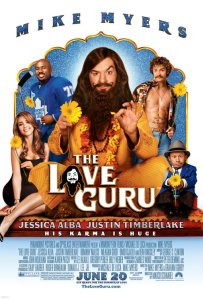 While never approaching the realm of good, I’ll admit that Mike Myers’ latest is not the cinematic abomination is has been hailed. I laughed a few times, though rare. Myers’ brand of comedy mixes puns, juvenile bathroom humor, slapstick, celebrity cameos (Ben Kingsley, why?!) and a certain level of self-aware absurdity (I don’t think Myers has found a penis joke that he didn’t enjoy). I feel that the comedy world has moved beyond Myers’ once popular brand of yuks. Thanks to Judd Apatow, we’ve transitioned to smart and tender character-based comedies. The threadbare plot relies takes too many self-indulgent and lazy detours. Why do we have to endure Guru Pitka (Myers) sing “More Than Words”? It’s not funny and just wastes time. Here’s an example of the lack of thought: Pitka wears a chastity belt but he can still get injured being hit in the groin. It’s a movie that doesn’t even remember its own gags. I’m always wary when a movie resorts to extended scenes of the characters cracking up and adding lines like, “I haven’t laughed this hard in a long time.” I have no qualms over crude comedy but it needs to be done with some planning to context and character. Watching someone get hit in the face with urine is not funny. Having pint-sized Verne Troyer get hit in the head is not funny the 80th time it happens. The movie never even satirizes the self-help industry. The Love Guru is too indulgent, too forced, too pun-heavy, too ill conceived, and far too stupid to succeed. I never thought I’d say this in a comedy that includes Myers, Stephen Colbert, Jim Gaffigan, John Oliver, Daniel Tosh, and Romany Malco, but Justin Timberlake is the funniest man on the screen as a daffy French-Canadian goalie, and that probably says enough.
Nate’s Grade: D+
Share this:

The Wackness (2008)
 Every Sundance Film Festival seems to coronate new talent and new films that never seem to materialize once they step outside of the happy bubble of festival life. It happened with Happy, Texas, with Tadpole, with Hav Plenty, with Primer and numerous others that never managed to get started with the public. At the 2008 Sundance film festival, the biggest buzz followed the documentary American Teen and The Wackness. Writer/director Jonathan Levine’s coming-of-age tale won the Audience Award for Drama and boasts shimmering visuals, formidable actors, and a hip soundtrack. Too bad the drama gets the least attention in that package. I suspect The Wackness will be yet another Sundance buzz flick that, while well made, fails to leave a mark on mainstream crowds (here’s hoping more for American Teen).
Luke (Josh Peck) has just graduated from a New York City high school and is winding down the summer before he moves on to college. He has a unique summer job: Luke sells marijuana out of an ice cream vendor’s box. One of his clients, Dr. Squires (Ben Kingsley), is a therapist. He trades therapy time to Luke for pot. The two of them form an unanticipated bond and Dr. Squires makes it a point to see that Luke is making the most of his youth. Luke is smitten with the doc’s stepdaughter, Steph (Juno‘s Olivia Thirby, gratifyingly authentic), and determined to lose his virginity and find love before the summer fades away.
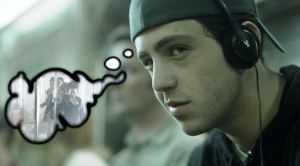 The strength of The Wackness is in the unexpected father/son relationship that forms between Luke and Dr. Squires. Kingsley is sensational in his role and provides all the pathos and unexpected discoveries that the coming-of-age genre is associated with. I think that’s what’s most interesting about Levine’s film, is that Kingsley is going through all the coming-of-age moments reserved for teenage protagonists. Dr. Squires and Luke form a surprising and deep relationship where they learn from each other. Luke learns to talk about his life’s sadness and make it a part of his life, instead of sweeping it under a proverbial rug. Dr. Squires learns to re-embrace life and to kick his heavy supply of pharmaceutical prescriptions. He is coming of age at middle age. He even gets to second base with an Olsen twin (Mary-Kate is only in the film for two scenes and an estimated five minutes). Most of all, Dr. Squires needs a friend and Luke fulfills this desperate void. Kingsley is funny, pathetic, and the real star of The Wackness.
My main problem with The Wackness is how familiar it all comes across. It follows the coming-of-age model down to the end, so a savvy audience is going to realize that Luke will fall in love, get his heart broken, stand up for himself, and gather a bit more wisdom by the time the end credits roll. You’ve seen this movie played in a thousand different ways before, and now The Wackness makes it 1001; you will essentially know every beat of this story before it happens. The film doesn’t break any new ground and doesn’t manage to provide much commentary or lasting insight while it comes of age. The screenwriting fails to hide what disinterests Levine. So we get quick glimpses of Luke’s home life and I swear in every one of them his parents are just yelling. That’s all Levine is interested in, setting up one ten second shot of Luke overhearing his parents shouting again and again. Dr. Squires’ wife (Famke Jannsen) gets the same kind of treatment. She gets a cursory amount of screen time to glower and that’s about it. I can tell Levine is only interested in his three main characters (Luke, Dr. Squires, Steph) but then why does he not concentrate on them further and scuttle what he feels is wasted time?
The Wackness is awash in pointless nostalgia. The movie is set during the summer of 1994 for no real reason. The time setting doesn’t impact the film in any manner except for some digs at Mayor Giuliani’s policies (he was only in office for sixth months or so when the film opens). Levine dishes out pop-culture references like the 8-bit Nintendo game system, old chunky GameBoys, Kurt Cobain’s suicide, mix tapes, and lots of rap music. The Wackness is an ode to mid 90s rap music and Luke is a lover of acts like A Tribe Called Quest, De La Soul, and some up-and-coming guy named The Notorious B.I.G. The soundtrack is also meant to convey good nostalgic vibes of a simpler time only — 14 years ago. Setting the film in 1994 is a lazy attempt to cover the lapses in screenwriting with cozy audience nostalgia. And is there anything really culturally transcendent about the summer of 1994?
 Peck may have lost like 100 pounds since he was fat comic relief on a Nickelodeon kids show, and he’s marginally handsome, but this kid needs some more practice before he’s a dramatic actor. I understand that his character gets stoned often and, as a typical teenager, is trying to pull off a too-cool-for-the-world-“whatever” attitude, but he seems freaking catatonic. He’s too aloof for his own good. His acting is dry and monotone and he feels like he’s constantly zoning out. Again, I understand that this works with his stoned persona but Peck is hardly ever convincing in the part and his acting shortcomings rob the role of a greater level of sympathy. A great actor can make you like a character that eats babies and kicks puppies, or the other way around, but Peck is not that actor. I believe that part of The Wackness‘ failure to connect and elevate beyond its genre trappings is due to Peck’s poor performance. He’s just kind of boring character and, to borrow a term from our pals on the other side of the pond, a bit of a wanker.
As a director, Levine has a playful and visually appealing look for the film, bathing it in arid tones to echo the hot summer days. The cinematography is a character all its own, giving the film a colorful and lively flair that makes every scene worth watching even if the script fails to do likewise. Levine has a handful of clever visual tricks up his sleeve, like a middle finger that moves through a crowd of New Yorkers at rapid speed before finding and dialing a pay phone. Levine has definite talent as a director and it shouldn’t be long before Hollywood comes knocking and plucks him away to make The Fast and the Furious 8: The Search for Curly’s Gold.
The Wackness feels like a coming-of-age film that goes through the motions. The main character is stoned to the point of comatose and he’s a rather boring protagonist, made even duller by Peck’s lackluster acting ability. Writer/director Levine flexes enough visual artistry to make him a talent to watch, however, his screenplay is too familiar with little personality or flavor to stand out against the pack. The movie looks good, it sounds good, and Kingsley is certainly good, it’s just a shame that it isn’t his movie. Steph tells the mopey Luke that all she sees is the goodness life has to offer and all he sees is “the wackness” (you can go home happy to understand the title). I guess I similarly be accused of focusing on the “wackness” of The Wackness because it’s certainly not a bad movie. It just happens to be ordinary. Though it does have some torrid Kingsley-on-Olsen Twin action. I suppose that isn’t too wack.
Nate’s Grade: C+
Share this:

Lucky Number Slevin (2006)
 Probably too clever by half, this Tarantino knockoff is gloriously twisty and far more twisted than you may have thought from the surface. It’s a puzzle piece that winds up being vastly entertaining. Josh Hartnett does the best work of his career in an effervescent comedic performance, playing Slevin, a nobody mistaken for a somebody who owes different mobsters large sums of money. There are a lot of balls to keep juggling, but Lucky Number Slevin finds a way to keep the headstrong momentum constantly going. The neo-noir art direction is fabulous and eye-catching. Things get really dark in the last act, perhaps too dark for some, but for me, this was a crime caper that left me captivated by clever storytelling and flashy camerawork. Definitely for fans of the noir genre and for those with hard stomachs for violence.
Nate’s Grade: B
Share this:

Bloodrayne (2006)
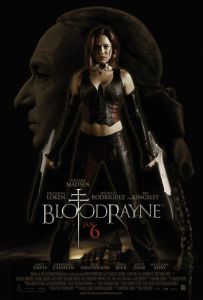 Bloodrayne is based on a video game of the same name that follows a svelte, red-haired vampire with two long pairs of swords she wields on her arms. In the video game she fights against Nazis in World War II. Now that is a movie I would love to see. Everyone hates Nazis (well, most everyone), and to see a sexy half-naked vampire run around and kill them … that just spells awesome. But then along came director Uwe Boll and his German financiers. Boll has turned back the clock and made his Bloodrayne an origin tale set amongst some old European landscape dotted with castles and vampires. He filmed in the real Transylvania in Romania. I don’t know if this location added any more authenticity. It couldn’t have made the film any worse.
In some place centuries ago, there’s a dhampir named Rayne (Kristanna Loken). A dhampir is a half-human, half-vampire hybrid, and we’re told most do not survive conception. Rayne has become a circus sideshow, where her captors torture her and then feed her blood, observing her nimble body heal itself. The Brimstone society is an organization devoted to fighting vampires. Vladimir (Michael Madsen) leads a small group, including Katarin (Michelle Rodriguez), on the hunt for Rayne. They believe she could help them defeat Kagan (Ben Kingsley), the most fearsome vampire in the land for some reason. Kagan is on the hunt for three guarded objects (an eye, a heart, and a rib) that will give him power beyond imagination. Rayne breaks free from her circus life, thanks to killing just about all of them, and joins the Brimstone group. You see, she’s got a score to settle with Kagan. He raped her mother and years later returned and killed her while Rayne watched. Complicating matters is the fact that he’s also Rayne’s biological father.
 If Bloodrayne had merely been a straight-faced, mystical, Medieval gore fest, I might have even credited it for being a decent genre flick. But it’s the assorted anachronisms and rudimentary scope that chafe Bloodrayne, never letting it settle. Take for instance the weirdest scene in the entire movie. Now, for a movie about vampires, prophecy, secret orders, and Michelle Rodriguez even attempting a British accent (one word of advice: don’t), the strangest moment is Billy Zane’s “special appearance.” The opening credits in Bloodrayne call it that, but how does someone have a “special appearance” in an open-and-shut narrative? This isn’t an ongoing TV series. Zane has two scenes. The first has him dictating a letter like a mid-level executive, straining and stretching to fill an inter-office missive. He actually says modern phrases like “No, scratch that,” and “et cetera, et cetera, et cetera, signed Your Father.” That’s it. That’s the scene. It serves little purpose other than to make you think Billy Zane sucks when it comes to personal skills.
Boll fails to curtail these anachronisms that hurt Bloodrayne’s tone and execution. His lack of interest in details or sense also puts the film at a disadvantage. There’s a late scene where Katarin suddenly is wearing a modern purple women’s jacket, like she just got it off the rack from TJ Max. Why does Vladimir wave his sword around all the damn time, but when it comes to actual combat he tosses it back and forth in his hands like a hot potato? A character has a hidden room of weapons, but it’s not much of a secret room when the lever to open this space is dubiously displayed for all to see. Domastir (Will Sanderson, making his fifth appearance in a Boll film) has a hilariously bad haircut that looks like crop circles were shaved into his head. Why, after Rayne has joined the Brimstone fighters late in the film, do we need her in a training montage? I’m pretty sure by that point Rayne can hold her own.
Kagan is never examined as to why he is so dangerous. We have no understanding why the film’s villain should even be feared. He’s on a quest for super power but what Bond villain isn’t? In fact, Bloodrayne has an altogether ho-hum view on vampires. In this movie they’re vulnerable to water as well as sunlight, but they’re also just as vulnerable to steel. The vampires fight with swords and die by them just as easily. One wonders what the allure of vampirism even is if this is all you get. There’s a scene early on where Rayne spots a female vampire chatting away in the open. She makes a come-hither motion with her finger and the lady vamp follows along obediently. Then Rayne bites her neck and drinks her dry, while the lady vamp does nothing but gets bug-eyes and goes limp. Apparently, the lack of sunlight must have negative effects on brain power and deductive thought. What Boll needs to learn is that if you’re going to have a movie where humans and vampires battle, at least give the vampires something beyond pointy teeth and bad hair. Seriously, was there a mullet discount at the wig store?
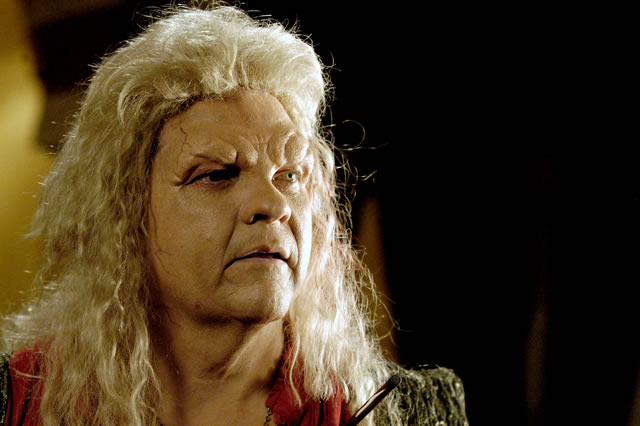 Then there’s the goofy series of one-scene actors. Meat Loaf appears as slovenly vampire pimp Leonid, surrounded by nubile nude women. He speaks like he’s taken a bottle of Quaaludes and has, what can best be described as, a dead and bleached muskrat on his head. The scene gets worse when Leonid is battling our Brimstone fighters. They take out several of the windows in his parlor and destroy Mr. Loaf by the influx of natural light. Now how stupid of an interior decorator did Leonid have? You would think a vampire running a blood parlor and place of otherworldly gathering would attempt to obscure very breakable windows. It’s the ignorance of these details and more that makes Bloodrayne ridiculous while still being pitiful of scope. If Boll is going to tell such a dull and cut-and-dry story, it’s not encouraging that he can’t even be bothered to get the details right.
The movie is poorly plotted from the start. Bloodrayne is aimless and doesn’t so much conclude as it does run out of bodies to kill. The ending will leave most scratching their heads not because it’s confusing but because the movie just peters out. More than most, Bloodrayne feels structured like a video game, with its plot points regarding the search and acquisition of super items that Kagan is after. The screenplay is credited to Guinevere Turner, co-writer of the American Psycho adaptation and frequent collaborator with director Mary Harron. I refuse to believe Turner’s responsible for the mess left on screen since Boll has the habit of rewriting whole scripts. The dialogue is unintentionally hilarious, with clichéd nuggets like, “Keep your friends close and your enemies closer,” and, “He wants a fight and a fight he shall get.”
The direction is shamelessly derivative. There’s a lot, and I mean a lot, of long exterior scenes where we see people on horseback riding along the substantial wilderness. It’s like Uwe Boll watched the Lord of the Rings series and said, “I can do that … but crappy.” These long exterior scenes conflict with the movie’s small playing field. Every town and every castle feels like a stone’s throw away, and the world feels like it’s populated by about 100 people. Boll never makes it clear what the setting of Bloodryane is. It feels like Vague Europe Land.
Boll doesn’t even manage to get his action sequences right. He’s got a bigger stage this time and some more money for effects but the results are still the same. To hide the fact that his actors had no time for fight training, Boll edits his fight scenes to the disorienting millisecond. The intent is to hide the stunt performers doing all the work. The result is that you can’t even tell what the hell’s going on in Bloodrayne. This also hamstrings his action choreography making it little beyond two figures clashing and one falling dead. The explosions of blood are overdone, with every gash shooting showers of red like the human body was connected to an off camera fire hose. Agreeably, there are a lot of splashes of blood but nothing too memorable or gruesome. It kind of has the feel of what bored teens would come up with during a sleepover with their dad’s camcorder. The violence and vampire angle are the two things that will appeal most to teenage men, but neither aspect is properly explored or satisfying. Bloodrayne presents a simple fable and doesn’t even bother to control its simple world of extraordinary creatures.
 I thought the sex scene in Boll’s Alone in the Dark was preposterously out-of-the-blue, but the gratuitous sex scene in Bloodrayne puts it to shame. Rayne is plagued by nightmares of her vampiric urges, as well as her mother being killed by Kagan. One night she has a vivid nightmare where she relives slaughtering her circus. She’s startled awake. What’s her first instinct? She grabs Sebastian (Matthew Davis), pins him against her cell bars, and proceeds to ride him like she has the upper body of a weight lifter. Maybe this is the lone benefit of being a vampire: a wider selection of sexual positions. The sex is sloppy and unerotic in its ludicrousness. Boll also manages to make sure his camera gets every loving detail of Loken’s nipples being lapped at. Boll figures that this gratuitous sex scene (it really couldn’t get any more gratuitous if they were skydiving) is meant to bond the characters into a romantic relationship. This forced romance is, like many elements in Bloodrayne, also inept. It stretches believability when this moment is all we have to go on why Rayne and Sebastian feel for one another. When they part Sebastian is crestfallen, though I think it’s more because he just lost the only girl he’ll ever meet that can perform gymnastic sex. Talk about a perfect score on the parallel bars.
The acting in Bloodrayne is about what I’d expect from a Uwe Boll movie. Loken (Terminator 3) is an attractive woman, yes, but the figure of Rayne is more a fetish fantasy than a flesh-and-blood character. There’s more attention to her revealing wardrobe than her character. Loken overplays her one facial expression, which looks precisely like she just caught wind of a fart. Her English accent is also very droning. Madsen (Species, Kill Bill) seems drunk the whole time. Rodriguez (SWAT) can do little more than scowl, but in Bloodryane she gets to scowl with a comically bungling British accent. And then there’s Sir Ben Kingsley. He spends most of his screen time confined to a throne as if he’s subconsciously trying to pass this movie like a stubborn bowel movement. He looks more like a terminally ill founding father with a penchant for silks than the evil Lord of Vampires. Kingsley hasn’t exactly been judicious with some of his film choices (Thunderbirds, A Sound of Thunder, Suspect Zero) but you’d think an Oscar-winning actor would have better sense than to work with Dr. Boll.
Bloodrayne is the best of Boll’s troika of video-game adaptations, but even that statement is without praise. This lame sword-and-sorcery tale is merely bad, instead of absurdly bad like most of Boll’s oeuvre. The difference is one tiny adverb, folks. The film is limited in scope but still careless and absent-minded with its details. The action sequences are heavy on blood and short on orientation, edited within an inch of their life. Bloodrayne is full of Boll’s typical lapses in plot and characters, and there’s plenty of stupid to go around for everybody. The plot is made up of nonsensical guest shots by slumming actors, and the villain himself seems as menacing as someone’s toilet-bound grandpa. In the world of film it’s tricky to judge films on a scale of badness, because that scale is surprisingly varied. Bloodrayne is clearly bad, but it’s also more entertaining than his previous films. Maybe Boll is learning after all, though at this rate of progression he’ll reach “mildly tolerable” by the time the sun explodes.
Nate’s Grade: D+
Share this:

A Sound of Thunder (2005)
 A Sound of Thunder, based on the classic short story by Ray Bradbury, is a movie that no one is going to see by design. It was shot way back in 2002, traded directors when Renny Harlin left to make Mindhunters and Peter Hyams (End of Days, The Relic) stepped in, sat on a shelf for two years, and now is being released without a peep. I have not seen a single TV ad, a single trailer, and until a few days ago I hadn’t even seen a poster for the film. It’s like the studio doesn’t want anyone to know that A Sound of Thunder exists and that they?re responsible. With zero advertising, the only people who are going to pay to see this are those familiar with Bradbury’s story. A Sound of Thunder will be gone in the blink of an eye. It doesn’t help that the movie is awful.
In the year 2055, time travel is here and available to those with deep pockets. Charles Hatton (Ben Kingsley) runs a service that allows rich people to travel back millions of years for the ultimate big game hunt — dinosaurs. The time squad is led by Travis Ryer (Edward Burns), a brilliant scientist biding his time working for the man. The time travel inventor (Catherine McCormack) warns about the dangers with playing around in the past. The tiniest alteration could drastically change the future. Hatton assures everything is safe; they hunt the same dinosaur that is just about to be destroyed and touch nothing else. Of course something does go wrong. On one hunt the clients run off the safe path and accidentally step on a butterfly. This causes “time waves” to sweep the present-day Earth and kick start some evolutionary changes. Travis is left to figure out what went wrong and fix it before humankind is wiped off the planet with the next wave.
 The movie pretends to play with brainy sci-fi principles, but A Sound of Thunder is really an empty vacuum of logic. As a precautionary measure, the team only travels back in time and hunts the same damned dinosaur. This dinosaur is special because it’s minutes away from getting stuck in a tar pit and then being obliterated by an exploding volcano. The team picks this dinosaur because hunting it won’t disrupt the fabric of time. Gotcha, but then why does stepping on a butterfly even matter? Is a butterfly seriously going to survive the oncoming volcanic blast and wall of ash? If the butterfly is just moments away from it too being destroyed, then why does killing it seconds earlier affect all of evolution? And how come these changes in time are always disastrous? Can’t someone just as reasonably step on a butterfly and wipe out cancer?
Let’s talk about A Sound of Thunder‘s alternate evolutionary timeline. In this world, because of our infamous butterfly stomping, apes and dinosaurs have inexplicably become linked. They’ve evolved into some weird hybrid, with a baboon head and the body of a dinosaur. This seems entirely implausible to me that two very different creatures would just blend together. At least A Sound of Thunder could have gone all out and had other animal mash-ups, like a whale/hummingbird or a walrus/cheetah. A Sound of Thunder could be rivaled by The Wuzzles in evolutionary theory (please tell me I’m not the only one who remembers The Wuzzles). I would have been more interested if A Sound of Thunder presented the future dinosaurs as fully evolved after an additional 65 million years. Let’s see dinos with industry, tools, community, language, and maybe even popular culture. It sure would be more interesting and imaginative than big dumb monsters.
A Sound of Thunder isn’t a sci-fi puzzler; it’s really a monster movie in disguise. After the evolutionary wrench, the film descends into a banal series of chase scenes, with our characters being plucked one-by-one by different monsters. The characters still manage to spout sci-fi dribble while on the run. Of course the characters can’t stop themselves from doing stupid things. A guy warns our team to be quiet lest they awaken the hordes of sleeping baboon-dinos hanging overhead. So what do they do? They make sure to shine their flashlights repeatedly in the creatures? faces. A Sound of Thunder is more preoccupied with what can go bump in the night than sci-fi brainteasers.

Not how evolution works.
A Sound of Thunder has some of the worst special effects I have ever seen. I’m talking about effects that would be shown up by some half-baked video game from the mid ’90s. It’s really hard to fully explain how profoundly bad the effects are. The green screen work is ugly and painful, with characters surrounded by halos and walking on invisible treadmills. The future’s boxy cars look like they were assembled by Lego. The look of the dinosaur is curiously retro, all sleek, entirely green or brown, and lacking definition. It looks like what people in the 1950s thought dinosaurs looked like. In the wake of Jurassic Park, a less realistic, more reptilian dinosaur is not the way to go. The film tries to save money by using the same dinosaur and repeating the scene with diminishing returns. Every special effect in A Sound of Thunder comes across as flimsy from the wildlife, to the skyscrapers, to the dinosaurs, to even a subway car and rising water. Every effect is so terribly obvious and obviously terrible.
The film’s acting is expectantly dull. Kingsley hams it up and has great fun as his money-grubbing business tycoon. He adds a zest to his lines. Burns plays every role so dead-panned that I doubt I will ever see an emotion from him that isn’t accompanied by a smirk. The rest of the actors couldn’t find their way with an industrial flashlight to shine in a monkey-dino’s eyes.
A Sound of Thunder is an inept sci-fi flick more concerned with hungry monsters than ideas. The special effects are abysmal, the acting is wooden, the plot holes are glaring, and the atmosphere is laughable. This giant schlockfest is so bad that it achieves a fun campy value, destined to become a drinking game for science fiction nerds. Only Ray Bradbury fans will be at the theater to see A Sound of Thunder, so in turn that means only Ray Bradbury fans will be disappointed with how terrible the film adaptation is. Everyone else will be at home scratching their heads; certain that a film called A Sound of Thunder never existed. Just like the studio wants.
Nate’s Grade: D-
Share this:

House of Sand and Fog (2003)
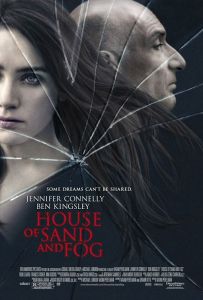 House of Sand and Fog (2003)
Premise: Kathy (Jennifer Connelly) has lost her family home due to a bureaucratic error, and a former Iranian colonel (Ben Kingsley) and his family move in for a rock-bottom price. Neither is willing to budge, and their turf tussle soon becomes a tragedy.
Results: Perhaps the first real estate thriller, House of Sand and Fog is a smartly written, emotionally harrowing film with phenomenal acting. Kingsley is superb and deserves a Best Actor nomination. Shohreh Aghdashloo is heartbreaking as Kingsley’s wife, who doesn’t know a lot of English but loses sleep over the word ”deportation.” The drama is meant to convey that both sides have a convincing claim to the house, but who are audiences going to side with, an American screw-up who could have avoided the whole mess by mailing in a letter, or a hard-working family ere the son is willing to take a second paper route to help out? The final act is a bit overly bleak, and the cop boyfriend character is an easy go-to for plot turns. House of Sand and Fog is one of the more compelling films of the year. What more could you want in a prestige picture?
Nate’s Grade: B+
Share this:

Sexy Beast (2001)
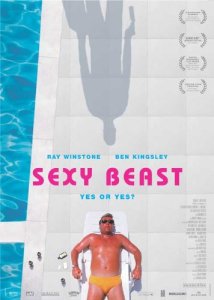 Never, under any circumstances, do you want to piss off Gandhi. Sexy Beast is a British crime story where the ferocious mad dog Don Logan (Ben Kingsley) is trying to recruit a retired hand (Ray Winstone) into one last job back in London. Winstone is enjoying the sun of California with his middle-aged ex-porn star wife who he loves dearly. But Don does not take “no” for an answer. Kingsley is the true focal point of the film and is astounding and brutally terrifying as the wound up gangster. He gives an electrifying performance that is the polar opposite of India’s non-violent leader. When Kingsley vanishes from the screen Sexy Beast suffers and becomes a variation of the old crime film, except a very short one at that being under 90 minutes of running time. Video director Jonathon Glazer has done a fine job for his debut but there isn’t much to this tale without Kingsley’s memorable efforts.
Nate’s Grade: B
Share this:

Rules of Engagement (2000)
 Samuel L. Jackson and Tommy Lee Jones are old war pals who took separate paths after a cataclysmic ambush in Vietnam. Jackson went on to a prestigious career in combat but Jones was restricted to desk jobs the rest of his tenure. It appears Arabs are at their old tricks again, being that without Nazis or Communists they are Hollywood’s favorite misrepresented bad guys. Jackson gets dispatched to protect a U.S. embassy besieged by protests. During the melee of confusion Jackson orders fire on the crowds outside. Now he has to face the ramifications which include murder charges and a tangled web of conspiracy.
Jackson gives an electric performance as the Marine Captain full of sound and fury. Jones and Jackson exhibit great chemistry together under William Friedkin’s deft hand. Friedkin, known for classics like The French Connection and The Exorcist, whose last pic was Jade, has crafted exciting sequences of action and suspense. The problem is they all happen early and the film unwinds and unspools as it continues.
Bruce Greenwood seems to be making a career out of beguiling Jones. In last fall’s Double Jeopardy he was a slimy not-so-dead hubby, and in Rules he’s a slimy National Security adviser. These two look like they’ll be the Ben and Matt of the over forty crowd.
Rules of Engagement is a courtroom action/drama that plays closely to the rules established but coasts on terrific performances from its leads and some dynamite action sequences. But eventually the weight of the plot drags Rules from the potential it flashed.
Nate’s Grade: C+


 nathanzoebl
You must be logged in to post a comment.