Army of the Dead (2021)
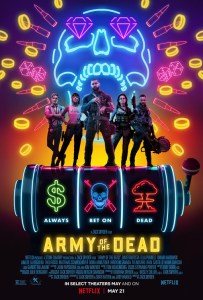 Despite an expensive redo into the editing bay for the supersized Justice League 2.0, this is director Zack Snyder’s first movie in four years and the aftermath of his family tragedy, and it’s the first with that sweet sweet Netflix money. Army of the Dead has an easy concept that seems silly as well as questionable why we haven’t seen this kind of movie before. The world loves zombies movies. The world loves heist movies. Why have we waited until 2021, in the year of our Lord, for a zombie heist flick? Our long drought is finally over and Netflix has answered our collective prayers. When I watch a movie described as “zombie Vegas heist” then I know what I’m hoping for, chiefly a fun, goofy, and well-developed action thriller, and that’s what Army of the Dead provides.
Las Vegas is ground zero for a zombie outbreak. The U.S. government has cordoned off the Vegas strip and contained the zombie virus. The president plans to drop a nuclear bomb and eradicate the zombie plague once and for all. That means there’s still time for one last score. A wealthy businessman wants to hire Scott Ward (Dave Bautista) to put together a crack team to break into a casino vault and steal $200 million before everything gets nuked. Scott gathers a crew of Zombie War vets, specialists, a guide to sneak them into the quarantine zone, and his estranged adult daughter who watched dad out mom down after she became a zombie. Together they’ll venture into certain danger to hit a jackpot.
 It’s easily Snyder’s most laid back and straightforwardly enjoyable movie since his debut feature, 2004’s Dawn of the Dead remake. It’s a movie that knows what we’re here for and provides a colorful band of characters with big personalities and over-the-top bloody violence. I can’t say that I genuinely cared about whether anyone lived or died in the movie, as many are so disposable that I forgot they were in the group, but I missed their presence when the time came to say goodbye. I enjoyed that two characters as outwardly different as Vanderohe (Omari Hardwick) and Dieter (Matthias Schweighöfer) could become best bros, and their chummy dynamic became one of my favorite aspects of the movie. The actual heist component of the movie amounts to less than the perilous journey to get to the giant vault, and the exaggerated booby traps reminded me of Indiana Jones temples. It was just the right splash of ridiculous to make me laugh. This is a movie designed to simply push the right buttons for a schlocky good time. Its opening montage sets the tone with famous Vegas staples falling victim to zombie mayhem. Early on, it’s Snyder assuring you that he’s not taking anything too seriously and that neither should you. There are moments where Snyder just throws out nonsense just to mess with the viewer, like a scene where Vanderohe theorizes that the skeletal corpses might actually be them and they are trapped in a loop, complete with matching edits to link up their clothing and jewelry to make you wonder. I turned to my girlfriend in disbelief; could this actually be happening? It doesn’t at all, but just the fact that Snyder devoted time for this throwaway sci-fi head fake amused me. I almost wished Snyder had given us more of these throwaway joke exit ramps. At one point, a character gets locked in a vault, and I hoped for a brief moment Snyder would frame the film like it’s suddenly evolved into the zombie’s own Ocean 11, where now the zombies need to put together a crack zombie team to break into the vault for some delicious brains. I appreciate that Army of the Dead prioritizes entertainment on all of its fronts.
Snyder and company have also put more deliberation into their world building. Most zombie movies just present a wasteland of the undead, a sea of hands and teeth that serve as a swarming obstacle but without any more thought. In Army of the Dead, the movie presents the beginning of a zombie civilization with a hierarchy. There are zombie alphas and zombie drones and the potential for zombie babies, maybe, but there is the beginning of something we fully do not understand. It reminded me a lot of the 2007 I Am Legend. I liked that the zombies weren’t as dumb as we often see them, and I also liked that the movie presented the possibility of the zombies being open to collaboration. In order to travel through the territory, the zombies demand a payment from the traveling parties, and this understanding and begrudging truce makes these creatures far more interesting than an army of drooling brutes. I liked that even the leader has learned he should be protecting his head from projectiles. There are some solidly constructed suspense sequences here, like where the team has to slowly creep through rooms filled with “hibernating” zombies, taking great pains not to touch them as they pass. It’s immediately accessible and different, as well as working with further world building. I also appreciated that one character who was left for dead went down fighting like a champion. It almost becomes a joke just how far this character keeps fighting, like they’re pushing against being just another disposable stock character in a genre movie. It’s impressive. The action set pieces are fun and well developed and make use of the different expertise from our assorted heist team.
 As a zombie movie, the violence is impressively gory and fun in its visceral splatter effects. With one big exception, there is a clear emphasis on practical effects and physical makeup prosthetics. The zombies at their different states of decay look great, as do their alpha higher-ups, enough to distinguish an easily recognizable class system that also portends further analysis. The deaths can also be gruesomely entertaining. Watching the sticky expertise of the gore wizards makes it even more perversely pleasurable and it’s often played for dark laughs. Two characters having to clear through the smashed remains of a smooshed zombie is gross and grossly funny. While I acknowledge that the recreation of a desolate and desiccated Las Vegas strip is an obvious computer effect, the major CGI addition to the movie is the zombie tiger (that used to belong to Siegfried and Roy) and it doesn’t look terribly great. Part of this is how unnatural it’s destined to fatefully appear, but the zombie horses looked great, though that was a practical costume placed upon a real horse. At least Snyder and company recognize that if you introduce a zombie tiger, you better guarantee it eats somebody and somebody we really don’t like so we can fully enjoy the experience.
There are a few issues that detract from the overall enjoyment of Snyder’s escapist entertainment. When the movie goes sentimental between daddy and daughter, it doesn’t really gibe with the rest of the film. I’m not upset that the movie ever attempted an emotional core to ground our investment in these characters, but there’s a reason you don’t see a tearful heart-to-heart in heist movies, let alone in movies with undead Elvises. I found the daughter character to be a nuisance. She falls under that character mold of the person who insists on tagging along to fulfill some personal goal and who inevitably gets people killed for no reason. The daughter’s goal is to rescue this one stubborn lady who ventured into the zombie quarantine, but this comes to nothing and, infuriatingly, gets many of our group killed trying to save her. Had she never tagged along, many of these people could have better survived, especially since her “expertise” did not save the day at any juncture. Therefore, her very presence was a net negative to the group, which helped drag down my opinion of the whole father-daughter drama.
I also found the overall style of the photography to be distracting. Working for the first time as his own director of photography in a movie, pitting himself in the middle of the action and manning his own camera, Snyder is more directly involved in making sure you see what he wants. However, he utilizes a very shallow depth of field, which obliterates much of the background as a blur. This can work in moments of suspense where seeing beyond waves of zombies can make them feel immense and overwhelming, but when it’s everything including people standing shoulder-to-shoulder exchanging exposition in a warehouse? Not as helpful. This singular focus, or limited focus, can get annoying and feel like an artifice that Snyder simply cannot let go of. It feels like the cameras got stuck on this mode and the filmmakers just said, “Oh well.” While Snyder has deigned that color shall exist in this movie (unlike in Justice League), the color palate is still drained and resembling an overused Instagram filter that cannot be undone.
 As a side note, originally this movie featured comedian Chris D’Elia as the helicopter pilot of the crew and then Netflix spent millions to digitally erase and replace him with comedian Tig Notaro after it was revealed D’Elia was the latest in a long line of sexual abusers in Hollywood. Notaro filmed all her scenes sans one in front of a green screen and if you never were told otherwise you wouldn’t have known. Bravo to Snyder and company for going the All the Money in the World route and replacing a creep with a beloved actor that should have been hired in the first place. Notaro, it must be said, is also sarcastically great in the film. Her scene where she openly discusses arranging for their corporate babysitter to get axed is a highlight.
Netflix has big plans for Army of the Dead. A prequel starring the Dieter character, and directed by the actor playing him, has already been filmed, and an animated series is also in the works. The studio sees this franchise as a creative well they want to tap dry, and I’m sure the movie will prove popular on the streaming giant and only lead to further network expansion. I think Snyder feels somewhat liberated by making his first movie without superheroes in a decade. He’s always been a first-class visual stylist but his command of narrative and character can be sketchy, hence 2011’s woefully miscalculated “feminist” passion project, Sucker Punch. I think Snyder is best when he keeps things lighter, sillier, schlockier, and absent larger themes and messages meant to make people think deeper about the human condition. Being a filmmaker who understands they work best in the land of shallow blockbusters isn’t some acceptance of limitation or failure. It’s an acknowledgement of where one’s skill set best matches up. I don’t begrudge Snyder as a filmmaker, though I question whether his interpretation of superheroes can escape the shadow of his love for Objectivist philosophy. I think it’s no coincidence that his two best movies, and least problematic, are both his zombie action movies. So bring me more of the Army of the Dead universe. Bring me more Zack Snyder at the helm. It keeps him busy, it keeps me entertained, and it keeps him away from making more four-hour long superhero movies.
Nate’s Grade: B
Share this:

The Woman in the Window (2021)
 The story behind The Woman in the Window is far more fascinating than the finished movie, based upon the 2018 best-selling debut novel by Dan Mallory under the pseudonym A.J. Finn, a hasty rehash of popular thrillers, notably Rear Window, mixed with recent unreliable narrator mystery/thrillers like The Girl on the Train. It’s actually somewhat shameless how derivative it comes across, so much so that you might be able to guess one of the movie’s Big Twists in the literal opening minutes. Amy Adams plays an agoraphobic psychiatrist who believes the new neighbor (Julianne Moore) across the street has been killed by her husband (Gary Oldman), and no one believes her because of her drinking and medication and general misogyny and obvious twists. I cannot tell if screenwriter Tracy Letts (Killer Joe) and director Joe Wright (Darkest Hour) were going for camp or sincerity, as the movie veers chaotically until its final groan-worthy revelation, which is apparently taken right from the source material. There aren’t any significant moments of tension. I was more confused why and how everyone was constantly coming into this lady’s opulent New York brownstone. I was also wondering why the filmmakers made Oldman look like Jon Voight. The troubled movie was delayed twice, went through several re-shoots by Tony Gilroy (hey, it worked for Rogue One, right, Disney?) and ultimately cast off to Netflix. The most interesting aspect of this movie, by far, is the author being discovered as a fraud and fabulist of the first order, lying about everything and anything to elicit pity and use it for personal and professional manipulation, and I’m talking lies about his mother dying of cancer, his brother committing suicide, himself suffering from a recurring brain tumor, and even pretending to be his brother to write emails to colleagues while still maintaining the same distinct writing voice. Mallory’s years of pathological lies (he blames it all on being bipolar now) have actually inspired a TV series where Jake Gyllenhaal is set to play him. You should spend the time you would have used watching The Woman in the Window on Netflix and instead read the extensive New Yorker article that painstakingly paints the damning portrait of Mallory as a narcissistic con artist who would weaponize people’s sympathy.
Nate’s Grade: C-
Share this:

Those Who Wish Me Dead (2021)
 If I told you I had a movie where Angelina Jolie is on the run from a team of assassins and under the backdrop of a raging forest fire, you’d likely be intrigued. Then if I said that it was co-written and directed by Taylor Sheridan, one of the best screenwriters working today who excels at taking muscular genres of old and providing uncommon depth and poetry, then you might say, “Why aren’t we watching this right now?” Those Who Wish Me Dead, based on the book by Michael Koryta, is Sheridan’s second directing effort after 2017’s excellent Wind River, and while I would not classify it as a bad movie, it is easily Sheridan’s weakest film to date. There’s so much amazing potential here with these plot elements, this cast, and this rising filmmaker, and to only produce a square, straightforward 90s action throwback feels deeply unsatisfactory. There could have been so much more.
We follow Hannah (Jolie) and her team of Montana forest fire fighters. She is still recovering from a recent tragedy where she was unable to save campers from a fire. She’s been reassigned to a lonely lookout tower to deal with her guilt and PTSD. Along comes Connor (Finn Little) whose father is being hunted down by a team of hired assassins (Aidan Gillen, Nicholas Hoult). His father is killed but Connor escapes, finding refuge with Hannah and wary of trusting anyone new. The two of them make a trek to find help while the killers narrow their search and start a forest fire to provide a very attention-grabbing distraction for the local authorities.
 The problem with the plot description I just provided is that there really isn’t much more to anything. You can probably see the progression of Hannah’s character arc immediately, having to confront her past trauma through combating the forest fire and saving this young boy’s life to make amends mentally for those she could not save in her past. The Sheridan of his past work would recognize that familiar arc and provide extra nuance, commentary, and make the character more emotionally resonant. Unfortunately, this version only produces a lead protagonist that is, shockingly, disposable. You could have eliminated the entire character of Hannah from this movie for all the personal significance she provides for this story, and that stunned me. We don’t really get insight into he beyond generic observations. She doesn’t really bond with this kid in any meaningful way. She doesn’t really teach this kid anything generally useful for his own safety. This is the type of relationship dynamic where the adult teaches the kid some means of defense, and then in a pivotal moment in Act Three, the child uses that technique to save themselves or the adult. It’s textbook (think: Face/Off with the butterfly knife as but one example). This movie doesn’t do that. In fact, once this kid hands over to Hannah the “unseen paper carrying dead dad’s important information” then he also comes across as disposable. I guess he’s still a witness to murder but the valuable intel seemed more pertinent to thwart. The fact that these two characters can arguably be removed from the story, either entirely or far earlier, is not a good assessment of their value added.
The competing storyline with Jon Bernthal (The Punisher) is surprisingly the one that feels most attached to the events of the plot and could have been its lead vehicle. He plays Ethan, a small-town sheriff’s deputy who happens to be Connor’s uncle. Ethan also has a pregnant wife, Allison (Medina Senghore), and they both take up a generous amount of screen time. There’s a good reason for this because they’re the best part. The loving yet pointed interactions between the two of them are the best example of characterization evident in the movie. When Allison is confronted by the assassins, she’s sees through their law enforcement disguise easily. When the bad men want to torture her to get key information, she manages to subdue them and escape, all while being seven months pregnant. In two short scenes, this woman proves more capable and fearless and badass than our lead character.
 It’s easy to see a version of Those Who Wish Me Dead where the Ethan character and his drama completely cover the same narrative territory that Hannah offers. Ethan’s wife is pregnant, the baby is due soon, and yet Ethan feels scared and unsure about whether he has what it takes to be a father. He comes across a young boy on the run from big trouble and protects him, and over the course of their shared experiences, he bonds and discovers paternal capabilities within himself, he teaches the kid a thing or two about defense, and he becomes more self-assured about his own personal future. Admittedly, you could say that’s a simplistic character arc, but is the one presented any less simple where we watch a person haunted by trauma confront that trauma by the end? My point in this revisionary hypothetical is that this version would be more aligned with the plot elements that seem to get the most care and screen time. I know it’s based on a book, but it clearly feels like Sheridan has shown what parts he cares about more so embrace those parts.
It’s also quite easy to identify the parts of the movie Sheridan did not care as much about. There is a surprising sloppiness to much of the setup here, where key connecting information is excluded from the viewer perhaps out of a sense of trying to be ambiguous but also perhaps out of a sense of general indifference. I was confused why the assassins blew up a house in their opening moment, what information Connor’s father had stumbled upon, and even who these killers were and what their connections were with an unexpected Tyler Perry cameo where he appears to be their boss or handler or buyer or someone. The plotting can also be disappointingly redundant, as Hannah and Connor fall into a frustrating pattern of leaving the lookout tower, going back to the lookout tower, leaving the lookout tower again, repeat. Perhaps most egregiously, the raging inferno doesn’t even seem to matter. How can you make a movie about a forest fire where the forest fire barely matter in the scheme of things. It exists as an immovable obstacle but more so as a means of emotional catharsis for Hannah’s prior trauma. Far too often it feels like the fire is practically standing still, watching the actors from afar and not wanting to interrupt, and then at the very end, it’s comically overcharged, zooming at super speeds to compensate for its earlier lazy pacing. There aren’t any real specific survival scenarios tailored to the circumstances of a forest fire, which means this movie could have easily been a flood or earthquake or any disaster or none at all.
 Those Who Wish Me Dead reminds me of the vanishing mid-level thrillers that Hollywood used to crank out on a near weekly basis. That’s probably also part of the reason it feels like a throwback to an earlier time, a time where a big star could be thrown into a disaster and given evil-doers to topple and we’d all gladly gobble it down with a heaping helping of popcorn. Perhaps that unassuming nostalgia will prove enough for some people, especially in the wake of a year of minimal big screen blockbusters. There are still moments here that feel like the Sheridan of old, but too much of this movie cannot escape the gravity of being a dull action movie without anything to say and without characters to invest in. It’s not even that the movie is too simple, because simplicity can be its own virtue, but that it’s underwritten, with characters that could be exorcised completely from the narrative, and a batch of villains lacking entertaining personalities or memorable menace. It’s hard not to feel like everyone’s talents involved were wasted somewhat on something so basic, which is even more baffling when you again recognize those fantastic story elements. Chases. From assassins. Into a forest fire. There’s an obvious movie to be had there. Unfortunately, Those Who Wish Me Dead doesn’t capitalize.
Nate’s Grade: C
Share this:

Immortal Combat: The Code (2020)
 In many ways, the Cleveland-made indie Immortal Combat feels like a bigger version of what a bunch of little kids might accomplish with a camera, a backyard, a bunch of pretend weapons, and a lively imagination fed from martial arts epics and actions movies of old. There is a certain charm to it, escaping into the pure play of childhood, including wrist devices that are merely tapping your bare wrist, but as an actual movie, it might have some problems. Look, this is a martial arts action movie. You watch a martial arts action movie to be entertained with the feats of action, and that’s what you should be looking for with any movie with “combat” in the title (albeit in a misguided font that looks like a child’s chalk). On that front, Immortal Combat is flawed but still passable entertainment, though it feels like a project that was never intended to entertain more than its own select cast and crew.
Neil (Ben Zgorecki) is a member of the villainous Four 11 gang. He’s tasked with infiltrating the rival Five Elements gang but he turns against his former gang. The Five Elements have come into possession of a code that will save humanity from environmental disasters. The world is running low on breathable air and implantable medical devices are malfunctioning. The gangs are going to war to control this code and thus control the trajectory for mankind’s future.
 The performers have physical skills they have honed over years, and director Johnny K. Wu (Innserself) emphasizes angles and cuts to fully appreciate those skills. There are extended shots where you can admire how much the performers practiced and memorized their routines. However, that deference also comes at the expense of the vitality of the action as depicted on screen. Because we’re at a medium range or farther distance, because there are longer takes, we’re watching the actors perform and realizing just how slow everyone is with their pacing. Without quicker cuts, the energy level of these fights comes across as too often lackluster, with many of the fighters just kind of hanging around and treating these battles as less life and death and more like a grocery aisle they cannot commit to. I can appreciate someone doing a fancy spin kick from a technical standpoint, but it feels less impressive when everyone else around them seems gassed or drugged in response. There is a lot of fighting in Immortal Combat but the editing and staging choices make it feel less believable, exciting, and potent. That’s why it feels like a bunch of grown-up kids running around, falling over, and continuing their pretend fighting rather than something, say, along the lines of a John Wick, an action franchise that is built around the appeal of expertly executed fight choreography.
The plot of Immortal Combat, written by Wu, Andras Zoid, and Linda Robertson, ignores the first rule of hidden conspiracies and alternate fantasies, which is to shepherd your audience gradually and not to make assumptions. I see this plenty of times with fantasy films that incorrectly assume an audience has as much understanding as the filmmakers do about the histories of their world, the intricacies, the rules and challenges, etc. A new world, or a conspiracy, needs to be unraveled slowly and in pieces to be accessible, to not overwhelm the audience. We need the right components as if they were building blocks, creating a sturdy foundation to attach new information and new rules and lessons. If you have a mysterious Chosen One, you don’t vomit up every last bit of expositional know-how right away, you have to draw things out at a natural, inclined pace. With Immortal Combat, we have an entry point into this new world through the rather non-intimidating character Neil (a.k.a. “Cloud”). He’s our learning curve. The problem is that Neil just runs with any information at once and this presents a confusing overload. The world of Immortal Combat resembles ours except there are martial arts gangs, some of them with elemental powers, or at least names, and a vast corporate conspiracy with implanted medical devices and environmental disaster, but the communication of these elements is so muddled that I kept having to rewind the movie to try and follow. Take the opening narration as an example:
“IN OUR future, one simple breath could mean life or death. As we search for a solution, pollution engulfs our world. If we don’t find an answer fast, all living things shall perish. We are the Five Elements, we strive to protect humanity… Years ago, many warriors came to us seeking change, joined our way of life. Right after, A Code was discovered that could save the world and was injected into one of us. We even lost one of our clan’s mate. Now we must fight for our lives to bring the code – to the world…or die trying. With the MediCan Research Corporation and The FOUR 11 gang on our tails….We must protect the code….AT ALL COSTS.”
 I guess the pollution is killing everyone, yet we don’t really get a sense of this impending and immediate danger because life seems pretty normal; people are hanging out at bars, strolling around, not rationing what might be their final breath. Because of this pollution, a corporation is looking for a solution for its implantable medical devices, yet why is this even introduced except to provide another batch of shadowy bad guys with a plot crowded with shadowy villains? The corporation wants a solution, a code, which is what the heroes have, and the heroes want to get the code out to save humanity, so why aren’t they actively working together? Why introduce two sides who have the same goal if they are never going to meaningfully interact? I suppose the evil corporation would exploit the code for profit, but why not express this through actions? Also, why is this world-saving code only injected into one person rather than, say, uploaded to the Internet? Why risk your only vessel containing the world-saving magic code getting hit by a bus? If the goal is proliferation, there seems to be more safety in diversifying the code-carriers. The rival evil gang, the Four 11s, are a criminal syndicate but their leader has a sick child. Wouldn’t this code also help cure this child? Why are all these organizations working against one another? The world building of this universe feels cluttered and confusing and lacking narrative purpose. It resembles a little kid making up the rules as they go for a game you didn’t recognize.
As Neil is introduced into the Five Elements gang, we’re inundated with names but not so identifying personalities and things to better cement the deluge of characters. We have Cloud, Water, Earth, Fire, Wood, Gold, and if you forced me to identify who was who I would not even under penalty of law. There are so many characters in this movie and very few, if any, leave a favorable impression at all. They are repositories of kicks and punches and the occasional grunt. Water (the exquisitely named Crystle Paynther Collins) keeps bringing up her dead sister to the point that I waited for her to reference it every time she was onscreen, and she did not disappoint. Naming your main character Neil, and sticking him in khakis to perform martial arts, made me laugh. It’s not that his code name “Cloud” is that much more intimidating. When you introduce characters in movies, it’s a good idea to give them a moment to set them apart, and through action, which will better convey who they are and through visual storytelling. This is one of those movies where a character says, “You need to see Earth and Gold or else Wood and Fire will combust,” and you just shake your head and try and determine who these people are and what are their connections. It’s clumsy writing and there are too many characters to keep track of without stronger involvement. After watching 80 minutes, everyone just blurred together into People Who Kick (except for Neil and his mighty fighting khakis).
 The problem with Immortal Combat is the same I’ve seen with other low-budget indies, namely that these movie projects were not made for a mass audience. They play like an insular group project for friends and family of the production, people who are already in the know and on board, and the writing and development are tailored for this narrow band rather than a broader outside audience. To make a movie for others, you’d have to carefully explain your plot in a way that would be engaging, clear, and escalating, with characters distinguishable by personality, goals, and choices, and you’d want to integrate them in meaningful ways that also push our protagonist or heroes to victory. You’d have to put the work in to make it an actual movie. Immortal Combat feels like it was made strictly for its friends and family, like finding excuses to squeeze in extras for gang group shots despite the fact that the very presence of “non-threatening-looking” members calls into question the hiring practices and determination of this vicious martial arts gang. When people who look like your ordinary neighbors are in a martial arts gang, do you fear them? This also extends to our invisible special forces team. Some of these guys have a noticeable deficit in their effort or duty to their job. There’s nothing wrong with creating art with a small intended audience. I’m sure corporate offices make little videos all the time only intended to play to their employees. If you’re thinking beyond your immediate circle, however, then you must put more thought into your storytelling choices and make the plot and characters matter rather than finding room for everyone to fit onscreen.
Immortal Combat plays like an overextended martial arts demo reel and a plot was strung together to justify more and more exercises, resulting in a calamitous collection of confusing characters that are nearly interchangeable and often extraneous and expendable. The impact and excitement of all that martial arts choreography is blunted somewhat by the choices how to present the fighting and revealing the lackluster energy levels of some of the performers. I know in reality that fight sequences are often at a slower speed when filmed, same with car chases that typically only go at speeds of 30 miles per hour, but you make choices to obscure those nagging parts of reality to maintain the illusion that these kicks are furious and these cars go fast. It’s the same thinking when it comes to casting and crafting a story that naturally widens rather than simply polluting it with more names and faces that will only leave a dent for making dents. It looks like the actors and people behind Immortal Combat had fun making a movie, and to that end I have no qualms with any of them. Unfortunately, it doesn’t have the elements to reach beyond its circle.
Nate’s Grade: C-
Side note: the poster for this movie is wildly inaccurate. Like amazingly inaccurate. There are no characters in the movie resembling those on the poster, which definitely seems designed to be the Asylum version of Mortal Kombat.
Share this:

Without Remorse (2021)
 Tom Clancy’s Without Remorse is Tom Clancy without Tom Clancy. It bears no resemblance to the famous author’s 1993 novel even though the entire production feels remorseless about being generic military thriller genre grist. There’s nothing to spark the imagination here, no signature action sequence or well developed turn of events, no colorful personalities or hissable villains. It’s all predictable from the opening credits onward, from the opening mission that cannot go according to plan, to the assumption of the short shelf-life for the pregnant wife in Act One, to the Obvious Red Herring Antagonist and the Obvious Real Antagonist played by the big name actor, to the presumptuous preparations for building a franchise in post-credit sequences. The best thing about Without Remorse is Michael B. Jordan as our lead Navy Seal seeking vengeance and climbing the ladder of international conspiracy. Jordan gives a far better performance than this material and movie deserves, always demanding your attention. He’s charismatic even in generic thrillers like this one, and it is the definition of a generic military thriller lost in the dull minutia of a thousand other similar movies. There’s really nothing separating this movie from the glut of direct-to-DVD action thrillers starring the likes of Bruce Willis (who filmed his part over a weekend). The motivation for the villain’s plot to kick-start another global war with Russia is laughable when there’s a ideological motivation within reach that would have worked and been interesting, namely declaring Russia already an enemy of the country and forcing those in power to fight the war they are ignoring. Instead, the stated rationale is so much dumber. If you’re a fan of these kinds of action thrillers, or the sub-genre that Clancy carved out for himself for decades, then you’ll likely find enough to pass the time with Without Remorse. It had glimmers where it could have stepped outside the mighty shadow of its influences. I wouldn’t have been surprised if this was starring Dolph Lundgren rather than Michael B. Jordan.
Nate’s Grade: C
Share this:

The United States vs. Billie Holiday (2021)
 The good news is that Andra Day is a surefire star. In her debut performance, the singer makes a bold impression as Billie Holiday, with her raspy voice, sterling stage presence, and powerful singing. Day was nominated for an Academy Award, just as Dianna Ross was for her own film debut, also playing Holiday in 1972’s Lady Sings the Blues. The highlight of this movie is a tight close-up of Day singing “Strange Fruit,” her anti-lynching protest song, written by a Jewish schoolteacher, a song that incensed the U.S. government and essentially began the woe-begotten War on Drugs with a racist task force targeting Holiday as their first victim to make an example of. The moment is filled with rising emotions and barely held restraint and the sheer power of Day’s performance communicates the danger and anger of this politically-charged song that earned such controversy. However, the rest of the movie is a bit of an unholy mess, as director Lee Daniels (Precious) takes his signature campy, over-the-top style and cannot say no to any creative decision in his mind. I don’t know what’s harder to grasp, the clashing tones or timelines, as the movie literally and figuratively jumps all over the place, at one instant having Holiday on top of the world, and another being beaten by a parade of one-dimensional and nearly indistinguishable abusive men, to waltzing through heroin hallucinations, and cuddling close with an FBI informant (Trevante Rhodes) who is definitely a fictional character. Like the recent Judas and the Black Messiah, we divest time from the star to the men who betray her, but none of these louts and schemers are worth that precious time. It becomes an uncomfortable misery montage as we watch Holiday get abused, shoot up, cry, get harassed by the police, and repeat endlessly for 130 minutes. I don’t know if maybe Daniels was trying to make me feel like I was on drugs while watching but the antic, unfocused, and careening narrative and energy levels certainly made me feel dizzy and nauseated. An then there are ridiculous moments where I just wanted to laugh, like the backroom of racist government agents saying lines like, “This jazz music is the devil’s work. That’s why this Holiday woman has to be stopped.” This is based on a chapter of a book about the early War on Drugs, not Holiday’s biography, and it feels very much like her own identity and significance is being strung along just to be a martyr for the evils of government persecution. The movie paints her chiefly as a victim and then seems to glorify in victimizing her, and it all feels so garish and ghoulish and misguided. Billie Holiday deserves an amazing movie but she’ll just have to settle for an amazing performance in an otherwise melodramatic mess of a movie.
Nate’s Grade: C
Share this:

Wolfwalkers (2020)
 Beautifully animated with painterly water color visuals, Wolfwalkers is another treat from the acclaimed Irish studio that is single-handedly trying to bring back hand-drawn animation. The visuals are a delight and styled in a flat dimensional space reminiscent of Medieval tapestries (and Wes Anderson movies). The story brings to life 17th century Celtic mythology in a way that is still relevant today and concerns weighty themes about family identity, female independence, religious persecution, prejudice, colonial occupation and exploitation, and environmental conservation. It’s part Miyazaki and Brave and also reverent to its own cultural heritage, and it’s emotionally affecting and engrossing as well as being a treat for the eyes. We watch a young girl befriend a wild “wolfwalker,” a girl who can transform into a wolf when she sleeps. their bond will push each other to fight against forces trying to dominate the forest and morality. The filmmakers have carefully laid out the rules of their story and the implementation of the special powers so that everything happens through gradual circumstances where the plot feels as if it is following an entirely organic path. The voice acting is excellent and heartrending and perfectly paired for the exaggerated, wood-block-styled character designs. It’s a lovely and entertaining supernatural fable with enough thematic relevance, girl power, and visual grace to reaffirm just how magical traditional animation can still be.
Nate’s Grade: A-
Share this:

Moulin Rouge! (2001) [Review Re-View]

Released May 17, 2001:
Director Baz Luhrmann’s last project was the MTV-friendly William Shakespeare’s Romeo + Juliet (like someone else has a Romeo and Juliet) which was adored by the under 15 set that now buy N*SYNC merchandise. Luhrmann waited a long time for his follow up with Moulin Rogue, a manic musical that seems like candy for the eyes. It may have been a long time but it was well worth the wait.
The sparkling world of Moulin Rogue is around turn of the century France. Christian (Ewan McGregor), an aspiring writer, has traveled to this place against his father’s wishes. Christian believes in the beauty of love and the pull of the heart. Within minutes of setting foot in France he gets wrapped up into a production by a dwarf (John Leguizamo) and his cadre of assistants. Christian is sent to the most provocative club in town, the Moulin Rogue. Here he attempts to persuade the most famous showgirl Satine (Nicole Kidman) to help push for their musical to get financial backing. Satine inadvertently confuses Christian for the man she is supposed to seduce for a large some of money, the Duke (Richard Roxburgh). And thus the merry band of misfits get their play the backing while Christian blossoms a love for Satine. But their love must remain hidden for the Duke is led to believe that Satine is his and his alone.

Kidman owns this movie, plain and simple. From her first shattering entrance being lowered from the ceiling to the last scene, she is absolutely magnificent. McGregor gives a nice performance as the dough-eyed lover. Jim Broadbent plays the Moulin Rogue’s owner, Zidler with howling delight in all his manic expressions. Even Roxburgh gives an underwritten antagonist the right amount of weasely twitch.
One of the more surprising features is how well the two leads can actually sing. Kidman gives a soft and sexy take on “Diamonds are a Girl’s Best Friend” and McGregor can belt out a tune with some admirably throaty pipes. As these two veer in and out of songs it’s a pleasure to watch and hear.
Luhrmann has crafted a musical with ADD, but I say this as a compliment. Moulin Rogue‘s pace is fast and pounding. People twirl above the sky, the camera zooms wildly through town streets, and dump trucks worth of confetti fly through the air. Moulin Rouge is exploding with glitz and never lets up. The editing and visual artistry is stirring. By about ten minutes into the proceedings when a green fairy starts singing a seductive version of “The Hills Are Alive” you know you are in for something else. And what a something else the film delivers. There was not a moment I didn’t have a smile glued to my stupid face.

Moulin Rogue could be described as a musical for people who dislike traditional musicals. In traditional musicals people go along stuffy formula, then break out into great choreography song-and-dance. With Lurhmann’s musical is a breakneck of pomp where the characters zip around to exaggerated Hanna-Barbara sound effects and start chiming away with 70s and 80s pop songs that we all know. After the initial shock/humor of hearing characters belt out renditions of “Roxanne” and “Like A Virgin,” a familiarity sets in and it blends in to produce a surprising artistic addition.
The story of the movie is nothing new or extraordinary; it’s well worn territory. But where Moulin Rouge breaks apart and shines are with its style and exposure. The visuals are astoundingly lush and lively, the music is game and pumping, and the movie is just screaming to be seen. This was a true work of love.
The movie is bursting to the seams with life. I loved every single second, every single frame, every single moment of Moulin Rouge. I can’t wait to go see it again.
Nate’s Grade: A
——————————————————
WRITER REFLECTIONS 20 YEARS LATER

This was a movie I was looking forward to revisiting and was partly dreading. With the movies that I loved in my past, there is more at stake revisiting them and finding that some of the luster, some of that original magic that enchanted me twenty years hence might be missing. Nothing is lost by re-learning that something like Freddy Got Fingered is still as awful today as it was in 2001. I had this same nagging concern with several of my favorites of 1999 and 2000, and not all of them held up (these re-reviews cannot help being partly biographical). Moulin Rouge wasn’t even a movie I had much interest in seeing back in 2001. I went at the behest of my friend Kevin Lowe and I remember my expectations being low, or maybe I wasn’t in the greatest mood, but within ten minutes that all changed. Moulin Rouge is a movie I unabashedly loved at 19 years old and watched repeatedly through my early 20s and consider a personal favorite. I was caught up in the razzle, the dazzle (especially the dazzle), but the sumptuous and crazed artistry of it all, where it could simultaneously be nostalgic and modern, irreverent and deeply serious, hopelessly romantic in the squarest of terms while being so quizzically weird. It could have been a spectacular disaster but it ended up being a spectacular spectacular. I’m happy to report that Moulin Rouge retains its charm and soaring passion even twenty toe-tapping years later.

This has and will always be a love-it-or-hate-it film. I don’t think there are many people who can watch this movie and remark, “Eh, it was okay I guess.” The opening act is relentlessly paced, anarchic and antic, bouncing all over the place, exploding with information, humor, colors, and bawdy and bizarre imagery, intending to shake you from your doldrums of what a modern big screen musical experience can entail. Under the mad genius of co-writer/director Baz Luhrmann, the movie is bracingly transporting and takes you for an immediate rush, and just as it slows down, you’re hooked. Or, if you’re in the hate-it camp, you’ve found the movie to be a scattershot, self-indulgent, ADD-addled, exhausting ride you’re eager to depart. An amusement park ride is a fine analogy for Moulin Rouge, a movie reverberating with energy and movement; it really does feel like it can’t possibly stand still. There’s a seductive green fairy line dancing, and a singing moon performing opera, and a narcoleptic Argentinian, and John Leguizamo as a dwarf, and plenty of ribald sexual humor and goofy slapstick comedy. It is, to put it lightly, a lot to handle.
With apologies to modern poets, for most of us, the poetry of our modern culture is the songs that have shaped us and our biographical experiences, the soaring ballads, the friendly singalongs, the bangers to shout at the top of your lungs, the love songs to swoon along to and melt away. Moulin Rouge is a major musical that only has one original song, the modern wedding staple “Come What May,” which was actually written for Luhrmann’s prior movie, 1995’s Romeo and Juliet, and thus declared ineligible for the Academy Award for Original Song (sorry Randy Newman, but your Monster’s Inc. song cannot compete). It is a musical composed of renditions and snippets of hit music, cementing its amalgamation as a pop-culture chimera. In many ways it previews the viral Glee music mashups and remixes, the effortless blending of one song into another, the melodies gliding like dancers and then becoming something excitingly new. It’s a different kind of creativity because it’s one thing just to hit “play” on some Greatest Hits CD and it’s another to make sure the songs track the emotional journeys and perspectives of its primary players. Early on, as Christian (Ewen McGregor) belts tunes from The Sound of Music, captivating his peers with his apparent genius, we immediately understand the instant appeal this man would have, seeming like a musical prophet to those lucky enough to listen in 1899 Paris. It’s a clever shorthand and another reflection that modern music has enough vitality and depth to serve as the romantic poetry of our age. Moulin Rouge also predates the sharp rise in jukebox musicals, using the songs of the past, usually limited to one artist, as part of the infectious fun.

The singing and song renditions are luscious and odd and beautifully re-calibrated. The introduction of Satine (Nicole Kidman) is a bold move, lowered on trapeze, her pale skin practically glowing, as she breathily sings “Diamonds Are a Girl’s Best Friend.” It’s like the movie perceives Satine as an angel being lowered to the mores of man. A male duet of “Like a Virgin” between club owner Harold Zidler (Jim Broadbent) and the villainous, twitchy, possessive and foppish Duke (Richard Roxburgh) is hilarious and at points unfathomably creepy. Watching “Roxanne” performed as a sultry tango is so good that you’ll never want to hear it any other way. The singing by the famous stars is remarkably polished and without the advent of Autotune, especially from McGregor who belts his tunes with impressive range. The blending of this sonic soundscape, especially McGregor inter-cutting with that “Roxanne” number, can be overwhelming to fully process, like the movie is trying to reach you on a pure emotional, elemental level where you feel it before you can fully process it intellectually. I think that sums up the movie and its lasting appeal well, because I can logically pick apart certain artistic choices, like the exaggerated cartoon sound effects that could have been pared back, but the movie is a messy, joyously messy, exuberant love letter to big messy emotions and cheesy romanticism even to the point of mockery. This is a big screen musical for our modern age, and it’s meant to tap the right combination of buttons to make you fall in love, and I do every time.
It’s amazing to me how Moulin Rouge feels like a crossroads of the old and new, reaching back to the big movie musicals of old but with the hyper-kinetic style of modern music videos. It’s immediately fresh but also familiar, and that clever construction most notably extends to its very specific use of music. It’s not trying to erase the old school musical but drag it into a new century, drafting off of modern music hits to reach a new audience waiting to feel that same heightened reality that those old musicals might not capture for a younger generation. The movie also begat a resurgence of big screen musicals like 2002’s Chicago, 2004’s Phantom of the Opera, 2005’s Rent and The Producers (also co-starring Kidman), 2006’s Dreamgirls, 2007’s Sweeney Todd and Hairspray, and on and on to recent musicals like 2019’s Rocketman (jukebox musical) and 2020’s The Prom (also co-starring Kidman). Everything Chicago did, I felt like Moulin Rouge did better the year before, and I’m convinced Kidman’s Best Actress Oscar for The Hours was a makeup award for being overlooked for her superior performance in Moulin Rouge a year prior. I don’t know if Kidman was ever better than she was here at this moment in her career, fresh off her divorce from Tom Cruise. I feel strongly that Broadbent should have won his 2001 Best Supporting Actor Oscar for this and not Iris. The movie was nominated for eight Oscars and justly won two for Best Art Direction and Costumes, both going to Luhrmann’s wife, Catherine Martin, who would also win two Oscars for her husband’s equally lush and anachronistic 2013 adaptation of The Great Gatsby. The electric editing, glittering cinematography, and all the bravura technical elements blend into a rare artistic vision so complete and so extravagantly bold at this budget level.

It should also be noted that Moulin Rouge was adapted into a Broadway stage musical in 2019, updating with more twenty-first century hits like “Crazy in Love” and “Firework” and “Toxic” and “Bad Romance” among others. Its stage run was postponed because of COVID although a national tour is planned for 2022.
From my original review back in 2001, many of my same points still hold up and it was difficult to perfectly capture the spell this movie can have, the same difficulty I’m running into today in 2021 to try and convey its unique hold on me. Regrettably, it’s another review that I felt I needed to take a potshot on “teenyboppers” from my oh so dismissive position as critic. It’s nice when I find myself agreeing with my twenty years younger self. I especially agree with this one summative statement: “There was not a moment I didn’t have a smile glued to my stupid face.” Moulin Rouge is one of my happy movies and twenty years later my stupid face is still smiling.
Re-Review Grade: A
Share this:

The Mitchells vs. The Machines (2021)

After watching it twice on Netflix, I have come to the conclusion that The Mitchells vs. The Machines is my favorite animated film since 2018’s Into the Spider-Verse. It’s so colorful, so exuberant, so clever, while still being heartfelt on its own terms and packing more jokes into a minute than any studio comedy in years. Everyone should check out 2021’s first cinematic treat.
The Mitchells are known as the weird family in their community. Rick (voiced by Danny McBride) is more about the outdoors and hands-on activities. His teenage daughter, Katie (Abbi Jacobson), is more about the digital sphere and creates her own sardonic, strange videos. She’s leaving for college and eager to fly the coop. Rick feels his last opportunity to bond with his daughter is leaving with her, so he forces the family into a cross-country road trip to drop Katie off at her school. Linda Mitchell (Maya Rudolph) is doing her best to be supportive of her husband and daughter while trying to bridge their divide. Youngest son Aaron just wants everyone to get along and talk about dinosaurs endlessly. The road trip gets even more precarious with a machine uprising and flying robots rounding up humans to eventually jettison them into space.

This is a gloriously entertaining movie that looks absolutely gorgeous. The animation is accentuated with similar styles from Into the Spider-Verse, so the filmmakers have implemented an overlay that adds a two-dimensional shaping and shading to the characters to provide more distinct definition. It’s a new design I heartily enjoyed in the Oscar-winning Spider-Verse and I hope more major animation projects employ it. It’s combining the fluidity and scale of 3D animation with the tactile and personal flavor of traditional animation. The movie also echoes its Gen Z-YouTube culture with cute hand drawn additions that will pop on the screen as accents or take over as quick freeze frames. I thought it was fun and a good indicator of Katie’s meta-drenched sense of humor and creative voice. This is also an explosively colorful movie with vibrant arrays popping off the screen. There were several visual sequences that took my breath away just at the arrangement of colors. The heavy use of neon pastels made me wonder if Nicolas Winding Refn (Neon Demon) was a visual consultant. There’s a stretch that highlights pinkish sunsets and the beautiful light blues of approaching dusk that I said this was the Nomadland of animated movies. Even when this movie has nothing happening, it’s a pleasure just to take it in and appreciate the artistry.
But oh my goodness there is so much happening with The Mitchells vs. The Machines. It’s a longer animated movie at 110 minutes but it’s also so fast-paced and antic, filled with ideas and jokes and moments it feels like it cannot wait to share. In some ways it feels like talking with a hyper-literate, boundlessly excited little kid, and I don’t mean that as a negative. I’m sure there will be more than a few viewers who will tire out early or find the pacing exhausting, but if you’re a fan of The Lego Movie and its hyperactive style of comedy, then you should be able to adapt here. The movie is densely packed with jokes, some that zip by in fractions of a millisecond to reward multiple viewings. I was laughing throughout and besides myself at several points, laughing hysterically from the slapstick to the offhand one-liners to the callbacks and silliness. There’s a little of everything here comedy-wise and it all works. It’s a buffet of laughs. One joke that is simply a tonally serious push-in on the question of mortality had me howling and it’s only a one-second gag. There’s a segment in a deserted shopping mall with the re-emergence of Furbys that is inspired lunacy (“Behold, the twilight of man!”). You have to be this good to be this smartly silly. This is the kind of comedy you can only do in the realm of animation, packing as much into the visual frame as possible and moving at the clip of the creative’s imagination. The side characters are the film’s secret weapons. The dumb dog made me laugh just about every time he was onscreen, and the fact that the movie legitimately finds a significant solution with this dog later is fantastic. The family also come across a pair of malfunctioning robots (voiced by Beck Bennett and Fred Armisen) and take them in as part of their unconventional family, and the robots are a terrific team for comedy bits, from their early entrance trying to ineptly persuade the family they are in fact humans (“Yum yum. Yum yum good.”) to their one-off remarks from a confused perspective had me laughing regularly.

The movie is more than just an assembly line of expertly calibrated gags, though again it must be said how flat-out hilarious this movie can be, like it’s disarming how instant the funny can break. The Mitchells vs. The Machines is also a well written movie from a character perspective and makes the audience genuinely care about this self-described clan of weirdos. My girlfriend looked at the running time for the movie and initially balked at how long it was, especially since we had seemingly come to a part that could serve as its Act Two break. “It better be worth that extra time,” she warned, and by the end even she agreed that it was time very well spent.
The heart of the movie is on the father-daughter relationship and while the other characters don’t get shut out, they become helpers to their various sides of this fractured relationship. The conflict is relatable, about the disconnection between two loved ones who just don’t feel like they have much in common any longer. For Rick, he doesn’t understand technology, the thing that Katie thrives in, and he’s struggling to adjust to her growing older. Those familiar daddy-daughter points of bonding don’t have the same appeal to her as a young woman increasingly embarrassed by her Luddite father. There’s a sincere warmth between the two, it’s just they don’t know how to express it fully to the other person and be seen as how they would like to be seen. It’s a generation gap, yes (Rick’s fear of technology will ring true to those with Boomer parents), but it’s also just two people who cannot use the same old tools to get the same results. The screenplay serves up both sides so that we see where each is coming from, understand their frustrations and overreaches, and pull for their reconciliation and growth. The themes are kept simple but expertly developed and with wonderful payoffs not just for Rick and Katie but for everyone. Each member of the Mitchell family unit has a character arc with a payoff, and each is utilized in a meaningful way with our outlandishly joyous climax, and that includes the dog and robots! Even the villain’s perspective is a parallel to our central family conflict, and that is just good writing. The story is deceptively clever and there’s more going on under the surface.

Besides the visuals, the comedy gold, and the heartwarming family relationships, there’s amazingly even more reasons to enjoy The Mitchells vs. The Machines. The voice acting is great, with McBride (This is the End) being a surprise standout as a loving middle-aged father. Also, of note, is that 2/3 of the principal cast of Netflix’s Disenchanted series are found in this movie (where for art thou, Nat Faxon?). The thrumming musical score by Mark Mothersbaugh is a synth-heavy blast that made me recall the scores for Blade Runner 2047 and his own Thor: Ragnarok score. The movie even features inclusivity in a casual manner; the son’s autism and the daughter being LGBTQ are treated with “yeah, sure” acceptance. At no point is either called out or featured in a moment to highlight this but neither are they dismissed as unimportant. Stick around because there are extra levels to the end credits, and I was happy for each because I didn’t want this wonderful time to end, so I kept hoping for more resolution to play out.
The movie was originally meant to be released a year and a half ago but COVID pulled its release date, and eventually Sony sold their project to Netflix for a cool $100 million. It’s hard for me to put an exact price on a work of art (what is this, an NFT? Seriously, someone explain these things to me) but I’m happy Netflix saved this movie and gave it a home. At this point, I’m willing to give producers Phil Lord and Christopher Miller the utmost benefit of the doubt when it comes to anything animated. After Cloudy with a Chance of Meatballs, The Lego Movie, Spider-Verse, and now this, they haven’t let me down yet. The Mitchells vs. The Machines is an eye-popping action movie and a superb comedy that the whole family can enjoy.
Nate’s Grade: A
Share this:

My Octopus Teacher (2020)
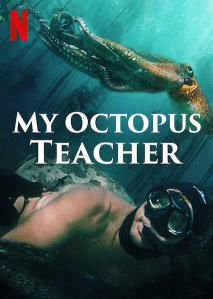 I’m close to finishing the documentary My Octopus Teacher and felt the urge to already begin typing out my thoughts, something I rarely do as I prefer to marinate over movies, let alone waiting for them to conclude. This Oscar-winning documentary wasn’t even part of Netflix’s critics screeners they sent me in the mail to consider for the top documentary prize, which tells me even its home didn’t have the highest of hopes for the true story of one man’s relationship to a mollusk. As it steamrolled through the awards season, my curiosity grew, and I finally took the plunge and watched the movie within hours of it being declared the finest documentary of the year by the Academy. As you can likely guess from the fact that the movie is still ongoing while I write, I may disagree with the Academy’s choice. My Octopus Teacher is a beautiful looking movie with some larger messages about our connections to nature and conservation, but the entire time I kept looking around and thinking, “There has to be more to this, right?” Alas, this is the story about one man and the octopus that won his heart, as told by that man, and that is it.
Craig Foster was a depressed nature photographer who was feeling lost. He would dive into the icy waters off the South African coast to reconnect with his childhood. He discovers a peculiar octopus and follows her movements, studying her for months, and earning the trust of the creature. Craig learns about himself and his view of nature through this fortuitous undersea bond.
 This is literally the story about one man explaining, without interruption, his life lessons he has learned through his yearlong relationship with an octopus, and I just couldn’t fully engage with this on an emotional or intellectual level. The underwater photography is stunning and gorgeous to watch, as would many high-gloss nature documentaries covering the same environment. Watching the octopus hunt, hide from predators, camouflage, contort itself, and even seemingly walk on its tentacles is fun to watch, and nature has plenty of weird specimens to discover and analyze. I’m on board with re-examining the depths of our understanding with some of the weirdest creatures doing their thing thanks to millions of years of evolution. However, where the movie left me wanting is that it is, one hundred percent, one guy talking to the camera and explaining his observations about one nifty octopus and what he has learned from these experiences. The scope of the movie is so minor that it feels less a film and more like a filmed nature article, a little colorful expose that your local news might play to close out its programming. I found the movie to be too slight and unvarying in its information and delivery.
Perhaps I’m a curmudgeon at heart but I kept thinking that Craig Foster was projecting a lot of emotions onto this octopus. I believe this creature meant something special to him, and he became familiar enough that the octopus saw him less as a threat and more as a… what? Does this octopus really see this man in a snorkel as a friend or an ally? She reaches out a tentacle to touch the appendage of this underwater man, but what does that mean? Is this signaling a friendship or is it merely signaling an animal taking stock of its surroundings? I don’t know and depending upon your personal relationship with the animal world, you will either accept everything Craig says at face value without skepticism or you will see him as a slightly foolish romantic.
 The movie’s gentle and empathetic nature is unbroken, though I’d be lying if I didn’t say I thought about the extremes of where this man/octopus relationship could lead. I wondered if Craig was going to declare that he and this octopus were getting married, he was leaving his wife, and that no one could compare to the touch of her tentacles. I don’t mean to sound cruel or dismissive about this man’s emotional experiences. This shared bond clearly touched this man and allowed him to realign his relationship with nature. He even says he feels like a better man and father thanks to these experiences. I’m happy that Craig found that kind of epiphany and direction in his life, and his story has fun details that made me agree that octopuses can be strangely fascinating creatures. However, that doesn’t mean I needed an 85-minute documentary about the guy more or less debriefing to the camera about his year of journaling. It’s just not that grabbing of a subject to satisfy a feature-length documentary. I don’t feel like I gained anything monumentally more from this movie being 85 minutes than I did if it was 25 minutes.
I may watch My Octopus Teacher again and give it another chance (for those wanting to know, it’s since concluded as I compose this review). It beat out serious competition in a year that had some seriously excellent documentaries (Collective and Dick Johnson is Dead both made my Top Ten of 2020). I’m happy so many people seem to be moved by this man’s personal tale of his magical bond with an eight-armed buddy. I was left mostly indifferent. The photography and plenty of the exclusive video captured is interesting to watch, but there’s little separating My Octopus Teacher from a viral clip you’d see forwarded to you from an animal blog. You can find plenty worse movies out there but I guess what makes this movie so special is just lost on me.
Nate’s Grade: B-


 nathanzoebl
You must be logged in to post a comment.