Rampage (2009)
 When I heard that Uwe Boll was writing and directing a movie called Rampage, my thoughts immediately went to the 1980s arcade game of the same name. In the game you played as one of various classic movie monsters, like King Kong or Godzilla, and the mission was to obliterate a city building by building and avoid the military forces trying to take you down (edit: later turned into a 2018 movie starring The Rock). At first I thought there was no way that Boll could raise a budget big enough for a giant monster movie, then I paid closer attention to Boll’s Rampage and discovered it only had one cost-effective monster — man. Boll’s film revolves around a single man massacring a small town. Most surprising of all, Rampage is actually earning Boll a full slate of positive reviews. Critics have mostly taken a shine to this violent shoot-em-up, going so far as to all it Boll’s best film to date. I suppose Boll’s recent upgrade in ability he showcased with Stoic and The Final Storm raised my expectations that the prospect of a “good Uwe Boll movie” is actually a concept not just in the theoretical realms any longer. It could happen. I can honestly say that Rampage is not it.
Bill Williamson (Brendan Fletcher) is just a regular dude living at home with his parents and bouncing from dead-end job to dead-end job. That’s all about to change. Bill seems to have taken a cue from his friend Evan (Shaun Sipos), who has advocated radical measures be taken to make the world a better place. Bill has been building a bundle of arms and body armor for one mission — to kill as many people as possible in a day.
 I think the movie’s main weakness is that it’s too insular. We can never free ourselves from Bill Williamson’s head (really, Boll? William Williamson? Are you even trying?). I understand that Boll tries to drop us into the psychosis of a seemingly ordinary 23-year-old burnout that snaps. To that end, Boll effectively fills the background with an mélange of chatter; short news radio bursts are strung together noting the ails of the global ails of the world. It feels like an actual peak into the anxiety-riddled skull of the main character. But this guy just isn’t that interesting. We’re never given any real insight into his thought process because Boll holds back whatever Bill really thinks until the very end, which means for the majority of the movie we’re just watching a nut in body armor. A far majority of the movie is tagging along on Bill’s killing spree, watching person after person gunned down. Is this entertainment and for whom?
Boll assembles a better thesis about what makes people grab guns and lash out than he did in 2003’s school shooter rumpus, Heart of America, which also starred Fletcher as a chief bully. But that doesn’t mean that the pieces fit together any better. Bill’s rationale is that the world is overpopulated and could use a good pruning. So everybody goes. This is a pretty weak justification, especially when you consider that he’s slaughtering the denizens of a SMALL TOWN who has plenty of room for growth. Will purposely goes out of his way to gun down the servers who irritated him the day before, thus he seeks vengeance not ideological purity. Boll at least switches spree motivations late into something a tad more consumerist, but by then it’s too late. We need outside perspectives for this story to become more than a horror highlight reel of death. This movie could have worked from a Falling Down-esque narrative divided between the man on the rampage and the man in hot pursuit. That dynamic would provide for more thrills as well as a natural good guy and bad guy designation. But Boll doesn’t want any such designation. He wants us to be uncomfortable from beginning to end, to empathize with Bill early on and become horrified about what this says about all of us. A radio broadcaster says, without a hint of irony: “I don’t know how this could happen here or anywhere?” You’re uncomfortable but not because of what Bill is doing. You never empathize with the guy because he’s a loser and pretty hotheaded. It’s because the movie is bereft of commentary that makes it uncomfortable because then the violence becomes celebratory.
Rampage is set in a small town for some sort of ham-handed message about the unpredictability of violence, but could something of this magnitude truly go down in today’s technologically saturated world (for extra sledgehammer irony, the town is called Tenderville)? I will even give some leeway that a small town has a limited number of police officers and Bill blows up the police station as his first goal, but then where are all the neighboring cops? When we live in a world where everybody owns a cell phone, and every cell phone owner is an amateur journalist, it’s somewhat preposterous that news of this magnitude would remain so isolated for so long. As soon as a crazy guy walked down the center of town and murdering everybody, you better believe that CNN would have some cell phone video up in a manner of minutes. Surely the barrage of 911 calls would have informed emergency technicians that the police station was bombed and the killer is still on the loose. Where are the neighboring communities’ police officers? Where are the helicopters? In the age of information, nobody seems able to communicate anything. And why do people have trouble locking and barricading their doors? As Bill goes window-shopping for victims all the store doors remain unlocked, allowing him easy access to blow away customers. If Rampage was set in a violence-torn area that had become eerily accustomed to the sound of gunfire then perhaps people’s initial indifference to gunfire could be explained. But remember, this is a small town for maximum intentional dramatic impact. They should be extremely responsive to the sound of continual gunfire. And these people should be packing too.
 The scheme of Bill’s coalesces in the last ten minutes of the movie, attempting to offer clarity and advance the material. Beware gentle reader, spoilers will follow, but you’ve already come this far. In the end, Bill has planned his killing spree with the intent of framing his only friend, Evan. Bill has made sure all his mail-order purchases were delivered to Evan’s home, Evan is the one with the long YouTube rants about overpopulation and people standing up to make change, and Evan’s father is a former radical from the 1960s who justified violence in the name of good causes. Of course we only learn that last bit in the film’s closing seconds because why would something like that be relevant to know beforehand, right? Bill meets his buddy in the woods for their scheduled paintball date, tazes the bastard, then stuffs a gun in Evan’s hand and has him pull the trigger to fulfill his role as patsy. The cops will think Evan has killed himself after being pursued into the woods. This is why Bill had to come back and brutally gun down an entire salon of women because he took his mask off and exposed his real face. Bill then disappears with the money.
As you expect, there are more holes to this plot than Swiss cheese. First off, there’s a noticeable height difference between Evan and Bill (Fletcher is only 5’4″ tall). Take into account different boot sizes, massive amounts of security camera footage, the registration for the cars that Bill turned into suicide bombs, the fact that the stolen bank money would now be marked, an autopsy report that would discover the stun gun wound and the awkward position for the self-inflicted gunshot wound, and the eye witnesses that must have seen Bill roaming around his neighborhood head-to-toe in his armor, never mind the fact that a massacre of this size practically guarantees the FBI’s involvement, and you’ve got so many areas for this master plan to unravel. That’s probably why Rampage ends with a post-script informing us Bill took off and has yet to be caught because somehow he’s a criminal genius.
This is Fletcher’s (Freddy vs. Jason, HBO’s The Pacific) movie and he pretty much hides behind his character’s literal and figurative mask. It’s not too hard to glower and walk with purpose, which is what Bill does for most of the movie. He doesn’t come across as overtly threatening, which is probably the point, but nor does Fletcher ever show insight into Bill’s dark recesses. He just seems like an irritable child with guns who wants to settle some scores from a bruised ego. Fletcher has acting ability but his assimilation into the Boll Players should worry anybody who wants to see that ability again (four Boll films and counting). Curiously, Katherine Isabelle, the star of the clever teen-girl-werewolf Canadian horror series Ginger Snaps, has a near cameo appearance as one of the salon workers who gets murdered. Having an actress like her play such a small character with brief screen time seems bizarre. Maybe Fletcher, as the film’s co-producer, called in a favor from his Freddy vs. Jason co-star.
 Boll’s direction pretty much gets swallowed whole by the void of his main character. Every decision seems made to suit some kind of allegorical message that never seems to materialize. The camerawork is self-consciously shaky; there’s no reason a simple family conversation over the breakfast table should look like a 9.8 earthquake is going on simultaneously. The film also has the annoying habit of jumping forwards and backwards in time for split-second edits. I couldn’t tell if these flash edits were mere foreshadowing peaks at what was to come, trying to sate a bloodthirsty audience getting antsy, or if they were small fantasies playing out inside Bill’s head, showing his violent tendencies and delicate hold on reality. Well, they were just previews for the main attraction, which makes their use hard to fathom. If Boll wanted an audience to be shocked by what was to come, why give them previews? The film would have worked better without the non-linear quirks. Boll makes sure his camera is never far away from Bill, and during stretches the camera is pinned on Bill’s face as he huffs and puffs and kills people off screen. It’s Boll’s one somewhat interesting moment of artistic restraint. Boll is improving as an action director in certain regards. Rampage has some nice stunt work and some pretty well executed explosions.
Don’t believe the steady stream of good press for Rampage. I never thought I’d have an opportunity to write these words … but Rampage does not live up to the hype. It is not Boll’s first successful movie; I’d argue that his Vietnam movie Tunnel Rats came much closer to being a good and entertaining movie. Rampage is a rather empty vehicle to watch innocents get massacred. It lacks subtext and commentary, so the violence becomes gratuitous and meaningless, which is much more uncomfortable than anything Boll intends with his narrative. Obviously, Boll has modeled his story after recent incidents like the Virginia Tech gunman in 2007. Sadly, there is no shortage of crazed gunman stories in the news to pick from. If Boll attempted to squeeze some subtext into the various proceedings, satirizing the sensationalistic media turning people into fragile, potentially-lethal time bombs, or perhaps even the allure of fame through whatever costs, even the most infamous, then maybe watching countless people get shot would at least offer some meaning. I wasn’t expecting a Funny Games dissection level of violence and voyeurism and the participation of the viewer, but I expected more than watching a dude in a suit of armor kill fleeing civilians for an hour. If that’s your idea of entertainment than perhaps you should go play a video game that rewards such behavior. Don’t worry; it’s only a matter of time before Boll transforms that into a movie next.
Nate’s Grade: C-
Share this:

This Is It (2009)
 More like a DVD behind-the-scenes feature that never materialized, This Is It is a documentary following Michel Jackson’s rehearsal for his comeback concerts that never were to be. The entire film feels more like a memorial service than an actual movie. It feels like a supplement. In between teary interviews where performers express how Jackson inspired others, we do experience some key moments where Jackson reminds us about his brilliance as a performer. The man is relentlessly dedicated to perfecting his vision, and he isn’t afraid to push others. But overall, This Is It is mostly a boring enterprise that ultimately alternates between feeling like a reverent memorial and a crass cash-grab. Unless you’re a Jackson fanatic, there really is no reason to watch this film. It provides no insights into Jackson’s final days, his state of mind, or even the events that lead to his death. I was morbidly searching for any little clues but the movie seems to skip over anything that doesn’t portray the King of Pop as a saint. There will be many documentaries and TV specials in the future that examine the life and impact of Jackson, as well as his bizarre and damages personality, but this isn’t it.
Nate’s Grade: C
Share this:

The A-Team (2010)
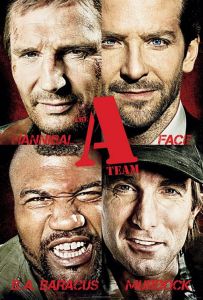 “Overkill is underrated,” quips Col. Hannibal Smith (Liam Neeson) in this big-screen adaptation of the 1980s hit TV show of the same name. And appropriately enough, like its source material, The A-Team is the very definition of mindless action. It’s completely shallow, goofy, yet over plotted and occasionally too serious for its own good, but like the A-team, the movie delivers when it counts. There is an undeniable pleasure in watching professionals work together, hatch a plan, and then watch that plan come to fruition. The A-Team is like an ADD-child because it can rarely sit still; five minutes won’t pass before something blows up. Writer/director Joe Carnahan (Smokin’ Aces) makes sure to keep things flying on screen so that the audience won’t stop and think about the multitude of plot holes and absurdities. The signature sequence that sums up the movie best is when the A-Team boys have escaped a downed aircraft by hiding inside a tank with parachutes attached. As they tumble back to earth they must try to “fly that tank” to land properly. It’s ridiculous on its face but rather entertaining. But the movie has its tongue firmly planted in cheek, even when it comes time to incorporate the show’s signature catch phrases (you could make an effective drinking game for the amount of utterances of “fool,” and, “I love it when a plan comes together”). The A-Team is overblown, silly, high-octane B-movie that obliterates your senses and thinking abilities, which means it successfully captures the spirit of the TV show.
Nate’s Grade: B-
Share this:

Get Him to the Greek (2010)
 How many scene-stealers get spin-offs? That sounds like something you’d more likely find in the realm of TV, but it does happen occasionally in cinema. In 2008’s Forgetting Sarah Marshall, comedian Russell Brand played British rock star Aldous Snow. He stole Sarah Marshall and he also stole the movie. Now the stringy Brit with the crazy hair gets is own movie, Get Him to the Greek, a semi-sequel to Sarah Marshall.
Aldous Snow (Brand) has had his career hit a bit of a snag. His latest album, and lead single, “African Child” has been met with a tidal wave of bad press. Critics are calling it the worst thing to strike Africa after famine, war, and apartheid. His longtime girlfriend and fellow recording artist, Jackie Q (Rose Byrne), has dumped him and gotten full custody of their son. His life, and he, has gone off the wagon. Music exec Sergio (Sean “Puff Daddy” Combs) is desperate for ideas to help make money for his company. Aaron Green (Jonah Hill) suggests to the boss man that it will be the 10-year anniversary of Snow rocking out at the Greek Theater in Los Angeles, a seminal concert event. The boss tasks Hill with traveling to London, retrieving Snow, getting him to a Today Show performance in New York and then to the Greek in L.A. for an anniversary concert. Of course babysitting a drug-addled rock star and getting him places on time is easier said than done.
 Get Him to the Greek is ultimately a buddy movie. Brand and Hill play off each other so well. In fact, I might say that Hill’s character is a tad too dull when he’s not around the hyperactive and impulsive Snow. You sort of feel for the guy and you’d like life to turn out well for him and his girlfriend, but you’re not completely committed to the character. However, when he’s bouncing off Brand, the movie transforms into a wild comedy with many funny moments and a few that miss the mark. Green has been entrusted to handle his high-maintenance rock star and this presents a few stellar comic setups. Green has to make sure that his star is not impaired when he performs on the Today Show, so he steals Snow’s flask of booze and joint and downs them both to protect his star. The resulting appearance on the Today Show then flips the script, having the flaky star be the straight man to the highly impaired handler. The funniest sequence for my taste involves a drawn-out drug trip in a Vegas hotel. Things spiral out of control and involve furry wall groping, mass amounts of property destruction, and Snow stabbing Green in the chest with an adrenaline needle, then being chased by an incensed Sergio who will not be stopped even after being hit by a car. It’s an exhilarating, madcap sequence that picks up comedy momentum and plows ahead. You may not be able to relate to either character, but when you put them together the movie comes alive with comic mischief and misfortune.
Being a Judd Apatow (Knocked Up, Superbad) production, Get Him to the Greek has got to bring the heart with the raunch. Even though we spend the majority of the running time with two characters, the film is less character-based than other Apatow-produced products. The sentiment slips in at the end. Obviously, given the setup, you expect Green to become more aggressive motivated, Snow to become more mellow and conscientious, and we’re all better for it in the end. The two characters do begin to bond in their unusual way, which elicits much of the film’s enjoyment. I enjoyed spending time with these two guys, especially when they were together. That likeability factor got the film through some of its rough patches. As far as supporting casts, a hallmark of an Apatow-produced film, Sean “P. Diddy” Combs is the movie’s scene-stealer, mostly through sheer force of will. He’s not the funniest guy but man does he chew scenery with gusto. He’s so loud and crazed that he practically scares you into laughing as a defensive impulse.
 Brand is a terrific comedy discovery. He has such an electric energy and his wild-eyed hijinks and deadpan delivery had me in stitches. I was worried that a full movie for Aldous Snow would wear thin, but Stoller and Brand have deepened the character. It would be extremely easy, and almost understandable, for Snow to just be this caricature of the rock and roll lifestyle, an easy send-up for easy jokes. But just like with Sarah Marshall, the more time you spend with Snow the more you start to like him. He’s genuinely charming. His onstage persona evokes memories of Mick Jagger, Led Zeppelin, and Freddie Mercury. He’s self-destructive and egotistical but he’s not as shallow as he may appear to be (his vocabulary is a notch above, too). He’s unpredictable but he’s not stupid. He’s fairly vulnerable with some real feelings, lamenting his failed relationship with Jackie Q and yearning to be the father for a son that may not even be his. His life is filled with hangers-on and leeches, including his own parents. Brand can be good at being ridiculous but he can also be very good at being miserable. His vulnerability and attempts to be something more than the sum of his lifestyle allows for some tender moments between the babes and booze.
Hill has graduated from supporting player to “regular dude” lead in the Apatow Academy. He’s presented almost as a brazenly average everyman, albeit one who appears to be dangerously overweight (seriously, Hill has ballooned like a blowfish and I worry for the guy). This role allows Hill to showcase the most range he ever has yet. He believes in the power of music and has a personal stake in what goes down at the Greek. He sells his dramatic parts better than expected. He and his girlfriend, Daphne (Elizabeth Moss from TV’s Mad Men), make for an unconventional couple via Hollywood’s superficial standards. It’s an interesting match and somewhat refreshing that Hill isn’t dating some knock-out (Moss is quite fetching, don’t get me wrong).
Greek doesn’t measure up to Sarah Marshall and part of that is because the story is a bit too shaggy, housing gags but lacking a stronger driving plot. Many of the scenes don’t connect so much as independently exist. Also, writer/director Nicholas Stoller (who also directed Sarah Marshall) sometimes doesn’t know when to leave well enough alone. The drug-addled sequences tend to get a little tedious after the third or fourth time. Granted, drugs and alcohol are all apart of the modern rock and roll experience, but watching people act weird on drugs can get tiresome unless given a different context to work with. Some of the comic setups are a tad lazy but are saved by the efforts of Brand and Hill. When Aldous orders his lackey to smuggle heroin in his rectum, it feels strained even by the standards of wacky comedies. It feels like one episode that doesn’t lead to anything other than a quick, almost absurd, comedy dead-end. And for a movie with a ticking clock constantly running down the hours before Snow needs to be at the Today Show and then the Greek Theater, there sure is a strong lack of urgency. When they run late or miss planes, you don’t really care because you know it’s a matter that will be easily solved.
 A fact I really enjoyed with Sarah Marshall was that the girls were given something to do — they were allowed to be more than the joke, they could be in on the joke. Mila Kunis and Kristen Bell’s characters were allowed to be nuanced, mature yet able to make mistakes, and both were funny while being central to the story. With Greek, the female characters are mostly one-note and then given a little polish. Jackie Q is all brash sexuality and Daphne is prim and constantly exhausted. They’re extremes made for easy laughs. When Jackie Q tries to get serious, we don’t really buy it because she seemed rather pleased to soak up the unhealthy riches of fame. Her behavior is inconsistent. With Daphne, her wet blanket personality is supposed to be the joke, and then when she cuts loose toward the end, requesting a three-way between her, Green, and rock star Aldous Snow, it feels wrong for her character and weirdly reminiscent of Chasing Amy. I know Get Him to the Greek is primarily a boys movie, but it lacks the same generosity of character that aided Forgetting Sarah Marshall.
Get Him to the Greek is a solid comedy helped by two strong lead performances. It’s a nice addition to Apatow’s family of character-based comedies even if it doesn’t live up to its ambitions. The movie is consistently funny throughout, which is integral to being a comedy. The character dynamics lead to some entertaining comic set-ups and sometimes some lazy ones, but the troupe of actors makes it all work. Brand and Hill are a fine team and the movie has plenty of surprises and cameos to keep things fresh when a gag misfires. I wouldn’t mind seeing the further exploits of Aldous Snow, or even listening to some of his recordings (his Sarah Marshall tune “Inside You” was criminally left off the Oscar nominees in 2008). But this movie just made me realize how much more I appreciate Sarah Marshall, and how that movie has grown on me over time. I suppose like Hill’s character, it took an extended detour with Aldous Snow to make me realize what I truly appreciate in life.
Nate’s Grade: B
Share this:

Toy Story 3 (2010)
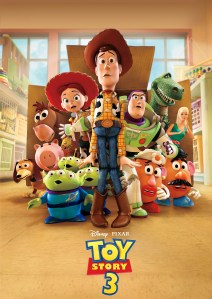 I was completely unprepared for how emotionally involving Toy Story 3 would be. Sure, Pixar has managed to break and melt your heart through ten previous movies, but I suppose I foolishly felt that I was beyond caring for toys. But even in the opening minutes, a tremendous make-believe fantasy, I felt punches of emotion as each character was reintroduced. It felt like I was reconnecting with old friends and it was such a pleasant reunion. It’s okay, guys, to cry over toys.
Cowboy sheriff Woody (voiced by Tom Hanks), the leader of Andy’s toys, is trying to keep hope alive. Andy is now 17 years old and on the verge of leaving for college. His favorite childhood toys have long since been relegated to a chest as Andy has matured. Joining Woody are spaceman Buzz Lightyear (Tim Allen), Jessie the cowgirl (Joan Cusack), Mr. and Mrs. Potato Head (Don Rickles and Estelle Harris), Slinky Dog (Blake Clark), the timid Rex (Wallace Shawn), and the piggy bank, Hamm (John Ratzenberger). They are all the toys in their gang that remain. As Andy leaves their main goal seems to have been accomplished. They were there for their owner and now he no longer needs them like he once did. The toys have a few options left: stuffed into the attic, sort of like a retirement home, until perhaps Andy digs them out for his own kids, or being thrown out with the trash. Woody assures them that Andy would never just throw them all out, though even he has his doubts about their current purpose. They all feel the loss.
 After a mix-up, the toys decide to take matters into heir own adjustable hands. They will sneak away inside a donation box for Sunnyside Day Care. The center seems too good to be true. The courtly Lotso Hugs Bear (Ned Beatty), who seems to lead the center, promises that all toys will never be forgotten again. When the children grow too old then a new batch moves in to play. It’s a toy’s dream, that is, until Buzz and the gang discover that they’re canon fodder for hyperactive, maniacally destructive toddlers. They can’t keep up with the daily abuse. Sunnyside Day Care is less a haven than a prison. New toys have to pay their dues and earn a place in the vaulted Butterfly Room, where young children lovingly interact with their toys. It’s a toy class system. Lotso refuses to cotton to rule-breakers, and toys are locked away nightly so they cannot escape. Woody must try to save his friends by breaking them out and getting back to Andy before he departs for college.
Given that the movie tackles major issues like moving on, growing up, and mortality, I knew I was in for some heavy moments, but absolutely nothing prepared for some of the emotions that clobbered me. You do realize through the course of this third film as the toys try and find a suitable place to retire, if you will, how attached you are to these characters. Late in the movie the toys are in some dire circumstances. There’s a horrifying junkyard sequence that even manages to evoke Holocaust imagery, which means parents are going to have to calm some spooked tykes come bedtime. There’s a silent moment, where the toys all seem to accept their fate, and all they want to do is join hands and face it together, as a united family one last time … and my God, I could not control myself. My face was dripping with tears (even thinking back right now is causing my eyes to well up a bit). Toy Story 3 isn’t the strongest of the trilogy in terms of character or plot (in some respects, the plot is a reworking of The Brave Little Toaster), but you better believe that it delivers emotional resonance in spades. Major credit goes to screenwriter Michael Arndt who won an Oscar for Little Miss Sunshine.
 But fear not, Toy Story 3 is not all sturm und drang, it also provides plenty of laughs and plenty of visual wonder and excitement. The toy’s point of view has always allowed for plenty of amusing insights and satirical riffs. The personality clashes makes for the most jokes, and the new characters pull their own weight, particularly Ken (Michael Keaton), an effeminate clothing-conscious doll who finds his true love with the arrival of Barbie. The use of Big Baby as a malevolent goon is also refreshing and quite creepy. The Spanish Buzz reboot personality seems superfluous but cute. The jokes come by at a steady pace and while they all may not work as well (Ken in a trying-on-clothing montage set to “Le Freak”?) there are still moments of great creative ingenuity. The detailed escape from Sunnyside feels like a terrific parody of prison movies, and they way it utilizes all the different characters as key components is satisfying and fun. But the best moment of the break-out, by far, is when Mr. Potato Head is trapped, hurls his pieces out of an opening, and reassembles thanks to a tortilla body. It’s a weird visual, like something out of Salvador Dali, and yet I could not stop giggling from watching his floppy movements. It’s comedic while at the same time a genius move in drawing out an action sequence — it makes keen use of the players and their skills. From an action standpoint, G-rated Toy Story 3 manages to have more thrills and spills than any other 2010 movie so far.
Director Lee Unkrich (co-director for three previous Pixar flicks) makes quite a debut for himself. The complexity of the action, while still maintaining an internal logic, is hugely rewarding. The Pixar wizards truly know how to craft inventive action sequences and stay true to character. Unkrich’s command of visuals is impressive. The action is well paced, but it’s the man’s use of composition, camera movement, and editing make Toy Story 3 a visual treat. Unkrich fully knows how to best utilize and fill up the screen. The world of Toy Story is popping with color and visual whimsy, as well as plenty of sight gags and subtle movie references for adults. Ten years of advancements in computer effects has also allowed the toys to get a bit of a facelift. The 3-D process enhances the overall experience without calling attention to itself. There aren’t any standard 3-D moments where big and pointy things keep flying out at the audience. The 3-D provides a greater field of depth without distracting you from the pivotal moments of story.
The voice acting is just about perfect from top to bottom. Allen and Hanks are a welcomed pair, Cusack provides plenty of spunk, Rickles brings his usual dish of joyful disdain, and new characters like Timothy Dalton as a stuck-up thespian porcupine and Kristen Schaal (TV’s Flight of the Conchords) as a bubbly triceratops toy are fun additions that don’t overstay their welcome. Blake Clark takes over the voice of Slinky Dog from the late Jim Varney who died in 2000, and he does a fine job without sounding like a direct imitation. I was really delighted by Beatty. He has such a Southern gentlemanly demeanor that underscores the hardened heart of his villainous character. And yet, Lotso gets his own rich back-story of abandonment and bitterness similar to Jesse the cowgirl. Even when he’s dastardly we can see where the big purple Teddy bear who smells like strawberries is coming from. Ned Beatty has finally appeared in another breakthrough cultural film to redefine his identity. Perhaps now he won’t be best remembered as the guy who gets raped in Deliverance. He probably still will be.
A lot has changed in the 15 years since Pixar revolutionized the world of animation and family films with their first feature, Toy Story. Kids at the time are now teenagers; some embarking on college this summer themselves much like Andy. They too have to put away former childish things and move forward. Toy Story 3 is magic confluence of heart, wit, visual whimsy, cleverness, and drama. Not quite as sharp as the first two installments, or as artful as Pixar’s high-water mark, WALL-E, the third Toy Story is still a mighty entertaining piece of work. The last 30 minutes of this movie is harrowing and then deeply satisfying and moving, finding a fitting sendoff for characters that we’ve come to love. It’s all about moving forward, saying goodbye, and reflecting about times shared. I wouldn’t be surprised if Toy Story 3 inspires kids, and adults alike, to go home and play with their old toys, giving them renewed life and purpose.
Nate’s Grade: A
Share this:

The Princess and the Frog (2009)
 It’s taken this long to get an African-American leading lady/princess in a Disney animated film, and she gets to spend the majority of the flick as a slimy frog? This return to traditional 2-D animation for Disney is less than a triumph due to a pretty dull storyline. All the familiar elements are there, but the characters just fill voids rather than tell a story. There’s the downtrodden heroine with her dream, the arrogant prince who learns to value others, the comical talking animal sidekicks, and get ready for a slew of songs you will instantly forget despite the added gumbo flavor. Set in 1920s New Orleans, the film has plenty of ravishing visuals to get you through the formulaic plot. It’s a nice return to Disney’s bread and butter before the 3-D animation craze took off, and I pray that there will be plenty more traditional 2-D animation on the horizon from the Mouse House, but this isn’t the best film to reestablish the glory of traditional animation, racial politics aside.
Nate’s Grade: B-
Share this:

Prince of Persia: The Sands of Times (2010)
 This video game adaptation has the curious distinction of being both too simplistic and too complicated, sometimes in the very same breath. The harried screenplay could have used a lot more clarity concerning back-story, exposition, character roles, setting, rules of this Middle Eastern time period, supernatural rules, etc. At the same time, Prince of Persia is saddled with a pretty dopey story with weak characters. The plot is far too repetitious; somebody has the magic dagger that can turn back time, they lose it, they regain it, they lose it, repeat for over an hour. It feels like the story is never getting anywhere despite the fact that new, and still weak, characters are being introduced. The tone and look of the movie feels too beholden to its video game roots; the action is momentarily rousing but then seems overly coordinated to squeeze in all the game’s special signature moves. You’ll grow tired of all the wall flipping, wondering if a controller is stuck somewhere. For a movie dealing with a time-traveling dagger, give me more time travel. This fantastic plot device is used too sparingly in a ho-hum plot about an adopted son (Jake Gyllenhall, buff and with a sporting accent) of the king being accused of killing the king. Despite the Disney name, this feels less like a Pirates of the Caribbean knockoff and more cut from the same cloth that gave us the Mummy sequels. It’s loud, stuffed with empty special effects, and feels like junk food for your brain but it’s not even good junk food. Weirdest of all, the movie is one big metaphor for the U.S. invasion of Iraq (acting on false intelligence about some country aiding an enemy by manufacturing weapons). Seems Prince of Persia is Hollywood’s second attempt to rewrite our past political blunders in the Gulf and come up with a dubious happy ending.
Nate’s Grade: C
Share this:

Sex and the City 2 (2010)
 Sex and the City is a cultural phenomenon that women around the globe celebrate. When the show first premiered on HBO in the late 90s, it chronicled the lives of professional women that wanted to have it all, and they wouldn’t apologize for their sexual appetites or fashion splurges. The successful show then launched a very successful movie in 2008, but the movie tied up everyone’s storylines in fairly nice little bows. So now where to? For the fans, it hardly matters. Sex and the City is a cause of celebration, a girl’s night out with cosmo in hand. The content of the movie seems almost like an afterthought. Fans aren’t going to be too picky but there is a lot to pick at with Sex and the City 2.
It’s two years after the events in the first film. Carrie (Sarah Jessica Parker) and her husband, John James “Mr. Big” Preston (Chris Noth), are settling into married life. Miranda (Cynthia Nixon) feels mistreated and unappreciated by her boss because she’s a woman. Charlotte (Kristin Davis) has her hands full with two young children, and motherhood in reality isn’t at glamorized as she thought. She’s also worried that her husband (Evan Handler) might cheat with their busty Irish nanny (Alice Eve, the “10” from She’s Out of My League). They girls dub her “Erin Go-bra-less,” I think as a weird wordplay on Erin Brockovich. Your guess is as good as mine. And then there’s Samantha (Kim Cattrall) who is 52 and desperately fighting to look and feel young again. She has a regiment of hormone pills and creams she uses daily to keep the encroaching effects of menopause at bay. To give the girls an excuse to get away, a rich middle Eastern sheik wants to persuade Samantha to do some PR work for his hotel, so he invites the foursome on a fabulous all-expenses-paid trip to Abu Dhabi in the United Arab Emirates.
 I know coming from my non-demographic perspective that I’m going to have some difficulty relating to these main characters, but these gals are so self-absorbed in their petty, rich people problems, I question who could really relate to much of this drama. Charlotte is being driven mad by the toll of motherhood, which is relatable, except her toll involves staying at home in a rich apartment, never having to worry about money, and handing off her screaming kids to the nanny. Not relatable. Carrie’s dilemma is the most forced and therefore the worst of the bunch. After having her storyline tied up in the first film, where can she go? She has got the guy, she got her wedding, she has a luxurious apartment, and her man wants to spend time with her. She’s in her mid-to-late 40s at this point and wants to still go out every night on the town. She complains that they stay in TWO NIGHTS a week. When Big gets her a thoughtful anniversary gift, a flat-screen TV in the bedroom so that they can watch old romantic movies TOGETHER, she pouts and says, “Jewelry would have been nice.” Her main problem is that her guy, the one she married, wants to spend time with his wife in their comfy abode and relax TOGETHER. When Carrie asks for two days leave so she can get some work done on an article, Big allows her the time off and then wonders if that apply to their marriage: each takes a day or two off to concentrate on work, relax, catch up with friends, etc. It’s her idea, but when he voices it suddenly it becomes threatening and again all about Carrie. She responds, “Is this because I’m a bitch wife who nags you?” Well, at least she cuts to the chase. These are the problems that people have when they don’t actually have any real problems.
There is one, count ’em, one great scene in the movie and it doesn’t involve Carrie or the ever increasingly cartoonish Samantha. Charlotte and Miranda are by themselves sipping from cocktails and confessing about the hardships of motherhood. Both take sips and then admit a guilty secret. One says she feels like a failure at being a mother. Another admits that being a stay-at-home mom just isn’t enough for her in life. They both admit that they love their children dearly, but have enjoyed the time away from them. The scene feels genuine, with some heartfelt laughs derived from the situation. Charlotte bashfully admits that her first thoughts following the idea that her husband might cheat with the nanny were, “No, I can’t lose that nanny,” and it feels honest and right for her character, plus it’s funny. And then they admit something that the audience had fortuitously forgotten in that moment — they do all this with help. Charlotte has a nanny and Miranda has her grandmother-in-law living with them to help raise the kids. A really nicely written and acted moment that peels away to showcase the complexities of the modern mother is dashed. Even the universal concerns we can all relate to (infidelity, doubt, settling, getting older) take a backseat to the overly manufactured melodrama.
 The rampant consumerism hasn’t slowed down despite the economic meltdown of 2008. Carrie makes a quick comment about how it “wasn’t a good time to sell her apartment,” and so she keeps her spacious apartment along with the multi-million dollar one she lives with Big. The sheer celebration of consumerism has turned into blind worship; it’s all about the stuff. The characters have long since burrowed into their types (the fussy one, the career-minded one, the sexually voracious one, and the self-involved one), and those types have become entrenched, and the men have become just another accessory for a large closet of goods. The real star of this movie is the outlandish, sometimes garish, fashion, and there is heaps of it. One outing into the Arabic desert makes use of three separate costume changes. The name-dropping and product placement are aggressive. For the first film I wrote: “‘I’m not going to charge the film with setting back feminism or anything but why do the main characters have to be so shallow, brand-conscious, and live to splurge? The emphasis on buy, buy, buy to make yourself feel good is a rather sad and empty message.” The Sex and the City movies have morphed into consumerist, female wish-fulfillment fantasies, enabling Carrie’s princess indulgences and superficial demands. The girls are all panicked towards the end about he possibility of, gasp, flying coach, you know, like the rest of us. These women haven’t lived in anything resembling reality for some time. It’s a shame that in these cost-conscious times, the Sex and the City universe seems unaffected. I would have enjoyed seeing how these high-powered women dealt with the repercussions of an economic recession (not to mention Carrie dealing with the death of print publishing). Yes, I know, it’s designed to be escapism, and that’s all well and good, but I wanted to escape from these characters and their lifestyles.
But what will get the most attention is the extensively long escapade in the Middle East, like Sex and the City is planning to solve global politics. Obviously, there is something wrong with how women are treated in several majority Muslim countries, from the demands to cover themselves in heavy garments so as not to tempt men, to the void of rights, to honor killings and stonings, and murdering women just because they went to school. This is a serious matter. These countries are behind the times and women deserve an equal footing and an equal say, and several contemporary movies have dealt with these issues in a thoughtful manner. Sex and the City 2, on the other hand, takes a patronizing approach that is culturally insensitive at best and downright racially insulting at worst. These ambassadors of modern feminist thinking basically show themselves to the Arab world as the quintessential ugly Americans; the ladies of Sex and the City are exactly what radicals think about when they order women to cover up or else. These women are self-indulgent, materialistic, vapid, and riding high on Western self-righteousness. I am in no way apologizing for how large portions of the Muslim world treat women, but Carrie and company are quite possible the worst ambassadors to argue the case for feminine equality. And remember, they complain about their pity-party problems while on an all-expenses-paid vacation to a lifestyle of lavish luxury in the Middle East. They reduce the problem of Muslim women into simplistic, indignant quips. It’s more than a little insulting to have somebody wearing clownish outfits telling women in other countries how to dress. This foursome is brash and in-your-face with their strong sense of cultural superiority, practically baiting the locals into making a scene. At one point, Samantha is jailed and shocked that the authorities might be upset that she was caught having sex on their beach. Don’t these women understand culture clash? In the end the women are chased out of town and you almost (I repeat — almost) feel for the other side.

This is considered fashionable?
Even worse than the ethically dubious moralizing is the fact that this extended portion of the movie (about 100 minutes) grinds the plot to a halt. Most of the storylines are set up before the trip, and then they are all tied up somehow when the women return, though the time in Abu Dhabi seems to have had no effect. Miranda’s conflict with her boss is resolved before the gals ever get on a plane, so she becomes essentially tour guide and confidant for the trip. Samantha is denied her plethora of pills at the airport, so she becomes the slapstick comic relief trying to stave off menopause. Her pun-heavy dialogue is full of groaners like, “Lawrence of my labia.” Her sex kitten act is getting as tiresome as her futile attempts to keep Mother Nature at bay. Samantha is the same from the beginning of the movie to the end, and fans will probably rejoice at this lack of character development. The entire misadventure in Abu Dhabi feels like a Hope & Crosby road picture, or, worse, one of those lame TV-movie gimmicks from sitcoms (luckily Carrie is spared the curse of the tiki idol).
But whatever I say will be regarded with shrugs by the legions of Sex and the City fans. They’ve grown with these characters over 12 years, so I understand the attachment fans feel. Like I said before, the movie medium is not the ideal place for these ladies. In half hour doses their quirks and problems seem cute, but when stretched to a bloated running time they come across as vapid and whiny. The conflicts don’t seem too relatable and the humor is once again tied to slapstick and leaden puns. The problem is that after six seasons and one 145-minute movie, the characters feel tapped out. They’ve been through plenty and now the crew is just coming up with whatever excuse they can have to reunite the cast on the big screen (stay tuned for Sex and the City 3 … in Space!).
Nate’s Grade: C
Share this:

49 Up (2006)
 In 1964, filmmaker Michael Apted (Coal Miner’s Daughter, Gorillas in the Mist) interviewed 14 seven-year-old kids from different British backgrounds asking them about their futures. The half-hour TV special by Granada was called 7 Up and it aimed to show the world where the future politicians and doctors and trash collectors would begin. Every seven years since, Apted has returned to those same kids and peaked in on their lives, chronicling their lives. It’s one of the most famous documentary series in history. Thanks to the virtues of Netflix’s streaming service, I was able to watch six of the seven movies in the Up anthology (sorry 35 Up, the lone film not available for streaming). I spent the next twelve hours watching the lives of 14 complete strangers from childhood to middle age, and by the end they didn’t feel like strangers any more. They felt, weirdly, like family. And that’s the true appeal of the ongoing series: you are watching the evolution of human beings. It’s not everybody that gets a visual scrapbook of their life that’s viewed by millions worldwide.
 Finally, after many hours, 49 Up is the first in the anthology to address the ideas of selective editing and building storylines to suit the “characters.” Long before reality television smoothed away life’s edges to make everybody fit into archetypes, Apted positioned the Up series as his thesis on class struggle. He purposely selected a cross-section of English schoolchildren from private schools and public schools and even two from a boy’s school for orphans. You can see it at 14, 21, and 28 how Apted sticks to his same line of questioning about class advantages and disadvantages, peppering his subjects with questions about what they didn’t have and then showing their current situations in a specific manner to make the audience feel a specific emotion. It’s not deliberately diabolical or partisan but the class warfare ideology certainly can chafe. Do the kids at the top still get all the perks? Are the kids at the bottom suffering with limited opportunities? Has anybody transcended class? Apted starts attributing achievements by the upper class boys as part of their upper class advantages and not due to their hard work, dedication, or talent, which they have every right to complain about. John complains at 21 that when, at seven, they declare their education ambitions, and Apted follows it up with narration, “John did attend such and such,” that it creates the illusion that everything has been handed to them. The hard work and long hours are not shown, and fair point. A few of his subjects actually begin to challenge Apted over his perceptions. Suzy takes aim at his line of questioning, hinting at her life’s disappointments, and fights back, accusing Apted of trapping her into a small narrative box. She even brings up another heated conversation in the history of the series, when Apted questioned whether Suzy, at 21, had experienced enough of life to settle down (she eventually divorced years later). You witness her youthful indignation and she remarks, with some resignation, that Apted is free to edit this outburst as he will and she is helpless (obviously Apted kept this in). It’s the first time I’ve seen the stars of Up contest their onscreen portrayals.
It is also with 49 Up that the film series starts to finally reflect. Part of that comes with living half a century, and many of the 12 on camera subjects are now at an age where they have grandchildren and are setting up retirement (I wonder what the economic meltdown of 2008 did for those plans). They can reflect about the accomplishments of their lives, the past dreams captured on camera that never came true, the marriages that dissolved, the joys and struggles of rearing children, the pains of burying parents, etc. They seem to be at that stopping point where they can take stock of a life lived. On top of that, the participants now begin to reflect on what being apart of the Up series has meant to them. It certainly shapes public opinion about who they are as people, and Apted gropes for any new info to connect with the prior material in the earlier movies.
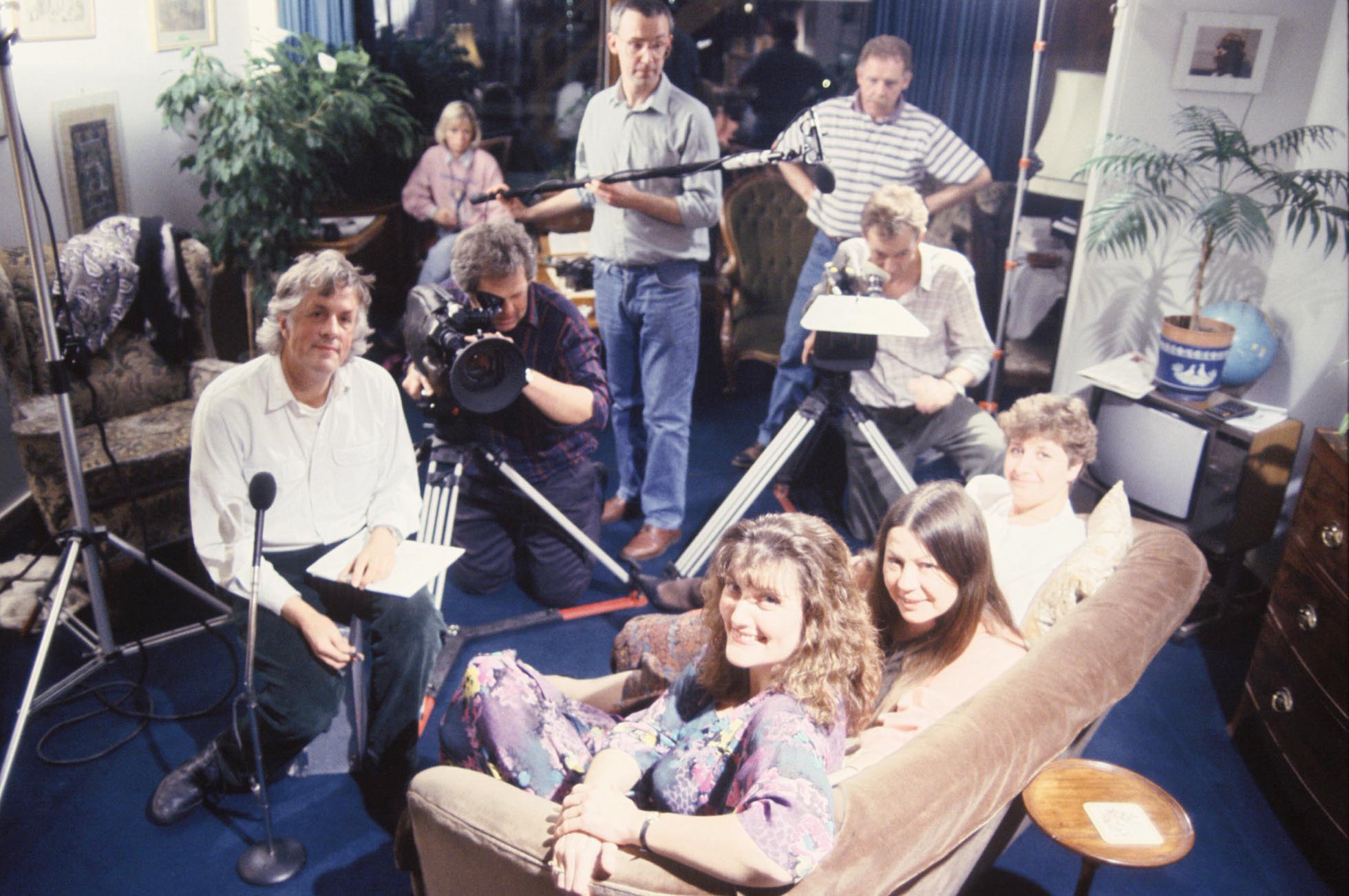 Perhaps Apted feels like he has to keep flogging his class thesis because most of his subjects are pretty regular, i.e. boring, people. They’ve lived lives of modesty and hardship and persevered, but they’re at heart no more interesting than your neighbors. The problem with selecting a bunch of seven-year-olds you plan to follow for the rest of their lives is that you have no clue what will happen. The narrative is completely up in the air. This is why Apted, early on in the series, sticks doggedly to his class thesis to provide some sort of framework he can revisit every seven years. That’s why the series starts to become something of an echo chamber. The exact same sound bytes get used over and over again, trying to find new relevancy. The adults get forever defined, and continuously redefined, by something they said at seven years old, like Neil’s worry that a wife would force him to eat greens and he “don’t like greens” (I’m in the same boat, kid). The echo chamber effect is even more obvious if you watch the Up series in a row. You will start to memorize the childhood catch phrase of everybody and then watch the same clips recycled from 7 to 42. Each is like a little stepping-stone to the present. When viewed as a whole, the series can almost come across as facile. Apted doesn’t probe very deep into his subjects and their lives, mainly sticking to the Life’s Checklist of Accomplishments of Being an Adult: school, job, spouse, family. Personally, I hate how we become defined by a profession. That seems to be the second question that rolls off our tongues when we meet a stranger: “Who are you and what do you do?” What do we do? That’s a loaded question and I object to the idea that our job is the only relevant thing that we “do.” But that’s just my hang-up, I suppose. Apted also lets his subjects reveal the biggest changes in their lives, meaning that if somebody doesn’t want to broach a topic then it gets left unanswered. It can get frustrating and makes for some opaque follow-up visits.
Not every participant is thankful for the Up series. In fact, many of them are wary and somewhat disdainful of participating. Every seven years these people have to rehash their life’s highs and lows, boil them down into a package, and then have it picked over by Apted and his leaning questions, stirring drama anew. It’s easy to see why this becomes a difficult and challenging experience for most, something akin to a cross-examination about your life. So why do most of the 14 return every seven years? Is it the secret hunger for fame? John Brisby ducked out of the Up series after the third installment, upset that he had been made into the series villain through editing. He came across pompous and like a prototypical “old money” sort who lived in a small privileged world (fox hunting!) and reinforced Apted’s thesis on class advantages. Of course his interviews didn’t help him, but I’ll give the guy the benefit of the doubt. I’d hate for everything I said when I was 14 and 21 to follow me for the rest of my life. Well, in 35 Up, John returned, though begrudgingly. He had a reason. His wife and he had begun a charity to raise funds to help the beleaguered educational state of Belarus, a country where John’s family once resided. In 49 Up, he travels once again to that ancestral country and he remarks, somewhat graciously, that it was directly because of exposure on the Up series that donations increased and the kids in Belarus today have books and school buildings and dedicated educators. John made the most of his fame and directed it to a worthy cause. Plus, it doesn’t hurt that John’s passionate desire to help Belarus (his wife is the daughter of an ambassador to the country) feels like the “character” of John has matured.
 Is there any sense of privacy when you know that cameras will be regularly scheduled to appear? There’s this enormous pressure to continue with the Up series, I imagine. But whom do these lives belong to? They were chosen by school officials and Granada at age seven, so they never really had much of a say in what has turned into a lifelong commitment. It seems that the world has a sense of ownership over these 14 individuals’ lives, an ownership that they never granted permission. They must feel an enormous obligation to keep informing the public about their lives, much like a nagging relative. We are a nosy, intrusive lot, human beings are. And I must say that I personally feel weirdly paternal about them. I feel happiness when they too reach happiness through whatever means. I was smiling from ear to ear when Nick, who at 14 was so shy and awkward, became a wonderfully charismatic, articulate, thoughtful, and rather handsome 21-year-old man (he looked strikingly similar to Andy Samberg). I feel despair as well when marriages don’t work out or once secure jobs vanish. Watching the Up series is like watching the evolution of a human being through time-lapse photography; it’s voyeuristic but at the same time it’s like having an extended surrogate family that requires no commitment. We can watch people grow up, mature, gain wisdom, and without anything more than the click of a button. We can watch hairlines get thinner, faces get larger, bodies get saggy, wrinkles multiply, all while playing the visual game of connecting the current iteration of participants with their past selves. We have these 14 people’s lives at our disposal for entertainment.
The Up series aren’t individually great documentaries. In fact, they’re pretty plain and not fairly insightful. As a whole, they present a fascinating document of the human experience and make for a great way to spend a rainy day. You can’t help but reflect on your own life after watching several of the Up movies, and curiously wonder what you have done with your own life at various intervals. As of this writing, all 14 original participants are still alive, which is somewhat amazing in itself. It will be morbidly interesting to see how the film series carries on after one or more of the participants pass away. Millions around the world will mourn what otherwise would have been a normal stranger passing. It’s probably selfish to keep hoping for future installments, and for the participants to keep updating me about their personal lives, but after a 45-plus year investment for some, it’s hard not to feel a sense of attachment to these people.
Nate’s Grade: B
Series Grade: A-
Share this:

Stoic (2009)
 Until recently, it would have been unthinkable to associate Uwe Boll with the idea of social activist. This is the same man who has caused people so much pain and with his movies, ranging from bad to ridiculously bad to “You cannot unsee what you have seen” bad. The German director who has caused so many film and video game fans suffering seemed an unlikely candidate to seriously explore the suffering of others. And yet Boll’s heart grew three sizes and he directed a slate of movies with a social conscience. His movie about the genocide in Darfur is still circling around, awaiting a release date, but let me stop to remind you that Uwe Freaking Boll directed a movie about a topical humanitarian crisis. This is akin to… Eli Roth directing an Edith Wharton adaptation (“From the director of Cabin Fever comes … Ethan Frome!”). It just doesn’t seem like an organic pairing. Boll is used to blood and boobs (both of the mammary kind and of the idiot variety), not social relevancy. You don’t expect an exploitation filmmaker to shine a light on exploitation. While we await his Darfur movie, in the meantime is Stoic, a quick and cheap movie about three prison inmates (Edward Furlong, Sam Levinson, Steffen Mennekes) brutalizing their cellmate, Mitch (Shaun Sipos) when a bet goes wrong. It’s based on a true story from a German juvenile detention center, or so we’re told.
So what kind of movie is Stoic, actually? Well, for starters it’s an uncomfortable one. The movie aims to show the capability of human cruelty and how easy it is to become compliant within a group, to go along with the flow despite some murky moral hazards. The three cellmates end up kick starting a cycle of violence, each trying to top the last so as not to appear weak or to damage ego. Can this cycle of cruelty be stopped? The dehumanization leads to some rather brutal and disgusting acts of violence and degradation including forcing Mitch to eat his own vomit, dumping urine on the guy’s face, raping him, and sodomizing him with a broom handle (“Just curiosity, I guess,” explains one of his attackers). Despite all this, there are actual moments of restraint on Boll’s part, particularly during the rape sequence. The audio drops out, the edits become jump cuts stuttering ahead through time, and I thought perhaps Boll was maturing. Needless to say this thought was torpedoed a tad when Boll later showcased the inmates rubbing the bloody broom handle over Mitch’s unconscious mouth. Stoic is essentially a torture movie; it’s 80 minutes of literal torture with some extra psychological justification tagged along for safe measure.
 Where Stoic comes into issue is whether or not it possesses any merits to justify watching 80-some minutes or torture. The movie doesn’t offer much in the way of psychological insights or rich characters. Watching people become increasingly hurtful is not the same as exploring the habits that make such escalating acts of barbarity occur. Boll and the actors pound us with the message that we’re in prison and prison has its own operating system and everybody jockeys for position; Peter (Levinson) repeatedly tells us that he feels sorry but felt he had to participate or else they’d turn on him. It’s all about having somebody weaker to take the fall. I’ll give Boll credit that the amplification of events seems plausible given the circumstances, to the point that the three guys have come to the conclusion that there will be serious consequences for their actions unless they convince Mitch to go along with a fake suicide. The movie maintains believability even as things get more and more out of hand, which is commendable. But what isn’t commendable is that there seems little reason for Stoic to exist. Narratively the movie is simple: three guys pick on another guy. The characters are all slight variations of one another based upon the level to process guilt and deception. During the interviews, we’re given fleeting glimpses at denial and coping mechanisms, mainly lying (“I would’ve remembered something like that.”) to self-rationalization (“I kept saying to myself, ‘As long as it’s not me.’”). There aren’t many insights to be gleaned from the brief interviews, which serve as commentary.
Boll decided to make Stoic his Mike Leigh film, meaning that he had the basic outline of a story and told his actors to run with it while he filmed them. There was no script and all the dialogue was completely improvised. This does allow Stoic to maintain a naturalistic feel, however, it also means that the actors are beholden to tough guy clichés. The dialogue, particularly during the interrogation scenes, keeps falling back to a “you don’t know what’s it’s like, man!” mantra. Here are some examples of bland dialogue that the actors came up with:
“What choice did I have?”
“You’re either with them or against them.”
“What don’t you understand? If I didn’t seem like I was apart of it, they’d kill me.”
“I had no choice. They forced me.”
“I want to lie because I don’t want to be that person.”
“I felt like there was no way out.”
And because you knew it had to happen:
“I’m just as bad as the two of them because I didn’t do anything to stop it.”
 You’ll note that most of these dialogue examples belong to the Peter, the chattiest and most remorseful interviewee. Improvisation has its virtues but it can also lead to actors falling back on stuff they’ve seen in countless other genre examples, which means that the banal, cliché dialogue all gets stirred together one more time.
In defense of Stoic, it may prove to be Boll’s finest directorial effort yet. The handheld camera, sharp edits, and close angles copy the Paul Greengrass (The Bourne Ultimatum, United 93) style of visuals, and yet the docu-drama copy works. The visual aesthetic improves the quality of the film and allows Boll many opportunities for interesting compositions and smart stylistic decisions with the economical space of the set. The interviews are shot as one static camera shot to contrast with the shaky, reactionary movement from within the cell. It may not be an original style, but then again Boll seems to adopt (some might say rip-off) a new style with every film. For Stoic, Boll’s direction makes you feel in the middle of these awful incidents, and the pain feels even more real.
But is there any reason to really watch Stoic? The acting is mostly good, and maybe fans of Edward Furlong would like to see what he’s been up to since 1998’s Pecker and American History X. Perhaps the declaration of “Boll’s best directorial effort” will appeal to maybe six or seven curious, and questionably masochistic, film fans. Due to Boll’s German background, I can’t help but wonder if his country’s history influenced him to try a narrative experiment hat explores how easy it is to go along with something awful, how difficult it is to make a moral stand against the grain, and how easily circumstances can find momentum and get out of control. I wonder if Stoic is Boll’s personal act of penance, of trying to understand a nation’s actions (and inaction) and working through a lingering shroud of shame. Then again, I may be reading way more into this movie than was ever intended. It could have just been a lark for a quick buck/deutschmark. Stoic is a mildly interesting little filmic experiment from Boll. Due to its narrative simplicity and limited characterization, it can’t offer much more than another voyeuristic slideshow of human degradation.
Nate’s Grade: C


 nathanzoebl
You must be logged in to post a comment.