Don’t Breathe (2016)
 Alex (Dylan Minnette), Rocky (Jane Levy), and “Money” (Daniel Zovatto) are a team of burglars that use security codes to break into homes. They steal materials under $10,000 to keep them below larger charges. The trio hear about a visually impaired Gulf War vet (Stephen Lang) and his thousands of dollars he keeps inside his home. The naive burglars break into his home and sneakily search for his stashed cash, but the Blind Man (that’s how he’s credited) is a far more formidable victim than they ever could have imagined, and he’s keeping his own secrets that may be worth killing for.
The suspense in Don’t Breathe is deliciously developed and tautly executed, taking a premise that sounds silly on paper and wringing every juicy suspenseful morsel out of it. The crux of this movie is dramatic irony wherein the audience knows more than the characters, and once the Blind Man is activated, so to speak, it becomes an intense game of hide and seek with the audience in on the game. Director Fede Alvarez (Evil Dead) and company have established the layout and geography of the game space, the various rooms and hallways and hiding places, and we spend significant time in every location. A haven one minute might be endangered the next, and the way out or at least a momentary escape from immediate danger might be upstairs or downstairs, or in the walls. An essential part of effective suspense is fearing what happens to your characters, and Don’t Breathe achieves this often with clever setups. There’s one scene where a character falls out a window and lands unconscious on a skylight. The glass begins to crack underneath his weight, and then we see the Blind Man in the room below, anxiously looking for his target. Then there’s also the Blind Man’s attack dog, which you forget about and then pops back up, providing a new threat that changes the dynamics of the moment. The suspense sequences change up so frequently that there’s always something new going on every few minutes. The movie’s attention even seems to alternate between Rocky and Alex and their personal obstacles when separated. The technical merits are present without being overly flashy and self-indulgent. An opening tracking shot inside the house nicely establishes the general layout of the space. Alvarez doesn’t rush his suspense set pieces either, showcasing a wonderfully natural feel for teasing out the tension to make his audience squirm in their seats. With the variety of the suspense set pieces, their clever development, the clear understanding of the geography and stakes, and a swift pacing that doesn’t allow the audience to catch its own breath, Don’t Breathe is a small-scale case study in exactly how to maximize your premise for the most entertainment.
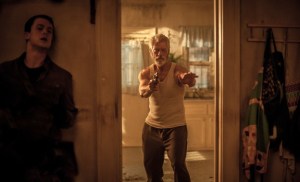 Don’t Breathe packs a punch and this is aided by how streamlined and clean the narrative proves to be, whittling down all unnecessary plot strands. I hated the Money character. He brought nothing to the burglary team besides perhaps some muscle (and a firearm), but I was worried that the movie was going to drag out his inevitable demise. Clearly Rocky and Alex were going to be the main participants and that meant that Money was the most expendable, and given the small number of characters, I worried he wouldn’t be given his merciful end until long into the movie. Well Alvarez must have heard my worry because Money is killed very early on, sparing the audience from dragging out the inevitable. I was appreciative but it also raised the stakes with the two remaining characters because now nobody was obviously next in line for death. A dead Money actually proves more useful than a living Money for the characters. I also appreciated that the movie didn’t dawdle when it came to setting up its trio of burglars and their goals. They’re breaking into the Blind Man’s house at about the 15-minute mark. There’s also no concerted effort at layering in larger social commentary. The economically depressed Detroit setting works to communicate the desperation of the characters, their desire to escape their trappings, and it also provides a tidy explanation for why the Blind Man can drag an unconscious girl by her hair down the middle of the road without alarm (it’s the opening image, so chill spoiler-phobes). This is not a movie that has larger things to say about The Way We Live Now, and to pretend otherwise would be a waste of valuable time. Also, having three white characters serve as the social commentary for Detroit’s ailments would seem rather tone deaf and ill advised.
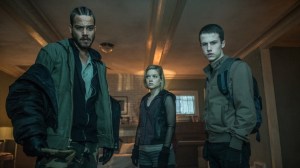 I think if the Blind Man had been a complete innocent that the movie would have been even more interesting as it forces the audience to test its loyalties and choose sides. As my friend Ben Bailey said upon leaving the theater, once they introduce a third act twist involving the Blind Man’s true goal, he ceased having any sympathy and “just needed to die.” I’ll concur mostly, but man I fell out of favor with our trio of young burglars and the best way I can explain is by making an analogy to the Howie Mandel prime time game show, Deal or No Deal. Contestants would randomly choose briefcases hoping that they contained low amounts of money, furthering the odds that their briefcase would contain a larger and joyous amount. It’s really just a game of odds and averages. It’s mildly fun but with every contestant there was a breaking point for me, a point where they really should have cashed out but instead chose to go forward against unfavorable odds. Once a contestant crossed this imagery point of no return in my mind I was rooting for their downfall (probably to just confirm that I was right all along). Horror movies are the same, and once the main characters make too many stupid decisions, then my sympathies generally gravitate elsewhere. With Don’t Breathe, the young characters have multiple opportunities to escape the house but make too many bad choices. They want to keep the stolen money above their own lives, and after the third missed chance I felt my loyalties wavering. Their first mistake was when they were casing the man’s house in broad daylight and see him walking his dog. Hello, here’s a golden opportunity to break into the home where you know he and his pooch will be absent. Why wait when they’re both back at home and needing to be dealt with? If the Blind Man had been an innocent, or even if they had simply omitted the insidious third act twist, I would have been rooting for this visually impaired war veteran to smite these punk-nosed kids but good.
Earlier this year Netflix debuted Hush, a home invasion thriller featuring a deaf protagonist. Now we have Don’t Breathe with a blind man trying to thwart home invaders. Let’s continue this trend: Don’t Taste, about a man that has to flick his tongue out to sense his hiding home invaders, or Don’t Smell, a pulse-pounding race-the-clock thriller where a scent-disabled man must match wits with attackers while his home, unbeknownst to him, fills up with carbon monoxide. It’s an easy punch line but credit Don’t Breathe for taking its potentially silly premise and treating it with deadly seriousness while still knowing how to have fun with its audience. There are several moments designed to get an audience to jolt or groan, and it all contributes to a skillful, above average experience at the movies that wears down your nerves. The film is terrifically tense, well developed, well paced, and not too stupid, veering in new directions and upping the ante with new twists to amplify the stakes. If you’re looking for a solid way to close out was has been an otherwise mediocre summer movie season, give Don’t Breathe a chance, sit back, and try to keep up with the fun.
Nate’s Grade: B+
Share this:

Ben-Hur (2016)
 How can one review the 2016 version of Ben-Hur without bringing up its multitude of predecessors, chiefly the 1959 Best Picture winner with one of the greatest sequences in all of cinematic history? I try and judge each movie on its own merits but remakes are difficult by nature because without the fame and hopefully good will of the original, they wouldn’t ever exist, and yet they have to find their own voice and purpose in order to justify why we even need another version of the movie. I understand some of the excuses why even tackling a new Ben-Hur would be advisable, mostly coming down to a more audience-friendly running time that’s half of the 1959 classic. Of course truncating a four-hour biblical epic has its own problems too, and while this newest Ben-Hur isn’t a three-chariot pileup of a misguided mess, it certainly pales in comparison and comes across mostly as a jazzed up yet mediocre imitation of something immutably great.
Judah Ben-Hur (Jack Huston) is a wealthy first century Jewish man who is sold into slavery as punishment from his adopted brother Mesalla (Toby Kebbel), a Roman soldier. Messala is also one of the greatest chariot racers for the Roman Empire, and so Ben-Hur, after surviving a slave ship shipwreck, rises to the top of the chariot ranks to confront Messala, seek vengeance, humiliate him, and find his family once more.
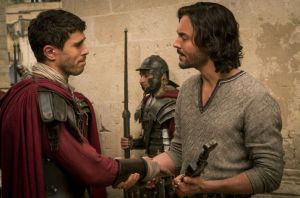 It’s obvious that this new remake wasn’t going to banish any cinephile’s memories of the 1959 version, but some of the decision-making handicaps the overall impact of the 2016 version, chiefly among them the characterization and casting of its lead. Judah Ben-Hur is definitely lacking when it comes to being a strong and engaging hero. The casting of Huston does not abate this. For fans of TV’s Boardwalk Empire, it’s clear that Huston can be a very capable and intriguing character actor, and he has an easy handsomeness that might slide him readily into mainstream big-budget projects. The problem is that Huston lacks the gravitas the role requires and this is further hampered by the limited characterization, and the two negative qualities twist together, lessening and lessening the quality of the picture. He’s certainly no Charlton Heston (unfair comparison, I grant you).
Here’s how bland it got: I was feeling more sympathy for the character presented to be the central antagonist. In the first act, I felt more for Messala and his plight than I did for Ben-Hur, and I’ll explain why. Ben-Hur comes from a wealthy Jewish family and a life of privilege, yet Messala did not want to fall back on this and wanted to make his own path, joining the Roman army. He returns several years later and connects with Ben-Hur, asking him to help root out zealots that would jeopardize a peace with Rome and incite violence against innocents. It so happens Ben-Hur is secretly harboring a zealot and, surprise, the guy stupidly tries to assassinate Pontius Pilate in full view of the Middle Eastern world. Ben-Hur allows the zealot to flee for his own safety. Messala has little choice in bringing some consequences but he’s asking for the zealot’s name, you know the guilty party, or else he knows that Ben-Hur’s family, Messala’s adopted family, will suffer in place as punishment. He’s begging his brother, pleading with him, and yet Ben-Hur refuses even though it may cost his own family members their lives. This plot point, by the way, is new. In no other version of Ben-Hur does a zealot jeopardize the Ben-Hur family. It’s always been an overreaction to the accidental coincidence of falling tiles from the family roof that doomed Judah Ben-Hur to slavery. This change makes the protagonist more culpable. It was here that I felt I was on Messala’s side. My friend Ben Bailey likens this to siding with a “kind Nazi” and says Rome was the Evil Authority that should be bucked at every opportunity and burnt to the ground. I don’t know what this says about me but I think it shows that the writing failed to make me root for our hero.
The movie gets slightly better once Morgan Freeman enters, as most movies do, and from there the plot streamlines into training to be a world-class chariot driver to take away from the glory of Messala and thus the roman overlords. The story follows familiar underdog plot beats seen in other sports genre movies from hob-knobbing with the disdainful and overconfident elites to training montages; it’s all here. It’s all marching toward that climactic brother vs. brother chariot race, and I’ll give the filmmakers credit that it’s respectable. There are some genuinely exciting moments and some great camera angles to communicate the danger and thrills of the action. The editing is a tad too choppy and the camera setups strangely favor far too many close-ups for a large-scale competition. Nothing could compare to the 1959 chariot race, which still holds up as one of cinema’s greatest sequences, more so with the renewed appreciation for practical effects. It’s not CGI horses and chariots and people in the stands cheering along. All of that is real and all of it is stunning to witness play out to tremendous realistic heights.
Director Timur Bekmambetov (Abraham Lincoln: Vampire Hunter) is not exactly the first name you might think of tackling a biblical epic. His sensibilities seem, at first glance, a bit lowbrow for such a venture, but the man is a gifted visual stylist, as he’s shown to perverse degrees in the perversely watchable Wanted. If you’re trying to bring the story of Ben-Hur to a new audience for a new century, Bekmambetov will at least ensure that it looks pretty, and most certainly it does. The biggest fault is with the challenges of the adaptation and the shortcuts and alterations that hamper the development of the characters and their ultimate arcs. Bekmambetov has one virtuoso sequence, and no it’s not the chariot race. It’s when Ben-Hur is chained in the galley of a slave ship and becomes one of the rowers. We’re trapped in his limited perspective during an attack sequence and it’s a terrific sequence. The confusion, the adrenaline, the fear are all accurately portrayed, and as the battle escalates and the ship is under attack and eventually sinks, it’s a race to escape his chains that is visually striking and exhilarating to watch. I don’t blame the director for this movie not working well.
 Another side effect of the overall truncating of the Ben-Hur saga is that the religious elements, namely the inclusion of Jesus Christ, feel really tacked on and obvious, reaching for a faith-based audience but doing so clumsily. Jesus (Rodrigo Santoro) is on the outskirts of the events of the movie, just enough to clue you in to his parallel presence (“Oh look, it must be Palm Sunday”), but he’s really another means to an end. The purpose of Jesus is to (spoiler alert) help facilitate Ben-Hur to abandon his anger and vengeance and instead adopt a position of forgiveness for Messala. The problem is that at a little over two hours long, and with the Jesus stuff fully feeling flimsy and tacked on, this big turning point for our protagonist also feels flimsy. Why would he be moved by the sacrifice of Jesus when his knowledge of the guy is primarily a helpful carpenter who fetched him water when he was thirsty? It doesn’t add up the way the movie wants.
Was a Ben-Hur remake doomed to fail considering the parameters it was fighting against? Not necessarily. While no remake will ever displace the majesty of the 1959 classic, a new movie doesn’t have to, merely opening up a new angle on a familiar story (the novel was originally published in 1880) and providing something of substance. It doesn’t have to cancel out one good movie to be its own good movie. There are enjoyable aspects of this newest Ben-Hur but all they end up becoming are aspects, frayed bits that fail to become a satisfying whole. It was a mistake to cast the blandly effective Huston in the lead and leave the character underdeveloped; a protagonist can survive one of these sins, not both. It was a mistake to coast for as long as it does with its second act. It was a mistake to provide more significant supporting characters, and Jesus doesn’t count. It was a mistake to film much of a chariot race in tight close-ups. This is not a disaster despite the money that will likely be lost. It’s easy enough to watch but hard to fully connect, and those memories of the 1959 film keep creeping back, providing unflattering comparisons.
Nate’s Grade: C+
Share this:

Sausage Party (2016)
 Following the “secret life of” Pixar story model, Seth Rogen and Evan Goldberg’s hard-R animated movie about anthropomorphic food literally uses just about every possible joke it can from its premise. I was expecting plenty of puns and easy sexual innuendo, but what I wasn’t expecting was a religious parable that actually has substance and some crazy left field directions the movie takes that made me spit out my popcorn. Sausage Party seems like a one-note joke as we follow Frank, a sausage (voiced by Rogen), and his girlfriend Brenda, a hotdog bun (Kristen Wiig) and their food friends over the course of the Fourth of July weekend. The supermarket items have been told that loving gods will take them to a wonderful promised land. The reality is far worse as the humans consume and “murder” the supermarket products. The messy food massacre sequences are some of the cleverest moments in the movie, which too often relies on a lot of easy profanity and vulgarity and broad ethnic stereotypes (it earns points for pointing out its lazy ethnic stereotypes too). However, when it veers into its religious commentary and the plight of the atheist, the movie becomes far more than the sum of its sex jokes. It’s consistently funny with some hard-throated laughs toward the end, especially in the jubilantly demented third act that takes an extreme leap first into violence and then into food-based sexuality. The concluding five minutes might be some of the most insane images put to film I’ve ever seen. The only equivalent I can even think of is the concluding act of Perfume. I credit Rogen, Goldberg and their team for taking a potentially one-joke premise and finding something more interesting and substantial, while still finding plenty opportunities for crass humor when called for and then some. Sausage Party is not a film for everybody but it’s also a film that is hard to forget, although you might feel guilty about munching on your popcorn at some point.
Nate’s Grade: B
Share this:

War Dogs (2016)
 As I watched War Dogs, the darkly comic true-life story of war graft, gunrunning, and bro-tastic bravado, I kept wishing to copy and paste other characters into what was an interesting plot. A pair of neophytes was awarded military arms contracts from the Pentagon during the Iraq War, and their schemes to skirt U.S. laws to import guns across borders, illegal and faulty munitions, and uneasily work as a go-between with a client (Bradley Cooper) on the U.S. terrorism watch list are filled with perplexing yet juicy details. The biggest problem is that the two main characters, played by Miles Teller and Jonah Hill, are so powerfully archetypal to the point of unrelenting blandness. We have the naïve everyman pulled into a life of big bucks, big risk, and big power only to have it all come crashing down. Hill’s character is the loud, uncouth part we’ve come to expect from the Oscar-nominated actor, and I defy anyone to tell me anything about Teller’s character other than occupation and his relationship to other people. These parts are so thinly drawn that I didn’t care about them once they finally got into deep trouble. I believe that director/co-writer Todd Phillips, he of The Hangover series, has the right qualifications to make a flinty neo-noir thriller, but War Dogs is more his half-hearted version of a glib Scorsese movie, or a David O. Russell version of a Scorsese movie. The voice over narration is dull and doesn’t help illuminate Teller’s character at all, and the other stylistic flourishes, from pointless inter-titles to a non-linear plot, add up to very little. Half of the movie’s scant jokes are the ongoing sound of Hill’s off-putting wheeze of a laugh. I’m not kidding, after an hour the movie still treats his laugh like it’s a potent punchline. There is entertainment value to be gleaned from War Dogs chiefly from its larger-then-life story and the intriguing, shadowy world of war profiteers. It’s a movie that made me wish I had read the magazine article it’s based upon instead, which would have also been shorter.
Nate’s Grade: C
Share this:

Pete’s Dragon (2016)
 I have no personal love for the original 1977 Pete’s Dragon. I thought you, dear reader, deserved to know this morsel. I never felt a sense of wonder from the animated dragon creating mischief while a town tried to rid itself of an orphan and a bunch of hillbillies sang an ode to child abuse (it was a different time?). Disney has gotten into the self-cannibalizing habit of dipping into its own past and remaking its animated hits for a new generation of moviegoers. It worked splendidly with last spring’s Jungle Book, and the new version of Pete’s Dragon is further proof that when Disney aligns the right artist with a vision and gives them latitude to express that vision, rewards are generously reaped. This is a delightful, heartwarming, and enchanting summer movie that got me crying.
Pete (Oakes Fegley) is a young boy who lives in the wooded reservations with one very special friend, a furry green dragon he has named Eliot. He’s been living in the woods for six years after Eliot rescued him following a car accident that claimed the lives of Pete’s parents. One day a park ranger, Grace (Bryce Dallas Howard), comes across Pete and brings him back into town for medical evaluation. He’s a mystery child, a bit feral, and demands to return home into the woods. Grace incites Pete into her home and her family, but there are worries about the boy acclimating to society. All the while Eliot is looking for his best friend and mournful that they might have to part ways after all.
 Pete’s Dragon is a simple story but this is not a detriment to its ultimate effectiveness. Rather the filmmakers take care to treat this childhood fable with enough heart and earnest emotion that the movie feels fully developed to its aims. The characters and their journeys aren’t exactly revolutionary, but I didn’t mind at all. This is an old-fashioned family film told without irony and set in a nondescript past that adds to the universal appeal of its message. It’s elegantly simple but there are poignant themes running under the surface, namely an unmistakable level of melancholy with Pete’s process of growing up. This feels like Disney’s version of Spike Jonze’s Where the Wild Things Are, a movie that examines the hard but necessary transitions of childhood and the acceptance of a sort of loss among the fantastic. This movie isn’t consumed with a dour interpretation of childhood as an oppressively hellish existence of misunderstanding (I didn’t connect with Where the Wild Things Are if you couldn’t tell) but it does acknowledge a loneliness of being absent a family to call your own. Pete’s life with Eliot is filled with boyish excitement and adventure but he knows he can’t hold onto that world much longer, and this realization magnifies the remaining time with Eliot. From start to finish, Pete’s’ Dragon is bursting with warmth and resonant emotions.
I was unprepared for the emotional wallop that this film delivered. Not since perhaps Pixar’s Up has a movie so effectively triggered my sympathies in its opening ten minutes. In a beautiful yet tastefully restrained sequence, Pete becomes an orphan and is rescued by Eliot, and the vulnerability and compassion of this moment already had me tearing up. Full disclosure: I’m a sucker for the “boy and his dog” stories, and while Eliot is a special dragon by design he is, at his core, a rendition of man’s best friend. Their relationship is one of love, companionship, and protection. They’re a pack. When Eliot spots Pete cozy in a family house, he’s crestfallen but accepts that a placement in the human world is where Pete belongs. And then at the end after a fraught situation, Pete instinctively runs to Eliot and leaps into his arms, and Eliot takes him in, holding him dearly, and it was at this point that I couldn’t stop the flow of tears even if I wanted to. Happy tears, people. The takeaway of the film is the formative bonds of family and the need to reach out for that nourishing companionship. While it’s highly emotional, it’s all earned and avoids cheap maudlin, manipulative theatrics, short of one extended sequence of Eliot’s capture.
I never would have expected such an old-fashioned yet preternaturally charming movie from the team responsible for the somber indie Western Ain’t Them Bodies Saints. Director/co-writer David Lowery is locked-in with its goals and finds ways to build its characters through small, cumulative actions. The film also has a marvelous sense of place as get a strong feel for everyday life in this foggy Pacific Northwest environment. Contributing to that sense is a terrific soundtrack of low-key folk songs that thrum with a lovely homespun gentleness that taps into the earthy magic of its setting. The score strings-heavy by Daniel Hart is perfectly attuned to the emotional rhythms of the film without becoming overbearing. The photography is often gorgeous and the editing near invisible with how effortlessly it presents its story with room to breathe. There’s a standout sequence that highlights just how well all of these individual elements come together to form a greater whole. Pete escapes from the town’s hospital and desperately runs outside. He is dazed by the activity of the modern world and the geography of the town, and the residents of this town are just as dazed about Pete, a wild child exploring his alien surroundings. He hops aboard a school bus and the children inside are amazed at Pete’s daredevil antics. The chase sequence is set to the Lumineers’ “Nobody Knows” and it builds upon the sense of discovery, community, and mutual awe. It’s a wonderful sequence that develops patiently.

Part of the success of the movie is also due to the skill and implementation of the special effects team. Eliot is a cuddly creature you want to take home with you yet he can still be intimidating under the right circumstances. He’s on screen a lot but his magical qualities don’t diminish. This is one highly communicative dragon and it’s easy to empathize with him (those exquisitely emotive canine eyes help). There’s a tenderness to him that convinces the audience early on to take a journey with Eliot and see what happens next.
The human specimens are heartfelt and enjoyable as well. Ostensibly the main character, his name is in the title after all, the role of Pete rests on the tiny shoulders of actor Oakes Fegley, and he aces the part, tapping into the rougher, wilder edge while also selling the dramatic moments in a clear relation to his interpretation of the character. The next main character is Howard (Jurassic World) and she’s quite good. She gives a maternal performance that doesn’t go overboard while still allowing her to come across as an independent, thinking woman with her own desire for proof of the fantastical. She has several tender moments with Fegley. The actors all perform ably. Even Wes Bentley (TV’s American Horror Story) works well in the movie, and when was the last time that could be said? Karl Urban (Star Trek Beyond) is enjoyably hammy as the villain who’s not much of a villain. I wish Redford (Captain America: The Winter Soldier) was in more scenes because his grandfatherly presence is so enjoyable to watch and he so easily slides into the part.
Disney is two-for-two when it comes to 2016 live-action remakes of its old catalogue, and if The Jungle Book and now Pete’s Dragon are any indication, then bring on the remakes. The original Pete’s Dragon was never a memorable or enjoyable film for me, so there was already much to improve upon, which is what the new version does in every way. It’s poignant, heartwarming, earnest, and bursting with feeling. It’s a simple story told exceptionally well with artistry and grace. There’s a dash of indie flavor to the mainstream filmmaking. I think this movie will appeal to people of all ages, grown ups that are looking for some magic in their movies, as well as families looking for a movie that will entertain children but won’t rot their brains. It’s fortunate that we can end such a mediocre summer at the movies on a high note, and Pete’s Dragon is a wonderful infusion of the old and new, magic and reality, heartache and triumph. It’s a movie dripping with purity, and one that demands to be seen and hopefully cherished.
Nate’s Grade: A-
Share this:

Lights Out (2016)
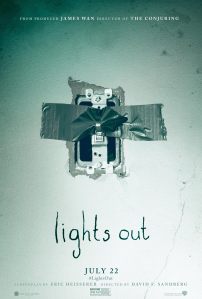 When it comes to horror, concept is king, but what’s just as important is fully developing that concept to meet its potential, and that’s where Lights Out succeeds. This is a low-budget horror movie that taps into a primal fear of the dark with a supernatural entity named Diana that can only be seen outside light sources. Thankfully, director David F. Sandberg smartly thinks of fun and interesting ways to play with this concept, like Diana disappearing in bursts of muzzle fire and a frantic, life-saving use of a car alarm. There’s a great suspense sequence where an off screen light from a flickering neon sign, switching off and on steadily, sets up audience expectations and lingers, drawing out the fear. The editing is terrific. There’s also a surprising subtext tackling the issue of mental illness and depression, as Diana, the malevolent spirit tethered to Maria Bello’s character, only seems to appear during the rougher patches of her life, and Diana fights against Bello getting “better” which weakens her existence. Theresa Palmer (Warm Bodies) settles in as a capable heroine that genuinely cares for her younger brother in danger from her mother and her “friend.” I cared about the people in this. The movie also subverts some genre clichés and treats its handful of characters with credibility. While the very end leaves some questionable final statements on mental illness, Lights Out is an elevated B-movie that takes its fun premise and executes it with aplomb. It’s worth 90 minutes in the dark.
Nate’s Grade: B
Share this:

Suicide Squad (2016)
 After watching the debacle that was Batman vs. Superman, I said it had killed my hope for the larger DC film brand. Thanks to writer/director David Ayer, and by extension Zack Snyder’s ongoing influence, Suicide Squad reconfirms every bad step they’re down on this bad road of anti-entertainment.
Amanda Waller (Viola Davis) is worried about national security in a world where a certain Kryptonian has upended our sense of priority. She wants to assemble a team of bad guys who can do some good. Rick Flag (Joel Kinnaman) is placed as the commander of a “suicide squad,” a black ops team of super villains that are injected with devices to make their heads go kablooey if they disobey. Among the ranks is Deadshot (Will Smith), a paid assassin who never misses, Harley Quinn (Margot Robbie), the former psychiatrist and lover to The Joker (Jared Leto), an Aussie named Boomerang (Jai Courtney), Diablo (Jay Hernandez), a guy with the ability to control fire, a human-crocodile hybrid named appropriately Killer Croc (Adewale Akinnuoye-Agbaje), and the Enchantress (Carla Delevigne), a thousands-year-old spirit inhabiting the body of Dr. June Moone, who also happens to be Flag’s girlfriend. Assisting Flag is Katana (Karen Fukuhara), a masked swordfighter with a tragic and mystical past. The Squad is thrown into harms way and have to work together as a group if they plan on surviving.
The tone and structure of the movie is like an unholy marriage of Stephen Sommers’ (The Mummy) sense of careless plotting and archetypes, mish mashing tones, and Joe Carnahan’s (Smokin’ Aces) sense of wanton violence, killer cool killers, and militaristic fetishism. It’s a problematic pairing of tone that almost sort of works in the opening twenty minutes as it sets up the various bad guys with their requisite little slices of backstory. Primarily Deadshot and Harley Quinn are the spotlight characters, and it helps that the two most charismatic actors play them. The first twenty minutes doesn’t exactly push the narrative forward in a meaningful way as it involves Davis digressing with an armada of high-energy flashbacks, but it’s almost forgivable. Her pitch to the government for a black ops team of super villains seems credible enough in this anxiety-ridden world, so Ayer has at least started off not quite well but well enough. And then it all goes downhill so fast into a vortex of suck and cannot recover.
 It was at the first act break that I knew this movie wasn’t going to recover and get better. You see the advertising has been very secretive about who the true antagonist is for this movie, which is none other than the Enchantress. The introduction of this Jekyll/Hyde character and her power is initially interesting, though she certainly stands out in a world of meta-humans. The problem is that this character is obviously far more powerful than everyone else in the movie, as evidenced by Waller’s “show off” moment having the Enchantress teleport and bring back nuclear secrets from a hostile foreign nation. I think Ayer realizes this and so he quickly, and I mean quickly, positions the character as the Big Bad of the film. Dr. June Moone whispers the word “Enchantress” and she appears, and then she whispers it in her sleep and, oh no, the wicked witch lady is out and nobody seems to have any contingency for this. How has nobody thought about the risk of her accidentally saying this one word? Should she be sleeping with some sort of gag?
Enchantress steals the other ancient idol containing the spirit of her brother, which is just hanging around for some unknown reason, and the two of them are distraught that mankind, which once worshiped them, has moved on. They’re going to destroy the world by making a vague world-destroying machine, which basically comes across as a giant energy portal. The brother becomes the primary villain, a giant heavy with dumb tentacle weapons, and the two of them take human beings and turn them into a faceless army of disposable soldiers thank to the power of Enchantress kissing them. It’s at this point that the movie reminded me of Sommers’ Mummy Returns sequel where the goofy tone and careless development swallowed the movie whole, shrugging and saying, “What more did you want from us?” The villains are quasi-Egyptian gods who want to destroy the world. The last act finally positions the Enchantress as the one to topple, and our anti-heroes are attacking her with guns and baseball bats. It’s just laughable and not in the good way. The entire Enchantress as villain storyline is a swirling CGI mess and her army of faceless henchmen inspire no interest or dread.
You would rightfully think that a movie about a ragtag team of kooky anti-heroes would be darkly comic and have a whimsical sense of fun, much like what James Gunn achieved with Guardians of the Galaxy. I walked out of Suicide Squad dumbfounded and muttering to myself, “How… how do you screw this up?” I think the movie has confused snark with humor. There is precious little that comes across as funny. The characters have some one-liners but that’s about it, and they grow tiresome after a while. Suicide Squad is a classic example of trying too hard; it’s all empty posturing and posing, asking for plaudits about how edgy this cut-and-dry PG-13 movie must be with its mall Goth aesthetic and irreverent sense of good and evil. It tries so hard to be edgy that you can see the onscreen flop sweat. Case in point: the avalanche of music selections. In the first ten minutes or so it feels like there is one needle-drop music selection mere seconds after another, and Ayer chooses a mixture of artists for their on-the-nose lyrics. “You Don’t Own Me” for Harley Quinn especially, “Come Baby Come” just for a scene involving a bat with the choice lyrics, “swing batter batter batter,” a cover of Nirvana’s “Lithium” because it has “friends in my head” as a lyric, “Sympathy for the Devil” for many obvious reasons, “Spirit in the Sky” when the gang is airborne, “Seven Nation Army” when the gang is put together, and so on. If there were a handful of on-the-nose music selections, it would be passable, but it’s almost like the overzealous music director worked overtime to provide as many selections as possible to cover-up the movie’s empty sense of fun.
 No character symbolizes the film’s ethic of trying too hard more than Leto’s (Dallas Buyers Club) rendition of the Joker. Admittedly Heath Ledger’s performance was iconic and cannot be replicated, but Ayer’s script doesn’t even justify the character’s presence. There is no standout or memorable scene with the Joker to help signify just what kind of character he is, how he’s far different and more dangerous than your everyday psychopath. If you called this guy a different name you would swear it’s a different character because they fail to make his inclusion meaningful. We see Joker in flashbacks relating to Harley Quinn, and it’s in these short moments that the character plays best, in particular a high dive into a vat of chemicals all in the name of twisted love. Through Harley, we get a fleeting sense of a Sid and Nancy sort of courtship that could be interesting. However, alone, Leto’s Joker is a wash, intimidating guards with lackluster “crazy talk” and maniacal giggles. There’s a shot of him lying on the ground surrounded by a carefully constructed circle of weapons. It’s a small moment but it makes him seem more OCD than scary.
Joker’s storyline is trying to free his girl from prison, but the larger problem is that Harley Quinn is a worse character when she’s with her “puddin'” Mr. J. She loses her independence and just becomes arm candy and settles into The Girlfriend in Short Shorts. She elevates him and he drags her down. That’s a direct problem with characterization. The Joker is a distraction to the other characters and his small scenes tracking her down do not excuse the detour. Leto snarls and struts but it feels over conscious and dull. There is a better way to use the Joker: make him the target of the Squad. That pushes Harley Quinn directly into the center of the story and provides plenty of internal conflict for her to wrestle with her tortured psyche and sense of adoration for a man who had tortured her and abandoned her. That would be more interesting. In the Snyder universe, we have a Batman who has no compulsion against killing his enemies, so why the hell is the Joker still alive to terrorize? It seems bizarre that Affleck’s Batman would let this guy go unless the fan conspiracy theory that the Joker is secretly a disturbed Jason Todd, a former Robin, was accurate. That would make the character instantly more intriguing and provide some needed depth to what is a shallow character that is all exaggerated attitude. He’s the worst modern Joker but not the worst part of the movie.
The characters are just not that interesting and the far majority of the Squad teammates are meaningless background players. Killer Croc, Boomerang, Slipknot, and Katana are utterly useless in this movie. They fill out space and kill some faceless bad guys, but their plots could just as easily been attached to the other Squad members. Katana in particular is another one that feels like she’s been pulled in from a different movie entirely. She’s introduced as this killer assassin and Flag says, offhand to the point of hilarity, that her sword captures the souls of the men it kills. There’s a later moment where she’s swearing her love to the trapped soul of her husband in the glowing blade, and I just couldn’t hold back and started laughing. I’m sure this point is directly taken from the comics, but it’s thrown in without any care, any setup, and its tone is directly conflicting with the snarky nogoodniks. Diablo is given a boring and predictable arc but he at least has a dollop of characterization outside “zany” or “menacing” because he wants to not use his fire-starting powers. These characters just don’t matter to the story, and the actors aren’t given anything close to resonant character moments to make them matter to us. The Batman cameos are completely superfluous as well. There’s no reason that our criminals couldn’t have been brought in from other circumstances. Batman also has a creepy moment where it seems like he’s forcing himself on Harley Quinn to give her mouth-to-mouth resuscitation. It’s such an off-putting and curious moment I kept waiting for Bruce Wayne to wake from another dream sequence.
I think back on Captain America: Civil War again and how the filmmakers were able to deftly integrate a bevy of heroes and make them matter, giving each one a small moment to be fleshed out, providing arcs, and incorporating them in exciting and satisfying ways into combat that would let them show off their stuff. Suicide Squad is not that.
 There isn’t one good action sequence in this whole movie, and with the Enchantress army of monster goons, it starts to feel like an extended episode of the Power Rangers but with an oversight of firearms. What’s the point of bringing in a bunch of weird characters with super powers if all they get to do is one gunfight after another? Once the Squad lands in Raccoon City, er, I mean whatever city ground zero is, the movie is one long slog to eventually confront the Enchantress. It’s one abandoned street filled with goons to get shot down after another. Repetition settles in and Ayer doesn’t use the opportunity to have his characters do something fun or different. The action doesn’t excite and the characters don’t excite, and everyone trudges, head down, to their dire destination in the sky. It feels like a shadowy warzone without a clear objective, direction, or understanding of the threat. There is one interesting aspect of the action that’s never developed as it should be, and it’s the Squad’s vulnerability to losing Flag. Not only does he have the control to make their heads burst, if he is killed in action then the Squad dies too. Deadshot realizes that the team has to defend Flag and out-rightly rescue him a couple of times. It reminds me of a video game escort mission but Ayer never really does much more than having his characters recognize this dynamic. As much thought is put into the action as put into the antagonists, which is to say little. Some of the action is so poorly edited and choreographed that I just hit my head against the back of my chair and waited for it to be over.
There are a few bright spots in the film, mostly provided by the lead actors. Smith (Focus) is still one of the world’s most charismatic actors even if he’s saddled with the rote “I wanna see my daughter” storyline to humanize his remorseless assassin. Smith relishes his anti-authority figure and settles into a comfortable and appealing groove. Robbie (The Wolf of Wall Street) is delightful and her character’s zany non-sequiturs are more often funny than grating. You can tell Ayer is also a fan, as his camera lovingly oogles her body. It’s a performance that whets your appetite for more Harley Quinn that the movie doesn’t seem to be able to deliver, especially when it starts to go down a route that presents her almost sentimentally. Davis (The Help) does a fine job selling her badass tough guy moments as the leader of the program. I don’t quite buy the “government/jailers are the real bad guys” angle the movie consistently presents to elevate its Dirty Dozen. The “worst of the worst” can’t be all that bad considering we’re working under the mandate of a mainstream PG-13 rating. They’re villains with gooey centers and moral codes.
It’s not at the punishing level of disaster that Batman vs. Superman wrecked, but this is a movie that is plenty bad, and not in the good way, or the fun way, just in the bad way. Even things that should be saving graces for a comic book movie about antiheroes, the fun personalities and visuals, are lacking. Ayer doesn’t know what to do with his overabundance of characters once he gets them assembled and he doesn’t have the visual dynamism of a Snyder. Ayer has talent with writing machismo characters and can even be a fine director of action as he proved with the sturdy WWII tank movie, Fury. It certainly feels like this movie got away from him. If this is trying to be an over-the-top B movie, it fails. If it’s trying to be a flashy and stylish diversion, it fails. If it’s trying to be a subversive take on super heroes, it fails. It just doesn’t work. It wants to thumb its nose at super hero movies and dance to its own anarchic, nihilistic beat, but you never believe the movie’s own convictions. It feels like empty posturing, confusing attitude and costuming for edge. It felt like some film exec pointed at Guardians of the Galaxy and said, “Make us one of those.” The sad thing is that Batman vs. Superman wasn’t good but it was at least ambitious, having to set up multiple franchises, serve as a sequel and reintroduce Batman. Suicide Squad had to do considerably less with the easy task of making a group of crazy anti-heroes as popular entertainment, and it flounders. It’s going to be a long wait until 2017’s Wonder Woman, the next DC movie in their larger plan to compete with the Marvel big boys, and the howls from dissatisfied moviegoers will echo until then, providing a pessimistic landscape for every new scrap of footage and trailer. Remember that the Suicide Squad trailer looked mighty good too and the actual movie is well and truly awful. Sometimes the packaging is the best part and sometimes it’s the only part.
Nate’s Grade: C-
Share this:

Star Trek Beyond (2016)
 With J. J. Abrams’ departure from the franchise for the greener space pastures of Star Wars, there was a creative void to fill, and in stepped director Justin Lin (Fast and Furious series) and co-writer/star Simon Pegg, acclimating to the established new movie universe and providing a Trek movie that proves to be the most “recognizably Trek” in the series thus far. The crew of the Enterprise is stranded on an alien world after being attacked by a hive-like armada of ships. It’s a somewhat familiar formula, a distress call that ends up being a trap, from an unknown entity that is harboring vengeance against the Federation. This allows for several dispirit storylines to explore the surroundings but also the enjoyable character dynamics of the crew; the casting department hit the jackpot with this franchise, and it’s just satisfying to watch the actors deliver solid, satisfying character moments. The new character Jaylah (Kingmen’s blade-legged Sofia Boutella) is interesting, kickass, and a source of deadpan comedy conflicts with others. There’s a genuine sense of discovery that’s patiently paced, not so much the set-piece-every-ten-minutes of the Abrams films. Idris Elba (The Jungle Book) makes for an intimidating villain and I’m happy to report he doesn’t get lost under gobs of makeup. He becomes more Elba as it goes, and he’s given a credible motivation and back-story to explain his actions. The action is a bit less exciting than I was hoping for from Lin, whose special blend of crazy has been somewhat dampened as he adopts the house visual style of the franchise. Pegg and co-writer Doug Jung have steered the franchise into safer territory but also put the focus on the crew and their bonds, which is the secret weapon of Trek. You sense that Pegg and Jung are fans, and they even provide greater context and justification for the new Trek elements that drew earlier complaints, like the use of the Beastie Boys song which now becomes a fun moment of fist-pumping triumph. Star Trek Beyond (no colons necessary, apparently) doesn’t quite hit the same highs as the previous two films, but it’s a solid movie overall and might be the best movie for the most ardent fans of classic Trek. My last piece of advice: go into space construction in the future. The way they go through starships, you’ll always have a job.
Nate’s Grade: B
Share this:

The Infiltrator (2016)
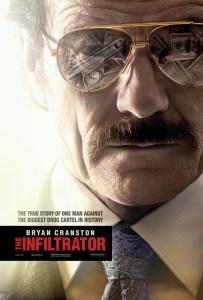 In the mid 1980s, Pablo Escobar and his cartel were responsible for billions of dollars worth of narcotics filtering into the United States. It’s the kind of work that can fill up Robert Mazur’s (Bryan Cranston) career. He works as a Florida Customs agent but his specialty is going undercover for his assignments. He’s called out of retirement with the promise of striking high in the ranks of Escobar’s ring of lieutenants. Mazur’s partner, Emir (John Leguizamo), uses an unreliable informant to start the new identity, and so Mazur poses as a money laundering expert who offers his sundry services to the Colombian cartel. After blurting out that he has a fiancé in lieu of accepting a prostitute’s services as a very 80s way of saying “thank you,” the agency must now provide him with a fake wife, played by rookie agent Kathy Ertz (Diane Kruger). The two have to rely upon one another in a world of criminals and murderers who would have no gutting them.
My main feeling once The Infiltrator had come to its natural conclusion was that everything about this movie should have been better. It’s a terrific premise as we follow the undercover travails of a man trying to stay one step ahead and keep his dual lives separated, invariably having them bleed into one another especially as danger escalates and his cover may be blown. Then you add an untrained partner and the conflict magnifies from there. Then you have Mazur work his way up the food chain to the major lieutenants of Pablo Escobar. This movie should be exploding with dramatic irony, weighty decisions, and magnificent suspense, but it’s really not. So why not?
 One reason is that the movie whiffs with its modest ambitions, namely in its shallow character study of Mazur and the lingering effects of pretending to be a very bad man. Going undercover has to be one of the most stressful jobs in law enforcement, and living two different lives has to have a noticeable psychological impact, eating away at our protagonist and affecting his relationships and sense of self. That doesn’t happen with The Infiltrator as the few glimpses we get of Mazur’s home life are mostly harmless check-ins. A red light is installed in his home to mean a secret special phone line. You would assume that some family situation has to draw out conflict from this scenario, maybe Mazur’s little girl answering the phone before he can reach it. Nothing of consequence happens with daddy’s special red light phone. The family, absent anything important to do but wait at home, becomes a drag on the narrative and doesn’t even fulfill what you would assume would be its primary service: contrast. In the world of The Infiltrator, sex, money, and drugs are rampant, but our protagonist is unaffected. He remains the same character from the beginning of the story to the end. We don’t really learn more about him other than he is skilled at going undercover. We don’t see any particular toll on him psychologically. We don’t feel the threat of what he’s going through because the movie doesn’t pretend it matters enough.
Going undercover with the Medellin Cartel should provide endless suspense scenarios. This movie should be rife with conflict, and yet it consistently finds deflating, coincidental outs to save its characters. As a good screenwriting rue of thumb, it’s acceptable to use coincidence to put your character into greater danger. It’s not a smart idea to use coincidence to save your character from danger. Example: in Donnie Brasco, a man approaches Johnny Depp’s character and clearly refers to him by his agency name, implying working together with the FBI. That’s a good use of coincidence. With The Infiltrator, Mazur’s secret recording in his briefcase is discovered by a mid-level cartel operative, for once it feels like Mazur is vulnerable. Then the movie quickly dispatches with this guy for a rash explanation and so he takes his secret to his grave. There’s another moment where Emir’s informant is about to squeal to some very bad people, with Emir in the room sweating bullets, and he too is wiped out before sharing his privileged information. The movie is filled with these frustrating solutions just when it seems like tensions is developed. The entire appeal of the undercover mob movie is the twists and turns to hide the real identity and make it out alive. I’m genuinely dumbfounded how much of this movie just skates by with little regard to drawing out effective tension.
I think I can crystallize just how poorly The Infiltrator handles its many threads of conflict with one great example. Kathy and Robert Mazur are fake getting married according o their cover stories, so what else does a fake bride-to-be do but seek out her fake husband’s tuxedo that he wore decades prior upon his real wedding to his real wife? Why does Robert need to wear the exact same tuxedo? Can his office not afford to rent a new one that likely more accurately represents his fitting size? Even if this cost-cutting measure was plausible, why must Kathy be the one to pick it up, and from Mrs. Mazur? It’s contrived and forced conflict to shove these two characters together, so that Mrs. Mazur can ask pointedly, “Are you sleeping with him?” Rather than say nothing, or dismiss the assertion, Kathy provides what has to be the most irritating and obfuscating answer: “I think you know the answer to that.” Does she? The film seems to think there is a simmering sexual tension between Kathy and Robert Mazur, but it never materializes. I guess we’re just supposed to assume a sexual tension. This scene is a pristine example of characters operating at a sub-level of intelligence because the movie wants to force contrived drama when there is already plenty of organic drama being ignored.
The last third of the movie is built around the relationship that Mazur and Kathy form with Robert Alcaino (Benjamin Bratt). With an actor of Bratt’s stature, you’d be lead to assume his character will have a significant amount of screen time; however, The Infiltrator also boasts blink-and-you’ll-miss-them performances from Amy Ryan and Jason Isaacs, so maybe not. Bratt’s character is a family man and we’re treated to several scenes with him and his wife. It’s meant to engender sympathy so that when the end comes around we can feel some conflicted emotions. Except this is another area where the screenplay cannot live up to its aims. At no point did I feel sympathy for this mobster. He’s a “family man” and we even see him with his daughter… in one scene who asks to sleep over at a friend’s. Robert preaches about the importance of trust and family in that typical way that all thinly veiled mobsters do in movies, and he even cooks, which is another personality trait I’m sure we’ve never seen in a film about mobsters. The entire last act is predicated on our undercover duo feeling guilt over setting up Robert and his family in an eventual sting, and this guilt feels entirely manufactured.
 Cranston (Trumbo) is the real draw here and it’s easy enough to see how alluring the undercover gig is for an actor of immense talents. In the opening scene we get a sense of Mazur on the job, digging deep into a seedy drug dealer lounging in a bowling alley and making passes at the waitresses. It’s a meaty introduction that whets your appetites for the different personalities that Cranston will have to draw from on his next assignment. Cranston is routinely entertaining to watch but I couldn’t help but feel underwhelmed at what the film was asking him to do and what I fully know he’s capable of delivering. It’s like hiring a world famous chef and asking him to fix your plumbing. The other actors don’t distinguish themselves in their fleeting scenes except for Kruger (Inglorious Basterds) and Joseph Gilgun (TV’s Preacher) as a convict that Mazur likes to have pose as his driver/muscle. In the case of both actors, you wish that more had been made with their dynamic to the mission.
The Infiltrator is based on a true story and I assume that what I see on screen closely echoes Mazur’s real exploits and predicaments, but somewhere along the way the filmmakers lost track on what made this story tick. The psychological aspects are barely touched upon, the family conflicts are given careless lip service, the suspense sequences are clipped, under developed, and often solved by convenient coincidence, and the characters are too shallow to grow out from their stock roles. I know these are real human beings for the most part but they don’t feel anything more than genre archetypes. The Infiltrator does enough at a serviceable level of entertainment that it might pass some viewers’ lower threshold to fill an empty two-hour window. With all of its ready-made suspense possibilities and internal and external conflicts, this real-life story should be far more compelling than the one we’re given, which settles too often. It’s a genre movie masquerading as a character study except it’s blown its cover.
Nate’s Grade: C
Share this:

Jason Bourne (2016)
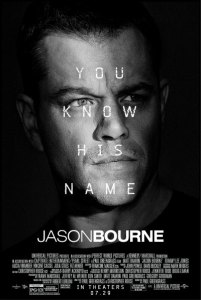 After the indifferent reception of its 2012 spin-off, original super spy Jason Bourne (Matt Damon) and director Paul Greengrass (Captain Phillips) are back and it feels like everyone is falling into familiar paces. The titular fourth film in the franchise (excluding Bourne Legacy) is easily the weakest (excluding Bourne Legacy) and the seams of the formula are starting to show. Once again an ally has intel to expose some sort of secret and illegal government conspiracy that ties into a revelation about Bourne’s past, and once again this ally is killed as the Act One break to spurn Bourne onward, and once again there’s a secondary assassin working for the morally murky government agency head, and once again there’s a signature car chase sequence, and once again there’s a final choice Bourne needs to make about what kind of person he wants to be given his new perspective on his old killin’ ways. The frantic Greengrass staple camerawork and editing can make just about anything bristle with some energy and suspense, but rarely was I fully feeling what was happening onscreen (except for the caveat of admiring how attractive Alicia Vikander’s face looks on the big screen). Short of the final car chase through Vegas with a SWAT truck barreling through traffic, the action sequences are pretty routine and unmemorable. The foot chases and fisticuffs, a hallmark of the franchise, feel slightly blasé in their development. The action isn’t bad but it feels more than a bit staid. The stakes aren’t as high and maybe that’s because it feels like there is little more to reveal about our hero’s hidden past. Is the next movie going to divulge the long lost secret that he never paid a parking ticket? Tommy Lee Jones makes an enjoyably crusty adversary. Vikander has just enough of an angle to provide more substance as a character than the typical agency analyst reciting exposition. The film ends with some promise of looking forward rather than back, and I hope that further adventures with Jason Bourne (excluding Bourne Legacy) stray a little more from the well-worn formula and provide better reasons for this spy to come out of his hiding.
Nate’s Grade: B-


 nathanzoebl
You must be logged in to post a comment.