Category Archives: 2024 Movies
The Ministry of Ungentlemanly Warfare (2024)

This is my kind of Guy Ritchie, leaning into the pulp sensibilities of genre movies with style, swagger, and cheek, and The Ministry of Ungentlemanly Warfare is his grand ode to the WWII men-on-a-mission capers. While reportedly based upon the recently divulged secret files of Winston Churchill, the heavily fictionalized account of Gus March-Phillips (Henry Cavill) assembling a team of experts to blow up Nazi plots treats the men like super heroes. For the first hour or so, the movie is rollicking, with the team mirthfully mowing down Nazis at a steady pace, chumming it up, and having a fine time. It’s only after that midpoint where some of the movie’s flaws start to drag and become more apparent. First of all, an extended mission of getting close to a Head Nazi (Til Sweiger) and abscond with some ships off the coast of Africa makes for a very labored stay but without much fekt in progression or complication. I was feeling wanderlust to get moving. Next, the entire team feels unstoppable to the point of becoming boring. They never break a sweat fighting and casually plow through their enemies, so the entertainment value of the slaughter begins to ebb when it all feels too easy for too long. You can do an entire movie of Nazi destruction from the hands of an unstoppable force, like Sisu, but the bloody appeal of that movie is its creative carnage. We needed more variation in the action and set pieces. These gents have no formidable adversary, no overwhelming odds, and no real bouts of bad luck to thwart them. Alan Ritchson (TV’s Reacher) is a hulking mountain of a man, and he has such poise and charisma to be the breakout character, and Ritchie just fumbles it. Ritchie has excelled in the past with easily imbuing striking and memorable personality and conflicts with his Cockney crime larks, and I was missing more of that peppy style and unique flavor. Don’t get me wrong, The Ministry of Ungentlemanly Warfare has great promise and entertainment value, but it unfortunately creates its own ceiling, stalling in the second half and failing to develop intriguing challenges to test its underwritten crew.
Nate’s Grade: B-
Share this:

The Strangers: Chapter 1 (2024)
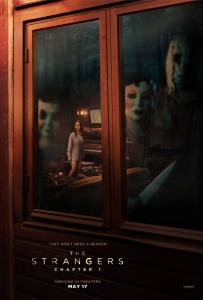 The most terrifying part of The Strangers: Chapter 1 is during its closing seconds, as text appears to inform all of us woeful viewers: “To be continued.” Oh no. Chapter 1 is intended to be the first in a new trilogy bringing back the essential concept of the 2008 home invasion thriller, that the masked attackers have no agenda, no motivation, and are being sadistic silent tormentors just because. The explanation, “Because you were home,” was a key revelation to the original, and here this famous line gets re-worked and has the same clumsy impact as Madame Web trying to reword that Spider-Man oath (“When you take on the responsibility, great power will come“). Not that the dialogue is the strong point of this thriller, with clunky expositional lines as nakedly transparent like, “Today is the third day of our three-day road trip around the country,” followed by, “Or our five-year anniversary.” It’s in the annoying, “Yeah I work here too” kind of lazy exposition. But you’re here for the scares, of which Chapter 1 has precious few because I think these are the most unimpressive and lackadaisical home invaders I’ve ever seen. I think the Wet Bandits might give these goons a run for their money (I’d watch Kevin take on The Strangers). Much of the movie is spent waiting, or checking places around the cabin, sometimes while one intruder plays the piano for ambience. One could make an argument they’re toying with their prey, but I would counter that I just don’t think they’re good at their whole enterprise. It doesn’t help that the main couple are so boring and undeveloped and I found it hard to fear for their well-being. As far as memorable scares or set-pieces or ingenious obstacles or overcoming said obstacles, it’s a big miss on all counts. A home invasion scenario can be exciting and terrifying, and it can be delicious fun to turn the tables on the attackers. This movie has so little that even the core ideas feel stretched beyond their breaking point. It’s hard to even feel much reverence for the original here, as The Strangers: Chapter 1 feels more like the steady, unrelenting squeezing of all IP for any possible drops of renewed audience interest. If this is what Chapter 1 has to offer, please spare us the rest. Fun fact: if you want to know what director Renny Harlin (Die Hard 2, Cliffhanger) has been doing lately, well here’s your underwhelming answer.
Nate’s Grade: D+
Share this:

Hit Man (2024)
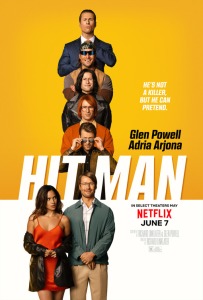
Hit Man is a movie that is wonderfully hard to describe. The premise has an easy-to-grasp hook that promises fun and hijinks, but where it goes from there takes on as many transformations as its protagonist, Gary Johnson (Glen Powell). It transforms from a fun game of undercover conning with wigs and silly accents into an unexpected rom-com hinging upon mistaken identity, maintaining assumed appearances, and secrets that then transforms into full film noir without losing its unique identity and the stakes of the character relationships. If you’d expect any filmmaker to pull off that trick, writer/director Richard Linklater has to be one of the best to keep things running smoothly, and that he does, as Hit Man is a crowd-pleasing comedy with some unexpected directions to keep everyone guessing until it lands on its own morally gray terms.
The movie is also, chiefly, a showcase of star and co-writer Powell, a handsome young actor hitting a new ascent of his career with last year’s Anyone But You and the upcoming Twisters. Powell is probably best known as the smirking guy you loved to hate in Top Gun: Maverick, but he’s also played memorable supporting roles in Scream Queens and three other Linklater film projects, notably 2016’s Everybody Wants Some!!, a pseudo-spiritual sequel to the seminal Dazed and Confused. This is Powell’s acting showcase and he’s utterly terrific. He has great infectious fun getting into the various hitman characters, which mostly exist in montages, and trying on different personas and voices. I cackled when he was doing his impression of Christian Bale’s Patrick Bateman, and I smiled throughout most of the other personas. It’s easy to see the network TV version of this premise, where every week Gary adopts a new persona and disguise to bust the next possible criminal from hiring a hitman, like an edgier Quantum Leap). The culprits are played like nitwits but then again the police are also played as nitwits (are there THIS many attempted hitman hirings in one city for the police to have a full-time unit?).

But before this acting experiment can get too broad or too redundant, Linklater and Powell switch things up. Around the Act One break is where Gary meets Madison (Adria Arjona), and that’s when everything changes for him and the audience. Now we have emotional stakes, because Gary intervenes to save Madison. While the circumstances of their first meeting involve her wanting to kill her husband and believing Gary as the professional to do such a job, the scene plays as a disarming first date you’d find in another charming romantic comedy, where it’s clear to anyone with a pulse that these two have something together. Instead of busting her for the solicitation, he pushes her to change her mind, take the money and leave her no-good husband rather than finding a questionable man to eliminate him. From there, they form a romantic relationship that fluctuates wildly. She thinks Gary is “Ron,” the suave and confidant persona Gary adopted for their sit-down. So the nerdy tech nerd who teaches philosophy must pretend to be the daring and dangerous man of mystery he wishes he could be. The script doesn’t get carried away with its farcical elements in play, juggling multiple identities for multiple specific audiences, but it asks the question, “Why can’t the milquetoast Gary simply be Ron? Is this an unexpected means of self-actualization for the nerd to win the girl?” Through this extreme exercise, Gary can mold himself into the man he would like to be. The rom-com is flirty, funny, and just as enjoyable as the earlier wacky comedy of being a versatile master of disguise.
It also really helps things when your two lead actors have such strong chemistry. Powell and Arjona (Father of the Bride, Andor) are smoldering together, like full on “get a room already” territory. This lends even more credence when Hit Man makes its next transformation into film noir thriller. I won’t divulge the specific plot elements but it all works with what Linklater has already established. There’s trouble for the both of them, and the question becomes how far is each participant willing to go to stay above the fray. The transition from silly costume comedy to sundry noir thriller is handled so naturally, as if the characters, already existing under such unique circumstances, found themselves in the elevated movie-movie version of their crazy relationship. Rather than feel contrived, Linklater and Powell have put in the work to make these twists and turns credible and exciting. The shifting nature of the movie is a wonderful reflection of its fake hitman hero. There’s a scene late in the film, where all of our principal players have come together, and you have characters saying one thing, intimating another, for different versions of different audiences, and it’s such a masterful tonal dance that feels satisfying as a climactic turning point as well as genuinely impressive for all the myriad subtext in play.

This is a clear-cut case of a movie being “inspired by” a true story rather than being “based on” a true story. Generally, we expect the “based on” stories to have some voracity to reality. We accept that there will be alterations for dramatic purposes, externalizing the internal, condensing timelines and characters into a more accessible structure, etc. If you go to a movie about Jackie Robinson, you don’t expect to see the famous baseball slugger fighting space monsters (“Racism was the real giant monster all along”). Hit Man is based upon a 2001 long-form news article by Texas Monthly journalist Skip Hollandsworth, the same author of the source material for Linklater’s fascinating true crime dark comedy gem, 2011’s Bernie, which I highly recommend (a career-best Jack Black). The real Gary Johnson really did pose as a fake hitman for the purposes of catching real criminals, but the rest of the movie exists in its own fictional universe of dramatic complications. Usually we want our film stories to have more fidelity with the truth and reality, but I’m glad Linklater and Powell recognized the sheer storytelling potential of this quirky premise. Sticking to the facts could have told an amusing story, but feeling confident to take bold leaps with well-worn genre motifs, when called for, is the right call for making the most of this tale.
The shame of Hit Man is how quickly it will likely be subsumed by Netflix’s suffocating tidal waves of content. Here is a fun, likable, and surprising indie comedy with definite mass appeal buoyed by great performances, clever writing, and a tonally shifting narrative to keep things fresh. Powell gets the breakout showcase he deserves and we get one of the most unexpected and amusing rom-coms of recent years. Hit Man is a movie that deserves to be seen, to be enjoyed with a crowd, but I worry it will get lost in the shuffle of streaming titles. I suppose this might just be the current reality for fans of mid-level adult dramas and comedies. At least they have a home on the streaming networks even if these movies would have been theatrical breakouts years ago. Regardless, Hit Man is a good time with good people pretending to be bad, or is it bad people pretending to be good, but whatever pretense, it’s a charming winner worth your two hours.
Nate’s Grade: B+
Share this:

The Last Stop in Yuma County (2024)
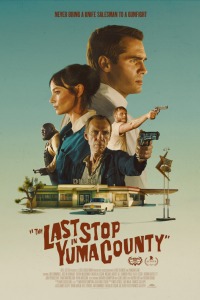
As a general rule of thumb, if some movie is described as “Coen-esque,” I must watch it. The Last Stop in Yuma County is a blend of Coen darkly comic malevolence, as well as Tarantino’s knack for the menace of dramatic irony and boiling tension waiting to explode, and it’s a firecracker of a debut for writer/director Francis Gallupi. It’s a relatively contained tale, sticking mostly to one rustic roadside diner and gas station along the dusty Arizona byways. On this day, two of its patrons happen to be recent bank robbers on the run, and they’re holding the other diner patrons captive until the gas pumps get fixed to fuel up and escape. The first hour then becomes a dread-filled game of waiting for things to go very badly. Our two main characters, a traveling knife salesman (Jim Cummings) and a waitress (Joceline Donahue) who happens to be the wife of the town sheriff, are working together to try and elicit help without endangering their lives, all the time more people keep entering the diner and inadvertently joining the simmering hostage situation. The way Gallupi writes his different characters is sharp and efficient, and the dread compounds in such organic complications, showing how fiendishly well-developed he’s made his potboiler. It also has a clear eye for style. Around the Act Two break, the movie becomes something else, which it intimated through a very specific film reference in conjunction with a specific character reference. It still proves compelling, but the overall sense of darkness and tragedy wore me down a little by the end. By the conclusion of its 90 minutes, I was hearing the saintly voice of Marge Gunderson in my head, shaking her head at the preventable body count and bad choices (“And all for a little bit of money. There’s more to life than money, don’cha know?”). The Last Stop in Yuma County is a twisty and twisted little macabre morality play in the guise of familiar Coen-esque capers. Welcome to the big leagues, Gallupi.
Nate’s Grade: B+
Share this:

Atlas (2024)
 In the world of Netflix releases, it’s hard to judge what is gauged as a success. Take for instance their new sci-fi action movie Atlas. It cost the streaming giant $100 million and they now tout it as being the top movie across the globe on their platform. This could very well be true, though Netflix has long been cagey about sharing their viewing numbers, instead preferring to go with the, “Hey, just trust us, okay?” defense, which hasn’t exactly been reassuring in an era where bonuses are linked to number hits. With the ever-expanding catalog of titles, being a reported hit on Netflix can sometimes feel like being, say, Homecoming Queen from 1989, an accomplishment soon eclipsed and forgotten. What was the last big Netflix action movie that had cultural staying power, that caused people to continue to discuss weeks or months later? Netflix swears their most-watched movie is 2021’s Red Notice, a star-laden breezy adventure caper that I challenge anyone to remember much about besides its stars. This is the challenge of gaining traction in a world of near endless content choices. Atlas is an above average film benefiting from a strong character dynamic at its core even if the rest of its story elements feel forgettably disposable.
Atlas (Jennifer Lopez) is a data analyst who has also helped develop Earth’s orbital security system. An A.I. program/robot named Harlan (Simu Liu) was born from Atlas’ mother, and then Harlan went and murdered millions of humans. The killer robot fled Earth with his robotic followers and Earth has been awaiting his return for decades. Atlas joins a mission to land on a distant planet where they think Harlan has operated as his base. However, Atlas must work with an A.I. program inside her mech suit that calls itself Smith. In order for them both to survive in this new world, they must work together.
 I found everything within the mech suit of Atlas to be engaging and dynamic, and everything that happens outside that giant suit to be underdeveloped and mediocre. I was genuinely surprised how Atlas essentially becomes a buddy survival movie. It’s the human who is distrustful of accepting help from others and especially from advanced technology with a mind of its own, and an A.I. program that is trying to improve its capabilities by getting to know its user and learning how to grow from her. They need each other to survive and that requires a trust and relationship to be fostered, and it’s a surefire enjoyable plot to watch two enemies become allies and maybe even friends over the course of their united struggles. The growth between them also feels relatively organic, coming at a natural progression with personal insights and offerings without clunky leading dialogue lines, like, “So why don’t you trust robots, huh?” This dynamic reminded me a bit of 2004’s I, Robot where Will Smith played a detective who hates robots who has to work with a robot and the two of them form a bond (there are other similarities I’ll get to later). Much of the movie takes place within a three-foot window from the capsule inside this mech suit, and the shared struggle between Atlas and Smith is the heart of the movie, and it’s actually quite good. Both of these characters find ways to surprise one another, both of them shed preconceptions, and both of them will discover the lengths they go to protect the other even if it puts their own existence in question. As a story about a woman and her robot, Atlas is a fun and fairly involving sci-fi buddy movie adventure.
Now, the world building and story that gets Atlas to this alien world, and the escalating stakes of world destruction are where the movie dissipates into an amorphous cloud of sci-fi action keywords. I don’t know why it had to be killer terrorist robots that brought out Atlas and her team of mech-suited warriors to this foreign planet. The reason why the characters are stranded on this unknown planet is unimportant. It could just as likely be a science team exploring a potential new habitable world for an Earth burning through its natural resources too quickly. It could be exploring the remnants of a possible alien civilization. It could even simply be the closest planet available during a distress from their spaceship going down for whatever mechanical or orbital obstruction. The story is about the relationship between the human being and the robot/A.I. working together to survive in an unfamiliar and hostile land.
 The robot insurrection feels like an acceptable plot device but it’s so under-explored until the movie needs to dramatically escalate the stakes into an apocalyptic cataclysmic scale. The fact that Harlan, which let’s agree is a terrible name for the villain of your movie, determines that the best way to save humanity is to annihilate humanity is already a tragically familiar refrain we’ve heard from numerous sci-fi villains, from The Hunger Games to Infinity War to The Day the Earth Stood Still to even I, Robot. In that last movie, the A.I. system determines the only way to protect humanity is through controlling and ultimately eliminating them, and this same motivation comes to Harlan. This character is introduced as our Big Bad through an opening montage, he disappears, and then only comes back at the end to be a force to threaten Earth. The entire robot uprising is so tremendously underwritten that the movie doesn’t even do the barest whiff of ambiguity to question whether humanity has been mistreating its robot servant class. Instead, Harlan is introduced right away as a terrorist figure and stays true to this characterization. I thought that Act Three would be upending for Atlas, where she learns the robots were framed or at least the conflict is more nuanced and her “side” might be more culpable than the military’s cover story. Nope. Evil Robot King is simply Evil Robot King. Fine, he’s a boring killbot, but then why go to such lengths to provide a personal connection for Atlas and Harlan. It’s unnecessary when she has to stop the killer robot from killing the Earth; we don’t need a personal connection for this to work. The level of personal guilt attached to Atlas is ridiculous, including multiple levels of tragedy that feel far too overwrought. Atlas didn’t need to feel guilty over her involvement in developing Evil Robot King as a child; she could have been simply the daughter to the woman who unintentionally brought this killer tech forward, or she could have simply been a woman who experienced a tragedy linked to the robot uprising without having a mom who developed the technology. She could just be a victim. She doesn’t have to be the first victim.
 Atlas is really a one woman show, so your feelings of Lopez (Hustlers) as an actress will dominate how you feel about the overall experience. I don’t know if Atlas is made substantially better with her as the lead actress but she certainly performs ably and doesn’t seem left unmoored by the fact that she’s talking to a voice in an empty space for most of her months filming. Lopez has a determination that gives her action novice character an underlying strength to tap into upon the call of action.
As a sci-fi action spectacle, the blockbuster aspects are sufficient for our casual entertainment fulfillment. The special effects and action are pretty solid under director Brad Peyton (San Andreas, Rampage) who knows his way assuredly around effects-heavy spectacle (he was also co-creator of the delightfully daffy 2019 Netflix apocalyptic series Daybreak). Much of the movie takes place within one mech suit, but I never felt a sense of visual claustrophobia thanks to the buddy dynamic and Peyton’s use of space. The big action sequences at the end have their share of impressive cool moments, but they also benefit from coming at the end of a character relationship that has helped to make the action more satisfying. I do lament the modern trend of filming on such large green screens or LED stages that lighting is always the same bright overhead setting without significant variance with shadows and other light sources.
If you’re looking for a Netflix action movie to divert your attention, or even barely pay attention to, then you could do far worse than Atlas. It might even hold your attention and keep you engaged thanks to the fun buddy film dynamic that serves as its foundation. There are plenty of elements that feel tacked on, underdeveloped, or blandly familiar, but the core works and Atlas is worth a couple hours of escapism.
Nate’s Grade: B
Share this:

Furiosa (2024)
 Mad Max: Fury Road is not just a movie for me, it is without a doubt one of my favorite movies of all time, and watching any moment of this 2015 masterpiece elicits pure, unrestrained joy, a feeling of elevation pure and simple. It’s the kind of euphoric response we all look for with art and, tragically, find too rarely, and for me, Fury Road is my divine experience. Even after having watched the movie over a dozen times, I can still slip it on and feel the same rising excitement, amusement, and happiness like it was all happening for the first time. I was a fan of director George Miller’s other wild post-apocalyptic entries, but Fury Road was different, as also evidenced by the fact that it nabbed six Oscars that year and was also nominated for Best Director for Miller and Best Picture. The totality of this artistic achievement seems certainly impossible to replicate. Over decades of development, Miller and his many collaborators fashioned plenty of material about life in the deserted Wasteland and its colorful characters battling for survival among the scavenged scraps of humanity, so there was always more room for more stories. That’s what brings us to Furiosa, the prequel explaining the back-story that turned a child prisoner into the ferocious one-armed Imperator of Imorrtan Joe. As a Fury Road super fan, I was hoping against hope to feel a little bit of that same unique artistic high again.
Young Furiosa (Anna Taylor-Joy) is kidnapped from her mother and sold into slavery. Her main tormentor, Dementus (Chris Hemsworth), is the head of a marauding biker gang. Furiosa spends years rising through Immortan Joe’s ranks to gain her vengeance.
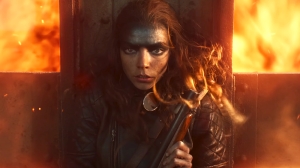 This is not Fury Road, to its benefit, and Furiosa is inexorably linked to Fury Road, which is also a mixed blessing. I kept telling myself, “It’s not Fury Road, and nothing can be, so don’t hold it to that standard.” Furiosa is not Fury Road. It’s slower, longer, and more plot heavy, taking its time to build around the edges of the world we were introduced to in 2015. Miller spends much of those two-plus hours filling in the missing pieces and histories of the other communities, like Gastown and the Bullet Farm, as well as the factional war between the different warlords and their territories. We also get an opening set in the much-heralded Green Place before it becomes the spoiled swamps. We get to see the construction of the war rig over time (it’s so shiny and chrome before collecting all that grime and singing). It fills out the wider world of Fury Road as well as the character connections and conflicts, so for those fans who felt Fury Road was lacking in its world building and overall plotting (the oft-spoken complaint that the movie is all about a woman turning left), this new movie might prove more appealing.
For me, dear reader, it made me reflect how Fury Road just hits the ground running and doesn’t let up, providing clues to the larger dystopian world that it lets you piece together, and I did. It was sufficient for me to get a sense of this world and its ongoing relationships and conflicts. What was implied in Fury Road is explicit in Furiosa, although there’s still plenty elided, like when we’re shown the 40-Day Wasteland War but only as a quick montage of violent images. In some ways, it reminds me of a director’s cut where the added material feels a tad secondary by nature, adding some better context and shaping but making you question whether that context was needed. Because the movie is tied to the events of Fury Road it can’t help but exist in its mighty shadow, ending in a very Rogue One fashion as it immediately sets up the story to be handed off, with clips from Fury Road playing throughout the end credits. I’m glad it wasn’t merely trying to replicate the same kind of entertainment as Fury Road, but I can’t help but feel slightly disappointed with Furiosa as it feels a bit overlong, unfocused, and extraneous.
 Miller’s dystopia is crazy and unique and the mayhem is energetic and enchanting, so I’ll happily spend two more hours in this gonzo Aussie universe, and while the highs might not be as uniformly high as my experience with Fury Road, there’s still a significant entertainment value in returning to this extraordinary world. Is there anything that comes close to the sheer glory of the action of Fury Road? Well, no. The action sequences are solid with a few nifty moments of sustained imagination and intensity, like the war rig’s first run that combats against raiders floating around their targeted prize in parachutes. I felt similar rousing feelings of discovery and immersion. The Bullet Farm attack has some great moving pieces that culminates in the biggest destruction of the movie. The action is still fun and morbidly cheeky, even if the effects used feel a little more cleanly green screen prevalent this time atop the moving vehicles. Fury Road is a monumental achievement and testament to the lasting appeal of practical in-camera effects, but it heavily used computer generated effects too, primarily for cleaning up the wire work as well as enhancing and replacing backgrounds. So the inclusion of computer effects in Furiosa isn’t new for the franchise, but it feels more noticeable and thus mildly distracting. It’s all intentionally smaller-scaled even as it’s looking at a wider scope of its weird universe.
The most interesting part of Furiosa is its primary villain, a wannabe fascist gang leader who proves repeatedly to be incompetent. Dementus has great presence, large and imposing and being drawn by a literal chariot of motorcycles. Hemsworth (Thor: Love and Thunder) is great and clearly having a ball, but what I loved even more about this villainous rogue is how hilariously bad he is at management. He’s the feared leader of a gang angling for respect and power, but he’s incapable of being more than posturing and sloganeering, and his huckster carny voice only solidifies this shading. He’s an unpredictable character, an agent of chaos, and he even undermines the established order of Immortan Joe and the other warlords who disdain him. I enjoyed little character touches like he keeps changing his moniker, going from Dr. Dementus to the Red Dementus (after being too close to a flare gun explosion). I appreciated that the final confrontation is also the talkiest scene in the entire movie, allowing both members ample time to state their perspectives, animosity, and fascination with one another (“No shame in hate. It’s one of the greatest forces of nature”). However, this climactic showdown 140 minutes in the making could have been even more impactful had the sprawling script not shelved Dementus for so long. This character drops out for long stretches of the movie and his absence is dearly missed.
 Originally, Miller intended to have Charlize Theron reprise her role as Furiosa by using cutting-edge de-aging computer effects, but after seeing 2019’s The Irishman he reconsidered (good call, George). In steps wide-eyed Anna Taylor Joy, who acquits herself fine, though doesn’t show up as the (younger) adult Furiosa for maybe forty-five minutes. This version of Furiosa speaks very minimally, so much of her intensity must be delivered through her eyes, so why not hire an actress with such striking and large eyes? The whites of her eyes are so notable that it reminded me of cartoons where we see floating white eyeballs whenever it’s unrepentantly dark. She also sounds exceptionally close to Theron’s voice at a few spots that it made me do a double-take.
Furiosa lacks the streamlined beauty of Fury Road, its immediacy and visceral energy that radiates from being dropped into the madness and keeping things in propulsive motion. It was also Miller’s first trip back to the Wasteland since 1985’s Beyond Thunderdome, so it was a 30-year leap for Miller to expand his crazy artistic vision onto an even broader modern canvas. Each one of the Mad Max films have existed on a mythical plane, eschewing ongoing continuity and treating Max like a drifter coming into a strange new world and aiding people in need. This is the first Mad Max movie, also minus Max, that attempts to connect to one of the other movies, and in doing so it’s less about creating its own identity than modifying an established identity. It’s different but also lesser. This is a longer and slower movie, but it’s also got fun action and zany humor and visual decadence. There is far more plot and world building, but it’s also only mildly interesting and too attenuated, feeling like fat cut off from the non-stop action movie sizzle that is Fury Road. I can declare Furiosa as a good movie and also a mild disappointment as well, but that’s coming from a Fury Road super fan. Perhaps I am merely coming to terms with my expectations being overinflated, to try and stubbornly catch that magic feeling once again. Witness me and celebrate Miller’s latest as it also makes me celebrate Fury Road even more.
Nate’s Grade: B
Share this:

Dune: Part Two (2024)
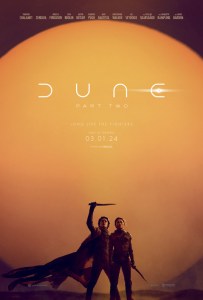 I wasn’t fully taken with the first Dune movie when it arrived in 2021. It was visually sweeping, with dense world building and careful development of characters and themes, but then it just hit the pause button without any certainty there would be a conclusion. Thankfully, director Denis Villanueuve was able to complete his vision, and what a spectacular science fiction landscape this man has fashioned, visually resplendent but also with a story that deepens and improves on all the promise and setup from 2021. The triumphant of Paul (Timothee Chalamet) becoming a hero and avenging his father from their betrayers is tempered by the tragedy of Paul, becoming the false messiah that will bring about mass genocide. The movie doesn’t hold back in its criticisms of its hero while also providing complexity that makes us root for him but uneasily dread what might become. The narrative structure is easy to follow with Paul ingratiating himself with the native culture, rising to power and influence, and organizing a resistance against the well-funded imperial overlords of Arakis. This is the kind of sumptuous, big screen spectacle with intelligence that is so rare in the Hollywood system, and Villaneuve once again shows his ability to perform artful blockbusters that put him in a rarefied class with hew others. After the first Dune, I was hopeful but a little wary. After the second Dune, I feel like all of my concerns were wiped away.
Nate’s Grade: A-
Share this:

The Idea of You/ Turtles All the Way Down (2024)

The Idea of You is the kind of movie that Hollywood used to crank out, a romantic drama star vehicle based upon a popular novel and with a skilled director, and now it forgoes any theatrical run and ends up as another option on a streaming channel. The Idea of You follows a 40-year-old divorced single mom played by Anne Hathaway who also happens to run an L.A. art gallery and has a meet-cute with a handsome boy band member (Nicholas Galitzine, Purple Hearts) at the Coachella music festival (oh the magic lives of people never having to worry about bills in rom-coms). they hit it off, and the rest of the movie is whether or not they can make a romance work. There’s a 15-year age gap that she feels very self-conscious about as an older woman (“older” by Hollywood standards). She’s this formerly normal woman who wants to date one of the most famous music stars in the world who isn’t always available, but most of the problems and conflicts stem from the perceived issues of the age gap. It’s a charming romance that’s more dramatic than it is comedic, and Hathaway is quite good as our lead plucked from obscurity. Though the many scenes of our smitten boy band member making googly eyes at Hathaway as he reminds her how attractive she is, and as she bashfully demurs, are a little much (it’s Anne Hathaway, notorious horrible-looking human specimen, right?). As a core romance, the movie works well under the guidance of director and co-writer Michael Showalter (The Big Sick), and it’s more adult than I was expecting. It’s rated R for language and it’s also more sensual, but it’s also more adult as in looking at the ramifications of this relationship in a mature perspective, from the terrors of paparazzi imposition to her daughter being harassed at school. The portrayal is thus more engaging and engrossing and feels above the more flippant and flimsy romances that would settle for far less. Though be warned: there are several sequences of singing and serenading which might cause you to shrink awkwardly inward on your couch. Surprisingly thoughtful, and relatively romantic, The Idea of You is a charming reminder of the appeal of comforting tales of love blossoming in unexpected places and pretty people allowing themselves the choice to be happy.
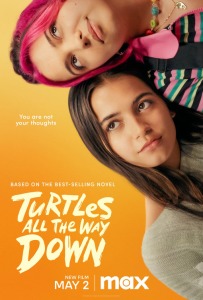
Based on best-selling YA author John Green’s 2017 novel, Turtles All the Way Down is a very accessible and very affecting glimpse at living with mental illness, obsessive compulsive disorder, and intrusive thoughts. Aza (Isabela Merced) has an overwhelming inner monologue that sabotages her daily life in high school and carries her along anxious thought diversions, constantly relating to some illness growing inside her that she needs to cleanse. This is the crux of the story, along with her relationship with her super eager best friend. There’s a romantic side plot where she helps out a rich classmate whose billionaire dad has gone missing, which feels like a plot device to necessitate the two characters spending time together. The standout aspect of this adaptation by writer/director Hannah Marks (Don’t Make Me Go) is its unsparing and honest yet hopeful depiction of mental health and intrusive thoughts. Merced (Dora and the Lost City of Gold, Madame Web) is excellent and deeply empathetic as this woman held hostage by her wayward thoughts and impulses. It’s a performance that goes beyond easy depictions of aloof detachment or exaggerated histrionics, shedding any acting techniques that are too mannered or attention-seeking. Marks’ direction helps reflect Aza’s troubled mind with rapid insert edits and voice over to communicate the intrusive thoughts and maelstrom of spiraling negative emotions. If you’re a fan of Green’s popular novels, or YA-themed literature, or even just honest attempts to empathize with teens in turmoil, then Turtles All the Way Down is worth battling through any negative thoughts to finish and relish the journey.
Nate’s Grades:
The Idea of You: B
Turtles All the Way Down: B+
Share this:

Unfrosted (2024)
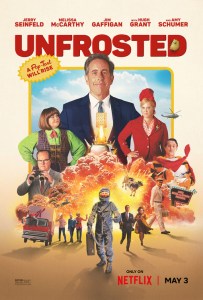 What to make of a movie like Netflix’s Unfrosted. It’s Jerry Seinfeld’s directorial debut, working off a screenplay he co-wrote, his first foray into film writing and acting since 2007’s Bee Movie. His eponymous sitcom “about nothing” was a 1990s mainstay and popularized an ironic meta form of comedy that still continues to dominate comedic tastes. Making a movie about the pseudo history of the invention of Pop Tarts, and the corporate rivalry between the major cereal brands, seems like a further exercise in that realm of humor, potentially satirizing a burgeoning sub-genre of late, the Biopic of Products (Air, Tetris, Flamin’ Hot, Blackberry). Except this supposed “biopic about nothing” is really a head-scratcher. Its humor feels pained and stale, the satire feels missing or glancing at best, and it seems like an expensive lark, wasting the nigh-infinite money of Netflix to purposely make a stupid comedy with all his friends.
Set in the mid 1960s, we follow two households, both alike in dignity, in fair Battle Creek, Michigan where we lay our scene. Kellogg’s has been the dominant cereal-brand for years but its chief rival, Post, is set to launch a new product that will revolutionize breakfast mornings. Bob (Seinfeld) is the head of development for Kellogg’s and reaches out to his old colleague, Donna (Melissa McCarthy), when it becomes evident that Post stole their unused research to develop a pastry treat designed to be cooked in one’s toaster. The warring CEOs, with Jim Gaffigan as Edsel Kellogg III and Amy Schumer as Marjorie Post, are desperate to one-up one another and be seen as more than an inheritor of their family’s wealth. It’s a race to see which company can get their treat to market first and capture the hearts, minds, and sweet teeth of America’s youth.
 I’d be lying if I said I didn’t laugh at points through Unfrosted, which operates like a spoof movie on a slower jokes-per-second pacing guide. There are zany sight gags amidst broadly drawn characters treating the silly straight, though occasionally you’ll have wisecrackers commenting on the inherent absurdity of moments, mostly confined to the stars making asides to the audience. Sometimes it’s lazy jokes that rely upon our foreknowledge, like when Bob coins a NASA beverage by saying it has a “real tang” (get it?). The movie frequently intensifies into goofy escalation when Kellogg’s impanels a team of mascots and inventors as a breakfast brain trust. Every one of these wacky characters is here to provide the exact same joke they will provide throughout the movie, and their inclusion is already suspect. Having the Schwinn bicycle guy (Jack McBrayer) comment on why he should be there is not enough. The hit-to-miss ratio will vary per everyone’s personal sense of humor, but overall I just felt mystified why this project would tempt Seinfeld from his comedy repose. What about this idea excited him? Was it just his lifelong love of cereal and Pop Tarts, a topic from his standup act decades ago? I ate a lot of cereal as a teenager too but I don’t want to make a movie about the Lucky Charms advertising campaign teaching children to beat and pillage the Irish (maybe Ken Loach could direct – to the three people on the Internet who appreciate this joke, I want you to know I appreciate you also).
It can be fun to simply watch dozens of famous people take their turns being silly in what is unquestionably a “dumb comedy.” When you have comedians of this quality in your movie, they’ll find ways to make even so-so jokes hit a little better, and that’s the case here. There’s an entertainment value in just wondering who will show up next, as many characters are only onscreen for a single scene or an abbreviated moment. Unfrosted becomes an example of Seinfeld’s industry power as he empties his Rolodex to fill even the tiniest of roles. Look, it’s James Marsden as Jack LaLanne. Look, it’s Bill Burr as JFK and Dean Norris as Kruschev (double Breaking Bad). Peter Dinklage as the head of the nefarious milkmen cartel? Why not? If you set your expectations low, maybe lower than what you were accounting for, there can be a mild amusement scene-to-scene just seeing who might show up next, almost like a modern-day version of those anarchic big ensemble comedies like It’s a Mad, Mad, Mad, Mad World.
 There is one segment that fell so flat for me that I was in utter amazement, and that was the unexpected January 6th insurrection parody. In a movie that has sustained a surreal and offbeat version of our universe, it evokes one of the most startling days of recent history. I think the humor is meant to derive from simply seeing a bunch of mascots in big colorful costumes as a mob running havoc, but there’s no jokes about like the challenges of a mascot costume in a fight, or say someone tipping over and being unable to get back up like a helpless turtle. There are jokes that can be had with this scenario, but instead Seinfeld is relying on the ironic juxtaposition of the ridiculous with the serious, and I don’t think it ever works as a joke. My sinking feeling began when Hugh Grant’s embittered mascot character wore a headdress resembling the QAnon shaman. It feels tacky and strange and the longer it persists the more I kept wondering what Seinfeld was doing with this. Why include this especially as the only form of relatively topical political humor, beyond, I guess, the depiction of business elites being complete morons? Why this? Again, it would be different if it was funny in execution, like the Saving Private Ryan D-Day parody from Sausage Party. This just isn’t funny, and its inclusion feels so odd compared to the stale nature of its other comedy.
As an admittedly silly enterprise, one that doesn’t even pretend to be accurate even as it flirts with the truth, Unfrosted is a successfully stupid comedy that feels a little too aimless, a little too edge-less and safe, and a little too dated and stale in its approach to comedy (lots of 1960s Boomer nostalgia ahoy). It’s hard to work up that much risible anger over a 90-minute movie that features a living ravioli creature. Clearly this movie wasn’t trying to be anything other than a gleefully stupid comedy, but I wanted more pep from its jokes and whimsy and general idiocy. I think the way to go may have been all the way in the other direction, treating the formation of a toaster pastry like international nuclear secrets and playing the corporate espionage completely straight while also making it patently ridiculous. Unfrosted did, however, make me want a Pop Tart that I ate afterwards, although it was my local grocery store’s generic brand, so I guess that doesn’t directly benefit Kellogg’s. This movie exists as a Seinfeld curiosity that ultimately left me hungry for more.
Nate’s Grade: C
Share this:

The Fall Guy (2024)
 The Fall Guy, loosely based upon the 1980s TV series starring Lee Majors, is not the best action movie, nor the best dedication to the efforts of Hollywood stunt performers, but walking away, I cannot help but think it’s perhaps the most summer blockbuster-y movie I’ve ever seen, a celebration of the magic of movies, the escapism of blockbusters, and the unsung heroes of the stunt community that deserve recognition and maybe even their own Oscar category. This is the kind of movie that reawakens feelings of cinematic elation, of what blockbuster cinema can accomplish with the right creatives in alignment, leaving a smile plastered across your face and a spring in your step leaving the theater. The Fall Guy is about our love of big stars, big explosions, big feelings, and the people responsible for making those big dreams a reality.
Colt Seavers (Ryan Gosling) is a professional movie stuntman who feels invincible until one stunt goes wrong, causing him to break his back. After a year of recovery, he’s parking cars when he gets a call that his ex-girlfriend Jody (Emily Blunt) is directing her first movie, a major sci-fi blockbuster called Metalstorm (which actually exists, it’s a 1983 movie directed by Charles Band and was the shares the same bombastic tagline: “It’s High Noon at the end of the universe”). They need a replacement stuntman and perhaps he can reconnect with her and start over. Also, Colt becomes entangled in searching for the missing star of the movie, Tom Ryder (Aaron Taylor-Johnson), a famous action star that Colt worked closely with, performing his stunts. Colt has to try and find this missing moron while keeping to the movie schedule, all the while hoping to win back Jody and make sure her movie finishes its costly production with its leading man.
 First of all, this is the Ryan Gosling show. If you’re a fan of the actor, especially his cavalier charisma that almost comes across as so cocksure to be enviably casual, then The Fall Guy is going to be a dream come true. It takes the Gosling of such comically committed, goofy, un-self-conscious performances from Barbie to The Nice Guys, and it builds a big Hollywood action movie around that persona, vaulting Gosling into his Big Movie Star phase with aplomb. He’s so effortlessly engaging as our hero, even when he’s being battered and bruised and exploded all over the screen. Colt is also immediately appealing as a capable man beset by challenges rediscovering his mojo. He’s been humbled by life and fights for his dignity while at the same time fighting to win back his girl, and it all plays on a breezy, light-hearted comedy wavelength that accepts the inherent and lasting appeal of movie stars being allowed to be movie stars. There might not be much to the characters of Colt and in particular Jody, but the movie just shimmers on their winning chemistry. You’ll yearn for them to be together again with quite little prompting. It’s a movie whose romantic force is front and center. It’s so unabashedly sincere too. When Colt is jamming to Taylor Swift’s “All Too Well,” it’s not an easy point of mockery, though some may take it as such seeing our strong hero in his feelings, but a point of reliability. It’s a movie unafraid of romance, of wearing its heart on its sleeve, and being a little square.
It’s also clearly a celebration of the unheralded stunt performers of Hollywood history filling in for the more dangerous derring-do of our big screen heroes and villains. Director David Leitch (Atomic Blonde, Bullet Train) came from the stunt world and stages his action set pieces to rely heavily upon real physical stunt work, practical effects, and giving extra time for the audience to understand various dangers and know-how, to learn about this often overlooked industry of professionals risking life and limb, and sometimes giving their own, to create the illusions. The action is varied and filmed in pleasing compositions to highlight the readability of the action. It’s big and propulsive and fun. That’s the key to all of Leitch’s moves here, making the fun infectious, extending the action into unexpected yet delightful directions for more payoffs. The climax involves branching out to an armada of movie stunt performers and technicians, and it feels like a communal effort to win the day, making the ending feel celebratory and satisfying.
 This goes along with the behind-the-scenes camaraderie of the found families of filmmaking, celebrating all the many collaborators that go into building these large-scale entertainment ventures. When they’re going through the steps of how to capture a big explosion or stunt, it’s educating the audience along to better anticipate and appreciate. The Fall Guy is clear about its sincere homages, recreating moods and style from action veterans like Michael Mann, James Cameron, and Michael Bay. It’s a movie celebrating movies, and if you’re a fan of the process like me, then you’ll easily join in on the revelry. I’m sure there are famous stunt performers littered throughout, getting Leitch’s favorite colleagues the platform they deserve. The movie’s insider satire is pretty glancing, without anything too vicious or specific about Hollywood stars, especially epitomized by Taylor-Johnson’s send-up of self-absorbed actors. The concept of Metalstorm, a sci-fi Western with elements of Dune and Mad Max, is a project where the silly mash-up of “cool” elements is the unspoken punchline, the sheer stupidity of this concept, magnified by Tom Ryder channeling his most laconic Matthew McConaughey impression.
There’s a special appeal about summer blockbuster movies and The Fall Guy understands that lasting appeal. It delivers a movie whose mission is to remind us why we love these kinds of movies, big and stylish and thrilling and romantic and enchantingly entertaining. It’s a movie that’s only interested in being two hours of excellent escapism, not setting up a cinematic universe or the next sequel leading to the next sequel and spin-off. It’s only concerned with telling its lone story, which is booed by the magnetic power of its leads and their buzzy chemistry together. Gosling is chiefly in the zone and supremely charming and funny. The Fall Guy is a treat for fans of action and the professionals that make all the action so incredible.
 As a personal side note, my lovely wife is almost five months pregnant and we were informed that our little baby boy would develop his sense of hearing around this time, and during the many action scenes roaring in the surround sound theater, the kiddo was moving around in utero. Either this kid was worried about the sudden shifts in volume and noise, or he was enjoying the experience and swimming along. Either way, I’ll consider this baby’s first movie, so thank you The Fall Guy for making this a personal landmark for me and my growing family.
Nate’s Grade: A-


You must be logged in to post a comment.