Category Archives: 2022 Movies
Terror Trips (2022)/ Isolated (2022)
 Two new Ohio-made indie films have just become available for rental or purchase both on DVD and digital streaming, and I’m here with reviews of both. Terror Trips is written and directed by Jeff Seeman (Elly) and even won the award for Best Ohio Film at the prestigious genre fest, the 2021 Nightmares Film Festival. Then there’s Isolated, directed by Tyler Lee Allen and written by Michael Ferree (Poor Baby), a single-location contained thriller mystery. Both movies have their merits and both movies have their faults when it comes to developing a satisfying story.
I genuinely like the initial premise of Terror Trips. Six friends from Cincinnati start a business where they host tours and overnight stays at various famous horror locations for horror fans. They talk about Camp Crystal Lake, the Burkittsville, Maryland woods, and Monroeville, Pennsylvania mall as some possible destinations. Granted, plenty of horror movies take place in fictional locales (Haddonfield, Illinois) but this seems like a fun business idea. Go to the site, mingle with other horror diehards, and then watch the movie at the famous location. We get a taste of this with a somewhat meta montage, and then the movie transitions to its own fictional movie, a 1970s Polish flick (Black Volga) about a child abductor terrorizing a small town. The gang is disturbed by the realistic quality of the grindhouse film but also eager to travel to Poland (still only scenic Ohio) to scout it as a possible travel destination for their clientele. While there, they become victims of a KGB organ harvesting plot, which was not the direction I was anticipating with the first act. However, there was still possibility here. There are three places that can be emphasized with this direction: 1) characterization, 2) suspense, and 3) commentary. Let’s go route by route and see how Terror Trips performs.
 It should be of little surprise that the characters in Terror Trips are inherently disposable. Horror is a genre that can get away with stock characterizations more than most, especially if there’s an added subversion or commentary to those stock roles. We have about six main characters, which is a good number to lead to plenty of death sequences. We know going into most horror movies that the character count is higher because it provides more people to then bump off. However, the group of six friends are so unremarkable from one another that you could rename them, consolidate them, or even remove them, and you would have little bearing on the plot. They’re six versions of the same character. They’re all horror nerds and that’s about it. I’ll credit the filmmakers for making them all very visually distinctive to tell apart, but the same kind of effort wasn’t given to what they were saying or how they were acting. For horror nerds, they don’t seem to recognize too many of the tropes to avoid. I wish at least one of the characters resembled the hyper-literate teens from the Scream franchise and could diagnose threats and options with encyclopedic vigor. What is the point of making them experts if they don’t use this expertise? I did like one character note; there’s a couple who engage in arguments, and before they walk away, or walk into what seems like certain danger, they say, “I love you” as a call and response. It’s funny that even under extreme circumstances, or moments of aggravation, they will utter their “love you”’s. I got to thinking about a deeper rationale for this, like characters who know they’re about to enter a definite horror no-no, and they don’t know if they’ll ever have the chance to say one final “I love you,” so they make a point to do so before any risky action. Perhaps I’ve imbued more depth in my analysis than these characters justify. I wish these characters were more interesting to remotely care whether they lived or died (more on that later).
So, if the characters aren’t going to entertain us or make us emotionally invested, then one other viable option is to essentially view them as sacrificial offerings and come up with some well and truly deranged manners of demise. This is another area where Terror Trips lacks development. Even abandoning the horror movie iconography and running with the organ trafficking goons, there is still plenty that could have been done. I wasn’t expecting the movie to so definitively go the Hostel route, but I was more surprised to get more scenes of Russian characters conversing about the dull details of their evil schemes than from the survival scenarios. If you want to be Hostel, with our characters placed on a slab to be carved up, then you better differentiate the killing. There’s one character who is running down the middle of an empty road (these people don’t really value stealth) and this character is pounced upon. They have their Achille’s tendons purposely sliced (Hostel nod?) and are dragged away still alive. Now, if you included this development, you’d want to also include a sequence where this character tries to escape, hampered by their injury cutting down on mobility, which would nicely build further suspense. Alas, none of that happens. This character might as well have been tackled and that’s it. A heavy torture angle is pretty budget conscious for a production, allowing devious creativity and twisted suspense, while possibly leaving much to the viewer’s imagination. I know we’ve moved away from the torture porn era of the mid 2000s, but if that’s your chosen playing field, you might as well make use of what it has to offer as far as discomfort. I’m shocked that there isn’t even one drawn out sequence of torture in Terror Trips at all. Maybe that’s a sign of restraint but I see it as more of failure to capitalize on its suspense possibility. There are no memorable dispatches or shocking deaths or well-developed suspense sequences. If you’re going to stick the audience with boring, interchangeable characters, at least make their troubles and terror entertaining.
 So, that brings us to the third and final area for creative nourishment, the hardest one of them all, and Terror Trips doesn’t seem that interested in any form of social commentary. There was potential on a few storytelling fronts. The movie could have satirized the ugly American attitudes and general ignorance of its main characters as they travel to rural Poland. You could turn their general ignorance into dark comedy and it would also provide welcomed characterization. You could also have opened up the world of these locals more, showing the great economic hardships and pressures they are under to do what they have to do to survive. At least 2005’s otherwise forgettable Turistas (remember? It had Josh Duhamel and Olivia Wilde) had an organ harvesting plot where they made some stab at social commentary. In that film, they were taking the rich gringo organs and providing them to the poor and needy in Brazil, those who would never rise to the top of a transplant list in their lifetime. With Terror Trips, it falls into the xenophobic tropes that drew similar critiques from Hostel but without attempted commentary to smooth the portrayals over for added meaning. Once the movie reveals that every person in this town is in on the conspiracy, it makes every non-American seem duplicitous and untrustworthy. Again, if that’s the direction you want to go, then own it and really embrace it, but Terror Trips feels so indifferent to its villains. They could just as easily be any group doing any nefarious scheme. The scheme is just KGB goons doing bad things because they’re bad. There’s an exciting possibility here about “underground horror” blending fact and fiction, exploiting real people’s pain, turning sites of trauma into tourist destinations, whether it’s critiquing an audience or capitalism. Unfortunately, there’s not a whole lot intellectually going on with Terror Trips.
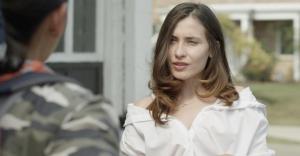 I wanted to highlight the ending, and in doing so will deal with spoilers, so you have been warned, dear reader. We spend the last 15 minutes or so following Ginny (Hannah Fierman) as she successfully calls for the police. Too bad that they too are in on it, and she apparently goes to sleep in the back of their car and allows the officer to carry her, like a child, into the creepy car from the horror movie-within-a-movie. There she’s also with one of her friends, the one who had their Achille’s tendons sliced. They commiserate and try to escape from the backseat (there’s a wall dividing the front and back seat like a cab). Then Ginny’s friend implores her to basically mercy kill them, and Ginny must go through her arguments of survival before realizing after everything they’ve been through that this might be a choice not presented later. Through tears, she slices her friend’s wrist, holds their hand, and watches as the life ebbs away – AND THEN THE MOVIE ENDS! “What?!” I spat at my screen. You have the Final Girl, or at least the supposed Final Girl, and you end things like this? It’s like the filmmakers ran out of time to make a climax. This is where the underwritten characters become an anchor. The movie cannot pull off this drama, especially as shaped as the film’s climax, because we haven’t invested in these people and their personal relationship. The work wasn’t set up for this as a big emotional payoff.
From a technical standpoint, Terror Trips is ably filmed. The visual compositions and acting are competent to good. I liked Abigail Esmena (They/Them/Us) as George and Fierman (V/H/S). They were both able to make positive impressions over the blandness of their characters. The Russian actors were authentic. Kate Kiddo (great name) was also memorable as the Polish intermediary for the tourists. The editing is a little overly jumpy for the first thirty minutes, like it needs to cut to a new shot for every sentence spoken, but it eventually settles down. The gore effects are few but serviceable and bloody. My biggest compliment is the sound design. For a movie spending a far majority outside, the sound quality here is shockingly good. I’m so used to sound being one of the most flagrant issues in low-budget indies, but here it’s an asset.
 With Isolated (formerly titled O9en Up), we have a contained thriller, which means much will hinge upon the chain of discovery for survival or enlightenment. There’s no shortage of people-stuck-in-mysterious-room movies. It makes sense from a production standpoint. It’s cheap. I remember one movie I saw on Netflix where it was like 50 people standing at game show podiums and they had to vote one person to die every so many minutes or else one person would randomly die. There’s two dozen Twilight Zone episodes about characters trying to make sense of a mysterious place they’re stuck in. It’s also featured in just about any Saw movie. It’s an immediate mystery that can work wonders. The trick is to either string the cause-effect plot elements so that we are learning and building off that knowledge along with the protagonist or connect the clues as to what or why their encasement means for them. I enjoy survival thrillers. I included Buried on my Top Ten for 2010 and that movie is one hundred percent Ryan Reynolds inside one cramped coffin. The problem with Isolated is that the mystery doesn’t feel that intriguing after about 30 minutes. The room itself looks like it should have more mystery to it, with a countdown and a giant nine painted on the wall. There’s a skylight with a latch just out of reach. Our main character, Nell (KateLynn Newberry), is even given her phone, which plays a song on the regular that seems too specific to be of little insight. But what does the movie actually do with its time and mystery?
At 99 minutes, you might find yourself getting a little antsy for the next reveal or clue to maintain an interest. I’m surprised the movie keeps its protagonist as such a blank. Nell seems resourceful, determined, and nursing some kind of personal pain or regret, but why is she here? Because we’re not given anything direct, your mind may likely anticipate that a major twist is in store by the end, and lo it happens (I don’t think the end explains the many hoops). I think the location just isn’t that intriguing enough to sustain the central mystery, and because we’re given few insights into this character we’re sharing a cell with for a whole movie, it made me feel restless. After Act One, Nell is given a cellmate, so to speak, on the other side of her wall, Travis (Lanny Joon), and the movie becomes a two-hander, though the perfunctory dialogue exchanges sound like the screenplay is filling time. It reminded me of 12 Monkeys when Bruce Willis’ character, a convict from the future sent back in time and doubting his sanity, hears a raspy voice on the other side of his wall who seems to know his dilemma. It becomes a playful and antagonistic exchange, and Willis doesn’t know if there is someone on the other side of the wall or if it’s all in his deteriorating mind. With Isolated, if Travis is meant to be our lifeline, it’s not enough. Now in a confounding location we have a confounding character, and rather than add layers to the mystery and our understanding, it just feels like vague on top of vague in service of stretching out a running time to feature length. I don’t think the twist earns the time spent, nor are the implications handled in a manner that feels satisfying or worthy. The ending reminded me of Old where for the final ten minutes M. Night Shyamalan basically says, “Okay, I’m just going to tell you everything explicitly now. Hope it’s been worth it. It hasn’t? Oh. Oh, okay then. Well, anyway…”
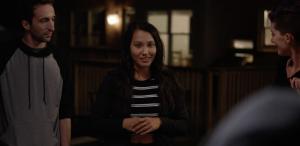 As a low-budget thriller, Isolated has some nice technical merits to praise. The cinematography by Greg Kraus (The Curse of Lilith Ratchet) is very good with more than a few shots that made me nod in appreciation, like an attached camera angle to Nell running in a panic. The editing, also by Kraus, is solid and nicely integrated with the visuals. I liked the quick cut montages of awful flashbacks forcing their way inside Nell’s mind. There are some neat visual tricks here for a low-budget film. The brooding musical score by TJ Wilkins (Knifecorp) does a lot of heavy lifting for the story.
For both films, there is a difficulty in following through with the story direction each chooses. With Terror Trips, it’s a horror movie that abandons its premise early to become a bland organ harvesting thriller with characters that are too indistinct and personality-free to care and with suspense sequences that are brief or underdeveloped. With Isolated, I went a little stir crazy from waiting for enough vital components to keep my attention and intrigue. The main character is simply not that interesting of a character to share 90 minutes with. Each movie feels padded out and undernourished where it counts with its storytelling, failing to capitalize on the promise of its plot elements. Horror and mystery fans might find enough to satiate their genre needs. Both of the movies have technical merits and agreeable acting, but it’s the story and, even more specifically, the development of its characters and suspense or mystery scenarios, where they do eventually stumble.
Grades:
Terror Trips: C-
Isolated: C
Share this:

Downton Abbey: A New Era (2022)
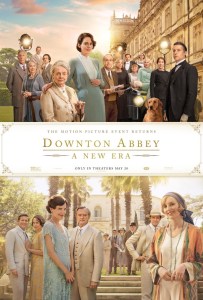 I have only watched the first movie, released in 2019, and know precious little about this widely successful BBC television series detailing the rich aristocrats and their plucky servants, so take my assessment with a whole serving tray of salt. The first Downton Abbey movie served as an epilogue for the series, providing extra resolution to several characters and coupling up others to provide a happy ending. Then it was wildly successful (a worldwide gross of almost $200 million) and so creator/writer Julian Fellowes (Gosford Park) got to come upon with yet another epilogue, this time finding even more happy endings and couplings for the those left out from the first cinematic victory lap. As someone new to this world, I was amused by its understated wit, puffery and pomp, and class conscious dramatics, plus it had a killer cast, most notably Maggie Smith as the tart-tongued Dowager Countess. The second cinematic offering is mostly more of the same, splitting the cast in two locations. One half are inspecting a picturesque villa in the south of France left to the Dowager, to the buttoned-up surprise of her son who questions what relationship his mother had with the former owner. The other half are stationed at the Downton estate while a Hollywood film crew decamps to make a movie. The inclusion of the movie-within-a-movie allows for some dishy moments, starstruck characters, and opportunities for a few Downton residents to make their mark in the pictures. These scenes are fun and provide some interesting conflict as the production has to quickly adapt from being a silent movie to one of them newfound all-the-rage talkies (with a lead actress better suited without sound). It’s a fluffy side story but allows many characters to shine. While the movie is mostly low-key and charming, much like its first big screen effort, by the end there might be some real tears, especially if you’ve been with these characters from the start. If you’re a Downton fan, you’ll eat this all up. I did have two questions that lingered: 1) where is this baby that was the entire story line for Edith in the first movie?, and 2) where in the world is Lady Mary’s husband (Matthew Goode) by the end when he should definitely be in attendance? My pitch for Downtown Abbey 3: Stiff Upper Lip begins with Lady Mary divorcing her racecar-obsessed hubby and moving to Hollywood for a new adventure.
Nate’s Grade: B
Share this:

The Other Side of Darkness (2022)
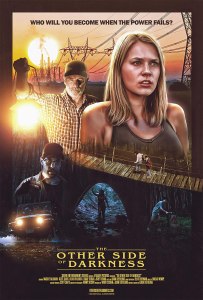 Adam Deierling is a native Ohioan who spent ten years in the hustle and bustle of the L.A. film scene before relocating back to the Buckeye State in 2008. He has since focused on wedding videography and short films and spoken that his goal was to get a professional feature film off the ground locally, an admirable goal, and he wanted to create a family-friendly adventure film that could inspire others. That result is The Other Side of Darkness, written and directed by Deierling and filmed entirely in Ohio and West Virginia. Unfortunately, the movie doesn’t know what to do with its major plot elements and feels a bit too lost by its own creative indecision.
Taylor Jo (Maggie Callahan), a.k.a. TJ is turning sixteen soon and eager to leave her small Ohio town. She works in her foster father’s auto shop and hates it and the direction of her life. Then one day she gets a mysterious note in the mail with a key that leads to an old Jeep. Turns out, the Jeep belonged to her biological mother and the note is from her still-living grandfather, Jack (Scott C. Davis). She hops in her new car, her best friend Hannah (Olivia Billings) and her cute brother Patrick (Drake Tobias) come along for the ride, and they head out to meet gramps. However, he might not be all that he seems, and a looming threat emerges that might cause the power system to go down, and then who can these beleaguered teens trust in these troubled times?
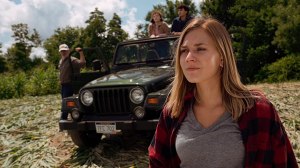 The Other Side of Darkness is like several different scripts stitched together, none of them richly developed or integrated to the other, which makes for an unfulfilling and tedious experience. Each of the half hours feels like a different movie. The first 30 minutes establishes the small-town life for TJ and her desire to escape, especially her predator of a foster parent. Then the next 30 minutes is about TJ and her friends going on a road trip to West Virginia to meet her biological grandpa and for TJ to learn more about her departed mother. Then the next 30 minutes is a mystery of whether or not the grandparent is who he says he is and discovering the terrain. Then the final 30 minutes is an action thriller to thwart homegrown terrorists. Each of these sections goes on far longer than it needs to, each of them presents very little sustained character development, and each of them feels adrift when compared to the other section. In the barest sense, these sections have a tenuous cause-effect relationship; however, the difference is whether the narrative feels like it’s actually building from scene-to-scene or just biding its time. I don’t know why we need a full half-hour to establish how awful TJ’s life is, especially throwing in the topic of sexual molestation, a serious subject that feels shoddily mishandled. The hook of this movie is the idea of our power system falling. Even the tagline says, “Who will you become when the power fails?” Well fear not, dear reader, because, spoiler alert, you’ll never have to wonder because the power grid doesn’t go down at all. The marketing sure looks like it’s going to be about people surviving in a world without power, with society possibly breaking down, but in reality, it’s about stopping two yokels from blowing up their local power station. That’s right, it’s not some far-reaching conspiracy that would trigger the crumbling of America’s interconnected infrastructure like the downfall of the Death Star. Nope. So, even if they blew up this lone power station, the power company would just come out and restore power. For a movie literally called The Other Side of Darkness and playing up a powerless world of survival, the actual employment of these big plot elements is strangely myopic and half-hearted.
Perhaps the title is in reference to the personal journey of our protagonist and her self-discovery, and I’ll humor this charitable interpretation and explain why this still doesn’t work. TJ’s story feels like it should have the right material to be engaging and even inspiring. The first part of the movie establishes her attitude, her plight, and eventually her escape via mysterious family member. This sets us off on her to discover her birth family and perhaps a little more of herself. When she meets her grandfather, he has one teary-eyed monologue, and then the rest feels like everyone is just dithering around and waiting for instructions on what to do. Grandpa gives TJ taped recordings her mother made with the intention of her daughter to one day listen. I don’t understand why this plot element was not explored far more in depth. This is her direct line of communication with her mother, her ability to hear her voice, listen to her singing, and emotionally connect with a woman who has long since departed her life. I also don’t understand why TJ isn’t interrogating her grandfather non-stop about her mother and father, or even simply bonding with dear old grandad and he her. It feels like right after everyone establishes their identities, the characters are just aimlessly hanging around loitering. In one early scene, it looks like Hannah and her brother are asleep on the couch behind TJ as she talks to grandad for the first time. I was mistaken because Hannah then moves, so she’s not asleep but she looks transparently bored (I’m sorry this family reunion couldn’t be more exciting for you). The writing for the characters keeps their conversations very surface-level. Every person is flat-out telling each other what they feel, who they are, what their personal journeys constitute. It’s a clunky, inauthentic manner of speaking that shows the writer’s too obvious hand.
 Another factor that keeps me emotionally distant from the movie is how little it makes use of its near two-hour running time. There are long stretches that resemble a glorified car commercial. TJ, Hannah, and her brother go riding along and the music rises in celebratory volume and then things just keep going from there. With the drone shots of the car passing along a dusty trail, the interior shots of the characters laughing and smiling maniacally, and the attached camera angles to show the wheels flying across the muddy roads, all you’d need is to slap “Life is a Highway” and some ad copy at the bottom and it would be indistinguishable from any glossy car commercial. Why does this bother me? It’s because the movie is unmistakably filling time, dragging out its plot with extended sequences of transportation. There are numerous sequences of people walking from Point A to Point B, especially trouncing through the woods, and rather than see one sequence of a character walking to establish distance, we get four or five. This is all at the expense of storytelling and character, and that’s what I chafe at. Let’s take as another example the best friend character Hannah. In the first 30 minutes, the film establishes her as TJ’s only friend and a supportive outlet, enough so that she agrees to come along when TJ wants to track her out-of-state grandfather. Hannah and her brother spend what appears to be days away from home and I kept wondering what their parents would be doing, whether they would be calling the police, especially since Hannah cannot get cell service. This plot point bothered me for two reasons: 1) why can’t Hannah just travel in the car to reach an area where she has service, and 2) why does Hannah even need to be here at all? At least her brother becomes an underdeveloped romantic interest for TJ. Hannah’s role is inconsequential. And, again, all of these dawdling decisions are at the expense of the dramatic potential of the plot, of a granddaughter learning about her mother and bonding with her grandfather for the first time. Once the movie reunites its characters, it feels so shiftless and waiting for delayed instruction.
From a technical standpoint, The Other Side of Darkness is low-budget but has a nice sheen of professionalism for a $15,000 budget. I have seen movies with ten to twenty times that budget that don’t look as good as this. The cinematography by co-producer Vinny Sisson is crisp and with satisfying visual compositions. The acting is generally competent. Nobody will astound but nobody took me out of the movie with a bad performance. I thought Davis (Chosen, Between the Walls) has a warm and weathered presence that improved the role. Callahan reminded me of Britt Robertson (Tomorrowland, I Still Believe). Billings reminded me of Sarah Yarkin (2022’s Texas Chainsaw Massacre). I can only imagine what these people could have done with a superior screenplay that allowed them the material and space to really dive into their character dilemmas with nuance and emotional authenticity. The one technical aspect that needed some curtailing is the overzealous musical score by Niklas Wempe. The score is everywhere and never subtle; it is loud, in your face, and trumpeting what is happening onscreen, pushing moments into unintended levels of farce, like people walking through the woods now feel like they must be running for their lives when the reality of the circumstances is nowhere near as urgent. The musical score is so intrusive and old fashioned that it reminded me of 1940s moviemaking.
 At almost two hours long, The Other Side of Darkness is a frustrating viewing experience. It’s not the movie it advertises itself as delivering. Just looking at that poster, you might surmise a post-social breakdown thriller like The Trigger Effect, or maybe even a nostalgic 80s adventure like The Goonies. You would be let down by either genre expectation. Sadly, the movie cannot live up to its own dramatic premise of a family reunion between grandfather and granddaughter sharing their common link, a deceased loved one they can relive with the other. It’s bizarre to watch a movie with such potent storytelling elements and seeming so indifferent to them or confused what should be done. This feels like a first draft of a screenplay, where characters are just expositing their direct feelings and desires, unencumbered by subtext. Too often the movie just has its characters milling about, and at two hours in length this is inexcusable. The power outage thriller concept feels almost entirely tacked on to provide more of a marketable angle. It’s shockingly underdeveloped and relatively unimportant in the film’s grand scheme of human drama. Often with first-time filmmakers also dabbling in their screenwriting, I find the stories that would have sufficed as short films expanded into feature-length but not given the attention for the adaptation to succeed. The Other Side of Darkness proves that Deierling has the technical chops to make the most with a micro-budget. I just hope his next feature takes more time to really establish what it wants to be and how best to develop and achieve these goals. The Other Side of Darkness is a little too much in the dark.
Nate’s Grade: C-
Share this:

Dual (2022)
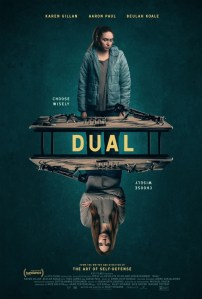 Imagine a world where anyone can create a clone, a perfect, or almost perfect, copy of yourself so that after you’re gone your family will never have to theoretically lose you? That’s the premise of Dual, an indie that played at the 2022 Sundance film festival and is now available online. Sarah (Karen Gillan) is generally miserable with her life. She doesn’t return her needy mother’s phone calls and texts. She’d rather watch porn than talk with her distant boyfriend. She’s also leaving disconcerting blood stains on her bed sheets. Turns out Sarah has a rare and incurable illness, and so she is eligible for the Replacement Program, an opportunity to get her own clone. She is gifted a clone (also Gillan), a reported exact replica except for eye color (the company offers a five percent discount for the defect). Sarah takes her doppelganger home and attempts to teach her about her life and how best to fit in. It’s not long that the Sarah clone has her own ideas about what her life could be. However, when Sarah’s terminal diagnosis improves, she intends to abort her clone. The clone triggers a legal clause that says that the ultimate decision over who gets to live as the only Sarah will be a televised duel to the death in exactly one year’s time.
Dual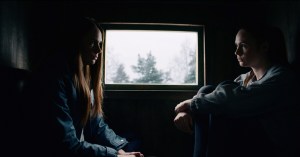 is a puzzling movie. I haven’t watched writer/director Riley Stearn’s other movies, notably 2019’s The Art of Self Defense, though I’ve read Dual is in keeping with his exaggerated, deadpan style, but to me it feels very much like an attempt to recreate a Yorgos Lanthimos world. Lanthimos is most famous for films like The Lobster and was even nominated for Best Director for 2018’s The Favourite. Lanthimos is excellent as creating these worlds that are reflections of our own but detached, deadpan, aloof, and irregular. The world of The Lobster is bizarre as a means of satirizing our social values when it comes to romantic relationships. In that world, if you cannot find a suitable mate within a period of probation, you will be transformed into an animal of your choosing. That world is bizarre in its very inception but there’s a reason that Lanthimos makes use of his stilted, stylized dialogue, to better reflect the absurdities of our culture. With Dual, the world never feels that wholly separate from our own and actually a little under-explored. The fact that society has cloning is woefully underutilized. What else does this mean about our concept of self, identity, legacy? What about clones that abandon their intended families? What about clones that murder their originals before their court-arranged duels? What about people that cheat the system and get more than one clone? What about a clone getting a clone? As the movie progressed, I kept feeling the unmistakable pull of wanting this story to be told straight and without the hip ironic posturing (I suppose that’s Swan Song, a 2021 movie I have yet to watch on Apple Plus). It just felt like there was so much more intriguing dramatic potential to be had here playing things straight, a woman facing her impending mortality, getting a “replacement you” and finding her not sticking to the script, endangering her fragile sense of preservation, and then the crisis of your friends and family preferring the clone over her. That’s some juicy stuff, but it all gets downplayed thanks to Stearn’s selected tone.
It would be one thing if Dual was hilarious with its cracked mirror approach but I just found little to actually laugh about. There are a few moments that I did chuckle, like Sarah and Trent (Aaron Paul) providing a play-by-play of their slow-motion brawl and the consequences of their amassed injuries, and the doctor that informs Sarah about her tragic diagnosis are the most well realized moments with tone (“This is why most doctors are depressed”). The bone dry, matter-of-fact style of speaking is too often the only joke. Just because characters are speaking in a detached manner does not mean you can skip over the same tenets of comedy construction. Lanthimos doesn’t just rest on his characters talking in a manner that is unexpected. There’s genuine work to make them seem of their weird world. The characters in Dual just seem like hyperactive, overly literal irritants. Often, they’ll just keep speaking about a subject and the joke is the length of the details. The Sarah duplicate doesn’t know how to drive, and as she watches her original, she remarks, “Oh, and I suppose you turn the big wheel left and the car goes left. Turn the big wheel right and the car goes right. Easy enough.” I suppose the joke is that she describes two pointless examples? Even the scenes with the doctor, which I laughed at, suffer from Stearns overwriting his dialogue exchanges. It’s not enough for the doctor to make an absurd, Kafkaesque remark, but the character must circle back and underline this over and over. The overall feeling is tiresome. There’s one example of what Dual could have been, where Trent suggests to Sarah during her money problems that she might provide “other means of payment.” The movie then cuts to them both dancing and Trent remarks, “Thank you for the hip-hop dance instruction. I’ve always wanted to learn but was too nervous.” That joke works. It’s a subversion that doesn’t overstay. I wish Stearns had pulled back and trusted his audience to get the joke without his incessant redirection of comic emphasis.
 The real reason to watch Dual is for the dueling Gillan performances. She gets to play two same-but-different versions of a character, and she really shines in the subtle differences she takes advantage of. I enjoyed the passive aggression of the clone re-examining the faults of her original, and I enjoyed how quickly she was interrogating her original while making casual, catty judgements. Paul (Breaking Bad) is also enjoyable but only appears in the second half of the movie and is underutilized. Stearns seems drawn to the mentor-pupil relationship dynamic (The Art of Self Defense) and the interaction between Paul and Gillan is a regular highlight of the movie. The actors generally elevate the material even as Stearns restricts the acting tools they can rely upon.
I’m sure there will be viewers that will genuinely enjoy the distaff comedy and pathos of Dual. There’s a clear artistic vision here by Stearns, it just didn’t fully gel for me because I felt the choices of tone and plot limited what could have been a far more emotionally engaging and intellectually fascinating story. The comedy too often settled on being quirky and too often it reminded you of this by circling and re-circling the same joke for diminished returns. Dual is not a bad movie, more a frustrating experience, one with big ideas and talent in front of the camera and behind, but it could have used more shaping and tone calibration to be its best version of itself. As it stands, it’s a fittingly amusing dark comedy with two solid performances from Gillan, and that could be enough for many to justify a 90-minute investment. For me, it felt too much like Lanthimos lite.
Nate’s Grade: C+
Share this:

Uncharted (2022)
 The successful Uncharted series (2007-2016) are some of the most movie-ready video games for big screen adaptation. While playing the globe-trotting, puzzle-solving, treasure-hunting action-adventures, it feels very much like you’re already in the middle of a big-budget Hollywood blockbuster. The game was in development for so long that the producers have finally ditched Nathan Fillion, the celebrity doppelganger in look and attitude of the game’s swashbuckling protagonist Nathan Drake, and resorted to everyone’s favorite web-slinger Tom Holland as a younger version of the hero. He’s a brainy bartender who is looking for some hidden Magellan treasure, and maybe his missing older brother too, and is aided by Victor “Sully” Sullivan (Mark Wahlberg), an Army vet with a shared goal of retrieving the gold before his rival, wealthy industrialist Santiago (Antonio Banderas). It’s a race against time and while it doesn’t reinvent the action-adventure wheel, Uncharted is a perfectly diverting piece of entertainment. The banter is fun between Holland and Wahlberg, the action set pieces are brisk, and the third act in particularly is just a showstopper of big action bravado. The visuals are eye-grabbing and the action sequences are inventive and exciting. That’s what Uncharted gets the most right, that sense of fun the games have built into their core, while keeping things moving smoothly with colorful characters and large-scale action. You’ve seen some combination of this movie before, but even genre masterpieces are built from their influences, so being derivative is not a fatal flaw as long as the filmmakers get the essentials of storytelling and action cinema right, and they do here. The world of video game movies is already one where the bar is fairly low for quality, but it seems like Hollywood has started raising its game, like with the new Tomb Raider, Detective Pikachu, Sonic the Hedgehog, and the upcoming Last of Us prestige HBO series. Count Uncharted as the Saturday morning popcorn spectacle that knows exactly how to deliver a good time in only 105 minutes.
Nate’s Grade: B
Share this:

The Bad Guys (2022)
 Even though it’s based on a popular series of children’s books, if you’ve seen Zootopia, you’ve seen the better version of The Bad Guys. As far as entertainment aimed at the wee ones, you can certainly do worse. It’s brisk, silly, and the animation is quite enjoyable, adding hand-drawn overlays and accents that really make the images pop and provide additional, gratifying textures. The story, on the other hand, is the same old-same old. We have a group of “scary animals” in a world where anthropomorphized creatures walk side-by-side with humans. These spooky creatures get a bad rap because people fear them, so they lean into social prejudices and become a notorious criminal gang. Except now they might want to go good because being good feels better than being bad. Thematically, it’s the same territory that Zootopia trod and with better world-building. We have “bad animals” that are tired of being looked as bad because people wrongly interpret them as scary threats. It’s the predator/prey dynamic but without the depth. Having an all-animal heist crew provides some creative entertainment and Ocean’s 11-style moments of frothy fun; I especially enjoyed that the giant shark is the team’s master of disguise and always very obvious. The character arcs, supposed betrayals, redemption, and plot should be familiar and predictable, which means much of the movie must coast on the appeal of the animation, vocal actors, and general sense of humor. The comedy can be amusing but too often falls upon cheap gags, like the piranha’s defining trait of being a nervous farter. The Bad Guys is suitable for animation aficionados, fans of the book series, and people who have never seen Zootopia, and if that’s you, then just watch Zootopia.
Nate’s Grade: C+
Share this:

Fantastic Beasts: The Secrets of Dumbledore (2022)
 If ever a film franchise looked to be in decline, I submit to you, the Fantastic Beasts movies. Begun in 2016 as a presumed five-part series, Harry Potter author J.K. Rowling was the one writing the screenplays this time and going back to 1920s America. Fantastic Beasts and Where to Find Them, chronicling bashful magical animal caretaker Newt Scamander (Eddie Redmayne), made $800 million worldwide. In the years since, Rowling has burned through much of her good will with transphobic comments, Johnny Depp has been replaced as series villain Grindelwald by Mads Mikkelsen, and 2018’s Crimes of Grindelwald made $150 million less than its predecessor. Now with COVID transforming the box-office, the question remains whether the Wizarding World franchise (as Warner Brothers has been calling the Harry Potter universe) can survive without its Boy Who Lived. The third film, Fantastic Beasts: The Secrets of Dumbledore, finds young(er) Dumbledore (Jude Law) confronting his old foe –- franchise fatigue.
It’s hard for me to fathom anyone, even the most ardent of Harry Potter fans, watching this movie and exclaiming, “I can’t wait for two more of these!” The Secrets of Dumbledore feels more like a regular episode of an ongoing TV series than a story that demanded to be told as a big screen adventure, something that meaningfully reassembles the key characters and moves the larger wizarding world story forward. By the end of the movie, Wizard Hitler still looks like Wizard Hitler. The end. The last movie set the stage for a looming wizard-vs-wizard civil war that would push the magic world to choose its sides. That’s why it’s so bizarre to then go right into a weird election conspiracy with a weird magic deer creature. This is a fantasy world with crazy characters and weird rules and I can’t adequately explain why this whole plot point with a magic deer wrings so silly and ridiculous for me. It’s like if we replaced our electoral system with letting the groundhog choose the president on Groundhog Day. Why bother with democratic elections when we can just have a pure magical creature provide its endorsement? The big scheme for Grindelwald to rig the election at any costs, which has a bizarre 2020 Donald Trump political parallel that also makes me dislike the plot more. The entire movie is hinging on this little creature making its opinion known, so why not guard it better if it’s so integral to their foundation of wizarding governance (warning: animal cruelty early)? This plot line does not work for me, and it feels clumsy both in contemporary political parallels as well as an effort to find reason to continue inserting Newt Scamander into these movies. The franchise began as a light distraction with a goofy zookeeper for magical creatures. Now it’s become a political thriller about the fate of the world against Wizard Hitler. It’s a bit different tonally, and perhaps it’s time to let Newt tend to his animals off-screen, much like what has happened to Tina Goldstein (Katherine Waterston), the co-lead of the other movies, casually “staying home.”
 This is also the first Fantastic Beasts movie where Rowling is sharing screenplay credit, with Steve Kloves, the man who adapted all but one of the Harry Potter movies. It feels like another act of trying to salvage this franchise. I’ve read plenty of critics claiming that this movie corrects the screenwriting miscues of the past films, and to this I do not agree. Reaching out for help from an industry veteran used to adapting Rowling’s imagination is a smart move, but the movie still suffers like the previous Fantastic Beast movie from a plot overburdened with incident and less on substance, willfully obtuse and convoluted in its plotting. Since Grindelwald gains the power to see into the future, a power that is woefully underutilized, the only way to disguise Dumbledore’s plot to uncover election fraud is through sheer confusion. They have to make things purposely confusing and hard to follow on purpose, dear reader. A purposely convoluted and confusing movie is the only way they can beat the bad guy. It’s like Kloves is speaking directly to the audience and admitting defeat at keeping anything clear. I went to brush up by reading the Wikipedia summary for this review and even that made me tired. A wizard heist is a great setup, but Secrets of Dumbledore cannot live up to that potential. The set pieces don’t lean into what a wizard heist could bestow. There’s one memorable sequence where Newt and his brother must escape from a crustacean prison by literal crab-walking. It’s the only light in an otherwise dismal, overwhelmingly grey movie. It all feels less transporting and more plodding.
What even are the “secrets of Dumbledore”? If it’s that he’s gay, well at least the movie finally has the temerity to finally say that Dumbledore and Grindelwald were more than just really special friends who decided to wear vials of each other’s blood as necklaces. The movie unequivocally confirms that they were lovers, had a relationship, and yet it’s all also contained in a prologue flashback that can easily be cut for foreign markets that would object. So congrats, Warner Brothers, for going far enough to at least say Dumbledore and Grindelwald were boyfriends at one point. However, this secret has been publicly known since Rowling outed Dumbledore in the late 2000s, so that’s not it. I guess we’re carrying over the revelation at the end of 2018 that Credence (Ezra Miller) is a Dumbledore, except that it’s revealed he’s the son of Dumbledore’s brother, meaning the big reveal in 2018 was… Dumbledore had a nephew? This character has even less screen time than the other two movies and it feels like the filmmakers are actively trying to work him back to the sidelines (perhaps Miller’s penchant for legal trouble accelerating matters). This all seems pretty minor, and I suspect the filmmakers are ret-conning a direction they thought would be pivotal and have since changed their minds. That’s all I can gather as what might constitute a “secret of Dumbledore,” although allow me to posit a different theory why the third movie has this subtitle. This is a franchise that has been leaking cultural cache and fan interest, and so the producers say, “Nobody knows a Newt or a Grindelwald. They know Dumbledore. They care about Dumbledore. That’s the title.” It’s about rescuing a flagging franchise with the only character that reaches forward to Harry Potter.
 It’s also a little strange that the movie doesn’t even comment that Grindelwald’s appearance has changed. This is made more confusing because of that prologue flashback where Grindelwald had the face of Mikkelsen, so I guess he just chose to hang as Depp for a while. Even a passing reference to this being his “preferred form” would have sufficed. It was established that the big bad wizard could alter his visage, but we shouldn’t just go movie-by-movie with a brand-new actor (really the third actor in three films) as the main antagonist without even the barest of references for the audience. I guess it’s just all assumed.
I think this franchise also needs a break from David Yates as its visual steward, the same director of the last two Beasts films and the last four Potter movies. This is the dankest, most greyed out blockbuster movie I can recall. Yates’ muted color palate and somber handling of the material has begun to drain the fun and magic from this universe for me. I said 2020’s Ammonite was “all grey skies, grey pebbles, grey shores, grey bonnets, grey leggings, grey carts, grey houses, grey this, grey that, irrepressible grey.” This movie is the Ammonite of studio blockbusters (it’s not quite Zack Snyder’s Justice League, where color is not allowed to exist by force of law). The last time someone else directed a Wizarding World picture was 2005’s Goblet of Fire. Yates has served his time, although considering he’s only helmed one non-Potter movie in the same ensuing years (2016’s The Legend of Tarzan), maybe he’s just as reluctant to walk away from this universe.
My personal interest in this franchise has been decreasing with each additional movie, and at this point I’d be content if the planned fourth and fifth movies stayed purely theoretical. Fantastic Beasts: The Secrets of Dumbledore feels, front to back, like a filler movie, a story that is rambling and haphazard (but on purpose!) and a franchise that has outgrown its initial parameters and is struggling to explain why these adventures are persisting and what the overall appeal would be. If you’re happy to just step back into this special world one last time, then you’ll at least walk away satisfied. I still enjoy Dan Fogler as Jacob Kowalksi, the Muggle pulled into the crazy world, the character that should have been the protagonist of the series. Mikkelsen is an upgrade for any franchise. I liked Jessica Williams (Booksmart) and her posh British accent. The special effects are solid if a bit twitchy. I just don’t see the driving force to continue this series, and Warner Brothers as of this writing has not greenlit either of the two proposed sequels to close Fantastic Beasts out, so we may end as a trilogy after all. If that’s the case, what will the legacy be for Fantastic Beasts? It feels like a franchise that started in one direction and was quickly course corrected to another, leeching the initial charm and light-hearted energy. Just like The Matrix universe, I think there are more creative stories that can be told here, but maybe it’s time to allow some fresh voices into the creative process. Maybe it’s time for Rowling to gracefully open her storytelling sandbox for others to dabble within. In many ways, it feels like the fan community and even the movies themselves have simply grown beyond Rowling.
Nate’s Grade: C+
Share this:

The Northman (2022)
 Consider writer/director Robert Eggers’ bloody Viking revenge movie as a companion piece to 2021’s The Green Knight. Both movies take mythical, supernatural-aided tales of heroics and medieval masculinity and feed into the spectacle while also cleaving the legend to make way for a sense of humanity. We follow Amleth (Alexander Skatsgard) who is a displaced prince who has sworn to kill his treacherous uncle and rescue his mother (Nicole Kidman). It’s a tale so old that it inspired Shakespeare’s Hamlet, though that play could have benefited from a climax involving two hulking naked men dueling to the death atop an exploding volcano. The Northman reminds me a lot of Mel Gibson’s Apocalypto, a movie I described back in the day as “an art film for jocks.” It’s immersive and impressive down to the exact detail, and it doesn’t shirk on the blood and combat. It’s also unmistakably the work of Eggers, a very precise and idiosyncratic indie director whose prior movies felt like stylistic dares. The camerawork is often long with single takes, making all the visual arrangements and coordination that much more impressive. It’s staggering that a studio provided Eggers with $90 million to go make his version of Conan the Barbarian. At a lugubrious 140 minutes, there’s enough sticky carnage to satiate fans of brutish medieval action movies, but I appreciated how Eggers keeps his story purposely streamlined and simplistic until a few keen reveals force the audience and protagonist to re-examine the assumptions and fleeting honor of vengeance in this harsh, unfair environment of men out-killing one another. It’s a movie that provides the red meat and then makes you question whether you might want to go vegan. There’s more that can be unpacked but I wish Eggers had cut back at points. This is a slow movie, which does contribute to its mood and atmosphere, but I also wish Eggers had gotten to some of his plot points with a bit more haste and vigor. The Northman is transporting and bold and also more than a bit bloated. You could laugh at some of its over-the-top machismo but I feel like Eggers is inviting criticism of that very machismo, so enjoy the movie on one level where it indulges all the Old World violence, and then enjoy it on another level where it subverts and castigates the same Old World violence. Or you could just watch for the glistening muscles, famous faces, bad accents, bad wigs, guttural score, and weird imagery.
Nate’s Grade: B
Share this:

Firestarter (2022)
 I have never seen the 1984 original movie starring Drew Barrymore but I have to assume it’s got to be better than the 2022 Blumhouse remake. Stephen King adaptations have a very wide range in quality, and from other reports Firestarter is one of King’s most straightforward novels. The most interesting aspect of this movie is that the score is provided by legendary horror director John Carpenter, as well as Cody Carpenter and Daniel A. Davies, and Carpenter was going to be the director of the 1984 Firestarter before the studio replaced him after the poor box-office performance of 1982’s The Thing, widely regarded now as a classic of its genre. Otherwise this is a pretty generic chase movie where people with superpowers are trying to stay hidden from evil government agencies looking to capture them and use them as weapons. I was reminded of that X-Men TV series The Gifted that lasted one season in 2017 for much of the movie. The dialogue is quite bad, including one climactic line that had me howling: “Liar, liar, pants on fire,” and she doesn’t even set the person’s pants on fire. The parenting miscues for Zac Efron’s psychic dad character are manifest, and it’s still strange to see the High School Musical star enter the dad part of his career. Efron’s character and his onscreen wife bicker about how best to protect and support their powerful little daughter who could go nuclear and has, in anger, set her mom on fire. Apparently, ignoring a problem isn’t the best solution. Regardless, the father-daughter moments are weakly written and you won’t care about any characters. There’s also a really extended and disturbing sequence of an animal in misery after being burned by out little firestarter, so that’s great at creating empathy. Even at just 90 minutes, this movie is a boring slog. By the end, I didn’t care who was being set on fire because the big thing that went up in smoke was my patience and my time.
Nate’s Grade: C-
Share this:

Morbius (2022)
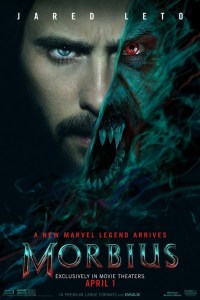 Not the train wreck the advertising made it seem, Morbius is merely a bland superhero retread that reminded me of the early 2000s superhero output like Daredevil and the Tim Story Fantastic Four. Having been delayed almost two years thanks to COVID-19, the film was released on April 1 for full unintended irony, and it’s a silly mess but also nothing worth getting too worked up over. Method actor extraordinaire Jared Leto (Suicide Squad) plays Dr. Michael Morbius who is suffering from a rare disease and finds a solution via a serum mixing vampire bat DNA but it has some consequences. He has super powers but needs to feast on blood every six hours and is dreading the point where he may not be able to resist the allure of feeding on humans. It’s a very Jekyll/Hyde concept, man trying to control his inner demons made literal, and once again we have a villain that essentially has the same powers as the hero. Matt Smith (Doctor Who) play’s Morbius’ childhood friend who also suffers from the same rare blood disease, but Dr. Morbius refused to share the cure because he explains it’s a “curse,” although maybe let the man suffering make that personal health choice. Bless you, Matt Smith, because you’re the only one having any fun with this movie, and that includes in the audience. Leto is actually fine though not much about the Morbius character is really imparted. The action sequences are erratic and the stylistic flourishes, like the “look at me” slow-mo ramps and the inexplicable wispy colorful smoke clouds trailing Morbius in action, hamper the ability to even discern what is happening onscreen. Maybe that’s on purpose after two years delay. The movie establishes a basic structure, series of goals, antagonist, and problems efficiently enough to make it to the end credits after 90 minutes. It’s just that we’ve come to expect better from our super hero cinema by now. As a disposable monster B-movie, Morbius is okay. It’s not recognizably campy, it’s not so-bad-it’s-good, it’s just a generic origin story/Dr. Jekyll and Mr. Hyde territory with a lot of dropped subplots and subpar CGI. I have my serious doubts about Sony’s plan to hatch solo movies for all these different Spider-Man villains, and the creakiness of this plan is even more evident with their contrived post-credit scenes trying to awkwardly establish their retinue of villains to confront Spider-Man. Does Morbius know who Spider-Man even is? Morbius the movie and character just feels too half-hearted for anyone to care.
Nate’s Grade: C


 nathanzoebl
You must be logged in to post a comment.