Category Archives: 2020 Movies
The Photograph (2020)
 The Photograph is a romantic drama that is unfortunately tethered to three very uninteresting lead characters. They all have potential; a journalist (Lakeith Stanfield) getting closer to a story than he anticipated, a woman (Issa Rae) learning more about her artistic, ambitious, and self-involved mother (Chante Adams) after her death. The problem is that these characters all feel trapped in boxes, confined, and the personal growth onscreen is minimal. Sure, we still get the boy-meets-girl and boy-loses-girl paces expected but there’s precious little depth given to these people. It feels like writer/director Stella Meghie (Everything Everything) should be mining more insights and revelations from this mother/daughter re-examination, but by the end we haven’t learned anything we didn’t already know in the first thirty minutes. It’s a strange experience because even as things are, on paper, moving forward, the movie feels stagnant. This is also a byproduct of the nascent chemistry between Stanfield and Rae, two genial, good-looking people that just don’t have that spark or urgency when they’re comfortably close. It’s a movie that seems to stay in the same languid gear throughout the movie, even as the couple is progressively getting closer. It’s a competently made movie with good actors but my mind kept wandering and wondering what a full movie following the mother chasing her dreams might resemble, or a full movie following Lil Rel Howery (Get Out) and his adorable family, the character who entertained me the most. The story elements are here for an engaging and potent romantic drama but the mix feels undercooked and stale.
Nate’s Grade: C+
Share this:

Birds of Prey (2020)
 Not really a Birds of Prey movie, not really a Suicide Squad sequel (see you in 2021), this is really more of a Harley Quinn solo spinoff that’s fun, colorful, bonkers, edgy, and a smile-inducing delight… when Margot Robbie is onscreen as Harley. Robbie is a charming, hyperactive live wire that commands your attention, and giving her the reigns of the storytelling, quite literally in some Deadpool-esque meta storytelling tweaks, is the best decision the filmmakers make. I enjoyed the frivolity, visuals, and narrative trickery, but I noticed something whenever Harley took a powder off screen. None of the other supporting characters are that interesting. I don’t know anything about Cassandra Cain (Ella Jay Bosco), the plot device that everyone is after because of the prized diamond she swallowed. She’s more attitude than person. There’s also Black Canary (Jurnee Smollett-Bell) who doesn’t do much and has a super power she doesn’t use until the end. Renee Montoya (Rosie Perez) provides the police angle and references to cop movie cliches (a hat on a hat). Huntress (Mary Elizabeth-Winstead) is almost a self-parody as the young girl growing up to be an elite assassin to avenger her murdered family and the movie treats her like an also-ran. The only other person of interest is the villain, Roman Sionis a.k.a. Black Mask (Ewan McGregor), because the performance is campy while also being menacing. Birds of Prey suffers absent Robbie because its additional pieces cannot carry the movie on their own. The vacuum of charisma is too noticeable. The fight choreography is impressive and with plenty of longer takes to fully appreciate the cool moves. I enjoyed how every action sequence was different from the last and director Cathy Yan makes excellent use of her environments; a police lock-up is a fantastic place for an action scene with all the evidence/props to utilize. A romp inside a fun house also keeps things fresh even though the goons never bring guns to their big fight. Birds of Prey works very hard with quirk and narrative shuffling, and it feels like a decided attempt to dazzle as well as distract, because there’s not much to this movie. It’s style and personality over substance, and that’s fine, but it does make the second half feel a bit like coming down from a sugar rush. I know there will be plenty that celebrate a group of strong women taking ownership of their own stories and fighting together against toxic men. I know there will be plenty of my friends that love this movie. For me, it was an enjoyable experience that made me realize just how much I enjoy Robbie as an actress, as this character, and when given extra room to roam with an R-rating. Birds of Prey is the kind of tasty junk food you just crave from the cinema every now and then, but without Robbie it’s decidedly less flavorful.
Nate’s Grade: B
Share this:

The Assistant (2020)
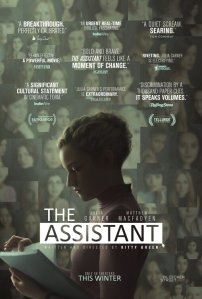 Jane (Julia Garner) is a young woman serving as an assistant to a high-profile film and TV producer, the kind of man with plenty of pull within the industry. She’s the first one into the production office and the last one out at night. Little by little, a larger picture forms of her temperamental, vindictive, and lecherous boss, especially as young women seeking to get ahead in the entertainment world as carted before him like sacrificial offerings. What will she do when the offending evidence becomes too much to ignore?
Where The Assistant lost me was in its lack or urgency with its storytelling. This is the slowest of slow burns, and it’s understandable, to a point, why this approach is the more realistic path. We’re watching the decades of inertia that make anyone standing up to harassment and abuse very difficult to find any traction or credibility. It’s much easier to just shrug it off, say “that’s just the way this awful man is,” laugh it off like some of his peers, ignore it like others, or compartmentalize, justifying your complicity as symptomatic of just how the industry works. I was waiting for the slow reveals to finally form a picture for our protagonist and push her into action, a desire to do something or say something about what she can no longer ignore or assist. The movie gets us to this point and, in its best scene, smacks her down for even seeking out this oversight. From there, the movie just becomes another repeat of what happened before, with more clues about the bad behavior of Jane’s boss, but it’s more of the same and then it just ends. I think writer/director Kitty Green (Casting JonBenet) was going for ongoing ambiguity whether or not Jane ultimately decides to leave her entry-level position or swallows her moral turpitude. However, there is a frustrating difference between an ending that is openly ambiguous and one that feels incomplete and lacking. After everything I went through, a little more definition by the end could have made the slog of work details more palatable.
 This subject is bursting with pertinent urgency and social commentary and I feel like this movie is just missing so many important things to say and do in the name of misplaced indie understatement. Understatement can be fitting as an approach to real-life dilemmas but The Assistant is understated to its unfortunate detriment, traversing from subtlety into somnolence. More time is spent establishing the mundane details of Jane’s office duties than the harassment and protection afforded to her boss. I was expecting to collect little telling details, like the male assistants’ patterned ease of composing “apology e-mails” for whatever indignation the boss feels, but we’re absent a certain momentum throughout. The first thirty minutes is packed with moments like Jane making coffee, Jane tidying an office, Jane getting food, Jane answering phones, Jane microwaving a cheap dinner. We never see her at home from the moment she leaves in the opening of the film. It’s like the movie is saying she lives at the office or must if she is to get ahead in a broken system of people using people. The people passing through are superficial to us, never more than pretty faces, or important names coming and going on the peripheral. I was feeling crushed by the obsessive details of this work routine. I expected to establish a pattern, establish a baseline, and then move from there, forcing change or at least reflection. The mundane details are meant to convey the soul-crushing nature of Jane’s job, being on the bottom of an industry she’s desperate to break into, and how un-glamorous the life of the little people can be. But she’s also a gatekeeper of sorts for the line of future victims encountering her bad boss. There’s a degree of culpability there, and it’s never fully explored because of how underplayed every moment and every scene comes across, choosing mundanity over drama. I would not begrudge any viewer if they tuned out The Assistant after the first half hour of work.
There is a noticeable feeling of dread and discomfort in the movie, but without variation or escalation it feels almost like a horror movie where we’re stuck with the person on the other wall of the action just briefly overhearing things. Imagine Rosemary’s Baby but if you were one of the neighbors just wondering what was going on. There’s an important message here and the point of view of an up-and-coming young woman as the assistant to a Harvey Weisntein-esque monster and her moral quandary of how far to ignore and how much she is willing to suffer is great. That’s a terrific, dramatically urgent starting point, and yet The Assistant is too muted and padded. There’s a remarkably thin amount of drama during these 85 minutes, with the more intriguing and disturbing action kept in the realm of innuendo and suspicion. It makes the final movie feel like the real movie is on the fringes of what we’re seeing and we just need to nudge back to the drama.
 There is one fantastic scene in The Assistant and it happens at the end of Act Two, and that’s when Jane finally seeks out the HR rep, Wilcock (Matthew Macfadyen). You sense just how much she wants to say but how much she feels the need to still be guarded, so minute by minute she tries a few more scant details, all that’s needed to limit her vulnerability and exposure. Wilcock seems like he might just take her words seriously, and then he interrupts to answer a phone call, and it’s an obnoxiously unimportant call and his behavior merges into just “one of the guys.” From there, he turns the heat on Jane, laying out her circumstantial claims and questioning what her future plans are and if this is the best course of action to see those plans through. It’s the company line sort of pressure and you feel Jane retreat within herself as soon as this potential ally becomes just another cog in a system to enable abusers. Garner (Ozark) is never better than in this scene, where the understated nature of the film, and her performance, really hits the hardest. It’s the quiet resignation and heartbreaking realization that the system is designed to protect itself. I wish the concluding twenty minutes had more of the drama that this scene points to as its direction.
The Assistant had a lot of things going for it as a queasy indie drama and it’s still well acted with searing details and a strong sense of authenticity. I feel like that authenticity, however, gets in the way of telling a more compelling and affecting story. I’m here to see the pressure, torment, and decision-making of a young woman put in an unenviable position, and what I was given was an hour of office tasks and eavesdropping. It’s got its moments but it left me wanting more.
Nate’s Grade: B-
Share this:

The Gentlemen (2020)
 I’ve been hoping, wishing, praying for Guy Ritchie to return back to his screwball Cockney crime pictures of his splashy beginning, but the further and further I get from 2001’s Snatch, the more I think it’s a luxuriously madcap exception. The Gentlemen is a closer return to form than 2008’s RocknRolla, but it’s still a long way off from early Ritchie. The recognizable elements are there, from the convoluted story with twists and turns, the non-linear storytelling lapping and overlapping itself, the comical brushes with sudden violence, the colorful array of criminal characters, and a sense of style that seems all over the place. We follow Matthew McConaughey as a marijuana titan looking to get out of the business, though there are threats old, new, and “just business” that are trying to take his empire from him before his exit. The biggest problem with The Gentlemen is how clever it feels like it needs to be and how few characters there are to find interesting. Snatch, by contrast, forever contrast, was practically a Dick Tracy rogues gallery of all its memorable and unpredictable characters. These feel pretty rote, even our heroes, and the minority characters get even shorter shrift. The plot is also more complicated than it needs to be with an extended meta-textual layer of a lecherous Hugh Grant tabloid journalist pitching the story like it was a movie (irony: it is a movie!). It took maybe 45 minutes before I felt like the story was finally picking up momentum and stakes, and by the end, it felt like Ritchie was just extending his story with another twist and wrap-up, and then another twist and wrap-up, like the outer edges of the movie cannot be contained and somehow it’s still even going. It’s like Ritchie doesn’t know when to walk away from his own party. Because of these things the pacing is wonky and there are more than a few tedious stretches. Colin Farrell has some amusing moments but should have been the main character as a boxing trainer who takes a shine to try and reform local hoodlums. McConaughey’s character is too boring and always wins too easily, which makes him more boring. The Gentlemen is a C-level rendition of Ritchie’s best material, and Snatch only shines even brighter with each new miss.
Nate’s Grade: C+
Share this:

Color Out of Space (2020)
 Color Out of Space is based on one of the short stories by famous horror author H.P. Lovecraft, but what’s even more noteworthy is that this is the first feature film from director Richard Stanley in 24 years. Stanley made a name for himself with early 90s gory cult movies Hardware and Dust Devil. Hollywood came calling and he was given directing duties on 1996’s The Island of Doctor Moreau, a production so plagued with troubles that Stanley was fired, replaced with John Frankenheimer, and then Stanley disguised himself and snuck onto the set again as one of the animal-human hybrids. There’s a fascinating documentary about the whole disastrous clash called Lost Soul that’s well worth watching for any fan of behind-the-scenes exposes (it would make a great double-feature with 2002’s Lost in La Mancha). Stanley has never been a man to put on airs about the material he gravitates to. He likes weird genre stories, and as a lover of weird genre stories, I’m glad to see that the man has broken from his sabbatical. Color Out of Space is a mostly successful, eerie, and occasionally stomach-churning little horror movie, and hopefully its release will make it that much easier for Stanley to deliver the next one.
A strange meteor crashes into the family estate of the Gardners. The parents, Nathan (Nicolas Cage) and Theresa (Joely Richardson), are struggling to make life “in the sticks” work with their family. Mom is trying to advise stock portfolio clients. Dad is tending to their prized alpacas. A land surveyor (Elliot Knight) is testing the drinking water and its safety after the meteor hits. Strange things begin to happen almost immediately. Young son Jack (Julian Hillard) is hearing voices and talking to an entity living in the well. Bright explosions of pink color come and go, followed by an oppressive cloud of static. And the animals are behaving differently, gaining pink glows in their eyes, and becoming more violent and deranged and dangerous.
 This is the kind of movie that you want to be weird, unpredictable, and terrifying, and Color Out of Space achieves these desires with a florid, downright Cronenbergian relish. There are several kinds of horror movies here mashed together, which don’t fully gel as a whole but it does exacerbate the overall effect of how screwed these characters are. There’s the cosmic invasion/outbreak angle with small weird changes going around the environment, from pink-hued flowers spreading to the bizarre effect it has on the wildlife. There’s a descent into insanity angle as the parental figures seem most affected and are tearing away the security of the kids. Cage’s character seems to be mentally slipping into his grandfather’s snitty persona, either implying mental illness, some degree of ghostly resurrection, or just general creeping madness. There’s the alien nature of being able to trust your own senses and body, as characters will lose hours of time in the blink of an eye and not be fully cognizant of their own actions. There’s the isolation of the invading force shutting down escape routes, blocking telephone calls (anyone want to try texting?), and trapping the family inside this hot zone. And then there’s the body horror as creatures begin physically merging together in nauseating displays that conjure the best/worst of the nightmares from John Carpenter’s The Thing. Stanley elects to build the horror and then dwell on it. There’s a scary development with a specific pair of characters, and Stanley lets the unknown of what will happen, as long as the dread of what seems to be happening, make it worse. He punctuates this moment with some gut-churning cries of anguish that run on a loop, to the point that you might be thinking yourself whether a merciful death was advisable. To the film’s credit, it switches back and forth between these different threats and alternating styles of horror. It allows a movie with a limited plot (meteor hits, bad things happen) to feel bigger.
A draw for any lower budget indie horror movie starring middle-aged Nicolas Cage is the desire to see the gonzo actor unleashed. You get tiny glimpses early, with his off-key line deliveries that might incite a few giggles. It’s halfway through where he starts to crack, breaking into an effete British accent, gesticulating more wildly and theatrically with his hands, and then breaking into protracted screaming fits. His references to the alpacas got some genuine goofy laughs out of me, as does passing moments where it feels like he’s channeling John Travolta in his performance style. The cult of Crazy Cage that found much to love with 2018’s moody Mandy should find extra enjoyment levels with Color Out of Space. These Cage-isms don’t detract from the movie or rip you out of the reality because it’s all about disintegration, mental and physical, so deploying Nicolas Cage losing it actually better serves the film’s cracked tone.
 Being a Lovecraftian horror adaptation, there is some leeway to be had for its incoherence. We’re dealing with a life form that defies our understanding by its inter-dimensional nature. Some of this will be mitigated simply by having to transpose Lovecraft’s more ethereal concepts into a functional visual medium. Characters call the strange incidents a “color, it’s only a color” but it’s not really just a color when you turn that literal concept into a movie. On the page, you can get away with something more obscure and abstract, but movies require a visualization, and so the “monster” of the film isn’t “just a color” but essentially a sentient neon energy cloud. I was reminded frequently of 2018’s Annihilation, a movie I admired but was indifferent to, just like its intended lesson about nature’s relationship to man’s existence. It’s a takeover that defies explanation because our puny human brains aren’t capable of perceiving what is happening. Therefore, when weird nonsense happens, we don’t need a tidy explanation. The breakdown of the family unit, both figuratively and literally, is enough to anchor our attention. We might not know why these things are happening but they are destroying this family slowly like an infection, and we’re watching them break down one-by-one, and that’s what matters. As the movie started picking up momentum and getting weirder and grosser, I wondered what possible ending could even be presented that might work. I think Stanley finds a workable solution that mostly suffices. Nobody wants to be in the business of explaining too much and damaging the reality of the movie (see: Us) but you still want to provide some set of rules, even if the larger picture is an incomprehensible design. Color Out of Space keeps things relatively vague but keeps to the few clues it offers, which at least makes the overall production feel forgivably vague.
There are elements I wish Stanley had fleshed out further or curtailed more. The supporting authority figures are mostly empty suits, including the willfully ignorant mayor running for re-election played by Q’orianka Kilcher, if you’re curious what she’s been up to since playing Pocahontas in 2005’s The New World. They don’t even qualify as “characters here just to be killed gruesomely later.” Then there are interesting personal aspects to the Gardners that deserved more integration into the story, like the teen daughter’s (Madeleine Arthur) interest in Wiccan spells and unorthodox spiritual practices. What does she fully believe? She’s trying to tap into something elemental to spare her mother, who is a recent cancer survivor who lost both breasts to the disease. When her husband begins to get physically intimate, she pauses, expressing that she doesn’t know if she still feels like herself, or desirable, after her surgery and recuperation. This is meant to serve as a launching pad for the body horror that will arrive later, with the mother already feeling violated by an entity, but it feels like something that should be more integral to the demonstration of the character than her angry demands to get the wi-fi fixed. Tommy Chong appears very briefly as an aged hippie living on the Gardner estate, and I wish that the movie had more to do for him besides slotting him as more or less Neighbor #1.
 For fans of Lovecraft, indie horror, body horror, Nicolas Cage, practical effects, atmosphere, and even Stanley’s past titles from long ago, there’s something to enjoy with Color Out of Space. It’s a movie that can get under your skin on its own terms, even if I wanted it to go deeper at points. It’s the right kind of airy atmosphere, switching styles and horror threats to keep things interesting, as well as not overstaying its welcome. It uses confusion and curiosity to its sneaky advantage and Stanley finds new ways to make old genre tropes still feel spooky. It’s nothing revelatory but Color Out of Space is a fitting visual translation of Lovecraft’s elemental nightmares and madness-inducing chaos. I don’t think it will take Stanley another 24 years before another production decides to take a chance on his next directing effort.
Nate’s Grade: B
Share this:

Dolittle (2020)
 Here’s the revelation of the new year: I didn’t hate Dolittle. In fact, I kind of admire it and mostly enjoyed it. Given the advertising, bad buzz, and mountain of critical pans, I was expecting very little from this movie, so perhaps it chiefly benefited from dramatically lowered expectations, but I feel comfortable going on the record in the Dolittle fan club. Robert Downey Jr. stars as the magical vet and adventurer who can speak with animals, and for the first 15 minutes or so, I was laughing at this movie and shaking my head. There’s a moment where Dolittle, a gorilla that just showed its backside while playing chess, and a duck are laughing uproariously in their own languages, and the moment holds awkwardly and it was so weird. After 15 minutes, I began to adjust to the movie’s wavelength and I began to appreciate how committed to being weird the movie was. This is not exactly a movie that aims for a safe broad mass appeal, even though it has familiar messages of family, acceptance of loss, and confronting personal fears. It takes chances on alienating humor. You could take any incident from this movie, including its finale that literally involves disimpacting a dragon’s clogged bowels, and on paper, without context, it would be the dumbest thing you could imagine. However, when thrown into a movie that never takes itself seriously, that is actively, almost defiantly being weird (a joke about a whale flipping off humans with its fin made me cackle), the things you might mock take on a new charm. Director/co-writer Stephen Gaghan has worked in Hollywood for years and given the world Traffic and Syriana, so he knows his way around working within a studio system. Dolittle at times feels like a live-action Aardman movie with its anarchic spirit. Downey Jr. (Avengers: Endgame) bumbles and mumbles in a thick Welsh accent that he may regret but he’s fully committed. Michael Sheen (Good Omens) is a delight as a seafaring antagonist, and he knows exactly what kind of movie he’s part of. The animal CGI can be a little dodgy at times for a movie this expensive and not every jokey aside works but enough of them did to win me over. I’m under no illusions that a majority of people will just scoff at Dolittle and never give it a chance, and I thought I was ready to join their ranks, but then a funny thing happened when I sat down to watch the movie and accepted it on its own silly terms. I had fun, and I know there will be others that do as well. It may be a disaster to many but to me it’s a beautiful mess.
Nate’s Grade: C+
Share this:

Underwater (2020)
 It may be rather derivative but Underwater is a solid genre thriller that is streamlined to deliver an enjoyable 90-minute ride. You start off right in the middle of conflict, as we follow a group of undersea scientists and workers trying to escape from a deep sea drilling station under attack. The movie is atmospheric and effective because that deep underwater is basically like pitch black night. As they stumble from one clearly defined and varied set piece to another, the movie plays into the elemental fear of the dark, coupled with a rising claustrophobia. Kristen Stewart is genuinely terrific as a steely action leading lady and the other supporting roles, rounded out by the likes of Vincent Cassel, T.J. Miller, John Gallgher Jr., and Jessica Henwick, create a cast of characters that I was rooting for even if they aren’t exactly fleshed out. It’s a trade-off. More time could have been spent finding room for added characterization and history, but when we know the majority of these people are slated to die from monsters, it feels like the movie made the better choice to jump into the thick of things. Yes, this is a monster movie, as the drilling potentially unsettled an unknown species, and their creature design is nice and creepy. There’s a wonderful moment where a hungry monster swallows a person whole, like a snake unhinging its jaw to consume an antelope. In Act Three, Underwater gets even bigger in its scope of the threat, and I won’t spoil the circumstances but, suffice to say, it approached epic. For a PG-13 monster thriller released in January, the usual dumping ground of studio losers, this is a far better movie and a far more entertaining experience than you would be lead to believe. It’s nothing spellbinding but there should always be room for smart, effective B-movies performed with grit and acuity. It looks like it was based on an anime, from the setup to the monsters to especially the design of the heavy undersea suits that look like mech armor, but no. This is an original film. Well, it’s an original story building off the foundation of other movies, mostly from James Cameron. Underwater is a slickly made, tense, atmospheric little thriller that is worth the dive.
Nate’s Grade: B-
Share this:

Like a Boss (2020)
 There’s little else as energy-zapping as a comedy fumbling for its funny, and that summarizes the disappointing Like a Boss, which is far from being boss-like. Tiffany Haddish and Rose Byrne star as best friends who own a makeup company together and Salma Hayek is the rich CEO who wants to buy their company and drive them apart. That’s about the story because the movie feels like it was one of those imrpov-heavy vehicles designed for the likes of a Melissa McCarthy where the scenes are barely sketched in with the assumption that the performers will discover something funny in the moment on the day of filming. Except this never happened. Like a Boss constantly feels straining, groping, struggling for any comedy from scene to scene. There isn’t one interesting comic dynamic or a set piece that felt really smartly set up and developed. There aren’t even that many set pieces outside a sequence where the ladies eat ghost peppers and cannot handle the heat. There’s one part where they destroy a drone and have to hide it. Nothing comes from this. There’s one part where the ladies are smoking a joint and it falls into a baby’s crib, and you’re waiting for the escalation, but that’s it. Nothing of consequence happens. Mostly the movie is so desperately grasping for whatever it can find to be funny, and every actor feels like they’re in a different movie. I started mentally checking out halfway through. I chuckled a few times but my dispirited sighs outnumbered them. I like Haddish. I like Byrne. I like Hayek. I like director Miguel Arteta (an unexpected Beatriz at Dinner reunion). I like that this is an R-rated comedy aimed at empowering women. The problem is it still needs to be funny. The best friends forever say how much they love one another but they’re also explaining all of their problems and solutions in exposition-heavy vomit sessions to assist the audience (“I know you’ve always have trust issues because of your mothers, and…”). For the scary boss antagonist, Hayek’s character is weirdly impotent and too easily foiled, including being upstaged at her own company’s launch party and deciding to do nothing to stop her usurpation. Like a Boss is a limp and flailing comedy that just made me sad.
Nate’s Grade: C-
Share this:

The Murder of Nicole Brown Simpson (2020)
 As soon as I read about the director of The Haunting of Sharon Tate’s follow-up movie, I knew it was destined for a spot on my worst of 2020 list. This filmmaker wasn’t exactly presenting nuanced and sympathetic portraits of famous dead celebrities, and instead was exploiting their fame and their famous demises for cheap genre thrills. The Murder of Nicole Brown Simpson was always destined to be a bad movie with these people involved with these intentions. This sleazy thriller is rife with bad decisions, bad faith, and victim blaming to its very nasty core.
Nicole Brown (Mena Suvari) is trying to start her life over after divorcing her famous husband, O.J. Simpson (Gene Freeman). She meets a painter named Glen (Nick Stahl) and invites him to paint her home, to make it more her new sanctuary. Except Glen is a disturbed drifter who will eventually be known as the Casanova Killer who had murdered many blonde women. From there, Glen stalks Nicole and terrorizes her to her very end. Sigh.
 The very nature of its premise alleviates the guilt from Nicole’s abusive, controlling husband. Oh sure, the movie still says O.J. is dangerous and jealous and protected by his personal relationships with many of the local law enforcement, but this is mitigated by the very act of using O.J.’s own half-baked alibi assertion from the infamous cash-grab hypothetical literary tome, “If I Did It.” In this highly disingenuous “hypothetical,” O.J. says he might have met a friend named “Charlie” and it was “Charlie” who did the killing and O.J. says he was simply blacking out that night as an unexpected accomplice. First off, the very nature of this book is disgusting, but the fact that this movie uses it as a foundation to posit an alternative theory that lessens O.J.’s blood-stained culpability is like re-telling the Ted Bundy’s account where a frisky and mischievous friend was really the one consuming people. What exactly is the purpose of presenting this alternative theory, which is predicated on the flimsiest of even a whisper of evidence; Glen Rogers’ brother says that mentally disturbed Glen once told him he killed Nicole Brown. That’s it. Add Glen talking to a voice in his head, a dark impulse he calls “Charlie,” and that’s the only connective tissue the movie provides for this new theory.
The entire inclusion of this “Could it be someone else?” theory is for crass sensationalism. Because if the filmmakers were trying to do anything beyond gaining craven attention, they would present a more compelling relationship between Nicole and Glen. The portrayal makes Nicole look like the biggest moron and the movie seems to flirt with the insidious idea that she might have invited her murder onto herself. First, she meets Glen in her neighbor’s driveway, having never seen him before, and invites him into her home and offers him a job, and all of this is miraculously before she even knows the man’s last name, an address, or references. He makes a shifty statement about past work experience being “here and there” and she hires him. The next time we see them together they’re already sleeping together. It feels like I was watching character assassinating propaganda, especially recalling O.J.’s crazed accusations of Nicole sleeping with every many she could find because, to him, she must be a whore. In one of the more wince-inducing moments, Nicole admits to her therapists that she misses the sex with her abusive ex-husband. Any feminism points the filmmakers thought they were providing by showcasing Nicole’s terror and resolve in starting a life away from O.J. just get sabotaged again and again by moments like this. Because Nicole isn’t a person to these filmmakers, she’s a marketable victim who was too stupid to understand how dangerous multiple men were.
 There’s also a problem structurally with The Murder of Nicole Brown Simpson because she discovers Glen’s unhinged side very quickly. There’s no prolonged buildup of piecing things together. There is half a movie left, which means the filmmakers have an awful lot of time to kill before the actual killings. There’s a drawn-out sequence where Nicole is shopping with the Kardashians (you better believe there are Kardashian kid cameos!) at a nearly empty mall and she sees Glen stalking her. The sequence just keeps going on and on until she’s now stalking him. It’s a sequence that fulfills little we didn’t already know about Glen as a dangerous man. This is further emphasized in unnecessary ways by showing him picking up a doomed woman at a dive bar (literally called “Sinners and Saints” – sigh) and suffocating her, setting her car on fire, and presumably leaving behind plenty of physical evidence like fingerprints. It’s a gratuitous sequence where we get to watch another woman get murdered before our special murder victim gets her showcase. There’s even a shockingly superfluous nightmare sequence that literally rips off the imagery from A Nightmare on Elm Street where Nicole is battling some invisible poltergeist that drags her up a wall and onto the ceiling. It’s filling time, which the movies does even after it finally meets its titular action. There’s a whole two minutes or so of watching a dog walker creep upon the Brentwood crime scene as if we already didn’t know what happened, so where is the suspense? Then the movie fills time even more blatantly by relying on a clip package of real-life TV news from the murders, the Bronco chase, the trial, O.J.’s acquittal, and then portions of his interview for “If I Did It.” It’s literally a clip show to get across that all-important 80-minute feature-length threshold. Watching this abysmal movie, it’s clear that the filmmakers had no real intention of presenting a story and were just presenting the most baseless historical “what if.”
The dialogue in this movie can be wretchedly obvious and trolling for forced profundity with heavily applied and snide dramatic irony. This occurred in the director’s previous film, using the audience’s knowledge of Sharon Tate’s eventual slaying to force a sense of literal and figurative premonition to use as dread. This was at its worse with her awful visions but it also translated to her many heavy-handed pontifications on whether she was fated. With this new film, Nicole is basically looking dead-eyed into the audience after every one of these lines. That includes an admission, “I worry he’s going to murder me and get away with it,” and that’s only five minutes into the movie. I would estimate twenty percent of Nicole’s dialogue in the movie is her contemplations that O.J. will be the literal death of her, like chiding a dismissive L.A.P.D. officer for eventual guilt about not intervening when he had an opportunity. These moments are meant to make Nicole Brown seem more tragic but why does she need any benefit of extra tragedy for empathy?

Look at this wig!
I chiefly pity Suvari (American Beauty). She likely thought she was doing the real Nicole Brown a service by portraying a woman who was trying to work up her courage to push back against her abuser. She probably thought these moments were humanizing Nicole, presenting a more recognizable face beyond the splashy tabloid headlines (see, she has difficulty working a home alarm system too!). I need to believe that Suvari felt she was doing some service because her name is listed as an executive producer, and I would hate to think she was onboard with the more wrongheaded and sleazy aspects of the film becoming a misguided reality. Suvari seems adrift for most of the movie, perhaps the weight of all that dramatic irony crushing her down. However, she doesn’t seem as adrift as Taryn Manning (Orange is the New Black) as a boozed-up cartoon of Nicole’s friend, Faye Resnick. She snorts cocaine. She tries to seduce Nicole at one point, referring to past trysts (more propaganda?). She has a remarkable helmet of a giant blonde wig that looks like it’s crushing her tiny neck. It’s a performance that seems too off-kilter that it almost reminded me of some of the acting I’ve witnessed in The Room. Then there’s Stahl (Sin City) who just acts like a sketchy guy from his first moment onscreen. It makes it hard to believe that Nicole would, after her interactions with O.J., so obliviously accept this new man into her home and into her bed. Then there’s Agnes Bruckner (Love and Chocolate) as a jaw-clenching Kris Kardashian, a character who probably should have just been removed entirely.
The Murder of Nicole Brown Simpson might not be as offensively bad as The Haunting of Sharon Tate, but even that declaration is not exculpatory. This is still a terribly written, terribly directed, and terribly made movie based on a terrible premise. Even if the filmmakers wanted to tell a compelling alternate theory to the much-publicized Trial of the Century, it sure doesn’t look like they had any interest other than grabbing their own attention-seeking headlines. There is no thought put into any part of this movie outside of its outrageous premise. At least we’re spared having to relive Nicole’s bloody death through several gross fake-out premonitions like Sharon Tate. The Murder of Nicole Brown Simpson wants to position its lead heroine as a tragic figure, but she was already a tragic figure, and it definitely doesn’t earn the artistic right to play Nicole’s real-life 911 calls where she frantically begs for help from her enraged husband. You don’t get to present a feature film that says O.J. didn’t do it and then play her real 911 calls of abuse from O.J. It’s a stark reminder of the resolute bad faith of the people involved in this lousy production. Beware famous dead celebrities, because even the grave can’t protect you from director Daniel Farrand’s gross revisionism for profit.
Nate’s Grade: D


 nathanzoebl
You must be logged in to post a comment.