Category Archives: 2020 Movies
Valley Girl (2020)
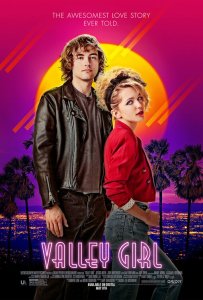 If you’re a big fan of 80s music and looking to congenially pass 90 minutes, I suppose you could watch the new musical Valley Girl as it whisks you away on a cloud of simple nostalgia. That’s the word for this movie. Everything is very simple, from the stock characterizations, to the boy-meets-girl romance, to even the performance of the dozens of popular 80s songs, which are reworked into being blander vanilla versions that reminded me of what Kids Bop does to music. We follow a titular valley girl (Jessica Rothe, so great in the Happy Death Day franchise) as she falls for a punk rocker (Josh Whitehouse, struggling in the singing department) from the wrong side of the tracks. The romance is very familiar as are their trials of stepping outside their individual comfort zones for the other person. The big problem with Valley Girl is that the first half feels like it’s at warp speed; nary a minute goes by without a song-and-dance number barreling onto the screen. The second half, in contrast, has only a handful of these numbers and tries to expand the characters but by that point it’s too late. I don’t care about them. Since it’s a jukebox musical, the songs should be selected to provide better insights into the characters’ emotional states, but too often they feel superfluous and clunky. “Hey Mickey” introduces our selfish jock (Logan Paul of YouTube infamy) at a pep rally. “Girls Just Wanna Have Fun” is about having fun on the beach. “Boys Don’t Cry” about dealing with being sad. It’s that kind of application. There’s a frame device where an older mom (Alicia Silverstone) is recounting her 80s experiences to her teenage daughter, and this could have provided a satirical and clever development, allowing the recounted experiences to blend into fantasy and her hazy memory. Valley Girl isn’t a bad movie, just one lacking significant purpose outside nostalgia and cleaning out a big music clearance account. If watching watered down 80s hits sounds like your thing, then party to the max, man.
Nate’s Grade: C
Share this:

Gretel & Hansel (2020)
 I feel bad for select audiences that went into Gretel & Hansel expecting a cheap thriller because what they really get is an atmospheric art movie that, even at a mere 80 minutes, moves at a very placid pace. Director Osgood “Oz” Perkins (The Blackcoat’s Daughter) takes the bones of the classic Grimm fairy tale and presents it as a feminist retelling of outcasts coming into their own feminine power and the costs of giving over to that power. The titular siblings are cast out by their mother after Gretel refuses to be a maid for a creepy older man very interested in hr “maidenhood.” They stumble upon the dwelling of an older outcast and she supplies plenty of food, but where exactly is it coming from? Gretel experiences strange dreams that portend to a witchy power of her own making, but she’s scared about what she may become and what may befall her brother, who the older woman deems Gretel’s “poison.” The story is a bit strained but the movie is visually luscious to watch. The photography and production design are exceptional and greatly lend the movie a transporting atmosphere that, coupled with its stodgy pacing, creates the sensation of experiencing a waking dream. The camera uses a lot of stark wide angles and centered compositions to heighten a sense of unreality. My favorite moments were the older Witch (Alice Krige, the Borg Queen from Star Trek: First Contact) was coaching Gretel on her inherent power and the sacrifices necessary for her to achieve her potential. She advises “trusting the darkness,” which sounds ominous enough. Because of the general familiarity with the fairy tale, the movie gets more leeway to fill its time with fantasy diversions and a slow build of horror revealing the disturbing process of how the feasts of food become prepared. It almost feels like the movie is reaching a breaking point with how lagging that pacing is, but then it generally gets back on track with a new revelation or complication. Gretel & Hansel is an enjoyably moody, stylish, equally beautiful and unsettling movie that’s heavy on grim and light on plot.
Nate’s Grade: B
Share this:

Capone (2020)
 In 2012, after the found footage superhero movie Chronicle became a surprise smash, director Josh Trank was at the top of Hollywood’s hot new director list. Within three years, he was a pariah. The production behind 2015’s Fantastic Four was so troubled and fraught with reshoots, creative clashes, and secret edits that Trank was labeled as a malcontent who couldn’t be trusted with the big tentpoles. He was unceremoniously dumped by Star Wars and seemed to become the latest casualty of an industry that eats its own promising wunderkinds. I’d highly advise people read a very illuminating in-depth article from Polygon on Trank’s troubles and triumphs, including his insights on where Fantastic Four went awry. Trank spent years honing his next script, an Al Capone biopic of his late years, and waiting for star Tom Hardy to be available. Some critics have called Trank’s comeback movie a self-indulgent, surreal, campy mess, and indeed while I was watching I had visions of Mommie Dearest. However, that wasn’t a bad thing, at least for me. I cannot call Capone an unqualified success but I appreciated the bizarre lengths Trank goes to make a biopic that mocks and tears away the mystique of its macho idol.
Capone (Hardy), or “Fonze” as he’s referred to primarily, has been released from his prison sentence for tax evasion and living the rest of his days on his Florida estate. He’s suffering dementia from the effects of neurosyphilis, a condition he contracted as a teenager. His wife, Mae (Linda Cardellini), tries her best to keep him from harming himself or others. The F.B.I. is still listening, still watching, and newspaper reporters are still hiding along the bushes. Capone struggles to keep his mind from being completely lost but will lose, dying at age 47.
 First off, I think Trank’s initial creative approach is a genius way to explore a biographical film, running through the major points of a subject’s life in a hallucinatory, non-linear fashion that mixes fantasy and reality. From that standpoint alone, Capone is never boring because it can quite literally go anywhere as Capone retreats further and further into his fraying mind. That’s such a visually stimulating way of telling a story while also presenting a chaotic impression of a character’s perception, locking us into an empathetic experience with an unreliable guidepost. I think that alone makes Capone worthwhile, as does Hardy’s go-for-broke performance (more on that later). It’s a weird fever dream of a movie, constantly shifting between past and present, fantasy and reality, and I think this perspective adds much to the film’s appeal and ambition. One second the man is sitting down with FBI agents and the next he’s wandering a ballroom to go onstage with Louis Armstrong for a New Year’s Eve duet. It gets pretty crazy and that’s good.
I was wondering if Trank would glorify his title subject. I only had to wait for the first twenty minutes where Al Capone literally craps himself twice for my answer. This is not Capone at the height of his fearsome power where he ruled the Chicago ganglands; this is a decrepit, doddering middle-aged man, equally helpless and reckless, unable or unwilling to even control his bowels. He is rotten from the inside out, a vile human being whose own filth is leaking out to smother him. Gangster cinema has often glamorized the mafia and criminals as unorthodox folk heroes, like in 1967’s Bonnie and Clyde and the more recent Public Enemies in 2009. So, with all of that said, I enjoyed that Trank took a legendary figure of the criminal underworld and totally undercut his machismo power. He strips away the romantic notions of the man’s life. This isn’t the man on the pulpy radio dramas, this is a guy who craps the bed. Martin Scorsese’s The Irishman got plenty of acclaim for spending its final half-hour showing where a lifetime of crime leads its elderly protagonist, a sad, lonely life without any lasting personal benefit. Trank takes that much-heralded final half-hour and turns it into an entire 100-minute movie. I wish more movies would do this to deserving subjects.
 The biggest draw of the film is Hardy (Venom, The Revenant) who never met a film role he couldn’t grumble, mumble, growl, or unleash a funny voice for. To say he is committed does not to do the man justice. He is not only chewing scenery; he is rapidly inhaling it. He is playing to the cheap seats with this role, bloodshot eyes bulging out of his head with thousand-yard stares of confusion and paranoia. He’s barely intelligible at times, and that’s before he has a stroke that further impairs his ability to communicate. He can also be hard to recognize under layers of pock-faced makeup. The acting-with-a-capital-A style is so enthralling but perhaps not for the exact intended reasons. It’s fascinating to watch a highly respected, Academy Award-nominated actor just indulge every over-the-top impulse and tic, where each small decision feels like generating the question, “Really, you went with that choice?” The batty performance brought to mind Faye Dunaway’s breathtaking performance in 1981’s so-bad-it’s-good Mommie Dearest as Joan Crawford (she thought she was going to in awards for that performance!). It’s a level of camp with no earthly reservation, and it’s rare to see from such a famous actor, and I was spellbound. If you enjoyed Mommie Dearest for its unintentional camp hilarity, then Capone might be just for you.
While at turns confounding and fascinating, Capone falls short when it comes to examining the inner life of its title character. I assumed with the conceit of losing touch with reality that Capone would be experiencing some reckoning over his past misdeeds, and this happens to a very mild, opaque degree. There are some supporting characters that turn out to be, surprise, ghosts that Capone had killed in his past. But they stop there, failing to provide an opportunity for Capone to feel remorse and they don’t even push him on being guilty. You would think a man with a sizeable list of dead people he’s responsible for would be haunted by more ghosts from the past, forcing him to reconcile his idea of himself with his tortured deeds. Capone is also seeing images of a young boy that is meant to represent his poor youthful upbringing, but he doesn’t interact with this past representation other than look uncomfortable in his presence. The movie desperately needed more introspection with this man examining his sins and legacy and validations. A bad man coming to terms with the end and what it means has great dramatic potential. A bad man who bumbles around his luxurious home, sees some ghosts, and continues bumbling has less so. That’s where Trank’s screenplay really falters because it doesn’t push harder. Capone is too caught up in upending the image of Al Capone rather than digging deeper into the man himself and his inherent end-of-life drama.
 The supporting characters also do little to offer alternative sides to better know Capone. His long-suffering wife is nicely played by Cardellini (Green Book), brought to tears watching her strong man waste away, calling her an angel one minute and forgetting her face the next, but we don’t learn more about the central figure through her. He started poor. Got power. Now he’s incompetent (and incontinent). That’s it. There’s room for more here than a man physically and mentally falling apart. What about the other people in his life? What about plans for succession from those who spent their lives in his service? There’s even a storyline of a lovechild trying to get in contact with him and the movie miraculously does nothing with this abandoned son to add further dimension and insight.
I would be lying if I said I wasn’t laughing throughout Capone, though I think Trank is intending some degree of mockery with his biopic that plumbs the depths of the strange and grotesque. There’s a guy who gets stabbed in the neck maybe 50 literal times. There’s Capone shooting alligators, convinced they’re conspiring to munch on his testicles. There’s Capone applauding and singing along to The Wizard of Oz and arguing for the sake of the Cowardly Lion. There’s an ongoing subplot about different supporting characters trying to somehow sift the location of Capone’s hidden millions from his broken mind like a treasure hunt. There’s an entire sequence where Capone, with carrot-as-cigar in mouth, marches around firing a golden Tommy gun while his saggy adult diaper droops around his waistline. In short, there’s more than enough material here to enjoy on a strictly ridiculous, pulpy, heightened to the point of breaking campy variety. Hardy is fully unrestrained, for better and worse, but he’s always watchable, as I would say of the film itself. Even if it feels ultimately superficial and underdeveloped, Trank’s Capone is a mess of bad taste about a bad man going through some bad times and it just might be the good kind of bad.
Nate’s Grade: C+
Share this:

Wendy (2020)
 I was not a big fan of writer/director Benh Zeitlin’s first movie, 2012’s indie darling and surprise Oscar contender, Beasts of the Southern Wild. Some choice highlights from my mixed review include: “This movie is awash in all sorts of tones and storylines, failing to cohesively gel together or form some kind of meaningful message…. [it] offers half-formed ideas, strange, conflicting imagery, and characters that are rather thinly written and barely register… This is just a swampy mess of a movie, one that sinks under the weight of its own pretensions. It’s admirable from a technical standpoint but, as a movie, Beasts of the Southern Wild is an exercise in eclectic indie navel-gazing.” So as you can see, I wasn’t exactly heartbroken that Zeitlin took eight years for his follow-up, Wendy, a loose reinterpretation of the Peter Pan story. It has many of the same flaws as Beasts and not enough of its few virtues, which means Wendy is its own lost movie experience.
We follow a group of children from a working-class diner waitress in small-town Louisiana. They watch the trains speed by on the neighboring tracks and dream of far-off adventures. Wendy (Devin France) and her two younger twin brothers (Gage and Gavin Naqui) sneak off one night onto a passing train and meet Peter (Yashua Mack), a boy who promises to guide them to a magical island where they will never grow old as long as they believe in Mother, the spirit of the island and embodied as a giant glowing fish. Wendy enjoys the freedom but worries if she’ll ever see her mother again and if this extended excursion is worth that level of sacrifice.
 Maybe I’m just going through Peter Pan fatigue or maybe this latest variation on the mythology of J.M. Barrie just failed to provide any really thorough message, theme, or entry point of interest for me. Wendy seems to be going for whimsy and flights of fancy, once again attaching its perspective to that of children escaping into the realm of fantasy as a means of avoiding the hardships of their impoverished lives and what it means to be a working stiff (one child in the opening runs away at the prospect of becoming “a mop and broom man”). It’s meant to be diverting but it’s never really that exciting or involving, tapping into a wellspring of awe. There’s a beautifully idyllic island and a volcano, and of course our magic fish, but there aren’t nearly enough genuine magical elements to convey that desired whimsy. The freedom of a life without adults seems less free when there’s less to do. Much of the movie feels closer to The Florida Project where a group of poor kids are playing around junk to keep from being bored. This Neverland universe feels very limited as far as what can be done. They run around, they pretend, there are even some decrepit buildings, but what else? There isn’t really a society here in concert with our lost children and former lost children. It’s a pretty empty island retreat.
Perhaps that was Zeitlin’s goal, to strip away the romanticized notions we attach to forever staying young, chasing the fleeting feeling of the past while ignoring the present and adulthood, but this more critical theme doesn’t come across thoroughly either. There is one interesting aspect of the island’s unexplained magic and that is the older adults are former lost boys and girls who lost faith in Mother, thus activating their advanced aging and expulsion from Peter’s posse. I like the idea that the future villainous pirates of a Neverland are former lost boys; it gives an interesting personal dynamic for Peter. These adults, though, want to go back to being young again and they are convinced that killing Mother will achieve this, and it doesn’t go as planned. The deconstruction of fantasy with real violence doesn’t work because the consequences aren’t at the same level of realism. A child, in an effort to avoid growing old, makes a drastic decision, but the brushed-off aftermath makes the insertion of the harsher violence feel perfunctory. Peter is portrayed as an idealist leader one moment and ignorant and selfish the next, even with Wendy scolding him that there’s nothing wrong with growing up and becoming an adult, despite the mixed message of the former lost boys. The movie concludes with a goofy sing-a-long for magic resolution purposes that is played so earnestly that it makes it hard for me to believe Zeitlin was intending to be too critical of his magical world.
 Is Wendy about rejecting adulthood or the unavoidable perils of rejecting adulthood? I cannot say because the themes are so muddled with such a precious lack of significant storytelling content. Once again, a Zeitlin film feels like an improvised series of redundant scenes, where we watch kids play fight, we watch kids yell at one another, we watch kids run, we watch kids swim, all with headache-inducing handheld camerawork, but do we get to know these kids on a deeper level where they feel like people rather than figures? The plot of Wendy, written by Zeitlin and his sister Eliza, is very unclear about the rules of its magical world, which makes for a hard time to understand why anything is really happening. It also makes the movie less fun to experience because we don’t get to play along with the discovery of a fantasy world, its new parameters, and how we can develop and complicate them (not that there’s really much to discover; Neverland gets old quickly). This is definitely a movie that’s meant to convey more in feeling and inference, so the plot beats are very inconsequential outside of a few key movements. I didn’t find myself caring about any of the kids and their general well-being, even after they take it upon themselves to make some rash medical decisions. Wendy is our best realized character as she at least seems conflicted about the appeal and consequences of staying young indefinitely. The others are easily replaceable.
Wendy isn’t a bad movie and it’s clearly a very personally designed project from Zeitlin given the years of preparation. It has consistently gorgeous photography by Sturla Brandth Grovlen, the first film production shot on location on Montserrat island, and the score by Dan Romer (Maniac, Atypical) excels at the big swooning, churning melodies that crescendo into triumphant bliss. But even these positive technical qualities can only distract you momentarily from the missing center of Wendy, the story and characters and themes and discernible messages. I’m not asking for my entertainment to spoon-feed me what to think and feel from my art, but having a consistent message, or even an accessible entry point to decode and debate the art would help, as would engaging characters and a plot that felt more meaningful than just another disposable color to blend into a murky abstract mess of childhood whimsy, magic realism, and coming-of-age themes. A little of Wendy goes a long way, and two hours gets quite tedious. I just cannot foresee people falling under the spell of this movie. I wrote that Beasts had “half-formed ideas, strange, conflicting imagery, and characters that are rather thinly written and barely register,” and this much is also true with Wendy. I also wrote that Beasts was “an exercise in eclectic indie navel-gazing,” and this much is also true with Wendy. Maybe I’m just not the right fit for a Benh Zeitlin film. This is two hours of kids running around on an island without supervision and the occasional Peter Pan element thrown in. Maybe that sounds like a grand retreat as a viewer but it made me happy to be an adult and leave.
Nate’s Grade: C
Share this:

My Spy (2020)
 This was a movie that intrigued me because of the number of release delays and because, by the trailers, it just looked like it was going to be fairly bad. It’s not actually bad, simply mediocre family fare (with an extra dose of Cardi B. swearing in song repeatedly). It’s Dave Bautista trying on the Kindergarten Cop formula, and the plot is pretty much what you would expect, with Bautista (Guardians of the Galaxy) having to watch a family and befriending the little daughter in danger, schooling her in the ways of spycraft before having to be rescued during the big finale. As far as children’s films go, it’s pretty standard and inoffensive stuff. It coasts on Bautista and the little girl (Chloe Coleman) having a fun chemistry that rises above the obvious and under-developed comedy set pieces. However, there are flashes that point to what My Spy could have been, a more spy and satirical tweak of spy hijinks and action movie cliches. The little girl wants to learn how to be a spy action hero, so she asks about walking away with her back to an explosion and trying out other tropes. She even sizes up all the “tragic backstory” options for Bautista’s character we expect. The finale even involves throwing a grenade into a burning oil truck just to achieve an explosion worthy of walking away from. These little moments are enough to convince me there was a superior draft of this script before it was dulled and softened in the rewrite process for mass consumption. It’s not going to be a great film experience but as formulas go, Bautista plus precocious kid is winning enough to satisfy for 90 minutes.
Nate’s Grade: C
Share this:

Extraction (2020)
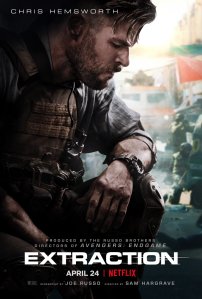 The new Netflix action movie Extraction is based on a graphic novel, co-authored by the Russo brothers, starring Thor himself Chris Hemsworth, and directed by longtime stunt choreographer Sam Hargrave. It has quite a pedigree, and after the wild success of the John Wick series, I’m genuinely excited to see what kind of action stuntmen-turned-directors can unleash. The best thing Extraction has going for it is its brutal, fluid, and immersive action sequences, including an extended sequence meant to convey a single take of relentless intensity. Unfortunately, that’s about the only thing this movie has going for it. The plot is very formulaic, with Hemsworth being brought in to retrieve a high-value target and then being betrayed, having to go on the run to protect the son of an imprisoned Indian mob boss. Hemsworth’s character is also haunted from personal tragedy and reluctant to get back into the fight, yet this final stand could allow him a late attempt at redemption for a lifetime of bloodshed. What I’ve just described could be a hundred other movies, minus the particulars of the Indian mob boss. The characters never really pop, even Hemsworth. The kid he’s tasked with saving never seems to get a moment to shine, to present a personality, or even a sense of growth or toughness. He might as well be a low-grade A.I. in a video game escort mission. The relationships don’t seem to matter. When it’s pumping, the action has an immediate appeal and Hemsworth acquits himself nicely with the more complicated fight choreography and stunts. As I kept watching, something didn’t quite feel right, and then it came to me. This movie doesn’t work from a tone standpoint. The John Wick-style action, glorifying in the fun and gory nature of slick violence done smoothly, conflicts with the setting and wider story of Extraction, namely the poverty-drenched streets of Bangladesh with child assassins thrown into duty by villainous gang leaders. It feels like you dropped John Wick into the searing reality of City of God, and the two styles of violence, and their larger social implications, do not really mix without uncomfortable consequences. It doesn’t help that so many of the characters just seem blank and replaceable. If you can ignore those misgivings, Extraction can offer some enticing thrills and above-average fight choreography.
Nate’s Grade: B-
Share this:

The Rhythm Section (2020)

I like Blake Lively as an actress. I like spy thrillers. I think Reed Moreno has real talent as one of the signature directors of TV’s Handmaid Tale series. So where did The Rhythm Section go wrong, besides its clunky title (it’s a reference to different parts of the body working together like an orchestra so…. yeah)? I think it’s because the movie, based on a book by Mark Burnell, is stuck in a tonal middle ground between spy escapism and spy realism, and it doesn’t quite work. The movie is filmed with the herky-jerky docu-drama camera movements of a Paul Greengrass Bourne flick, which when done well creates a visceral sense of immersion, but here it just creates an unstable atmosphere that makes it hard to settle on what is important. The story has Lively as Stephanie, whose family died in an airplane crash that may have been a terrorist bombing. She is trained by former MI6 agent Jude Law and then sets off on a messy path of vengeance tracking down the suspected perpetrators. Stephanie’s actually really terrible as a killer and it makes for an amusing, and confusing, batch of run-ins, as Lively’s character is far more vulnerable than the famous names of spy fiction. It should make the missions and fights more exciting but The Rhythm Section is drained of most excitement. It’s so suffocating and dreary. The characters aren’t well developed or even given memorable personalities. Stephanie, once she is set off on her mission, fails to grow as a character or, really, as an assassin. It makes the entire movie feel hard to engage with emotionally or intellectually. There are some interesting moments of combat or suspense but nothing that carries over into a sustained sequence. A car chase shot entirely within Stephanie’s vehicle should be exciting but it just felt underdeveloped too. The plot is packed with needless flashbacks and obtuse to the point I had to read a Wikipedia summary after the movie was over. It’s not fun spy hi-jinks with interesting characters to draw our appeal, and it’s not really a twisty John le Carre thriller (Tinker, Tailor, Soldier, Spy) that’s dense in its plotting, character ambiguities, and the realities of actual spycraft. It’s just a non-invigorating mystery with blandly developed action and suspense sequences, when you can make out what’s going on, and very minimal characterization. It’s a thoroughly mediocre bore.
Nate’s Grade: C
Share this:

Fantasy Island (2020)
 I wasn’t expecting to become a defender of Blumhouse’s much-reviled remake of 1970s TV staple, Fantasy Island (it currently has a 7% fresh rating on Rotten Tomatoes) but this year has been defined by surprises. I’m not going to say that this is a good movie but turning a cheesy TV drama into a horror thriller that might as well take place on the magical island from Lost, I have to admit that’s a daring approach and it almost works. Michael Pena is miscast as a villainous Mr. Roarke who invites a group of strangers to a beatific island resort to have their fantasies come true be they hedonistic (wild parties with sexy guys and gals) or vengeance (Lucy Hale getting even against a high school bully) or regret (Maggie Q saying yes to a proposal and starting a new life). At first the fantasies seem too good to be true and then the darker reality comes forward, forcing many characters on the run. I was very happy that the filmmakers, the same creative team behind the equally-reviled Truth or Dare, present the proceedings as being clearly supernatural and stick with it. I was expecting some hackneyed explanation of how it was all a show, or a simulation, or some kind of televised event for the rich to gamble upon, but the movie stays supernatural to the end as if it is the Lost island with its weird secrets. Because of that scenario, even when the rules of the island and the final scheme comes to light as to whose fantasy all of this pertains to, it’s a forgivable level of convolution. There were moments I even had fun, mostly just seeing how crazy and far away from the source material everything can get. It felt like if someone was ordered to remake The Love Boat and came up with Ghost Ship. It’s just fun how different it can go. I didn’t care for any of the characters outside of Maggie Q, who gets the best acting showcase as a woman with many regrets who is trying to ignore her misgivings. Hale seems to be playing a character ported from the Spring Breakers universe (what a dreadful thought). Michael Rooker (Guardians of the Galaxy) appears as a grizzled veteran of the island. Even when things aren’t working, like black-eyed zombies or much of the comedy, I wasn’t ever bored. How crazy would things get next? How would they tie this all together? Fantasy Island is not the horrible experience critics claimed earlier this year. It’s not a great movie but it works as silly escapism, and during a time of pandemic-initiated quarantine, a little silly escapism might just be what you need for a couple of hours.
Nate’s Grade: C+
Share this:

Bloodshot (2020)

Bloodshot is the kind of junky sci-fi action movie you might have seen in the 90s before The Matrix, the kind of thing that an X-Files episode would have covered, probably with a better sense of storytelling. Based on a Valiant comic book, and reportedly the first step in a hopeful Valiant Cinematic Universe (oh boy), Vin Diesel stars as dead soldier given new life thanks to tiny nanites living in his blood that magically repair his body, making him nigh invincible. He gets vengeance on the man who killed his wife or so he believes, as Diesel’s memory is wiped after every successful kill and re-implanted with new memories of a new identity of his wife’s murderer. The movie plays this as a big twist even though it was central in the trailer and advertising, and despite the fact that it seems too convoluted a path for a science project in the billions, it’s pretty predictable. That’s the problem with Bloodshot is that it’s a two-hour action movie that feels like it’s going through the motions, built upon the spare parts of other better movies, and heading in one direction that’s too telegraphed. The action is over-edited and under developed, with first-time director Dave Wilson (an esteemed director of video game cut scenes and promo trailers) getting lost in the “cool stuff” of his world, little gizmos and side characters rounding out Diesel’s super-powered teammates and later opponents. You can feel that certain visual compositions are here just to look cool for a trailer. I was looking for the super-powered action sequences to be a major source of fun with this one and they left me shrugging. There’s one CGI-heavy fight scene down 50 stories of elevator shaft that has some moments to it, but as a whole Bloodshoot feels bloodless with its excitement. The appearance of Diesel being rebuilt by the wispy nanites reminded me of Apocalypse’s weird sand powers in X-Men: Apocalypse. Having its main character essentially be invulnerable takes the stakes out of his fights, which means even more thinking needs to go into the action design to maximize this effect. The final confrontation between Diesel and his tormentor (Guy Pearce, making a home for himself as this kind of character) has a clean and clever resolution I appreciated, but it was a long slog to get to something clever in construction and execution here. If you’re looking for a pretty straightforward action movie that you won’t have to burden much thought with, you could do worse than Bloodshot. This also has Eiza Gonzalez in another movie where she plays a CGI-augmented version of herself (Alita: Battle Angel, Welcome to Marwen), so there’s that too. At this rate, I don’t think we’re going to be getting that Valiant Cinematic Universe if this is the inauspicious kickoff.
Nate’s Grade: C
Share this:

I Still Believe (2020)
 I Still Believe was one of the last wide releases before theaters shuttled thanks to COVID-19. It was a low-budget Christian indie by the Erwin brothers, Andrew and Jon (I Can Only Imagine, October Baby). My expectations were already low and the final film is equal parts earnest and goofy, but where it goes wrong is with its stretched-out passion play built on suffering.
Jeremy Camp (K.J. Apa) heads to college and falls instantly in love with art student, Melissa (Britt Robertson). He’s a budding Christian musician and gets his big break from fellow “student” and successful musician, Jean Luc (Nathan Parsons). Jeremy and Melissa’s relationship is tested when she is given a cancer diagnosis, but he’s unwavering in his support. They pray for help and struggle for meaning, with Jeremy turning to music for answers.
As with many Christian indies, I’ve discovered that the elements of filmmaking and storytelling are generally secondary to whatever the message is the film wishes to confirm for its built-in audience. So the details don’t really matter as much as the bigger picture, which in this case I assume is to inspire in its audience that even when they are suffering that God has a plan for them. I can see how people can find that topic comforting because one of the nagging questions in theology is over why a loving God would allow terrible things to happen to good people. The best the film can surmise is that there is a “greater good” sort of response we cannot know, and that the death of one person could have ripple effects and inspire many millions more. That’s what I Still Believe is proposing with its true story, namely that the tale of Jeremy Camp’s deceased first wife happened to inspire millions and bring them closer to God through Camp’s music and storytelling over his loss. Either you find that comforting and an answer enough or you don’t, but if you question that logic, then the movie demonstrating this resembles a cruel passion play.
 Even before I started this movie, I knew that Melissa was going to die, and I knew her ultimate purpose was going to be to push the man along on his own spiritual and artistic journey. She dies so that you can become a better guitarist, Jeremy. I don’t mean to sound crass considering these are based on real people, and the real Melissa really died, and her friends and family felt real grief. My critical aims are with how the movie handles this and not her real tragic loss. I think many can be irritated when a movie says a character’s ultimate suffering was all to prop up another character; I’m reminded of numerous Hollywood stories about African-American suffering where it props up a white savior character to learn or achieve Important Things. This nagging feeling would have been lessened had Jeremy come across as a more compelling character in the movie and, even, a more compelling artist. He’s a pretty bland white dude and his music is fairly vanilla acoustic guitar soft rock. The music is earnest, it’s pleasant enough, but there’s nothing that really stands out, but that assessment is personal, I admit. I struggle with movies that try to convince me of someone’s artistic ascendance but don’t feel like they back it up with the evidence for that fame. The character of Jeremy onscreen is a nice guy, well-meaning, but he’s more interesting when he’s in the goofy love triangle with Jean Luc. Once Melissa gets her cancer diagnosis, his characterization just gets put on hold. He becomes a loving caretaker and then, once she inevitably passes, he becomes a loving and bereaved husband.
This is where I rankle because that cancer diagnosis comes so early and that is all the movie becomes afterwards, and when we all know where I Still Believe is ultimately heading, it becomes very tedious and arguably garish. The cancer diagnosis happens with an entire hour left to go, which means we’re left to watch Melissa get sick, everyone worry and cry, and when her remission happens with a half hour left to the movie, you know we’re just biding time until it comes back again because what else are we going to do with all this extra time? It’s not like Melissa, fresh from beating cancer, says to her man, “Let’s pull off a heist.” We all know where this is going, so this momentary reprieve and the movie treating it like, “Hooray, look at what prayer has done,” feels downright cruel because we know it’s not going to last. We know the rest of the road ahead is going to be watching her returned suffering, which is the entire movie. It is a passion play where we watch a young woman suffer and die so that we will ultimately get some songs written about her memory and experience. For those outside the target audience, this can become borderline offensive, and from a storytelling standpoint so much is left simply broad.
 The most enjoyable parts of I Still Believe for me are how goofy it can be especially with its fuzzy details. This is a movie without any sense of humor and yet it can inspire laughter. Jeremy seems to be attending a school where he never has to do any work. This school is also I guess a regular stop for Jean Luc, an alum who has already become famous and has a backing band, so why does he just keep showing up to perform on this campus? Doesn’t he tour outside the school? Also, Jeremy is almost immediately successful. He’s thrown onstage in what amounts to the film’s Star is Born moment when Jean Luc invites Jeremy to share his special song to a live audience. From there, Jeremy is recording, performing regular to packed crowds, to the point that I questioned when he has a sit-down with his college dean about quitting school to tend to the ailing Melissa, I was shocked he was still attending school at all. Isn’t he just a successful musician now? My opening impression of Jeremy as he goes off to college is positive, as he calms down his impaired little brother who is bereft with the departure. Then over the opening credits he’s playing his acoustic guitar on a charter bus and I thought how rude that would be. But by far the most amusing part of the movie is the love triangle between Jeremy, Melissa, and Jean Luc. First off, every time a character says the name “Jean Luc” with such seriousness I giggled. The actor seems so much older than everyone else, though he’s only two years older than Robertson (who is 7 years older than Apa). The love triangle is enough to keep Melissa from being public about dating Jeremy, and when he presses her on it, she pushes back that he should return the jacket that Jean Luc gave him, as if these are equivalent. And then she keeps bringing it up. Jean Luc isn’t even a character so much as a platform of opportunity for Jeremy and then a contrived obstacle for their blooming romance.
The acting overall falls into that earnest yet occasionally goofy territory of many Christian indies. It’s not quite camp but there are moments where characters are so serious that things feel a tad off, like we’re just seconds away from everyone breaking into laughter. Apa (Riverdale) is blandly appealing but feels very much like Zac Efron lite. He does all his own singing and guitar playing which is more technically impressive than the character he has been given. Robertson showed such promise with 2015’s Tomorrowland and seems to be given little to do here. She’s slated in that dewy role as the Wise Woman Fated For Tragedy, which is kind of like the more somber terminal illness equivalent of the Manic Pixie Dream Girl. Even in her last moments, she seems to have a radiance of knowledge. I wish I could say there was strong chemistry between the leads but Apa has better chemistry with his guitar. Then there are Jeremy’s parents played by Gary Sinise and, surprise surprise, recording star Shania Twain. This is only her third film appearance and she is given so little to do that, frankly, it didn’t impress me much. The best performance in the film happens late when Jeremy meets a fan (Abigail Cowen) who monologues what Jeremy’s songs and experiences have met to her and how they’ve changed her life. It’s a moment that feels emotionally affecting even if you know it’s here to literally remind the audience of the theme. That same woman would then go on to become Jeremy’s wife, so good for them.
 I Still Believe isn’t offensively bad, campy, or even theologically misguided in its view of morality like a hokey Kirk Cameron vehicle. It feels like a glossy made-for-TV movie that just happens to be made for a majority-Christian audience. The message is paramount, and all else serves the message, which means the characters are uninteresting, the story is redundant to the point of piling on cruelty, and the overall earnest tone can approach unintentional goofiness. It feels like much of the film is padding the running time with lengthy musical performances like a concert movie. It’s also a movie without enough story to cover its near two-hour length. Either you connect with the overall message that there can be meaning in suffering or you see past it and take umbrage with the movie presenting a woman’s suffering as character development for a soon-to-be popular musician. This is like a Christian weepie version of The Fault in Our Stars, which was another movie we knew where it would be headed, but it lacks the effort level. The Erwin brothers shoot everything either with annoyingly distracting handheld camerawork or swooping drone footage. The film has technical merit but filmed like it’s a collection of B-roll for some prescription drug ad (all those smiling, warmly lit faces on the beach having fun). I Still Believe is a blandly dull movie built upon extended suffering and extended musical performances. Maybe it knows its audience too well but I doubt anyone outside the flock will find inspiration here.
Nate’s Grade: C


 nathanzoebl
You must be logged in to post a comment.