Author Archives: natezoebl
Bowling for Columbine (2002) [Review Re-View]

Originally released October 11, 2002:
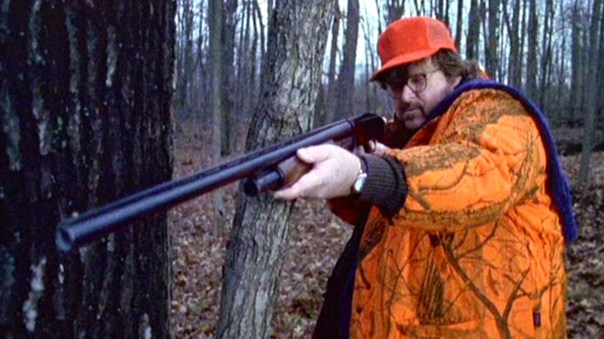
Documentary filmmaker, political activist and corporate pot-stirrer Michael Moore prefaces his latest film Bowling for Columbine by admitting his lifetime membership in the National Rifle Association (NRA). He even received a marksmanship award as a teenager in his hometown of Flint, Michigan. Bowling for Columbine is Moore’s sprawling and hilarious search for answers among America’s zealous gun culture and alarmingly high number of homicides. It’s the tangents Moore just can’t help but take along the ride that add some of the more fun moments.
He opens a checking account at a Michigan bank that’s offering a gun for new customer accounts. Moore astutely asks an employee, “Do you think it’s a good idea handing out guns in a bank?” Moore travels to Canada to find out what reasons exist that make our cultures so different when it comes to crime. After hearing from citizens about how they don’t lock their doors, Moore decides to go door-to-door and see for himself. Sure enough, he walks into half-a-dozen homes.
Moore is better at pointing the finger than fathoming real answers. He touches media sensationalism, our nation’s bloody history, corporate greed, past military involvement, and an environment of fear being developed by those who profit from such actions. The sobering truth is that there are no easy answers to be debunked. The film’s climax involves an impromptu sit-down with NRA president Charlton Heston. Moore questions the sensitivity of the NRA after it held support rallies days after the school shootings in Littleton and Flint. Heston becomes weary and walks out of the interview after five minutes.
The film demands to be seen. It’s complex, challenging, and thought-provoking. Not only is Bowling for Columbine the most important film of 2002, it’s also one of the best.
Nate’s Grade: A
——————————————————
WRITER REFLECTIONS 20 YEARS LATER
I was a junior in high school when the horrific massacre at Columbine happened in April of 1999. I remember the shock that washed over the country. I remember the daze and sorrow. I remember students not coming back to school for days, some because they feared that our Ohio school could be the next site of the next tragedy because of how upending the Columbine school shooting had been for the general sense of security. “How could this happen?’ we solemnly asked. I remember exasperated politicians wringing their hands, grasping for solutions and scapegoats alike, and I most remember just the overall gravity of the whole situation, the sense of loss, and the sense that this meant something significant. Flash forward twenty years, and the Columbine school shootings, which snuffed out 15 lives that fateful morning, is now ranked fifth on the list of deadliest school shootings in the United States, having been gut-wrenchingly eclipsed by the 18 at Parkland in 2018, the 22 in Uvalde in 2022, the 28 in Sandy Hook in 2012, and the 33 in Virginia Tech in 2007. Since then, mass shootings and spree killers have become so common that the satirical news website The Onion keeps recycling the same condemning headline with the latest mass shooting: “‘No Way To Prevent This,’ Says Only Nation Where This Regularly Happens” (this damning headline has been repeated 22 times in eight years time, and it’s only a matter of months at most before it gets repeated yet again if history is anything).
After each new tragedy, we’ve been inured to the reality of anything of merit being done in the way of reform; we move from “thoughts and prayers” to, “let’s not politicize this now,” to, “you’ll never solve every problem,” and then finally to a litany of social issues that conveniently are the real culprits, and never the guns mind you, of course. It’s easy to be cynical that, in our current day and age, no gun tragedy will ever move politicians to make real changes. After Sandy Hook, the most watered down of reforms, increasing background checks, was met with stonewalling from Republicans and those funded by the formidable National Rifle Association (NRA) lobby. After 60 people were slaughtered during a music festival in Las Vegas in 2017, the next hopeful reform was eliminating bump stocks. That didn’t happen. The patterns emerge and become their own tragic parody of performative action masquerading as meaningful action.

When people argue, “Well criminals will just ignore the new laws we pass anyway,” I’m dumbfounded by this logic, as if that is reason enough to cancel all attempts at law and governance. The oft-quoted axiom of a “good guy with a gun” being the only real solution to a “bad guy with a gun” is equally nonsensical to me. If that’s the case, then the rising presence of guns would better police these matters, mitigating their deadliness, and that is definitely not the case. The good guys with the guns aren’t working. The challenge is determining who is a good guy with a gun or a bad guy with a gun. This reflexive thinking never applies to other tragedies: “The only way to battle a bad drunk driver is with a good drunk driver.” It’s maddening for any citizen genuinely seeking common sense gun reform that’s supported by a far majority of voters.
America’s fixation with our gun culture was already a potent issue in 2002 when political muckraker Michael Moore elevated himself to new commercial and critical heights, and it’s only become even more essential to unpacking twenty years later. Moore had restyled documentary filmmaking with his searing and tragic-comic 1989 Roger and Me, his documentation of the fall of the American auto industry in his hometown of Flint, Michigan, where my mother grew up, and his search for answers with General Motors’ CEO, Roger B. Smith. Moore put himself front and center in his films, the schlubby everyman trying to hold truth to power, though he himself would have a slippery hold on it as well. Moore directed two more features in the 1990s, The Big One and Canadian Bacon, his only non-documentary film. But Moore catapulted into a new stratosphere of media attention and derision in the George W. Bush era, first with 2002’s Bowling for Columbine, which won him his first Oscar and set doc box-office records, and then in 2004 for Fahrenheit 9/11, which obliterated the box-office records Moore had just set and would have likely won him another Oscar but he refused to submit in Documentary and only wanted to submit for Best Picture (Born into Brothels won that year instead, so thanks I guess).
Bowling for Columbine is an aggravating movie by design and through Moore’s tactics. The issue of guns and violence in America has only become more central to American lives. Moore’s thesis is messy because it’s hard to find a single cause for the root of America’s gun violence, ignoring, of course, the sheer number of guns, though he even says Canada has a high guns-per-resident ratio from their culture of hunting but lacks our murder rate. The section on the media sensationalism driving gun sales is potent, as a nation constantly in fear will reach for protection that is abundant supply and access. As the murder rate has gone down over the 1990s and 2000s, the network news’ reporting over violent crime has increased, as well as gun ownership. It’s a brew of paranoia that benefits politicians, media, and especially gun manufacturers. Gun sales soared once Barack Obama swept into office, not because he said he would take people’s guns, but a section sure trumpeted those fears for monetary gain. The extended anecdote on the mother of the youngest school shooter, a six-year-old, is a powerful indictment on welfare-to-work and a system that forces people into unlivable choices. I wish Moore had touched more upon the mental health aspect of the gun violence equation, as the far majority of gun violence are suicides and not homicides. Many were quick to deduce that the Columbine killers, Eric Harris and Dylan Klebold, were victims of bullying, but millions are victims of bullying and do not shoot up their schools. In a 2017 TED Talk, Dylan Klebold’s mother, Sue, discussed her personal process of coming to terms with her son’s actions and realizing how essential his desire to die was to his infamous actions. When people make irrational, impassioned, split-second decisions, and guns are readily available, then bad things can be made even worse. Moore doesn’t explore this angle, unfortunately. Some of his larger connections can seem very reaching, like when he tries to say that kids knowing their parents work for Lockheed Martin, a military weapons manufacturer, would be less likely to value human life.

But it’s the needless sleight-of-hand tactics with the truth that confound me with Moore, and these inevitably blunt the power of his message and ability to convert thinkers. This habit infuriates and flabbergasts me. Moore has so many good points already at his disposal, so many meaningful data points and heart-tugging anecdotes that he doesn’t need to stretch the truth to convey his message. I’ve since used Bowling for Columbine as an example in teaching credibility gaps and the concept of ethos with public speaking. This is epitomized in the handling of NRA president Charlton Heston. Shortly after the events of Columbine are replayed for us, including frantic 911 calls and security camera footage, Moore cuts to Heston defiantly declaring, “With my cold dead hands,” and informs the viewer that within ten days that the NRA held their annual conference in Denver, despite pleas from local leaders for distance and sensitivity. “Don’t come here? We’re already here,” Heston replies to applause. The problem is that Moore has stitched together two separate Heston speeches to seem as one, including the “From my cold dead hands” intro, which was given an entire year after the Columbine shooting. He also excludes pertinent details like the fact that the meeting in Denver was scheduled a year in advance, the NRA was required by law to notify all four million of its members ten days before a location change, and all other NRA events were canceled except for the meeting required by corporate law. When you look at the parts of Heston’s speech Moore picked from, anyone could follow the same approach and edit the speech to say whatever message they desired. The climax of the movie is Moore sitting down with Heston, but when he peppers him with questions about his speech days after Columbine, and Heston has no idea what he’s talking about, it’s because Moore isn’t playing fair. Then also take into account the aged actor likely going through the Althzeimer’s that caused him to step down from acting and the NRA in 2002. Look, I’m no fan of the NRA, and I personally believe their self-serving actions perform a genuine harm to the country, but this is just self-righteously badgering an ailing old man.
Moore is not the only documentary filmmaker to make use of selective editing, anecdotal evidence extrapolated, and narrative cheats for manipulative emotional purposes, but when you’re being provocative, you’re going to get push back, and when you use deceitful storytelling methods with your facts, you are a disservice to your cause and your message. There’s so much on this topic that Moore can effectively criticize, like the handy media scapegoats, the failings of zero tolerance and school resource officers, the obvious hypocrisy of do-nothing elected officials, the fear-mongering news seeking out consistent sensationalism, a deference to the military industrial complex, and the fact that the rest of the world watches the same movies, listens to the same music, plays the same violent video games, and yet, to paraphrase The Onion, we’re the only country where this happens all the time. Sadly, no place is safe in the U.S. from a possible mass shooting, and yet a good portion of this country will shrug and say that’s just the price we have to pay for living our freedoms. There are so many fallible arguments to poke apart, and that’s why I’m so frustrated with Moore’s misuse of his platform, giving his opponents the ammunition to dismiss his points.

Moore’s career has fallen quite a bit from his meteoric height in 2002 and 2004, last releasing Fahrenheit 11/9 in 2018 to warn about the lasting dangers of an inactive voting public and Donald Trump as president (it grossed $6.3 million, approximately five percent of the gargantuan $119 million gross of Fahrenheit 9/11). It feels like Moore’s style, once so revolutionary, prankish, and urgent, has now become stale. As I wrote in 2018: “If our country ever needed Moore, it would be now, but his time might have already passed as an influencer. The last time Moore was breaking through into the cultural conversation was with Sicko in 2007, years before the formation of the ACA. Since then we’ve seen the rise of social media, YouTube, and the instant commentaries of media old and new, all trying to one-up one another in expediency and exclusivity. Is Moore just another member of the old guard he laments has become obsolete?” It’s not uncommon for a filmmaker to lose their edge or passion after 30 years. It’s also not uncommon for the envelope-pushers to become part of an establishment that a younger public starts tuning out for lack of relevance. I don’t know if Moore has a real audience any more.
Re-reading my old 2002 review, I’m sure glad I kept a paper copy of each of my published film reviews for my college newspaper because it was the only surviving copy I could find. I could not find my review for Bowling for Columbine on any of the websites and blogs I’ve used over the years, so in 2022, I literally sat with my twenty-year-old newspaper and retyped my relatively brief review from 2002. Thank you, me, for stubbornly holding onto these yellowing papers. I remember being more taken with the film in 2002, so much so that I would brush aside criticisms from my other friends who made valid points about Moore’s larger thesis (they just “didn’t get it,” I’m sure I incredulously scoffed). My apologies, my put-upon and sensible friends.
In the scheme of Moore’s catalog of films, I still think Roger and Me is his finest work and much of this is because it’s the most personal of his movies, chronicling the decline of his hometown with his special access. It’s the one that feels most essential for him to be the face of the movie. Bowling for Columbine is a messy movie but all Moore’s films are scattershot entertainments in retrospect, each deserving of reflection but also outside verification. As a result, the movies never become more than the sum of their parts and floating ideas and interviews and stunts and his loose thesis statements rarely coalesce into anything definitive, like an Alex Gibney documentary. Moore can be hectoring and disingenuous, especially during his interviews, and most of all aggravatingly short-sighted in his techniques, but he is a documentary industry unto himself and with good reason. Bowling for Columbine is the start of a conversation, with many asides both illuminating and diversionary, and it’s still worth watching twenty years later, as gun violence has only gotten worse. I think it’s likely Moore’s third best film, after 2007’s Sicko, but maybe I’ll change my mind in 2027. Until then, I’m lowering the film grade from an A to a B.
Re-Review Grade: B
Share this:

Blonde (2022)
 After receiving such blistering and excoriating responses, I went into writer/director Andrew Dominik’s Blonde with great trepidation. The near-three-hour biopic on the iconic Marilyn Monroe, played by Ana de Armas, is the first movie to earn an NC-17 rating since 2011’s Killer Joe, and as such, there’s a natural curiosity factor to any movie receiving such hostile reactions. Fans and critics have called the movie exploitative, navel-gazing, misogynistic, and redundant misery porn. One critic even said Blonde was “the worst movie Netflix has ever made.” I was a major fan of Dominik’s verbosely titled 2007 film, The Assassination of Jesse James by the Coward Robert Ford, and less so 2012’s Killing Them Softly, though I recognized sparing artistic merit. It’s been ten years since Dominik has directed a movie, so surely Blonde, based upon the novel by Joyce Carol Oates, had to have some merit beyond all its hype and criticism, right? Well, no. I processed my general disgust for Dominik’s three-hour slow-mo car crash. This movie is so stupendously misguided and cruel and filled with bizarre, outlandish, and maddening artistic decisions. For my movie review, I felt I needed to break my standard formula, so I decided to give voice to my analysis and criticisms by writing a pretend conversation between Dominik and a stand-in for the Netflix production. Enjoy, dear reader, and beware.
Andrew Dominick sits in front of the desk of a very concerned Netflix Producer, who fidgets uncomfortably in his seat and shuffles papers in his hands.
Netflix Producer: So, thanks, Andrew for making time for this meeting. We’ve seen your full movie and we have some… well, concerns.
Andrew Dominik: That’s life, man. You can’t tell stories without risk. Break a few eggs.
Netflix Producer: Yes, sure, but, well, I guess one of our biggest questions is why did you need almost three hours to devote entirely to the lengthy suffering of Marilyn Monroe? This is supposed to be a biopic, but all we get, scene after scene, to a fault, is a moment of Marilyn being abused, or crying, or being generally exploited. It’s… a lot to take in, Andrew.
 Andrew Dominik: Hey man, that was her life. She was this glamorous star, but behind the glamor is a lot more dirt and grime. Everyone wanted to be her, and I wanted to show the world how wrong that would be. This is a woman who was desired by the world and she was still a victim in the Old Hollywood system, which was a rape factory. I was just being honest, man.
Netflix Producer: I get that principle, but it really feels like the only version of Marilyn we get in this movie is the role of a long-suffering victim. It’s practically a passion play: The Passion of Marilyn Monroe. You’re cheapening her real-life suffering by making it so redundant to the point of self-parody, and also, if you were so concerned about creating an honest portrayal of what this woman went through, then why are you also making things up to add to her legitimate suffering?
Andrew Dominik: What d’ya mean? I adapted the book.
Netflix Producer: Yes, but you do know that Oates’ book is explicitly fictitious, right? It’s made up. Marilyn never had a throuple relationship with Charlie Chaplain Jr. and Edward G Robinson Jr. Marilyn had a positive relationship with her mother. Even worse, you’re adding fictitious suffering, like her relationship with her mother, or Marilyn being raped during an audition.
Andrew Dominik: Yeah, that might never have happened, but the rape represents the-
Netflix Producer: I’m gonna stop you there. You should refrain from sentences that include the phrase, “The rape represents [blank].” We don’t need literal sexual violence, of which we return to time and again, to stand in for a larger thematic message. Also, it’s quite disingenuous to add extra traumatic experiences when you’re purporting to tell this woman’s real trauma and conflict.
Andrew Dominik: Agree to disagree, then.
Netflix Producer: No, not really, but, okay, Andrew, can you tell me any personable impression you get of Marilyn from this movie? And-and you cannot say “victim.”
 Andrew Dominik: She was…….
Netflix Producer: …Yes?
Andrew Dominik: Sexy?
Netflix Producer: Okay, sex symbol for nearly 60 years after her death, sure. What else?
Andrew Dominik: She was…. Um…. Uh… Can I look this up on my phone?
Netflix Producer: See, Andrew, this is our problem-
Andrew Dominik: Oh, she has daddy issues! There. That.
Netflix Producer: And for an hour you have her referring to all the men in her life as “daddy,” which is very uncomfortable especially when those men are literally abusing her.
Andrew Dominik: But, y’see, she calls ‘em all “daddy” because she has-
Netflix Producer: Oh, we get it. Thank you. You have 160 minutes and you keep hitting the same point over and over, bludgeoning the viewer into submission. It’s more than a bit gratuitous, especially when you factor that you’re adding even more trauma.
Andrew Dominik: What d’ya mean by “gratuitous?”
Netflix Producer: I have prepared several examples. For starters, it might be a bit much within the first twenty minutes of your movie to subject your audience to a mother trying to drown her child in the bathtub and Marilyn being sexually assaulted at one of her first auditions.
Andrew Dominik: Okay. Okay. I get that.
Netflix Producer: Then there’s the ghastly POV shot from inside Marilyn’s vagina, which by God happens twice, and both times it’s during forced abortions. Did we really need that queasy angle that is literally invading her body against her will to accomplish what exactly?
Andrew Dominik: The purpose of any true artist is to go deeper-
 Netflix Producer: I’m gonna stop you there again. It’s just bad taste, Andrew. Also, speaking of bad taste, maybe we don’t need the entire sequence where JFK rapes her and then hires government goons to abduct her and force Marilyn into an abortion. And then, on top of all that, she hears the pleas of her first aborted fetus calling back to her. Yikes. Can you at any point step outside of your position, Andrew, and realize how shockingly gratuitous all of that can be?
Andrew Dominik: It’s all designed to separate the person from the icon. Marilyn Monroe never really existed beyond the fantasies of the public, man. It’s about bringing back her humanity.
Netflix Producer: Separating the legend from the person would be a natural artistic angle, but that means spending time establishing the person, building her up through multiple dimensions, multiple opportunities to flesh her out. You only spend time seeing her as a victim, that is when we’re not meant to partake in the same sexualization of her that you seem to be criticizing. I mean the 1996 HBO TV movie managed by having two different actresses portray her, with Naomi Judd as Norma Jean and Mira Sorvino as Marilyn. That literalized the differences and even had Marilyn converse with her former persona as a plot device. You have none of that.
Andrew Dominik: I might not have that, but my movie has a cross dissolve that goes from Marilyn getting banged to the literal crest line of Niagara Falls.
Netflix Producer: I don’t think that really makes up for a lack of character substance.
Andrew Dominik: Agree to disagree, man.
Netflix Producer: You really can’t keep using that as a defense.
Andrew Dominik: Agree to disagree, man.
Netflix Producer: Your horror show of relentless trauma and bad taste might undercut your stated goal of humanizing this woman. She’s not a character but a symbol of abject suffering, a martyr, and you increase her suffering, and sometimes in grating, absurdly grotesque ways. Do you even care about this woman? You’ve devoted three hours to reanimating her as a powerless punching bag.
Andrew Dominik: Well, I did say Gentlemen Prefer Blondes is about “well-dressed whores” and that Blonde is “just another movie about Marilyn Monroe. And there will be others.” I also said that the most important part of her life was that she killed herself.
 Netflix Producer: Exactly. That makes us question whether you have the passion and sensitivity for this project. Why does this movie even have to be NC-17? Will your three hour torture chamber be bereft of meaning if the audience doesn’t see two inner vaginal camera angles?
Andrew Dominik: How dare you even question my artistic integrity. If you remove those shots, you might as well be removing the soul of this movie. Why even tell this story?
Netflix Producer: Yes, why indeed?
Andrew Dominik: It’s meant to be disorienting.
Netflix Producer: Congrats.
The Netflix producer leans back in his chair and releases an extended, wearying sigh.
Andrew Dominik: So… after everything…. Are you going to make me cut anything?
Netflix Producer: Please. We’re so hungry for Oscar recognition, we don’t care. Go for it.
I want to cite de Armas’ (The Gray Man) performance as one of the few attributes to the movie. It’s hard to watch this woman suffer and cry in literally every scene, but I also just felt so sad for not just her character but for de Armas as an actress herself. She shouldn’t have to endure everything that she does to play this character. She is undercut by Dominik’s artistic antics and avarice at every turn, like the story jumping around incoherently so every scene fails to build upon one another. There is no genuine character exploration to be found here. It’s a cycle of suffering, and the movie wants to rub your nose in the exploitation of Monroe while simultaneously exploiting her. De Armas deserves better. Marilyn Monroe deserves better. Every viewer deserves better. Spare yourself three awful hours of pointless suffering in the name of misapplied art.
Nate’s Grade: F
Share this:

One Hour Photo (2002) [Review Re-View]
 Originally released September 13, 2002:
Do we regularly invite strangers to view the picturesque and personal moments of our life like marriages, celebrations, and maybe even a handful of hastily conceived topless photos? Well we all do every time we drop off a roll of film for development.
Robin Williams continues his 2002 Tour of the Dark Side (Death to Smoochy, Insomnia) as way of Sy, your friendly photo guy working at your local Sav-mart superstore. Sy takes an intense artistic pride in the quality of prints he gives. He knows customers by name and can recite addresses verbatim. One family in particular Sy has become fond of is the Yorkins, mother Nina (Connie Nielsen), father Will (Michael Vartan) and nine-year-old Jake. The Yorkins have been coming to Sav-mart and Sy for over 11 years to have their photos developed. He tells Nina that he almost feels like Uncle Sy to the family. For Sy, the Yorkins are the ideal postcard family with perennially smiling faces and the happiest of birthdays. He fantasizes about sharing holidays with them and even going to the bathroom in their posh home.
 Sy is an emotionally suppressed and deeply lonely man caught in his delusions. In one of the eerier moments of the film we see that Sy has an entire wall made up of hundreds of the Yorkin’s personal pictures. When Sy attempts to become closer to the objects of his infatuation that’s when things begin to unravel at a serious pace. The more Sy learns that the Yorkins are not the perfect family he yearns for the more he tries to correct it and at any cost.
One Hour Photo is an impressive film debut by music video maven Mark Romanek (best known for the NIN “Closer” video). Romanek also wrote the darkly unrepentant story as well. One Hour Photo is a delicate voyage into the workings of Sy’s instability with lushly colorful metaphors. Romanek’s color scheme is a lovely treat, with vibrant colors popping out and Sy’s life being dominated by cold, sterilized whites. His direction is chillingly effective.
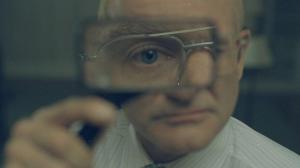
This may be the first time we can truly say Robin Williams has not merely played a version of Robin Williams in a movie. Sy’s thick glasses and thinning peroxide-like hair coupled with an array of facial pocks allow us to truly forget that the man behind the mask is Mork. His performance is unnerving and engrossing. The supporting cast all work well. Nielsen (Gladiator) is a sympathetic wife even if her hair looks like it was cut with her eyes closed. Vartan (Vaughn on ABC’s wonderful Alias) plays understandably wary of Sy’s friendliness. The great Gary Cole has a small role as Sav-mart’s manager who grows tired of Sy’s outbursts and peculiarities.
 One Hour Photo is rife with nervous moments and titters. Williams almost has an uneasy predatory feel to him when left alone with Jake. The greatest achievement the film has is that is depicts the scariest person youll ever see, sans hockey mask, and by the end of the film you actually feel degrees of warmth for this odd duck.
Not everything clicks in Romanek’s dark opus. A late out-of-left-field revelation by Sy feels forced and needlessly tacked on. The Yorkin family photos all appear to be taken by a third party, since the majority of them involve all three of them in frame. The climax to One Hour Photo also feels anything but climactic.
A compellingly creepy outing, One Hour Photo is fine entertainment with beautiful visuals and a haunting score. And maybe, in the end, it really does take an obsessive knife-wielding stalker to make us realize the importance of family.
Nate’s Grade: B
——————————————————
WRITER REFLECTIONS 20 YEARS LATER

I miss Robin Williams. I’m sure I’m not alone in this sentiment. I can still recall the visceral recoil I had learning about the news of his suicide in 2014. It’s one of the celebrity deaths that hit me hard, as I think many people have fond memories of their childhood linked to Williams and his litany of cherished comedy hits. As boundlessly hilarious as he was, I never felt he got his due as a dramatic actor. He was a four-time Oscar nominee, starting with 1988’s Good Morning Vietnam and concluding with a win for Best Supporting Actor for 1997’s Good Will Hunting, but I think his famous funny side always overshadowed the plaudits for his drama. Nobody could do what he did when it came to comedy; just being a good-to-great dramatic actor didn’t make him as unique in that field of performers, so I think his efforts were often discounted. Williams is one of several comedians who tried their hand at drama, to be deemed a Serious Actor, like Jim Carrey (The Truman Show, The Majestic) and Adam Sandler (Punch-Drunk Love, Uncut Gems) and Eddie Murphy (Dreamgirls) and Will Ferrell (Stranger than Fiction.) and Bill Murray (Lost in Translation) and Sarah Silverman (I Smile Back) and Steve Coogan (Philomena) and Melissa McCarthy (Can You Ever Forgive Me?). After 2000, Williams had even more dramatic performances than comedic ones, and I termed 2002 his World Tour of Darkness where he co-starred in Death to Smoochy, Insomnia, and One Hour Photo all that same year. Revisiting the stalker thriller One Hour Photo, it’s easy to think of the time gone by, and it’s also easy to further appreciate just what an interesting actor Robin Williams could be no matter the project.
This is an intriguing character study of obsession, trauma, and perversion, but I wish it had even more material to better build upon the excellent unease and tension of Sy Parrish (Williams). We learn pretty effectively how lonely and sad Sy is, enough so that even a perceptive little boy can sense that this older man working for years at the photo department of a Wal-Mart-esque big box store is in need of some happy thoughts. He’s dedicated to his job and his regular customers, and that’s about the extent of his purpose because his happy home is so empty that he resorts to filling it with the personal pictures of the Yorkin family. He dreams about the Yorkins inviting him into their home, accepting him as “Uncle Sy,” and providing a welcomed belonging. This is a story of one man projecting all of his hope and envy onto a family unit that cannot live up to Sy’s unrealistic expectations of Hallmark bliss. Sy narrates early that our pictures are the moments we want to remember, the moments we want to treasure and share. “No one ever takes a photo of something they want to forget,” he intones. It’s a theme that bears even more relevancy in our modern age of curated social media versions of ourselves, presenting the best possible versions for consumption by our friends and family and various Internet strangers.
 There was more room to explore with this thematic contrast, the idealized versions of ourselves presented to the outside world and the real versions, often with more insecurity and flaws. Sy takes his simmering anger out mostly on the family patriarch, Will (Michael Vartan), and how he doesn’t appreciate what he has. I think it would have been even more intriguing if each member of the Yorkin clan was somehow failing to live up to Sy’s expectations and how this unraveled his delicate psyche and patience. He develops their photos for years, and the Yorkins seem like the happiest and healthiest family, at least to Sy, a family he’d like to call his own. It would have been more compelling if each family member had their own unique way of falling short. Imagine the mother having a secret drinking problem. Or maybe little Jakob is slouching when it comes to his studies, or he needs to learn how to play baseball better, or he’s bullying some kids. The movie would have extra conflict if Sy was having difficulty with more than one family member and inserted himself to resolve it, but the others skate by as Sy’s contempt is directed solely at the bad dad. There is a narrative reason for this, beyond mere plot convenience, and it relates to the ending reveal that gives the audience the biggest clue about what has driven Sy’s desperation.
I called the final reveal in 2002 to be a bit “forced and needlessly tacked on,” and it’s certainly handled in such a haphazard way that you feel like it’s more sleight than it should be. However, having re-watched the film in 2022, it’s this scene, and especially William’s performance, that clinches the movie for me. Sy is sitting in police custody and it’s this setting that establishes the movie’s question of what did this man do and who did he harm. The obvious culprit would be Will as he’s the one wrecking this family unit with his affair, so it’s a nice surprise when the movie subverts our expectations and it turns out Sy hasn’t killed anyone after all. And the pictures he took of Will and his mistress, naked and trembling as he ordered them to strike poses while he brandished a knife, are simply of ordinary objects and exteriors. Both of these mitigate the danger of our knife-wielding, unstable protagonist. Then Williams delivers a tragic monologue about Sy’s father taking pornographic pictures of him while he was a child. It’s never hinted at before but it’s a final puzzle piece that makes sense, especially his ire for Will. It’s a major reveal but it’s not sensationalized, and Williams’ angry yet weary performance feels absolutely in-character and also devoid of prurient sensationalism. While the movie is structured as a crazy person escalating their crazy and ensnaring others, it’s also a dive into a sad man’s tragic life brought about from a tragic past that made him eager for another family’s illusion.
 This was director Mark Romanek’s second movie, though his first since gaining industry-wide acclaim as a premiere 1990s music video director (Nine Inch Nails’ “Closer” and Fiona Apple’s “Criminal,” to name a couple). It’s always interesting to me what projects esteemed music video directors decide to tackle for their big picture debuts. Very often they’re tasked with horror movies (Marcus Nispel, Samuel Bayer), as music videos are heavy on atmosphere and visually striking arrangements. Romanek chose to helm his own original screenplay about a sad, scary man at a photo booth who obsessed over another family. It’s a gamble, one that Romanek never was able to repeat. He began as the director for 2010’s The Wolfman before being fired and replaced by Joe Johnston. That same year his last film was released, the exquisitely heartbreaking Never Let Me Go. He hasn’t directed a movie since, returning to music videos, commercials, and TV pilots, and this is a shame.
Twenty years later, one-hour photo stations have also been relegated to the dustbin of history. The majority of Americans use their smartphone as their primary picture-taking device, and digital has overtaken film stock for its value and ease. In that regard, it’s also a time capsule of its own, including the humorous montage of Sy’s regular customers (enjoy a young Jim Rash as an amateur smut photographer). It’s just yet another reminder about the changes over time, and it made me reflect even more upon how many years it’s been since we lost Williams.
One Hour Photo is a good movie, elevated by one of the few Williams performances where he disappears inside the character, but it definitely could have been even greater. It’s solid, sleek, and effectively unnerving, but you can also wish it was a little more. The textured yet streamlined score by Reinhold Heil and Johnny Klimek stands out, as it should considering this is the same dynamic team behind Run Lola Run, Cloud Atlas, and HBO’s Deadwood, all sensational scores. The cinematographer, Jeff Cronenweth, has worked on three of the last four David Fincher movies. The editor, Jeffrey Ford, has since gone on to edit nine Marvel movies. The art director, Michael Manson, went on to work on Doctor Strange and The Mandalorian TV show. In short, there was a lot of talent here to help usher Romanek’s vision to the screen. One Hour Photo is a tantalizing movie that still entertains, especially watching Williams rock the role of a disturbed loner reaching his nadir. As I said in 2002: “A compellingly creepy outing, One Hour Photo is fine entertainment with beautiful visuals and a haunting score. And maybe, in the end, it really does take an obsessive knife-wielding stalker to make us realize the importance of family.”
Re-View Grade: B
Share this:

Bodies Bodies Bodies (2022)
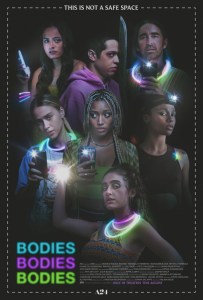 Bodies Bodies Bodies is a darkly comic horror indie but the most horrifying aspect is being trapped in a house with these obnoxious Gen Z stereotypes. A gathering of drug-addled teenagers is interrupted by two major events: a hurricane isolating everyone inside the posh Floridian estate, and a hidden murderer among their ranks picking them off. The problem with this would-be Scream scenario is that its screenplay is hampered by tonal anguish; it’s not scary enough to unsettle, and it’s certainly not funny or satirically lancing enough to count. These cringe-worthy caricatures of Gen Z as over-stimulated, over-entitled, and over-offended are hacky and feel like somebody collected a lazy grab bag of generational complaints. Everyone in this movie is annoying or unlikeable or shallow or selfish or plainly insufferable. I know the movie wants to satirize the worst of modern social media-heavy teen friendships, but it feels written by someone who hates Gen Z but without deeper understanding of the foibles of Gen Z struggles. Cultural buzzwords will be thrown out (podcasts, ablest, gaslighting, feelings are facts, appropriation, triggering, etc.) with abandon but it all feels so phony and dubious. The central mystery has some appeal, and there are some performers who make the most of their sketchy characters, like Shiva Baby‘s Rachel Sennet and a well-cast Pete Davidson, but more often the actors are trapped from such limited material, especially Oscar-nominee Maria Bakalova (Borat 2) as our sheltered protagonist navigating this weird world of privilege. The horror elements feel entirely out of balance, utilizing the dark environment and rave glow band-lighting accents for most of its lackluster, murky atmosphere. Bodies Bodies Bodies has some shining moments but far too much down time with inauthentic yet very insufferable characters, and after 80 minutes, I didn’t care who survived because my patience had long been murdered.
Nate’s Grade: C
Share this:

Fall (2022)
 It’s no more, no less than its bald premise, but with the benefit of some nifty aerial photography to heighten viewer veritgo, some seamless special effects, and a streamlined story structure, Fall is serviceable survivor escapsism. The motivation is pretty inconsequential as to why these two young women (Grace Caroline Currey, Virginia Gardner) are climbing an old radio tower, but they do, they reach the top, and then the ladder crumbles below them, trapping them way up high. From there, it becomes a survival thriller that isn’t as dumb as its straightforward title and premise might have you believe. I recall 2010’s Frozen, not the popular Disney musical, but the small indie thriller about a group of characters stranded on an abandoned ski lift. It’s a similar scenario and becomes less of a question over whether they will get down and more how they will endure the elements and simply survive long enough to draw attention to their plight. If you have a fear of heights, there are several deft moments that draw out that anxiety-ridden tension; I even gasped a few times at the movement from teetering positions and leaps. There’s a late twist I wasn’t expecting that I think is handled well, and there’s just enough character introspection to keep things interesting without de-escalating the urgency and tension of the premise. Also, Fall originally had a lot more swearing and 30-some F-bombs and these were eliminated from the use of a Deep Fake A.I. software that swapped the actors’ mouths into contorting new PG-13-approved syllables. I didn’t even notice it, which is a sign of how remarkable the technology has become and how cost-effective (the budget for Fall was only $3 million). There’s little else to this than being a well-developed, well-executed 100-minute thrill ride (you get Jeffrey Dean Morgan for exactly two whole scenes) and when you’re looking for fleeting fun, that’s certainly agreeable disposable entertainment.
Nate’s Grade: B
Share this:

Clerks III (2022)
 I’m at a crossroads with writer/director Kevin Smith. Well, I might actually have already switched sides but don’t want to fully admit it yet even if it’s self-evident. I’ve written about this before but Smith was one of those major cinematic voices that helped shape my sense of indie film and even comedy during my formative teenage years. I became a diehard fan, watched every movie several times and had all their interconnected Easter eggs memorized, and I’ve seen the man in person three times, one time recorded for a college Q&A DVD release. In short, I was most definitely a Kevin Smith super fan. Then over the last five years or so, things began to change, or more accurately my perception of Smith’s movies began to change. The attempts at humor were strained, obvious, and gassed, and it felt like his biting wit and raunch had transformed into mawkish nostalgia. The man in his twenties who made comedies I identified with and loved became a man in his forties with different priorities and a different perspective. He evolved. However, I am no static creature, and I too was evolving, and my fanfare for Smith’s comedy sensibility has transformed into more of a pained grimace. I re-watched Dogma in 2019 and Jay and Silent Bob Strike Back in 2021, as well as its second-banana imitation Jay and Silent Bob Reboot in 2019, and my assessment was only reaffirmed with each movie: I’ve outgrown my old influence. As a big screen storyteller, Smith has become more and more insular, inaccessible, and beholden to eroding fan-service, almost like he too is trying to bid goodbye to his own universe of characters. Maybe that will be the big reveal, Smith putting all his toys back away while he still can.
Clerks III is a return to the old QuickStop convenience store in Red Bank, New Jersey, last seen in 2006 with friends and malcontents Dante Hicks (Brian O’Halloran) and Randall (Jeff Anderson) as the new owners. Clerks II seemingly ended on a moment of triumph, of the guys returning to their roots but also stepping up, assuming ownership responsibilities. However, many can also view the ending as a darker indictment on what the future held for these men. Sixteen years later, what have these men accomplished? That’s the thrust of this third film, following Randal’s brush with death from a heart attack (based upon Smith’s own life-threatening experience). He re-evaluates his life at 50 and yearns to make a movie about his life and his personal experiences, which just happens to be life in service at the QuickStop. He bands together with Dante as producer and they put together a ragtag crew, including old buddies now selling their own state-approved brand of bud, Jay (Jason Mewes) and Silent Bob (Smith), to make their movie.
 In many ways, Clerks III is like a remake of Clerks with the characters of Clerks making their own version of Clerks only thirty years removed from the actual scenes of Clerks. There’s a bit of a snake eating its own tail feeling; many scenes are re-creations of moments from the original Clerks and with the same actors. It’s slightly fun to see even the smaller non-actors come back to recreate these moments, but it also makes the movie feel like an extended high school reunion (“Oh look, that guy lost his hair.”). If you were not a fan of Clerks, well you shouldn’t really be watching the third film in the series, but if you didn’t have an attachment to these characters and this odd world, seeing older versions of former fleeting characters, from the Chewlie’s Gum rep to the angry ruse-baiting video store customer or the woman who manually masturbates caged animals, would feel like flipping through someone else’s photo album, devoid of whatever nostalgic or emotion was intended.
As a lifelong fan of Smith’s filmography, or at least a former lifelong fan now transitioning to accepting a parting of ways, it’s neat to see this reunion of sorts, but it’s also ultimately pointless from a narrative standpoint. Smith is treading the same ground now with irony and distance. Actually, the irony gives way more to sentimentality. It’s not an insult to say that Smith has gotten increasingly softer as he’s gotten older, blunting much of his comedy edge. He comes across as a sincere man who really cares for the people in his life, including these very people that contributed their time and efforts in 1992 to help make a young man’s dream come true. I understand his desire to pay back all the little people, to check back with them one more time, and to have Clerks III serve as a love letter to those who were there from the very beginning. If you’re plugged into this universe, you might smile and you might also feel some of the love.
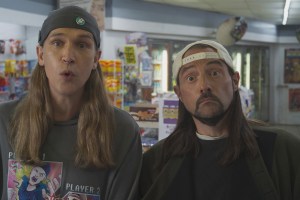 There are famous cameos to balance out the lesser known faces from the original Clerks. You’ll see Ben Affleck hamming it up, Justin Long doing a funny voice, Fred Armisen grasping for something to do, and Sarah Michelle Gellar’s first film role since 2012 and first live-action film role since 2009’s Possession (Gellar was a voice on Smith’s Masters of the Universe animated series on Netflix). The two big additions from Clerks II also return. Trevor Fehrman, returning as the socially awkward coworker Elias, is the funniest part of the movie as his character goes through a spiritual crisis. He feels let down by Jesus and commits himself to Satan, and his runway show’s worth of crazy outfits and cosplays throughout the movie is the funniest joke that never even bears mentioning, which only makes it funnier (he too has his own Silent Bob-esque quiet sidekick played with good spirits by Austin Zajur). Elias was the voice of a younger generation of Internet fandom in Clerks II, allowing Smith his opportunity to criticize modern geek pop-culture, like the Star Wars prequels and Lord of the Rings. That doesn’t really happen in Clerks III despite 16 years of Dante and Randal’s cinematic absence. Smith doesn’t even nibble or good-naturedly rib any pop-culture landscape. Even the jokes about NFTs feel hesitant and wishy-washy and lazy. Smith was defined by his ribald wit and hyper-literate dialogue, and now his comedy has become inane slapstick and pandering nods meant to serve as a replacement for an absent punchline. It’s disappointing how little the comedy registers now.
The biggest addition to the Clerks trilogy was Rosario Dawson, now even more popular as she’s firmly solidified in the Star Wars TV empire. I figured she would have been written out of the franchise as her availability was going to be far more limited. It’s not a spoiler considering it’s revealed within the first minute or so, but Dawson’s character, Becky, who was pregnant with Dante’s child and this presented a new route for his future, is dead. Not only is Becky gone but she died in 2006 from a drunk driver, which means that her unborn child with Dante also died, though this is never touched upon and that seems truly bizarre because much of Dante’s characterization in this movie will be his prison of grief he’s been unable to break from. It’s been 16 years and Dante has not moved on, and I wish more of this was explored thoughtfully. He views himself as a man stuck, now in his 50s, and having missed his off-ramp to another and better life. Without more careful attention, it can come across like a schlub holding onto his grief as a mistaken form of identity. Even that description could be interesting, but you’re not going to get that level of drama in something like Clerks III. Dawson does have a few appearances as a ghostly memory trying to help Dante move on, though if this is the case, I feel like she should be reaching some kind of breaking point after 16 years of effort.
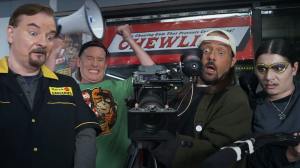 By the end of Clerks III, it’s clear that Smith intends for this to be the concluding chapter, sending off these characters as reflections of his own film history. The focus of the final act is far more dramatic, as the act of retelling one’s life story as a movie becomes its own way of sharing the love and admiration of a decades-long friendship. I don’t quite think Smith gets to the dramatic heights he’s reaching for, even when some pretty significant and surprising events play out. Too much of the movie is like watching a low-budget remake of Clerks thirty years late, and while I’m a sucker for movies about the making of movies, and those fun found families of creatives banding together, the structural vehicle and conceit for Clerks III left much to be desired. If you remember the scenes of 1994’s Clerks, watching Clerks III is like reliving them as a strange Lynchian dream where the edges are smudged and everything isn’t quite as it should be. At this point, a new Kevin Smith movie is made strictly for the most diehard of fans. I can see that ever-shrinking pool of fans warmly smiling and chuckling from the movie but more in nostalgic recognition of time gone by. It’s nice to revisit these characters, as I’ve been eager to see what life has dealt them since Clerks II. You can feel Smith’s affection for these people, the ones who catapulted him into fame, but the movie is too backward-looking and uninterested in its own comedy as Smith winds down.
Nate’s Grade: C
Share this:

Secretary (2002) [Review Re-View]

Originally released September 20, 2002:
Secretary is a new romantic comedy with a few kinks to it. It’s actually the most romantic S&M movie ever. It’s the first S&M romantic comedy since maybe Garry Marshall’s disastrous 1994 Exit to Eden. I’m still trying to get the image of Rosie O’Donnell in a bondage mask out of my ongoing nightmares.
Lee Halloway (Maggie Gyllenhaal) is fresh from a stop at a mental institution for her hazardous habit of cutting herself to feel relief. Her overbearing mother stashes the entire kitchen cutlery in a locked cabinet. The sheltered Lee resorts back to a kiddy make-up box stashed under her home bed. Instead of colorful brushes and arrays of lipstick, she has a selection of sharp objects. Lee goes job hunting to step back from her habit, and is hired as a secretary to E. Edward Gray (James Spader). He is a rigid taskmaster who delights in pointing out typographical errors with his red marker, his weapon of choice. Gray enjoys his dominance and Lee complies, even if it’s routing through garbage. He ticks away Lee’s flaws like a checklist of annoyance but also appears to have genuine concern for her. When he notices her wounds Gray confronts her and convinces Lee to stop cutting herself.
The turning point arrives when Gray orders Lee into his office one afternoon. He commands her to bend over his desk and then delivers a sound spanking. Lee stares at her purple rump with fascination, like something has been awakened inside her. Soon enough Lee purposely makes typos so she can re-assume her spanking position.
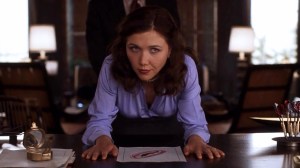 Maggie Gyllenhaal is a cinematic find with a fearless and breathtaking performance that is at once delicate, nervous, self-controlled, seductive and delightful. Gyllenhaal, with her heart-like face and pert lips, radiates star quality. She allows the audience into Lee”s head and we quickly fall in love with this peculiar yet charming heroine. If there is any justice in this world Gyllenhaal should at least get an Oscar nomination (she didn’t). Spader can do this left-of-center creepy character stuff in his sleep.
Secretary on the surface may seem like a fetish flick but it’s no different than boy (sadist) meets girl (masochist) and falls in love. Director Steven Shainberg treads carefully around serious subject matter, like Lee’s self-mutilation, to focus on these two very special characters. Secretary isn’t making any loud statements on sadomasochism or post-feminism, it’s just showing us that S&M is the route these two people take to find true love. It doesn’t judge them for their unconventional tastes and neither should we. This is one of the finest romances in recent memory and it seems to come from one of the most unlikely places.
Sadomasochism has been predominantly shown involving pain or some leather-masked madman evoking torture. Secretary may be the film that shows there can be pleasures with pain. Some people regard what Lee and Edward do as sick, perverted, or downright wrong. Secretary is a foot in the door to get people to understand what willing sadomasochism really is about. We all have fetishes and interests, and S&M is the number one fetish truth be told. This isn’t your everyday romance.
Obviously, this is a movie that will not appeal to everyone. The relationship between our leads is surprisingly complex but gentle and even sweet (if that’s the proper word for an S&M romantic comedy). Secretary shows that it truly takes different strokes and, despite an overly silly ending, is the most pleasing romance of the year. You’ll never look at red felt pens the same.
Nate’s Grade: A
——————————————————
WRITER REFLECTIONS 20 YEARS LATER

I’ll be honest with you, dear reader, because I think you deserve that. I didn’t recently re-watch Secretary. I did re-watch it a year or two ago, and the return experience was so jarring that I didn’t feel that I would greatly benefit from watching it so soon again, but I knew I would have to include it on my 2002 re-watch list when it was time. When I first watched it in 2002, I was smitten with its offbeat charms about an unconventional romance through the BDSM community and a young woman’s self-actualization through accepting her kinks. It was a star-making performance from Maggie Gyllenhaal (originally was going to be Gwyneth Paltrow) and as a sucker for quirky romances, it was one of my favorite films of the year. Nearly two decades later, I took out my DVD copy to share with my now fiancé, who is also a fan of quirky romances and who had never watched Secretary. Surely, I thought, she would be entertained. Dear reader, she was very not entertained. She was horrified. She was shaking with disgust. She was having a literal violent reaction to the movie and its onscreen display of what constituted romance, and I will say it struck me differently too. I understand that not every film will age well, as our sense of what is funny or acceptable or what is even compelling will change over time as our culture inevitably shifts. That’s art. But hoo boy has Secretary aged about as well as milk in the ensuing twenty years.
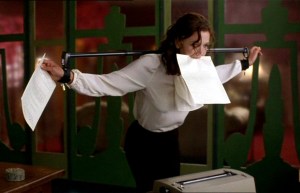 The very nature of the S&M relationship between boss and secretary was already problematic when it was released in 2002, but in a post-Me Too universe it is inexcusable and taints any charms the movie may have had. Mr. Grey (James Spader), the dominant boss and rigid stickler for rules, is the villain of the movie and not its Byronic hero, the brooding and damaged man that a pure-hearted woman just needs to find a magical way to reach and reform. He is not romantic. He is appalling, and the early critical praise, myself included, excused far too much of his behavior. While not condoning his excesses, critics may have given more leeway because the end result was framed as a happy ending, with Lee (Gyllenhaal) being cared for by Mr. Grey. However, he completely uses his position of authority in many inappropriate manners, and while they do develop a mutual relationship, eventually, the power dynamic is not equal at all. This takes away the agency of Lee and makes the romance feel like a false choice. Much of her relationship can be summarized by the awful moment he ejaculates on her back: she just has to take whatever he dishes and like it. That’s not romantic. That’s not cute. That’s toxic. It also hurts the overall movie that the way Lee proves her devotion as the film’s climax is to stay fixed at her boss’ desk for many days, to the detriment of her physical health. Yes, Mr. Grey gets Lee to kick her habit of self-harming but she replaces one need with another. He resembles a predator by most every definition, and to try and say, “Well, he’s just complicated,” is bad man excuse-making.
I tried imagining tweaks and alterations that could make this all work, but anything where he is her boss muddies the issue of consent. Maybe if he was a visiting businessman, but that would also offer a questionable dynamic. The core of Secretary is built upon the secretary/boss interplay and imagery. The tagline is, “Assume the position,” and depending upon the poster, you might only get a woman’s rear in fishnets as the sole imagery. Director Steven Shainberg (Fur) and screenwriter Erin Cressida Wilson (Chloe, The Girl on the Train) are clearly veering into the obvious office power dynamics for provocation. They are very intentional about subverting romantic clichés and looking for something different for our heroine. We have a nice guy, played with squirmy energy by Jeremy Davies, who just won’t cut it. He’s too vanilla for her and afraid to be too forceful in his spanking. It’s like the filmmakers are declaring that Lee demands more, and her specific combination of qualities just so happens to align with this gross man. The movie wants us to hold our judgment, and I could in 2002 in a “love is love” declaration, but what I see on-screen in 2022 is not indicative of love. It’s obsession. It’s codependency. It’s sad.
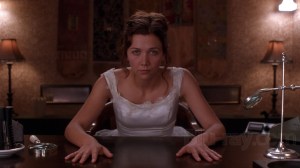 The other problem, sadly, is Maggie Gyllenhaal’s fragile performance. The choices she makes collapse Lee, greatly infantilizing her and magnifying all the icky feelings I had. She’s playing Lee less like an adult woman who is struggling to figure out her confusing life, and impulses, and more like a teenager who woke up in the body of an adult woman. Part of this is the screenplay but it’s not helped by the acting choices that Gyllenhaal engages with. I do really enjoy her as an actress, and it’s easy to see why she could captivate so many circa 2002 with this performance, but it plays so differently now. Today, she comes across as another young woman trying to remodel herself to please a man. Her little girl acting choices only make the courtship feel even more abhorrent. I wonder if they were trying to aim for the movie to be its own kinky fable, wherein the infantilization would harken back to older fairy tale tropes and Mr. Grey as the unorthodox knight in shining armor.
This is one of the biggest critical swings I’ve had since re-watching twenty-year-old movies and my initial reviews, and I’d say even one of my biggest changes on any movie I’ve watched. I do think you can make a funny and sexy S&M rom-com; for years I thought Secretary was it. Not so. I wouldn’t even recommend this movie and it used to be in my top of 2002. I suppose people who are curious could give it a chance, but I think the objections outweigh whatever positives can be gained from viewing. Oh well. That’s the nature of art. Not every movie or book or song will have the same power over time. They stay the same but we, the prism upon which art is judged and related, are constantly in flux. That’s just the way it is. This won’t be the last movie where my opinion changes dramatically. I just won’t watch Secretary again, and that’s okay.
And you’ll never be able to convince me that E.L. James didn’t take her BDSM character’s name from this film.
Re-View Grade: D
Share this:

Nope (2022)
 Within two movies, and most likely just with his first in 2017, Jordan Peele catapulted himself as a brand name in the world of horror. At this point, you’ll see a Peele horror movie sight unseen because you know what you’re getting is going to be a unique experience. There are plenty of modern horror directors that have built a rabid fandom, like Ari Aster or James Wan, but nobody seems to be given the same platform as Peele has earned at this juncture. The writer/director has become what M. Night Shyamalan used to exhibit, the director whose creative visions were each highly anticipated event movies. Nope is Peele’s first foray into science fiction territory and the results are messy, disturbing, and, at points, astounding.
The Haywood family ranch has been involved in the motion picture industry since its very beginning. One of the first film images, a black man astride a horse, was the great-great-great grandfather of Emerald (Keke Palmer) and Otis Jr. (Daniel Kaluuya). The brother and sister are trying to save the family ranch after the untimely and strange passing of their father (Keith David) who was felled by debris falling from the sky. Their neighbor, Ricky “Jupe” Park (Steven Yeun), is spinning his notoriety as a child actor into a Western theme park attraction. Ricky’s claim to fame was being one of two survivors of a 1990s sitcom where the trained chimpanzee, who in the context of the show was his adopted sibling, snapped and went on a killing spree. Emerald and Otis Jr. begin to suspect that there is a real unidentified flying object hanging over their land, so they set out to capture living proof and become rich and famous. The alien, hiding in an unmoving cloud over the course of six months, has other plans and intends to assert its claim on the Haywood territory.
 Peele is proving himself more and more as a major director of genre spectacle and vision. Each of his three directorial efforts will hit people differently; I think they’ve incrementally gotten a little sloppier in the writing department, but Peele is only growing stronger as a visual stylist and orchestrator of big screen spookery. There is a grandeur to the visual arrangements, owing as much to the expansive language of Westerns and the awe of early Steven Spielberg. I wish I had seen the movie in IMAX as Peele intended, since he went to all the trouble of planning specific sequences for the grand IMAX cameras. There are several moments that are jaw-dropping and stirring in horror and wonder. A literal rain of blood and viscera and expelled non-organic items is a striking image. Even the unnatural way that helpless people are thrown off the ground can be jolting and primal. There’s a claustrophobic interior sequence of desperate people that really conveys the terror of the doomed. A big addition to the eerie atmosphere is the brilliant sound design. The otherworldly-ness of the alien encounters is heightened by a really in-depth sound design that can make the hairs on the back of your neck stand at attention. Even the sound of rain, and its distance, can be an indicator of the proximity of danger. There are also the distant sounds of horrible screams circling through the clouds high above, and it’s a deeply unsettling design trick that works every time. Even when the movie wasn’t quite as engaging from a narrative or thematic standpoint, Nope is always engaging on a simple delivery system of spectacle. The way Peele distributes his visual clues and keys, sometimes literally, always provides something for an audience to anticipate.
I was also starting to grow impatient from Peele’s coy narrative games. The plot moves in frustrating starts and stops, teasing an intriguing development or proffering a question and then skipping backwards, denying the viewer a sense of gathering momentum. There’s a toying sense of teasing out how far he can go before an audience gets too impatient and quits. Much of the first half also takes place during night or sequences of sustained darkness, which can definitely play into the the fear of what could be in those shadows, but it makes for a fitfully frustrating experience when you’re trying to unravel a science fiction mystery. I kept wondering how all these pieces were going to come together, especially the ongoing subplot about this killer chimpanzee, but I had faith in Peele (mostly). That faith was rewarded but I’ll admit for the first hour I was wondering if Peele was too evasive for his own good.
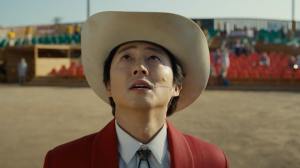 Nope begins as Close Encounters of the Third Kind and then transitions into Jaws and stays there, and it was during the second half that my interest magnified exponentially. It’s around the hour mark that the movie finally puts all its cards on the table and declares what it is and what the remaining movie is going to be about. All the stutter steps and vagaries are cast aside, and the movie finally shifts into its grand entertainment of a group of humans learning about an overwhelming and unusual threat and plotting their unorthodox plan of attack. I’ll still try and play around spoilers without getting too deep into specifics. It’s a great relief when Peele no longer has to tease his threads and mysteries and can at last be open and let the conflicting components come together. The annoyances I felt in the first half melted away, and I was satisfied as the movie picked up a genuine momentum and smartly tied in many prior plot elements for the bigger picture, like the inflatable tube men, old timey picture-taking souvenir machines, and even the very vague almost carwash-esque imagery from the opening credits. The second half of the movie is more fun because it’s a big hunt and it allows our characters to make use of what they have learned to form conclusions and strategic moves and adjustments. It’s characters making smart decisions. It’s a scenario that finally allows Peele to finally play with all the setups he’s spent an hour cheekily hiding around.
While the climax is great, and the movie gets consistently better, I don’t feel like all of its many thematic ties come together. Being a Jordan Peele horror movie, we’re now expecting there to be extra layers of social-political commentary and allegories. The back-story for Ricky as a child actor is given a lot of attention and screen time for a two-hour movie, and I don’t know if what it adds up to is equal to the time it was given. Thematically, you can make some speculative reaching about the exploitation of animals for spectacle, about underestimating and not respecting nature, and even setting up for later tragedy, but it all seems less meaningfully integrated than any other Peele movies’ elevated subplots. With the Ricky back-story, there is even a literal anticipation of a literal shoe to drop, which seems so obvious as a visual metaphor but I cannot link it directly with what follows. I can keep digging and find connections but it requires far more effort than Peele’s other works of horror. The family history of working for Hollywood as horse wranglers feels underdeveloped. There are also rules that it establishes that Peele isn’t fully consistent (just don’t look?) that left me questioning. I figured that colonialism would be an obvious parallel with invading aliens (H.G. Welles even made use of the analogy 120 years ago), but maybe that was too obvious territory for someone like Peele. My friend Ben had a crazy early theory that the aliens themselves would resemble horses and thus they were returning to free their equine brothers and sisters from human exploitation. I guess I’ll go ahead and spoil you, dear reader, that this does not happen in any shape with Nope.
 I’d rank Nope the third best Jordan Peele horror venture, and while it clearly makes use of science fiction concepts and its rich iconography, it’s still very firmly a movie rooted in horror, the horror of the unknown, the horror of being small and helpless, the horror of being left behind. Not all of Nope’s many ambitions quite land, and the themes feel a bit more jumbled or underdeveloped, but I want Jordan Peele to continue making the movies he wants on his terms. Not every one is going to hit exactly the same for me, or for any viewer, but we’re all better when unique artists like Peele are given the latitude and support to bring their personal visions to the big screen. As long as he’s still achieving a baseline of quality, something that befell the middle Shyamalan period, then I say swing away and let’s see where you’ll take us all next, Jordan Peele.
Nate’s Grade: B
Share this:

Orphan: First Kill (2022)
 This is such a strange movie. The original Orphan, released in 2009, was an otherwise forgettable killer kid movie with a memorable twist: little Esther (Isabelle Furhman) wasn’t a child but a 30-something woman with a hormonal disorder (supposedly inspired by a true story). What do you do with a prequel when the young actress is now a grown woman and the audience knows the big twist from the start? The first answer is use a body double, have the other actors wear platform shoes or step on boxes, and forced perspective with some de-aging CGI sprinkled over Furhman’s adult face. That’s a whole lot of effort, albeit practical and less costly, to make a prequel without much going on. We follow young Leena as she escapes from an Estonian mental asylum and poses as a missing child from an American couple (Julia Stiles, Rossif Sutherland) who adopt her and bring her back to the States. It’s here where little “Esther” must keep up the illusion, with the mother already gathering her suspicion but not wanting to trouble her husband. For the first hour of this 100-minute movie, I was quite bored and the movie was relatively listless. There were some kills but it all felt like simply going through the motions, especially already knowing her secret and not being emotionally invested in whether her new identity would be maintained. And then the movie makes a sudden turn, one I’ll spoil right now because I think it makes the film actually watchable, where the mother confesses she knows Esther is not her missing daughter, is an adult woman, and then both of the women in this dysfunctional nuclear family are trying to undermine and kill one another while vying for the favor of the father/husband. It took an hour of sequel/prequel drift, but here First Kill (there are many after her first) finally delivers something new to do after sitting for an hour rehashing the original twist. I wish the screenplay had gotten here even earlier and veered into wicked black comedy. It definitely feels like the movie wants you to laugh at the escalating battle between fake daughter and fake mother. I laughed out loud over a scene with slippery dentures. There’s no real reason for this movie in 2022, especially with all the extra work to make it plausible, but I wish the filmmakers had just embraced all its goofy implausibility.
Nate’s Grade: C
Share this:

Bullet Train (2022)/ The Princess (2022)
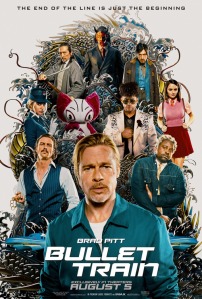
Bullet Train and The Princess are two recent releases that could serve as a double feature for all they have in common. Both movies prioritize fun above all else, both of them feature stylized violence and bloodshed, both of them have a perverse sense of humor, and both of them feature young actress Joey King (The Kissing Booth, Wish Upon), coincidentally playing the listed roles of Prince and The Princess. What more do you need for this combo? If you are a fan of Bullet Train, you’ll likely be a fan of The Princess, and vice versa, because both of them are exactly as advertised. They’re wild, whimsically violent, but succeed with nimble action construction, bizarre and engaging characters, and high energy that sparks fun escapist entertainment.
Bullet Train is set almost entirely on a speeding bullet train in Tokyo, and we follow a group of hired killers, mercenaries, and generally nasty people all sharing one very fast locomotive. “Ladybug” (Brad Pitt) is a reformed hitman who only takes snatch-and-grab gigs as he’s trying to better himself with therapy and meditation. He’s meant to grab a briefcase of money and get off the train. Naturally, things don’t go as smoothly as planned. Onboard the train are “Lemon” (Brian Tyree Hill) and “Tangerine” (Aaron Taylor-Johnson), who have the briefcase in their possession along with the prodigal son (Logan Lerman) of a scary Yakuza boss known as “The White Death.” Also on board is Kimura (Andrew Koji) seeking to find the person responsible for pushing his child off a rooftop, Prince (Joey King) using her diminutive stature to trick unsuspecting men, the Wolf (Bad Bunny) seeking out the person responsible for the death of his bride, and several other masked killers looking to up the ante. Characters will clash, many will die, and “The White Death” will be appeased by the end, coming to collect a blood debt from all. 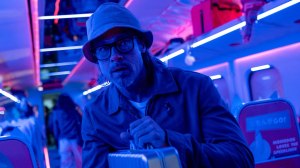
Bullet Train was, blissfully, everything I was needing it to be. It’s a universe familiar to fans of Quentin Tarantino and especially Guy Ritchie, with colorful and threatening characters with large personalities and quirks colliding in unexpected and violent ways. I’ve seen so many Tarantino knock-offs, and Tarantino knock-off knock-offs, so I appreciate when someone is able to understand what it takes to succeed on this unique playing field. Screenwriter Zak Olkewicz (Fear Street: 1978) knows how to sharpen the kind of off-the-cuff banter that makes these movies excel, with space given for the characters to make a sizable impression. There needs to be time to get to know them, their quirks and faults, and then send them all running at one another at cross-purposes, interacting in fun ways that lend to one character screwing something up for another. There’s about a dozen characters dropped upon us, and just about everyone gets a flashback or introduction set piece, sometimes more, sometimes extensions of previous flashbacks, sometimes extensions from alternate perspectives. Part of the fun is just seeing how the different characters relate to one another, so there is a period of time where the mask has to eventually drop, and the reveal needs to be worthwhile. It’s a lot, and Bullet Train gleefully trades in excess upon excess all in the name of chasing after a good time, and if you connect on its zany and breezy wavelength of reckless violence and dark humor, then you shall be happy for the ride.
The movie is constantly reshuffling and transforming, allowing it to hyperextend into whatever shape it necessitates before contorting back to its next phase. This malleability makes the movie far more responsive, sometimes overlapping, and it provides an extra level of energy. It’s reminiscent of Snatch, my favorite of the Ricthie cockney crime capers, where the story zigged and zagged through linear time, providing answers to different stacked questions. I won’t say the characters are as distinct as Snatch, but Olkewicz takes his time to introduce each with relish. Pitt may be the marketable star of the movie, at least as far as advertising is concerned, but it’s really much more of an ensemble, and one anchored by Lemon and Tangerine. Their droll, snappy banter really cements their long-term relationship almost like a screwball romance. They end up becoming, strangely, the heart of the movie, if one were to suggest a movie with an entire wedding party vomiting their guts to death had a beating heart. Their exact connection and genuine affection for one another, even when they’re driving one another mad, is one of the film’s many surprises as it zooms ahead. There are fun cameos, and some unexpected abrupt deaths, but Bullet Train works because of the entertainment of the kooky killer characters. I enjoyed that one character’s obsession, namely likening people to Thomas the Tank Engine avatars, has a personal connection but actually leads to some ironic turns. Not every set-up has the best payoff (Chekov’s toilet snake comes to shockingly little) or resolution (why wasn’t the snooping conductor thrown back in or given a revelation?) but with so many characters criss-crossing, so many goofy asides and cul-de-sacs, and so much bloody mayhem, there’s a steady stream of fun, satisfying payoffs and retribution until the mid-credits sequence. 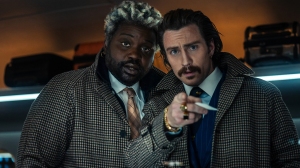
To me, the water bottle symbolizes Bullet Train at its best and worst. After two hours of multiple characters and their out-of-order flashbacks shuffling for dominance, we get an inanimate object with its own flashback. It’s a goofy and superfluous addition, as the water bottle has served as a plot device but has served its ultimate plot purpose already, so seeing its entire history offers no new information that the audience didn’t already have. However, what it does is show the movie from the perspective of this bottle, and many sequences are reframed from the bottle’s rigid point of view. It made me think about how after they got their shot setups, someone on staff would then call out, “Okay, we need the water bottle POV shot now,” and they would film that. I appreciate the effort for something this fleeting and silly. They didn’t need to put in this flashback or this level of attention to an object that ultimately just gets thrown at a guy’s head. However, it’s the misdirect, the ridiculous inclusion on top of the others, and the ramping of energy that made me smile, even as little else came out of it. I appreciated the showmanship. For me, this is emblematic of the movie as a whole, an overload of style and energy just for the fleeting hell of it.
Under the direction of David Leitch (Atomic Blonde, Deadpool 2), the action is as fun and energetic as the colorful characters. Leitch has become one of the best modern directors of action movies. The hand-to-hand combat is refreshing and makes use of close quarter combat demands. I enjoyed that the two participants in a fight are trying to sneak in quick moves without getting caught by an older lady who demands quiet in the quiet train car. I enjoyed the zany flashback where Tangerine and Lemon recount to the camera and dispute the number of men killed on a previous job. With a character cursed with bad luck, it provides opportunities to have fun with accidents and bad timing, which Leitch works into different action set-ups and setbacks. Even when the movie literally goes off the rails and becomes a big cartoon, Leitch finds ways to marry the big tone in such a manner that the ridiculous doesn’t prove off-putting. When characters are swinging samurai swords in slow-mo, while a Japanese version of “Holding Out For a Hero” is pumping on the soundtrack, I just sat back and soaked up the deliciously disposable fun times. 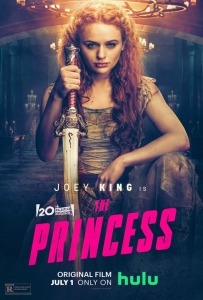
The plot of The Princess is as straightforward as Bullet Train is knotty. The Princess (Joey King) of a fantasy kingdom is chained at the very top of a castle tower. Her captor, Julius (Dominic Cooper), has imprisoned her family and plans to wed the princess and become king. The princess, however, has other plans. Thanks to her martial arts and weapon training, she breaks free and becomes a one-woman wrecking crew as she descends the tower floors to freedom.
I was genuinely surprised at how well developed and exciting the action sequences were. The Princess shares more in common with The Raid than anything by the Grimms. The script by Ben Lustig and Jake Thornton follows the model of a video game; every new floor is a literal new level with a new boss or new objective to be achieved to advance to the next level. The simplicity of the premise is refreshing, and the movie doesn’t waste any time ramping things up. Blood is shed within the first few minutes and it doesn’t let up. What I really appreciated was how well constructed each new action set piece was. There’s variety and specification that challenges our heroine, who is powerful but still not all-powerful and bereft of vulnerability. Each new encounter forces our protagonist to think through a different application of skills. There’s a situation that involves overpowering a larger and stronger man, a situation trying to wound a fully armored man, a situation battling two men, then even more, a situation with men charging into the battle and having to escape to a safer environment, a situation where she has to swing along the outside of the castle to enter a different room, a situation involving stealth, and many others, but each requires something different and thus each proves to flesh out our main character and her capabilities and problem-solving acumen. It’s always a pleasure to watch smart people overcome challenges in fun and smart ways, and The Princess has this formula down. I was worried the movie might get repetitive with its video game level design, but each new challenge is an opportunity to dazzle and enlighten us about our John Wick-esque fighter.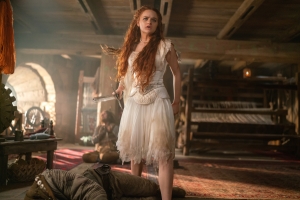
That’s probably the best comparison, the John Wick franchise, because it’s a series of movies that is defined by the thrills of its fight choreography and action set pieces. That’s it. The world has some interesting flourishes but the draw is the fight scenes and the pleasure of watching professionals operating at such a high level and with demonstrations that allow us to better immerse and appreciate the artistry of the fighting. And it’s good here. The impressive choreography has a really nice A-to-B propulsion, with each move connecting to the next to tell its own story of countermoves and adjustment. I really appreciated how the specific geography of each location is incorporated into the action, whether that be as a hindrance or an assistance to the fighting. It makes the sequences more meaningful and better developed. It’s also a movie that understands that if you give your villains specialized weapons, they better use them in fun or nasty ways. If all you’re looking for is imaginative, bloody, and brutal fighting, The Princess delivers it all. Credit also to King for throwing herself completely into the role. She effortlessly executes complicated fight moves and swordplay during long takes. You can tell she’s having a blast being a badass. Think of The Princess like a feminist version of The Raid or an upside-down version of Dredd (“Instead of fighting up, this character fights her way… down.”).
The Princess could have made more social statements but its very conceit is a feminist reworking of outdated fantasy tropes, so I don’t mind that it’s a streamlined action movie with a blunt yet obvious point. The familiar story tells us that these damsels in distress are the maidens in need of rescuing (“Sorry, our princess is in another castle” and the like), so just having the princess be her own champion is a simple yet satisfying subversion. This is an action movie and less one on politics; however, it’s a movie that cannot help from being political because it’s upsetting the expected social norms, that women are docile and weaker and at the whims of men. The Princess isn’t breaking new ground here. There have been plenty of movies that re-contextualized the feminine roles of old legends and folk tales and made them more capable and strong and fierce. That doesn’t mean there’s any less enjoyment watching our princess take down one leering man after another. It’s the appeal of the underdog who makes men pay dearly for underestimating her. These repeated interactions and bloody comeuppance speak about as well as necessary for this kind of movie. I doubt things would have radically improved if one of the characters broke into a treatise on the misapplication of gender roles. It’s a woman beating the stuffing out of creepy and lascivious misogynists. For this movie, that’s more than enough to keep me watching. 
Where The Princess starts to lose itself is once it shifts into its final act and abandons its formula. I can understand wanting to shake things up so the viewer doesn’t get lulled into complacency, but because the sequences were, beforehand, varied, my interest was not lagging. During this final stretch, the titular princess leads a squad to take down the baddies, and the movie becomes any other number of similar fantasy action movies. The enjoyable fight choreography is still present, but it feels like a rush to clear everything in comparison to the methodical floor-by-floor clearing from before. I wish the filmmakers had merely held steady with their plot rather than throwing things out and relying upon a grand team-up revolutionary raid. There’s also a sudden shift that throws out the rationale for keeping the princess alive. The bad guy just shrugs and says, “Forget it, I’ll find a replacement,” and it feels too arbitrary of an escalation. If he could do this, why was he so insistent for the first hour that she not be killed? It’s not a bad ending or one that ruins the movie but it’s definitely a downshift from the action excitement highs from before.
The Princess and Bullet Train are both frantic, over-the-top, cartoonishly violent, while still understanding how to effectively sell their escapist mayhem. We need to be dazzled by the action sequences and have them be meaningful (check), we need weird and interesting characters that we want to root for or watch bumble onscreen (check), we need payoffs that feel rewarding (check), we need an onslaught of style and attitude (check), and we need, above all else, fun and surprises (check). Neither of these movies is going to qualify as one of the best movies of the year. That’s just not the kind of experience either is shooting for. However, they may be some of the best fun you have with movies for 2022, and in a world in short order of fun, that’s plenty.
Nate’s Grade’s:
Bullet Train: B
The Princess: B


You must be logged in to post a comment.