Author Archives: natezoebl
A Separation (2011)
 When A Separation won the Best Foreign Film Award at the 2012 Oscars, its writer and director, Asghar Farhadi, gave a heartfelt speech where he accepted the award on behalf of a proud people who “respect all cultures,” a country that is much more than portrayed on the news as a Middle Eastern state of agitation and repression. Then the Iranian state-run TV used the opportunity to insult Israel, saying that the Academy “bowed before Iranian culture,” their movie “left behind” the Israeli nominee (Footnote) and “the beginning of the end” of Israel’s influence as it “beats the drums of war.” Sigh. Just when it looks like progress can be made to build cultural bridges. A Separation is a nuanced tale of struggle between tradition, morality, and personal choice. It’s a movie worth taking pride in.
Nader (Peyman Moadi) and Simin (Leila Hatami) are a married couple heading for a divorce. She wants to move to the West. He does not want to leave, especially since he must care for his elderly father who suffers from Alzheimer’s. Simin wants a better life for herself as well as their 11-year-old daughter, Termeh (Sarina Farhadi, the director’s own daughter). Simin does not want to leave without her daughter but cannot get the judge to give her custody without Nader’s approval. Simin has moved back in with her parents. Nader hires a working-class maid, Razieh (Sareh Bayet), to care for his father while he’s away at work. Razieh is working unbeknownst to her husband, who would disapprove but has been unemployed for nine months. Caring for the elderly man is a lot more than she bargained for. At one point, Razieh calls an imam to ask if it is a sin to change the elderly man’s soiled pants. Then one day Nader comes home to find hid father sprawled out on the floor, tied to his bed, and locked in the apartment. When Razieh comes back, she says she had an emergency and keeps it vague. Nader fires her, she demands payment for the day, and he pushes her outside his door. The repercussions of this action will be larger than either could have imagined. Razieh and her husband accuse Nader of intentionally pushing the woman, and when she fell she miscarried her baby. Nader is being tried for murder, but nothing is as clear-cut as what it seems.
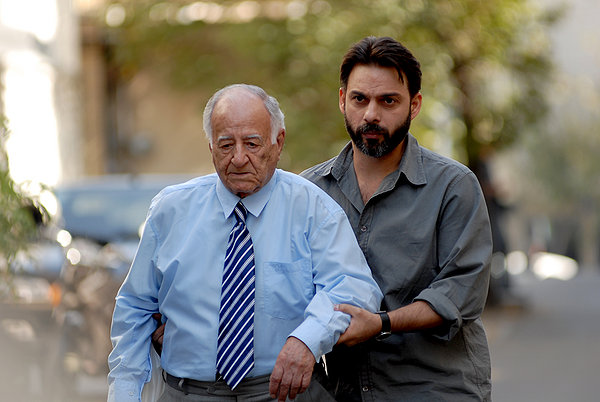 There’s so much to dissect in the intimate, thrilling, and observant little movie about imperfect people living under an imperfect system. It’s far more than the dissolution of a marriage and its impact that has on their family. It’s about the separation of moral relativism, compromises, cultural estrangement, and the concepts of justice in a world brokered by unjust forces. A Separation is really an ongoing court case that ensnares all the characters and brings them down in some degree. The more information we learn, the more we start questioning exactly what we knew about these characters and their circumstances. We’ll get speeches about doing the right thing in the face of opposition, and yet characters will routinely lie to save their own self-interest in the sacrifice of truth. You’re thrown into the middle of this drama and by the end you’ll likely feel exhausted by how emotionally charged the whole thing is. Lots of breathless arguing, lots of teary-eyed emotions, lots of unvarnished pain exposed, and very little in the way of resolution. This is an agonizing film that doesn’t feel the need to kowtow to the hopes of an audience for a happy ending. The lives of these characters are too complicated for tidy resolutions. The open ending, where Nader and Simin await their daughter’s decision over which parent she will live with, feels perfect considering that these people, due to circumstance both personal and political, are resigned to limitations on their happiness.
This is one of those movies where there are no real villains. You can see everybody’s plight and find some reasonable empathy for these people. Initially, the audience sympathy seems to be completely with Nader. He doesn’t want a divorce but feels indebted to taking care of his ailing father. He feels like he cannot abandon his father to live in the West. Simin is more vague about her rationale for wanting to leave the country, though one can only assume that her concern for her daughter is directly tied to the subjugated roles of women in Iran. Otherwise, her daughter is apart of a middle-class family where education is prized. Simin callously says that the old man is so far gone into dementia, why does it matter? The tension becomes whether Nader would rather care for his aged father or secure a brighter future for his daughter. After this opening marital clash in front of a judge, the film mostly follows Nader and his care of his father. When he confronts Razieh and is fuming about how he discovered his father, we’re there with him. Then when he’s accused of murder, a charge we know seems preposterous given what we’ve witnessed, our empathy further aligns with Nader, who we fill is wrongfully accused of something so serious it will wreck his life and family. Then when Simin reappears, and seemingly believes the worst of the story, it feels like she’s using the fraught circumstances to her advantage to force her daughter’s hand into deciding to leave Iran. But then the movie continues and you see that Simin has more at stake, Razieh is a sad woman penned in by circumstances, and Termeh is not the innocent child she appears to be. Your loyalties will be pulled in multiple directions until you ultimately conclude that these aren’t good people or bad people but merely people, fairly relatable and sympathetic.
 A Separation shows a different side to Iran, a side that most Americans don’t see given the news coverage. The Iran on display in the film is a world in conflict. There’s the emerging voice of women conflicting with the male sense of privilege, there’s the conflict between classes illustrated by the stark difference sin living conditions between Nader and Razieh, who must make lengthy commutes just to earn a pittance, the conflict between parents who say they want what is bets for their child but provide her with false choices and use her as a battering ram against the other side, the conflict between a justice system that must stick to the letter of the law and the cases that cannot be so simply defined, the conflict between allegiance and self-interest, the conflict between personal gain and the truth, the conflict of caring for the old versus establishing a life of opportunity for the young, and the conflict between religious faith and daily living. There’s so much going on in this movie that every detail feels telling, ever actor feels rooted is reality, and every new moment further complicates an already messy situation.
A Separation is the kind of meaty drama that Hollywood seems to have forgotten how to make anymore. It’s patient and uncompromising, trusting its audience to wade through nuance and ambiguity rather than be told explicitly how to feel. The complex character work, alarming intimacy, and observational details of a society in relatable turmoil build the foundation of one very enthralling, thrilling, deeply resonant piece of work. A Separation is an example of superior filmmaking and the idea that movies from around the globe, even places that our politicians demagogue as an “axis of evil,” can tell universally human stories. This is a movie that will spark discussion long after it’s over.
Nate’s Grade: A
Share this:

Fright Night (2011)
 Horror is a genre that’s been notoriously cannibalistic, especially as of late. I don’t mean flesh-eating, I mean the glut of remakes that has polluted the horror market in recent years. After remakes of Halloween, A Nightmare on Elm Street, Friday the Thirteenth, The Hills Have Eyes, House of Wax, Prom Night, My Bloody Valentine, The Amityville Horror, The Fog, The Texas Chainsaw Massacre, Black Christmas, Sorority Row, Dawn of the Dead, The Crazies, Don’t Be Afraid of the Dark, I Spit on Your Grave, Last House on the Left, The Thing, and scads more, you’d be forgiven for believing that the remake of 1985’s Fright Night would be another soulless cash grab. It turns out that it’s way better than even the original and quite an entertaining movie that got lost in the shuffle.
In a quiet little suburb outside Las Vegas, students are going missing. Ed (Christopher Mintz-Plasse) suspects that there is a vampire in town. Ed’s former friend, Charley Brewster (Anton Yelchin), dismisses this idea, especially since the would-be vampire in question is his new neighbor, Jerry (Colin Farrell), a home construction worker who seems to work at night mostly. But lo and behold, after Ed goes missing, Charley concludes that his old friend was right all along. Jerry has his eyes set on Charley’s single realtor mom, Jane (Toni Colette), and maybe even Charlie’s sprightly girlfriend, Amy (Imogen Poots). The only ally Charley can muster is a drunken Vegas magician in the Criss Angel tradition. Peter Vincent (David Tennant) has been studying vampires for years due to his tragic personal connection to vampires, notably Jerry.
 Fright Night finds that horror sweet spot, equal parts scary and funny. Credit screenwriter Marti Noxon who cut her teeth on TV’s seminal show (yeah, I said it) Buffy the Vampire Slayer; there’s even a reference to a “Scooby gang” for we Buffy fans. Noxon does a terrific job of establishing a suspenseful situation and then developing it nicely, teasing it out. There’s a sequence where Charley is trying to rescue a neighbor lady that just involves a series of hiding places but uses a simple setup of ducking around corners so well. When our plucky protagonist checks in with Vincent for some assistance, we’re introduced to an array of exotic vampire-hunting weapons and artifacts that the Vegas magician has under glass. With a setup like that, you better believe we’re going to be using those weapons later, and how. The character development is richer than most teens-battle-monster genre films. The relationship between Charley and Ed, and the awkwardness and resentment of two friends growing apart, feels rather believable even dropped into the middle of a vampire adventure. The standard girlfriend role is given a bit more weight, as she’s the one who feels confidant and aggressive. She knows what she wants, and as played by the adorably named Imogen Poots (Solitary Man), you want to be what she wants. Seriously, this actress is striking in her Grecian features and I like a woman who knows how to handle a mace. There are also small touches that I really enjoyed that helped round out the movie. At one moment, a woman is being fed on by Jerry and she spots Charley hiding behind a door. Rather than cry out for help, she carefully draws a shaking finger to her mouth, wishing him to keep quiet and not to save her. The resolution of this rescue attempt is shocking in all the right ways. It’s a surprise that feels completely within reason, and organic twists and turns are always the most satisfying.
Noxon’s script continually surprises even when it starts to follow a by-the-numbers plot. Instead of an axe lopping off a vampire’s head, it just goes about halfway through thanks to the rigidity of bone. That’s a nice touch, but then when that same vampire tries to bite our hero and can’t move his fairly severed neck closer, then that’s when Noxon has capitalized on her cleverness. And she capitalizes often enough for Fright Night to be a real step above most vampire action flicks. Noxon also finds clever spins on vampire mythos; to get around the whole can’t-enter-without-an-invitation rule, Jerry just attempts to blow up the Brewster’s home to drive them out (“Don’t need an invitation if there’s no house”). There’s a particularly ingenious method to light a vampire on fire. And the entire character of Peter Vincent, played brilliantly by Dr. Who actor David Tennant, is a hoot and a great addition. He’s a riot as a cynical, profane, and selfish stage performer. His character is such an enjoyably comic foil, and Tennant plays him with aplomb, that you almost wish for a Peter Vincent spinoff movie.
Director Craig Gillespie shows that he is shocking adept when it comes to staging a horror film. I would not have expected this level of competency from the director of Lars and the Real Girl. It embraces its R-rating and the bloodshed is plentiful though the gore is restrained. Gillespie draws out scenes with judicious editing, letting the dread build steadily. The tension of something simple like Jerry standing in a doorway, waiting for any verbal slipup to come inside, can be terrific. Gillespie also has some nifty visual tricks up his sleeve to complement Noxon’s crafty screenplay. There’s one scene where Jerry walks into a hotel lobby and is confronted by a security guard. The camera pans over a series of security monitors that do not pick up Jerry. Then in the background we see Jerry hurl the guard to the ground to bite him and in the foreground we see the security footage minus Jerry. There’s an ongoing tracking shot inside a fleeing minivan that’s not exactly Children of Men but still a good way to feel the fever of panic. The final showdown between Charley and Vincent versus Jerry is suitably climactic and rewarding, nicely tying back elements that were introduced earlier and giving Poots an opportunity to vamp out, literally and figuratively.
 Farrell (Horrible Bosses) is a charming, sexy, alluring menace as Jerry, which is exactly what you’d want in a vampire (sorry Twilight fans). Vampires are supposed to be seductive; they’re inherently sexual, what with all that biting and sucking and sharing of body fluids. If Jerry is going to be dangerous, he also has to be seductive, and Farrell is exactly that. With his swaggering walk, with his pose-worthy stances, with his grins, he’s a great ambassador for vampire kind. But this guy does more than preen; he’s also a credible threat. He’s the bad boy that is actually quite bad. Farrell’s enjoyment of his villainous role is noticeable. Jerry taunts Vincent: “You have your mother’s eyes.” He shoots and misses the big bad vamp. “And your father’s aim,” he add, chillingly. Having a strong villain can do wonders for an action movie, and Jerry is a formidable foe played with great relish by Farrell.
Not everything goes off without a hitch. The special effects can be dodgy at times, especially when Jerry goes into full CGI vampire face. The vampires tend to look like shark people, with long exaggerated jaws and rows of gnarly teeth. It’s not a particularly good look. While Noxon’s script excels in most areas, there is still enough dangling plot threads. Charley’s mother is really never a figure of significance. Her potential romance of her neighbor/vampire is a storyline that is never capitalized upon, oddly enough. That seems like the kind of storyline you’d build a whole movie around. She’s written out of the movie in hasty fashion, immediately going from a sequence of driving to being unconscious in a hospital bed. How did that happen exactly? After the Brewster house explodes, nobody seems to make a big deal out of this, like it’s just some regular neighborhood occurrence. What kind of neighborhood watch is this?
Fright Night is just a fun night out at the movies. It’s got plenty of laughs thanks to Noxon’s clever script, plenty of scares thanks to Gillespie, and plenty of sex appeal oozing from Farrell (though “sex appeal” and “oozing” don’t sound like an advisable linguistic match). It’s not much more than a vampire action flick but it’s a really good vampire action flick, clearly a cut above the dreck that usually just relies on its audience’s understanding of genre convention to cover up for its shortcomings. There’s no reason you cannot be a good movie with this genre, and Fright Night is proof of that. Convincingly acted, cleverly staged, and surprisingly well-executed, this is one genre movie that hits the right vein.
Nate’s Grade: A-
Share this:

The Secret World of Arrietty (2012)
 This adaptation of Mary Norton’s classic book, The Borrowers, is colorful, imaginative, and the antithesis of what has become the modern-day family film. It’s less antic with its pacing, it has a more somber mood, and the ending is essentially anticlimactic. While commendable on one hand, The Secret World of Arrietty is also a minor work under the tutelage of the brilliant Hayao Miyazaki. Like other Miyazaki works, the film immerses you into an imaginative world where all the details fit. The story itself within that world is a bit low-key. Arrietty is a 13-year-old tiny person, a Borrower, living with her mother and father inside a human being’s home (they refer to people phonetically as “beans”). Her friendship with one of those “beans,” a boy named Shawn, is pleasant and gradual, as she feels she cannot trust the enormous human. I kept waiting for something larger and more significant to happen, but it didn’t. The story feels too slight to justify being the introduction, and likely final, chapter of these characters. The world of Arrietty is beautiful to watch but after a while you’re just watching pretty pictures.
Nate’s Grade: B
Share this:

Friends with Benefits (2011)
 Sometimes chemistry can make up for a lot, and the dynamic, natural, and playfully flirty chemistry between stars Justin Timberlake and Mila Kunis makes up for a lot of their movies shortcomings (if you know what I mean). Friends with Benefits is another tale about a guy and a girl, both friends, who embark on a challenge to have casual sex and not form emotional/romantic attachments. No matter how many romantic comedy clichés it points out for ridicule, it doesn’t excuse the fact that the movie becomes one big, mushy, clichéd rom-com itself, albeit with saltier language (if you know what I mean). The randy humor will occasionally feel like it’s trying too hard, afraid to let an obvious joke lie dormant for too long. That’s where the sheer star power and amiable chemistry of the leads comes in handy. Kunis and Timberlake are both rather easy on the eyes, but they have a sharp sense of comic timing and a natural interplay. Hooray, a movie about friends where they feel like actual friends. Under the direction of Will Gluck (Easy A), the film has a jaunty pace except for an extended layover in Los Angeles that seems to sap the comic mojo and chart the film’s obvious rom-com reconciliatory ending. Friends with Benefits is sexy, funny, and an easy way to waste a couple hours (if you know what I mean).
Nate’s Grade: B-
Share this:

The Woman in Black (2012)
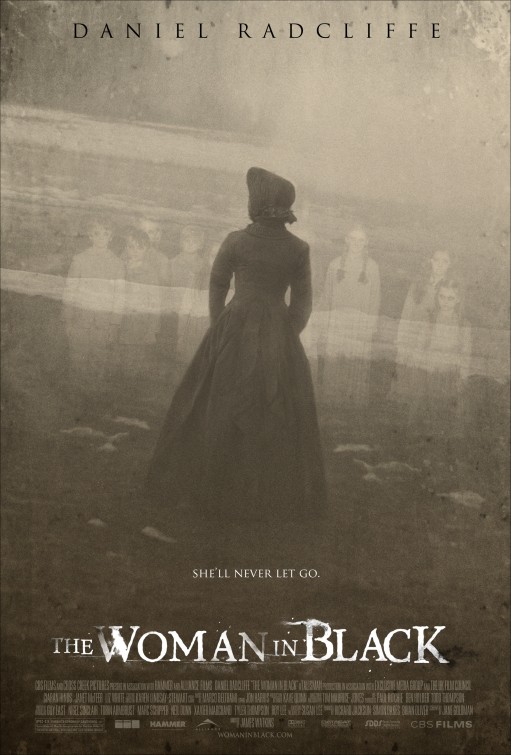 It’s got a decent ending but it’s a long, lumbering walk to get there. This handsomely mounted Hammer throwback involves Harry Potter himself, Daniel Radcliffe, slowly walking through a spooky old Victorian haunted house. And he slowly peeks around a door. And he slowly holds a candle. And I slowly go to sleep. There’s a 40-minute sequence where I swear only two things are spoken. Radcliffe plays a widowed father who has to investigate a haunted house to make ends meet. The movie has a few genuinely creepy moments, mostly owing to set design, but it gets hooked on jump scares and doesn’t know how to quit. The jump scares, accompanied by what sounds like an eagle screeching as music, happen at near two-minute intervals, like some sort of alarm the movie can’t turn off. Alas, The Woman in Black is a pretty staid ghost story where once again a restless spirit is terrorizing others and somebody takes it upon themselves to help that spirit find closure. The plot is so transparently predictable that it becomes fairly frustrating when the movie takes so long to get to its pre-designated stops. The pessimistic ending is weirdly given the most positive spin imaginable. For fans of this horror sub-genre, there may be enough going on to entertain. I just keep learning that ghosts are never grateful and satisfied even when you help them. Ghosts are jerks.
Nate’s Grade: C
Share this:

Chronicle (2012)
 I’ve learned a valuable lesson when it comes to genre movies – do not trust the marketing department of 20th Century Fox. Every promotional clip, trailer, TV spot, even the notion that people were flying around in cities as an attempt at viral marketing, it all coalesced into making me turn up my nose at Chronicle. It just looked like a bad movie. Then the critical reception was rather glowing and I took a chance, pleasantly surprised by the skill and execution of the flick. What made this thought-process notable was that it was almost an exact repeat of what I went through with Rise of the Planet of the Apes. Every piece of promotion stoked my disinterest into outright loathing, and then after the positive press I saw the movie, begrudgingly, and was floored. I guess when it comes to future 20th Century Fox genre releases, I’ll try and figure out my reaction and then turn that upside down. If a movie looks like utter crap, then under this new value system it must be good. I’m sure my new cinematic equation will prove me wrong as soon as the latest Eddie Murphy family vehicle terrorizes theaters (“This fall, Eddie Murphy is… The Governor. And his political opponent? His wife! Also played by Eddie Murphy”). In short, the marketing department at 20th Century Fox sucks but Chronicle does not.
Chronicle is the chronicle (heh) of three high-school friends who contract telekinetic powers. Andrew (Dane DeHaan) is a social outcast, determined to videotape his life as a means of escape from his ailing mother, his violent, alcoholic father (Michael Kelly), and the torment of school bullies. His cousin, Matt (Alex Russell), is trying to read up on philosophy to impress Casey (Ashley Hinshaw), a blogger/amateur documentary filmmaker. He’s more than some dumb jock. Steve (Michael B. Jordan) is the popular athlete planning to run for political office one day. The three guys discover what looks to be an alien craft underground. After coming into physical contact, the guys discover they suddenly have the ability to control objects with their minds. They test out their new powers in small ways at first, stopping speeding balls, assembling Legos. Matt insists they establish some system of rules to ensure they use their new powers for good. Andrew chafes at the idea of holding back, especially since he is by far the most powerful member of the group and eager to settle a few scores.
 Just as the found footage motif is starting to get old along comes a movie that makes creative and clever use of the narrative structure. Documenting one’s life, including the endless trivialities, has become normal habit for a younger generation accustomed to Twitter-style instantaneous information dissemination. Given that Andrew is abused and harassed, it makes sense for his character to use his camera as a means of security physical and emotional: the promise of being recorded should at least keep some of the bullying and physical abuse at bay, and it also provides a barrier for him and the real world, letting him stand outside himself. As John Malkovich said in Shadow of the Vampire, “If it isn’t in the frame, then it doesn’t exist.” This is one of the few found footage films where I didn’t feel constrained by the limitations of its concept. I suppose it helps when your main characters have super powers and can fly into the sky for a game of pigskin. The climactic battle is plenty thrilling but also subtly ingenuitous, as we cut back from various camera footage to piece together our super smackdown; we jump from security cameras, police dashboard cams, helicopter cameras, to even personal video cameras of people doing what people do… document the strange and unusual (I’m just curious who assembled the footage, though I have my theories).
The key to Chronicle’s success is that it’s a well-written, character-based piece that just so happens to morph into a superhero cautionary tale. Andrew has a pretty hard life and it’s easy to see why this insecure, neurotic, and angry young man takes his new-found gifts as a cosmic opportunity for retribution. In a way, Chronicle is like an all-male version of Carrie for the digital age; incidentally, Andrew was set to perform in a school talent show and I was cringing, saying to myself, “Oh no, here comes the Carrie moment.” He’s a tragic figure and you feel for the kid, which gives him a little more leeway when he starts to veer to the dark side. Until the very end, you can follow Andrew’s motivation for every action, so when he dresses up in his father’s firefighter outfit to shake down the neighborhood bullies, you can justify it to yourself, saying, “Well, he’s desperate and needs to pay for him mother’s super expensive medication. Oh, and those guys had it coming. Jerk.” The power of empathy is a mighty one, and writer Max Landis (son of director John Landis) takes a measured amount of time to connect everything back to the character. The best compliment I can give Landis is that nothing feels out of place. The characters behave in a relatively believable manner, the action intensifies at a natural incline, and the characters manage to have some brainy, existential debates about power and responsibility in between typical teenage pranks/antics (it’s only natural that teen boys would somehow use telekinesis to improve their sex life). Sure these characters aren’t terribly deep and the multitude of Andrew’s misery heaped upon misery almost seems ridiculous. In another universe, perhaps Andrew uses his powers to lash out at his tormentors at school, though that approach would questionably glamorize school shootings. However, by the time the big action hits, we’re emotionally invested in the characters and have watched Andrew’s long fuse finally blow.
The special effects are even more impressive given the low budget and the found footage gimmick. The camera makes some nifty telekinetic moves, floating around and giving the film a bigger space to play within. The flying effects are pretty convincing, especially when one of our guys ends up tumbling back to Earth in one tense sequence. Whether it’s floating Pringles or cars crushed inside out, the effects are smooth and well integrated, and any noticeable lack of polish just fits in with the fuzzy nature of our video recording as lone record of the events. There’s a notable solution for sub-par special effects in movies: blame the nature of the movie (Uwe Boll, that suggestion is free of charge).
 But the best special effect is young actor DeHaan (HBO’s first-rate show, In Treatment). Looking eerily like a young Leonardo DiCaprio, the guy manages to channel pent-up rage, frustration, and helplessness in a way that doesn’t feel histrionic or twerpy. His character is the point of view for our tale given that it is Andrew’s camera after all; we’re mostly locked into his perspective. Good thing that the character is interesting enough and so well played by DeHaan that I didn’t feel stuck with a loser. He reacts like most teenagers would react when bullied and harassed, trying to be aloof and ambivalent but only able to hide the pain and resentment for so long. When Andrew does start to give in to the allure of his powers, DeHaan seems practically seduced by his sense of superiority. There’s a dangerous look in his eyes that turns on that cues the audience for trouble to come. Russell is an amiable actor even if his character is bland and somewhat inconsistent as a foil to Andrew. Jordan (TV’s Friday Night Lights) is a charming guy who finds the right balance of exuberance and sarcasm with his character. Together, the threesome of guys has a winning chemistry and character dynamic. When they’re getting along and the good times are rolling, you feel part of the gang.
Being a super hero has become a dominant male fantasy as of late in the movies, so it’s invigorating to see a movie that puts a fresh spin on what seems ad infinitum. Chronicle is something of a small wonder, bringing new life to the found footage concept, making smart use of its narrative confines rather than chained by its limitations. The story is just as involving from a character standpoint as much as its sci-fi genre elements and superhero wish fulfillment. Landis and debut director Josh Trank are talents that I have no doubt Hollywood will snatch up. They’ve given the super hero genre a necessary human element, too often lost in the splashes of action and merchandising. Along with its engaging character-work, Chronicle also happens to be a clever action movie with some soaring thrills. Ignore the shoddy marketing and take a chance on Chronicle.
Nate’s Grade: B+
Share this:

Fast Five (2011)
 The fifth movie in the gearhead Fast and the Furious series unapologetically eschews logic and physics to deliver an energetic, over-the-top, stupidly entertaining action movie. This thing’s got swagger to spare. Credit Justin Lin, director of the last three films in the series, who has a tremendous knack for orchestrating mass chaos into eye-catching sequences. The plot is practically inconsequential but involves Vin Diesel and his team planning an Ocean’s 11 style heist against an evil Rio de Janeiro crime lord. Diesel, that black hole of charisma, sticks to what he’s good at: grunts and glares. It was a smart move to introduce The Rock as a dogged DEA agent. His added brashness and command of cool gives the series a boost in star power. The final act of this film is an exceptional chase sequence where Diesel’s crew drags a large bank vault through the streets of Rio, destroying just about every car in sight. The stunt work is phenomenal and the special effects feel seamless, never ripping the viewer out of this hyperactive, preposterous reality. Sure, it can get bogged down in its teenage horndog worship of hot cars and hot gals (Rio is in no short supply of physically ample women), but Fast Five delivers in spades when it comes to junky popcorn thrills. I can’t believe I’d ever write these words, but I’m actually looking forward to more Fast and the Furious hijinks. Just as long as Lin and The Rock return.
Nate’s Grade: B+
Share this:

A Dangerous Method (2011)
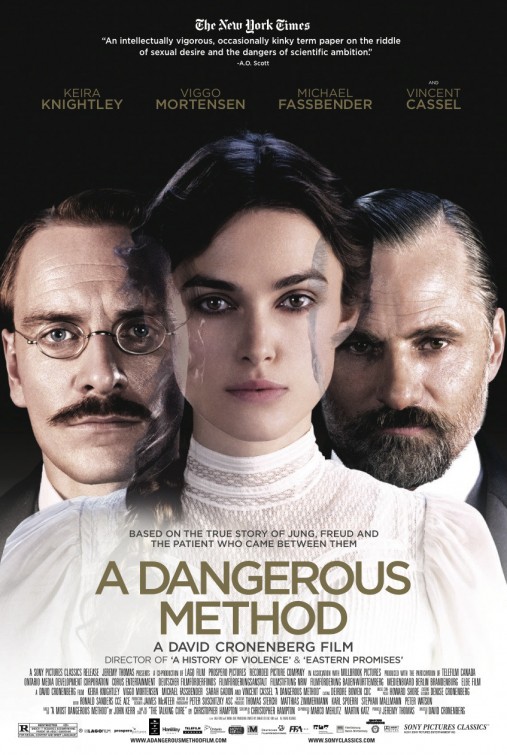 At first glance, the movie seems like an odd fit for director David Cronenberg, that is until you realize that, as Freud himself might approve, the entire movie is bubbling with sexual repression and kink. The movie showcases the friendship between the two titans of psychoanalysis, Sigmund Freud (Viggo Mortensen) and Carl Jung (Michael Fassbender), and the strange patient (Keira Knightley) who brought them together and tore them apart. This is a very intimate chamber drama, confined to lots of men in suits talking in great detail about psychology and philosophy and desire (there are three separate scenes of dream decoding and lots of letter correspondence voice over). Knightley is superb as a hysterical patient torn apart by her socially inappropriate desires. It may be a tic-heavy performance but my God can the woman act. She’s like a feral beast at points. The majority of the film follows Jung’s affair with Knightley and his friction with the single-minded Freud, who incidentally is never without a cigar clenched between his teeth. Jung wants to expand their field of study to include paranormal activities; Freud wanted to stay within the realms of science to give their movement credibility. Cronenberg’s period drama can be a bit too sedate at times given its aberrant sexuality. You don’t really empathize with either Freud or Jung, and thus the drama is a robust and intellectually stimulating exercise but only an exercise. For people who do not share an interest in psychoanalysis, they’re in for a long slog. A Dangerous Method is a rather short film, only 99 minutes, and would have benefited from being a bit more dangerous with its subdued subject matter.
Nate’s Grade: B+
Share this:

Safe House (2012)
 Safe House is an an action movie that has some nice above-average action sequences strung together by a very sub-average plot. Tobin (Denzel Washington) is a rogue CIA agent being hunted down by shadowy forces. Or is he? A young agent (Ryan Reynolds) was responsible for the safe house in Cape Town that was breached and now takes it upon himself to bring Tobin in for the agency. Or does he? If you’ve seen any spy thriller in the last few years then you’ll recognize the glut of clichés and be able to ably predict the traitorous higher-ups using the economy of characters. Here’s a clue to the villains of the picture: don’t keep all your villainous deeds together on one computer file (and don’t label it “All Our Evil Deeds,” try instead, “Vacation Photos.”). Washington and Reynolds are appealing actors even in ho-hum parts. Washington never seems as devilish or as clever as his character is billed to be. While the plot is bland, director Daniel Espinosa (Easy Money) knows how to shoot some thrilling action sequences. The style is a bit of a Bourne rehash, what with the jangly camera angles, but the movie has a surprising level of verisimilitude; when two guys fight it really feels like a couple guys beating the crap out of each other. The chase sequences are well staged and find smart ways to make use of its South Africa location, like a chase through the levels of a soccer arena or a race atop the rooftops of shanty homes. It’s when the movie stops to catch its breath and the plot reemerges that Safe House becomes a snoozer.
Nate’s Grade: C+
Share this:

In the Name of the King 2: Two Worlds (2011)
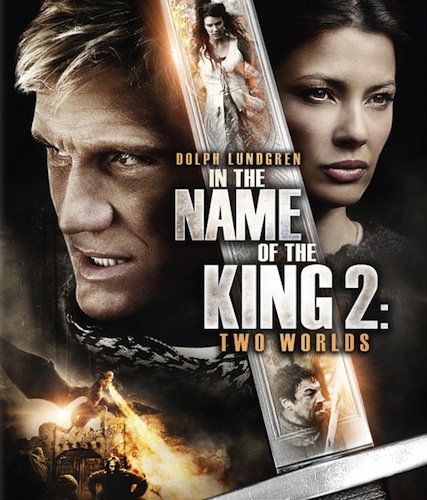 In the Name of the King 2: Two Worlds has a tenuous at best connection to the original 2008 In the Name of the King, noted as the most star-studded Uwe Boll film and the last Boll film to get a theatrical release. I think that highest-profile belly flop, and the revision of the German tax code loopholes, is what banished Boll to the little league of direct-to-DVD movies. I suppose the movie does involve things happening in the name of a king, but that’s being overly generous. There’s barely a mention of Jason Statham’s (The Transporter) character from the first flick, a commoner who arose to become king and who was slain by an enemy that is pathetic and embarrassing. The only meaningful connection lies in the title and the prospect of Boll trying to draft attention to his sequel off the momentum of his pitiful predecessor.
Granger (Dolph Lungren) is a former Special Forces soldier who has retired and runs a karate studio for kids now. Then one day he stumbles upon a mysterious woman being chased by ninjas (Vancouver’s ninja crime rate has skyrocketed since 2008). A portal to another world is opened and Granger gets sucked back to a feudal kingdom. The King (Lochlyn Munro) has awaited for a special visitor who would restore balance to the kingdom, drive away the Dark Lords. The prophecy says that Granger is their man. He’s a little skeptical and even turns down the services of a concubine, though still accepts a little cuddling. Manhatten (Natassia Malthe) is the king’s medic of sorts and accompanies Granger on his journey to defeat the evil sorceress and save the Kingdom of Whatever.
 After having viewed 19 different Boll movies, all to certain degrees of willingness, I can safely say that this is the most boring of the bunch, and hopefully those words will still have meaning. The plot never really evolves further than its premise, another rehash of A Connecticut Yankee in King Arthur’s Court, or to genre fans, a rip-off of Army of Darkness, or to idiots, a rip-off of Black Knight. Granger goes back in time, bumps around some rather stock characters, gets told about prophecies and destiny, and then there’s a fight and a dragon and a jump back to Earth and we’re done. In between is very little to care about. This is the first movie I’ve seen that feels completely constructed as one long saggy middle. Just about every scene takes place in the forests of Vancouver (I mean… whatever the hell the other world is called). It gets repetitious very quickly, never seizing on the fish-out-of-water comedic possibilities or just giving in completely to the genre elements of a medieval sword and sorcery flick. It’s all just irritating blather; a “chosen one” here, a “dark one” there, something something “prophecy.” When people badmouth fantasy, they think of this kind of stuff. I kid you not at one point Malthe’s character says, “You are the villain of this tale” to the said villain. Thanks for clarification, but the third act betrayal was telegraphed well over an hour ago.
The writer, Michael Nachoff, has written exactly one other movie, Bloodrayne 3, and served previously as an office coordinator, post-production assistant, and in material serving. That last one sounds like a made-up job or some kind of finessing that a prostitute would put to make her resume sound more professional. Whatever the case, Nachoff has shown that after two movies he cannot be counted on to deliver anything resembling a competent plot. This is the laziest more yawn-inducing hero’s journey I’ve ever witnessed. The movie literally put me to sleep. There are all sorts of dropped setups and subplots, including the notion that Granger must complete three trials, though we only ever get one. That’s bad sooth-saying, but then again the seer gets murdered so I can’t imagine she was first in her class at prescience. Nachoff keeps using the phrase “time travel,” and so do I, but I think what they really mean is dimensional travel. I’m fairly certain that Granger is not just from the future but an altogether different world. Yet at one point a character says, “Your fear will carry you to the pits of hell.” Ah, I see that Christian missionaries must have visited this alternate dimension. Oh well, the character also seem to keep erroneously saying “biological weapon” when clearly the bad guy assembled it out of various powders and chemicals. They even refer to his skill as alchemy, which of course is all about biology, right?
The action is mirthless and hastily thrown together, often becoming incomprehensible because the villains, the Dark Lords, wear dark cloaks and our heroes too wear dark clothes. Good luck deciphering who’s who on the battlefield. Maybe you’ll be like me and just become crippled by apathy. Granger isn’t a very compelling hero either. Under Nachoff’s compliant attention, he is strictly stock: 1) he is retired, 2) he helps kids, 3) he has a past that haunts him, 4) he drinks to cope, 5) he is entirely boring. If you’re going to go fish-out-of-water, at least have your guy be funny. Granger’s quips just seem too surreal even given the nature of the movie. After killing a baddie and sampling his stew: “Underdone.” On entering the Black Forest: “Given the name, bigger is probably better,” and brings a larger broad sword. Oh boy. Nobody’s gonna miss you, are they?
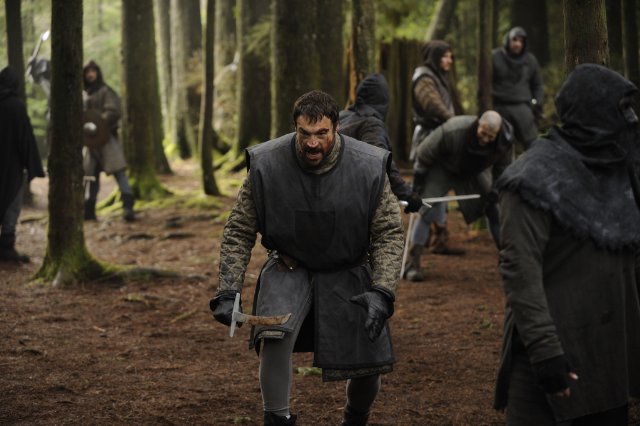 The production seems to be taking a cue from Lungren (The Expendables), who is unfazed from beginning to end despite some strange goings-ons. The man just sleepwalks through the whole film, cracking wise in the same somnambulant tone. It’s like Lungren swallowed an entire bottle of Quaaludes. Lungren isn’t exactly the most charismatic or expressive actor on the planet given that he’s made a living being tall and beating up smaller men, but I would have hoped for some life in the guy. He’s so straight-laced that it’s absurd. It drains any potential interest from the character, sapping our time-traveling hero of empathy. Who cares if he can’t be bothered to care? Malthe (Bloodrayne: The Third Reich) is just as uninspiring as his sidekick. She’s just so impassive, probably because she doesn’t get to wear a corset in this Boll movie to highlight her assets. Letting her speak medieval vernacular and syntax was a mistake. Usually actors can at least adequately hide their displeasure about their participation in a lousy movie. Either these actors aren’t even good at that or they just don’t care, take your pick.
And now it’s time for my regular reoccurring segment in a Boll film review – who got ripped off this time? Allow me room to pontificate. The concept of a fantasy world mixed with some adult themes, like strong bloody violence, nudity, sex, profanity, and darker themes, would lead me to believe that Boll was inspired by HBO’s hit fantasy reinvention series, Game of Thrones. Then again Boll shot this movie in December 2010, a full four months before Thrones’ aired its excellent pilot episode. Then again who’s to say that Thrones didn’t influence Boll during the editing stage or at least make him itchy for some reshoots to tart up this tedious movie. At least that would give the viewer something worthwhile to look at besides an oft-used castle exterior that LARP-ers would howl at.
In the Name of the King 2: Two Worlds just reeks of lethargy and indifference. Devoid of interesting characters, an engaging story, even tasty genre elements, this low-budget fantasy flick would falter in comparison to the cheesiest Sci-Fi Channel original movie. I cannot overstate how boring this movie is. I’m struggling even to effectively communicate how monotonous this movie is; I’m tempted to just write “boring” a thousand times but you, dear reader, deserve better. And so I rack my brain to come up with more specific and sarcastic criticism of what is execrably an awful movie. Boll’s no stranger to awful movies, but In the Name of the King 2 is the first time where I felt like even he didn’t give a damn about his final product in any shape. And it shows.
Nate’s Grade: C-


You must be logged in to post a comment.