Blog Archives
Emilia Perez (2024)

Movie musicals can be sweeping, invigorating, and at their very best transporting, They mingle the high-flying fantasies and visual potential of the cinema, and we’ve gone through many waves of kinds of musicals. Today, we’re in an outlandish world of the outlandish musical, an experience in ironic air 210quotes, where stories that you never would have thought could be musicals would then dare to be different and attempt to be musicals. The much-anticipated Joker sequel, Folie a Deux, dares to be a challenging jukebox musical of old favorites. The French movie Emilia Perez tells the story of a cartel leader that undergoes a sex change and tries to do good with her second life. Both movies are deeply interesting messes as well as experiences I don’t think work as musicals.
In contrast, Netflix’s Emilia Perez is like an entire season of a telenovela streamlined into a two-hour-plus movie that manages to also, for better or worse, be a musical. It is filled with many outlandish and provocative elements you would never expect to be associated with singing and dancing, like a sex change surgery center. This movie mixes so many genres and tones that at one point it feels like you’re watching a crime thriller about Mexican cartels and their manipulation of those in power, and then the next moment it feels like you’re watching an absurd rendition of Mrs. Doubtfire, where a spouse has adopted a new identity and uses this to spend time with their kids they otherwise would not be able to do so. It’s a wild film-going experience; I can’t recall too many musicals that use street stabbings in syncopation with percussion. Because of its go-for-broke ambitions and veering tones, Emilia Perez is destined to be a cult movie, some that fall in love with its bizarre mishmash of elements, but most will probably be stupefied by the entire experience and questioning why, exactly, this was made into a musical.

In Mexico City, Rita Castro (Zoe Saldana) is a savvy defense lawyer tired of living in the shadows of her buffoonish bosses that rely upon her writing prowess to win cases. Someone sees great potential with her, and it happens to be Manitas del Monte (Karla Sofia Gascon), the head of a dangerous cartel. He wants Rita to find the international means to finish the process of Manitas surgically becoming a woman. Under the gun, metaphorically and literally, Rita finds the doctors who will transform the dangerous him into a new her. Manitas then fakes their death, leaving his old life behind to start anew, including their children and wife, Jessi (Selena Gomez). Manitas becomes the titular Emila Perez, but rather retire in luxury, she wants to do good, and Emilia begins a non-profit organization that exhumes bodies, victims from the cartels, to provide closure for their widows and grieving families. Emilia then invites Jessi and their kids to come live in her estate, explaining she is a formerly unknown “aunt” to Manitas. Now Rita is trying to run Emilia’s organization, keeps Emilia from going too far in revealing her identity, and looking out for her own sake considering she’s one of the few that knows about a life before Emila Perez.
I know there will be hand-wringing and cultural tut-tut-ing about the movie’s implicit and explicit themes dealing with trans issues, exploring one woman’s exploration of self and securing the identity she’s always wanted through the lens of a lurid soap opera trading in stereotypes. It’s a lot of movie to digest, and while it feels entirely sincere in every one of its strange creative decisions, it’s also the kind of movie whose tone can invite snickers or derision, like the sex change clinic where a heavily bandaged chorus repeats words like, “vagioplastia” and “penoplastia.” It’s a movie with extreme feelings to go along with its extreme plot turns, but the whole movie feels like it’s trying to settle on a better calibrated wavelength of melodrama.

I think this could have been significantly improved by director/co-writer Jacques Audiard (Rust and Bone, A Prophet) had he embraced more of the movie’s outlandish reality breaking through. Too few of the musical numbers actually do something more than witness someone singing. The opening number, one of the best, involves Rita trying to compose a defense through the streets of Mexico City, while a crowd sweeps around her, often stopping to chime in as an impromptu chorus, sometimes setting up props for her use. It’s a great kickoff, the energy crackling, and I was looking forward to what the rest of the movie could offer. There’s only one other musical number that recreates this significant energy and engagement, a fundraising dinner for Emilia’s organization amongst the powerful members of society. While Emilia speaks at a podium, Rita struts around the floor, sashaying between the tables, and informing the audience about all the dirty deeds and skeletons of the assembled muckety-mucks. She’s literally manhandling the frozen participants, dancing atop their tables in defiance, and it’s a magnificent moment because of how it breaks from our reality to lean into the storytelling potential of musicals. These sequences work so well that it’s flabbergasting that Audiard has, essentially, settled for far less creatively for too much of his movie’s staging. The big Selena Gomez song is just her listlessly singing to the camera while shifting her weight while standing, like the laziest music video of her career. Why tease the audience with the crazy heights as a musical if you’re unwilling?
And now let’s tackle the music, which to my ears was too often rather underwhelming.It sounds like temp music that was intended to be replaced and never was. It’s lacking distinct personality, catchy or memorable melodies, anthems and themes, the things that make musicals enjoyable. The best songs also happen to be the best staged sequences, both involving Rita. These songs have a different vivacious energy by incorporating a hip-hop style of syncopation. “El Mar,” the song during the fundraising dinner, offers an infectious chorus adding extra percussive elements like people slamming fists down onto tables, listening to plates and glasses rattle. These are the moments that enliven a musical and convey its style and panache. Alas, too many of the songs lack that vitality, and can best be described as blandly competent and too readily forgettable.

It’s a shame because Saldana is giving her finest screen performance to date (to be fair, I never watched her Nina Simone biopic). The actress best known for being the strong warrior in sci-fi franchises like Avatar, Guardians of the Galaxy, and Star Trek plays an intriguing character with a rising fire of purpose and paranoia. Early on. Rita is ambitious but unhappy, practically dowdy in appearance, and she begins to come alive under her new role for Emilia. Saldana is electric as she sings and dances and slips effortlessly between Spanish and English, possibly to her first Oscar nomination. She’s the standout, which is slightly strange considering the role of Emilia Perez should be the breakout. Gascon, a trans actress, is quite good in such an outsized role, and gets to play her pre-transitioned identity as well under gobs of masculine makeup and tattoos. The fault isn’t with Gascon’s performance, the issue is that her character has such amazing potential but feels criminally underdeveloped. There is a world of issues of self-identity, culture, repression, shame, anger, jealousy, desire, to name but a few, that could be richly explored from the perspective of the leader of a deadly gang wanting to become a woman. The character is left too inscrutable for my tastes, leaving behind so much unobserved drama. As a result, even though the movie is literally named after her, Emilia Perez feels like a projection more than a character, and if that was indeed the point, then we needed more conflict about that friction.
Emilia Perez is a lot of things all at once; campy, ridiculous, sincere, crazy. It’s messy but it’s an admirably ambitious mess, one that even the faults can be the unexpected charms for someone else. I didn’t fall in love with this genre-bending experiment, although I found portions to be fascinating and others to be confounding. I don’t even think the musical aspects were finely integrated and explored, and so they feel like more of a gimmick, a splashy attempt to marry the high-art of musical theater with the perceived lower-art of grisly crime thrillers and melodrama. It earns marks for daring but the execution is haphazard and scattershot at best. There are moments that elevate the material, where the musical elements feel confidently integrated and supported with the dramatic sequence of events, providing an unexpected and rousing response. However, those moments are few and far between, and the absence only further cements what could have been. Emilia Perez might be your worst movie of the year, a grave miscalculation in tone and storytelling, or it might be a transporting and wild experience, one that can lock up multiple Academy Award combinations for its artistic bravura, a middle-aged Frenchman telling the story of trans empowerment through the guise of a Spanish-speaking musical framework. It sounds like so much and yet paradoxically I was left disappointed that it wasn’t more.
Nate’s Grade: C+
Share this:

Guardians of the Galaxy vol. 3 (2023)
 It’s taken me longer to review the third, and reportedly final, installment of the Guardians of the Galaxy trilogy because I didn’t think that I nor my family had the emotional bandwidth when the movie was originally released to herald the summer. I’ve been a big fan of writer/director James Gunn’s comic book escapade efforts with the Marvel Cinematic Universe (MCU), as well as his first DC entry, 2021’s The Suicide Squad, the best DC film of the new era, so I’ve been highly anticipating a third Gaurdians ever since the second ended six years ago. Of course all fans have had to wait a little longer after Disney fired Gunn in 2019 for offensive social media posts they already knew about before the first Guardians film in 2014, and then they came to their senses and re-hired one of the most unique voices working within their giant sandbox of superheroes. The reason I decided to wait even longer is because I had been warned by many of my critical colleagues about the heavy thematic nature of the third entry, namely the frequent sequences of animal abuse. My family had to put down their household dog of over ten years in late April, and having to re-open that wound by watching pretend animals get abused was not the best for any of our emotional states. And so I waited until it was available on digital and in the comfortable sanctity of my home, and I alone in my family watched Volume Three, partly as a harbinger of future warning over what scenes to skip over for them. It’s a fitting end to a strange and funky series of movies that taught us to feel real emotions over racoons and trees, and even though I’d rate this as last in its respective Guardians standing, it’s still a winner and a topical reminder that these big-budget blockbusters are only ever as good as when the passion is evident.
The Guardians are on a mission to save their friend, Rocket (voiced by Bradley Cooper). He’s been incapacitated and is sought after by his creator, The High Evolutionary (Chukwudi Iwuji), a maniacal man with a god complex who is trying to create a perfect life form. This forces the Guardians to learn more about Rocket’s tragic past as a cruel science experiment, and it brings back Gomorrah (Zoe Saldana), though she’s not the same woman who fell in love with Peter Quill (Christ Pratt), and he’s having a hard time reconciling the different green girls. They’ll have to work together to rescue Rocket and stop the High Evolutionary from further harm.
 This is a movie built around the back-story and emotional connections of Rocket, a character that, prior to Gunn’s first film, had fewer than a dozen comic appearances but has had an outsized influence over the movies. If the first movie was about the formation of our team, and the second was deepening the supporting characters, as well as exploring Quill’s daddy issues, then the last movie is all about how we say goodbye to the ones we love. Volume Three is clearly structured like Gunn’s fond farewell for these characters rather than merely a pause in their contractually obligated appearances (whether Marvel overrules Gunn is another matter). It makes the interaction more meaningful and also more emotionally rich, not just because certain characters might perish, but because of the journey we’ve been privileged to hop along for, how far they’ve come and how much they matter to others, and by extension us, the audience.
Case in point: the emotional evolution of Rocket Racoon. He began as a surly visual joke, a teeny mammal with a big gun and a big attitude. It wasn’t until a drunken outburst in Volume One that you got a glimpse of the trauma and pain beneath that antisocial demeanor. With Volume Three, he gets sidelined pretty early, which means the majority of the time we spend with Rocket is through a series of flashbacks with baby Rocket and his cute pals, all ongoing science experiments (one needs only to recognize the absence of these childhood friends as grown-ups to anticipate where this is inevitably heading). In some ways, it is cheap and manipulative. It’s not hard to make an audience feel extreme emotions by introducing a slew of adorable animals as well as a villain who hurts them and sees them as expendable experiments undeserving of sympathy. I wish Gunn hadn’t gone so hard in this direction because it feels excessive in the ideas that the film bluntly communicates. Yes, a storyteller will need time to establish a baseline of relationships, conflicts, and looming change, but do we need six or seven flashbacks to settle the concept of animal testing and animal cruelty being a bad thing? I credit Gunn with making his thematic intent unambiguous; this is wrong, and you will feel it explicitly. However, sidelining Rocket for a majority of the movie and having characters project onto his unconscious body, while providing more insight through a system of excessive and heavy-handed flashbacks, might not be the best model for ensuring this character gets his due when it comes to this showcase. Quill keeps calling Rocket his “best friend” and I’m trying to remember when this happened. I re-watched Volume Two this summer, and now consider it the best of the trilogy, and I cannot recall the specific events that bonded these two bickering alphas into inter-species BFFs.
 Another facet of Gunn’s relevant themes is personified in the romantic realizations of Quill. Not to get too complicated, the current Gomorrah is a past version of herself and not the one who joined the Guardians, fell in love with Quill, and died in Infinity War. She’s back, but from her perspective she never left, and this moon-eyed dolt keeps projecting his feelings onto her. I respect that Gunn doesn’t try and wave away this complication, nor does he mitigate the agency and importance of this Gomorrah not having to follow the same path as her predecessor. The easy thing would have been for Quill to wait and for this new/old Gamorrah to see the same qualities that made the old/dead Gomorrah fall in love. It would be like one of those soapy romances where a person suffers amnesia and gets to fall in love with their spouse all over again. Gunn doesn’t do that. These are different people, and despite the aching desire of Quill to rekindle what he had, it has been lost, and this needs to be acknowledged and accepted. “I bet we were fun,” she says, and it’s a bittersweet summation that extends beyond the Guardians.
There is still Gunn’s signature sense of style and humor while checking the boxes of a big-screen action blockbuster. There’s an infiltration set piece that plays like a goofier Mission: Impossible setup but in a squishy bio-mechanical facility that reminded me of the eccentric and schlocky sci-fi diversions personified in the Lexx movies and TV series. There’s an entire planet of animal-human hybrids that feels wasted as further proof of the High Evolutionary’s already established evil. The entire character of Adam Warlock (a beefed up Will Poulter) is a himbo that definitely feels lacking in larger purpose now that the Infinity Era is over. There is one signature action scene involving a protracted fight through a crowded hallway, and it’s exciting and fun. The jokes are mostly contained to sardonic banter, which can be hilarious depending upon the combination of characters, though it also can be grating when it feels forced, like Mantis (Pom Klementieff) and Nebula (Karen Gillan) butting heads. The celebrated dad rock soundtrack has moved onto 90s and early 2000s music, and as a 90s kid, it gave me a personal nostalgic lift watching scenes jamming to dreamy whoo-hoo alt-rock acts like Radiohead and Spacehog and The Flaming Lips.
 This also might be the grossest MCU movie yet, and not just from the animal abuse but a face-peeling scene that will startle most. I had to pause the screen and drag my 12-year-old stepdaughter into the room with the promise, “Want to see the grossest thing ever in a Marvel movie?” She agreed that it was indeed that. It’s reassuring that no matter the budget, Gunn’s sensibilities that make him the unique storyteller he is, the same man who began with Troma, will be there. Though this point also concerns several of my friends wondering if Gunn can abandon these silly and schlocky tendencies to tell an earnest and tonally appropriate tale for his 2025 Superman reboot.
Guardians of the Galaxy volume 3 is the end of an era for Gunn and for the MCU. As the new head of the DC film and TV universe, it’s unlikely he’ll be lending his talents to Marvel any time soon, although the characters he made us fall in love with could carry on. Gunn clearly loves these characters, and especially identifies with Rocket, the angry malcontent lashing out in pain, so it’s fitting to give this character the big stage for a final outing, and if he can throw in some animal cruelty messaging along with silly humor and pathos, then so be it. This practically feels like Marvel is giving Gunn even more leeway as an apology for firing him. The Guardians trilogy stands out from the prolific MCU assembly because of how much Gunn has personalized these movies to make them special. They have permission to be weird, to be heartfelt, and to be reflections of their idiosyncratic creator, a much more benevolent force than the High Evolutionary. Perhaps there’s even a parallel to be drawn there, a filmmaker trying to endlessly tinker with their creation in the futile pursuit of perfecting it whereas the imperfections and rough edges are often the lasting appeal of a movie. I don’t know if the MCU will contain a series quite like this again, and that adds to the feeling of this serving as a farewell. It was a fun, messy, ridiculous ride, and it was all Gunn.
Nate’s Grade: B
Share this:

Avatar: The Way of Water (2022)
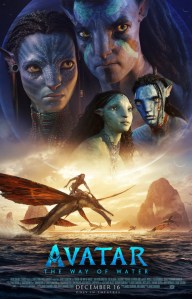 In the 13 ensuing years since James Cameron’s smash hit Avatar, we’ve debated whether or not the collective consciousness has simply moved on and forgotten what was, at one point, the highest-grossing movie of all time. What cultural dent had it made? Are there really still fans? Was it a fad of the new 3-D, itself already dissipated? Does anyone really want three or four sequels? Then Avatar: The Way of Water was released in late 2022 and it didn’t do as well as its mighty predecessor. Instead of being the highest-grossing movie ever, it’s only the third highest-grossing movie ever with a paltry $2.3 billion worldwide (how can the man even sleep at night?). It’s a lot of the same, both in its big feelings, awe-inducing visuals, and its resurrection of characters, scenarios, and conflicts of before, so you’ll likely find yourself reliving your own 2009 Avatar reaction.
Cameron’s long-awaited follow-up returns to the alien word of Pandora where our Marine-turned-Na’vi Jake Sully (Sam Worthington) has raised a large blended family with his Na’vi partner, Neytiri (Zoe Saldana, given little to do but cry this time). The first hour of this three-hour blockbuster is establishing the family dynamic with the different kids, including adopted daughter who is… somehow… the daughter of the deceased scientist Grace (both Sigourney Weaver) as well as the human child nicknamed Spider who is the biological son of Quaritch (Stephen Lang), our deceased villain. Nobody seems to stay dead in this series as Quaritch concocted his own backup plan in case of his untimely demise. He transferred his consciousness into a tank-born avatar, and this new Na’vi Quaritch has his own team of Marines in blue-skinned Na’vi bodies. They’re heading back to Pandora for some out-of-body vengeance, and thanks to their genetics, they seem to get a pass from the natural environment of Pandora mistaking them as native.
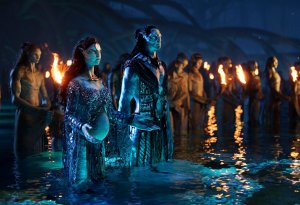 There’s a lot of set up here, and the second hour introduces us to the coastal community, and it becomes another formula of the outsiders learning the rules and culture of the new setting and integrating, turning enemies into friends, gaining honor, etc. It’s within this second hour that the big environmental message coalesces around whaling, with one Sully son bonding with an alien whale Free Willy-style. There’s a whole hunt sequence that poaches a mother and her calf that’s quite upsetting. The parallels are obvious but subtlety is not exactly one of the storytelling options in the Avatar universe. This is a broad canvas in the biggest sense, so every message will be spelled out very finely and underlined, with character voicing obvious themes and villains practically twirling space mustaches. And that’s okay. The final hour is an action-packed showdown bringing all the characters to account and forcing Jake to face off once again with his old commander.
The visual immersion is outstanding and the real reason to sit still during all three hours of Way of Water. The Oscar-winning visual effects are transcendent, and the extended sequences underwater really captivate and achieve the sense of natural awe Cameron aspires for. It is an exceedingly pretty movie to watch, and the level of high-definition detail is astounding. There’s a tangible realism here even when it’s entirely gangly CGI characters. At no point does it feel like an empty green screen stage or an over-exposed cartoon. The world of Pandora is still interesting and worth exploring, and the coastal aliens with their evolutionary differences makes me excited to explore other corners and communities of this alien world. The story works, and the payoffs work, and each of the Sully kids has a moment to shine, though I kept confusing the two older brothers (where did one of these kids learn to say “bro” every other word?). It’s a bit strange to see and hear Weaver in a preteen alien’s body, but that disconnect is part of the point, as the character feels like a foreigner searching for meaning. Considering the decade-plus delay, the huge scope, and setting up potentially three other movies, I’m impressed that Way of Water even works as well as it does as a sequel. I was able to re-acclimate pretty easily in that first hour.
 It’s not revolutionary storytelling but not every movie need be. It follows a familiar formula but puts in the work to make the action meaningful and connected to character and for the emotional beats to resonate. I thought the upside-down sinking military vessel had some striking, terrifying Poseidon Adventure-esque visuals, and the sequence was rooted in the family trying to save one another. With so many moving pieces and characters, the plot can be overburdened and redundant at times (the Sully kids get kidnapped so often they might as well save time and tie themselves up early) but even at three hours it doesn’t feel slow or wasteful. There is a sense of repetition in bringing back so many of the same faces, like literally rehashing the same villains. I wish more consideration was given to the new Quaritch and his own existential journey of the self. Just because you have the brain of this dead evil guy, do you have to follow in his doomed path? That could have been a really intriguing and profound character journey, the cloned Marines bred to be weapons who decide their own identities. That could have sufficed as the entire movie for me. The messages are heavy-handed but effective, though Pandora already had a natural resource that Earth wanted to exploit so I didn’t think we needed a second natural resource that essentially functions as immortality juice. At this point, will the third movie introduce ANOTHER magical resource that cures cancer? Likewise, I hope the next movie doesn’t find us yet another Quaritch (a twin brother!) looking for further score-settling. The ending sets up a larger confrontation with Earth’s corporate elite that will come about with the ensuing sequels, though I would have thought since Way of Water makes a big leap forward in time that Earth’s powerful forces would have already marshaled their unhappy response to being kicked out in the original movie.
Cameron has an innate blockbuster sensibility and storytelling structure; the man just knows how to tell rousing big screen adventures like few others. I didn’t see Way of Water in theaters but I won’t make the same mistake with the many Avatar sequels that will dominates the 2020s. It’s a bit hokey though deeply sincere, and Cameron proves yet again that he should not be doubted on big stages of his own creation. It might take the domestic gross of a small country to make these sci-fi epics of his, but the man delivers like few in the rarefied field of dependable blockbuster artists. There’s going to be an Avatar sequel every two years, so this universe won’t go extinct anytime soon, and I’ll be there waiting too.
Nate’s Grade: B
Share this:

Amsterdam (2022)

It’s been seven long years since writer/director David O. Russell made a movie. He was prolific from 2010-2015, making four movies, which were nominated for a slew of Oscars, especially in multiple acting categories. Three were also nominated for Best Picture and Russell was nominated for Best Director three times as well. It was quite a vaunted run of mainstream and critical success, with devoted actors like Christian Bale and Jennifer Lawrence eager to sign up for Russell’s quirky ensembles (it helps when both won Oscars playing Russell roles).
It’s natural to want to take some time off after such a busy creative period, but as the years stretched on, and after the Me Too accountability movement, Russell’s on and off-set behavior gathered more scrutiny and rebuke. His volatility had been known, like his screaming fit he had on the 2004 I Heart Huckabees set with Lily Tomlin. Even George Clooney recounts stepping up to Russell’s bully behavior on the set of 1999’s Three Kings (rumor has it Clooney was the one who released the Huckabees footage). On 2013’s American Hustle, Amy Adams said she cried repeatedly from Russell’s bullying and felt intimidated and isolated. Then there were the renewed revelations from Russell’s own niece who had been transitioning and accused Russell of inappropriate touching when it came to her changing body. Russell even admits to this, though he defends his actions by saying he was given tacit permission, or so he says. With all of this controversy and harassment swirling around Russell, it’s a wonder who would want to continue working with this kind of person. I guess as long as he was producing at his peak level, studio execs would excuse his bad behavior and keep funding his ballooning budgets. Well Amsterdam might just be the end of Russell’s star-studded big studio ride.
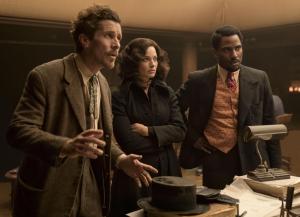
In 1933 New York, Burt Berendsen (Bale) is a WW1 veteran making ends meet as a doctor who specializes in veteran care. He and his best friend Harold Woodman (John David Washington) are framed for a murder and on the run, and the only way to clear their good names is to uncover a conspiracy that leads to a possible government coup. Helping the fellas out is Valerie Voze (Margot Robbie), a nurse who makes art from the shrapnel she recovers from inside war vets, and a wealthy socialite who also happens to be in love with Harold. Together, the three friends bumble their way through danger and mystery and crazy mishaps.
This is a mess of a movie, a waste of its top talent, and an excess of Russell’s excesses. The director has established a certain style since 2012’s Silver Linings Playbook, a movie I still to this day genuinely love (it was my top movie for that year). It’s a style that communicates mania, a nervous energy, and it made sense for Silver Linings Playbook as the movie was following a bipolar protagonist given to uncompromising bouts of mania. It makes less sense with each additional movie, but this improv-heavy, experimental, loose sensibility has become the default style for the director, and it feels misapplied. It leads to Russell bombarding his actors with questions or different requests in the moment, keeping them guessing, and actors have gone forward saying they never knew what they were shooting on the day and the shooting never stopped. This indulgence leads to stories that feel like a lot of elements are sloppily thrown together with the undying hope that somehow it will all come together in the end. With Amsterdam, it doesn’t.
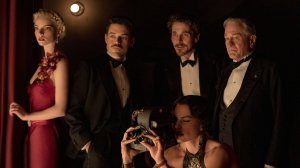
It’s not a great sign when I can say that the entire first hour could be jettisoned. There’s little sense of urgency for far too long, and what is presented feels almost comically unrelated, like even Russell can’t believe his silly characters are in real danger. The uneven pacing creates many dead spaces that feel like an awkward improv detour that you wish could have been avoided. We’re introduced to Bert as a drug addict, and then as a World War One veteran helping other veterans with facial scars and wounds, Bert’s relationship with his pal Harold, then their history in France during the war, then their introduction to Valerie and their kinship, then we have a mysterious death that also leads to a secondary love interest, which requires more setting up of the first love interest and her disapproving family, and then we get police investigating and warning about the first death and then a second murder, this time blamed on our characters, and they’re off to clear their names by… reuniting with Valerie and then bumbling through more characters before, finally the movie presents what it’s actually about well after a full hour-to-80 minutes of movie. It is exhausting and feels like a meandering alternative story that was clumsily grafted onto the Business Plot of 1933. The first half of the movie feels like a slipshod screwball comedy, and then once the particulars of a fascist conspiracy to overthrow the president are introduced, it’s like watching Looney Tunes characters try and foil Adolf Hitler. It just does not tonally work.
The Business Plot is a lesser known event in history, glossed over by the fact that the chief perpetrators more or less got away with their insurrectionist planning. They never did succeed in overthrowing FDR and installing their puppet, but they also did not get prosecuted in the end and most of the media dismissed the scheme as hogwash. It’s undetermined how advanced this plot eventually got but a coup was discussed by a consortium of business leaders. It feels like Russell is applying what he learned from 2013’s American Hustle, which introduced a crazy group of fictional criminals and then, in its last hour, explored the real Abscam criminal sting of the 1980s. I can see themes that Russell thinks are still prescient today, like a dark element desiring to overthrow the U.S. government because it didn’t get its way, as well as the collusion of big business in political king-making, seeking shells that will do what their benefactors demand. The problem is the themes behind this scheme are too serious for Russell’s trifling antics. Think about retelling the insurrection on January 6th but for the first hour it’s two bumbling bank robbers who keep finding themselves in the worst possible situations, ending at the U.S. Capitol. If you’re going to treat the rise of fascism, assisted by corporate overlords, as a serious threat, and something relevant for today, then maybe don’t have most of the movie be wacky nonsense.
Russell’s past films have often glided on energy and in-character authenticity, but this one feels so grasping and desperate. When the master plan to reveal the conspiracy and its shadowy participants is throwing together a big veteran’s show, I was reminded of the movies of young Mickey Rooney and Judy Garland where the solution to any dilemma was to put on a show. Then at one point the literal Nazis are singing loudly in German and are being confronted by our characters and the good patriotic Americans counter by singing “America (My Country ‘Tis of Thee)” and I had to stop the movie and just let out a deep sigh. I think Russell was going for the famous reference in Casablanca, also against Nazis, but it just flounders into unintentional comedy, accentuated by the antsy energy that treats it like camp. There are a couple of spots that I laughed out loud, though I doubt that was the intended response, like watching Taylor Swift abruptly run over by a car. The attempts at actual humor are winding and often lead to little, and the characters feel like more of a collection of quirks than firmly established personalities and perspectives to anchor a movie. What does Bert having a false eye add besides something for Bale to fidget with? What does Chris Rock have to do here? What does Anya Taylor-Joy have to do here? Most egregiously, what does John David Washington have to do here? It feels like Russell just wanted a character for Bert to talk to. The screenplay is overstuffed and polluted with all these minor and underwritten characters that could have been better consolidated.

I suppose you can still have fun with Amsterdam and engage with it on a light-hearted level, smiling as you watch the many big stars having a good time messing around with accents, props, and wacky character traits and tics, like a bunch of kids with a dresser of costumes (maybe it is a throwback to those corny Rooney/Garland kids pictures after all). With other Russell movies, I’ve felt invigorated by the energy and artistry, encouraged to sit a little closer and be more attentive of the character turns, and dig into the actors making three-course meals of their roles. With Amsterdam, I felt the desperation to recreate the success of old patterns but the creeping realization that it wasn’t going to materialize. It’s just a big mess of a movie, not without interesting ideas or moments or good acting, but too much feels resoundingly and frustratingly frivolous. You could ditch entire characters, entire subplots, even entire hours of this movie. Amsterdam cost Disney/Fox $80 million dollars, the biggest of Russell’s career, and only earned a pittance, so I think there is a retraction in due order. Begin with not watching Amsterdam yourself.
Nate’s Grade: C
Share this:

The Adam Project (2022)
 Watching the trailer for Netflix’s The Adam Project, I wasn’t too impressed. It felt like a combination of familiar and popular movies like Back to the Future, E.T., and Looper. It seemed like another assembly of popular sci-fi movie tropes and I wasn’t expecting much else. Then as I watched the movie, I realized how enjoyable and engaging this original story by writer T.S. Nowlin was and what must have attracted Tom Cruise to want to star and produce this project in 2012. It met a long developmental hell, as is common in the industry, before being given a second life at Netflix with Ryan Reynolds as star and director Shawn Levy (Free Guy). It kind of muffs the action and sci-fi spectacle, but The Adam Project is a movie that’s big where it counts.
Adam (Reynolds) is a pilot in 2050 who is fighting against a corporate evil that uses time travel to enshrine its power. Adam’s own wife (Zoe Saldana) crash landed in 2018. In desperation, he travels back in time to find her and team up against their future foes, except he lands not in 2018 but in 2022, and he meets his younger, twelve-year-old self (Walker Scobell). It so happens that Adam’s ship is marked to respond only to his DNA, so he needs his younger self to help while he recovers from his injuries. Unfortunately, the future is antsy to eliminate Adam and sends killer super soldiers and missile-launching spaceships. Both Adams come to the conclusion the only way to prevail is to stop the initial first steps of the invention of time travel, meaning going back further to see their departed father, Louis Reed (Mark Ruffalo), the inadvertent creator of time travel.
 Where The Adam Project really shines is with its core ideas and relationships, which is the emotional heart of a movie. It’s peculiar because we’re so used to seeing the other half, the sci-fi action spectacle, prioritized at the expense of story and characterization. Usually a studio puts much more emphasis on a movie looking good, or at least passably entertaining, and less on the substance that would make it meaningfully so. Credit to the filmmakers that they understood what the core appeal of this movie was and that is the idea of characters out of time getting a chance to interact, learn, and reconcile. Who among us wouldn’t want another opportunity to talk with a loved one before they are gone? Who among us would not be hesitant to eliminate the special confluence of events that lead a special someone into our life? The idea of two different aged versions of one character butting heads is inherently fun but also meaningful, because every one of their squabbles or disagreements is telling from a character standpoint. We’re learning about the differences between these two versions and two different timelines. The older Adam is resentful of his younger self, of his naivety, and looking to toughen him up or settle some scores he thinks will be cathartic. The younger version resents his older self for being so domineering, for being so cynical, and for pushing him into uncomfortable situations to relieve long-standing grudges that he hasn’t dwelled over yet. It also allows older Adam to remember things that he has forgotten from the perspective of his younger self. The buddy banter is capable and spry but it’s also revelatory about the characters, which makes every interaction more important.
Adam’s father doesn’t come back until the second half of the film, and then the movie transforms into a real family affair and takes on extra pathos. Dear old dad is the square pushing back against the ethical implications of knowingly participating with time travel. Here we have three different characters, all related, but each has a different perspective and competing goals: Younger Adam wants to beat the bad guys but also is freshest in his grief over his dad and wants to save him; Older Adam wants to rescue his wife but also has a score to settle with his departed father; and Dad gets a chance to see his grown son, something he will never otherwise witness, but is adamant about refusing to help and prosper from time travel foreknowledge shenanigans. That’s a good combination of conflicts and personality differences, and through the relatable lens of broken relationships repairing between two sons and their father, it elevates each routine action moment later.
 My other surprise was how mundane the action plays in The Adam Project. I started to notice how the action was usually pretty small-scale with only a handful of future soldiers fighting in relatively open and empty spaces. The big future addition is an electrified baton that older Adam utilizes, as younger Adam gushes, much like a lightsaber. It has the power to propel enemies in a force blast that launches out in a circumference, but I kept questioning why Adam wasn’t knocked over by this force as well? It’s a cool device but little else is utilized to separate the past and future. When the characters murder people, they vanish in fiery clouds, free of blood, and we’re told this is what happens when a person is killed outside their timeline. I think it was meant to make the audience forget the mechanics or downplay that all these vanishing soldiers are actually being murdered from existence. The younger versions of these characters are still present but it’s not like there’s another version that will take their place. Their lives ended in this moment as they traveled back in time to this final fate. No do-overs for them. The finale of The Adam Project is a mess of bad CGI and a world-destroying machine; both it and the plot are on apocalyptic autopilot at this point. The preceding movie was much better to simply fall victim to such a dumb climax. It’s not enough to dent the positives that came before it, but the movie succumbs to the pressures of big blockbuster silliness it had avoided.
Here is a vehicle that makes perfect use of the charms of its leading man. Reynolds (Free Guy) has always been a charismatic performer, a fast-talking rogue you can’t help but fall for, but not every movie role allows him to play to his strengths, Sometimes he’s just on quip overload and can come across like the overly ironic, insincere, vacuous version of his motormouth persona. His glib demeanor has a way of eating him whole. Here, the actor gets to essentially be playing off himself, and it works so much better. Reynolds is also a natural with kids (see 2008’s Definitely, Maybe) and there’s an inherent big brother/little brother vibe to the Adam interactions that makes them heartwarming while also amusing. Newcomer Scobell is able to hold his own with Reynolds, no small feat. He has a vibrant, excitable energy that feels youthful without getting into annoying Anakin “yippee” Skywalker territory. Reynolds may be the star but you’ll enjoy spending time with young Adam too, and this is also a credit to Scobell and his performance. Ruffalo and Jennifer Garner (a welcomed 13 Going on 30 reunion) are enjoyable if extremely under utilized; each could have had a whole movie from their vantage point.
 The Adam Project is an action movie that looks like typical pandering studio junk at first glance but gets the hard stuff right, namely the reasons why you should care about any of the flying bodies, explosions, and world-ending CGI. It’s about the characters, and here we have a dynamic that keeps things interesting and fun while also making the dilemma personable and emotional. The same stakes given to saving the world are also given to having one more conversation with a departed father or with trying to get things right in your past while time is still ahead of you. The Adam Project might be overlooked or discounted because of how its parts appear to be generic and stale, but it’s the care with which they are assembled that won me over. I’m just amazed that, for once, a Hollywood big-budget tentpole release emphasized the right stuff.
Nate’s Grade: B
Share this:

Crossroads (2002) [Review Re-View]
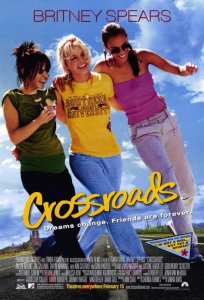 Originally released February 15, 2002:
When informed that her feature film debut was receiving shrieks of laughter during advanced screenings for critics, Britney Spears said she was glad because she never likes the same films the critics do. Well Ms. Not That Innocent, the truth hurts; you’re not a girl, not yet an actress. Crossroads is really the filmic adventures of Britney Spears and her ever-present navel. The navel should get second billing, but alas, we do not live in a society of equality for navels.
The film opens up with three 10-year-old best friends burying a box of wishes and dreams and promising to be bestest friends forever and ever. They make a pact to come back and dig up the box on the night of their high school graduation. Flash to the present and the word “bestest” isn’t what it used to be. Lucy (Britney Spears) has become the virginal nerd preparing to give her speech as valedictorian. Kit (Zoe Saldana) has become the haughty popular snob, obsessed over getting married ever since she got her first Bridal Barbie. Mimi (Taryn Manning) is pregnant and become the trailer trash girl that everyone sees fit to remind her of. Despite their growth apart they all do come together to reopen their box of dreams. Mimi informs the others that she plans to head to California to audition for a record deal in an open contest. Kit decides to use this opportunity to check up on her boyfriend at UCLA who has been strangely evasive. Lucy complains that by having her nose in a book her entire high school experience she never got to go to a football game or even “hang out.” Somewhere a small violin is playing. She decides to jump at this chance and possibly see her mother in Arizona, who ran out on Lucy and her father (Dan Akroyd) when she was only three. The wheels of their adventure are provided by guitar-playing mystery Ben (Anson Mount). He pilots them on their travels to the Pacific coast, though the girls think he might have killed someone, but oh well.
 Crossroads is filled to the brim with every imaginable road trip cliché. The girls “open up” after getting drunk, have a scuffle in a bar, reap in the sights of nature, and perhaps create some sparks of romance with their hunky heartthrob of a driver. The car also inevitably breaks down and the girls have to find a way to scrape some quick cash together. They enter in a karaoke contest and Britney proceeds to sing Joan Jett’s “I Love Rock and Roll” with her two gal pals providing backup. But no, this isn’t the last time you’ll hear Ms. Brit sing. In an effort to pad as well as become a showcase for its star, Crossroads gives us many scenes of the girls just singing to the radio. Besides Jett, Shania Twain’s “Man I Feel Like a Woman” and Sheryl Crow’s “If It Makes You Happy” are also on the chopping block. You’ll also be accosted by the movie’s single “Not a Girl, Not Yet a Woman” several times, including one scene where Poet Britney is asked to share her poem and it ends up being the song’s lyrics.
Saldana (Center Stage) is not given much, as the attention is always centered on Britney, so she merely comes off like a token conceited character. Only Taryn Manning (crazy/beautiful) comes away with a little dignity. She gives Mimi a lot more heart than should be there and shows some honest reflections for her character. She also, coincidentally enough, looks like a dead ringer for Joan Jett with her black bangs.
Crossroads is nothing but a star vanity project for Spears, with some not-so-subliminal Pepsi product placement here and there. This was not a script looking for a lead; this was something Britney’s management team suited for her, and Crossroads is perfectly suited for Britney. It allows for many ogling periods of booty shaking. The majority of the film’s drama doesn’t even concern her, and when she does have to act, her scenes are cut short to help her when the real drama unfolds. The movie’s true intentions are revealed when Britney is shown in her pink underwear twice in the first 15 minutes.
 Crossroads moves along on gratuitous skin shots of Spears half-naked body every 20 minutes until it reaches its torture chamber of a final act. In this very melodramatic period we get abandonment, date rape, infidelity, and even a miscarriage in one of the film’s most shameless plot devices. Of course none of these horrors matter, especially a psychologically damaging miscarriage, because Britney has to get to her BIG audition in order to perform, yep you guessed it, “I’m Not a Girl, Not Yet a Woman.” She also has to wear what looks like kitchen drapes while she sings.
You’ll walk out of the theater wondering many things. Why does Britney wear pink in EVERY single scene she’s in? There’s even one scene where she changes from a pink top to another pink top and is FOLDING a third pink top into a suitcase. Are we to believe that Akroyd and Spears share some kind of genetics? In what high school would Britney be considered a nerd?
Hopefully Crossroads will be the pop princess’ last foray into film, but I strongly doubt this is the last we’ve seen of Britney Spears. Crossroads is a terrible girl-power trip. Only Spears’ target demographic will enjoy this melodramatic mess. Truly, the two largest groups that will see this film are adolescent girls and creepy older men who fawn after adolescent girls. Crossroads is exactly everything you’d expect.
Nate’s Grade: F
——————————————————
WRITER REFLECTIONS 20 YEARS LATER

I’ve been waiting for this mea culpa for twenty years. In 2002, I saw Britney Spears’ movie debut, Crossroads, opening weekend with some friends with the chief purpose of seeing how bad it would be and tearing it to shreds for my collegiate newspaper. I graded it an F and sharpened my knives to eviscerate the star vanity project and everything it supposedly represented, eventually declaring it the worst film of 2002. Many years later, I have to wonder just exactly what was I so upset about with a middling road trip drama? What made this movie more deserving of a critical take-down than any other movie of that year? Had Spears not been its star, I doubt I would have expelled as much vitriol. So then the big question becomes, what did Britney Spears do to deserve so much ire from the 19-year-old version of myself? After some further reflection, I think I have some answers, and I’m glad I’ve had some significant growing up since then. I think it comes down to a personal animus blinding me as a critic, and this is something I’ve tried to push through and shed as I’ve gotten older and hopefully more experienced at evaluating art.
Flashback to the mid-to-late 1990s, and it was a golden time for fans of alternative rock, such as myself, bands that were cutting edge, audacious, and reaping the commercial rewards as well. MTV was filled with bizarre and exciting music videos from eclectic artists that were given an elevated platform. I grew my sense of self through my burgeoning musical taste, enveloping myself in the sounds of the Smashing Pumpkins, Radiohead, Tori Amos, and many more. And then the pop infusion began in 1997 with Hanson and really exploded with the emergence of the boy band craze and young pop stars like Spears and Christina Aguilera and others. Suddenly the music I was accustomed to, the music that to me was built on artistic integrity and depth, was being pushed aside for music that felt shallow and inferior, driven by exploiting the clean-cut physical beauty of the performers as compensation for substance. My younger self felt irritated that the music I considered to be genuine and revelatory was supplanted by bubblegum pop ditties. In my sophomore year of high school, for a Canterbury Tales group assignment, I co-wrote an epic quest for a strange band of characters to go to a Hanson concert and kill the three mop-headed brothers (I also had the collective pre-teen audience rise up and retaliate, killing our band of heroes). Looking back, there’s nothing new about any of this. Music has gone through many spells where pretty pop stars have coasted because of their looks and sex appeal. For whatever reasons, it felt personable, like an attack, and that is such a misplaced assessment on the winds of popularity.
 I’ve tried to eliminate anything that feels like a personal attack from my film criticism, because at the end of the day it’s just a movie, and whether or not it works for me, and it may work for others, it’s still only a movie. It’s not like the filmmakers personally robbed me of anything other than my time, and as my friends will often chide me, I chose to watch these movies I knew would be almost certainly dubious entertainment options. I’ve re-read several past film reviews and winced as I found myself resorting to low blows or critiques about body appearance. My review of 2008’s The Hottie and the Nottie (for the record: not a good movie) was a glorified take-down of Paris Hilton and everything she supposedly represented, a prized vapidity. I deleted heavy portions of it, especially those shaming Hilton for her promiscuity. It made me ashamed. As I’ve grown, I’ve tried to focus solely on the art and story of each movie. If the performance was weak, it’s just a reflection of a bad performance and not a bad person deserving of some sort of misplaced score-settling by yet another angry random guy on the Internet.
That brings me back to the star of Crossroads, Britney Spears, who in the ensuing decades had the culture rally to her back as well as re-evaluate the treatment of the paparazzi-heavy targets of the 2000s. She was celebrated for her sexuality and demonized for it as well, again not exactly new in the realm of media. After so many years under the harsh scrutiny of the public spotlight, in 2007, Spears shaved her head, attacked a paparazzi car, and checked in for much-needed mental help, and in doing so essentially signed her life away for the next 14 years to her father, who had the final say over her finances and tour commitments and even whether or not Spears could have an IUD removed. She was finally released from her conservatorship after a groundswell of public support in 2021. She’s released many more albums, had a long-standing residency in Las Vegas, and has even talked about turning her struggle for agency into a big screen movie.
 Crossroads is an odd concoction because of how many people went on to have robust careers. Chief among them is the credited screenwriter Shonda Rhimes who would become one of the preeminent TV power producers of the twenty-first century with Grey’s Anatomy, Scandal, and Bridgerton. Fans of Rhimes’ adult soaps might find recognizable traces of her plotting with the overly melodramatic third act of Crossroads. This was also one of the earliest movies for Zoe Saldana, an integral part of THREE high-profile, highly successful sci-fi series, Avatar (where she has blue skin), Guardians of the Galaxy (where she has green skin), and the J.J. Abrams’ Star Trek (natural skin). She was also in the first Pirates of the Caribbean just a year after Crossroads. Then there’s Taryn Manning who found memorable parts in 8 Mile, Hustle and Flow, before redefining her career as the memorable, and dental-deficient, Pensatucky on Orange is the New Black. Anson Mount would later go on to prominence in TV series like Hell on Wheels and Star Trek Discovery (less so Marvel’s Inhumans). Apparently many of the other actors in Crossroads agreed to sign on just to meet Spears, like Dan Akroyd, Kim Catrall, and Justin Long. Even Mount was hesitant until the urging of none other than Robert DeNiro, who read lines with Mount from the Crossroads script during their downtime on 2002’s City by the Sea (DeNiro reed Britney’s lines, which makes me wonder what he could have done in the lead).
Reading back over my original 2002 review, I actually think most if not all the criticisms of the movie still land. The movie is rife with road trip cliches. The third act is indeed a torture chamber that really tilts the drama into overdrive, though smartly places the workload on the abilities of Saldana and Manning. There is definitely an unsettling preoccupation with Spears’ sexuality with the film. I wrote, “The movie’s true intentions are revealed when Britney is shown in her pink underwear twice in the first 15 minutes,” and I can’t disagree. It’s an uncomfortable watch at points, not because anything on screen is so salacious or ribald (Spears in fact insisted on her character’s use of profanity to be stricken to maintain her image) but because of what it thinks its audience wants. I suppose there were thousands of teenage girls looking to someone famous like Britney Spears for inspiration, and the lesson of waiting until you feel comfortable with a partner, and it’s your choice, is worthy, but the primacy emphasis on Spears’ body feels wrong.
My concluding line in my review was meant to summarize my stance, indicating that Crossroads is “exactly what you expect it to be,” and in 2002 I guess that meant the worst of the worst. In 2022, that just means a familiar, formulaic road trip movie with lots of melodrama. Yes, it’s a star vehicle for Spears’ acting career and there are many opportunities for singing, but that doesn’t make it any worse than any other mediocre drama aimed at a teenage demographic. And in 2022, I can say that I appreciate the pop music of the 90s. There were some real top-notch ear worms there and they still stand up to this day, easily hum-able when they reappear on radio. Spears and her ilk did not get the full credit they deserve during their reign. Crossroads is, to excuse a forced metaphor, a sort of crossroads for myself as a critic, something I’ve tried to improve upon as I got older. Movies are good and bad. Their intentions might even be noble or prurient or purely driven by money, but they’re still only movies and not personal attacks. I’m sorry Ms. Spears for unfairly maligning you, your acting ability, and your movie. Crossroads is easily not the worst movie of 2002. It’s merely mediocre at best and undeserving of antipathy.
Re-View Grade: C
Share this:

Avengers: Endgame (2019)
 This may prove to be the most difficult review I’ve ever written in my twenty years (!) of reviewing movies. How do I ever begin to describe the events of Marvel’s culminating blockbuster Avengers: Endgame without stepping too far into the dark and dangerous territory of the accursed spoilers? I thought it would be difficult talking about last year’s Infinity War considering the shocking plot events and general secrecy, but this concluding chapter to a 22-movie journey is even more secretive (the trailer accounts for only footage roughly from the first twenty minutes). I’ll do my best, dear reader, to give you the clearest impression I can of this unique experience while respecting your need to be un-spoiled. In short, Avengers: Endgame is unparalleled in our history of modern popular blockbusters because it needs to work as a clincher to a decade-plus of hugely popular blockbusters for the Marvel Cinematic Universe (MCU), and boy do they ever stick the landing.
The film picks up with our surviving Avengers picking up the pieces following the events of Infinity War, namely Thanos (Josh Brolin) eliminating half of life throughout the universe. The original six Avengers are all suffering through guilt, depression, and degrees of PTSD following their failure to defeat Thanos. Scott Lang a.k.a. Ant-Man (Paul Rudd) arrives after having spent time in the quantum realm and has a potential solution that will involve traveling through time to correct the mistakes of the past and bring everyone who vanished back to life. The remaining teammates assemble at the behest of Steve Rogers a.k.a. Captain America (Chris Evans), including Bruce Banner a.k.a. Hulk (Mark Ruffalo), Black Widow (Scarlet Johannson), Thor (Chris Hemsworth), Hawkeye (Jeremy Renner), Rocket Racoon (voiced by Bradley Cooper), Nebula (Karen Gillan), and War Machine (Don Cheadle). However Tony Stark a.k.a. Iron Man (Robert Downey Jr.) needs the most convincing, as he is most afraid of making things even worse and losing more people he feels are too precious to be casualties to their failures once again.
 The thing to know ahead of time is that Endgame is not for the casual fan. This is a long love letter to the fans that have pored over all 22 preceding films, not just a scant one or two. Infinity War was accessible to relative newcomers because of the structure and focus on Thanos as the main character, providing a self-contained arc that lead up to his finger-snapping triumph. It also benefited from the fun factor of simply watching a bunch of popular characters interact and team up for the first time in MCU history. Now that a majority of those characters have turned to dust, the emphasis falls back on the original core of the Avengers, bringing things full circle. In several ways, Endgame is about bringing to a close this mammoth project that began with Iron Man, this decade of storytelling ambition that has stretched out into multiple inter-connected franchises. If you love these characters, then Endgame is a movie made specifically for you. There is a long stretch in Act Two that relies upon a decent amount of fan service and sentimentality, but I don’t think either is an automatically negative attribute. Before we reach the finish line it’s important to take stock of how far we’ve come and this goes for the essential characters and their long arcs. There are several fun cameos strewn throughout and the filmmakers even take an interesting tack of trying to reclaim and re-contextualize the MCU movies that fewer people enjoyed. It makes for a filmgoing experience that is heavy in references, in-jokes, Easter eggs, and cozy nostalgia, which will confuse and frustrate those not well versed in this big world.
The other thing to know, especially if you’re a long-standing fan, is that there will be tears. Oh will there be tears. I lost count of the amount of times I was crying, which was pretty much on and off nonstop for the final twenty minutes. I was even tearing up for supporting characters that I didn’t know I had that kind of emotional attachment for. The film is done so well that the first third actually could play as the MCU equivalent of HBO’s The Leftovers, an undervalued and elegant series about the long-term recovery of those that remain in a post-rapture world. The opening scene involves a character having to go through the loss of loved ones via Thanos’ snap, and it’s brutal as we wait for what we know is coming, dread welling up in the pit of your stomach. The Russo brothers, the returning directing team from Infinity War, know what scenes to play for laughs (the line “That’s America’s ass” had me in stitches), what scenes to play for thrills, what scenes to play for fist-pumping cheers, and what scenes to play for gut-wrenching drama. They allow the movie to be an existential mood piece when it needs to be, actually dwelling on the repercussions of a life post-universe culling. There’s a character who frantically searches to see if a loved one was among the missing, and that eventual reunion had me in tears. With the three-hour running time, the Russos have the luxury of allowing scenes to naturally breathe. This might be the most human many of these characters have ever seemed, and it’s after recovery and grief. Needless to say, the conclusion feels very much fitting but also unabashedly emotional, unafraid of diving deep into its feelings. I sobbed.
 I was worried once the film introduced the time travel plot device that everything was simply going to be erased and invalidate the struggles that came before. The worst use of time travel is when it eliminates any urgency or danger, allowing an endless series of do-overs to correct the past. Fortunately, returning screenwriters Christopher Markus and Stephen McFeely (Civil War, Winter Soldier) realize that in order for there to be a reversal, a glint of a happy ending, there must be a cost or else it all meant little to nothing. There are finite events in the movie that cannot change (as of now) and losses that will be permanent (as of now, if they don’t want to cheapen the journey). People died with Infinity War but we all knew, at least when it came to its dreary conclusion, that it wasn’t going to be too long lasting, which allowed the communal grief to be short-lived. After all, there’s a new Spider-Man film coming down the pike two months from now, so it’s highly unlikely the teenage web-head will remain dead. However, with Endgame, the deaths serve as the cost for resurrecting the MCU, and they will be felt for years. The screenplay provides limitations to the time travel mechanics, though I don’t think the collective hand-wave to the nagging paradoxes was as successful as the movie thinks it was. The film barrels ahead, essentially telling you to forget about the paradoxes and enjoy the ride, focusing on the characters and remembering what is really important.
Suffice to say Downey Jr. is once again his charming, self-effacing, and enormously entertaining self. The MCU began with this man and his contributions cannot be overstated. He is the soul of this universe. Evans is compelling as the straight-laced inspirational figure who takes stock of what he’s sacrificed over the years, Hemsworth showcases a potent mixture of comedic and dramatic chops, Johannson is definitely the Avenger going through the “bargaining” phase to try and make things right and she has some subtle emotional moments that belie her desperation and guilt, and Renner makes a welcomed return in a way that made me appreciate Hawkeye like I never had before. Brie Larson does reappear as Captain Marvel but the movie smartly puts her back on the sidelines protecting the many other worlds in the universe needing assistance because of how overwhelmingly powerful she can become. Larson filmed her scenes for Endgame before her own solo movie, released a month prior, so forgive the different hair and makeup, Twitter nit-pickers. I will say there is one scene that is a bit convoluted how it gets there but is destined to make women in the audience cheer with excitement as the MCU says, “Hey, that whole ‘strong female character’ thing? Yeah, we’ve had all that for years, and here you go.”
 How does one properly assess a movie like Avengers: Endgame, a conclusion not just to an Infinity War cliffhanger but to a twenty-two movie prelude over the course of eleven years? The emotional investment in these characters, their journeys, has to come to something to be ultimately meaningful when it’s time to close the chapter on one massively ambitious story before starting the next. And there will be a next chapter; the MCU’s unparalleled financial success assures the fanbase they’ll have plenty more high-flying and wild adventures to come in the years, and more than likely, decades to come. Marvel had the unenviable task of wrapping up a major narrative in a way that would prove satisfying without devaluing the individual films and overall time investment. Hollywood is filled with trilogies that messed up their conclusions. Nailing the ending is just as important as getting things going right, because without a satisfying conclusion it can feel like that level of emotional investment was all for naught. Endgame reminds you how much you’ve grown to love these characters, what fun you’ve had, and genuinely how much you’ll miss these characters when they depart for good. It’s hard not to reflect upon your own passage of time with the ensuing eleven years, how you’ve changed and grown from the MCU’s humble beginnings in the summer of 2008. These heroes and anti-heroes can begin to feel like an extended family for many, and so fans desperately need the ending to do them justice. Avengers: Endgame is the ultimate fan experience.
Nate’s Grade: A
Share this:

Missing Link (2019)
 The stop-motion animation wizards at Laika have made some of the most charming and visually impressive movies of the last few years, including The Box Trolls, Kubo and the Two Strings, and ParaNorman. They’ve built up enough trust that I will see anything that they attach their name to. Missing Link is probably their least successful big screen effort yet, though that still means it’s only perfectly fine rather than great-to-amazing. It’s a heartfelt buddy comedy about a Bigfoot creature (voiced by Zach Galfianakis) that seeks out mentorship from a dashing adventurer (Hugh Jackman). It’s a sweet story but not fully emotionally engaging because the characters are fairly simplistic. There isn’t a lot of depth here and, surprisingly, more crass jokes aimed at a younger audience than their earlier output. From a visual standpoint, it’s beautiful with vibrant colors and fluid animation that has become indistinguishable from CGI nowadays. The action set pieces, usually appearing at a regular clip with each new location change, are fun and have their clever moments, like a capsizing ship that reminded me of the spinning Inception hallway. It’s an amusing, lower tier animated movie for Laika, but I’m worried that there might not be more of these movies the way they’re going at the box-office. Laika was treading financial water with excellent movies, and anything “less than” seems like it could possibly tip the independent animation production company over for good. Missing Link is a cute, mostly harmless, mostly entertaining movie that just doesn’t have the same ambitions and level of execution that previous Laika films have had. With that being said, it’s still worth a watch on the big screen for any animation aficionado.
Nate’s Grade: B
Share this:

Avengers: Infinity War (2018)
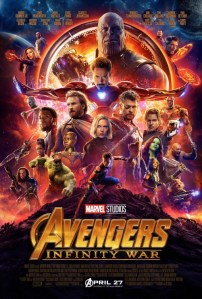 It’s hard to draw comparisons to the major commitment to long-form storytelling that the Marvel Cinematic Universe (MCU) has dabbled with over the course of ten record-shattering years of success. I can think of movie franchises that have been popular over long periods of time, like James Bond, but rarely do they keep to continuity. It’s been 18 movies and ten years since the caddish Robert Downey Jr. first stole our hearts in the original Iron Man, and its stable of heroes and villains has grown exponentially. Looking at the poster for Avengers: Infinity War, it’s hard to believe there’s even enough space just for all of the actors’ names. Infinity War feels like a massive, culminating years-in-the-making film event and it reminded me most of Peter Jackson’s concluding Lord of the Rings chapter, Return of the King. After so long, we’re privy to several separate story threads finally being braided as one and several dispirit characters finally coming together. This is a blockbuster a full decade in the making and it tends to feel overloaded and burdened with the responsibility of being everything to everyone. It’s an epic, entertaining, and enjoyable movie, but Infinity War can also leave you hanging.
Thanos (Josh Brolin) has finally come to collect the six infinity stones stashed around the universe. With their power, he will be able to achieve his ultimate goal of wiping out half of all life in the universe. Standing in his murderous way is a divided Avengers squad, with Tony Stark (Downey Jr.) still on the outs with a wanted-at-large Captain America (Chris Evans) and Black Widow (Scarlett Johansson). One of the in-demand infinity stones resides in the head of the Vision (Paul Bettany), who is in hiding with his romantic partner, Scarlet Witch (Elizabeth Olsen). They know Thanos will be coming for Vision eventually. On the other side are the Guardians of the Galaxy who have a few personal scores to settle with Thanos, the adopted father of Gomora (Zoe Saldana) and Nebula (Karen Gillan). Elsewhere, Thor (Chris Hemsworth) strikes out looking for the key to defeating the big purple menace. Thanos’ loyal lieutenants attack Earth to gather the remaining infinity stones, drawing the attention and push-back of Doctor Strange (Benedict Cumberbatch) and Peter Parker (Tom Holland). The various heroes of Earth and space unite to eliminate the greatest threat the universe has ever known.
 Avengers: Infinity War serves not as much a series of payoffs as it is climaxes, with climactic event right after another, and this time it’s for keeps (more on that below). There are moments that feel like major payoffs and moments that feel like shrug-worthy Last Jedi-style payoffs. Infinity War is the longest MCU movie yet at 149 minutes but it has no downtime. That’s because it has to find room for dozens of heroes across the cosmos. With the exception of three super heroes, everyone is in this movie, and I mean everyone. This is an overstuffed buffet of comic book spectacle, and whether it feels like overindulgence will be determined by the viewer’s prior investment with this cinematic universe. If this is your first trip to the MCU, I’d advise holding off until later. Any newcomer will be very lost. I’ve deduced the seven MCU movies that are the most essential to see to successfully comprehend the totality of the Infinity War dramatics, and they are Iron Man, The Avengers, Captain America: Winter Soldier, Guardians of the Galaxy, Captain America: Civil War, Doctor Strange, and Thor: Ragnarok. Naturally, being intimately familiar with the previous 18 movies will be best, but if you don’t have thirty hours to spare then please follow my seven-film lineup and you’ll be solid.
As far as the stakes, the MCU has been notoriously reluctant about killing off its characters, but Infinity War is completely different. I won’t spoil circumstances or names, of course, but the march of death happens shockingly early and carries on throughout. There are significant losses that will make fans equally gasp and cry. This is a summer blockbuster that leaves behind an impressive body count across the known universe and ends in a downbeat manner that will naturally trigger reflexive Empire Strikes Back comparisons. It’s hard to feel the full impact of the drastic decisions, and the grief over their losses because I know there is a Part Two coming summer 2019, and with that comes the almost certainty that several important events will be diminished or straight-out reversed. After all, in comics, nobody is ever really dead, though with movies the heroes have the nagging habit of aging. With that said, you better believe I was holding my breath during some standoffs, tearing up at some sudden goodbyes, and reflecting upon journeys shared.
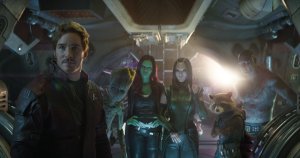 This is very much Thanos’ movie, which was one of the bigger surprises for me. Beforehand, our exposure to the big purple guy has been relatively minor, a brief moment here or a cameo there during a post-credit scene. Considering Thanos is supposed to be the universe’s biggest bad, it makes sense to finally give him his due, and that is what Infinity War does. Thanos gets the most screen time of any character and is given an honest-to-God character arc. He’s a villain who goes on an actual emotional journey as he follows a path that he feels compelled to even as it tests him personally. He finally opens up as a character rather than some malevolent force that is oft referred to in apocalyptic terms. We get his back-story and motivation, which is less a romantic appeal to Death like in the comics and more a prevention of the apocalypse reminiscent of the Reapers in the Mass Effect series. Thanos sees himself as a necessary corrective force and not as a villain. He’s never portrayed in a maniacal, gleeful sense of wickedness. Instead he seems to carry the heaviness of his mission and looks at the Avengers and other heroes sympathetically. He understands their struggle and defiance. Having an actor the caliber of Brolin (Deadpool 2) is a necessity to make this character work and effectively sell the emotions. Thanos is the most significant addition to the MCU appearing the latest, so there’s a lot of heavy lifting to do, and Infinity War fleshes him out as a worthy foe.
 As an action spectacle, however, Infinity War is good but not great. The action sequences are interesting enough but there’s nothing special and little development. There’s nothing that rivals the delirious nerdgasm of the airport battle in Civil War pitting hero-against-hero to dizzying degree. The characters are separated into units with their own goals leading to a final confrontation that feels more climactic conceptually than in execution. That’s because this is an Avengers film that falls into some of the trappings of the glut of super hero cinema, namely the army of faceless foot soldiers for easy slaughtering, the over exaggerated sense of scale of battle, the apocalyptic stakes that can feel a bit like a bell rung too many times, and even minor things like the lackluster supporting villains. Thanos’ team of lieutenants are all the same kind of sneering heavy with the exception of one, a sort of alien cleric heralding the honor of death from Thanos. Carrie Coon (HBO’s The Leftovers) is generally wasted providing the mo-cap for the Lady Lieutenant That Sounds Like a Band Fronted by Jared Leto, a.k.a. Proxima Midnight. There are far too many scenes where characters reluctantly strike a deal to give up an infinity stone if Thanos will spare the life of a beloved comrade. The film’s greatest point of entertainment isn’t with its action but the character dynamics. The fun is watching years-in-the-making character interactions and seeing the sparks fly. There’s more joy in watching Downey Jr. and Cumberbatch try and out smarm one another than with any CGI collision of a faceless army of monsters. There are so many characters that few are given fully defined arcs. Most are given beginnings and stopping places. Though the eventual sequel will have fewer characters needing to share precious screen time.
The standouts on screen are Hemsworth (12 Strong) carrying a large portion of the movie and not missing a beat of his well-honed comic rhythms from Ragnarok, Bettany (Solo) brings a sad soulfulness to Vision as a man who knows fate is likely unavoidable, and Dave Bautista (Blade Runner 2049) is perfectly deadpan as Drax and has the funniest lines in the movie followed closely by the exuberant Holland (Lost City of Z). To even say which characters deal with more complex emotions might be a spoiler in itself but there are several actors showing an emotive level unseen so far in the bustling MCU.
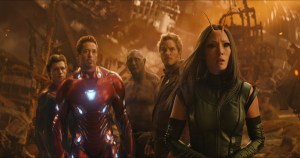 Avengers: Infinity War marks a significant concluding chapter for one of cinema’s most popular series, until at least the next movie possibly makes it feel less conclusive. I pity Marvel because expectations are going to be astronomical for this climactic showdown. There are so many characters, so many crossovers, and so much to still establish, like Thanos as a character more than a spooky force of annihilation, that it feels rather breathless even at nearly two-and-a-half hours. You may be feeling a rush of exhilaration on your way out or an equally compelling sense of exhaustion. Infinity War doesn’t have the imaginative highs of a Dcotor Strange, the funky personality and style of a Guardians of the Galaxy, the wonderfully thought-out structure of a Spider-Man: Homecoming, the adroit weirdness of a Thor: Ragnarok, or even the hero-against-hero catharsis of a Civil War (still my favorite). What it does have is a sense of long-gestating finality, of real stakes and dire consequences. It’s not all pervading doom and gloom; this is still a fun movie, buoyed by crackling character team-ups and interactions. While, Infinity War won’t be all things to all people, myself included, it will please many fans, casual and diehard alike.
Nate’s Grade: B
Share this:

Guardians of the Galaxy vol. 2 (2017)
 If Marvel was ever going to have a dud in its near historic run of blockbuster success, it should have been Guardians of the Galaxy, a movie that asked audiences to care about a talking raccoon and a tree creature who could only say three words. And yet that movie had me in tears by the end, and I was not alone. Writer/director James Gunn (Slither, Super) graduated from Troma to demented indie films to the Big Time with studio tentpoles. A sequel was fast-tracked and is definitely one of the most highly anticipated films of 2017 not named Star Wars. Can Gunn still deliver fans what they want without falling into the morass that is fan service, a sticky trap that can sap big-budget sequels of differentiation and make them feel more like product?
Set mere months after the events of the first film, the Guardians are enjoying their newfound celebrity and taking lucrative for-hire jobs. Star-Lord a.k.a. Peter Quill (Chris Pratt) and Gamora (Zoe Saldana) are still going through their will-they-won’t-they sexual tension. Gamora’s sister Nebula (Karen Gillan) is still looking to gain the upper hand. Baby Groot (voiced by Vin Diesel) is growing up and still cute. Drax (Dave Bautista) is still mourning his family and trying to better fit in. And Rocket (voiced by Bradley Cooper) is still making rebellious, self-destructive decisions, like stealing valuables from The Sovereign, a race of genetically bred golden snobs. The leader of the Sovereign, Ayesha (Elizabeth Debicki, looking good in gold), declares a bounty on the Guardians for their disrespect. The Ravagers are hired to collect the Guardians, though Captain Yondu (Michael Rooker) is hesitant to go after his surrogate son, Peter. Complicating matters further is the arrival of Ego (Kurt Russell), a mystifying man who happens to also be a living planet and Peter’s biological father.
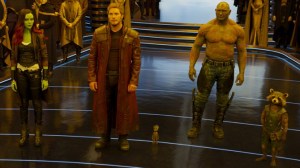 Guardians of the Galaxy vol. 2 is highly enjoyable with great moments, great action, and great characters but I was left feeling like it was a step or two behind the original and I’ve been trying to articulate just why that is. I thought perhaps it was better to be upfront. I think it all stems from the fact that it’s not as fresh the second time, it doesn’t quite have the same blast of attitude and personality to disarm and take you by surprise, and I’ll admit part of this is just due to the fact that it’s a sequel to a hugely popular movie. However, also because of this there are now a set of expectations that Gunn is leaning towards because audiences now have acute demands.
We have an idea of what a Guardians of the Galaxy movie can provide, and from those demands spur creative decisions that don’t fully feel as integrated this go-round as they did in the first film. It feels like Gunn is trying to also work within a box he’s created for himself, and for the most part he succeeds admirably, but it still feels slightly lesser. The standout musical moment occurs during an opening credits that involve an action sequence from a Baby Groot-eyed point of view. As the Guardians are flying and falling to destroy a ferocious alien blob in the background, Groot is strutting and dancing to “Mr. Blue Sky” by ELO. It’s a moment of unrestrained pleasure and it also undercuts action movie conventions by having a majority of the events obscured or implied. It’s the moment that feels the most like that electric feeling of discovery from the first film. There are also 80s pop-culture references and cameos and some off-kilter comedy again. Much of it is fun, especially one cameo in particular as it relates to Peter’s father, but they also have the noticeable feel of boxes to be checked, expected items that now must be incorporated in what a Guardians of the Galaxy feature should be. Expectations can lead to fan service and then that leads to less chances and originality. Hey, I loved the 2014 original and consider it my favorite Marvel movie so I don’t want them to simply chuck out everything that worked just for something one hundred percent different. You want what you loved but you don’t want it exactly the same, which is the creative bind. Gunn leans into what the audience wants and I can’t fault him too hard. It’s still a really good film.
 What Guardians vol. 2 does best is remind you why you love these characters. It even elevates a group of supporting players from the first movie into characters you genuinely care about, chiefly Nebula and Yondu. Both of these characters were slightly defanged antagonists in the first film, problems but problems you didn’t want to see go away. Yondu gets the biggest boost thanks to the thematic bridge of Peter’s search for his father. The notorious leader of the Ravagers has a definite soft spot for the scrappy human and it’s finally come to a head with his tempestuous crew. They mutiny on Yondu and declare him to be an unfit leader, unable to do what is necessary. This direction allows for a lot of introspection for a character that was essentially just Michael Rooker in blue paint. He has a history to him and he makes a moral deviation from his expected path, one that bears ongoing consequences. He’s Peter’s real surrogate father, and his acceptance of this reality brings a snarling secondary antagonist into the realm of a full-blown character that earns our empathy (a Mary Poppins joke also had me in stitches).
The same can be said for Nebula, who is working out some serious daddy issues. She is the stepsister to Gamora and holds quite a grudge against her green sibling. It seems that their father, Thanos, would constantly pit them against one another, and Nebula would always lose, and with each loss came a painful consequence. It’s the kind of back-story that’s given more time to breathe and develop. It opens up an antagonist into another person who is dealing with trauma and pain and who doesn’t play well with others, which seems as good a job description to join the Guardians as anything. Nebula has a fearsome sense of competition with her sister, and that parlays into some fun over-the-top action sequences. When the movie allows the two women to talk, as surviving sisters of rather than enemies, is where Nebula comes into her own.
Gunn makes sure there’s a grounded and emotional core to his characters, which makes these appealing underdogs and antiheroes ever easier to root for. Guardians vol. 2 doesn’t really move the overall plot forward too much but it does explore the relationships and their personal lives with greater depth and clarity. The characters are spread out into smaller pairings for a majority of the extended second act, which allows interesting connections and developments due to the personalities. Drax is paired with Ego’s assistant/pet Mantis (Pom Klementieff) and it’s an instantly winning couple, a man who only speaks literally and a woman who is able to channel the feelings of strangers through touch. They’re both relied upon for the greatest amount of comic relief and they routinely deliver. Klementieff (Old Boy) is a wide-eyed delight. Rocket and Yondu being stuck together allows for both to come to realizations that feel organic though also too fated by Gunn’s hand. Their general disregard for decorum leads to some great action sequences. Gamora and Nebula are working through their family issues and it makes both more interesting. When they come to a form of resolution it still feels awkward but earnest and right. But the biggest personal exploration is Peter and his own lingering space daddy issues.
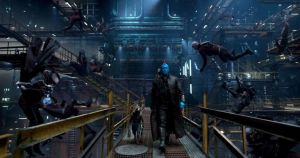 Another fantastic addition to the movie was the character of Ego because of the wonderfully charming Russell (The Hateful Eight) and also because of what the character allows for. The very fact that Ego is a millions-year-old living planet is a clever curveball for the Peter Quill “who’s your daddy?” mystery sweepstakes. It also opens all sorts of intriguing questions that the second act wades through, like the exact mechanics of how Ego exists, projects a Russell-looking avatar, and what is his ultimate purpose. I’m going to steer away from spoilers but fans of the comic will already have suspicions where this whole father/son reconciliation may lead, and you won’t be disappointed. Russell radiates paternal warmth and it goes a ways to cover up the purposeful obfuscation of the character. Because Gunn has to hold back on certain revelations, some of them gasp-worthy, he can’t open up the father/son dynamic too fast or too unambiguous. As a result, the latent bonding relies upon more familiar touchstones, like throwing the ball out back with your pops or sharing a love of music. Russell makes even the most ridiculous thing sound reasonable, which is important considering we’re talking about a planet boning ladies.
Gunn also takes several steps forward as a visual filmmaker with the sequel. He has a great feel for visual comedy and how to undercut the more boilerplate heroic moments in other superhero fair. He fills his screen with crazy, bight, psychedelic colors and has a Tarantino-esque instinct for marrying film with the right song. The sequel doesn’t have as many iconic moments set to music but it will play most agreeably. The special effects are pretty terrific all around but I appreciate that Gunn doesn’t allow the movie to feel overwhelmed by them, which is important considering there are fundamentally CGI-only characters. Gunn’s action sequences, chases, escapes, and breakouts are presented with plenty of dazzling style and witty attitude to spare without feeling obnoxious. The comedy is consistently funny and diverting. There’s a bit with the need for tape that just keeps going and actually becomes funnier the longer it goes, undercutting the end-of-the-universe stakes with the search for something as mundane as tape. My screening was presented in 3D and I was worried about the film being set in space and being too dark. This is not the case at all, and while the 3D isn’t a high selling point like it was for Doctor Strange, it is a nice experience that doesn’t dilute Gunn’s gonzo color scheme. The level of thought put into his novelties can be staggering, like an end credits series of dancing clips that also manages to play upon a character note for Drax. Gunn manages to further comment on characterization even during the freaking end credits. The final showdown goes on a bit longer than necessary and is the only section of the movie that feels consumed by CGI spectacle, but the fact that only the end feels this way can be considered another small triumph of Gunn fighting through a corporate system.
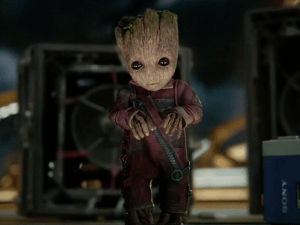 Marvel knows what it’s doing to a molecular level. Almost ten years into their system, they know what works in their criss-crossing franchises and how to calibrate them for maximum audience satisfaction. At this point after Guardians, Ant-Man, and Doctor Strange, they’ve more than earned the benefit of the doubt no matter the premise. However, entrenched success has a way of calcifying audience expectations. Guardians of the Galaxy was so funky, so different, so anarchic, and so wildly enjoyable. It should only be expected that the things that made it different would now be folded into audience expectations. The misfits can only be misfits for so long. It may not be as brash and fun or memorable as the first edition but it does benefit from the strong rapport of its cast and the deeper characterization, tackling some serious subjects while still slow motion stepping to a murder montage set to the golden oldies of the 1970s. The movie matters not because of the action, or the funny one-liners, or the adorableness of Baby Groot. It’s because we genuinely love these oddball characters. The first one introduced them and brought them together, and the second film deepens their bonds and widens their scope of family. Guardians of the Galaxy vol. 2 is a sequel that provides just about everything that fans should want. If it feels slightly lesser it’s probably just because it can’t be fresh twice, but Guardians vol. 2 still dances to its own beat and it’s still a beautiful thing.
Nate’s Grade: B+


 nathanzoebl
You must be logged in to post a comment.