Blog Archives
Marty Supreme (2025)
 Marty Supreme is like the Oscar bait version of 2019’s Uncut Gems. Director/co-writer Josh Safdie, one half of the Safdie brothers that literally gave us Uncut Gems, has applied that same panic attack-inducing formula to a more broadly friendly combination of elements (example: this movie doesn’t open on a colonoscopy). Timothee Chalamet plays the titular Marty, a young man in 1952 New York City with a dream of being the best ping pong player on the world stage. He’s so supremely confident of his abilities that he never seems to plan beyond the immediacy. He’s a born hustler, and the majority of this 150-minute exercise is watching him work multiple schemes to gather the funds to secure a plane ticket to Japan. Reminiscent of Uncut Gems, it’s a movie of antic episodic events, with a charismatic but self-destructive lead spinning collapsing scheme upon collapsing scheme, one ending while another begins, and struggling to keep them all spinning and paying out. It makes for a frantic, propulsive experience, and even though there are some shady characters eventually and threats of violence, the stakes feel less dramatic and therefore more accessible to endure for so long. This is the kind of movie where, upon finally getting an item that will pay for that ticket, Marty’s own uncompromising hedonism has to be satiated in that moment of supposed triumph, all for it to get taken away again. In many ways, Marty is his own worst enemy when it comes to actually achieving his goals.
The whole thing is built upon the performance of Chalamet, who dominates the movie. There’s maybe five total minutes where Marty isn’t on screen. It’s a movie that needs a charismatic anchor. Chalamet digs in as the smooth-talking, impulsive, manipulative con man literally looking for his big ticket to stardom. It’s a brash performance of bravado, and it’s easy to get carried away by the actor, or at least intrigued to see how Marty is going to get out of all these crazy jams of his. The whole movie kind of takes a note from its lead to be bold. There’s digressions upon digressions. There’s key supporting roles for Tyler the Creator and Kevin O’Leary, yes, the bald guy from Shark Tank. There’s an opening credits sequence following sperm fertilizing an egg. The last 20 minutes is almost all ping pong action. There’s anachronistic music throughout. It’s remarkable how much of it works, but the frantic, anxious nature of the plotting covers up the hollowness of Marty. Perhaps he’s always yammering because a second of silence could force introspection. I don’t know if this man is capable of reflection, despite what the final image might infer. It’s a wild, whirling, consistently surprising movie that blends in so many characters and incidents to keep you entertained, but I don’t know if, much like Marty, there’s anything deeper under the surface of that desperation
Nate’s Grade: B
Share this:

A Complete Unknown (2024)

I’m not really a Bob Dylan fan. While I can appreciate several of his songs, it’s his voice that has always put me off. An entire movie about the mystique of Dylan and his rise through the 1960s folk scene was never going to be too appealing for me. So keep all of that in mind as I tell you that A Complete Unknown is a thoroughly fine movie with the not-so grand insight that this famous troubadour might just be a talented prick. The end. Director/co-writer James Mangold returns to the musical biopic sub-genre almost twenty years after his Walk the Line (a non-Joaquin Phoenix Johnny Cash has a cameo in this movie too, securing the Boomer Music Cinematic Universe). It all feels very stately and staid and reverent and, especially during its climax, hopelessly quaint. The conclusion is over whether or not Dylan will play music at the Newport Folk Festival that the fuddy-duddy programmers demand. Will he go electric? Will he play traditional folk? Will you care? I suppose it’s about people trying to control and define this idiosyncratic artist who wants to be himself, whatever that may be, whatever feathers may be ruffled by the traditionalist gatekeepers of the folk music scene. This celebration of artistic integrity and creative revolution would mean a little more if I got a better understanding of Dylan as a person. Blessed with audience foreknowledge, we already know he’s going to be successful and that his creative impulses will be rewarded. Timothee Chalamet does a fine Dylan impression and recreates the famous songs with an impeccable nasally impersonation. For my money, I’d rather this have been a Pete Seger (Edward Norton) movie about his passing of the torch from one generation of folk artists to another and recognizing that the culture and peace movement were moving beyond him. Regardless, if you’re a Bob Dylan fan, there’s plenty to like, especially many extended jam sessions. If you’re looking for more than a handsomely recreated Best Of album, you might need to read a book instead.
Nate’s Grade: C+
Share this:

Dune: Part Two (2024)
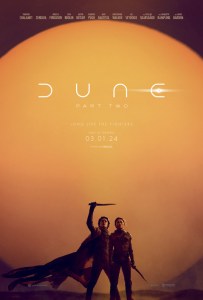 I wasn’t fully taken with the first Dune movie when it arrived in 2021. It was visually sweeping, with dense world building and careful development of characters and themes, but then it just hit the pause button without any certainty there would be a conclusion. Thankfully, director Denis Villanueuve was able to complete his vision, and what a spectacular science fiction landscape this man has fashioned, visually resplendent but also with a story that deepens and improves on all the promise and setup from 2021. The triumphant of Paul (Timothee Chalamet) becoming a hero and avenging his father from their betrayers is tempered by the tragedy of Paul, becoming the false messiah that will bring about mass genocide. The movie doesn’t hold back in its criticisms of its hero while also providing complexity that makes us root for him but uneasily dread what might become. The narrative structure is easy to follow with Paul ingratiating himself with the native culture, rising to power and influence, and organizing a resistance against the well-funded imperial overlords of Arakis. This is the kind of sumptuous, big screen spectacle with intelligence that is so rare in the Hollywood system, and Villaneuve once again shows his ability to perform artful blockbusters that put him in a rarefied class with hew others. After the first Dune, I was hopeful but a little wary. After the second Dune, I feel like all of my concerns were wiped away.
Nate’s Grade: A-
Share this:

Wonka (2023)
 Was there anyone out there wondering how a young Willy Wonka could have gotten his start as a cutting-edge candy maven? It’s an unnecessary back-story for a kooky character that most will just accept as is. The invented story of Wonka is one of an upstart entrepreneur (Timothee Chalamet) proving a danger to the established corporate oligarchy’s vice-grip on the local confectionery industry. They use the levels of corrupt power to scheme and block Wonka from getting started, but his charms and optimism are just too much, and he wins over the town with his candied delights that provide revelry to the people’s humdrum lives. As a candy-colored musical following an underdog triumphing from the power of friendship and integrity and imagination and good will, it mostly works on a fizzy cloud of its own manufactured whimsy. It’s all highly silly stuff and working very hard to be light-footed and whimsical. There are moments that made me smile and tohers that made me chuckle, like one rich man who gags whenever somebody ever says the word “poor.” The new songs are fairly forgettable except when they’re making you remember the dreamy 1971 numbers. I also think Chalamet (Bones and All) is painfully miscast as our young Wonka. I don’t think his broody-moody acting style works shifting over to manufactured quirk. His performance is just so off from the beginning. Wonka would have been exceedingly better as an original musical without trying to retrofit into the world of Willy Wonka, although that would mean losing Hugh Grant as our first specimen of Oompa Loompa, and he is a droll delight. It’s just weird for a movie to work this hard to tell us how Wonka got his start and to end on uplift when we know in the future he grows up to be a sad middle-aged loner who has to resort to a scam to find a successor, as well as the town becoming an impoverished slum to Wonka’s oppressive factory. My pal Ben Bailey reasoned it would be like a prequel to Death of a Salesman where a younger Willy Loman starts his career as a door-to-door salesman, so chipper and eager to make a name for himself. Wonka is a sugar rush designed as an origin story.
Nate’s Grade: B-
Share this:

Bones and All (2022)
 What do you get when you team up Oscar-nominated director Luca Guadagnino, twee handsome man Timothee Chalamet, and the ravenous consumption of human flesh? You get the new indie drama Bones and All, a literal love story between cannibals. It’s boy-meets-girl-meets-dinner.
It’s 1980s Reagan America, and Maren (Taylor Sheridan) is in high school and not allowed out to parties for a good reason. Her father (Andre Holland) nails her bedroom window shut, and we soon realize why when, at a slumber party, Maren eats one of her friend’s fingers. It’s back on the run except Maren’s father has finally had enough. He leaves her behind one morning with a tape recorder to explain. Maren travels to the Midwest and discovers other Eaters, those afflicted with her same impulses. One of them is the young man Lee (Chalamet), who Maren decides to follow. They can look out for one another, but what’s to be done when the hunger strikes, and how far will they go to feed?
 Bones and All is a doomed Romeo and Juliet romance with its own provocative subversion. I was hooked for the first half of the movie, as the script slowly revealed that these cannibals are born this way and their compulsion may also give them super powers, like the ability to smell their own kind as well as key characteristics, like a last feeding or even when a person may be close to death. The movie plays along the fringes of a monster or superhero formula, where we have people with extraordinary abilities, or a curse they must keep hidden depending upon your perspective, and how this challenges their vulnerability and sense of self. It’s reminiscent of vampirism, the need to feed, so we’ve seen aspects of this kind of story dozens and dozens of times, but the world and rules can still be engrossing to learn. Maren and Lee trade stories of their “first time,” though in this context it’s the first time they fed on human flesh, and it so happens both are with a traumatized babysitter. It’s a morbid bonding experience but such is partnering with a person who shares your unorthodox appetites. I was getting shades of Bonnie and Clyde, with our cross-country duo keeping on the run, and also Let the Right One In, where a man is reluctantly killing in order to feed and protect his ward. There’s also the 2017 French film Raw with a young woman discovering her family trait of cannibalism. The source material of Bones and All is a 2016 YA novel by Camille DeAngelis and the script feels very much like the total of its many pop-cultural and literary influences.
There’s still something compelling here about two oddballs finding a person who understand their unique situation. The addiction analogy is apt and provides an interesting discovery, as both Maren and Lee inherited their eating habits from a parent similarly affected. Maren’s search for her biological mother is a solid direction as it also promises a search for answers. Russell (Netflix’s Lost in Space, Escape Room) is an understated but captivating lead. Her character has never been out on her own and doesn’t know much about a larger world of Eaters, so every encounter is her stretching her boundaries and discovering what she is capable of. She also needs to learn how to better live with her impulses, or whether she even can, and being paired with a more experienced companion allows her to explore those feelings with better understanding. Chalamet (Dune) is part scraggly drifter, part twink prostitute, part deceitful vampire, and part sensitive boyfriend. In other words, he fits right in as a brooding Byronic love interest that Maren questions how close she can allow herself to be in his presence. The us-against-the-world sensibility of young and/or forbidden love is amplified with the extra genre trappings. In many ways, Bones and All feels like a strange amalgamation of Guadagnino’s last two movies, the 2018 gory remake of Suspiria and the 2017 tender gay romance, Call Me By Your Name.
 Where the movie starts to lag is its second half, which is built upon two conflicts that feel inadequately developed. The first, and biggest, is the relationship between Maren and Lee. It’s natural for Maren to be wary of Lee early on, especially with how much is at stake if either one of them. There’s also the danger of being alone with a cannibal, much like befriending a wild animal and always having to keep one eye open. It becomes a guessing game of trust and compulsion, can either control their urges? However, the romantic coupling between Maren and Lee felt very distant, as if the movie intended for them to be these star-crossed lovers and instead both of them looked at each other and shrugged and settled on being friends. It’s not that there isn’t really any heat or chemistry there. I can ignore that when both members are struggling to control how much of themselves they offer to the other. It’s a relationship built upon mutual survival and the occasional make out, but the difference between the two of them is at once emphatically stated and then casually ignored. The big hiccup for a Maren/Lee relationship seems to be that Lee will kill people in order to feed and Maren disagrees with this. You would think over the course of their time together the movie would follow one of two directions: 1) Lee’s willingness to kill for food becomes more extreme and Maren is pushed away, or 2) Maren begins to share in Lee’s willingness to kill and changes her moral outlook. Neither of these really happen, so when Maren considers leaving Lee’s company, I was left wondering what changed. He’s presented as dangerous, but he doesn’t become more unhinged, and there isn’t a point of no return for their relationship. I didn’t feel much when this union was arbitrarily was put on pause.
The other conflict is an external one and a nag. I thought there would be more attention about Lee and Maren having to hide from encroaching law enforcement. Instead, it’s another Eater who becomes a stalker, and this character would have been best served as a one-sequence passing weirdo. The reappearances feel contrived and poorly integrated once the fledgling Lee/Maren relationship takes center stage. There isn’t enough to the character to deliver with multiple appearances. The fact that this character plays such a big role in the second half is a letdown. If Lee and Maren were worried about people coming after them, why not the police tracking them for the murders they leave behind? Why not even a gang of Eaters that have decided there is even more security in number and have no compunctions over eating their own kind? That topic isn’t even explored, whether eating an Eater would be even more compelling. You could even have someone deem themselves a Super Eater who seeks out other Eaters to consume, either because he or she feels they are an even more exquisite taste/addiction, or because they have a self-righteous sense of purpose and feel eliminating other Eaters will protect the innocent they feed upon. It’s not even expressed whether they have to eat living people or if old corpses could suffice. There are different external threats that could have been better developed and integrated, so it’s a shame that the one we have is given so much more attention than deserved.
 With every movie, it’s important to judge what you’re presented rather than what could have been; it would be unfair judging a hamburger at a restaurant for not being a pizza. Still, I felt like the more compelling perspective to tell this cannibal love story was a parent protecting a child rather than as disaffected teenagers. I thought following Maren’s father from raising her and realizing she had a problem but ignoring it until he couldn’t, and then his challenges to reign in her impulses, would be the more compelling and dramatically charged point of view. It doubles down on the theme of what a parent would do for their child, as well as the personal fear of every parent whether they are capably raising the child to be a moral and self-sufficient adult. Then you mix in the possibility of the genetic lineage for cannibalism, and you can have the parent trying to pass down their knowledge to their progeny or the parent feeling immense guilt for bringing this would-be innocent into a situation that may spell their doom. Every time the narrative went back to Maren listening to her father’s audio narration, I felt like I was getting a bigger picture of the weight of the years of raising Maren. I suppose that also might lean a little heavily into a similar Let the Right One In dynamic. I understand that Bones and All is an adaptation of a YA novel and young outsider lovers is par for the course with the genre, so I wouldn’t expect such a radical adaptation even if it feels like a superior story perspective for drama.
Even as things didn’t fully come together for me, I was always interested in Bones and All for its two-hour duration. It’s not every day that genuine artists are putting their all into a love story that also involves chewing the nipple off a dying man. It didn’t really work as a romance for me because I didn’t really feel invested in the coupling of our main characters. There is so much more intriguing dramatic potential here with these story particulars that I can’t help but feel slightly disappointed by the end results hewing very closely to YA staples. More could have been explored in the romance, especially what nourished the attraction and what would compel Maren to rethink her feelings. As a gauzy, young lovers-against-the-world drama, it has its melancholic pleasures and diversions, one of which is that it was filmed primarily in southern Ohio. It was also filmed in Columbus, so I got to point to the screen and say, “Hey, I recognize that Greyhound bus station” (that was the extent of the Columbus filming, one five-second external cutaway). Bones and All can surprise plenty of viewers, and I’m positive many will be swooning from its mixture of romance and depravity, but the bigger surprise for me was that it left me ultimately hungry for more of everything.
Nate’s Grade: B-
Share this:

Don’t Look Up (2021)
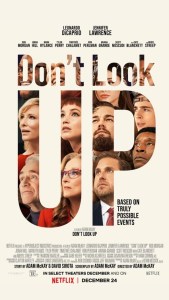 A scorched Earth satire that flirts with a literal scorched Earth, Don’t Look Up is writer/director Adam McKay’s star-studded condemnation of everything stupid and myopic in media, politics, and pop culture. Jennifer Lawrence plays a doctoral student who discovers a comet heading for direct cataclysmic impact with Earth, and she and her astronomy mentor (Leonardo DiCaprio) are trying to sound the alarm but nobody seems to be listening. Not the president (Meryl Streep) and her inept chief of staff/son (Jonah Hill). Not the greedy CEO (Mark Rylance) of a tech company. Not the media where morning TV co-hosts (Cate Blanchett, Tyler Perry) are more compelled by music star breakups than pressing science. It makes a person want to stand up and scream about priorities, and that’s McKay’s point, one that will be bludgeoned again and again. This movie is animated with seething rage about the state of the world and the cowardice about facing obvious problems head-on. It’s fit as a climate change allegory but COVID-19 or any scientific crisis could be applied as well. It’s about choosing ignorance and greed, about deferring to our worst instincts, and those in power who profit from inaction. I laughed at several points, some of it good cackling, and the movie is dark to its bitter end. This is the bleakest movie of McKay’s foray into his more sober, activist movie-making (The Big Short, Vice). It’s less Seeking a Friend for the End of the World, exploring the foibles of humans reconciling their last moments of existence, and more Idiocracy, where there is a lone voice of reason and the rest of the population are aggravating morons that refuse to accept reality even if it literally means just looking up with their own eyes. In some ways, the dark laughter the movie inspires is cathartic after years of COVID denials and mask tirades and horse medicine. The satire is bracingly blunt but also one joke on repeat. If you’re the right audience, that one joke will be sufficient. I don’t think the movie quite achieves the poignancy it’s aiming for by the end of its 138 minutes, but the anger is veritably felt. Don’t Look Up wants us to save the world before it’s too late, though the people that need to see the movie the most will be the ones fastest to dismiss it. Still, congrats to McKay for making a movie this depressing and relevant for the holidays.
Nate’s Grade: B+
Share this:

The French Dispatch (2021)
 Wes Anderson’s latest quirk-fest is his usual cavalcade of straight-laced absurdity, exquisite dollhouse-level production design, famous faces popping in for droll deadpans, and the overall air of not fully getting it. The French Dispatch is structured like you’re watching the issue of a news magazine come to visual life, meaning that the two-hour movie is comprised of mainly three lengthy vignettes and a couple of short asides. This narrative decision limits the emotional involvement and I found myself growing restless with each of the three segments. I was amused throughout but each felt like a short film that had been pushed beyond its breaking point. Perhaps that is Anderson’s wry, subtle point considering the entire journalistic voice of the movie feels like somebody made a movie in the style of one of those esoteric, supposedly “funny” New Yorker cartoons. It’s occasionally so arch and droll that it feels too removed from actual comedy. This is not the most accessible Anderson movie for a newbie; it’s very bourgeois in the kinds of people it follows, the stories it pursues, and the intellectual and political conflicts it demonstrates. The first and best segment follows Tilda Swinton discussing a heralded but imprisoned experimental artist (Benicio del Toro) who is dealing with the pressure to produce. The second segment follows Frances McDormand as she investigates a Parisian student union revolting against the ignorant powers that be. The third segment follows Jeffrey Wright recounting an assignment where he investigated a master police chef (not “chief”) and gets in the middle of a wacky hostage negotiation. Each of them has the requisite charm and random asides we’ve come to expect from Anderson, including a leotard-wearing strongman that is called upon by the police to help during the hostage crisis, but it felt more like a collection of overlong short films than a cohesive whole. If you’re already a fan, by all means, step into The French Dispatch. If you’re new to the idiosyncratic world of indie film’s most precise curator, then I’d advise starting with a more digestible and earlier Anderson entry. I enjoyed myself during stretches, was getting frustrated during other stretches, and I hope Anderson focuses more on the big picture of his next picture.
Nate’s Grade: C+
Share this:

Dune (2021)

I attempted to read Frank Herbert’s novel Dune when I was in the seventh grade. I had begun to read more fantasy literature and was looking at older, heralded novels. I can still recall my frustration of reading those first five pages and having to repeatedly flip back and forth to a twenty-five-page glossary of terms so that I could even start to comprehend what was happening on the page. After those five excruciating pages, I gave up. Maybe I was too rash, and maybe my older present self would be more accommodating to the struggle, or maybe it just wasn’t worth the effort. I never watched the 1984 David Lynch adaptation that was met with great derision from critics and fans alike, although it does have its vocal defenders (Hindsight alert: Lynch turned down directing Return of the Jedi to helm Dune). So when acclaimed filmmaker Denis Villeneuve (Arrival, Blade Runner 2049) became attached to direct a big-budget, large-scale adaptation of Herbert’s novel, I was finally interested for the first time in my life. It was originally slated to be released in 2020, and after the studio planned to release Dune onto its HBO Max streaming service, Villeneuve and the production company negotiated to make sure a theatrical release would still be an important part of the plan. Alas, I watched the 2021 Dune at home, and I found myself enjoying the experience and development of the world building. However, it’s unlikely to watch this version of Dune and feel like you got a full movie for your money.
In the distant future, like 10,000 A.D., mankind has colonized worlds and the most important planet of them all is Arrakis. It’s a desert world inhabited by poor natives, Freeman, who live a moisture-preserving life mining the natural “spice,” a special substance that makes space travel capable as well as prolonging human life. The top family houses are vying for dominance and House Atreides has been assigned by the unseen Emperor to rule over Arrakis and bring it and its spice production back in line. Duke Leto Atreides (Oscar Isaac) sees great opportunity but also great danger. The other houses will scheme to engineer the failure and desolation of House Atreides, especially House Harkonnen, led by the Baron (Stellan Skarsgard), who is like a mixture between Marlon Brando from Apocalypse Now and Marlon Brando from The Island of Doctor Moreau (plus with levitation powers?). Paul Atriedes (Timothee Chalamet) is his family’s heir and much is expected of him, especially from his mother, Lady Jessica (Rebecca Ferguson), who believes he may be long-prophesied messiah. On Arrakis, Paul and his father must tackle this very delicate new mission while keeping the many adversaries at bay.

As anticipated, Dune is yet another visually stunning and gorgeously immersive visual experience from one of the greatest visual filmmakers working today. If you can watch the movie on a big screen, or at least a bigger screen, then you owe it to yourself to do so. The sweeping vistas and startling science fiction imagery have so much power and grandeur to them. If Lynch’s movie inspired a generation of devotees and impressionable children, I imagine that this superior modern version will do likewise. The production design and costumes are terrific and perfectly in keeping with the larger scope of the expansive visuals. You really feel the size of this world and its imposing weight. Villeneuve has such a natural keen eye for pleasing visual compositions, but he also has the patience many famous big screen stylists lack. He allows the moments to linger and to let scenes breathe in a way that feels more transporting and immersive. If you were simply looking for a visually resplendent movie-going experience, then Dune is the ticket. The sound design is also very smartly aligned and makes use of unconventional and alien sounds to make the movie feel even more like its own thing. When Dune came out in 1965, this was before much of the modern building blocks of our sci-fi pop-culture, so in a way while Dune was the influence it feels partially like an odd after-effect rather than a predecessor. The same thing happened with 2012’s John Carter, based upon a novel a hundred years old that influenced many sci-fi adventure serials and now seems derivative even though it came before the many imitations. I was happy with the first 90 minutes of Dune and felt like the slow pace of the first hour, and its heft of needed but spaced-out exposition, was paying off with a thrilling assault. The concept of the protective shields is a smart way to communicate the casualties of battle, where “kill shots” are illuminated in red, informing the audience of a mortal wound. It makes for an easy to read visual to keep up with the development of battle and stay in a safer PG-13 realm. The whole rescue sequence on the mining station is thrilling at every step.
The cast is another major credit to the success of Dune. Chalament (Little Women) has a soulful yearning to him, to learn, to be his own man, to prove his father wrong and then prove worthy of his father’s faith. Surprisingly, the next biggest role isn’t Zendaya (Malcolm and Marie), the woman that Paul dreams about (prophetically?); it’s Rebecca Ferguson (Doctor Sleep) as Paul’s mother. She’s a woman with deep secrets belonging to a powerful religious sect that might be the real power behind the throne. Lady Jessica is more Paul’s mentor than any man. She teaches him to hone and focus his mind, to use the “Voice” to impart his will, and to prepare for the hardships to come. With every new exposition dump, and she has many, we learn about her growing concern for the fate of her son and her possible culpability for that fate. There’s a genuine warmth between them that serves as the film’s emotional core. I enjoyed watching Jason Momoa (Aquaman) and Dave Bautista (Army of the Dead) as opposite ends of Super Good Fighter Guy, though Momoa looked unsettling without a beard. Needless to say, the 2021 movie is far more diverse than the 1984 movie. It makes space feel more lived in when it’s reflective of a diversity of people that we already have at this point in our history.
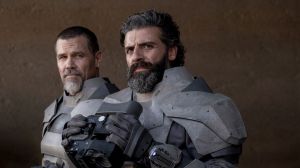
And then, after the hallway mark, Dune became a protracted sequence of chases and then I started to worry that things were just going to end in an unsatisfying manner, relegating the 150 minutes as setup for the as-yet-unplanned sequel, and that’s exactly what happened. My mood began to deflate somewhat during the last hour of Dune. I was still interested and the visuals were still mighty captivating, but the events had the unmistakable feeling of being stretched out to meet a frustrating stopping point, a pause that didn’t produce a satisfying endpoint. I just kept thinking, “Oh, they’re not going to resolve this,” and, “Oh, Zendaya is barely going to be in this movie,” and the movie proved my predictions correct. It’s hard to judge the movie as its own entity since it’s so dependent on a Part Two that has yet to be greenlighted (though its strong opening box-office returns are hopeful). This is an expensive movie, possibly pushing $200 million, so it’s quite a gamble to declare you would only be adapting roughly half of the story. Villeneuve’s Blade Runner sequel, a movie I loved, had a budget of $150 million and a worldwide gross that didn’t make the producers comfortable going forward with a Blade Runner 2050. To be fair, that was an original story, a sequel, and rather well contained. Still, it’s an expensive sci-fi movie that has as much in common with dry art house fare as it does blockbuster adventures, like Villeneuve’s Dune. The promise of a second movie is not secured. If Dune doesn’t do well enough, we’ll forever be left with a movie that feels designed to only be a teaser. It reminds me of the hubris of 2007’s The Golden Compass where the filmmakers had a whole 20-minute finale that they carved out with the intention of having it be the opening for the assumed sequel (welp). Even when designing a multi-movie arc, it’s necessary to plan each entry so that it can exist as its own beginning-middle-end and with a suitable intermediary climax. The Lord of the Rings movies each had their own climax, each moving the larger picture forward, and each had storylines and subplots that came to a head by film’s conclusion. Dune doesn’t. There are more dead characters by the end and certain characters are displaced, but it feels less like the end of the big-budget Dune movie and more like the conclusion of episode two of the Dune mini-series.
My resonance with the source material is minimal, but the world of Dune feels stuffed with stuff and not as deep in the realm of commentary. Fans of the book series will likely thrill at the level of minutia the 2021 movie luxuriates in, allowing fans to lap up the lore. For those of us uninitiated into the fandom, it feels like there could be more going on behind the scenes. The book was released in 1965 and has clear parallels to Middle East occupations and quagmires, a subject even more relevant in the first quarter of this new century. There’s the occupying force coming in to manage the supposedly primitive natives on a desert planet, replacing the last occupier who made bold promises that were unable to be met by the reality on the ground. The parallels of colonialism are there and obvious, but that’s because everything in Dune seems obvious to me. The bad guys are corpse-white and dressed in all black. They look like the alien zombies from 1998’s Dark City (itself referencing the silent sci-fi classic, Metropolis). The leader of House Harkonnen is this noxious man who bathes in black goo and sucks the life force from others. I don’t need my sci-fi to be ambiguous about its heroes and villains. We clearly recognize the bad guys because they’re grotesque. However, the lessons learned by the heroes seem a bit stilted. Its attacks on capitalism are a little more nuanced but not much. The planet of Arrakis could produce water but that’s not in the interest of the power brokers of the galaxy. They need the spice for the economy and thus keep the exploitative status quo. The parallels are there but there’s not much more to be had other than direct summations. The movie has more to say with religion and messiah figures but at this point we’re grading on a curve, and the more complex commentary attached to messiah figures seems reserved for a Part Two.
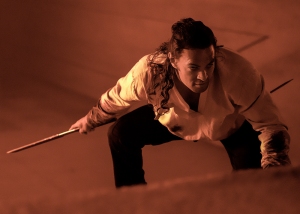
Another aspect I want to highlight that seems trivial but no less intriguing to me is how Herbert chooses his character names. We’re eight thousand years into the future, spanning multiple planets with names like Arrakis and Giedi Prime and Salusa Secondus, and then we have such anodyne twentieth-century names like… Paul and Jessica? It’s funny to me that Herbert goes to the trouble of coming up with so much jargon and terminology and alien-sounding names and then he says, “Hey, this guy’s name is… Duncan Idaho,” like he’s a supporting character in Point Break. I realize this is a very dubious criticism, and there are other character names to conflict with this assertion, but it made me laugh at the different levels of effort Herbert put into his world-building and universe than selecting character names for that same far away land.
After watching the new Dune, I went and watched the 1984 David Lynch version for the first time and was, quite simply, dumbfounded. I’ll credit Lynch for many of the weird choices in style and how it never stoops to even be accessible for a mass audience, despite having characters explicitly narrate their schemes and motivations out in the open (by scene one, the power play that took up 90 minutes of Dune 2021 is awkwardly explained in full). By the end of Lynch’s movie, it is an incomprehensible campy mess. I only have more appreciation for the 2021 Dune after watching the goofy (those eyebrows!) 1980s version that Lynch has disowned entirely, although that stirring guitar riff from the score still rocks thirty years later. The new Dune is only intended as Part One as its presumptive title promises, and because of this key artistic decision, there’s a feeling of padding and wear by the end. I found myself reflecting back on the first 90 minutes more fondly. It’s not that the last hour is absent great moments or audacious style, but it’s hard to fully judge this Dune when its last line is its own conditioning of expectations: “This is only the beginning.” The 2021 Dune is a visually remarkable movie experience with fantastic artists executing at some of the highest points of their talent. I’m eager to see if a Part Two can provide the satisfaction lacking in this beginning half. It’s a hell of a start but it feels too incomplete and in need of an ending.
Nate’s Grade: B
Share this:

Little Women (2019)
 By my count, this is approximately the 182nd version of Louisa May Alcott’s Civil War sisterhood. There must be something universal about the trials of the March sisters and their struggles for independence, agency, love, and happy endings on their own turns. Greta Gerwig, fresh off her Oscar nominations for Lady Bird, has given Little Women a decidedly modern spin. The story flashes back and forth between past and present, sometimes in consecutive shots, and feels full of authentic youthful energy. It’s also the first adaptation I’ve watched that has fixed the problem of Amy (Florence Pugh, affecting), widely regarded as the least liked sister. Through Gerwig’s telling, she becomes a self-determined woman, just like Jo (Saoirse Ronan), who recognizes the social trappings holding her back but chooses to do her best within this unfair system rather than rage against it. It’s like an empathetic reclamation for this often reviled character. The enjoyment of Little Women is how vibrant and different each of the March sisters is and how an audience can see degrees of one’s self in each little woman. Jo is by all accounts our lead and her struggle to be a successful writer pushes her against conventions of the era. There is an invented and very amusing bookend where Jo bickers with a blowhard male publisher (Tracy Letts) about “women’s melodrama.” It’s a meta commentary on Alcott’s book herself, especially with the helping of marriages and happy endings by story’s end. Ronan is a force of nature in the film and sweeps up everyone around her with charm. Meryl Streep is supremely amusing as an older rich aunt bemoaning the girls won’t get anywhere without marrying a wealthy man. The limited options for a working-class family are given great consideration, but it’s really a movie that seems to pulsate with the exciting feelings of being young, having the world stretch out before you, and chasing your dream, rain or shine. It’s also gorgeously shot and feels so assured from Gerwig as a solo director. There are a few detractions for this new 2019 Little Women, the biggest being how confusing it can get with its melded chronologies. If this is your first exposure to Alcott’s story, I fear you’ll get lost more than a few times trying to keep everything in order. The love story with lovesick pretty boy Laurie (Timothee Chalamet) feels tacked on even though it’s a feature of the novel. This newly structured, reinvigorated, charming remake of a literary classic feels definitely of the period and of today. It’s the first Little Women adaptation that made me realize how timeless this story really can feel in the right hands. It may be the 182nd version but it might be the best one yet.
Nate’s Grade: B+
Share this:

Hostiles (2017)
 A slow-paced Western with A-list actors, Scott Cooper’s Hostiles is a ponderous Western that feels too lost in its own expansive landscapes. It’s about an Army captain (Christian Bale) reluctantly taking the lead to escort a Cheyenne chief to die on his native soil. As you could expect from that premise, Hostiles is reverent and meditative to the point of boredom. It deals with Major Themes about man’s place in the world, connection to nature and the land, and our treatment of Native Americans, but it feels like it believe it’s saying a lot more than it accomplishes. The final film is over two hours but I kept waiting for the movie to feel more substantial, for the real story to start. The premise is workable and there are some interesting side characters, notably Rosamund Pike as the sole survivor of her family’s Native American attack, but it all feels underdeveloped to serve the central figure. It’s a story of one man having to come to terms and forgive himself for the cruel things he’s done in the past in the name of glory, honor, and patriotism. There are too many moments where characters reach out to remind him that he is, in fact, a Good Man. It gets to be too much. The talented supporting cast is generally wasted. Bale (The Big Short) is very internal, almost far too insular as a man speaking with looks and eyebrow arches, as he feels the weight of his soul over the course of this journey. I just grew restless with the movie and kept waiting for it to change gears or get better. Hostiles is not a poorly made movie, nor without some artistic merit, but it’s too languid and lacking.
Nate’s Grade: C+


 nathanzoebl
You must be logged in to post a comment.