Blog Archives
Primer (2004) [Review Re-View]
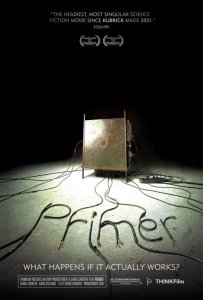 Originally released October 8, 2004:
I was intrigued about Primer because I had been told it was classy, smart sci-fi that’s so often missing in today’s entertainment line-up (see: Sci-Fi channel’s Mansquito). It won the Grand Jury Prize at the 2004 Sundance Film Festival and the critical reviews had been generally very positive. So my expectations were high for a well wrought, high brow film analyzing time travel. What I got was one long, pretentious, incomprehensible, poorly paced and shot techno lecture. Oh it got bad. Oh did it get bad.
Aaron (Shane Carruth) and Abe (David Sullivan) run a team of inventors out of their garage. Their newest invention seems promising but they’re still confused about what it does. Aaron and Abe’s more commercially minded partners want to patent it and sell it. Aaron and Abe inspect their invention further and discover it has the ability to distort time. They invent larger versions and time travel themselves and thus create all kinds of paradoxes and loops and confusion for themselves and a viewing audience.
Watching Primer is like reading an instruction manual. The movie is practically crushed to death by techno terminology and all kinds of geek speak. The only people that will be able to follow along are those well-versed in quantum physics and engineering. Indeed, Primer has been called an attempt to make a “realistic time-travel movie,” which means no cars that can go 88 miles per hour. That’s fine and dandy but it makes for one awfully boring movie.
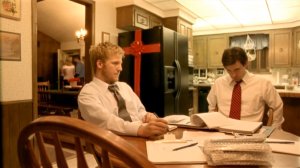 Primer would rather confound an audience than entertain them. There is a distinct difference between being complicated and being hard to follow. You’d need a couple volumes of Cliff Notes just to follow along Primer‘s talky and convoluted plot. I was so monumentally bored by Primer that I had to eject the DVD after 30 minutes. I have never in my life started a film at home and then turned it off, especially one I paid good money to rent, but after so many minutes of watching people talk above my head in a different language (techno jargon) I had reached my breaking point. Primer will frustrate most viewers because most will not be able to follow what is going on, and a normal human being can reasonably only sit for so long in the dark.
I did restart Primer and watched it to its completion, a scant 75 minutes long. The last 20 minutes is easier to grasp because it does finally deal with time travel and re-staging events. It’s a very long time to get to anything comprehensible. I probably should watch Primer again in all fairness but I have the suspicion that if I did my body would completely shut down on me in defense. Some people will love this and call it visionary, but those will be a very select group. It’s not just that Primer is incomprehensible but the film is also horrifically paced. When you don’t know what’s being said and what’s going on then scenes tend to drag because there is no connection. This movie is soooooo slow and it’s made all the worse by characters that are merely figureheads, dialogue that’s confusing and wooden, and a story that would rather spew ideas than a plot.
Writer/director/star Shane Carruth seems to have high ambitions but he has no empathy for an audience. Films can be dense and thought-provoking but they need to be accessible. Richard Kelly’s Donnie Darko is a sci-fi mind bender but it’s also an accessible, relatable, enjoyable movie that’s become a cult favorite. Carruth also seems to think that shooting half the movie out of focus is a good idea.
I’m not against a smart movie, nor am I against science fiction that attempts to explore profound concepts and ideals. What I am against, however, is wasting my time with a tech lecture disguised as quality entertainment. Primer is obtuse, slow, convoluted, frustrating and pretentiously impenetrable. After finally finishing Primer, I scanned the DVD spine and noticed it said, “Thriller.” I laughed so hard I almost fell over. The only way Primer could be a thriller is because you’ll be racing the clock for it to finish.
Nate’s Grade: C-
——————————————————
WRITER REFLECTIONS 20 YEARS LATER

I tried, dear reader. I had every intention of giving 2004’s Primer another chance, wanting to allow the distance of time to perhaps make the movie more palatable for my present-day self than it was when I was in my early twenties and irritated by this low-budget, high-concept Sundance DIY time travel indie. I thought with two decades of hindsight, I’d be able to find the brilliance that people cited back in 2004 where instead I only found maddening frustration. I consider myself a relatively intelligent individual, so I felt like I would be able to unpack what has been dubbed the most complex and realistic time travel movie ever created, let alone on a shoestring budget of only $7000, where the showcase was writer/director/star/editor/composer Shane Caruth’s intricate plotting. The whole intention with my re-watches is to give movies another chance and to honestly reflect upon why my feelings might have changed over time, for better or worse. That’s my intent, and while this day may have always been a matter of time for arriving, but I tried valiantly to watch Primer again and I quit. Yes, my apologies, but I tapped out.
I gave the movie twenty minutes before I came to the conclusion that I just wanted to do anything else with my time. I even tried watching a YouTube explanation video to give me a better summation, and even five minutes into that I came to the same conclusion that I wanted to do anything else with my fleeting sense of time. I think this is a case of accessibility and engagement.
Ultimately, this is the tale of two would-be inventors who keep reliving the same day to make money and win over a girl at a party. Reliving this day several times, with several iterations, and literally requiring a flowchart to keep it all together, is a lot of work for something that seemingly offers so little entertainment value beyond the academic pat on the back for being able to keep up with the inscrutable plotting. Look, I love time travel movies. I love the possibilities, the playfulness, the emphasis on ideas and casualty and imagination. I love the questions they raise and the dangers and, above all, the sheer fun. A time travel movie shouldn’t feel like you’re reading a book on arcane tax law. It needs to be, at the very least, interesting. Watching these two guys live out their lives, while on the peripheral more exciting things are happening with doubles, and we’re stuck with watching them migrate to this same party, or this same storage lockers and garages. It’s all so resoundingly low-stakes, even though betrayal and murder appear. I found this drama so powerfully uninteresting, and then structured and skewered and stacked to be an inscrutable, unknowable puzzle that makes you want to give up rather than engage. For me, there isn’t enough investment or intrigue to try and unpack this movie’s homework.
 This is a lesson for me, as I have a newborn baby in my house, and sleep deprivation and fatigue are more a presence in my life, that I’m going to be more selective with what I choose to spend those moments of free time. Do I want to invest my time watching a movie I am not engaging with, that gives me so little to hold onto? When my friend Liz Dollard had her first child, she talked about not watching downer movies like 2016’s Manchester by the Sea, only having the emotional space for stories that wouldn’t be draining to her mental well-being. This meant low-stakes, uplifting, generally happy or familiar tales. I remember at the time thinking that she was willfully shuttling so many potential movies from her viewership, great films that could be challenging or depressing and deserving of being seen. Now, I completely get it, because after you’ve woken up several times during that night to feed a small child who has no means of communicating with you other than volcanic screaming, watching a long movie about human suffering can feel like a tall order. While Primer isn’t overwhelming as some kind of miserable dirge, it is too hard for me to access and gives me too little to hold onto.
As a film critic for over twenty-five years of my life, I try my best to thoughtfully analyze every movie I sit down to write about, and I try to think about potential audiences and the artistic intentions for them, and whether choices help or hinder those intentions. Not every movie is going to be for me just like any other work of media; there are countless musical artists that I will never willfully listen to but have their respective fan bases. I know there are people that love Primer, as hard as it is for me to fathom. I know there are people out there that leap to the challenge of keeping the nine iterations and timelines together as time confusingly folds upon itself. I know there are sci-fi enthusiasts that respect and appreciate the stripped-down, more “realistic” application of time travel. I know there are people who celebrate this movie, but I am not one of them. Primer is simply not for me, and that’s okay. Not every work of art will be for every person. I doubt I’ll ever come back to Primer again for the rest of my life, but there’s so many more movies to watch every day, so why spend precious time on a movie you’re just not clicking with?
Adios, Primer. To someone else, you’re a wonderful movie. To me, you’re, as I wrote in 2004, a “techno lecture” disguised as an impenetrable film exercise.
Re-View Grade: Undetermined
Share this:

Indiana Jones and the Dial of Destiny (2023)

I held off watching Indiana Jones and the Dial of Destiny for almost half a year as I feared that this even longer-in-the-tooth Doctor Henry “Indy” Jones (Harrison Ford) would make me reassess the 2008 Kingdom of the Crystal Skull more favorably. Having re-watched the original trilogy, I can say that Dial of Destiny has made me reassess the much-maligned 2008 sequel. It’s still not good, and has many wide misses, but it’s also a more interesting movie to watch even in its myriad ways of disappointment. Maybe that’s the Steven Spielberg difference, a filmmaker so talented that even his rare cinematic follies have their own dynamic appeal. Dial of Destiny is a nostalgia slog, including the opening action caper with a de-aged Indy set in 1944 battling Nazis, just like we like. The action sequences lack the whimsy and satisfying scope and scale of the past, but everything here just feels on autopilot, including a gruff Ford as an Indy well past his prime in a world that has only gotten more complex. He’s given two lackluster sidekicks, neither of which are well integrated, and an old former Nazi (Mads Milkkelsen) who literally wants to find the ancient time travel device to go back to WWII and give Hitler notes. It all feels so deflated and absent the spirit and fun of the original movies, and it’s disappointing in a manner that is more bland and predictable than crazy and outlandish (nuking the fridge, killer ants, Tarzan swings, etc.). There’s an interesting kernel of a concept here, an archeologist possibly finding a skeleton in an ancient excavation that belongs to himself, and an ending that could have been ballsy and poetically fitting for the adventurer to become literally part of history. Alas, the one really exciting aspect of Dial of Destiny wimps out, settling for an ending that feels like another weak feint to the franchise’s storied past. I was so thoroughly disengaged by this movie throughout its 154 minutes. It is bereft of lasting charm and imagination and fun. At this point, with an 81-year-old Ford, I think it’s time to leave the character in a museum.
Nate’s Grade: C-
Share this:

The Butterfly Effect (2004) [Review Re-View]
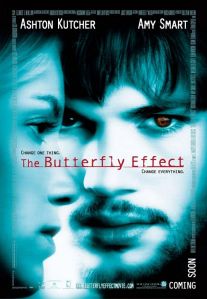 Originally released January 23, 2004:
Notice: I found Ashton Kutcher, star of The Butterfly Effect, on a trip to buy dog food, and cordially asked him to write a review. This is what he sent me. It’’s totally him. I wouldn’’t make this stuff up. That would be dumb.
“So, like, this Nate guy asked me to do a review of my new awesomest movie, The Butterfly Effect. Dude, like anyone needs a review for the most awesomest movie ever. I mean, like, the term ‘awesomest movie ever’ should say, like, everything. The only thing possibly more awesome than The Butterfly Effect would be trucker hats …… or two chicks totally making out. And I only said ‘possibly more awesome,’ which doesn’’t mean it is more awesome, because, dude, like I said before, The Butterfly Effect is the most awesomest thing ever. You can’t dispute that. Don’t even try. I’m awesome!
Like, the story goes like this, man. I play this guy, like I know big stretch there, but he’s not the most awesome guy ever, which is what you’d be thinking since it’s the most awesomest movie ever. But no, he’s like this kid who blacks out and has this wickedly twisted childhood where he stars in his neighbor’s kiddie porn, has his dog set on fire, and, like, his dad is all crazy, or, like I like to say, insane in the ole’ membrane. Ha, I totally made that up right now. I’m awesome!
So, you’re like saying, ‘Dude, that movie sounds less than awesome. Yes, sir, I am having definite doubts about the awesomeness of this movie. Like, do I need to go to the movies to, like, feel bad? I got my parents to do that for me. That and school.’ Hey man, I’m there, I know what you feel. ‘Cause right when you are like, ‘Dude, when is Demi gonna’ show up playing his mom?’ I find these old journals of mine and, dude, use them to travel back in time. I know, the awesomeness has returned. And I use the journals to go back and try and punk time, man. I try and make things better and change the future but I like totally just make it worse. I know, double punk’d, man! I try and fix the life of this hot girl in the movie (she showed her boobs in that Road Trip movie, did you see that? That part where she shows her boobs, oh man … It is awesome) but things don’’t work out. Like she becomes a crack ho at one point. Dude, total punk’d. I’m awesome!
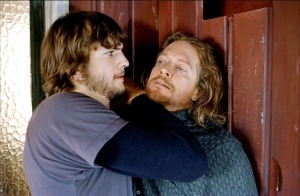 I should be taken as a serious actor. I didn’t hit my head on something and I grew a beard, what more do people need to know I got the goods? I mean, I don’t want to keep saying it but …… beard. C’mon! When actors want to be taken seriously they, like, grow beards. That’s why all those people in movies before 1970 (I know, it surprised me too that there were older movies) got awards and stuff. Beards, dude. Beards. When Billy Dee Shakespeare, like, invented acting, he totally imagined dudes, and chicks too, with beards. That’s why girls can’t be taken as serious actors, ‘cause they can’t grow beards. Ha. I’m awesome!
So, like, if you ever wondered what it would be like to see me, Ashton Kutcher, the most awesome man alive …who ever lived, no… the most awesome human being …-the most awesome thing …- ever, as a frat boy, or like, some poor dude with no arms, then you should see my new movie, The Butterfly Effect. After all, it is the most awesomest thing ever. That’s awesome. So, like, you people reading (is that what school is for?) should go see my movie. I’ll tell you why in two words: beard.”
Nate’s Grade: C+
——————————————————
WRITER REFLECTIONS 20 YEARS LATER
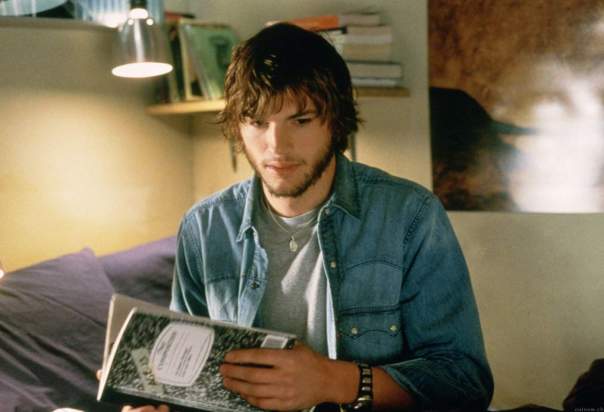
It’s hard to remember but there was a time where Ashton Kutcher was the king of the early 2000s universe. He had parlayed his excitable supporting character on a late 90s network sitcom into a successful movie career top-lining wild comedies, and he had also found success as a producer, bringing new life to the hidden camera prank TV show with his eponymous Punk’d where many of his celebrity friends would be victimized for the lols. The man even single handedly made goofy trucker hats a fashion mainstay. I know we haven’t seen much of the Kutch in a while, as he’s settled into his non-profit charities and being a family man, ceding the spotlight to his wife and former sitcom girlfriend, Mila Kunis. The Kutcher brand was stronger than ever at the time of The Butterfly Effect, enough so that Kutcher signing on as an executive producer was what finally got this widely read industry script to finally get made. You must view The Butterfly Effect as a point not just in Kutcher’s career but also in millennial edge-lord culture, the concept that anything dark is therefore compelling, and the more twisted the better. Re-watching the movie twenty years later, I wanted to laugh out loud at so many points because The Butterfly Effect is so serious while being so silly as it plumbs every depth of misery, both for its characters as well as any potential audience members still keeping track of the messy metaphysics.
Kutcher plays the adult version of Evan, a kid who has had quite a challenging upbringing to put it mildly. Mom (Melora Walters) is doing her best while Evan’s father is locked away in a mental asylum, and she’s worried her child might have inherited dad’s instability. He blacks out for extended periods and is found holding a knife or having drawn a horrible massacre at school, and even worse neighborhood tragedies (oh, I’ll get to all of them). A psychiatrist advises him to start journaling as a therapeutic means, and so he does, and when adult Evan reads his childhood journals, the words become blurry and he’s able to travel back in time to those exact moments. With this great power, adult Evan tries to right the wrongs of his life and those around him, but as all time travel stories are destined to discover, there are cruel unintended consequences to endure.
 Watching this movie is like watching a checklist of events that producers thought would be dark and grisly and So Messed Up, but this movie is so self-serious that it could be a parody of what a moody teenager would think of as a “mature movie.” Let me just list some of the content the movie covers: the drunken dad next door (Eric Stoltz) is a pedophile who records his daughter and son and Evan in child porn, the kids put a firecracker in a mailbox that blows up killing a mother and her baby, an angry kid kidnaps Evan’s dog and ties him in a bag and literally sets the bag on fire killing the animal, lots of violence against young children including murder, attempted suicide, disturbing behavior in children including traumatic self-harm at school, prison rape, multiple mental asylums, disfigurement and disability, prostitution and addiction, and in the original ending, the one I re-watched, a fetus literally strangling itself with its own umbilical cord rather than being born. Wow. Just… wow. This movie is only two hours and it crams enough sundry melodrama and grimdark grist to fill out a month of the grimiest soap opera ever. Because of the sheer amount of disturbing content, every new provocative addition makes the movie’s tone teeter further and further into unintended self-parody. Once you’re starting to process the homegrown child pornographer, the movie throws animal cruelty at you, and so on. It’s not enough that Evan had a bad childhood of trauma, but does he have to experience all the traumas?
Much of the movie follows Evan’s morose quest to improve the life of his unrequited love, Kayleigh (Amy Smart as the adult version). He runs into her after several years apart and merely bringing up the past with her pedophile father filming the two of them propels her to kill herself off-screen. She’s literally introduced in one scene and then in the next she’s dead, and it’s all Evan’s fault, so says her angry brother via the answering machine clunkily informing us. Evan goes back and stops her dad from molesting her, so now dad only molests her brother Tommy instead, who Evan kills as an adult defending himself. He travels back in time and now her brother is dead and she’s become a heroin-addicted hooker and that won’t do. He travels back again and manages to improve the lives of Kayleigh, Tommy, and their friend Lenny, except in this timeline Lenny and Kayeligh are the romantic couple and Evan has no arms, having lost them in the childhood mailbox explosion. He travels back again and this time Kayleigh gets blown up as a child. Ultimately Evan concludes he cannot save her and have everything he wants, so he makes some form of sacrifice by the end; in the theatrical cut, young Evan upsets her so she chooses to live with her mother rather than her pedophile father, and in the director’s cut, he ensures Kayleigh will never meet him by killing himself in the womb (his mother reveals she’s had multiple miscarriages, leaving the impression other future siblings have done the same). I appreciate how the filmmakers have streamlined their convoluted time travel tale into a simple task of trying to get the girl, but it also becomes so overwrought that I wanted to shake my head and sigh.
 These characters are put through an emotional and often physical grinder, so it’s hard not to feel sorry for them. I long felt the film’s contempt for Kayleigh ever since young Evan (a young Logan Lerman) tells her, “You don’t even know how beautiful you are,” like she’s so stupid to see the obviousness of his compliment. I think dark comedy is the best way to read the movie, laughing along the way as Evan fails time and again to improve the lives of everyone through his space-time interventions. He can save this kid but doom his mother to lung cancer. He can save this person but is locked away in prison. It’s a no-win scenario for Evan, so he decides it’s better if he was never born, negating all the possible good he’s done in his life, including maybe being a force that could keep Kayleight from living with her dad. Maybe not having that friend and an advocate push her into that decision doomed her to a life of molestation, so way to go Evan.
I kind of loathe the time travel method in this movie but at least it provides a limitation that works within the universe of The Butterfly Effect. He can only travel reading his journals, which means he’s stuck in whatever nightmare timeline he’s responsible for unless he can recapture some part of his childhood scribblings. Reading them aloud is also an unexpected source of dark comedy because it makes me question how forthcoming a child of trauma would be about writing down his experiences in simplistic shorthand (“So today Kaleigh wasn’t feeling so good. Her face blew up. I was sad”). I did like that this inherited disorder provides more mystery to his family line, a source of material not covered in either of the Butterfly Effect direct-to-DVD sequels unrelated to Evan’s troubled story. This is perhaps the second worst method of time travel I’ve found in the movies after 1980’s Somewhere in Time where Christopher Reeve uses the power of positive thinking to convince himself he’s in 1912, and lo and behold he shall be.
 Watching this movie is like revisiting a Goth phase you had as a brooding teenager but have since considered a point of embarrassment (not that being Gothic is something to be ashamed of, simply that it was an overzealous step in asserting a misguided sense of what being a mature adult meant, generally disaffected and cynical and edgy for its own attention). The Butterfly Effect is an endless improv game of “yes and” where the proceedings only get worse. My original review in 2004 was one of my more unconventional reviews, and I just wanted to adopt my perception of the “Kutcher brand” persona of the era and make a bunch of dumb jokes, several of which I’m not too ashamed to admit still made me chuckle (“two words: beard.”). I’d lower my grade a tad but there is still a car-crash fascination of watching a movie try so transparently hard to be so twisted.
Re-View Grade: C
Share this:

Aporia (2023)
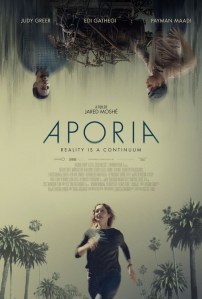
In writer/director Jared Moshe’s low-budget indie film Aporia, the Trolley Debate, killing one person in order to spare the lives of, presumably, more people or a greater number of people, gets its own movie in a thoughtful and provocative little indie. The thorny ethical questions are given their rightful due, and this is where Aporia really shines for me, as a small-scale sci-fi story with Big Ideas bursting forth and the understanding to give them adequate space for satisfying contemplation. It bowled me over.
Sophie (Judy Greer) is still very much not over the death of her husband, Malcolm (Ed Gathegi). He was killed by a drunk driver months ago and that driver also seems to have escaped justice. Sophie is left alone to raise their pre-teen daughter Riley. That’s where Jabir (Payman Maadi) comes in. He was a friend of Malcolm and reveals they had been working on a prototype for a time machine in secret. The machine has its own limits. It sends a photon particle back in time, which will kill any living creature that it materializes inside. All you need are the time, place, and coordinates and you could kill anyone. The further in time you need to go the more power the machine will have to draw. Sophie is beside herself but taken over with the excitement of possibly bringing her husband back to life. All it takes is murder.

What the characters have created is essentially a magic gun that can shoot into the past, which means the only use for this time travel device is to take life. They will only ever be murderers if they decide to use it, and so it becomes a question over under what circumstances would it be permissible to utilize this weapon. The first victim is obvious, the man responsible for the death of Sophie’s husband, and like magic he returns good as new without any memory of ever having been gone. It’s an important rule introduced that only the people in the room with the machine will still have memories of the previous timelines before the space-time revisions. This is a good move for an obvious dramatic one, so that the characters will be able to be impacted by the changes because they can recall a life without them, but it also sneakily supplies another complication. Each one of them has the potential to use the machine alone and thus never having the others realize what they had done. It’s one more tricky ethical question, asking whether you would betray the trust of someone close to you if you could get away with it. Naturally, the characters debate the merits of when to use the machine and when not to, with each new use further complicating matters because the next change can always destabilize the state of things, and then it’s a chain of changes to try and find the right order, and that leaves a trail of bodies littering the past.
It wouldn’t be a compelling time travel narrative without the ole’ favorite of unintended consequences. By removing the drunk driver before he could ever fatefully get behind the wheel, Sophie has brought back her husband and felt like the cost was negligible, as that driver in present-day is an abusive husband who gets drunk and yells at his family while he escapes justice for manslaughter. However, once you start pulling at the knots of the human timeline, some interesting and unexpected results can happen. That same man has been removed but his family isn’t necessarily better off. Kara (Whitney Morgan Cox), the widowed wife, is struggling to make ends meet as a single mom with a daughter (Veda Cienfuegos) suffering from multiple sclerosis (MS). They are deep in medical debt. It seems that the least this man did was help provide a financial cushion. Without his presence, they’ve had to go it alone and they’re broke and likely unable to continue paying the costly medical treatment for this adolescent girl. Because of Sophie’s desire to bring back her husband, she has doomed this innocent victim. Sophie’s guilt causes her to seek out the family, check up on them, and upon the discovery of their hardships, befriend mother and daughter and find a way to make things right as the unknowing perpetrator of their dilemma. From there it becomes a game of thinking how she can erase their misfortune while keeping her own husband.

I will discuss one significant turn because I think it’s an evocative example of the thought-provoking nature of the screenplay, but I will warn you there will be significant spoilers. If you wish to remain pure, dear reader, then skip to the next paragraph. The team comes up with a new name to eliminate to solve the fortunes for Kara and her daughter, a man who swindled her, a Ponzi scam artist who left her penniless and forced to close her bakery. Seems open and shut with an obvious bad person, thus an easy solution. But you should recognize there are no easy solutions in stories untangling timeline interference. All of a sudden, Sophie and Malcolm come home to discover that they have a completely different child. Their teen daughter is now a teenage boy with a different personality and different interests. How? How could eliminating one bad man in a completely different state change the course of history enough that their child has been affected? They debate the possibilities, perhaps something as small as a different sperm winning out or conceiving her on a different day or month, but the results are irrefutable. While their child is alive in this timeline, in a very real sense they have both now lost their daughter. The person they raised together, loved, and helped shape has been eliminated and the grief is palatable. This new child is a stranger, but they too are strangers to this child. They are absent formative memories and do not have the shared connections and history to draw upon. When Sophie tries to comfort this new Riley, she doesn’t know what may work because she doesn’t know anything about this child. I don’t think the filmmakers are making negative commentary on adoption, which is essentially what this scenario mirrors, but the grief goes two ways. They mourn the child blinked from existence, and this child also had his parents blinked from existence and replaced with lookalikes, they just don’t understand it yet. It’s this escalation that personalizes the unintended harm of what they’re doing and sets the stage for the final decision.
The ending is going to divide people but it felt note-perfect for me. It ends on an emotional high of coming to terms with their culpability but also on accepting uncertainty. We end on an ambiguous note, absent a resolution about the final extension of the final decision. I think it works very well not just in trying to have it multiple ways but because after being in the know, it puts the characters, and vicariously the viewer, in a state of vulnerability and the acceptance of staying there. It’s an uplifting conclusion thematically because it’s about accepting loss but also accepting our limitations. The final conversations are inadequate because how can you summarize a life with another person, whether a lover or a friend or a spouse, into just a handful of clumsy words. Our vocabulary does us a disservice when it comes to expressing the glorious debt we feel having had these people in our lives. That is why the movie ends on an emotional high for me and really comes together, personalizing the ethical conundrums.

Greer (Halloween Kills) has had a long career as a supporting actress, usually the funny but supportive best friend to the lead, and as an outstanding voice actress (Archer, Let’s Go Luna), but rarely does she get a meaty dramatic lead role. She’s terrific here and serves as our dramatic anchor through the turbulent changes and moral soul-searching. She is our reflection, and Greer’s emotional journey is well encapsulated in a performance that doesn’t go big into histrionics but is more carefully grounded and natural. I don’t think the movie would work as well, at least on an emotional level, without her.
Is Aporia a perfect film? Well, very few are, and the movie could have even more development, leaving possibilities behind given its tantalizing premise. I’m glad the movie didn’t go overboard into some slapdash thriller territory and instead grounded its science fiction timeline wonkiness into engaging human drama about loss, sacrifice, and acceptance. As my pal Eric Muller said, Aporia likely works better as a screenplay than a finished film, though this discounts the heavy-hearted contributions of Greer. I’m glad this movie emphasized its ideas and provided the time to really dwell in them, even if the movie is only about 90 minutes altogether. Aporia is a deeply engaging movie that worked on all levels for me, enriching emotions and satisfying intellect, and is definitely worth the discovery.
Nate’s Grade: A-
Share this:

The Flash (2023)/ Spider-Man: Across the Spider-Verse (2023)
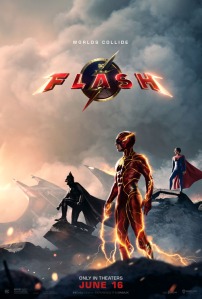
Released within two weeks of one another, two big summer movies take the concept of a multiverse, now becoming the norm in comic book cinema, and explore the imaginative possibilities and wish-fulfillment that it proposes, but only one of them does it well. Spider-Man: Across the Spider-Verse is the sequel to the Oscar-winning 2018 revolutionary animated film, and it’s a glorious and thrilling and visually sumptuous experience, whereas DC’s much-hyped and much-troubled movie The Flash feels like a deflated project running in place and coming apart. Let this be a lesson to any studio executive, that multiverses are harder than they look.
Barry Allen (Ezra Miller) has the ability to travel at fantastic speeds as his superhero alter ego, The Flash. He’s tired of being the Justice League’s errand boy and still fighting to prove his father is innocent of the crime of killing Barry’s mother. Then Barry discovers he can run fast enough to actually travel back in time, so he returns with the intention of trying to save his mother. Except now he’s an extra Flash and has to train his alternate self (also Miller) how to control his powers. In this different timeline, there is no Justice League to combat General Zod (Michael Shannon, so thoroughly bored) from destroying the planet for Kryptonians.
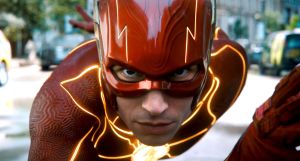
This is the first big screen solo outing for The Flash, and after none other than Tom Cruise, Stephen King, and James Gunn calling it one of the best superhero movies of all time, it’s hard to square how trifling and mediocre so much plays out as an example of a creative enterprise being pulled in too many directions. Miller was cast as the speedster almost ten years ago, and this tale has gone through so much tortured development, leaping through numerous filmmakers and writers, that its purpose has now gone from being a pillar of the expanding DC cinematic universe began with Zack Snyder’s Man of Steel in 2013 to becoming the Snyderverse’s death knell. The premise of traveling back in time is meant for Barry to learn important lessons about grief and responsibility and the limits of his powers, but it’s also intended as the reboot option for the future of these cross-connected comic franchises. It allows Gunn, now the co-head of the new way forward for DC movies and TV, to keep what they want (presumably Margot Robbie and Jason Momoa) and ditch the rest (Henry Cavill, Ben Affleck, Black Adam, Shazam, and Zack Snyder’s overall creative influence). So reviewing The Flash as only a movie is inadequate; it’s also a larger ploy by its corporate overlords to reset their comic book universe. In that regard, the quality level of the movie is secondary to its mission of wiping the creative slate clean.
Where the movie works best is with its personal stakes and the strange but appealing chemistry between the two Millers. It’s an easy starting point to understand why Barry does what he does, to save his mother. This provides a sturdy foundation to build a character arc, with Barry coming to terms with accepting his grief rather than trying to eradicate it. That stuff works, and the final talk he has to wrap up this storyline has an emotional pull that none of the other DCU movies have exhibited. Who wouldn’t want one last conversation with a departed loved one, one last opportunity to say how you feel or to even tell them goodbye? This search for closure is a relatable and an effective vehicle for Barry to learn, and it’s through his tutelage of the other Barry that he gets to see beyond himself. The movie is at its best not with all its assorted cameos and goofy action (more on both later) but when it’s a buddy comedy between the two Barrys. The older Barry becomes a mentor to himself and has to teach this inexperienced version how to hone and control his powers as well as their limits. It puts the hyper-charged character into a teaching position where he has to deal with a student just like him (or just him). It serves as a soft re-education for the audience alongside the other Barry without being a full origin story. The impetuous young Barry wanting to have everything, and the elation he feels about his powers, can be fun, but it’s even more fun with the older Barry having to corral his pupil. It also allows the character an interactive checkpoint for his own maturity and mental growth. Miller’s exuberant performances are quite entertaining and never fail to hit the comedy beats.
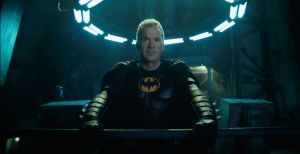
The problem is that the movie puts so much emphasis on too many things outside of its titular hero. Much was made of bringing back Keaton to reprise his Batman after 30 years. I just wish he came back for a better reason and had legitimate things to add. His role is that of the retired gunslinger being called back into action, and there’s an innate understanding with Barry wanting to go back in time and save his family, but too much of this character’s inclusion feels like a stab at stoking audience nostalgia (the callback lines all made me groan). I highly enjoyed Keaton as Batman and appreciated how weird he could make the billionaire-turned-vigilante, but he’s no more formed here than a hologram. The same thing happens with the inclusion of Super Girl a.k.a. Kara Zor-El (Sasha Callie). In this universe, there is no Superman, so she’s our requisite super-powered alien that Zod is hunting to complete his plans for terraforming Earth. She’s an intriguing character as a tortured refugee who has lingering doubts about whether humanity is worth the sacrifice, but much of her usage is meant only to make us think about Superman. She’s not given material to make her own impression, so she simply becomes the imitation of the familiar, the shadow to the archetype already being left behind. But these character additions aren’t even the worst of the nostalgia nods, as the final climactic sequence involves a collision of worlds that harkens to just about every iteration of the famous DC heroes, resurrecting several with dodgy CGI and uncomfortable implications (spoilers… the inclusion of George Reeves, when he felt so typecast as TV’s Superman that he supposedly killed himself because he thought his acting career was over, can be galling).
The action of The Flash is mostly fine but with one exceptional example that boggles my mind. In the opening sequence, no less, Barry is trying to help clean up a crumbling hospital when it collapses and literally sends a reign of babies falling through the air. I was beside myself when this happened, horrified and then stupefied that this absurd action sequence was actually happening. Barry goes into super speed to save the day, which more or less reverts the world into super slow-mo, though he needs to power up first, so we get a quick edit of him stuffing food into his face to load up on calories. We go from Barry breaking into a falling vending machine, stuffing himself in the face with snacks, getting the green light from his suit which I guess measures his caloric intake, and then grab a baby and literally put it in a microwave to shield it from danger. Just describing this event makes me feel insane. I figure the filmmakers were going for an over-the-top approach that also provides light-hearted goofiness to separate the movie from the oppressively dark grist of Snyder’s movies. However, this goes so far into the direction of absurdity that it destroys its credibility. It’s hard for me to fathom many watching this misguided and horrifying CGI baby-juggling sequence and say, “Yes, more please,” rather than scoff and shake their head. It’s not like the rest of the movie keeps to this tone either, which makes the sequence all the more baffling. There are Flash rules that are inconsistently applied to the action; Barry’s caloric intake is never a worry again, and the effects of moving a person during super speed don’t ever seem to be a problem except for one spewing gross-out gag.
While not being an unmitigated disaster, it’s hard for me to see the movie that got so many figures in the entertainment industry raving. The Flash has some notable emotional stakes, some amusing buddy comedy, and some goofy special effects sequences that run the gamut from amusing to confounding, but it’s also quite a mess of a movie, and too many of its nods to the fandom feel like empty gestures of nostalgia compensating for imagination. For all it gets right, or at least keeps interesting, it seems like another cog in a multi-billion-dollar machine, a stopping point also intended to be a reset and starting point. It feels like the character wasn’t trusted enough by the studio to lead his own solo movie even after years of buildup with Miller, nine seasons of the popular TV series, and 80-plus years of prominent placement in DC comics.
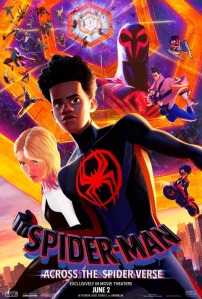
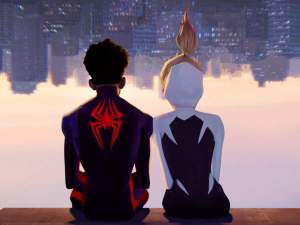
Conversely, Across the Spider-Verse is a sequel that expands an already stuffed story but knows what stories and themes to elevate so they don’t get lost amidst the fast-paced lunacy. Taking place a year later, Miles Morales (voiced by Shameik Moore) has grown into his role as the new Spider-Man for his world. He strains to meet the expectations of his parents, and keep up his grades, while fulfilling the duties of a superhero jumping into danger. When Gwen Stacey (voiced by Hailee Steinfeld) reappears to discuss joining the multiverse police, Miles jumps at the chance, having genuinely missed his other Spider friends, especially Gwen. There are countless Spider people in countless worlds, even including a Spider-T. Rex and a Spider-Car (Peter Parked Car, I believe the name was). Miguel O’Hara (voiced by Oscar Isaac) is the Spider-Man tasked with keeping order across the many interconnected multiverses, and he insists that sacrifice is essential to maintain balance, one that hits too close to home for Miles to abide.
The 2018 original is a hard act to follow, and while Across the Spider-Verse doesn’t quite overrule its predecessor it is a more than worthy sequel that has everything fans loved about the first trip. The visual inventiveness has been taken even higher, with the mixture of even more different animation and art styles. I loved seeing each Spider person and how they fit into their unique art style of their world, like the living water colors of Gwen’s world and the punky paper collage style of Spider-Punk (voiced by Daniel Kaluuya). There’s a villain that comes from a paper universe, so he resembles a three-dimensional paper construction with hand-scribbled notes appearing around him like Da Vinci’s commentary. There is something to dazzle your senses in every second of this movie. The visuals are colorful, creative, and groundbreaking with the level of detail and development. There’s probably even too much to fully take in with just one viewing. I want to see the movie again not just because it’s outstanding but so I can catch the split-second vernacular asterisk boxes that pop up throughout the movie. Going further into living comic book aesthetics, new characters will be introduced with boxes citing their comics issue reference point, and certain names and vocab will get their own citations as well. These are split-second additions, nothing meant to distract from the larger narrative. Simply put, this is one of the most gorgeous looking movies of all time, animated or live action. It’s bursting, thrumming, nearly vibrating with life and love stuffed into every nook and cranny, and it’s exhilarating to just experience a vivid, thriving world with animators operating at peak talent.

However, the movie has an engrossing story to better position all those eye-popping visuals. The worry with any modern multiverse story is that the unlimited possibilities of variations and opportunities for characters to do just about anything will overwhelm a narrative, or like The Flash, become a checklist of overburdened and empty fan service. The screenplay by Phil Lord, Christopher Miller, and Dave Callaham is all about relationships. If Miles’ relationship with his stern police lieutenant father (voiced by Brian Tyree Henry) wasn’t such an important focal point, then the emotional stakes of the movie would be meaningless. We see a relatable struggle from both sides, the parents trying to connect with their growing child and give him enough space to find himself, and the child who clearly loves his parents but doesn’t fully appreciate or understand their concerns. They worry about Miles leaving them and whether others will love and support him like his parents. Miles has to experience a wider world of possibility, but these experiences make him appreciate what he has at home, and what could be permanently lost. I don’t mind saying there were more than a few moments that caused me to tear up. I found Gwen’s storyline equally compelling, and her turmoil over keeping her secret identity and then coming out to her father was rather moving. The family bond resurfacing will get me every time, and the simple action of a hug can be as heartwarming and fulfilling as any romantic ode. Across the Spider-Verse makes sure we care about the characters and their personal journeys.
At a towering 140 minutes, this is the longest (American) animated movie ever, and it’s still only one half of a larger story. I knew ahead of time this was only the first part so as soon as we entered Act Three I kept gearing up for the cliffhanger ending. Every five or so minutes I thought, “Okay, this is going to be the end,” and then it kept going, and I was relieved. Not just because I got to spend more time in this unique universe but each new moment added even more to raise the stakes, twist the intrigue, and make me excited for what could happen next. I was shaking in my seat at different points, from the excitement of different sequences to the emotional catharsis of other moments. I cannot wait to experience this same feeling when the story picks back up reportedly in March 2024, though I fear it will get delayed to late 2024.
Even with the unlimited possibility of jokes and silly mayhem, the filmmakers keenly understand that it doesn’t matter unless we care about the characters and their fates. I am shocked that a goofy character I thought was going to be a one-scene joke, The Spot (voiced by Jason Schwartzman), could end up becoming the ultimate destroyer of worlds. I think this reflection nicely summarizes the impeccable artistry of Across the Spider-Verse, where even the moments or characters misjudged as fleeting or inconsequential can be of great power. It’s a movie that is full of surprises and thrills and laughs, all in equal measure, and a blessed experience for a movie fan. In the crush of comic book multiverse madness, Across the Spider-Verse is a refreshing and rejuvenating creative enterprise, one that builds off the formidable talent of its predecessor and carries it even further into artistic excellence that reminds us how transporting movies can be. If you see one superhero multiverse movie this summer, the choice should be as obvious as an inter-dimensional spider bite.
Nate’s Grades:
The Flash: C
Across the Spider-Verse: A
Share this:

Ant-Man and the Wasp in Quantumania (2023)
 Phase Four of the Marvel Cinematic Universe (MCU) has had a bumpy ride, coming after the significant climax of 2019’s Avengers Endgame and releases shifting thanks to COVID, with plenty of think pieces and pundits waiting to seize upon the possible decline of the MCU’s box-office and pop-culture dominance. This was still a phase with several enjoyable blockbusters with stars of old (Black Widow, Loki, Black Panther 2, Spider-Man No Way Home) and stars of new (Shang-Chi, Ms. Marvel), but it’s been defined by movies and series that have not engendered the same level of passion with fans and audiences, and left many questioning whether audiences are finally suffering from dreaded Marvel Fatigue. I cannot say, because even movies people were so-so on have generated tons of money, and it’s not like I even have to travel far in the past for a good-to-great Marvel movie with Wakanda Forever last November. However, after the muddled response to a third Ant-Man movie, as well as a bland Shazam sequel within weeks, then the old media narrative reignites the Marvel Fatigue question. I think the better question is aimed at the studio and whether we’re entering into Marvel Complacency.
Scott Lang (Paul Rudd) is trying to live a normal life, at least for a superhero that helped save the world. His adult daughter Cassie (recast as Kathryn Newton) is a social activist and a burgeoning scientific genius, and with the help of her grandad, Hank (Michael Douglas), they’ve developed a way to communicate into the Quantum Realm, the metaphysical world of subspace where Janet (Michelle Pfeiffer) was lost for decades. The entire family gets sucked into the Quantum Realm and separated, fighting to make their way in a strange new land. Among all the unorthodox beings is Kang (Jonathan Chambers), a banished interdimensional conqueror. He’s looking to break free of his prison and thinks Scott can be persuaded to help under the right pressure.
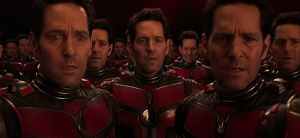 Ant-Man and the Wasp in Quantumania is blatantly weird and shapeless, which allows for some of the most silly character designs in the MCU yet, and it also adds up to so precious little. From a character standpoint, we get minimal forward progress, which is strange considering Scott was deprived of years from his daughter, missing out on her growing up into an adult. When you have a villain who can manipulate space and time, and this scenario, wouldn’t you think that the ultimate appeal would be to regain that lost time? Maybe Scott feels like this older Cassie is a version of his daughter he doesn’t recognize, and he misses the innocence of her younger self, and therefore he wishes to experience those moments he had missed. Mysteriously, this doesn’t factor in at all with Ant-Man 3. I suppose it’s referenced in vague terms, but you would think the thematic heft of this movie would revolve around lessons learned about thinking in the past, of trying to recapture what is gone, of moving onward and trying to be present for those we love, you know, something meaningful for the characters besides victory. Nope, as far as Cassie is concerned, she serves two story purposes: 1) being a plot device for how we got into this crazy world, and 2) being a damsel in distress. Kang’s threats to withhold Cassie or harm her are the motivating factor for him to collaborate with the villain. How truly underwhelming. I did enjoy a sequence where a plethora of Scotts across multiple timelines come to work together with a common goal, with every one of the many Scott’s love for Cassie being their top ambition.
As for the universe existing between space, the Quantum Verse of our title, it’s the highlight of the movie, so if the characters and their personal conflicts aren’t hitting for you, like me, then at least there’s some fun diversions to be had with every new locale and introduction. There’s an enjoyable sense of discovery like a new alien world where the possibilities seem endless. The strange quirks were my favorite. I adored the exuberant goo creature Veb (David Dastmalchian) fascinated by other creatures having orifices. There’s also a mind reader played by William Jackson Harper, who was comically brilliant on The Good Place, and just repeating the same lazy joke here about people’s minds being gross. There’s even Bill Freakin’ Murray as a lord. I enjoyed how many of the new characters, many of them strange aliens, had prior relationships with Janet, and her hand-waving it away explaining that over thirty years she had certain needs. This subplot itself could have been given more. time, with Janet having to deflect Hank’s sexual inadequacies in the face of so many virile lovers (“How can I compete with a guy with broccoli for a head?”). I think this reunited couple confronting their discomfort would be far more entertaining than yet another massive CGI face-off with thousands of soulless robots. There are interesting moments and characters in this strange new world, but they’re all so fleeting, meant to be a goofy supporting character or cameo or simply a one-off joke and not what matters.
 Like Multiverse of Madness and Love and Thunder, this feels very much like a table-setting MCU movie, meant to move the pieces along and set up other movies, chiefly the next Thanos-level big bad with Kang, first portrayed in Loki’s season one finale in 2021. I found this character version underwhelming. Part of this is that Kang’s first appearance was so memorable, spirited, anarchic, but also subversive, going against the audience expectations of what the final confrontation with the puppetmaster was going to involve. With Ant-Man 3, this version of Kang is an overly serious, well-poised castoff in a secondary Shakespeare play, which would work if the screenplay gave the guy anything interesting or memorable or even really threatening to play. He’s just another authoritarian who speaks in grand speeches of their greatness and then proves not to live up to his much-hyped billing. I worry that the next few years of the MCU will feature a rotating set of Kangs to topple with every film, which will make the villain feel less overwhelming and powerful and more like a reoccurring Scooby Doo villain (“I would have gotten away with it too, if it wasn’t for you meddlin’ heroes, and YOUR ANTS!”). This isn’t to say that Majors (Creed III) gives a poor performance. It’s just so stubbornly stern and shouty and rather boring in comparison to He Who Remains from his Loki appearance. Note to Marvel: given the serious charges that have surfaced against Majors, if you do wish to recast the role, a character who is different in many universes should be a pretty easy explanation for any change.
Is Ant-Man and the Wasp in Quantumania the beginning of the end of the country’s love affair with the MCU? Well… probably not. Just three months later, Guardians of the Galaxy vol. 3 hit it big, so maybe it’s less fatigue with big screen superhero escapades and more fatigue with mediocre movies. Maybe the public won’t be so forgiving of less-than-stellar efforts, but at this point the MCU in a moving train and some movies seem to get caught in the churning wheels of “progress.” After thirty movies and counting, some of the novelty is gone, that means just delivering the same old won’t deliver the same old results. Too much of Ant-Man 3 feels like the characters are inhabiting a large and empty sound stage. The visuals are murky and gunky and less than inspiring, and while some of the special effects are occasionally dodgy, they aren’t the travesty that others have made them out to be (though MODOK is… something, I suppose). It’s such a dank-looking movie that it feels like somebody put the light settings on power saving. There were things I enjoyed but most of Quantumania left me indifferent, and that’s the feeling I got from the cast and crew as well. I dearly missed Michael Pena’s Luis, who should have gone along for the ride just for his commentary for all the weirdness. At this point, you’re along for the MCU ride or not, and this won’t deter your 15-year investment, but coasting on its laurels will also not satisfy anyone. Not every MCU entry will be great, but they can at least try harder.
Nate’s Grade: C+
Share this:

Lightyear (2022)/ Luck (2022)
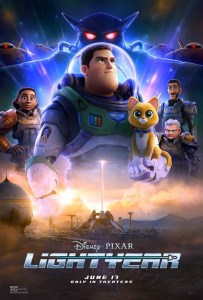 After two years and three movies sent straight to Disney’s burgeoning streaming service, Pixar returns with a theatrical movie that taps back to the very beginnings of this storied storytelling company. We’re told, via opening text, that Lightyear was Andy’s favorite movie and thus the reason he was so excited to bring home a Buzz Lightyear action figure in the first Toy Story. However, if this is Andy’s “favorite movie,” then this kid needs to be exposed to more movies. It’s an acceptable sci-fi story about Buzz (voiced by Chris Evans) learning the value of others and that being vulnerable is not the same as being weak. He’s a space ranger stranded on an alien world. Every time he attempts to restart their fuel system, it jumps him forward in time four years, and soon enough he’s a man out of time and those stranded have built a colony civilization over 100 years. There’s a band of misfits, who aren’t terribly funny, and some laser fights and action sequences, which aren’t terribly exciting, and the third act twist is predictable. The animation is top-notch, but the storytelling is definitely a few notches below infinity and beyond. What astounds me is that Andy could watch this movie and want a Buzz toy instead of the real breakout, the robotic cat Sox (voiced by Peter Sohn) who is wonderfully droll. I cannot fathom anyone watching this movie and desiring owning another character above this delightful supporting character. This movie makes me think a little less of Andy as a discerning arbiter of pop-culture zeitgeist. Lightyear is fine as escapist entertainment but too facile and inessential to the Toy Story universe.
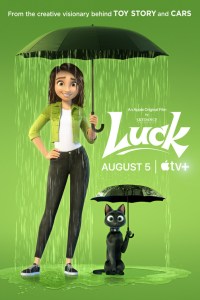 Luck is the first animated feature from Skydance, a production company that entered the animated realm by hiring former Pixar head John Lasseter as their chief creative executive. In some ways, Luck feels reminiscent of early Pixar movies, exploring the “secret life of” those in charge of dictating the forces of luck. The problem with Luck is that it is overwritten and overburdened with world building that crushes the emotional core. We follow a young woman aging out of the foster system and she’s been besieged with bad luck all her life. She follows a talking cat and discovers a hidden world where workers mine luck crystals and have lucky pennies as portal generators and there’s a dragon, for some reason, as the CEO of Good Luck, and to get back home she needs to team up with the cat to find a thing, but to find that thing they need to go to a place, but to go to that place they need to – and you get it. The plot is overworked with a chain of tasks that explain more of this world’s mechanics without connecting to the emotional journey of the character, like in 2015’s Inside Out. I was amazed that this woman lacks even a shred of bitterness about her own trenchant bad luck. There’s a nice message about accepting the bad with the good in life, and how both are opportunities for growth, but I kept wondering why our hero didn’t once lash out at those responsible. I’m also a little hesitant about using whether a little girl will be stood up by her potential new foster family as the stakes of completing the good luck reset goal. That seems pretty heavy for wackiness. The animation isn’t quite at the level of Pixar, or the best of Dreamworks, but it’s colorful and bright even if lacking more advanced lighting and texture. Luck lacks enough gravitas and development to really appeal to adults but it’s also probably too busy and convoluted to entertain small kids.
Nate’s Grades:
Lightyear: B-
Luck: C+
Share this:

The Time Machine (2002) [Review Re-View]
 Originally released March 8, 2002:
The Time Machine is one of the most famous works of fiction in history. It was writen long long ago by the great H.G. Wells. It presents a fantasy glimpse into our future, but in it Wells also gave readers the opportunity to ponder what would happen if they could go back and change their own lives. People have used the story as a cautionary allegory to our own times, like the 1960 film version of The Time Machine. Now, a bigger budget Hollywood remake attempts to put another spin on the Wells classic.
Alexander Hartdegen (Guy Pearce) is an absent-minded professor interested in cracking down the physics of time. He’s chided by some of his peers for crackpot theories and his fascination with any new gadget. He’s supposed to meet Emma (Sienna Guillory) at Central Park and tonight’s the big night he plans to propose to her. He eventually catches up to Emma and the two go strolling off into the park. Shortly after popping the question the two become victims of a mugging and in the fray Emma is left dead. The death drives Alex to create his fanciful time machine, which only happens to take four years time.
Alex gives his big brass LA-Z-Boy looking machine a try and travels back to that fateful night to avoid Emma’s death. Alex avoids the mugger all right, but while purchasing flowers his fiancé gets plowed over by a runaway carriage instead. It seems that one cannot change the past. Alex decides to give the future a chance and travels to a very Back to the Future 2 looking 2037. Someone astutely asks Alex if his time traveling machine makes a good cappuccino.
 When Alex hops a little further into the future the moon is breaking up because of ill-fated lunar construction. Moon rocks are hurtling toward the surface and disrupting everyone’s day. (It was in this moment that a scene of rocks smashing into the World Trade Center was cut for taste) Alex jumps back into his machine but is konked out by some lunar cheese and falls asleep at the wheel. The next thing you know Alex is in a mysterious future world.
The place where The Time Machine really bogs down is once Alex arrives in 80,000 something or other. The child-like thrills and adventure of Alex zipping between the past and near future are buried underneath the standard post-apocalyptic movie world. The people dress in loin cloths and rags (though some of the female natives wear revealing tops that look like see-through chain mail) but still have perfect teeth. When Alex doesn’t understand the linguistics of 80,000 AD the next words that he hears are English from Mara (pop star Samantha Mumba). It’s amazing that English survived 81,000 years when Latin didn’t last a mere 2,000 and change.
It turns out these people who live in huts resembling hot air balloons along the faces of cliffs are called Eloi. The Eloi don’t have anyone looking old enough to carry an AARP membership and are apprehensive to speak of why. Perhaps it’s because creatures resembling something that would belong in The Mummy Returns pop up from the sand to capture whatever slow moving prey they can and return to for an underground feast.
The creatures, called Morlocks, are the offshoots of evolution. Seems after the whole moon destruction thing (whoops!) those who took refuge below the surface have evolved into dusty hunchbacked cannibals. Their rowdy ranks are controlled by Uber-Morlock (I’m not making up that name) who resembles an albino bassist for Poison or Skid Row. It’s actually acclaimed actor Jeremy Irons under all that pancake makeup and fleshy spine-showing prosthetic. The less said about Irons the better.
It’s during this part that The Time Machine reverts into a half-baked Stargate. Alex encourages the Eloi race to stand up to their oppressors and fight for their freedom. He becomes part of the Eloi community, rallies the troops into rebellion, and also has to save the damsel in distress.
The Time Machine remake isn’t the political statement the 1960 film was on man’s folly with technology, particularly nuclear weapons. What this suped-up version is all about is special effects and plenty of them. The effects are for the most part dazzling, especially the scene where Alex travels to 2037 and we see the development of New York City with skyscrapers assembling themselves.
 Simon Wells (The Prince of Egypt) directed this remake and is actually the great-grandson of the famous adventure’s author, H. G. Wells. Trivial Pursuit fans everywhere rejoice. Wells had to sit out the last 18 days of shooting due to “exhaustion” and Gore Verbinsky came off the bench to finish the directorial duties. The film clocks in at a scant 90 minutes but there are definite moments of drag.
Pearce (Memento) is a hunky hero and for the most part is admirably gung-ho with the role. Samantha Mumba’s motivation must have been to stand and look pretty the entire film. To think that Mumba might be the most talented of the recent singers-come-actors (Mandy Moore and Britney Spears) is a distressing thought all its own.
As The Time Machine kept dragging into its Mumba-filled period, I began day dreaming of an alternate, darkly comic version. In my head, Pearce’s character keeps traveling back again and again to save his beloved only to lose her a different way each time. I could picture a humorous montage of his girlfriend dying an assortment of colorful deaths and Pearce just getting more frustrated and jaded. I could picture them skating only to have her plunge below the ice. I could picture the couple dining at a fine restaurant only to have her choke and Pearce just throw his napkin onto the table and sigh loudly. I was enjoying my alternate take on The Time Machine so much that I didn’t want to return to the one that was playing.
The Time Machine has its moments of thrills and excitement but they are mostly condensed to the opening third. This remake doesn’t have the political edge or wow-factor the original did. It plays more to the rules of conventional Hollywood than the wide open possibilities Wells wrote about. Pearce tries valiantly and the special effects are really something, but more often than not The Time Machine is not worth your time.
Nate’s Grade: C
——————————————————
WRITER REFLECTIONS 20 YEARS LATER

The 2002 Time Machine is fanciful schlock on the verge of being populist spectacle. It’s not just another adaptation of the famous H.G. Wells sci-fi novel, it’s also emerging from the shadow of the 1960 movie that broke ground in the realm of special effects. Storytellers will often find new relevant meaning to be mined from the resources of old, and literature with classic stories can still be compelling decades and centuries hence as long as they are served with care and empathy. In theory, another Time Machine movie could be a worthy venture especially in a realm of modern special effects marvels and a more socially conscious viewpoint. If the 1960 film was a cautionary tale about mankind’s impending doom from nuclear arms and technological hubris, you would think a movie born from the ashes of the Cold War would follow a different approach, perhaps something more in line with the colonialism critiques from Wells. It’s surprising then that the 2002 movie also follows the “be careful with your machines, mankind” thematic warning of the earlier version. It made me think of Tim Burton’s maligned 2001 Planet of the Apes remake where they could have gone with ANY ending possible except one, the original’s famous twist ending, one of the most famous endings ever, and what did the new movie do? The same ending. Re-watching the 2002 Time Machine, it’s more fun than it has any right to be and there are aspects worth celebrating, but much like its hero, it’s a victim of unmet potential.
 Firstly, this is a pretty entertaining studio movie that blows by quickly at only 96 minutes. The screenplay is by John Logan, the same writer with credits like Gladiator, The Aviator, Rango, Hugo, Skyfall, and other quite successful, quite large studio hits. And yet this movie doesn’t just feel like another paycheck for the man. The opening half of this relatively brief movie definitely feels like the favorite half. It’s here where the movie introduces the protagonist’s personal loss being the motivating force that drives him to make a time machine, something absent from the 1960 original and an exciting and emotional way to separate itself. Watching Alexander (Guy Pearce) go back to save his love has an immediate appeal, and watching him fail again brings forth the idea of being unable to change the past. Even twenty years later, I still think about the darkly comic version of this story, just as I did in my initial review in 2002, where Alexander tries again and again to save his beloved only to lose her to some new calamity. It would have a lighter approach even while dealing with darker humor, and it would certainly contribute to the film’s central thesis that man is unable to change the miscues of the past.
You would think The Time Machine would follow a theme about correcting the mistakes of the past to prevent future danger; many time travel tales follow a hero trying to thwart a terrible future, although sometimes they inadvertently cause that same terrible future in grand ironic tradition. This movie doesn’t really dwell on fixing the past but more so upon learning from it. During its post-apocalyptic second half, the focus isn’t on preventing it or going back to warn mankind of the folly of its ways. It’s about adapting to change, which can be viewed as defeatist or pragmatic. The future world of 800,000 years ahead is messed up because of the actions of mankind’s past, namely the lunar collision thanks to bad condo construction (thanks, capitalism!). It’s none too difficult to place a general ecological/climate change message in place, the exploitation of the present spoiling the future for generations yet to come. However, the movie isn’t about Alexander going back to teach mankind how to avoid its own mistakes. Unlike the 1960 original, he stays put in this uncertain future world with his new Eloi family and Eloi girlfriend (Samantha Mumba). He’s content to remain in this new time and live his life, ignoring the foresight of a time machine. There’s a message there about looking ahead in one’s life, not dwelling on the past at the expense of the future, but it’s also unexpected for a time travel action adventure. It’s usually about preventing the horrible future, not learning to live with it and make a better tomorrow. This also could be read as the present giving up on avoiding the mistakes of contemporary excess.
 You can probably tell what kind of person that you are depending upon which half of The Time Machine you prefer. For me, the first half has all the surprises and time jumping and fun, and the second half settles into standard post-apocalyptic rally-the-masses formula. It’s not bad but it honestly feels like an entire second act is missing from the development of the plot. In quick succession, Alexander learns he’s in a far-flung future, the customs of the Eloi, the danger of the Morlocks, their hunting practices, their cannibalistic impulses, what caused them, and then who their leader is, and how there are multiple Eloi-Morlock colonies throughout the world. It’s a lot of absurdly fast exposition that just unfolds to the convenience of our hero, and so little of it occurs from the virtual A.I. figure (Orlando Jones) that seems entirely designed to be an exposition device. It’s during the second half that the playfulness and ideas give way to a grungy future with efficient if unspectacular chase scenes from monsters. I am convinced that the Morlock leader played by Jeremy Irons was originally intended to be the older, more evolved, and more callous ends-justify-the-means version of Alexander. That kind of twist would have brought things back to the personal realm of those first minutes traveling through time. Alas, he’s just another monster with bad hair. It seems like wasted potential for the last twenty minutes of this movie to just be another climax involving blowing up the monsters and rescuing the damsel.
Apparently there was significant contention behind the scenes over the look of the Morlocks. The creatures were designed by the famous Stan Winston studios and then director Simon Wells and the producers wanted to change their look, making them more humanoid and recognizable. This infuriated the effects team who strongly disapproved of this creative direction. I appreciate that the production went to the trouble of expensive prosthetics and costumes rather than just making all of the Morlocks ugly CGI monstrosities. I was worried that twenty-year-old humanoid CGI would not age well, but thankfully I didn’t have to bother with that fear.
 This was the first live-action movie for Wells as director. He spent over a decade in the world of animation and helmed An American Tale: Fievel Goes West, Balto, and The Prince of Egypt. After the mediocre reception to The Time Machine, Wells didn’t direct another movie until almost ten years later, 2011’s Mars Needs Moms, a film that reportedly cost the studio over $200 million in losses. It was one of the biggest box-office bombs ever. It’s not much of a surprise then that Wells hasn’t been able to direct another studio movie until just this year, and even that is a small-scale adaptation of a children’s TV show, to the best of my knowledge. The man has directed two movies in the last two decades. On a more fortunate note, Wells has had steady work in his old field of animation as a consultant and storyboard artist for just about every Dreamworks cartoon (Kung Fu Panda, How to Train Your Dragon, The Croods, etc).
Re-reading my old review, there’s not much more to extrapolate. I agree with just about every word I wrote back in 2002. It’s fun for me when I watch these films twenty years later and have the same remarks in my head only to discover my younger self had the exact same response.
While not breaking new ground or even attaining its own creative potential, the 2002 Time Machine is a perfectly reasonable genre movie that you could put on and kill 90 minutes. It’s relatively fun, has some bigger ideas, and some surprising moments where it appears on the verge of poignancy. One of those is when the A.I., who has survived 800,000 years of isolation, talks about the misery of remembering every face he ever interacted with, cataloging every detail, and how this is tearing him apart and how valued having a lone friend was for him. It’s such a thoughtful and empathetic moment that seems to come out of nowhere and leave just as fast before you can really dig into it for genuine pathos. The Time Machine feels this way, like whenever it presents something intriguing, intelligent, or emotive, it then it has to veer sharply back to the bigger, dumber lane of blockbuster filmmaking for the masses.
Re-View Grade: C+
Share this:

The Adam Project (2022)
 Watching the trailer for Netflix’s The Adam Project, I wasn’t too impressed. It felt like a combination of familiar and popular movies like Back to the Future, E.T., and Looper. It seemed like another assembly of popular sci-fi movie tropes and I wasn’t expecting much else. Then as I watched the movie, I realized how enjoyable and engaging this original story by writer T.S. Nowlin was and what must have attracted Tom Cruise to want to star and produce this project in 2012. It met a long developmental hell, as is common in the industry, before being given a second life at Netflix with Ryan Reynolds as star and director Shawn Levy (Free Guy). It kind of muffs the action and sci-fi spectacle, but The Adam Project is a movie that’s big where it counts.
Adam (Reynolds) is a pilot in 2050 who is fighting against a corporate evil that uses time travel to enshrine its power. Adam’s own wife (Zoe Saldana) crash landed in 2018. In desperation, he travels back in time to find her and team up against their future foes, except he lands not in 2018 but in 2022, and he meets his younger, twelve-year-old self (Walker Scobell). It so happens that Adam’s ship is marked to respond only to his DNA, so he needs his younger self to help while he recovers from his injuries. Unfortunately, the future is antsy to eliminate Adam and sends killer super soldiers and missile-launching spaceships. Both Adams come to the conclusion the only way to prevail is to stop the initial first steps of the invention of time travel, meaning going back further to see their departed father, Louis Reed (Mark Ruffalo), the inadvertent creator of time travel.
 Where The Adam Project really shines is with its core ideas and relationships, which is the emotional heart of a movie. It’s peculiar because we’re so used to seeing the other half, the sci-fi action spectacle, prioritized at the expense of story and characterization. Usually a studio puts much more emphasis on a movie looking good, or at least passably entertaining, and less on the substance that would make it meaningfully so. Credit to the filmmakers that they understood what the core appeal of this movie was and that is the idea of characters out of time getting a chance to interact, learn, and reconcile. Who among us wouldn’t want another opportunity to talk with a loved one before they are gone? Who among us would not be hesitant to eliminate the special confluence of events that lead a special someone into our life? The idea of two different aged versions of one character butting heads is inherently fun but also meaningful, because every one of their squabbles or disagreements is telling from a character standpoint. We’re learning about the differences between these two versions and two different timelines. The older Adam is resentful of his younger self, of his naivety, and looking to toughen him up or settle some scores he thinks will be cathartic. The younger version resents his older self for being so domineering, for being so cynical, and for pushing him into uncomfortable situations to relieve long-standing grudges that he hasn’t dwelled over yet. It also allows older Adam to remember things that he has forgotten from the perspective of his younger self. The buddy banter is capable and spry but it’s also revelatory about the characters, which makes every interaction more important.
Adam’s father doesn’t come back until the second half of the film, and then the movie transforms into a real family affair and takes on extra pathos. Dear old dad is the square pushing back against the ethical implications of knowingly participating with time travel. Here we have three different characters, all related, but each has a different perspective and competing goals: Younger Adam wants to beat the bad guys but also is freshest in his grief over his dad and wants to save him; Older Adam wants to rescue his wife but also has a score to settle with his departed father; and Dad gets a chance to see his grown son, something he will never otherwise witness, but is adamant about refusing to help and prosper from time travel foreknowledge shenanigans. That’s a good combination of conflicts and personality differences, and through the relatable lens of broken relationships repairing between two sons and their father, it elevates each routine action moment later.
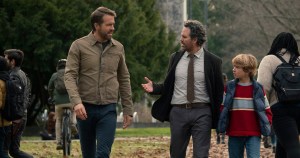 My other surprise was how mundane the action plays in The Adam Project. I started to notice how the action was usually pretty small-scale with only a handful of future soldiers fighting in relatively open and empty spaces. The big future addition is an electrified baton that older Adam utilizes, as younger Adam gushes, much like a lightsaber. It has the power to propel enemies in a force blast that launches out in a circumference, but I kept questioning why Adam wasn’t knocked over by this force as well? It’s a cool device but little else is utilized to separate the past and future. When the characters murder people, they vanish in fiery clouds, free of blood, and we’re told this is what happens when a person is killed outside their timeline. I think it was meant to make the audience forget the mechanics or downplay that all these vanishing soldiers are actually being murdered from existence. The younger versions of these characters are still present but it’s not like there’s another version that will take their place. Their lives ended in this moment as they traveled back in time to this final fate. No do-overs for them. The finale of The Adam Project is a mess of bad CGI and a world-destroying machine; both it and the plot are on apocalyptic autopilot at this point. The preceding movie was much better to simply fall victim to such a dumb climax. It’s not enough to dent the positives that came before it, but the movie succumbs to the pressures of big blockbuster silliness it had avoided.
Here is a vehicle that makes perfect use of the charms of its leading man. Reynolds (Free Guy) has always been a charismatic performer, a fast-talking rogue you can’t help but fall for, but not every movie role allows him to play to his strengths, Sometimes he’s just on quip overload and can come across like the overly ironic, insincere, vacuous version of his motormouth persona. His glib demeanor has a way of eating him whole. Here, the actor gets to essentially be playing off himself, and it works so much better. Reynolds is also a natural with kids (see 2008’s Definitely, Maybe) and there’s an inherent big brother/little brother vibe to the Adam interactions that makes them heartwarming while also amusing. Newcomer Scobell is able to hold his own with Reynolds, no small feat. He has a vibrant, excitable energy that feels youthful without getting into annoying Anakin “yippee” Skywalker territory. Reynolds may be the star but you’ll enjoy spending time with young Adam too, and this is also a credit to Scobell and his performance. Ruffalo and Jennifer Garner (a welcomed 13 Going on 30 reunion) are enjoyable if extremely under utilized; each could have had a whole movie from their vantage point.
 The Adam Project is an action movie that looks like typical pandering studio junk at first glance but gets the hard stuff right, namely the reasons why you should care about any of the flying bodies, explosions, and world-ending CGI. It’s about the characters, and here we have a dynamic that keeps things interesting and fun while also making the dilemma personable and emotional. The same stakes given to saving the world are also given to having one more conversation with a departed father or with trying to get things right in your past while time is still ahead of you. The Adam Project might be overlooked or discounted because of how its parts appear to be generic and stale, but it’s the care with which they are assembled that won me over. I’m just amazed that, for once, a Hollywood big-budget tentpole release emphasized the right stuff.
Nate’s Grade: B
Share this:

Donnie Darko (2001) [Review Re-View]
 Originally released October 26, 2001:
Donnie Darko (Jake Gyllenhaal) is your normal malcontent teenager in late 1980s Reagan America. He bickers with his older sister, worries over the right moment he’ll kiss his new girlfriend, and tries to ignore the advice of many imprudent adults. Donnie’s your typical teenager, except for his imaginary friend Frank. Frank is a sinister looking six-foot tall rabbit that encourages Donnie into mischief and gives a countdown to the impending apocalypse. And I haven’t even gotten to the time travel yet.
One night as Donnie wanders from his home at the behest of Frank, an airline engine mysteriously crashes through the Darko home and lands directly in Donnie’s room. The airlines are all at a loss for explanation, as it seems no one will take responsibility for the engine or knows where it came from. Donnie becomes a mild celebrity at school and initiates a relationship with a new girl, Gretchen Ross (Jena Malone). One of his classes consists of watching videos of self-help guru and new age enlightenment pitchman Jim Cunningham (Patrick Swayze). His school has even, under the persistence of self-righteous pain Kitty Farmer, persuaded Cunningham to speak and try to help students conquer their “fears.”
 Donnie is also seeing a therapist for his emotional problems and taking medication for borderline schizophrenia. Around this time is when Donnie starts to inquire about a strange old woman, obsess over the possibilities of time travel, as well as see weird phosphorescent pools extend from people’s chests. He also floods his school at the urging of Frank. This is no Harvey-type rabbit.
The longer Donnie Darko goes on the more tightly complex and imaginative the story gets. First time writer-director Richard Kelly has forged an excitingly original film that is incredibly engaging with charm and wit. He masterfully mixes themes of alienation, dark comedy, romance, science fiction, and a sublime satire of high school. Donnie Darko is the most unique, head-trip of a movie unleashed on the public since Being John Malkovich. Kelly has a created an astonishing breakthrough for himself and has ensured he is a talent to look out for in the future.
 Gyllenhaal (October Sky) is superb as disenchanted Donnie, a Holden Caulfield for middle suburbia. His ghastly stare conveys the darkness of Donnie but his laid-back nature allows the audience to care about what could have merely been another angst-ridden teenager. Swayze is hysterical as the scenery-chewing Cunningham. The rest of the cast is mainly underwritten in their roles, including stars Drew Barrymore (who was executive producer) and ER‘s Noah Wyle, but all perform admirably with the amount they are given. Not every plot thread is exactly tidied up but this can easily be forgiven.
Donnie Darko is a film that demands your intelligence and requires you to stay on your toes, so you can forget any bathroom breaks. The film is one of the best of 2001 but also one of the funniest. You’ll be honestly surprised the amount of times you laugh out loud with this flick. The theater I saw this in erupted every half a minute or so with boisterous laughter.
Donnie Darko is a film of daring skill and great imagination. You don’t see too many of these around anymore.
Nate’s Grade: A
——————————————————
WRITER REFLECTIONS 20 YEARS LATER
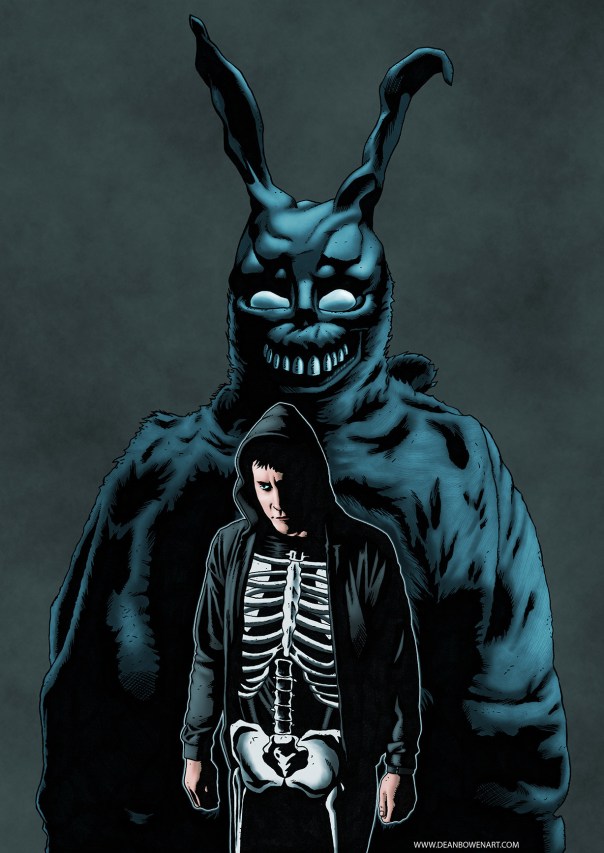
Not to sound too annoying, but I’ll cash in my hipster points here and declare that I was on the Donnie Darko bandwagon from the start. The eventual cult phenom was originally released in October 2001, mere weeks removed from 9/11, dooming its commercial appeal considering a major plot point happens to involve deadly airline debris. I was a sophomore in college across from a little indie movie theater, the Drexel, that was like a wonderful escape for a budding cinephile looking for his next fix of weird and daring movie experiences. I recall seeing the trailer for Donnie Darko and being immediately intrigued, but its release date kept bouncing back month after month until it finally opened at the Drexel in February 2002, and I was there opening day. I saw it twice, brought friends with me, and I wrote about it as one of my earliest reviews as my college newspaper’s film critic. I wanted to get the word out that this was something special. The first day it was available on DVD, I went to Best Buy looking for a copy and the store employee was deeply confused about its existence. He probably knows now, as the movie achieved cult status on DVD and became an iconic indie fixture for many a Millennial.
Revisiting the films of 2001 has been reliving many films that made such formative impacts on my life: Memento and its airtight structural sleight-of-hand, Moulin Rouge and its ambitious and messy celebration of old, new, reverent and irreverent, and now Donnie Darko (this isn’t even counting films I never wrote reviews for and thus were ineligible for this re-watch, like Hedwig and the Angry Inch and Amelie – 2001 was an excellent year at the movies). I have probably watched this movie more than any other in the 2000s, with the late exception perhaps of The Room that came on strong for me at the end. My friends and I would debate it, quote it, and work toward bringing others into the cult of Darko. Looking back now twenty years, I’m happy to report the movie’s power is still just as alluring and transcendental. What earned this movie its fawning fandom? Why did writer/director Richard Kelly, only in his early 20s, find success with his weird little indie while others went painfully ignored? I think it comes down to Kelly’s ambiguous approach, threading a delicate needle so that there are enough pieces present to put together an interpretation that can prove satisfying while personal and potentially different from your friend or neighbor with an equally valid interpretation.
 What helps is that Donnie Darko doesn’t feel like it’s weird for weird’s sake, like a formless collection of strange ideas and confounding imagery operating on an unknowable surreal dream logic. What Kelly has done is mix and match parts of an intriguing apocalyptic puzzle. There’s relatable high school drama about pushing back against the hypocrites and phonies of the adult world, there’s a mystery about who or what is behind Frank the bunny, the creepy otherworldly figure serving as Donnie’s Virgil-like guide, and the character study of a lonely, troubled kid trying to find a better sense of understanding of himself, his place in the world, and his sense of what lies beyond. I could just as readily view Donnie Darko as a spiritual refresher, and I’ve always sided more with a divine interpretation than sci-fi. Donnie and his therapist talk about the question over God’s existence and Donnie says he doesn’t feel like he can get anywhere debating it, so he has simply agreed to give up. Donnie talks about dying alone and how if everyone is resigned to do so then this must be a condemnation of God. Kelly establishes these early conditions as the beginning of an arc that leads to Donnie not just accepting a messianic status but volunteering for one, dying alone but in a manner that serves as victory. This to me is why he laughs at the end after being transported back to a fateful spot. He rolls over in his bed and closes his eyes knowing an end for him is not an end but a vindication (the honking from Frank the second time serving as a “we did it” victory celebration). Through his sacrifice, the world will continue (“I hope when the world comes to an end, I can breathe a sigh of relief, because there will be so much to look forward to.”). Through bizarre circumstances, a young man has found spiritual renewal, bringing him to a personal fulfillment as well as the larger picture of averting a looming apocalypse for a tangent world.
This has been my preferred reading of Donnie Darko, with divine forces selecting Donnie as the universe’s lone hero and mysteriously guiding him along his journey, each intervention and urging from Frank leading to the culmination of events that would convince Donnie of his duty. When Donnie is talking to Frank the bunny in an empty movie theater (playing a double feature of Evil Dead and The Last Temptation of Christ, one of my favorite jokes), he asks Frank, “Why do you wear that stupid bunny suit?” Frank turns and asks, “Why do you wear that stupid man suit?” Under my interpretation, Frank is a supernatural force, call it an angel or whatever you want, but he is not human and only using the form of a doomed man as a necessary vessel. When Donnie breaks into his school and breaks the water main, under the hypnotic control of Frank’s urging, we see that the vandal has also spray-painted “They made me do it” on the school mascot. The school and police go class-by-class and have students rewrite the phrase on a chalkboard, analyzing their handwriting. Donnie’s handwriting is clearly different. Could it be that Donnie, under the influence of Frank, also wrote as him, adopting his handwriting? With that, perhaps instead of Donnie writing a would-be confession it was actually Frank. “They made me do it,” Frank writes in apology to Donnie, not just for prodding him along but ultimately for the pain and suffering the real Frank of this world will cause for Donnie. “I’m sorry that all of this has to happen to you, Donnie. It wasn’t my choice. They made me do it for their plan.” I think that’s a more intriguing examination than Donnie just saying he was told to flood the school by his imaginary friend.
 This is one reason why I was not a big fan of Kelly’s eventual director’s cut DVD release in 2004, which added twenty minutes to the film and changed many edits, song choices, and special effects sequences. The director’s cut went too far for me, specifically spelling out Kelly’s vision of time travelers from the future trying to coach Donnie as their variable. Whole sections from Roberta Sparrow’s book, The Philosophy of Time Travel, were printed on screen, explicitly connecting the various pieces in a way that had previously been left as ambiguous. My disappointment with the director’s cut reminded me of the disappointment Star Wars fans felt when George Lucas went back and tinkered with the original trilogy. Lucas has said the re-releases were the films he had always intended them to be, that the earlier theatrical editions were the imperfect versions of his creative intentions. The problem is that millions fell in love with those versions of the movie, even if they were an imperfect vision of their creator. Richard Kelly always intended for the opening song to be INXS’ “Never Tear Us Apart,” but hearing that felt wrong to me after watching the same scene played to Echo and the Bunnyman’s “The Killing Moon” with the theatrical cut. Kelly’s imperfect version was the one I fell in love with, the one that spoke to me as a 19-year-old and as a 39-year-old, and that’s the one I vastly prefer.
Another reason for Donnie Darko’s success is more than likely the appeal and performance of young Jake Gyllenhaal. Over twenty years, Gyllenhaal has become one of the best actors of his generation and criminally overlooked by the Academy. He’s only been nominated for one Oscar for 2005’s Brokeback Mountain, not for 2017’s Stronger, or 2007’s Zodiac, or, most egregiously, for his hypnotically disturbing portrayal in 2014’s Nightcrawler. Gyllenhaal has mesmerized for so long and handles the many confusing aspects of Donnie with aplomb. It would be easy to play Donnie as a cliched rebellious teenager, but Gyllenhaal really digs into his questioning nature; he’s hungry for answers, desperate even, and tired of being disappointed in the adults of his life. That’s why it becomes emotionally satisfying for me when Donnie appears to achieve some semblance of answers by the end, his laughter is victorious and cathartic.
 Jake Gyllenhaal is terrific but the rest of the cast is outstanding. This was the first time I saw Maggie Gyllenhaal, as Donnie’s older sister, one year before her star-making turn in 2002’s Secretary (stay tuned, 2022). Jena Malone (The Hunger Games sequels) was a remarkably downhearted presence, able to imbue teenage heartache and unease so preternaturally. Ever since her role as the snitty, judgmental gym teacher Kitty Farmer, I perk up whenever I see Beth Grant in a movie or show. To this day I still consider her wondrous line reading of, “Sometimes I doubt your commitment to Sparkle Motion” to be one of the greatest achievements in mankind’s history. Mary McDonnell (Battlestar Galactica) has two scenes that still get me as Donnie’s mother, where she fights back tears at the suggestion of Donnie’s therapist to up his medication as doing what she thinks is right for her son, and a final scene with that same son where she responds to his query that having a “weirdo for a son” is, in fact, wonderful. The parental care and empathy that she exudes is poignant. I still laugh when Holmes Osborne, as Donnie’s father, cannot contain his inappropriate titter to hearing about his son’s vulgar outburst directed at Ms. Farmer. The adult actors (Drew Barrymore, Patrick Swayze, Noah Wyle) all got the bigger headlines at the time, but it’s these actors that have stayed with me the most.
With so many people being launched into success and acclaim from this movie, it’s a sad surprise that Richard Kelly himself was never able to recreate his winning alchemy. He wrote the shooting draft for 2005’s Domino, a needlessly excessive and irritating movie. His big follow-up, 2008’s Southland Tales, was a disaster at the Cannes Film Festival and Kelly cut a half-hour before it was ultimately released stateside to head-scratching. I was eagerly anticipating Southland Tales and then I watched it and minute-by-minute the sinking realization set in that this was not going anywhere and anytime soon. It was like Kelly was trying to throw every dispirit idea he ever had into one movie for fear he’d never make another. I haven’t re-watched it since and feel no need to do so. The last movie Kelly directed was 2009’s The Box, an adaption of the William Matheson short story featured on newer incarnations of The Twilight Zone. It too failed at the box-office, suffered from a confusing and muddled narrative, and from there Kelly was radioactive to Hollywood. He hasn’t a credit to his name since. With each directorial effort, you can feel Kelly trying to recreate that formula from Darko, bringing the different weird pieces and tones together by the end to form a satisfying mosaic open to interpretation. Southland and The Box both feel over-extended, strained, and cluttered with too much salient junk. I truly wish Kelly has another shot to tell a big screen story after everything he’s been through. I’m sure he has more stories to tickle our brains. Maybe he just needs an editorial guidance.
 The other thing of curious note is that a sequel, S. Darko, was released in 2009 starring Donnie’s little sister Samantha, played by Daveigh Chase (The Ring). It’s not very good at all and strains to be an imitation of its predecessor, right down to Samantha having to be the sacrifice to go back in time and save her friend’s life. Kelly had nothing to do with the sequel, which was written by Nate Adkins, who would go onto create the Netflix franchise, The Christmas Prince. There is nothing of note in this cash-grab of a sequel to even reward your curiosity in watching it.
Donnie Darko was a movie I loved when I originally saw it and I’m happy so many others were able to become fans and share the good news of Darko. I’m happy this movie exists and has stuck with me all these years. It’s still transporting and invigorating and funny and soulful and tantalizing. I still love the lilt of Michael Andrews’ minimalist score. I love the scene of Donnie reaching out to Cherita Chen, the target of rampant bullying, to promise her one day everything will be better for her. I still get fascinated by the instant-iconic design of that Frank the bunny mask, an image that has lead to thousands of Halloween costume imitations. My original review was more driven by distilling its plot so that I could hook a reader into making the trip for themselves. Otherwise, my thoughts remain relative the same in twenty years of reflection. This is a gem of a movie that was never really recreated by its creator, which makes it all the more remarkable and special. If you haven’t joined the cult of Donnie Darko, there’s no time like the present, folks.
Re-View Grade: A


 nathanzoebl
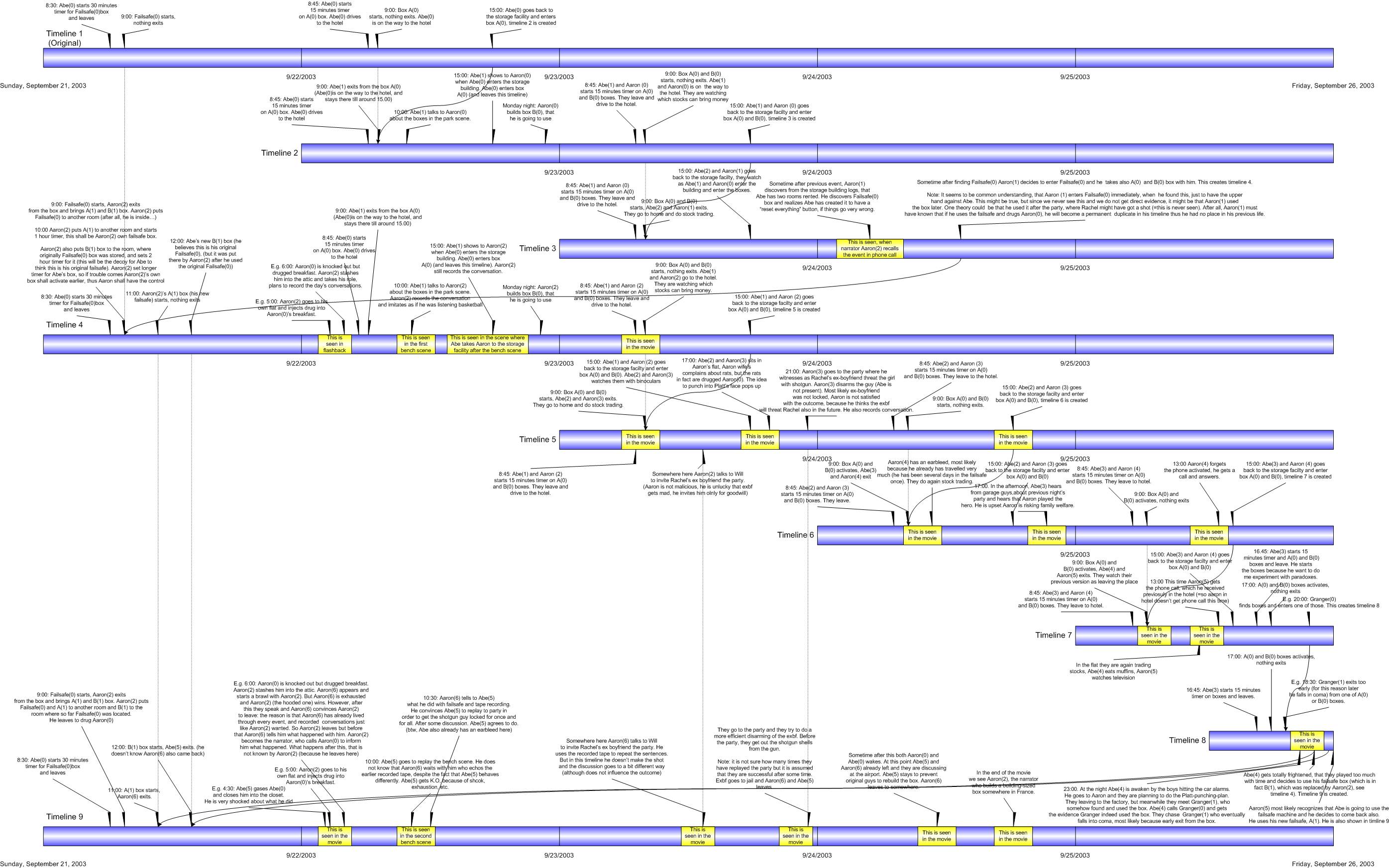
You must be logged in to post a comment.