Blog Archives
Drive (2011)
 Driver (Ryan Gosling) is a Hollywood stunt driver who has a lucrative side-project. For the right price, he can be hired as a personal driver. He gives the client a five-minute window. Whatever happens in that window, he’s their driver no matter what. Miss it and he’s gone. As you can imagine, this kind of job offer is mostly filled with getaway driving duties. Driver takes an interest in his apartment neighbor, Irene (Carey Mulligan), a young mother. Her husband (Oscar Isaac) has just been released from prison and already feeling heat to pay his debts. He gets winds of a pawnshop holding a million in cash. Driver offers his services to square the guy’s debt and to keep Irene and her son safe. But of course things go wrong, as they tend to in these sorts of pictures, and Driver is left with a sack of money and two very angry gangsters. Nino (Ron Perlman) and Bernie (Albert Brooks) would like the money back and to eliminate the number of people that know about their involvement in this scheme.
Drive is being sold as one kind of movie, a high-octane action thriller with plenty of car chases, when it’s really a European art-thriller paying fawning homage to those kinds of movies. That means that Drive plays out much more placidly and contemplatively with sudden bursts of gruesome violence. My audience seemed to grow restless with the purposely plaintive pacing so when the violence exploded they would laugh or cheer, happy that something of conventional entertainment value was finally occurring. I was growing restless myself, not with the infrequent appearances of genre action or the artistic flourishes, but just with the prevalent pauses. Danish director Nicolas Winding Refn (Bronson) will have his camera hold onto a scene for several seconds longer than what feels necessary, or he’ll shoot dialogue between actors and Gosling will pause a full 20 seconds before answering. I understand that Refn is establishing a stoic loner akin to Clint Eastwood’s celebrated stable of strong silent types, a modern American cowboy. I’m sure that you could cut 10 minutes of out the film just from snipping these extended pauses and overlong shots, moments that seem to be filling time and giving the audience an opportunity to step outside the movie. I doubt that was ever the intent but it’s certainly the effect. When a scene or camera shot holds on longer than it should, we can feel it, and when it keeps going we start to wonder why, and when an answer is absent then we start to snicker or second-guess the artistic choices. I’m sure audiences that watched Drive will probably be scratching their heads wondering why there isn’t more, well, driving.
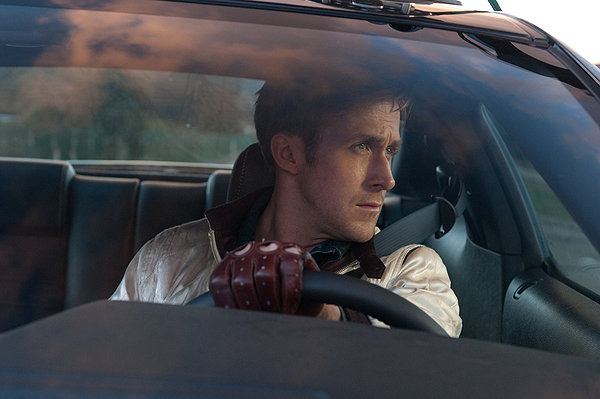 The action that does appear onscreen is extremely well choreographed. The car chases thrill and the edits allow for full audience orientation. You know what’s happening and you know what’s at stake. And we care. A car chase after a botched robbery is particularly exciting when Driver starts driving backwards to block his opponent’s view of the road. The opening chase sequence is notably almost an anti-car chase. Driver is listening to a police radio and choosing when to duck around side streets and wait out the patrolling cop cars. The tension isn’t watching one car chase another, it’s watching one car idly sneak away. What I’ve described, however, is about all the movie offers for car action, though Driver does ram one motorist off a ravine later.
You can tell Refn is a fan of Hollywood genre films, and Drive takes typical thriller tropes and puts them through an art-house prism, bringing a near Kubrickian level of beauty to the violence. Drive is a gorgeous movie to watch; the shot selections, the chiaroscuro lighting, the use of the 80s style Euro-synth score by Cliff Martinez (Traffic, Contagion), it all coalesces into a near hypnotic blend of visual and sound. It’s a beatific landscape even when horrible things are going on. There’s a sequence where Driver, Irene, and one of Nino’s thugs are in an elevator together. Driver notes the imminent danger and slowly motions Irene behind him. He then turns and kisses her, and while he does this the elevator lighting seems to brighten and darken, like it too is being charged through the power of a kiss. And then Driver sharply pivots, blocking the thug’s attack, knocks the guy to the ground and stomps on his head until it bursts. The looming violence is teased through slow motion, and then it hits with the power of a crescendo. The violence is always looming, always seeming to be just on the cusp of an explosion. But under Refn’s direction, the movie fulfills that audience bloodlust in unexpected ways. Instead of a big fight, Driver casually drowns one of the toughs in the surf of a beach. Instead of a brutal elimination, Bernie dispatches someone with what can almost be described as compassion, slitting a major artery and whispering, “It’s done. It’s all over. There’s no pain. Just let it happen.” Even the big showdown between Driver and Bernie plays out with flash-forward edits, giving the meeting an extra level of gravitas knowing what awaits when they leave the table.
Refn has created a beautiful movie, it’s just that it has so much empty space pretending to be nuance. And that’s the rub. I appreciate an art-house sensibilities elevating and celebrating classic American genre pictures. I though Joe Wright did an excellent job of this with Hanna earlier this year. However, Refn shortchanges his actors. The script by Hossein Amini (The Four Feathers) is light when it comes to character detail. Again, this might be because Refn wishes to make a statement on genre films by having his movie populated with genre types and sticking to this limited route of characterization. Whatever the rationale, it makes for some pretty elusive one-note characters. Irene is less a character than a symbol of innocence. It doesn’t help matters that Mulligan has little chemistry with Gosling. Nino and Bernie are interesting characters who have such unspoken histories. They’re mid-level criminals stationed out of a cheap pizza joint in a strip mall. Nino is tired of the criminal higher-ups always disrespecting him. Bernie used to be a movie producer in the 80s, and may have bankrolled something like Drive. He hates getting his hands dirty but he shows an eerie talent for violence. These small glimpses are hints at something more, but that is all Hossein and Refn leave us with.
 Gosling (Crazy, Stupid, Love) has very little to say in the film. He probably only ever speaks 80 words, but brevity does not mean he’s just sitting around. Gosling goes for understated in a genre known for histrionics. He plays things very close, a taciturn mystery man. The existential drifter. Gosling sure knows how to hone his flinty stares. Mulligan (An Education) gets very little to do in the film, so it’s another round of her crinkling her pretty face and blinking those glassy eyes. Christina Hendricks (TV’s Mad Men) also appears as a third wheel on the pawnshop scam. The real surprise is Brooks (The Muse). The famous comedian is shockingly believable as somebody you don’t want to cross. Even when he’s trying to be cordial there’s a veil of menace. If only there was more to his role. I would have loved to see him regrettably step back into his past, taking care of business with ruthless yet disdainful efficiency.
Drive is an action thriller that’s more a Euro-infused commentary on the genre. Fans of Hollywood action will likely be put off by the elusive characters, the sluggish pacing with numerous pauses, and the overall art-house nature of the finished product. Refn’s movie is beautiful to watch, with intricate precision taken to making the imagery and sound design mesmerize. If only that same level of care was paid to character and plot. We’re dropped into this criminal scenario and left to flesh out the characters given the hints and nods we accumulate in 100 minutes. I don’t need to be spoon-fed but I’d like my movie to have better attention to character than ambiance. Drive is a beautiful looking vehicle that just doesn’t have any particular place to go.
Nate’s Grade: B
Share this:

Red Riding Hood (2011)
 In risk-adverse Hollywood, everything old is new again, so why not remake classic fairy tales for a modern audience? After all, there’s no rights fee. While we’ll have to wait on the competing Snow White films until 2012, Twilight director Catherine Hardwicke unleashes her stylized retelling of the Red Riding Hood tale, titled easily enough, Red Riding Hood. This messy and incompetent movie may cause you to run away screaming into the woods all the way to grandmother’s house.
In a small village on the crest of the big bad words, Valerie (Amanda Seyfried) is betrothed to Henry (Max Irons), a hunky blacksmith that comes from a family of high standing. She’s rather run away with Peter (Shiloh Fernandez), the town’s resident moody guy who’s also her childhood friend. Valerie’s family is ostracized due to past indiscretions, so her grandmother (Julie Christie) lives in a cottage off in the woods. Valerie’s mother died when she was young and she’s been raised by her father (Billy Burke) and her step-mother (Virginia Madsen). This happy hamlet is gripped with fear after a series of violent wolf attacks. Father Solomon (Gary Oldman) ushers into town with a proclamation that he will find the wolf and slay it. But he clarifies that they are hunting for a werewolf among the townsfolk. During one attack, Valerie discovers that she has an odd telepathic link with the wolf, which makes her further question her identity. Naturally, this makes the town fear her and offer her as a red riding sacrifice. But who is the wolf and what is his or her plan with Valerie?
This is a disaster of epic fairy tale proportions. Red Riding Hood attempts to reshape the oft told tale into a palatable mix of sex and violence for today’s pre-teens (teenagers will surely be bored by this), somehow forgetting that the original tale is filled with macabre violence. The filmmakers have tried to make Red Riding Hood (RRH) hip to a younger generation; this ain’t your granny’s fairy tale, yo. But they’ve really turned the simple story into a lumbering, idiotic, grating, and nearly impenetrable movie. This youthful infusion of hollow artifice and misplaced attitude, as well as a fumbling attempt at ill-conceived edge, makes the movie a metaphorical bratty teenager. You get tired of its taxing nature and empty posturing. It’s trying to be cool with last year’s catalogue. Hardwicke is using every tool at her disposal to appeal to an easily bored teenage demographic, so the movie takes several sidesteps that are only justifiable because someone might think they are cool. The musical score includes grating, churning anachronistic electric guitars. It feels like your neighbors are throwing a party and the music occasionally drifts over. These visual and narrative flourishes only remind you how desperate and out-of-tune this whole lousy production is.
 Screenwriter David Johnson (Orphan) takes the familiar woodland frolic and turns it into the world’s worst Agatha Christie-styled guessing game. The wolf is now a werewolf and then the town undergoes a witch-hunt that would make Arthur Miller wince (“I saw Goody Red with the wolf”). It’s here that the movie preposterously attempts to become some sort of important statement on, I kid you not, the war on terror. Solomon brings a metal elephant that he sticks prisoners in to soften them up. He also lights a fire below the belly of the elephant to expedite the process of getting the truth out of a suspect. Solomon’s status as a cleric has to serve as some sort of biting criticism of church authority, especially after he wants to get an inquisition going. I appreciate the wholly misguided attempt at topicality and commentary, but this was not the movie to make statements. Anyway, the plot is convoluted and every scene seems to just further dilute the clarity of the narrative. The movie just descends into a manic game of “Guess the Wolf.” We literally go through just about every speaking part at some point as a potential werewolf suspect. That means every bit part is given due consideration, including the mentally handicapped child. I actively wanted the wolf to be the mentally handicapped kid just for the awkward discussions of what to do next (“We can’t kill the wolf. He’s… special.”). Red Riding Hood works so hard to make like 8 characters look alternatingly guilty. The town seems to be populated by red herrings and not people.
Red Riding Hood is a neutered horror movie and a rather bloodless romance; there’s a lack of blood pumping with either. For a movie about a killer wolf there is precious little blood or wounds even considering some people are mauled to death. It seems the filmmakers had a choice of going with mild gore or mild sensuality to stick the PG-13 landing and erred on the side of hormones. The romantic elements are kept at a pre-teen simmer. For only they will blush at the more suggestive elements, including the table-dance-in-slow-mo shimmy dancing that the town seems to favor during their festivals. At one point Peter unties one of Valerie’s bodice strands. To be fair, in mythical land/mythical time setting, that’s probably like their equivalent of third base. The romantic triangle is desperate to ape the Twilight model, and the male characters are pinup pinheads. They occupy types, one being the brooding “darker” guy who Valerie really wants to be with, and the other is a nice guy from a proud family (sound familiar, Twi-hards?). The movie goes to shoddy lengths to keep these two at odds, when it appears that, like Bella Swan, our Valerie is one flower not worth the trouble of plucking. It’s hard to get involved in a romance when you’d rather watch every participant getting eaten by a wolf.
 “What big eyes you have” is something of an understatement when speaking about the saucer-eyed Seyfried (Letters to Juliet). She gets to make good use of her ocular abilities, though who knows if it’s acting or just expressions of disbelief about what kind of movie she is trapped inside. Seyfried does her whole blasé shtick, which makes the character feel more like an annoying know-it-all even when she admittedly knows nothing. Oldman (The Dark Knight) inhales scenery at a dangerous pace, acting ferociously over-the-top and unrestrained. It’s like he’s trying to channel a wolf in his performance. At least he’s entertaining to watch, which cannot be said for the movie as a whole. Irons (Dorian Gray) is bland but Fernandez (Skateland) is laugh-out-loud awful at a few points. Clearly talking is not this guy’s strong suit. Neither is emoting. The weirdest part of Red Riding Hood is merely seeing Madsen’s face. Clearly this woman has undergone plastic surgery since her Oscar-nominated turn in 2004’s Sideways. She almost resembles a gentler looking Mickey Rourke at certain unkind angles. Another famous face goes to sad lengths to alter her looks to be seen as acceptably good-looking in ageist Hollywood.
Red Riding Hood is a tragic misjudgment on the part of just about everyone involved. The screenwriter thought he must have been making a serious allegory, Hardwicke thought she was making a wild and witchy cousin to Twilight, and the producers thought they were making a film that had genuine appeal. They were all categorically wrong. The reworking of the fairy tale elements is mostly mundane. She gets a red cloak from her granny but otherwise this story might as well just be about a girl and a werewolf. It’s not an imaginative update or a clever reworking, this is just a dumb werewolf story with extra dashes of Twilight for seasoning. The key to unlocking the Red Riding Hood story is not by introducing a sterile love triangle. This hyperactive hodgepodge mistakes setting for atmosphere and a high number of characters for mystery. I was astounded as I sat and watched this movie; turn after turn it veers wildly in tone and execution. I haven’t even talked about the special effects for the wolf, and there’s a reason I am leaving that unsaid. Red Riding Hood is a movie 12-year-old girls might fawn over. If you find yourself outside that marginal demographic, then you’ll likely find this movie to be an irritating, nonsensical, dopey, pitiful bore. You can stuff that in your picnic basket, Red.
Nate’s Grade: D
Share this:

The Debt (2011)
 A tense and mature spy thriller that’s as well written as it is acted, The Debt is a thriller that even stops to ponder some serious moral ambiguities along the way. Back in 1965, a group of Israel agents (Jessica Chastain, Sam Worthington, Marton Csokas) were sent to Berlin to capture a notorious ex-Nazi doctor (Jasper Christensen) and bring him back for justice. When things don’t go according to plan, the group must decide what is justifiable in the name of moral cost. In 1997, the aged former agents (Helen Mirren, Cirian Hinds, Tom Wilkinson) have to deal with the full consequences of their actions. A far majority of the film takes place in the 60s, and it’s for the best considering that’s where most of the tension and interest reside. As a thriller, drama, and non-linear mystery, there’s always something going on. The film is not without its genre clichés, but the sequences of holding Christensen (Quantum of Solace) hostage rise beyond genre mucking. He is a true monster and his dialogues with the various agents are chilling, reminiscent of Hannibal Lector’s tête-à-têtes. The cast is uniformly good, even Worthington, but the real star is Chastain (The Help, Tree of Life). She is magnetic. It’s a shame that The Debt felt it needed to tie up its loose ends in a conventional ending that discards the film’s more ambitious moral quandary. I suppose the toll of false identities and moral relativism just doesn’t make audiences happy like good old-fashioned vengeance. I guess that’s a debt everyone would rather have paid.
Nate’s Grade: B+
Share this:

Contagion (2011)
 For the germophobes amongst us, you probably want to skip seeing the new thriller, Contagion. Like for life. Never see this film if you’re the type that needs a paper toilet seat cover before sitting down to do their business. Contagion is a movie that makes you reevaluate basic human interaction. You may not leave the house again without covering yourself in plastic and a year’s worth of Purel. Director Stephen Soderbergh (Che, Ocean’s Thirteen) has assembled an all-star cast to drop like flies like only Hollywood’s most talented can do. Contagion is an intelligent, unnerving, technically authentic thriller that will make you cringe just watching people cough.
Contagion’s main character is a virus that begins its origin in a Hong Kong casino and quickly spreads from there. A British model takes it to the UK, a Chinese waiter goes home infected, a Japanese businessman keels over dead on a return trip home, and Beth Emhoff (Gwyneth Paltrow) comes home from her business tripe back to Minneapolis and goes into seizures. The next day, she’s dead and soon after having her brain dug out for an autopsy. The spooked docs alert the Centers for Disease Control immediately; something is definitely wrong with Paltrow’s brain (insert Coldplay joke here). The head of the CDC, Dr. Ellis Cheever (Laurence Fishburne), and his specialists track the expansion of the virus. He dispatches Dr. Erin Mears (Kate Winslet), to Minnesota to coordinate inter-agency action and interview Beth’s husband (Matt Damon), who appears to be immune to the virus. He’s in shock and isolated from his remaining daughter. He’s still trying to make sense of how quickly everything fell apart for his family. Capitalizing on fear, anti-establishment medical blogger Alan Krumweid (Jude Law) steers a panicked public toward a homeopathic medical alternative that he just so happens to have a financial stake with. The World Health Organization sends Dr. Leonora Orantes (Marion Cotillard) to investigate the Hong Kong casino and overview hours of security footage to glean the origins of the virus. But she, like others, soon find themselves in ever-increasing danger as the world races against time to beat this new threat.
For those expecting an action-thriller with plenty of doctors barking moral quandaries and racing against time to escape government agents… you will be sorely disappointed. Contagion is much more cerebral, cool, like a scientific procedural that plays the premise out in a realistic fashion, which means it’s often short the fireworks that mainstream audiences have come to expect from disaster movies. The CDC is really the main setting as they try and determine the origin of the virus, breaking down the virus, and projecting its rate on infection and contamination. Soderbergh has onscreen titles indicating how large the population centers are for the plot settings, reminding us simply with text how vulnerable to danger all those people are. The real pleasure of the film is watching A-level Oscar actors puzzle out how to solve this multi-faceted crisis. The movie does a minimal amount of explanation and expects an audience to be able to keep up with its scientific analysis. Soderbergh’s film is much more in keeping with The Andromeda Strain than Outbreak (find that monkey and all will be happy again!). You witness smart people doing smart things and still making little traction. This isn’t necessarily Irwin Allen territory of disaster. It’s a disaster that seems all too reasonably possible rather than being trapped in the belly of a ship that has turned upside down. Getting sick is a lot harder to avoid especially in our modern world. Globalization has done many wonders for the world, but by making the world a smaller place it also means that we’re all much more susceptible to the spreads of pandemics. No longer can geography be held as a total defense. We’re all one flight away from the spread of the next great illness (as the end credits to Rise of the Planet of the Apes also remind).
Soderbergh and screenwriter Scott Z. Burns (The Informant!) cast a wide net all over the world to see the ramifications of crisis. Things go rather quickly. By the end of the first week, the CDC is coordinating its resources and media strategy to not inflame panic. Easier said than done when ignorance and fear are in large quantities. The reaction to the news, the intra-government squabbles over resources and money, the exploitation of fear by opportune business types, the rising resentment of those left out of the loop, and even the kidnapping schemes for those known to have access to medicine. Contagion works because it gets the details right without losing track of the big picture. The film feels eerily plausible at every beat. Nurses are on strike refusing to be near the sick until uniform safety protocols are established. Funeral homes refuse to handle infected bodies out of health concerns. These are absorbing details that feel completely authentic yet would easily have been overlooked in other disaster pictures. The movie even addresses recent pandemic fears related to H1N1, SARS, and the perceived “overreaction” when these potential worldwide disasters turned out to be milder bugs. A government agent asks the head of the CDC if some terror organization could have weaponized the bird flu. “They don’t have to. The birds are already doing it,” the CDC head replies.
While Burns lies out a host of characters and scenarios with increasing tension as stakes mount and the death toll rises, Contagion just kind of drifts into an ending for the last 20 minutes. I was expecting another big wallop, some kind of sudden plot turn that reestablished an ongoing threat, but it wasn’t to be. The tension just sorts of lets out slowly like a balloon, playing against movie laws. That means that Contagion, wile tense, eschews a dramatic buildup for a climax. Burns and Soderbergh instead to play out their realistic “what if” experiment to its conclusion, which makes for a realistic if somewhat inert final act. There’s no chasing monkeys or butting with government agents willing to sacrifice infected town for “the good of mankind”; it’s just government employees doing good work and trying to minimize damages. It’s exciting to watch smart characters break down a nasty new virus and try to understand it and get ahead of it, but once they succeed, it’s not as exciting to watch the aftereffects of people getting better and returning to a normal existence (minus 30 million people on the planet – the solution to fixing unemployment?).
 Because the emphasis is on the cross-sections of plot and scientific breakdown, the emotional connection to the characters is limited. There are a lot of famous faces that appear in this movie; even bit parts are taken up by the likes of Bryan Cranston (TV’s Breaking Bad), John Hawkes (Winter’s Bone), Demetri Martin (Taking Woodstock), Enrico Colatoni (TV’s Veronica Mars). Damon (The Adjustment Bureau) is probably the closest thing the film has to an emotional center. He’s immune to the virus but he has to watch his family fall apart with the knowledge that his wife was Patient Zero. On top of that, he has to deal with the fact that she was cheating on him. That’s a healthy brew of emotions to confront in such a heightened situation, and Damon does a nice job of putting a human face to the mass tragedy. Winslet (The Reader) is superb as a CDC investigator, so duty-bound that even when she awakes to discover she has become infected she goes through protocol trying to investigate who serviced her room so that others will not share her fate. Law (Sherlock Holmes) is suitably sleazy as a moral relativist trying that uses his army of Internet followers to discredit the government’s response. Fishburne (Predators) has terrific poise as the man in charge of scrambling the response forces, keeping his cool, and being the public face of the government response until an all too human scandal tarnishes him. But perhaps the best performer is Jennifer Ehle (Pride and Glory, The King’s Speech). She plays one of the chief CDC scientists studying the virus and takes some extreme measures to test a potential vaccine. She has a scene with her sick father that is likely the most emotionally affecting moment in the film. Her sturdy determination even when most vulnerable is selfless.
Contagion is a smart by-the-book procedural thriller that may not be dramatic enough for audiences fed by Hollywood disaster films. The film is far more analytical and detail-oriented to its benefit and sometimes detraction. It’s got stars galore and some plenty of rising tension, but the film also follows a realistic blueprint toward a rapid world response to a new pandemic, which means that well-developed characterization is spared amidst all that fraught scientific lingo. As a result, Contagion feels more like a docu-drama than an amped-up Hollywood thriller with its finger firmly pressed upon American anxieties. Contagion is a bit overextended and data-heavy. It’s a stripped down indie in studio clothing. Soderbergh’s movie is a bit too lean and clinical to be fully satisfying and emotionally engaging, especially with its somewhat inert ending. It’ll sure make you look at free bowls of peanuts differently. And Gwyneth Paltrow’s skull.
Nate’s Grade: B
Share this:

Skyline (2010)
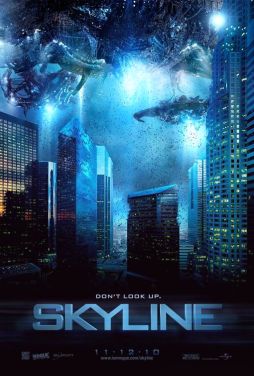 This movie is out-of-this-world terrible. Who wouldn’t want to spend an alien invasion stuck in some L.A. condo with a load of insufferable Los Angelinos? From a storytelling standpoint, watching characters I don’t care about talk about amazing and horrible things happening off camera is not the best use of anyone’s time. Skyline is a movie that keeps surprising you with the depths of its stupidity; just when you think it couldn’t plumb any deeper, the aliens have invaded to eat our brains. Yes, they’re after our brains. So that explains why gigantic monsters will claw away at a building, scrounging for the tiniest morsel of human (that still doesn’t explain it, really). That does not explain why they targeted L.A. if they’re after brains. The special effects are notable for a $10 million dollar movie, but due to the budget restraints, that’s probably why most of this alien invasion is spent indoors and behind trusty sets of Venetian blinds. The pacing is as shoddy as the character work. I kept waiting for these nitwits to step into the light and be vacuumed up into the alien mothership. The end almost looks like it might redeem part of this monstrosity, with our survivors accepting a doomed fate together. But then… I can’t even put into words how shocking, dreadful, and groan-inducing the true ending is for this junk. Suffice to say, it ends with zero resolution, a jagged plot left turn, and setup for a sequel that I’m absolutely positive not one person will be demanding.
Nate’s Grade: D
Share this:

Hobo with a Shotgun (2011)
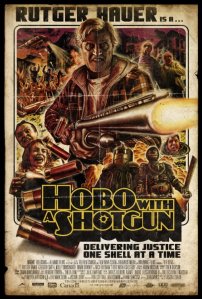 Consider the ultraviolet, gleefully vulgar movie Hobo with a Shotgun is the SECOND feature-length film that began life as a fake trailer for the 2007 exploitation opus, Grindhouse. Except this film began as a fan-made trailer to win a Grindhouse contest. Director and co-writer Jason Eisener’s winning entry followed a homeless defender of the streets, a hobo who found himself thrust into greatness thanks to oen fortunate shotgun. The two-minute fake trailer became a viral hit, was even attached to Canadian prints of Grindhouse, and Eisener was asked to extend his bloody trailer into an actual movie. He scored Rutger Hauer (Bladerunner, The Hitcher) as the star. finally, an actor from the 1980s who begs for change – on purpose! Hauer’s hobo rides the rails into a very Canadian city (the hookers say “aboot” – it’s cute) discovering an urban landscape overrun by scum. Drug dealers, gangs, pedophiles, crooked cops, all under the thumb of crime boss, the Drake (Brian Downey) and his two sons, Slick and Ivan (Nick Bateman and Gregory Smith). Can one hobo, shotgun in hand, inspire a city to stand up?
Hobo with a Shotgun is a movie that lives up to its very title. It’s a gleeful, jubilantly violent, colorfully over-the-top genre exercise that doesn’t push your nose in its campy excesses. But it is excessive, and to what effect? If you stop to catch your breath, you’ll start to realize that there isn’t a whole lot holding the film together. It barely covers 80 minutes and that’s with a lot of wheezing to get to the finish. The plot is mostly a series of beheadings, stabbings, and, of course, gunshots. Sure it’s a fun throwback and meant to be entertaining due to its homage to awful exploitation films, but it’s a one-joke movie that’s pretty hollow at its center. He’s a hobo, he’s dispensing justice (“one shell at a time” a newscaster reports), that’s about all there is, not that I expect a film with a title like Hobo with a Shotgun to tackle weight philosophical topics (the titular hero seems like a figure that would give Ayn Rand fits). If somebody wants to go to the effort of making the hobo some metaphorical everyman, lashing out at a society he feels impotent and angrily displaced by, then by all means. This is not a film with commentary in its blood. It lacks the creative consistency of a Black Dynamite or the narrative pulse of a Planet Terror, or the genre-rattling re-purposing of a Tarantino effort (have your pick). But the violence is often brutal and sickeningly clever, sating base appetites.
 This is a movie chiefly about grotesque characters, grotesque violence, and grotesquely dark and demented laughs. Luckily, the film has a finely attuned sense of humor that elevates what otherwise might be static genre exercises. The film is fully aware of its outrageousness. One of the Drake’s thuggish sons literally walks around with ice skates on before confronting the hobo of fame. He declares somebody’s going to be “skate raped.” He then uses these unorthodox shoes as an unorthodox weapon. A hooker (Molly Dunsworth) with a heart of gold saves the hobo. He remarks, without a hint of irony: “You’re smart. You should be a teacher.” He then refers to her as a teacher for the rest of the film. They develop a bizarre relationship that involves the shared desire to see a bear in a zoo (no joke). A cop reasons, “Well at least he’s only shooting the dirty cops,” in reference to the hobo, to which the chief responds, irony-free, “We’re all dirty cops!” A pedophile is dressed up as Santa Claus and abducts children, including one who bangs on the back windshield of a car as it drives by our hobo. The fact that it happens not a second later than two or three other incidents of crime, creating a melange of overrun criminality, made me giggle. And some of the jokes in this movie are dark; I’m talking scorched earth dark, but I was howling throughout. Now you know where my sense of humor lies. The newspaper headlines decrying the vigilante uprising have a frenzied penchant for rhyme and overly serious statements that are often hilarious (“Hobo Refuses Money, Demands Change”).
Eisener takes care to make his film look like a relic from the 1970s, from the low-budget mayhem, to the ominous synth-laden score, to the highly saturated film colors that advertise being phony “Technicolor.” His camera is antic, constantly swooping to find its intended target, and the cinematography feels grimy, constantly lit by strong neon colors like Joel Schumacher was a paid consultant. Eisener would do best to settle down a bit at times. His direction is a little too erratic, a little too antsy, like he’s constantly afraid that his audience will turn on him. Hobo with a Shotgun is a loving yet messy and uneven homage to the schlock movies of old, and your enjoyment level of this flick will depend greatly on whether or not you appreciate movies aim low on purpose. The crazy nature of the film, its frenetic pacing, and its strong sense of humor will delight fans of trashy cinema. The rest of the audience will probably just view it as trash.
 Hauer is a classic movie tough that actually has a bit of a soul inside those steely blue eyes. He’s an actor that’s been giving small, quietly menacing performances over the last decade. He plays the character completely straight, which makes him far funnier and even somewhat surprisingly sympathetic and less sociopath than a Travis Bickle-esque figure that wants to cleanse society through blood. His dream is to own a lawnmower, which he loftily dreams of opening his own lawn care company. He’s spat on, beaten, and treated without a shred of respect. To many, the hobo is just a nuisance at best and a subhuman lecher at worst. Hauer doesn’t even have to say a word, just hang onto his weary grimace and it says enough about the character. The hobo character makes for an interesting dispenser of justice, though the character is little more than a concept with legs. However, Hauer makes this hobo one for the ages. Way better than the creepy magic hobo from The Polar Express.
The movie is more fun than it should be and at the same time the movie is nothing more than the power of its admittedly awesome title. This seedy, blood-soaked is destined to be an acquired taste for a select few, however, I doubt anyone will randomly stumble into something as provocatively titled as Hobo with a Shotgun. This is a self-aware B-movie celebration of the grindhouse canon while giving is a gentle parody nudge; enough to capture a wink without going into camp. It has enough of a chaotic energy and cracked sense of humor to make up for its narrative deficiencies. Hauer somehow finds a soul inside his cartoon hobo, which is more than I can say about any of the other actors. But when you’re in a movie with burning school children, pedophilic Santas, oddball lines like, “When life gives you razors… make a baseball bat filled with razors,” and a hero who dreams of owning a push mower, well, you’re not expecting Shakespeare.
Nate’s Grade: B
Share this:

Hanna (2011)
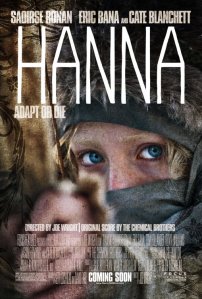 We all seem to love child prodigies. The concept of someone so small doing something well ahead of their years seems to fascinate our minds. I suppose the same holds true for professional killers. We all seem smitten with teenage depiction of super-powered killing machines. Last year presented Kick-Ass whose real star was the adolescent Hit Girl (Chloe Moretz-Grace), pint-sized reaper of carnage. Then there’s River from Serenity, Gogo from Kill Bill: Volume One, the ladies of Sucker Punch, the Heavenly Creatures girls (at least this one is based on a true story), and pretty much half the cast of Battle Royale. Just wait until The Hunger Games comes to screens in 2012, built upon the premise of 12-18-year-olds fighting to the death on national television (so the premise is almost exactly Battle Royale). We love our innocence mixed with ironic cynicism. Along comes Hanna, the tale of another teenage girl leaving a trail of bodies in her wake.
Hanna (Saoirse Ronan) is a sixteen-year-old girl living above the Arctic Circle with her father, Erik (Eric Bana). She’s been in survival mode all of her life, preparing for a day when she would finally break free and seek vengeance. CIA Agent Marissa Wiegler (Cate Blanchett) killed Hanna’s mother and has been lying in wait to finish the job, eliminating the rest of the family. Erik has taught his daughter well to think on her feet, master several languages, and become an excellent marksman/fighter. Hanna makes the choice to set their plan into motion. She triggers a device that signals to the CIA where they are. Marissa sends a crew to pick up Hanna and Erik, but only finding the girl. Once in an underground CIA compound, Hanna turns her focus on Marissa, killing her double (good call, lady), and breaking out of the compound. She finds that she’s been taken to Morocco. Fortunately, a family is traveling through the land and Hanna can catch a ride before she meets up with dear old dad in Berlin. Marissa sets out on a manhunt to find Erik. She hires a group of German criminals (led by Tom Hollander) to retrieve Hanna (“I need you to do things my agency will not let me do,” she reasons). Everyone is on a crash course to Berlin, where Hanna’s mysterious origin will be finally revealed.
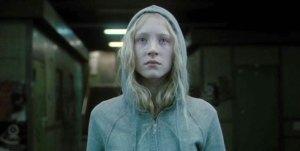 Director Joe Wright blew away all my expectations for him. The British director was mostly known for visually lavish period pieces like Pride and Prejudice and Atonement. This is a drastic change of pace and proof that the occasional art director can produce a great-looking, meditative action thriller that still delivers the goods. Wright’s camerawork is beautiful, making artful use of composition, lighting, and editing to deliberate purpose. There were several moments that I just got caught up in the look of the film, aided by the energetic if sadly too-often absent score by The Chemical Brothers (I love the chunky bass groove on “Container Park”). I was just impressed what could be produced under the guise of action cinema. This is an elevation of the genre. Wright’s color palette is awash in ominous reds, soft blues, and delicate yellows, which helps give the film this painterly approach to photography. Pay attention to the dream-like visual metaphors connected to fairy tales (Marissa seems to have a tooth cleaning fetish –“What big teeth you have…”). At the same time, Wright knows how to stage a terrific action sequence. His signature tracking shots allow the audience to become enveloped in the action, taking in the punches and kicks without the disorientation of the popular erratic editing style of modern action cinema. Bana taking down a bunch of goons in a subway level is made more thrilling because we see every second of activity, allowing the moment to build in tension as he is followed, then cornered, then strikes out.
17-year-old Ronan has left the awkward pubescence of The Lovely Bones far behind her. Like her Atonement director, she too steps far beyond our concept of what she is able to perform. Ronan is a five-foot-tall wrecking crew. She keeps her eyes intensely focused, tense blue orbs. At the same time that she convincingly kicks butt up and down the screen, Ronan successfully communicates the internal drama of her character. Hanna is an outsider trained her whole life for a single purpose. When she’s left in a Moroccan back room, Hanna is overwhelmed by the cacophony of noises by electronic appliances, at a loss to make the melange of sound cease. She’s a victim of her own upbringing and her father’s quest for vengeance. Ronan keeps her icy cool demeanor when she means business, but the Irish lass and her straw-blonde hair manage to find the girl inside the super girl. Bana (Star Trek) is suitably stoic and conflicted as the father, and all hail Blanchett (Robin Hood) as a good villain for once. With her Southern drawl, she presents an alluring sense of menace throughout without breaking down into over-the-top histrionics. Blanchett is so good as a slippery CIA agent that you wish she didn’t farm out her villainy to a group of German goons.
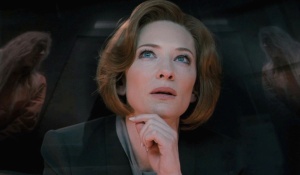 What holds Hanna back from greatness is it uneven natures of its plot and the lack of sustainable action. The movie is just as much a strange coming-of-age saga for a girl who was raised in the woods. The lengthy travelogue with the British family from North Africa through Spain kills the film’s momentum routinely. Things will start picking up, the excitement builds, and then we cut back to the goofy caricature of a flighty liberal family (Olivia Williams and Jason Flemying as the parents). Despite the painful “do what you feel?” parenting cues, the family unit seems to have some level of functionality. These scenes are meant to contrast with Hanna’s own upbringing. It’s meant to show the life that Hanna has never been allowed to choose. But I got that rather quickly. Also, if you want to sell the “alternative path” contrast it would have more impact if this foil family were more appealing and less annoying. Even moment Hanna tags along as a stowaway with this family it disrupts the momentum. I understand that Hanna needed some narrative excuse to get from the rocky deserts of Northern Africa into central Europe, but when you’re dealing with a super kid, why rely on her just hitching a ride with a van full of hippies?
What really let me down was the lack of sustainable action that developed. While I’ve already credited Wright’s handling of the onscreen fisticuffs, I just wish there was more of it. The action occurs in spurts that fail to keep up. That tracking shot fight sequence is wonderful, but it’s too short. Hanna taking out men twice her size is undeniably enjoyable, but short of an excellent sequence of hide-and-pummel through a cargo ship yard, Hanna is never put in a position of risk. Sure she’s in danger but she’s never overmatched, which is part of the reason why the action sequences only happen in bursts. Her competition never seems to be truly threatening. Hollander (looking eerily, eerily like celebrity blogger Perez Hilton) in white bike shorts is not that intimidating. He’ll stand out, which might not be what a CIA agent wants when she hires goons to track and kill a super kid, but he’s never more threatening than Henchman #2 status, though he’s been irresponsibly promoted for the purposes of this movie. I realize that Wright and his screenwriters, Seth Lochhead and David Farr, wanted a character-based action thriller. Hanna is that film, but it could have been a more thriller vehicle if more attention was spent on the realities of their dramatic setup. The problem with making Hanna a super kid warrior is that she needs either BETTER competition or MORE competition. Pick one. But having a small number of inferior toughs seems like the worst outcome for people who want solid, sustainable action.
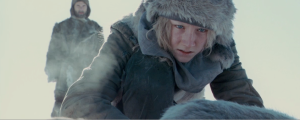 The plot of Hanna is fairly conventional but the style and feel of the film are anything but. Wright has assembled a first-class art-thriller that would have been a work of true greatness if the plot could have gotten itself figured out. Splitting time between action set pieces and a family road trip is not an ideal use of running time. The action works fantastic, that is, when it does make its too-brief appearances. I’ve read several comparisons to Run Lola Run due to the stylized visuals, pace-setting electronica score, and likely general German setting, but I feel these comparisons are surface-level; Lola was a firecracker of style and energy rarely replicated in film (it’s my go-to film to show people who are self-described haters of foreign films). Hanna is no Lola, but Hanna is still a class ahead of her peers. Wright and company have produced a film that is moody, stylish, thrilling, and just a little bit ridiculous. As Hanna says to her prey, she just missed your heart. Whether that’s by design or accident, we’ll never know.
Nate’s Grade: B
Share this:

Unknown (2011)
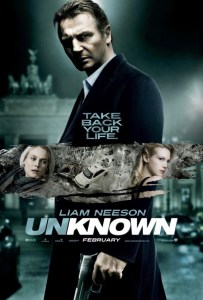 With Liam Neeson kicking ass in a European country, fighting a nefarious conspiracy, and trying to reclaim what has been taken from him, you’d be excused for thinking that Unknown is a sequel to the highly popular Taken. And the films do share plenty in common. Both involve Neeson trying to regain his life against a ludicrous conspiracy, and both are equally ludicrous in their action sequences, and yet both are fun, passably diversionary entertainment. Neeson gets into a car accident to find that his wife (January Jones, blankly Betty Drapier wherever she goes) doesn’t recognize him and enjoys the company of another man asserting the identity of Neeson. Is he really crazy? That idea lasts about ten minutes before the bad guys and their bad guy accents come to kill Neeson and tie up a loose end. The action is swift, well edited, and fairly exciting, a highpoint being a thrilling car chase through the streets of Berlin. The movie has enough clues and questions to string along an audience, though by film’s end you wish you got more scenes with Neeson in full-on attack mode, as seen in Taken from start to finish. What is it about losing one’s memory that always turns men and women into better people? Perhaps prison rehabilitation should consist of a Flinstones-esque treatment of knocks to the head to adjust moral consciousness for the better.
Nate’s Grade: B
Share this:

A Nightmare on Elm Street (2010)
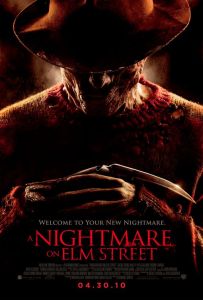 The next in an endless assembly line of vapid horror remakes, a new trip to the realm of Elm Street at least held some promise. The famous boogeyman Freddy Kruger was going to be played by Oscar-nominee Jackie Earle Haley (Watchmen). Has any other actor of Haley’s caliber played a blatant slasher villain in recent memory? And the playground of the Nightmare on Elm Street franchise was the world of dreams, which should be fruitful territory for some bug screen chills. I mean you don’t have to adhere to earth logic anymore, not that horror movies tend to. I didn’t expect much but I expected the movie to do more. Many of the signature moments from the first film are simply repeated. How does an entire school of young kids forget that Mr. Krueger molested them? What is the point of hiring Haley and giving him nothing to do? Lead actress Rooney Mara (soon to be seen in as the “girl” in David Fincher’s Girl with the Dragon Tattoo) looks as bored as somebody watching her movie. Her performance is lifeless for a film that requires energy and action. There is such wasted potential in the world of reams and personal fears. The whole movie just feels so rote and routine, following an established pattern of terrorizing the teens and knocking them off one-by-one; you get an overwhelming impression that everyone was just going through the motions, repeating someone else’s song and not bothering to make it their own.
Nate’s Grade: C-
Share this:

The Eagle (2011)
 In 140 AD, the Roman Empire has spread its reach across the European continent. Commander Marcus Aquila (Channing Tatum) is stationed in northern Britain. 20 years earlier, Marcus’ father led a legion of Romans into the northern British territory. The natives attacked them and Rome’s golden eagle, a significant idol under the guidance of Marcus Senior, was lost to history. Marcus has endured shame and vowed to redeem his family name. After surviving a nightly attack at the fort, Marcus displays great bravery but is injured. He’s honorably discharged from the Roman military. While he regains his strength, Marcus plans on venturing into the northern British highlands and finding that missing eagle. He teams up with Esca (Jamie Bell), a slave whose life he saved, and the duo goes beyond the wall that separates civilization (Rome) for the wilderness (native Britons).
Too often The Eagle feels like its wings were clipped. With such life and death stakes, the movie feels curiously adrift and prosaic. It never feels like it has any rush to go anywhere. In some regard, that makes the film feel like a product of the Hollywood of old, where a plot was allowed to meander and marinate to build to something worthwhile. But The Eagle is hardly worthwhile. It begins with some amount of excitement but that quickly dissipates with an interminable middle that feels like it’s still going on even as I write this. The plot is far too lean to cover a wide canvas, and the characters are far too shallow and incurious. They say so little, and what they do say means so little. It’s general variations on the idea of honor and sacrifice. They’re just focused on retrieving the prize. Meaningful conversation would just get in the way of things. The character dynamics between Marcus and Esca is stilted and kept at a distance. The class struggle and history of foreign occupation is never really addressed beyond a superficial nod. It’s like being stuck with two boring guys on a long, uninteresting road trip. Director Kevin Macdonald (State of Play, Last King of Scotland) gives the proceedings a docudrama touch thanks to his background in nonfiction films; too often this means he goes on half-baked Terrence Malick-like asides to admire a grain of wheat or some old artifact. The docudrama approach seems to conflict with the relatively old fashioned feel for this film, like Macdonald is trying to do his best to lift up material in want. There’s just so little at the core of this movie.
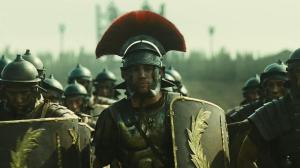 Tatum (G.I. Joe, Step Up) tries some form of an accent, though I’m not exactly sure what region of the Roman Empire the man is hailing from. He still has an imposing presence that manages to fill in the gaps of his acting ability, much in classic Hollywood tradition. And yet the man seemed more masculine in a Nicholas Sparks movie from last year. Bell (King Kong, Jumper) takes his haunted, submissive character to heart and gives a performance that confuses submission with understatement. He main mode of acting is the power of serious staring. The two actors don’t ever develop any onscreen sense of camaraderie or warmth. Even during the climax, you never feel like these guys have anything more than a civil employer/employee relationship. That’s why the laugh-out-loud, tonally jarring ending seems so out of place. Instead, Marcus and Esca strut through the halls of Rome, music triumphantly rocking out, and says, “What do you want to do now?” like they’re lining up weekly wacky adventures to be had. You’ll be surprised to see actors like Donald Sutherland, Mark Strong, Denis O’Hare, and even A Prophet‘s Tahar Rahim littered among the cast. Why are they in this movie when they have such insignificant parts compared to their bland leads?
The colonial perspective also started rubbing me the wrong way. Now colonial tales have long been featured in pop culture. I don’t on the surface have an issue with a storyteller utilizing a massive horde of natives to stand in as an antagonistic force. But sometimes that dynamic creates a skewed rather culturally tactless portrayal. Are the overpowered, conquering empires always blameless? Do the natives, who have been displaced and killed, not have a respectable grievance? Do they not have a right to fight for the lands that have been taken? Too often, the natives are viewed as blunt brutes (just watch the “cowboys and Indian” pictures from the 1950s) and the figures of expansion are viewed as heroic pioneers. The Britons come across as, essentially, the Indians. The filmmakers always want us to side with our hunky hero Marcus and his quest for honor at every turn, but the movie takes great turns to make the natives seem extra villainous. For a while they just come across like another culture. They have community, customs, and the like; it’s just not the dominant culture’s community and customs. And then, in an appalling moment of cheap melodrama, the Briton chief kills a child to send a message to Marcus and his Romans. This material is handled so indelicately that an unsettling undercurrent emerges and gains steady traction.
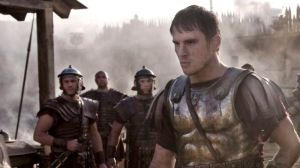 So what if the Britons stole one gold eagle 20 years ago? “It’s not just a piece of metal. The eagle is Rome,” we are reminded by Marcus. Symbols are great, but a one-man search in a land as large as Scotland seems impractical so many years hence. And then you have to take into account the time passage. It’s been two decades seen this beloved bauble went M.I.A., and damn near anything could have happened to it. It could have been thrown into the ocean. It could have been buried. It could have been smashed to smithereens. It could have been taken to another land. It could have been melted down into smaller, gift-shop sized eagles on sale to the general public. I’m just saying that in the ensuing 20 years anything could have happened to this bird. The fact that one guy can traipse on foot through Scotland and the first group of natives he runs into happen to possess the artifact that went missing 20 years prior is just insulting. First chance and he lucks in? I was eagerly waiting for an ending where Marcus, brimming with pride at having returned the eagle to Rome, is informed by one of the politicians that it’s the wrong eagle (“Here we go again!”).
The Eagle is dressed up to be an old time adventure story, but it’s just too slovenly paced and generically plotted to work. The lead characters are bland, distant, and noble to the point of annoyance. When a character is defined entirely as forward thinking, exceptionally lucky, ethically straight figure of honor, excuse me when I start to yawn. And when all he’s tasked with is finding an old relic that miraculously happens to be with the first freaking group of people he finds, then excuse me for eyeing my watch. The Eagle has some workmanlike action and suspense to it, brief moments of activity over what is in essence two hours of silent walking (it’s like somebody cut out the middle of a Lord of the Rings movie and sold it). The Eagle, both the film and the titular hunk of metal, are simply not worth the effort.
Nate’s Grade: C


You must be logged in to post a comment.