Blog Archives
Killer Joe (2012)
 This is one nasty, alarming, but very involving movie that wallows in darkness and plays it up for laughs. Killer Joe is a dysfunctional family drama, a crime thriller, and a mesmerizing character study when it comes to the lessons of amorality. Based on the play by Tracy Letts (August: Osage County), Joe (Matthew McConaughey) is a crooked cop who works as an assassin on the side. A weasely loser (Emile Hirsch) and his family hire Joe to kill their mother for the insurance money. Things get out of hand in frequent measure, with splashes of brutal violence, healthy amounts of sex and full-frontal nudity, and a disturbing sexual act with chicken that more than earn this film its adults-only NC-17 rating. What makes the movie rise above base exploitation is its depraved, deep-fried sense of humor. There is plenty of uncomfortable laughter and guffaws. The end of the film, during a fever-pitch of violence, is so sudden, so kooky, so debauched, that my friend and I burst out laughing. Without its wicked sense of humor, and its sharp ear for working-class dialogue, the movie could be accused of wallowing in the muck. There’s also the terrific acting, chiefly from McConaughey. He gives a hypnotic performance, chilling, unpredictable, and deeply committed to retribution. When he zeroes his cold eyes on you, boy does the flesh crawl. It’s an intense performance and arguably the best of the man’s career. Directed by William Friedkin (who also directed the 2006 adaptation of Letts’ play, Bug) with brutish élan, Killer Joe is one nasty piece of work, but given the right audience, it could prove to be a perverse entertainment.
Nate’s Grade: B
Share this:

Savages (2012)
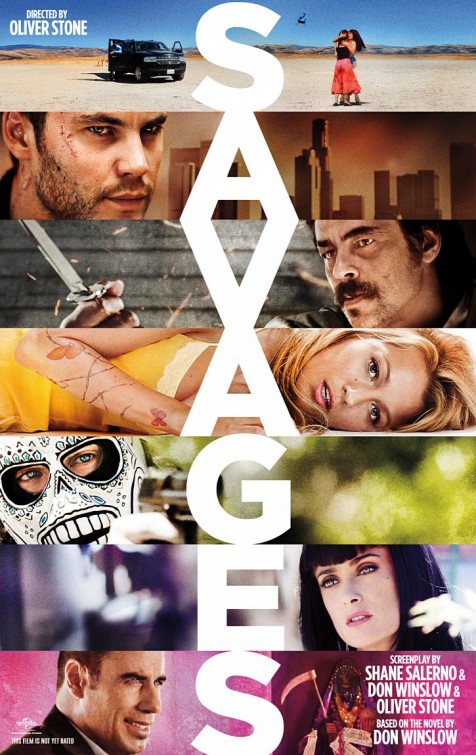 Savages has been described as a “return to form” from prolific director Oliver Stone, who has spent the last decade making straight biopics (W., Alexander) and safe feel-good movies (World Trade Center). The less said about Wall Street: Money Never Sleeps the better. You never thought one of the world’s edgiest filmmakers would follow such a square path. I can’t fault people for getting excited by Savages, hoping this drug-addled crime thriller can revive the gonzo sensibilities of the man. Well, Savages isn’t going to satisfy most people, especially those looking for a cohesive story, characters that grab your interest, and an ending that manages to stay true thematically with the rest of the movie. In short, Savages is a savage mess of a movie but not even an entertaining mess. It’s just a boring mess, and that is the film’s biggest sin.
Best friends Chon (Taylor Kitsch) and Ben (Aaron Johnson) are living the American dream. They began farming their own marijuana plants, using the best seeds form Afghanistan while Chon was on tour with the military. Together, the guys have produced a product high in THC that blows away the competition. They have flourished in California. Now a Mexican cartel, lead by Elena (Salma Hayek), wants in on their business, and they won’t take no for an answer. The cartel kidnaps the boys’ shared girlfriend, O (Blake Lively), and promises to hold her ransom for one year unless the boys agree to their terms. Chon and Ben decide to use their considerable resources to put the squeeze on Elena and her team of scumbags, all the while looking for a way to rescue their shared love of their life.
 It’s a lurid movie all right. Plenty of sex, drugs, and violence, but man oh man is it all just empty diversions because the movie cannot survive its trio of unlikable, uninteresting, and painfully dull characters. O, Chon, and Ben have a dearth of charisma; light cannot escape their black hole of charisma. What sinks Savages is the realization that it’s just a shoddy movie filled with a lot of skuzzy characters but hardly anyone that merits genuine interest. We’ve got skuzzy good guys, skuzzy bad guys, but where are the personalities? Where are the quirks or the hooks to drive our interest? Just having Benicio del Toro (The Wolfman) act weird and mumbly is not enough to cover the shortcomings of his character. I’ve read reviews where critics cite del Toro as “hypnotic.” I have no idea what they’re talking about. He’s just your average skuzzy bad guy you’d find in any mediocre crime picture; he just so happens to be played by Benicio del Toro. The DEA Agent John Travolta (From Paris with Love) plays is your typical skuzzy desk weasel; he just so happens to be played by John Travolta. And that’s where the movie falters. We have all these characters on all sides of the law but we couldn’t give a damn for any of them. O comes across like an annoying, privileged, faux intellectual. Chon is a meathead. Ben is an amorphous do-gooder. I don’t care about their problems and I especially don’t care about them retrieving O so they can return to their vague polyamorous lifestyle. She wasn’t worth all the effort, nor where these men worth dying over. At any point in the film, I wanted these characters to hastily die so that I might, just out of chance, come across a more interesting figure. I received no salvation.
Our trio of bland characters is made flesh by a trio of bad performances. First off, people have got to be realizing that the kind of lived-in, edgy, and compelling performance Lively pulled off in 2010’s The Town is more the exception than the rule. Stop casting her in gritty parts unless they are directed by Ben Affleck. As O, our zombie narrator, she does little to make us sympathize with her dumb plight. Then there’s Kitsch (Battleship) who is just having a record year of high-profile flops. He’s done fine acting work before, but as Chon he’s just another ramped-up hothead with little else on his mind. Johnson (Kick-Ass) has the most “flavor” of the trio, acting granola-y and with philanthropic ambitions, but he’s still just another meathead just in different clothes. All three of these characters are idiots and the young actors don’t find any way to redeem them.
Actually, I found Salma Hayerk’s character the most interesting and would have enjoyed a movie based around her dilemma. Elena’s husband was the head of a drug cartel. He was assassinated, so the duties would have fallen to her son, but in order to protect him she assumed power. She has an estranged relationship with her youngest daughter, Magda (Sandra Echeverria), who is ashamed of her mother. This, Elena tells us, makes her produ; she is proud that her daughter is ashamed. Now just look at all those contradictions and complexities inherent with this character. She’s assumed a duty she did not want, something she knows is morally wrong, but she does so in the interest of protecting her children, even if it means pushing them away and having them despise her. And because she’s a woman, any wrong move and her competitors would be ready to pounce. Plus you add the day-to-day anxieties of a life of crime, the threat of betrayal or some upstart wanting to make a name for himself, and you have the makings of a great character drama. But do we get even a little of this? No. Instead, Elena’s just portrayed as another colorful villain. The supporting cast is peopled with what should be seen as “colorful” characters, but really these people are just as skuzzy and boring and personality-free as our loser ménage a trois.
I suppose there is a certain pleasure seeing Stone return to his blood-soaked, violent, gonzo self. The man has a certain enviable madness when it comes to composing a movie, a mad fever of images and sensations. From that standpoint, Savages is at least watchable even though you would rather see most of the characters get hit by a car. I just wish if Stone was going to go nuts that he committed and went all the way, bathing this movie in his lurid predilections as we tumbled down the rabbit hole of the underground world of organized crime. If you’re going to assault my senses with excess then at least have the gall to be excessive. How can you make a lurid movie but EVERY woman onscreen engaging in sex is clothed? That seems unrealistic even for a movie this stupid. Stone seems to have no problem dragging out uncomfortable rape scenes, so who knows what the further implications of that are. There are several grisly torture scenes and some random brutality, so you’ll at least be kept awake in spurts by people screaming.
 Too much of this supposed crime picture is caught up in the oppressively irritating soap opera between O, Chon, and Ben (a little part of my soul dies every time I have to type “Chon” as a main character name). The script, based upon Dan Winslow’s novel, adapted by Shane Salerno, Stone and Winslow as well, is a mess but not even an enjoyable mess. Some of this dialogue is just laugh-out-loud bad. O opens the movie saying she has orgasms but Chon, you see, has… “wargasms.” Oh ye God, that one hurt. Every time we’re subjected to O’s protracted, monotone narration the movie loses whatever momentum it may have had.
She keeps saying, “Just because I’m telling this story, doesn’t mean I’m alive at the end.” Can you promise me that? Then there’s the very stupid ending, where the movie tries to have it both ways. It gets its bloody, operatic, tragic lovers ending…. and then in the next breath a happy ending as well, a ridiculously inappropriate happy ending. At least bloody and dead would have been satisfying. It’s a cop-out, a cheat, and a mystifying way to end a movie.
I wanted Savages to be a wild thrill ride. I never expected to be bored. Even when things go off the rails, the movie struggles to keep your interest. Blame the inane screenplay that eventually resorts to a cheap, cop-out of an ending, one that barely rises above the “it was all a dream” blunder. Blame the pathetic character and their lack of personality. Blame the strange feeling that Stone is holding back. Blame the bad performances. Blame the lack of fun. Blame the overwrought nature of the title the movie twists into knots trying to give some philosophical meaning. And finally, you might want to blame yourself for thinking that this movie would be any good in the first place. When movies are this mediocre, this lacking in intrigue, you almost wish they had tipped over completely into irredeemable garbage just so you’d at least have something worth watching. Savages is a strange crime thriller that manages to assemble all sorts of exploitation elements and then fumbles them all. If this is Stone in a “return to form,” I weep for what that entails.
Nate’s Grade: C
Share this:

The Raven (2012)

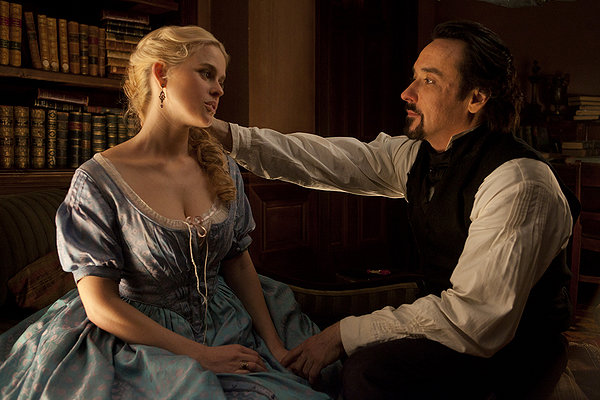
When “The Raven” was released in 1845, it was a literary sensation. I can’t say that the 2012 movie of the same name will be met with anywhere near the devoted fanfare. Edgar Allan Poe (John Cusack) has become embroiled in a deadly criminal investigation. The famous author is penniless, drunk, and depressed, but what else is new? What is new is that some Poe admirer has been stalking Baltimore and killing people in grisly styles fashioned after Poe’s macabre stories and poems. Detective Fields (Luke Evans) recognizes the connection to Poe and enlists the author to aid in capturing the murderer. Poe’s upper-class love, Emily Hamilton (Alice Eve), is captured by the unknown madman and buried alive. Poe must race against time to stop a killer, rescue the girl, and write a new horror-themed story to be published via the killer’s demands.
The Raven feels like an ill fit from the start. What is the point of featuring an American literary icon when all you’re going to do is plop the man into a pretty rote police procedural/serial killer thriller? The deadly flaw of The Raven isn’t its concept; it’s that the finished product didn’t embrace the particulars of its literary mash-up enough. Is it really a good use of Poe to just have him tag along on a police investigation? I wanted this premise to crackle with a devious slyness, a cleverness of genre and concept that the movie seems incapable of producing. You’re taking America’s singular literary voice of the Gothic and macabre and putting him into a game with a deranged fan. That’s a great start. I’m interested in that movie. But there needs to be some follow-through. This should be a battle of wits, an opportunity for Poe to backslide into the murky chasm of his own creations, bearing some pinning of guilt at having birthed a mad killer with the power of his words and imagination. This should be a psychological descent into hell for a man already famously tortured. Instead, the movie just becomes another rote serial killer movie but somebody typed in the name “Poe.” The various corpses, inspired by Poe’s works, just end up being gory, easily telegraphed deposits for clues. We don’t see these people in peril, terrified by the fiendish ye olde Saw-like death traps. We don’t even understand the process of the killer. The movie just ends up becoming one long, tiresome chase from dead body to next dead body, with Poe literary association haphazardly ladled in to tie stuff together. After a while, it feels like somebody took a thoroughly uninspiring serial killer script and just transported it into mid 19th century America. It’s nice to know that some clichés are timeless.
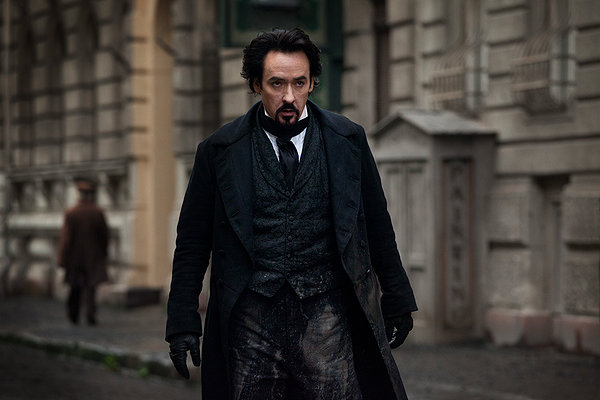 The movie never feels like it works properly, and the potential of its premise is completely unrealized. The murder mystery isn’t really ever given suitable footing to be a mystery, except in that tried-and-true “who’s going to be the bad guy” reveal. There aren’t really any clues left behind. So when characters suddenly come up with epiphanies on their murder investigation, you wish they would at least show their work. For a movie written by screenwriters with names like Ben Livingston and Hannah Shakespeare, The Raven certainly isn’t smart. The Poe stories feel tacked on in an arbitrary fashion instead of being interwoven into foundational elements of the story. Who cares how the characters die if their deaths have no impact on Poe or anyone else? The “how” of the equation becomes inconsequential. The title poem doesn’t even bear any weight on the story. The love interest/damsel in distress character is so bland and underwritten, that it’s hard to really feel Poe’s gnawing sense of urgency. Sidling the gloomy Gus Poe with a puppy-dog love story seems like a poor misunderstanding of the man and his demons. To top it off, the girl isn’t even his cousin (surely the oddest criticism of mine thrown at a movie)!
The movie doesn’t really ever become a convincing thriller either. The pulpier elements are ignored or downplayed, played with stodgy seriousness for a movie this ridiculous (Saw-style death traps in 1849?). Director James McTeigue (V for Vendetta), who after this and 2009’s Ninja Assassin is starting to look like a one-hit wonder, badly misplays the action elements. The dingy cinematography is unnaturally dark, making it exceedingly difficult to understand certain sequences and giving the audience yet another reason to lose interest. The impressive production design is totally mitigated when there’s not enough light to even see it. I understand given the nature of the story that we’d be dealing with lot of shadows and darkness, but this is just one poor looking movie. The only way you’d feel excitement from this movie is if in a fit of amnesia you forgot what you were watching and suddenly thought it might be a different, better movie, only to be disappointed ten minutes later when that sinking feeling reemerges and you realize, no, I am still watching The Raven.
I love me some John Cusack (Hot Tub Time Machine), but this guy is just the wrong fit for the movie. His sensibilities never really gel with the character, so Poe’s sense of melancholy comes across as more haughty boredom. He is not the right fit for the material. Eve (She’s Out of my League) has got nothing to do but look pretty and scream occasionally. The worst crime of all is utterly wasting one of my favorite contemporary character actors, the phenomenally great Brendan Gleeson (The Guard). He plays the uptight father of Poe’s love interest, which means he gets to pop onscreen and glare at Poe while looking worried. It’s a criminal waste of this man’s considerable talents.
 I think the best part of The Raven is actually it’s mostly unseen killer. It’s not because the guy is particularly clever or interesting or even remotely memorable (when they reveal who it is, make sure to pay attention to the constant reiteration of who he is, because if you’re like me, you plum forgot). The reason this guy is good is because of his impetus. He’s ultimately terrorizing Poe so that he can force the author to create more stories. Call it an extreme case of motivation. I can see our studious killer justifying his bad behavior, claiming to give the world new gifts of literary brilliance that we can all share, stories that will last the test of time. Isn’t that worth a few dead bodies, he’d argue. Ultimately, this rationale becomes more egotistical, about flattering the killer and his devious appetites, which is a shame. I’d prefer if the bad guy were more devoted to the cause of helping to shape the Canon of transcendental literature. I almost wish that the movie were told from this skewed perspective. I could have dealt with an entire catalogue of famous authors being victimized under the auspices of producing great literature. What if this one sick person is responsible for wresting the great works of the 19th century out of the authors’ minds and onto the page? I think we all owe this terrible individual a debt of gratitude.
I’m finding myself disliking The Raven the more thought I put into it, which, admittedly, my brain is actively fighting against. It does not want to spend more time processing this bore of a movie; a fun premise never fully realized, a conflict never truly developed, and characters that are the 19th century equivalent of the stock roles you’d find in any mechanical CSI/Law & Order TV episode. So in the interest of literary fairness, I’ve decided to channel the spirit of Edgar Allan Poe for the final word on The Raven:
And The Raven, never flowing, still is going, still is going,
On the pallid screen I silently stare at in unblinking bore,
And its plot is not that smart, missing heart and clues to start,
And it seems like the writers were tasked with an unfriendly chore,
The movie does not work; it’s dull and empty to its very core,
And so I lastly ask does this movie properly entertain?
Quoth The Raven – “nevermore.”
Nate’s Grade: C
Share this:

Lockout (2012)
 Rather derivative and not very clever, the sci-fi prison break movie Lockout is surprisingly enjoyable, in a brain-dead sort of way, mostly thanks to a few lean suspense sequences and the deadpan glory of star, Guy Pearce. The man plays a reluctant hero sent to a space prison to rescue the president’s daughter (Maggie Grace) hiding amidst the dangerous inmates. It’s like every action, sci-fi cliché rolled into one, and yet the movie is consistently entertaining. Pearce carries the same deadpan gumption throughout; it doesn’t matter what’s happening, it will not faze him and he has a quip for everything. When the first daughter asks him if her dad had any words to pass along, he quips, “Yeah, you’re adopted.” The roguish charm of Pearce keeps the movie grounded even when it goes a little nutty with conspiracies, obstacles, and a mad rush of a climax. The movie is set only 40 years or so in the future, and as such it feels too weirdly futuristic for the minimal time jump. Would we really have an orbiting space prison and put prisoners in hyper sleep? Anyway, the movie is a lot more fun and tolerable than I would have expected, and Columbus, Ohio’s own Grace (Taken) actually gives the most mature performance of her still young career, for what that’s worth. It’s not great, but thanks to Pearce, it’s pretty passable entertainment, especially for generous genre fans.
Nate’s Grade: B-
Share this:

Miss Bala (2011)
 Miss Bala (Mexico’s foreign film entry for 2011) is an unwavering, startling, and deeply tense movie about one woman’s tragic and unwilling association with a powerful drug cartel. Laura (Stephanie Sigman) wants to be the next Miss Baja California, but she’s unwittingly pulled into a life of crime after she witnesses a gang hit. The cartel ensures that Laura wins the beauty pageant and becomes a courier for them. The movie takes a Lars von Trier approach to storytelling, putting its heroine through a torture chamber of anxiety and terror. This woman only wants to escape the hell she has accidentally found herself a part of, but every attempt to escape, be it going to the police or confessing assassination plots to the intended targets, gets her corralled back into the fray. For Laura, there is no escape. The movie packs a near-constant surge of paranoia, as we fear that at any time something awful will happen. In fact it’s usually only a matter of time. Laura is more a symbol of the collateral damage of Mexico’s billion-dollar drug war than a character, and she kind of becomes a numb zombie by the movie’s latter half, perhaps accepting her doomed fate. Director Gerado Naranjo favors long unwinding takes and handheld cameras, which add a gritty realism and sense of compounding dread to the picture. The movie has an unflinching level of realism to it that makes it all the more haunting, stripping the romanticism from a life of crime. Much like Italy’s heralded crime film Gomorrah, this bleak but impassioned movie shows the inescapable tentacles of organized crime and gives a face to innocents caught in the middle. Miss Bala is a testament to the hidden toll of a nation at war with itself.
Nate’s Grade: B+
Share this:

The Girl with the Dragon Tattoo (2011)
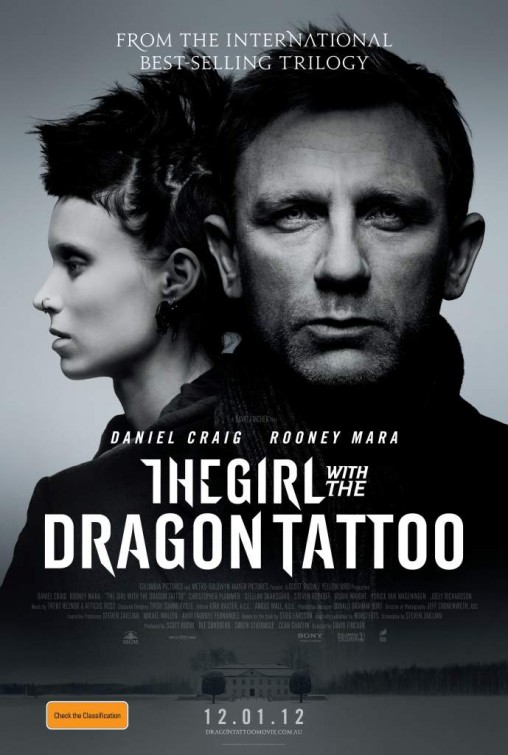 Nothing says holiday treat for the whole family like a nearly three-hour movie about rape. Late author Stieg Larsson’s best-selling trilogy made three very successful Swedish films, all released last year in indie theaters. It was only a matter of time before Hollywood optioned The Girl with the Dragon Tattoo, benefiting those averse to reading subtitles. At least they hired the right director in David Fincher, a man used to plumbing the depths of human depravity in films like Seven, Fight Club, and Zodiac. Fincher’s take is pretty dark and hardcore, but once you wash all that perfectionist grime off, I prefer the Swedish film in just about every way.
Crusading journalist Mikael Blomkvist (Daniel Craig) is smarting from a court case that found him guilty of libel. He’s commissioned by a wealthy businessman Henrik Vagner (Christopher Plummer) to investigate the 40-year-old disappearance of his granddaughter, Harriet. Henrik strongly believes she was murdered by one of the sinister members of his extended family, a group of shady characters with some allegiance to Nazism. Mikael is assisted by the unorthodox computer hacker Lisbeth Salander (Rooney Mara), a rail-thin Gothic gal clad in tattoos and piercings. Their partnership sometimes gets blurry as they grow closer over the course of the investigation. Together the pair investigates a series of grisly, ritualistic murders related to Harriet’s disappearance, and the closer they get to discover the truth the more dangerous things get.
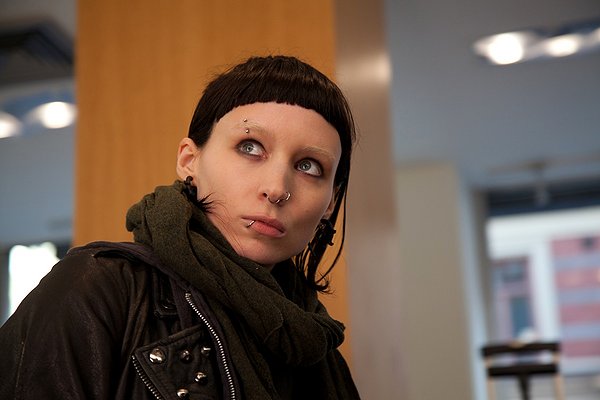 So the burning question: is Fincher’s take better than the original Swedish version? Well, in some areas yes but in many areas I’d have to say no, that I prefer the lower budget, no-name Swedish version. Obviously a director of Fincher’s caliber is going to significantly raise the quality of a production, and the technical merits of Fincher’s Dragon Tattoo are without question. This is a seedy, grimy, prurient, and very dark (in both lighting and thematic material) little movie. There’s always been an eerie beauty to Fincher’s cool aesthetics, and it’s on display here as well. Many of Fincher’s Social Network crew carried right over to Dragon Tattoo, so the editing is crisp, the cinematography sleek, and Trent Reznor and Atticus Ross’ score is a storm of ominous tones. Their plaintive score is actually a fairly unmemorable muddle, never approaching the energy, intricacy, or diversity of their Oscar-winning score for The Social Network. However, the extra polish and the glut of familiar actors takes away from the intrigue of the movie. When something meant to be gritty is too artistically stunning, it detracts from the thematic intent of the story. That sounds like a contrary way to insult Fincher for making his movie look too good, but perhaps that’s the best way of stating the point. Niels Arden Oplev is nowhere near the filmmaker that Fincher is, nor did he have the budget or creative freedom afforded Fincher, but perhaps someone of lesser talents was better suited to best tell this tale. By all means, the American Dragon Tattoo is a more visually alluring film, but Oplev’s film is more fully felt. I recently rewatched the Swedish version again for points of comparison and found myself much more involved in the characters, the story, and the actors, even though I had already seen the movie. Fincher’s version may be the better-looking movie, but surprisingly Oplev’s is just the better movie, period.
The adaptation by Steven Zallian (Schindler’s List) actually hews closer to Larsson’s book than the Swedish film, though Zallian redirects the film into a new ending. But the additions don’t seem to add anything of substance to the narrative (Blomkvist’s teenage daughter; dead cat), and the new ending feels more confused than helpful. Most of all, Zallian’s script devotes less time to the characters of Lisbeth and Blomkvist. I had a better understanding of these characters and their complicated, shifting relationship in the Swedish film. That narrative was much cleaner with helpful, clarifying procedural details and a dose of ambiguity. Simply put, the story just flowed better in the Swedish film. The personal connection Blomkvist had to Harriet (she was his babysitter long ago) has also been severed. Many of the story’s problems are still the same regardless of language or adapter. There is a clear disparity when it comes to audience interest in the two leads. What’s more interesting, a punky, bisexual, computer hacker or a disgraced, somewhat bland journalist? Exactly. Also, the story takes far too long to put our lead characters together, over an hour at that. The murder mystery is filled with murky plot points, pieces that seem like they might be integral but then turn out to be incidental. It takes a good while to process and familiarize oneself with the expository details of the case, but under Zallian’s draft, the mystery is given less room to breath. For a movie clocking in at 150 minutes, things feel untidy and rushed. The resolution feels drawn out to ungodly Lord of the Rings-lengths; I swear there must be a solid 20 minutes after the eventual serial killer is dealt with. It just feels like it goes on forever. Still, the characters are what ultimately makes Dragon Tattoo engaging, and Zallian’s efforts cannot dampen the captivating, curious nature of Lisbeth Salander.
Both Craig and Mara give fine performances but I prefer both Swedish actors to the A-listers. Craig is certainly a better actor than his Swedish counterpart, but the role is a middle-aged journalist and not James Bond, and thus a better fit for the unknown Swedish actor, Michael Nyqvist (Mission: impossible: Ghosts Protocol). Blomkvist isn’t supposed to be an ass-kicker. As a result, you don’t feel his terror as he gets in deeper and lands in serious physical jeopardy. Likewise, following in Noomi Rapace’s (Sherlock Holmes: A Game of Shadows) shoes was going to be a difficult feat for any actress, but Fincher got the girl he wanted, Mara, who tore down Mark Zuckerberg with precision in The Social Network. Mara commits herself completely to the role and undergoes a severe physical transformation (bleached eyebrows, wiry frame, nipple piercings), but she lacks the intensity of Rapace, the spiteful attitude, the recklessness and the resourcefulness. Rapace felt like a caged animal that could explode at any moment; Mara feels more like a lost puppy. I’m being intentionally cavalier with my word choice. Mara is quite good as Lisbeth; it’s just that Mara can’t quite measure up to the preceding tattooed girl. It feels like there’s a lot more going on with the Swedish Salander, whereas the American (still Swedish) Salander is waiting for her cue. It’s like Mara has dressed the part and waits for the character to just click over.
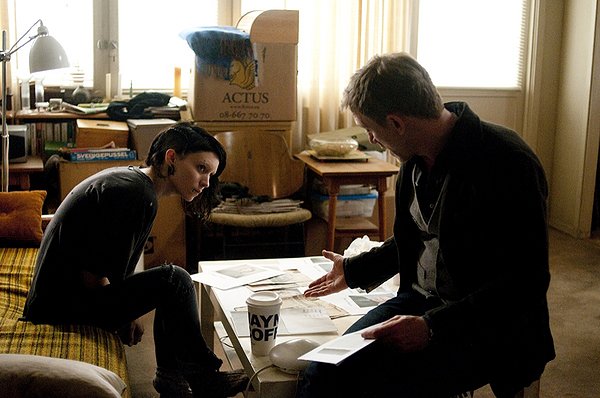 I’m not one for lazy analysis, but I feel like the uncomfortable issue of sexual violence/ voyeurism needs to be addressed, and I find that everything I wrote a year ago in my original Girl with the Dragon Tattoo review could readily apply to its Hollywood counterpart. So here goes: “The book’s original title was ‘Men Who Hate Women’ and that seems apt given what occurs on screen. Sure there’s a serial murderer on the loose but that’s par for the course. Even the grisly ritualistic killing stuff. But Lisbeth encounters a lot of malice and hostile male aggression, some of it very sickening. There’s a startlingly extended rape sequence, followed by some sadistic, if justifiable, revenge. It all contributes to an overall tone of queasy misogyny that seems to waver between intentional and unintentional. I’m not sure tone-wise whether the movie ever creeps into unsettling voyeurism at the behest of women in explicit sexual peril, but it certainly is a distraction. It can get pretty hard to watch at times in this disturbing thriller. I hope the eventual sequels don’t follow this same queasy, upsetting tone but I also worry that this may be unfortunately part of the books/movies’ appeal.”
For those new to Lisbeth and Larsson’s sordid saga, The Girl with the Dragon Tattoo will more than likely play well, a squalid thriller with the nicest coat of gloss you could ever hope for given the material. This is dark, rape-heavy stuff, and an odd adult drama to position as a Christmas release, but the collective appeal of the best-selling books should guarantee so many butts in the seats. It’s likely a safe bet that a high majority of those paying customers are unfamiliar with the Swedish version of the same story, which is a shame because, short of a few technical advances, I believe the Swedish film to be the superior movie. It had better acting, more appropriate casting, a rounder narrative that fleshed out the characters, their relationships, and their histories better, and a better score (sorry Trent, better luck next time). It’s still a movie that registers a “good” on most critical accounts, and Lisbeth Salander is still a fascinating person, a wounded warrior that catches the imagination. I’ll be curious to see if the subtitle-free Girl with the Dragon Tattoo does well enough at the box-office to warrant filming the next two decidedly lesser books. Whatever the case, there will always be the Swedish films and Ms. Rapace’s star-making performance.
Nate’s Grade: B
Share this:

In Time (2011)
 Andrew Niccol is a filmmaker that has earned my respect and my hard-earned money. After The Truman Show, Gattaca, and Lord of War, this guy has me hooked. I forgive him 2002’s S1mone, which had some good ideas in need of a better plot. Lo and behold, his latest film, the sci-fi thriller In Time, falls victim to the same issue. Niccol’s premise is more intriguing than the people onscreen.
In the near future, science has solved the age-old question or mortality, for a price. Every human has an internal clock somehow embedded in his or her arm. It kicks in at age 25 and then people have one year remaining. Time is the only currency that matters. People work jobs to add minutes to their time. When it comes to a cup of coffee or a bus fare, you pay in minutes off your time (a hooker says, “I’ll give you ten minutes for an hour”). The rich are well stocked in time but the poor must fight every day just to keep alive. Sam (Justine Timberlake) works in a factory just to make ends meet. His mother (Olivia Wilde, we should al be so lucky) gives her son an extra 30 minutes for his lunch; humans can “pass” time from one to another through touch. This will come back to bite her. One day Sam meets a tall dark stranger who’s lived for over 100 years and is tired of it all. He donates all his time to Sam. This is a no-no in the future. The timekeepers are a police force, lead by Raymond Leon (Cillian Murphy), that polices time allowances. They’re paid to basically make sure that time remains the property of the upper class. Sam hobnobs with the elites, including Philippe Weiss (Vincent Kartheiser), a man who owns thousands of years. When the (Van Damme-less) time cops come looking for Sam, he makes a run for it, taking Sylvia (Amanda Seyfried) as his hostage. The two eventually fall for one another as they dash across the country stealing time.
 In Time has all sorts of ideas running through its system. What it doesn’t have it much of a plot to go with its heady sci-fi setup. Will is a fugitive but he never really formulates any sort of tangible plan. There’s no higher plot or goal here other than “sticking it to the man” but what exactly does that mean in this context? I understand he’s upset about losing a loved one, but his plan for vengeance or justice or whatever you want to call it lacks needed clarity. It feels like he and his cohort are just making it up as they go along. The film is at its worst when it descends into a populist, sci-fi Bonnie and Clyde, where Sam and Sylvia storm these time banks and redistribute the minutes, becoming heroes to the day-to-day drudgers. The ease that these two people have at knocking over bank after bank, armed only with a handgun, seems hard to swallow. The banks aren’t going to have tougher security especially after word gets out? Niccol adds plenty of chase scenes to fill out his plot but it doesn’t do much more than pad a half-baked story. The end confrontation goes in a direction I shall shamefully describe as “action movie idiocy.” You’re going to tell me that a timekeeping pro doesn’t pay attention when his clock is minutes away from death? Furthermore, I’m stunned that the people onscreen don’t act with more urgency when their time runs out. When death is on the line, I imagine a human being would resort to any kind of irrational desperation just to get a few minutes more, yet In Time shows a demoralized populace that just seems to give up. That makes the heroes-as-revolutionaries storyline even more implausible. Here’s a tip to Niccol: if it’s Sylvia’s last day on Earth, maybe you don’t have her racing for her life in heels. I’d think the gal would have purchased some decent running shoes by this time.
The ideas presented are compelling, though I wish Niccol had continued to push further. The social satire is pretty on-the-nose about the class system. I would have liked Niccol to be more biting in his social critique, perhaps carving up the rich as more venal than pampered. It’s true that they can live forever… unless something violent happens. This may be the future but there’s still no cure for a bullet to the head. The rich may live but they must live in sheltered, insular communities; a life encased in bubble-wrap. There is much potential there that goes unexplored. I also wanted a global sense of what was happening. Is time traded on the stock market? Are there different values placed on human time based upon geography? Is a Japanese life more valuable than a Ukrainian? The glimpses we do get about how the world operates are enticing and clever. The time roadblocks, tolls asking increasing amounts of time to pass into more affluent communities, feel authentic to the world and a cruel way to limit class mobility. When Sam pays for his expensive dinner he tells the waitress, “And take a week for yourself.” The timekeepers are only allotted a day at a time, so they can’t get carried away (I think it’s the futuristic equivalent of having the pizza delivery guy only have twenty bucks on him so he’s less likely to be the victim of theft). For the most part, In Time feels like it has some of the neat sociological quirks down but misses the psychological ramifications of its premise. People stop aging at 25. What does that do to a person’s sense of self? What about the peculiarities of dating? There’s definitely a sexual farce waiting to be written here. But let’s focus on the main dilemma – scrapping every day for just enough to stay ahead of the countdown. It’s an apt allusion to the working poor, but we never really see the tremulous stress that such a situation demands. This is life and death stuff, folks. The panic of inflation should also have been something Niccol paid more attention to. Just upsetting their time budgets could rock people’s world. There’s a lot more human drama inherent in this story that Niccol ignores, or flat out dismisses, for some standard Hollywood frills, namely chases and contrived romances.
 Timberlake has shown that he has some chops when it comes to acting in shrewd supporting roles (The Social Network, Black Snake Moan). His skills aren’t really well utilized by In Time. The role of Sam is pretty bland, lacking edge or depth. This part could have been played by anyone not befitting Timberlake’s genetic credentials. Timberlake can make a credible action hero, though his charm covers up for his lack of intimidating presence. There is one regrettable moment where he wails at the death of a loved one, and it hits the wrong notes and feels laughably awkward. Seyfried (Red Riding Hood) also turns on a dime from being a scared hostage to a romantic partner. Her role gets reduced to being dragged by the hand by Timberlake; she’s human luggage. Murphy (Inception) does a fine job of being a dogged, Tommy Lee Jones-style pursuer. Kartheiser works that reptilian sleaze he’s perfected on Mad Men. The guy is like a younger version of Sam Neill (Jurassic Park, Daybreakers), possibly the most reptilian of all living actors. The strangest part about casting is that it’s an Alpha Dog reunion (Timberlake, Seyfried, and Kartheiser all had supporting roles).
In Time is a better idea than a movie, and it’s an idea that deserves more examination. Niccol’s film has some interesting ideas and concepts, but it seems too slavish to a typical Hollywood blockbuster boilerplate. The characters are pretty bland and the thrills are too. I wanted to spend more time in this brave new time-obsessed world; I just wanted to spend it with other characters. The populist Bonnie and Clyde plotline doesn’t seem to gel. If the rich can control the arbitration of time, why don’t they just ungodly raise the price of things? In a a generation or two, the rich will weed out all lower classes thanks to near literal social Darwinism. The social commentary is a bit heavy-handed and simplistic. I wish Niccol had ditched his young heroes/lovers and explored the particulars of his world more, especially the portent psychological implications. In Time doesn’t feel like a complete movie, just a finished one. Ultimately, the film’s greatest sin may be that it wastes too much of your own time.
Nate’s Grade: C+
Share this:

Red State (2011)
 Kevin Smith, love him or hate him, you can’t deny the man is a natural promoter. Earlier in the year, the indie filmmaker self-distributed his first foray into horror films, Red State, on a nationwide tour of screenings. I first saw Red State way back in March when Smith visited Springfield, Ohio to screen the film and then answer questions afterwards. I’ve been trying to wrestle with my critical opinion in the ensuing months. Fortunately for me, Smith has made it extremely easy to revisit my thoughts. Red State eschewed the traditional theatrical release pattern for a new digital-age model. It was available on demand through cable systems, available for download, and even broadcast in special theaters for a one-night only event. A month later the film hit DVD. In its better moments, Red State is the unholy union of Quentin Tarantino’s love of language, and penchant for jolting violence, and the Coen brothers’ nihilistic, cock-eyed sensibilities. This is strange new territory for the man. I wish I could say Red State is worthy of all the attention, though this sinister, messy, gritty little movie can work its wicked mojo, at least for a while.
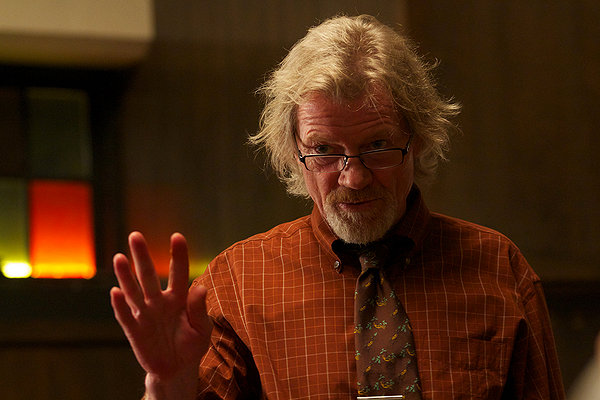
The Five Points Church is a notorious family-operated cult. Under the guidance of their shepherd, Abin Cooper (Michael Parks), this fundamentalist Christian group pickets the funerals of dead soldiers, haranguing the grieved that their loved ones are dead because “God hates fags” (excuse me for failing to put two and two together). A group of teenage boys (Michael Angarano, Kyle Gallner, Nicholas Braun) is lured to Sara’s (Melissa Leo) trailer with the promise of sex. The middle-aged woman plies her young bucks with drinks and they are knocked out. The boys awaken to find they are inside the Five Points compound and witness to Abin Cooper’s solution to sinners. Rather than railing with signs, the family has decided to take a more hands-on approach and execute them. While this is going on, a sheriff’s deputy alerts the authorities and the ATF rolls up to the compound. Lead by Agent Keenan (John Goodman), the government agency engages in a firefight with the rightwing cult. Ordered to take down the compound, and all witnesses, the various characters will try and escape with their lives, never knowing when that fateful moment of atonement may drop.
 What Smith does well for a genre novice is to keep his audience constantly upended. Just when we think we’ve settled on a protagonist and a plotline, suddenly Smith switches gears. The surprises are sudden and often merciless, leaving the audience little room to adjust. In a genre usually beholden to formula, the consistency of Smith’s surprises makes for a darkly satisfying viewing. Watching Red State demands due attention. Naturally, not all of these tonal shifts work to the movie’s best interest. The final shift, to all-out action thriller, is the most leaden. The Ruby Ridge/Waco-style standoff allows for a lot of gunfire but very little action. We mostly just cut back and forth between the two sides firing and, inexplicably high numbers, being shot in the face. It can get repetitive and seem like all the mounting tension gets squandered. There is a nice storyline within of one family member, Cheyenne (Kerry Bische), forming a plan to save the compound’s children and escape. Bische (the lead on the last season of TV’s Scrubs) makes fantastic use of her limited screen time to render the anxiety and fear of her character. She’s second only to Parks in the performance department as far as I’m concerned. Then the climax comes along and Smith teases being audacious, going in a fire-and-brimstone angle that would completely obliterate audience expectations. And just when it seems like we’re about to get something radical… Smith falls back to what he knows – dialogue. For the final five minutes, Smith concludes his narrative with two government officials explaining what happened in florid detail. It’s a fairly big letdown.
The setup of luring teens to their doom is an old horror staple, though usually the ones doing the sacrifices are card-carrying Satanists. And when exactly would a Satanist be in a situation needing to prove their validity with a membership card (“I’m sorry Mr. Darkseed, but we can’t give you the ten percent discount on all those goat skulls unless we see some valid photo ID.”)? Smith flips the switch religious allegiance. Instead of Satanists or some other misunderstood fringe religion, the cult is a group of pious Christians. There’s plenty of room to work here and Smith refrains from making easy associations; the Five Points nutjobs aren’t meant to represent Christians as a whole or Christianity. They are extremists, and they will go to extreme measures. Ostensibly based upon the Westboro Baptist Church and Fred Phelps, you keep waiting for Smith to satirically carve up the clan, but this never really occurs beyond the superficial. Smith’s writerly instincts give Abin Cooper a ten-minute sermon/platform where the guy just unloads a hate-filled diatribe against homosexuals and progressives. For many, this will be the make it or break it point of the film. There are some genuinely tense moments to the first half of Red State. There’s one scene where the camera holds on Gallner (The Haunting in Connecticut) inside a wired cage. He rattles and screams and generally comes unglued, and we too piece together what he hears, dreading what is to come. The many escapes and narrow calls are also harrowing and finely edited to ratchet up suspense.
 It seems, though, that Smith’s bleak screenplay does not present any characters we can truly root for. Horror has been shifting this way for the past twenty years. Thanks to the rise of the slasher flick, audience empathy has shifted from being with the running/screaming victims to being with the gruesome yet personable killers. Red State has a high body count but you won’t feel much when those bodies hit the floor. You’ll feel a jolt of shock, but from an empathy standpoint the needle barely registers. Sure, we don’t want people to be tortured and we want the abused to escape torment, but that’s not the same as characterization. The closeted sheriff (Stephen Root) feels like the start of an idea more than anything else. The trio of teen boys is presented with as little care as any other throwaway slasher flick. They are but meat for the grinder, our entryway into this hidden and spooky fundamental world. These aren’t so much characters as bodies waiting to be slain. The people are set up so they can be knocked down. This issue can become troubling when Smith wants us to rethink our loyalties, especially once the siege has begun. He wants us, dares us, to start feeling empathy for members of the Five Points Church. The problem is that the plot’s adherence to shock value and the underbelly of human nature has desensitized our empathy. When the ATF starts firing most in the audience will probably just cheer, not reflectively question the moral relativism. I doubt anyone will be switching allegiances midway through.
Cults are usually held together with a charismatic leader, and Red State has that in spades with Parks. The man just dissolves into his twisted character, a preacher that uses the Word of God to indoctrinate and arm for his own holy war. Parks has done fine supporting work before in the stable of Tarantino and Robert Rodriguez movies, but Red State is the actor’s biggest modern showcase yet. The man makes your skin crawl the way he can wrap hate into a honeyed, easily digestible product. Abin holds sway over his flock and likewise Parks commands the screen. He provides grandeur and menace to Smith’s words. It’s not a scenery-chewing performance; Parks doesn’t go for the obvious notes when he can hit something deeper and more unsettling. You get a sense that this man fully believes the dogma he teaches, and that makes him all the more terrifying. The other actors peopling Red State are fine, though Leo (Oscar-winner for The Fighter) seems a bit unrestrained especially in contrast with Parks. Goodman (TV’s Treme) gets to talk on the phone a lot to his unseen superiors. The end of the film just descends into frenzied yelling on everyone’s part.
Credited as a horror movie, though I view it more of a survivalist thriller but I suppose genre specifications are subjective, regardless, Red State is miles away from Smith’s usual output. The movie has its share of creeping dread and menace, thanks to Parks’ transfixing performance. The screenplay is unrepentantly dark, cruelly cutting down lives with shocking acuity. The constant surprises and upheavals are a way to keep the audience guessing, though the shock value starts to wear off by the noisy, repetitive gun battle climax. It’s hard to nail down exactly what kind of commentary Smith is presenting. Obviously he doesn’t side with the hateful fundamentalists (this is probably why he pulls back at the end), but he also shows the government’s reaction to religious zealots to be morally queasy at best. It’s hard to get a read what the commentary is, and with horror, if you don’t take a stab at commentary then you’re just watching high-gloss snuff films. Red State resembles a snuff film in several ways and not just in its grimy aesthetics. You feel a little dirty after it’s over, and you can’t help but question your motives for watching it. Plus you can’t help but think it could have been better done (note: I have never watched an actual snuff film, you sickos, but the point remains).
Nate’s Grade: B-
Share this:

The Thing (2011)
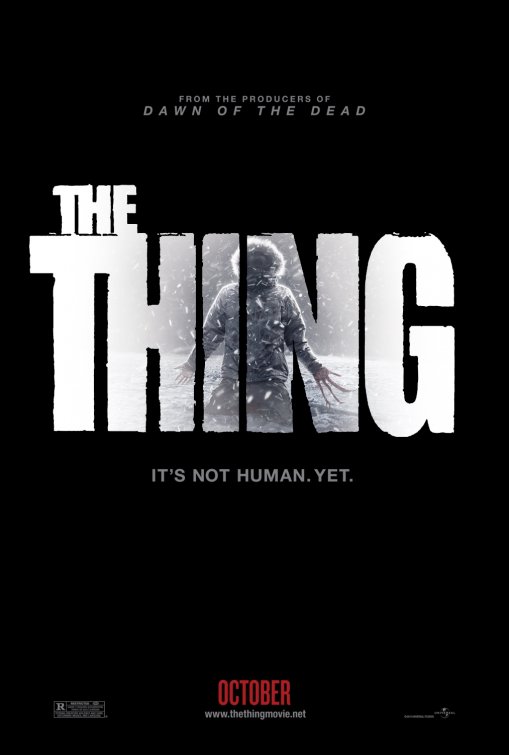 Has any modern filmmaker endured more crappy remakes of their films than John Carpenter? The man has suffered through remakes of Halloween, The Fog, Assault on Precinct 13, and now his 1982 creep-fest The Thing, itself a remake of the 1951 Cold War allegory, The Thing From Another World, gets the same awful treatment. This new Thing is some hybrid of remake and prequel, because it’s set before the events of the 1982 film but it pretty much follows the same overall plot. Once again a group of scientists (this time they’re Norwegian!) on a remote Antarctic outpost discovers an alien body buried in the ice. Once again the alien breaks loose and can assume the fleshy form of man. But this new film forgoes the rampant paranoia and rising tension of Carpenter’s film for cheap Boogeyman thrills. The alien monster is introduced early and the rest of the film succumbs to people looking around pensively, afraid it will jump out and attack. This alien creation is an odd quirk of evolution; a species that seems to be made of nothing but gnashing teeth, spindly legs, and vaginal imagery. How these things built and fly spaceships, I have no idea. Some of the gore effects are crafty and stomach-churning, but nothing is as memorable as the practical effects used sparingly and to great effect in the 1982 flick. This Thing is too much of a familiar monster to make an impact.
Nate’s Grade: C
Share this:

Limitless (2011)
 With a dream premise for a pill-popping culture, Limitless is a visually fervent thriller that manages to stay a step ahead of the pack. Bradley Cooper takes a pill and can unlock full potential of his brain, which involves, obviously, scoring big paydays and women. It’s a silly fantasy but a universal curiosity of what we could do if given full access to our noodle. Director Neil Burger (The Illusionist) uses every visual trick in the book to represent the new brainpowers, as we watch words, numbers, and memories drift through a colorful explosion of imagery. It’s all very pretty to look at. Burger’s visual prowess elevates the more pedestrian moments of Limitless, but the film has a way of surprising you. The Mob takes an interest in this wonder pill, operating at a new peak of production. A woman being hunted down takes the magic pill and is able to quickly formulate an escape. So what if the profound existential questions regarding human capacity and possibility are thrown aside, we got some nifty visual flourishes and foot chases here people. The pacing is relentless and the plot manages to find intriguing ways to keep a superbrainiac in danger. Limitless is a perfectly enjoyable movie with enough juice to forgive its lamer moments and contrived ending.
Nate’s Grade: B


You must be logged in to post a comment.