Blog Archives
Side Effects (2013)
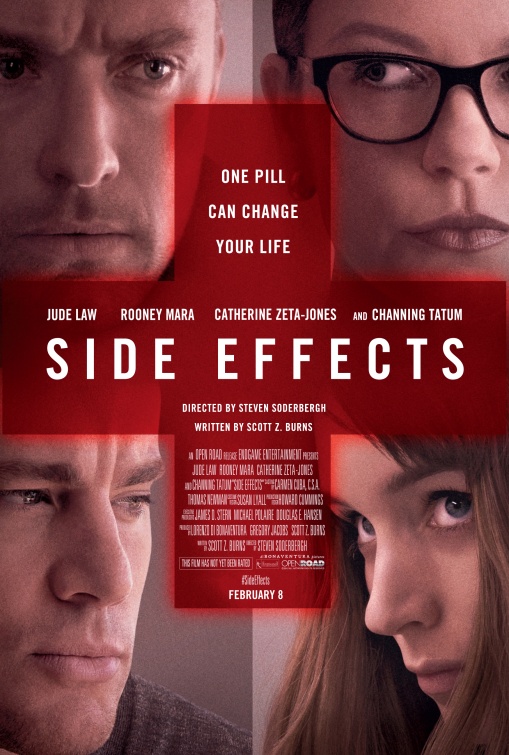 Steven Soderbergh’s supposed last stop before retirement is another of his genre exercises, but Side Effects feels like a firmer success, albeit modest, for the director to go out on. It’s the story of a woman battling depression, played with terrific cageyness by Rooney Mara (The Girl with the Dragon Tattoo). She gets prescribed a new drug and… does some very bad things. Who is culpable? The doctor, being funded by the drug companies? The woman who was sleepwalking at the time? The industry for blanketing patients with ads to demand their drug? After a rather slow start, the movie gets interesting and starts to try out different genres like hats. It appears for a good while we’re now going to be following her doctor (Jude Law) and his downfall as the industry turns on him and the media coverage intensifies. Written by Scott Z. Burns (Contagion), the movie has that same enticing sense of realism about how all the moving parts of a complicated industry would come into sync and conflict. Then the film tries out another identity, that of traditional thriller, with wronged parties orchestrating vengeance. I was invested until the end and felt sufficiently satisfied with the end results. Soderbergh’s smooth camerawork and cool color palate are well suited for a film about the battles of depression, and for a good while, before the thriller aspects take over, the movie is a fairly mature look at the struggles of depression and the industry that profits off it. Side Effects doesn’t seem like a closing statement for an artist as varied and unpredictable as Soderbergh, but as far as a Saturday afternoon goes, it’ll sure pass the time nicely.
Nate’s Grade: B
Share this:

Gangster Squad (2013)
 It’s hard to mention the action thriller Gangster Squad without a passing reference to the Aurora, Colorado movie theater shooting in the summer of 2012, the reason for the film’s five-month delay and reshot action sequence. Gone is a shootout at the movies and now we have a confrontation in the streets of Chinatown. I wish they hadn’t stopped there. If given the opportunity, and remember they did have an additional five months, I would have scrapped Gangster Squad almost completely and started fresh.
In 1949, former boxer Mickey Cohen (Sean Penn) has seized control of Los Angeles organized crime. His influence extends even into a police, which forces Chief Parker (Nick Nolte) to go to desperate measures. He asks Sgt. John O’Mara (Josh Brolin) to assemble a team of enforcers to fight back. They won’t have badges but they will be pushed to use whatever means necessary to carry out their mission, which means blurring the line between what is considered lawful. O’Mara assembles a super group of former officers and one of them, Sgt. Jerry Wooters (Ryan Gosling) gets into even deeper danger when he starts seeing Mickey Cohen’s main squeeze, Grace Faraday (Emma Stone).
This movie is like if The Untouchables and L.A. Confidential had an illegitimate child and then abandoned it in a sewer where degenerate hobos raised it. Gangster Squad rips off other gangster movies with liberal abandon that I can’t even begin to list the lifts. I’d be less offended if I felt that the movie had more on its mind than just replicating the tone and look of noir cinema. Actually, it feels more like what they want to replicate is the tone or style of the video game L.A. Noir.
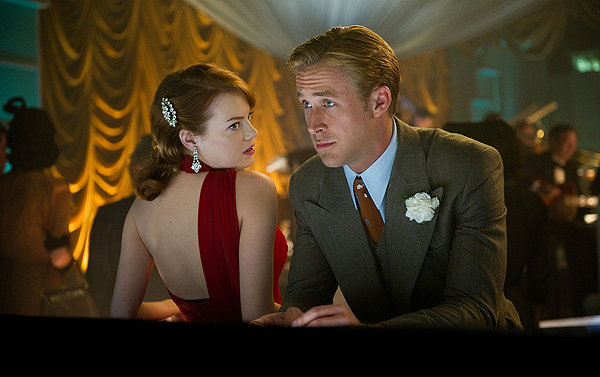 The main problem is that Gangster Squad really only has the skeletal outline of a plot. It’s missing any essential character and plot development. Here, I’ll summarize the barebones plot for you: Mickey Cohen is a bad guy. O’Mara forms a team. They have a montage taking out bad guys. Mickey takes out one of them. They have a showdown. That, ladies and gents, is it. There really aren’t any scenes that diverge from those scant descriptions. It felt like only five minutes passed from one of O’Mara’s guys getting killed (and just like The Untouchables, it’s the nerdy one) to them descending on Cohen’s headquarters and duking it out. Why does the film introduce the conflict of Wooters seeing Cohen’s girl if he never finds out? There isn’t even one scene presented to take advantage of this conflict. It just ends up being another half-baked plotline. It feels like the only development we get with Gangster Squad is through montages. What is also apparent is that O’Mara and his team really don’t have anything resembling the faintest notion of a plan. We watch them take out some bad guys via fights and shootouts but there’s no higher plotting to it. You get a sense that these former cops are just playing it by ear, looking for a fight every night. It’s hard to imagine that these people, even with their law enforcement and war experience, could be effective in the long term. Without any formative organization or greater planning, these guys just seem like dull bruisers bouncing from fight to fight with no sense of direction.
Then there’s the paucity of character work, relying solely on genre archetypes to do its work for the movie. O’Mara is the determined family man but his team can best be described by one-word classifications: The Black Guy (Anthony Mackie), The Nerdy Guy (Giovanni Ribisi), The Mexican Guy (Michael Pena), The Young Guy (Gosling), The Old Guy (Robert Patrick). That’s about it, though I suppose they do have different weapon preferences meant to supply all that missing characterization. Oh look, Officer Harris (Mackie) brings a knife to gunfights. That’s pretty much the beginning and end of his character. Wooters is so lackadaisical he feels like he’s on drugs, and Gosling’s soft-spoken, mealy-mouthed line delivery only adds to the effect. It feels like Gosling, in a stretch to find something interesting out of the mundane, said to himself, “I wonder if I could give a whole performance where I only speak under a certain vocal register.” Then there’s the woefully miscast Stone (The Amazing Spider-Man) as the femme fatale/mol to Mickey. I love Stone as an actress, but man-eater she is not and sultry seductress doesn’t fit her well either. Perhaps with the aid of a sharper script and a greater depth of character she could rise to the challenge. At no point does Gangster Squad really even attempt to make these people multi-dimensional. They never reflect on the moral turpitude of their own vigilante justice or the ramifications of their actions. There’s no room for ambiguity here.
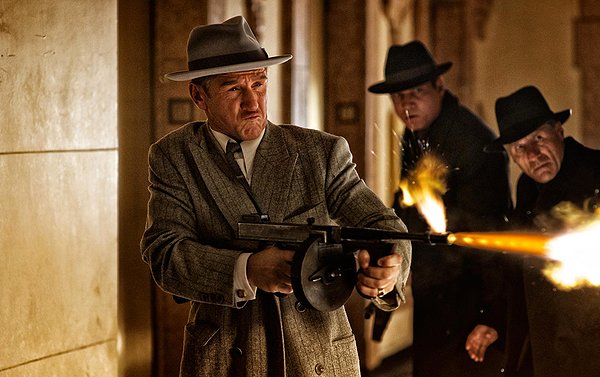 Finally, we must speak of Mr. Sean Penn (Milk). The man’s actorly gumbo goes into campy overdrive. In these rare circumstances, you aren’t watching Sean Penn Esteemed Actor so much as Sean Penn Human Vortex of Overacting. Normally I would criticize Penn for going over the top but over the course of 110 minutes, he single-handedly becomes the only entertaining thing in the movie. He’s chewing scenery up a storm, yes, but at least he’s channeling the pulpy silliness of the whole movie. I came to enjoy his antics and outbursts and thus became more empathetic of Mickey Cohen and his efforts than I did with O’Mara. Such is the danger screenwriters run when they spend more time crafting an interesting villain than a hero.
Gangster Squad is what happens when a movie is sold on title and genre elements. To be fair, it’s a bang-up title. The plot is half-baked at best, really only serving as a thin outline of a gangster movie, but instead of adding complexity and intrigue and characterization, they just ran with it. The actors are either camping it up or out of their element, the action and shootouts are pretty mundane, and the story is just uninvolving, even for fans of film noir like myself. It’s a good-looking film from a technical standpoint, but that’s as far as I’ll go in my recommendation (it could be an odd pairing with Milk considering the two shared actors). It feels like it just wants the setting elements of film noir, the atmosphere, and then figures just having good guys and bad guys shoot it out will suffice. That glossy, high-sheen period look just seems like a cool façade, and a cool façade seems like the only ambition of Gangster Squad. I can’t really recall any signature action sequence, snappy quote, plot development, or peculiarity worthy of remembering. It may be one of the most forgettable gangster movies Hollywood has produced.
Nate’s Grade: C
Share this:

Jack Reacher (2012)
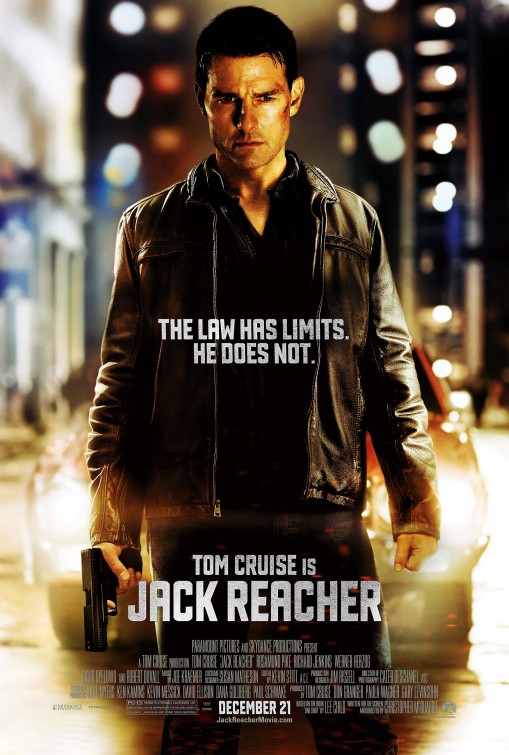 The Jack Reacher of the best-selling novels is a hulking, blonde haired, blue-eyed, 6’4” man of flinty justice. The Jack Reacher of the film of the same name is played by Tom Cruise, an actor who fits none of those descriptions. He is a movie star, however, and those are in short supply. The character is a former MP who operates like a drifter, leaving little trace, and inserting himself as needed to dispense his own sense of justice. The plot of the movie involves Reacher looking for a sniper responsible for a massacre, and hey is that German filmmaker Werner Herzog as the arch villain? Why yes it is. It’s a pretty standard mystery/investigation, complete with crooked cops and inept crooks. What elevates the movie is Cruise’s lone wolf intensity and writer/director Christopher McQuarie’s (The Way of the Gun) ingenuity with clichés. You’ve probably seen this sort of movie before, but McQuarie finds creative and clever ways to stand out, delivering a nifty car chase and a nifty escape as well. It’s just fun watching Cruise outfox his adversaries, via his wits or his fists. Where the movie becomes annoying is how it consistently has to remind you just how badass Jack Reacher is. At every turn, someone will say what kind of exceptional man he is, how he follows his own rules, etc. Reacher even gets the requisite “I’m not a hero so be afraid” speech. After a while, it just feels like the movie is overcompensating, trying to quell the irate fans of Lee Child’s novels who probably envisioned The Rock in Reacher’s shoes. Unlike Reacher the character, Jack Reacher the movie is not the best at what it does, but with a charismatic Cruise in control, it’s at least good enough to see once.
Nate’s Grade: B-
Share this:

Zero Dark Thirty (2012)
 Director Kathryn Bigelow and journalist-turned-screenwriter Mark Boal, Oscar winners for 2009’s Best Picture-winner war film The Hurt Locker, were hard at work on their next movie when fate intervened. They were about to start production on a film about a 2001 incident where U.S. Special Forces almost nabbed Osama bin Laden, the notorious mastermind behind 9/11. Then on May 1, 2011, the world learned that Seal Team Six stormed bin Laden’s secret compound in Pakistan and executed the most wanted man in the world. Bigelow and Boal scrapped all plans and rewrote their movie from scratch. Now they had the ending we’d all demand; isn’t a movie where we get bin Laden way better than one where he narrowly escapes? Zero Dark Thirty (military terminology for well after dark) is the stunning result of Boal’s impressive reporting and condensing, Bigelow’s masterful direction, and a great supporting cast that brings history to vivid life. If you’re like me, you’ll walk out of the theater whistling to yourself, speechless at the spellbinding artistic achievement of the movie. This, ladies and gentlemen, is what essential, invigorating, quality filmmaking is all about.
We may know about Seal Team Six and the lead presented from tracking the courier, but few people know of the CIA analyst at the heart of the manhunt. Maya (Jessica Chastain) is a young agent stationed in Afghanistan who desires nothing more than to be the one who helps ensure that bin Laden gets killed. We follow her decade-long quest as she chases down leads, interrogates prisoners, and successfully presses the CIA brass for action, resulting in the fateful raid that took out bin Laden.
 You can tell early on that Zero Dark Thirty is going to be an excellent film. Given the pedigree of is creators, my expectations were enormously high. I rated their previous collaboration as my top film of that year. I knew I was in capable hands when the film opens on September 11, 2001 but skips any visuals. We sit and watch a minute of a blank screen while the sounds of desperate 911 calls become a wall of sound. It’s enough to reassert the stakes while still being restrained. Bigelow’s directorial command is astonishing, pitting you in the thick of the action. There are a lot of moving parts with a movie like this, wheels within wheels, and Bigelow keeps everything moving and focused. It helps that the bigger manhunt is broken up into a series of mini-missions over the ten years. Bigelow and her talented production team have recreated the ends of the world to bring this story to life. That added sheen of verisimilitude gives every moment a sense of magnified power, an electric sense of relevancy. You’ll get goose bumps as they start circling the actual location of bin Laden. Bigelow, who won an Oscar for her virtuoso work on The Hurt Locker, still knows how to play every one of your nerves. There’s a clandestine meet up with a possible turncoat that is stuffed with dread. Every checkpoint, every safety procedure waved, you’ll be biting your nails, the voice in your head clearly saying, “Oh no, this isn’t going to go well.” Zero Dark Thirty is more crime procedural than the action thriller. Even so, Bigelow’s direction is top-notch and brings an intense, churning verve to the film, down to the smallest detail.
The film plays out like an absorbing, hard-hitting piece of investigative journalism, recreating the steps and false turns over the ten-year manhunt for bin Laden. There is a lot of information to process and over 100 speaking roles, and Boal and Bigelow do not stoop to pander to the less intelligent in the audience. You will be expected to catch up or fall behind. It can get confusing at points but Boal does an exceedingly articulate job of narrowing the particulars of the bin Laden case and presenting a clear through line. It’s a story that hops around the globe through a series of mini-missions, from a meet up with a possible al Qaeda spy to locking down a phone number to trace a courier in Pakistan. You see every step, every deal, and every effort that it takes to land the big break, namely tracking down bin Laden’s trusted courier to his Abbottabad compound. Boal even separates his narrative with titled sub-sections like a lengthy piece of journalism. We all know where the story is going to end up, but Boal’s supreme talent is making every step meaningful and tense leading up to that fateful raid May 1, 2011. The level of reportage detail is completely enthralling and will be relatively unknown to most filmgoers. Beyond 9/11 and the London bombings, I confess to being ignorant of the other al Qaeda attacks highlighted throughout. Therefore, not only is Zero Dark Thirty an exciting manhunt, it’s also an educational endeavor for most Americans.
 The proceeding two hours are an engrossing manhunt, but when Zero Dark Thirty gets to the raid sequence, that is when the movie ascends to a level of cinematic excellence unsurpassed this year at the movies. There is nothing else in 2012 that comes close to matching the 30-minute raid on bin Laden’s compound. My heart was in my throat the whole time. I was physically shaking. I was pinned to my chair. The conclusion, nabbing bin Laden, is one of the most riveting sequences in film I have ever seen. It’s like Bigelow has complete control of your senses, and even though we all know how this story ends, you’ll be glued to the screen, pulse racing, anticipating every step. After the film ended, I told my friend Eric that I felt like I needed to start smoking, thus was how exhilarated I felt leaving the theater (message to kids: don’t smoke, even if you see Zero Dark Thirty). My head was bustling afterwards. All I could think about was the masterful conclusion to a very good movie. The raid sequence is brilliantly recreated and just about portrayed in exacting real time; you feel like you’re right there along with the members of Seal Team Six. For a civilian, it’s fascinating jut to watch the minutiae of what went down, but under Bigelow’s taut direction, it’s the moment every American has been waiting for since September 11, 2001. Bigelow is also careful not to portray the death in any sort of jingoistic, fist-pumping context. She sticks with her docu-drama approach, avoiding sensationalism, and you don’t even see the shot that takes down bin Laden. The film is also very careful not to linger on bin Laden’s dead body or even reveal his face; she doesn’t, as President Obama said, “spike the football.” Bigelow deserves a second Oscar just for her superlative handling of those unparalleled 30 minutes of pure filmmaking bravado. Plus, it’s the best ending of the year at the movies.
Let me address the brewing controversy ensnaring the movie regarding its depiction of torture. Zero Dark Thirty does demonstrate torture but it never glorifies it or presents it as anything less than dehumanizing and morally repugnant. But torture did happen (I’m sorry Dick Cheney… “enhanced interrogations”) and to whitewash this regrettable period of time from the historical record is a disservice to the truth. This country, as well as any other, engages in extreme and detestable measures; we only hope that our leaders have the moral clarity to make these ethical lapses as few and far between as possible. Now, the politicians and bloggers have attacked Bigelow’s movie as tacitly condoning torture, indicting that it was successful in getting that big break. This is not the case. Zero Dark Thirty shows a variety of methods being used, and yes we get a heavy helping of torture and humiliation, but it’s when Maya and others start treating the detainee like a human being again, offering food and conversation, is when the progress is made. The film does not explicitly declare one interrogation method successful, however, I can see where people will draw their own (wrong) conclusion. If anyone wants to read my exact stance on torture, just check out my lengthy review of the 2007 Oscar-winning documentary, Taxi to the Dark Side. In short, torture does not work and Zero Dark Thirty does not purport that it does, though many may conclude otherwise. It seems to me that the critics don’t have enough faith in the audience to accept ambiguity.
2011’s breakout actress, Chastain (The Help), is the focal point of the movie and she delivers. Her character has no life outside of doggedly hunting for bin Laden. She’s completely driven by the goal of killing him, and as such she gets to uncork some dandy angry monologues dressing down her colleagues for their failing dedication. Chastian does a fine job of keeping a veneer around Maya, shrouding her emotions into a mysterious calm, which seems realistic given the nature of the character but also makes it tricky to connect with her emotionally. This movie is not the great character study that The Hurt Locker was, and so Maya gets some rather shrift characterization: she’s a workaholic fighting for credibility. The real star of the movie is the story so all the characters take a back seat to Boal’s journalism. While Chastain is quite good, I have to shrug my shoulders at the various critics groups throwing Best Actress accolades her way (go Jennifer Lawrence).
 The supporting cast doesn’t have a weak link amongst them, from Kyle Chandler (Super 8) as an outpost boss, Mark Strong (Tinker Tailor Soldier Spy) as a CIA superior screaming at the bin Laden team to “find me targets to kill,” Jennifer Ehle (Contagion) as Maya’s closest friend in a hostile land, James Gandolfini (TV’s Sopranos) as CIA director Leon Panetta, Stephen Dillane (Game of Thrones’ Stannis Baratheon) as a skeptical NSA head, and Chris Pratt (TV’s Parks and Recreation) as a member of Seal Team Six. That’s right America, TV’s Andy Dwyer helps cap bin Laden. But the real standout is Jason Clarke (Lawless) as an interrogator who eventually leaves the field for an office but still makes headway for Maya.
Much like The Hurt Locker, here is a movie that transcends politics and genre. Zero Dark Thirty is a nerve-wracking thriller, it’s an intelligent crime procedural, and it’s an engrossing and powerful work of relevant art. It operates on such a high level of artistic achievement that little else from 2012 even comes close. This thorough, intense, provocative, thought-provoking, morally ambiguous, thrilling, and generally tremendous movie is taken to a whole other level with its concluding act, brilliantly recreating the raid that took down Osama bin Laden, the most cathartic and satisfying ending of the year. You’ll be liable to whistle in awe at how accomplished Zero Dark Thirty is. Of course audiences should not accept every thing they see in the movie as unimpeachable gospel, as dramatic license is needed to help shape a formidable narrative. This is still a movie that desires to entertain and yea does it entertain. I look forward to the American public getting a chance to experience the same riveting theatrical experience that I had with my critical brethren, as well as the sense of catharsis and relief by film’s end. Zero Dark Thirty forgoes sensationalism for modulation, eschews moral righteousness for ambiguity, and expects the audience to keep up with its retinue of information. And you’ll be grateful to be given the chance to tag along. Run out and see this remarkable movie when you have the chance. Movies don’t get much better than this, folks.
Nate’s Grade: A
Share this:

Killing Them Softly (2012)
 A funny thing happened while watching Killing Them Softly, the latest film from writer/director Andrew Dominik (The Assassination of Jesse James by the Coward Robert Ford). After an hour, I noticed a couple people stand up and leave, never to return. Then another and another like permission had been communally brokered. I counted ten walkouts at my showing, which was more than I had at Cloud Atlas, a film that I can at least understand the possible exodus. But this? It also got a rare F grade from CinemaScore, joining the ranks of The Devil Inside, Wolf Creek, and The Box. Before you put that much stock in what is essentially a movie going exit poll, Alex Cross was given an A grade from audiences. But why all the venomous hate? I can only theorize that the mainstream audience feels it was sold a bill of goods, a crime thriller with one of Hollywood’s biggest stars. The audience did not want to go on the lengthy talky detours. They wanted people to get dead. Whatever the reason, Killing Them Softly has killed its audience, who choose not to go softly in their disapproval.
Set amidst the economic meltdown of 2008, Frankie (Scoot McNairy) and Frankie (Ben Mendelsohn) are two lowlife thugs hired to rob a mob-affiliated card game. The trick is that local gangster Markie (Ray Liotta) had previously paid a group of guys to rob his own card game, fleecing his own customers. In his drunken revelry, Markie admitted as such to his pals. Now the situation is ripe for exploitation. Because any future robberies will have their suspicions pinned firmly on Markie, whether he had anything to do with them or not. As a result, no one is gambling, the public has lost confidence in the markets, and the mob needs to get things back to business. Jackie (Brad Pitt) is called in to make that happen. He’s a professional killer, who prefers to kill at a distance, without all those messy emotions. He has to trace the culprits responsible and give them the reckoning they have coming.
 From a plot standpoint, Killing Them Softly is pretty thin. It’s just about the ramifications of two nitwits robbing a card game. This lack of narrative depth will rankle most filmgoers, but I didn’t mind it so much because Dominik uses the crime thriller veneer to examine the sheer ugliness of a criminal lifestyle. This is a pretty character-driven crime flick, and it has to be when there’s a malnourished plot. It takes some lengthy sidesteps, notably with James Gandolfini’s (Zero Dark Thirty) character, Mickey. He’s supposed to be a professional, but the man is a complete wreck. He’s belligerent to those in service positions (waiters, prostitutes), chronically drunk, and weirdly empathetic for his struggling wife, yet seemingly powerless to change his life’s downward slide into self-medicated self-destruction. Mickey is the ghost of Christmas Future, the vision of what this lifestyle does to people who make a living out of it, who actually live into their retirement age. The two young crooks, Frankie and Russell, are idiots yes, but even when they have money their lives are so empty. Russell is so disgusting, sweating profusely, that you can practically taste his stank. Frankie is a little more cognizant of the danger he’s in, and yet the moron doesn’t leave town after his big score. I’d think that’s the first thing you do when you rip off the mob. The day-to-day anxiety of a life of crime is just not worth the effort. You constantly have to look over your shoulder, a life dominated in paranoia, where every stranger or furtive glance could have sinister meaning. Even when you make money, you’re theoretically taking money away from someone else’s profit, and these are the kind of people that don’t take kindly to friendly competition. This is no enviable, glamorous life.
I think Killing Me Softly would be a better, easily more satisfying movie had it eschewed the attempts at extra weight and commentary. It’s no surprise that the scenes that follow a more traditional crime thriller route are the best. There’s palpable tension when Frankie and Russell are in over their heads. The conflict is prevalent and the suspense is nicely stretched out, notably during the card game robbery. Being neophytes, you don’t know what they’re liable to do but you can bet it won’t be smart. This is when the movie is most alive, most engaging, and most entertaining. When it plays it straight, and explores the sliding power plays at stake in a world of cash and guns, it can be a nasty but taut little movie. I’m just sorry that Dominik took a functional crime thriller and gave it an extra sheen of Important Things to Say (”America’s not a country. It’s a business.”). The political parallels never feel more than tacked on attempts to grope for deeper meaning. Oh I get it, I understand the comparison of mob enforcers and corrupt Wall Street execs, hoodlums and crooks in different casual wear, but that doesn’t mean the parallel is that meaningful. It’s on-the-nose and a bit in your face (really, people are watching C-SPAN in dive bars?).
 Given Domink’s last film, I expected there to be some visual flourishes, though I’m unsure of whether they added much to the proceedings. Dominik sure can make violence entrancing, setting a slow motion slaying in the rain with stirring beauty to ironic Motown music. But he can also make the violence feel brutal, like a beat down on Markie that uses choice sound effects and editing to make you feel the punches. Even the opening seconds feel like an artistic assault to the senses, the loud static of noise interrupted by bursts of Obama’s sound bytes. The extreme camera angles, the visual felicities, the ironic music selections, they all seem to underscore the movie’s subtext-as-text approach.
Pitt (Moneyball) doesn’t come into the movie for the first thirty minutes. You’re welcome to see him, especially since he has such a coolly threatening demeanor, but also because here’s a character that will mix things up. I found myself rooting for the guy, partially because he was an accomplished professional but also because I wanted there to be consequences for idiots doing dumb to powerful enemies. I enjoyed the slow-burn intensity of Pitt when he was turning the screws on the screw-up. Richard Jenkins (Cabin in the Woods) is also enjoyable as a mob shill left to communicate the wishes of his higher-ups. McNairy (Argo) gives a performance that screams desperation, as he realizes the depth of trouble he finds himself into. And even Liotta (Charlie St. Cloud) does a fine job as a lout who misjudges the friends he keeps, discovering the costs of bragging.
In many ways, I feel like Killing Them Softly is akin to last year’s Drive, a more meditative crime thriller with bursts of gruesome yet beatific violence. Likewise, many filmgoers will be sore thinking they were catching straight crime thrillers and been given arty genre ruminations instead. And like my ambivalent feelings toward Drive, I can’t work up that much enthusiasm for Killing Them Softly either. It’s certainly got more ambition than most crime flicks but I’d rather it concentrate on telling a more engaging story. Dominik’s film is a bit too indulgent for its own good, given to visual flourishes and a narrative routinely sidetracked. And yet, I found it fairly interesting at just about every turn, well-acted, and intensely suspenseful and effective at different points. But it doesn’t add up to enough to recommend. The political allegory probably rubbed the walkouts the wrong way as well. The political allegory is too obvious, too pat with its “they’re all crooks” broadside. I wish the movie had abandoned the squalid, nihilistic art house ambitions and just kept things straight. When it has less on its mind, it works best. But for many, Killing Them Softly will be too tedious to see to the bloody end.
Nate’s Grade: B-
Share this:

Compliance (2012)
 The day at a fast food eatery began like any other. Sandra (Ann Dowd), the manager of the branch, has to shepherd her small group of employees through a hectic Friday evening. Then she gets a phone call from an “Officer Daniels” (Pat Healy). He tells her one of her workers, Becky (Dreama Walker), has stolen money from a customer. Sandra takes Becky into a storeroom and confronts her. Becky is aghast and professes her innocence. This is where things start to get out of control in writer/director Craig Zobel’s potent indie pressure-cooker. “Officer Daniels” insists that Becky be searched, then strip searched, and then worse, and Sandra and the employees begrudgingly go along. After all, it’s an officer of the law telling them what to do. Except that “Officer Daniels” is no police officer. This whole incident is an awful prank, and the people involved will never be the same.
This really is an indie horror movie, flipping the oft-repeated cry, “Don’t go in there,” with, “Why are you still doing this?” You may have to watch portions of this movie between your fingers. I was squirming and crying out at numerous points. The tension and dread just continue to mount, and you watch the characters slowly degrade, as they’re asked to do more insidious acts of humiliation in the name of compliance, and to watch them carry on the path of shame. It’s a step-by-step process of human degradation, so that the more disturbing moments of sexual obedience don’t feel entirely implausible given the journey through hell the characters have endured. It is impossible to watch this movie silent and detached. This is a provocative film that will garner many reactions but it’s also something of an endurance test. How long can you watch? How far can you watch these characters descend? The movie hooks you early and then you almost feel complicit, but you’re completely taken over by morbid curiosity.
 The movie is a powerful modern-day example of the Milgram experiment, the famous psychological exercise where a figure in authority, who assumes all responsibility, gradually gets average people to commit increasingly harmful acts to others. As long as people believe they are following orders, they can be convinced to do almost anything by someone in control. It’s easy to sit back and judge these characters, scoffing at how naïve they seem to be. It’s always easy for us to say what we would do in hypothetical situations, that is, until they happen. Compliance is an intriguing analysis of the shifting facets of power, authority, and manipulation. “Officer Daniels” enlists a host of tricks and verbal intimidation to persuade his victims to do things outside their better judgment (the caller’s true profession is a brilliant backstory). After a while, Sandra looks to be developing some slight Stockholm syndrome as she empathizes more with the plight of the phony officer on the phone than her employee. He provides just enough sympathy and validation she’s looking for to win her over. He also plays people against one another; he implores Becky to spare Sandra any extended grief, which often cows her into consenting. “Officer Daniels” isn’t the only one manipulating others; Sandra pressures employees to become involved in the situation, using her position of power to squeeze others into getting what she wants. There are numerous victims and culprits here.
Zobel could have easily given over to the exploitation elements of his story and made a very tawdry, voyeuristic exercise in sexual dominance. We watch as Becky bares all of herself and then goes even further, as “Officer Daniels” instructs male attendants to physically inspect her body cavities. It is a credit to Zobel’s sensitive direction that Compliance does not come across like a glorified S&M masturbation fantasy. He treats the incident very seriously, providing clear distaste without going overboard into preachy condemnation or superiority. It’s amazing that Zobel’s script finds so much empathy for his participants. You may be surprised at how relatable and “normal” these people seem. You may even recognize some of them. They’re all trying to do the right thing at heart, but that distinction gets extremely blurry as the night carries on. The point of Zobel’s script is that these people could be us. The added empathy makes the downward spiral all the more stomach-churning, as we want these characters to take a stand, to wise up and question the voice of authority.
 Dowd (Marley & Me) is downright heartbreaking and deeply frustrating in the movie. We get a clear sense of the pressure she’s under in her position, but she’s really the focal point of the movie. Walker (TV’s Don’t Trust the B in Apartment 23) is the martyr of the piece, and her slow resignation to the humiliation is deeply affecting, but this is Dowd’s movie. The longtime character actress takes the character of the dowdy Sandra, striving for respect, and transforms her into a figure worthy of Greek tragedy. She can be vindictive and, well, bossy, but she’s also a figure struggling for respect and validation and what she feels is morally just. We watch as her confidence starts getting chipped away, the flickers of doubt that she must tamp down because now she’s gone too far to reverse course. I don’t imagine that a movie as small as Compliance will be remembered around Oscar time, but I’ll certainly recall Dowd’s sad and transfixing performance.
I’d like to share a spooky bit of personal connection to the film. No I’ve never experienced anything this heinous before, but there was an offhand music cue that caught my interest. When we cut to the dining area early on, there’s an Admiral Twin song playing. Who is Admiral Twin? Why they’re a brilliant pop-rock band from Tulsa, Oklahoma that I’ve been singing the praises of since 2000. I’ve won over friends with my discipleship, but the band is still relatively unknown, playing few performances outside of their native Tulsa. Given the phonetic approximations of my name with the film’s writer/director, and the inclusion of an obscure indie band that few know (but should), it seems likely that Zobel may indeed be some far off relative of mine or, more likely, myself. I must have crafted an entire film without ever knowing about it. This seems like the most probable scenario.
I don’t want it sound like Compliance is some grueling exercise in group sadism. In lesser hands, it might have devolved to that. It’s a fascinating and provocative game that challenges and incenses an audience. The movie is a sickening but compulsively watchable dramatic experiment that will leave you talking for hours once it concludes. It’s an uncomfortable sit, yes, but that doesn’t mean it’s not worthwhile. The events in the film seem unbelievable and yet it’s based on a true story. This stuff happened, people. Not only that, it happened multiple occasions in multiple vicinities. What does that say about human nature? Will we only be as good as society lets us be? If we are absolved of responsibility, how far removed from our own sense of ethics will we go? Are we all susceptible to this moral failing under the right circumstances? I think that’s the truly terrifying and lasting lesson of Compliance. These people could be us, both victim and unwitting antagonist. Destined to stir debate and become a college ethics course favorite, Compliance is a gripping movie that will make you cringe but also give way to some scary introspection. How far would you go?
Nate’s Grade: A-
Share this:

Cloud Atlas (2012)
 Most people regarded David Mitchell’s 2004 sprawling novel Cloud Atlas was unfilmable. It has six different stories each set in a different time period, slotted into a different genre, and each a variation on storytelling. Mitchell’s tome was structured like a series of nesting dolls, each narrative pulling back to reveal a character reading the previous manuscript, and eventually the direction was reversed. We go from the mid-nineteenth century to post-apocalyptic and back again. I read the book over the summer and found it to be enthralling, especially because each storyline was written so distinctively in a different writing style. The post-apocalyptic linguistics definitely took some getting used to. How could you turn this unwieldy book into a workable movie?
The Wachowski siblings, Andy and Lana, teamed up with German director Tom Tyker (Run Lola Run) to try and find a way. They decided to split up the stories into a musical syncopation, with stories blending into one another. As a result, Cloud Atlas is six different movies for the price of one but it’s far more than the sum of its parts. Cloud Atlas coalesces, bleeds, and bends, becoming a Mobius strip of causality and courage and love. The trio of directors, who shot simultaneously with two separate film crews, has done the impossible and translated Mitchell’s brilliant novel into a soaring, compelling, and multifaceted epic on hope and humanism.
Where to begin with this one? Well, in 1849, Adam Ewing (Jim Sturgess) is traveling across the Pacific back to his home in San Francisco. He’s fallen ill on the ship and keeping the secret of a stowaway in his chamber, a Moriori slave named Autua (David Gyasi). In 1931, Robert Frobisher (Ben Whishaw) is a penniless gay musician looking for refuge. He offers his services to the aged but still famed composer, Vyvian Ayers (Jim Broadbent). Ayers will dictate and Frobisher will assist in writing. In 1971, Luisa Rey (Halle Berry) is a reporter investigating a series of murders tied to a nuclear facility and a report the head honcho (Hugh Grant) doesn’t want exposed. In 2012, Timothy Cavendish (Broadbent) is a small-time publisher who mistakenly checks himself into a nursing home that won’t allow him to leave. In 2140, a new working class is grown from the lab. Somni 451 (Doona Bae) is one of these fabricants. With the help of a revolutionary (Sturgess), she escapes her confines and learns the horrors of the totalitarian world and becomes part of the rebellion. And 100 winters after “The Fall,” mankind has descended into agrarian tribes. Zachry (Hanks) is a goat herder who reluctantly agrees to take Meronym (Berry) to a hallowed mountain. Meronym belongs to the last group of technology-abled civilization, the Prescients, and Zachry mistrusts her and is tempted to kill her to protect his people. Just describing this stuff is tiring and could take up two reviews.
 This is going to be a very divisive movie, this much I can tell. It’s so powerfully earnest that you either embrace its mushiness and ambitions or you smirk and mock its New Age philosophy and optimism. There will be no middle ground with this film. We’re talking about transmigrating souls over the course of 500 years, Tom Hanks as a post-apocalyptic goat herder, and an evil presence known as Old Georgie, who looks like the forgotten cousin to the Wicked Witch of the West. There is some stuff in this movie that is plenty goofy, especially when seen on the surface. It takes a while to ease into the film, adjust to its tempo and accept the context of those goofy elements. But once that’s established then it feels like you can handle anything. There’s such an overflowing of feeling in this movie that it’s easy to make fun of it, to dismiss it under the safety of ironic detachment. It would be easy to decry the Cloud Atlas team for being self-indulgent or pretentious. What they are doing is far from normal, but the achievement of Cloud Atlas is the graceful way it finds to connect the rhythms of a deeply felt humanity. It has its stirring moments and memorable scenes, but when compacted and collected into a beautiful whole, that’s where the movie transcends. When an authoritative character barks, “You are but a drop in an ocean,” and our hero responds, “What is an ocean but a series of drops?” you either roll your eyes or you cheer. This is an earnest movie that wears its humanism on its sleeve. You either roll with that or you don’t, and I decided to embrace the big, messy, mushiness of the whole project and was swept away.
For a three-hour movie, the time flew by, and by the end I knew I had to see Cloud Atlas again. The first viewing requires much in the way of processing. You’re stringing together the disparate strands of the narrative, you’re listening hard to decipher the post-apocalyptic tongue of Zachry and company, and then you’re also keeping track of what actors are playing what characters, crossing lines of race and gender. The disguised actor factor is something of a fun ”who’s who” party game throughout the movie; initially distracting and somewhat questionable (especially the cross-racial makeup). I think seeing Cloud Atlas a second time will allow me to immerse myself further, finding new depths and connections. The pacing is surprisingly swift for a three-hour movie. You barely notice the time is gone, and honestly I could have done with even more movie, especially during the Neo Seoul segment. Given the six segments, some stories are going to be more compelling than others. I don’t think too many people are going to be as compelled with Frobisher’s creative sessions as they are Somni’s escape from enslavement. Initially, you’ll be scratching your head what they all have in common, and the lighthearted segments seem to clash with the more severe segments of systemic abuses. But then the big picture starts to eventually emerge and you see the parallel themes of oppression, bondage, rebellion, sacrifice, abolition and the yearning for freedom at all costs. The filmmakers find clever ways to thematically link their different tales. The movie starts to become a musical experience, much like Frobisher’s central melody, the overlapping notes of repetition and the swelling movements of human life in minor and major.
 As anyone who endured the Matrix sequels will attest, the Wachoswkis are film theologians and Cloud Atlas is unabashedly spiritual. The filmmakers openly favor examining the spiritual side of Mitchell’s novel rather than the political. I found the results to be intriguing but short of profound. From a philosophical/theological standpoint, Cloud Atlas is not breaking new ground or even going into great depth. We’ve got some basic Eastern notions like reincarnation and trying to improve upon one’s soul through various lifetimes. There’s also the notion that death is just a transitional phase and not the end. The film is also very interested in the transcendentalist interconnections of human history. “With each crime and each act of kindness, we give way to our future,” says Somni at one point. I like this; it’s essentially karma in its purest form but it also denotes that every choice gives ways to multitudes of possible futures (perhaps pedestrian but I still like it). I feel that human kindness is long-reaching and casts out many ripples, and Cloud Atlas is a film all about the ripples, seeing the long-reaching effects to causes, and discovering that individuals can become movements and movements can become inspiration. I also like the relatable debate over religious belief in the far-flung future; the Valley people worship Somni as their gracious Goddess, but the more advanced Prescients view her as a person, noble and with strong and important ideas but flesh and blood. And yet the film doesn’t look down on Zachry and his people for their beliefs; Somni inspires them to do good. Do the details matter when the results are positive? Cloud Atlas has plenty of intriguing questions roiling around, moments of pause worthy of post-screening debate. It’s not too deep but it’s far from shallow (the Wachoswkis love their Christ-like imagery, don’t they?).
From a filmmaking craft standpoint, Cloud Atlas is often breathtaking. In some respects it feels like something radically new, a $100 million dollar art film. The visuals are wonderful and the different time periods all come across handsomely mounted, perfectly realized, the details vivid and period appropriate. The future worlds are easily the most engrossing just because of how different they are. You’re never spoon-fed the answers in this movie, so we’re left to put together what lead to each future. I would have loved to have gotten even more details about Somni’s world, a time where democracy has been replaced by “corpocracy,” a world run by corporations. The ambitious story structure of Cloud Atlas could have easily become confusing, but the filmmakers smartly give each segment its own little undivided period to set up that world and its unique tone. They even provide date stamps. Then things get more spliced together, the different storylines cascading and braided together. Some of the storylines have to wrap up early and others are saved for heartbreaking finales of tragic resonance. The elliptical romances spanning centuries provide nice counterpoints and satisfying out-of-time conclusions for storylines that don’t always end cheerful. The movie is often thrilling, intellectually stimulating, disturbing, and poignant, though to be fair it comes up short when it comes to emotional involvement. Like the stunted depth of its philosophy, the movie has a way of drawing you in but never fully; it’s all about a wealth of human feelings and the nature of humanity yet it quixotically comes up short emotionally.
With up to six roles to play, the actors are given plenty to work with. It would be redundant to say you’ve never seen many of these actors like they are in Cloud Atlas (has anyone ever seen Berry in whiteface?). Every actor gets to play heroes and villains, saints and sinners. Only Weaving (The Matrix) and Grant (The Pirates! Band of Misfits) play antagonists in just about every story, and when you have Weaving at your disposal you have to give the man a role with menace. Grant gets to play a post-apocalyptic marauding cannibal. You won’t see him eat anybody’s face in one of those Bridget Jones movies. Like the filmmakers, the actors display full commitment to their varied roles no matter how silly some of the future diction may sound (“for true-true”). Hanks instantly anchors your empathy as Zachry and grounds a storyline that has the biggest danger of slipping into silliness. Readers will know I’m not the biggest Berry fan, and that is probably being charitable. However, I was truly impressed with her work in Cloud Atlas and would easily classify this as her best work since her Oscar-winning turn in Monster’s Ball. Her portrayal of Luisa Rey has such fire and her Meronym has such melancholy. Broadbent (The Iron Lady) is still highly enjoyable as a pompous sort, I’m always happy to see Keith David, and Weaving is delightful in his venomous villains, as a devil, a hit man, and most vividly as the Nurse Ratchet-style sadistic head nurse antagonizing Cavendish. The real breakaway star is Bae (The Host), who also benefits by having the most involving storyline. Her gradual awakening is just about note-perfect, alternating between curiosity, horror, amazement, and finally anger. All of those emotions need to be free of histrionics but if too underplayed then Somni seems like a walking zombie. Bae finds the right somber middle ground and her journey is the most emotionally rewarding.
 In the end, there’s so much to unpack, dissect, discuss, debate, and contemplate with this movie, and every hour I think of some new connection that dovetails the plots. Cloud Atlas is a thrillingly artistic mosaic, a giant puzzle that begs for closer examination. Unlike the films of Terrence Malick, this is a dense, challenging work that is also accessible and, here’s the heretical part film snobs, entertaining. We get a kaleidoscope of the human experience told in beautiful flourishes. There are a lot of demands with Cloud Atlas, and ultimately it may demand multiple viewings to completely sort out one’s opinion on this gigantic picture of gigantic feeling. I’m still uncertain whether I really enjoyed it or loved it, nagging doubts concerning the limited emotional attachment to consider. I’m curious what a second viewing, stripped of analyzing which actor is in what body, will allow me to further appreciate the scale and scope of the film’s achievement.
The individual stories of Cloud Atlas may not be terribly profound but collectively this movie is something special. I anticipate it will be trendy to mock its sincerity and ambition and New Agey spirituality (not that a negative opinion is automatically invalid). We live in a cynical world. It’s rare to find a movie that has so many things to say with such intense earnestness. It’s even more rare for that movie to be good. Due to the sci-fi elements and time hopping, The Fountain and 2001 will be natural film comparisons, but In some ways Cloud Atlas reminds me more of another divisive film, 2001’s Moulin Rouge!. Both were sincere movies about the genuine power of love and human connection, told with such artistic flair, drive, and ambition, and both attempt to transform the traditional tropes of storytelling and drama into a brave new 21st century collage of sight and sound and sprawling spirits. Simply put, you’ll never see a movie like Cloud Atlas again. So do yourself a favor and see it already, then find someone to talk about it and compare how fast the time goes. Then, if you’re like me, see it again.
Nate’s Grade: A
Share this:

Argo (2012)
 The reinvention of Ben Affleck as movie director took a big step forward with the critical and commercial success of the 2010 Boston cops-and-robbers thriller, The Town. While I’d argue Affleck’s first outing as a director, 2007’s Gone Baby Gone, is still his best, The Town won over plenty of doubters. Here was an actor-turned-director who could deliver smart drama, intense suspense, and coax Oscar-caliber performances from his brilliantly assembled casts. Have you seen Blake Lively half as good in anything as she was as a tragic junkie single mom in The Town? She’ll be able to get work for years just from the demo reels of that performance. But with two sturdy, complex, taut genre movies under his belt, Affleck still had doubters. The political thriller Argo takes Affleck far out of his Bostonian comfort zone. The creative stretching proves fruitful because Argo is a stirring, fascinating, and engrossing true-life story that should at last silence the remainng doubters concerning Affleck’s talents behind the camera.
In 1979, The U.S. embassy in Tehran was overtaken by a storm of Iranian protestors. Fifty-two Americans were held hostage for an exasperating 444 days. During the takeover, six Americans escapes through a back alley and found asylum with the Canadian ambassador (Victor Garber). There they waited for months, trying to work out a plan to escape. If caught by the mob, it’s very likely they would be deemed spies and executed. Enter CIA agent Tony Mendez (Ben Affleck) and his scheme. His idea is to pretend the six American hostages are part of a Canadian film crew scouting locations in Iran for their sci-fi movie. His superiors seem dubious but Mendez gets the green light. He heads to Hollywood and puts together his team, a veteran makeup artist (John Goodman) and an established producer (Alan Arkin) on the outs with the industry. They settle on the screenplay “Argo” and have to build a credible cover story. From there, Mendez travels into Iran to meet with the hidden hostages to sell them his scheme. They were all coming out together or nobody was getting back home.
 Argo is a fascinating story that seems like it could only exist in the movies, and yet it’s a true story and one hell of a story. It’s a mission movie, so we know the familiar flow of the film even as the details seem fresh (unless you’re Canadian). The very idea is one of those “so crazy it might work” plans; one State department official asks, “You don’t have any better bad ideas than this?” Even though we know it was a success, that doesn’t stop the movie from being engrossing. Argo flies by like a caper film as the CIA gathers the resources and experts to try and put together a ramshackle rescue mission. There’s feeling out the Hollywood angle, gathering the pieces to create the illusion of an actual film production, and the urgency of the façade. Even though it’s a bit outlandish, the fake movie plot seems worlds better than the other possible plans being pitched by the government agencies (smuggling in bicycles and maps?). I thought it was genuinely interesting just to be granted access to a room where people where debating rescue options and picking them apart. The film is consistently intriguing watching smart people come up with smart solutions to challenging problems.
Argo really is three movies expertly rolled together into one; a Middle East thriller, a Hollywood satire, and a D.C. procedural. It’s a bonus that every one of these segments works but it’s even more surprising, and rewarding, that the different segments all snap together without breaking tone. Credit Affleck the director for making sure his movie parts don’t overpower one another. We can go from a tense Middle East sequence where the hostages might have just risked exposure, and then we’ll cut to Hollywood and laugh at the cantankerous Lester. It’s a delicate balancing act that Affleck superbly handles. The humor of Hollywood doesn’t detract or minimize the seriousness of the Middle East chapters; it allows room to breathe, to let off steam. The D.C. segments are the biggest expository moments but they give scope and meaning to the danger. Each of these segments is compelling and each one could have been a captivating movie all its own. We’re fortunate that Argo gives us all three.
Audience ignorance aside, we may know how this story ends but that doesn’t stop the film from being completely nerve-wracking. Affleck showed remarkable skill in The Town when it came to building exciting sequences that felt like they would explode with tension. When it came to Argo, there were moments that literally kept me on the edge of my seat, a rarity with action films. The beginning sequence of the American embassy is rapt with suspense, as the security system deteriorates and the people inside realize the inevitable. They start destroying classified state evidence but really they just have to sit and wait, hearing the footsteps, knowing what is near. The sharp screenplay from Chris Terrio (Heights) does a tremendous job of developing clear suspense sequences. There’s the tension of the precarious subterfuge, of the hostages hiding behind enemy lines, so to speak. If one wrong person were to discover their identity, it could quickly unravel. There’s a whole team of children being paid to piece together shredded documents and photos like they were jigsaw puzzles. Knowing this, it makes the scenes where the group ventures out of the embassy thrilling. The group has to visit a marketplace as part of their cover and it’s terrifying. We know the steps of escape, and each one could easily blow up and get everyone killed. Just when you think you can breathe a sigh of relief we’ve moved onto the next challenge and the tension washes over you again. The climax is so tense that your audience will likely erupt in applause when the hostages eventually escape, relieved and proud of the accomplishment.
The maturation of Affleck as a bonafide directing talent continues. There’s a growing confidence in his direction. The man doesn’t have to rely on flashy visual artifice nor does he seem to be hewing to one notable style. He’s directing each movie as its own beast, be it crime thrillers or true-life suspense story. The man knows where to put his camera in the thick of the action. Affleck also eschews the popular shakycam docu-drama approach that too many filmmakers automatically does all the work of establishing realism. Docu-drama visuals can work when properly utilized, but too often I find it to be self-consciously arty and an annoying distraction. Affleck’s camera remains steady but holds on his actors, giving them space to emote. Three movies into his directing career, Affleck has established himself as one of the best men to direct actors. He’s already lead two actors to Oscar nominations and might just earn a third for Arkin. Plus there’s the fact that Argo, top to bottom, is cast with great character actors. You have people the likes of Michael Parks (Red State) who are there for one line. It also helps Affleck the actor to have Affleck the director.
 The only nagging problem with Argo is that it’s rather light when it comes to character development. The caper is the star of the movie and sucks up most of the screen time. The film does an excellent job of recreating the anxiety that the hostages felt. I can’t say we get to know any of them well as people. I can’t say we get to know much about Tony Mendez either, beside the de rigueur parts of being a CIA agent like divorce, child custody, and long nights of loneliness. The best-developed character in the movie is Lester Siegel, and while he’s terrifically entertaining, it’s something of a misstep for the cranky Hollywood producer to win that title. He’s a man who knows his value in the ever-changing currency of Hollywood; bitter, crabby, but hopeful of making a difference. Arkin (Little Miss Sunshine) is a natural fit for the character and brings more dimensions to the role. I wish the same care were given for the other people in the story, particularly those in harm’s way. The nuanced approach to character with Gone Baby Gone and The Town is just absent. Thankfully, the story is so engrossing that it’s not a mortal wound, but you do wish there was a greater emotional involvement in the film rather than a generic empathy of rescuing those in danger. Also, the Canadian involvement seems curiously downplayed even though their ambassador was the one hiding them for months. His role in the movie plays like he’s Guy #8. I know we tackle the CIA’s involvement but Canada could use more recognition for their integral contributions.
Argo establishes Ben Affleck as a dependable, versatile, actor’s director; someone along the likes of a Sidney Lumet or Sydney Pollack (I swear I don’t have a “Sydney” key lock in my brain). Affleck has proven to be a director who immerses himself into his stories, and his fingerprints are on every frame, every performance. He just nails it. The pacing is tight, the suspense builds to near unsustainable levels, and the tones are expertly juggled to prove complimentary rather than distractions. Best of all, Affleck lets Terrio’s terrific script take center stage. The incredible true-story of Argo is the biggest selling point for the movie, and Affleck doesn’t try to gussy up a whopper of a tale. The film has even more unexpected resonance given the recent spur of violent protests in the Middle East, notably the deadly attack on the U.S. embassy in Benghazi. Argo doesn’t sensationalize the hostage crises for cheap popcorn entertainment. Nor does it glorify or denigrate the Iranian’s outrage over the U.S. giving sanctuary to the deposed Shah. For a very political subject, the movie takes a very muted political stance, relying on the facts of the situation. The movie finds a rare poignancy in its appeal to the power of international cooperation. By the end of the movie, you might even tear up when you hear the actual hostages and government officials recount their struggle and ultimate triumph. Argo is that rare breed of a movie that seems to have everything. While it’s not perfect, it’s clear that Affleck is here to stay as a top-level director.
Nate’s Grade: A-
Share this:

Looper (2012)
 I became a Rian Johnson disciple the second that 2006’s Brick ended. I was floored by the originality, the artistic vision, the intelligence, and the creative voice. This was a unique filmmaker and I instantly knew this writer/director would be a man worth following. His follow-up, 2009’s The Brothers Bloom, was three fourths of a great movie, but a bit of an overdose on whimsy. Then I read that Johnson was next going to try his hand at time travel, and I could not contain my excitement. One of my favorite film genres and one of my favorite up-and-coming indie filmmakers together. I was expecting Johnson to do for time travel what he did with film noir (Brick) and the con movie (Brothers Bloom). How could Looper disappoint? Well, sadly, the movie found a way. It feels like Johnson smashed two halves of two different movies together, one good and one not so good.
In 2072, time travel is invented but instantly made illegal. The only people who have access to time travel are the mob. They have a surplus of dead bodies that need to disappear, so the mob sends them back 30 years. In 2042, Joe (Joseph Gordon-Levitt) is employed as a looper. He kills the guys the mob sends back in time and then disposes of the bodies. He’s paid well, and he and his fellow loopers live it up as privileged members of the Kansas City social sphere. Abe (Jeff Daniels) runs the show in town; he’s a mob guy from the future. There’s a catch to all the looper riches. The mob also wants to protect them in the future, so they send back the looper’s future self to be executed. It’s called closing the loop. And if you don’t kill your future self, bad things will definitely happen, just ask Seth (Paul Dano), a looper hacked apart to lure his future self back.
 The day comes where Joe is tasked with executing his future self, Old Joe (Bruce Willis). Old Joe escapes and goes on the run. Younger Joe is now under extreme pressure to kill his guy, or else the mob might just find him and start slicing body appendages. Old Joe is looking for the Rainmaker, who in 30 years will become a criminal tyrant responsible for much death. But in 2042, he’s only a child. Old Joe’s mission is to kill the child before he becomes the Rainmaker, and before he murders Old Joe’s eventual wife. While fleeing the mob, Joe takes refuge on a farm outside of the city. Sara (Emily Blunt) and her young son Cid (Pierce Gagnon) warily take in Joe but they’re also hiding a secret, that Cid has powerful telekinetic powers that can be put to great damage.
The film’s premise is compelling and allows for plenty of mind-bending possibilities, and Johnson has a fresh take on the sci-fi genre. Hunting down your future self is a grabber of a concept and I loved the scenes where Joe and Old Joe would sit down and converse. There’s the natural tension of Joe’s mission to eliminate his future self, but there’s also a flurry of ideas, ones that make the film better developed. Old Joe has an edge in foreknowledge but Joe has his own edge. He can change Old Joe’s memories by choosing different actions. He swears if he ever sees a picture of Old Joe’s wife that he’ll do everything in his path to alter fate, to make it so he never finds her. As a result, Old Joe is hobbled by headaches and fuzzy memories because the order of events is no longer concrete. “This time travel stuff fries my brain like an egg,” Old Joe admits. That, my friends, is a fascinating struggle for dominance and a refreshing take on time travel. Then you throw in the mob chasing after both Joes and you got an extra sense of urgency. Looper is playfully heady but easy enough to follow. It’s a thriller that doesn’t get bogged down in time travel logistics but it doesn’t pander to its audience either. If it did, I’m fairly certain Joe (addict, criminal, selfish) and Old Joe (eventual child slayer) would have taken turns to be more likeable. For a solid hour, Looper is alive with narrative jujitsu, a nice balance of action, drama, dark humor, intelligent plotting, stylish direction, the occasional startling visual, and strong acting from Gordon-Levitt and Willis.
And then the Looper becomes a completely different movie. Once the action shifts to Sara’s farm is where this movie completely unravels. I just couldn’t believe what was happening. The first half was so intriguing, intellectually stimulating, and thrilling, and then I got stuck on a farm and the movie turned into a lame version of Children of the Damned. I didn’t come for a telekinetic kid movie; I came for a time travel movie. The second half of this movie is practically wall-to-wall telekinetic kid stuff. The action slows down to a crawl and the flurry of ideas turns to a trickle as we introduce Strong Single Mom and Weird Son. I may have a cold heart but I didn’t care about these characters. I found the romance forced and Sara to be poorly developed. I found the kid annoying, and when he got mad and made his stupid mad face, it irritated me. Mostly I was irritated that the promise of the first half of the film had stalled out, and that this was where the movie was choosing to spend its dwindling time. It’s like the movie has been swallowed inside out by this stupid telekinetic subplot. The climax is fine but why did we have to travel through Dumb Farm Rest Stop to get there? Is it so that Joe can learn to be a better person? I didn’t buy that growth, especially with a kid as annoying and obviously dangerous as Cid. I suppose one night of sex with Emily Blunt (The Adjustment Bureau) could do the trick.
Besides the whole farm deal, there are other nagging questions I have that devalue Looper in my eyes.
 1) So in the future the mob is the only entity with access to time travel, but all they use it for is to dispose of bodies? That’s it? Biff Tanner used a sports almanac from the future to become king of the world. Are you telling me an organization that has historically profited from gambling would make no use of foreknowledge for personal gain?
2) Why would the mob have the loopers kill their older versions of themselves? This seems like a natural conflict of interest that could readily be avoided. Instead of having that particular looper kill his future self, thus closing the loop, why not assign that future version to a different looper? That way you don’t have to run the risk of the past looper letting his future self go. Or you could just never tell them what happened. For that matter, why does the mob have to send the guys back alive? Could they not simply just kill them and send the dead bodies 30 years back in time? This seems like an easier solution that also minimizes risk.
3) If you’ve just uncovered the power of time travel, why are you even bothering to send back your dead bodies 30 years into the past? Why not send your dead bodies back BILLIONS of years where the Earth is still forming, hot, and uninhabitable? I find this to be a better solution (I also wrote this solution in my own time travel screenplay, so there’s that too). Why can’t the mob feed dead bodies to dinosaurs? I’d love to see that.
4) You have a mob guy from the future, and you do nothing with that? Abe has one wisecrack about being from the future, and it’s a good one, but otherwise this guy could have just been from the present. The movie does nothing with the juicy element of a mob boss from the future. Maybe he doesn’t do as he’s told and arranges for his own rule. Or maybe he utilizes a sports almanac and makes some prescient bets, huh?
5) The movie takes place almost entirely around the confines of Kansas City. I find it hard to believe that a criminal organization would be sending all its bodies to Kansas City. Perhaps the mob also sends people across space and time, otherwise this means that we’re only following the future evil masterwork of the Kansas City mob.
6) I suppose you have to ask at what point do you really start to nitpick the whole butterfly effect of cause and effect paradoxes. With all time travel movies, there’s going to be some degree of suspension of disbelief, because changing one action can have wide-ranging consequences. However, with Looper there are several instances that gave me pause. Firstly, there’s the central idea of killing the Rainmaker as a child, which would negate the killing of the loopers, which would negate Old Joe seeking out the Rainmaker to kill. I’ll look beyond that. So Old Seth, in the film’s most horrifying sequence, starts noticing his fingers are disappearing, then his nose, and then his legs, etc. The mob is torturing young Seth to lure back the missing target. It’s an amazing visual sequence, but are you telling me that cutting off young Seth’s body parts would not have altered his future to a greater degree? I’m fairly certain when you start removing fingers and legs that Old Seth’s timeline would have been dramatically altered and he would cease to exist or follow the exact path to wind up in the past again. For that matter, why even bother luring the older Seth back? Could they not just take care of him by killing young Seth? What are they going to do with young Seth? If they’re just going to kill him then they should have just done that to begin with.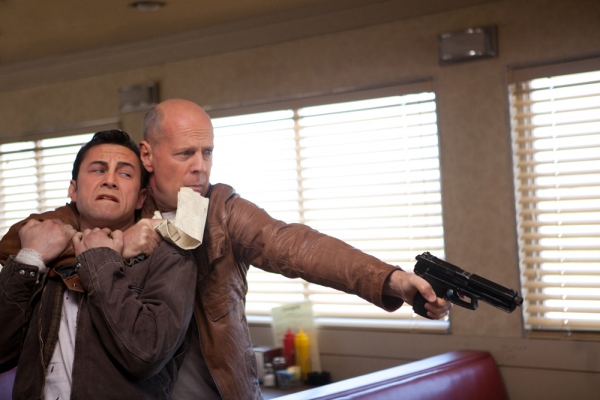
Johnson has plenty of thought-provoking questions he’d like to address within the bounds of a sci-fi action thriller. Would you kill a child if that kid were going to grow up and be a monster? Is redemption possible after doing horrible things? Could you kill your future version of yourself? Would you sacrifice everything to prevent future misery? These are legitimate questions and Looper deserves credit for spending time to ponder them, but I just wish Johnson could have gone back in time and chosen a different path.
Coming off of the stupendous Brick and the perfectly enjoyable Brothers Bloom, my expectations for Johnson’s third film were astronomical, especially given this crafty man’s take on time travel. I love the premise, love the actors involved, and love the ideas toyed around with, but the movie completely falls apart at the halfway mark. The pacing gets slack, the story becomes forced, and Looper transforms into a different, unwelcome movie. I can’t help but feel disappointed, partly from my expectations but also from the knowledge that Johnson could do better. The story just isn’t as well developed as it carries on, and the telekinetic subplot feels like a dull leftover from another movie. After an invigorating first half, Looper crumbles under the weight of a weak subplot that consumes the movie. There’s a good amount of thrills and intellectual stimulation aboard, but it’s all concentrated in the first half of the movie. I can’t recommend one half of a movie. I’ll still eagerly anticipate Johnson’s next project, but Looper is a sci-fi thriller that unravels at an alarming rate, turning a possibly great movie into a mediocre one.
Nate’s Grade: C+
Share this:

End of Watch (2012)
 David Ayer has written seven movies and directed three, and almost all of them have followed the Los Angeles police department. The man wrote a character that got Denzel Washington a Best Actor Oscar, and from there it’s been all cops all the time, some dirty, some noble, but all residing in the LAPD. I suppose Ayer knows what he does best and is sticking to his wheelhouse. End of Watch is Ayer’s newest tale featuring one of the protagonists recording his activities on the force to put together for a documentary. And with that flimsy excuse, we have ourselves the first found footage cop drama.
Officers Brian Taylor (Jake Gyllenhaal) and Mike Zavala (Michael Pena) are two young police officers patrolling the mean streets of Los Angeles. Rather than dark and brooding, these guys are often quick with a joke and get along peachy. That doesn’t mean they don’t take their jobs seriously, and we watch them take down suspects, save children from burning buildings, and discover horrible mass slayings by Mexican cartels. During their off duty time, Taylor is dating a spunky woman (Anna Kendrick) whereas Mike has a wife (Natalie Martinez) and children of his own. The guys are honorable cops and run afoul of the local gang leader Big Evil (Maurice Compte), a man with connections to those dangerous cartels.
 The best reason to watch End of Watch is the ebullient yet natural chemistry between Pena (World Trade Center) and Gyllenhaal (Source Code). These guys really come across like partners that have been through thick and thin. Their interaction is arguably the best part of the movie, watching two guys who defy cop movie stereotypes. First off, neither is naïve or world-weary; they’re idealistic but grounded. Both men get to be complex individuals, each funny, each warm, each flinty when called upon, each dealing with the heavy toll of protecting and serving, each an honorable police officer trying his best. These guys feel like real-life partners and not just Movie Partners, and that is a great testament to Ayer’s script and the performances by Pena and Gyllenhaal. I also appreciated that the guys are presented as co-leads; I would have assumed Gyllenhaal was going to anchor the movie. These guys really love one another and you understand their camaraderie. The actors went on ride alongs for a solid five months before shooting, and that must have been an invaluable tool for an actor because these guys are so natural with one another. They can bicker but it’s mostly playful, and the dialogue feels authentic and crisp. The performances are measured and meaty and we emotionally invest in these characters and fear for their welfare. These guys are great together and so you worry that we may not see them both live by the end credits.
These guys are such pals, you’ll start to ask yourself, “Hey, shouldn’t there be like some conflict some time?” For almost tow full acts, we are immersed in police procedure details, routines, mundane realities, with the occasional burst of action. Except it takes until the very end of Act Two before there’s a real conflict, one that lasts beyond an individual sequence. These guys are so chummy, so lovingly buddy-buddy, so there’s no tangible conflict between the two of them. The LAPD seems mostly supportive despite some paranoid warnings that do not bear fruit. Even the local thug, Big Evil, doesn’t prove to be an active threat until the Mexican cartel pays him to kill our lead cops (the cartel also wants an expense report of the hit). But this threat doesn’t emerge until well into the film, so much so that the plot feels rather aimless, like we’re on one eternal ride along with our boys in blue. It’s a good thing I enjoy their company.
Here’s why I speculate why Ayer chose to tell his story through the guise of found footage. I don’t out rightly see it as a cash grab, Ayer’s attempt to repackage something old with something new (that is quickly becoming something old). Ayer is not particularly dogmatic about the found footage approach; often we’ll get first-person angles, gun POV angles, or just general angles that could not have been captured through the found footage mechanics. I think Ayer chose this route because he felt it afforded him greater latitude to craft a realistic depiction of the daily grind of the embattled LAPD officer. This approach allows Ayer more freedom to flout cop movie clichés we’ve become well accustomed to. There are no wildly mismatched partners, no long gun heroics, and no long-suffering personal relationships. Though I find it extremely unbelievable that the LAPD would be so casual and blasé about an officer recording his activities and internal workings. That seems like an open invitation for a lawsuit or a subpoena especially if a criminal attorney gets wind. To a degree, the found footage edict works and the authenticity of End of Watch is never in question, but it also seems like Ayer’s convenient go-to excuse when you’re looking for that missing conflict. It is a fictional movie after all.
 The visceral nature of the camerawork, and the extra emotional attachment we feel for the leads, makes for some pretty nail-biting suspense, though only after the cartel issues their hit. The movie teases you with a gutsy ending, one that exemplifies the men’s sense of brotherhood in arms and the fatalistic prospect of protecting the City of Angels. It felt fitting and poignant. I was surprised that Ayer was taking an audience in this direction… and then he didn’t. The film chickens out and gives us a miraculous plot turn that also reinforces the Hollywood pecking order of racial significance. It’s a misstep and one that costs End of Watch from being more emotionally resonant.
As a side note, I’m not a prude when it comes to the use of salty language. Films that reflect certain realities should not curtail the way people genuinely speak. Some people just have filthy mouths. However, the profanity level in End of Watch is off the chart, notably concerning the character of Big Evil. I am dead certain that every second or third word out of this guy’s mouth is some variation of the f-word. If you catalogued all of his dialogue, I bet over 75% of total words would be profanity. It starts to get ridiculous and even funny when you hear nothing but the same three words during an angry outburst. And this is no David Mamet or Kevin Smith poetic composition of vulgarity and the profane; this is just lazy dialogue, like Ayer told his actor that, when in doubt, let loose a litany of f-bombs. Perhaps Big Evil would be less evil if people just helped him with his limited vocabulary.
End of Watch is an involving police procedural with some gripping moments of tension thanks to the stellar performances from its pair of police officers, Pena and Gyllenhaal. Ayer’s found footage motif gets some visceral excitement out of an old story, but what really sucks us in are the emotional bonds we’ve forged with these two men over the course of an hour. That makes the danger feel very dire. The movie feels like a bromance at times. I wish Ayer hadn’t pulled back from his more dour ending but it’s not enough to spoil what is an above average genre film with a spiffy new visual polish. I don’t know how many films Ayer can keep cranking out about the LAPD but as long as he pays due attention to character, and gives us the occasional break from the ubiquitous antihero with a badge, then at least he’ll keep making compelling genre cinema.
Nate’s Grade: B


You must be logged in to post a comment.