Blog Archives
Ghost Rider (2007)
 Nicolas Cage’s career has been flaming out, so what better role than a burning skeleton biker who serves as a bounty hunter for the Devil, in this case Peter Fonda. A cliché-riddled script, laughable performances, cheesy effects and dull villains doom any entertainment prospects this movie might have had. Cage, as the titular rider, gets to fight a group of escaped demons who all have one connection to an element; one has the power of fire, another the power of wind, etc., it’s like a hellish Captain Planet squad. But what’s the point when Ghost Rider simply vanquishes them so easily? It’s repetitive and goes nowhere. There’s one moment Sam Elliot “turns” into an older ghost rider/bounty hunter and rides along with Cage to save the day. But then he says, “Well, I could only do that once more, so good luck.” What? You could only turn into a flaming ass kicker one more time and you wasted it on riding a horsey through the desert? Eva Mendes is awful as her role of “girlfriend from past,” and why, if she and Cage grew up as childhood sweethearts, does he look over 15 years older than her in the present? I guess working for Satan can really take a lot out of you.
Nate’s Grade: D
Share this:

I Know Who Killed Me (2007)
 We interrupt the nonstop barrage of Lindsay Lohan media coverage and speculation to bring you her movie, or, more accurately, further proof that Lohan is in desperate need of a career makeover. The tabloid target has a pretty shoddy track record of late when it comes to picking acting projects, so it’s no wonder that her splashy private life has overshadowed her cinematic duds. Thanks to a second summer DUI Lohan was unable to promote her new movie, I Know Who Killed Me. This may be a blessing in disguise because if I were her I would want to draw the least amount of attention possible to what is destined to contend for the worst film of 2007.
We open to Aubrey (Lohan) reading her story in her high school class. The story revolves around a stripper named Dakota and the amorous attention she earns from creepy older gentlemen. One night Aubrey goes missing and the police believe she may be the next victim of the local blue-gloved serial killer that hacks off the limbs of his victims. The last girl, currently residing in the morgue, is missing her right forearm and her right leg. Her parents (Neal McDonough, Julia Ormond) fear the worst. Then a motorist finds Aubrey’s mutilated body on the side of the road. She wakes up in the hospital and will survive, except the problem is that she has no idea who any Aubrey is; her name is Dakota and she worked as a stripper. She vows to find the “real” Aubrey.
This films is sleazy and tries to energize a lame straight-to-video thriller with some tawdry turns. Without Lohan’s name, I Know Who Killed Me would never have gotten a theatrical release. The torture sequences are drawn out to the soundtrack of Lohan’s muffled screams. The violence fails to excite or horrify, but instead it just seems like a sorry attempt to ape the success of recent torture-heavy horror flicks.
 The sex is even less believable. Aubrey/Dakota, fresh from the hospital, beds the quarterback in one of the least convincing, most unintentionally hilarious sex scenes of recent memory. She throws the jock onto her bed and pins him down for a good pumping. In the ensuing two minutes, the pair engage in exaggerated and noisy PG-13 sex where the woman stays on top and keeps her bra on the whole time (does any woman do that?). The whole time the movie cuts back and forth to Aubrey/Dakota’s mother listening and furiously cleaning the kitchen sink. I think the juxtaposition is intended to be funny, and it is, just not in the manner the filmmakers were probably hoping for.
The movie would be more revolting if it weren’t so incomprehensible. I Know Who Killed Me begins to disassemble at a fantastic rate of idiocy once it attempts to explain its central Aubrey/Dakota conflict. But the movie only presents two options: 1) Aubrey and Dakota are the same person and she just created a fictional persona as a means of post-traumatic stress (yawn), or 2) somehow there are TWO Lohans on this planet (what?). The first scenario is pretty dull and obvious and way too feeble for such a dank exploitation thriller. The second scenario requires a scheme so convoluted and ridiculous that it cannot be taken seriously. In the end, the movie becomes Saw meets The Parent Trap, and it’s every bit as terrible as you would concur from such a description.
For the sake of the morbidly curious, I will be discussing some heavy-duty spoilers to fully shine the spotlight on how ludicrous the movie gets. Don’t say you were not warned. Aubrey/Dakota keeps swearing she is indeed her own woman but no one seems to believe her. She researches the unexplainable via the Internet and it is here that she gathers the theory of stigmatic twins. The idea is that whatever happens to one twin will magically happen to the other, no matter the distance and no matter the situation. In the online example, a man with gambling debts is shot in the throat, and thousands of miles away his twin brother bleeds to death thanks to a perfectly placed and ill-timed hole in his own throat. I Know Who Killed Me tries to wrap up its questions with answers that would seem preposterous even in a soap opera. Not only does the film give us the old long-lost twin chestnut but it also goes the extra inane inning to say that one twin endures whatever happens to the other. So when Aubrey is losing limbs during her capture, Dakota is mysteriously waking up some considerable weight loss. If my limbs were disappearing I might consult a doctor. Essentially, if there’s any merit to this theory, the best way to get revenge on your twin (long-lost or not) is through extreme masochism.
 I Know Who Killed Me is littered with stupid behavior and stupid plot points that stick in your brain. A doctor fixes Aubrey/Dakota with a pair of prosthetics – a fake leg and a robot arm. He slides the robot hand onto her stump and it reacts to her nerve impulses. As soon as I saw this scene I blurted out, “Oh my God, Lindsay Lohan becomes the Terminator!” Where the scene earns its stupid wings is that the doctor says she’ll have to charge her prosthetic when not in use or else the battery will go dead. Naturally, I’m thinking he’s referring to the robot arm of doom, but no, he’s talking about her freaking leg. Aubrey/Dakota’s leg amputation is below her knee; therefore this fake leg is little more than a pole. There’s nothing mechanical to it. Why does it need to be plugged in? Will it hop away? It doesn’t matter because the leg and arm never pose any trouble or danger for Aubrey/Dakota. It’s a strange setup without any payoff.
The bloody ending to I Know Who Killed Me is such a mess that it takes special attention just to pick apart its awfulness for further clarity. Aubrey/Dakota figures out the whole complicated rigmarole and declares in titular fashion, “I know who killed me.” Given the silly stigmatic twin theory, even this statement is incorrect from a tense standpoint (if it was true she wouldn’t be able to utter the words). Aubrey/Dakota and her dad head off to the dismembering serial killer’s home without bothering to contact the authorities. She says they don’t have time because, apparently, cell phones do not exist in this universe. I don’t know how it’s possible for Aubrey/Dakota to dig up a grave with one arm. When she goes running into the woods she’s looking for an owl from a vision. That’s good. It’s not like the woods are big or have more than one owl. For that matter, how did Aubrey even get kidnapped in the first place when she was among a large crowd on a busy sidewalk? Would no one have noticed and done something? Even the identity of the serial killer cannot give the movie a sense of finality that it wants. This is your standard serial killer movie where the killer has no working motivation and their identity is relatively meaningless. The limb-slicing maniac might as well have been the janitor seen in the background of one scene for a fleeting moment.
 Lohan gives a performance that suits the material – dreadful. Her idea of a bad girl seems more like a perturbed and insolent child. Lohan gets to hurl her share of F-bombs but never seems adult in whatever she’s doing onscreen. I Know Who Killed Me is a depressing low point for such a once-promising young actress who had the world on a string.
Director Chris Sivertson seems to know he’s the captain of a doomed vessel. He overwhelms the movie with irritating lighting excesses. Sivertson takes a cue from Shyamalan and ramps up the color symbolism; there’s blue roses, blue gloves, blue killer tools, blue stained glass of blue roses. You may start to wonder if the Blue Man Group suddenly became a symphonic serial killing side project.
I Know Who Killed Me is a disaster in every sense of the word. The ineptness on display is staggering. The movie is trash from start to finish but it’s not even redeemable trash. The movie tries to cover its numerous plot holes with images of Lohan canoodling with a stripper pole. I Know Who Killed Me is a ludicrous, incomprehensible, and rather sundry thriller that won’t help Lohan’s troubled life. I have a lot of good will for Lohan after her performances in Freaky Friday and Mean Girls. I want her to succeed, but truthfully, if she needs to know who’s killing her career, the answer is in a mirror.
Nate’s Grade: D
Share this:

Pirates of the Caribbean: At World’s End (2007)
 Shiver me timbers Jerry Bruckheimer. The Pirates of the Caribbean movies are taking no prisoners when it comes to money and fans. Ten months after 2006’s Dead Man’s Chest comes the concluding chapter to the Pirates saga. At World’s End is longer, bigger, and more expensive, but it is also the first Pirates movie that felt like a ride I wanted to get off.
The British navy, at the command of Lord Beckett (Tom Hollander), is eliminating all piracy once and for all. He now controls the heart of Davey Jones (Bill Nighy) and so controls Jones and the crew of the Flying Dutchman, the most fearsome ship run by cursed barnacle-encrusted crewmen. As the very busy hangmen will attest, it’s not a friendly time to be a pirate. The Black Pearl has set out to Singapore to find support from Soa Feng (Chow Yun-Fat), one of the nine pirate lords. The Pearl is now commanded by Barbosa (Geoffrey Rush) who was brought back from the dead thanks to the witchy Tia Dalma (Naomie Harris). They travel to the ends of the earth to Davy Jones’ locker to rescue Jack Sparrow (Johnny Depp), who was last seen in the belly of a beast. Elisabeth (Keira Knightley) and Will (Orlando Bloom) are both aboard and still bickering about their stalled romance. Once Sparrow returns to the land of the living, the group meets with the other pirate lords from all across the globe in an effort to pull together and stand against Beckett.
 As it turns out, the fear that Pirates of the Caribbean: Dead Man’s Chest was a 150-minute trailer for this movie was unfounded. That’s because the third movie in the Pirates of the Caribbean series completely ignores or messes up the many intriguing setups from the second film. Character motivations from Dead Man’s Chest are mostly unresolved and revert to stock generalizations. Jack Sparrow feels like he’s been grafted onto an unrelated storyline. Most disappointingly is what happens to Davy Jones, the greatest addition to the Pirates landscape. This awesomely-realized villain was scary and fascinating and looked fantastic thanks to Oscar-winning special effects. At World’s End takes such an intriguing villain and turns him into an impotent tool to Beckett. He’s been transformed into a houseboy who might as well fill people’s teacups. Yes Davy Jones thankfully figures into the climax but why in the world’s end must an audience wait that long? Davy Jones reminds me a lot of the ghostly twins from 2003’s The Matrix Reloaded who were completely dropped from the second Matrix film to the third.
But not only does At World’s End fumble the hand-off from the previous sequel, the movie itself establishes many setups with poor or unsatisfying payoffs. So much is made about the pirate lords from all over the world, and we see a colorful collection of international pirating groups that is fitfully amusing, but the whole section has no point at all. Chow Yun-Fat’s character is a non-starter; in fact none of the new characters introduced in At World’s End play any importance on the overall plot. The film is building to a final all-out battle between the united pirate lords and the British navy. We witness the awesome sight of the sea filled with vast armadas of ships, and as an audience we are getting hungry for some epic nautical action. Then At World’s End pretends that none of the other ships matter and sets its entire battle as one ship versus one ship inside a whirlpool. While this is admittedly exciting it isn’t anywhere near as exciting as an entire war amongst hundreds of ships. The filmmakers have all the money in the world and they couldn’t give us a little something bigger in scope? The pirate lords could have just as easily been cut from the movie if they were just going to stand on the sidelines and wave a flag.
The pirate lords make a big deal about their apprehension with releasing the sea goddess Calysto from her earthly prison. The pirates trapped her into the body of a human in order for them to gain control of the seas. They reckon she’ll be one very bitter sea goddess and take out some apocalyptic wrath out on the pirates. So the pirates release her, cowering in fear at her powerful reprisals and,,, nothing. Calysto vanishes, causes some mildly inclement weather, and is never seen again. Talk about a lot of pointless hot air.
 I think perhaps the clearest example of how the movie screws up is with the monstrous Kraken. This slimy beast got a ton of attention in Dead Man’s Chest and was a ferocious terror on the high seas. Now, I would expect that such a creature that played an integral role in Dead Man’s Chest would be back for the next sequel. Ignoring its prominence in the plot, the thing just looked amazing onscreen. But with At World’s End the giant monster is killed off screen and in between the movies. I felt insulted when I saw the mighty carcass washed ashore like a pathetic beached whale. What is satisfying about that? Why would Beckett make Davy Jones kill such a powerful weapon he could use for his own unseemly gain? It makes no sense. The Kraken isn’t the only character done a disservice by a plot stuffed to the gills. Some are killed in terribly pointless incidents and it just becomes irritating.
At World’s End is missing the high-flying fun of the first two Pirates movies, and this venture just feels draggy, tiresome, and far too dreary. You know you’re headed for some morose subject matter when a movie hangs an eight-year-old before the opening credits. This latest film is crushed to death by the weight of excess plot and confusion. There’s a damn near 20-minute section of the movie that’s nothing but characters double-crossing, triple-crossing, quadruple-crossing each other; it literally requires a character to spell out what has just taken place and set the record straight. I don’t think At World’s End ever recovers from this absurdly confusing miscue.
The film seems more interested in talking over an audience than delivering something genuinely thrilling and stirring. There’s a curious lack of action and nothing new matches the imaginative action set pieces of the previous films, like the duel atop the roving water wheel. Excluding a large melee between the Black Pearl and the Flying Dutchman as the climax, the action pops in and out in shortly timed bursts. For a movie within a hair or running three hours, there needed to be more action. Instead of derring-do, At World’s End spends interminable periods of people talking, usually in personal quarters, and explaining the increasingly laborious plot to each other. All of the Pirates movies are filled with false endings and heaping helpings of extra plot, but this is the first time I really felt the real drag of its running time. Director Gore Verbinski still knows how to keep things looking good but he can’t save the film from its anchor of a maddening and convoluted plot.
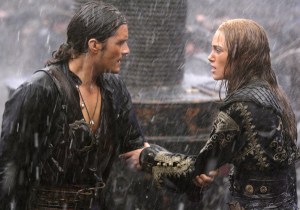 The movie is not without its due pleasures. Depp is always going to enchant with his now iconic character, but the true star of the film is Rush, who makes welcomed return. The special effects are still tops. The sequence rescuing Jack from the world of the dead provides many trippy moments that possess their own strange beauty, like when we watch the Black Pearl sail against the black, star-spotted sky. It’s fun seeing Keith Richards appear in cameo as Jack’s father and the stated inspiration for Depp’s performance. A small man and a large gun makes for one very funny sight gag. A Mexican standoff that actually involves an armed monkey is a comic high point. It’s just that all the fun or memorable moments seem to be the ones that matter the least. At World’s End still manages to do enough right to work, especially its Singapore opening. As far as a movie that upholds the quality of its franchise name, that’s a whole other matter.
Pirates of the Caribbean: At World’s End is a somewhat entertaining but heavily flawed final film to a trilogy. It’s the darkest and trippiest of the three movies, but it also makes the least amount of sense and has the least amount of action. That doesn’t seem like a good exchange in my book. There are not enough important events to justify the bloat. At World’s End has a hardcore case of butterfingers when it comes to handling plot and character setups from earlier films, and as a result almost nothing and no one ends in a satisfying fashion. The effects are still eye-popping and Depp will always be a comic treasure, but this lackluster movie feels like tripping at the end of a marathon. I had so much hope for At World’s End after how gratifying I found the other two movies but I cannot quell my disappointment. This is not a fitting conclusion. This feels more Matrix Revolutions than Return of the King. Of course it’ll make tremendous amounts of booty at the box-office, but will demand for a fourth be as rabid after this muddled and murky capper?
Nate’s Grade: B-
Share this:

The Reaping (2007)
 Forgive me father for I have sinned… I think The Reaping is not a terrible movie. Now, that would be damning praise in most circles, but when it comes to the notoriously implausible and awful genre of religious-based horror, well then “not terrible” is worthy of being brandished in the film’s ad. All of my fellow critics need to take a step down from the pulpit and see The Reaping for what it is: mild harmless fun.
Katherine (Hilary Swank) is a professor at Louisiana State who specializes in debunking claims of religious miracles. “38 miracles and 38 scientific explanations,” she says matter-of-factly. Katherine has something of a grudge against the Big Guy, being that she used to be a minister before her husband and daughter were murdered on an overseas missionary trip. Doug (David Morrissey) has a case only that only Katherine can crack. In the sleepy town of Haven, along the Louisiana Bayou, is being beset by Old Testament style plagues. The river has turned to blood and the Bible-beating townsfolk are itching to blame a little blonde girl (AnnaSophia Robb) who they feel could be the spawn of Satan.
 The Reaping starts off with tiny amounts of promise and intrigue because of Swank’s character. She?s a globetrotting spiritual investigator and a skeptic that an audience can get behind. She has a checkered history and Swank uses glances and moments to make her seem convincing. The Reaping isn’t complicated when it comes to its spiritual message. It’s all about renewal of faith, and I?m not exactly certain how all the pieces add up but that’s the gist. The Reaping isn’t too deep when it comes to thoughts of any kind, but that doesn’t mean much from a genre that requires a healthy suspension of rationale thought.
As a horror movie The Reaping relies on routine jump scares and the occasionally jump cut to a dream or a flashback in Africa with a lot of loud, abrasive sound effects to jolt the viewer. The plagues themselves are kind of weak, especially when plagues of maggots and frogs are seen as being so contained and limited. For maggots, we see a grill loaded with fish now covered in maggots. We never get any other anecdotes of what may have been reaped by the maggot plague. The frogs fall for about ten seconds and only in one part of the swamp. These pathetically isolated incidents don’t do much to ratchet up any scares and they certainly belittle the powerful wrath of the Almighty. Then again, maybe God is trying to tell people in unorthodox ways to eat less meat, thus the ruined fish and diseased cows. The plagues lack some oomph when they just happen to a handful of people, especially when it comes to lice or boils. I think the small-scale plagues really say, “We blew our budget on that river of blood, but hey, that was pretty cool right?”
 I don’t think I’ll ever utter these exact words again but here goes. The Reaping is a rather so-so movie that is mostly redeemed by an implausible and foreseeable twist ending. Yes, as horror and supernatural thrillers are go, twist endings seem pretty common place and often times forced, like the studio is dictating that they need something just a little extra to fool the audience into thinking they got their money’s worth. We as a movie watching society are so attuned to twist endings now that we can sniff them out like bad CGI. Twists generally become worked into the advertising campaign. The Reaping has some last-second turns to it, and even though I had my suspicions, I was quite pleased the movie walked the path it did. In fact, I would even go as far to say that it turned a spiritually thin schlocky horror movie into a moderately enjoyable spiritually thin schlocky horror movie. This is far from a good movie, but as a dumbed down genre flick it will be like home cooking for the right audience. Now, I cannot defend the gaps in logic brought about by the twists in The Reaping, and you will be spending the rest of your day coming up with a new problem every minute (the line ?some people just don’t wanna go to heaven? takes new life). The film takes one step too far with trying to up the ante. Just know that the upcoming crisis in Katherine’s life has been solved by a little thing called Roe vs. Wade.
Director Stephen Hopkins has some stinkers to his resume, chief among them 1998’s abominable Lost in Space, so he will take kindly to having his latest film deemed “not terrible.” Swank struts around in a tank top in the balmy South, gets knee-deep in blood, and convincingly sells this nonsense as only a two-time Oscar winner can. The scares are clunky and the story is rife with lots of explaining for a 90-minute movie built around the simple concept that the devil is nasty. The Reaping will play best for fans of the religious horror genre as well as those willing to lower their expectations. This isn’t a good movie, but then again, it’s not terrible.
Nate’s Grade: C+
Share this:

300 (2007)
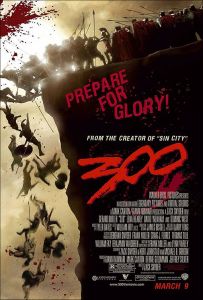 The story of the 300 is the story of the Battle of Thermopylae in 480 B.C, 150 years before Alexander the Great. Xerxes (Rodrigo Santiago) has deemed himself a “God king” and his Persian army has been conquering Asian nations and acquiring the most massive military force of its time. He sets his sights on conquering Greece, and to do so must go through the narrow passage of Thermopylae.
King Leonidis (Gerard Butler) assembles 300 of his finest Spartan warriors to thwart the Persian invasion. The Spartans were the super soldiers of their time, a society that valued brute strength and the honor of combat. Children born with imperfections were cast onto the rocks to perish; the society couldn’t afford a weak link in its protection. One day a Persian emissary rides into Sparta carrying the skulls of other kings and princes and a message from Xerxes: submit or you’re next. Well, after the emissary insults Queen Gorgo (Lena Headey), he refutes the message and kicks the emissary down a giant black pit in the middle of town (is this where they dump their garbage?). Thus, as they say, it is on. The Greek city-states have no sense of nationalism, so Leonidis commands little support to thwart the advancing Persian hordes. The Spartans have discipline and superior equipment, and because of these advantages they are able to hold back overwhelming numbers from the Persian army.
 Back at the home front, Queen Gorgo is wheeling and dealing behind the scenes to state her case to the Spartan assembly. She needs to shore support for more troops to help her husband. Theron (Dominic West) is a member of the priesthood that looks to sexually charged Oracles for guidance. However, he’s willing to drop his pacifist stance if the queen drops her robe and grins and bares it.
Xerxes is not a happy “God king.” He tries appealing to Leonidis, insisting that if he will simply bow down and relent than he will be spared. “Imagine what horrible fate awaits my enemies when I would gladly kill any of my own men for victory,” he threatens. Leonidas replies, “And I would die for any of mine.” The two men (well one man and one God king) go back to their corners ready for another round of this epic slugfest.
The action sequences are intense and director Zack Snyder (2004’s Dawn of the Dead) heightens their realities with surreal touches. He fondly gives life to the bloodshed and exaggerated combat popularized from Frank Miller?s graphic novel. The Sin City author has created another testosterone-soaked hyper-real adventure. The movie doesn’t even flirt with the notion of rigid historical accuracy (I doubt the Spartans fought rhinos, giant mutants, and were done in by a disgruntled hunchback); the film uses Miller’s artwork as a jumping point, which means that the Spartans fight in leather codpieces and red capes and that combat is more one-on-one even after we learn about the important of the phalanx. But quibbling over inaccuracies is a waste of time, because 300 is a pumped-up, super cool action movie that plays out in a vivid dreamscape. The movie was filmed with extensive green screen, much like Sin City was, and it feels like a direct transition of Miller’s pulpy comic book. Even the farewell sex between the King and Queen is stylized and seems to be snippets or panels from a comic book.
Let’s all be honest, there’s something undeniably homoerotic about 300. The movie worships the male form, with rippling abs and bulging biceps lovingly showcased in glowing, sweaty, fawning detail. The movie also focuses on manly men primarily spearing one another with phallic weaponry while the spurting blood dances across the camera in balletic CGI spasms. There?s a definite gay appeal to this film, not that there’s anything wrong with that. However, 300 also manages to curiously be homophobic at the same time (I swear this came to me independently, Phil). Xerxes is designed very as being very fey even at a massive height of eight feet. He lays his hands against Leonidis’ shoulders and asks for him to submit, and you can’t help but wonder what the teen boys in the audience are thinking. Xerxes also has a party tent filled with whores, the disfigured, transvestites, and the overall effeminate opposite of all those Greek macho muscle men the film postures as elite specimens.
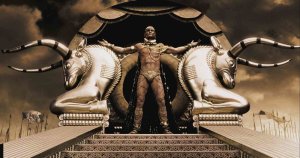 The acting is set to one tempo and that’s a mesmerizing use of yell-speak; it’s part guttural and part long-standing bellow that makes any piece of dialogue sound macho. King Leonidis growls, “SPAAAAAAAARTANS! TONIGHT WE DINE IN HELLLLLLLL!” After two hours of this primal style of speech, it becomes somewhat infectious and you want to try it in everyday situations in your life. Next time you’re out with friends at a fine dining establishment, I suggest asking for the salt thusly: “DINING PAAAARTNAAAAAH, COULD. YOOOOOOOOOU. PAAAAAAAAASS. THE SAAAAAAAAAAAALT?!” You’ll be guaranteed to get a reaction. It strains my throat even writing about the 300 yell-speak.
300 is a rousing movie going experience that plays out in a beautiful, pristine dreamscape that closely resembles our planet. The action is highly stylized and frenetic. It’s just that when the film stops to take a breath you start to look elsewhere, and when you do you realize there isn’t much below the blood-caked eye candy shell. 300 is grand spectacle that elicits thrills and chills, but the movie fails to touch on emotions beyond loyalty and courage. Both are essential for a soldier, and one as dedicated as a Spartan warrior, but the lack of substance keeps 300 from being anything other than a visually arresting, if ultimately disposable, two hours at the movies. There’s nothing wrong with a movie whose sole purpose is to quicken the pulse for a short supply of time, and 300 succeeds smashingly with this singular ambition. It is an ass-kicking history lesson that makes me wish I could learn more about Persian executioners with blades for hands at my local library.
Every culture has their own account of a last stand, a small group that heroically held off seemingly superior forces (remember the Alamo?). Snyder and Miller present an entertaining hack-and-slash primer through history that’s rarely dull and often enchanting to the senses. Deep down, there may not be much more to 300 than a lot of pretty pictures and a bunch of chiseled hunks, but that?s enough for most carnage fans with a free afternoon.
Nate?s Grade: B
Share this:

The Prestige (2006)
 Christopher Nolan can do no wrong in my book. The director of Memento, Insomnia, and Batman Begins has bewitched me with his clever non-linear storylines and artistic vision. The Prestige is 2006’s second period set magician movie, and in my opinion it’s the better of the two. Nolan’s film lacks the magic of The Illusionist, instead focusing more on the bitter realities of obsession, self-destruction, and the lengths that men will travel for vengeance. The script centers on a pair of dueling magicians (Christian Bale, Hugh Jackman) that are each trying to discover the other’s trick and top them. The storyline is as twisty as a pretzel and told in Nolan’s familiar non-linear fashion, building to a very dark reveal. Whereas The Illusionist sweeps viewers up with the wonder of magic, The Prestige is all about how tricks are orchestrated both on and offstage. The results are a tad cold; you don’t really feel for either magician. The movie is itself a trick but one grandly told with excellent slight of hand. The final act takes a step outside of the film’s tone but it works for me, and it’s been weeks since I last saw the haunting final images and I still cannot get them out of my mind. The Prestige is another notch on my Nolan love meter.
Nate’s Grade: A
Share this:

Pirates of the Caribbean: Dead Man’s Chest (2006)
 America loves its pirates, plain and simple. We as a nation are infatuated with the characters and the high-seas adventure of 2003’s Pirates of the Caribbean: Curse of the Black Pearl. We?re starving for more, and when the first in a two-part sequel was released it only became one of the biggest movies of all time. Pirates of the Caribbean: Dead Man’s Chest has shattered box-office records, rolling up $100 million in two days and a record $135 million weekend gross, easily surpassing former champ Spider-Man‘s supposedly invincible $118 weekend tally. America loves its pirates more than Spiderman, Star Wars, and who knows, maybe even Jesus. After all, Dead Man’s Chest did just kick out The Passion of the Christ from the top ten all-time grossers. Mel Gibson sure has a lot of grief at this moment.
Jack Sparrow (Johnny Depp) is a wanted man on the high seas. The East India Company, whose emissary now controls the Caribbean town of Port Royal, is after Jack and his special compass. But Captain Jack has bigger fish to fry. Davey Jones (Bill Nighy), ruler of the seas, wants what was promised to him: Jack’s soul. Jack made a bargain with the sea creature and now his time is running out. He must assemble a crew and track down the whereabouts of a buried chest. Inside this chest is the still-beating heart of Davey Jones, and he who controls the heart controls Jones, and thus the seas. That is why the East India Company is so interested in Jack. They’ve made an arrangement with groomis interuptis Will Turner (Orlando Bloom), who had his wedding hijacked and his bride (Keira Knightley) locked away. If he can retrieve Jack’s compass, then he and Elizabeth will be pardoned for aiding and abetting a known pirate. Will and Elizabeth each set off to find Jack Sparrow and to gain their freedom.
 The filmmakers have taken notes in the school of sequels from The Empire Strikes Back. Like the second Star Wars chapter, we’re left with the heroes separated and licking their wounds, evil appears to have the upper hand, and the lives of some beloved characters are left in doubt. Just as long as there’s no Ewoks, Disney has guaranteed my place in line on opening day 2007 for Pirates 3.
It?s hard to fully judge this Pirates sequel because it’s part one of a two-part story. I’m holding out my final say, especially if this movie just turns out to be an expensive 150-minute teaser trailer for Pirates of the Caribbean 3. I can?t fully judge many story and character arcs because we don?t know where movie #3 will carry them. Maybe it’ll end up being like the middling Matrix sequels, where subplots and characters were dropped as if the Wachowski brothers had screenwriting butterfingers (it’s a film critic’s unwritten duty to deride the Matrix sequels at any chance). At least this movie ends with a jolt that I did not see coming.
Most surprisingly, Dead Man’s Chest suffers little from the creative deadlock of sequels. Dead Man’s Chest is more a sci-fi monster fantasy than a swashbuckler. The supernatural edge has swallowed the series whole. Take for example Jack’s broken compass. What once was an oddity befitting its owner is now seen as another element of magic. Some of the interest seems lost if things are simply explained away as being magical. The story, unlike the Matrix sequels (See: above), expands and enriches its universe. Some leftovers from the first film made me cringe. I thought we were headed for a bad track, where the movie uses the audience’s memory as a cheap storytelling device. Familiar characters might pop up every which way, smiling, and saying, “Hey ho, remember me?” Miraculously, the leftovers are integrated so well with the new tale that they really do matter and don’t come across as cheap shortcuts. Norrington (Jack Davenport) and the two comic relief cursed pirates are all smartly woven back into the troupe, and each impacts the story in a non-obtrusive manner. Even the undead monkey is used well.
I made it a point to keep my expectations in check for Pirates of the Caribbean: Dead Man’s Chest. It would be naive to think that you could catch lightning in a bottle again. Yes, now with audience expectation we lose the originality and unpredictability that made the first Pirates adventure so joyously delicious. And yet I found myself getting riled up just the same and being whisked away by spirited entertainment. My expectations may have been tempered for Dead Man’s Chest but I still greatly enjoyed the ride. It seems that my opinion sharply differs from my overly negative critical colleagues; my own sister said Pirates 2 was one of the worst movies she’s ever seen. That seems a bit rash. She hasn’t even seen any Uwe Boll movies.
 There are moments that seem to stretch the credibility of the story. It’s been said before that it’s not the impossible that bugs you but the improbable, and this holds true for Dead Man’s Chest. I’m able to believe Davey Jones and his creepy crawly crew, but I’m not able to believe that Elizabeth Swan could single-handedly best them all at once in sword fighting. The movie becomes dangerously close to eye-rolls in parts, but generally steers clear of moments that rip you out of the story. Of course a Pirates film would be nothing without Johnny Depp. He’s the main reason the first film was so memorably embraceable and entertaining. It?s not every day someone gets nominated for a Best Actor Oscar playing an addled, swishy comic pirate. He’s truly the star and has been one of our finest actors long before he had any box-office clout. He’s created a character so beloved that he’s crossed over into the cultural lexicon. How many Jack Sparrow outfits do you see come Halloween? I had a friend directing a high school performance of A Midsummer Night’s Dream and every young actor wanted to audition as Captain Jack interpreting Shakespeare. Come to think of it, Jack Sparrow would certainly liven up some of the bard’s dusty works.
Depp is still hilarious and likeable even when he’s being a scoundrel. We simply love this character; I love this character. The unpredictable nature of Jack feels squeezed dry by the demands for familiarity with sequels, but Depp finds new ways to enthrall in Dead Man’s Chest. Some people are going to be uncomfortable with Jack being more dastardly, willing to trade others’ lives to save his own hide. I think desperation is an interesting place to put this character. Besides he has his big hero moments as well.
New dimensions are added to the other characters. Knightley gets to be shrewd and try her hand at pragmatic treachery. It eats her up inside at the end and Knightley, a nice comedic actress, allows us to see the rough seas of guilt within her. Bloom will always be Bloom, meaning he’ll be handsome, British, and seemingly too little for grownup movie stuff. Will is given a whole new set of daddy issues when he actually gets to spend time with dear departed dad (Stellan Skarsgard). Best of the rest (“the rest” being everyone other than Depp) is an unrecognizable Nighy, who saunters his deck with the fiery air of a preacher. Nighy manages to make Davey Jones even more interesting. Naomie Harris (28 Days Later) makes her presence felt as a witchy woman responsible for Jack’s compass.
The action sequences are gigantic and well constructed. They expand with organic complications and a lively, graceful sense of humor. An already fun sword fight atop a watermill wheel gets even more pleasing when the giant wheel breaks free and the fight continues. Three characters climb inside and out, all vying for a key that keeps changing hands thanks to gravity. A human-sized fruit-kabob tied to Jack has a wonderful payoff for something that seemed completely random. The special effects are gorgeous. You can practically taste the slime and sea salt from the creatures. Davey Jones is a fantastic design and I’m dying to know how they did his tentacle beard. Whether it be motion capture, CGI, or puppetry (was someone billed in the credits for “operating” Bill Nighy? Does that sound like a fluffer?), it’s all dazzling to behold. The Kraken is ferocious and so well designed that it’s destined to give an entire nation?s children nightmares for weeks. Coupled with the equally super expensive Superman Returns, it seems that nowadays if you want special effects that will retain their wow-factor, it helps to have a $200 million dollar budget. Director Gore Verbinsky has a terrific eye for shot compositions; I am convinced that if you give this man good material then he will give you popcorn gold. If you give him bad material, well, then you get shiny but pointless stuff like The Weather Man.
 I know this movie, at its center, is empty. It’s grand throwaway entertainment, a true popcorn romp, but yes, when you get down to it the film has little to it. It’s an explosion for the eyes and has some great characters and action choreography, but Dead Man’s Chest is nothing more than very pricey, very tasty cotton candy.
Pirates of the Caribbean: Dead Man’s Chest feels less like a rehash and more like the start of an exciting new voyage. It’s darker, bigger in scale, scarier, louder, brasher, but still barrels of fun. Time will tell whether the back-to-back sequels will support enough intrigue to cover two very long, very expensive action movies. But Dead Man’s Chest has the key Pirates ingredients returning: clever screenwriting duo Terry Rossio and Ted Elliott, and, naturally, the irreplaceable Johnny Depp. An early eye gouging might set the icky tone, but this is one sequel that compares favorably to its source. We’re left in a very Empire Strikes Back position, but not after running out of breath keeping up with the many treasures of Dead Man’s Chest. Nothing will recapture the magic of the 2003 original but this is one summer sequel that delivers without letdown. Then again, after Pirates 3, it could all be for naught. See you in 2007!
Nate?s Grade: B+*
*Final grade pending the outcome of Pirates of the Caribbean 3.
UPDATE: Having just seen the third film, I’m somewhat conflicted. Many items from Dead Man’s Chest have little payoff in the third film, At World’s End. So while I wouldn’t grade Dead Man’s Chest any higher after seeing where it concludes, I still find it to be too fun to rate any lower. Its final grade stands.
Share this:

Lady in the Water (2006)
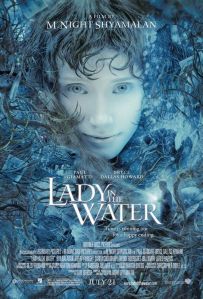
Writer/director/twist-abuser M. Night Shyamalan must have been smarting from the cool reception to his last high-concept thriller, 2004’s The Village. Shyamalan has built a reputation for smart, eerie, complex movies, as well as forced twists and endings that leave the films in shambles. He went back to basics. Lady in Water started as an ongoing story he told his kids at bedtime. His kids participated in the creation of the story. If we didn’t learn from last year’s The Adventures of Sharkboy and Lava Girl, movies where children helped shape the story should be left as bedtime stories. Lady in Water is further proof of this.
Cleveland Heep (Paul Giamatti) is the fix-it man at an apartment complex. Someone’s been swimming in the pool late at night and clogging up the filter. The unexpected culprit is Story (Bryce Dallas Howard), a waif of a girl. She says she is a “narf,” a sea nymph who’s crossed from her world, the Blue World, to ours. Her purpose is to plant the seed of change by finding a special individual. When her mission is complete a giant eagle will carry her back to her world. Cleveland accepts being her guardian and protector and assists her on her quest. He mingles with the apartment complex’s eclectic residents, trying to figure out who fits what role to help Story. There is one hairy problem. A scrunt, a wolf-like beast with twigs and long grass for fur, is after Story. An evil monkey creature is overseeing the whole weird affair.

Early on, Lady in Water was advertised as “a bedtime story by M. Night Shyamalan,” and just like your typical bedtime story, the thing feels entirely made up on the spot. The story sounds like a little kid making up a book report: “There’s this grass wolf, see, and it’s after this sea lady, and there’s these evil monkeys that oversee everything, and an eagle carries her away when she’s done, but she’s like the unknown Queen of the sea ladies, and she has helpers but can’t say who they are, and they all have special abilities, except some of them can only do stuff, and no one can see her leave.” What? Was Dio an unaccredited co-writer for this? Lady in Water feels like Shyamalan is haphazardly throwing spontaneous obstacles and rules into his story, hoping something sticks when it just muddies up the story.
Naturally, there are many unanswered questions brought about by the supernatural subject matter. Why is it an eagle that plucks Story away to safety when she?s fulfilled her mission? Wasn’t part of the schism between man and the Blue World because man moved to land? Wouldn’t something aquatic make more sense to rescue her? What about the entirely unnecessary evil monkey judge? Why is it even there? Why does it just sit there idly if the scrunt breaks the rules (and if the scrunt is a rule-breaker then why not just bust inside Cleveland’s home and eat the chick)? For that matter, if the monkey judge is so evil then why does it even respect the rules? Why don?t the evil monkey judges side with the already evil scrunts? Why do the scrunts hate the narfs so? Who established these systems of rules for narf contact and scrunt hunting? Do the monkey judges allow the narfs to get killed as long as it’s during the right time? Is it like a boxing match (“Touch gloves, to your corners, and no biting after the bell”)? And of course everyone believes this tripe. Shyamalan could fall back on the excuse that his tale is a bedtime story and not meant for extensive examination. Sure, not everything needs to be explained but that doesn’t mean Shyamalan can get away with being lazy.

There’s no finesse in the writing. Shyamalan seems to have taken his frustration with the dwindling critical reception of his works hard. The movie critic character, Mr. Farber (a droll Bob Balaban) is one of two items, either the embodiment of his ire, a figure out of touch with human emotion and the public’s trust, or Shyamalan making a preemptive strike. The critic complains there are no more original stories left in Hollywood; well, Mr. Smarty Pants, what do you think of a tale of narfs and scrunts? The problem is that the film critic is not unlikable, just cynical, and despite how dismissive Shyamalan may wish to be, the critic’s complaints and observations about the film industry are solid. In Lady in Water, characters do speak their feelings so casually. People explain back-stories and motivations like it was written on foreheads. The critic character is so inconsequential as well, so the notion that Shyamalan spends so much energy on him makes it feel like a score being settled.
What’s more irritating is how self-involved the movie comes across. The whole purpose of Story’s venture to our world is to inspire a gifted writer, a writer whose work will be seen as unchecked genius that will cause great change throughout the world. Nations will renounce war, men and women will greet each other as brother and sister, and the world will be a profoundly better place to live, all thanks to one artistic genius that changed the world. And who plays this artistic genius lying in wait? M. Night Shyamalan. In conjunction with the critic character, perhaps Shyamalan is proclaiming that his movies will stand the test of time, despite what those fuddy-duddies at their typewriters say. Lady in Water is either an intense example of artistic insecurity or an unflappable, monstrous ego.
Shyamalan is too gifted a filmmaker to make outright bad movies. However, he is prone to making very misguided choices. The addition of the monkey judge just mucks things up and more unanswerable questions. Are the monkeys like the regional overseer? Is there a tri-state office run by a giraffe with twigs on its head? Shyamalan’s plot is too formless and relies on some garish ethnic stereotypes, like the nattering Jewess and the screechy, rail-thin Korean teen. His sense of direction takes a back seat to his writing. Many moments are filmed out of focus, or the camera bounces around trying to capture whoever’s talking, always seemingly just out of reach. His visual aesthetic feels noticeably simpler. There’s a certain unapologetic yearning in Lady in Water to be a Steven Spielberg film, from the John Williams-like score, to the assembly of characters wanting to believe again, to the heaping helping of schmaltz. Lady in Water is proficiently crafted (special thanks to cinematographer Christopher Doyle) but the movie is an unmistakable artistic misfire.

Giamatti is a dependable sad sack, and he deploys an array of stutters and tics to convey how damaged Cleveland Heep is. He’s good but then he always is, no matter how stupendously awful his material may be (he did survive Big Momma’s House). Howard is one of the more beguiling and intriguing young actors in the movies right now. She bewitched me in The Village, but in Lady in Water she befuddled me. It’s hard acting as a made-up creature. Howard relies on lots of vacant, supposedly, ethereal staring. She comes across as less supernatural and more like a club kid on ecstasy.
Lady in Water is not an unmitigated disaster but it’s definitely not good by any stretch of the imagination. M. Night Shyamalan seems to fray with every new movie, and Lady in Water is by far the man’s most ridiculous and self-involved flick. He’s too great of a talent to write off, even during his misfires, but we can’t be expected to iron out his narrative kinks every time. Shyamalan’s films generally center on broken people looking for their place in the universe and finding a grander plan for their pain. Hopefully, after the birth pain of Lady in Water, Shyamalan can find his place in the artistic landscape and spare us more half-baked bedtime stories.
Nate’s Grade: C-
Share this:

Stay (2005)
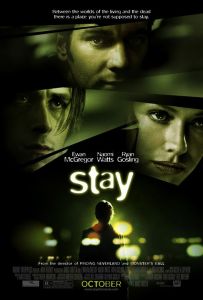 This is a movie that piles on the mystery and clues but once the finish does arrive I was left saying, “That’s all there is?” There’s so little to this film that, in retrospect, it’s simply blowing off the dust on An Occurrence at Owl Creek (I may have said too much). The trickery Stay throws at you is slightly intriguing but mostly confounding and, once the reveal tidies everything up, wholly unsatisfying. Part of the problem is that I didn’t care about any of the characters, so I didn’t really care about their plight. Yes I get it that there is a reason for how shallow they are, but the only thing Stay had to keep me going was my waning interest in what the hell is going on with everything. I’m not the biggest fan of Marc Forster (Finding Neverland) as a director, and he serves Stay to good and harmful effect. Forster gooses the film with all sorts of visual trickery like jump cuts, using twins and triplets as extras in backgrounds, repeating scenes, playing around with blocking, and lots and lots of spiral staircases (hello, Vertigo). And you do realize that most of these disorienting stylistic decisions have a seemingly coherent reason in retrospect, but it also effectively pushes the audience away from the story, aided by the fact that no one can get into the characters. The entire affair seems pointless and empty but it is pretty to look at. I’m sure I’d garner more from a second look, but I really just don’t want to see Stay again.
Nate’s Grade: C+
Share this:

Silent Hill (2006)
 Video games will never be translated into a good movie. There, I said it. I caught some grief before by this opinion. Think about it. Unlike say comic books, video games are dependent on user interactivity, on game involvement, and not necessarily story or character. A video game requires an audience to be interactive, whereas movies require an audience to be passive, letting a story envelope around them and take them some place. Video games just aren’t structured in a way that lends itself to storytelling. Just look at some recent results: House of the Dead, Alone in the Dark, Doom, Bloodrayne, Double Dragon (remember that movie?), Mortal Kombat 1 & 2, Street Fighter, etc. Granted three of those are Uwe Boll films, but what does it say when the best video game adaptation yet was Super Mario Brothers?
Now comes Silent Hill based on the very popular horror video game series. The screenplay is written by Roger Avary, who used to be Quentin Tarantino’s writing partner and wrote and directed one of my all-time guilty pleasures 2002’s Rules of Attraction. I guess I foolishly expected more, but with Silent Hill what I got was further fuel to my theory that no video game will make a good movie.
Rose (Radha Mitchell) and her husband Christopher (Sean Bean) are very troubled about their adopted girl, Sharon (Jodelle Ferland). She has the habit of sleepwalking and uttering “Silent Hill” repeatedly. So what’s a 21st century mother to do? Look up Silent Hill online, put her tyke in the car, and drive to the ghost town herself, much to the dismay of her husband left behind. It seems that Silent Hill was a town in West Virginia that had a horrible coal mining accident in the early 70s, killing many and condemning the town. We’re told the fires are still burning underground to this day. Along the way, a roadside motorcycle cop (Laurie Holden) gets suspicious of Rose and chases her. They crash their vehicles along the road and wake up to falling ash. Rose’s daughter is missing and she looks inside the nearby Silent Hill, a presumably deserted town. Then there are routine air sirens warning of an approaching darkness. The world changes form and nasty creatures come to life, like disjointed bodies, charcoal-skinned children, and malevolent evil spirits. It’s about here where I’d just say, “Oh well. I can adopt again.”
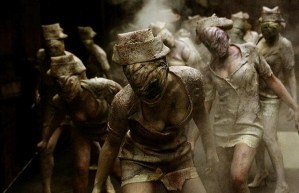 The movie is paced and structured like a video game, which means it’s just as tedious to sit through. The first two acts of Silent Hill center on Rose going from Point A to Point B, finding clue that leads her to a new point, and repeating this tiresome exercise. There?s a scene where there’s a giant hole in the floor and Rose has to navigate across scattered beams to get to the other side. It’s portrayed exactly like a video game level, as are most of her encounters. Worst of all, the movie follows a code of logic that dares to only exist in video games. Why does Rose instinctively know she needs to reach inside the mouth of a corpse to find a sign? How does she know a hidden room lay behind a portrait? Why does Rose know that light attracts the “Thriller” dance team/nurses with potato sacks on their heads? How come the evil presence that basically created this limbo world of the undead cannot penetrate a church? The plot is mostly incoherent and intentionally surreal, but that doesn’t excuse the fact that the story is just plain awful.
Silent Hill completely collapses once the third act begins. It was plodding up until that point, but now the film becomes downright ridiculous and painful. We’re amongst a crazy group of fundamentalist witch burners that, for whatever reason, dress in hazmat suits to venture outside their grounds. It’s at this point that the surreal nature stops and we find the answer to our questions: another vengeful spirit from beyond the grave. Ho hum. The protracted climax goes overboard and practically rapes the stellar ending of Carrie. Also, Silent Hill expects its Big Reveal to be shocking or surprising, but it cannot be anything except redundant because the film spelled it out an hour ago.
The dialogue is howl-inducing. There’s a moment that Rose says, “Don’t worry honey, everything’s going to be okay. You’re going to be alright.” And this immediately precedes the little girl watching the religious cult burn someone’s face off. There’s another moment, more than an hour in, where Rose says, “Something bad happened here.” You think? All of the dialogue can be fitted into two categories: either expository or instructional. It’s like to be true to a video game they also decided to lift the terrible dialogue as well. The plot meanders for the longest time, allowing Rose to visit place to place, and then Avary decides to bludgeon his audience with a 5-minute chunk of exposition meant to clarify everything up to that point.
The acting is pretty bad. Mitchell gives a valiant effort and has a nice scream, but she can’t escape the dead weight of the dialogue and total lack of characterization. Bean is entirely wasted and his “American” accent seems to waver quite a bit for such short screen time. Holden is more a fetish figure fantasy than a character, evidenced by her tight leather pants being the first thing we ever see of her. Still, it’s somewhat interesting seeing the romantic lead from 2001’s The Majestic kickin’ some unholy ass. It’s hard to say if any actors of any caliber could have redeemed the film, but this collection of thespians doesn’t even try to put a polish on the dialogue. You can tell because the howler lines are still howlers.
 Lest I forget, this thing is OVER two hours long. There’s no reason Silent Hill should even be teetering over 100 minutes, especially for a film as sparsely plotted as this one, that is, before Avary’s exposition head rush. I don’t know why the filmmakers included the pointless subplot involving Christopher on the search for his wife. The subplot adds no deeper insight, affords no opportunity to help shape the plot, and only serves to whisk the audience out of the moment and remind them how pointless Silent Hill is quickly becoming. And is it ever pointless.
Director Christophe Gans (Brotherhood of the Wolf) has a great taste for visuals, Silent Hill‘s only positive marks. Some of the images in this movie are truly horrifying and have, reluctantly, stuck in my head days afterwards. The Pyramid Head man, with a 20-foot sword, makes little sense but is a jarring and memorable image. When those loud sirens sound there is a slight amount of dread, but really it’s more of a morbid curiosity at what kind of hellish transportation will happen next. The excellent production design and cinematography also contribute to the film’s eerie, striking, sometimes suffocating atmosphere. But, alas, an interesting visual palate cannot save a slow, dimwitted, inane movie. Otherwise What Dreams May Come may have worked. But it didn’t.
Silent Hill is pointless, plodding, incoherent, far too long and far too boring. The bad dialogue, acting, and plot don’t seem to help matters either. Gans creates a moody atmosphere with some powerfully nightmarish imagery, but that’s the only thing Silent Hill has going for it. Whether it be a man with a Pyramid for his head ripping the flesh off someone like a coat or a little demonic girl dancing in a literal blood shower, Silent Hill has its small potent visual moments. However, these small moments of visual potency cannot make up for the giant black hole of suck. This movie is simply dreadful and designed too faithfully as a video game adaptation, which means the same gaps in logic and pacing are present. I certainly expected better from Avary. I told my friend Dan that I was embarrassed we’d forever know we saw Silent Hill on its opening night, so much so that I bought him food after the show to make up for dragging him along. This is the first movie I’ve ever attended where I heard booing afterwards from my audience. I would have joined them but I was too busy getting out of the theater as soon as the end credits rolled.
Nate’s Grade: D


 nathanzoebl
You must be logged in to post a comment.