Blog Archives
The Electric State (2025)

The fire hose that has been the Netflix cash flow may be reigning in, but that didn’t stop the streaming giant from making another attempt at a huge blockbuster to rival those Hollywood designs for the big screen. The Electric State is a $320-million sci-fi adventure spectacle from the Russo brothers, Anthony and Joe, the team that gave us the highs of the Marvel Cinematic Universe (MCU) later Avengers movies, and the lows of, well, everything after their MCU movies. Netflix is actively trying to compete with the theatrical experience brought to you at home, so they take these big expensive swings on large-scale, quippy, action vehicles like Red Notice and 6 Underground every so often to mixed results. Netflix has become the go-to place for a kind of movie that has altogether vanished in the studio sphere, the mid-tier movie for adults. We need those stories. What Netflix hasn’t done as effectively is compete with the big studios for comparable expensive action spectacle. The Electric State is further proof.
In an alternate America, robots were created and given menial tasks by mankind. Naturally, they grew tired of this and attempted a revolution for their equal rights. Mankind was on the brink when an unlikely savior emerged. Tech CEO Ethan Skate (Stanley Tucci) created an army of humanoid drones controlled via VR helmets. This disposable army of avatars was able to beat back the robots and forced their leader, literally an animatronic Mr. Peanut (voiced by Woody Harrelson), to sign a “peace treaty.” The results exiled the robots into a walled off wasteland in the American southwest, and humanity went on its merry way, now with VR-controlled avatars that allowed every American the luxury of staying on their duff. Michelle (Millie Bobby Brown, contractually obligated to be in every Netflix original not starring Joey King) is an orphan WITH AN ATTITUDE. One day she’s greeted by a pint-sized robot looking like the Cosmo cartoon character her younger brother was obsessed with. The little robot says he is her brother and Michelle realizes that maybe she has some family left after all. She and the Cosmo bot are on the run from scavengers and bounty hunters trying to stop their fateful face-to-face reunion.
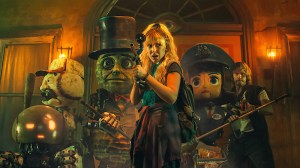
The Electric State is lacking such vital creative sparks to feel anything more than the ramshackle sum of its derivative sci-fi parts. It began as a melancholy mixed media book from the same Swedish author behind Tales From the Loop and it’s become a giant lumbering mess of mediocre and familiar elements. It kind of feels like the newer Ready Player One-era Steven Spielberg trying to emulate early E.T.-era Spielberg, but then that would give us an artist on the level of Spielberg, and that’s not what we have here. It’s standard adventure fare with a brother and sister crossing the country to save the day and thwart a big evil corporation along with scrappy, rakish rogues joining them along the way for fun and life lessons. Chris Pratt’s character is so transparently a Han Solo clone but he’s an empty vest with eye-rolling quips. This is an alternate history story with a literal robot uprising but it devotes so little interest in its own world building and history. The movie essentially castigates all the robots to a forbidden zone that naturally will be visited by our plucky heroes. The majority of the movie is watching these robotic avatars (reminded me of the Geth from Mass Effect) for people who can’t be bothered to leave their VR helmets. If this new world has devolved human interaction into a series of screens (commentary!) then maybe let’s explore that with meaning. If robots are going to be an exploited labor class (commentary!) then maybe let’s explore that too. If this is a future world where robots have been exiled and feared as an Other (commentary!) then let’s explore that too. There’s one moment where Evil Steve Jobs enjoys a VR recreation of his deceased mother, except he admits that this version is the version he wishes he had, and the real figure was far less doting and far more abusive. That’s an interesting concept, that VR offers users the ability to live in a reality of their own desires. But this isn’t a movie that wants to take time to explore interesting and relevant themes, because that would get in the way of action set pieces and goofy robot action. Seriously, there’s one fight where a U.S. postal service robot is literally hurling undelivered mail at a killer robot avatar and succeeds. Because this isn’t a deep movie, we have essentially good robots and bad robots, and if you’re shocked that the robots may have been misunderstood, well congratulations on seeing your first movie. I assure you, they mostly get better from here if you give them a chance.
The inclusion of robots is so underutilized, tapped for ready sidekicks and villains, that you could have replaced them with aliens or clones or any other disposable science fiction element. In this parallel world, Walt Disney created the robots for Disney World, so wouldn’t it be worthy of exploring that history and the sense of Victor Frankenstein-style paternal obligation? Wouldn’t the robots retreat to their ancestral home of Disney World? Or perhaps they view this as the birth of their enslavement? What about different generations of robots, especially older models being replaced with newer ones, thus creating class warfare within an exploited secondary class? What about looking at robots having to subsist off junk to continue with their meager existences? What about robots still living in forbidden zones that are hunted by the government and its armada of robot drones? There are so many possible ideas and stories and characters that are open through the inclusion of robots, but the movie doesn’t have the interest or drive to make them matter. As a result, it’s mostly a swift-moving travelogue with some ugly-looking or cranky guests riding shotgun. Occasionally The Electric State will remember, oh yeah, robots can do stuff people cannot, like having one of them hack into a server or having a smaller robot inside like a high-tech Russian nesting doll.
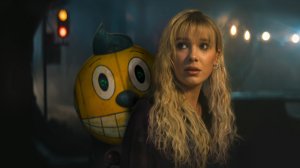
I think it was a combination of the uninvolved storytelling as well as the character design that left my emotional attachment to be null and void. I hated the Cosmo character design. He’s this big spherical head with little skinny limbs, but the head might as well be an un-moving mask. A giant toothy smile is drawn on the front and it’s so inexpressive. Also, the fact that the kid has to exclusively rely upon only using sound bytes from this canceled cartoon series makes for a quickly annoying little brother. I didn’t care about this kid, human or robot, and I didn’t care if Michelle ever reunited with her brother. Then the fact that the movie’s climax involves such a serious and emotional choice seems absurd considering what has been underdeveloped up until this abrupt shift in intended emotional stakes. It’s such an out-of-left field escalation that I almost laughed out loud at what the movie was asking me to feel, as well as what it was asking its protagonist to decide. Likewise, the betterment of robot-kind is given such little recognition, culminating in a showdown between the avatar of good robots and evil robots essentially going to revise a treaty that we don’t know much about. For a movie about how easy it can be to distance ourselves via technology, it sure fails to reasonably make the viewer care about robot equality.
Then there’s the fact that this whole enterprise cost an astounding $320 million for Netflix to platform it as its next hit movie to doze off to while in the middle of doing laundry. The Russo brothers have retreated back to Marvel to handle the next two Avengers movies, and it seems like at a time where both parties have missed and could use one another. Outside of Marvel, the Russos have delivered one super expensive action movie (The Grey Man), a super expensive spy action series (The Citadel), and one lackluster biopic that used every Scorsese stylistic trick they’ve been saving up (Cherry). With The Electric State, we have the brothers’ more familiar mixture of large-scale action and special effects in a mass appeal studio blockbuster space. However, every movie outside of Marvel has made me question their capabilities of handling these big movies. I know the Russos can be fantastic with comedy, as some of their TV episodes are the best of recent memory, and their stewardship of the big MCU movies in the wake of Joss Whedon’s departure was undeniably successful. So why isn’t The Electric State successful? It comes down to the screenplay which is so disinterested in its own ideas, world, and characters, held together by the familiarity of other adventure blockbuster staples like loose chewing gum. It’s a movie replete with famous faces and big effects but feels so devoid of life and creativity, a blockbuster automaton intended to hold the attention but rarely engage one’s imagination and emotions.
Nate’s Grade: C
Share this:

Heretic (2024)/ Conclave (2024)
Recently, two religious-based, single-location thrillers have emerged from the confines of indie cinema, and this combination is so rare that I felt a unique opportunity to review them both.
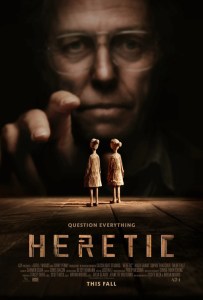 Heretic is a chamber movie about two teen Mormons (Sophie Thatcher, Chloe East) proselytizing to a middle-aged man (Hugh Grant) one dark and stormy night. He invites them in and seems kind and welcoming, but looks can be very deceiving. He has some very strong opinions when it comes to the nature of belief, and he will test both of these young Mormons on the faith of their convictions as he puts them through a series of trials and lectures. That last part might stun people, but Heretic is actually at its best during its lengthy lecture sequences. It might remind people of a nattering Reddit atheist being unleashed, but the movie really comes alive when Grant is challenging the roots of their belief systems as well as the historical contexts of religions. The Mormon ladies push back as well, countering some of the arguments so it’s not so one-sided. There’s a clear point of view to the movie but I wouldn’t say it’s didactic. The thrills ratchet as the two women start to fret about what this man has in store for them, how they might escape from his labyrinthine house, and how to signal for help. Unfortunately, the revelations can never quite match the fun of the mystery of motivations, and once it gets into a really convoluted place of switcheroos, then I think it loses momentum. The performances are all outstanding, led by Grant’s magnetic about-face turn as a snide villain. The same self-effacing charms he worked so well in the realm of rom-coms have a new eerie manipulative quality, luring his prey into his fiendish trap. The end attempts to go a bloodier and more ambiguous route that I don’t know it earns, but by that time, even after stalling out for the last act, Heretic won me over by virtue of its creepy convictions.
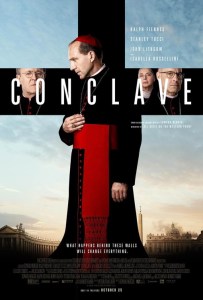 Conclave is an electioneering movie that places the viewer in the middle of the fraught voting process to determine the next pope of the Catholic Church. Ralph Fiennes plays a cardinal tasked with leading the conclave, the gathering of Catholic cardinals who will stay until a nominee has won a majority of their secret votes. Except it’s all not so secret as multiple candidates are openly campaigning for votes, trying to persuade different factions to support their candidacy. Each round of voting without a winner resets the field of play and leaves sides scrambling to reclaim footing. The movie is surprisingly very easy to get into, a crackling political thriller about the behind-the-scenes machinations and politicking for the highest office in the Catholic Church. There is a bevy of twists and turns and plenty of juicy revelations and betrayals, as these holy men start acting a little less holy to eliminate their competition or sully their chances. The constant churning is enough to keep things unsettled and intriguing, but there’s also a larger question for our protagonist, a man of faith who told the prior pope that he wished to leave his faith only to be denied by the pontiff for reasons we aren’t quite sure. Why did this pope specifically pick him for this position? The movie also asks deeper questions about the nature of power and leadership, namely are the people actively seeking it the right candidates for the right reasons? The very end of the movie knocked me out with a twist that I dare say nobody will rightly see coming, but it made me want to applaud. Conclave is an intelligently crafted thriller with weighty ideas and engaging performances.
Nate’s Grades:
Heretic: B
Conclave: B+
Share this:

The Core (2003) [Review Re-View]
 Originally released March 28, 2003:
I knew about 15 minutes in that The Core was not going to take its science too seriously. Aaron Eckhart, as a hunky science professor, is addressing military generals and essentially says, “We broke the Earth.” He tells them that because the Earth no longer spins (don’t think about it, you’ll only hurt yourself) the electromagnetic shield will dissipate and the sun will cook our planet. And just to make sure people understand the term “cook” he sets a peach on fire as an example. At this point I knew The Core was going to be a ridiculous disaster flick with its tongue firmly planted in its cheek.
Earth’s core has stopped spinning and horrific disasters are starting to be unleashed with anything from drunken bird attacks to lightening strikes in Rome. I always love how in disaster films Mother Nature always instinctively goes after the monuments, the landmarks, the things of cultural importance. The United States government hires a ragtag group of scientists and NASA pilots to journey to the center of the Earth and jump-start our planet. Of course everything that can go wrong on this fantastic journey will eventually go wrong.
The Core is so improbable, so silly, that it ends up being guilty fun. If you let go, ignore the incredible amounts of birth imagery (the sperm-like ship tunneling through to get to the egg-like core), then the very game cast will take you for a fun ride.
There’s a scene where the government approaches kooky scientist Delroy Lindo to build the super-ship that will take them to said core. When asked how much he thinks it’ll cost Lindo laughs and says, ”Try fifty billion dollars.” The government responds, ”Can you take a check?” I was pleasantly reminded of an episode of Futurama where the space-time continuum is disrupted and time keeps skipping forward. The old scientist and a Harlem Globetrotter (it was a very funny episode) theorize that to create a machine to stop this problem they would need all the money on the Earth. Flash immediately to the two of them being handed a check that says, “All the money of the Earth.” Richard Nixon’s head, in its glass jar, then says, “Get going, you know we cant spend All the Money on the Earth every day.”
 The assembled cast is quite nice. Hilary Swank assumes a leadership role quite nicely. Eckhart is suitably hunky and dashing. Stanley Tucci is very funny as an arrogant science snob. Tcheky Karyo (the poor man’s Jean Reno) is … uh, French. I don’t think anyone would believe that these people were the best in their fields (only in movies are scientists not old white men but hunky and sexy fun-lovin folk).
Director Jon Amiel (Entrapment) seems to know the preposterous nature of his films proceedings and amps up the campy thrills. An impromptu landing of the space shuttle in an L.A. reservoir is a fantastic action set piece, yet is likely the reason the film was delayed after the Columbia crash. The cornball science and steady pacing make The Core an enjoyable if goofy ride. The film does run out of steam and goes on for 20 minutes longer than it should.
The Core is pure escapist entertainment without a thought in its head. And in dire times of war and harsh realism blaring at us every evening, there’s nothing wrong with a little juicy escapist fair. Buy a big tub of popcorn and enjoy. Does anyone else wonder if we broke the Earth just after its 5 billion-year warranty was up?
Nate’s Grade: C+
——————————————————
WRITER REFLECTIONS 20 YEARS LATER

I never knew just how influential the 2003 disaster movie The Core has been. It’s a schlocky Hollywood sci-fi thriller built upon junk science but still enjoyable junk food entertainment. However, the science was so unrepentantly bad, that the science community as a whole decided to do something about it, and in 2008 the Science & Entertainment Exchange was launched. Founded by the National Academy of Sciences (NAS), its director Rick Loverd told Salon magazine how influential pop culture can be in its depiction of science, citing Star Trek inspiring scientists, Top Gun inspiring pilots, and CSI inspiring young forensic students. He also cites the power of seeing positive representation, like 2016’s Hidden Figures. The Science & Entertainment Exchange is an organization that is intended to consult on the application and depictions of science in cinema, hoping to make things more realistic. Apparently, The Core’s director, Jon Amiel (Entrapment), was so taken back when a science advisor was bad-mouthing the movie to Scientific American because he was under the impression that his movie, including restarting the Earth’s iron core with atomic bombs, had been scientifically accurate. Among the scientific community, they regard The Core as the nadir of big screen accuracy (as an example of a movie that got the science fairly accurate, they cite 2014’s Interstellar). I bet you never knew how truly influential and world-changing The Core was, albeit for being a junk movie. However, as it was in 2003, and even twenty years later, this is exactly my kind of junk.
I recognized the campy appeal of The Core right away. It’s a goofy movie from the premise to the science to the action set pieces but it’s all played one hundred percent straight, which makes it that much more entertaining and amusing. The opening sequence involves people with pacemakers dropping dead (approximately 1.5 million people worldwide). Then the birds start acting funny and crashing into buildings and cars and panicked outdoor crowds. For a disaster movie literally about the possible demise of the planet, this is such a strange and minimalist start to the looming threat at hand. The movie feels like it’s a throwback to the science fiction mission movies of the 1950s with a touch of the worldwide disaster movies of the 1970s. Even with the modern special effects, which are as delightfully cheesy as the rest of the movie, it doesn’t feel akin to the disaster epics of Roman Emmerich. The movie feels cornier and more dated and less interested in large-scale disaster spectacle. The surface-level disaster carnage is marginal, mostly an out-of-control lightening storm in Rome that knows to always steer for the monuments and cultural artifacts. The Core, at its core, is about the fantastic journey of its brave scientists. Take for instance a scene where the Serge is locked behind and being crushed to death by extreme pressure. I don’t know how anyone could keep a straight face while Aaron Eckhart, our handsome lead scientist, shouts, “Serge!” over and over while Tcheky Karyo (The Patriot) pretends he’s being squished to death while the walls get closer and closer to his face. That’s the kind of stuff I want, not CGI waves killing thousands in large-scale yet antiseptic spectacle.
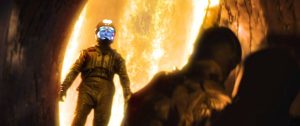 The movie takes about an hour before it really gets going, which is also admirably silly. Why devote so much time to setting up the reality of this dilemma for the complications and solutions to seem so throwaway? Seriously, the government uses one hacker (DJ Qualls) to control the entire Internet so that they can cover up the news about the possible impending apocalypse. It reminds me of an episode of The X-Files from the early 1990s where the government sends out an “all-Internet alert.” Perhaps the screenwriters felt we needed more time to accept the outlandish premise, which is strange because most disaster movies get a significant benefit of the doubt from audiences. Just having a person in glasses, and maybe a lab coat, or sweater if you want it to be more casual, explaining in a grave tone while removing their glasses dramatically, is likely all we need to accept the craziness to come. However, we do spend more time with our characters so that, when they depart one-by-one through sacrifice and accident, I actually cared enough because I was enjoying their comradery. I enjoyed Stanley Tucci being a blowhard who would even record his own narration as they travel through the Earth. I enjoyed Bruce Greenwood as the stern father figure that of course has to die first. I enjoyed Delroy Lindo as our excited but exasperated drill scientist. I enjoyed Hilary Swank as, essentially, the “best damn pilot I’ve ever seen.” I liked simply watching them all banter and bond together. It had enough development that their losses actually felt like losses and/or the accumulation of a character arc.
The question arises how do you keep things interesting when you’re burrowing through layer after layer of rock, and the answer is to just make things up. How about a layer of air? Could the Earth, compact as it is through billions of years of gravitational forces, have a layer of air like it was an English muffin? I did enjoy how the team had to restart their vessel before the magma poured into the vacant and awaiting space from their entry point. Of course, that raises the question now that magma is filling this vacant layer, have these scientists unintentionally ruined this unknown layer of the Earth? How about a layer with diamonds the size of states? These internal layers might as well be alien planets for as little they connect to reality.
 The movie is overlong and too uneven, but for fans of schlocky science fiction, it’s a delicious combination of campy entertainment. The silliness, played completely straight, even down to the part where Richard Jenkins explains man’ hubris is at fault for destroying the rotation of the Earth, is the grand appeal. I’m not going to call The Core a good movie but it sure feels like it knows exactly what kind of movie it is, and boy does it lean into that. My original review in 2003 caught on right away and I still recognized that same knowing vibe (why do we need a visual demonstration for the obvious concept of the sun cooking the Earth?). There really is a lot of birthing imagery too with the shape of the vessel burrowing to that egg at the center, so there’s that as well. The special effects are pretty murky and hokey for this kind of budget, but in 2023, that even works to the bountiful charms of the movie. I won’t pretend that most people will watch The Core with derision regardless of whether or not you’re an actual scientist. It inspired a generation of movies to be more scientifically sound, and it also inspired one of the biggest filmmakers on the planet. The metal that encases the spaceship? Unobtanium. You cannot tell me James Cameron wasn’t watching and taking notes.
Re-View Grade: B
Share this:

The King’s Man (2021)

In 2015, I was completely on board with a Kingsman franchise. Based upon the Mark Millar comics, the film was a hip, transgressive, action-packed, and refreshingly modern remix of stale spy thriller tropes. It also followed a satisfying snobs vs. slobs class conflict and a My Fair Lady-stye personal transformation of street kid to suave secret agent. In short, I loved it, and I said co-writer/director Matthew Vaughn used big studio budgets smarter than any other blockbuster filmmaker. Flash forward to 2017, and the Kingsman sequel started to show cracks in my resolute faith in Vaughn, and now with the long-delayed Kingsman prequel, I just don’t know if I care any more about this universe. It feels like the appeal of the franchise has been stamped out by its inferior additions. This one chronicles the origins of the Kingsman tailors/secret agency, a question nobody was really asking. It’s the beginnings of World War I, and a comical cadre of super villains, such as Mata Hari, Rasputin, and future assassin Gavrilo Princip, is meeting to plot doom and destruction and goad the world’s powers into war (in a goofy but appreciated comical touch, Tom Hollander plays the leaders of England, Germany, and Russia). Ralph Fiennes plays Orlando Oxford, a pacifist leading a special team trying to thwart the drumbeats of war by taking out the shadow brokers. The Kingsman movies were known for its attitude and cheekily crossing the line from time to time, but that willful perversity seems so desperate with this new movie. During the Rasputin mission, the disheveled madman literally stuffs an entire pie into his face, tongues Oxford’s wound on his upper thigh, and lasciviously promises more to come for him and Oxford’s adult son. The sequence is almost astonishing in poor taste and grotesque, and it just seems to go on forever. And yet, thanks to the sheer audacious energy of Rhys Ifans as the pansexual cleric, this actually might be the best or at least most entertaining part of the 130-minute movie. The problem is that The King’s Man doesn’t know whether it wants to commit to being a ribald loose retelling of history or a serious war drama. It’s hard to square Rasputin cracking wise and sword fighting to the 1812 Overture and an interminable 20-minute tonal detour that seriously examines the horrors of trench warfare. It jumps from silly comic book violence to grisly reality. That entire episode is then washed away with a joyless climax that feels like a deflated video game compound assault. I’ll credit Vaughn for dashes of style, like sword-fighting from the P.O.V. of the swords, but this movie feels too all over the place in tone, in ideas, in execution and lacking a dynamic anchor. Fiennes is a dry and dashing leading man, though I was having flashbacks of his 1998 Avengers misfire at points. It’s a story that doesn’t really accentuate the knowledge base of future Kingsman, and it’s lacking a sustained sense of fun and invention. It needed more banter, more subversion, more over-the-top and less formulaic plot turns. In my review of The Golden Circle, I concluded with, “It would be a shame for something like this to become just another underwhelming franchise.” That day has sadly arrived, ladies and gentlemen.
Nate’s Grade: C
Share this:

The Witches (2020)
 Rare is the Hollywood movie where the biggest question afterwards is simply, “What in the world were all these talented people thinking?” Why did Robert Zemeckis want to remake The Witches after a perfectly good and eerie 1990 movie starring Anjelica Huston? Why did the screenplay adjust the action to be set during a segregationist South without any added social commentary? What exactly is Anne Hathaway, as the lead witch, even doing with an accent that sounds like she’s blindly jumping from nationality to nationality? In one second she’s Hungarian, in another she’s Scottish, in another she’s Swedish. What was with this bizarre character design for the witches that gives them dinosaur talons and one-toed clog feet and, most off-putting, extended mouths visible with slits along the sides that they don’t even bother concealing? Why does the movie keep making fun of the chubby kid at every opportunity for being chubby? Why, even in life-and-death stakes, is the chubby kid unable to stop himself from losing all willpower around food? Why does Octavia Spencer’s grandmother character sound almost exactly like a rambling Grandpa Simpson when she’s just given enough room (“So I had an onion on my belt, as it was the style of the time…”)? How could a screenplay, that includes the likes of Oscar-winner Guilermo del Toro, include lines like, “That’s the thing about snow — it’s slippery”? I was groaning throughout this movie and just beside myself trying to make sense of the inexplicable creative decision-making on display. I also felt embarrassed for Hathaway, an actress I have enjoyed and find to be quite accomplished, who is just inhaling every piece of scenery that is not bolted down on set. It’s such a crazily misconceived performance of theatrical bombast that I felt like Zemeckis had done Hathaway wrong. This is a big hot mess of a movie and it’s so joyless.
Nate’s Grade: D+
Share this:

The Silence (2019)
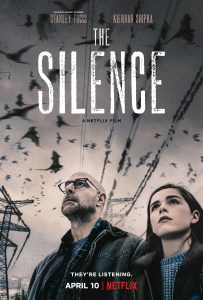 Sometimes in Hollywood there is such a thing as coincidence. The novel The Silence was published in 2015, the film adaption in the works in 2017, and yet it feels overwhelming like a rehash of another sound-sensitive blockbuster, 2018’s A Quiet Place. Following in the footsteps of a popular hit, you better be able to bring something different to the table or else you risk feeling like an also-ran. Having watched The Silence on Netflix, it’s hard not to constantly be comparing it with A Quiet Place, and it’s hard not to constantly be wishing you were watching A Quiet Place instead of this mess.
A group of scientific spelunkers unleashes a subterranean species of bat dinosaurs that are attracted to sound. A family (Stanley Tucci, Mirnada Otto), their ailing grandparent (Kate Trotter), deaf teenage daughter (Kiernan Shipka), son, dog, and uncle (John Corbett) hop in the car and head to the countryside for safety, but it’s not that easy.
 The Silence fails as a thriller because it’s so unclear so often about the nature of its threat, its extent, and the lack of urgency on display. Once the bat dinosaur monsters are on the loose, it feels like the rest of society immediately knows the rules of what attracts them. People in subway cars are already banishing women with crying babies to die alone. At the same time, the reaction seems absurdly mellow. It dilutes the sense of danger when nothing feels imminent. The family casually piles up in the cars and heads out to the country but nobody seems to be too panicked. It was at this point, relatively a half hour in, that I started getting the first of many Birdemic vibes. Why would they think the neighboring countryside would be out of the reach of winged monsters? How many winged monsters are there? Because we’re dealing with the immediate aftermath of the first strike, it can create points of disbelief. At least Bird Box had that crazy and effective opening of society breaking down. We don’t get anything like that.
I also call into question the thinking behind going out to the country as a refuge. If they’re not outrunning the flying monsters, it’s the idea that there will be less noise away from the cities. This seems like the exact opposite of what people should be doing. It’s the nitpick from A Quiet Place about why the family didn’t just live under the waterfall (as we all do, of course) because the loud sounds muffled the other sounds that could be absorbed. Therefore it makes strategic sense to stay around the places that makes the most noise, like a bustling city that also has locked chambers within chambers. This is later demonstrated in a scene where the dino bats are discombobulated by an indoor sprinkler system. Perhaps this is because of the rain, but if that’s the case then everyone needs to relocate to the Pacific Northwest.
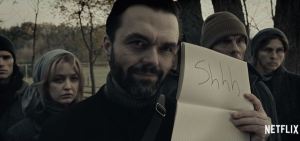
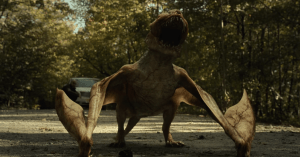 Without a sense of danger, the movie suffers from its timeline and lack of structure. It doesn’t feel like the movie is going anywhere. The immediate aftermath of the dino birds appearing leads to a limited response. How interesting or scary can things get when the Internet is still functioning and the teenage daughter can still keep up with her instant messages even out in the country? This brings me to the last act where the movie completely changes into a home invasion thriller with a religious cult that has bitten off their own tongues. This creepy cult is obsessed with the family, following them home to that country cabin because… the teen daughter is “fertile.” What the hell? It’s way too soon for this kind of apocalyptic nonsense. The world hasn’t broken down into factions. Society is still standing. It’s not like there is a shortage of fertile women, like some Children of Men doomsday. This group must have been waiting for any minor social setback to jump forward with their dreams of being a creepy cult. This late group of antagonists attach “sound bombs” in the form of smart phones. Even a little girl straps herself with several phones like she’s a suicide bomber. Even dumber, the other characters flail around once the phones ring like they have no idea how to turn off phones. It all comes together to form a hilariously awful conclusion that teeters into pure camp.
Let’s tackle one of the more essential elements of A Quiet Place that feels almost entirely unnecessary with The Silence, and that’s the hearing loss of the teen daughter. It astounds me that these two movies have similarities that go even that deep, even to the aesthetic choice of adopting the lack of sound when the camera takes her perspective (so many strange coincidences, which extend into its Bird Box-like cult as well). This element was a strength of A Quiet Place and played a significant plot purpose, placing the daughter in danger because of her sensory disadvantage, but it also related to the ultimate reveal of how to combat the monsters. It also communicated the distance she felt between the other members of her family after a horrible tragedy that she blamed herself over. It’s a carefully integrated and thoughtful addition to the movie.
Now take The Silence. The daughter has had a recent accident that damaged her hearing, which explains why she doesn’t have the vocal affectation that many hard of hearing people have adopted. The artistic choice that doesn’t work is that The Silence at no point makes her lack of hearing meaningful to the plot or for her character. If you were hardly paying attention you would never know she had hearing loss. Conversations between the family occur rapidly, with minimal signing, and sometimes the parents aren’t even looking at her when they speak. The best lip readers in the world only get a third of what is being said. She is holding normal conversations with no struggle. At no point does her disability put her at risk. At no point does it have any bearing whatsoever on anything, except showing the actors spent a weekend learning sign language.
 Another laughable feature is the presence of completely superfluous voice over narration from the daughter. It is powerfully clunky and made me cringe in the beginning and at the end. She’s explaining things that don’t need explaining and doing so with lines that don’t add any real insight. “I had to adjust to being deaf,” she says, while jerky students make fun of her lack of hearing because I guess that’s a thing people do. Then at the end she bounds back with a resilient narration about how it’s a race for evolution, but is it really? I think mankind has a leg up over creatures that, until two days ago, evolved in a subterranean environment. It’s another sign the movie has no idea what it’s doing with its story and how to relay the important information or what even is important.
Much could be forgiven if the scares were consistent, well constructed, or even interesting, or if the characters were engaging and relatable, or if the structure packed a series of setups and satisfying payoffs, or if there was a sense of thought and care put into the world building with these unique creatures, or, all the things that A Quiet Place achieved. The Silence is a movie that is best deserving of being silent. Skip this Netflix original and, if possible, watch A Quiet Place again. This one is not entertaining, from a good or bad perspective, and even at a mere 90 minutes feels like a wasted opportunity for a nap.
Nate’s Grade: D
Share this:

Show Dogs (2018)
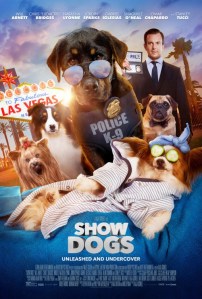 I was expecting something much worse but ultimately it’s hard to get too upset with Show Dogs, a lowest common denominator slice of entertainment for the youngest of children. There are two separate Lego Movie references in relation to star Will Arnett, a cop who partners with a dog for an undercover operation. The weird part is that the movie seems to exist in a world where animals talk to one another but humans cannot hear them. Fine, except then why does Arnett treat a stray dog like an equal? Occasionally human beings will interact with the animals like they can hear them. World building inconsistency aside, it’s simply a very unfunny comedy. The lazy puns and slapstick are somewhat excusable in smaller doses but the movie is nothing but. The only reason to watch Show Dogs is to look for the former material relating to a storyline that literally involved the hero dog having to learn to go to a happy mental place while adult judges fondle his genitals. Shockingly, the filmmakers did not see any problem with this storyline aimed at children until weeks after its initial release, and then it was re-cut with the offending and abuse-grooming material wisely removed. How does something like this happen? How does it pass through so many editorial approvals? It wasn’t a simple joke but an ongoing character arc for the protagonist. Show Dogs is for the dogs.
Nate’s Grade: C-
Share this:

Transformers: The Last Knight (2017)
 Unlike many of my critical brethren, I do not view Michael Bay as the devil incarnate. I think the man has definite talent and is one of the finest visual stylists working in the realm of film. I’ve enjoyed about half of the Transformers franchise and don’t consider it the end-all-be-all of modern American cinema. Transformers: The Last Knight is exactly what the detractors have railed against from the start: a cacophonous ejaculation of incomprehensible nonsense. The charge has often been made against Bay’s long filmography that his stories are unintelligible, but Transformers 5 proves to be the new measuring point for incensed incredulity. This isn’t only the worst Transformers entry in a seemingly never-ending franchise (thanks product placement, merchandising, and toy sales) but an early contender for worst film of 2017.
Cade Yeager (Mark Wahlberg) is hiding out with other Autobots in a South Dakota junkyard awaiting the return of Optimus Prime (voiced by Peter Cullen). Prime ventured into space to find the remnants of the Autobot home world, Cybertron. Once found, he’s brainwashed by the Cybertron goddess Quintessa (Gemma Chan) into being her servant. She’s after an ancient staff that will prove to be the key to restarting Cybertron. It was last seen on Earth during the Dark Ages and rumor has it was given to Merlin. Cade is enlisted by a centuries-long secret society to help find the staff before the evil forces at bay get hold of it.
 It feels like the Transformers 5 writers were on a week-long cocaine bender when they cobbled together this impenetrable narrative. Let me give you but a taste of the confusing, muddled, and overall mind-numbing plot as it exists. There’s a magic staff from the robot world that will recharge the robot world, and it just so happens 12 robot knights, which form a giant robot dragon, landed on Earth and gave it to Merlin, played by a soused Stanley Tucci who was already a different character in the fourth Transformers movie, who then established a secret order that would keep the giant alien robots secret even as they were doing things as high-profile as literally killing Hitler, and the members of this secret society include Frederick Douglass and Queen Elizabeth and Shia LeBouf, and this staff needs to be retrieved from an underwater spaceship under Stonehenge by Merlin’s blood progeny and will be aided by an alien talisman that forms an alien sword that does something, and the evil alien robots are going to recharge their planet by scraping the Earth’s crust, which has horns protruding from it that once aligned with Pangaea, and there’s an evil alien robot goddess who brainwashes Optimus Prime to retrieve her magical items on demand and then Megatron is being hired the U.S. government and a team of special ops are trailing him to get to the staff and… I’m sorry; did your brain start bleeding out your ears? I looked over to my friend Ben Bailey during the screening and saw him slumped over in his chair and thought, for a fraction of a second, that the movie had literally killed him (he had just fallen asleep for the third time). What an ignoble end.
The movie is a nonstop barrage of yelling and movement, an assault on the senses that leaves you dumbfounded and dazed, and without anything to moor onto. Almost every single actor is on screen for one of two purposes: quips or exposition. These are not characters but devices for words that ultimately don’t make sense. Wahlberg has two different female sidekicks. For the first half, he’s got a plucky teen that serves as a surrogate daughter figure. Izabella (Isabella Moner) is a kid with attitude and carefully arranged strands of hair that always fall over her face in every single shot in the entire movie. Izabella’s introduction actually might be the highlight of an otherwise soul-crushing experience. Then Wahlberg leaves for England and he adopts a new sidekick, this time the hot smart woman who changes into a more comfortable outfit but literally keeps her heels. Vivian (Laura Haddock) is pretty much the next in a long line of highly sexualized, tawny female characters under Bay’s alluring gaze (I wrote about the second film: “Women don’t seem to exist in the Michael Bay world, only parts and pieces of women.”). Her mother doesn’t care about the end of the human world, or her daughter’s many academic credentials, and instead pesters her about getting herself a man. This leads to one of the film’s worst comedic moments, as Vivian’s mother and friends giggle and eavesdrop on her and Wahlberg trashing a library as a spontaneous bout of sexy time. Wouldn’t it be weird for anyone’s mother to take pleasure in listening to your escapades and offer a play-by-play?
 But the strangest characters are Anthony Hopkins’ Sir Edmund Burton and his 4-foot robot ninja (voiced by Jim Carter). You can clearly tell that Hopkins didn’t care at all what he was saying. He uncorks ungainly monologues with relish and then transitions into strained comedy as a doddering old man. The robot butler begins as a C3PO-esque prim and proper servant with a disarming fighting ability, and it works. However, as the movie progresses, the robot butler gets downright belligerent and seemingly drunk. It’s truly bizarre, as if this robot is acting out to be seen like he’s one of the cool kids, but whom exactly is he trying to impress? At one point, he tells Wahlberg that he is “on my shit list” and torpedoes out of a submarine, brings back fish, prepares a sushi dinner for the humans while supplying ingredients that were totally not found on a WWII-era sub that was parked as a tourist locale up until 20 minutes ago. The character makes no sense and seems to bounce around behavioral extremes. Take this passage late into the film:
Robot Butler: “Of all the earls I’ve served-“
Me: “You were the greatest?”
Robot Butler: “-You were the coolest.”
Me: “Whaaaaaaaa?”
Another confusing part of the film is the setting of its story. We’re five movies in to an alien civil war taking place on Earth, so you would assume that normal life shouldn’t feel normal after so many catastrophes. Egypt was destroyed in the second film (only Six Wonders of the World left in your punch card, Bay), Chicago was decimated in the third film, and China was blown up in the fourth film. It’s about time that people started paying attention to these things and behaving differently. A new government agency is tasked with hunting down Transformers and there are war zone portions of the world that are quarantined, but that’s about it. I initially thought this fifth movie was going to take place in a somewhat post-apocalyptic Earth where human beings have to struggle to survive. That’s not Transformers 5 at all. It seems all too easy to ignore reality; Wahlberg’s daughter is away at college. After four movies, the world of this franchise needed a jump in its stakes. Bay’s films have always possessed an alarming sense of urgency but it rarely feels earned. Characters yelling, running, and explosions going off like fireworks isn’t the same thing as genuinely developed stakes.
 Another confusing aspect of Transformers 5 is Bay’s jumbled aspect ratios (i.e. how wide the frame of the movie is presented). Sizeable portions were shot on IMAX, which has become all the rage for action movie directors since Nolan’s The Dark Knight. I expected that. What I didn’t expect was three different aspect ratios that jumped from shot to shot. Two characters will be having a conversation and the aspect ratio will cycle and it rips me out of the movie every time (there are SIX credited editors). The Dark Knight’s IMAX sequences worked because they were sustained sequences. I expect the higher-grade IMAX film stock for the expansive action or picturesque landscapes to take in the natural splendor. What I wasn’t expecting was measly interior conversations to be filmed in IMAX. Did I really need to watch a conversation with Vivian and her mother in IMAX to fully appreciate their bookshelf? Like much else in this perfunctory movie, this game of pin-the-tail-on-the-aspect-ratio makes no sense.
I don’t normally like to quote myself, but reading over my concluding paragraph of 2011’s Dark of the Moon, I was struck by how much of my assessment could equally apply to the fifth film, even down to the exact running-time: “Transformers: Dark of the Moon is likely everything fans would want from a franchise built around the concept of robots that fight. There’s wanton destruction, a plethora of noisy explosions, and plenty of eye candy both in special effects wizardry and pouty, full-lipped women. But at a colossal 150-minute running time, this is a Transformers film that punishes as much as it entertains. There’s really no reason a movie about brawling robots should be this long. There’s no reason it should have to resort to so much dumb comedy. There’s no reason that the women should be fetishized as if they were another sleek line of sexy cars. There’s no reason why something labeled a ‘popcorn movie’ can’t deliver escapist thrills and have a brain too.” Take this assessment and times it by ten for The Last Knight. The incomprehensible plotting, infantile humor, nonchalant misogyny, empty action bombast, and dispiriting nature of the film are enough to suck the life out of you. I was bored tremendously and contemplated walking out on the movie (I stayed for you, dear reader). It feels like the screenplay was put into a blender. Transformers 5 is exhausting and exhaustively mechanical, and if this is the first start in a larger Expanded Transformers Cinematic Universe (ETCU?) then resistance may be futile. Still, it’s worth fighting against brain-dead spectacle that only moves you to the exits.
Nate’s Grade: D
Share this:

Beauty and the Beast (2017)
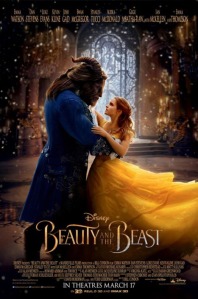 Disney has been on a tear lately with its slate of live-action remakes but Beauty and the Beast is the first title to come from the relatively recent Renaissance period of the early 1990s. The 1991 classic, based upon the French fairy tale, was the first animated film ever nominated for Best Picture, and back when the Academy was only proffering five nominees for the category (Toy Story 3 and Up earned Best Picture nominations after the category expanded up to ten). This is a beloved movie still fresh in people’s minds. I was curious what Disney and director Bill Condon (Dreamgirls) would do with the material, what potential new spins, and how faithful they might be. Regrettably, the 2017 Beauty and the Beast is a charmless, inferior remake of a Disney classic. In short, there is no reason for this movie to exist.
Belle (Emma Watson) is a small French town’s least favorite daughter, namely because she always has her nose in a book and wants “more than this provincial life.” Gaston (Luke Evans) is the most popular man in town and a dreamboat that ladies savor, and maybe also Gaston’s silly sidekick, LeFou (Josh Gad). The hunk is determined to marry Belle at all costs but she wants nothing to do with the brute. Belle’s father (Kevin Kline) falls prisoner to a ghastly Beast (Dan Stevens), a monster who used to be a prince who was cursed for his vanity. The Beast’s servants were also cursed, turned into living objects, like cowardly clock Cogsworth (Ian McKellen), lively lamp Lumiere (Ewan McGregor), and a tea kettle (Emma Thompson), feather duster (Gugu Mbatha-Raw), harpsichord (Stanley Tucci), dresser (Audra McDonald), and probably a chamber pot somewhere. Belle trades places with her father, becoming the Beast’s captive. The servants encourage the Beast to put on a charm offensive and change his ways to woo Belle, because if he cannot earn reciprocal love before the last pedal falls from an enchanted rose, then they will all be doomed to live their current fates.
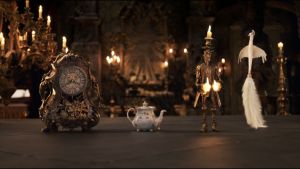 I figured, at worst, I would be indifferent to the live-action version of a great animated musical, especially since they were following the plot fairly closely. I was not indifferent; I was bored silly, and as the boredom consumed me I felt the strong urge to simply get up and leave. Now I didn’t do that, dear reader, because I owed all of you my complete thoughts on the complete film. I’d be lying if I didn’t say I debated escape, which is a rarity for me (I’ve never walked out of a movie, but Beauty and the Beast now joins a small number of films where I considered the inclination). The source of my urges spring directly from the realization that I knew exactly what was going to be coming at every step, even down to shots, and I knew it was going to be worse than the source material. It felt like watching the soul slowly get sucked out of the 1991 film. It was imitation that squeezed out all the delightful feelings from the original, stamping out joy and replacing it with an awkward, stilted facsimile. There’s also the problem of live-action being a medium that distorts some of the charming elements from the animated movie. The anthropomorphic servants are especially unsettling to watch.
The new additions are few and completely unnecessary, adding a half hour to a classic’s efficient running time. It’s kind of like remaking Casablanca and adding forty minutes of stuff that doesn’t belong, which might as well be known today as Peter Jackson Syndrome. With Beauty and the Beast, there are four or five new songs added, and they are awful and needless. Two of them are back-stories for Belle and the Beast/Prince, both of which were already covered earlier either explicitly or implicitly. They are the clear clunkers and further evidence that the 2017 additions are artistic anchors hampering an otherwise great musical. The Prince is given more screentime pre-Beast transformation but it covers the same ground that a simple voice over achieves in the original. I don’t think much is added seeing Stevens get gussied up and partying with the pretty people of his village except as an excuse for costuming excess. Some of the elements added also feel remarkably tacked on and feebly integrated, like the Beast’s magic teleportation book. He has a book that will take the user anywhere in the world, which Belle uses once to visit her parents’ old home and learn redundant information. At no point is this powerful magical device ever used. Why introduce a teleporting book and never bring it up again, especially if only to reveal something superfluous? Why does the Beast need a magic mirror to spy on people if he can teleport there? These are the unintended questions that befall poorly planned story elements that nobody asked for.
 The 2017 Beast also wants to celebrate itself for being more inclusive, feminist, and forward thinking than its predecessor, but this claim is overblown. Much has been made out of Condon’s claims of an “exclusively gay moment” in the movie devoted to LeFou, which wouldn’t be that surprising considering his Gaston-adoring behavior walks a homoerotic line in the original. This “exclusive” moment is LeFou dancing with another man and seeming to enjoy himself, or at least not hating the idea. It lasts for a grand total of two seconds on screen as part of a closing epilogue scanning across our happy characters reunited on the dance floor. It seems like much ado about nothing, especially since the 1991 film had the exact same comic beat of a man discovering an unknown joy of dressing in women’s clothing. Watson has been an outspoken actress, a UN human rights ambassador, and has said in multiple media interviews that it was important to make Belle a more actionable feminist figure. There was certainly room for improvement considering it’s a romance that many have cited as a clear case of Stockholm syndrome. If a modern remake of Beauty and the Beast were going to make socially conscious strides, it would be here, naturally. It’s pretty much the same movie except now she creates a washing machine by completely occupying the town fountain. That’s it. Considering that the movie added thirty minutes to the running time, you would think a majority of that would be judiciously devoted to building a plausible bridge from the Beast being Belle’s captor to being her lover. Nope. It’s a more forward thinking movie in fairly superficial ways that feel overly designed to warrant applause, like the inclusion of two interracial couples in the small staff of a seventeenth century French castle.
I went in and thought, if all else, I would at least have the instantly humable and highly pleasurable songs to fall back on. Then I realized this imagined respite was a fallacy. Like every other element in the film, the singing was going to be worse than the originals, and it was. The biggest aural offender belongs to our heroine, Miss Watson (The Bling Ring), whose singing vocals are Auto tuned within an inch of their lives. I have no idea what Watson’s singing voice sounds like in real life but I can almost assuredly bet it does not sound like what comes out of her mouth in this movie. The Auto tune effect was immediate, and overwhelming, and it felt like daggers in my ears for the entirety of the film. Auto tune flattens out a singer’s vocals and makes them sound tinny, unreal, almost like the comedown from sucking helium. I listened attentively to the other performers and it seemed like Watson was the only one given this exaggerated treatment. I’ve said before I’m not a fan of Watson as an actress, feeling she plateaued at a young age from the Harry Potter series, and her performance here will not change my mind. Similarly, the Beast’s vocals are so enhanced with bass that it would be hard to judge Stevens authentic singing voice. McGregor (T2 Trainspotting) has proven his singing chops before but a French accent was clearly something that got away from him. Evans (The Girl on the Train) is acceptable as a singer but lacks something of the brio that makes Gaston a larger-than-life pompous ass. Gad (Frozen) is right at home with musical theater. If I had to pick a musical highlight I would cite “Be Our Guest” simply for the visual barrage of colors and playful imagery that is absent most of a rather dreary looking movie. The other performers are adequate and sing their parts with equal parts gusto and reverence, but they’re all clearly weaker singers than the less known cast of the 1991 edition. It leaves one with the impression of a shabby celebrity karaoke version of a better movie.
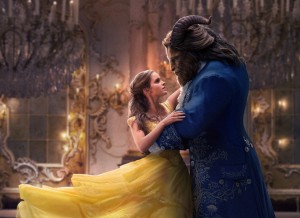 Beauty and the Beast isn’t just a disappointment, it’s an artistic misfire on multiple fronts that is looking for applause but doing too little to even earn such consideration. It wants to be forward thinking for a contemporary audience but they’re empty gestures, as it just copies the 1991 movie down to similar shot selections. The 1991 movie is great, no question, but I don’t need a Gus van Sant Psycho-style remake that only serves to make me appreciate the original more. This movie has no reason to exist outside of the oodles of cash that Disney will probably collect from repackaging its much beloved classic to a new generation of fans and an older generation seeking out millennial nostalgia. The singing is off, especially from a painfully Auto tuned Watson, the new songs and scenes are pointless, and even some of the production design resembles a play that ran out of budget halfway through. If you’re a fan of the original, you may find entertainment just reliving the familiar beats and notes from the 1991 film, just to a patently lesser degree of success. It’s not like Disney’s other live-action remakes of their extensive back catalogue of titles. The Jungle Book and Pete’s Dragon were sizeable improvements, and the agreeable Cinderella found some welcomed maturity to go with its fairy dust. Those movies found new angles, and in some cases had little relationship to their original material as in the case of the wonderful and heartfelt Pete’s Dragon. These are examples of filmmakers who were inspired by their sources but told their own stories. Beauty and the Beast, in contrast, is just the hollowed out husk of the original, now made putrid.
Nate’s Grade: C
Share this:

Spotlight (2015)
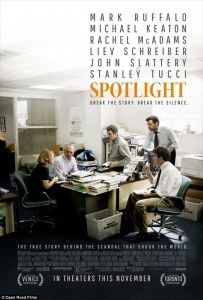 Spotlight is the true-story behind the 2002 expose into the Catholic Church’s cover-up of decades of sexual abuse and it is unflinching in its focus and animated by its outrage, which is the best and worst part of this awards-caliber movie. Writer/director Tom McCarthy (The Station Agent, Win Win) is a splendid curator of unlikely movie families, and with Spotlight he follows the titular investigative team (Michael Keaton, Rachel McAdams, Mark Ruffalo, Brian d’Arcy James) at the Boston Globe as they go about their jobs. That’s really about it. Over the course of two tightly packed hours, we watch as the Spotlight team chases down leads, goes through archives, interview subjects and know when to push harder and when to fall back, and day-by-day build their case to expose the massive corruption within the Church. It’s invigorating material and worthy of the careful and sincere reverence that McCarthy and co-writer Josh Singer have afforded, though the flurry of names can be difficult to keep track of. However, that’s about the extent of the movie. We don’t really get to know any of the journalists on much of a personal level or as a character; they are defined by their tenacity and competence. We don’t get much time for reflection or contemplation on the subject, especially its psychological impact on a majority Catholic city/staff, and the culpability of those within systems of power that chose to ignore rather than accept the monstrous truth. I don’t need more “movie moments” or emotionally manipulative flashbacks, per se. With its nose to the grindstone, Spotlight is an affecting and absorbing news article given life but it feels less like a fully formed movie of its own. It’s confidently directed, written, acted, and executed to perfection, and I feel like a cad even grumbling, but the ceiling for this movie could have been set higher had the filmmakers widened its focus.
Nate’s Grade: B+


 nathanzoebl
You must be logged in to post a comment.