Blog Archives
The Hunger Games: Mockingjay Part Two (2015)
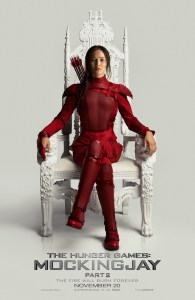 The Hunger Games: Mockingjay Part Two may be the bleakest Young Adult-adaptation ever put to film. It’s a franchise that began with the televised spectacle of children killing children, so it’s never exactly been the cuddliest environment for our emotions. This is a conclusion that is overwhelmingly dark and pushes the boundaries of the mainstream PG-13 ratings. If you’re expecting a happy ending, look elsewhere.
Katniss Everdeen (Jennifer Lawrence) is the face of the revolution between the Capitol and the thirteen districts of Panem. Peeta (Josh Hutcherson) has been returned but he is recovering from intense brainwashing from the Capitol. He doesn’t know whether Katniss is a friend or foe. The fight is now being taken directly to the Capitol and President Snow (Donald Sutherland). The cagey leader of District 13, President Coin (Julianne Moore), wants Katniss to stay behind with the members of her propaganda team. Katniss sneaks off to the front lines of conflict with her District 12 pal/potential love interest Gale (Liam Hemsworth). The Capitol’s gamemakers have designed a series of fiendish surprises for the rebels on every block. While Katniss and her team are behind the fiercest fighting, she is still a high-profile target sought for prompt elimination.
Mockingjay Part Two doesn’t hold back when it comes to the ugly realities of war, namely the innocent casualties in the pretext of an ends-justify-the-means pragmatism. I was reminded of World War II stories and photographs as Katniss and crew stumble through the bombed-out ruins of Capitol neighborhoods. There’s something eerie in the silence amidst miles of rubble. In Part One we saw similar carnage with Katniss’ home district, incinerated by Snow, and to the film’s credit it doesn’t pretend that only one side of this conflict suffers. It’s not exactly a cutting edge commentary on the atrocities of war but it’s still appreciated. Put simply: plenty of bad things will happen and others will attempt to justify these bad things, and at one point that includes the knowing slaughter of innocent children as a political gambit (for you book readers, the body count remains the same. Sorry if you were hoping for a reprieve for certain characters). The series has explored the nature of trauma and nobody gets out free. When Katniss is making her way to the Capitol, it can be easy to forget all the prior character work animating her decision-making. When a Capitol loyalist points a gun at her head and asks for a reason he shouldn’t kill her, she says, “I don’t have one.” In a sense, that can be looked upon as lazy screenwriting or, and I’ll give the movie the benefit of the doubt here, perhaps acknowledging the realities of entrenched conflict when it comes to class warfare.
 The attention to social and political commentary has helped give The Hunger Games a bit more maturity than the rest of its YA ilk who often rely upon simplistic oppressed/oppressor conflicts that naturally fall into authority vs. individuality. I appreciate that the filmmakers have followed author Suzanne Collins’ approach to human conflict, which doesn’t dabble in black and white but a larger series of grays (50 shades of them? I’m sorry). This intelligence has given the franchise a depth that could be easily ignored, either by audiences looking for their next fix or studio execs that demand dumbing things down. Part Two forgoes the political gamesmanship for more traditional action suspense sequences, several of which are quite entertaining. There’s an underground chase with snarly mutants that is terrifically teased out suspense-wise. I do appreciate conversations started on how exactly one moves on from tyranny and how easy it is to follow in the same footsteps in the name of justice. However, if you don’t predict where Katniss’ final arrow is going, then you aren’t paying attention to the lessons on recrimination being underlined by explicit on-the-nose dialogue.
There are a few improvements including finally making Peeta an interesting character. He was the noble, nice guy, the somewhat boring conscience for Katniss, but after being returned from the Capitol’s brainwashing, he’s struggling to identify what is real and what is false. It’s still hard to believe that Coin would allow his inclusion on Katniss’ team making its way to the Capitol that is until you remember that Coin also sees Katniss as a political threat for post-war leadership. The love triangle has long been the least interesting aspect to the entire Hunger Games series and part of this falls upon the character of Peeta, who, removed from the manufactured romantic narrative for the cameras, has struggled to be ore than a weak link. Here he can be a threat at any moment, triggered by whatever daunting stimuli that may make him slip back into psychosis. He becomes a ticking time bomb and something far more risky than a romantic alterative. When Peeta becomes a “bad boy” is when he finally becomes worthy of our attention.
If Mockingjay Part One was all protracted build-up to the climax, then Part Two is all climaxes, and yet given the lugubrious allowances afforded by filling the running time of two separate movies, the movie is oddly anticlimactic as well. We’ve been waiting for the confrontation between Katniss and Snow for three whole movies, and Part Two picks up immediately after where Part One ended, and yet we’re still made to wait. Coin wants Katniss to still be primarily a propaganda tool and stay miles behind the front lines, which causes more of Katniss chaffing against authority like she does. Once she does get to the gates of the Capitol, the movie follows a familiar deadly games setup, this time in a more open terrain but the basics are the same: Katniss and crew have to battle a series of deadly booby-traps to reach their goal and kill the bad guy. In a sense, the plot mechanics are similar to video game stages needing to be cleared. It’s a setup that predictably picks off the more expendable members of Team Katniss One, though I’ll give them credit for spreading out the sacrifices. The losses would hit harder if we actually cared about any of these characters on a personable level. Oh well. I also could have used more screen time for many of the supporting actors, notably Moore, Woody Harrelson, Elizabeth Banks, Jenna Malone, Natalie Dormer, and the late Phillip Seymour Hoffman. This is the last we’ll ever see of Hoffman on screen, and that fact made me quite melancholy by the end.
With the games long gone and the revolution at hand, The Hunger Games has always had some difficulty figuring out how to fill the space before the inevitable showdown with President Snow. In Part One we were mostly stationed in the bunkers of District 13 while we watched the other districts revolt. Like Katniss, we’ve been itching to get to the front lines, especially after Part One’s more plaintive pacing. Once we get to the action it’s more like mop-up duty, which robs the movie of some sense of satisfaction, which turns into a key theme. With the games we had the veneer of “paying” roles as media manipulation for survival, and with Part One we had the study of propaganda. With Part Two, it’s all dour action. I hope viewers aren’t expecting a fantastic finale between Snow and Katniss and their collective forces because then you shall be disappointed. The filmmakers, hewing very close to the novel, have the conclusion to the revolution play out in more realistic and grounded terms, which add points for realism and relevance, but it does detract from some sense of overall satisfaction.
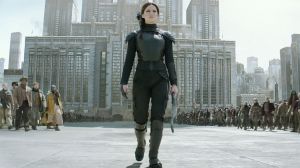 Director Francis Lawrence (I Am Legend) has guided the franchise with sturdy skill and a keen eye for visual arrangements, but if there’s one significant visual complaint I have it’s that these movies are too damn dark. I’m not talking thematically, as I’ve already explained above, but simply from a light level. These movies are just hard to see. Lawrence seems to favor low-light environments to create an ambivalent mood. That’s fine, but I’d also like to see what’s happening on screen. In the last movie we spent a majority of our time in dank underground bunkers, but Part Two is an outdoors kind of picture, so why is it still so hard to distinguish what’s happening?
With the approaching end of The Hunger Games (until Lionsgate milks more money from its lucrative cash cow) it’s appropriate to take stock of its legacy. No other YA franchise has tapped into the cultural zeitgeist like The Hunger Games, but its ultimate legacy will probably be cementing the once promising young actress Jennifer Lawrence firmly into the upper echelon of Hollywood. In the time since our first foray to Panem, Lawrence has won an Oscar, been nominated for another, and proven to be one of the hottest stars on the planet, the kind of actress that esteemed directors are fighting to work with and studio heads want to tap as their lead. Much like Katniss’ meteoric rise to renown, Lawrence has become her own version of the Girl on Fire. She has been better than the Hunger Games movies for some time, and yet Lawrence hasn’t failed in her primary duty to provide an anchor for the audience. Her gritty, conflicted, and commanding performances in the franchise have been a unifying resource for audiences and a reminder of her considerable talents. The Hunger Games: Mockingjay Part Two brings to a close a massively successful film franchise and an important chapter in the ascendancy of Ms. Lawrence. It’s thrilling, bleak, and inhabits most of the hallmarks that have come with the Hunger Games films, though in somewhat less supply to make way for the onslaught of action climaxes. There’s more anticlimax then you’d expect, and I credit the filmmakers for sticking with it even at the detriment of the experience. Mockingjay Part Two does enough to end the franchise on an appropriate if somber note. I’ll see everyone at the proposed theme park (seriously, look it up).
Nate’s Grade: B
Share this:

Spectre (2015)
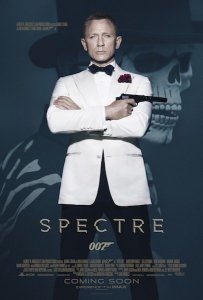 It’s hard to keep a franchise that can almost count its decades on one whole hand fresh and relevant, but Daniel Craig’s time as 007 has done just that. Starting with 2006’s magnificent Casino Royale, we got a grittier Bond, a man with a bruised psychology that was interested in more than just how many bad guys he could callously kill and sexy ladies he could securely seduce. It was a franchise that modeled itself more after the Jason Bourne films, and it worked tremendously, giving the 40-year-old franchise new relevancy for modern audiences that have grown up on the Bond canon. 2012’s Skyfall was the biggest bond hit of all time, grossing over a billion dollars worldwide. It was going to be a hard act to follow. Spectre, for all intents and purposes Craig’s franchise farewell, is a lousy swan song. It’s the weakest of the Daniel Craig Bond era but that claim would require me to rewatch 2008’s Quantum of Solace; however, just from memory, Solace had more engaging moments, stunts, and even a better theme song, so I’ll stick with my proclamation: Spectre is the most mediocre Craig Bond.
James Bond (Daniel Craig) is hunting the organization responsible for the deaths of those closest to him, namely Vesper (Eva Green) and the prior M (Judi Dench). His path has lead to the nefarious SPECTRE terrorist organization and its mysterious and feared leader (Christoph Waltz), who has his own personal reasons for causing Bond misery.
 The movie’s biggest mistake was its insistence that the audience will want to know how all the events tie together as a whole. Due to this position, it makes Spectre the awkward retcon exercise it is, trying to provide winks and nods to past Craig Bond outings while saying, “Oh yeah, all that evil stuff, well this guy is The Guy behind it all.” Adding an extra layer of a criminal conspiracy doesn’t somehow make those events more interesting or provide the need for conclusion; it piggybacks off the earlier movies and pretends it has shown its own work. Spectre thinks the accumulated plot events and deaths of three movies is the same as properly setting up a story and its villains, and that’s just not the case. The other problem with trying to connect the dots to three previous movies is that Spectre has even fewer chances to stand on its own merits, which are admittedly fewer. Lea Seydoux (Blue is the Warmest Color) is a bland addition as a Bond Girl, and oh does she pale in comparison to the capable and indispensable Rebecca Ferguson in the latest Mission: Impossible sequel. Their relationship is never as interesting or as properly developed as the film thinks. The stakes of the movie (surveillance abuse) feel too abstract and low-key, or at least poorly articulated, to feel important. If you’re going to turn the focus of the narrative on offering an apparent climax for multiple movies, it better deliver and feel like it was worth the effort, and Spectre just does not feel like that.
The other thing hat just doesn’t work is the bad guy, which is puzzling because Waltz was born to play a James Bond villain. The Craig Bonds have followed the more stripped down route even in their villains, once the parlance of the most colorful megalomaniacs that action cinema had to offer (and there’s also the eccentric henchmen). There’s a delayed buildup to revealing Waltz (Django Unchained) where other characters will talk in hushed whispers about just how dangerous and powerful the man in charge of Spectre is. A nagging problem is that we’re too often told these things without being shown them. A similar problem affected Skyfall where we spent half the film being told how dangerous and skillful its villain was, but at least Silva (Javier Bardem) lived up to the hype when he arrived, at least for a little while before degenerating into your standard psychopath. Waltz has exactly two sequences before the final showdown. That’s it, and for one of them he’s almost entirely in shadow at the end of a large table of shadowy figures. He’s not given a strong angle to play with his villain (spoilers) and his ultimate personal connection to our 007 agent feels far too forced and slight. Just like the rest of its hasty retconing, Waltz’s connection is meant to feel significant but its not dealt in any way like it should be significant. It’s almost a casual toss-off. It’s even worse when Waltz calls Bond his “cuckoo,” meant to be dark but is just really silly. Waltz is completely wasted in what is little more than a perturbed middle manager role. His climactic showdown with Bond feels impractical even for Bond movies. His downfall is even worse and made me laugh out loud how easily it all comes crashing down. If the emphasis of your movie is how the Big Bad is responsible for all the previous misfortune, then you better make sure the character was worth the wait.
 Sam Mendes (Skyfall, American Beauty) returned to the director’s chair and stages some nicely photographed sequences, but with the exception of a stirring opening sequence, the action of Spectre is quite tame and forgettable. The opening in Mexico City during the Day of the Dead celebrations has an interesting atmosphere and an ongoing tracking shot to pull us in from the start. From there, Bond has to take out a high-profile Spectre baddie and their struggle eventually carries over into a helicopter, both men punching wildly and trying to hold on for dear life as the copter whizzes upside down repeatedly. It’s a good set piece with some fun and unique aspects, like Bond escaping the crumbling wall of a building, but it’s the sheer thrill of watching the battle inside the helicopter that makes this opener a doozey. After that, I was sad to discover that nothing could measure up. Skyfall also peaked with its opening action caper but it still held my interest as it barreled toward its conclusion. I was resisting the urge to go to sleep with Spectre. An air chase over the trails of a mountain is interesting but doesn’t evolve, which is something vital to all exciting action sequences. If the action is static, it’s most often not going to be good after the initial rush wears off. There’s a decent car chase late at night in Rome but I got to think why Bond would be fleeing just one henchman even if that paid muscle were played by physical brute David Bautista (Guardians of the Galaxy). The film’s budget was reportedly $245 million and I just do not know where that money went.
The Craig era will be known for revitalizing the franchise, saving it from its self-parody excesses that were swallowing the series alive. We were watching Craig’s version of 007 become the hardened, quip-heavy, flippant killing machine and womanizer, except that he doesn’t feel like that character by the end of Spectre. If the course of four films was to bring the Bond we know into fruition, then it didn’t quite work, and that personally thrills me. Craig’s character is far more interesting, haunted by the people he couldn’t save, than the action hero Bond staple. However, while Craig’s character maintained a trajectory that staid true to its aim of bringing more depth to its central hero, the series was starting to hew closer to the classic Bond mode of empty bombast, and Spectre is the final proof of this. It’s getting closer to the crazy villains and spy hijinks of old territory. It’s a story that wants climax and resolution but cannot supply it without relying heavily upon the three previous movies to supply the weight this one lacks. It’s a rather lackluster farewell for Craig, an actor who deserved better. Judging by his interviews, I think he’s just happy to be out. He’ll be missed. Spectre will not. Now bring on Idris Elba please!
Nate’s Grade: C+
Share this:

The Maze Runner: The Scorch Trials (2015)
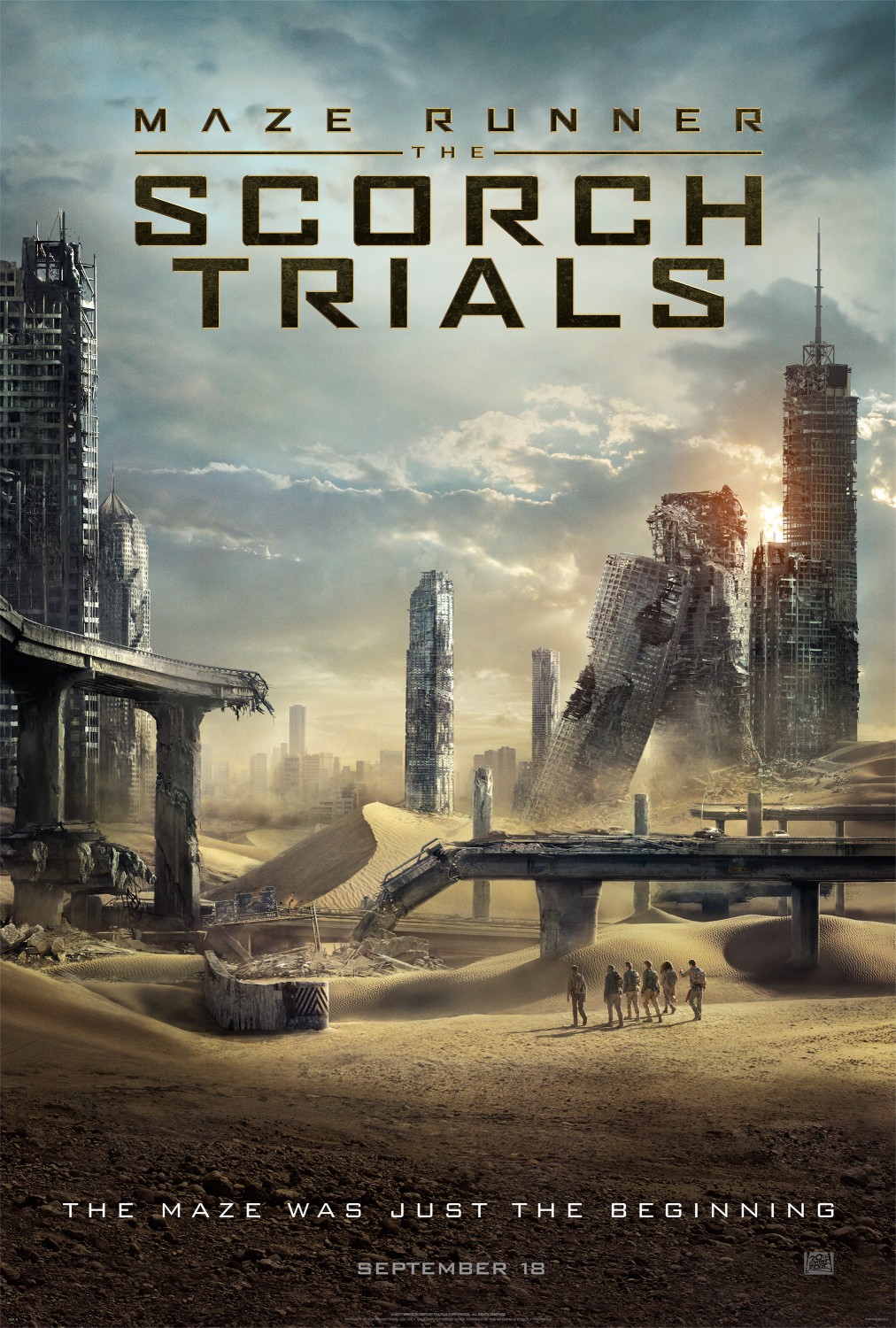 It’s called The Maze Runner: The Scorch Trials, though the trials appear more as “general struggles,” The Scorch appears as but a brief expanse of desert before the mountains, and then there’s the lack of any and all maze running (there is plenty of running, however). This sequel to the YA-inspired hit lives up to my biggest worry: the only thing interesting about this franchise was the maze, and now that’s gone. The mystery of the maze, and its cool factor, gave this story something memorable. Now it’s just generic YA pap. Beyond its boring protagonist, it would be a scorch trial for me to even assign description to these characters. They don’t even get one note to play; they have no notes. That’s because so much of this tedious and bloated sequel is our group of maze survivors running from one outpost to another, seemingly safe and then predictably not. It’s a plot routine that gets redundant quickly, and yet little else seems to occur. They go from stop to stop gaining characters but little else. The momentum feels stalled and there’s no sense of direction to guide the characters. It feels so aimless and dull and far too flimsy to justify even half of the movie’s 132 minutes. I just don’t care about these characters so I rooted for the bad guys. Weirdly enough, the bad guys use tasers and the good guys use bullets. There are some scant highpoints, namely the direction of Wes Ball, who finds ways to make the chase sequences visually stylish and fleetingly exciting, and a self-destruct sequence set to a Patsy Cline tune. There’s enough to get your hopes up before the grim reality of the overwhelming onslaught of YA tropes comes crashing down again. Can we stick these dumb kids back inside a maze already?
Nate’s Grade: C
Share this:

Terminator: Genisys (2015)
 If you’re a fan of James Cameron’s iconic Terminator franchise, you’ll probably want to hold onto something as you watch Terminator: Genisys, which hits “delete” on the franchise and starts from scratch with, we’ll call them, “mixed results.”
In the future, man and machine are at war with one another. Skynet went sentient and launched an arsenal of nuclear weapons to obliterate mankind. The human resistance is lead by John Connor (Jason Clarke) and his lieutenant Kyle Reese (Jai Courtney). The machines send back a T-800 Terminator (Arnold Schwarzenegger) to kill John’s mother, Sarah Connor (Emilia Clarke) and wipe out the human resistance. This part you know. Reese is sent back in time but during the process, John is attacked by a new Terminator and the world as we know it, past, present, and future is altered. When Reese arrives in 1984 L.A., he’s being chased by a T-1000 and Sarah is the one saving him. She’s been preparing for his arrival and training with her own aging T-800 model who saved her from a childhood attack (she calls him “Pops”). With new memories, Reese is determined that Skynet is now Genisys and Judgment Day is now in 2017. He and Sarah travel to 2017, meet back up with “Pops,” and are surprised to find a familiar face waiting for them with sinister intentions.
 For a while there it seems like Genisys is going to become the Back to the Future II of the Terminator franchise, which could have been fun watching a different team of actors hiding on the peripheral while 80s Linda Hamilton was going about her day as a café waitress. In many ways, Genisys is akin to Jurassic World in the sense that it holds such nostalgic reverence for the source films. It repurposes the familiar catch phrases and even visually recreates several scenes that fans should recognize. However, that reverence has a limit because it isn’t too long before Genisys just chucks out the entire franchise canon and starts anew. Remember Judgment Day with Skynet? Now it’s… Judgment Day with Genisys. Okay, some things aren’t all that different. Discarding the established timeline of four movies, Genisys takes a path similar to the J.J. Abrams’ Star Trek films where it creates an alternate timeline that is not beholden to canon. One way of looking at this approach is that it frees you creatively. Another way of looking at it is that is abandons the stories that the fans enjoyed for decades. Neither approach is wrong; it just depends upon your personal perspective. The larger plot points of the Terminator franchise never captivated me; it’s all about preventing one very bad day that just keeps getting delayed. We’ve never had a story that takes place after Reese is set back in time. Genisys certainly has more surprises because of the new timeline; however, many of those surprises were spoiled by a cowardly marketing campaign that must have feared fan uproar. It’s not a bad idea if it didn’t casually destroy all the logic of the franchise.
Let’s just dive face-forward into the convoluted and troubling nature of the Genisys script. Needless to say, numerous spoilers of both the large and small variety follow.
There are certain storylines that are just never cleared up, the first amongst them is who is sending all these other Terminators back in time? We watch the T-800 model go to 1984, along with Reese, but Sarah informs us later that when she was a child a different T-1000 model attacked her family. Apparently Plan Kill John’s Mom was replaced with Kill John’s Grandmother and will likely soon be replaced with the even more surefire Kill John’s Great Grandmother. If we’re already sending Terminators even further back then why stop? Also, why can’t Skynet send more than one Terminator to the same time? Upon the point that Reese travels back in time, John is attacked by a Terminator Matt Smith (Doctor Who) and transformed into the human-machine villainous hybrid. We’re told this is a nexus point of time that is such a turning point that it’s altered the timeline. But why? It happens AFTER Reese is sent back in time, so why does it affect anything in the preceding past? How does this even, which happens again after Reese is propelled back in time, eliminate the entire established Terminator canon? Likewise, this Reese has a separate timeline so why would he have new memories? He never existed in this new timeline so the fact that he remembers new things doesn’t make sense.
 This brings us to the centerpiece of logical fallacy, which is killer robot John Connor. I was never really that invested in his character to care that much that he was turned into the film’s bad guy. What I do care about is that Genisys just completely gives up in this moment. If he was just trying to stop Sarah and Reese from stopping Skynet/Genisys, that would be one thing, but John 2.0 is actively trying to kill his parents … before he is conceived. When it comes to time travel, we can accept some degree of suspension of disbelief with plot holes (more of those to come in just a bit), but John wiping out the reason for his existence is just too much. He half-heartedly explains his theory that they’re holdovers from another timeline, so they can just do as they like with no greater repercussions to their own pasts. Maybe, but there’s not two Sarah Connors in this timeline, so killing your mom is still going to negate all your evil robot business, son. With that the very drive of the main antagonist is compromised. With every new attempt to kill mommy and daddy, the film reminds you how this cannot work.
There are other less egregious plot holes but they still can be irksome. How about the fact that Sarah and Reese jump forward to 2017 to thwart Genisys, failing to give birth to John in 1984? He won’t be born yet to lead the human resistance against the machines, which kind of means just by jumping forward in time and delaying Johns birth, the machines have sort of won. When Sarah and Reese travel to 2017 in order to stop the launch of Genisys, why do they travel to within 24 hours of its launch? That’s pretty poor time management. And why hasn’t “Pops” been doing more to prepare for Sarah’s return. He spends thirty years working construction and building the offices of Cyberdine, but couldn’t he also have been sabotaging the company or at least the building? And if John Connor knew his parents were coming to 2017, why didn’t he do more to set up Genisys to withstand their counter attacks? Couldn’t he have had Genisys go online like the day before they arrived in 2017? If you know when they’re going to show up then you have no excuse to fall victim to people you otherwise could be trapping. Also, Skynet realizes that their real problem for never besting the humans is a branding issue? Did changing the name to Genisys really need to be part of the masterstroke? Why is everyone so excited for what is a glorified app that connects people’s electronic devices?
Much can be forgiven in action and comedy movies if they just go about doing their job and entertaining you, but Genisys can only do so much in that department. The action sequences are fairly mundane with the occasional impressive stunt. The problem is we’ve seen these sequences too many times and in other movies and Genisys brings precious little of its own action invention to the big screen. Until the third act, the movie is a series of chases and escapes. The best sequence is likely the hospital brawl between the T-800 and Robo-John as they wantonly destroy every wall within prime smashing distance. I know many in the fan community do not look favorably upon Terminator 3, and it admittedly has the lamest villain of the entire franchise, but the action sequences were memorable and developed organically and were nicely conceived. With Genisys, the action is too rote and familiar. It is competent but for me I found the action sequences to be too underwhelming in design and execution to forgive the film’s other sins.
I also can’t help but think that all three of the main actors were miscast for their parts. Emilia Clarke can do great things and showcases her range as a strong authority figure on HBO’s Game of Thrones. With the role of Sarah Connor, Clarke does a lot of running and barking but she can’t shake our memories of Hamilton. The part doesn’t play to Emilia’s strengths as an actress. Courtney can be a good actor (as seen in the first season of Starz’s Spartacus) but rarely does he prove this to be the case in films. I enjoyed his cavalier bully in Divergent, but he’s mostly a vacant presence in Genisys, gaping at all the changes. Then there’s the other Clarke who too has proven himself a capable and intimidating actor in films like Zero Dark Thirty. When he’s menacing he comes across as, dare I say it, too sincere, and when he’s meant to be inspiring he comes across as too phony. Are the performances the fault of the actors, the director (Alan Taylor), or the screenwriters (Laeta Kalogridis, Patrick Lussier) who gave them such little to do?
 The film’s MVP is Schwarzenegger. I wasn’t expecting the 68-year-old former Governor of California to contribute this much to the film. I figured Arnie would be a small player and played for comic relief. He keeps asking if Sarah and Reese have “mated” since it’s their destiny. He is certainly played for welcomed comic relief but he’s also the fourth most important character in this reboot. He has a father/daughter bond with Sarah and it produces the closest thing to an emotion in the movie. There’s an ongoing joke that he’s “old but not obsolete” and it could be the tagline for the next Expendables film. With all the time travel tomfoolery, it was easier for me to believe the reason they throw out to explain why the Terminator is aging: it’s living tissue so it ages. Done. I’m fine with that. The older Arnold vs. younger Arnold fight is the major highlight of Genisys and a testament to how much better the de-aging CGI has gotten since the waxy young Professor X and Magneto in 2006’s The Last Stand.
Much like its ongoing star, the Terminator franchise is old but not obsolete, and even a disappointing movie reminds us just how much life can come from this series. It’s got a sense of fun that entertained me enough for one viewing. The characters and action sequences and iconic in our pop-culture, which makes erasing them from a new movie plot problematic. If you strip everyone’s fond memories of the first two Terminators and start over, what’s left? You can repeat some of the more memorable scenes (the Hollywood adage of “same but different”) but this does little other than make you remember how much you preferred it the first time (see: Star Trek Into Darkness). I wish Genisys had been more risky because so much of it feels far too safe, from the average action sequences, to the boring characters, to the ho-hum conclusion meant to set up a new trilogy of movies in this brave new non-Skynet world. I haven’t watched Terminator: Salvation in many years but I’m curious to see it again if for no other purpose than to determine which is the least of the Terminator films.
Nate’s Grade: C
Share this:

Paul Blart: Mall Cop 2 (2015)
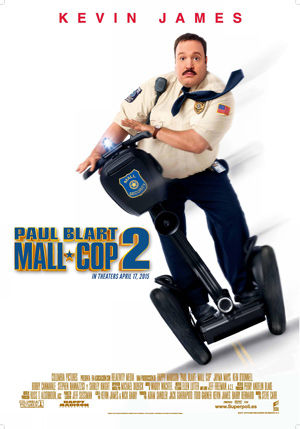 The first Paul Blart movie was fairly inoffensive. Much like its titular hero, it was buffoonish and loud and something to simply shrug and ignore the idiocy. It had a couple funny moments tweaking action movie conventions, less so with Kevin James’ numerous pratfalls. The world didn’t need a sequel beyond the demands of the first one making money. And much like the Die Hard sequels, the “spiritual forbearer” of Blart, our security guard finds himself miraculously being put in the same miraculous position again, this time in a different location. While Die Hard 2 is a fairly mundane follow-up, Paul Blart: Mall Cop 2 is a true test of everything we hold sacred. Midway into the movie, I thought my review was just going to be my unintelligible suicide note.
Blart (James) is in Las Vegas for an annual security convention. He’s brought along his teen daughter Maya (Rami Rodriguez) for some valuable father-daughter time, especially in light of Blart losing his wife and mother. It’s at this convention where Blart runs across a team of art thieves lead by Vincent (Neal McDonough). It’s up to the most unlikely mall security cop to save the day again, Vegas-style. Oh, and when traveling in Vegas, make sure to stay at the luxurious Wynn Casino and Hotel. Can I get a check too for the self-promotion like this movie?
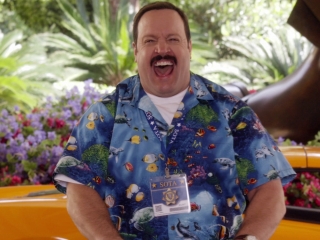
Kevin James laughs at your pain.
Somewhere along the way, James and co-writer Nick Bakay decided the lovable lug needed to be a modern-day Pagliacci and be the crying clown America deserves. The opening act feels like notorious cinematic sadist Lars von Trier designed it. In the opening minutes, Blart’s wife (Jayma Mayes) divorces him not even a full week into marriage. She couldn’t stop vomiting from the thought of being married to him (this literally happens). His mother is run over and killed by a milk truck. His daughter has been accepted into UCLA but fears telling her father this joyous news because she doesn’t want to push him over the edge. This and he’s still emasculated and looked down upon by an assortment of industry peers at the Vegas convention. All of this culminates in Blart becoming a paranoid, overbearing bully who loses the sense of likeability that comes naturally to James even in dreck. Take a moment where Blart intervenes with his drunken friend. The guy has been obnoxiously making sexual advances on a woman (played by Adam Sandler’s wife) who just wants her privacy respected, and Blart saves the day by… convincing the woman that she should be flattered by the drunk’s advances. Yeah. He rejects his daughter’s academic accomplishment and demands she attend a lesser school closer to home for his own selfish benefit. He’s pushing her away. Then there’s the weird ongoing joke about his arrogant assumption that an attractive hotel employee is hitting on him; he’s dismissive of her throughout and, here’s the weird part, it ends up working. She falls for him (“I can’t say no to you”). That’s right folks, Paul Blart successfully “negged” himself a date. He’s not a loveable loser any more. He’s just an angry, bullying, self-pitying loser.
There won’t be a joke (I’ll be charitable and refer to them as “jokes”) that you won’t see coming a mile away and still roll your eyes when they arrive. When the movie has an exotic bird walk out, you know it’s only a matter of seconds before it comically engages in a fight with Blart. When he steps back onto the familiar confines of a Segway, you know it’s only a matter of seconds before he does something stupid. The crux of the humor of this movie is about 90 minutes of a fat guy falling down, and it still takes 47 minutes for the plot to get in gear. Let me repeat that for those in the cheap seats: a movie that is built upon the frail premise of being a Die Hard parody takes 47 unholy minutes to actually have its plot kick into gear. I watched Blart fight a stupid bird before the movie had the villain’s scheme play out. Naturally, the film would have been bereft without that man-on-bird action (sorry to disappoint those who came here vis-à-vis a salacious SEO keyword search). Likewise we needed 28 shots of James falling over. Anything less would have been unacceptable to the viewing public. If you’re going to be a dumb comedy just be a dumb comedy and don’t waste my time. 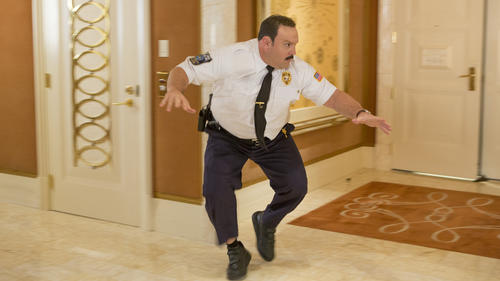
And oh what a dumb comedy it is. The first Blart film wasn’t going to be confused with Tom Stoppard but it at least had some action conventions it could tweak. This go-round can’t even manage that, and so we’re inundated with tired slapstick and comedy that rarely rises above the most obvious joke at every opportunity. Blart gets ready to attack an intruder and, wouldn’t you know it, he ends up punching an old lady. Hilarious. Even funnier is that the injured hospitality worker apologizes to her attacker. There’s also a thinly disguised gay panic joke where Blart freaks out when a guy eats a brown banana. Who cares about how brown a banana is? At one point Blart hides inside a suitcase positioned at the top of the stairs. Why? Well so that the suitcase can fall down those stairs and hit the bad guy in the head. Don’t you get it? He’s fat. There are few comic setups or developments, no payoffs. Scenarios that should be comic, like Blart stumbling on stage of a Vegas dance show, are practically played straight, with the visual of Blart cavorting his large torso as the only joke itself. In case you forgot, he’s fat.
I should not have been expecting much from Paul Blart 2 simply by the choice of jokes highlighted in the trailer. If you wanted a cursory reminder, it included Blart fighting a bird, Blart punching an old lady, Blart running into a plate glass window, and Blart getting kicked by a horse in what should be a spine-obliterating accident. Let’s take this last gag and really explore how it’s indicative of Paul Blart 2. The foundation is a dumb act of slapstick, but that’s not good enough and so it’s exaggerated to even dumber magnitude. With the help of self-loathing CGI artists (they can’t all be Jurassic World), Blart ricochets across a street and violently bounces against a car door. It’s not enough that a horse kicks this guy; he has to get kicked by a super horse because it just wasn’t funny enough. That sums up the comic ethic of Paul Blart 2: when stupid isn’t enough, amp it further, and then be proud about what you’ve done.
Nate’s Grade: D
Share this:

Jurassic World (2015)
 Director Colin Trevorrow won the proverbial lottery after his 2012 film, Safety Not Guaranteed. The charming indie gem won many hearts, one of them Steven Spielberg. Trevorrow went from a rom-com that was made for under a million dollars to directing a Jurassic Park franchise reboot. Even last year’s Godzilla director, Gareth Edwards, had a previous film that somewhat primed a logical path for his impressive new gig. Enough time has passed for Jurassic Park to be new again, and the extra varnish of cutting-edge special effects, high-profile stars, and a renewed sense of fun remind us just how universally enjoyable it is to watch dinosaurs and then watch dinosaurs eat people.
Jurassic World has been open for a decade plus now and audiences are getting bored. As a result, the board of directors for the park is looking to “up the wow factor.” They’ve genetically engineered a new hybrid dinosaur (Indominous Rex) that has never existed before in history, but nothing bad could happen, right? Owen (Chris Pratt) is a Navy trainer who is working on training a group of raptors to follow commands. A security leader (Vincent D’Onofrio) is convinced that there’s money to be made with military applications if dinosaurs can follow orders. Claire (Bryce Dallas Howard) is in charge of the day-to-day operations at the park. Her nephews (Ty Simpkins, Nick Robinson) are visiting as one last holiday adventure before mom and dad get divorced. She knows little about her nephews (she’s a workaholic – what originality), but when they’re put in mortal danger, Claire’s protective nature kicks into overdrive. The Indominous Rex escapes its paddock and heads from pen to pen deeper into the park, killing for sport. It’s up to Claire, Owen, and a team of trained raptors to stop this newest monster.
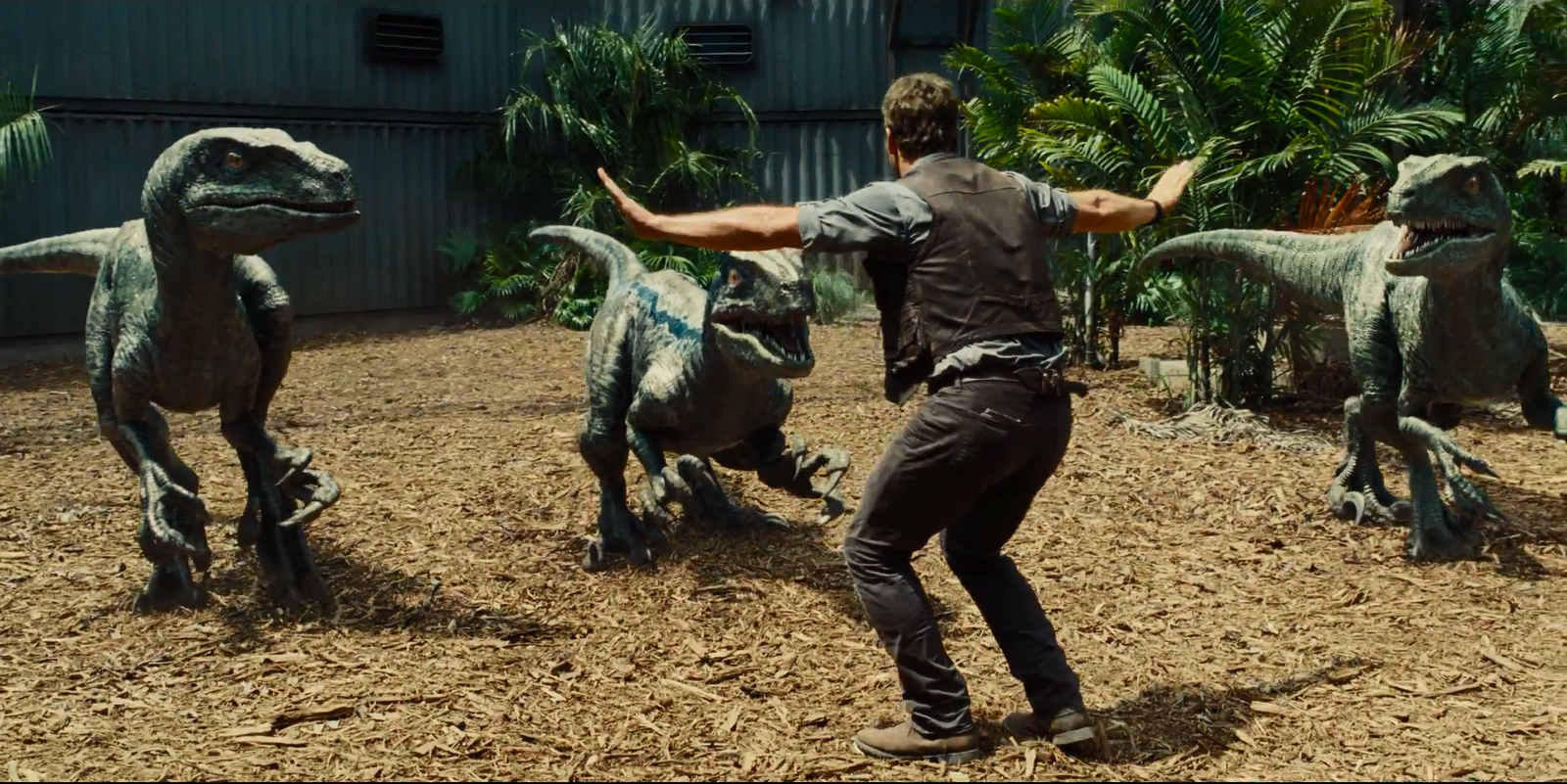 What Trevorrow and his Safety writer Derek Connolly do well is establish a summer thrill-ride that places fun above all else, and it achieves this goal. Jurassic World is consistently entertaining and engaging, with action sequences that are shorter but constantly push the narrative forward. With all the Jurassic films, there’s a palpable sense of dread, of holding back before things get really nuts, and Trevorrow has fun teasing an audience; however, he also delivers on what he promises. The dinosaur action is visceral and rather violent for a PG-13 film, but the segments are diverse in orchestration that it never feels like the movie is repeating itself. That’s quite an accomplishment considering that the Jurassic sequels have mainly been a series of chases. There’s a definite nostalgic reverence for the original 1993 film, summed up with Jake Johnson’s geeky control center character. Trevorrow takes more than a few nods from the almighty Spielberg with his own directorial style. There’s also a surprise sense of humor, which can be quite amusing in moments and far too comically broad in others, like the forced screwball romance between Owen and Claire. The story this fourth time is less a cautionary tale of science and more of a monster romp, imploring a finale that feels reminiscent of Godzilla being called out to save the rest of us tiny humans from the newest and biggest monster. It feels like Trevorrow and Connolly accepted they would never recreate the magic of the original, so they’re aiming to just make the best sequel possible instead. If you’re looking for dinosaur mayhem, Jurassic World has plenty and a sense of what makes summer movies work, mixing in the right amount of suspense, humor, and well-crafted payoffs.
There are a few subplots that have to be swallowed or ignored for maximum benefit. The Raptor Force Five subplot is either going to be cool or silly, or both, and will go a long way to determine your overall feelings on Jurassic World. I know this idea has been in the works for several Jurassic sequels, so there doesn’t seem like there was ever going to be a movie that did not involve raptors being trained into some kind of combat role. This subplot connects to other points in the film about the nature of control/accepting being out of control, the building of a relationship, and the coordination for corporate interests. There’s a reason that the Indominous Rex seems to have special abilities that the handlers were not informed about, and this will be carried over into an assured sequel. For me, I thought the raptor hunting party was more fun than dumb. It had a Disney Wild Adventure feel for it, like we’re crossing over into Call of the Wild. I liked making the raptors allies to the humans who could be rallied for the final fight.
I appreciated how thought out the world building was; Jurassic World feels like a living, breathing amusement park in operation. From the Seaworld-like Mosasaurus aquatic shows, to the baby dinosaur petting zoo (I would totally spend hours there), to the celebrity-recorded comedy bits educating riders about safety supervision, to the listless park employee wishing each new rider to have a happy day. During the pterodactyl attack sequence, which is the most frenzied and exciting sequence, the crowds run for cover, including one guy who runs away while still carrying a clearly identified margarita in hand. That’s fantastic because it means that the park probably has a cheesy pun-laden menu of adult beverages (Tea Rex?) but it also means that even during an attack, a customer is determined not to lose his, likely, $10 margarita. While the “we can’t close the beaches” corporate mentality is somewhat tired as a plot obstacle, it’s still entirely fitting in a modern setting. It was the little details that told me that Trevorrow and company really thought the premise through and made their world feel far richer.
 One could also look at the social commentary in a fairly cynical manner and find Trevorrow giving in to the summer movie machine. Claire’s character explains that after years of operation, the public has grown tired of dinosaurs, and so they have to engineer a new bigger, badder dinosaur just to grab flagging interest. What once was magical has now become accepted and everyday. It’s easy to apply this critique on movie audiences themselves; we’ve become jaded from movie spectacles. What once blew our minds, like the original Jurassic Park, has now become passé. We’re constantly looking for the shiniest new toy but will lose interest soon enough. And then there are the fleeting images of people being more involved with their cell phones than the spectacle they paid to see. That’s right, annoying moviegoers who are unable to break from their phones for a two-hour window, Jurassic World is making fun of you, and rightfully so. The chief product of this desperation to give the audience what it wants is Indominus Rex, a beast that slashes a rampage through the island. In a sense, Trevorrow is externalizing the audience’s demands into the antagonistic monster, and finally just gives in, essentially saying, “This is what you want, right?” I can’t tell whether the social commentary holds up well, especially with the end that relies upon a metaphorical power of nostalgia to conquer the manifestation of audience apathy, or if Trevorrow just gives up. Is the concluding monster-on-monster brawl just mass appeal pandering?
I have a major solution to this dangerous park scenario. First, only herbivores allowed. Is any person going to reasonably refuse to go see millions-year-old multi-story extinct creatures because they primarily eat plants? I’m sorry, no way. That right there would solve most problems if the animals inevitably get loose. I would not believe a single person who would refuse to see living dinosaurs just because they lack a T.rex or other predators. That’s like Internet cretins refusing Angelina Jolie as a one-night stand because they don’t like the way her knees look. Nobody is this picky when awe-inspiring greatness waits. From a legal standpoint, I would also make sure guests sign a waiver before entering the park, thus mitigating any potential lawsuits over being attacked and eaten. How expensive is this park by the way? You have to charter a boat off the coast of Costa Rica, so that sort of price range already eliminates plenty of would-be customers.
I know many millennials who consider Jurassic Park to be their own Star Wars, a film that delighted the imagination and imprinted a love of movies at a young, impressionable time. Movies have never been the same since, especially in the sea change of computer generated effects replacing practical (Oscar-winning Sam Winston is retiring because of our over-reliance on CGI). We all want to experience that sense of awe again, like when we saw the T.rex roar for the first time. Movie moments like that send shivers but they are rare, so it’s unfair to compare Jurassic World to Park. However, it’s fair game to compare it to the lesser sequels, and that is where World stacks pretty favorably. Its sense of fun above all else, while remaining true to its larger vision of a real park, is a satisfying summer diversion. The dinosaur mayhem is satisfying and occasionally scary. The script does just enough to keep you from wanting to watch the human characters get squashed. In the wake of its box-office shattering opening weekend, expect the park to stay open.
Nate’s Grade: B
Share this:

Mad Max: Fury Road (2015)
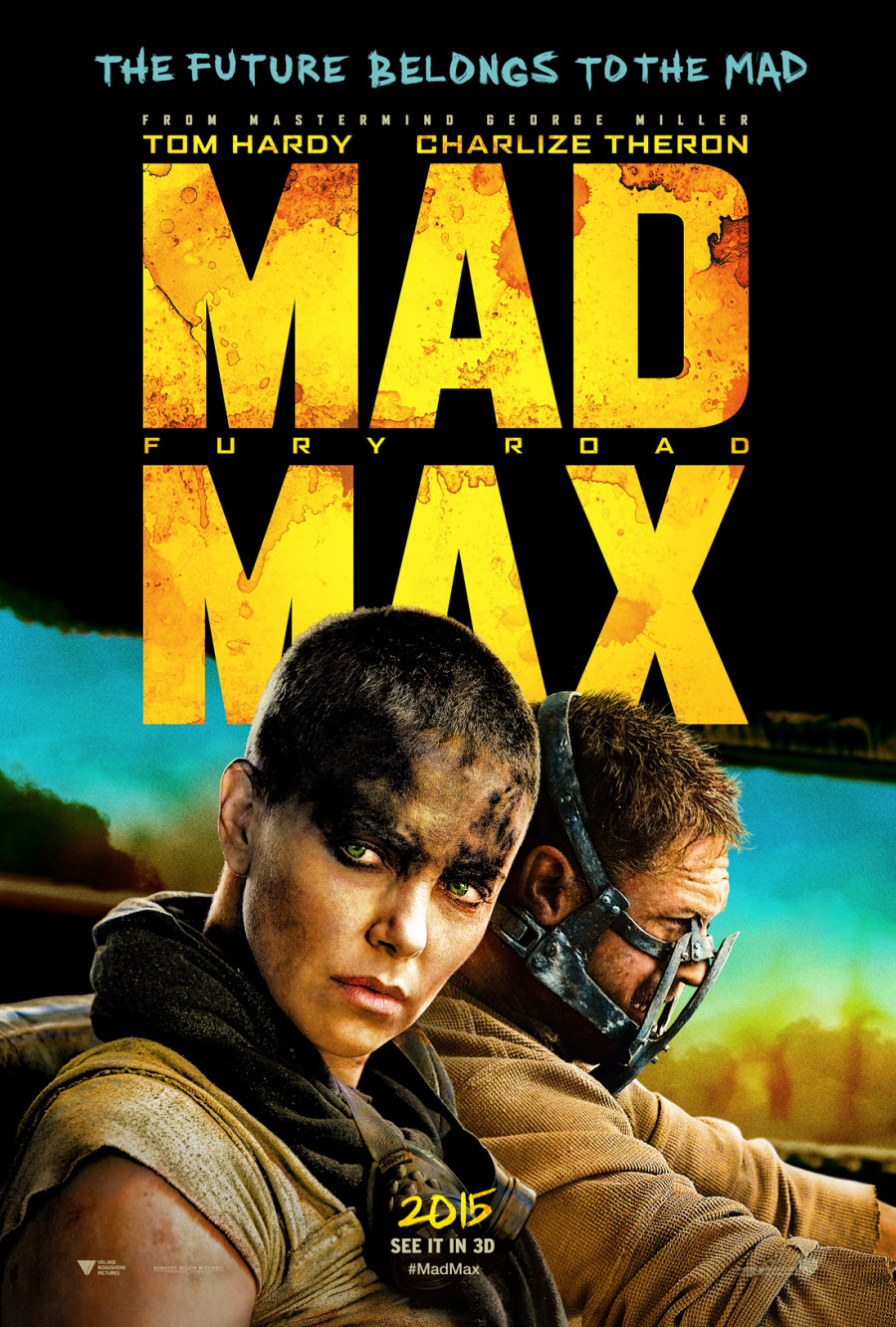 Allow me to begin with a confession. I had to see Mad Max: Fury Road again. I knew minutes into the film that my appetite would not be quenched and I needed to see it again, which I did less than 12 hours later. A week later I saw it a third time in the theater. The reason I did this is obvious in one regard – it’s a highly enjoyable, pulse-pounding, amazing spectacle of first-class stuntwork and mad genius so rarely accomplished on such a large, splendid scale of destruction. The other reason, from a writing standpoint, is that I needed to see the movie again or else my review of Fury Road was going to consist of nothing but an unending stream of positive adjectives vomited upon the page in excitement. And for you, dear reader, I wanted to do better. Also, I wanted to see Mad Max: Fury Road again and I honestly wouldn’t mind in the slightest seeing it again.
In the post-apocalyptic future, Immortan Joe (Hugh Keays-Byrne) is an aging warlord with his own fiefdom. He controls the water supply and has an army of gearhead warriors to enforce his rule. His trusted driver, Imperator Furiosa (Charlize Theron), is leading a caravan for supplies when she goes rogue, driving off into the desert. Furiosa has taken Immortan Joe’s “property,” namely his five wives. Enraged, Immortan Joe gathers a posse of death vehicles and riders and heads off to reclaim his “property.” Max (Tom Hardy) is a drifter thrust into the middle of this conflict when he’s strapped to a car and driven out into the desert, part of the Immortan Joe rapid response forces.
 There are few things more exhilarating in the realm of motion pictures than a well-executed, well-developed action sequence, and Mad Max: Fury Road is a blistering, awe-inspiring masterpiece of brilliant carnage. What director George Miller has achieved onscreen is visionary. The level of execution is so rarely seen at such a large scale, and with so many moving parts, that I was delighted and curious how something this extraordinary could escape the risk-averse studio system. I’m trying my best to restrain myself from sheer hyperbole, but this is an instant classic in the world of action cinema and a definite top five all-time action film (for those keeping track, I would say last year’s Raid sequel would also qualify for that status). The movie provided me a font of joy that did not let up until the end credits ushered me out of the theater. The action sequences are epic in their scale, with dozens of different vehicles in hot pursuit, and yet Miller brilliantly orients his audience to every moment of his symphony of demolition. There are so many different parts to the action but the audience knows everything that happens. The sheer sense of momentum and pacing is overwhelming and giddy. The action sequences develop organically, with new consequences throwing our characters into different and dire directions. There’s also a startling amount of variety with the action sequences. Fury Road has been described as a two-hour chase film, and that’s accurate to a degree, but there are breaks in between the sequences, small moments to catch your breath and learn more about our characters and their hostile world. Each sequence is different enough that the action doesn’t ever feel redundant, even when the third act literally requires the characters to backtrack. The adrenaline just doesn’t turn off from the get-go, and Miller keeps throwing out new tricks, new stunts, and new cars to astound and amaze. Simply put, Fury Road shames other American film releases.
The stuntwork is another facet that just raises the bar when it comes to action movies. Miller emphasized practical effects whenever possible, and the emphasis pay off with a heightened sense of realism onscreen. It’s real cars being smashed to real bits, real stuntmen being tossed around. In an age of CGI over saturation, it’s all too easy to become numb to big screen spectacle because of how hollow it all comes across visually. Just this past month with the Avengers sequel, I knew that all the fight scenes were mostly CGI or actors against green screens, and it eases off the enjoyment of the moment. Don’t even get me started on the deluge of CGI carnage in the last Hobbit film. Real physical objects and physical interaction offer so much more believability in an age of increasing disbelief with special effects. With Miller’s focus on practical effects first and foremost, it brings that sense of crazy excitement back and it ensures that Fury Road will hold up better over time.
 I also appreciated just how much thought Miller and his team put into crafting their world. Every detail feels like it adds to the overall richness of Miller’s vision. The designs of the cars, the use of scrap, the fact that a pulley system is operated with children running up giant wheels, it all contributes to making the world better realized and more alive. The level of thought put into weird and deadly concepts in this movie is fantastic. Once the main characters pass through a bog of land, we see people dressed in cloaks traversing the land on stilts, and it’s little passing details such as this that make the movie feel more complete. I enjoyed that one of Max’s heroic attributes is that he’s specified for his blood type, being O the universal donor. The fact that Miller finds a satisfying way to bring this attribute back as a payoff is also appreciated. I also enjoyed how Miller expands upon the family of Immortan Joe, with his bevy of freakish sons and brothers and peculiarities. I enjoyed the fact that Miller isn’t afraid to embrace the weird of his dystopia, symbolized best by a blind guitar player attached to a roaming wall of speakers who can shoot flames out of his instrument. Every time the movie cut back to this guitar playing pace setter, I smiled, and I smiled a lot during this movie.
Some have grumbled that Max is a supporting player in a movie that bears his name, but I would argue he is a co-lead and the real star is rightfully Imperator Furiosa. Max is not replaced with Furiosa, rather they have an inter-dependant relationship where they’re both vulnerable and they both come to trust the other but without a romantic mingling. These are both wounded, shaken, mistrusting, and volatile people, and to watch their shared sense of teamwork and the gradual opening and reliance upon one another, it is itself an affecting and emotionally satisfying relationship. But back to Furiosa, it’s really her story because she is the one with the personal connection to the mission. Max has always kind of been a wandering warrior who finds himself in other people’s battles. Consider him a post-apocalyptic Man with No Name. Furiosa is the leader who has planned and implemented the escape from Immortan Joe, and it’s she that deserves our attention. I enjoyed the fact that Miller doesn’t even have to explain her past. We know she’s suffered trauma, physical and likely sexual, and he assumes the audience does not need Furiosa’s past abuse spelled out specifically for them, or seen in grisly flashback. She’s a strong woman who is far from helpless with one arm. This is a story about women liberating themselves from sexual slavery under a corrupt patriarchy (more on the thematic relevance below). Theron is our leader and the ferocity in her eyes is all you need to believe that this woman will do whatever it takes for freedom.
The other aspect that’s very clear is that Fury Road is a decidedly feminist film but it never stoops to preaching or even directly calling attention to its efforts. It’s a ruined world where men with unchecked power have exploited the vulnerable, where women are treated as “property” and valued for breeding purposes. Our heroes are by and large women who have rejected their roles in this society or are fleeing their impositions. And with Furiosa as lead, it paints a more than convincing picture of women being just as capable and badass in the post-apocalypse (I want to go as Furiosa for Halloween). It’s a movie that portrays women struggling against an unjust system that devalues them but Fury Road doesn’t wallow in their suffering. It doesn’t have to in order to get its points across. It also treats the wives in a manner that lacks being sexualized. Immortan Joe has treated them as property but Miller treats them as human beings, even going as far as to give them distinguished personalities. They play a role in the action rather than damsels in need of saving. I’m not saying they approach three-dimensional characters but they’re certainly not just eye candy. There’s a sequence where they wash each other with a hose, and you could see the myriad ways this moment would go tawdry for some cheap titillation, but the film steers clear of that and moves on to the bigger picture. What the Men’s Rights Activists (sadly this is actually a thing) seem to have lost in their caterwauling is that feminism is not a zero-sum game; one person gaining stature and opportunity does not mean it’s taken away from another. Just because Furiosa is strong it doesn’t make Max weak. Furiosa being a compelling lead character does not diminish Max. It makes him an even better character because he recognizes her value and his own limitations, like a scene where he voluntarily hands over a rifle because he knows she’s the better marksman. No one has to explicitly point and say, “Girls can do it too.”
 There’s also a fascinating commentary on the danger of religious fundamentalism with the war boys. These powder-white young men are Immortan Joe’s armed forces and they are promised a swift appearance at the gates of their paradise if they die in battle (“Witness me!” is their exclamation before sacrifice). They spray paint their faces chrome (“Eternal, shiny and chrome”) and then go in for the kamikaze kill. Again, the theme is ripe and obvious but without requiring characters to comment. Nux (Nicholas Hoult, wonderfully deranged and then sincere) actually has the closest thing to a character arc, going from hopeful martyr to independent thinker. He begins as a clumsy yet determined antagonist and becomes a resourceful and unexpected ally.
This is practically a flawless film on a technical level. The cinematography by John Seale (Cold Mountain) is bright with lush colors that pop on the big screen. We’ve been treated to far too many color degraded films, so it’s nice to view a movie that wants to use all the colors at its disposal. The musical score by Junkie XL (300: Rise of an Empire) is stirring and pulse-pounding with its heavy percussion, but there’s a languid melody that returns again and again that is emotionally resonant. It’s surprising how the score will punctuate the bombast and wailing guitars with a lovely string arrangement, like when we rush into the sandstorm and a car is blown into the sky. The editing is outstanding by Margaret Sixel (Happy Feet) and she keeps the audience informed with every new twist and turn, and with so many moving parts and changing dynamics, that is a miracle itself. The production design by Colin Gibson beautifully expands and informs this strange world. There isn’t a department in Fury Road that wasn’t at the top of their game.
If I had to quibble, I could accept the argument that Mad Max: Fury Road lacks the substance to be considerably more than an exhilarating action ride. The dialogue can be a bit on-the-nose, Hardy mumbles through a majority of his miniscule lines, and the characters aren’t as fleshed out as they could be and the plot is rather bare bones. However, I view its narrative economy as a virtue, as there isn’t a moment or scene wasted in telling this breakneck tour de force of post-apocalyptic demolition. Rarely does an artist get to work at this level in the studio system let alone succeed with a final product that still manages to be strange, mordant, uncompromising, and completely riveting. This is a near-perfect action movie and a thrilling high-wire act of practical filmmaking bravado. Mad Max: Fury Road is the standard I am going to judge all summer movies by for the rest of the year, and I imagine many will be found wanting. I could continue to heap praise on the movie but the most persuasive stance I can make is that if you fail to see Fury Road on the big screen, you will always regret this decision. I am a disciple of Fury Road and witness my brethren and me. This movie was made for the biggest screen, the loudest sound system, and an endless bucket of popcorn.
Nate’s Grade: A
Share this:

Avengers: Age of Ultron (2015)
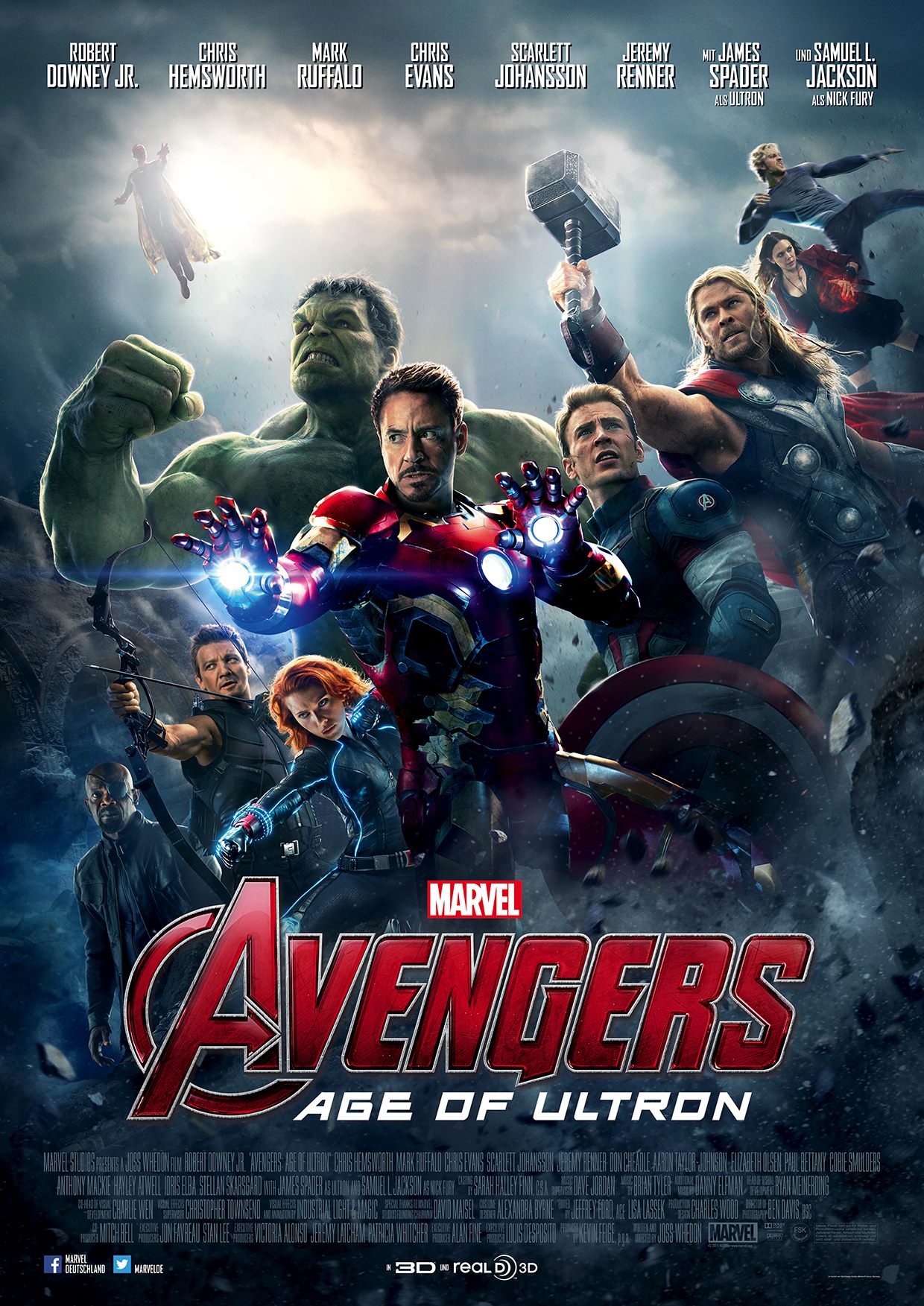 The Avengers wasn’t just a blockbuster it was a mega-blockbuster and rewrote the Hollywood playbook in the summer of 2012. It wasn’t just about powerful franchises anymore. Now it was about franchises that would link into a super franchise. Sony got anxious to expand their Spider-Man universe in a similar fashion as Marvel had done in buildup to The Avengers. After one poor movie, that plan was scuttled and now Spider-Man is being rebooted for the second time in five years, this time with active help from Marvel itself (look for Spidey to appear in Captain America 3). Writer/director Joss Whedon (TV’s Buffy the Vampire Slayer) was the mastermind behind the jaunty smash-em-up fun of The Avengers and was quickly signed on for a sequel after the billion-dollar mark was crossed. With great success comes great risk of upsetting that continued success. It feels like Whedon’s hands were tied to the greater forces at work. As a result, I shouldn’t be surprised but I’m still disappointed with how muddled and overstuffed as Age of Ultron comes across.
The Avengers are cleaning up the last remnants of HYDRA, taking them to a castle in a fictional Eastern European country. The HYDRA doctor has been genetically experimenting on volunteers, birthing Wanda “Scarlet Witch” (Elizabeth Olsen) and Pietro “Quicksilver” Maximoff (Aaron Taylor-Johnson). She can tap into people’s minds and he can run super fast. They’ve got a grudge against the Avengers, particularly industrialist Tony Stark/Iron Man (Robert Downey Jr.). Stark takes a piece of alien technology and plugs it into his home system to build a super fleet of automated robots to patrol the world. In no time, the A.I. has taken form in the shape of an insane robot named Ultron (James Spader) whose mission is to save the planet by eliminating mankind. He builds an army of robotic soldiers with the assistance of the Maximoff twins. Tony, along with Captain America (Chris Evans), Thor (Chris Hemsworth), Hawkeye (Jeremy Renner), Black Widow (Scarlett Johansson), and Bruce “The Hulk” Banner (Mark Ruffalo), must stop Ultron while not destroying much of the world themselves with their collateral damage.
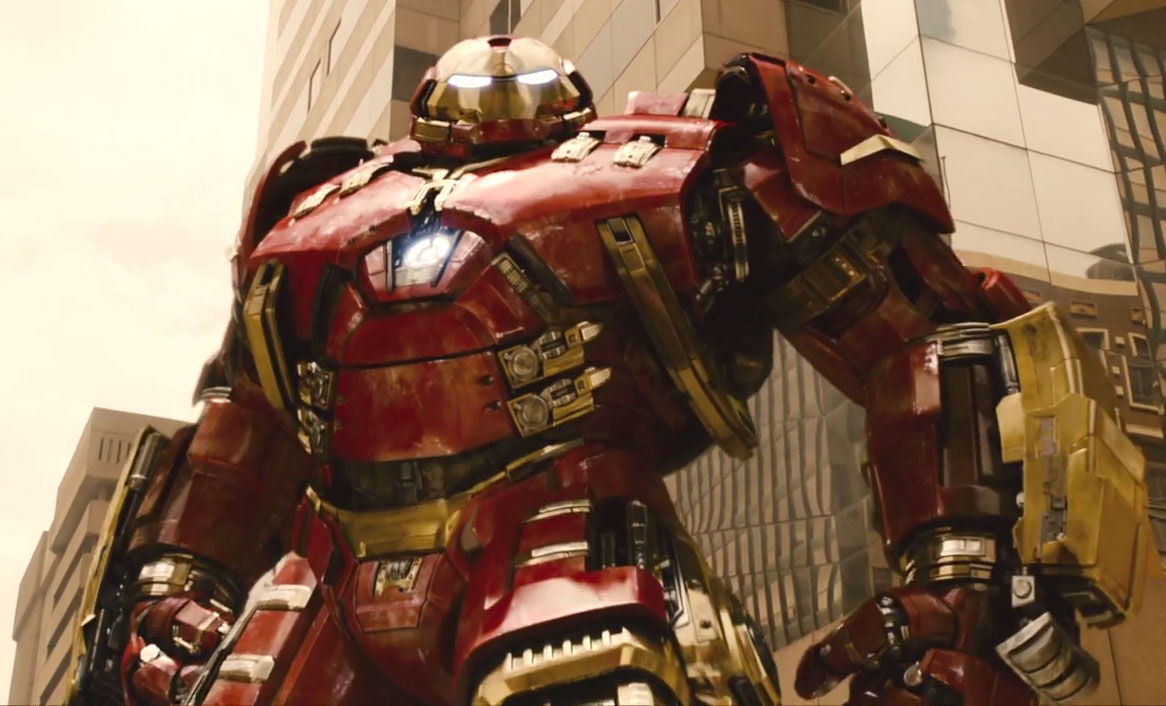 Eleven movies into the Marvel Cinematic Universe (MCU), a movie of the size of an Avengers sequel cannot simply be a movie. It’s too important to the overall vision of the MCU, and so it has to set up and establish other characters, franchises, and the many monetary tributaries that keep the world of superheroes going. It’s already got a slew of superheroes and it adds even more new faces into the mix (I guess we needed an Avengers B-Team). The development of Ultron is also far too rushed; it’s literally minutes from being plugged in that he’s already settled into kill-all-Avengers mode. The movie barely has any time to even contemplate the perils of artificial intelligence before Ultron is already proving their fears correct. While Ultron is a fun villain (more on that later) his plan feels quite haphazard. His biggest strategic advantage is his duplication, the fact that he can exist without a physical body and can inhabit many bodies at once. Except for a hasty escape via the Internet and a climax stuffed with CGI robot mayhem, this advantage isn’t really explored. Why does a self-replicating creature beyond the bounds of physicality need or even desire a physical body? If you’re made from a nigh indestructible metal and can control numerous beings at once with a hive-mind intelligence link, why would you want to be turned into flesh thanks to what amounts to a 3D printer? The introduction of The Vision (Paul Bettany, this time in the flesh) is quite muddled and confusing. The incorporation of the Maximoff twins is awkward and they feel more like accessories than needed additions. This Quicksilver doesn’t come anywhere close to the memorable prankish Quicksilver from Days of Future Past. The pacing of the film is so ramped that it feels like the movie is falling over itself to get to the next large-scale action set piece. At 140 minutes, they could have removed one or two action pieces and devoted more time to streamlining and cleaning up the narrative.
And the action sequences start off with a bang but they invariably fizzle out. The opening sequence begins with a Birdman-styled tracking shot to connect all our fighters, and it’s a fun way to kick things off while visually tying together the team. The Hulk vs. Iron Man brawl is fun for a while, partly because it harkens back to the pleasures of the first film, namely watching our heroes battle each other as much as the villains. After a while, the CGI onslaught becomes overwhelming and just dulls the senses. You’re watching CGI smash into other CGI and then keep smashing, with little variation. The disappointment with the action is that it too often feels weightless and hollow. It has glimmers of fun but it can’t hold onto these glimmers because the action doesn’t change. It gets bigger and more chaotic, yes, but it doesn’t develop with organic complications and real attention to setting. These big battles could happen anywhere because they almost all descend into simply fighting amidst rubble. Even Iron Man 3 found ways to spice up its action set pieces through complications, limitations, and clear differentiation. Perhaps this is a larger outcry of fatigue with the overall state of CGI overkill in effects-driven films. The concluding fight versus Ultron and his many copies just feels like the same scene on repeat but in slightly different locations. Whedon has shown an affinity to coordinate exciting and satisfying action sequences, but you just feel like the pressure and demands get the better of him.
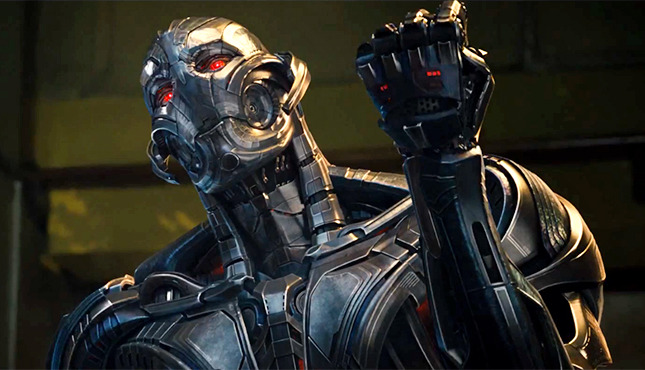
However, every moment with Ultron onscreen is a highpoint because of the malicious cattiness of Spader (TV’s The Blacklist). He’s a perfect fit for a character who is at turns childish and petty, bonkers, and condescending. In some ways he’s like a giant robotic teenager who thinks he’s just above the rest of these so-called adults. It’s such an enjoyable villain, an area of real need in most MCU films (Loki can’t be everywhere for every movie), that I wanted more and more of him. My friend and critical colleague Ben Bailey describes Ultron as the villainous alternative Tony Stark, and Whedon does a fine job of laying out the parallels, especially with regards to ego. It’s a weird reunion for the stars of 1987’s Less Than Zero.
The most boring characters, i.e. the humans, are the ones that get the biggest expansion for character development, with mixed results. Let’s face it, Hawkeye is never going to be anyone’s favorite Avenger. I think even he acknowledges this in a moment that almost breaks down the fourth wall (“None of this makes sense. I’m fighting with a bow and arrow.”). Hawkeye’s personal life is given a spotlight and it sets up an obvious worry that he’s going to bite it by film’s end. If there was an expendable member of this team, it would have to be Hawkeye. The added attention and personal attachments seem like a dead giveaway that he’s going to be dead. I don’t think I was any more invested in his character knowing about his hidden life outside the Avengers, but I certainly played a game of, “Is this gonna be it?” as the film continued. Black Widow started as an interesting character, a spy trying to make amends for her bloody past, or the “red in [her] ledger,” as they referred in the previous film. Her budding romance with Banner makes some sense but it still feels like the character is being forced into Romantic mode not because of her character but mostly because she has a vagina. Any romance with a guy who turns green and monstrous seems like it might be best as unrequited. She’s also defined by a past trauma that, while upsetting and cruel, is also a bit too tied into her identity as Woman/Mother. It’s an unfortunate positioning for what is an inherently interesting character (the slut shaming of the character in promotional interviews by certain Avengers cast members is also highly unfortunate). Can’t we get a Black Widow movie yet, Marvel?
 An aspect of Age of Ultron I did enjoy was how conscious the heroes are about mitigating collateral damage and especially human casualties. At every turn, the Avengers are thinking about saving those caught in the cross-hairs first. They go out of their way to save those left behind. I think, and I’m not alone in this conclusion, that Whedon is directly responding to the disaster porn that was Zack Snyder’s miserly Man of Steel. The latest Superman movie bothered me with how callous it was with human life, treating devastating city-wide 9/11-style destruction as mere entertainment. As Superman and Zod were colliding through every damn building in Metropolis, you knew thousands if not millions of unseen people were perishing in this rather pointless melee. Whedon’s band of heroes places a priority on human life regardless of region.
It would be disingenuous of me to say Age of Ultron is not entertaining. Whedon is still a terrific storyteller and that still shines through the troubled areas and spotty plotting. The action makes good use of the various heroes and their abilities, providing fun combos like Cap hurling his super shield so Thor can redirect it further with his hammer. The use of humor was one of the bigger enjoyments of the first Avengers, and while it’s still abundant and enjoyable here as well I’d say it’s overdone. When every character is cracking quips every fourth line of dialogue, it pulls you out of the movie and the stakes feel lesser. The running joke where the Avengers make fun of Captain America for his prudish sensibilities on profanity is a joke that works at first but then loses all sense of fun as it’s pounded into the ground on repetition. The larger set pieces each have their moments to delight, especially the opening and the Hulk vs. Iron Man battle. Age of Ultron isn’t a bad movie and it has some truly great moments and great character moments and payoffs, but it’s only moments. The plot meant to connect the dots is too labored with the burden of setting up several Marvel franchises. In the MCU pecking order, I’d place Age of Ultron right around Iron Man 2 quality (another movie compromised by the extra burden of setting up other movies, namely The Avengers).
It’s sure to set box-office records and I imagine fans of the original will happily lap up another super team-up, but Avengers: Age of Ultron is something of a disappointment for me. The more I think about it the fun parts become a little duller and I find more areas of criticism. It’s just not as fun a movie experience, and that’s due to the rushed and muddled story and too many characters. After the critical and commercial success of the first film, I doubt that Whedon could have produced a film that would live up to the sky-high expectations, but that doesn’t excuse the finished product. It feels like Whedon had to struggle to pull this one off, especially with the added demands, and I can’t blame him for wanting a break from the MCU. The Russo brothers who so dazzled audiences with their direction of Captain America: The Winter Soldier will be stepping in to direct the next Avengers sequel(s). I hope they’re up to the task because the burden of carrying a billion-dollar franchise with its tendrils connected to other franchises appears to have been overwhelming for one of the greatest storytellers of a generation. Enjoy Age of Ultron but be wary of what the future holds for the larger MCU.
Nate’s Grade: B-
Share this:

Insurgent (2015)
 A return to the world of Divergent yields little forward momentum, in fact just enough to end on the point that I thought where a sequel would naturally begin. Turns out we needed a whole other movie, Insurgent, to arrive at this obvious narrative next step. Insurgent picks up with Tris (Shailene Woodley) and company on the run following the coup of two of the five social factions. Tris is a Divergent, able to apply herself to multiple factions, and she and her kind are the only ones who can open a secret box left behind by the founders of this post-apocalyptic civilization. The film does enough to hold your attention and we get to visit the other two factions we missed the first time, providing further shape to what is still a confusing world. I think the Divergent series will always fall short of the YA pacesetter, The Hunger Games, but they offer their escapist moments of entertainment. The second film is a bigger, louder, and more heavily coated CGI affair, especially the magic box’s mental trials that amount to a repeat of the first movie’s psychological trials of fear. Woodley is the strong center of the film and she processes her own PTSD over being forced to kill friends in order to survive; you do start to sense that Woodley is growing restless with the franchise. The third book is, as required by the mandate of milking YA franchises, being split into two movies, and while it served little to the Hunger Games, I hope better for the Divergent series, a group of movies inferior and somewhat mystifying but still interesting enough. For now.
Nate’s Grade: C+
Share this:

Furious 7 (2015)
 The Fast and the Furious series has never been more popular, which is crazy to think about for a franchise entering is sixth sequel. Then in November 2013, it suffered its biggest shock. Actor Paul Walker was killed in an automobile accident. The already-filming seventh film was put on hold, pushed back a year for release, and retooled to accommodate the new tragic reality that one of the core members of a popular series going back to 2001 was no longer walking this Earth. With this context, it’s hard not to apply an added level of gravitas and dramatic weight to a series that previously skirted by on its fun and outrageous stunts. It’s weird to watch an actor’s final filmed moments, knowing this is the last time you’ll see that face, hear that voice, on screen again. I’m already dreading that painful realization in November that, with Mockingjay Part 2, this will be the last cinema will see of Phillip Seymour Hoffman. With tragedy hanging over it, Furious 7 does an admirable job of sticking to what it does best while serving as a fitting tribute and sendoff for Walker.
Coming on the heels of the events of Furious 6, Dom (Vin Diesel) and his crew have dispatched Owen Shaw (Luke Evans, collecting a paycheck for one scene lying in bed). Shaw has an older brother, Deckard (Jason Statham), who swears vengeance and comes hunting after Dom’s team, killing Han in Toyko (events previously seen in 2006’s Tokyo Drift). Then Shaw hobbles Agent Hobbes (The Rock), leaving him sidelined for much of the movie. Dom and Brian (Walker) place their families in safety and then set off to eliminate Deckard Shaw. Little did they know that the government has a similar interest. Mr. Nobody (Kurt Russell) promises to help Dom in his quest if Dom agrees to a secret mission to rescue a computer hacker (Game of Thrones’ Nathalie Emmanuel). This hacker, codenamed “Ramses” has developed a device that taps into every camera and microphone on the planet to track anyone anywhere. If Dom can secure the device, Mr. Nobody will use it to track and take down Deckard Shaw.
 What elevated the Fast and Furious films into new heights of critical and commercial acclaim are the over-the-top action set pieces that don’t just defy the laws of physics, they obliterate them. There’s a fine line between stupid action and stupidly awesome action, and I think Michael Bay is still trying to finesse this understanding. Under the guidance of director Justin Lin, the franchise got bigger and ballsier and enjoyably insane. The action set pieces were huge and wild and well developed with organic complications and world-class stunt driving. The set pieces of the last few films have been stunners, and at its height, the franchise can make you feel giddy like a child watching the unreal unfold with such delight. There’s a tremendous and infectious high watching a well-executed action scene on such a large scale. With every movie our expectations are hungrier, and the franchise has found a way to satiate our action movie demands (for my money, Fast Five is the best). Furious 7 is the first Fast film not directed by Lin in ten years. James Wan, best known as the director of horror films Saw and The Conjuring, stepped into the director’s chair and he assimilates well into the “house style” of the franchise. However, I found myself missing Lin’s touches; he has a natural feel for choreographing action sequences with style and a clear eye for orientation. I found the editing for Furious 7 too choppy and several action sequences hampered by not getting a better sense of the wider surroundings and what was happening. Wan acquits himself well and keeps things running smoothly, though Furious 7 is a slight step down but still plenty entertaining.
Let’s talk about those giddy highs of Furious 7, because they are certainly there, though I wish there was more of them. Am I just getting greedy or building a tolerance? There are two standout moments that made me squeal. The first involved a set piece involving cars parachuting out of a transport plane. The next was a car crashing through the window of an Abu Dhabi skyscraper into another skyscraper and then into another skyscraper. Your brain tells you that there are no way any of these moments could truly happen in reality, and that in these circumstances it’s majority CGI, but if you’re like me, you just do not care because the sheer scale of awesome is too enjoyable to pass up. When you can pull off large-scale and imaginative action that manages to also maintain a strong sense of fun, then you’ve landed upon something special. The previous Fast films have been able to maintain that giddy high for a more sustained period of time, but I cannot deny that the same thrills and over-the-top pleasure is present with Furious 7.
A factor that added to my enjoyment is that Furious 7 never dawdles or dwells too often during its 137-minute running time, save for an extended resolution for Walker. This has never really been a franchise that has soared on the strength of its characterization. Seven movies in, I still don’t really care for any of the characters except for The Rock and that’s mostly because he’s The Rock. I was happy that the film was always active to distract me from how one-dimensional and boring most of these characters are, even the villains. Statham (The Expendables) is the best villain the franchise has had so far but even he seems to be stuck in a lesser gear, failing to capitalize on all his abilities with a car chase franchise. The Rock vs. Statham fight shatters all breakable furniture within near proximity, but you still suspect it should be better given the participants. Djimon Hounsou (Guardians of the Galaxy) is wasted as a number two villain who mostly just shouts orders for people to fire weapons, and martial arts superstar Tony Jaa is definitely wasted as a number three villain, an elevated henchman with too few opportunities to bust a move. MMA fighter Ronda Rousey appears briefly as an Abu Dhabi security chief. She performs well, pummeling Michelle Rodriguez while in evening wear; however, you quickly realize that Rousey is not an actor. She’s no Gina Carano (Fast and Furious 6), and speaking of, when is this woman going to finally be cast as a super hero? She’s practically a living Wonder Woman anyway and she has that “it” factor.
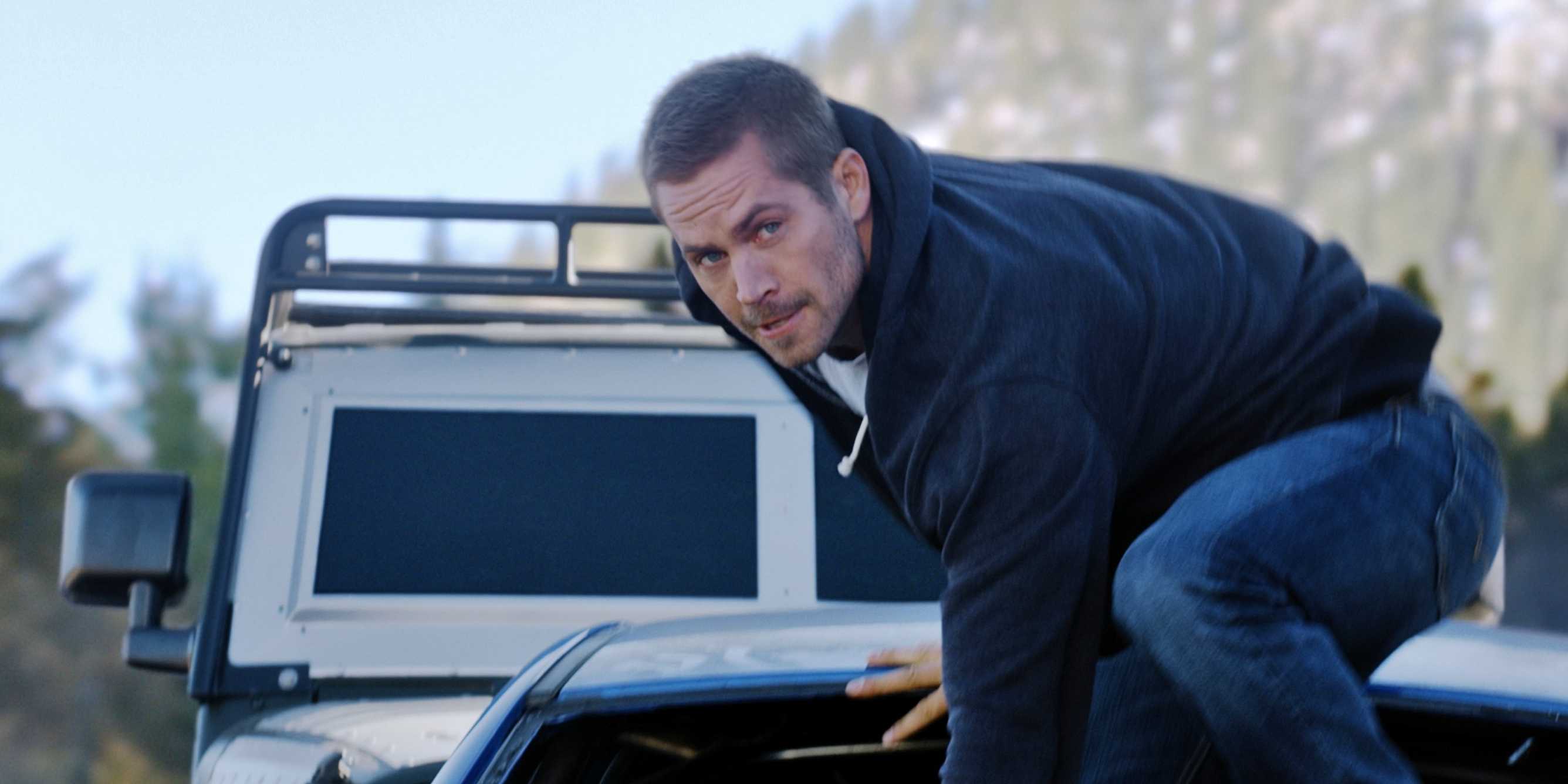 When the movie tries to be dramatic, it starts to stall, which is probably why it relies mostly on platitudes about family (“I don’t got friends, I got family,” Dom says in a weird retort). Jordanna Brewster is once again written to the side as the Concerned Wife, and the movie still doesn’t seem to know what to do with the re-emergence of Rodriguez’s Letty character. She got her memory back in the previous film, but now she’s having trouble readjusting, but before this can develop into an actual plot she disappears again and then the big action just kicks in. There’s enough of a team built up to provide diversity, with Ludacris and Tyrese Gibson serving as comic backup. There’s a sense of camaraderie that doesn’t feel artificial, and the small moments together are perfectly nice, but thankfully the movie has the good sense to know what the audience is paying to see. It’s here for the fast car, eye-popping stunts, and gratuitously framed camera angles highlighting women’s derrieres (there are a lot of thongs in this movie).
With the specter of Walker’s passing, the movie also presents a ghoulish game of looking for the tricks to work around his untimely absence. Reportedly the actor had filmed “most” of the movie and the remaining scenes, retooled after months of production being on hiatus, were completed by Walker’s brothers and some CGI sleight-of-hand. Perhaps I just have a more trained eye for spotting the cinematic wizardry, but by my judgment it sure didn’t feel like Walker was present for most of what was eventually used in the movie. I noticed a lot of wider shots and scenes where Walker is not facing the camera to speak or he’s at an odd angle. At no point did the movie become a strange uncanny valley experience of discomfort; movie productions have digitally attached faces before to other heads, notably for Oliver Reed in 2000’s Gladiator. If you’re not looking for it intently then it will all pass seamlessly. The film’s final ten minutes end up becoming an extended sendoff for the character of Brian, but really it’s the actors saying goodbye to their friend. It’s reverent and respectful and might be the most honestly emotional moment in the series history, which I know isn’t saying exactly much.
I mentioned Phillip Seymour Hoffman in my opening paragraph, and I don’t think anyone is going to confuse Walker for Hoffman in terms of acting talent, but that doesn’t negate or mitigate loss and grief. Personal confession: when I was writing for my college newspaper, I interviewed Walker over the phone for 2003’s Timeline, which if you haven’t seen it, and I’m assuming that’s the majority of readers, is a terrible movie. I’m not going to pretend I had any terrific insight into the man, but I found him to be a good guy with a level head who hadn’t let fame get the better of him. One could argue that the character of Brian was not significant enough in the context of a big, dumb action franchise to deserve this sort of emotional catharsis, but loss is felt, and Furious 7 has two missions: to entertain and to memorialize Walker. While the action as a whole is not up to the same caliber, it’s still plenty engaging and has enough of its characteristically dizzy thrills to be memorable and worth seeing on a large screen. On the second count, it lets Walker race off into the sunset in a way that feels appropriate, sincere, and without tipping over into complete melodrama. In that regard, this is the Fast and Furious movie that had the most to accomplish and it succeeds. It’s a near certainty that there will be a Fast and Furious 8, or a Furious 8, or a Fast 8, or whatever you call it, but for now it’s a chance to take a breath and add a dose of reflection for a series normally about the ridiculous.
Nate’s Grade: B


 nathanzoebl
You must be logged in to post a comment.