Blog Archives
X-Men: Apocalypse (2016)
 “We all know the third movie is the worst,” says young Jean Grey (Sophie Turner) in a curious moment that is too meta for its own good. It’s meant to be an in-joke, and possible a jab at 2006’s heavily derided X-Men: The Last Stand, but it ends up summarizing more than one X-Men movie. Easily the weakest of the prequel series, X-Men: Apocalypse is a muddled super hero movie that marginalizes its interesting characters, lacks a thematic linchpin, pushes a new batch of boring and often superfluous new mutants, and feels like everyone is running through the paces of what they think an X-Men movie should be. It’s not Last Stand, the near franchise-killer that Days of Future Past had to wipe out of existence, but this movie is a dull and clear example of the lousy mediocrity of compounded missed chances suffered at the expense of loyalty to formula.
In 1983, Charles Xavier (James McAvoy) is running his school for gifted youngsters, a.k.a. mutants, and has a new class of students including Jean Grey, Scott “Cyclops” Summers (Tye Sheridan), Kurt “Nightcrawler” Wagner (Kodi Smit-McPhee). Magneto (Michael Fassbender) is trying to live a simple life and exclude himself from a larger fight between humans and mutants. Mystique (Jennifer Lawrence) is crossing the globe and discovering new mutants to rescue. Everything changes when an ancient mutant is awakened in Egypt. Apocalypse (Oscar Isaac) is thousands of years old and is rumored to be the first mutant. He collects four mutant helpers he deems his Horsemen, and in 1983 it happens to be a young Storm (Alexandra Shipp), Psylocke (Olivia Munn), Archangel (Ben Hardy), and Magneto. Apocalypse promises a world built for only the strongest mutants and will wipe the planet with those found lesser.
 Let’s start with the empty void that is the titular super villain; Apocalypse is a complete waste and a complete bore. Oscar Isaac is a terrific and soulful actor who can be so malleable to roles as diverse as misanthropic Llewyn Davis to dreamy X-wing pilot Poe Damaron. He is buried under pounds of purple makeup that limit his expression, coupled with a heavy costume that also limits his movement. Apocalypse should have probably been a motion capture performance. Andy Serkis has proven that mo-cap performances can exhibit tremendous emotive qualities and the technology can support it. Mo-cap would have been better than staring at Ivan Ooze lumbering around. Then there’s his haphazard characterization. Apocalypse is both too all-powerful and shackled with powers that are too vaguely ill defined. He doesn’t seem like the kind of guy that needs an entourage for support despite the whole snazzy “Four Horsemen” backing band name. Apocalypse should be the solo act; he doesn’t need a backup band. You could have written Storm and Psylocke out entirely and had no impact on the plot whatsoever. My pal Eric Muller even jokes that Psylocke literally walks off the movie. Allow me to indulge my X-Men fandom a moment and just say how Apocalypse is my favorite X-Men villain and Psylocke was one of my favorite X-Men way back when I was reading the comics consistently in the 90s. I loved the psychic blade of Psylocke, though in this movie it’s pretty much just a laser arm sword, which is a underwhelming. Seeing both of these characters completely wasted is particularly disappointing to 90s me.
But back to Apocalypse, he seems too powerful to need to seek out a select group of super lieutenants and part of this is also because of how poorly the movie explains the specifics or limitations of his powers. He absorbs the powers of his host mutants but what are those powers exactly? The movie never specifies beyond the weird shifting-humans-into-walls thing that looks a bit too silly to be truly terrifying. Every time he displays a new fancy power we just have to accept it, but if he keeps unleashing powers we never know about then why does he even need assistance? We already see Apocalypse turning the world into dust clouds, so why does he need Magneto to, I believe, rip the metal core out of the Earth? It’s not like he has a meaningful relationship with Magneto, the only Horseman who truly matters. Apocalypse should be the mutant equivalent of a god, and credit to my pal Ben Bailey on this assertion, and the world of mutants should be forced to make a choice to follow this god who genuinely wants a new world consisting only of his “children.” Instead he’s just a bloviating and boring demagogue that makes a terrible lead villain. For a guy who might be the “first mutant” and inspire the Bible, it sure seems like squandered potential.
 The trio of the core characters of the prequels (Professor X, Magneto, Mystique) is largely sidelined and you can certainly tell that the actors are eyeing the exit door, no more than Lawrence. These are the characters we’ve gotten to know and the ones we’ve built up an emotional attachment to, so why not just push them to the outer edges of your story and shove some new even younger X kids in place to dominate the narrative? Lawrence and Fassbender especially are given the least to do. When Mystique has to become a de facto X-Men leader and teacher, you can feel like everyone is just going through the motions. They just look bored or at least unable to hide their ambivalence with the muddled screenplay. The new X kids are also fairly bland with little charisma. I think there’s an actual scene where Nightcrawler is walking around a mall in plain sight. The X kids are here to take over for the Magneto/Xavier/Mystique unit and provide a bridge to the original X-Men series. It is here where I must now gripe because First Class was set in 1961 and Apocalypse is set in 1983 and nobody looks like they’ve aged. Maybe that’s a mutant ability plot device but then Rose Byrne’s human character hasn’t aged much either. Her character is also completely pointless in this movie. She might not be as badly shoehorned into the action as Lois Lane was in Batman vs. Superman, but then again there still isn’t anything as terrible as anything in BvS.
The X-Men franchise from the beginning has been a super hero saga with subtext and social commentary. It might not be completely subtle but it was effective and brings greater relevance and emotional power to the struggles of our mutant heroes. The first prequel was about a core philosophical divide between Xavier and Magneto; the second movie was about the individual versus society and was personally exemplified by the moral crisis of Mystique’s hunt for vengeance that would lead to the downfall of humanity. This third movie has none of that. Magneto is suffering from a personal tragedy caused by prejudice and fear but the basic theme is the same from First Class just not nearly as well articulated. Here it’s more just blunt “kill ‘em all” vengeance, and he’s made to be a practically mute cipher until called upon at the very end for some tidy plot work. I haven’t even talked about the tacky return to a concentration camp. The characters are either fighting the bad guy or fighting with the bad guy. That’s it. There isn’t any major personal or philosophical conflict that is highlighted by the subtext of the plot. It’s all just more grist for world-ending CGI nonsense.
Apocalypse at best is a series of moments, and the overall quality level rarely rises beyond competently acceptable, not exactly a ringing endorsement. The movie’s action sequences are rather dull and visually repetitive, making poor use of geography and development. The entire third act is a blandly extended action sequence in the dusty ruins of Cairo. Things just sort of happen and then more things just sort of happen. The opening action sequence in Days of Future Past is better than 99% of the scenes in this movie. The clear highlight that everyone will rightly cite is Quicksilver (Evan Peters) showcasing the amazing potential of his super speedy powers, but even this is a repeat of a highlight from a previous movie. It’s like the producers decided to take the moment everybody loved and do it bigger and better. It was a real fun surprise in the first time, and now it’s become the newest part of the X-Men formula. Still, it’s a fantastic sequence with great visual panache and a lively sense of humor. When the world slows down and Quicksilver steps into the frame, it’s almost like a hero moment for the audience to cheer. He saves a school of mutants, and a dog, from a colossal explosion, but it too is just another moment that could have been cut from the movie entirely. It’s a fantastic moment, the obvious highpoint, and yet it’s still superfluous. The other highpoint is an extended cameo at Alkali Lake, and again it is superfluous and calls into question greater franchise continuity.
 Speaking of continuity, there are some major events in Days of Future Past but especially Apocalypse that make me question how the events in the 2000s X-Men still stand. According to the events of the prequels, Mystique “outed” herself to the world and proved the existence of mutants to the wider public when she tried killing Boliver Trask (Peter Dinklage) and infiltrated the Nixon White House. Cut to 1983 and Apocalypse broadcasts a message to every human and mutant on the planet. He launches the world’s entire arsenal of nuclear weapons into space. That seems like a big deal, the kind of deal that would dramatically alter the events in the 2000s to the point that a mutant registration act would seem hilariously quaint and far too late. The character relationships in the first X-Men movie must also be reassessed with the events of Alkali Lake. It’s hard for me to reconcile the earlier films matching up with these prequels at this point.
The studio execs and producers behind the X-Men series have already gone on record speculating that their next movie will take place in the 1990s and have Mr. Sinister as its chief villain. I think they’re getting a little too ahead of themselves with the larger franchise vision much like what happened to Sony after their 2012 Amazing Spider-Man reboot. They started plotting two sequels, a spin-off, and lost sight of simply making a good movie with characters you care about and memorable action sequences. They lost track and had to reboot their Spider-Man franchise yet again, this time with an assist from the Marvel bigwigs. I don’t need an X-Men-a-decade adventure. I just want good movies. Out of six movies, half of them are great and the rest are acceptable to terrible. Apocalypse won’t kill its franchise but I think the negative and indifferent response from the public, as well as less-than-robust box-office returns, will give the studio caution. Don’t just throw out an X-Men movie in order to lay the tracks for the next two X-Men movies. Make a compelling and entertaining X-Men film that stands on its own. If you can’t do that, then there won’t be too many more X adventures, period.
Nate’s Grade: C
Share this:

Neighbors 2: Sorority Rising (2016)
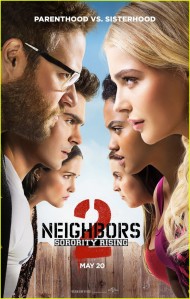 The first Neighbors was a pleasant surprise, a gross-out comedy with heart, cross-generational appeal, and a surprising degree of sincere attention to round out its cast and supporting characters. For my money it was a comedy that checked all the boxes. Now two years later comes a sequel that looks to repeat just about all the plot mechanics of the first except with a sorority replacing the fraternity. It looks like it’s checking the standard more-of-the-same sequel boxes. I was again pleasantly surprised, especially how little Neighbors 2 repeated the comic setups and jokes of the original (the malignant comedy disease known as Austin Powers Sequel Syndrome) and how much I still enjoyed these characters. Seth Rogen and Rose Byrne are now expecting their second child and trying to sell their house. They have to pass a 30-day escrow period without their buyers rescinding their purchase. That’s when Chloe Grace Moritz transforms the next door home into an off-campus sorority. She’s appalled at the gross and derogatory nature of fraternity-hosted parties and an unfairly arbitrary rule that sororities can’t host parties. She and a couple one-note stock fiends throw a female-friendly party house (Feminist Icon parties and bawling your eyes out to The Fault in Our Stars) where they won’t cotton to uncheck male ego. I was laughing throughout the movie with some big laughs at key points. Rogen and Byrne maintain a wonderful comic dynamic and the warring generations premise can still produce plenty of entertaining set pieces. The jokes can be sly and come at you from different angles, taking you be surprise (a “bun in the oven” joke had me almost spit out my drink). There are some things that don’t quite work, mostly how listless and self-involved the female coeds come across and some of their hollow arguments in the name of feminism. I guess equality does mean that women can behave as badly as men. Neighbors 2 replaces a bit of the heart of the first film with an excess of slapstick. There’s also a weird corporate synergistic tie-in with Minions that never quite settles. Still, Neighbors 2 is a satisfying sequel that reminds you what you enjoyed about the first film while not being indebted to what made it succeed.
Nate’s Grade: B
Share this:

Captain America: Civil War (2016)
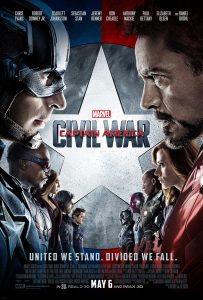 Think you were disappointed by last summer’s Avengers: Age of Ultron? The pressure-packed experience broke writer/director Joss Whedon who swore off being the creative shepherd of the Marvel cinematic Universe (MCU). Enter the Russo brothers, a pair who were widely known for their work in eclectic TV comedies like Community and Arrested Development before blowing away all modest expectations with 2014’s Captain America: Winter Soldier. I can say that the Russos are more than capable for the challenge. My simplistic blurb for Captain America: Civil War is thus: everything Batman vs. Superman did wrong this movie does right.
After the cataclysmic events of multiple movie climaxes, the world governments are wary of the power wielded by the Avengers. Secretary Ross (William Hurt, the lone returning element from 2008’s Incredible Hulk) is pushing the superheroes to sign the Sokovia Accords, which would put them under the control of a U.N. joint panel. This panel would decide when and where to deploy the Avengers. Captain America, a.k.a. Steve Rogers (Chris Evans), is worried about a group of people taking away their choice. Iron Man, a.k.a. Tony Stark (Robert Downey Jr.), believes that they need to accept limitations and that agreeing to these terms staves off something worse later. This division becomes even more pronounced when Rogers’ old friend the Winter Soldier, a.k.a. Bucky Barnes (Sebastian Stan), reappears as the chief suspect in a U.N. bombing. Black Panther, a.k.a. T’Challa (Chadwick Boseman), swears vengeance against Barnes for the bombing. As the assembly of heroes squares off over the fate of the Winter Soldier, Baron Zemo (Daniel Bruhl) is tracking down classified Hydra documents to uncover pertinent information that will topple an empire.
 While I don’t want to turn every new film review as an opportunity to beat a dead horse, I cannot help but draw immediate and stark comparisons between Civil War and the earlier titanic superhero slugfest, Batman vs. Superman: Dawn of Justice. Let’s take this case point by point so there is no reasonable doubt left for the jury of ticket-buyers.
“Batman vs. Superman doesn’t set up its conflicts with enough time to develop them and it lacks real emotional stakes.”
With BvS (I’m saving my fingertips some drudgery), we hadn’t known these characters for more than one movie at best, and in the case of Bruce Wayne less than one. When they fought there wasn’t any real stakes despite the apoplectic marketing because we hadn’t built relationships with these characters. In the case of Henry Cavill’s Superman, many were turned off entirely by the guy (not necessarily by Cavill’s physique, though). Did anyone really care who won? The filmmakers relied on the audience to supply their pop-culture good will for the characters instead of proper characterization and development. In the case of Civil War, we’re dealing with the cumulative effect of having twelve movies to build up storylines and character relationships. We’re invested in these characters and their friendships, so when they fight it actually does matter. You feel for both sides and multiple characters and the movie does a good job of providing each side a credible motivation. It’s a political thorny issue but it’s kept very streamlined, focusing more on the characters. If the MCU has had one nagging problem throughout its history it has been a dearth of good villains. There’s Loki and… Loki. One solution is to just pit the heroes against each other and this produces as many fist-bumps as winces. My audience was gasping at reveals and twists and turns. They weren’t doing that with BvS. And wouldn’t you know Civil War actually has a climax that’s more than just an increasing series of punches and kicks (though plenty of those are featured); the climax is an emotionally grounded confrontation that cuts to the core of the group. The events of this movie matter and while obviously it can’t follow its divisions to an irrevocable end, I appreciated that not everything is resolved. These storylines and the conflicts between characters will carry onward when we pick up the pieces in 2018.
“Batman vs. Superman is too burdened with setting up an array of other film franchises that it loses badly needed focus and momentum.”
 To be fair, this charge can also be laid at the feet of Age of Ultron, which buckled under the heavy weight of setting up multiple other future movies rather than telling a completely satisfying movie in its own right. Once the franchises gave birth to mega-franchises, the wheels-within-wheels of moneymaking, now the studios require a lot of heavy lifting from our entertainment. They’re investments in futures and if done improperly can easily crumble under the failed execution like the Amazing Spider-Man series (R.I.P. 2012-2014). Miraculously, Civil War finds ways to involve every member of a large ensemble cast into the story in ways that matter. The movie finds small character moments that make them feel better rounded, like Vision (Paul Bettany) and Scarlet Witch (Elizabeth Olsen), and it introduces featured supporting players with great care. Black Panther is a terrific addition and brings a quieter intensity that contrasts nicely with the more colorful characters. Hawkeye (Jeremy Renner) introduces himself and Black Panther curtly says, “I don’t care” and goes back to fighting. Boseman (ageless I tell you!) is smooth and magnetic. Then there’s everyone’s favorite neighborhood Spider-Man (Tom Holland), or whom I’m already referring to my pals as “best Spider-Man.” It’s another incarnation of Peter Parker but the first that feels like an actual teenager, a bundle of adolescent energy and excitement. He’s the voice of the fans and during the big battle he can’t help but gush that he gets to be involved alongside the big names. Spidey’s a fanboy too. He also has a few choice meta one-liners that had me cackling. Holland (The Impossible) makes an immediate impact and, unlike BvS, finds new ways to make us care. I’m genuinely excited for solo Black Panther and Spider-Man adventures with these characters. Even the more traditional villain of Civil War, Baron Zemo, is handled in a way that provides an emotional motivation for his character that is sincere rather than mustache-twirling villainy. In a lot of ways this feels like a third Avengers film just with the size and scope alone. The dozen characters are juggled skillfully but the emphasis is always on Rogers and Stark and their significant personal conflicts.
“Batman vs. Superman’s action sequences are repetitive, joyless, and dank.”
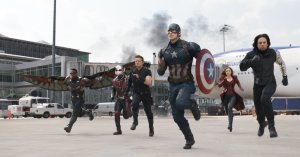
I challenge some enterprising soul to even try and decipher what is happening during the climactic three-on-one monster battle in BvS. I was sitting in the theater and just gave up. I wasn’t having any fun and I couldn’t even literally tell what was happening onscreen with all the confusing CGI obfuscation. The action droned on and on with little variation and was at pains to include certain members and storylines (Lois, maybe don’t get so hasty with that kryptonite spear). It was all just one big overwrought mess that made you question whether anybody on that film production actually liked these superheroes. With Civil War, the action sequences are smartly conceived and choreographed, making excellent use of geography and adding organic complications. The standout is the 20-minute superhero-on-superhero brawl at the Leipzig airport. It is nothing short of nerd nirvana. The characters use their powers together in exciting ways and it further helps them feel like an actual team taking proper advantage of their resources. It’s the culmination of a child’s imagination at play, the living embodiment of smashing action figures against one another and flying around the room. I was thrilled that the Russo brothers found ways to incorporate all the heroes into the action. The specific powers are taken advantage of in fun and surprising ways. The action changes as the stakes keep getting more complicated as more heroes enter the fray. It’s a set piece that will become legendary within film geek circles and it provides payoff after glorious payoff.
“Batman vs. Superman is devoid of all fun and takes itself far too seriously. You feel beaten down, exhausted, and punished by film’s end.”
 The Marvel movies have earned a reputation for their brisk and breezy nature, which has unfairly been labeled as “weightless” and “silly.” I challenge someone to watch Civil War and tell me just how weightless and silly it is. The Russo brothers and the screenwriters take these characters seriously and their care shows. While there can be plenty of rapid-fire quips and one-liners, the movie’s sense of humor does not detract from the emotional weight of its dramatic shifts. There are political and thematic overtones, mostly the costs of vengeance and culpability, that provide extra depth to the onscreen derring-do. However, Civil War understands that an audience wants to be entertained as well with their heavy-handed messianic imagery. There are payoffs galore in this movie. Some are several movies deep from set up. It all comes together to make a thrilling and highly enjoyable movie experience that plays to its audience in the best way possible. It’s an expert summer blockbuster that packs its own punch. There’s a reason I have already seen Civil War three times already. There is so much to enjoy and it’s so tightly packed and structured that you can jump right in and go for the ride. This is the movie fans were hoping for. This is the movie that washes out the bad taste of the dreadful BvS. If one of my lasting disappointments with BvS was how it made me lose hope for future DC movies, Civil War has cemented my anticipation. The future creative direction of the MCU is in good hands with the Russo brothers. This is the movie that reminds you just how damn good superhero movies can be when they’re at the top of their game. I’d place Civil War right up there at the top of the MCU, though at this time I’m still holding Guardians of the Galaxy as the apex. They’re still achieving this high level of quality after a dozen movies, people. I would not have thought that Captain America would become the gold standard of the MCU but there it is. I felt beaten down by the merciless end of BvS. I felt the elation of an adrenaline-rush from Civil War.
I’ll conclude this unorthodox film review with my in-summary blurb: everything Batman vs. Superman did wrong Captain America: Civil War does right. Do yourself a favor and start the healing process from BvS and enjoy Marvel’s latest cinematic gift to its fans.
Nate’s Grade: A
Share this:

10 Cloverfield Lane (2016)
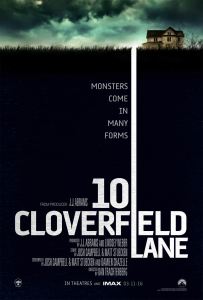 The mysterious sequel to the 2008 found footage monster movie sprung from nowhere, surreptitiously filmed without the general public having any idea of its connection to Cloverfield until mere weeks before its release. It’s the equivalent of a modern-day publicity magic act, something that J.J. Abrams is known for with his crusade against spoilers. The biggest surprise about 10 Cloverfield Lane is that the best parts of a slick and suspenseful movie are the parts that have nothing to do with Cloverfield. The majority of the film’s first two acts take place entirely in a bunker with one possibly disturbed individual played by a terrifically unsettled John Goodman. The unease and dread build nicely and the reveals are paced out in a clever manner to make us second-guess and second-guess our second-guesses. There’s a great moment during an awkward game of charades where Goodman’s character can’t conceive of calling a woman by the term “woman,” instead relying upon patronizing terms like “girl” or “princess.” There’s a darkness and a fury under the surface that should remind of Goodman’s expert turn in Barton Fink. This is a finely suspenseful and mysterious chamber piece until we leave the bunker and the movie officially connects into the Cloverfield universe. It’s a little sloppy and makes for a tonally inconsistent finale. It’s not enough to ruin the movie by any means but it certainly lessens the smartly constructed suspense and paranoia. Mary Elizabeth Winstead (Scott Pilgrim vs. the World) makes for an effective survival thriller heroine, and her line reading of “Oh come on” is a divine highlight. As a Cloverfield movie, this opens up the space for a wider variety of humans vs. monsters stories, but as a movie, it plays at peak performance when it follows its own lead.
Nate’s Grade: B
Share this:

Batman vs. Superman: Dawn of Justice (2016)
 Batman and Superman have been a collision course for a while. The two most famous superheroes were once scheduled to combat in 2003. Then the budget got a tad too high for Warner Brothers’ liking and it was scrapped. Flash forward a decade and now it seems that money is no longer a stumbling point, especially as Batman vs. Superman: Dawn of Justice cost an estimated $250 million dollars. I wasn’t a fan of director Zack Snyder’s first take on Superman, 2013’s Man of Steel, so I was tremendously wary when he was already tapped to direct its follow-up, as well as the inevitable follow-up follow-up with 2017’s Justice League. You see DC has epic plans to create its own universe of interlocked comics franchises patterned after Marvel’s runaway success. Instead of building to the super team-up, they’re starting with it and hoping one movie can kick off possibly half a dozen franchises. There’s a lot at stake here for a lot of people. That’s what make the end results all the more truly shocking. Batman vs. Superman isn’t just a bad movie, and I never thought I’d type these words, it’s worse than Batman and Robin.
Eighteen months after the cataclysmic events of Man of Steel, Metropolis is rebuilding and has an uneasy relationship with its alien visitor, Superman (Henry Cavill). Billionaire Bruce Wayne (Ben Affleck) is convinced that an all-powerful alien is a threat to mankind, especially in the wake of the dead and injured in Metropolis. But how does man kill a god? Enter additional billionaire Lex Luthor (Jessie Eisenberg) and his acquisition of a giant hunk of kryptonite. Bruce runs into a mysterious woman (Gail Gadot a.k.a. Wonder Woman) also looking into the secrets held within Luthor’s vaults. Clark Kent is pressing Wayne for comment on this bat vigilante trampling on civil liberties in nearby Gotham City, and Wayne is annoyed at the news media’s fawning treatment over an unchecked all-powerful alien. The U.S. Senate is holding hearings on what responsibilities should be applied to Superman. Lois Lane (Amy Adams) is worried that her boyfriend is getting too caught up in the wrong things. Lex Luthor is scheming in the shadows to set up one final confrontation that will eliminate either Batman or Superman, and if that doesn’t work he’s got a backup plan that could spell their doom.
 I think it’s only fitting to tackle each of the particular heavyweights in this huge showdown and devote time to dressing down why exactly the movie fails them.
Let’s start with Batman because quite frankly he’s the character that the American culture prefers (his name even comes first in the title for a Superman sequel). Ben Affleck (Gone Girl) was at the bad end of unrelenting Internet fanboy-fueled scorn when the news came out that he was going to play the Caped Crusader, but he’s one of the best parts of this movie, or perhaps the better phrasing would be one of the least bad parts. He’s a much better Bruce Wayne than Batman but we don’t really get much of either in this movie from a character standpoint. There isn’t much room for character development of any sort with a plot as busy and incomprehensible as Batman vs. Superman, and so the movie often just relies upon the outsized symbolism of its mythic characters. We have a Batman who is Tough and Dark and Traumatized and looking for (Vigilante) Justice. We only really get a handful of scenes with Batman in action, and while there’s a certain entertainment factor to watching an older, more brutal Batman who has clearly given up the whole ethical resolve to avoid killing the bad guys, under Snyder’s attention, the character is lost in the action. The opening credits once again explain Batman’s origin story, a tale that should be burned into the consciousness of every consumer. We don’t need it, yet Snyder feels indebted to what he thinks a Batman movie requires. So he’s gruff, and single-minded, and angry, but he’s never complex and often he’s crudely rendered into the Sad Man Lashing Out. He’s coming to the end of his career in tights and he knows it, and he’s thinking about his ultimate legacy. That’s a great starting point that the multitude of live-action Batman cinema has yet to explore, but that vulnerability is replaced with resoluteness. He’s determined to kill Superman because Superman is dangerous, and also I guess because the Metropolis collateral damage crushed a security officer’s legs, a guy he’s never met before. The destructive orgy of Metropolis is an excellent starting point to explain Bruce Wayne’s fear and fury. I don’t know then why the movie treats Wayne as an extremist. I don’t really understand why there’s a memorial for the thousands who lost their lives in the Metropolis brawl that includes a statue of Superman. Isn’t that akin to the Vietnam Wall erecting a giant statue of a Vietcong soldier stabbing an American GI with a bayonet? This may be the most boring Batman has ever been onscreen, and I repeat, Ben Affleck is easily one of the best parts of this woefully begotten mess.
Next let’s look at the other titular superhero of the title, the Boy Scout in blue, Superman. The power of Superman lies with his earnest idealism, a factor that has always made him a tougher sell than the gloomy Batman. With Man of Steel, Warner Brothers tried making Superman more like Batman, which meant he was darker, mopey, theoretically more grounded, and adopted the same spirit of being crushed by the weight of expectations and being unable to meet them. Cavill (The Man from U.N.C.L.E.) was a Superman who didn’t want to be Superman, where dear old Pa Kent advocated letting children drown rather than revealing his powers (Father’s Day must have been real awkward in the Kent household). It wasn’t a great step and I wrote extensively about it with Man of Steel. The problem is that Superman and Batman are supposed to be contradictory and not complimentary figures. If one is brooding and the other is slightly more brooding, that doesn’t exactly create a lot of personal and philosophical conflicts now does it? It clearly feels that Snyder and everybody really wanted to make a Batman movie and Superman just tagged along. Superman clearly doesn’t even want to be Superman in the Superman sequel, often looking at saving others with a sigh-inducing sense of duty. He’s still working as a journalist and making moral arguments about the role of the media, which seems like a really lost storyline considering the emphasis on blood and destruction. He wants Superman to be seen as a force of good even if others deify him. That’s a powerfully interesting angle that’s merely given lip service, the concept of what Superman’s impact has on theology and mankind’s relationship to the universe and its sense of self. Imagine the tectonic shifts acknowledging not only are we not alone but we are the inferior race. We get a slew of truly surprising cameos for a superhero movie arguing this debate (Andrew Sullivan?) but then like most else it’s dropped. Clark is trying to reconcile his place in the world but he’s really just another plot device, this time a one-man investigation into this bat vigilante guy. The other problem with a Batman v. Superman showdown is that Superman is obviously the superior and would have to hold back to make it thrilling. We already know this Superman isn’t exactly timid about killing. The climax hinges on a Batman/Superman connection that feels so trite as to be comical, and yet Snyder and company don’t trust the audience enough to even piece that together and resort to a reconfirming flashback.
 Arguably the most problematic area of a movie overwhelmed with problems and eyesores, Eisenberg’s (Now You See Me) version of Lex Luthor is a complete non-starter. He is essentially playing his Mark Zuckerberg character but with all the social tics cranked higher. His socially awkward mad genius character feels like he’s been patched in from a different movie (Snyder’s Social Network?) and his motivation is kept murky. Why does he want to pit Batman and Superman against each other? It seems he has something of a god complex because of a nasty father. He is just substantially disappointing as a character, and his final scheme, complete with the use of an egg timer for wicked purposes, is so hokey that it made me wince. If you’re going with this approach for Lex then embrace it and make it make sense. Late in the movie, Lex Luthor comes across a treasure-trove of invaluable information, and yet he does nothing substantive with this except create a monster that needs a super team-up to take down (this plot point was already spoiled by the film’s marketing department, so I don’t feel guilty about referring to it). If you’re working with crafty Lex, he doesn’t just gain leverage and instantly attack. This is a guy who should be intricately plotting as if he was the John Doe killer in Seven. This is a guy who uses his intelligence to bend others to his will. This Lex Luthor throws around his ego, nattering social skills, and force-feeds people Jolly Ranchers. This is simply a colossal miscalculation that’s badly executed from the second he steps onscreen. The movie ends up being a 150-minute origin story for how Lex Luthor loses his hair.
The one character that somewhat works is Wonder Woman and this may be entirely due to the fact that her character is in the movie for approximately twenty minutes. Like Lois, she has little bearing on the overall plot, but at least she gets to punch things. I was skeptical of Gadot (Triple 9) when she was hired for the role that should have gone to her Furious 6 co-star, Gina Carano (Deadpool). She didn’t exactly impress me but I’ll admit I dropped much of my skepticism. I’m interested in a Wonder Woman movie, especially if, as reported, the majority is set during World War I. There is a definite thrill of seeing the character in action for the first time, even if she’s bathed in Snyder’s desaturated color-corrected palate of gloom. Realistically, Wonder Woman is here to introduce her franchise, to setup the Justice League movies, and as a tether to the other meta-humans who each have a solo film project on the calendar for the next four years. Wonder Woman gets to play coy and mysterious and then extremely capable and fierce during the finale. One of the movie’s biggest moments of enjoyment for me was when Wonder Woman takes a punch and her response is to smile. I look forward to seeing more of her in action and I hope the good vibes I have with the character, and Gadot, carry onward.
 The last act of this movie is Snyder pummeling the audience into submission, and it’s here where I just gave up and waited for the cinematic torment to cease. The action up to this point had been rather mediocre, save for that one Batman fight, and I think with each additional movie I’m coming to the conclusion that Snyder is a first-class visual stylist but a terrible action director. The story has lacked greater psychological insights or well-rounded characters, so it’s no surprise that the final act is meant to be the gladiatorial combat Lex has hyped, the epic showdown between gods. In essence, superheroes have taken a mythic property in our pop-culture, and Batman and Superman are our modern Mt. Olympus stalwarts. This showdown should be everything. The operatic heaviness of the battle at least matches with the overwrought tone of the entire movie. It’s too bad then that the titular bout between Batman and Superman lasts a whole ten minutes long. That’s it, folks, because then they have to forget their differences to tackle a larger enemy, the exact outcome that every single human being on the planet anticipated. I’m not even upset that the film ends in this direction, as it was fated. What I am upset about is a climax that feels less than satisfyingly climactic and more like punishment, as well as a conclusion that no single human being on the planet will believe. Snyder’s visual style can be an assault on the senses but what it really does is break you down. The end fight is an incoherent visual mess with the screen often a Where’s Waldo? pastiche of electricity, debris, smoke, fire, explosions, and an assortment of other elements. It’s a thick soup of CGI muck that pays no mind to geography or pacing. It’s like Michael Bay got drunk on Michael Bay-filmmaking. What the hell is the point of filming this movie in IMAX when the visual sequences are either too hard to decipher or something unworthy of the IMAX treatment? Do we need an entire close-up of a shell hitting the ground in glorious IMAX? The Doomsday character looks like a big grey baby before he grows his spikes. I was shocked at how bad the special effects looked for a movie that cost this much money, as if ILM or WETA said, “Good enough.” Once it was all over, I sat and reflected and I think even Snyder’s Sucker Punch had better action.
Another problem is that there are just way too many moments that don’t belong in a 150-minute movie. There’s an entire contrivance of Lois disposing of a valuable tool and then having to go back and retrieve it that made me roll my eyes furiously. It’s an inept way of keeping Lois involved in the action. How does Lois even know the relevancy of this weapon against its new enemy? Then there’s her rescue, which means that even when the movie shoehorns Lois into the action to make her relevant, she still manages to become a damsel in needing of saving. She feels shoehorned in general with the screenplay, zipping from location to location really as a means of uncovering exposition. Then there’s the fact that there is a staggering THREE superfluous dream sequences, and we actually get a flashback to one of those dumb dream sequences. The most extended dream sequence is a nightmarish apocalyptic world where Batman rebels against a world overrun by Superman and his thugs. There’s a strange warning that comes with this extended sequence of future action but it doesn’t involve this movie. Batman vs. Superman suffers from the same sense of over-extension that plagued Age of Ultron. It’s trying to set up so many more movies and potential franchises that it gets lost trying to simply make a good movie rather than Step One in a ten-step film release. In the age of super franchises that are intertwined with super monetary investments, these pilot movies feel more like delivery systems than rewarding storytelling. Payoffs are sacrificed for the promise of future payoffs, and frankly DC hasn’t earned the benefit of the doubt here.
 I must return to my central, headline-grabbing statement and explain how Batman vs. Superman is a worse movie than the infamous Batman and Robin. I understand how loaded that declaration is so allow me to unpack it. This is a bad movie, and with that I have no doubt. It’s plodding, incoherent, tiresome, dreary, poorly developed, and so self-serious and overwrought to the point that every ounce of fun is relinquished. It feels more like punishment than entertainment, a joyless 150-minute exercise in product launching. By the end of the movie I sat in my chair, defeated and weary. Here is the most insidious part. Batman vs. Superman: Dawn of Justice obliterates any hope I had for the larger DC universe, let alone building anything on par with what Marvel has put together. If this is the direction they’re going, the style, the tone, then I don’t see how any of these will work. What’s to like here? “Fun” is not a dirty word. Fun does not mean insubstantial nor does it mean that larger pathos is mitigated. If you’re going to have a movie about Batman and Superman duking it out, it better damn well be entertaining, and yes fun. It’s not a Lars von Trier movie. The Marvel movies are knocked for not being serious, but they take their worlds and characters seriously enough. They don’t need to treat everything like a funeral dirge, which is what Batman vs. Superman feels like (it even opens and closes on funerals). This movie confirms all the worst impulses that Man of Steel began, and because it gutted all hope I have for the future of these oncoming superhero flicks, I can’t help but lower its final grade. Batman and Robin almost killed its franchise but it was in decline at the time. As campy and innocuous as it was, Batman vs. Superman goes all the way in the other direction to the extreme, leaving a lumbering movie that consumes your hopes. The novelty of the premise and seeing its famous characters standing side-by-side will be enough for some audience members. For everyone else, commence mourning.
Nate’s Grade: D
Share this:

London Has Fallen (2016)
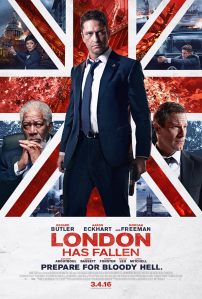 Years after the events from Olympus Has Fallen, Secret Service agent Mike Banner (Gerard Butler) is escorting President Asher (Aaron Eckhart) to London to attend a funeral. It’s there where chaos strikes and Muslim terrorists, disguised as British agents and local police, unleash a series of attacks and explosions throughout the city. Mike is able to rescue the president but the two are essentially in enemy territory looking for an escape, and the terrorists have seized London and plan on executing President Asher live on the Internet for his drone strikes in the Middle East.
The first mission for an action movie is to entertain with its action sequences, and it is here where London Has Fallen falls. The budget has been reported as high as $100 million dollars, and if this is true it may be the biggest waste of $100 million dollars I’ve ever seen on film. The movie just looks cheap. The locations (Bulgaria often doubling for London) look too vague and interchangeable with empty streets. Also, for a city that has over ten million inhabitants, why are these streets so empty? There were people milling about outdoors after 9/11, and the president wasn’t rumored to be somewhere on the streets in that scenario. Another sign of the movie’s cheapness: I’m certain that the shots of the emergency vehicles in London were stock footage. Now this wouldn’t be the first film to pad its establishment scenes with purchasable B-roll footage, but the offense is simply how poorly the movie is at hiding this fact. The footage is clearly from a lower video/film quality and not referenced as a media perspective, so the quality of the movie will suddenly drop for a brief few seconds to watch a cadre of ambulances race off. But back to these lackluster action sequences. There are very few variations on the standard run-and-shoot variety with little regards to geography. The initial escape from the first attack has some sizzle but it devolves into a series of chases and stands being made in small locations. The final assault on the bad guy’s compound unfolds as a tracking shot to kick things off and it’s here that you get a full sense of the movie’s limited ambitions. The action isn’t accelerated or given a visceral kick from the long take; it’s just guys shooting off screen, walking, shooting, with the occasional explosion. There’s no added benefit from the tracking shot, and yet somebody must have thought it would be so cool to do so and patted themself on the back.
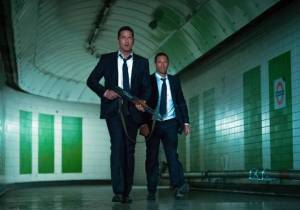 Another issue is that Butler’s character is nearly indestructible and without any vulnerability. Olympus Has Fallen didn’t wow me but it hewed closed to the Die Hard plot points and that’s a great formula to model your action movie after. In that scenario, Mike Banning was outnumbered and had to rely upon his stealth to be most effective. In the sequel, Mike has to protect the president but it’s really just the story of two buds running from place to place, having the occasional chat, and then Mike easily murdering any slew of bad guys, then repeat until the climax. It doesn’t make use of locations enough to cast out the sinking feeling of redundancy. Repetitive action sequences rely upon the concept of “more is better” when what we really demand is “more but different.” The best action movies are the ones where each sequence can stand on its own, push the story forward, makes smart use of its geography, and develops organically. There just aren’t enough of these in London Has Fallen. Our lead character is boring because he is never seen in a vulnerable position. He is told how outnumbered he is and his quippy reply is a trailer-ready line: “You should have brought more men.” This guy doesn’t sweat and only growls and stabs (lots of stabbing in this) and the R-rated violence does little to give this man anything resembling a personality. Mike is a dullard, and his personal arc of whether or not he’ll turn in his resignation from the Secret Service is one of the least believable moments of indecision you’ll ever witness. Gee, I wonder if Stabby McLoves to Stab is going to step away from his stab-heavy vocation.
With the action failing, it becomes even more apparent, and shockingly so, just how unpleasantly xenophobic and grotesque the movie’s overall political message becomes, so much so that you’d have to imagine a contingent of Trump supporters watching with baited breath and cheering mindlessly. It’s not uncommon for the bad guys in Hollywood action films to be darker-hued foreigners, so that wasn’t exactly something shocking, and the movie opens with a stab at creating a legitimate and politically pertinent grievance, a drone strike with unexpected collateral damage that obliterates a wedding party. The bad guys here have a cause that at least goes beyond blind ideology, though perhaps vengeance is actually a lesser motivation than something larger akin to ideology. They aren’t really fleshed out beyond this simple concept of vengeance or given anything larger to play with because they’re simply just villainous cardboard cutouts. And yet, most of this is expected with the territory of a typical action thriller. It’s when London Has Fallen decides to go the extra ugly mile when the movie starts becoming something far more unseemly and uncomfortable. I’m not expecting the most culturally nuanced portrayal of geo-politics, but this movie is practically a campaign ad for anti-Muslim nationalism. Our hero brutally stabs a nondescript bad guy and definitely enjoys inflicting pain. He kills another guy while screaming, “Go back to Fuckheadistan” (note to the geographically challenged: not a real standing nation as of this writing). Then it’s not enough that our hero is beating our secondary villain, he also has to deliver a speech about America’s standing and just what these pesky terrorists will never understand: “100 years later, we’ll still be here, and you’ll be dead.” What highlights these moments is that there aren’t any other political aspects in this movie, even a scant dismissive comment on something like gun control, so it feels like London Has Fallen has purposely chosen to highlight this anger and distrust of foreigners with its hero. It comes across like giving voice and credence to your crackpot uncle who, naturally, is voting for Trump to sweep them illegals and dusky-faced folk from the borders of ‘Merica.
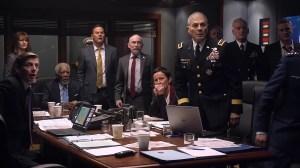 There’s an ongoing subplot in London Has Fallen that answers the question of how many Oscar nominees can you cram into a room and waste their talents. The answer, it would appear, is four, folks. Interspersed between Mike and the president on the run is Vice President Morgan Freeman (yes he has a character name but it’s really VP Morgan Freeman) deliberating in the White House with the assembled cabinet. There’s Melissa Leo (The Fighter) returning as the Secretary of Defense, Robert Forster (Jackie Brown) as a general, and Jackie Earl Haley (Little Children) as DC… something. Every time the movie has to cut back to this room full of wasted talent you’re reminded just how sad this movie is becoming. These characters don’t even have any larger bearing on the plot or any agency into the ongoing conflicts. Instead they are presented as exposition devices and reaction shots. These are some terrific thespians, including two Oscar winners, and here they are barking exposition or delivering forlorn reaction shots. We have four Oscar nominees and they’re stuck in a room, looking horrified into the camera lens, and slowly uttering lines like, “My God.” I do not begrudge actors taking paycheck roles (everybody’s got bills to pay) but this entire scenario is just an insulting waste of time.
Nobody is going to argue that Olympus Has Fallen was one of the greater works of cinema but it was a mildly enjoyable action thriller that was diverting enough to remind its rowdy audience of the Cannon genre films of the 80s. It was bloody, brutal, and fitfully entertaining (my preference was the other 2013-Die–Hard-in-a-White-House flick, White House Down). It was good enough, mostly because it hugged Die Hard closely and repeated the same plot mechanics to success. Now on its own, the sequel has to manufacture its own plotline and it doesn’t fare as well. Director Antoine Fuqua didn’t want to return for the sequel after reading the script, and this is a guy who made King Arthur and Shooter. Shooter, people! His replacement is an Iranian-born filmmaker, which just adds another level of questions for the finished product, and make no mistake, London Has Fallen is just that – product. It’s not really meant to be savored or enjoyed so much as it is processed and consumed and forgotten. The action doesn’t work well and is poorly orchestrated, often repetitive, the characters are boring, the villains are one-note, the capable actors are wasted, the overt political messages that continuously emerge are ugly and pointedly xenophobic, and the end even turns a drone strike, the same tool we saw wipe out an innocent wedding gathering to open the movie, into a crowd-pleasing climactic moment of payback. London Has Fallen is a misguided nationalistic action movie and then some.
Nate’s Grade: C-
Share this:

Joe Dirt 2: Beautiful Loser (2015)
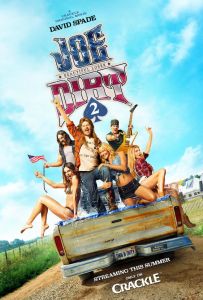 How bad does bad get? That’s the question with Joe Dirt 2: Beautiful Loser, a sequel 14 years in the making to a one-joke character from an actor now in his 50s. It’s so bad that this movie is a Crackle original, a streaming service that I don’t think people know exists. You can feel every degree of sad desperation while you watch. There are so many scenes that just seem to prattle on indefinitely, varying from one or two angles, as if they only had time to film one take and kept encouraging their actors to just keep throwing things out there in the misplaced hope that somehow somebody would strike gold. It does not happen once. David Spade returns and he’s whisked away Wizard of Oz-style into the past where he watches his beloved girlfriend choose his rival (Mark McGrath) over him. It’s a weird Back to the Future Part 2 alternative timeline and one where McGrath also plays his character’s father in an inexplicable scene where he allows his family to unknowingly jerk him off. I hope that last sentence begins to reveal the true depths of comic despair that is Joe Dirt 2. It’s not that it’s powerfully unfunny, it’s not that the plot is completely inconsequential, it’s not that the jokes end up being weird pop-culture references dating back to the 90s (Buffalo Bill in 2015?), it’s not that Spade looks like he’s fulfilling some deal with the devil, it’s not that the movie has no purpose and no reason to exist, it’s that Joe Dirt 2: Beautiful Loser is like a communal funeral. You watch it and you mourn; for those involved and for your lost time. If you can find a more pointless, depressing, past-its-prime sequel, then I think the seventh seal has been opened, spelling the doom of mankind. I figured Adam Sandler would be responsible somehow.
Nate’s Grade: F
Share this:

The Human Centipede 3 (2015)
 Sometimes as a critic I seek out the worst of the worst so you don’t have to, America. And you really owe me big time for sitting through all 100 torturous minutes of the regretful-in-every-aspect horror… “comedy,” Human Centipede 3: Final Sequence. I’ll confess that horror is a genre I’ve grown to enjoy and I genuinely liked the first Centipede film, finding its premise near ingenious and that writer/director Tom Six developed his horror grotesquerie in a way that turned it into an accessible survival thriller with some gonzo edges. The sequel was pretty repulsive and the third film, with the hopeful promise of being the “final sequence,” is even worse. This is a horrifying endurance test not unlike Tom Green’s abysmal lone directorial affront, Freddy Got Fingered. It is that bad. Scenes just seem to go on and on and exist for no purpose. It’s like Dieter Laser was just told to do whatever he wanted as long as he yelled as loud as he could and based his performance after the Looney Tunes cast. It’s cheap vulgarity masquerading as edgy provocation; it’s transparently lazy and insufferable. It’s not funny no matter how weird or loud or garish or bloody or dumb it gets. The premise is basically an insane prison warden (Laser) is going to create his own human centipede, the biggest ever, linking over 100 inmates. Ignoring the escalation of all the Centipede sequels, it’s a facile plot device and it doesn’t even happen until the very end. Until that awful reveal, you will have to endure, no a better word is survive, extended “comedy” bits like Laser sticking his tongue out and roaring in orgasm while his secretary (Bree Olsen) is forced to felate him while others are in the room. The movie is trying so hard to be shocking and irreverent that you can see all the pained efforts. It’s tedious and boring. Human Centipede 3 is 100 minutes of pathetic flop sweat that could more or less end with the throwaway punchline, “The Aristocrats!”
Nate’s Grade: F
Share this:

Star Wars: The Force Awakens (2015)
 May 19,1999 is a day that lives in infamy for legions of Star Wars fans. The day hoped died. I remember trying to convince myself that The Phantom Menace was good but a second viewing confirmed my earlier fears. These movies were not going to be the same as the original trilogy, and George Lucas confirmed that with each successive release. I’ve had debates with teenagers who swear that the prequels are better films. They aren’t. This isn’t a matter of opinion; this is fact. After Revenge of the Sith was released in 2005, you could sense that Lucas was burned out and had no desire to further awaken the ire of the fandom. Then in 2012 he surprised everyone by selling the Star Wars empire, along with other properties like Indiana Jones, to Disney for four billion dollars. Immediately Disney let it be known that they wanted to get new Star Wars movies into production ASAP. They tapped J.J. Abrams to spearhead the first steps in a new direction. No other movie has felt the weight of hype and expectation like Episode VII: The Force Awakens. Fans don’t want to be hurt once more by someone they loved. For millions of fans that grew up on the original trilogy, The Force Awakens will be the Star Wars movie they have long been waiting for. It erases the bad feelings of the prequels and re-calibrates the franchise. However, it is also flawed and seems too indebted to nostalgia. It’s certainly good but I cannot put away my nagging reservations (far, far less than what I felt with the prequels).
Thirty years after the events of Return of the Jedi, the First Order has risen in place of the evil Empire. The First Order is lead by General Hux (Domhnall Gleeson) and aspiring sith lord Kylo Ren (Adam Driver). They’re searching for the droid BB-8 and its owner, Resistance pilot Poe Dameron (Oscar Isaac). The droid has a map that leads to the whereabouts of the last known Jedi – Luke Skywalker (Mark Hamil). A Stormtrooper who adopts the name of Finn (John Boyega) runs away from his mission and joins forces with Rey (Daisy Ridley), a scavenger waiting for her family to return to her world. The duo finds BB-8 and seeks to return the droid to the Resistance. They run into Han Solo (Harrison Ford) and Chewbacca (Peter Mayhew) and a few other familiar faces on their journey to the Resistance base and to escape the reach of the First Order.
 Abrams has captured the essential magic of what made the original trilogy so enjoyable and timeless. The prequels carried the burden of setting up characters we had come to love, and so as we watched younger versions of them or characters integral to their development, it was hard to ignore just how little we cared. It didn’t feel like Lucas himself cared that much, more content to direct his green screens than his actors. The special effects had improved but for much of the three prequels it felt like watching disinterested actors recite poorly written lines while they run around fake environments with no semblance of reality. The details that Lucas emphasized were ones that were unnecessary, like treaties and trade tariffs and the notorious midichlorians, which made the force into a blood disorder. The prequels harmed the legacy of the franchise. It takes only seconds for you to feel like you’re in better hands when you read the opening text crawl. No trade disputes. No galactic senate. It sets up its central chase and the important players in three brief paragraphs. And then we’re off and the movie rarely lets up.
We pass the torch to a new generation of characters and it’s here that Force Awakens is able to leave the large shadow of the original trilogy. The characters are great. Finn gives the viewer an entry point into a world we’ve never explored onscreen in any real depth, the life of a Stormtrooper, the cannon fodder of the series. He has moral crises and goes AWOL from the duties he has been raised to do. He doesn’t want to be a mindless killing-machine and forges his own destiny. Watching him embrace a sense of individuality is entertaining. He’s charming and excitable but also fearful of what may catch up to him. Then there’s the hero’s journey with Rey, a plucky heroine who comes of age over the course of the movie’s 135 minutes. Ridley has the presence and poise reminiscent of Keira Knightley, and the screen just adores her. It also helps when her character is easy to root for. Boyega (Attack the Block) and Ridley are terrific and even better paired together. They have a great chemistry and much of the humor is born from the characters rather than lame visual gags like in the prequels. It’s fun to hear characters verbally spar with actual good dialogue. Driver was the first actor hired and it’s easy to see why. If you’ve been watching the man on HBO’s Girls, you’ll know that he has a magnetic presence that separates him from the herd. He plays a villain that so badly wants to follow in Vader’s footsteps but the thing that holds him back is the “temptation of the light.” In one moment, a badass and imposing villain with super force powers had now also become an interesting character wrestling with his influences. Isaac (Ex Machina) is suave and cocksure as an ace pilot. His affection for the other characters is touching, particularly the robot BB-8. This little guy is going to be the toy that every child on Earth demands for the holidays. BB-8 is adorable from its first moment on screen and made me forget about R2D2. The big worry with Force Awakens was that its new characters would be compelling on their own. After one movie I’m looking forward to more adventures with the new kids on the block.
 Abrams has restored the sense of fun and awe that resonated from the original trilogy and the biggest compliment is that Episode VII feels like a Star Wars movie (more on which below). The action sequences are quick and filled with great visuals and shot arrangements. For those worried about Abrams’ penchant for lens flairs in the Star Trek reboots, they are completely absent in Force Awakens (Fun fact: for Star Trek Into Darkness, computer effects had to go in and take out lens flairs because Abrams later admitted he had gone a bit overboard). There are some beautifully orchestrated shots and sequences all around here. The first 40-minutes is the best part of the movie, before the older stars come back for their due. The rest of the film is enjoyable, no doubt, but I was more pleased with the original material. The technical expertise has never been higher. Like Mad Max: Fury Road, there’s a joy with watching characters interact with a real world of practical effects. Watching the characters run around real environments and real sets rather than immense green screens just makes it feel more real and vital. I enjoyed how worn and weathered the technology in this world comes across. The special effects are judiciously utilized and are excellent as anticipated. It’s easy to sense the reverence that Abrams and others have for the series as well as their determination to not repeat the mistakes of the prequels. The first mission for Episode VII is to reset the course, to wash away the bad taste of the prequels that haunt many. Abrams has gone back to what works with these movies and recreated the playbook. It’s a movie that will satisfy the hardcore fans and reawaken their love for the series.
And yet it almost feels like Force Awakens is a swing too far in the other direction, an overcorrection to the prequels that turns a reboot into a loving homage that approaches facsimile. I was amazed at just how closely Episode VII follows the plot beats of A New Hope (mild spoilers to follow – for real, if you don’t want to be spoiled in the slightest, and I’m no monster and won’t dare include anything that would substantially deter your viewing, skip to the spoiler safe area). Here goes: once again we start with an escape from an evil starfleet ship, only to land on a desert planet. The hunt is for a droid with valuable information. Our dispirit band of characters collect on the desert planet and flee, only to be eventually pulled back to the evil base of operations, which once again is a giant floating orb that specializes in planet destruction and this orb seems to have the same pesky design flaw that plagued Death Star 1.0 and 2.0. How does this one design flaw still exist? Are there not backups and redundancies? It would be like Titanic 3.0 going down by hitting another iceberg. There are more parallels involving the characters and personal revelations that mirror Episode IV but I won’t go into detail on those (end of spoilers). Suffice to say, it felt like I was watching a cover act remind me how much I enjoyed the first Star Wars release. Perhaps Abrams felt his rabid audience needed to go backwards before going forward, pay homage to what had been built by practically reliving its plot in a galaxy not so long ago as it once was (it still is likely the same distance: far far away). It’s a movie that cannot escape the nostalgia of its predecessors, and so it indulges it instead. In deferring to fan demands, Force Awakens has moments that waver into the dangerous territory of fan service. This will harm its overall staying power once the glow wears off from audiences overcome with relief.
 Thankfully, the new main characters are compelling and I’ll be happy to follow their continuing adventures with Episodes VIII and IX and who knows. Abrams and company have set up the next generation of fan favorites that have the chance to grow out of the sizable shadow of the original cast. However, not all elements are given that same nurturing care. The Force Awakens is so briskly paced that it rarely has time to establish the new history of its universe. We get character relationships and reunions but I couldn’t help but feel that the larger plot they inhabited felt rushed. The First Order seems rather vague and their rise to power needed at least some explanation. Instead we’re dropped right into a timeline with an Empire knockoff. It’s just easy fascism placeholder. Why are the Republic and the Resistance two separate entities? The villains with the exception of Kylo Ren are pretty one-note and also callbacks to the bad guy types from Episode IV. Captain Phasma (Gwendoline Christie) is in the movie for a lousy three minutes. I’m also not a fan of either of the two motion-capture performances courtesy of Oscar-winner Lupita Nyong’o (12 Years a Slave) and mo-cap pioneer Andy Serkis (Rise of the Planet of the Apes). I hated Nyong’o’s character and her performance. The character design for both of these creatures is rather weak and weirdly unimaginative. There’s also a habit of characters being naturals at things that would ordinarily require expertise. The worlds we visit and the creatures we encounter are all a bit too similar to earlier sources and distinctly unmemorable. We don’t learn much via our locations and geography and so it feels a tad interchangeable and meaningless, which is a shame.
The Force Awakens is a mostly exciting return to the rich world of Star Wars with characters we care about, old and new, lively action that feels substantial and real, and a sense of fun that isn’t at the expense of your full brainpower. Abrams had two missions: 1) eliminate the disappointment over the prequels, and 2) set up new characters and stories for future installments. Both have been accomplished. Abrams may have been the perfect candidate to restart the Star Wars series as he has a history of making films as loving homage to his cinematic influences. Super 8 was Abrams’ homage to Spielberg, and Episode VII is very much homage to Episode IV. The well-trod story allows for the series to reset comfortably while setting up its new characters to take a greater storytelling burden from here on out. I hope future installments give us more development to make the worlds and the history matter just as much as Rey, Finn, Kylo, Poe, and BB-8. This may be an unpopular opinion but I feel that Abrams’ rollicking 2009 Star Trek reboot is a better Star Wars movie than The Force Awakens. Abrams and company prove you can make a new and good Star Wars movie. Now my own new hope is that writer/director Rian Johnson (Looper) will be able to steer the franchise into a fresher direction with Episode VIII. In the meantime, fans can sleep well once again.
Nate’s Grade: B+
Share this:

Creed (2015)
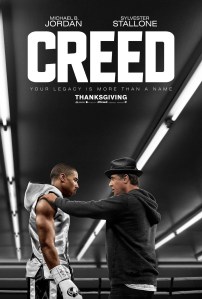 Creed is a crowd-pleaser, an effective character drama, and a rewarding continuation into the Rocky franchise that brings greater relevancy to Sylvester Stallone’s acting muscles. Thanks to the talents of co-writer/director Ryan Coogler (Fruitvale Station) and star Michael B. Jordan, the franchise is given new life by mostly following the same tried-and-true underdog formula that Stallone helped cement long ago. Jordan plays Adonis Creed, the illegitimate son to the deceased boxing legend, and he wants to make his way on his own merits. Adonis tracks Rocky (Stallone) down and convinces him to be his trainer, and the two build a father-son relationship supplying the half the other was sorely missing. From there the plot is fairly predictable as the media discovers Adonis’ identity and he’s fast-tracked for a high-profile bout with the outgoing champ but the movie still hits the right notes to earn its emotional triumph. I was surprised at the careful attention Coogler gave his supporting characters, providing details to round them out and make them feel like legitimate people rather than stock roles. I enjoyed Tessa Thompson (Dear White People) being an actual character rather than an underdeveloped love interest. Coogler’s fluidity with the camera is also striking, and many of the boxing matches are filmed in long tracking shots that amp up the sports verisimilitude. Jordan gives a strongly felt performance that further confirms his star status. The real surprise is Stallone, whose legendary fighter is starting to break down physically. Rocky’s inability to fight an invisible enemy makes for great drama, and Stallone sinks into the meaty dialogue. He has a few genuinely affecting moments, and I didn’t even know Stallone was still capable of that. Easily the best Rocky sequel, Creed is an uplifting underdog tale that doesn’t reinvent the formula but brings added attention, reverence, and sincerity to a whole lot of punching people in the face.
Nate’s Grade: B+


 nathanzoebl
You must be logged in to post a comment.