Blog Archives
Five Nights at Freddy’s 2 (2025)
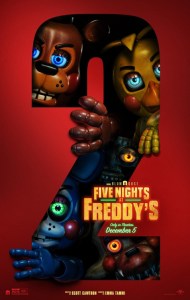 I wasn’t a fan of the original 2023 movie based upon the insanely popular video game series that serves as an entry point into horror for kids. It didn’t work for me but I thought fans of the series would have fun watching the characters come to life in live-action. Now with the sequel, I don’t know anyone that could enjoy this dreck except for the most diehard of the Freddy’s fanbase. I’ve watched the movie and I couldn’t understand it. I read the Wikipedia summary and that didn’t clear it up. So much hinges on so many characters having peculiar responses and relationships to what are… killer animatronics powered by the spirits and literal corpses of murdered children. Why is this pizza parlor even still standing? These robots went on a killing spree in the first movie, and yet this lonely little girl misses her “friends” and runs away to see them again. This isn’t E.T. here, it’s a weird killer robot horror movie that seems to be making up its lore and rules as it goes, like one unending “yes and?’ improv game you’re desperate to tap out from. I guess there’s more killer robots this time, and some unintelligible distinction between the good bad robots and the really bad robots. I don’t know. I gave up trying to comprehend what was happening and felt like maybe I could just try and enjoy the minimal PG-13 scares and tension. The animatronic designs are solid. Wayne Knight (Seinfeld) appears as a villainous robotics teacher. There’s a marionette character that’s kind of sinister to watch. That’s about it, folks. It’s a fairly nonsensical waste of 100 minutes, and unless you’re steeped in the lore and history of the series, you too will wish that this town would just set fire to the whole parlor.
Nate’s Grade: D+
Share this:

Wake Up Dead Man (2025)
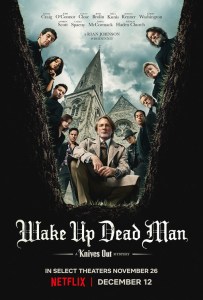 Being the third in its franchise, we now have a familiar idea of what to expect from a Knives Out murder mystery. Writer/director Rian Johnson has a clear love for the whodunit mystery genre but he loves even more turning the genre on its head, finding something new in a staid and traditional style of storytelling. The original 2019 hit movie let us in on the “murderer” early, and it became more of a game of out-thinking the world-class detective, Benoit Blanc (Daniel Craig). With the 2022 sequel Glass Onion, the first of Netflix’s two commissioned sequels for a whopping $400 million, Johnson reinvented the unexpected twin trope and let us investigate a den of tech bro vipers with added juicy dramatic irony. With his latest, Wake Up Dead Man, Johnson is trying something thematically different. Rather than adding a meta twist to ages-old detective tropes, Johnson is putting his film’s emphasis on building out the themes of faith. This is a movie more interested in the questions and value of faith in our modern world. It still has its canny charms and surprises, including some wonderfully daffy physical humor, but Wake Up Dead Man is the most serious and soul-searching of the trilogy thus far, and a movie that hit me where it counts.
In upstate New York, Pastor Jud (Josh O’Connor) has been assigned to a church to help the domineering Jefferson Wicks (Josh Brolin). The congregation is dwindling with the exception of a few diehards holding onto Wicks’ message of exclusion and division. The two pastors are ideologically in opposition, with Pastor Jud favoring a more nurturing and welcoming approach for the Christian church. Then after one fiery sermon, Wicks retires to an antechamber and winds up dead, with the primary suspect with the most motivation being Pastor Jud. Enter famous detective extraordinaire Benoit Blanc to solve the riddle.
 I appreciated how the movie is also an examination on the different voices fighting for control of the direction of the larger Christian church. Wicks is your traditional fire-and-brimstone preacher, a man who sees the world as a nightmarish carnival of temptations waiting to drag down souls. He sees faith as a cudgel against the horrors of the world, and for him the church is about banding together and fighting against those outside forces no matter how few of you remain to uphold the crusade. Pastor Jud rejects this worldview, arguing that if you think of the church as a pugilist in a battle then you’ll start seeing enemies and fights to come to all places. He’s a man desperate to escape his violent past and to see the church as a resource of peace and resolution but Wicks lusts for the fight and the sense of superiority granted by his position. He relishes imposing his wrath onto others, and his small posse of his most true believers consider themselves hallowed because they’re on the inside of a special club. For Pastor Jud, he’s rejecting hatred in his heart and looks at the teachings of Jesus as an act of love and empathy. It’s not meant to draw lines and exclude but to make connections. These two philosophical differences are in direct conflict for the first half of the movie, one viewing the church as an open hand and the other as a fist. It’s not hard to see where Johnson casts his lot since Pastor Jud is our main character, after all. I also appreciated the satirical tweaks of the church’s connections to dubious conservative political dogma, like Wicks’ disciples trying to convince themselves the church needs a bully of its own to settle scores (“What is truth anyway?” one incredulously asks after some upsetting news about their patriarch). It’s not hard to make a small leap to the self-serving rationalizations of supporting a brazenly ungodly figure like Trump. At its core, this movie is about people wrestling with big ideas, and Johnson has the interest to provide space for these ideas and themes while also keeping his whodunit running along pace-for-pace.
There is a moment of clarification that is so sudden, so unexpectedly beautiful that it literally had me welling up in tears and dumbstruck at Johnson’s capabilities as a precise storyteller. It’s late into Act Two, and Blanc and Pastor Jud are in the thick of trying to gather all the evidence they can and chase down those leads to come to a conclusive answer as to how Pastor Jud is innocent. The scene begins with Pastor Jud talking on the phone trying to ascertain when a forklift order was placed. The woman on the other side of the line, Louise (Bridget Everett, Somebody Somewhere), is a chatty woman who is talking in circles rather than getting to the point, delaying the retrieval of desired information and causing nervous agitation for Pastor Jud. It’s a familiar comedy scenario of a person being denied what they want and getting frustrated from the oblivious individual causing that annoying delay. Then, all of a sudden, as the frustration is reaching a breaking point, she quietly asks if she can ask Pastor Jud a personal question. This takes him off guard but he accepts, and from there she becomes so much more of a real person, not just an annoyance over the phone. She mentions her parent has cancer and is in a bad way and she’s unsure how to repair their relationship while they still have such precious time left. The movie goes still and lingers, giving this woman and her heartfelt vulnerability the floor, and Pastor Jud reverts back to those instincts to serve. He goes into another room to provide her privacy and counsels her, leading her in a prayer.
 The entire scene is magnificent and serves two purposes. This refocuses Pastor Jud on what is most important, not chasing this shaggy investigation with his new buddy Blanc but being a shepherd to others. It re-calibrates the character’s priorities and perspective. It also, subtlety, does the same for the audience. The wacky whodunit nature of the locked-door mystery is intended as the draw, the game of determining who and when are responsible for this latest murder. It’s the appeal of these kinds of movies, and yet, Johnson is also re-calibrating our priorities to better align with Pastor Jud. Because ultimately the circumstances of the case will be uncovered, as well as the who or whom’s responsible, and you’ll get your answers, but will they be just as important once you have them? Or will the themes under-girding this whole movie be the real takeaway, the real emotionally potent memory of the film? As a mystery, Wake Up Dead Man is probably dead-last, no pun intended, in the Knives Out franchise, but each movie is trying to do something radical. With this third film, it’s less focused on the twists and turns of its mystery and its secrets. It’s more focused on the challenging nature of faith as well as the empathetic power that it can afford others when they choose to be vulnerable and open.
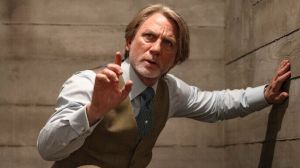
Blanc doesn’t even show up for the first forty or so minutes, giving the narration duties to Pastor Jud setting the scene of his own. Craig (Queer) is a bit more subdued in this movie, both given the thematic nature of it as well as ceding the spotlight to his co-star. Blanc is meant to be the more stubborn realist of the picture, an atheist who views organized religion as exploitative claptrap (he seems the kind of guy who says “malarkey” regularly). His character’s journey isn’t about becoming a true believer by the end. It’s about recognizing and accepting how faith can affect others for good, specifically the need for redemption. Minor spoilers ahead. His final grand moment, the sermonizing we expect from our Great Detectives when they finally line up all the suspects and clues and knock them down in a rousing monologue, is cast aside, as Blanc recognizes his own ego could be willfully harmful and in direct opposition to Pastor Jud’s mission. It’s a performance that asks more of Craig than to mug for the camera and escape the molasses pit of his cartoonish Southern drawl. He’s still effortlessly enjoyable in the role, and may he continue this series forever, but Wake Up Dead Man proves he’s also just as enjoyable as the second banana in a story.
 O’Connor (Challengers, The Crown) is our lead and what a terrific performance he delivers. The character is exactly who you would want a pastor to be: humble, empathetic, honest, and striving to do better. It’s perhaps a little too cute to call O’Connor’s performance “soulful” but I kept coming back to that word because this character is such a vital beating heart for others, so hopeful to make an impact. It’s wrapped up in his own hopes of turning his life around, turning his personal tragedy into meaning, devoting himself to others as a means of repentance. He’s a man in over his head but he’s also an easy underdog to root for, just like Ana de Armas’ character was in the original Knives Out. You want this man to persevere because he has a good moral center and because our world could use more characters like this. O’Connor has such a brimming sense of earnestness throughout that doesn’t grow maudlin thanks to Johnson’s deft touch and mature exploration of his themes. O’Connor is such a winning presence, and when he’s teamed with Blanc, the two form an enjoyable buddy comedy, each getting caught up in the other’s enthusiasm.
Johnson has assembled yet another all-star collection of actors eager to have fun in his genre retooling. Some of these roles are a little more thankless than others (Sorry Mila Kunis and Thomas Haden Church, but it was nice of you to come down and play dress-up with the rest of the cast). The clear standout is Glenn Close (Hillbilly Elegy) as Martha, the real glue behind Wicks’ church as well as an ardent supporter of his worldview of the damned and the righteous. She has a poignant character arc coming to terms with how poisonous that divisive, holier-than-thou perspective can be. Close is fantastic and really funny at certain parts, giving Martha an otherworldly presence as a woman always within earshot. Brolin (Weapons) is equally fun as the pugnacious Wicks, a man given to hypocrisy but also resentful of others who would reduce his position of influence. The issue with Wake Up Dead Man is that elevating Pastor Jud to co-star level only leaves so much room for others, and so the suspect list is under-served, arguably wasted, especially Andrew Scott (All of Us Strangers) as a red-pilled sci-fi writer looking for a comeback. The best of the bunch is Daryl McCormack (Good Luck to You, Leo Grande) as a conniving wannabe in Republican politics trying to position himself for a pricey media platform and Cailee Spaeny (Alien: Romulus) as a cellist who suffers from deliberating pain and was desperate for a miracle delivered by Wicks. He’s the least genuine person, she’s hoping for miraculous acts, and both will be disappointed from what they seek.
Wake Up Dead Man (no comma in that title, so no direct command intended) is an equally fun movie with silly jokes and a reverent exploration of the power of faith and its positive impact, not even from a formal religious standpoint but in the simple act of connecting to another human being in need. This is the richest thematically of the three Knives Out movies but it also might be the weakest of the mysteries. The particulars of the case just aren’t as clever or as engaging as the others, but then again not every Agatha Christie mystery novel could be an absolute all-time ripper. That’s why the movie’s subtle shifts toward its themes and character arcs as being more important is the right track, and it makes for a more emotionally resonant and reflective experience, one that has replay value even after you know the exact particulars of the case. If you’re a fan of the Knives Out series, there should be enough here to keep you enraptured for more. Because of that added thematic richness, Wake Up Dead Man has an argument as the best sequel (yet).
Nate’s Grade: A-
Share this:

Predator: Badlands (2025)
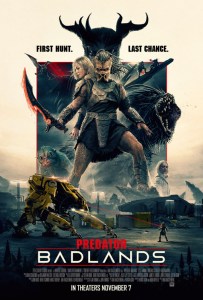 This movie plain rules. I was a nominal Predator fan beforehand but these last two movies, both directed by Dan Trachtenberg (10 Cloverfield Lane) and written by Patrick Aison, have taken the concept of a badass alien bounty hunter and made it so much more interesting than its killing prowess. Badlands is the first movie told entirely from a Predator’s perspective, also known as the Yautja. We’re set on an alien world, a proving ground that has claimed many who attempted to make their mark, and we’re following a “little brother” Yautja named Dek who wants to make big brother proud and stick it to dad. There’s also just the general struggle for survival in a hostile world where even the grass can kill you. That’s what I loved about Badlands, how seamlessly it drops you into its perspective and the fascinating sense of discovery along the way. Every ten or so minutes introduces another obstacle, character, or environmental detail that creates such a more vivid picture of this planet, and those details will almost all come back in important and satisfying ways for our climax, proving Dek has learned many lessons. Where the movie goes from great to amazing is when Thia (Elle Fanning) is introduced as a legless android from a Weyalnd-Yutani corporate expedition. It’s a perfect buddy pairing: he’s stoic and inflexible and quiet, and she’s chatty and goofy and friendly. The way the two of them genuinely bond and grow to become allies is surprisingly satisfying on an emotional level, which is not something I thought I’d ever say about a Predator movie. The action is immersive and clever and quite creative with its various details, but the real winning formula is just how structurally sound and engaging it is from the character dynamics. I cared. I celebrated their victories. I celebrated their rewarded faith in one another. Badlands is badass as delightful sci-fi/action but it’s also badass as a funky found family movie that felt like magic. Even if you’ve never enjoyed a Predator movie, or seen one, give Predator: Badlands a well-served trip.
Nate’s Grade: A
Share this:

Zootopia 2 (2025)
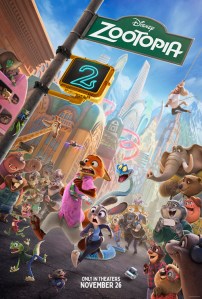 I’m genuinely shocked it took nine years for Disney to drum up a sequel to their billion-dollar “woke” allegorical hit, Zootopia. It used anthropomorphic animals living in a modern metropolis to analyze prejudice, racism, and segregation through the dichotomy of predators (untrustworthy animals beholden to vicious nature) and prey (docile animals). Specifically, it was about plucky police officer Judy Hopps (voiced by Ginnifer Goodwin) learning to work with con artist-turned-ally Nick Wilde (voiced by Justin Bateman). Now the partners are back and on another wild case uncovering yet another long-standing mystery of the city’s history entrenched in blame and suspicion of a “kind of people,” namely serpents/reptiles, who were driven out of town generations ago. There is a slight repetition in the message about looking beyond staid stereotypes and accepting other animals as equals (will Zootopia 3 be about finally accepting insects?), but when the tolerance message is essential to what made the 2016 original movie so much more thoughtful and relevant and satisfying, then keep it. The movie rises on the bickering but engaging buddy dynamic between Judy and Nick, who obviously love one another but don’t know how to admit it (consider me a shipper). The mystery tackles themes of gentrification, forced relocation, on top of its anti-prejudice and pro-tolerance foundation, so there’s plenty to unpack thematically while also taking in the visual whimsy and action slapstick. I laughed heartily at several points, including a very unexpected but transparent reference to a classic horror film complete with heavy music cues. It’s not as fresh or as finely developed as its predecessor but Zootopia 2 is further proof that this universe and its creativity can house many adventures, even if some of those plots and themes get repetitive.
Nate’s Grade: B
Share this:

Tron: Ares (2025)
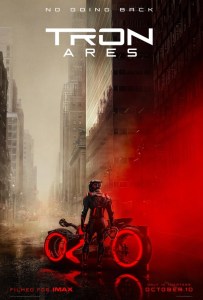 Known more for its cutting-edge visual effects, the Tron series has long felt like a franchise that Disney keeps trying to reanimate every generation with the hopes that this time, this time, it won’t be ahead of its time and merely of its time and a measurable hit. I think the issue I’ve had with the Tron movies, the original in 1982 and the 2010 glitzy sequel by debut director Joseph Kosinski (Top Gun: Maverick), is that the computer world that the characters get sucked into is, quite simply, boring. The world-building of life inside the computer is dominated by design and less by depth. It’s cool-looking and sleek and alien but it’s also over-glorified setting details without a larger sense of life. That’s probably why every movie has dealt with the threat of the computer world coming into the real world. That’s where Tron: Ares does right, spending far more time in the real world than the computer one, with a flesh-and-blood character (Greta Lee) traveling into the computer realm and a digital one (Jared Leto) traveling out to track her down. On the outside is a war between two tech companies, both racing to be able to replicate structures from the computer world into our own, except they disintegrate after 30 minutes. This is a smart limitation as it naturally presents a goal, to outlast this measure, but it also presents a ticking clock for our computer programs tracking down their missions. Much of the characterization is Leto’s security program, Ares, becoming self-aware and questioning the orders of his superiors, which makes for a pretty predictable arc from a pretty stoic if tedious character. He’s simply the cool fighter that we need for cool fighting, and admittedly, there are plenty of cool fights here. The Tron visual aesthetic of force movements creating warriors makes for some nifty images, especially when those barriers are used for strategic purposes in escapes or combat. You could mentally check out from all the tech mumbo-jumbo and just enjoy the pleasure of the sci-fi action, especially with Nine Inch Nails (really Trent Reznor & Atticus Ross) providing the sonic musical accompaniment. I don’t know if I’ll ever really love a Tron movie but there’s enough offered with Ares that allows me to at least like a Tron movie.
Nate’s Grade: B-
Share this:

Wicked: For Good (2025)

To paraphrase a famous debate line, I knew Wicked, Wicked was one of my top films of 2024, and you, Wicked: For Good, are no Wicked. Obviously that’s not completely true as For Good is the second half of the adaptation of the popular Broadway musical, of which only the first act compromised the prior movie released a year ago. The problem was that the first Wicked movie felt complete, and had there never been another second after, it would have served as a fitting and even moving portrait of the unknown back-story to the Wicked Witch of the West and the implied propaganda that would taint the perception of the citizens of Oz. The movie was two hours and forty minutes but it felt extremely well-paced and developed. It felt, more or less, complete, even though I know it was only adapting half the musical. In short, it did too good of a job, and now Wicked: For Good suffers as a sequel because what’s left to tell just isn’t as compelling or as emotionally or thematically coherent as its charming predecessor. Plus, all the banger songs were clearly in the first movie.
After the events of the first movie, Elphaba (Cynthia Erivio) has assumed the mantle of the Wicked Witch of the West and is sabotaging the Wizard of Oz’s (Jeff Goldblum) plans at expansion and animal abuse. Glinda (Ariana Grande) is the Wizard’s public ambassador and the “good witch” to inspire the masses, even though she doesn’t possess actual magical abilities. Glinda wishes dearly that Elphaba will change her mind and decide to work with her and the Wizard. However, Elphaba wants to expose corruption, and the Wizard is at the top of her list of the corrupt and powerful needing to be toppled for good.

For Good suffers from the adaptation struggles the 2024 Wicked film was able to avoid. The first movie was an effervescent treat built upon a poignant friendship and some killer songs given the full showstopper visual treatment. It was a vibrant adaptation, and while it expanded upon the stage show significantly, the extra time with the characters felt like breathing space, and it all contributed to what felt to me like an extremely well paced and well developed and arguably complete movie experience. Now the second act of a musical is almost always the shorter of the two, and For Good is about 30 minutes shorter than its predecessor. The filmmakers even added two new songs for Oscar eligibility and further padding, neither of which are winners (more on the songs later in the review). That sense of care is not present in For Good, as characters are frustratingly repeating beats they already worked through. Take for instance Glinda, who begins the first movie as an entitled popular girl used to getting her own way, and by the end of the movie, she’s grown to see the world differently and through her sisterly friendship with Elphaba, she has a more empathetic and grounded perspective. She has already changed for the better, and yet in For Good it feels like the movie kicks her character growth backwards. She has to again learn that maybe the Wizard and others are not the best people in charge just because they are. Wicked is a victim of its own success. The character development and arc was so well realized in the first movie that Glinda feels like she’s repeating lessons she’s already learned. I also don’t buy Elphaba being seriously tempted by the Wizard’s offer of collaboration after all she experienced and learned earlier. It’s irksome to have the characters seem curiously different from where we left them in 2024’s Wicked. There is also a character relationship revelation that I and many others had figured out FROM THE OPENING SCENE of the first movie. Behold, dear reader, For Good doesn’t even address this until the last twenty minutes of the movie and it does absolutely nothing with this revelation. I was flabbergasted.
The biggest time-waster and padding is when Wicked drags The Wizard of Oz characters and plot incidents awkwardly into its own universe. Granted, the entire enterprise is supposed to be the unknown back-story for the villain of The Wizard of Oz which gives it its identity. Except Dorothy and her lot are not essential at all to telling this story, as evident with the sense that the 2024 Wicked could feel complete. Dorothy and her motley crew of locals, some of whom are made up of previously established characters, are given the Rosencrantz and Gildenstern treatment, meaning they’re primarily kept off-screen and incidental. You don’t even see Dorothy’s face once. These characters feel annoyingly tacked-on and inconsequential to the story we’ve already spent three hours with. They’re knowing nods for the audience and they’re also making efforts to better pad out the running time. I don’t fully comprehend their importance in this new retelling. The treacherous Madame Morrible (Michelle Yeoh) sees the presence of Dorothy as an advantageous development, like she can use her as a Chosen One to thwart Elphaba. It’s never remotely explained why this makes sense. Why this person versus any other Oz citizen? Dorothy possesses special shoes but we’ve seen what can be accomplished with them. They’re not really some superpower or a weapon, more an item of personal attachment for Elphaba she would like returned. In this retelling, the entire inclusion of Dorothy and her friends is a means to an end for a public ruse. It might seem odd to say this Wizard of Oz back-story would have been better minus Dorothy but there it is.

Now it’s time to discuss the actual songs for this movie musical. The best known and most popular tunes were all in the first act and thus the first movie. The songs for For Good are a combination of middling ballads and continuation of the leitmotifs and themes of the previous one. There’s perhaps a bigger emotional current when characters bring back melodies and lyrics from the first movie to expand or contrast, like “I’m Not That Girl.” Did you want another song with Goldblum singing? The biggest number is “For Good” where Elphaba and Glinda face off and admit their shared sisterly love for one another, but again this was already established by the end of 2024’s Wicked. It’s more explicitly stated through song but the sentiment was evident to me already. Adding further disappointment, returning director John M. Chu (Into the Heights, Crazy Rich Asians) lacks the same thoughtful staging of the musical numbers in this edition. He is a filmmaker who innately knows how to adapt stage musicals into the medium of film, and he did so splendidly with 2024’s Wicked. With For Good, the staging lacks a real immersion and visual dynamism, often murky or overly saturated, like “No Good Deed” being performed almost entirely with intrusive sunsetting silhouettes dominating the screen. The less engaging songs, added with less engaging visual staging, make the movie feel longer and less jubilant. I don’t know if “For Good” has the intended emotional crescendo simply because this movie isn’t nearly as good.
As a personal note, the 2024 Wicked was the last movie I saw in theaters with my father while he was alive. We were supposed to see Gladiator II together as a family after Thanksgiving but he wasn’t feeling up to it, and then a little more than two weeks later he was unresponsive. I’m happy Wicked was such a pleasant and enjoyable experience for him, but as we left the theater, he asked me, “Wasn’t there supposed to be more?” We had seen the stage show when it toured through our city many years ago, and I remarked that there was going to be a whole second movie adapting the second act of the musical and it was going to be released in a year. He nodded and I felt the silent acknowledgement shared between us: he would not be around to see the conclusion, that it was a future unavailable to him. So it’s hard for me to not have some melancholy feelings with For Good, and I’ll admit maybe that’s influencing my critique.

Wicked: For Good is a frustrating, disappointing extension of what had been a sterling and magical original movie. It doesn’t outright ruin what came before it but confirms for me that 2024’s Wicked could stand on its own. The songs aren’t as good. The staging and visuals aren’t as good. The character development feels repeated and occasionally confounding. The plotting is stretched and unsatisfying. The inclusion of the more direct Wizard of Oz characters feels arbitrary and unnecessary. The actors are still charming and affecting and sing wonderfully, but they’re also unable to defy the gravity of the material they’re stuck with. If you’re a super fan of the source material, albeit the original story by L. Frank Baum, the 1939 Wizard of Oz movie, the Gregory Maguire book, the 2000s stage musical, or even the first movie, you will probably find enough to sing along to and walk away fairly happy. I loved the 2024 Wicked and was left mostly cold at the concluding half but I realize I very well may be a curmudgeonly minority here. My advice would be to consider the 2024 Wicked a complete movie and skip For Good.
Nate’s Grade: C+
Share this:

The Black Phone 2 (2025)
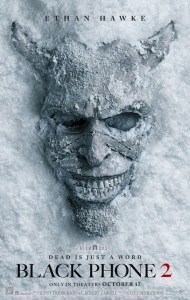
The original 2022 Black Phone was a relatively entertaining contained thriller where a kid was relying upon the ghosts of victims to escape the clutches of an evil kidnapper. It had other elements to fill it out as a movie, like a psychic sister, but the central conceit and execution worked well, especially a disturbing performance by Ethan Hawke as The Grabber, the aforementioned grabber and locker-away-er of unfortunate children. Then it was popular enough to demand a sequel, but where do you go when the villain has been killed and the source material, a short story by Joe Hill, has been exhausted? The answer is to turn the very-human Grabber into a Freddy Krueger-style supernatural predator terrorizing our survivors in their dreams. The kids from the first film are now teenagers and really the psychic sis is the main character. She’s the one most affected by the Grabber’s supernatural vengeance. Most of the movie is watching the sister get tossed around invisibly in the real world and talking to irritable ghost kids. There’s a mystery about uncovering the truth about what happened to their deceased mother, who too could have a personal connection to the Grabber from a Christian summer camp located in the far mountains. The snowy locale makes for a visually distinctive setting, though once you see the Grabber ghost ice skating it does take a little of the mystique away from the overall menace. The Black Phone 2 just didn’t work for me, feeling like another “let’s help these dead kids be at peace” adventure like a weekly TV series, but the scenario just didn’t have the draw and satisfaction of the original. I suppose the returning filmmakers wanted to expand their universe and its mythology, Dream Children-style, but the material doesn’t seem there to build a franchise foundation. The first film was simple and complete (makes me think of a variation on a line at the end of Bioshock Infinite: “There’s always a Grabber. There’s always a black phone. There’s always a ghost”). The sequel cannot compensate for that, and so it feels overstretched, underdeveloped, and goofy. At least they tried something different than just a straight replica of the original but it would have been best to leave the Grabber and us at rest.
Nate’s Grade: C
Share this:

Mission: Impossible – The Final Reckoning (2025)

It’s not just the increasing age of producer and star Tom Cruise, the Mission: Impossible movies have become victims of their own outlandish success, and this might have led to their ultimate end. This franchise has become known for its amazing stunts and placing Cruise in the thick of them. After every gasp-inducing, eyeball-popping stunt, the inevitable question arises, “What could top that?” And so writer/director Christopher McQuarrie, who has steered the franchise for a decade straight, has placed himself in a filmmaking arms race of action set pieces, and these budgets keep getting bigger and bigger, to compensate for the increasing scope and scale. As a result, these movies need to make an even higher amount of money to break even to cover their expanding expenses, and it doesn’t look like the M:I franchise has reached that next level of success (six of the previous seven movies have grossed between $175 million and $220 million domestically). As a result, Final Reckoning is the winding down of the franchise, or at least this incarnation, and it has enough to satisfy long-time fans, yours truly included, but it’s also a reminder of how things have gotten away from the series in the name of chasing spectacle.
Agent Ethan Hunt (Cruise) is tasked once again by the Impossible Mission Force (IMF) to save the world. In a continuation from the 2023 movie, Dead Reckoning, an evil A.I. known as The Entity is taking over the world’s complex computer networks and taking over control of nuclear missiles. It’s only a matter of time before the last four nations fall victim as well, so Ethan and his team (Simon Pegg, Ving Rhames, and now Hayley Atwell as Grace) must work together to get the only code that can kill The Entity.

Final Reckoning is the Scream 6 of the Mission: Impossible franchise. For those who never saw the sixth entry in an irony-drenched, self-reverential slasher series, it was intended to be the final entry in the franchise, and in doing so that made it try to tie back as many elements and moments as possible to the previous five movies. It was meant to feel not just final but full-circle for the fans. Naturally, the problem for Scream 6 is that it wasn’t going to be the final movie, and so a sequel is scheduled in 2026, and all that finality and franchise-reflection seems a bit like misguided internal stargazing. Coincidentally, the Mission: Impossible franchise also began the same year as the first Scream, 1996, and so this movie is intended to (possibly) close the door on the 30-year franchise and on (possibly) Ethan Hunt’s career as the best damn agent the IMF has ever had and yet whom they always doubt his motives in every movie.
M:I 8 takes far, far too much time trying to set up its stakes, which were already set up in M:I 7, which at the time was titled Dead Reckoning Part One before the “Part One” was scrubbed. Seriously, the first 45 minutes or so is awash in M:I clips from the previous seven movies and sloppy attempts to connect everything back together. Now the evil A.I. threatening the world has been revealed to be born from… the “Rabbit’s foot,” the undetermined MacGuffin from the third Mission: Impossible in 2006. Is that better? Does anyone really care about that? How about one of the cops being the son of a previous character? Does that change your opinion of Chasing Cop #2? How about the one guy in the first movie who found Ethan’s knife after he broke into the CIA in that movie’s most memorable sequence? Did you ever wonder what happened to him? Did you ever care about his well-being? I strongly doubt it. These Easter eggs to the older movies would be less egregious if this supposed final movie didn’t squander its first 45 minutes going over its own history as a means of trying to convince the audience This Stuff Really Matters. It’s even more egregious when the running time is 165 minutes long. All of this backward-looking ret-coning and clip show montages feel like an attempt to add weight to a franchise that never needed it. Let the stunts and set pieces stand for themselves. I don’t need all this nostalgic congratulatory back-patting.
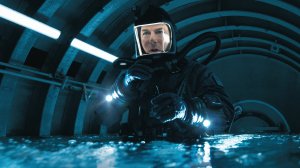
And there is a truly outstanding action set piece that anchors this movie, so much so that it actually comprises a full hour of the film. Set up in the preceding movie’s prologue, we know the only way to kill the evil A.I. is by securing a code located in a Russian submarine at the bottom of the Bering Sea. Just planning to find the location is the first hurdle that Ethan and the team have to surmount. Then there’s getting onto a clandestine U.S. submarine and launching out its tubes to swim to the bottom of the ocean, securing passage inside the fallen sub, and working one’s way through the different chambers, filled with frozen dead bodies, while the sub rolls around, tumbling further and further along the ocean floor. Each smaller sequence has a clearly defined series of mini-goals and organic complications, the kind of exciting escalations that make these set pieces so much better. It’s not enough for the pros to come up with a comprehensive plan, there needs to be unexpected complications that force them to improvise. A foolproof plan that goes perfectly is anathema to action cinema. This sequence has it all, which is why I have no qualms about its length because McQuarrie has justified every link in this set-piece chain. It’s also fantastic visually and really taut, especially as Ethan is tumbling through the innards of the sub with torpedoes falling over and pinning him underneath. This is a prime example of the maximalist virtuoso blockbuster filmmaking excellence that people have come to expect from the franchise.
The problem is that there’s an entire hour after this sequence and, once again, an M:I movie has peaked early. I think only Fallout and Dead Reckoning have their best moments during their actual climaxes. It hurts that Gabriel (Esai Morales) is the weakest villain the franchise may have ever had. I don’t care that the prior film tried to ret-con younger Gabriel into killing Ethan’s love and thus motivating him for vengeance and entering into the IMF. That personal connection and tragedy is a transparent attempt to make this character more important and menacing, and frankly, I am still astounded that this guy… THIS GUY… killed Rebecca Ferguson’s Ilsa. I can confirm, sadly, she is still dead, a reality that astounds me in the realm of a spy thriller where people assume identities. It’s she that Ethan should be fantasizing about in what could be his final moments, not Grace, and I will stand by that (no disrespect to Atwell, who is a genuinely fun and flirty addition to the team as an expert thief).

Regardless, back to Gabriel, who is just an empty suit of a villain, partly because the real villain is the scary A.I. conquering the world’s nuclear arsenals. It’s hard to really vilify a computer code for a movie, so enter this human handler, but he was uninspiring, so they added the secret back-story connection. It doesn’t work. I don’t really care about this guy being defeated, nor do I find him particularly threatening, miraculously killing Ilsa notwithstanding. The ultimate fight atop warring biplanes is visually impressive with its aerial photography, but the conclusion feels anticlimactic and the thrill of the set piece feels even slightly redundant when we remember Cruise has already hung from the side of a plane in M:I 5 and dangled from a helicopter in M:I 6. There’s yet another ominous timer ticking down, yet another deadly device with wires needing to be cut, and yet another side character possibly bleeding out to death. It feels rather par for the series, perhaps a thematic distillation of all those clips. There’s also some extra Fail Safe-style political hand-wringing at the highest levels of the U.S. government whether to give Ethan the benefit of the doubt or resort to some unorthodox methods for added stakes. It just adds up to a final hour of some strong moments in passing and too much of the same for a franchise that chartered new heights.
Placing it through the M:I pecking order, Final Reckoning is probably the weakest of the McQuarrie Era and arguably lesser than Mission: Impossible III, but it is leagues better than the first two Mission: Impossible entries. Realistically, this isn’t the end of the Mission: Impossible franchise, which has grossed close to five billion dollars over the span of its eight movies, but it is the end of Cruise as our star. The franchise was already previously engineered to hand off to Jeremy Renner in 2011’s Ghost Protocol, but then the movie proved too popular to persuasively function as writing off Ethan Hunt (unlike the other franchise also trying to hand off to Renner at the time, 2012’s Bourne Legacy, which proved so unpopular that Matt Damon came out of Bourne retirement). Cruise is now 63 years old and probably aware that these kind of death-defying stunts might be behind him even at his pace. Though I think the three separate shirtless scenes with Cruise are intended to dissuade you about the limits of his age (hey, I hope I look as good as Cruise’s abs when I’m 63). Final Reckoning is another chance to bid goodbye to its seminal action hero, which may be why there’s so much looking back and connecting unnecessary dots. This franchise is a celebration of the highs of big–budget action storytelling with the most game superstar with a death wish Hollywood could provide, so it’s bittersweet to see it reach some form of an end. McQuarrie, the David Yates of the franchise, has been an excellent shepherd with a kinship with Cruise for grand popcorn entertainment. It’s not the best entry but even a lesser M:I movie still rises above just about most studio action cinema. It’s definitely underdeveloped, too long, and structurally questionable with its pacing and climax, but at its best, it still reminds you why this franchise rose above the rest.
Nate’s Grade: B
Share this:

Jurassic World: Rebirth (2025)
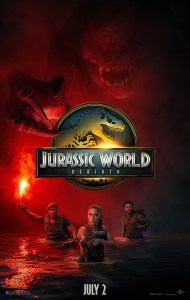
“Rebirth” might be a bit optimistic in that title. The issue with the still-quite-popular Jurassic Park/World franchise is an ongoing lesson in diminished returns. Back in 1993, Steven Spielberg and special effects breakthroughs enchanted audiences on the peril of man’s hubris and the core love and undying appeal of dinosaurs getting to be wrecking machines. Thanks to the marvels of modern big-budget blockbusters, we can bring realistic dinosaurs back to life for perilous adventures in survival, but much like the famous line, the producers eager to crank out a new Jurassic movie every so many years only focused on whether they could and not whether they should. The movies are still significant moneymakers; the worst film in the franchise, 2022’s Dominion, still made over a billion dollars at the global box-office. Just imagine how much that could have raked in if it was actually, you know, good. Jurassic World touched upon the nature of diminished returns through satire, that audiences that were once wowed by the very presence of real dinosaurs have grown bored and need more to capture their flagging interest. Since then we’ve had a movie about dinosaurs eating the rich in a haunted house-style horror-thriller and a nostalgic-heavy conclusion that was more about giant locusts and far less about dinosaurs cohabitating with mankind. The interesting storyline (man co-existing with dino) has been there for multiple movies, and yet the producers keep neglecting that glorious potential. Now here comes Jurassic World: Rebirth, another attempt to keep this franchise chugging along with more mediocre sequels that have fleeting moments of popcorn thrills. Ultimately, it’s a bit more of the same, and like the characters in this world, I too am growing restless.

There are two groups of characters that we follow. The first is a clandestine science team funded by a large pharmaceutical company looking to create the next big drug as a result of studying dinosaur blood and tissue. This is the familiar movie world of quippy security experts and ex-CIA agents and panicky scientists thrust into danger in the field. The other group is a family going on a sailing trip through… dinosaur-infested waters for some reason. The first group is on a mission. The second group is just trying to survive, and possibly for the teen daughter’s boyfriend to grow on her skeptical father.
Rather than reinvention, Rebirth is once again more of the same old same old. There can still be intrigue and spectacle from simply interacting with living dinosaurs brought to life by the best special effects money can buy, so the Jurassic movies will never be without some level of primal appeal. There are some fun moments and sequences throughout Rebirth, but it’s hard to stitch together the whole movie from these minor pieces. I think the premise could have worked. The team on the mission has to track down and retrieve blood from the three biggest dinosaurs by habitat: one by land, one by sea, and one by air. There’s some flimflam excuse that these creatures have the biggest hearts and therefore the live blood they extract blah blah, but it doesn’t really matter. The premise of having to track three of the biggest dinos in different terrains makes for an episodic but varied structure that is easy to follow and engage with. All along the way, we know what the total number needs to be and the progression provides mini-climaxes. It’s just that the retrieval of all of these is completed before Act Three. That’s right, it’s all done before the movie is supposed to get really climactic and intense. The land dino isn’t even a challenge, more just an attempt to recreate the majesty of when we first saw those plodding apatosaurs in 1993. This feels like a mistake, and each of the dino retrievals should be getting moderately harder to succeed. There should be escalation so that each one feels more like an accomplishment with the team getting better not worse.

So what could be Act Three? Well you see, dear reader, this is yet another new island. I can already hear you asking how many islands there are, and the answer is however many the studio needs. This island could have been nicknamed Monster Island because it was the dinosaur experimentation labs. Here’s where the InGen scientists threw darts at a board and said, “What if you mixed a [anything] with a raptor?” That seemed to be their go-to for these sequels. We’re introduced into mutant T-Rex in the opening, presented like a monster lurking in the shadows, and then we come back to our giant lab-designed monstrosity. Except this is the silliest looking dinosaur mutant. I laughed out loud when I saw its full form. It made me think of the xenomorph and human hybrids from Alien Resurrection. Its head is so bulbous like he’s part mushroom, but there’s no contours or anything menacing like spikes or something evolutionary useful. It’s just a big goofy head. This is the kind of dinosaur that would be made fun of by the other dinosaurs who snicker when his considerable back is turned. It has larger forearms but walks with them like a hunched gorilla. A T-Rex was already frightening because of its size, as evidenced during one of the movie’s better sequences where a normal T-Rex chases after the beleaguered family in a raft. This just made the T-Rex’s head comically oversized, like somebody glued a shower cap on this guy. This guy has a bigger head but it doesn’t mean bigger brain. It makes for a rather perfunctory and silly ending fighting against a disappointing dino Frankenstein. We shouldn’t have held our expectations too high considering this mutant’s lab breakout all stems from a lone Snickers candy wrapper getting loose.
The characters are also pretty disposable and strictly archetypal. Scarlett Johansson (Fly Me to the Moon) is the lead as our quippiest ex-CIA agent, more or less playing a version of her Marvel persona. She has a slight arc about joining the mission for the money and being convinced by the idealistic head scientist (Jonathan Bailey) to release the medical information to the entire planet. I don’t think this is as hopeful as the characters think because it seems like you’re also making it so plenty more mad scientists have access to dino DNA to make their own at-home Jurassic Parks. The other lead character is played by Mahershala Ali (Leave the World Behind) as the boat captain who provides the movie with the most disposable of characters so that the dinosaurs have something to feed upon. It doesn’t seem like a coincidence that the one lost family is gifted a dinosaur baby that they trot around like an adorable puppy. That thing’s going to get extremely big and I don’t know if anybody is going to be able to pick up after it. I wouldn’t say any of these characters are memorable or even that likeable, mostly stars coasting on charm autopilot.
I didn’t know where else to put this but I loathed every time the Jurassic Park musical themes would start to trinkle into a scene, especially since so many of them are perplexing. Why would you insert that familiar theme over this scene? It’s intrusive, tone deaf, and just a bizarre creative choice.

It’s hard to really see the added value of returning veteran screenwriter David Koepp (Black Bag) and new director Gareth Edwards (Godzilla, The Creator). This whole enterprise feels a bit like a runaway train rushing to meet its release date deadline. The development needed for a relaunch seems to go by the wayside so that we can squeeze in more set pieces, and I suppose two sets of characters equal always having a new and fraught action sequence we can jump to. It’s just that everything feels so rote and familiar, so much of the same kinds of thrills and chills we’ve gotten from the previous six movies. The most exciting development across these new movies since 2018 has been the reality of humans having to adapt to an Earth with dinosaurs in our ecosystems, and yet this again is hand-waved away in exposition that limits the dinosaurs to a much smaller band of the Earth. Turns out they only really live around the Equator now. Okay, if that’s the case, then tell me a story from that setting. It can still be done. Jurassic Park: Rebirth doesn’t feel like the start of something new or exciting or even promising. It feels like more of the same, sliced and cut up with different actors getting their turn to make frightened faces. It’s not as bad in design or execution as Dominion but Rebirth is no more than more of the same.
Nate’s Grade: C
Share this:

The Old Guard 2 (2025)
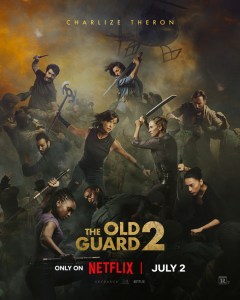
I wasn’t a big fan of the 2020 immortal action movie The Old Guard, but apparently it became one of Netflix’s most viewed movies, so here we are five years later with a sequel about the ancient conspiracy of warring immortals co-starring Chiwetel Ejiofor (not to be confused with Infinite, which is about an ancient conspiracy of warring immortals who are reincarnated into new bodies co-starring Chiwetel Ejiofor). I found the action and the general world-building to be underwhelming, but Old Guard 2 makes The Old Guard look like Michael Bay in comparison. There are two key developments in this sequel. Uma Thurman plays the first immortal and she wants to destroy the world or whatever. The second is that anyone injured by our newest immortal, Nile (Kiki Layne), loses their immortality. The rules of this universe get awfully hazy. I’m taking this directly from the film’s Wikipedia summary: “Additionally, anyone who has lost their immortality can regain their power by another wounded immortal who can transfer their power to the host they choose.” Still following? So we have one person who can make immortals mortal, but any mortal immortal can also choose to have their absent immortality bequeathed to a mortal immortal of their choice, reasserting their immortality. Okay. The confusing rules would be mitigated if we found any of the characters compelling. The sequel does bring back Andy’s (Charlize Theron) ex-beloved Quynh (Veronica Ngô) who was locked into an iron maiden coffin and dumped overseas. The established rules had immortals reawaken from death, so this poor woman would keep waking back up again only to drown instantly and repeat the horrifying process again. Let’s do the math here. On average it takes about two minutes to drown (FYI, I typed into Google “how long does it take to drown,” and now my computer is worried about my mental health). Let’s cut that in half from the extra water pressure filling her lungs. So let’s say she dies every minute. That means she dies 1440 times a day. Over the course of 500 years she has died 262,800,000 times. Rescuing this woman should be a recognition not just of her relentless suffering but the fact that her mind should be shot. Having to endure that horror would break anyone, and Andy coming to terms with her inability to heal someone who cannot die but is also unable to continue life any longer woukd be interesting. That’s my preferred sequel. Instead with The Old Guard 2 we get a bunch of lackluster fights and convoluted lore, and it doesn’t even offer a conclusion, more an implied hand-off to a third movie where the characters may indeed be able to finish what they’ve started. It’s time to let these mortal immortals just die in peace.
Nate’s Grade: C-


 nathanzoebl
You must be logged in to post a comment.