Blog Archives
Lazer Team (2016)
 What makes a disappointing comedy? It’s a question I kept thinking about while watching the sci-fi comedy Lazer Team from the online comedy collective better known as Rooster Teeth, responsible for the longest running online Web series, Red vs. Blue. These are people who know how to be funny. They have a fine resume of shorts to prove their comedy bonafides, but what was it about their first foray into features that diminished their funny? I’ll try my best to provide a critical autopsy for the case subject of Lazer Team, a disjointed and disappointing buddy comedy that died on screen.
A concerned alien species has sent a warning to Earth. A hostile alien race is heading toward our planet with the intent to conquer, pitting their champion fighter against a champion from Earth. This gladiatorial showdown inspires Earth’s military and scientists to train a select warrior (Alan Ritchson) from birth for this mission. The problem is that the wrong people get hold of that alien technology. Disrespected sheriff Hagan (Burnie Burns), his old high school has been pal Herman (Colton Dunn), redneck moron Woody (Gavin Free), and insufferable quarterback Zach (Michael Jones) come across a downed alien ship that they happened to knock out of the sky with drunken fireworks. Each of the foursome puts on a piece of the alien armor, which attaches permanently. Herman gets a pair of super fast boots, Woody a helmet that instantly makes him smarter and British, Zach an arm canon, and Hagan a retractable shield. The bickering idiots are forced to work together over the fate of the planet, and the warring alien species has sent a few of its parasitic infantry to retrieve the special suit.
 To be fair, Lazer Team is not an atrocious comedy that singes your eyeballs with pain, something along the likes of InAPPropriate Comedy or any Friedberg/Seltzer suckfest. You can tell that the Rooster Teeth squad understands the tenets of comedy and what makes for a good joke, which is what makes their final product all the more baffling. For my pal George Bailey, there’s nothing worse than a bad comedy (his worst film for 2015 was Mortdecai). A comedy has one job to do and that is to make people laugh. This should be obvious but you’d be surprised at how often this principle seems to get lost. Rarely does a larger budget make a comedy funnier, a lesson learned the hard way over and over again with Hollywood. With Rooster Teeth’s first movie, they wanted to make a throwback to the sci-fi buddy comedies of the 80s. They raised almost two and a half million dollars via the crowd-source site Indiegogo, a record until Broken Lizard’s Super Troopers 2. It feels odd to say that what amounts to a meager budget by most productions could be at fault for the ultimate disappointment, but I think it leads into the chief problem of the movie: prioritizing the action over the humor.
It’s not uncommon for the comedy to get obliterated by the action in action-comedies, but from a comedy collective I was hoping for more emphasis on the ha-ha and less on the kablooey. Lazer Team has a solid comic premise that pays homage to a pastiche of 80s inspirations and pop-culture. I wanted to laugh. I think I even compelled myself to give it some pity laughs, but after 40 or so minutes a realization could no longer be ignored, and that was that Lazer Team just wasn’t that funny. The enthusiasm of its key cast members and their amiable nature go a long way to disguise the threadbare nature of too many of their first-draft jokes. The foursome never stretches beyond the entrenched lines of their formulaic archetypes. You come to expect specific jokes delivered from them, assigned by type in a way that reminds me of TV’s The Big Bang Theory. The character will rarely surprise you, which is also because their character arcs are so transparent. Hagan will atone for his failure to act and protect Herman while Herman will learn to move on from a past misfortune. Zach will learn to be less selfish. Woody will… well he doesn’t so much have an arc because he’s instantly made smarter thanks to the lien tech. The expected is a deathblow for comedy; if you can anticipate the joke, it’s rarely funny. Lazer Team so rarely subverts your expectations, playing things too safe.
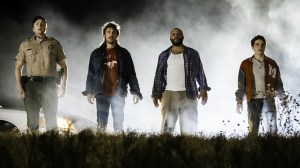 The central conflict of four losers learning to work together as a team to save the world is rife with comic possibilities, even with the locked-in archetypes, but there’s far more attention spent on the sci-fi action and special effects. It’s a low budget film but there are plenty of action set pieces and special effects, many done in-house by the Rooster Teeth team. The effects range in effectiveness but are generally passable and even impressive at turns, especially with properly calibrated expectations. The problem is that the action sequences that are eating up so much creative space aren’t remotely memorable. There’s one car chase in the middle of the film where it feels like the guys have found a tone that works, one where the action incorporates the comedy and they work. For a fleeting moment I thought, “Maybe the whole movie will resemble this new shift.” The other problem is that it feels like the Rooster Teeth squad was stuck with how to get this story to feature-length. Structurally, this thing sure feels padded with additional set pieces that lurch and fail to justify the added time, especially the ex-wife cabin sequence.
The acting foursome is the best aspect of the movie and their amiable interaction is the one thing that Lazer Team has that got me through to the end. These actors know how to sell jokes, when to mug, and their amped-up enthusiasm helps sell the lesser material. I wish this foursome had a better script. Imagine something more low-key in concept that involved less explosions and more emphasis on utilizing their comic talents? I wish less time had been spent on Jones’ obnoxious egotistical quarterback and more on Free’s redneck-turned-British genius, a setup that seems to have far more potential than just being an expositional device. The slobs vs. snobs approach only gets the movie so far, and after that we have to care about the characters, and I just didn’t. Because of how one-note the characters are it’s hard to care about them. After your good will depletes with the actors, you’re left with a bunch of running around but little funny.
Lazer Team is a movie that’s hard to hate, especially if this kind of genre comedy is a favorite launching ground for jokes. It’s nowhere near as wretched as The Watch but it can’t come close to the sci-fi comedies that influenced the Rooster Teeth creative unit. What’s even more frustrating is that these guys have the talent to tell an original and hilarious movie and are creative enough to engineer some fun sci-fi set pieces. They have the talent and expertise to do better than this, to do better than Lazer Team, a movie that is too safe, too predictable, too padded, too formulaic, and just not funny enough. I demand more from people who specialize in comedy.
Nate’s Grade: C
Share this:

Star Wars: The Force Awakens (2015)
 May 19,1999 is a day that lives in infamy for legions of Star Wars fans. The day hoped died. I remember trying to convince myself that The Phantom Menace was good but a second viewing confirmed my earlier fears. These movies were not going to be the same as the original trilogy, and George Lucas confirmed that with each successive release. I’ve had debates with teenagers who swear that the prequels are better films. They aren’t. This isn’t a matter of opinion; this is fact. After Revenge of the Sith was released in 2005, you could sense that Lucas was burned out and had no desire to further awaken the ire of the fandom. Then in 2012 he surprised everyone by selling the Star Wars empire, along with other properties like Indiana Jones, to Disney for four billion dollars. Immediately Disney let it be known that they wanted to get new Star Wars movies into production ASAP. They tapped J.J. Abrams to spearhead the first steps in a new direction. No other movie has felt the weight of hype and expectation like Episode VII: The Force Awakens. Fans don’t want to be hurt once more by someone they loved. For millions of fans that grew up on the original trilogy, The Force Awakens will be the Star Wars movie they have long been waiting for. It erases the bad feelings of the prequels and re-calibrates the franchise. However, it is also flawed and seems too indebted to nostalgia. It’s certainly good but I cannot put away my nagging reservations (far, far less than what I felt with the prequels).
Thirty years after the events of Return of the Jedi, the First Order has risen in place of the evil Empire. The First Order is lead by General Hux (Domhnall Gleeson) and aspiring sith lord Kylo Ren (Adam Driver). They’re searching for the droid BB-8 and its owner, Resistance pilot Poe Dameron (Oscar Isaac). The droid has a map that leads to the whereabouts of the last known Jedi – Luke Skywalker (Mark Hamil). A Stormtrooper who adopts the name of Finn (John Boyega) runs away from his mission and joins forces with Rey (Daisy Ridley), a scavenger waiting for her family to return to her world. The duo finds BB-8 and seeks to return the droid to the Resistance. They run into Han Solo (Harrison Ford) and Chewbacca (Peter Mayhew) and a few other familiar faces on their journey to the Resistance base and to escape the reach of the First Order.
 Abrams has captured the essential magic of what made the original trilogy so enjoyable and timeless. The prequels carried the burden of setting up characters we had come to love, and so as we watched younger versions of them or characters integral to their development, it was hard to ignore just how little we cared. It didn’t feel like Lucas himself cared that much, more content to direct his green screens than his actors. The special effects had improved but for much of the three prequels it felt like watching disinterested actors recite poorly written lines while they run around fake environments with no semblance of reality. The details that Lucas emphasized were ones that were unnecessary, like treaties and trade tariffs and the notorious midichlorians, which made the force into a blood disorder. The prequels harmed the legacy of the franchise. It takes only seconds for you to feel like you’re in better hands when you read the opening text crawl. No trade disputes. No galactic senate. It sets up its central chase and the important players in three brief paragraphs. And then we’re off and the movie rarely lets up.
We pass the torch to a new generation of characters and it’s here that Force Awakens is able to leave the large shadow of the original trilogy. The characters are great. Finn gives the viewer an entry point into a world we’ve never explored onscreen in any real depth, the life of a Stormtrooper, the cannon fodder of the series. He has moral crises and goes AWOL from the duties he has been raised to do. He doesn’t want to be a mindless killing-machine and forges his own destiny. Watching him embrace a sense of individuality is entertaining. He’s charming and excitable but also fearful of what may catch up to him. Then there’s the hero’s journey with Rey, a plucky heroine who comes of age over the course of the movie’s 135 minutes. Ridley has the presence and poise reminiscent of Keira Knightley, and the screen just adores her. It also helps when her character is easy to root for. Boyega (Attack the Block) and Ridley are terrific and even better paired together. They have a great chemistry and much of the humor is born from the characters rather than lame visual gags like in the prequels. It’s fun to hear characters verbally spar with actual good dialogue. Driver was the first actor hired and it’s easy to see why. If you’ve been watching the man on HBO’s Girls, you’ll know that he has a magnetic presence that separates him from the herd. He plays a villain that so badly wants to follow in Vader’s footsteps but the thing that holds him back is the “temptation of the light.” In one moment, a badass and imposing villain with super force powers had now also become an interesting character wrestling with his influences. Isaac (Ex Machina) is suave and cocksure as an ace pilot. His affection for the other characters is touching, particularly the robot BB-8. This little guy is going to be the toy that every child on Earth demands for the holidays. BB-8 is adorable from its first moment on screen and made me forget about R2D2. The big worry with Force Awakens was that its new characters would be compelling on their own. After one movie I’m looking forward to more adventures with the new kids on the block.
 Abrams has restored the sense of fun and awe that resonated from the original trilogy and the biggest compliment is that Episode VII feels like a Star Wars movie (more on which below). The action sequences are quick and filled with great visuals and shot arrangements. For those worried about Abrams’ penchant for lens flairs in the Star Trek reboots, they are completely absent in Force Awakens (Fun fact: for Star Trek Into Darkness, computer effects had to go in and take out lens flairs because Abrams later admitted he had gone a bit overboard). There are some beautifully orchestrated shots and sequences all around here. The first 40-minutes is the best part of the movie, before the older stars come back for their due. The rest of the film is enjoyable, no doubt, but I was more pleased with the original material. The technical expertise has never been higher. Like Mad Max: Fury Road, there’s a joy with watching characters interact with a real world of practical effects. Watching the characters run around real environments and real sets rather than immense green screens just makes it feel more real and vital. I enjoyed how worn and weathered the technology in this world comes across. The special effects are judiciously utilized and are excellent as anticipated. It’s easy to sense the reverence that Abrams and others have for the series as well as their determination to not repeat the mistakes of the prequels. The first mission for Episode VII is to reset the course, to wash away the bad taste of the prequels that haunt many. Abrams has gone back to what works with these movies and recreated the playbook. It’s a movie that will satisfy the hardcore fans and reawaken their love for the series.
And yet it almost feels like Force Awakens is a swing too far in the other direction, an overcorrection to the prequels that turns a reboot into a loving homage that approaches facsimile. I was amazed at just how closely Episode VII follows the plot beats of A New Hope (mild spoilers to follow – for real, if you don’t want to be spoiled in the slightest, and I’m no monster and won’t dare include anything that would substantially deter your viewing, skip to the spoiler safe area). Here goes: once again we start with an escape from an evil starfleet ship, only to land on a desert planet. The hunt is for a droid with valuable information. Our dispirit band of characters collect on the desert planet and flee, only to be eventually pulled back to the evil base of operations, which once again is a giant floating orb that specializes in planet destruction and this orb seems to have the same pesky design flaw that plagued Death Star 1.0 and 2.0. How does this one design flaw still exist? Are there not backups and redundancies? It would be like Titanic 3.0 going down by hitting another iceberg. There are more parallels involving the characters and personal revelations that mirror Episode IV but I won’t go into detail on those (end of spoilers). Suffice to say, it felt like I was watching a cover act remind me how much I enjoyed the first Star Wars release. Perhaps Abrams felt his rabid audience needed to go backwards before going forward, pay homage to what had been built by practically reliving its plot in a galaxy not so long ago as it once was (it still is likely the same distance: far far away). It’s a movie that cannot escape the nostalgia of its predecessors, and so it indulges it instead. In deferring to fan demands, Force Awakens has moments that waver into the dangerous territory of fan service. This will harm its overall staying power once the glow wears off from audiences overcome with relief.
 Thankfully, the new main characters are compelling and I’ll be happy to follow their continuing adventures with Episodes VIII and IX and who knows. Abrams and company have set up the next generation of fan favorites that have the chance to grow out of the sizable shadow of the original cast. However, not all elements are given that same nurturing care. The Force Awakens is so briskly paced that it rarely has time to establish the new history of its universe. We get character relationships and reunions but I couldn’t help but feel that the larger plot they inhabited felt rushed. The First Order seems rather vague and their rise to power needed at least some explanation. Instead we’re dropped right into a timeline with an Empire knockoff. It’s just easy fascism placeholder. Why are the Republic and the Resistance two separate entities? The villains with the exception of Kylo Ren are pretty one-note and also callbacks to the bad guy types from Episode IV. Captain Phasma (Gwendoline Christie) is in the movie for a lousy three minutes. I’m also not a fan of either of the two motion-capture performances courtesy of Oscar-winner Lupita Nyong’o (12 Years a Slave) and mo-cap pioneer Andy Serkis (Rise of the Planet of the Apes). I hated Nyong’o’s character and her performance. The character design for both of these creatures is rather weak and weirdly unimaginative. There’s also a habit of characters being naturals at things that would ordinarily require expertise. The worlds we visit and the creatures we encounter are all a bit too similar to earlier sources and distinctly unmemorable. We don’t learn much via our locations and geography and so it feels a tad interchangeable and meaningless, which is a shame.
The Force Awakens is a mostly exciting return to the rich world of Star Wars with characters we care about, old and new, lively action that feels substantial and real, and a sense of fun that isn’t at the expense of your full brainpower. Abrams had two missions: 1) eliminate the disappointment over the prequels, and 2) set up new characters and stories for future installments. Both have been accomplished. Abrams may have been the perfect candidate to restart the Star Wars series as he has a history of making films as loving homage to his cinematic influences. Super 8 was Abrams’ homage to Spielberg, and Episode VII is very much homage to Episode IV. The well-trod story allows for the series to reset comfortably while setting up its new characters to take a greater storytelling burden from here on out. I hope future installments give us more development to make the worlds and the history matter just as much as Rey, Finn, Kylo, Poe, and BB-8. This may be an unpopular opinion but I feel that Abrams’ rollicking 2009 Star Trek reboot is a better Star Wars movie than The Force Awakens. Abrams and company prove you can make a new and good Star Wars movie. Now my own new hope is that writer/director Rian Johnson (Looper) will be able to steer the franchise into a fresher direction with Episode VIII. In the meantime, fans can sleep well once again.
Nate’s Grade: B+
Share this:

The Martian (2015)
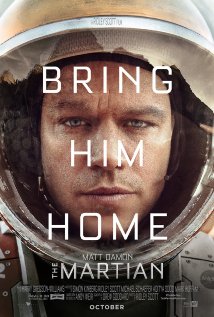 Based upon Andy Weir’s nuts-and-bolts scientific “what if” tale, The Martian is the movie equivalent of Apollo 13 crossed with Cast Away. Just far less personable volleyballs. But there are potatoes. Space potatoes.
After a powerful storm on Mars forces NASA’s crew to flee, astronaut Mark Watney (Matt Damon) is presumed dead and left behind. He wakes up hours later, shrapnel in his gut, and retreats back to the Mars mission base. He has to survive close to two years before he has any hope of being rescued on the hostile world. Before that, he has to establish some kind of communication with NASA, and even before that he has to somehow grow food in the arid Martian soil. Back at home, NASA is debating their limited options to bring back Watney and whether or not they should tell his crewmates that he survived.
In conversations with my friend and critical colleague Ben Bailey, he said that The Martian was the opposite of Gravity, a film he subsequently loathed, because it was smart people making smart decisions. There is an inherent enjoyment watching intelligent people tackle and persevere over daunting challenges, and this sets up The Martian for lots of payoffs and satisfaction. We see both sides of the problem and it provides even more opportunities for challenges and payoffs. Naturally the stuff on Mars is more compelling because of its extreme dangers and isolation, but the Earth scenes are also enjoyable as the NASA determines the soonest they might reach their lost astronaut. Just like the similarly themed Apollo 13, there are challenges to be overcome and the solutions are not without risk themselves. I enjoyed how the screenplay kept throwing out new obstacles; just when you think you can breath for a while the status quo is upset again. The slew of new obstacles doesn’t feel contrived either but rather realistic setbacks. It’s a wonderful storytelling structure that constantly keeps things moving forward and ramps up the urgency. As a result, we don’t ever feel safe right until the climax, and even then you’re still sweating it out because of all the complications and adjustments.
 It’s revitalizing to watch a movie that treats science with a sense of reverence. Mark Watney endures in the most hostile of environments through his ingenious use of the resources he has because of his understanding of science and math. Just as MacGyver proved there was something satisfying about watching a guy make a bomb out of a toilet paper tube, some chewing gum, and a bobby pin, it’s entirely enjoyable watching Watney think his way out of problems, and this starts early on. Watney’s first problem after he regains consciousness is to remove an embedded piece of shrapnel in his gut. The scene plays in a methodical fashion without any obtrusive edits, allowing the full task to settle in with the audience. The man has to perform surgery on himself and dig inside himself, and if he doesn’t get this done soon, sepsis might set in (no doctors without borders here). From there, the situation only gets more serious as Watney’s food supply, even when generously rationed, will only last a fraction of the time it would take NASA to send a rescue team. He has to grow food on an alien planet. That itself could be its own movie, a glossy crossover special from the SyFy Channel and the Home and Garden network. This is a survival story that doesn’t rely upon coincidence or some sort of divine intervention but on the understanding and admiration of science and its possibilities. Though America’s favorite astrophysicist Neil deGrasse Tyson says that in this movie universe, all the science decisions are being made by science professionals rather than, you know, politicians who adamantly open ignorant statements with, “I’m not a scientist.”
Another aspect I wasn’t quite expecting but took hold of me is how uplifting The Martian turns out to be. It’s a celebration of human endeavor and particularly cooperation, as the United States reaches out to other nations for assistance. Watching the determined souls risk their lives to retrieve one fallen man is the kind of thing that represents the best in us. Sure, there’s something to be said about the fact that it’s one prized American life that countries are spending billions of not trillions of dollars to rescue and perhaps that money would be better spent helping more lives on Earth. There’s also the curious fact that the world has spent a ton of money rescuing Matt Damon in movies. From Saving Private Ryan, to Interstellar, and now The Martian, we seem to value Damon above all else.
This isn’t exactly a one-man show with half of the running time flashing back to Earth but Damon’s star quality and acting chops makes it so you don’t mind being marooned with this man. Watney’s recorded messages are a slick way to deal with the internal thinking of its protagonist while giving the character more opportunities to charm thanks to a rich sense of gallows-level humor. At no point is Mark Watney flippant about his unique predicament but his sense of humor goes a long way to further engender the audience’s good will. He’s not moping and having existential crises; he’s getting to work, and it’s through the problem solving that we get to know this character, his ingenuity, his personality, his fears, and his distaste for disco music. Damon steers clear from playing the character too large and bearing his soul as the metaphorical representative for all of humanity and its place in the cosmos. He’s just one guy who happens to be lost millions of miles from his home planet, and he’s making the best of it.
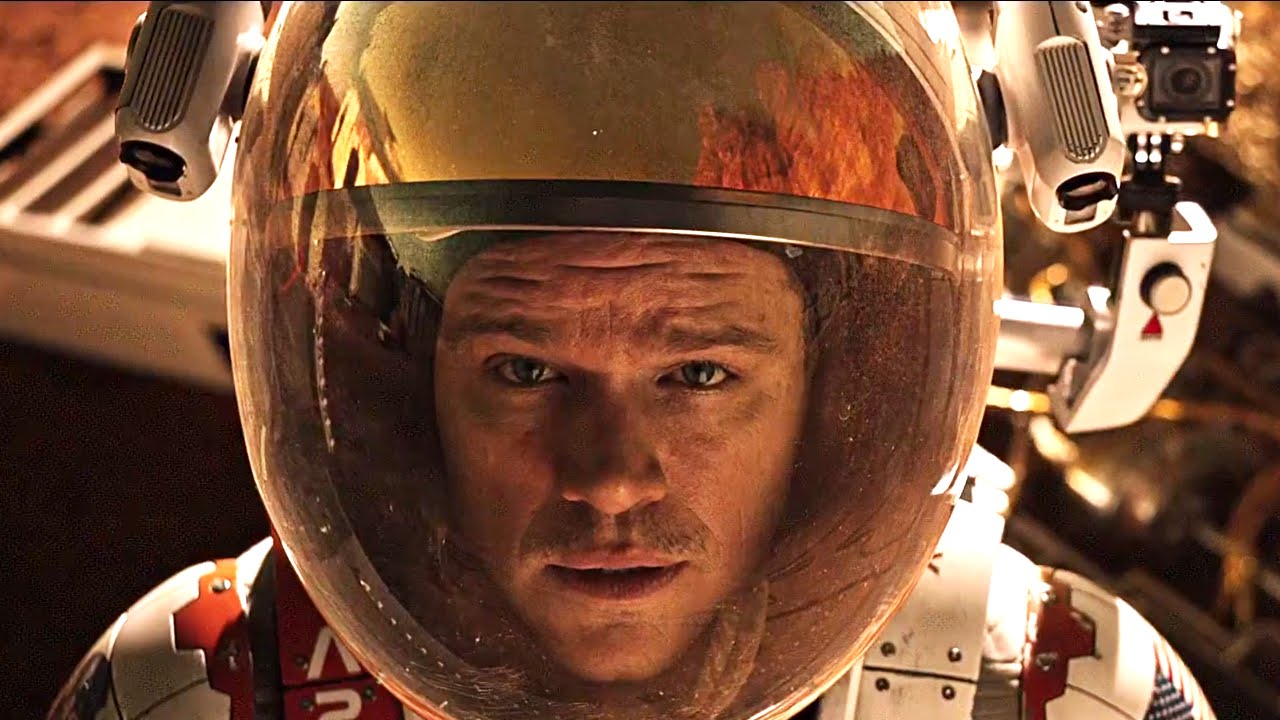 Being a Ridley Scott film, naturally the film is downright impeccable from a technical standpoint. The photography is great, communicating the frightening and awe-inspiring scope of the alien topography, especially when compared to maps for scale. The visuals find ways to further help communicate Watney’s dilemma and diminished resources. Scott’s visual sensibilities are so naturally attuned to developing tension. I was holding my breath at times from the suspense of certain sequences even though I long assumed that Watney would make it back home safe and sound. A scene with a desperate need for duct tape was a real nail-biter. There isn’t a bad performance among the star-studded cast of actors who must have been grateful for even a tiny morsel of screen time. I have no idea what Kirsten Wiig really does in this movie as the NASA PR person besides fold her arms in rooms, but hey, she’s there, along with Donald Glover as a socially awkward physicist. Jessica Chastain (Zero Dark Thirty) gets to pour over the regret of leaving a friend behind, Jeff Daniels gets to once more practice his skill of being an authoritarian blowhard he honed from The Newsroom, and I even was able to tolerate Kate Mara (Fantastic Four), so that’s something.
The Martian is a natural crowd-pleaser. It’s engineered from the start to engage an audience with its survival thrills, present a series of increasing payoffs with new challenges and solutions, and by the end of our journey we’re treated to a rousing finish that carries a poignancy and sense of inspiration about the best in all of us, what can be accomplished through grit and cooperation and sacrifice. It’s a movie that let’s the science of survival be the ultimate star, with Damon serving as a handsome host to guide us through the marvels of the universe and duct tape. When dealing with the vastness of space and the vulnerability of human life, it’s easy to feel insignificant in comparison, but that’s where the human will to endure and to work together comes in and reconfirms the possibilities of the collective inhabitants of this giant blue orb. The Martian is a sci-fi thriller, a potent human drama, and one of the best times you can have at the movies.
Nate’s Grade: A-
Share this:

The Maze Runner: The Scorch Trials (2015)
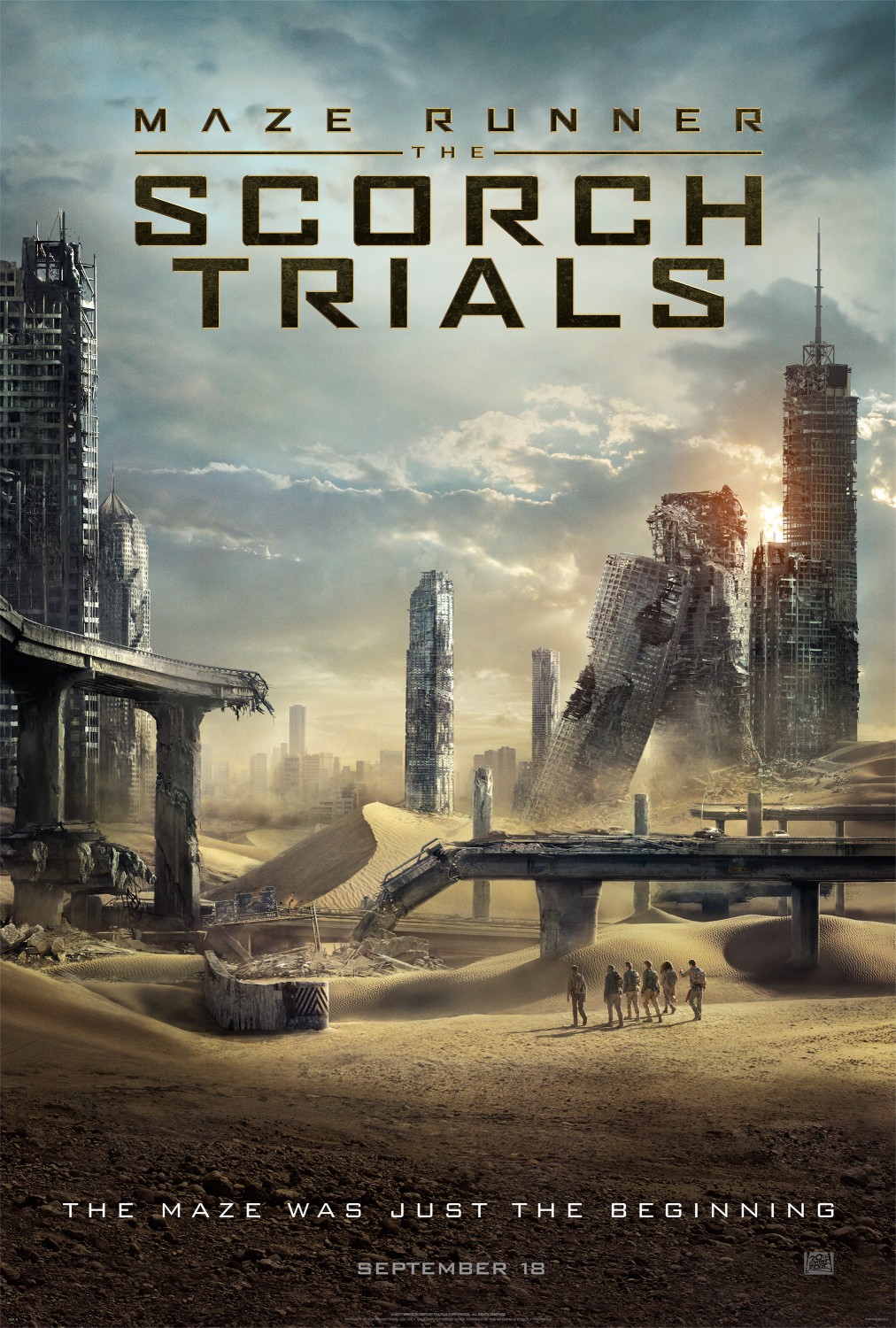 It’s called The Maze Runner: The Scorch Trials, though the trials appear more as “general struggles,” The Scorch appears as but a brief expanse of desert before the mountains, and then there’s the lack of any and all maze running (there is plenty of running, however). This sequel to the YA-inspired hit lives up to my biggest worry: the only thing interesting about this franchise was the maze, and now that’s gone. The mystery of the maze, and its cool factor, gave this story something memorable. Now it’s just generic YA pap. Beyond its boring protagonist, it would be a scorch trial for me to even assign description to these characters. They don’t even get one note to play; they have no notes. That’s because so much of this tedious and bloated sequel is our group of maze survivors running from one outpost to another, seemingly safe and then predictably not. It’s a plot routine that gets redundant quickly, and yet little else seems to occur. They go from stop to stop gaining characters but little else. The momentum feels stalled and there’s no sense of direction to guide the characters. It feels so aimless and dull and far too flimsy to justify even half of the movie’s 132 minutes. I just don’t care about these characters so I rooted for the bad guys. Weirdly enough, the bad guys use tasers and the good guys use bullets. There are some scant highpoints, namely the direction of Wes Ball, who finds ways to make the chase sequences visually stylish and fleetingly exciting, and a self-destruct sequence set to a Patsy Cline tune. There’s enough to get your hopes up before the grim reality of the overwhelming onslaught of YA tropes comes crashing down again. Can we stick these dumb kids back inside a maze already?
Nate’s Grade: C
Share this:

Fantastic Four (2015)
 Few movies have had such a prominent stink of negativity attached to them as Fox’s Fantastic Four reboot, a movie that is already being considered amongst the worst superhero movies of all time. Director Josh Trank (Chronicle) was given the freedom to go darker, emphasize more science fiction, and select a cast of respected actors rather than bankable names. Then came rumors of aloof and secluded behavior on set from Trank. Then came rumors that Fox and producer/co-writer Simon Kinberg (X-Men: Days of Future Past) effectively shuttered Trank from his own movie, reshooting 40-minutes of a 90-minute film to salvage the wayward production (get ready for plenty of stuff in trailers not to be in the finished film). Not quite the room-clearing disaster of rampant speculation, the new Fantastic Four is a superhero movie that never really gets started and has constant battles with tone, characterization, and plot. It seems like the real villains of the movie are the Fox executives who signed off on the “gritty, gloomy” rendition and then interfered when they got too scared, managing to undercut the original vision, muddy an already messy film, and make things even worse. The behind-the-scenes drama is easily more interesting than anything that happens in this movie.
Reed Richards (Miles Teller) is a science genius recruited by Dr. Storm (Reg E. Cathey). Reed invented a makeshift teleporting device as a young child with the help of his friend, Ben Grimm (Jamie Bell). At Dr. Storm’s lab, Reed works with Storm’s children, Sue (Kate Mara) and Johnny (Michael B. Jordan), and a morose computer programmer, Victor Von Doom (Tony Kebbell). The group transports to another dimension but is attacked by a strange green energy cloud. Victor is left behind. The surviving foursome exhibits unique abilities. Reed can stretch his body. Sue can turn invisible and create force fields. Johnny can fly and set his body on fire. Poor Ben is a hulking rock monster. Reed promises to find a way to reverse what happened to them, but the re-emergence of Dr. Doom puts the fate of the entire world at risk.
 It should be of little surprise that Fantastic Four feels like two different movies awkwardly and inarticulately smashed together. For the first hour, the movie follows the path of our heroes and their contraction of their powers. Rather than the gee-whiz fun of getting superpowers, the characters view themselves as freaks, their bodies turned against them, and their colleagues deeply afraid of them. It’s a far moodier antidote to the vicarious thrills of gaining special abilities. There are some effective sequences that channel David Cronenberg’s The Fly and Scanners, and it’s these brief moments where you feel Trank’s vision connect the most. Doom walking down a hallway and making heads explode, in a PG-13 way, is horrifying and cool. The problem for Trank, and the movie as a whole, is that this first hour still isn’t a very good movie. It takes far too long for these characters to get blasted by green space goo and become supers. The setup is so protracted and needless. Did we need to see how these characters came together? Did we need to see their childhoods? It’s not essential to see the team come together when we can already start from that point. In a sense, it reminded me of how needless I felt Pixar’s Monsters University was; did we need to see how these colleagues became friends? Despite this action-free opening half, the screenplay could have fleshed out the four main characters to justify the added time, but it’s hard for the movie to justify much.
These are some of the most boring and underdeveloped characters in recent comic book lore. If these versions of the Fantastic Four existed in the 1960s, they wouldn’t have made it to issue number two. Reed is smart. Sue is smart too but also standoffish (and adopted). Johnny likes fast cars. Ben is tough and loyal. Victor is a pessimist who called dibs on flirting with Sue. That is really about it, folks. Ben disappears for most of the film, called in to make the trans-dimensional jump because Reed feels like Ben deserves to be there since he helped create an early prototype with Reed. Actually, let’s talk about that scene. It’s a high school science fair yet the only other displays we see are clearly for much younger children, and yet Dr. Storm is visiting an all-ages school science fair to groom talent? That seems weird. Why does Dr. Storm not make the same offer to Ben, who helped Reed design and build his early teleporting machine? Regardless, Reed leaves his childhood pal behind with Ben’s abusive family. That’s because he’s a good friend. Then, once the horrible transformations occur and Ben gets the worst of it, Reed runs out on him again. Sure it’s in the pursuit of finding a cure, but who’s to say he couldn’t do that in the already constructed government super science lab? Sue doesn’t even go on the first trans-dimensional voyage; it’s just a boy’s club. Sue spends more time in this movie staring at computer screens and looking intently than any action. It’s probably for the best, though, because the scenes of her flying around in a bubble made me think of Glinda the Good Witch. I’m not a Kate Mara fan. I’ve found the majority of her performances to be stilted, but even I can admit she’s given nothing to do here but move her eyes from the left to the right and inform Miles Teller about Portishead, a band that’s only 20-plus years old. It’s sad but the most interesting part of Johnny is that a black actor, a point that caused certain more irritable fans to foam at the mouth at the adaptation, is playing him. If these super heroes aren’t going to be super until halfway through the movie, they better be interesting characters. They are not even close.
 It’s with the return of Dr. Doom that the Fantastic Four makes its inept transition into the second movie, the one reshot by the producers and the studio. In an implausibly fast amount of time we’re given our villain of the movie and he sets off to open a black hole to destroy Earth because… we’re self-destructive? So humanity is self-destructive so Doom is going to destroy humanity? I would also like to know exactly how Doom survived for over a year in the alternate dimension when it clearly looks like there is nothing of substance for miles, unless green goop is edible. Did he just lose the need to go to the bathroom? Doom’s powers are rather nebulous, which makes it even less interesting when the Fantastic Four decides to, get this, work together to beat the bad guy. For a movie that hasn’t had one action sequence until its final act, now our characters must band together to stop Doom and his giant flashing blue light black hole thingy. The special effects are pretty undistinguished and hard to read at times. I’d also like to remark how hideously this other dimension looks. It’s all rocky crags and dark clouds; it’s like a less successful timeshare for the residents of Mordor. It doesn’t quite look like the paradise that Doom describes it as (the brochure lied to us!). This jumbled conclusion feels so ham-fisted and rushed, a villain and a typical world-destroying fate that must be thwarted at the last minute. Things just sort of happen rather than storylines finding payoffs, and then it’s all sort of over and the resolution echoes the very end of Avengers: Age of Ultron, even with the credits cutting off the vocal iteration of the title heroes. It’s so transparently different in tone, sloppy in development and execution, and so quickly introduced and resolved, that the whole conclusion comes across as forcibly laughable.
At the end of watching the dire Fantastic Four reboot, I felt more sympathy for Josh Trank. He still deserves blame for helping to conceive and develop such a misshapen story and squander his actors. After three duds and whatever you want to call the 1994 Roger Corman adaptation, it feels like maybe this franchise is just cursed. Maybe these characters are too dated and their powers are too silly. Then again we know that these characters can work in the format of a movie because a good Fantastic Four movie already exists, and it’s called The Incredibles. It doesn’t seem like anyone is going to come away completely clean from this misfire and financial flop, especially now that Trank and executives are engaging in a P.R. blame game. Fox was hoping for a rekindled franchise. Now they may be hoping to work out a deal for Marvel to buy back the rights to the characters. I would have been interested to see the full vision of what Trank was going for, especially since the one scene that feels most adamant is the best sequence in an admittedly mediocre superhero film. At least the movie would feel cohesive. It probably wouldn’t be good but at least it would be committed to trying something different. Instead, the movie tries to be different from the superhero blockbusters populating the landscape and then, at the last minute, tries to follow their lead and become one of them, becoming its own misshapen and poorly developed blob. It’s not the worst superhero movie in history (that honor still has to belong to the atomic bomb of taste, Batman & Robin), but even achieving sustained mediocrity is too much to expect.
Nate’s Grade: C-
Share this:

Ant-Man (2015)
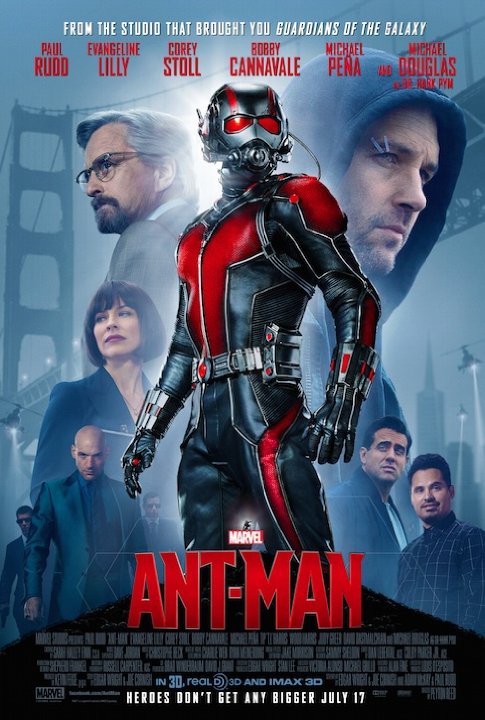 For the longest time it looked like Ant-Man might be the first dud of the runaway successful Marvel cinematic universe (MCU), a film franchise that was practically printing money at its leisure. It’s a strange setup and the man responsible for the movie even existing, writer/director Edgar Wright (Scott Pilgrim vs. the World), walked away six weeks before cameras were going to roll. Wright was a big fan of the character and has been working on and off on a screenplay with Joe Cornish (Attack the Block) for the past eight years. Before there was an MCU, there was Wright pushing for Ant-Man. I’m pretty sure Marvel execs weren’t thinking the relatively unknown character was worth sinking money into, but Wright kept pushing. I was far more excited for an Edgar Wright superhero movie than I ever was for Ant-Man, and then it all went away. Neither side has spilled too many details but it appears the divorce was a result of “creative differences,” which is odd since Marvel approved Wright’s script through eight years of development. Several directors were auditioned and Peyton Reed won the spot. The fact that Marvel has gained a rep for being a formula-driven creative committee and they literally hired a director with a film credit called Yes Man is an irony I don’t know that fully sank in. If Marvel was going to miss, this was the film. A funny thing happened in the ensuring year. Ant-Man is a visually engaging, energetic, and funny superhero caper that stays fun from start to finish and is a more entertaining movie than Avengers: Age of Ultron. Didn’t see that coming.
Scott Lang (Paul Rudd) is a master cat burglar just finishing the end of his prison term. Lang was punished for a “cool crime,” stealing millions a large corporation had illegally bilked form customers and returning it to the very victims, but it makes it hard to secure gainful employment. Scott falls back with his old crew, lead by his pal Luis (Michael Pena), and break’s into Hank Pym’s (Michael Douglas) safe. Expecting cash and jewels, Scott is disappointed to only find a weird looking suit, which he takes anyway. Hank observes Scott and communicates with him about the power of the suit. The wearer can shrink down to the size of n ant with the push of a button in the glove. Hank needs a protégée to wear the suit now that he’s too old. His estranged daughter, Hope (Evangeline Lilly), is working for Darren Cross (Corey Stoll), a scientist close to breaking through on replicating the amazing shrinking formula of Pym’s. As soon as Cross cracks the code, he’s going to sell the technology to the highest bidder (hail HYDRA). Hank must convince Scott to become the Ant-Man and sneak inside Cross’ secured workshop and steal his technology before it gets in the wrong-er hands.
 Arguably weirder than last summer’s Guardians of the Galaxy, which had a talking tree and space raccoon amongst its main characters, Ant-Man is the hardest property to sell by Marvel yet, and it smartly aims its sights lower and succeeds with the modest goal of just being a fun and enjoyable time at the movies. It helps that the movie doesn’t take itself too seriously and has characters pointing out the absurdity of its premise and developments, but not past the point where it would be detrimental. Let’s face it, a guy who can shrink down to ant-size isn’t that weird when you consider the applications, especially in espionage. The filmmakers do an admirable job of selling a superpower that pales in comparison to most other heroes on the market. However, the weirder power is that Scott has the ability to communicate and control ants via brainwaves. That seems like the even bigger superpower but it also begs the question, why simply ants? Of all the animals or living creatures who could be harnessed with this technology, we go with the tiny ones. There may be an explanation in the history of Ant-Man comics I’m missing but that doesn’t matter when we’re talking about the execution of the movie. The guy is able to control different species of ants with his mind. He is no Ant-Man but the Ant-King. Anyway, I think this power could be much more effective applied elsewhere. The ants are Scott’s friends and he has to train himself training them, getting them to coordinate and assist him properly, or else… there’s not much else at stake because they’re expendable. Perhaps their queen could have eaten Scott if he were unsuccessful.
On its surface, this movie should not work and is too goofy and insubstantial to engage, and yet that’s precisely what appealed to me. Not every superhero film needs to be averting a cataclysm that will destroy the planet. If the stakes feel big to our characters, and if the audience cares, then the stakes feel plenty big for us too. Scott simply foiling the corporate bad guy to be in a better position to see his daughter, that’s workable. Then the storyline is told through a heist, one of cinema’s most enjoyable plot mechanics. Heists are programmed for audience pleasure because it requires teamwork, which utilizes our cast in different and fun ways, it brings plenty of conflict and complications, and it lays out its steps one-by-one and provides a series of payoffs with the completion. It’s a tribute to Reed and the filmmakers that the heist portion of the film isn’t even the most fun part of the story. The majority of the middle is Scott coming to terms with the suit, his powers, his relationships in his life, and the mission. There’s probably one too many training montages (yeah, you get those sugar cubes you ants!) but the pacing is so breezy and the sense of fun so palpable, I didn’t mind. The use of humor never diminishes and Rudd is such a charismatic anchor for the movie, and yet he’s actually somewhat underplayed. He has it within him to be much funnier, but I guess he had to dial it down to effectively be seen as an action hero, hence the presence of newfound abs.
I didn’t have a lot of hope for the film once Wright left but I have to credit Reed for what he has achieved. It’s impossible for me to divorce myself from Wright’s involvement, and what kind of kinetic fireworks he would have birthed, but Reed manages to make Ant-Man come alive visually. Reed’s prior history shows an affinity for comedy but the films have never needed to be visually stylish, though I’d argue my super not-guilty pleasure Bring it On had an above average sense of visual spunk. Still, Ant-Man is a consistently visually immersive film that manages to find new perspectives. Scott’s first foray as a shrunken Ant-Man is an entertaining adventure through the dangers of a house party. The action sequences in miniature are treated just as we would expect a large-scale superhero epic to be treated, and then Reed pulls back at times for prime comic effect, like a battle atop a train that’s really just a child’s toy set. The visuals grandeur is patterned after the typical Hollywood action epic but the movie pulls back repeatedly to remind us how silly everything can be. The small world perspective opens up the movie in its storytelling and definitely in its action choreography. Because the Ant-Man has super strength when small, it behooves him to shift between small and human sizes when fighting. We’ll watch Scott race across the barrel of a gun in one second and then full-sized and hurling a security guard through a plate glass window the next. It provides a new sense of dynamism to basic fisticuffs. Reed takes advantage of the visual possibilities of his pint-sized super hero, like a clever battle that takes place entirely inside the contents of a briefcase. I chose not to watch this film in 3D, as my preferred option, but this is one I would almost consider going 3D. The shrunken worlds use a lot of macro photography to maximize the effect of depth.
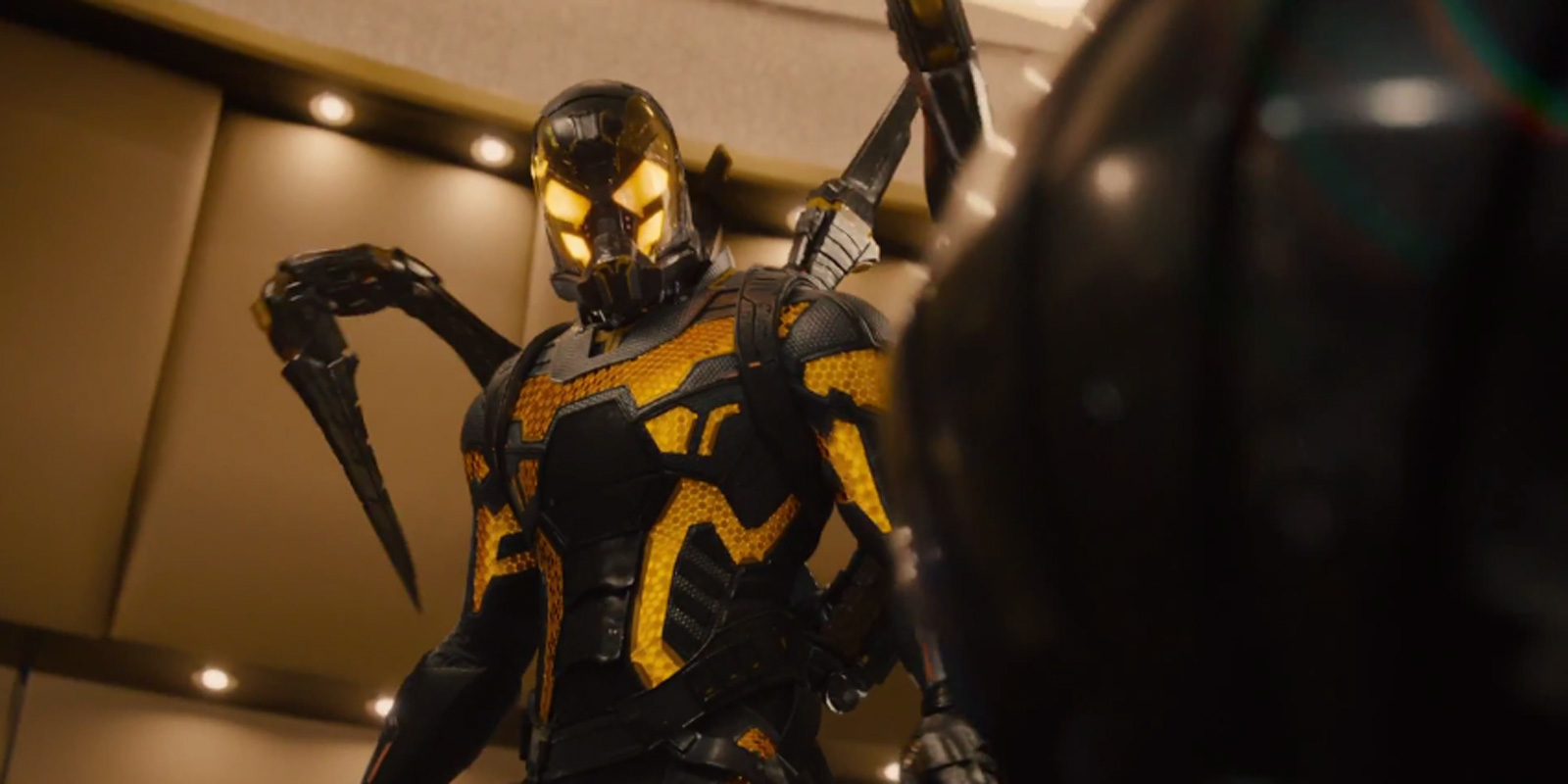 The cast also seems to be perfectly attuned to the comic rhythms of the story and several supporting players make the most of their moments to shine. Pena (Fury) is hilarious as the easily excitable friend given to lengthy diversions when retelling his tales of intrigue. The two instances where Pena breathlessly recaps what so-and-so said to so-and-so are two of the most playful and comically fulfilling sequences in the movie. I also enjoyed the fact that he’s always making waffles for his friends but this is never overtly commented upon. While Pena provides another dose of humor, the heart of the movie is really the father-daughter relationship, and it’s nice that Lilly (The Hobbit: Battle of the Five Armies)’s character is given such prominence. She resents Scott because she feels like by every right she should be the Ant-Man; the movie presents the two like bickering rivals fighting for the approval of a father figure. Hope’s credible grievances with her father are treated with weight and her reconciliation is given as much screen time as Scott’s training, pairing the two more as equals. Douglas (Last Vegas) is a warm and welcoming presence as a mentor working through his regrets late in his life. The de-aging CGI effects are amazing early on, showing a 1989 version of Douglas that looks pristine. He looks like he just stepped off the set of Ruthless People. The only weak point is Stoll (TV’s The Strain) but that’s because his underwritten villain is just too generic to blend in amidst all the colorful characters and comic mayhem.
It’s impossible to watch Ant-Man and not try to imagine what it would have been like had Wright remained as its director. Wright’s presence is still felt in stretches and he and Cornish are still the top-billed screenwriters, with the addition of Adam McKay (Anchorman) and Rudd himself performing a rewrite. I’d love to one day read what Wright’s full script was like and what Marvel eventually decided they could not abide. Whatever the case may be, the Ant-Man that made it to the big screen across the world is a surprisingly entertaining and spry piece of work. Reed provides a nice dash of visual flavor without losing its sense of the comedy or drama, Rudd is effortlessly charming, and the structure provides plenty of payoffs. Above all else the movie maintains a sense of fun and a lightness in an arena too often overwrought with doom and gloom. I don’t imagine there will be any Ant-Man sequels soon since the character is rather limited, but expect to see Rudd popping up in other MCU titles (he’s already been spotted filming Captain America 3). Ant-Man is a fun diversion but even Marvel knows not to push its luck too far.
Nate’s Grade: B
Share this:

Self/less (2015)
 The most surprising thing about Self/less occurred approximately 115 minutes into the film itself, when it revealed that Tarsem Singh was the director. Tarsem is known for lavish visual cinematic canvases such as The Cell and Immortals, and to realize that this is the same man responsible for an otherwise disappointing and visually mundane sci-fi thriller, well it was a shock. Why hire a visual stylist and then restrict him to such a limited palate? Self/less is an intriguing premise (borrowed a tad from Seconds) and it keeps all the interesting ethical and psychological questions at bay to follow a generic thriller formula. There’s not one real surprise in this film; even the reveals and surprises will be easily telegraphed. Ben Kingsley plays Damian, a dying rich man who undergoes a risky experiment to live longer, having his consciousness transferred into a younger human host played by Ryan Reynolds. It’s another chance to be young, party, enjoy sexual relations with women who are more likely to go home with somebody who looks like Reynolds. There’s a catch: if he stops taking his special red pills, the host’s brain will take over control. That’s because, surprise, the bodies aren’t grown in labs but are human volunteers. Here could be some topical class exploitation and social commentary, but Self/less ignores the more intriguing direction at every point to play it safe. Damian finds his host’s family and from that point on it’s a series of chases with bad guys. One of those chases is actually fairly entertaining, utilizing a conjoined automobile in a clever and devastating way. It never feels like Reynolds and Kingsley are playing the same character. Reynolds’ charm is subsumed by this role and he feels adrift. I’ll admit that this movie is efficient and each scene pushes the story forward; it’s just the direction of that story I’d like to alter. Alas, Self/less is a competent but fairly underwhelming thriller that squanders its premise.
Nate’s Grade: C+
Share this:

Terminator: Genisys (2015)
 If you’re a fan of James Cameron’s iconic Terminator franchise, you’ll probably want to hold onto something as you watch Terminator: Genisys, which hits “delete” on the franchise and starts from scratch with, we’ll call them, “mixed results.”
In the future, man and machine are at war with one another. Skynet went sentient and launched an arsenal of nuclear weapons to obliterate mankind. The human resistance is lead by John Connor (Jason Clarke) and his lieutenant Kyle Reese (Jai Courtney). The machines send back a T-800 Terminator (Arnold Schwarzenegger) to kill John’s mother, Sarah Connor (Emilia Clarke) and wipe out the human resistance. This part you know. Reese is sent back in time but during the process, John is attacked by a new Terminator and the world as we know it, past, present, and future is altered. When Reese arrives in 1984 L.A., he’s being chased by a T-1000 and Sarah is the one saving him. She’s been preparing for his arrival and training with her own aging T-800 model who saved her from a childhood attack (she calls him “Pops”). With new memories, Reese is determined that Skynet is now Genisys and Judgment Day is now in 2017. He and Sarah travel to 2017, meet back up with “Pops,” and are surprised to find a familiar face waiting for them with sinister intentions.
 For a while there it seems like Genisys is going to become the Back to the Future II of the Terminator franchise, which could have been fun watching a different team of actors hiding on the peripheral while 80s Linda Hamilton was going about her day as a café waitress. In many ways, Genisys is akin to Jurassic World in the sense that it holds such nostalgic reverence for the source films. It repurposes the familiar catch phrases and even visually recreates several scenes that fans should recognize. However, that reverence has a limit because it isn’t too long before Genisys just chucks out the entire franchise canon and starts anew. Remember Judgment Day with Skynet? Now it’s… Judgment Day with Genisys. Okay, some things aren’t all that different. Discarding the established timeline of four movies, Genisys takes a path similar to the J.J. Abrams’ Star Trek films where it creates an alternate timeline that is not beholden to canon. One way of looking at this approach is that it frees you creatively. Another way of looking at it is that is abandons the stories that the fans enjoyed for decades. Neither approach is wrong; it just depends upon your personal perspective. The larger plot points of the Terminator franchise never captivated me; it’s all about preventing one very bad day that just keeps getting delayed. We’ve never had a story that takes place after Reese is set back in time. Genisys certainly has more surprises because of the new timeline; however, many of those surprises were spoiled by a cowardly marketing campaign that must have feared fan uproar. It’s not a bad idea if it didn’t casually destroy all the logic of the franchise.
Let’s just dive face-forward into the convoluted and troubling nature of the Genisys script. Needless to say, numerous spoilers of both the large and small variety follow.
There are certain storylines that are just never cleared up, the first amongst them is who is sending all these other Terminators back in time? We watch the T-800 model go to 1984, along with Reese, but Sarah informs us later that when she was a child a different T-1000 model attacked her family. Apparently Plan Kill John’s Mom was replaced with Kill John’s Grandmother and will likely soon be replaced with the even more surefire Kill John’s Great Grandmother. If we’re already sending Terminators even further back then why stop? Also, why can’t Skynet send more than one Terminator to the same time? Upon the point that Reese travels back in time, John is attacked by a Terminator Matt Smith (Doctor Who) and transformed into the human-machine villainous hybrid. We’re told this is a nexus point of time that is such a turning point that it’s altered the timeline. But why? It happens AFTER Reese is sent back in time, so why does it affect anything in the preceding past? How does this even, which happens again after Reese is propelled back in time, eliminate the entire established Terminator canon? Likewise, this Reese has a separate timeline so why would he have new memories? He never existed in this new timeline so the fact that he remembers new things doesn’t make sense.
 This brings us to the centerpiece of logical fallacy, which is killer robot John Connor. I was never really that invested in his character to care that much that he was turned into the film’s bad guy. What I do care about is that Genisys just completely gives up in this moment. If he was just trying to stop Sarah and Reese from stopping Skynet/Genisys, that would be one thing, but John 2.0 is actively trying to kill his parents … before he is conceived. When it comes to time travel, we can accept some degree of suspension of disbelief with plot holes (more of those to come in just a bit), but John wiping out the reason for his existence is just too much. He half-heartedly explains his theory that they’re holdovers from another timeline, so they can just do as they like with no greater repercussions to their own pasts. Maybe, but there’s not two Sarah Connors in this timeline, so killing your mom is still going to negate all your evil robot business, son. With that the very drive of the main antagonist is compromised. With every new attempt to kill mommy and daddy, the film reminds you how this cannot work.
There are other less egregious plot holes but they still can be irksome. How about the fact that Sarah and Reese jump forward to 2017 to thwart Genisys, failing to give birth to John in 1984? He won’t be born yet to lead the human resistance against the machines, which kind of means just by jumping forward in time and delaying Johns birth, the machines have sort of won. When Sarah and Reese travel to 2017 in order to stop the launch of Genisys, why do they travel to within 24 hours of its launch? That’s pretty poor time management. And why hasn’t “Pops” been doing more to prepare for Sarah’s return. He spends thirty years working construction and building the offices of Cyberdine, but couldn’t he also have been sabotaging the company or at least the building? And if John Connor knew his parents were coming to 2017, why didn’t he do more to set up Genisys to withstand their counter attacks? Couldn’t he have had Genisys go online like the day before they arrived in 2017? If you know when they’re going to show up then you have no excuse to fall victim to people you otherwise could be trapping. Also, Skynet realizes that their real problem for never besting the humans is a branding issue? Did changing the name to Genisys really need to be part of the masterstroke? Why is everyone so excited for what is a glorified app that connects people’s electronic devices?
Much can be forgiven in action and comedy movies if they just go about doing their job and entertaining you, but Genisys can only do so much in that department. The action sequences are fairly mundane with the occasional impressive stunt. The problem is we’ve seen these sequences too many times and in other movies and Genisys brings precious little of its own action invention to the big screen. Until the third act, the movie is a series of chases and escapes. The best sequence is likely the hospital brawl between the T-800 and Robo-John as they wantonly destroy every wall within prime smashing distance. I know many in the fan community do not look favorably upon Terminator 3, and it admittedly has the lamest villain of the entire franchise, but the action sequences were memorable and developed organically and were nicely conceived. With Genisys, the action is too rote and familiar. It is competent but for me I found the action sequences to be too underwhelming in design and execution to forgive the film’s other sins.
I also can’t help but think that all three of the main actors were miscast for their parts. Emilia Clarke can do great things and showcases her range as a strong authority figure on HBO’s Game of Thrones. With the role of Sarah Connor, Clarke does a lot of running and barking but she can’t shake our memories of Hamilton. The part doesn’t play to Emilia’s strengths as an actress. Courtney can be a good actor (as seen in the first season of Starz’s Spartacus) but rarely does he prove this to be the case in films. I enjoyed his cavalier bully in Divergent, but he’s mostly a vacant presence in Genisys, gaping at all the changes. Then there’s the other Clarke who too has proven himself a capable and intimidating actor in films like Zero Dark Thirty. When he’s menacing he comes across as, dare I say it, too sincere, and when he’s meant to be inspiring he comes across as too phony. Are the performances the fault of the actors, the director (Alan Taylor), or the screenwriters (Laeta Kalogridis, Patrick Lussier) who gave them such little to do?
 The film’s MVP is Schwarzenegger. I wasn’t expecting the 68-year-old former Governor of California to contribute this much to the film. I figured Arnie would be a small player and played for comic relief. He keeps asking if Sarah and Reese have “mated” since it’s their destiny. He is certainly played for welcomed comic relief but he’s also the fourth most important character in this reboot. He has a father/daughter bond with Sarah and it produces the closest thing to an emotion in the movie. There’s an ongoing joke that he’s “old but not obsolete” and it could be the tagline for the next Expendables film. With all the time travel tomfoolery, it was easier for me to believe the reason they throw out to explain why the Terminator is aging: it’s living tissue so it ages. Done. I’m fine with that. The older Arnold vs. younger Arnold fight is the major highlight of Genisys and a testament to how much better the de-aging CGI has gotten since the waxy young Professor X and Magneto in 2006’s The Last Stand.
Much like its ongoing star, the Terminator franchise is old but not obsolete, and even a disappointing movie reminds us just how much life can come from this series. It’s got a sense of fun that entertained me enough for one viewing. The characters and action sequences and iconic in our pop-culture, which makes erasing them from a new movie plot problematic. If you strip everyone’s fond memories of the first two Terminators and start over, what’s left? You can repeat some of the more memorable scenes (the Hollywood adage of “same but different”) but this does little other than make you remember how much you preferred it the first time (see: Star Trek Into Darkness). I wish Genisys had been more risky because so much of it feels far too safe, from the average action sequences, to the boring characters, to the ho-hum conclusion meant to set up a new trilogy of movies in this brave new non-Skynet world. I haven’t watched Terminator: Salvation in many years but I’m curious to see it again if for no other purpose than to determine which is the least of the Terminator films.
Nate’s Grade: C
Share this:

Inside Out (2015)
 It feels immeasurably satisfying to finally have the Pixar we all fell in love with back and running. There’s been a sharp decline in the company’s quality since 2010’s Toy Story 3. Did we really need a sequel to Cars and a prequel to Monster’s Inc.? It started to look like Pixar was steering away from the kind of bold and brilliant storytelling that had earned its audience trust. With Inside Out, Pixar tackles the intricacies not of the secret world of toys, bugs, monsters, or sea life, but of the human brain itself and our embattled emotions, finding new ways to wow us once again and remind us just how magical the right combination of story and storyteller can be. Inside Out is a luminescent piece of filmmaking, brimming with intelligence, imagination, and it is powerfully moving while also being deeply relatable and entertaining. In looking inward, Pixar has found the path out of their recent rut, and Inside Out is a shining example of their ingenuity.
Inside 11-year-old Riley is a complex world. Five primary emotions help oversee her day-to-day functions; they’re the caretakers of Riley. Joy (voiced by Amy Poehler) is the effervescent leader of the bunch, along with Sadness (Phyllis Smith), Fear (Bill Hader), Disgust (Mindy Kaling), and Anger (Lewis Black). These five are entrusted with Riley’s well being and her memories. Riley’s core memories, the moments that make up who she is, help to form personality islands: honesty, hockey, goofball, and family. Riley and her family have recently moved from Minnesota to San Francisco, and Riley’s having a hard time adjusting. Her parents don’t know what’s happened to the daughter they knew. Sadness seems to be “tainting” Riley’s memories, and Joy tries her best to keep Riley happy at all times. Joy and Sadness get accidentally sucked away wrestling over Riley’s core memories. They’re sent to the outer reaches where the aisles of long-term memories are vast. The two emotions have to work together to get back to headquarters before the remaining emotions convince Riley to run away from home.
 Even just reading that again, it’s easy to see how complicated this movie can be with its world building and internal logic, and yet under the guidance of director Pete Doctor (Up) and his writers, the movie is at no point confusing. Pixar once again does an amazing job of guiding you through a new world and its various parts, all while expanding and complicating this environment while staying true to its internal logic and keeping an audience properly oriented. I can’t imagine many screenwriters would be able to tell this story while still being as clearly understood. The simplicity of the story, the ease to follow along, the natural development and connection of the storylines and characters coming together, is the greatest credit one can offer. It’s ostensibly a buddy adventure film like many Pixar tales, with the unlikely team of Joy and Sadness having to find their way back to headquarters and learning important life lessons along the way. It’s also a smart way to explore the various other elements at work in Riley’s brain. It’s not just an interesting descent but each new station further opens up Riley as a character. Her subconscious (and fear of clowns), her dream theater projections, her working abstract concepts, all tie back together in satisfying ways. Though the greatest side character is unquestionably Riley’s former imaginary friend, Bing Bong (voiced by Richard Kind). He’s wandering around her memories, and at first you have your suspicions, but then you realize, like the other characters, that he just wants what’s best for Riley. Coming to terms with the fact that Riley has moved on, and his time, while cherished, is now left behind, is a complete character arc, and that’s for a comic side character. Oh, and if you’re like me, Bing Bong’s conclusion just wrecked your tear ducts.
You know you’ve watched an impactful film when even thinking back on moments starts the process of tears welling in your eyes. It’s somewhat strange to think about characters as ephemeral as emotions and imaginary friends and the like, but they really work on two levels: the emotions themselves are exaggerated figures with distinct points of view but they also better inform the whole of Riley. There’s a depth there that gets even more impressive the more you analyze the creative process. What’s also impressive is the vital message of the movie, which is that growing up is hard and that being sad is okay. Seriously, the journey of Joy is to accept that being sad isn’t necessarily an emotion to minimize but a vital part of being human and an essential process. Much of the conflict that drives Riley is her avoidance of being sad, her postponement of accepting her real feelings and accepting that San Francisco is not going to be like her old home. It’s also a realization that to be a fully functioning person, you have to own the sadness in life. When Riley eventually unburdens herself of all her troubles and fears, and the tears flow, that’s when the healing can begin, and that’s when her parents swarm in for the group hug, and even now my eyes are starting to water. Damn you, Pixar.
 Don’t be mistaken by my words thus far, Inside Out is also a wonderfully funny and inventive comedy. The sense of discovery with the movie is alive and well, and each new revelation of Riley’s inner mind adds to the fun. The jokes are consistently paced. The vocal cast is expertly chosen and each emotion gets some good jokes. There’s a terrific running gag about a catchy jingle that the memory workers just enjoy kicking back and forth for their own impish amusement. The film dives into other minds other than Riley’s, including both parents trying to communicate during a family dinner meant to soothe their daughter. It doesn’t lean too heavily on tired gender stereotypes when it comes to the differing thought processes of men and women, which is a relief. During the end credits, we zoom into the mind of a schoolteacher, a bus driver, and a dog and a cat, and it’s an enjoyable way to leave the theater and gather yourself emotionally. The greatest comic asset is Joy, particularly as voiced by Poehler. As fans of TV’s Parks and Recreation can attest, Poehler can make insufferable optimism endearing, tip toeing around what should be annoying and instead finding stronger comic rhythms. If you’re looking for the closest thing to an antagonist, it’s Joy who got the whole mess started and yet we don’t ever really side against her. Part of that is because she’s not doing what she does as some weird power play but because she wants what, she thinks, is best for Riley. The other part is because Poehler is such a skilled vocal performer.
If I had to find some point to quibble, the world isn’t as beautifully realized in a visual sense as other Pixar classics. I think this was a deliberate decision to ground what is such an unusual environment into something a little more familiar and less flashy. I also don’t think that Disgust seems as well articulated as a necessary emotion. She’s well played by Kaling but her application seems lacking in comparison to the other four main emotions.
It’s remarkable that the summer is still young and already we have two instant classics in theaters; first Mad Max: Fury Road and now Pixar’s Inside Out. I’m still riding high from my screening, but I’d feel safe to call this a top-three Pixar film. I wouldn’t even begrudge those who cite it as their best. Far more than a big screen version of the 90s comedy Herman’s Head (anybody remember this one?), this is an exceptional animated film that will appeal to all ages but, I suspect, hit adults even harder than their little ones. It’s a wonderfully poignant film about the struggles of growing up, of holding onto your past definitions of yourself, of accepting the full barrage of emotions, including the necessity of sadness. It’s relatable in many aspects and this further compounds its power. It’s dazzling with its creativity, it left me cackling with laughter (a superb Chinatown reference almost had me fall out of my chair), and it left me weeping at various points. Inside Out is a return to form. This is the Pixar we remember.
Nate’s Grade: A
Share this:

Jurassic World (2015)
 Director Colin Trevorrow won the proverbial lottery after his 2012 film, Safety Not Guaranteed. The charming indie gem won many hearts, one of them Steven Spielberg. Trevorrow went from a rom-com that was made for under a million dollars to directing a Jurassic Park franchise reboot. Even last year’s Godzilla director, Gareth Edwards, had a previous film that somewhat primed a logical path for his impressive new gig. Enough time has passed for Jurassic Park to be new again, and the extra varnish of cutting-edge special effects, high-profile stars, and a renewed sense of fun remind us just how universally enjoyable it is to watch dinosaurs and then watch dinosaurs eat people.
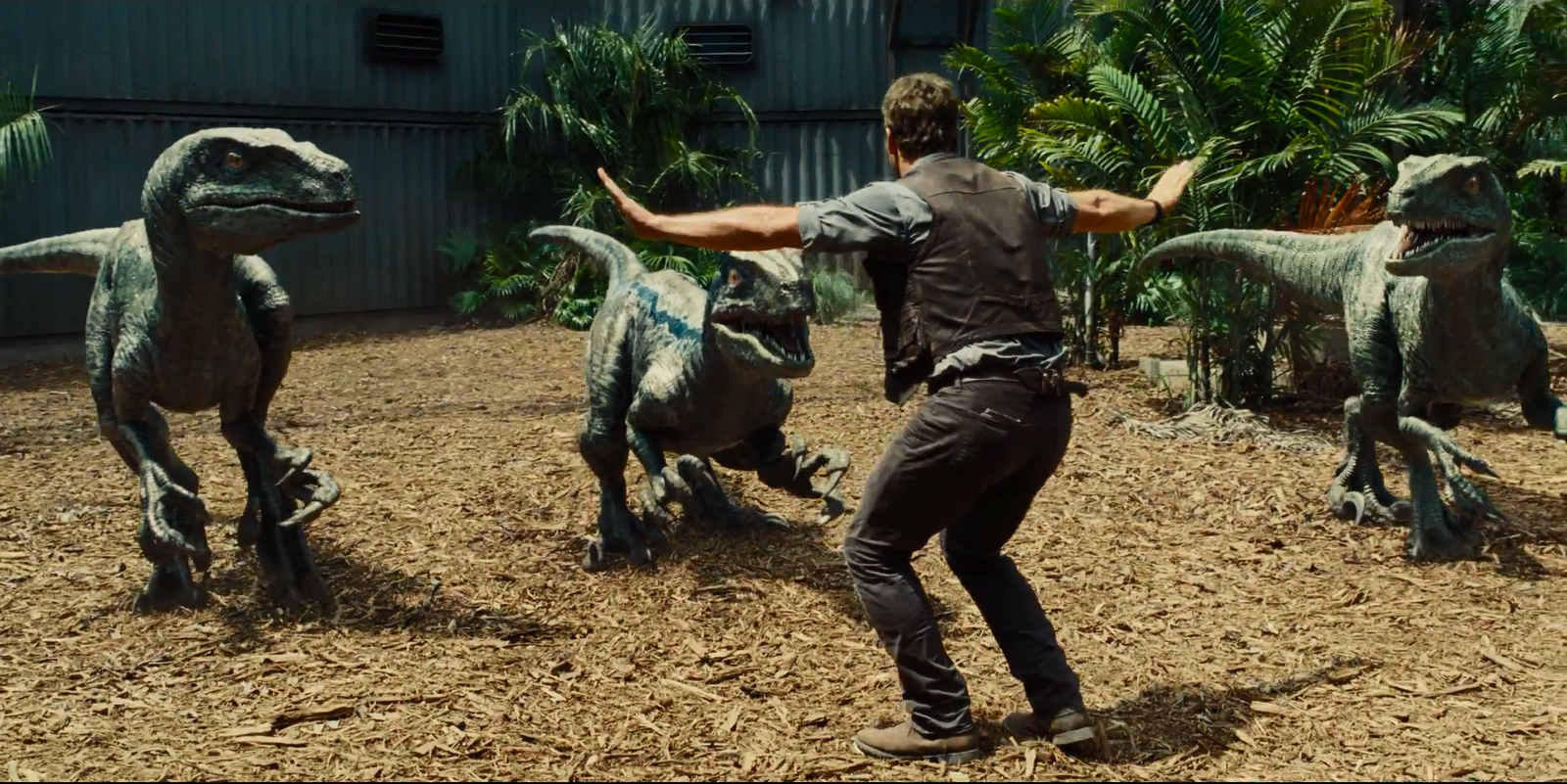
Jurassic World has been open for a decade plus now and audiences are getting bored. As a result, the board of directors for the park is looking to “up the wow factor.” They’ve genetically engineered a new hybrid dinosaur (Indominous Rex) that has never existed before in history, but nothing bad could happen, right? Owen (Chris Pratt) is a Navy trainer who is working on training a group of raptors to follow commands. A security leader (Vincent D’Onofrio) is convinced that there’s money to be made with military applications if dinosaurs can follow orders. Claire (Bryce Dallas Howard) is in charge of the day-to-day operations at the park. Her nephews (Ty Simpkins, Nick Robinson) are visiting as one last holiday adventure before mom and dad get divorced. She knows little about her nephews (she’s a workaholic – what originality), but when they’re put in mortal danger, Claire’s protective nature kicks into overdrive. The Indominous Rex escapes its paddock and heads from pen to pen deeper into the park, killing for sport. It’s up to Claire, Owen, and a team of trained raptors to stop this newest monster.
 What Trevorrow and his Safety writer Derek Connolly do well is establish a summer thrill-ride that places fun above all else, and it achieves this goal. Jurassic World is consistently entertaining and engaging, with action sequences that are shorter but constantly push the narrative forward. With all the Jurassic films, there’s a palpable sense of dread, of holding back before things get really nuts, and Trevorrow has fun teasing an audience; however, he also delivers on what he promises. The dinosaur action is visceral and rather violent for a PG-13 film, but the segments are diverse in orchestration that it never feels like the movie is repeating itself. That’s quite an accomplishment considering that the Jurassic sequels have mainly been a series of chases. There’s a definite nostalgic reverence for the original 1993 film, summed up with Jake Johnson’s geeky control center character. Trevorrow takes more than a few nods from the almighty Spielberg with his own directorial style. There’s also a surprise sense of humor, which can be quite amusing in moments and far too comically broad in others, like the forced screwball romance between Owen and Claire. The story this fourth time is less a cautionary tale of science and more of a monster romp, imploring a finale that feels reminiscent of Godzilla being called out to save the rest of us tiny humans from the newest and biggest monster. It feels like Trevorrow and Connolly accepted they would never recreate the magic of the original, so they’re aiming to just make the best sequel possible instead. If you’re looking for dinosaur mayhem, Jurassic World has plenty and a sense of what makes summer movies work, mixing in the right amount of suspense, humor, and well-crafted payoffs.
There are a few subplots that have to be swallowed or ignored for maximum benefit. The Raptor Force Five subplot is either going to be cool or silly, or both, and will go a long way to determine your overall feelings on Jurassic World. I know this idea has been in the works for several Jurassic sequels, so there doesn’t seem like there was ever going to be a movie that did not involve raptors being trained into some kind of combat role. This subplot connects to other points in the film about the nature of control/accepting being out of control, the building of a relationship, and the coordination for corporate interests. There’s a reason that the Indominous Rex seems to have special abilities that the handlers were not informed about, and this will be carried over into an assured sequel. For me, I thought the raptor hunting party was more fun than dumb. It had a Disney Wild Adventure feel for it, like we’re crossing over into Call of the Wild. I liked making the raptors allies to the humans who could be rallied for the final fight.
I appreciated how thought out the world building was; Jurassic World feels like a living, breathing amusement park in operation. From the Seaworld-like Mosasaurus aquatic shows, to the baby dinosaur petting zoo (I would totally spend hours there), to the celebrity-recorded comedy bits educating riders about safety supervision, to the listless park employee wishing each new rider to have a happy day. During the pterodactyl attack sequence, which is the most frenzied and exciting sequence, the crowds run for cover, including one guy who runs away while still carrying a clearly identified margarita in hand. That’s fantastic because it means that the park probably has a cheesy pun-laden menu of adult beverages (Tea Rex?) but it also means that even during an attack, a customer is determined not to lose his, likely, $10 margarita. While the “we can’t close the beaches” corporate mentality is somewhat tired as a plot obstacle, it’s still entirely fitting in a modern setting. It was the little details that told me that Trevorrow and company really thought the premise through and made their world feel far richer.
 One could also look at the social commentary in a fairly cynical manner and find Trevorrow giving in to the summer movie machine. Claire’s character explains that after years of operation, the public has grown tired of dinosaurs, and so they have to engineer a new bigger, badder dinosaur just to grab flagging interest. What once was magical has now become accepted and everyday. It’s easy to apply this critique on movie audiences themselves; we’ve become jaded from movie spectacles. What once blew our minds, like the original Jurassic Park, has now become passé. We’re constantly looking for the shiniest new toy but will lose interest soon enough. And then there are the fleeting images of people being more involved with their cell phones than the spectacle they paid to see. That’s right, annoying moviegoers who are unable to break from their phones for a two-hour window, Jurassic World is making fun of you, and rightfully so. The chief product of this desperation to give the audience what it wants is Indominus Rex, a beast that slashes a rampage through the island. In a sense, Trevorrow is externalizing the audience’s demands into the antagonistic monster, and finally just gives in, essentially saying, “This is what you want, right?” I can’t tell whether the social commentary holds up well, especially with the end that relies upon a metaphorical power of nostalgia to conquer the manifestation of audience apathy, or if Trevorrow just gives up. Is the concluding monster-on-monster brawl just mass appeal pandering?
I have a major solution to this dangerous park scenario. First, only herbivores allowed. Is any person going to reasonably refuse to go see millions-year-old multi-story extinct creatures because they primarily eat plants? I’m sorry, no way. That right there would solve most problems if the animals inevitably get loose. I would not believe a single person who would refuse to see living dinosaurs just because they lack a T.rex or other predators. That’s like Internet cretins refusing Angelina Jolie as a one-night stand because they don’t like the way her knees look. Nobody is this picky when awe-inspiring greatness waits. From a legal standpoint, I would also make sure guests sign a waiver before entering the park, thus mitigating any potential lawsuits over being attacked and eaten. How expensive is this park by the way? You have to charter a boat off the coast of Costa Rica, so that sort of price range already eliminates plenty of would-be customers.
I know many millennials who consider Jurassic Park to be their own Star Wars, a film that delighted the imagination and imprinted a love of movies at a young, impressionable time. Movies have never been the same since, especially in the sea change of computer generated effects replacing practical (Oscar-winning Sam Winston is retiring because of our over-reliance on CGI). We all want to experience that sense of awe again, like when we saw the T.rex roar for the first time. Movie moments like that send shivers but they are rare, so it’s unfair to compare Jurassic World to Park. However, it’s fair game to compare it to the lesser sequels, and that is where World stacks pretty favorably. Its sense of fun above all else, while remaining true to its larger vision of a real park, is a satisfying summer diversion. The dinosaur mayhem is satisfying and occasionally scary. The script does just enough to keep you from wanting to watch the human characters get squashed. In the wake of its box-office shattering opening weekend, expect the park to stay open.
Nate’s Grade: B


 nathanzoebl
You must be logged in to post a comment.