Blog Archives
Zack Snyder’s Justice League (2021)
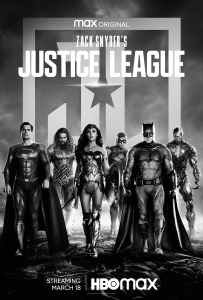
Zack Snyder had a unique situation that many filmmakers would never get close to fulfilling. He departed the 2017 Justice League movie in the wake of a family tragedy, Joss Whedon was hired to direct and rewrite extensive reshoots that totaled an estimated additional $30 million dollars, and the world was given the strange amalgamation of two different filmmakers, along with the nightmare-inducing CGI baby lip to replace actor Henry Cavill’s mustache. The 2017 theatrical release of Justice League was meant to be a significant milestone for the DCU, launching an all-star assembly of superheroes and setting up future solo adventures and franchises. It was meant to be a major kickoff and it was simply a major shrug. The general public was indifferent to the 2017 League, and it seems like the DC brass is positioning for a cinematic universe do-over, retaining the elements they liked (Jason Momoa, Gal Gadot) and jettisoning the other pieces to start anew. In the ensuing years, fans have been petitioning for the fabled “Snyder Cut,” a theoretical version of Justice League that was closer to Snyder’s original artistic vision before the studio intervention and interloping of Whedon. It became a joke on social media and then one day it became real. Warner executives, seeing opportunity with the rabid fanbase, decided to give Snyder an additional $70 million to finish his version of Justice League. It would be an exclusive to their new streaming platform, HBO MAX, and Snyder could complete his version without artistic compromise. The resulting four-hour version, titled Zack Snyder’s Justice League, is less a movie than a mini-series, and a rare chance for a director to complete the story they wanted to tell without artistic compromise. After having watched the full four hours, along with re-watching the 2017 version again for comparison, The Snyder Cut just feels like the original version only longer. I would actually advise people that if they haven’t watched either Justice League to simply catch the 2017 version. At least its mediocrity is half your time investment.
Once again, months (?) after the death of Superman (Cavill), Bruce Wayne (Ben Affleck) is traveling the world and recruiting a very specific group of job candidates. He needs serious help to combat an oncoming alien adversary, Steppenwolf (voiced by Cirian Hinds). The cosmic Big Bad is looking for three special boxes, a.k.a. mother boxes, to destroy the world and make way for his master, Darkseid. Wonder Woman (Gal Gadot) helps Batman convince the half-man/half-machine hybrid Cyborg (Ray Fisher), underwater dweller Aquaman (Jason Momoa), and hyperactive speedster Flash (Ezra Miller) to form a league of sorts to thwart Steppenwolf.
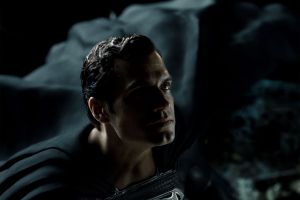
I think it’s unfair to judge the 2017 film to the Snyder Cut as a movie simply because this version never would have been released in theaters. No studio would have released a four-hour version. The two edicts that Whedon was given by the studio when coming aboard the project was that it could not be over two hours and to lighten it up. Imagine what the 2021 Snyder Cut would look like if Snyder was then tasked to cut it down to a more manageable two-hour running length. I predict many of the same scenes being eliminated or dramatically trimmed down. That’s the main takeaway from the Snyder Cut, that there is more room for everything, and quite often too much room. I swear a full hour of this movie might be ponderous slow-motion sequences. Plot-wise, Zack Snyder’s Justice League is pretty close to what was released in theaters in 2017. The action sequences are extended longer (Steppenwolf’s attack on the Amazons has increased from six minutes to a whopping twelve minutes) but I don’t know if they’re dramatically improved. Instead of two punches there’s four; instead of one chase, there’s two. It’s that kind of stuff, filling out the sequences but not really elaborating on them in an exciting fashion that reorients the moment. I liked some additions, like the inclusion of blood during the underwater Atlantis fight because it added a neat visual flair, but the added action is often obscured by visual decisions that dis-empower the experience (more on that later). I found myself growing restless with the movie. All that added time allows some sequences and plot beats to breathe better, but it also allows Snyder to meander to his greater indulgence (more on that later as well, notably on the multiple epilogues). The four hours feel like Snyder’s kitchen sink approach, and with the benefit of years of hindsight from the critical and fan reception of the 2017 version, he’s able to spend tens of millions to correct mistakes and improve a flawed film.
I hate how this movie looks for multiple reasons. The most obvious difference is that the aspect ratio has been altered to a 4:3 ratio more reminiscent of pre-widescreen television. Why is this the case? Snyder has said he cropped his movie to this boxy format so that it could be played on IMAX screens. That’s fine, but why crop your movie now months if not possible years before it will ever play on IMAX screens? When it comes time to adjust for the IMAX screen, adjust then. Why must every viewer see this limited version now on their widescreen televisions at home? It’s just so bizarre to me. It would be like if Quentin Tarantino reasoned that his movies will eventually play on airplanes, so he better get ready and cut back his widescreen into a flat, pan-and-scan mode, and he might as well include alternate takes and scenes to cover for those that would be deemed too profane or intense for the all-ages captive audience of an airplane, and then that version was the one he released to all audiences and we were stuck with it. Snyder had millions of dollars to reshoot his epic and he lopped off the edges, meaning you’re getting more movie but also less (at least the footage predating the new reshoots) in every second because of the framing. The grandeur of the superhero saga is also extremely hampered by the drab color palette. Snyder has always preferred muted colors to his movies but his Justice League drains all life and vibrancy. Everything is literal shades of grey. Color is not allowed to exist in this universe. A sunset is almost comical. Apparently, there’s going to be an official black-and-white version but we’re already practically there. Some could argue the oppressive grey is meant to evoke the grief and heaviness of the picture, and I’ll give you some leeway with that, but the drab colors also nullify the visuals. It’s simply harder to see everything that’s happening even during the daytime, and then you tack on the ugly CGI that makes everything look like a fuzzy video game. For a movie that has cost potentially over $350 million dollars combined, Justice League looks so phony. Maybe that’s part of Snyder’s overall stylized look, he’s never really been one to visually ground his operatic action spectacles, but I feel like the aspect ratio and color palate just make it worse. For those four hours, this is often a very visually unappealing movie to watch.
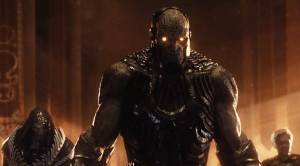
With the added time, there are definite benefits and characters that are lifted by the extra attention. Chief among them is Cyborg, a character that felt like a Swiss army knife in the original who was just there to perform whatever techno jazz the movie required at a moment’s notice. With the Snyder Cut, the character becomes more engaging and given a fuller arc relating to the relationship between father and son. The father’s placement in the story actually matters and Cyborg has more of a personal journey coming to terms with his new abilities. There is a back-story with his frayed relationship with his father, his accident that caused him to become the creature he is, and a reoccurring theme of a son blaming his father and the father trying to reconnect with the son he refused to part with. I still think Cyborg ranks low on the list of superheroes, but the additional scenes give the character more weight, more tragedy, and more intrigue. Another added benefit is that Steppenwolf’s motivation is improved as well as his look. He’s now outfitted with a herring-bone armor that twitches over his body. It’s a more intimidating look than what he had going on in 2017. I also appreciated that he now has more motivation other than “conquer the universe” because now it’s “conquer the universe to get back in the good graces of the boss.” Steppenwolf is trying to repay a debt and make amends, and that makes him slightly more interesting than his generic motivation in the original theatrical cut.
However, not all the new editions are as smooth or as helpful. The added time with the rest of the Justice League doesn’t seem to have added anything to their characters. Each one’s arc is more or less the same from the 2017 version, except now we have even more scenes of Wonder Woman wondering whether she needs to get off the sidelines and be more involved (the events of WW84 conflict with this timeline) and Aquaman rejecting his call to adventure from the Atlanians. Neither is a richer portrayal and the scenes are redundant. Take Wonder Woman finding out about Steppenwolf’s attack. In the 2017 version, her mother lights an arrow and it sails into Greek ruins, signaling her daughter, who knows what this means. In the Snyder cut, the arrow still lights the Greek ruins, but now Wonder Woman visits the ruins, she gathers a stick, she wraps a cloth around it, she dips it in kerosene, she lights it on fire, she enters a secret room because of the arrow, she jumps down a cliff, she finds a hidden temple with hieroglyphics warning about Steppenwolf and the mother boxes and Darkseid. Even if you really wanted the end where she sees those hieroglyphic warnings, why did we need these many steps to get there? The opening hostage/bank heist scene is given far more attention, with multiple scenes of hostages being terrorized, and then Wonder Woman literally vaporizes the chief terrorist. A little girl looks at her, likely traumatized for life by the whole experience, and says wistfully, “I want to be like you when I grow up.” She wants to be a murderer? In Snyder’s universe, Superman kills people, Batman kills people, so why not Wonder Woman too?

The revised introduction of Barry Allen is also regrettable. He’s applying for a dog walking job and a car accident occurs and he saves the day, but not before slowing down time in a frustrating manner. This is because he seems to be dawdling while the rest of the world is frozen, which makes the event seem less special. His movements seem less urgent than Quicksilver in the X-Men films when he would perform the same memorable slow-mo set pieces. I disliked that the Flash’s big involvement in the final showdown was literally running around in a circle, a repeat of what he had done prior. Also making the slow-mo save introduction less special is the fact that the Flash picks up a hotdog floating in midair for silly reasons. It’s drawn out with interminable slow-motion and the song choice is baffling, a common theme throughout Snyder’s movies. I think he’s been smarting ever since he painfully paired Leonard Cohen’s “Hallelujah” with a sex scene in 2009’s Watchmen, and now we must al endure similar awkward auditory pairings. Every song inclusion just feels wrong here. As Aquaman is drinking and walking along a pier, in slow motion, we hear “There is a Kingdom” by Nick Cave, and it just doesn’t pair right, especially in contrast with the hard-rocking guitar riffs from The White Stripes in the 2017 version. For good measure, Snyder even includes another “Hallelujah” cover by the end for good measure, as if he’s still fighting this same battle over musical taste.
And then there’s the barrage of epilogues, each the start of a story never to be continued, and it approaches the realm of self-parody (spoilers to follow). We get three endings, the first an extension of the post-credit scene from the 2017 version where Lex Luthor (Jessie Eisenberg) suggests the formation of a Legion of Doom for villains. He even shares with Deathstroke (Joe Manganiello) that Bruce Wayne is Batman. Well, that could be an interesting next step, but we know it’s not to be so it becomes just a teasing preview. The next ending cuts forward in time to the dusty, apocalyptic vision that Batman had in Batman vs. Superman, and he’s got a crew including an older Flash, Meera (Amber Heard, why does she have a British accent now?), and even Jared Leto’s Joker. They’re facing off against a villainous Superman who has been driven mad by the death of Lois Lane (Amy Adams), which is pretty much the plot of the Injustice games. The Joker is antagonizing Batman with some references to killing someone close to the Dark Knight, and this whole sequence amounts to Snyder basically saying, “Hey, here’s where I wanted to go with things but you’ll never see it.” Then there’s a third ending, because the second is revealed to be another dream/vision for Batman, where he meets Martian Manhunter, a character that, other than diehard comic aficionados, no one cares about and has been given any reason to care about. The guy just introduces himself and Batman is like, “Oh, cool,” and that’s the ending Snyder decides to close his four hours with. There is a literal half-hour of epilogues and false endings to finish with and I was exhausted. I owe Peter Jackson an apology.
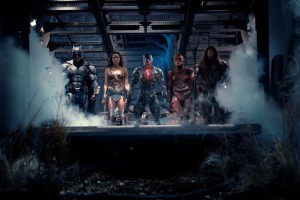
In my original review of the 2017 Justice League, I wrote, “I think I might have actually preferred Joss Whedon not being involved and simply releasing the full Zack Snyder cut. It would have been stylistically more coherent. Much of the Whedon reshoots do not feel like they are for the better. To be fair, he came in late and this franchise behemoth had already gone too far to fully alter its fate. There are small moments that work but the big moments are what fail. This movie is missing setups, payoffs, and character arcs. It’s missing pathos and emotion. It’s missing memorable action sequences that are exciting and varied. It’s missing basic internal logic. It’s missing a greater relevance.” Some of those issues are resolved with the four-hour Snyder cut and too many others still remain. At the end of the day, this is still just a longer, bloodier version of a mediocre superhero movie, except now we get stuff like Batman saying the F-word, so I guess that’s cool. I have more of an artistic appreciation for what Whedon had to pull off to even wrangle this beast into two hours. I’m happy Snyder was able to fulfill his complete vision and that HBO MAX offered a platform that would provide such a rare opportunity of expensive art unencumbered by studio meddling. I can’t say it’s worth your four hours, nor can I say it’s dramatically better than the 2017 version because whatever benefits it offers are weighed down by the extraneous, the redundancies, and the length. As it stands, I feel I have no choice but to grade Zack Snyder’s Justice League the same as the 2017 Justice League.
Nate’s Grade: C
Share this:

Boss Level (2021)
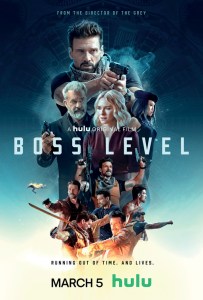 It’s a time loop action movie where Frank Grillo (The Purge: Anarchy) plays a special forces agent going through one long, hellish, bullet-heavy day of violence on repeat. As with other time loop movies, the joy is watching the many different iterations and building from previous excursions and finding the fun detours to discover with the many “what if” scenarios at play. Boss Level is simply fun and disposable entertainment. We watch Grillo strut through the day with amazing clairvoyance and annoyance as he does over and over again, with a team of flashy Smokin’ Aces-esque super assassins chasing him down through the day to score the big hit. The story is rather generic with Grillo learning to take responsibility for being a father, with a generic villain played by Mel Gibson and a generic damsel-in-distress ex-wife played by Naomi Watts. The appeal is Grillo and his gruff charm as well as the darkly comic violence and the creative ingenuity of Grillo dying over and over and then persevering. The action, while definitely scaled down through its lower budget, is filled with fast cars, explosions, gun fights, and pulpy over-the-top deaths to really make the movie feel like perhaps the best video game adaptation even if it was never a video game. The biggest drawback is that this movie is packed, wall-to-wall, with excessive and grating voice over where Grillo’s character will explain EVERYTHING on screen and I just wanted him to shut up. It’s not like his constant verbal commentary is really adding anything; he’s not exactly a character with a strong personality. I am not kidding when I say that 90 percent of this voice over could be eliminated entirely. Imagine being stuck beside an annoying and ceaselessly chatty neighbor in a theater and having that intrusion drown out the experience of the movie, and that’s how prevalent and irritable the constant voice over can be. Seriously, there’s more voice over than dialogue here. Otherwise, Boss Level is a suitably stylish, slick, and action-packed B movie with enough flair and imagination to fill up 90 minutes of entertainment. Three time loop movies in under one year makes me wonder what genre will next be explored. Get ready for the medical drama time loop, the courtroom thriller time loop, and maybe even the disaster movie time loop. Whatever they may be, they guarantee at least a watch from me.
Nate’s Grade: B-
Share this:

The Map of Tiny Perfect Things (2021)

Reader, I love time loop movies and their very playful nature of storytelling that allows for plenty of payoffs and creativity and inherent pathos of being stuck reliving life experiences. Palm Springs was my second favorite movie of 2020, so how soon am I ready for yet another time loop romantic comedy, this time from a very Young Adult perspective and with an overly precious title? The Map of Tiny Perfect Things is very much a time loop formula by heavy amounts of YA twee whimsy and worldly lessons. It’s charming, witty, predictable, and maybe a little too content, much like its central characters, to meander when there was more meaning to explore.
17-year-old Mark (Kyle Allen) lives in a small town and is stuck in a time loop living the same day over and over. He argues with his younger sister, rolls his eyes at his out-of-work father’s Civil War novel he’s devoted to writing, and skateboarding around town and skipping school. His buddy Henry is stuck on the same video game level, his mom leaves for work before he wakes up, and every night his father tries to talk to Mark about what he wants to do with a future that he will never see. Then Mark meets Margaret (Kathryn Newton) who appears to be aware of the same loop. Now he has a partner and together they have fun being mischievous in a world where people are eternally asleep and unaware, a world without larger consequence.

The Map of Tiny Perfect Things is an immediately entertaining movie that glides by on charm and cuteness before bringing the heavier emotional catharsis we know is coming. Kyle’s daily routine is reminiscent of the beginning of Palm Springs (for fairness, I’ll try to refrain from making comparisons at every turn) where we see the breadth of the man’s knowledge and implication of how long he’s had to accrue this god-like understanding of timed events. It’s fun to watch Mark push a man out of the way before getting pooped on by a bird, or catch a falling book in the library, or know the answer before a person can even ask their question. The movie takes a while to fully get going but it keeps entertaining you in the meantime with these pleasant quirks. This is indicative throughout the movie. Even when the plot is just coasting, screenwriter Lev Grossman (adapting from his own short story) keeps things swift and entertaining. There’s a montage of Mark getting awful haircuts and sending pictures to Margaret, and then lamenting maybe they can meet up the next day instead once his hair resets. The script is packed with quick-witted jokes and fun visuals that it can return to for elevated and imaginative payoffs. Each side character has their own sustained loop and checking in on each is a reminder that they all have their own little universe of struggle and desire and despair. It’s one of those benefits of time loop movies; they are like getting 32 flavors of stories in one delicious 90-minute serving.
Just like Palm Springs (I lied), the big plot change comes with the discovery of a partner also re-living the same day in infinity. From there, the story becomes a very standard YA romance but set in an extraordinary setting. Margaret doesn’t qualify as a Manic Pixie Dream Girl but she is more blunt, assertive, and seeking out a deeper meaning for their shared purgatory. She’s not the quirky free spirit we associate with the type. She’s more goal-oriented and literal than Mark, and she even takes on teaching him algebra. Once the love interest is introduced, the movie starts a countdown clock for how long it will take for a romance to kindle. Mark is clearly lonely and we see his failed attempt to spark up a potential romance with another girl who will forever be trapped in, at best, a first date mentality. You can’t build a relationship when everyone else only has 24 hours unless it’s like Before Sunrise. Margaret expresses a deep reluctance about anything going beyond the platonic, especially if she and Mark are the only two humans in this “temporal anomaly” for a potential eternity. Just imagine a failed relationship with a co-worker and having to uncomfortably mingle at the same job for years. Mark, being the headstrong young lad in a YA drama, is certain he can win her over in the long run and that his feelings must be true and therefore honored. Since the movie is being told from his perspective, his yearning is given primacy and it makes for an uncomfortable arc.

But it’s the last act of the movie where the larger emotional connection takes root and where the actual life lessons are to be had. This is not a movie about stopping to enjoy the little things in life that otherwise might go ignored. That element is present, and the subsequent scavenger hunt across town to catalogue all the cute little moments of humanity and nature dominates Act Two. It’s a cute little premise and something we’ve seen in countless other YA tales, finding the hidden beauty right under our noses in our lives. The message is clear and fine, but it’s what takes place toward the end where The Map of Tiny Perfect Things takes off from its YA orbital decay of preciousness. If you’ve watched enough movies, you should likely start to guess where Margaret disappears every day after six o’clock and what secrets she may be hiding. I won’t spoil what is revealed but I was waiting for Mark to wise up as quickly as I did. He does, and the movie takes on a transformation toward the end that changes perspective, weight, and even provides a little subversion on the previous male gaze that was our primary filter. The end provides a satisfying enough conclusion that examines the nature of grief and processing. The way the secret design of this universe is discovered is slight and ridiculous, but it doesn’t take away from the movie successfully landing the most difficult part of its emotional journey.
It also helps that both of our leads have great chemistry and are genuinely likeable. Allen (All My Life) has a laid-back presence that fits nicely with the genial vibes of the movie. He’s funny without being obnoxious and emotive without being melodramatic. He starts off sardonic and flip but becomes more earnest as his character learns to stop and listen and invest in others. Newton (Freaky) is enjoyably no-nonsense without being prickly. Margaret is a character with layers and ultimately, you’ll wish the movie had been retold from her point of view from the very beginning. There’s a reason for this, but there’s much more depth and sadness to Margaret. Still, even just hanging out with them as they observe the day, share their stories and discoveries, and pop-culture-heavy banter back and forth is entertaining because the writing and acting carry the day.

What holds The Map of Tiny Perfect Things back is that it never really goes into larger questions of self, identity, and the existential conundrum of at once being the center of a universe with limitless time and being unable to move forward. It feels a bit too content to stay on a lower level and dust off many familiar YA tropes to have a diverting good time. That’s fine, though in direct comparison to something like Palm Springs (my apologies), it can feel lacking. Think about Mark’s inability to see his mother again and how that unique circumstance forms its own loss. More attention to these details would have been preferred than on-the-nose pop-culture references and deep cuts for hipster points. It’s a good cheerful time with plenty of wry amusement and some well-earned emotions, but it also feels a little too content to simply hang around and follow the YA map for programmed spiritual affirmation. It manages to subvert the quirky-girl-shows-guy-how-to-carpe-his-diem formula, but that’s not before devoting plenty of time walking the same walk for a little longer than needed. If you’re a fan of time loop parables, YA stories, or unconventional rom-coms, check out The Map of Tiny Perfect Things and then, maybe, if you haven’t already, also Palm Springs.
Nate’s Grade: B
Share this:

Space Sweepers (2021)
 Luc Besson sci-fi opera by way of South Korea, the unfortunately named Space Sweepers is a wonderful surprise of a movie that could unfairly get lost amid the glut of Netflix. It’s immediately engaging and filled with intriguing world-building. In 2093, Earth is a garbage dump and the rich (and primarily white people) have migrated to an orbiting space station that needs protecting from space debris. That’s where the space sweepers come into play, ragtag teams competing to claim space junk to sell back to The Company, though never able to escape their crushing debt. The Company is looking to colonize Mars and put more effort into making it habitable than salvaging Earth. A little girl might be the key to a flourishing Mars or resurgent Earth. She finds her way into the custody of a colorful group of malcontents, each with a clearly defined personality, motivation, and character arc, including the snippy robot who likes to harpoon ships in space. Spending time with this world and these characters is such an enjoyable experience because it just uncovers more and more layers to the hefty world-building and history. The story itself isn’t revolutionary, and the villain is a megalomaniacal CEO (Richard Armitage), and you’ll fully anticipate that the same space scrappers that want to sell off this little girl will eventually grow close to her and will be willing to die for her. The plot itself, at least in broad strokes, might be familiar, but it’s the level of detail and imagination and especially execution that sets Space Sweepers apart. I enjoyed how diverse the depiction of this future was, where people from different languages would simply speak their native tongues and be perfectly understood thanks to in-ear translators. The action sequences are exiting and visually immersive. I’ve never seen a harpoon in space battles before. It feels like a living anime moment. The special effects are consistently impressive. The set designs are large and lived-in. The small details all manage to add up, and small character moments still resonate, like one character’s constant loss of his shoes for greater sacrifices or a robot that feels seen for the first time as they are. A late twist had me nearly applauding for the emotional impact it altered with a big standard doomsday scenario. It’s a supremely fun and imaginative setting, enough that I thought it would have sustained a whole series on Netflix. I was happy it was a movie, though, because then I got all the payoffs and climaxes in one slightly two-hour setting. I’m impressed every year at the sheer high quality of the genre movies that South Korean filmmakers have been delivering. I highly advise fans of frothy, fun sci-fi like The Fifth Element to find this movie on Netflix and give it a watch. It’s a surprise treat and proof positive that old concepts can still shine with the right effort and careful development.
Nate’s Grade: A-
Share this:

Psycho Goreman (2021)

The Canadian quintet Astron-6 is a production company that specializes in practical horror effects to delight the eyes and churn the stomachs. In 2011, they decided to make their own films and released Manborg, a hilarious if sketchy and stretched-out horror-comedy replete with loving references to 1980s culture and movies. Their crazy, low-budget schlocky efforts have developed a following, and they earned extra credibility when they played things gravely serious and terrifying in 2016’s The Void. Now writer/director Steven Kostanski (one-fifth of Astron-6) has delivered Psycho Goreman, and this is what happens when gonzo, genre filmmakers are working at the top of their chintzy, delightfully deranged capability. The results are highly entertaining with equal parts great, good, and bad-good, and lovers of silly, schlock cinema will be in high heaven.
Mimi (Nita-Josee Hanna) is a little girl used to bullying her big brother Luke (Owen Myre) and generally getting her way. She and her brother discover a gem hidden in their backyard and it just so happens to connect to a powerful and murderous alien monster, the self-described “Archduke of Nightmares,” named by Mimi as Psycho Goreman (Matthew Ninaber), or PG for short. The creature was imprisoned by a galactic council who feared that unleashed he might conquer the universe in fire and blood. Unfortunately for PG, he’s at the mercy of Mimi, who can command him thanks to her ownership of that magic gem. For her, PG is her greatest new friend and play partner and woe unto thee anyone who tries to take PG away from her.
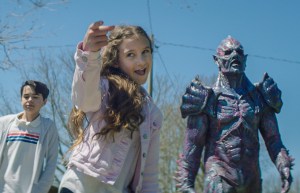
The movie feels like a cleverly constructed episode of Rick and Morty where a crazy idea is given unusual consideration and development and layers of humor and ridiculousness are uncovered so that the whole enterprise impresses. The basic premise is what if a brat had the power to control a monster, and while the movie pretends like life lessons will be learned or earned (“humans are the real monsters” is so trite that it’s an obvious put-upon), the movie also never downplays how much of a terror the little girl can be. It might be an easy joke but it’s still a good one, the fact that the universe shouldn’t fear this hideous monster but really this mean little girl is a fact that many parents will nod along with. The movie does some effort to redeem her, if that’s really important to you, but it also doesn’t soften her rough edges and her impudence. She is a brat, and she will inflict pain on others, and the fact that she has awesome power makes her a scary being the entire universe should really be quaking over.
The enjoyable fish-out-of-water dynamic elevates the comedy and payoffs of Psycho Goreman. This powerful monster is beholden to the childish whims and forced to do the bidding of a child, and he hates being out of control and every moment he is forced to play with her. The begrudging acclimation makes for several fun scenarios where he learns from her and also learns how far she’s willing to go. I enjoyed PG trying to make sense of Mimi’s made-up game and its nonsensical rules, and I enjoyed the levels of bizarre family domestic drama as PG integrates himself with this terrified clan. Having a normal dinner between humans and a blood-thirsty alien marauder is rife with comedic potential, and that’s even before the additional side story of the strife between the put-upon mother and the father who is just a gigantic loser. Their ongoing relationship troubles relate to some hilarious motivational turnarounds, like the father (Adam Brooks, another Astron-6 member) resenting the mother for thinking he’s a loser, so he’ll prove her wrong by being a supportive parent, which just happens to include helping his daughter’s involvement with a killer alien. He has an inspirational speech to his daughter late in the movie that had me cackling. The movie is more than its crazy, schlocky moments of gore and rubber costumes. It’s a fun but cleverly constructed comedy that understands the tenets of what makes crazy so genuinely funny.

But along the lines of gore and rubber costumes, Psycho Goreman is like a gloriously inappropriate Power Rangers episode for adults. The elaborate care and design of these monster and alien costumes is outstanding, especially for a relatively low-budget movie. It might look cheap from time to time, though I would argue this is also part of its unassailable charm, but the filmmakers show their real priorities with their monster designs. They are so varied and weird and good looking and have levels of detail to them as well. There’s one design that is simply a living cauldron of corpses (I think voiced by Rich Evans from Red Letter Media). Every new character is a new joy to behold, and when the clashes begin, as they inevitably do, you discover the extra care put into the creature designs with how they viciously come apart. There is a simple pleasure watching the great production design of the costumes and outfits as well as the outrageous gore. I loved that a kid is turned into a giant living brain monster and nobody seems to really care and it becomes a running joke of how callously everyone has viewed this child, including his own indifferent parents. If you’re a fan of goofy monster costumes and extravagant gore, this film is a twisted treat.
Mimi is going to be a love-her-or-hate-her character because she is exactly what Angela Pickles (Rugrats) would be like if given ultimate, unchecked authority over human life. She wields her power flippantly and will joke about siccing PG on her brother to kill him. She also hoots and hollers for PG’s violence against innocents because to her it’s all a big show of amusement. I found the high level of energy of Hanna’s performance to be the difference maker for me. Her character is an unrepentant brat but she’s so entertaining to watch because she holds to this very specific vision. Hanna is downright brilliant in her smarty-pants, mean girl articulation and has great physical expression. Watching her dance in discombobulated movements like the queen of the world made me laugh every time. I thought Hanna was terrific and her comedic timing was so well-honed for being so young. I understand many will find Mimi grating or overbearing or simply too much to handle. I get it, and I don’t think Psycho Goreman will be nearly as enjoyable for anyone who dislikes Mimi. You’re not meant to approve of her actions and warpath of destruction, but you can still enjoy the mayhem all the same.

If you’re a fan of low-rent, cheesy midnight movies, the deranged and demented, and giant silly costumes and bloody excess, Psycho Goreman will be everything you hope it to be. I will admit it peters out a little right before its big showdown, but otherwise the movie is consistently entertaining, consistently strange, and consistently funny. The comedy is better than you think as the filmmakers refuse to rest on the appeal of easy jokes and easy sentiment. They know why you’re watching and deliver, but the work under the surface is impressive and admirable. The filmmakers know they have a very specific, tailored audience that will celebrate their unique retro pastiche sensibilities, and if you happen to live on that same wavelength as I do, then you too will find Psycho Goreman to be an insane near masterpiece of low-budget, high-concept schlock. Give your 2021 a boost by checking out this Canadian splatter comedy and give in to the madness.
Nate’s Grade: A-
Share this:

Wonder Woman 1984 (2020)
 Big, colorful, and brimming with optimism easy to scoff at, Wonder Woman 1984 (WW84) is finally here to save Christmas and maybe movie theaters and it’s an escapist treat. It won’t register among the best of superhero cinema but will likely keep a smile on your face.
In 1984, Diana (Gald Gadot) is working at the Smithsonian Museum in Washington D.C. and fighting crime as her costumed alter ego. She’s never quite moved on from the death of Steve Trevor (Chris Pine) back in WWI and she dearly needs some friends. Barbara (Kristen Wiig) is a mousy co-worker who comes across a mystical artifact, a rock that magically grants wishes. Barbara wishes to be strong like her boss/idol Diana and she gains new intoxicating power. Max Lord (Pedro Pascal) is a wannabe TV pitchman and an empty suit, fleecing investors and barely keeping ahead of his own Ponzi scheme. He learns of the magic rock and wishes himself to become the rock itself, turning him into a living genie. From there, Max’s wishes are spinning out of control, placing the world in greater crisis. Diana is torn because, before Max absconded with the wish rock, she wished for her heart’s desire, the return of Steve. Stopping Max and reversing the effect of the wishes means having to say goodbye to Steve all over again.
The original Wonder Woman was a break from the pallid doom and gloom motifs that Zack Snyder established, and the sequel goes even further with its candy-colored recreation of the 1980s. I was wondering if there would be a good reason to set the movie specifically during the 80s, and it’s mostly for the Cold War and Yuppies. I was pleasantly surprised that Jenkins and company don’t overdo the 80s nostalgia or the fish-out-of-water comedy for Steve Trevor. I thought this was going to be the entire reason for the throwback setting, and this time instead of Diana marveling at a modern world she did not understand it would be Steve. If you’ve watched the film’s trailer, then you’ve seen all of those jokes at Steve’s expense. That’s it. WW84 can manage to surprise you, mostly in a pleasant manner. Its sincerity is its biggest virtue. It’s a movie about plenty of goofy things but at its core it’s about relatable desires and struggle.
 WW84 is an improvement over the original in the action department. Returning director Patty Jenkins feels freed of emulating Snyder’s house style and brings a welcomed sense of levity and playfulness to the action. The fight choreography makes significant use of Diana’s lasso, opening up the playing field for her to swing around wildly, at times even literally riding the lightning. At points the lasso seems to have a mind of its own and able to divide into fragments. It’s something that helps separate WW84 from the glut of other superhero movies and it offers pleasing visual variance for the fights. There’s a car chase midway through the film where Diana has to leap from speeding truck to speeding truck, dodging goon gunfire. It’s an exciting and sustained action sequence, yet even across the Middle East, chase clichés will reappear, like dumb kids playing in the street ignorant to any emerging noise like a caravan of speeding vehicles. Jenkins seems even more adept behind the camera for the action, delivering big stunts and memorable spectacle ready to make a splash on a big screen. However, some of the CGI can be shockingly dodgy for a big-budget blockbuster and a final confrontation with a CGI-hybrid creature unfortunately reminded me of the lamentable Cats.
The magic wish rock setup shouldn’t be any harder to believe than, say, a secret island of immortal female warriors or just about anything in the absurd and absurdly entertaining 2018 Aquaman feature film. If I can accept a drumming octopus, I can accept a magic wish rock. WW84 hinges on the concept of the drawbacks of creating your own false reality where every wish comes with a cost and an increasing flood of alarming consequences. It it better to just accept the comfort of lies or accept hard truths? The characters even name-check the classic short story The Monkey’s Paw recognizing the ironic trap. That doesn’t stop characters from struggling with the pull of their burning desires, and it makes for an agreeable return for Steve Trevor. Ever since it was revealed that Pine’s character was returning, I was worried what the possible explanations could have been, pessimistic it would be satisfying. Is he going to be a clone? Reincarnation? The grandson who happens to look identical? The screenplay by Jenkins, Geoff Johns, and Dave Callaham finds a way to make it work by bringing him back through magic but with restrictions. In a very Source Code sort of style, Steve is operating in someone else’s body, but only Diana sees Steve. It’s a decision that frames the return in a personal way that also reminds us what is eating at her. It’s been 70 years and she hasn’t moved on from the man she loved, which can be viewed as sad, romantic, and unquestionably unhealthy. It’s a familiar character arc, having to move on from a loved one and accept grief, but it still works, and it humanizes this mighty Amazon warrior woman. It’s a worthwhile development that opens up these living gods into emotional, vulnerable beings.
 With the wish plot comes some gripes and lingering questions. I kept asking, “Is everyone simply not seeing what’s happening?” or, “Is everyone forgetting what has happened?” The scale of the wish consequences is substantial and very public but it never feels like the world is registering just how fantastic these supernatural shenanigans are. In 1984, Wonder Woman is fighting crime as a hobby but still not a named and identified hero. The world does not seem aware of the presence of super beings and amazing powers living among us. So as Max continues his wish-granting ways there are immediate consequences of huge staggering scale, but nobody seems to register how weird and not normal things are, like a giant 50-foot wall suddenly appearing in Egypt. People should be asking what is going on or what others are doing. Therein lies the lingering problem with setting this movie in the past. Much like the 80s-set X-Men: Apocalypse, the events presented generate questions to why future-set movies seem to be ignorant of these same events. If Wonder Woman comes forward and addresses the world, why is she still hiding her identity in 2016’s Batman vs. Superman? And if she learns more about her own super abilities, why does she not make use of these very helpful skills in 2017’s Justice League? These sound like quibbles, and they mostly are, but the movie would have benefited from being a little more judicious with its rules and applications because I started wondering if everyone was oblivious.
I was genuinely surprised how much screen time and consideration was afforded to the primary villain. No, I’m not talking about Barbara/Cheetah, who could have been completely cut from the film. I’m talking about Max Lord. He’s arguably in the film as much as Diana. He’s a con man trying to be a successful TV pitchman and oil tycoon but really he’s trying to be a “somebody” to make his son proud. The problem is that his goal always seems to be just out of reach no matter what is gained. This part confused me. After successful wishes with power and money, Max seems to desperately continue searching for more. I suppose it could just be a general “power-hungry corruption” explanation but I kept asking when enough was enough, and that’s likely the point. I don’t know if Max Lord is a character deserving of this much consideration, but the approach appeals to the film’s empathetic mentality that no one is beyond reach. Rather than the villain having to be physically defeated, WW84 rests on emotionally appealing to a broken man’s sense of self. It makes for a more intriguing conclusion in a superhero realm than merely out-punching the CGI antagonist, like the clunky, lumbering finale from the prior Wonder Woman movie.
The conclusion of WW84 rests upon millions having to make a personal sacrifice for the greater good, which is a lovely sentiment that we could all use at this point after a dispiriting 2020. However, this year has also proven for me that the conclusion of WW84 is pure escapist fantasy. Throughout a deadly pandemic, the United States has been beset by too many people refusing to endure inconveniences in the name of protecting others and saving lives from COVID-19. The cost-benefit doesn’t add up for many if they can’t see the results, never mind the harsh yet sterile reality of over 300,000 dead Americans and counting aided by this selfish obstinance.
 Gadot might not ever escape the long shadow of playing a famous superhero but she’s settled into the role nicely and even gets to flex some untapped acting muscles. I was skeptical of Gadot early when she was hired but became a believer in 2017. She definitely has an unmistakable presence onscreen. Gadot’s best moments aren’t even the punching and kicking, which she does with gusto, but the moments where she has to make grand appeals and hard decisions. There are a few emotional moments where Gadot’s familiarity with the character blends together and she and the filmmakers are not afraid to show strength in other ways other than brawn. Gadot still has a very enjoyable chemistry with Pine (Hell or High Water) that makes them a winning pair. One of the film’s highlights is a personal flight through fireworks that delivers sheer joy for Steve Trevor. His awe about the future and getting one more spin with life itself is heartwarming. Pascal (The Mandalorian) is going big and hammy with his performance that reminded me of the Richard Donner Superman movies. Wiig (Ghostbusters) is the big miss for me. She’s not convincing as a threatening foe and her early scenes as a klutzy, put-upon dweeb feel overdone and yet insufficient. We needed more establishment of Barbara’s life before her wish to better recognize why she would never want to go back. One reoccurring street harasser doesn’t cut it.
Wonder Woman 1984 is fun, splashy, and doesn’t lose sight of its characters and their emotional states even as it elevates the world-annihilation stakes. It’s a movie that seems more confident in its identity than the first film. It accepts that it can be silly, it can be sincere, it can be exciting, it can be smaller and more personal, it can be hokey, it can appeal to your best self. It’s overly long (the opening flashback of young Dianna in the Amazon Games could have been ditched entirely) and not everything works, but the problems are easier to digest and forgive with what does work. It might be the last blockbuster for some time given the uncertain theatrical landscape so I’ll take it. WW84 isn’t the swaggering solo venture the first film proved to be, but I would say it still makes for a mostly satisfying and fun experience that plays to the strength of the creative team.
Nate’s Grade: B-
Share this:

The Midnight Sky (2020)

The Midnight Sky is really two sci-fi survival movies in one. In 2040, the world is experiencing a planet-killing ecological disaster. A team of astronauts, lead by a pregnant Sully (Felicity Jones), is returning from a multi-year mission to check if a moon of Jupiter is habitable. On Earth, Augustine (George Clooney with a Santa beard) is the lone scientist left at an Arctic research station. He has cancer and sees his life as having run its course, that is, until he finds a small girl (Caoilinn Springall) who missed being evacuated. They band together to brave the wintry, poisonous elements to travel to another outpost to better communicate with the returning astronauts and possibly secure an escape from this dying world. It sounds like it should be a very exciting and interesting movie. There are even sinking ice floes, space walks amidst deadly asteroids, and Augustine having to stop at points lest he overtax his frail body. In practice, the movie isn’t so much exciting as it is ponderous, grasping for a larger philosophy and existential meaning that seems entirely elusive. We’re treated to several flashbacks of a young Augustine (different actor but still voiced by Clooney) that seem superfluous until a grand reveal that made me audibly groan so loud I thought my neighbors would complain. I kept waiting for the relevancy between the stories to be demonstrated, and when it happened it was not worth the two-hour wait. The realization was so hokey that it retroactively made me dislike the movie’s moments that had been working earlier. As far as direction, this might be one of Clooney’s strongest turns as a visual storyteller, even if he borrows liberally from other recent sci-fi movies, notably Gravity, The Martian, and Interstellar. There are moments of stark beauty and terror. Ultimately, the whole movie amounts to a sad man taking stock of his life and legacy (is he a metaphor for the Earth? Is the Earth a metaphor for him?), and I’m still wondering how something this glum could also be so maudlin. The pacing is another issue. I was always eager to jump to the other storyline to see what they were doing (a cinematic “grass is greener” mindset). The acting is fine and I wish I could have spent more time getting to know the crew of this space mission (including Kyle Chandler, Demian Bichir, David Oyelowo, and Tiffany Boone) or conversely gotten to feel more of bond between Augustine and his near-mute charge that felt like it was providing insight into this man. Looking back, there’s a reason for some of the stilted characterization, but having an excuse for why your characters aren’t better developed is like preparing an excuse why you did something self-sabotaging. The rest of The Midnight Sky doesn’t better compensate for this storytelling choice, and so the movie feels too dull, frustrating, opaque, and overly manipulative, aided and abetted by Alexandre Desplat’s sappy score. No more than the sum of its parts, you can soon watch The Midnight Sky on Netflix and fall asleep to it on your own couch.
Nate’s Grade: C+
Share this:

Tenet (2020)
 As my girlfriend described, Tenet is a headache disguised as a movie. I can agree about the confusion and irritation from trying to make sense of a 150-minute movie that almost defies you to even keep watching. From the opening sequence, my head was hurting from trying to make sense of everything and deduce meaning and connection. Christopher Nolan’s movie was set up to be the savior of the summer, a thinking man’s blockbuster with such size and scope that people would come back to the newly opened theaters to get a taste of the summer they missed because of COVID. It didn’t work out that way and Tenet’s box-office disappointment contributed to the recent decision for its parent studio to release its entire 2021 slate of movies onto its streaming service (nobody should risk their life to go see the Tom and Jerry film). Tenet has too much going on for me to call it a bad movie, but it also has too much going on for me to call it a good movie.
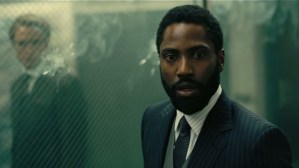
Protagonist (John David Washington) is recruited by a secret organization that is trying to thwart a cold war from becoming hot between the future and the past. Neil (Robert Pattinson) explains about “reverse entropy,” about effect before cause, and that there are machines that can allow people to reverse their direction in time. It’s less jumping through points than it is hitting the rewind button. A Russian oligarch (Kenneth Branagh) and his wife (Elizabeth Debicki) may be the key to preventing a future catastrophe or one that hasn’t happened yet or has already happened. It’s time travel so the tenses can get confusing. That’s not the only thing that’s going to likely confuse you.
 At around the half-hour mark, it felt like every character was talking past me, like they had no intention of being accessible. It is practically maddening to be in a conversation where everyone is talking above your level, relying upon lingo and references you are unfamiliar with, and you can try your best to grasp the basics of context clues to try and decipher a base level of understanding, and then, when you think you have things together, they start talking backwards. That is Tenet in a nutshell. It is a mystery how Nolan expected general audiences to even want to keep up with this. I’m not one of those people that needs my story spoon-fed to me, and I welcome challenging storytelling that rewards multiple viewings. However, the problem with that gambit is that if you require your movie to be seen a multitude of times to be understood, you better guarantee anyone will want to watch it a second time. I’m certain I’ll better understand Tenet with another watch and that I’ll find even more little clues to celebrate the exquisite cleverness of Nolan, but I don’t want to re-watch this any time soon, if possibly ever.
Nolan has been here before with 2010’s Inception, a movie that could have been confusing from its very conception given a heist upon four levels of dreams each with their own sense of linear time. Early on, Inception was also confounding, but slowly Nolan opened up his world, allowing the audience to adjust to a learning curve and process the information we needed to be set by the time the big heist got underway. Even after, we had mysteries and complications to be solved. It was a complex puzzle with layers but it was accessible. I thought early into Tenet we would be following a similar track, and I kept waiting to adjust to the learning curve, for things to gain a momentum. There needs to be rules, a demonstration of the rules, and then we proceed. I guess I understood things on a general level, stopping the bad guys from somehow destroying the world, and special turnstiles that make you go in reverse time, and there’s a palindromic plotting emphasis that becomes a late justification for 90 minutes of mostly boring blather with the occasional set piece. For the purposes of further clarity, I even read the Wikipedia plot summary to fill in the gaps of my personal comprehension, and it didn’t really assist beyond confirming for me that I understood the broad strokes of an otherwise confounding movie. It’s hard not to feel like Tenet is more an expensive, globe-trotting experiment for Nolan than a movie intended for mass entertainment. Again, I’m not deriding Tenet because it’s ambitious. I’m deriding it because it’s indignant of a potential audience.
I cannot stress enough that every time characters began speaking, I liked Tenet less. If somehow the movie had eliminated all dialogue, it might have worked better. It’s not like Nolan’s scripted words offer much comprehension anyway. It feels like the dialogue is nothing but impenetrable riddles about scientific jargon and vague pronouncements often given to too cute dialogue about the nature of time. There were points I just wanted to scream. Of course there were other moments I was straining just to try and understand what was being said. Tenet is another example of Nolan’s self-sabotaging sound design where he makes the volume of characters speaking subsumed to the volume of sound effects and score. It becomes another hindrance to try and understand an already confusing and aggravating movie experience.
 Another factor that made Tenet a slog was the lack of any emotional engagement. Nolan has often been criticized for being a cold filmmaker, one more beholden to the intricacies of his origami-styled plots and surprises. I think this is often an unfair charge but he’s certainly a filmmaker known for his preference for plots that take ownership of character. You would not confuse a Christopher Nolan blockbuster for some mumblecore indie. Even in a movie with as much plot groundwork as Inception, Nolan provides an emotional core with the story of a man literally haunted by the ghost of his wife and his grief over his own culpability for her demise. The climax even involves him having to finally let her go in order to save the day. With Tenet, we get nothing. There’s an abused wife and while I don’t want to watch her get threatened and attacked by her husband, that’s not exactly the same as providing an emotional anchor. She’s, at best, a supporting player. The world-saving stakes are all you’re going to get. I didn’t care about Protagonist as a protagonist, and I didn’t care about Tenet as a secret organization, and I didn’t even like spending time with these people. These characters are boring, but the movie thinks by keeping them moving fast enough, or talking nonsense long enough, that you will fail to notice.
I’m not even fully cognizant of the benefits of inverse time. You can travel backwards and watch people go in reverse but is this really a practical application of technology? Reverse fight choreography can be cool, like people doing reverse flips, and it can also look extremely silly with punches exchanged that look too fake and people scooting on the ground like child trying to break dance. For me, it’s a toss-up whether watching characters run in reverse is surreal and dreamlike or just plain goofy. I guess one could reverse and then un-reverse, more or less traveling back to a point in the past and going forward from there. This means you’ll have to live those extra days, weeks, whatever the time difference, but it also seems to indicate that you must do everything you did before because you have already done it. If this is the case, why bother going back in time if you’re just indebted to doing the same things all over again? Why take a test again when you have to give all the same responses to the same questions? It feels like Nolan wanted to try and make a time travel movie that isn’t quite a time travel movie, so he settled on people running backwards. There is an intriguing disorientation at work when Nolan really plays with the physics of reverse time, but I don’t think this core idea ever fully comes together in a satisfying manner.
 The last hour of Tenet does liven things up as we have two large action set pieces that play out with patience and an expansive scope. This is Nolan’s spy action-thriller. A high-speed heist on the road leads to a car chase with reverse cars to combat. It’s the only action sequence where the audience has a good understanding of the mini goals. Even an earlier art heist resulted in raising questions of credulity (“If the security system sucks out all oxygen, and they’re triggering this, why have they not come prepared with their own oxygen tanks?”). The high-speed heist and ensuring chase sequence flat-out works and is pretty cool. The conclusion involves two teams of soldiers, one going forward in time and one going in reverse, and that has such amazing potential for an intricate and exciting culmination of action. Imagine a character going back and forth and jumping from their unique perspectives to aid and inform each team. Unfortunately, in execution it comes across as jumbled chaos. Again, I imagine there are details and parallels I would notice more with a second viewing but I doubt when that will happen. For a movie essentially about time travel, it feels like Nolan has put more careful thought into trying to make his movie a palindrome than trying to come up with engaging and cool things to do with time travel action.
Christopher Nolan is one of the biggest names working today, a man whose risky, expensive blockbuster projects get greenlit because of his artistic audaciousness. You would never want a Nolan movie to simply play things safe. He seems at his most comfortable when it’s playing around with chronology and audience expectations of what moments have meant. There is a reverse palindromic feature to this screenplay I do admire from a writer’s perspective. However, knowing it takes a confounding 90 minutes to get to that reveal means that you’ve had to endure 90 minutes of protracted set up and with characters that are, at best, glib archetypes, empty suits, and guns with people attached to them to occasional bark orders or say confusing terminology. It makes for a very frustrating and at times disengaging viewing experience, one I even contemplated retreating from. I’m glad I stuck it out but cannot say it was worth the time and ensuing headache.
Nate’s Grade: C
Share this:

Super Intelligence (2020)
 Given the sad and off-putting output from Melissa McCarthy and her husband Ben Falcone when they collaborate, it’s a small victory that Super Intelligence is only really super bland and forgettable. McCarthy stars as an everywoman picked by a highly intelligent A.I. to be the test subject for whether or not humanity should be saved or wiped out of existence. It sounds like an amusing premise but what it becomes is just a boring romantic comedy. The super A.I. (voiced by James Corden) becomes more or less a magic genie, and now our heroine has all her wishes granted. She has a huge new bank account, a new car, a new luxury condo, and all to impress the guy she let get away played by Bobby Canavale. That’s right, the super A.I., meant to test and judge mankind, is really just the world’s most advanced wingman and trying to get his human pal some love. As far as tests go this seems a bit weak. This mighty A.I. should be working against our protagonist, throwing increasing obstacles that push her out of her comfort zone, rather than just handing her everything and looking from afar with approval. The comedy is resolutely flat save for the inherent charms of McCarthy, who doesn’t seem challenged by anything in the movie. Much of the film is watching McCarthy talking into high angle CCTV cameras. Visually, it’s quite boring. Super Intelligence feels like an interesting idea that can’t be bothered to find anything interesting in execution. It’s standard rom-com fluff but the two characters aren’t even appealing together. I found Canavale’s character to be far more annoying than endearing. I’ve found that Falcone is a bad director for his wife. He encourages her worst onscreen habits and doesn’t have the presence or vision to be able to assert restraint or imagination. If Falcone is attached as director, you know you’re getting McCarthy doing her familiar shtick with little self-control. She’s still a highly appealing comedian, and an underrated dramatic actor, but the only super intelligence here are the people who avoid this film.
Nate’s Grade: C
Share this:

Love and Monsters (2020)
 Imaginative, quirky, and monstrously fun, Love and Monsters is a winning sci-fi monster movie and more evidence to the unique amusements provided in full from a Brian Duffield (Spontaneous, The Babysitter) story. In the near future, after blowing up a world-threatening asteroid, the ensuing chemical debris causes many lizards and insects to grow to world-threatening sizes, killing a majority of the population, and forcing the survivors to live underground in vaults. Our hero is Joel (Dylan O’Brien), a very Jessie Eisenberg-esque guy who isn’t so good at survival skills in this new world. His group looks at him like he’s a helpless kid who can’t defend himself. Joel discovers that his teenage crush, the girl he’s been writing letters to, is alive and he pledges to make the 80-mile trip on the surface to reunite with her. The resulting journey can be episodic but each section is impactful, each monster encounter is different and contributes to a fuller understanding to the world, and the character arc finds ways to surprise you, like when it acknowledges that Joel’s foolhardy romantic gesture is exactly that, him not fully accepting how the world has changed both he and the object of his desire. That sparkling creative voice of Duffield’s is alive and well throughout. His worlds feel well thought out, lived in, crazy but with purpose, and his characters are often teenagers with pointed attitude but they feel like characters rather than mouthpieces for overt stylized dialogue and pithy banter. O’Brien (The Maze Runner) is an interesting choice and gets to be far more neurotic and physically comedic than I’ve ever seen him. He’s an underdog that’s easy to root for. There are moments of wonder, moments of unexpected empathy, moments of suspense and terror, and plenty of moments of comic bemusement in the face of this crazy world. Joel befriends a very Woody Harreslon-esque father (Michael Rooker) with an adopted daughter in tow (the Zombieland character dynamics are pretty apparent but not a major detraction) and they form an enjoyable fractured family to help Joel become a better survivalist. I loved a small moment with a beaten down robot helper that manages to be sentimental as well as subverting sentimentality. The conclusion feels like a Walking Dead episode but it brings together many of the dangling storylines and proves satisfying for the character’s arc, a better understanding of the creatures in this world, and for Joel’s sense of self and community. The special effects are amazing for a movie that shockingly only had a tiny $28 million budget. Love and Monsters is a movie that makes the most of its time and money to tell a bigger story but one with enough wit, heart, and personality to draw you in and leave you happy for more post-apocalyptic monster adventures. All hail Duffield, king of spry and accessible quirk within the Hollywood system.
Nate’s Grade: B+


 nathanzoebl
You must be logged in to post a comment.