Blog Archives
Horizon: An American Saga – Chapter 1 (2024)

I admire Kevin Costner throwing out all the stops to achieve his passion, a four-part, twelve-hour film series to showcase a sprawling Western epic. The man put a hundred million of his own money into the first two parts of Horizon: An American Saga, and the time devoted to this project was so all-consuming that Costner quit the Yellowstone series, a cable TV juggernaut getting bigger ratings every season. It’s ballsy all right, to abandon a monumentally successful series at the height of its zeitgeist popularity so he can direct not just one but four throwback Westerns that will ultimately be as long as the Lord of the Rings trilogy. It’s rare to see this level of sheer chutzpah in Hollywood. Horizon’s first part was released in June, with its completed second part intended to be released a mere two months later in August. After the poor box-office of Part One, the studio decided to pull Part Two from the release schedule, ostensibly to give people more time to catch the first movie. Will we ever see Part Two in theaters? Will we ever see Part Three, which Costner is currently filming, or Part Four, which Costner is currently raising money for? Costner intended to release the whole saga as a miniseries upon completion, and this might be the best case scenario. As a movie, albeit one quarter of an intended whole, Horizon Part One feels far more structured as an incomplete and rather prosaic TV series.

Upon the completion of the 170 minutes, I was left wondering what was here that would make someone want to come back for a lengthy second part, let alone a third and a fourth. It doesn’t feel like a complete movie or even a completed chapter, and again let me cite Peter Jackson’s Lord of the Rings series. Released over the course of three years, each movie had its own form of a beginning, middle, and end, with each climaxing around some event that left one satisfied by its conclusion. They didn’t just feel like chapters linking to the next; they felt like completed stories that pushed forward a larger overall story. Now, with Horizon Part One, it doesn’t feel like a three-hour movie, rather like three one-hour episodes of a TV series. Each of those hours feels too separate from the other. I’m reminded of television in the streaming era, where producers anticipate viewers binging through multiple episodes in speedy succession. This tacit assumption lends itself toward the general pacing issues I find with too many streaming series, where the filmmakers take far too long to get things moving in a significant manner. I’m reminded of a joke by Topher Florence that back in the day a show like Surf Dracula would feature its lead character surfing in weekly adventures, but the streaming age version would take its entire first season showing how he got his surfboard and then spend five minutes surfing in the finale. When you’re pacing out only one quarter of your possible intended story, calling it slow and lacking development and payoffs is an obvious hazard, which is why every movie needs to be its own thing, to provide a sense of conclusion even if it’s not the final conclusion.
Part One is divided into three parts: 1) the early settlers of Horizon, in the San Pedro Valley, being massacred by the Apache, 2) an old gunslinger (Kevin Costner) tasked with protecting a woman and child on the run from vengeful gunmen, 3) a wagon train of settlers headed to Horizon. Now, from that very streamlined synopsis, which of those storylines sounds the most exciting? Which of those storylines sounds like it can lend itself toward having an in-movie climax? Which of these storylines feels the most fraught with danger and intrigue? It’s the one starring Costner himself, of course, fitting naturally into the role of a tough curmudgeon.

I’m confused why the entire first hour of this movie is devoted to following the frontier town when we’re only going to get two survivors total that go forward. As far as its narrative importance, this entire section could have been condensed to a terrifying flashback from Frances Kittredge (Sienna Miller) and her daughter after the fact. The majority of this hour is spent watching the fine Christian folk of the early days of Horizon die horribly. We’re confined inside the battered Kittredge home that serves as the foundation of a siege thriller, with the band of various townspeople trapped and trying to fight off their indigenous intruders. The attack is prolonged and unsparing in its violence, eliminating all these nice, smiling faces from before. What does it add up to? It’s the tragic back-story for Frances, but it also makes her conveniently romantically unattached so that the nice cavalryman, Trent Gephart (Sam Worthington), can swoon and she can Learn to Love Again. It also sets up a young Apache warrior, Pionsenay (Owen Crow Shoe), making aggressive moves that his elders disagree with in their continued efforts to find some balance with the American settlers grabbing their territory. It also sets up what serves as the only possible character arc completion, with young Russell (Etienne Kellici) escaping the massacre in the beginning to then witness a massacre of Apache, and as he observes the scalping butchery, it galls him, not providing the relief of vengeance he had sought. Now that’s a conceivably emotional storyline, but Russell isn’t the primary character, or even one of the most essential supporting characters. You might genuinely forget about him like I did.
Something else I forgot an hour in was that Part One opens with Ellen Harvey (Jena Malone) shooting her abusive husband and running out. This prologue eventually comes back to setting up the present-day conflicts of the second hour, where Ellen has started a new life as Lucy with her young son. She lives in the Wyoming territory with a prostitute, Marigold (Abbey Lee). This storyline picks up significantly with new characters coming into the mix and disrupting the status quo. The first is Hayes Ellison (Costner) who finds himself attracted to Marigold, perhaps recognizing a woman in over her head. The second are the Sykes brothers (Jamie Campebell Bower, Jon Beavers) who have come looking to retrieve Lucy and her child, the son of their dearly departed pa who was slain in the opening. I am astounded that Costner decided to make the audience wait an hour for this segment because it feels like a much better fit to open Part One. There’s an immediacy to the looming danger and the consequences of actions, and what would serve as the Act One break is when Hayes has to intervene at great risk. This is, by far, the best segment of Horizon Part One. The ensuing on-the-run segment doesn’t get much further, setting up ongoing antagonism between the two sides that presumably will come to blows again. It’s not exactly reinventing the wagon wheel here: drifter reluctantly becoming protector for the vulnerable and reckoning with his shady past and trying to make amends. However, for this first movie, at least this storyline provides a sustained level of engagement with needed urgency.

The weakest portion is the wagon train led by Matthew Van Weyden (Luke Wilson). The most significant conflict during this section isn’t even the protection of the wagon train, it’s whether or not the hoity-toity British couple (Tom Payne, Anna and the Apocalypse‘s Ella Hunt) will assimilate to life on the prairie. They’re privileged, though at least he seems to recognize this. She bathes in the drinking water supply in an extended sponge bath sequence that feels so oddly gratuitous and leery. Two scouts are caught eagerly peeping and this seems like the most significant conflict of this whole section. They’re headed for Horizon, the setting of tragedy and indigenous conflict we know, but the entire wagon train lacks any feeling of dread or even the opposite, a feeling of yearning for a new life. It’s just a literal pileup of underwritten characters in movement without giving us a reason to care.
Costner’s Western eschews the trappings of modern revisionism, deconstructing the heroism and Manifest Destiny mythology of popular Wild West media. This isn’t a deconstruction but a full blown romantic classical Western, embracing the tropes with stone-faced gusto. In some ways it feels like Costner’s version of a Taylor Sheridan show (1883, Yellowstone). He left a Sheridan show to make his own Sheridan show. It’s more measured in its portrayal of the Native Americans even as it shows them massacring men, women, and children as our first impression. I wager Costner is showing that the evils of violent tendencies pervade both sides of the conflict, with a troop of American scalp-hunters that don’t really care where those scalps come from. It’s hard to fully articulate the themes given this is only one-fourth of the overall intended picture. The expansive settings are stunning and gorgeously filmed. I can understand why Costner would want people to watch this movie on the big screen with scenery this beautiful from cinematographer J. Michael Muro, who served as Costner’s DP on 2003’s Open Range, another muscular Western. Fun fact: Muro also served as a Steadicam operator on Costner’s Best Picture-winning Dances with Wolves, so their professional relationship goes back thirty-five years and covers Costner’s love affair with Westerns.

During its conclusion, Horizon: An American Saga runs through a wordless montage of clips that serves as a trailer for the forthcoming Part Two. It’s not edited like a trailer, more so a very leisurely preview with clips that look good but, absent context, can be shrug-worthy. Oh look, a character looking out a window pensively. Oh look, a character walking along a trail. Oh look, a character dismounting from a horse. Oh look, another character looking out a window pensively. It’s hard for me to fathom this truncated preview getting too many people excited for what Part Two has to offer, but then I think that’s the same problem with Part One. It doesn’t serve as a grabber, with characters we really care about, with conflicts that keep us glued, and with revelations and character turns that can keep us intrigued and desperately wanting more. It’s hard for me to think of that many people walking out of Part One and being ravenous for nine more hours. I accept that stories might feel incomplete and characters might feel disjointed, but Horizon is perhaps a Western best left in the distance, at least until you can binge it in its completed form, whatever that may be, though I doubt we’re going to get four full movies. Ultimately, Costner’s opus will need to be judged as a whole rather than as consecutive parts.
Nate’s Grade: C
Share this:

Avatar: The Way of Water (2022)
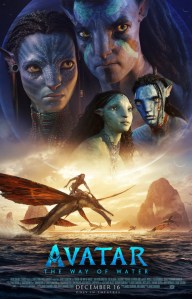 In the 13 ensuing years since James Cameron’s smash hit Avatar, we’ve debated whether or not the collective consciousness has simply moved on and forgotten what was, at one point, the highest-grossing movie of all time. What cultural dent had it made? Are there really still fans? Was it a fad of the new 3-D, itself already dissipated? Does anyone really want three or four sequels? Then Avatar: The Way of Water was released in late 2022 and it didn’t do as well as its mighty predecessor. Instead of being the highest-grossing movie ever, it’s only the third highest-grossing movie ever with a paltry $2.3 billion worldwide (how can the man even sleep at night?). It’s a lot of the same, both in its big feelings, awe-inducing visuals, and its resurrection of characters, scenarios, and conflicts of before, so you’ll likely find yourself reliving your own 2009 Avatar reaction.
Cameron’s long-awaited follow-up returns to the alien word of Pandora where our Marine-turned-Na’vi Jake Sully (Sam Worthington) has raised a large blended family with his Na’vi partner, Neytiri (Zoe Saldana, given little to do but cry this time). The first hour of this three-hour blockbuster is establishing the family dynamic with the different kids, including adopted daughter who is… somehow… the daughter of the deceased scientist Grace (both Sigourney Weaver) as well as the human child nicknamed Spider who is the biological son of Quaritch (Stephen Lang), our deceased villain. Nobody seems to stay dead in this series as Quaritch concocted his own backup plan in case of his untimely demise. He transferred his consciousness into a tank-born avatar, and this new Na’vi Quaritch has his own team of Marines in blue-skinned Na’vi bodies. They’re heading back to Pandora for some out-of-body vengeance, and thanks to their genetics, they seem to get a pass from the natural environment of Pandora mistaking them as native.
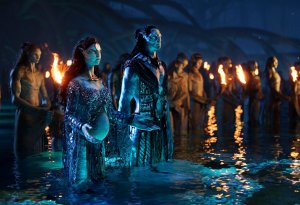 There’s a lot of set up here, and the second hour introduces us to the coastal community, and it becomes another formula of the outsiders learning the rules and culture of the new setting and integrating, turning enemies into friends, gaining honor, etc. It’s within this second hour that the big environmental message coalesces around whaling, with one Sully son bonding with an alien whale Free Willy-style. There’s a whole hunt sequence that poaches a mother and her calf that’s quite upsetting. The parallels are obvious but subtlety is not exactly one of the storytelling options in the Avatar universe. This is a broad canvas in the biggest sense, so every message will be spelled out very finely and underlined, with character voicing obvious themes and villains practically twirling space mustaches. And that’s okay. The final hour is an action-packed showdown bringing all the characters to account and forcing Jake to face off once again with his old commander.
The visual immersion is outstanding and the real reason to sit still during all three hours of Way of Water. The Oscar-winning visual effects are transcendent, and the extended sequences underwater really captivate and achieve the sense of natural awe Cameron aspires for. It is an exceedingly pretty movie to watch, and the level of high-definition detail is astounding. There’s a tangible realism here even when it’s entirely gangly CGI characters. At no point does it feel like an empty green screen stage or an over-exposed cartoon. The world of Pandora is still interesting and worth exploring, and the coastal aliens with their evolutionary differences makes me excited to explore other corners and communities of this alien world. The story works, and the payoffs work, and each of the Sully kids has a moment to shine, though I kept confusing the two older brothers (where did one of these kids learn to say “bro” every other word?). It’s a bit strange to see and hear Weaver in a preteen alien’s body, but that disconnect is part of the point, as the character feels like a foreigner searching for meaning. Considering the decade-plus delay, the huge scope, and setting up potentially three other movies, I’m impressed that Way of Water even works as well as it does as a sequel. I was able to re-acclimate pretty easily in that first hour.
 It’s not revolutionary storytelling but not every movie need be. It follows a familiar formula but puts in the work to make the action meaningful and connected to character and for the emotional beats to resonate. I thought the upside-down sinking military vessel had some striking, terrifying Poseidon Adventure-esque visuals, and the sequence was rooted in the family trying to save one another. With so many moving pieces and characters, the plot can be overburdened and redundant at times (the Sully kids get kidnapped so often they might as well save time and tie themselves up early) but even at three hours it doesn’t feel slow or wasteful. There is a sense of repetition in bringing back so many of the same faces, like literally rehashing the same villains. I wish more consideration was given to the new Quaritch and his own existential journey of the self. Just because you have the brain of this dead evil guy, do you have to follow in his doomed path? That could have been a really intriguing and profound character journey, the cloned Marines bred to be weapons who decide their own identities. That could have sufficed as the entire movie for me. The messages are heavy-handed but effective, though Pandora already had a natural resource that Earth wanted to exploit so I didn’t think we needed a second natural resource that essentially functions as immortality juice. At this point, will the third movie introduce ANOTHER magical resource that cures cancer? Likewise, I hope the next movie doesn’t find us yet another Quaritch (a twin brother!) looking for further score-settling. The ending sets up a larger confrontation with Earth’s corporate elite that will come about with the ensuing sequels, though I would have thought since Way of Water makes a big leap forward in time that Earth’s powerful forces would have already marshaled their unhappy response to being kicked out in the original movie.
Cameron has an innate blockbuster sensibility and storytelling structure; the man just knows how to tell rousing big screen adventures like few others. I didn’t see Way of Water in theaters but I won’t make the same mistake with the many Avatar sequels that will dominates the 2020s. It’s a bit hokey though deeply sincere, and Cameron proves yet again that he should not be doubted on big stages of his own creation. It might take the domestic gross of a small country to make these sci-fi epics of his, but the man delivers like few in the rarefied field of dependable blockbuster artists. There’s going to be an Avatar sequel every two years, so this universe won’t go extinct anytime soon, and I’ll be there waiting too.
Nate’s Grade: B
Share this:

The Shack (2017)
 When it comes to faith-based movies, especially those based on best-selling books, you know that they’re going to be preaching to the choir and more determined to give its intended audience the message it wants first; everything else is secondary. With The Shack, I got the start of an interesting film scenario and then it became the most boring, laborious, and theologically trite Ted Talk ever. I was fighting to stay awake and it was a battle that I was losing. The opening twenty minutes presents a story with dramatic possibility: Mack (Sam Worthington) is a family man who is grieving the loss of his youngest daughter. On a camping trip, she was abducted by a pedophilic murderer and killed in a shack in the woods. Mack is a shell of himself and his family doesn’t know how to reach him. He gets a mysterious invitation from “Papa,” his wife’s nickname for God, inviting him to the murder shack. So far so good. There’s even a fairly interesting back-story for Mack about his alcoholic and abusive father. Young Mack eventually poisoned his bad dad’s drinks with hazardous chemicals to protect he and his mother. However, all remote sense of entertainment is snuffed out once Mack enters the confines of the titular shack. Inside are human avatars for the Holy Trinity of Christianity, with Oscar-winner Octavia Spencer serving as a homespun “Papa.” The next 100 minutes is a series of talk show interview segments with each person to engage in full on flimsy spiritual psycho-babble to explain why God lets bad things happen and forgiveness is key. The movie stops being a dialogue and becomes a lecture series, and each one just kept going on and on. The characters stop being characters and become different mouthpieces for the spiritual cliches. It’s like the filmmakers threw up their hands and gave up. This is not a movie. It’s a inspirational exam told by the most cloying professors. The lessons learned feel trite (who are you to judge, God is with you through good times and bad) and the movie curiously leaves a lot of dramatic implications unresolved. Did Mack kill his father with the poisoned drink? Did this killer pedophile ever get caught, and if not doesn’t that mean other children are at risk? It’s like once Mack enters that mystical murder cabin, the movie loses any sense of structure, pacing, stakes, and dramatic propulsion, and that’s before the silly race across the water with Jesus. I would also say Worthington (Avatar) is not the best choice as the lead actor due to his limited dramatic range and growl-pitched voice. Other movies have dealt with heavy loss but rarely has one felt so detached from making that loss personable and empathetic. The Shack is a maudlin fable that wants to make people feel good even during the dark times. That’s admirable but it doesn’t make this 135-minute sermon any more of a worthwhile movie to watch.
Nate’s Grade: C-
Share this:

Hacksaw Ridge (2016)
 Mel Gibson needs to direct more movies. End of statement. It’s been a decade since Gibson last helmed a movie, 2006’s visceral art film for jocks, Apocalypto, and he’s been in “movie jail” ever since a string of controversial drunken statements. His new movie is a completely earnest, classical example of storytelling that you just as easily could see faces of old appear (say John Wayne in place of curmudgeonly Vince Vaughn), and Hacksaw Ridge is a stirring war movie and a stirring character study. Andrew Garfield plays Desmond Doss, a conscientious objector who wanted to go to war but refused to touch a gun. The first half of the movie is the U.S. Army trying to make sense of this inherent conflict, looking for ways to intimidate him, make him compromise, or kick him out of service. Yet, he endures, and it’s in the second half that Doss single-handedly saves 75 wounded men as a medic left alone on a deserted battlefield in the Pacific. Garfield (Amazing Spider-Man) is a solid lead performance, though his cornpone West Virginia accent irritated me… until the real Desmond Doss is showcased in archival footage and he sounds exactly alike. The supporting characters are rich and have more depth than I was expecting, including Hugo Weaving as Doss’ father, a drunken shell from his WWI survivor’s guilt. There’s much more complexity to what otherwise could be a hateful drunk and one-note character foil. The one miss I felt was the courtship between Doss and his future wife (Teresa Palmer). It felt like an outdated perspective where a man’s insistence overrode a woman’s agency and he was rewarded for it. Admittedly, that’s a modern perspective applied to a generational relationship from long ago. The movie is naturally graphic but the bloody violence is stylized in a way that communicates the ugliness and chaos of war. The action develops and is grisly and engaging without losing sense of the characters and without falling into redundancy. When Doss is rescuing survivors in the final act, the movie finds new challenges that he has to overcome to keep things interesting and raise the stakes. Gibson’s images can be frightfully beautiful; his command of visual storytelling and its evocative power is too good for only one movie a decade. It may be impossible to make an anti-war movie without in some way glamorizing war, so even though Hacksaw Ridge celebrates the heroism of one man’s anti-violence values it finds a mainstream sense of entertainment in the carnage. It’s like a tentpole Oscar movie and I hope I don’t have to wait until 2026 for the next Gibson-directed vehicle.
Nate’s Grade: B+
Share this:

Wrath of the Titans (2012)
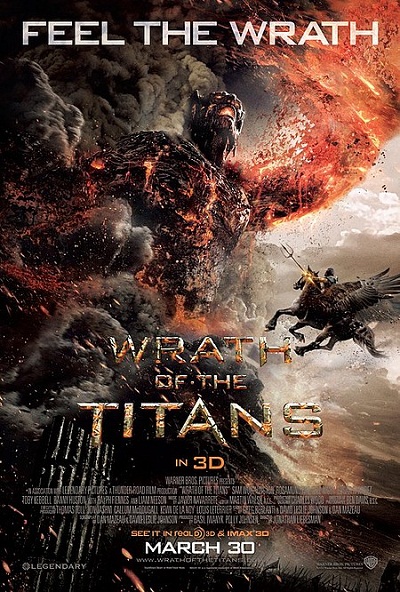 The 2010 Clash of the Titans made some sizable sums of money but it really became famous for one reason – the beginning of the 3D fleecing and the public’s souring on what was supposed to “save the movie going experience.” Clash was converted to 3D in post-production, and its lack of foresight and rushed conversion showed. After the high of Avatar, it only took approximately three months for the public to feel ripped off by 3D. Certain Hollywood bigwigs are concerned that bad 3D conversions will kill the golden goose, and it is having an effect. The percentage of movie audiences seeing big releases in 3D has slipped steadily from 2010. Whether it is the added cost or the underwhelming conversion, movie audiences are warier of the third dimension. And it was Clash of the Titans that destroyed a nation’s innocence. Two years later, the sequel is out and, surprise surprise, you also have the ability to see it in 3D. Either way, this movie will cause you a headache.
In the wake of Perseus successful slaying of the Kraken, he is now a widower with a young son, living their lives quietly, trying to avoid the daring heroics of his earlier life. Fat chance, kid. The gods are at war, particularly Hades (Ralph Fiennes) and Aries (Edgar Ramierez) versus Olympian head honcho Zeus (Liam Neeson), Perseus’ absentee father. The titan Kronos will be unleashed from his prison, Tartarus, and this powerful behemoth will lay waste to the armies of mankind. The gods have grown weak due to mankind’s dwindling faith, and as such they cannot conquer Kronos without the help of man. It’s up to Persues, Queen Andromeda (Rosamund Pike), and Poseidon’s demigod son a (Toby Kebbell) to track down the right magic artifacts to take down Kronos.
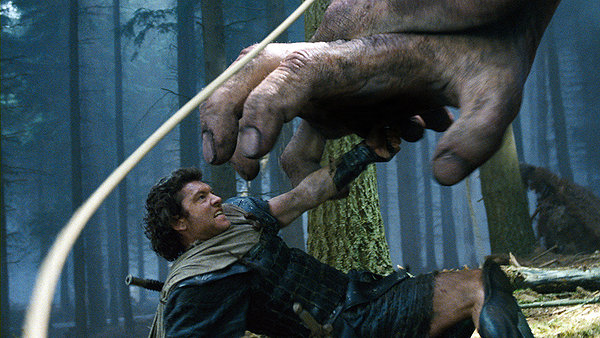 Once again we have a threadbare story that involves running from one location to another to find a clue that leads to the next location; the plot is just a series of magic-item gathering missions, much like a video game. Greek mythology made regular use of magic weapons to slay great monsters, but the myths at least gave their audience heroes worth fighting for. Worthington’s scowling rendition of Perseus is a bore, and giving him a son doesn’t help much. Just because the guy keeps insisting he has someone to protect doesn’t fill his void of characterization. He’s so free of charisma, so gruff and without any defining personality, that you wish he could find some magic shortcut to find his dumb magic items faster. The whole setup with our villain is also vague, beyond the very specialty of the god in question. And then there’s the whole concept of the gods dying, which was also featured in last fall’s glorious-to-look-at-but-empty-on-the-inside Immortals, another cinematic tussle with the titans. What’s the point of being a god anymore if the defining quality, immortality, can be ripped away? I suppose the screenwriters wanted to raise the stakes when Zeus and other gods enter the fray, dangling the threat that they too could perish. “We may not have weapons, but we’ll fight how long we can,” Zeus declares with modesty, and then he proceeds to zap enemies with lightning bolts. I don’t think a club is going to outrank a giant projectile of electricity. Realistically, I think the whole death-of-the-gods angle, which cold have brought some real somber and existential weight to the film, was just a setup to allow the producers to recast future sequels with less costly actors (goodbye, Neeson and Fiennes; they’ll be no more Kraken-releasing for either of you).
Director Jonathan Liebesman (Battle: Los Angeles) isn’t going to wow anybody with his addition to cinema, but he can put together a serviceable sequence of action. My favorite sequence in the entire film is when Perseus and crew enter the underground maze of Tartarus. The stone walls are constantly shifting around and the characters are zooming all around the room. It reminded me of the moving staircases in the Harry Potter world or think of it as the real prequel to Cube. And yet, even this nice sequence is limited because Liebesman and the screenwriters don’t take full advantage of their situation. We have a constantly shifting three-dimensional maze, and nobody gets lost at all? And the heroes, after discarding the map, easily find their way to the other side? What kind of design flaw is that? Liebesman prefers a lot of handheld camerawork and low angles, which can be jarring at times. Worse, the action favors a visceral chaos rather than steady development. There are plenty of people dying, columns exploding, fireballs tossing, but little of it adds up to much. It’s all disparate shots, like every character is in a separate movie. Such a shame because the special effects are rather good. If you’re going to spend this kind of money on a Greek mythology spectacle, at least make us care beyond a “fire pretty” level of tepid enjoyment.
The movie is in some breech of false advertisement since the title clearly states a plurality of titans, but by my modest account we only really have one titan to deal with, the giant lava beast Kronos (do the smaller creatures and Cyclops count as titans? I doubt this). Now we all love how fire looks, though some love it a bit too much. And lava itself has long been a childhood adversary. Who amongst us has never pretended the floor was once lava and but a handful of couch cushions were the only stepping-stones to safety? It’s hard to get an exact feel for how massive Kronos is considering he emerges from a mountaintop and seems to extend even higher into the sky. It’s intended to be a threatening and horrifying sight, but I kept thinking of a Marine ad from the 1990s where prospective recruits displayed their mettle by combating giant lava creatures (“Marines: Keeping the U.S. safe from lava men since 1916”). Instead of being awed by Kronos, I started picking apart the logistics of being a lava man. I suppose when you’re a god, or a titan for that matter, you don’t have to really eat or drink or do the things we mortals must for sustenance. But how does a lava creature work when part of his fiery M.O. is how drippy and malleable he can become? Perseus flies into the mouth of the lava beast but why does a beast, which needs no food or drinks, even needs a mouth? It’s not like this guy is speaking beyond a ground-shaking mumble. The entire face is almost superfluous. It’s not like a lava creature has eyes or a working circulatory system. Now I could apply these same annoying ticky-tack questions to any monster or mythological creature. The reason I did this is because the monster of monsters is no more intimidating, or satisfying, as the array of giant monsters that Godzilla would fight (or for you youngins – the Power Rangers). When your ultimate bad guy, and lone titan, can just as easily be blown up in the same manner as the Death Star, then we have a problem.
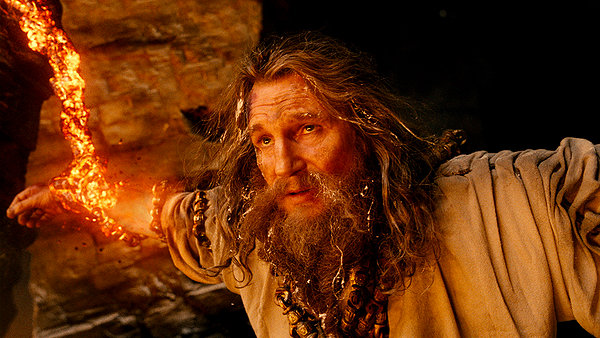 There’s a certain level of entertainment watching dignified actors in something so inherently campy. Neeson (The Grey) and Fiennes (Harry Potter and the Deathly Hallows: Part Two) are a long way from their Shindler’s List collaboration. The two men lend a level of gravitas to a movie that is leagues below their talents. Perseus proves to be such a dull demigod, that I wish the entire movie had followed the warring gods instead. That approach would have been much more interesting considering that they must confront mortality. Worthington (Avatar) still has a notable screen presence in the realm of action cinema, but his constant scowling is just getting tiresome. Hollywood, give this man something to do other than scowl and he may surprise you, like in The Debt. Pike (Doom) is unconvincing as a warrior princess, and her forced romance with Persues could not be more contrived (did somebody say, rebound?). The best actor in the movie is Bill Nighy (Underworld) who shows up as a daffy version of Hephaestus, the god of metallurgy and blacksmiths. Nighy understands how completely cheesy the whole getup really is and delivers a performance on the comic wavelength that the entire movie should have held.
While not nearly as humorless and joyless as the 2010 edition, Wrath is still a fairly block-headed romp through the noisiest parts of Greek mythology. After two movies with “titans” in the title, it’s somewhat remarkable that we only witness one single titan in the entire combined 245 minutes. It’s all CGI sound and fury with little cohesion to make anything feel important, despite huge mythological creatures demolishing cities. From an action standpoint, Wrath packs enough serviceable, escapist sights for the eyes to please diehards of Greek mythology and genre fans with low expectations. I wish there was a more compelling reason to run through all this stuff than big monsters needing to be killed; this hero’s quest needs more motivation or at least a grander sense of awe. The demise of the gods due to mankind’s mounting religious doubt seems like a juicy subject that could have opened these characters up. But then the theological discussions would get in the way of people hitting made-up CGI monsters. If you like your cheese feta, then Wrath of the Titans will provide enough wrath for your bucks, though found lacking in titans.
Nate’s Grade: C
Share this:

The Debt (2011)
 A tense and mature spy thriller that’s as well written as it is acted, The Debt is a thriller that even stops to ponder some serious moral ambiguities along the way. Back in 1965, a group of Israel agents (Jessica Chastain, Sam Worthington, Marton Csokas) were sent to Berlin to capture a notorious ex-Nazi doctor (Jasper Christensen) and bring him back for justice. When things don’t go according to plan, the group must decide what is justifiable in the name of moral cost. In 1997, the aged former agents (Helen Mirren, Cirian Hinds, Tom Wilkinson) have to deal with the full consequences of their actions. A far majority of the film takes place in the 60s, and it’s for the best considering that’s where most of the tension and interest reside. As a thriller, drama, and non-linear mystery, there’s always something going on. The film is not without its genre clichés, but the sequences of holding Christensen (Quantum of Solace) hostage rise beyond genre mucking. He is a true monster and his dialogues with the various agents are chilling, reminiscent of Hannibal Lector’s tête-à-têtes. The cast is uniformly good, even Worthington, but the real star is Chastain (The Help, Tree of Life). She is magnetic. It’s a shame that The Debt felt it needed to tie up its loose ends in a conventional ending that discards the film’s more ambitious moral quandary. I suppose the toll of false identities and moral relativism just doesn’t make audiences happy like good old-fashioned vengeance. I guess that’s a debt everyone would rather have paid.
Nate’s Grade: B+
Share this:

Clash of the Titans (2010)
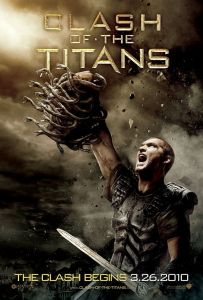 Rather unremarkable and rather dingy, a big-budget remake of Clash of the Titans removes all the fun from the campy 1981 original. Stop-motion is replaced with the sheen of super CGI, but the whole souped-up production feels hollow and overly serious for a movie involving fantastical creatures and Liam Neeson as Zeus. The original film was by no means a classic but it had an enjoyable retro spirit thanks to effects by Ray Harryhausen. The gods are trivialized and hardly in the movie, which is a shame. Danny Huston, as Poseidon, gets one single line in the film. Worse, Perseus (Sam Worthington) is given the motivation of revenge, instead of love, seeking to stand up to the gods who have left man to stew in despair. He blames the treacherous Hades (Ralph Fiennes) for the death of his father. And so the epic adventure is for vengeance, which gives everything a somewhat nasty pall. Who wants to watch a story about Greek mythology where the main character wants to rid the world of the gods? Why would Zeus go along with this? For a fairly straight forward plot, the movie frantically rushes from scene to scene. The action sequences are a particular letdown for director Louis Leterrier (Transporter). The CGI effects, mostly efficient, are like quick blurs and whooshes. You can?t tell what’s happening or you just don’t care. The movie has no character development and I’m not even certain I liked Perseus. Worthington?s scowling and howling is starting to get old after three high-profile action roles in an 18-month window. Would you believe that there isn’t even a titan to be clashed?
Nate’s Grade: C
Share this:

Avatar (2009)
 Avatar cannot possibly meet expectations. Can it? The long-in-development pet project of director James Cameron has been dubbed as nothing short of a tectonic shift in moviemaking; it will “change movies forever.” Cameron had the idea for the movie 15 years ago but held on, waiting for the technology to catch up. After you’ve directed Titanic, the highest grossing movie in history, I suppose you have the luxury of waiting. The budget has been rumored to be wildly anywhere from $250 million to $500 million. Avatar was always planned as a 3-D experience and nothing short of the savior of modern movie and the theatrical experience. It would make going to the movies an event once again, something that could not be duplicated at home on puny TV screens. Given the reams of hype and anticipation, Avatar couldn’t possibly succeed, could it?
In the year 2154, mankind has posted a colonial base on the distant moon of Pandora. The planet orbits a gas giant and the atmosphere is deadly to humans after a few minutes exposure. The planet is inhabited by all walks of deadly, incredibly large life, including the indigenous Na’vi tribes, skinny, nine-feet tall blue aliens. The Na’vi also have connective tissues coming from their ponytails that allow them to connect with all nature by “jacking in,” so to speak. They are a relatively peaceful clan that makes sure to respectfully use every part of the space buffalo. It just so happens that they are also sitting on top of a huge enrichment of the mineral Unobtanium, which sells for a crapload of money back on Earth. A corporate exec (Giovani Ribisi) has hired a private army of mercenaries to forcefully move the natives. In the meantime, they are trying to reach a diplomatic solution. Dr. Grace Augustine (Sigourney Weaver) is the head of the Avatar program, where they biologically grow Na?vi bodies with some human DNA mixed in. People can then link their brains to the giant Na?vi bodies and walk and talk among the natives.
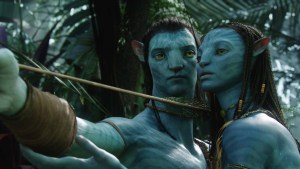 Jake Sully (Sam Worthington) is an ex-Marine who is living the rest of his life in a wheelchair. His twin brother was apart of the Avatar program but was murdered, and he?s signed on to take his brother’s place (the avatars, naturally, are hugely expensive). Jake will plug into his avatar body and be able to feel like he can walk again. Colonel Miles Quaritch (Stephen Lang, superb) likes the idea of having a former Marine on the inside. He makes a deal with Sully: provide useful Intel on the Na’vi, and he’ll get his “real” legs back. Jake and his fellow avatars ingratiate themselves with the Na’vi, and Jake is taught the ways of the tribe by Neytiri (Zoë Saldana). Their teacher-student relationship transforms into a love affair, and Jake begins having second thoughts about his mission.
To the heart of the matter, the special effects are transcendent. This is one of those pinnacle moments in the advancement of special effects technology. Avatar is now the new standard. The environments are so incredibly realistic that if I were told that Cameron and his crew filmed on location in some South American jungle, I would believe it without a moment’s hesitation. But everything in this movie was filmed on a giant sound stage. The visual detail is lushly intricate and altogether astounding. The planet of Pandora feels like a living, breathing world, with a complex environmental system. Every blades of grass, every speck of dust, every living creature feels real. Cameron and his technical team have crafted an intensely immersive, photo-realistic alien world. The level of depth is unparalleled. I found myself trying to soak up the artistry in every shot, admiring a tree canopy four dimensions back. The planet has an extensive night period, which has allowed the planet to evolve with an emphasis on bio-luminescence. Everything from moss that glows from being stepped on, to dragonflies that look like spinning flames, to glow-in-the-dark freckles on the Na’vi allows the movie, and Pandora, to feel like it has a rich evolutionary history. The ecosystem makes sense given the particulars of this world. Cameron isn’t just giving an extra leg or another eye to make the wildlife alien. The special effects are so good that you can easily take them for granted, like Jake’s atrophied legs. Those were special effects as well and yet they looked so real that I never stopped to consider them.
The Na’vi don’t necessarily have the same level of photo realism, however, this is by far the greatest motion capture accomplishment of all time. The creatures don?t appear rubbery or waxy, and there is honest to God life in those eyes, the same life that is absent in Robert Zemeckis’ motion capture movies. The CGI characters have believable facial expressions, capturing subtle movements and realistically capturing emotion. I’m still not a fan of motion capture, but at least Cameron makes effective use of the technique by recording actors movements and mannerisms and transforming them into nine-foot tall blue cat people. That seems like a better use of the technology than having Tom Hanks play a mystical hobo.
 The 3-D is impressive as well but not the “game-changer” it was heralded to be. This is because Cameron doesn’t want to distract the audience and make them conscious of the 3-D gimmicks. There aren’t any moments where someone just hurls something at the screen randomly. There aren’t any clumsy swordsmen jutting forward. Because the 3-D glasses naturally dim the screen and make things darker, Cameron has smartly compensated by cranking up the natural light and vivid colors on screen. Nothing ever comes across as murky or hard to distinguish. Cameron has designed a 3-D environment that spaces out the different elements of the foreground and the background. There will be floating bits like ash or water that will seem right in front of your face. Short of that, you may find yourself forgetting about the 3-D because it’s not always utilized for a 160-minute action movie. It’s more just pushing the visual planes back with your depth of field. After all the praise about Avatar being the triumphant 3-D experience, I’m surprised that the best 3-D I’ve ever seen is still Zemeckis’ Beowulf. At least you still have that laurel, Zemeckis. For now.
From a narrative standpoint, Avatar has a lot of borrowed elements. It follows the exact same plot paces as Dances with Wolves. In fact, this story is exactly Dances with Wolves in space. Like Kevin Costner’s film, we follow an injured military man find acceptance and community with a native (Pandorian?) population. He falls in love, changes his world perspective, and realizes that these dignified people of the land deserve more than to be pushed aside for the greed of the Encroaching White Man. So he bands together and leads the natives against the superior military power of the White Man (It’s also the same plot formula for 2003’s The Last Samurai too). There?s even a young native that distrusts our hero at the start but eventually comes to call him “brother.” Add a few touches from Ferngully and The Matrix and there you have it. It’s the modern tale of colonialism where we, the people in power, are the enemy, though the villains of Avatar are corporations and private military contractors. That might not sit well with certain parts of the country; the same people that blithely think America can do no wrong simply because of its name. Cameron’s politics are pretty easy to identify on screen, and it’s probably too easy to dismiss the flick as “tree-hugging” eco-worshipping prattle. However, this is the same man that wrote and directed True Lies, which is nothing but the cool allure of the military industrial complex AND the villains were Arab terrorists.
Now, the characters aren’t too deep and the love story between Jake and his blue lady seems to be missing a couple reels worth of romantic development, but the movie follows its familiar beats with ease and the last act is terrific. It’s once again one of those all-out endings that gives way to a relentless series of explosions, but Cameron brings together all the creatures and characters he has established prior, which makes for a hugely satisfying and kick-ass payoff. Cameron is one of the greatest masters when it comes to constructing an invigorating action sequence, and he pulls out some great ones in Avatar. Geography is so key to staging a compelling action sequence, utilizing the particulars of the location and having an audience familiarized with the location. By he end, Cameron has fleshed out his world so well that we recall specific locations and remember their strategic value. The assault between the giant mechanical robot suits and the noble natives is great, with different points of action on the ground and in the air. Some have complained that the action sequences of Avatar are like a video game cut scene, and so what? My one complaint about the action is that we lose perspective by being with the Na’vi for so long. The audience becomes accustomed to seeing the world from the Na’vi proportional perspective, forgetting that these creatures are nine feet tall and even they look tiny on their flying dragon creature things, so how big must those things be?
 The movie is not without some level of flaws, primarily in the storytelling department. The first 90 minutes of the movie feels really solid but then the next hour kind of simplifies everything in a rush to the climactic booms. The human villains become dastardly, the Na’vi become extra noble, and the romance with Jake and his blue lady gets consummated in a sequence begging for biological questioning (Do they “jack in” to each other? Is this somehow considered bestiality?). Jake could have benefited with some more back-story as well. The earnest “I see you” Na’vi greeting can get silly after a while. The whole avatar aspect doesn’t feel fully committed and could use more explanation. The Ribisi character is a shallow glimmer of the corporate weasel that Paul Reiser played so perfectly in Aliens. Cameron never says why the Unobtanium element is so valuable in the movie; apparently, Earth is out of energy resources. There are elements that border on the ridiculous, like the giant mech robot suit having a giant Bowie knife. The end leaves the distinct impression that the defeated human beings will just come back with bigger hardware and stronger nukes. If this Unobtanium element is so valuable to the energy resources of Earth, I doubt that one butt whipping is going to stop the exploitation of Na’vi resources. The sappy end credit love song by James Horner and Leona Lewis also might elicit more than a few guffaws.
The only real groundbreaking part of Avatar is the visuals but a familiar story doesn’t stop Cameron’s technical achievement. The plot is entirely predictable, and wholly borrowed, with a crazy different environment and a fresh coat of CGI. But can a highly derivative story kill a project built upon visual wonders? Not for me. Star Wars itself was derivative of many other stories, from samurai tales like Akira Kirosawa’s The Hidden Fortress, to Buck Rogers and Flash Gordon, to Westerns like The Searchers, and war movies like The Guns of Navarone and The Dam Busters. Has that hindered the lasting impact of George Lucas’s quintessential space opera? I’d doubt you?d find too many folk with nagging complaints about Star Wars being too derivative. That’s because the characters were interesting and we cared about them, the story was satisfying, and the visual techniques pushed the medium forward. I could repeat that exact same sentence, word-for-word, about Avatar. It might not change movies forever as we know it, but Avatar is a singular artistic achievement that demands to be seen at least a few times, if, for nothing else, to stare at lifelike trees some more.
Nate’s Grade: B+
Share this:

Terminator Salvation (2009)
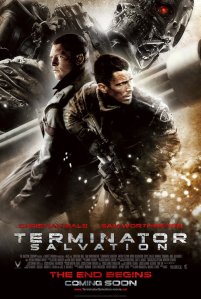 The fourth Terminator movie ultimately comes across as a lifeless enterprise. It’s set during the war between man and machine, which means John Conner (Christian Bale) is leading the human resistance, as was prophesied. He must stop those crafty machines from finding and killing Kyle Reese (Anton Yelchin), who is destined to be sent back in time and become Conner’s father. The storyline focuses a lot more attention on the mysterious man Marcus (Sam Worthington), who isn’t so mysterious because they give away in minutes that he’s a machine. But he’s a thinking machine that reclaims his humanity, or whatever. The point of this movie is to make some cool action sequences and not step on the toes of the previous movies. Director McG (Charlie’s Angels) has a few nifty visual tricks up his sleeve, but this is one soulless machine just going through the Action Blockbuster subroutine. The character development is nil, the story is muddled, the machines are dumb, and Bale forgoes any normal kind of speaking voice in favor of growls and hissing. The throwbacks to the other movies can be fun (a 1984-aged Arnold!) or agonizingly lame (shoehorning in famous quotes like, “I’ll be back”). The movie is competent and has one or two exciting chase sequences, but that is simply not good enough coming from this storied action franchise. Terminator Salvation plays out more like Transformers, where the robots are big and bad and loud and sort of dumb. I guess that sums up the movie pretty well.
Nate’s Grade: C+


 nathanzoebl
You must be logged in to post a comment.