Blog Archives
Inside Out 2 (2024)

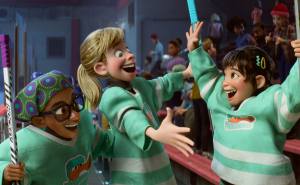
Of all the Pixar hits, 2015’s Inside Out is one of the better movies to develop a sequel for, and thankfully Inside Out 2 is a solid extension from the original. The internal world of Riley’s burgeoning sense of self is so deeply imaginative and creatively rewarding, balancing slapstick and broad humor with a deeper examination of abstract concepts and human psychology (Freud would have loved this movie… or hated it… or just thought about his mother). The unique setting was made so accessible by the nimble screenplay that the viewer was able to learn the rules of this setting and how interconnected the various parts are. While not being as marvelously inventive as its predecessor, nor as poignant (R.I.P. Bing Bong), Inside Out 2 is a heartwarming and reaffirming animated movie that will work for all ages.
Riley is now turning thirteen years old and in the midst of puberty. That means new emotions, and Joy (voiced by Amy Poehler) has to learn to work well with her co-workers, such as Envy, Embarassment, and Ennui. The biggest new addition is Anxiety (voiced by Maya Hawke) who wants to prepare Riley for her life ahead, which seems especially rocky now that Riley knows her two best friends will be going to a different school. A weekend trip to hockey camp becomes Riley’s opportunity to test drive the “new Riley,” the one who impresses the cool older kids and gains their acceptance. This will force Riley to have to determine which set of friends to prioritize, the new or the old, and whether the goofy, kind version can survive to middle school or needs to be snuffed out.

With the sequel, there aren’t any dramatically new wrinkles to the world building already established. We don’t exactly discover any new portions of Riley’s mind, instead choosing to place most of the plot’s emphasis on another long journey back to home base. This time the other core emotions get to stick around with Joy, each of them proving useful during a key moment on the adventure. The externalization of the emotions invites the viewer to feel something toward feelings themselves. When Joy, at her lowest, laments that maybe a hard realization about growing up is that life will simply have less joy, it really hit me. Part of it was just the sad contemplation that accepting adulthood means accepting a life with less happiness, but a big part was teaching this concept to children and being unable to provide them the joy they deserve. Since the 2015 original, my life has gone through different changes and now I watch these movies not just as an individual viewer recalling life as a former adolescent figuring things out, but now I also come from the perspective of a parent with young children, including one turning thirteen. The development of the mind of this little growing person is a heavy responsibility given to people who are, hopefully, up to that very herculean task. We can all try our best, but recognizing limitations is also key. The kids have to have the freedom to be themselves and not pint-sized facsimiles of a parent.
The emotions inside Riley’s mind are featured like internal surrogate parents, tending to the development of Riley’s emotions, morals, and personality. They presumably want what’s best for her, there just happen to be opposing interpretations of what that exactly means, which leads to the majority of conflict with Anxiety. However, there’s also an understanding that Riley has to do things on her own and be able to make mistakes and learn from them. Inside Out 2 is ultimately about accepting the limitations of providing guidance. Joy and Anxiety are both trying to steer Riley down a deliberate path they think is best, but Riley needs to discover her own path rather than have it programmed for her. I appreciated that Anxiety is not treated as some dangerous one-dimensional villain hijacking Riley’s brain. Much like sadness, there is a real psychological purpose for anxiety, to keep us alert and prepared. Now that can certainly go into overdrive, as demonstrated throughout Inside Out 2, including a realistic depiction of a panic attack. It’s about finding balance, though one person’s balance will be inordinately different from another. The stakes may be intentionally low in this movie, all about making the hockey team and being welcomed by the popular girl she may or may not be crushing over (more on that later), but the focus is on the sense of who Riley chooses to be through her life’s inevitable ups and downs. It’s about our response to change as much as it is our response to the presence of anxiety.
Inside Out 2 also answers a thorny world-building question that the original creators never thought to go into greater detail. It’s established in the 2015 original that even the adults have the same five core emotions manning their brain battle stations: Disgust, Fear, Sadness, Anger, and Joy. So if adults only see these same emotions, what happens to those new puberty emotions? Do they go away? As an adult, do we gradually work through anxiety and embarrassment to the point where they are no longer present (this is where every adult can wryly laugh)? There’s an emotion introduced as Nostalgia, depicted as a kindly grandmother so eager to remember the ways things were. Joy tells Nostalgia to leave, as it’s not time for her to be developed yet until Riley is older. This one moment clears up the world-building question; the emotions don’t leave, they just sit out for periods of time like bench players waiting to be called into the big game. And just like that, it all works and makes sense. I wonder what other new emotions make their appearances later in life. Resentment? Choosing to rather die in authority rather than give up an iota of power to a younger generation? Sorry, that last one was more directed at those stubborn folks clinging to Congressional offices.
There is some sight narrative and thematic redundancy here. The first movie was about learning the importance of accepting sadness as a vital part of the human condition and how we can process our emotional states. It was about Joy learning that not every moment in life can or should be dominated by joy, and that the other emotions are also necessary functions. With the sequel, we have a starting point where Joy is picking and choosing what memories are worthy of being remembered, banishing the “bad moments” to the back of Riley’s mind, forming a cavernous landfill of junked memories. It’s treading some pretty similar ground, prioritizing one set of memories or emotions over others wherein the ultimate lesson is that repression in all forms is unhealthy and robbing one of the necessary tools for self-acceptance and growth. This is further epitomized by a trip to one of these memory vaults where Riley’s Deep Dark Secret is willfully imprisoned. The movie proper never comes back to this self-loathing figure, and the revelation could have really supported the overall message of self-acceptance. Pixar could have done something really special here, like having Riley coming to terms with being bisexual/queer, and that perhaps something we may personally agonize over as a horrifying secret could, once shared, be far from the dreaded life-destroying culprit our minds make it out to be. This would have really worked with the perceived lower stakes of the movie, naturally elevating the ordinary to the profound, as life can often unexpectedly become. Alas, the Deep Dark Secret is just a setup to an underwhelming post-credits joke – womp womp. That’s it? Again, if you’re going to tread the familiar thematic grounds about the dangers of repression, at least give us something bigger to reach than the same lesson that all emotions have a place.

The first Inside Out was a masterpiece. That’s a hard act to follow. This sequel, of which we can all assume there will be more given its billion-dollar box-office, is a solid double to the original’s home run of entertainment. It’s not among their best but it’s one of their better non-Toy Story sequels. Inside Out 2 is a heartwarming winner.
Nate’s Grade: B
Share this:

Elemental (2023)
 The joke is how Pixar has taken its storytelling motif of examining The Secret Life Of [Blank] and showing what happens in our world when we just aren’t paying attention. We’ve had toys with emotions, bugs with emotions, fish with emotion, cars with emotion, robots with emotion, rats with emotion, and even emotions with emotions, so why not break things down to their basics and give the elements of carbon-based life their own emotions too?
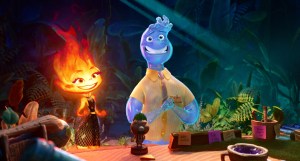
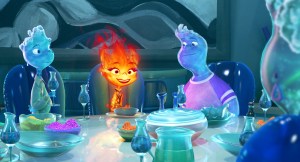
In Element City, Ember (voiced by Leah Lewis) belongs to the fire community living on the outskirts of town, as the big city wasn’t built for their kind. The earth people, and water people, and air people go about their business while the fire people form their own thriving offshoot. Her father and mother came across the sea to give their baby a new life, and the family shop will pass over to Ember’s management when her traditionalist father thinks she’s ready. Her whole life has been about serving her family and trying to live up to their hopes and dreams. This gets more complicated when Wade (voiced by Mamoudou Athie), a water person and a health inspector, has to report her family’s shop for code violations. They work together to save the shop and also learn from one another’s cultures and differing perspectives, and then this unexpected friendship becomes an even more unexpected romance, but can elements so different stay together?
 I was pleasantly surprised at how enjoyable Elemental is to experience and how wondrous its visual presentation is to watch. It is a certifiable treat for the eyes, with so many dazzling colors and quirky but easily readable character designs. There’s a mixture of hand-drawn animation used as Spider-Verse-style accents that provides a pleasing element that allows the images to pop even more. I was never bored looking at a single second of this movie, and even with my theater’s 3-D presentation, the glasses didn’t darken the screen and lessen my overall enjoyment. By existing within a fantasy universe, it allows for every scene and every location to better inform you about this new world and its rules and highlights (fire baby carriages that are barbecue grills). This is a bright, colorful, and supremely enchanting movie to watch because, at least visually, it feels very well developed as far as its world building and atmosphere. What would a community of fire people tend to look like? What would their jobs be? What would their celebrations be like? Their heritage from the Old Country? Naturally, with any fantasy universe, you can nit-pick it to death with questions, such as why do people even bother wearing clothes in this world? What part of the exposed fire or water is observed as obscene? How exactly do these different communities have their offspring? What does air exactly eat for food?
Where Elemental really takes off is with its charming and affecting romance. It’s been a while since romance was at the forefront for a Pixar movie, since 2008’s WALL-E (a.k.a. the greatest Pixar movie). Now there are themes and resonance that go beyond the romance and also enrich it, like Ember’s personal conflict of being a first-generation immigrant daughter and upholding the traditions and wishes of her family at the expense of her personal desires, but the core of this movie is on the burgeoning feelings between Ember and Wade. The movie begins with them butting heads as two elements seemingly in conflict but it doesn’t exactly follow an enemies-to-lovers path. She runs hot and explosive with trying to keep things under control whereas he is deeply empathetic of others and wants to help them become their best selves. He accepts who he is, and the movie doesn’t equate his full-bodied embrace of big feelings as some point of weakness. It brings about laughs from exaggeration, the streaming rivers that burst forth from his eyes upon crying, but it’s his compassion and acceptance that challenges Ember for the better and helps her assert her sense of self. They’re good together, and Wade helps serve as a guide to the wider world for Ember as she’s been isolated her whole life. Their interactions are cute and heartwarming and elevated by pleasant vocal performances. I was drawn into their story and cared about their well-being, enough that I don’t mind sharing that I shed some water myself by the end (I guess this could also make some people mistake that I peed my pants, and I assure you that was not the case, dear reader).
 While the core relationships are poignant and winning, the world building and metaphorical allegories feel half-finished and a tad confusing. The movie also goes surprisingly soft exploring its miscegenation metaphor of two elements being forbidden to mix romantically. This universe has four communities of living elements, though air is represented as clouds and those are, literally, water vapor, and the xenophobia and discrimination that the fire people endure feels like a direct parallel to a disadvantaged minority group. However, this isn’t explored in any satisfying depth. We’re told that fire people aren’t really wanted in the city, and the city isn’t really built for them, which is typified by a rail line that splashes water discharge. There’s a lot more that could have gone into this including a more elaborate examination of the harm of red-lining and restricting the economic mobility of one group for bigoted reasons (I know, I can already hear people scolding me for even asking for such socio-political commentary in a family film). However, this metaphor gets a little murky when you take into account the literal danger that living fire exudes. Yes, you can drown, and you can get crushed under earth, but these creatures aren’t walking incendiary devices. This doesn’t translate directly to people, and thus applying class metaphors to actual races can be circumspect. Ember’s worry is that she’ll explode if she gets too angry, and this causes literal physical destruction around her. You can say it’s meant to represent when hurt, angry people lash out that they can inadvertently harm others, but not everyone can incinerate a block because they lose their temper. This kind of undercuts the lesson on misplaced fear.
Also, so much of the external story consists of bad public planning and everyone’s lackadaisical attitude toward fixing this infrastructure miscue. Again, if the larger point was a society that is actively hostile to the fire people, then the ignorant city planning that actively harms a disenfranchised group of people makes sense, but without that larger underlying conflict, it all seems so strangely forgotten. Much of this conflict is on the structure of a wall against a coming buildup of water, something possibly deadly to the fire community, so you would think this community would be a lot more concerned about this looming conflict. You might think that others would organize to provide better safeguards or maybe they would get the city’s attention. That this threat goes unreported and is played at such low stakes makes it all feel forced and manufactured. If the characters don’t seem to think it’s a big deal, then who are we to worry as well? And I can hear some of you trying to branch this out into, say, a metaphor for larger problems that go ignored, like climate change or societal inequalities, but that’s giving Elemental too much credit.
 Elemental reminds me of 2020’s Onward, coincidentally one of the last movies I saw in theaters before the pandemic shutdown. I was worried that the core story looked weak but it was actually the world-building that was a bit hazy and under-developed and the emotional core was strong and authentic. It’s the same with Elemental, and while I can quibble about its dropped potential and misshapen world, it has a strong foundation that matters more. The relationships between Wade and Ember and Ember and her family are what makes the movie work and ultimately what made me smile and tear up. It’s an emotional nourishment that makes the movie feel satisfying and worthwhile no matter the lingering questions for this bizarre world. It’s also one of Pixar’s best looking movies, fully deserving of being seen on a large screen for added impact. Elemental has the right DNA for a charming and enjoyable family film for everyone.
Nate’s Grade: B
Share this:

Lightyear (2022)/ Luck (2022)
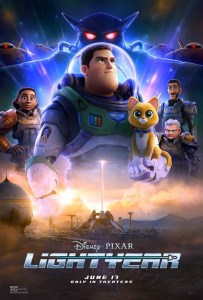 After two years and three movies sent straight to Disney’s burgeoning streaming service, Pixar returns with a theatrical movie that taps back to the very beginnings of this storied storytelling company. We’re told, via opening text, that Lightyear was Andy’s favorite movie and thus the reason he was so excited to bring home a Buzz Lightyear action figure in the first Toy Story. However, if this is Andy’s “favorite movie,” then this kid needs to be exposed to more movies. It’s an acceptable sci-fi story about Buzz (voiced by Chris Evans) learning the value of others and that being vulnerable is not the same as being weak. He’s a space ranger stranded on an alien world. Every time he attempts to restart their fuel system, it jumps him forward in time four years, and soon enough he’s a man out of time and those stranded have built a colony civilization over 100 years. There’s a band of misfits, who aren’t terribly funny, and some laser fights and action sequences, which aren’t terribly exciting, and the third act twist is predictable. The animation is top-notch, but the storytelling is definitely a few notches below infinity and beyond. What astounds me is that Andy could watch this movie and want a Buzz toy instead of the real breakout, the robotic cat Sox (voiced by Peter Sohn) who is wonderfully droll. I cannot fathom anyone watching this movie and desiring owning another character above this delightful supporting character. This movie makes me think a little less of Andy as a discerning arbiter of pop-culture zeitgeist. Lightyear is fine as escapist entertainment but too facile and inessential to the Toy Story universe.
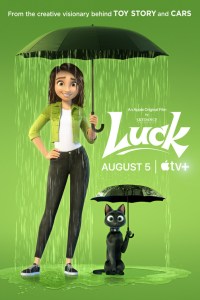 Luck is the first animated feature from Skydance, a production company that entered the animated realm by hiring former Pixar head John Lasseter as their chief creative executive. In some ways, Luck feels reminiscent of early Pixar movies, exploring the “secret life of” those in charge of dictating the forces of luck. The problem with Luck is that it is overwritten and overburdened with world building that crushes the emotional core. We follow a young woman aging out of the foster system and she’s been besieged with bad luck all her life. She follows a talking cat and discovers a hidden world where workers mine luck crystals and have lucky pennies as portal generators and there’s a dragon, for some reason, as the CEO of Good Luck, and to get back home she needs to team up with the cat to find a thing, but to find that thing they need to go to a place, but to go to that place they need to – and you get it. The plot is overworked with a chain of tasks that explain more of this world’s mechanics without connecting to the emotional journey of the character, like in 2015’s Inside Out. I was amazed that this woman lacks even a shred of bitterness about her own trenchant bad luck. There’s a nice message about accepting the bad with the good in life, and how both are opportunities for growth, but I kept wondering why our hero didn’t once lash out at those responsible. I’m also a little hesitant about using whether a little girl will be stood up by her potential new foster family as the stakes of completing the good luck reset goal. That seems pretty heavy for wackiness. The animation isn’t quite at the level of Pixar, or the best of Dreamworks, but it’s colorful and bright even if lacking more advanced lighting and texture. Luck lacks enough gravitas and development to really appeal to adults but it’s also probably too busy and convoluted to entertain small kids.
Nate’s Grades:
Lightyear: B-
Luck: C+
Share this:

Turning Red (2022)
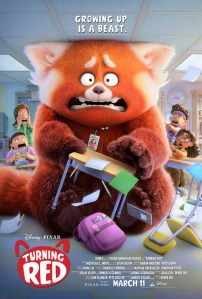 It’s fair to start to wonder whether Disney has some kind of grudge against Pixar at this time. The last three Pixar movies have been pulled from theatrical release and made exclusively available as part of their streaming war chest with Disney Plus. You can blame COVID for Soul being pulled, and the theatrical market was still recovering by the time Luca was scheduled to be released during the middle of summer 2021, but this didn’t stop Disney from releasing both of its own in-house animated efforts to theaters. Both Raya and the Last Dragon and Encanto played in theaters in 2021 and both under-performed at the box-office, which is clearly not close to where it was pre-pandemic. No animated movie has earned over $100 million at the U.S. box-office since COVID, and maybe that’s the reason that Turning Red has become the third Pixar movie to go directly to streaming. There are rumors that this trend has been demoralizing for Pixar employees, and explanations by Disney brass that these movies move valuable subscribers to their service, but I guess we’ll see when the Buzz Lightyear movie comes out summer 2022. Regardless, Turning Red is a high quality movie that made me feel warm and fuzzy all over.
 Meilin Lee (voiced by Rosalie Chiang) is a 12-year-old student trying to live her best life in Toronto circa 2002. That means she’s one way with her friends and one way with her domineering mother, Ming (Sandra Oh). Mei is an overachieving student, devoted daughter to her family’s business caring for a Chinese temple honoring their ancestors and red pandas, and a fangirl in the extreme for the popular boy band, 4-Town (even though there are five members). Mei’s mother does not approve of her devotion to this band, or the influence of her friends, and doesn’t understand the new person her daughter is turning into. However, Mei also happens to turn into a giant red panda whenever she feels any strong emotion. She has to keep herself in check, which is hard to do with mean students, an embarrassing mother, and the prospect of scrounging up enough money so she and her three besties can see their favorite boy band live.
I had to consider what about Turning Red worked for me and what about Luca did not. They’re both relatively smaller scale movies about characters who transform into fantastical creatures, who have to hide their secret, deal with parental disapproval, and come of age while pushing their personal boundaries and re-examining who they are and what they felt was important. There are several points of comparison but I found Luca to be broadly lackluster and low in stakes. With Turning Red, I found the movie to be much more engaging and poignant. So what’s the difference where one feels shallow and the other feels personal and resonant? I think the difference is that Turning Red’s relationships feel more realized and complex. The mother-daughter dynamic is fraught with tension, as trying to live up to the standards of the prior generation is often a surefire way to disappointment. That stuff is relatable, and the drama is potent, but the movie doesn’t lose sight of the generational love underneath all the headaches. Both movies are in essence about growing up and finding your identity, relishing different parts of you that stand out as unique, and coming to terms with differences in perception, but I felt with Turning Red that the film embraced these themes, integrated them better, and also built a sturdier foundation of enriched character relationships.
 The animation is irrepressibly gorgeous but I really enjoyed the added style of Turning Red. It had a more tactile physical presence that reminded me of the Aardman models (Wallace and Gromit, Chicken Run). The color balance also emphasized bright colors that popped with subdued hues as a background. I especially enjoyed playful little touches from anime that emphasized the overly dramatic nature of the personal stakes, like when Mei is sweating over whether her mom will find her notebook filled with pictures of a crush that she felt compelled to draw. There’s a definite energy to this movie that’s missing from plenty of other Pixar movies. It follows the perspective of its heroine, so it’s joyfully excitable and goofy at points and definitely over-the-top, like when she’s calling out her besties and we flash to a rotating mountain they’re all triumphantly scaling. It’s adopted her perspective in a way that makes the movie feel more personable, and I appreciated Mei’s character even more. Special credit should go to whoever was in charge of designing the fur textures for the red panda. When she fully panda’s out, Mei resembles a wonderfully realized version of a Totoro-styled demigod.
It was the third act where Turning Red went from amusing to surprisingly poignant for me. The central conflict is between Mei trying to be herself and the version her mother thinks she should be, which is naturally more deferential and devoted to the family at the expense of independence. This isn’t the first story to explore the difference between traditional families and their children becoming more influenced by Western pop-culture. It’s also not the first story about finding your voice and making a stand, or about parents coming to terms with the realization that their little kid isn’t so little any more. That’s fine. The supernatural elements are also pretty straightforward to follow and in service of the central relationships and metaphors. It’s the personal details that make this movie feel specific to its voice while still being accessible and relatable. It’s easy to cringe when Mei’s mother shares Mei’s private drawings with her fleeting crush. While many of us might not have been diehard fans of a boy band, we all had some phase where we felt more mature, more grown up, and dramatically different because of what this interest meant for us. I found myself battling genuine tears by the end. The end comes down to a conflict between mother and daughter, itself an echo of past conflicts, of overbearing generations being less flexible. It’s also ultimately about acceptance, but the idea that the aspects about yourself that you feel embarrassed or insecure about do not need to be expunged from your identity I think is a worthwhile message about growing up. It’s not about shedding parts of yourself, killing off things you dislike. It’s more about transformation and acceptance of self.
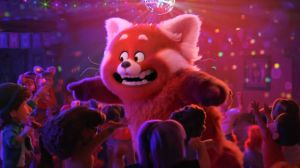 Turning Red is a briskly paced comedy with a precise, charismatic lead character letting us in on the pressures of her world and of being a teenage girl in the early twentieth century. It’s colorful and frenetic at points but feels completely in keeping with the personality of our plucky protagonist. The combination of puberty and monster transformation has been a ripe area for films especially in the realm of horror. This also might be the horniest Pixar movie to date, and a climactic confrontation involves shaking one’s butt, as they kids are wont to do in leisure. It’s got the substance I felt was missing with Luca and the simplified and streamlined world building that I felt could have improved Soul. In short, Turning Red isn’t top-tier Pixar but it’s an irresistible urban fantasy that has plenty of heart and whimsy to enchant audiences no matter the age.
Nate’s Grade: B+
Share this:

Luca (2021)
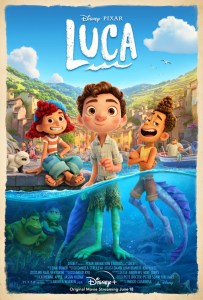 Pixar’s second straight direct-to-Disney-plus outing, Luca, is a decidedly lesser movie from the creative powerhouse. It’s more in keeping with the low stakes and minimal characterization of something like the Cars franchise or Monster’s University. It has its gentle charms and important themes about acceptance, accessibility, and identity, but Luca feels a bit too shallow and lacking in magic. Two sea monster boys want to feel the thrill and freedom of living on land, and it just so happens they transform into looking like humans as long as they don’t get wet. They must learn the ways of blending in, keep their secret, and win the local triathlon to achieve their dream of owning a Vespa scooter. Yes, ostensibly it’s about two kids, and a third once they become friends with a rambunctious redheaded girl in town, wanting to win a race to get a scooter, and you can see the larger theme about friendship and self-acceptance in the name of intolerance, but the movie feels like Ponyo meets The Little Mermaid with the setting of Call Me By Your Name (with maybe some of its coming-of-age queer coding?). The movie barely gets to 84 minutes long, pre-credits, and even that feels very lackadaisical and padded, stretching a thin storyline with minimal development. The animation is expectantly gorgeous and colorful, the lovely daubs of light are so soothing to watch, though I didn’t care for the Gravity Falls-style character designs. The stakes are low and personal but I didn’t really care about the broad characters. There are some fun farcical hijinks trying to hide their monster selves from being seen, and the conclusion has a sweet message without being overtly sentimental, but Luca is little more than a fitfully amusing yet slight seaside vacation for your hungry eyes.
Nate’s Grade: B-
Share this:

Soul (2020)
 I needed to watch Soul twice before I fully processed how I felt about it. Pixar’s latest animated wonder follows a New York City music teacher named Joe (voiced by Jamie Foxx) who goes into a coma right before his big break playing for a jazz legend. He’s transformed into a cuddly little blue tuft of cloud creature and informed his soul is ready for The Great Beyond. In a nod to Heaven Can Wait, Joe indignantly fights his way back to Earth to reclaim a life he felt was just now getting on track. His ticket back to Earth is through mentoring a surly, pessimistic young soul 22 (Tina Fey) that nobody seems able to reach, even Mother Theresa. Early on, there are two very clear realizations. First, Soul is beautiful to look at and very weird and art deco with its character designs in its spiritual realms. Second, the world building and rules of this special world are quite convoluted. Unlike Inside Out where you were dropped into a new world and all the parts added up with a sense of logic, the spirit world and especially the process of how baby souls become what they are seems hazy and arbitrary and not fully articulated. This confusing world building also includes the idea of people “being in the zone,” lost souls wandering the land as lumbering monsters, and a traveling group of mystics that can meditate their way into this higher plane of existence. That’s even before a second act trip back to Earth that reminded me of Brave and leaned into slapstick and comical misunderstandings. There is a soul guardian on the hunt for Joe to keep things back in order, though the consequences of a soul count being out of whack are never explained. I thought this antagonist character was going to amount to much more but is mostly forgotten. Where Soul succeeds is with its heart about people trying to find their spark, that special something that lifts their spirits and makes them who they are, and I think it’s an important lesson that it’s not the same as a purpose. The comedy banter between Foxx and Fey is solid and there are some funny sequences and a few gags that impressed for going the extra mile. I was interested from the opening moments but I cannot say I was terribly emotionally invested. Part of this is because the movie swiftly runs through so much world building and rule-setting in 90 minutes, partly because the character of Joe is a bit close-minded in how he designates success, and partly because the young character of 22 feels more like a sidekick than a developed supporting role. The musical score by Atticus Ross and Trent Reznor is highly original and evocative. It was providing an emotional resonance and wonder I found missing at other points in the film. It feels very ethereal and propulsive and just new and exciting. The climactic track “Earthbound” feels so stirring and emotional and light. It’s my favorite film score of the year. Soul is a fun and imaginative movie that has some wrinkles with its world building, characterization, and delayed emotional investment, but even a second-tier Pixar movie means it’s still one of the better movies you’ll see for 2020.
Nate’s Grade: B
Share this:

Onward (2020)
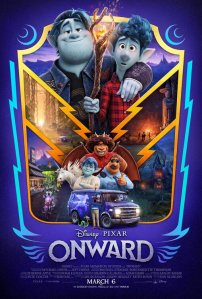 In a modern fantasy suburbia, Ian Lightfoot (voiced by Tom Holland) and older brother Barley (Chris Pratt) have been gifted with a magic staff from their long-departed father. Barley was only a young child when their father died, and Ian never knew him, and now both are granted an opportunity via magic to bring their dear old man back for one more day. The magic spell is interrupted and, as a result, only one half of their father is brought back to life, the lower half, chiefly his legs. The boys must travel on an epic quest in order to bring the rest of their father back to life before all of him disappears again.
Onward is the first time Pixar has ventured into a fantasy realm and the mixture of the modern with the high-fantasy setting allows for some fun juxtaposition. The teenage worries about fitting in, testing your boundaries, and finding out your sense of self can be very relatable, even in a world of trolls and elves. I enjoyed the combative and compassionate brotherly dynamic between Ian and Barley, and Holland (Spider-Man: Far From Home) and Pratt (Avengers: Endgame) are terrific together and really do feel like feuding family members. Their high energy performances translate well to animation. The Pixar creative team does enough to provide little distinguishing character touches for both, enough to provide some extra shading so they don’t quite feel like cartoon versions of their more famous Marvel counterparts. Ian is all awkward and lacking in confidence whereas Barley is overloaded with self-confidence and an unshakable sense of arrested development. I enjoyed the small number of memories relating to their father that Barley holds onto, and I enjoyed how Ian listens to a brief, ordinary test recording of his father on a cassette tape and creates a dialogue between father and son. It’s such a sweet moment that also demonstrates Ian’s ache. I enjoyed how the screenplay connects the external to the internal, namely the obstacles on this quest to the personal trials for Ian and Barley. It allows more meaningful payoffs and more rewarding character growth for our duo. I enjoyed spending time with both boys and was glad their quest was more about them than magical ephemera.
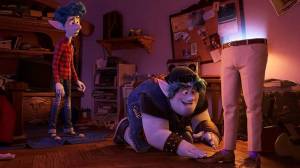 Amazingly, what works best in this movie is its emotional core, which sounds slightly bizarre considering it’s a road trip with a pair of legs. As Onward progresses and settles down with its better honed second half, it puts more emphasis on the relationship between the brothers, their hopes and worries for one another, their sacrifices and shames, and ultimately it becomes a movie about two boys trying to find closure with the memory of their dearly departed dad. The genuine emotion of the brothers is enough to pave over most of the undeveloped elements of the world and storytelling (more on that below). I would have thought, going in, that Onward would present a so-so story with an intriguing world of possibility. I’m surprised that my experience was the exact opposite. The story and central relationships are what kept me going, and it’s what ultimately earned some teary eyed responses from me late in the movie. The topic of seeking closure is a personal one for me and something I value highly, so it was very easy for me to plug my own yearning and vulnerability into these characters. They’re going through all this dangerous trouble not just to see their departed father one last time but also to say goodbye, and that got me big time. It gave the entire movie a new weight that I wasn’t expecting. Who wouldn’t want another chance to tell a loved one how much they miss and appreciate them?
The whole concept of being stuck with a loved one’s lower torso allowed me many moments of contemplation. First, I wondered what their father must be going through to only experience the world through his legs. It felt limited. How do you communicate to others? The film finds its ways. How do you express emotions simply from a pair of disembodied legs? The film finds its ways. As Ian and Barley drag him along on a zipline leash, I kept thinking about the dad. What is he thinking in this moment? Is he waiting for some kind of comforting confirmation from his sons to tell him where he is and what is happening? I kept thinking how confused he must be. To the filmmakers’ credit, they don’t ever emphasize the potential hell of this half-existence. He’s presented often as a figure of comic relief, especially as his upper torso pile of clothes sloshes around and tumbles off. In a way, the pair of legs reminded me of the visual metaphor of the floating house in 2009’s Up, the manifestation of the protagonist’s heavy grief. They’re tethered to this half-formed memory of their father, unable to fully interact with him and let him go. I was worried that Onward was going to be the Pixar equivalent of Weekend at Bernie’s and it is not.
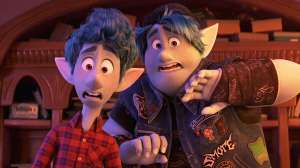 There are some issues with the movie, nothing major, but enough to make it feel under developed, especially in comparison to the Pixar movies of past. The imagination is there, however, the world-building of this fantasy world is decidedly lacking. There are some cute asides like unicorns as the equivalent of trash-eating raccoons, but as a whole the fantasy world feels underdeveloped to its full potential. There’s a significant story point where the current world has forgotten its magic roots thanks to the ease of technology and its inoculating effects, which seems like a pretty straightforward message for our own lazy world. Again, though, Onward doesn’t dig deeper into this theme or what it could mean for the larger mythology of its own world and its history and the rules governing its magical creatures. I started to wonder whether Pixar could just have set this story anywhere.
Likewise, the supporting characters don’t amount to much and feel like leftovers from earlier drafts where they had richer involvement. The ongoing subplot with their mother (Julia Louis-Dreyfus) teaming up with the fabled beast-turned small business owner Manticore (Octavia Spencer) offered little other than occasional exposition. The Manticore is supposed to best represent how the new world has traded its culture and history for comforts and safety, but it’s not clearly realized and integrated. My pal Ben Bailey reflected that the Manticore seemed like a one-scene character that the filmmakers didn’t want to drop, and so she was stretched through the rest of the film to diminished returns. The last act has a sudden and arbitrary monster to defeat that feels like the kind of thing expected in these sorts of movies, which is a rarity for Pixar and thus a slight disappointment.
Lastly, much of the humor just doesn’t work. The jokes can be stale, safe, or one-note, like a team of very tiny pixie bikers. It’s often silly without exactly being clever. There’s more fleeting visual humor with the incongruous nature of fantasy in a modern setting. There’s less slapstick than you would think considering one of the main characters lacks a torso. I chuckled a few times but, much like the fantasy setting, felt the humor was kept at an superficial level of thought.
Onward isn’t top-tier Pixar but it’s a solid mid-tier entry, an enjoyable adventure with a resonant emotional core that makes me forgive many of the film’s other aspects that don’t quite work. The brothers are the best part, their interactions are the most interesting, and their heartfelt journey and hopeful desire for closure is what ultimately left me emotionally satisfied. The jokes and world and supporting characters don’t feel as developed, but it hits with its core relationship and its emotional center, so Onward works where it counts the most with its storytelling. Mid-tier Pixar is much like mid-tier pizza — still satisfying and better than a lot of other options.
Nate’s Grade: B+
Share this:

Toy Story 4 (2019)
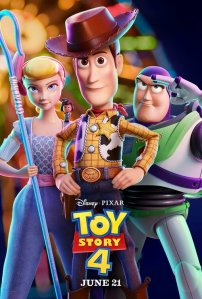 The Toy Story franchise has been the gold standard for Pixar with three excellent movies, the last of which was released back in 2010. When the Pixar bigwigs announced they were making a fourth entry, I felt some degree of concern. The hidden world of toys still felt like an interesting world with more stories to be told, but did we need to revisit Woody and Buzz and the gang? Everything ended so beautifully and perfectly with the third movie, with the toys getting their sendoff from their original owner and a new life in the possession of a new child, little Bonnie. I’ve been more wary about this movie than just about any other Pixar film because the audience had something that could be lost, namely closure. If they harmed that perfect ending in the crass desire to extend the franchise for an extra buck, it would have been aggravating and depressing to disturb something that felt so complete. It’s like when Michael Jordan came out of retirement (the second time) to be a shadow of himself for the Washington Wizards in order to sell tickets for the team he was part owner of. Nobody wanted that. I’m happy to report that Toy Story 4 is a treat of a movie and a worthy addition to the franchise.
Bonnie is gearing up for kindergarten and nervous about the change. She isn’t allowed to take toys with her to school, though that doesn’t stop Woody (voiced by Tom Hanks) from tagging along. In her desire for a friend, and with a little assist from a certain cowboy, Bonnie creates a fork-figure named Forky (Tony Hale), and amazingly it comes to life. Woody tries valiantly to convince Forky that being a toy to a child is the greatest gift but he’s also really reminding himself now that he sees his influence waning with Bonnie as he’s selected for play time less and less. During a family road trip, Forky escapes and Woody leaps to find him, both of them coming into the clutches of Gabby Gabby (Christina Hendricks), an antique doll missing a functional voice box who has her sights set on Woody’s voice box. It’s at this small-town pit stop for a carnival that Woody discovers Bo Peep (Annie Potts), an old flame he never thought he would see again. She’s assured, happy, and preaching a life of being independent from a kid. Woody has defined himself for so long by one identity, and now he must decide which to follow.
 In many ways, Toy Story 4 takes themes and questions from the third movie and improves upon them, making what could have been a retread feel like a do-over you didn’t know you desired. It’s been many years since I saw the third film but I recall the major themes being the fear of change, reconciling one’s self-identity, and the courage of letting go and starting over. The toys had to recognize that their owner was growing up and their old place wasn’t going to be the same. This same issue finds new life in Toy Story 4 primarily through the lens of Woody, who finds himself on the decline with his kid’s interest. He’s not offended or upset by this but is still trying to provide what assistance he can as a beloved toy, even if that relationship becomes more and more one-sided. His identity is in selfless sacrifice for another, but with the re-emergence of Bo, he is now contemplating a life on his own, a life without a kid. This alternate path never seemed a possibility until his former flame stepped back into his life. It challenged Woody in a way that feels more personal and more relevant than it did with 3, especially with the removal of a larger external threat to occupy the attention of our main characters. This places a renewed focus on Woody’s internal dilemma beyond his role as leader and protector.
Toy Story 4 might also be the weirdest movie of the franchise, which really elevates the comedy into another realm. I thought the characters played by Jordan Peele (Us) and Keegan Michael-Key (Predator) were going to quickly wear out their welcome; they seemed to be a heavy part of pre-release teaser trailers. The filmmakers don’t overdo them and use them in clever ways, which is a compliment that can be applied to every new character in this sequel. The plushies by Key and Peele have a hilarious running gag of their increasingly absurd plans to attack a woman, and one instance deliciously prolongs the eventual punchline, becoming more bizarre and macabre to the point that I lost control from laughter. Keanu Reeves (John Wick 3) is fun as a very Canadian Evel Knievel motorcycle driver, and the weird references to the Canada-ness of it are played completely straight, making it even funnier (his laments with the French-Canadian boy’s name made me snicker every time). There’s a trio of action figures, Combat Carls, and one of the three is always left hanging for high-fives and he just leaves his arm up waiting, silently pleading, and then lowers it in defeat, and it’s hysterical even just as a background gag. The ventriloquist dummies are routinely played for creepy laughs and physical humor. There’s a running joke where Buttercup, the unicorn voiced by Jeff Garlin, is always suggesting getting Bonnie’s father sent to jail no matter the circumstances. It’s these touches of weirdness that make the movie stand out that much more from the three others.
 The villain of Toy Story 4 is given a surprising sense of poignancy, enough that I genuinely sympathized with her plight. She’s a damaged doll used to being behind glass, isolated and separated from the children she wishes to be part of. She views her salvation in fixing in her damaged voice box, her perceived disability. She’s after what Woody has physically, the voice box, but it’s a means to an ends to have what Woody has had emotionally, the love of a child in need, the connection she yearns for. I won’t spoil what happens with her but even when there are setbacks the film and the characters don’t give up on Gabby Gabby. Her perspective and desires are still seen as valued, and the eventual resolution of her character put a lump in my throat. She wasn’t really the villain after all. She was just another toy in pain looking for acceptance and having to adjust her identity. I feel like there is a conscious disability empowerment message implanted in Toy Story 4, namely that those who are disfigured, disabled, or seen as “broken” can continue to be valuable and that their lives don’t end.
If this serves as the finale of the franchise, it will end on a fitting and resonant high-point. As much as Toy Story 3 was about change and acceptance, this sequel does a very respectable effort of personalizing that message even more to one central character’s dramatic arc. It also works wonderfully playing off of our collective investment in the character over the course of four movies and twenty-four years. There are some drawbacks to this approach. It makes the majority of the other toy characters feel like they have little to do on the sidelines, other than fret about retrieving Woody and Forky. Buzz is given a cute joke about listening to his inner voice but it doesn’t amount to much more than a cute joke. The inclusion of Forky feels like an exciting and even daring addition, tackling some existential questions and how and when toys are “made” and brought into being, and he presents these for a while. Once we get to our carnival setting and Forky is captured, he seems to be forgotten about. He’s more a motivation point for Woody than overtly anything else. I suppose you could make the analysis that Forky represents how Bonnie is moving on even with invented toys at the expense of Woody. However, these are minor quibbles considering the quality and emotional involvement of what Pixar has produced.
It goes without saying that the animation is beautiful but what amazed me is how expressive the faces of the characters could be, even when they were relatively inflexible toys. The relationship between Woody and Bo actually has a surprising amount of nonverbal dramatic acting to communicate nuance. As the years go by, I continue to be further and further amazed at the Pixar animators and their abilities.
 As protective I was over Toy Story 3’s perfect ending, I am happy to say that Toy Story 4 more than justifies its own existence in this hallowed franchise and even improves from the third film. The themes are something of a repeat but the filmmakers have elected to focus almost entirely on Woody and his personal journey, and it makes the loss and possibility more robustly felt. In many ways the film is an exploration on relationships and the need to redefine ourselves, to move onward when the time is right, and to try something new even if things get scary. Between Woody and Gabby Gabby, ostensibly the hero and villain of the piece, they’re looking for meaningful connections where they can. They may be secondhand, they may be disabled, but that doesn’t mean they aren’t worthy of affection. This is a joyous movie that finds time to be wonderfully weird and often funny. It might not have the set pieces or ensemble showmanship of the prior Toy Story tales, but what it does have is a character-based emphasis on the most complex figure in this universe of toys. The conclusion is moving and satisfying and I don’t mind admitting that tears were shed. I even teared up at different other earlier points. Toy Story 4 could have gone a lot of different ways but I’m relieved and appreciative with this new sendoff we’ve been granted.
Nate’s Grade: A
Share this:

Incredibles 2 (2018)
 The prevailing problem with Pixar sequels (and prequels) lacking “Toy” in their title is that they never feel like stories needing to be told, tales that will enrich our understanding of the characters and their larger world. I would much more gladly like a Monster’s Inc. sequel where Adult Boo is visited by her old closet-dwelling friends rather than an inoffensively cute prequel explaining how characters became friends long ago. The Incredibles universe always seemed like the one most demanding of a real sequel. Writer/director Brad Bird created a rich retro-futuristic world with numerous possibilities. I’m happy to report that Incredibles 2, while not soaring to the exact heights of its predecessor, is still a very worthy sequel that even manages to outshine the original in select areas.
Taking place literally seconds after the conclusion of the 2004 film, the Parr family fights together against the Underminer. The city, however, is none too happy about the collateral damage. Superheroes are still illegal. There’s no more relocation either. The Parrs are stuck, until a pair of billionaire siblings (voiced by Bob Odenkirk, Catherine Keener) reaches out to try and repeal the superhero ban. They want to position Helen Parr a.k.a. Elastigirl (Holy Hunter) for the public relations campaign (she causes a lot less collateral damage than her husband). Bob Parr a.k.a. Mr. Incredible (Craig T. Nelson) encourages his wife to go out and save the day, though he’s barely holding back his jealousy. He takes on the domestic duties, helping Dash (Huck Milner), moody daughter Violet (Sarah Vowell), and the young baby, Jack-Jack (Eli Fucile, reprising the role of voicing a baby, for real). A villain known as the Screenslaver is terrorizing the city and hypnotizing citizens through hijacked broadcasts. Elastigirl tries to uncover the mystery of the Screenslaver while Mr. Incredible tries to juggle the realities of stay-at-home parenthood.
 Bird’s sense of visual inventiveness is still heartily alive and whimsically well in the medium of animation. Bird’s original film was an imaginative marvel with its intricate action sequences, some of which are the best in any medium, animated or live-action. He’s a choreographer of action that upholds the basic tenants of action, namely that if you have characters with special abilities, they should be utilized, along with attention toward geography and the purpose of the scene. It’s a genuine pleasure to watch well developed action sequences that go beyond flashy style, that account for mini-goals and organic complications. Take for instance Elastigirl’s motorcycle chase scene. It’s exciting as is but when the bike breaks apart, taking advantage of Elastigirl’s stretchy powers, that’s when it becomes even more gratifying and clever. There is a group of lesser super heroes that come out of the shadows thanks to Elastigirl’s heroics. At first they’re played for primarily comedic value, but Bird smartly turns them into a force to be reckoned with when they band together. I especially appreciate having a character with portal-manifesting powers and finding many opportunities to explore this unique power. When the film is humming with its visual energy and inventiveness, Incredibles 2 is a gloriously entertaining and satisfying action movie told by one of the best on the business.
The action is on par (no pun intended) with the first film even as the overall experience lacks the emotional stakes and depths of the first Incredibles. That should not be seen as some destabilizing deficiency as The Incredibles was a nearly flawless film (it’s my second favorite Pixar film after WALL-E). There were moments in the original film that transcended the superhero setting, where they Parr family felt like real people with real emotions and relatable stakes, like Mr. Incredible’s confession that he’s not strong enough to suffer the loss of his family. While Bird’s film made several homages to the James Bond cannon, there were real stakes. People could die. Many superheroes did, albeit mostly off-screen. This was Pixar’s first PG-rated film and that’s because it dealt with some heavy thematic issues in a mature manner. The bad guys weren’t like the movies, Helen Parr warned; they would kill children if given the chance. Incredibles 2 doesn’t have any real moments like that to cut through the whiz-bang.
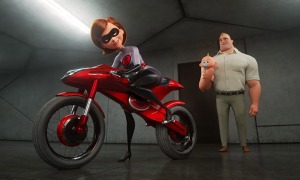 This time it’s Elastigirl enjoying the limelight, and there’s a notable feminist message of a woman finally getting her due. She relishes the adventure though is willing to sacrifice it for her family if needed, which her husband will refuse to allow her to do. Her success is his success, he reminds himself. The sooner she succeeds the sooner he can also get back out there to fight crime. I think one of the reasons the characterization isn’t as developed this time is because of the abbreviated time frame. We’re literally picking up seconds from the first movie and dealing with the immediate consequences. We’re only following the events of a few weeks, maybe months at most, and while the Parr family undergoes trials and disappointments, It feels like maybe there just wasn’t enough space for the characters to have succinct arcs and grow substantially. This is a quibble for an otherwise great movie. Incredibles 2 still stay true to the characters you love.
The exploration of Mr. Incredible’s descent into domestic life was my favorite part of the film, and I had been worried it would be outdated Mr. Mom-style jokes. The movie steers away from most of the tired gender tropes, moving past simply having an incompetent man performing household duties in hilariously incompetent ways. The jokes aren’t dependent upon a man doing them so much as someone who feels out of step and beleaguered, so parenthood in general. The first movie was about midlife identity crises and that has carried over into this sequel as well. Bob has a meaningful challenge with each one of his children, having to re-learn old concepts with his son and adapt to new ones, having to tackle the minefield of dating with his daughter and finding the right tone, and the increasingly the demands of a child with, let’s call them, special needs. The Jack-Jack segments are inspired pieces of old school Looney Tunes slapstick. Each new power provides another point of discovery for our characters that, remember, are initially clueless about Jack-Jack’s amazing abilities. Mr. Incredible is so eager to get back to being a super hero that forcing him to confront his own inadequacies as a parent is a smart way to better open him up as a three-dimensional character. I enjoyed the action of Elastigirl’s spotlight missions but I kept looking forward to returning to the other Parrs.
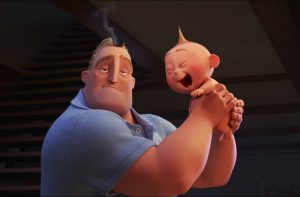 In a few areas I would even say Incredibles 2 has its original beat, especially in the realm of comedy and visual inventiveness. Part of that is simply the advancement of the technology allowing Bird more freedom to up the ante as well as showcase more intricate facial emotions. There are some areas that just cannot compare, which is not to say that they are bad on their own. The late twist of the villain’s identity should be more than obvious for anyone paying attention. The themes of this movie are much hazier this time around. There are a few that pop up, like police surveillance and body cams, then a general screed against the general social malaise brought on from technology, then breaking unjust laws to serve a more realized sense of justice, and then finally the movie settles on what seems like its true theme, the danger of being too dependent on, essentially, government assistance. If the superheroes represent the government, the villain’s plot is to shake people away from waiting for the superheroes to fix everything and growing over reliant on outside assistance (finally a summer blockbuster with a message even Paul Ryan could love). Bird has featured some Randian ideals in past films, The Incredibles a prime example. My pal Ben Bailey strongly believes that the first film’s villain had the right idea though wrong method. Superheroes are by design egotistical. The belief that there are people who are better and deserving of a elite, preferential status seems antithetical with the sequel’s major theme. Or maybe it’s the mutated evolution of Ayn Rand’s sense of political objectivism. Feel free to debate at the kitchen table with your own family.
If the major fault of Incredibles 2 (there is no “The;” look it up if you doubt me) is that it can’t quite live up to the dizzying heights of the original, then that’s hardly a damning fault. In the 14 ensuing years, the superhero movie has become the dominant Hollywood blockbuster, and Bird needed to think long and hard about how his return visit would distinguish itself from a cluttered landscape of super heroics. Bird finds meaningful and interesting stories for both the “normal” version of his family unit as well as their super selves. Fans of the original should find more than enough to entertain themselves with even if the depth and characterization aren’t as wonderfully realized. There’s great comedy, great action, and great fun to be had with Pixar’s best sequel not with “Toy” in its title.
Nate’s Grade: A-
Share this:

Coco (2017)
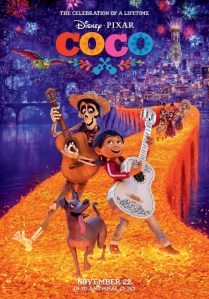 Taking a cue from Miyazaki’s Spirited Away, Pixar’s newest animated wonder is a leap into a fantasy world with a young protagonist trying to get back to his family through trials of courage. A young boy wants to be a musician but his older grandmother forbids it, blaming music for luring away her grandfather and almost ruining the family. He steals a famous celebrity’s guitar from his crypt and is transported to the world of the dead on Dia de los Muertos (Day of the Dead). The boy is able to meet his departed family members but if he can’t make it home by the end of the night he’ll stay there forever. This is a pretty dense film with a lot of rules to remember and yet the movie’s wonderfully structured story doesn’t give you more than you can handle. One rule leads to another organically, and you’re fully invested in the world and the characters. The Mexican culture and heritage is portrayed with extreme reverence while still being playful. This is a movie about death that treats it seriously but can still have fun when it counts. It’s lively, joyful, and sneaks up on you emotionally, as all great Pixar movies seem to do. I was wiping away tears by the end, and I’m sure fathers will be wiping away even more. The screenplay takes staid concepts (power of dreams, importance of family, respect for elders) and finds meaningful ways to personalize them. It’s ultimately a story about sacrifices and relationships between generations, how we honor and remember those we cherish. The visuals are colorful and gorgeous, though I didn’t feel the world of the dead was as memorable in its various locations and developments as the characters. Coco is a funny, charming, heartfelt, poignant, and vastly entertaining movie that soars with great imagination, story development, and an enrichment of characters to fall in love with.
Nate’s Grade: A


 nathanzoebl
You must be logged in to post a comment.