Blog Archives
The Magdalene Sisters (2003)
 There’s a certain genre of films as well-defined as say, the Western, Film Noir, or even Romantic Comedies. The genre Im speaking of is I-can’t-believe-that-happened cinema. This is a genre made up of little-known true stories where people with power abuse those below them. These include films like Rosewood, Rabbit Proof Fence, Matewan, Mississippi Burning, and just about every movie with a Holocaust setting. These films are intended to antagonize the audience and to get them to ask, How could something like this happen? The Magdalene Sisters is a film that an audience will walk away with very much wondering how something so cruel, amoral, and heartless could carry on in our modern world.
In 1960s Ireland, the Catholic Church was life. The Magdalene Sisters sheds light on the little known work asylums, which were institutions set up to help girls who had transgressed against God. The girls admitted to the asylum, a kind of extreme reform school, are there to work away their sins and reach forgiveness, thus saving their immortal souls. Rose (Dorothy Duffy) had a child out of wedlock. Bernadette (Nora-Jane Noone) was caught by school officials for being too pretty and tempting teen boys. But perhaps the most startling admission is Margaret (Anne-Marie Duff), admitted to the asylum by her own father for the grievous sin of being raped by a cousin. The Magdalene Sisterhood asylum is run by Sister Bridget (Geraldine McEwan), an old nun who subscribes to the cruel to be kind theory in spades. The girls at the asylum toil tirelessly in sweatshop conditions, are physically abused by the nuns, sexually abused by the asylums priest and are left hopeless of escaping. Girls who run away are turned back in by their parents or cooperative police. Some of the women at Magdalene have been there for their entire lives. It seems the only ways out are death or joining the convent. Get thee to a nunnery indeed.
 The Magdalene Sisters is full of sadistic moments that will shock an audience. One of the most disturbing scenes transpires late into the film. The girls of the asylum line up completely nude, shivering and crying. Two nuns, with a nauseating smugness, chortle and play a game seeing who has the largest breasts and the smallest nipples, among other things. When the winner of this sick experiment stands forward and clenches her teeth from crying so hard, one of the nuns asks, ”What are you crying for? It’s just a game.”
The young ladies at the films core deliver magnificent performances tinged with honest emotional devastation. Noone is the standout as Bernadette. She utilizes steely rebellious gazes that speak volumes about her characters resourcefulness. Noone can convey more poignant emotion in the raising of an eyebrow or the biting of her thumb than most starlets can ever hope to express.
McEwan is terrifying as the head nun and head source of torment. Her grandmotherly voice, tinted with an Irish brogue, is enough to send shivers down your spine. She is surely 2003’s greatest movie villain, next to Johnny Depp in Once Upon a Time in Mexico.
Writer/director Peter Mullan keeps the suffering at an almost unbearable level but allows the spark of human resistance to keep us going. His film is one brimming with anger and disbelief; ensuring the audience will experience that same burning anger before the credits roll. Mullan’s passionate story can be deemed one-sided, but then again, what exactly is the other side going to say about the abuse of innocent girls for life-long slave labor? Not much I suspect.
 The Magdalene Sisters is a somber, unflinching look at the abuses of the church as well as the upward battle for equality women faced. This film is tough to sit through. It might be too much for some, especially if they don’t have a strong relationship with the Catholic church to begin with. The decades of abuse The Magdalene Sisters sheds light on is incredible, but it’s also a beginning for healing. Before we can overcome atrocities we must acknowledge them, and this is something I’m sure Mullan is arguing that the Church is failing to do. In fact, the Catholic church has denounced The Magdalene Sisters for its portrayal of church abuses. Something tells me Mullan is not surprised.
Not only is The Magdalene Sisters an eye-opener, it’s also great cinema. The characters, pacing, realistic sharp-eyed direction, and superb acting render it more than just a snuff film. This film is more than watching people mistreated and suffer; this is a film about perseverance and resolve. It’s about the enduring human spirit. I’ll gladly (well, not gladly) watch sequences of misery in order to see human triumph. This isn’t just a sad story, it’s exceptionally well told and acted and it bathes you in the pain of its characters. You feel their heartbreak and tragedy, but you also feel their victory.
The Magdalene Sisters is, without a doubt, the must-see feel-bad movie of this year. Now, there will be plenty out there saying, Why should I pay to see a movie that will make me feel bad? This is my defense: because the movie is so good at having its fears, tortures, and ultimate triumphs resonate that it makes you authentically feel something. And isn’t this the purpose of art, to feel something? The Magdalene Sisters is unflinching, passionately powerful and unforgettable. Just one more item to get your blood boiling: the last of these Sisterhood work asylum closed in 1996.
Nate’s Grade: A
Share this:

Luther (2003)
 Certain things can pass under my radar. Previously it’s been items like female flirtation and the due dates of papers. So imagine my befuddled surprise when last weekend my father, himself a Lutheran minister, said the family was going to hop on over to the movie theater and catch a historic bio-flick about Martin Luther, plainly titled Luther. I had no idea this movie existed. And after seeing it, it left no strong memory that it did.
Luther (Joseph Fiennes, Shakespeare in Love) is a 16th century German monk with some quibbles with the Catholic Church. Seems Luther doesn’t like how the Church is preying upon people’s faith for money, most notably its chief indulgence seller Johann Tetzel (Alfred Molina, with a criminally scant appearance). He makes up a list of 95 grievances, nails them to the doors of a church, and thus Protestantism is born. Luther’s ideas catch on wit the lower classes through rampant publication, thanks to the newfound printing press. The princes of the German states also like what this monk is cooking, and they decide to hold him in safety. The Catholic Church, however, is none too pleased. They threaten excommunication and eventually death, and keep pushing for Luther to recant. But Luther feels he must stand strong in his convictions.
The acting is fine, and the direction is passable, but the pacing of Luther is like tracking the movement of a glacier. Some representative decisions are also fairly stupid. To try and communicate Luthers internal struggle he hits his head and yells like at voices. The first time it’s funny. The next five times, it’s dumb. There’s also a dirty peasant child who’s crippled but still a big fan of the Luther Man. Her gaping tooth smile has more screen time than some characters. Later in the film the peasant revolts ravage through the country with thousands massacred. Luther visits the ruins and comes across the little girl’s broken crutch and breaks down and cries. If you were in my theater you probably heard me hitting my forehead repeatedly (no voices though).
The film is an admirable effort, but Luther ultimately fails because of the measures of film. To try and tell the story of Luther would be more appropriate for the confines of a miniseries, not a two-hour movie. The Reformation and its players lose its impact in such a shrift retelling. What the audience gets is a pared Cliff notes version that misses the richness, and gives lip service to the historical importance. What were left with are endless scenes where people dress up and talk and talk and talk. Without a sense of weight for character or story, the countless talky moments blur into tedium. If I had a sleeping bag with me I would have curled up into it.
Another problem is the lack of makeup. The film spans thirty-some years and yet Fiennes doesn’t age a day. My mother proposed that maybe he didn’t want to look old and decrepit in the film. I responded by saying, He let them shave his head but he didn’t want anybody to splash some gray in his hair?
I guess if you judge movies on costumes or production values, Luther would be competent. But does anyone go to a film saying, ”Man, I sure hope those costumes and sets are incredible! Fingers crossed!?” Luther is a well-meaning bore that only historical enthusiasts and Lutherans might enjoy.
Nate’s Grade: C
Share this:

The League of Extraordinary Gentlemen (2003)
 This movie is certifiably insane. While a very literary X-Men seems like a great idea, what exactly does Tom Sawyer bring to the table? What, is he going to convince the bad guys to white wash a fence? And yet, this highly operatic bombast almost succeeds on its sheer level of lunacy, like when you realize you’re watching Sawyer get a crush on a vampire on a giant underwater submarine that’s so big it has end tables and vases in its hallways. Still, the handling of Jekyll/Hyde here is what Hulk should have been like. League of Extraordinary Gentlemen almost works, but its falls apart amidst shabby special effects, outlandish plotting, and very wooden dialogue. The director doesn’t make it any easier to follow, trumping his action sequences with rapid fire edits. Ah well, my bafflement was more entertaining.
Nate’s Grade: C
Share this:

City of God (2003)
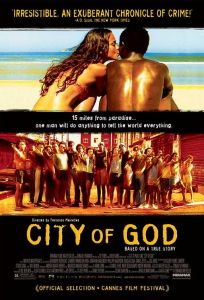 Looking for a film that really packs a genuine wallop? Take the visual panache of a pre-Madonna Guy Ritchie (Snatch) film, the juvenile delinquency and debauchery of a Larry Clark (Kids) film, the propulsive narration and bloody violence of a Martin Scorsese (Raging Bull) film and mix it with a cast of about 40 characters. What you get is City of God, a brilliant and vibrant film that pulsates with exhilarating action, thoughtful commentary and devastating power.
In the 1960s, the Brazilian government transported its impoverished citizens outside of Rio de Janeiro, a glamorous tourist magnet. This new place of residency was a distant housing project of shabby slums, ironically titled City of God. In this begotten neighborhood the police rarely emerge (except to occasionally pick dead people’s pockets) and crime has become rampant. A mixture of poverty and an overabundance of guns and testosterone have bred a culture of criminals where teenagers populate ruthless gangs.
 Our story focuses on Rocket (Alexandre Rodrigues) narrating the rise, and many falls, of all the flashy thugs of the City of God and the ripples they create in the community. Hes a young boy who is too scrawny to be a hoodlum like his older brother Goose. His brother belongs to a gang known as the Tender Trio, who are used to hijacking propane tanks for small gain. They get the idea to knock off a brothel at the urging of Lil Dice, a younger kid with ambition and a heart like a stone. After the successful robbery Lil Dice cleans up after the Trio, sifting through the brothel killing everyone inside and laughing insidiously.
The murder spree has long lasting effects, with each member of the Tender Trio finding an untimely end. Lil Dice grows from calculating child into a big-time burgeoning cruel gangster, who now calls himself Lil Ze (Leandro Firmino De Hora Phellipe). Ze has climbed to the level of kingpin the most pragmatic way possible: systematically eliminating all of the competition. Ze attains reign over the city. He instructs others not to do anything to arouse the outside police (the locals are paid off), and thus has made the City of God a safe place for rich tourists to drive in and purchase their drugs. It seems that Ze ruling by fear has brought newfound safety and prosperity.
Rocket’s path is quite different. As he matures into a teenager he discovers a love of photography. His attempts at a life of crime are short-lived; he simply likes his victims too much to rob them. Ze has Rocket take pictures of his gang strutting their machismo that eventually gets published onto the front page of a newspaper. Rockets reaction is that he thinks his death certificate has been signed. Ze’s reaction is delight. Lil Ze’s great weakness is his self-believed sexual inadequacy. When turned down by a girl he seeks out her good-looking boyfriend, Knockout Ned (Seu Jorge), and humiliates him. He terrorizes Ned, raping his girlfriend in front of him and inspiring him to long bloodthirsty battles of vengeance against Ze that will engulf the City of God.
 A complaint that could be levied against City of God is the numbing effect of its violence. The gangsters in this film aren’t the mustache-twirling types of Gangs of New York, but merely kids. This isn’t any kind of glamorized Hollywood gun battle. When these kids get hit their bodies go limp; they drop to the ground in weeping masses. The films message of the hereditary nature of barbarism is clear. One of the amazing parts of the film is that it was mainly filmed in the actual City of God and uses a cast almost entirely of non-actors.
City of God is a loud announcement to the world of the arrival of a fresh, invigorating and monumental talent with director Fernando Meirelles. The visual flair he utilizes to advance his storyline is amazing yet never falters into the land of gimmickry. The narrative folds in on itself time-wise (much like Tarantino films) yet rhythmically connects the numerous lives and history of the City of God in one lustrous and captivating tapestry of urban decay. A fantastic example is a scene that chronicles the entire history of one apartment and the origins of the entrance of drugs in one un-moving shot. Imagine the Natalie Imbruglia “Torn” video but with drugs and guns.
 There is one sequence of crushing emotional power that has been burned into my memory. The sequence involves a bawling child, no older than seven, being forced to decide where he would rather be shot, in his foot or his tiny trembling hand as punishment for his mischief. The reality of City of God is a harrowing one. As you can clearly see, City of God is not for the weak. The movie has its definite squirm-worthy moments of discomfort and will not be a good choice if you and your date are looking for that perfect weekend movie. This is a difficult movie to sit through at times, and the reality can be grim and uncompromising, but City of God is rewarding in respect to the amazing narrative and visual accomplishments. This is an unforgettable film.
The film piles on the body count while at the same time advancing a pacifist message between the bursts of adrenaline and bullets. Meirelles’ film will leave your jaw dropped to the floor by its sprawling complexity. This is what great filmmaking is all about. City of God is one of those movies that once you’ve left the theater you excitedly claim, “Now thats why I see movies.” City of God is simply a cinematic masterpiece and not only the best film I’d seen in 2003 but also one of the best movies I’ve seen in my life.
Nate’s Grade: A+
Share this:

Chicago (2002)
January at the theaters is a tale of two kinds of films. One type are the studio bombs (take Just Married and Darkness Falls, please take them far away). The other type are the prestige pictures expanding their releases in hopes of garnering some of that Oscar magic. A lot of prestige films were released around the holidays and though not every one could be a winner, they were all better than Kangaroo Jack. Well, except for The Hours.
 Chicago (2002)
Premise: Roxie Hart (Renee Zellweger), hungry for fame, finally grasps it when she kills her lover and is put on trial. Silver-tongue lawyer Billy Flynn (Richard Gere) stirs up the media in her defense, as well as for another starlet killer, Velma Kelly (Catherine Zeta-Jones).
Results: A song-and-dance picture thats quite toe-tappin with imaginative numbers, even if I can only remember like two songs. A surprisingly steady Zeta-Jones really shines and Gere can cut a rug. Chicago is just lively fun. Blink and youll miss Lucy Liu in it.
Nate’s Grade: B
Share this:

The Hours (2002)
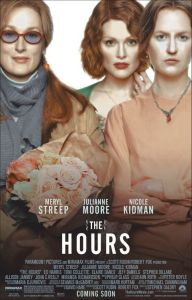 Okay, after watching the Golden Globes award show and seeing The Hours crowned with the highest prize, and hearing incessantly about Nicole Kidman’s fake prosthetic nose in the movie, it was time to venture into that darkened theater and see how good the awards-friendly The Hours was. Little did I fully realize what I was getting myself into.
Nicole Kidman plays Virginia Woolf, who is in the midst of writing her novel Mrs. Dalloway, where she proposes to display a womans entire life through the events of a single day. Julianne Moore plays Laura Brown, a housewife in 1951 having difficulty adjusting to a domestic life that she feels ill equipped for. Meryl Streep plays Clarissa Vaughan, a gay copy-editor in 2001 planning a party for a poet and former lover (an emaciated Ed Harris), who is suffering from the late stages of AIDS. These three storylines will be juggled as the film progresses, with each womans life deeply changing before the end of the day.
The Hours is a meandering mess where the jigsaw pieces can be easily identified. The attempt at a resolution for an ending, tying the three storylines together, is handled very clumsily. The film spins on and on that you start to believe the title may be more appropriate than intended. What this movie needed was a rappin kangaroo, post haste! The film is wrought with victimization and screams ”Give me an award already!” Before you know it youre being bludgeoned to death with what is profoundly the most over serious Lifetime network movie ever assembled. And there’s nothing fundamentally wrong with Lifetime movies but The Hours does not share the sensibilities of its TV brethren.
 Kidman, nose and all, gives a strong performance displaying the torture and frailty of a writer trapped within her own mind but too often relies on wistful staring or icy glares. Moore is effectively demoralized but cannot resonate with such a shallow character. Streep is the least effective of the three and fizzles among an over-stuffed assembly of characters.
The supporting cast is unjustly left for dead. The characters are seen as parody (Toni Collette as Moore’s un-liberated homemaker neighbor), extraneous (Claire Danes as Streep’s daughter, Allison Janney as Streep’s lover, Jeff Daniels as Harris ex-lover, you know what, almost anyone in the Streep storyline), one-note (the workmanlike John C. Reilly who plays yet another doting and demystified husband) or merely obnoxious (Moore’s brat child that refuses to separate from her). It appears The Hours is the three lead actress game, and everyone else is not invited to play along.
Stephen Daldry’s direction shows surprising stability and instinct after his art-house pandering Billy Elliot showed little. The technical aspects of The Hours are quite competent, especially the sharp editing and musical score, which just points out further how slickly hollow and manufactured the film is.
The Hours is an over-glossed, morose film that is too self-important for its own good. It sucks the life out of everything. And for all its doom and gloom and tsunami of tears, the only insightful thing The Hours is trying to pass off onto the public is that women are more depressed than you think.
Nate’s Grade: C
Share this:

The Time Machine (2002)
 The Time Machine is one of the most famous works of fiction in history. It was writen long long ago by the great H.G. Wells. It presents a fantasy glimpse into our future, but in it Wells also gave readers the opportunity to ponder what would happen if they could go back and change their own lives. People have used the story as a cautionary allegory to our own times, like the 1960 film version of The Time Machine. Now, a bigger budget Hollywood remake attempts to put another spin on the Wells classic.
Alexander Hartdegen (Guy Pearce) is an absent-minded professor interested in cracking down the physics of time. He’s chided by some of his peers for crackpot theories and his fascination with any new gadget. He’s supposed to meet Emma (Sienna Guillory) at Central Park and tonight’s the big night he plans to propose to her. He eventually catches up to Emma and the two go strolling off into the park. Shortly after popping the question the two become victims of a mugging and in the fray Emma is left dead. The death drives Alex to create his fanciful time machine, which only happens to take four years time.
Alex gives his big brass LA-Z-Boy looking machine a try and travels back to that fateful night to avoid Emma’s death. Alex avoids the mugger all right, but while purchasing flowers his fiancé gets plowed over by a runaway carriage instead. It seems that one cannot change the past. Alex decides to give the future a chance and travels to a very Back to the Future 2 looking 2037. Someone astutely asks Alex if his time traveling machine makes a good cappuccino.
 When Alex hops a little further into the future the moon is breaking up because of ill-fated lunar construction. Moon rocks are hurtling toward the surface and disrupting everyone’s day. (It was in this moment that a scene of rocks smashing into the World Trade Center was cut for taste) Alex jumps back into his machine but is konked out by some lunar cheese and falls asleep at the wheel. The next thing you know Alex is in a mysterious future world.
The place where The Time Machine really bogs down is once Alex arrives in 80,000 something or other. The child-like thrills and adventure of Alex zipping between the past and near future are buried underneath the standard post-apocalyptic movie world. The people dress in loin cloths and rags (though some of the female natives wear revealing tops that look like see-through chain mail) but still have perfect teeth. When Alex doesn’t understand the linguistics of 80,000 AD the next words that he hears are English from shapely native Mara (pop star Samantha Mumba). It’s amazing that English survived 81,000 years when Latin didn’t last a mere 2,000 and change.
It turns out these people who live in huts resembling hot air balloons along the faces of cliffs are called Eloi. The Eloi don’t have anyone looking old enough to carry an AARP membership and are apprehensive to speak of why. Perhaps it’s because creatures resembling something that would belong in The Mummy Returns pop up from the sand to capture whatever slow moving prey they can and return to for an underground feast.
The creatures, called Morlocks, are the offshoots of evolution. Seems after the whole moon destruction thing (whoops!) those who took refuge below the surface have evolved into dusty hunchbacked cannibals. Their rowdy ranks are controlled by Uber-Morlock (I’m not making up that name) who resembles an albino bassist for Poison or Skid Row. It’s actually acclaimed actor Jeremy Irons under all that pancake makeup and fleshy spine-showing prosthetic. The less said about Irons the better.
It’s during this part that The Time Machine reverts into a half-baked Stargate. Alex encourages the Eloi race to stand up to their oppressors and fight for their freedom. He becomes part of the Eloi community, rallies the troops into rebellion, and also has to save the damsel in distress.
The Time Machine remake isn’t the political statement the 1960 film was on man’s folly with technology, particularly nuclear weapons. What this suped-up version is all about is special effects and plenty of them. The effects are for the most part dazzling, especially the scene where Alex travels to 2037 and we see the development of New York City with skyscrapers assembling themselves.
 Simon Wells (The Prince of Egypt) directed this remake and is actually the great-grandson of the famous adventure’s author, H. G. Wells. Trivial Pursuit fans everywhere rejoice. Wells had to sit out the last 18 days of shooting due to “exhaustion” and Gore Verbinsky came off the bench to finish the directorial duties. The film clocks in at a scant 90 minutes but there are definite moments of drag.
Pearce (Memento) is a hunky hero and for the most part is admirably gung-ho with the role. Samantha Mumba’s motivation must have been to stand and look pretty the entire film, which is all she really does. To think that Mumba might be the most talented of the recent singers-come-actors (Mandy Moore and Britney Spears) is a distressing thought all its own.
As The Time Machine kept dragging into its Mumba-filled period I began day dreaming of an alternate, darkly comic version. In my head, Pearce’s character keeps traveling back again and again to save his beloved only to lose her a different way each time. I could picture a humorous montage of his girlfriend dying an assortment of colorful deaths and Pearce just getting more frustrated and jaded. I could picture them skating only to have her plunge below the ice. I could picture the couple dining at a fine restaurant only to have her choke and Pearce just throw his napkin onto the table and sigh loudly. I was enjoying my alternate take on The Time Machine so much that I didn’t want to return to the one that was playing.
The Time Machine has its moments of thrills and excitement but they are mostly condensed to the opening third. This remake doesn’t have the political edge or wow-factor the original did. It plays more to the rules of conventional Hollywood than the wide open possibilities Wells wrote about. Pearce tries valiantly and the special effects are really something, but more often than not The Time Machine is not worth your time.
Nate’s Grade: C
Share this:

We Were Soldiers (2002)
 Randall Wallace and Gibson last teamed up on Braveheart and came away with a bushel of gold statuettes. Their latest collaboration is a Vietnam war flick called We Were Soldiers based upon the novel by Lt. Col. Hal Moore and photographer Joe Galloway. It details the chaos of the battle at Ia Drang where 400 US soldiers were surrounded in a valley by 2000 North Vietnamese fighters and held their own for three long days.
The opening chunk of We Were Soldiers concerns the domestic side of the soldiers. Lt. Col. Hal Moore (Mel Gibson) is a man of great honor and battlefield heroics complete with five kids and a determined and loving wife Julie (Madeleine Stowe). Does anyone have any problems identifying the hero yet? Moore has been commanded to assemble an inexperienced band of soldiers and mold them into the 7th Cavalry division. His men include new father Lt. Jack Geoghegan (Chris Klein), helicopter pilot Maj. Bruce Crandall (Greg Kinnear) and grizzled veteran Sgt.-Maj. Basil Plumley (Sam Elliott). They’ve been called in to be apart of one of the first strikes of the Vietnam War in 1965. Gibson rallies the troops and they head toward the East. What followed could be deemed a suicide mission as the 7th Cavalry and other divisions were surrounded by the advancing Vietcong and fought to the teeth for their survival.
Director Randall Wallace (who last directed and adapted for the screen Man in the Iron Mask) is a director that doesn’t know a thing about subtlety in his mess of patriotism. Wallace just doesn’t hammer his points and views; he’ll bludgeon you to death with them. Gibson ensures his men that he will be the first one into battle and the last to leave. Sure enough, as the helicopter is setting down we see a big close-up of Gibson’s boot hitting the earth and a thunderous echo follows. The point has been made. Wallace also manages to squeeze in a bit where he can skewer the media. A horde of reporters show up at the end of the battle, ducking at any noise they hear, and stick their mics in Gibson’s face asking absurd questions like “How do you feel about the loss of your men?” Oh Wallace, you are such a shrewd satirist.
 The violence in the film is incredibly graphic, as with the tradition of most recent war movies like Black Hawk Down. The violence almost reaches a sadistic level where we see slow motion shot after shot of people with a geyser of blood spewing from head wounds. The blood flows freely and often but loses its impact. I would even go as far as saying that much of the violence in ‘We Were Soldiers’ is overkill under Wallace.
The makeup that accompanies some of the battle wounds is surprisingly disappointing (as is a lot in the film). One character, after an accidental blast from napalm, has half his head looking like a burnt marshmallow. The shoddiness of the look inspires more laughs under your breath than gasps.
The battle of Ia Drang shows reactions from both sides of those fighting. Every now and then the film cuts back to the Vietnamese side in their underground lair. The leadership over explains all their strategic movements in large flailing gestures. It’s like a cheap play-by-play for the audience. We Were Soldiers also follows the recent trend of trying to humanize the enemy. But these attempts are easily seen as the hollow politically correct handouts that they are. One scene shows a Vietnamese soldier writing in a book to his honey back home. It’s nice to see clichés transcend ethnicity.
 The film succumbs to the usual war movie clichés and Hollywood formula. The problem with making a supposed “emotional” Vietnam movie is that the definitive Vietnam movies concerning the madness of battle (Apocalypse Now and Platoon) and the crippling after-effects (The Deer Hunter and Born on the Fourth of July) have already been made. We Were Soldiers portrays Vietnam before the politics got in the way and concentrates on the courage of the men who dutifully entered into battle at the heed of their country’s call. I can’t help but feel that the men who bled and died in that battle don’t deserve a better movie.
Gibson as Moore gives a stoic performance and adds a level of humor to the figure, but there’s no questioning the mettle of this soldier. Gibson’s character is almost an exaggerated propaganda action figure. Moore’s courage is unquestionable and that’s the way they want it. Madeleine Stowe is a terrific actress but is generally wasted here. Most of the movie she spends her time hugging people while wearing some horrible Cher wig and looking eerily like Hillary Swank in The Gift. Chris Klein looks entirely out of place, as does his wife played by curly-coifed Felicity actress Keri Russell. Greg Kinnear spends the entire movie sitting in a helicopter chair barely seen. They could have saved some money and hired an extra.
We Were Soldiers is an okay film but it should have been much more. Gibson elevates what could have been worse but Wallace isn’t doing the film any justice. Wallace is too heavy-handed with his direction and flag-waving message and seems to have his film begging to be taken seriously. We Were Soldiers can pass the time all right, but there are better things you could do then watch this force-fed old-fashioned narrative.
Nate’s Grade: C
Share this:

Donnie Darko (2001)
 Donnie Darko (Jake Gyllenhaal) is your normal malcontent teenager in late 1980s Reagan America. He bickers with his older sister, worries over the right moment he’ll kiss his new girlfriend, and tries to ignore the advice of many imprudent adults. Donnie’s your typical teenager, except for his imaginary friend Frank. Frank is a sinister looking six-foot tall rabbit that encourages Donnie into mischief and gives a countdown to the impending apocalypse. And I haven’t even gotten to the time travel yet.
One night as Donnie wanders from his home at the behest of Frank, an airline engine mysteriously crashes through the Darko home and lands directly in Donnie’s room. The airlines are all at a loss for explanation, as it seems no one will take responsibility for the engine or knows where it came from. Donnie becomes a mild celebrity at school and initiates a relationship with a new girl, Gretchen Ross (Jena Malone). One of his classes consists of watching videos of self-help guru and new age enlightenment pitchman Jim Cunningham (Patrick Swayze). His school has even, under the persistence of self-righteous pain Kitty Farmer, persuaded Cunningham to speak and try to help students conquer their “fears.”
 Donnie is also seeing a therapist for his emotional problems and taking medication for borderline schizophrenia. Around this time is when Donnie starts to inquire about a strange old woman, obsess over the possibilities of time travel, as well as see weird phosphorescent pools extend from people’s chests. He also floods his school at the urging of Frank. This is no Harvey type rabbit.
The longer Donnie Darko goes on the more tightly complex and imaginative the story gets. First time writer-director Richard Kelly has forged an excitingly original film that is incredibly engaging with charm and wit. He masterfully mixes themes of alienation, dark comedy, romance, science fiction, and a sublime satire of high school. Donnie Darko is the most unique, head-trip of a movie unleashed on the public since Being John Malkovich. Kelly has a created an astonishing breakthrough for himself and has ensured he is a talent to look out for in the future.
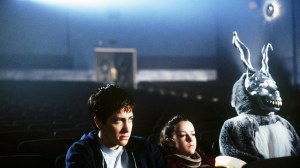 Gyllenhaal (October Sky) is superb as disenchanted Donnie, a Holden Caulfield for middle suburbia. His ghastly stare conveys the darkness of Donnie but his laid-back nature allows the audience to care about what could have merely been another angst-ridden teenager. Swayze is hysterical as the scenery-chewing Cunningham. The rest of the cast is mainly underwritten in their roles, including stars Drew Barrymore (who was executive producer) and ER‘s Noah Wyle, but all perform admirably with the amount they are given. Not every plot thread is exactly tidied up but this can easily be forgiven.
Donnie Darko is a film that demands your intelligence and requires you to stay on your toes, so you can forget any bathroom breaks. The film is one of the best of 2001 but also one of the funniest. You’ll be honestly surprised the amount of times you laugh out loud with this flick. The theater I saw this in erupted every half a minute or so with boisterous laughter.
Donnie Darko is a film of daring skill and great imagination. You don’t see too many of these around anymore.
Nate’s Grade: A
Reviewed 20 years later as part of the “Reviews Re-View: 2001” article.
Share this:

The Count of Monte Cristo (2002)
 Call it swash without the buckle. While The Count of Monte Cristo does an adequate job of telling the Alexander Dumas story (heavily editing chapters and making the leads friends in this version) the whole experience feels very rote. The sword fighting scenes are nowhere what they were billed as and the direction is surprisingly lackluster. Only the actors allow this film to arise mediocrity particularly with a devious turn from Guy Pierce (Memento). Kevin Reynolds (Robin Hood: Prince of Thieves) directed this film and proves he doesn’t need Kevin Costner to screw something up. Somewhere Costner is laughing. Actually, somewhere Costner is likely crying in his beer wondering what happened to him. “I was the king of the cinema…”
Nate’s Grade: C+


 nathanzoebl
You must be logged in to post a comment.