Blog Archives
Her (2013)
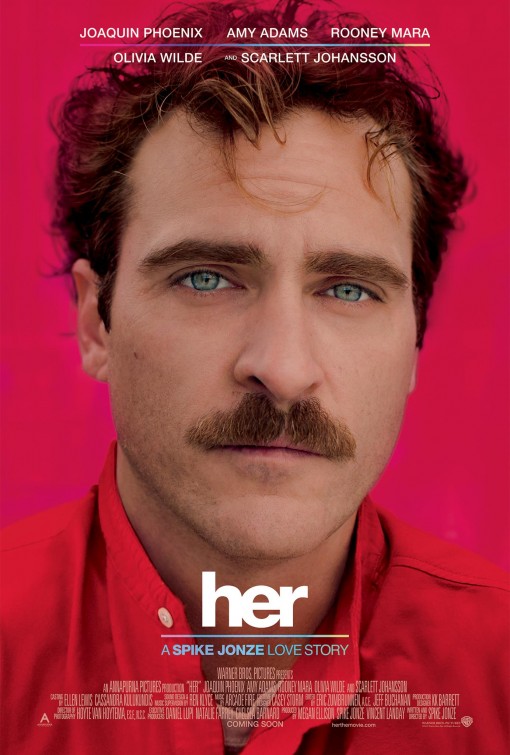 It’s been several years for Spike Jonze since he escaped the turmoil around Where the Wild Things Are, an ambitious adaptation that ran afoul with studio execs over the oppressively sad tone (I agreed with the execs). He’s one of the most stylish visual directors working today, but Her is something very different for the man. For starters, it’s a film Jonze wrote himself; no collaboration with Charlie Kaufman this time. It’s also a pared down love story, focusing heavily on two characters and their exciting and emerging union. There are no visual tricks, no gimmicks, no overt special effects, nothing to distract from the central relationship commanding the screen. It’s a different kind of film from Jonze but one that’s just as brilliantly well made as his best. Her is a beguiling winner.
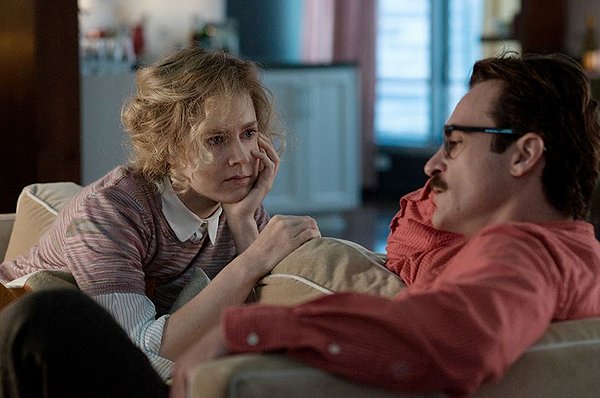
Theodore (Joaquin Phoenix) is a man struggling to get his life back together. He’s a star at his job where he writes other people’s personal letters for them, but he’s a sensitive soul still refusing to sign the divorce papers from his ex-wife, Catherine (Rooney Mara). He doesn’t want to lose that part of his life. After watching an ad, Theodore buys a new computer operating system (OS) that promises to be the most lifelike possible. He pops the software onto his computer and, voila, the voice of Samantha (Scarlett Johansson) emerges, chipper, helpful, and compassionate. Theodore is a new man with her assistance, and soon they grow even closer together on a romantic scale. Theodore and Samantha embark on the greta unknown together, but can a relationship work when it’s with a voice in your computer.
 It’s been weeks since I first watched Her and I keep thinking back upon it, turning it over in my mind, finding more and more to like about this captivating little movie. It’s a tenderhearted and poignant movie that also manages to have something to say about human connection. And this really is a love story, and an engrossing one at that, despite the fact that it’s man and machine. The romance between Samantha and Theodore is never looked down upon, marginalized, the setup to some punch line about how nerd can’t get dates with real women. You think the film might go there, and then Theodore’s co-workers just shrug when the truth comes out and treat his relationship like any other. I suppose you could make all sorts of analogues, but they are unnecessary because Samantha truly feels like another person. She’s given complexity, curiosity, impulses, and, yes, as voiced by the husky-voiced Johansson, an alluring edge. Because she’s a disembodied voice minus form, theirs is a relationship built upon intellect, conversation, personality, and a burgeoning connection, though they do cover the sex part as well. In fact, the climactic (pardon the pun) vocal exploration is simultaneously awkward, funny, heartfelt, and yes, even a little sexy, and the music crescendos to give it even more oomph. Samantha is learning just as much about herself as Theodore is. Their relationship is opening both of them up to the possibilities they might never have sought. In that respect, Jonze’s film falls under that sweet spell all engaging romances achieve where our spirits are lifted and we swoon along with the onscreen coupling.
I’ve found it tricky to talk about Her at least in describing the premise to other people; comparing Samantha to Siri has helped rather than just referring to her as an “operating system.” One concern I had was that Jonze was just going to deliver the premise in a very expected manner and Her would serve up more of the same. But he doesn’t. While this is a light science fiction film, it is extremely well developed and thought out. Jonze has taken remarkable care to flesh out his story and enrich the not too distant future world. It felt like a world that could reasonably exist. I enjoyed the fact that there were so-called surrogates for hire, people that would serve as the physical embodiments of the OS personalities, providing a different kind of encounter, one meant to converge intimacy with touch. I could see these people existing if this were the future. Even better, Jonze takes great care to develop the central relationship between his lovers, so that every unique complication is given some form of respectful coverage. They discuss the limitations but not just what you would assume. Yes Samantha has no body, but she can also be in many places at once, doing many things at once, and simply will outlive all her carbon-based life form companions. Can they make this last? Even with the technological component, old problems can rear their head, particularly jealousy, like when Samantha begins communicating with other OS personalities. Then there’s Theodore’s lingering divorce with his wife, a woman who can stir up old feelings and doubts. Without giving too much away, the end manages to be hopeful, melancholy, expected, and satisfying.
 Jonze also manages to slide in some subtle jabs about the state of communication and connection. There’s an early shot where Theodore is riding a train and everyone on board appears to be talking except that they’re all talking to their OS, each person an isolated unit. Theodore’s job also seems like a perfect social commentary as well as a clever conceit for a man who has unsurpassed skill with words but difficulty with the flesh-and-blood interaction. It works directly with the theme of the film. I also find it humorous, and a bit subversive, that Theodore has long-standing relationships with clients. He’s been writing letters for certain couples for years going all the way back to their first meeting. Think about that, this couple’s communication and courtship rest upon the words of an intermediary paid for his services. These people could go their entire lives thinking their partner is the author of such wonderful, heartfelt, observant words. That’s the dearth of honest communication plaguing human relationships, but it’s not a new problem. We’ve all ducked hard conversations. Many of us would love to have someone come in and do the dirty work while we sit back and reap the rewards. But a relationship built upon deceit or convenience will ultimately fall apart, or, in this new age of technological isolation and greater deception, will it?
Jonze’s direction seems invisible, like we’re dropping in on these characters and peaking on their lives. The overall technical aesthetic of Her is a clean, simplified look and feel for a love story that manages to be new and familiar. The production design has an eye-catching degree of colors, which bathe the film in a consistently dreamy, gauzy aura, echoing the screenplay’s warm heart. The score by the Canadian alternative band Arcade Fire is low-key but just as vulnerable, resonant, and special as the characters in the film. It’s mostly pared down piano trinkles but the reoccurring motifs stick in your head, elevating Jonze’s film. When Samantha takes up composing songs to express her sum total feelings of a moment, capturing a snapshot of a particular time as she refers, it’s nice to have talented musicians able to bring this to life.
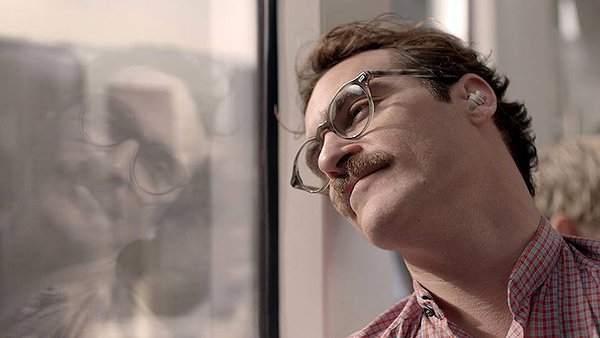
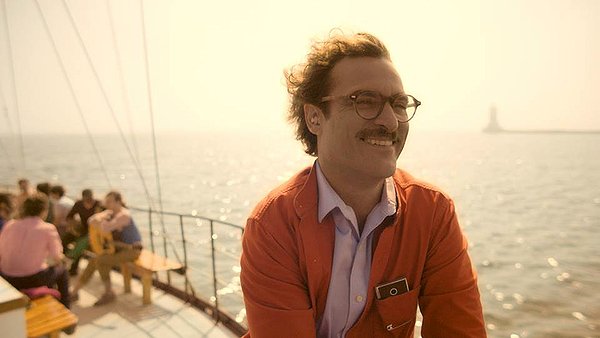
Phoneix (The Master) gives such a tender, vulnerable performance that you worry that he’s going to be crushed by life. He has this remarkable way of making you want to hug Theodore, like he’s this sad puppy that just needs a good home. There are moments in the film where just one perfectly executed crinkly-eyed crooked smile tells me everything about this character. Phoenix plays his character as a good-hearted, amiable, and deeply romantic individual, and the sheer strength of his performance will knock you back. Theodore has such great pools of empathy, and a poet’s soul, which allows him to excel at his job but it also makes relationships hard. A relationship takes work, and Theodore may have not been up to the labor, as his ex-wife argues. Personally, I found a lot of striking points of similarity with the character and I think others will as well. Who hasn’t, in a moment of dark-clouded funk, wondered if they’ve reached the apex of their emotional experiences, that everything will somehow be lesser variations? Who hasn’t feared that they somehow tapped out on their ability to love as powerfully as before? As Theodore is picking up the pieces of his life, trying to determine his new sense of self, we’re learning alongside him exactly how Samantha is changing him.
 Before this movie, I would have said a Johansson (Don Jon) performance minus her body would be a travesty, but damn if she doesn’t give a performance that is worthy of the Oscar buzz. It’s easy to understand why Theodore falls for Samantha, and you will too. Johansson has never been this winsome and loveable but she’s far more than some idealized Super Girlfriend to be placed precariously on a pedestal. She’s learning too, making choices, some of them bad, and exploring the consequences. The depth of emotion she’s able to convey with a character only heard audibly is impressive. Samantha is a fully formed character that wants to be treated as such, and Johansson give her all the shadings of a living being. She’s inquisitive, funny, curious, but also eerily human in her mannerisms, like when she uses short breaths when feeling awkward even though she has no use for breath, obviously. Johansson is so easily sultry, voice included, but Samantha is not relegated to some high-tech toy, some quirky sexual fantasy. She feels real, which is why their relationship feels genuine and so moving and charming.
Who knew the most affecting love story of 2013 would involve a man and his computer? Her is an insightful, touching, and rewarding movie that hits you on many levels, satisfying all of them. It’s a smart film that explores the various complications of its premise while widening its scope further, it’s heartfelt and humble as it approaches relatable matters of love and loss and feeling adrift, it’s sweetly romantic while at the same time being tethered to reality, finding a perfect balance, and at its core it’s the tale of two people, one human and one mechanical, that find happiness in one another. People will likely pick the movie apart to search for personal messages from Jonze about his own divorce from filmmaker Sofia Coppola in 2003. Maybe that stuff is buried in there, but Jonze has crafted something far more applicable and enjoyable. Her is an openly romantic film that doesn’t shortchange heartache, and it posits that love is love no matter whom it’s directed at. Her is an extraordinary sort of movie and one I plan on revisiting again. Give this unconventional romance a chance and you may be delightfully surprised.
Nate’s Grade: A
Share this:

Inside Llewyn Davis (2013)
 “There’s no success like failure. And failure’s no success at all,” Bob Dylan wrote. He could have been talking about any number of characters in the oeuvre of master filmmakers Joel and Ethan Coen. Losers and has-beens and could-have-beens fascinate the brothers, and their newest film certainly follows this model. Llewyn Davis (Oscar Isaac) is a struggling musician in the 1961 Greenwich Village, New York folk scene. He rotates crashing with various friends, unable to scrounge up enough money to ever pay his own way. His musical partner recently killed himself and Llewyn has been trying to get traction with his first solo record. His world gets even more complicated when Jean (Carey Mulligan) reveals that she’s pregnant; the baby’s father may be Llewyn or Jean’s husband and fellow performer, Jim (Justin Timberlake). Llewyn can’t catch a break.
Inside Llewyn Davis is a classic Coen creation, a character study of a misanthropic loser trying to find direction in a comical universe of indifference. I greatly look forward to every Coen picture and that’s because nobody writes characters like they do. There are no throwaway characters in a Coen universe. Even minor characters like the elevator Attendant or Manager’s Secretary are given sparks of personality, each fully formed figure creating a richer canvas. There is great pleasure in just listening to their characters speak, in natural cadences yet elevated with grace. Inside Llewyn Davis is no exception. Their storytelling is always rife with wonderful comic surprises and pit stops. The Coens are such brilliant technical craftsmen, that every shot is gorgeously composed, even without longtime cinematographer Roger Deakens (to give you an idea how old this movie was, Deakens was busy filming Skyfall). The music, supervised by O Brother maestro T. Bone Burnett, is impeccably performed and quite lovely to the ear, if you’re into folk music arrangements. If you’re not, well, it’s going to be a long movie experience.
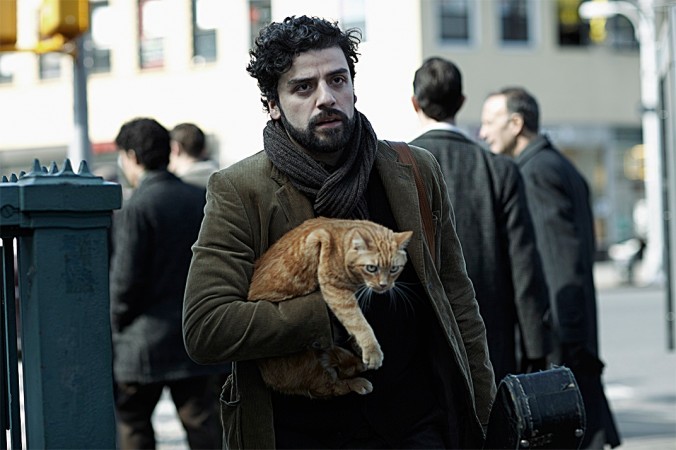 But here’s the problem with Inside Llewyn Davis: the film will likely turn off most people. It’s not a comforting movie by any means. We’re stuck following a self-destructive struggling musician bounce around couch-to-couch, chasing dreams that will never seem in reach. And Llewyn is a tough character to love. He’s surly, careless, selfish, egotistical, and also jaded. And he’s just about the only character in the movie. Most of the other famous faces are fleeting supporting players. Only Mulligan (The Great Gatsby) is given a plurality of scenes to expand her perturbed character, and even those may not be enough. Much like Llewyn’s musical direction, this is a one-man show, and he’s not cuddly. But an unlikable protagonist is not uncommon. The Coens tease so many different directions for Llewyn to go that it’s likely that audiences will feel some degree of disappointment where the film does end up. It’s a circuitous path, proving Llewyn is the architect of his own fate, but at that point audiences may not care. They may just be happy to watch Llewyn punched in the face. The plot is pretty light, running into a series of various self-contained scenes, and there isn’t much in the way of closure. I’ve watched the film twice and while I appreciate it more I’m certain that Llewyn Davis will leave a majority of people feeling cold, more so than even A Serious Man.
Unlike former Coen creations, notably in A Serious Man and Barton Fink, our titular character is the architect of his own misery. He is a musician that identifies with an older class of folk artists, something that strikes him as genuine and touching the soul. He cannot stand artistic compromise. He won’t even accept a winter coat from his music manager. He wants no handouts. He chastises Jean about her and Jim’s attitudes toward the business, calling them “careerist” and “a little bit square.” To Llewyn, to sell out is the worst crime. Jean says that they’re just doing what they can to raise up the musical ranks, and maybe the songs aren’t top-notch, like a catchy but instantly dated novelty song about the Space Race (the sure-to-be Oscar-nominated “Please Mr. Kennedy”), but they’re commercial, they’re finding an audience, they’re making inroads, partially as a husband/wife act and partially due to their own physically attractive appearances, and it frustrates Llewyn greatly. A great example is early in the film a young Army vet on leave performs a wonderfully pure song with a beautiful voice. Llewyn scoffs at the mawkish nature of the tune. “He’s a great performer,” Jim advises. Llewyn takes umbrage at the distinction; a performer is not the same as a musician. The people getting ahead are the performers, the sellouts. One of Jean and Jim’s rising hits, “500 Miles,” lyrically suggests it was an old slave song that has been repackaged and homogenized for safe consumption. Llewyn is going to stick to his guns and make it on his own terms, with expected results. Late in the movie, after Llewyn performs before a record exec (F. Murray Abraham), so aching and affecting as he puts it all into the song, the exec simply responds: “I don’t see a lot of money here.” However, the exec offers Llewyn a chance to be in a trio he’s putting together, if he cleans up and knows how to keep to the background. It’s a real opportunity. Just not for Llewyn.
It all comes down to legacy and Llewyn contemplating what his will be. His singing partner is now defined by his death, finding cruel irony in their song, “If I Had Wings.” His father is known for his long dedication to the Navy, but now he sits alone in a nursing home, a prisoner to his own infirmary and defeated mind. A road trip partner, the pompous jazz musician Roland Turner (a royally hilarious John Goodman), seems like a Ghost of Christmas Future visit from a possible future Llewyn, the artist who’s an iconoclast only in his own mind. Throughout the film, Llewyn is beset with choices, different options he could take, one in particular stemming from a revelation involving an old girlfriend. And yet, much like the thematic nature of folks songs, we’re told, Llewyn looks for something new with something old, be they routines, goals, or occupations. The folk music scene is on the cusp of change with a more commercialized pendulum swing, as evidenced by a surprise new performer at the Gaslight in the closing minutes. Llewyn is contemplating his life beyond the world of show business and where he goes next.
 And if there is a sad aspect to the Coens’ tale, it’s that Llewyn really is a talented musician. This is a breakout role for Isaac (Drive, Robin Hood) especially when you consider that he did all his own singing and guitar playing. It’s one of the most astonishing musical performances by an actor I’ve ever seen in a movie. The level of craft at command, the different slivers of passion he carefully puts into the performances, the trembling emotion, the merging of himself with the song. There’s a reason the Coens open the movie with Isaac performing the full rendition of “Hang Me, Oh Hang Me.” It crystallizes right away where the man’s talent level is, both the character and the actor. We’re left to then wonder why he hasn’t found his place in the industry, and the rest of the film is the explanation. This is the first film since perhaps 2007’s Once where full-length performances of songs really do move the story forward (I’m obviously excluding traditional musicals). Some have labeled the heavy use of song as lazy, distracting from an undercooked narrative, but I can literally go through every song in the film and justify its existence. Each tune, and the performance and performers, gives insight to character, plot, and state of mind.
Inside Llewyn Davis is an easy movie to admire but a harder one to love, unless you’re a fan of the Coen brothers or folk music in general. The protagonist is unlikable, his struggles his own doing either by hubris or integrity, the plot is rather loose with scattered supporting characters, and the film ends on a somewhat lackluster note that feels inconclusive. But then I keep going back to the richness of this world, the pop of the characters, the lyrical beauty to the unvarnished songs, and the concept of folk music as its own sense of purgatory (here me out, folk fans), the idea that we seek something new with something old, and so we follow in circles, like Llewyn’s onscreen journey. Isaac gives such a strong performance that you almost wish his character could catch a break. Almost. This is another technical marvel from the Coens, filled with their dark humor and their sense of cosmic melancholy, but Inside Llewyn Davis may ultimately find some strange sense of uplift as Llewyn continues to hold to his ambitions even as the world around him is changing, losing sight of artists like him. As long as we have the Coens, the Llewyn Davis’s of this world will get their due in one form or another.
Nate’s Grade: A-
Share this:

Dallas Buyers Club (2013)
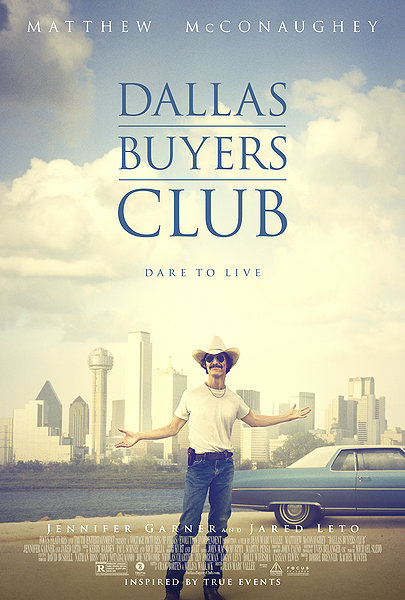 It’s been a while since Hollywood really tackled the AIDS crisis and the prejudices associated with it. Thanks to better understanding and tolerance, and a rise in life-extending drug treatments, AIDS is rarely stigmatized today as it once was, as a death sentence, as a gay disease. It’s faded into the back of most people’s minds. It’s been twenty years since Philadelphia and Tom Hanks’ Oscar-winning performance. Has it been too long? The drama Dallas Buyers Club returns to the early years of the AIDS crisis and the ignorance of the age, illuminating a lesser known true story about one of the most unlikely activists to emerge.
In 1985, Ron Woodruff (Matthew McConaughey) is a Texas electrician and part-time rodeo bull rider. He’s drinking, snorting cocaine, and sleeping with every woman he lays eyes on. Then one day he collapses and wakes up in the hospital. He’s told he has contracted HIV/AIDS and likely only has 30 days left to live. Ron is aghast, instantly defensive, declaring, “I ain’t no faggot.” Rather than wallow, he fights to live as long as he can, refusing to be part of a hospital drug treatment for AZT unless they can tell him, definitively, he’s getting the actual drug and not the placebo. Ron travels to Mexico and finds a sympathetic doctor with alternative treatments involving vitamins and other natural drugs, none of them illegal, just unapproved by the FDA. Ron returns to the States and runs into trouble trying to sell his wares to the afflicted gay community. Raylon (Jared Leto), a kindly transvestite suffering from AIDS, agrees to help Ron make inroads, for a percentage of the sales. Ron and his unlikely business partner skirt legal loopholes to sell “memberships” into the titular Dallas Buyers Club. With monthly dues, every member gets a dose of attentive medicine, and it’s having remarkable results.
 The bulk of the attention Dallas Buyers Club has received is from the transformative performances of its two lead male actors, and they are exceptional. McConaughey (Mud) begins as the sort of character we’ve seen before, the swaggering cowboy who’s a natural ladies’ man, but as his life quickly falls apart and his circle of friends turn on him in gay panic and ignorance, Ron is pushed to the brink. McConaughey’s weight loss, which garnered plenty of ink in tabloids last year, is startling and instantly echoes his character’s dire state. Likewise, when you see a late scene of Leto (Lord of War), his frame is so gaunt, so frail, and so evocative of the few remaining moments these men have left to them. It’s no stunt or gimmick because their performances, even without the weight loss, are enormously affecting and powerful. Both men project a blustery confidence they themselves occasionally buy into, but both men are, naturally, scared witless, fumbling, scrambling against the clock. McConaughey is the strong face, the wheeler-dealer who has to use his live-wire charm and bag of tricks to get the meds. As roadblock after roadblock is thrown his way, we readily watch the toll is takes on Ron, the heaviness of his burden that becomes more about people than money. Leto is the conscience of the film and as he shrinks away, you can’t help but feel the inescapable tragedy. Leto will break your heart. I fully expect both men not only to be nominated for Oscars but likely to be favorites to win.
Despite the strength of those two outstanding performances, the film itself doesn’t measure up in a disappointing number of ways. The script by Craig Borten and Melissa Walleck misses far too many opportunities to round out the characters and the central conflict. The second half of Dallas Buyers Club feels a tad rudderless, and this is mostly because of a general sense of sameness in Ron’s conflicts. He butts heads with the FDA, finds a loophole, keeps going. This pattern repeats but it never escalates until the very end. As a result, the film feels like it’s treading water when it shouldn’t be. The portrayal of the FDA and other antagonists is decidedly one-note, almost to a ghoulishly degree. The movie sets up the piñata of Big Business/Pharma to take easy whacks at a faceless, money-driven entity that put profits before human lives. I get it, but it’s too easy and a movie that gropes for emotional depth should not have to stoop to caricatures of bureaucratic evil. The truth of the matter is that there was plenty of legal intransigence and feet dragging when it came to the response to AIDS, and that’s why it feels almost callously wrong for Dallas Buyers Club to reduce this dramatic point in history, where 95% of people who contracted HIV/AIDS had a month left to live, to an us vs. them/slobs vs. snobs underdog tale. That reductive condensing is a disservice to the real people but also a greater dramatic story at heart here.
I’d also like to note that the characters themselves are lacking. They held my interest, certainly, but what can I say about them? What moments revealed nuance or progression? The character arcs are dramatic with a capital D: homophobic Texas good ole’ boy becomes unlikely AIDS activist and friend to gays. The parameters are clearly mapped out, the start and the finish, but what’s lacking is substantive growth that I can acknowledge onscreen. Beyond the ongoing presence of Raylon, the movie doesn’t provide enough evidence for me to move Ron from homophobe to activist. I think this is due to the script meeting the basic requirements of what it thinks are the big signposts along Ron’s personal journey. So we get a scenario such as Ron refusing to enter a gay bar, then cautiously entering, then feeling comfortable around gay people. I don’t need people to trip over soapboxes to blurt out their inner feelings, their changing perspectives, but there has to be more than what’s presented in the interest of time and narrative cohesion. Likewise, Raylon is portrayed as saintly, your prototypical movie gay man with flamboyance and attitude, and he is certainly charming, but much like the main character in 12 Years a Slave, Raylon is more tragic martyr than fully-realized character. His service to the script is to push Ron forward on his own humanizing arc, and I’ve already stated my problems with that. The remaining characters are underwritten, with the unfeeling Dr. Sevard (Dennis O’Hare) served up as a stooge. Except he’s trying to get a sample size to test a drug’s viability, the same process with all medicine. Yet because he’s looking at the big picture, and lacks bedside manner, he’s the enemy to harrumph. Jennifer Garner’s character is more an exposition spout than person.
 Weirdly, the movie drifts into an extended subplot, almost a secondary antagonist after the FDA, against the preliminary AZT drug treatment. This was the first major drug produced to combat HIV/AIDS. It had major backing with huge pharmaceutical industries. Opposition to the conventional norm of the time (AZT is our only medical hope) provides a snug storyline to garner our rooting interest in Ron, but this fight seems too impersonal and one-sided. We’re given reams of stats on the effects of AZT on AIDS patients, presenting a picture that AZT breaks down the patient’s immune system. Dallas Buyer’s Club becomes a sermon against AZT. The movie doesn’t have to be apolitical but it needs to mask its sermonizing or at least be more passionate about its case. Then in the end credits we’re served a short post-script saying that a low-dose AZT, in combination with other drugs, saved millions of lives. After hearing two hours of how terrible and stupid AZT is for treatment, it’s a surprising endnote. Does that justify the doctors that the film so easily vilified?
Ultimately a good film worth watching, I can’t help but continue finding problems as I reflect upon my Dallas Buyers Club experience. If it wasn’t for the excellent acting onscreen, I would have noticed the flaws of Dallas Buyers Club even earlier, but strong acting has a way of being a soothing balm with the deficiencies in a film. The narrative, with easy one-note villains and a runaround of repetitive conflicts, needs more development to match the caliber of performances of McConaughey and Leto. Both men give it their all, breaking your heart in the process, and their performances are even more commendable and impressive when you realize that the film’s characterization is wanting. I feel like the complexity of this volatile time, and Ron Woodroof as a human being and unlikely activist, have been simplified into a rah-rah mass appeal underdog vehicle. I think this does a disservice to the characters and their personal drama, and I wish the filmmakers presented them better as well-rounded individuals rather than tools for the re-education of Ron Woodroof. There’s enough good here to balance out the could-have-been-better, chiefly the power of the central male performances. However, if you want a passionate account of early AIDS activism, I suggest checking out last year’s Oscar-nominated documentary How to Survive a Plague.
Nate’s Grade: B
Share this:

12 Years a Slave (2013)
 In 1841, free black man Solomon Northup (Chiwetel Ejiofor) lives in Saratoga Spring, New York, performing as a trained violinist. Some traveling performers offer him serious money if he’ll play with their circus act in Washington, D.C. Solomon bids goodbye to his family, never knowing he will not see them again for a dozen years. He’s kidnapped, imprisoned, and sold down South to a series of plantation owners. He insists he is a free man, but who will believe him? He’s a black man in chains, and frankly many people just do not care. He learns to adjust to the rules of his new life, finding some companionship with the fiery Patsey (Lupita Nyong’o), and looking for a trusted source to mail a letter to Solomon’s family. It’s a life of daily terror and Solomon could be killed at any moment if word got out that he knew how to read and write.
12 Years a Slave is, as expected, a hard movie to watch at times but it is an essential movie to be seen. A friend of mine literally had this conversation with a movie patron (I wish I was only making this up):
Customer: “Yeah, I don’t think I’ll end up seeing 12 Years.”
Friend: “Oh. Well it is a hard movie to watch.”
Customer: “It’s not that. I’m just waiting for a movie that finally shows all the good slave owners doing nice things. It wasn’t all bad.”
 This brief conversation exemplifies for me why a searing drama like 12 Years of a Slave is still vital in 21st century America. This is a slice of history that cannot be forgotten, but just as sinister is the amelioration of its cruelty. As time passes, and those with direct personal experience are long gone, then the mitigation begins, and you have ignorance consuming people who want to whitewash America’s original sin, like the above movie patron. I’ve even read, simply on message boards for this very film, a dubious prospect I admit, people arguing, “Can’t we just move on already?” and posing false equivalences like, “Well the poor Southerners who worked as indentured servants had it just as bad.” I swear I am not deliberately setting up a straw man argument, these are actual gripes people have. It’s as if acknowledging the totality of the horror of slavery is, in itself, some kind of insult to people today. It’s history and vital history that need not ever be forgotten or mitigated, and we need more films dealing with this subject.
There is zero equivalency to treating people as subhuman property, stripping them of all human rights and dignity, separating them from their families, beating them, raping them, murdering them without consequence, being punished for defending yourself, and kept in a constant state of terror where anything horrible can happen to you at any time without reason. Sorry slavery apologists, but even the notion of a “kindly slaver,” which the movie actually showcases, is erroneous. Whether they don’t beat their slaves as often or addressed them as people, slave owners are still profiting from the institution of slavery, and as such the notion of a “good slave owner” is antithetical to the very insidious nature of plainly owning another human being.
With all that said, 12 Years a Slave is an unflinching look at the cruel reality of slavery but one that demands to be seen. Director Steve McQueen (Shame, Hunger) doesn’t pull his punches when it comes examining the unrelenting misery of slavery. There’s a whipping scene where he are in the safe position of focusing on the faces of those involved, studying their horror, but then McQueen has the camera turn around and you see, in graphic detail, the ravaged back of an innocent woman, the bloody result of every one of those whippings that we watched at a comfortable distance at first. This is a gory example, and the film is rather restrained when it comes to this aspect. This is not simply wallowing in sadism. Hollywood has yet to have a definitive film showcase the traumatic reality of slavery. 1997’s Amistad gave you glimpses, but most of Steven Spielberg’s movie was set in courtrooms arguing the philosophical nature of inherent rights. I wish they would remake the classic miniseries Roots; today’s TV landscape would be more permissible at showing the graphic terror of slavery than 1970s network television. With 12 Years a Slave, there are several uncomfortable moments that will make you gasp, but overall, while retrained on the gore, you feel the overall devastation of a slave’s predicament. Every moment of life was at the whims of another, and a victim could be trapped at every turn. Solomon is beaten soundly, and after he defends himself, he is rounded up to be lynched for his audacity. The aftermath is portrayed with stark tension, as Solomon is left hanging by a noose, his feet barely touching the muddied ground, trying to maintain his stance or else choke to death. And like the long takes in shame, McQueen’s camera just holds us there, trapping the audience in the same strenuous dilemma. The worst goes to Patsey, who is raped by her master and tormented by the master’s jealous wife. Both Solomon and Patsey are damned with every decision. By the end, Solomon is rescued and reunited with his family, but you can’t help but think about all those other unfortunate souls left to mire in slavery. For millions of them, there was no set limit to their desolation.
 From a script standpoint, the movie flows more as a series of scenes rather than a traditional three-act arc. Writer John Ridley (Red Tails, Three Kings) works from Solomon’s own autobiography and does an incisive job of recreating the dimensions of mid-19th century America and the diseased mentality that accepted slavery. No more is this evident than in the frightening character of Edwin Epps, played with chilling absorption by Michael Fassbender, McQueen’s favorite collaborator. Epps is the kind of man who uses selective Scripture to justify his heinous actions. “A man can treat his property how he likes,” he quips with authority. Epps’ plantation is the worst along Solomon’s hellish odyssey. Fassbender (X-Men: First Class, Prometheus) spookily possesses Epps with great ardor, bringing out the snarling dangers of a man and his unsavory convictions. You’ll cringe over all the unwanted lascivious attention he gives to Patsey. He is a weak man through and through, but one who rages against others with his weaknesses. Fassbender is electric and keeps an audience extra alert when onscreen.
The acting is exceptional and infuriating. Ejiofor (Serenity, Salt) is commanding in a performance that stays with you. There is so much the man has to communicate with his eyes, those great orbs of his. Because of his circumstances he must hold back his ire, do what he can to make it another day, and his adjustment to the horrors of slavery are heartbreaking in itself. He must always be cautious, and when he dares to risk trusting a white man, we feel the same tremors of trepidation. There’s a great scene where Solomon, having been betrayed, has to come up with a credible alternative in the moment, with so much riding on his improvisation skills. It’s as suspenseful a moment as most Hollywood thrillers. The most heartbreaking performance, though, belong to Nyong’o, who is making her film debut in a major way. As Patsey, she symbolizes the mounting torment of unremitting victimization, a woman begging for death but too proud to make it happen. She has some intense monologues where not one word feels false. She is a broken woman struggling to find her footing, and watching her get abused in so many different ways is gut wrenching. She’s more than a martyr and Nyong’o shows you that.
Undeniably a good movie, there are still enough filmmaking choices that hold it back for me, and it all comes down to Solomon as the protagonist. The movie’s center was not as strong as it needed to be, and that is chiefly because our focal point, Solomon, is not well developed as a character. I feel pings of something approaching shame just bringing up the subject, but I must profess that Solomon is just not given much to do beyond suffer. As a free man, his adjustment to the absurd cruelty of the institution of slavery is meant to serve as an entry point for a modern audience, to have the safety of our lives suddenly stripped away. But if I had to describe Solomon as a character, I could say that he mostly vacillates between two modes: shock and solemn dignity (“I don’t want to survive. I want to live.”). Strange that Patsey and Epps and even Epps’ wife are shown more dimension than the lead character. I’m not asking for Solomon to suddenly become a more active character and to rise up, Django Unchained-style; the context of slavery limits his opportunities to express himself. I just wanted more to this guy to separate him from the others suffering onscreen. And maybe, ultimately, that’s the point, that Solomon is, at heart, no different than any other slave. I can agree with that in philosophy, however, this approach also nullifies my ultimate investment in the protagonist. I feel for him because he suffers, I feel for him because I want him to find some semblance of justice (an impossible scenario given the circumstances, I know), and I feel for him because he is a good, honorable man. But I do not feel for him because I have an insight into the character of Solomon Northup. Fortunately, Ejiofor does a superb job of communicating as much as he can non-verbally. It just wasn’t enough for me.
 To criticize 12 Years a Slave makes me feel awkward due to the seriousness of its subject matter, but hey, plenty of people make mediocre movies exploring Holocaust atrocities too (does anyone ever dare say, “Get over it,” to Holocaust survivors?). A horrifying historical subject does not give filmmakers cart blanche to slack when it comes to the important elements of storytelling, like story and characterization. 12 Years a Slave, by extension, is an exceptionally made movie with moments to make you wince and cry, gifted with powerful acting and sensitive direction. It is a searing recreation of the many facets of slavery, not just the sheer brutality of the beatings. You will understand on multiple levels the terrorism that was the institution of slavery, a vicious reality that should never be forgotten by a complacent citizenry. I can applaud 12 Years a Slave for its technical excellence, depth of performance, and historical accuracy; however, my personal investment in the protagonist was somewhat limited because Solomon Northup was not developed sufficiently enough. I certainly empathized with the man, but too often I felt like I was watching Solomon as a suffering symbol rather than a character. He’s obviously an interesting figure and I wanted more dimension. While not exactly rising to the level of a Schindler’s List for the institution of slavery (as some have dubbed), 12 Years a Slave is an enthralling movie in so many ways. It’s just a shame that an underdeveloped protagonist would hobble a film so otherwise worthy.
Nate’s Grade: B+
Share this:

Gravity (2013)
 Director Alfonso Cuaron spent over four and a half years developing his latest film, Gravity. The tale of two stranded astronauts had to invent technology to fully realize Cuaron’s zero gravity vision, carefully programming precise camera movements into a room full of LED flat screens to orient the harnessed actors and light them properly. It could have gone stupendously wrong in so many ways. Instead it’s the biggest leap forward in movie technology since 2009’s Avatar and surely one of the best science fiction films since 2006’s Children of Men, Cuaron’s last movie. It is a thrilling, awe-inspiring, astonishing, illuminating, and altogether brilliant film. Films like Gravity are the reason we go to the movies.
High above planet Earth, astronauts Mike Kowalski (George Clooney) and Ryan Stone (Sandra Bullock) are repairing the Hubble telescope when a field of satellite debris crashes into their shuttle. Both of the astronauts are adrift in space and have to maneuver to the safety of a space station. The debris storm circling the Earth is gathering size and force, and these two are running out of oxygen and safe places to hide.
 Gravity is one of those movies that you feel like ordinary English adjectives do it a disservice. I can refer to it and visually resplendent, awe-inspiring, and borderline transcendent, but my words will ultimately prove fruitless, because the experience of Gravity is beyond description. This is the reason we go to the movies, to be amazed, to feel something new, and Cuaron has taken the next great leap forward in technical moviemaking while also retaining the artistic soul of an engaging thriller. You could simply view Gravity as a visual feast and be content, or you could view it as a harrowing survival thriller and be content, or you could view it as Cuaron’s spiritual exploration on the perseverance of life against all odds (more on this later). Any way you shake it, it’s hard to come away from Gravity being disappointed, though I know with every lofty word of praise I inject that the bar is set even higher in audience expectations.
From a visual standpoint, Cuaron has crafted a truly immersive film going experience that puts you in the center of the action. The signature long takes amaze just as much as the visuals, both of which give you the sensation of what it’s like to be in space, weightless, free-floating, and oh so vulnerable at a moment’s notice. It’s been almost 45 years since Stanley Kubrick’s 2001 showed the visual poetry of zero-gravity acrobatics, and the sheer visual still has plenty of potency left. But coupled with Cuaron’s blinkless long takes, the illusion is rarely broken, especially in the first twenty minutes, which establishes the stakes and the reality of survival in space. Ignoring all aspects of the plot and acting, you could sit through the entirety of Gravity and find it a sumptuous, invigorating experience purely from the cutting edge special effects. There is a real sense of majesty to the views from space, overlooking our blue orb, the vastness of it all. It would be overwhelmingly beautiful if it weren’t also simultaneously terrifying. Space, much like nature itself, has an indifferent cruelty to it, and Cuaron does an exceptional job of presenting both the grandeur and the inherent dangers of space.
My nerves were racked throughout those tense 90 minutes of intense orbital activity. As a thriller, Gravity is a very well constructed setup with pristine execution. Each problem is dealt with in the immediacy, the unique particular of space allowing us a new perspective on the survival/disaster thriller model. First she has to stop floating. Then she has to get more oxygen. Then she has to get to a more safe location. Then she has to get back home. It may sound like not enough little plot pit stops but each one is pivotal and a remote respite from jeopardy. The wholeness of space is so complete that it feels like the odds are forever stacked against Stone. I was breathless through many of the suspense sequences, nervously tapping my feet, urging the onscreen characters onward. Cuaron and his son, co-writer Jonas, make it clear early the steps of her journey, and each feel like a natural result of the dire changing circumstances. The accumulative debris is given a 90-minute countdown for return, so we’re always wary that Stone will be caught back in the orbiting mass of projectiles. The sense of peril is kept on high and doesn’t relent, leaving you feeling like every nerve is spent by the conclusion. It’s a top-notch thriller that doesn’t involve the use of a single gun or car chase.
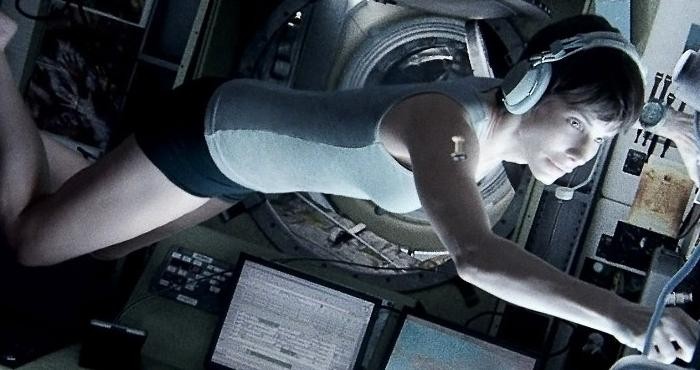 If there is one complaint, I suppose it could be over the somewhat thin back-story and characterization of Stone. I don’t know what a medical officer is exactly doing in space fixing the Hubble telescope but oh well. Cuaron keeps the audience firmly stuck in Stone’s predicament; we do not cut away to any flashbacks of life on Earth, and so it makes fleshing out a central character notable difficult. People don’t usually open up into revealing monologues while they’re trying to fight for immediate survival. She’s got the standard tragic back-story, losing a daughter, but for me this was enough to work with. I don’t necessarily need Stone to be a thriving, complex, emotionally nuanced character because my empathy was already there as soon as the peril began. I wanted her to survive because she was a person; I didn’t have to relate to her on a deeper fundamental level to root for her survival. There are some nice late scenes where Stone reflects on the existential crisis, on knowing her imminent death, on the fog she’s been trapped within since her daughter’s accidental death. Bullock (The Heat), in her best performance to date, is able to pull you in. If faced with your imminent end, how would you attempt to make peace of things, let alone stranded away from all human contact? It’s a strong awards-caliber performance and while her character isn’t given much development, she still has an arc, and I think there’s a greater thematic link with her crossing.
I’m no fan of Terrence Malick (Tree of Life, To the Wonder) but I understand people’s assertion that the man is a film theologian, making the theater a borderline religious experience for his faithful fans. In my eyes, Gravity has an unmistakable spiritual subtext that it can be viewed in different directions. Firstly, it’s hard not to feel an overpowering sense of awe when taking in the sheer magnitude and beauty of the incalculable universe. But then there’s Cuaron’s opening text that prefaces how outrageously impossible life in space is, contemplating all the harsh realities. And yet, here we are. Whether you chalk that up to something religious like God or just the fortune of the cosmos, it’s still a remarkable journey. The evolution of Stone is also reminiscent of that of life on Earth. When she finds refuge in the space station, she removes her suit, curling up in a fetal ball, while the camera centers her and she slowly rotates. The womb imagery is obvious but still effective. There’s also a third act assist that seems like direct divine intervention by most accounts. Then, spoilers, as she lands on a hospitable planet, she emerges from the sea, triumphant, taking her first steps onto land. Triumphant against all odds, against the cruel vacuum of space, life proves to be the winner. Again, whether you ascribe this to a creator God or a wonder of lucky evolutionary forces, it’s hard to escape Cuaron’s spiritual subtext tugging away at you, making the personal survival of Stone a greater analogue for the genesis of mankind and the emergence of humanity.
This is one of the few films I would recommend seeing in 3D. Cuaron has spent four and a half years translating his vision to the big screen and you’ll do yourself a disservice if you don’t see Gravity on the biggest screen possible. It is a film experience to be savored that will not measure up when you are forced to watch such outsized splendor on your puny home TV. This is an expertly made thriller, a visually transcendent, cutting-edge trip to space, and a revitalizing time at the movies. It’s as awe-inspiring as it is terrifying. It’s bursting with stimulation for the senses as well as a reawakened sense of spirituality, of something greater to be thankful for. I am in awe of Curaron as a filmmaker and I am in awe of his finished product. It was worth the wait. Now I hope I never have to wait another seven long years again before I see the words “directed by Alfonso Cuaron” again.
Nate’s Grade: A
Share this:

Blue Jasmine (2013)
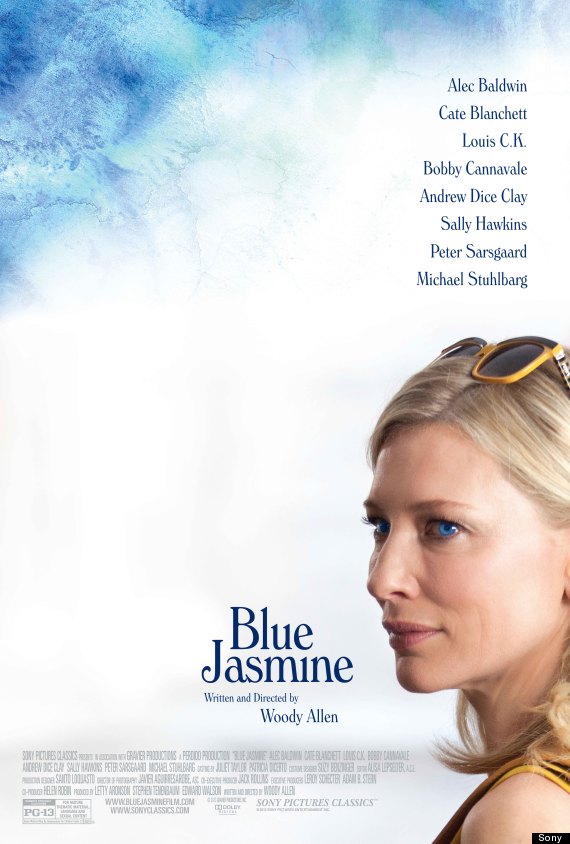 With writer/director Woody Allen’s proliferate output, cranking out a movie every year, it’s all too easy to take the man for granted. Critics will argue his halcyon days are long gone, that the man is coasting on his past laurels. Of course when you’re comparing everything to Manhattan, Annie Hall, or Crimes and Misdemeanors, well sure most movies will be found lacking, even Allen’s. And there’s no real forgiving of 2001’s Curse of the Jade Scorpion. But when Allen hits a rich topic with a capable cast, he can still produce knockout cinema, as is exactly the case with the engrossing Blue Jasmine.
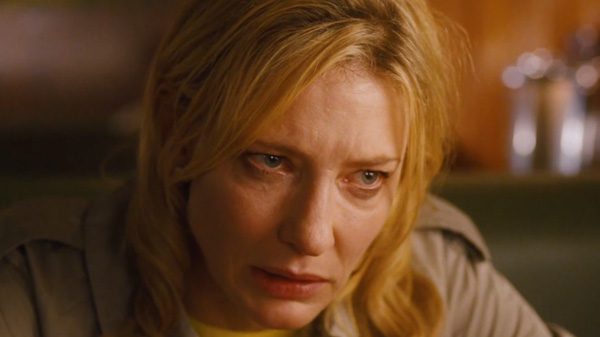
Jasmine (Cate Blanchett) is experiencing a tumultuous change of living. Her wealthy husband Hal (Alec Baldwin) has been indicted for a Ponzi scheme that fleeced millions. Her posh New York lifestyle has vanished, Uncle Sam has frozen the assets that haven’t been repossessed, and she’s forced to move in with her working class sister, Ginger (Sally Hawkins), in San Francisco. Jasmine immediately has her complaints, mostly about the men that Ginger seems to date. She also tries adapting to a life she has been ill prepared for. Much like a domesticated animal, Jasmine’s social skills and pricy tastes do not have real-world transitions into her getting a job and supporting herself. She’s looking for a way to re-enter the shrine of privilege, and that it through a man of means.
 Blue Jasmine is a fascinating character study of a life of self-delusion, denial, greed, and guilt, and it is a marvelous film. Allen hasn’t done something this cutting, this precise in several years and it’s a reminder at just how skilled the man can be at building magnetic, fully realized characters, especially women. This is a rich, complex, and juicy character for an actress of the caliber of Blanchett (Hanna) to go wild with. Jasmine is something of a modern-day Blanch DuBois with a sprinkling of Jay Gatsby; she’s a woman who’s become accustomed to a luxurious fantasy world that she’s still striving to recreate, but she also is a woman who reinvented herself. As we learn in the opening scene, Jasmine left school without finishing her degree when Hal whisked her off her feet, to a world of privilege. She even changed her name from Jeanette to Jasmine at her husband’s whim. She also became particularly adept at looking the other way when it concerned her husband’s shady dealings. Surely she must have known what was happening (in the end, it’s pretty clear) but as long as her illusion of wealth was maintained then it was easy to not ask questions. Why ruin a good thing, even if that good thing is built upon ruining the lives of ordinary people? Two of those people bilked of their money were Ginger and Augie (Andrew Dice Clay), which make Jasmine’s complicity all the more troubling. Every line of dialogue from Jasmine needs to be studied and dissected, analyzing how buried is the real Jasmine.
Jasmine’s declining mental state is also given much attention and curiosity. We are watching in full view a woman go through various stages of a nervous breakdown. She’s medicating herself via booze and a cocktail of prescription drugs, but there are hints that point to something other than substances at play. She hints at undergoing electric chock therapy (does this still exist?) and she may have a touch of mental illness as well, though it’s unclear. Jasmine is given to talking to herself, reciting anecdotes and patter from previous parties with the rich and fabulous. It could be a sign of madness or it could be a desperate attempt by Jasmine to zone out, to return to that former life, to relive her former glory. Personally, I’ve done something similar, recited old conversations out loud to myself, though usually a line or so, not to the degree of recitation that Jasmine engages in. In the opening, it’s revealed that the lady she’s sitting next to on the plane, who we assume she’s talking with, is really just a bystander. She tells her husband she was confused because Jasmine was really just talking to herself. As Jasmine tries to get back on her feet, with delusions of grandeur about reinventing herself again, her world seems to be collapsing around her as she struggles to adapt to the real working world. A receptionist job for a dentist is beneath her as well as far too much for her to handle. She has one real sincere heart-to-heart where she lays out her true feelings, and it’s to her nephews in a pizza shop with no other adult present: “There’s only so many traumas a person can withstand until they take to the streets and start screaming.
An enthralling character study, but Blue Jasmine also benefits from Allen’s precise plotting, folding back into flashbacks to create contrast and revelations. There is an economical finesse to Allen’s writing and directing. Every scene is short and sweet and imparts key knowledge, keeping the plot moving and fresh. It also provides back-story in a manner that feels unobtrusive. Jasmine’s more modest living conditions with her sister are contrasted with apartment shopping in New York City’s Upper West side. The class differences between Jasmine and her sister are put on full display when Ginger and Augie visit New York. However, Allen isn’t only lambasting the out-of-touch rich elite here. Few characters escape analysis. In this story, everyone is pretending to be someone else, putting on fronts, personas, to try and puff themselves up. Once living with her sophisticated sister, Ginger starts seeing her world with new eyes, mainly finding dissatisfaction and a yearning that she could do better. She meets Al (Louis C.K.) at a fancy party and gets smitten, though he’s not what he seems. She dumps her current boyfriend, buying into Jasmine’s theory that she “dates losers because that’s what she thinks she deserves.” She tries to remodel herself into a posh, inaccurate version of herself, a knockoff on Jeanette to Jasmine. It’s a bad fit. The person with the most integrity in the entire film appears to be, surprise, Andrew Dice Clay’s character. Augie is a straightforward blue-collar guy but he has a clear sense of right and wrong, one that comes in handy when he’s able to bust people.
 This is much more a dramatic character study than a typical Allen comedy of neurosis, but I want to add that there are a number of laughs to be had, mostly derisive. There is comedy but it’s of a tragicomedy vibe, one where we laugh at the social absurdities of self-deluded characters and the irony of chance encounters. It’s far less bubbly than Midnight in Paris, Allen’s last hit, but that serves the more serious, critical tone. The class conflicts made me chuckle, as well as Jasmine’s hysterical antics and self-aggrandizing, but I was so thoroughly engaged with the characters and stories to complain about a lack of sufficient yuks. Confession: I generally enjoy Allen’s dramas more than his straight-up comedies.
Naturally, the movie hinges on Blanchett’s performance and the Oscar-winning actress is remarkable. I expect her to be a lock for another Oscar nomination if not the front-runner until later. She fully inhabits the character and lays out every tic, every neurosis, every anxiety, and every glimmer of doubt, of delusion, of humanity. She is a fully developed character given center stage, and it’s a sheer pleasure to watch Blanchett give her such life. You’ll feel a mixture of emotions with the character, from intrigue, to derision, to perhaps some fraying sense of sympathy, especially as the movie comes to an end. Blanchett balances the different faces of Jasmine with startling ease; she can slip into glamorous hostess to self-pitying victim to naiveté like turning a dial. I never tired of the character and I certainly never tired of watching Blanchett on screen.
Woody Allen has been a hit-or-miss filmmaker for over a decade, and you’ll have that when the man has the perseverance to write and direct a movie every freaking year. I had a pet theory that, as of late, every three years was when we really got a great Allen movie: 2005’s Match Point, 2008’s Vicky Cristina Barcelona, 2011’s Midnight in Paris. Well now my theory has been put to rest, thank you very much, all because Allen couldn’t wait one more year to deliver Blue Jasmine, a truly great film. It’s a tragicomedy of entertainment, an exacting character study of a flawed, complex, deeply deluded woman as her carefully calculated world breaks down. Anchored by Blanchett’s supreme performance, the movie glides along with swift acumen, doling out revelations at a steady pace and consistently giving something dishy for the actors and audience to think about. It’s funny, it’s sad, but more than anything Blue Jasmine is compelling as hell. This is one of Allen’s best films and one I’d recommend even to non-fans of the Woodman. Give Blue Jasmine a chance and you may be surprised what you feel, for the film and the woman, both complex, engaging, and memorable.
Nate’s Grade: A
Share this:

Amour (2012)
 No other foreign film in 2012 racked up as many awards as Amour, a.k.a. Love, by Austrian writer/director Michael Haneke. It’s a love story but it shows the end of that love story, the part where the happily ever after meets the uncomfortable reality we must all eventually face. So, essentially, Haneke has crafted a horror film about getting old (this can happen to you, youngsters!). It’s a hard film to watch, though for me not just because of the subject matter but also because of the maddening ways that Haneke chooses to tell his art-house tales of woe.
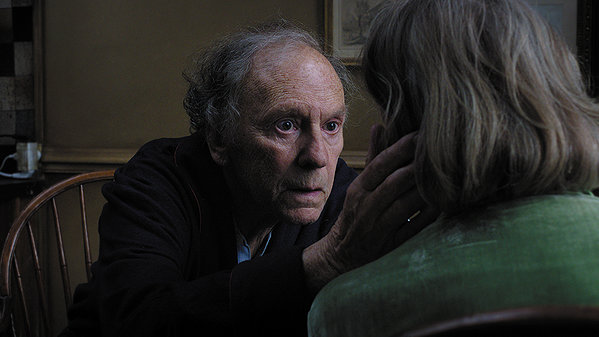
Anne (Emannuelle Riva) and Georges (Jean-Louis Trintignant) are an 80-year-old married couple living in Paris. They are both retired musical teachers, they go about their days together, enjoying one another’s companionship. Then Anne suffers a stroke and starts slipping into senility. Her condition worsens and Georges tries to care for her increasing needs himself, buoyed by her fleeting moments where it seems like her normal self returns. But there’s only one way this story can end, and George must come to terms with letting go of his life’s love.
 I will probably come across like a heartless bastard but that is the risk I’m willing to take; I found this movie to be rather boring and was, after an hour, just waiting for Anne to die so that the movie would likewise be at a merciful end. I’m just not a Haneke fan. I didn’t like Cache, I didn’t like (both) Funny Games, and I didn’t like The White Ribbon. In fact, while watching Amour I was reminded of all the reasons I dislike Haneke’s style. There was a sequence where a character leaves a room, but rather than follow that character or cut, the camera holds on the scene for an extended period of time, like 40 seconds, until the actor returns. I said, “Oh, I just remember he did the same thing in The White Ribbon, and I hated it then and I hate it now.” Want to watch an old man chase after a pigeon for five minutes? Oh, I get it, the pigeon is a metaphor, but did I need five minutes of it? I find Haneke’s sense of storytelling to be so glacial and, mostly, a spiral of kamikaze nihilism that’s usually distasteful. He’s such a cold filmmaker and the idea of him handling a “love story” seems dubious. It’s hard to watch a Haneke film and feel good about it. And that’s fine, the world needs downer filmmakers who will tackle serious subjects, but this guy is just not for me. With that said, take everything I recount in my review and analysis with a measure of consideration.
I know my power of empathy is alive and well, so I have to stop and run a diagnostic examination as to why I found it hard to really engage with this movie. I’m sure part of it is my relative youth in comparison to the onscreen couple. Death is still a mostly abstract concept I choose to be blissfully ignorant over. But that can’t be fully it. I went through a similar experience helping to care for my 91-year-old grandmother when she died (she lived with my parents for years before her eventual passing). It’s not the same as losing a spouse, naturally, but I do have a relatable entry point. Maybe it was the acting, which was free of any sort of showy actorly tricks we may expect from people reaching the big end. Death scenes have long been a staple of overacting, but underplaying it can also rob the movie of worthy emotional opportunities, and with an artist like Haneke, you may not get many more opportunities to soak up. While I had heard raves about Riva, and make no mistake she is quite good, I cannot help but think, “Yeah… but….” She’s quite convincing at showing the frailty of aging but she’s also practically comatose for half of the movie (I know I’m a Jennifer Lawrence homer, but glad she won the Oscar). And then Haneke tries to get clever with his ending, especially since he had been so straightforward for the previous two hours. The ending, a possible point of confusion, doesn’t feel like it fits the exacting, grounded reality I just barely stayed awake for.
 Amour is really less about Anne, the one slowly dying, as it is Georges coming to terms with his own selfishness, prolonging his love’s life after the point of dignity and mercy. It’s about how he comes to terms with the reality that he cannot care for his beloved, that she is too much of a burden, and that she ultimately wants to die and will fight her husband to achieve this wish. Again, this is an extremely dramatic storyline that could have developed some monstrously powerful examinations about end-of-life care. Sadly, I just didn’t, well, care too much. The relationship between Anne and Georges is very thinly realized onscreen. I’m sorry but I hate it when a character is afflicted so early in a story and that affliction becomes the stand-in for what should be proper characterization. All I know about Anne is her deteriorating condition. I don’t know about her life, her personality, her relationship with her husband before senility sets in. I’m just supposed to automatically feel for her because she’s old and suffered a stroke and her husband really cares a lot. Haneke’s storytelling has not done an adequate job to involve me. The actors, both quite good, can only do so much. There’s a reason that Hollywood has its heroines start the Cough That Symbolizes Terminal Illness when we hit the third act because by that time we’ve gotten to know them and care about their ultimate plight.
Now, Amour goes about its death business in a very sensitive but unsentimental way, which has and will likely emotionally devastate many a viewer. There are serious and hard discussions the movie gives adequate attention to, like how far can one spouse cope with care, when does holding on serve as a detriment, breaking the news to heartsick family members that your loved one isn’t getting any better, coming to terms with the inevitable, the tricky debate about what comes next as far as inheritances, and whether the person who is suffering should have a say in their care or lack thereof. It’s refreshing that serious decisions are given serious consideration, but like everything else, Haneke drags these out to great lengths that I stopped caring.
I find Haneke to be an outrageously overrated filmmaker of clinical coldness and occasional contempt. Just watch Funny Games to see what the man’s opinion is for most movie audiences lapping up your rote thrillers. Better yet, if you’re like me, don’t see Funny Games, and don’t see The White Ribbon, and don’t see Amour. I fully acknowledge I’m out on a critical limb here, cherishing my minority status, but I found this Oscar-winning film to be painfully ponderous and emotionally closed off. I’m happy people can watch Amour and see a great, tragic, affecting love story, because I don’t see it. The actors do fine jobs but the characterization is weak, relying upon circumstance and affliction in place of characterization. Maybe, and this is just a harebrained theory, but maybe Haneke dragged his movie out so long to symbolize Georges’ journey, so that we too, the audience, felt like when the end came it was a relief. I know for me, it did. Whatever Haneke does next, you can count me out. I’m done with the guy. After all, life’s too short to endure more plodding Haneke films.
Nate’s Grade: C+
Share this:

The Impossible (2012)
 On December 26, 2004, an underwater earthquake triggered one of the deadliest tsunamis on record, devastating coastal cities along the Indian Ocean. Over 230,000 people are believed to have perished from the waves and resulting damage. The Impossible tells the harrowing and ultimately inspiring true-story of one family and their vacation from hell. We follow Marie (Naomi Watts) and Henry (Ewan McGregor) as well as their three sons, from oldest to youngest, Lucas (Tom Holland), Thomas (Samuel Joslin), and Simon (Oaklee Pendergast). They’re vacationing in Thailand for the holidays and then the tsunami hits, separating Marie and Lucas from the group. They are swept away by the punishing waves and Marie is badly hurt. Henry is desperately searching for his loved ones, Lucas is desperate to get his mother proper medical attention, and there are thousands just as desperate and just as in need.
It’s nigh impossible to watch this movie and be unmoved. It’s not very subtle when it comes to its themes and messages, but man is it ever effective. The family struggle could have easily descended into melodrama with a sappy, maudlin reunion, punctuated with swelling music to hit you over the head. It’s a fairly simple story with little to its plot. The family gets separated and then they desperately search for one another and, surprise, they reunite. It is after all based on a true story and they all lived, so there’s that. It’s the startling level of realism, the exceptional performances, and the poignant moments of human kindness and grace that suckered me in big time. I was an emotional wreck throughout this movie but in the best way possible. I cried at points, sure, but my tears and my emotions always felt genuinely earned. There’s no doubt that this is one manipulative movie. It knows what strings to pull, what buttons to push, and it does so with finesse. Last year I decried Extremely Loud & Incredibly Close for being overly manipulative and overdosing on false sentiment. However, with this movie, my investment was never in jeopardy. I was completely absorbed by the story and felt great empathy for the array of characters as they persevere. The horror of that 2004 tsunami is told in one small story, personalized, and giving an entry point for an audience to engage without feeling overwhelmed by the magnitude of destruction and death.
 Let me go into further detail about that wall of destruction, given astonishing, terrifying realism. The recreation of the tsunami ranks up there as one of the most frightening sequences I’ve ever seen in film. It’s a solid ten minutes of chaos, and you will feel the frenzy of that chaos. You’re put in the middle, floating along with mother and son as they helplessly try and cling to one another. The scope of the disaster will leave you gasping. I know they must have used sets and water tanks but I’m left stupefied how it all came together to look so seamless. It sounds macabre to compliment the marvelous recreation of mayhem, but director Juan Antonio Bayona (The Orphanage) and his team have turned disaster into world-class drama. It’s not just the powerful waves as well, there’s the field of debris just under the surface to contend with. When the first wave hits Maria, we experience her complete disorientation. The sights and sounds are blurs, the water oppressive, and the debris sudden, jolting, unforgiving. It’s the closest any person would ever truly want to get in the middle of a tsunami.
The majority of the film is about the family coming back together, and while their reunion is indeed a tearjerker, I found the film littered with many small moments that just soared emotionally. When a disaster of this magnitude hits, I’m always struck by the wealth of human kindness and cooperation that emerges in response. There’s something deeply moving about helping your fellow man in need, even if you cannot understand his or her language. Maria is aided by the Thai locals who do not treat her differently because she’s a white woman. She is just another person in need.
Whenever disaster strikes, we think of the people who plunge into the middle as heroes, but simple acts can be just as comforting and thoughtful. There are small moments of kindness, like lending a stranger your cell phone to call home, that speak volumes. In that one instance, Henry is so distraught, the weight of everything hitting him as he tries to put it into words, and his call is abrupt and somewhat incomprehensible thanks to his rising emotions. Henry is urged to call back, not to leave it at that, to leave his relatives dangling with such precious little and the alarm in his voice. So he’s given the phone again, and in a more measured demeanor, Henry is able to talk about the situation and promise to find his wife. It’s such an everyday gesture made invaluable to Henry. There’s a woman talking to Thomas about the stars in the sky, how we don’t know which are dead but they continue to live on, and the subtext is a bit obvious but it’s still heartfelt. Then there’s Lucas’ mission of organizing the triage center, scouring the grounds looking for missing family members. He takes it upon himself to make a difference rather than sitting idle. It’s that human connection in the face of adversity that proves most uplifting.
 Watts (J. Edgar) gives a performance of tremendous strength and fragility. The tenacity and resilience she has to keep pushing through is remarkable. She’s so strong but vulnerable at the same time, showing you the fine line she walks to stay above the fray for her child. She endures great physical trauma, a gnarly gash in her leg peeling off like tree bark. Then there’s the emotional burden of trying to be a mother to a child desperately in need of a sturdy parent. Watts could have readily played to the heights of the emotions, resorting to hysterics, but the quiet strength of her character makes her underplay the burdens she endures. She can’t simply just break down. You don’t get a true sense of the toll she has suffered until her life-and-death struggles at the very end.
The supporting team around Watts also deserves accolades. McGregor (Salmon Fishing in the Yemen) has several heartbreaking and heartwarming scenes, striving for hope. Lucas has to rise to maturity when his mother is wounded, protecting her, supporting her. Acting novice Holland rises to that challenge with great courage, though there are moments that still remind you he’s only a boy, like when he bashfully turns his back upon seeing his mother’s exposed breast. That awkward, indecisive moment where a young boy doesn’t know how to handle the sight, seeing his mother so exposed and vulnerable, is quite effective. The other actors who round out the family (Joslin and Pendergast) are quite superb as well. The family feels like a cohesive, loving unit, and every performance feels believable.
The Impossible is based upon the true experiences of a Spanish family, and yet the onscreen family we follow is white, so what gives? It’s not surprising for Hollywood to whitewash a story to appeal to a wider audience. Should we have any more sympathy for this family’s plight because they are white? Would we feel less if they were Spanish? I think the perils and victories would be the same regardless of language or ethnicity.
Watching the unflinching and stunning events in The Impossible, you will likely shed some tears, be they from horror, sadness, or happiness at the family’s reunion. While the ending is never in doubt, the movie has plenty of other potent and poignant small moments to keep your emotions safely stirred. It’s a visceral experience that will shock and exhilarate. There were moments where I felt like I had to cover my eyes. But The Impossible is not disaster porn, ogling over the suffering and endurance of the misfortunate. It’s as much about the response to tragedy as it is the wallop of that cruel tragedy in 2004. The perseverance, the open-hearted help of one’s fellow man, the strength of human connection, the long ripples of kindness, it all comes together to form one compelling, often moving, and quite memorable film experience. Add some formidable performances, top-notch direction, and tremendous technical achievement, and The Impossible is a rousing drama that speaks to the best of us even in the worst conditions (think of it as the antithesis of Ayn Rand’s philosophy). It may be manipulative, it may be somewhat straightforward, and it likely climaxes too soon, but when the results are this powerful and emotionally engaging, then I’m happy to have my buttons pushed.
Nate’s Grade: A-
Share this:

Django Unchained (2012)
 It’s an understatement that no one makes films like Quentin Tarantino, though after Pulp Fiction it seemed like everyone was trying. The famous writer/director is an audacious filmic DJ, taking samples from all genres and mixing and matching them into a new and elevated form of art; he takes low-grade B-movie concepts and genres and turns them into highly literate A-class films. My only quibble is that, while I heartily enjoy the man’s unique efforts, I don’t know if we’re ever going to see a different Tarantino anymore. Since 1997’s Jackie Brown, he seems intent on re-imagining exploitation films and B-movies and putting his articulate spin on them. I have yet to dislike a Tarantino film (I rate Jackie Brown the lowest but that’s still an A-) and I’ll be first in line for anything the man attaches himself to as writer/director. Django Unchained is Tarantino’s ode to spaghetti Westerns, and it’s every bit as violent and tense and entertaining as you’d hope it to be.
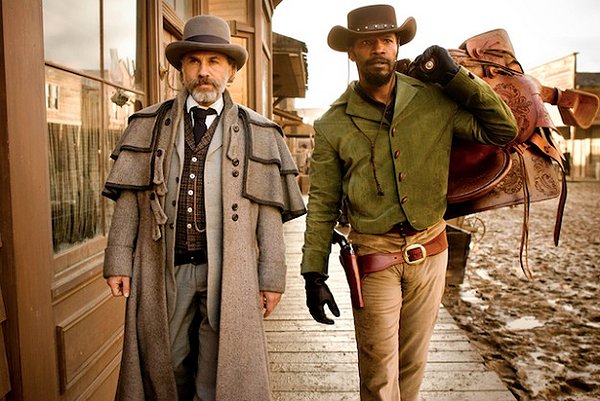
In 1858 Texas, an abolitionist bounty hunter, Dr. King Shultz (Christoph Waltz) frees a slave named Django (Jamie Foxx) and enlists his help in tracking down a team of outlaws. They strike up a mentorship, gunning down outlaws for money. “Kill white folk and they pay you for it? What’s not to like?” Django reasons. After a successful season nabbing bad guys and training Django in the ways of shooting, the men come to a crossroads. Django is looking for his wife Broomhilda (Kerry Washington). She was torn away from him and sold off to wealthy Mississippi plantation owner Calvin Candie (Leonardo DiCaprio). Schultz and Django cook up a scheme to rescue Broomhilda. Schultz will pose as a rich power player wanting to enter the “mandingo fighting” game (think savage gladiatorial combat). Django will play a black slaver, and expert when it comes to picking out prized fighters. With a generous offer, the two get invited to Candie’s family plantation, dubbed Candieland. Standing in the way of their plan is Stephen (Samuel L. Jackson), Candie’s head of the house. Stephen is deeply suspicious of their guests and ready to expose them for who they truly are.
 I’ve been dragging my feet writing a review of Django Unchained and I’m trying to determine why that is. Just after typing that sentence I spent 30 minutes checking my e-mail. I’m an avid Tarantino fan, so I’m left wondering what my hesitation is about. I certainly enjoyed the film, thoroughly, but perhaps my question is whether I should have enjoyed the film as much as I did given the historical reality of slavery. No movie will ever approach the true horrors of slavery; even the very act of owning another human is a detestable and crushing reality. Of course I’m coming at this movie from the perspective of a white male, so I feel like aspects of my commentary can only be minor. Is the backdrop of slavery too horrific for Tarantino to stage his spin on a revenge-filled Western? Spike Lee seems to think so via his critical public remarks. Tarantino has great glee in reveling in over-the-top movie violence, the kind that audiences (at least mine) cheer for. I guess the questionable angle is marrying the two realities and tones. You don’t want to take away from the brutality of slavery and at the same time you want to tell a compelling revenge-soaked thriller that satisfies with its buckets of blood. I’d say Django Unchained mostly finds the right balance to hit you in the gut one minute and the next have you clapping along.
It seems like the media is pressing every black celebrity for his or her personal thoughts on Django and especially Tarantino’s copious use of the N-word. Tarantino has gotten into hot water before with his penchant for the N-word, notably his own sequence in Pulp Fiction, but the N-word is entirely period appropriate for Django. Let’s face it, a majority of Americans, let alone Southerners, had really one word for slaves, and it wasn’t kind. This is the word that would have been uttered. However, after seeing the film a second time, I can see the complaints about the overwhelming use of the N-word. If you were to turn this into an awful and disrespectful drinking game, you’d probably pass out before DiCaprio even steps onscreen.
Like Inglourious Basterds, this movie is really a series of sit-downs that simmer with tension. The man has gotten so good with establishing the particulars of a scene, what the characters desire, and to push it to its breaking point when it comes to tension. While I don’t think anything approaches the highpoints of Basterds, this is still a movie that luxuriates in beautifully played tension and the danger lurking underneath Tarantino’s finely crafted words. And let’s talk about those wonderful words of Tarantino talk, the kind that seem so effortless to build sensationally interesting characters. The man sure enjoys writing his umpteenth variances on badasses engaging in verbal pissing contests (the literal kind are far less entertaining, at least for me). When you have character this sharply developed with such counter objectives, I could watch them duke it out all day. There are some pacing concerns with the movie, particularly once we get to Candieland, but when I’m engaged this much in a movie, I’d rather it go overboard than scrimp. Tarantino’s signature cool/funny/funny cool dialogue is alive and well. Every scene advances the plot, pushes it toward its bloody conclusion where bodies explode with sprays of red mist. It’s completely over-the-top in the Kill Bill vein, enough to draw snickers and laughter from a crowd, but Tarantino knows how to serve up a satisfying ending even with a body count to rival Hamlet.
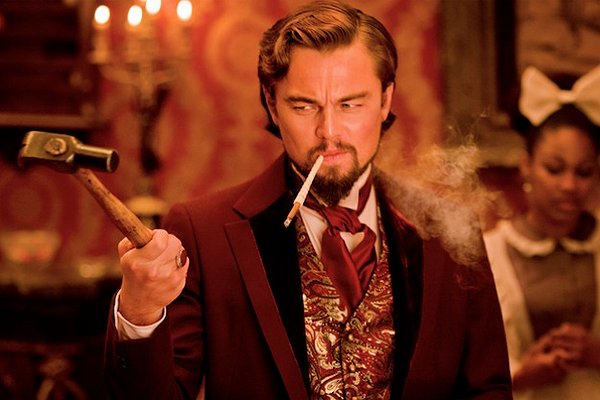 I don’t want to give the wrong impression that Django Unchained is deadly serious given the subject matter and historical context. I don’t think it disrespectfully sanitizes the horrors of slavery, but Tarantino’s brand of humor finds opportune moments to poke through. There’s a sequence with an early version of the KKK, a group of Southerners on horses arguing over whether they need to wear the ill-fitting bags on their head they prepared (plus Jonah Hill cameo). I was laughing so hard I thought people around me were going to shush me. It may well be the funniest thing Tarantino has ever written. There’s also natural humor to be had in the awkward handling of race relations, something that hasn’t exactly been perfectly ironed out to this day. A wealthy plantation owner (Don Johnson) struggles to explain how his slaves should treat Django, presented as a freeman by Schultz. “You want me to treat him like white people?” someone asks. This is followed promptly with a curt, “No.” There’s also plenty of gallows humor to be had with the over-the-top violence that pervades in the finale. It’s all key moments to blow off steam, so to speak, and make the film more bearable.
Django Unchained follows a traditional Western plot; in fact I’d say what we watch is essentially Tarantino’s whacked out spin on The Count of Monte Cristo (Alexander Dumas is even referenced in the film by name). Our lead character, Django, is in the Clint Eastwood mode of the strong and silent type. Schultz is the one who does all the talking while Django learns and glowers. They make a terrific buddy team and you almost wish that Tarantino had just diverged his story and allowed them to keep doing their bounty business. But Django’s wife needs some saving and that’s where the movie slows down. I wish Broomhilda had been given more character development. She’s pretty much the princess that needs saving, much like the German folk tale we learn is where Broomhilda gets her uncommon name. My sister described Django Unchained as a love story and I think that’s being a little generous (Tarantino did cut much of her torture, physical and sexual, from his script). We certainly feel Django’s desire to rescue her, and we worry about all the plot machinations and masks the characters must wear to accomplish this feat. With that said, the movie still has plenty of sucker punch surprises, much like Basterds, where violence erupts and despicable characters are given arias to illuminate the depths of their depraved worldviews.
I do wish that Tarantino had been a bit more judicious with his editing (the first without longtime editor Sally Menke who died in 2010) and curtailed all his self-indulgent meta film homage nods. We get stuff like Amber Tamblyn (The Sisterhood of the Traveling Pants) in one shot. Why you ask? See her father also stars in the movie in a small role, and he once played a character titled “Son of a Gunfighter.” So in his own credits, Tarantino lists him as “Son of a Gunfighter” and his daughter as, what else, “Daughter of a Son of a Gunfighter.” When all of that contorting is for an end credits gag and one shot in the whole movie, you feel like it was strictly masturbatory. Then there’s the original Django, Franco Nero, asking Foxx how to spell his name. Old Django asking new Django how to spell his name. I guess it’s supposed to be like a cinematic passing of the torch but it’s another moment that feels superfluous in a 165-minute movie. The movie can get a tad exhausting. The final 15 minutes, while still smartly written and boasting some terrific bloody comeuppance, feels like an add-on that wasn’t needed. It does manage to tie some elements back together but at this point the audience is ready for Django to ride off into the sunset, not have another obstacle to overcome in improbable yet badass fashion. At my first viewing, the kid behind me kept complaining to his parents that the movie had failed to end (“This is still going? It’s already been two hours!”). I also understand the fruitless and ironic nature of asking Tarantino to reign in his self-indulgences; that is, after all, what makes him who he is.
As expected from Westerns, the movie is a boy’s show. Foxx (Ray) has a steely screen presence that works very effectively for the character. The man’s quiet confidence and growing insolence play well, as he burrows into a role that boosts his confidence and assertiveness. Foxx’s journey from beleaguered and shell-shocked slave to mighty walking vengeance is definitely a full performance and one that Foxx delivers without any winks to the camera. Waltz (Carnage) will be dinged for playing a character similar to his Oscar-winning role in Basterds, but he’s still joyously entertaining, with that strange speech pattern of his that he plays like a musical instrument. He has a lot to say with plenty of theatrical flourishes, but that’s what makes him so entrancing. Simply put, Waltz and Tarantino are a match made in heaven.
 DiCaprio (Inception) doesn’t appear until over an hour into the film but he’s worth the wait. At my first screening, I thought DiCaprio was good but was unimpressed. Upon a second viewing, I must say my appreciation grew for the man’s performance. Calvin Candie is certainly a vile man and DiCaprio is able to give him such an intriguing brio; he’s not the magnetic source of evil that Waltz was in Basterds, a man able to stay two steps ahead of his prey. Candie is easily taken for a fool. He’s not the smartest guy in the room but he can work up a pretty sizable fury; DiCaprio actually cuts open his hand during a confrontation and remains in character, undeterred. But the best actor in the movie is Jackson (The Avengers). There are far more layers to his head house slave than meets the eyes. It sure seems like he’s really the fist behind the glove. He may put on an act for company, but the man is far more calculating and sinister than anyone else in the film. You know he’s a good villain when the audience cheers the loudest at his demise (don’t act surprised, spoiler-phobes). I wouldn’t be surprised if Waltz, DiCaprio, or even Jackson get nominated for supporting Oscars.
It seems like Tarantino has also stumbled into a hidden lucrative subgenre at the box-office, namely the historical revenge film. Who doesn’t want to see a group historically shafted get some sweet revenge, the bad guys punished, and all with sparkling dialogue? In 2009, Tarantino went on a Nazi scalping spree and got to shoot Hitler in the face. With Django, a brutalized slave becomes the hero of his own story and kills some vile slave owners and traders. It’s essentially a Nat Turner-style rebellion from history, albeit with some harebrained scams and colorful characters. Following this lucrative model, Tarantino could take other maligned minorities and give them cinematic justice. Sadly, there are too many examples to count where Tarantino can take inspiration.
Django Unchained is a bloody, rollicking, talky, messy, exciting, surprising, uncomfortable yet satisfying movie and probably one of the oddest crowd-pleasers in recent memory. I saw it on Christmas day and my theater was a sell out. They loved it, soaking up every minute, laughing at the funny parts and wincing at the gruesome violence. I couldn’t think of a better way to celebrate the birth of baby Jesus. It doesn’t whitewash the evils and viciousness of slavery, but at the same time Tarantino knows how to serve an audience and their demands for big characters, big set pieces, and big vengeance. Django is a sturdy Western/blaxploitation film, and whatever other genres Tarantino feels like tossing into his cinematic blender. Whatever you classify it as, Django Unchained is another Tarantino original specialty and his tremendous talent comes through loud and clear, even with a few false endings and self-indulgences at play. It looks great, has a great soundtrack, and presents great acting talent reciting Tarantino’s great words like they were prized possessions. It’s a bit long and a bit overdone, but when you’re enjoying yourself, who wants to leave the party early?
Nate’s Grade: A
Share this:

Les Miserables (2012)/ Rock of Ages (2012)
 I have no qualms with my heterosexual nature to make the following statement: I love a good musical. Why shouldn’t I? None other than Martin Scorsese said any true film lover is a fan of horror movies and musicals, two genres uniquely suited to the visual flourishes of cinema. My tastes tend to run toward the more offbeat, like Avenue Q and Hedwig and the Angry Inch and Sweeney Todd and Dancer in the Dark. My favorite movie musical of all time is 1952’s Singin’ in the Rain, but that’s probably because I’m a movie lover first and foremost. A well-done movie musical can sweep you off your feet. The polarizing Moulin Rouge! is still my favorite film of 2001; I love every messy, ambitious, transporting second of it. And that’s what the best musicals and, in general, best films achieve: they transport us to another realm. Since the success of 2002’s Chicago, there’s been a run of hit-or-miss movie musicals proliferating the big screen. It’s hard to think of any longstanding Broadway hits that have yet to make the leap (you’ll get your turn, Book of Mormon). Of course it also works the other way, with plenty of movies being adapted into Broadway musicals, like Shrek, Elf, Ghost, Catch Me if You Can, Newsies, A Christmas Story, Sister Act, Legally Blonde, Bring it On, and Tony-winner for Best Musical, Once. Then you get movies turned into musicals and back into movie musicals, like The Producers and Hairspray. It seems like Broadway and Hollywood are stuck in a loop, feeding off one another’s spoils.
In 2012, two high-profile musicals got the big screen treatment: Rock of Ages and Les Miserables. The former is from 2009 whereas the latter is one of the most successful Broadway shows of all time, beginning in 1980 and spanning continents. Rock of Ages was savaged by critics and bombed at the box-office, whereas Les Miz is soaring this holiday season and is seen as a major Oscar contender. Of course one of these films is about the outrage of the lower classes being exploited by an unfair system that benefits the rich, and the other has Tom Cruise and a monkey named “Hey Man.” Having seen both films recently, and Les Miserables more than once, I think they present an interesting discussion on the pitfalls of adapting a popular theatrical show to film. You won’t have to wait long to figure out which movie succeeds and which falters badly.
 Les Miserables, based on Victor Hugo’s novel, is set in early 19th century France. Prisoner Jean Valjean (Hugh Jackman) is nearing the end of his twenty-year sentence for stealing a loaf of bread. Inspector Javert (Russell Crowe) is convinced Valjean will never reform and go back to a life of crime. After help from a kindly bishop, Valjean flees his parole and sets up a new life as a businessman. Fantine (Anne Hathaway), one of Valjean’s workers, gets thrown out and tumbles down a chain of regrettable circumstances. She becomes a prostitute to support her young daughter, Cosette. Valjean recognizes poor Fantine on the street and, horrified at his own neglect leading her to this path, takes it upon himself to care for her and her daughter. Years later, the teenaged Cosette (Amanda Seyfried) has fallen for the young revolutionary Marius (Eddie Redmayne). Marius enlists his good friend Eponine (Samantha Barks) to help find out who Cosette is, all the while ignorant that Eponine is clearly in love with him. The young people of France are riled up about class abuses and exploitation, and the spirit of revolution is in the air. Javert is also becoming suspicious of Valjean’s true identity, so Valjean feels the need to flee once again. However, Cosette’s love and the bravery of the young revolutionaries makes Valjean decide to stop running from his past.
Oscar-winning director Tom Hooper (The King’s Speech) made the ballsy but ultimately brilliant decision to have his performers sing live. Every line, every note, every performance is captured in the moment; there is nary a second of lip-synching. I cannot overstate how blessed this decision was. It places the emphasis on the performances, and that’s exactly what something as big and deeply felt as Les Miserables required for the big screen. Look, Hollywood actors are never going to be able to outdo trained and professional theatrical singers. What I expect from movie stars is movie-star level performances, and Hooper understands this. These actors aren’t playing to the cheap seats, belting the tunes with power and over exaggerated dramatics (note: there is absolutely nothing wrong with this style given the theatrical setting). In many ways, this is a more intimate Les Miserables, and it still maintains its charms and magic. There is no choreography, short of perhaps the more jovial “Master of the House” number, and Hooper puts us right in the muck of life in a 19th century impoverished slum. This is one dirty movie with lots of grimy period details, creating a reality that can only be implied on stage. The more visceral version of Les Miserables demands performances that are more naturalistic and less bombastic, to a degree. I am a cinephile first but I genuinely prefer my musicals with trained actors to trained singers. A great actor can add so much inflection and personality through the prism of song, whereas a great singer is concentrating on the notes first and foremost. I value performance over nailing the mechanics, and more movie musicals should follow Hooper’s path. This, ladies and gentlemen, is how to do the movie musical experience right.
 I don’t know if Hooper was exactly the right man for the job but he certainly does the beloved stage show justice. Hooper’s visual tics are still present. The man loves to film in close-ups and at all sorts of tilted Dutch angles; he also loves filming a conversation between two people where neither one will be in the same shot. It’s a peculiarity that I never really warmed up to. However, Hooper generally has the best interests of his movie at stake, capitalizing on the large outpouring of feeling. This is a Big Musical with big emotions, and it’s easy to be swept up in its exuberant earnestness and humanism. It even has a famous concluding line, “To love another person is to see the face of God.” It’s the kind of stuff you roll your eyes at under lesser circumstances. Now, thinking back, you’ll realize that many of these people were simply painfully naïve and that there was a slew of death for no good reason. Purists may chafe at some altered lyrics and truncated songs, but really this is pretty much the closest version of the famous stage show you’ll ever see adapted. Not one of the songs has been cut (in fact a new one was written for the film by the original composers), and at a lengthy 157 minutes, it’s practically as long as the stage show, and just about sung through every moment. There are probably ten total lines that are merely spoken. I predict hardcore Les Miz fans will lap up every second.
Les Miserables also boasts some fortuitous casting (Taylor Swift at one point was rumored to be up for a role… shudder), none more than Anne Hathaway (The Dark Knight Rises). She is nothing less than perfect as Fantine. There isn’t a false note during any of her acting. Her performance of “I Dreamed a Dream” is so powerful, so breathtaking, so intensely felt, that it ranks up there with some of the best moments in all of 2012 movies. And oh can this woman sing her ass off too. You feel every flicker of anger and devastation, the grain in her voice, on the verge of tears and fury. This woman deserves every accolade they can come up with this year. This woman is a total lock for Best Supporting Actress. She’s wonderful during every moment of her screen time and the lengths and emotional ferocity of her performance, and subsequent pitfalls the character endures, left me reaching for the tissues at several points.
The other standout amidst a pretty stellar cast is Barks. This is her first film work though she has plenty of experience with her character, portraying Eponine in the 25th anniversary run of Les Miserables. Her singing is terrific, as you’d imagine, but her acting is just as strong. Her rendition of “On My Own” is a showstopper of a number. Barks naturally transitions to the demands of film. I was completely on Team Eponine and found her to be an infinitely better catch than Cosette. After people get a glimpse of this woman, she is going to get plenty more acting offers, and a few concerned inquiries into the size of her waist, which at times looks like it might be the size of The Rock’s neck. Hooper also has the good sense to film both “I Dreamed a Dream” and “On My Own” in unbroken takes; focus tightly pinned on our outstanding actresses, letting the skill of their performances sell the big emotions.
 Of course the crux of the tale rests on two men, Valjean and Javert, and the rest of the cast does kind of get saddled in underdeveloped roles made more apparent as a movie. It seems blasphemous to say I was a little disappointed with both lead actors. Crowe (Robin Hood) is easily the weakest singer of the cast but that doesn’t mean he’s bad. He has a lower register and sings his parts like a rock musician rather than a Broadway player. Fans of the stage show will have to adjust their expectations for a more subdued Javert. Still, having an actor of Crowe’s talents is definitely a plus even if his singing is adequate. Jackman (Real Steel) is a Tony-winning thespian, so I held him to a higher standard. He’s got a lot of heavy lifting to do as Jean Valjean, and Jackman does an admittedly fine job with the bigger emotional parts. I just expected more from his vocal abilities but it’s not a major detraction. As my mother noted, it’s not too difficult to spot the classically trained singers in the cast. Also, for eagle-eyed Les Miz fans, look for the original Jean Valjean, Colm Wilkinson, as the Bishop in this movie.
There is the tricky nature of translating a Broadway production into some variance of period reality. There’s plenty of relevance with the class struggle illustrated in the second half of the movie (Bane would approve). It’s an obvious statement but film is a different medium than the theater and affords different opportunities. The depressing reality of lower class life and the vultures that preyed on others is striking, yes, but sort of conflicts with the comic relief characters represented by the scheming Thenadiers (Sacha Baron Cohen, Helena Bonham Carter). When the seriousness of the period is inflated, they feel like they sort of belong in a different movie. Then there’s just the conflict between stage reality and film reality. On the stage we’ll accept Marius falling madly in love with Cosette at first sight. When it’s on film, the guy comes across as a callous chump, oblivious to Eponine’s pining. He ignores the friend he’s had for years for some blonde in a bonnet. And the final number, reuniting all the dead cast members, works better as a curtain call than a finale to a film. These are just the quirks of theater one must just accept. I wouldn’t say the songs and music is in the same category as Sondheim or Webber, but there are definitely some hummable tunes here made all the more swooning. You’ll have a fine pick of songs to get stuck in your head for days (mine: “Look Down”).
 Earlier this year, Rock of Ages came and quickly left the box-office, failing to make a splash with the American public despite a healthy enough run on Broadway and touring the country. The stage show is a jukebox musical set to the head-banging tunes of 1980s hair metal. Adam Shankman, the director behind the bouncy and thoroughly entertaining 2007 Hairspray movie musical, was tasked with bringing Rock of Ages to the screen with the same finesse. Cherie (Julianne Hough) a hopeful singer just off the bus from Oklahoma, meets up with Drew (Diego Boneta), a nice kid who gets her a job at The Bourbon Room, a rock club running afoul with the mayor (Bryan Cranston) and his moral crusading wife (Catherine Zeta-Jones). The club owners (Alec Baldwin, Russell Brand) are relying on fickle, burned-out, taciturn, and overall mysterious rock legend Stacy Jaxx (Tom Cruise) to save their club from financial ruin. Along the way, Cherie and Drew look for their big breaks, fall in love, get pulled apart, and reunite in time for one final sendoff to leave the audience tapping their toes.
 Allow me to elucidate on my main problem with the rise in jukebox musicals: I find them to be, with rare exception, exceedingly lazy. The musical number is meant to advance the narrative and give insights into character and situation, just like any other aspect of plot. You’ll find great original tunes that do this. When you’re dealing with pop songs that the public is well familiar with, then your job becomes even harder, and I find many are just not up to the task. Too often jukebox musicals are designed to merely string together a pre-packaged and time-tested number of hit songs, utilizing the faintest of narrative threads to get from one song to the next. The appeal of jukebox musicals lies not with the story or characters but waiting for the next recognizable song and wondering how it will, poorly, fit into this new context. You’ll notice that these jukebox musicals seem to have twice as many song numbers. They know their selling point, and more singing means less time spent developing characters and story. And so my impression of the jukebox musical is one of a cynical cash grab following the bare minimum of narratives to achieve the status of musical so it can be resold with low risk. I’m simplifying things in my ire, yes, but there’s a definite reason that jukebox musicals have sprouted like mad in the past few years. They don’t require as much work and the audience seems to hold them to a lesser standard. Much like the worst of Friedberg and Seltzer (Disaster Movie, Meet the Spartans), it seems just recognizing the familiar has become the core draw of entertainment.
And this is one of the main problems with Rock of Ages. I’ve never seen the stage show, but my God for something that purports to live the rock and roll lifestyle, it’s certainly so tame and scrubbed clean of anything dangerous. This feels like your grandparents’ idea of what “modern” rock music is. After a cursory search online, I’ve found that the movie makes some significant changes to convert a story about rock and roll hedonism into sanitized family friendly fare (spoilers to follow, theatergoers): apparently in the stage version, Cherie and Jaxx had sex, Jaxx remains a creep and flees the country on statutory rape charges, though before that he and Cherie share a lap dance/duet to “Rock Me Like a Hurricane,” the family values crusader characters were new inventions, the Rolling Stone reporter (Malin Akerman, the best singer in the film) is considerably beefed up to provide Jaxx his happy ending, and they don’t even use the song “Oh Cherie.” I’m not a stickler for adaptation changes, but clearly it feels like Rock of Ages had every edge carefully sanded down to reach out to the widest array of mainstream filmgoers (Shankman says he cut Cherie’s lap dance number because it tested poorly with mothers). The funny part is that the movie lambastes a slimy manager (Paul Giamatti) for playing to demo numbers, shooting for pandering mass appeal rather than the art, man. Feel the hypocrisy.
 The first hour of Rock of Ages is mildly passable mostly because of the goofy supporting cast, but then the movie just keeps going, getting more and more tedious with every protracted minute. The second half involves Cherie and Drew apart and finding new lows; for him it’s selling his soul to join in a boy band, and for her it’s selling herself, working as a stripper. Let’s look back at that sentence. One of those life choices is not nearly as upsetting as the other. Nothing against the hard-working strippers in this country, but Cherie taking to the pole is definitely more of a moral compromise for the character than whatever the hell Drew endures. It’s this leaden second hour that made me lose faith that Rock of Ages would even provide a morsel of cheesy entertainment. It has the misfortune of two of the blandest leads I’ve ever seen in a musical. Hogue (Footloose) and Boneta (Mean Girls 2) are both physically blessed specimens of human genetics, but oh are these kids boring boring boring. Their love story is completely malnourished and you couldn’t scrape together one interesting thing about them combined. The fact that Rock of Ages further strips away any interesting personality from Cherie (see above) makes them even more disastrously boring. To be stuck with these two for another hour of vapid griping, only to magically get back together, is interminable. Thank God they pumped up the side characters because that is the only time when Rock of Ages even challenges for your attention. Cruise isn’t the best singer but he’s pretty good belting out 80s rock hits, and the man has his natural charisma and stage presence to spare.
So I guess where Rock of Ages goes wrong, and where Les Miserables succeeds, is thinking of how best to translate the experience of the stage to the medium of film. Shankman does a pitiful job staging his musical numbers, with lackluster choreography that rarely takes advantage of the sets and characters. Worse, Shankman feels like he strays from the tone and angle of the stage show, sanitizing the rock and roll lifestyle and looking for ways to squeeze in bland happy endings. In other words, he doesn’t capture enough of the essence of the original stage show to please neophytes and fans of the Broadway show. With Les Miserables, I think most fans of the stage show, and they are legion, will walk away feeling satisfied with the results, content that real artists treated the long-running musical with justice. Hooper opens up the world of the stage show, utilizing the parameters of film, and the emphasis on performance over singing mechanics maximizes the unique power of film. Les Miserables is a grand movie musical smartly adapted to the opportunities of film. Rock of Ages is a sloppy, neutered, criminally boring mess poorly developed and poorly translated to the silver screen. Let this be an educational resource for future generations. Take note, producers, and learn from the mistakes of Rock of Ages and the accomplishments of Les Miserables. Oh, and guys, if you see Les Miserables, it will get you super laid with your girlfriend (I have anecdotal evidence).
Nate’s Grades:
Les Miserables: B+
Rock of Ages: C-


 nathanzoebl
You must be logged in to post a comment.