Blog Archives
Atlas (2024)
 In the world of Netflix releases, it’s hard to judge what is gauged as a success. Take for instance their new sci-fi action movie Atlas. It cost the streaming giant $100 million and they now tout it as being the top movie across the globe on their platform. This could very well be true, though Netflix has long been cagey about sharing their viewing numbers, instead preferring to go with the, “Hey, just trust us, okay?” defense, which hasn’t exactly been reassuring in an era where bonuses are linked to number hits. With the ever-expanding catalog of titles, being a reported hit on Netflix can sometimes feel like being, say, Homecoming Queen from 1989, an accomplishment soon eclipsed and forgotten. What was the last big Netflix action movie that had cultural staying power, that caused people to continue to discuss weeks or months later? Netflix swears their most-watched movie is 2021’s Red Notice, a star-laden breezy adventure caper that I challenge anyone to remember much about besides its stars. This is the challenge of gaining traction in a world of near endless content choices. Atlas is an above average film benefiting from a strong character dynamic at its core even if the rest of its story elements feel forgettably disposable.
Atlas (Jennifer Lopez) is a data analyst who has also helped develop Earth’s orbital security system. An A.I. program/robot named Harlan (Simu Liu) was born from Atlas’ mother, and then Harlan went and murdered millions of humans. The killer robot fled Earth with his robotic followers and Earth has been awaiting his return for decades. Atlas joins a mission to land on a distant planet where they think Harlan has operated as his base. However, Atlas must work with an A.I. program inside her mech suit that calls itself Smith. In order for them both to survive in this new world, they must work together.
 I found everything within the mech suit of Atlas to be engaging and dynamic, and everything that happens outside that giant suit to be underdeveloped and mediocre. I was genuinely surprised how Atlas essentially becomes a buddy survival movie. It’s the human who is distrustful of accepting help from others and especially from advanced technology with a mind of its own, and an A.I. program that is trying to improve its capabilities by getting to know its user and learning how to grow from her. They need each other to survive and that requires a trust and relationship to be fostered, and it’s a surefire enjoyable plot to watch two enemies become allies and maybe even friends over the course of their united struggles. The growth between them also feels relatively organic, coming at a natural progression with personal insights and offerings without clunky leading dialogue lines, like, “So why don’t you trust robots, huh?” This dynamic reminded me a bit of 2004’s I, Robot where Will Smith played a detective who hates robots who has to work with a robot and the two of them form a bond (there are other similarities I’ll get to later). Much of the movie takes place within a three-foot window from the capsule inside this mech suit, and the shared struggle between Atlas and Smith is the heart of the movie, and it’s actually quite good. Both of these characters find ways to surprise one another, both of them shed preconceptions, and both of them will discover the lengths they go to protect the other even if it puts their own existence in question. As a story about a woman and her robot, Atlas is a fun and fairly involving sci-fi buddy movie adventure.
Now, the world building and story that gets Atlas to this alien world, and the escalating stakes of world destruction are where the movie dissipates into an amorphous cloud of sci-fi action keywords. I don’t know why it had to be killer terrorist robots that brought out Atlas and her team of mech-suited warriors to this foreign planet. The reason why the characters are stranded on this unknown planet is unimportant. It could just as likely be a science team exploring a potential new habitable world for an Earth burning through its natural resources too quickly. It could be exploring the remnants of a possible alien civilization. It could even simply be the closest planet available during a distress from their spaceship going down for whatever mechanical or orbital obstruction. The story is about the relationship between the human being and the robot/A.I. working together to survive in an unfamiliar and hostile land.
 The robot insurrection feels like an acceptable plot device but it’s so under-explored until the movie needs to dramatically escalate the stakes into an apocalyptic cataclysmic scale. The fact that Harlan, which let’s agree is a terrible name for the villain of your movie, determines that the best way to save humanity is to annihilate humanity is already a tragically familiar refrain we’ve heard from numerous sci-fi villains, from The Hunger Games to Infinity War to The Day the Earth Stood Still to even I, Robot. In that last movie, the A.I. system determines the only way to protect humanity is through controlling and ultimately eliminating them, and this same motivation comes to Harlan. This character is introduced as our Big Bad through an opening montage, he disappears, and then only comes back at the end to be a force to threaten Earth. The entire robot uprising is so tremendously underwritten that the movie doesn’t even do the barest whiff of ambiguity to question whether humanity has been mistreating its robot servant class. Instead, Harlan is introduced right away as a terrorist figure and stays true to this characterization. I thought that Act Three would be upending for Atlas, where she learns the robots were framed or at least the conflict is more nuanced and her “side” might be more culpable than the military’s cover story. Nope. Evil Robot King is simply Evil Robot King. Fine, he’s a boring killbot, but then why go to such lengths to provide a personal connection for Atlas and Harlan. It’s unnecessary when she has to stop the killer robot from killing the Earth; we don’t need a personal connection for this to work. The level of personal guilt attached to Atlas is ridiculous, including multiple levels of tragedy that feel far too overwrought. Atlas didn’t need to feel guilty over her involvement in developing Evil Robot King as a child; she could have been simply the daughter to the woman who unintentionally brought this killer tech forward, or she could have simply been a woman who experienced a tragedy linked to the robot uprising without having a mom who developed the technology. She could just be a victim. She doesn’t have to be the first victim.
 Atlas is really a one woman show, so your feelings of Lopez (Hustlers) as an actress will dominate how you feel about the overall experience. I don’t know if Atlas is made substantially better with her as the lead actress but she certainly performs ably and doesn’t seem left unmoored by the fact that she’s talking to a voice in an empty space for most of her months filming. Lopez has a determination that gives her action novice character an underlying strength to tap into upon the call of action.
As a sci-fi action spectacle, the blockbuster aspects are sufficient for our casual entertainment fulfillment. The special effects and action are pretty solid under director Brad Peyton (San Andreas, Rampage) who knows his way assuredly around effects-heavy spectacle (he was also co-creator of the delightfully daffy 2019 Netflix apocalyptic series Daybreak). Much of the movie takes place within one mech suit, but I never felt a sense of visual claustrophobia thanks to the buddy dynamic and Peyton’s use of space. The big action sequences at the end have their share of impressive cool moments, but they also benefit from coming at the end of a character relationship that has helped to make the action more satisfying. I do lament the modern trend of filming on such large green screens or LED stages that lighting is always the same bright overhead setting without significant variance with shadows and other light sources.
If you’re looking for a Netflix action movie to divert your attention, or even barely pay attention to, then you could do far worse than Atlas. It might even hold your attention and keep you engaged thanks to the fun buddy film dynamic that serves as its foundation. There are plenty of elements that feel tacked on, underdeveloped, or blandly familiar, but the core works and Atlas is worth a couple hours of escapism.
Nate’s Grade: B
Share this:

Tar (2022)
 It’s been 16 years since writer/director Todd Field has helmed a movie, and if you’re a fan of his two previous efforts (2001’s In the Bedroom, 2006’s Little Children), and if you watch both it’s hard not to be, then a new Field movie is cause enough to celebrate. Tar is set up like a biopic for a brilliant yet problematic German conductor, Lydia Tar (Cate Blanchett), a renowned talent in her field who also happens to have a long history of grooming her female Julliard music students into transactional sexual relationships. The movie is presented like one of those Oscar bait-ready biopics, enough so that I looked up more about Lydia Tar’s life (surprise: she’s completely fictional). It’s a character study of a flawed creative superstar in the wake of a Me Too reckoning, and in one revealing and excellently written sequence, Lydia argues for the noble separation of the art and artist and harangues an undergrad for his refusal to play the old classical masters for their centuries-old outdated perspectives. She accuses him of playing into performative identity politics, of course glossing over her own narcissistic problems. The dialogue is impressively curated, with lengthy conversations feeling authentic and packed with details of the world of classical music and composition and different ways we appreciate and interpret art. The movie unfolds at a very relaxed pace, revealing key details and connections about Lydia without underlying their significance. You have to really keep up with the movie, and the first hour is quite slow to get over. It opens with a fifteen-minute New Yorker on-stage interview with Lydia, and names will be dropped that won’t be relevant for whole acts. It’s self-indulgent but the details feel so authentic that I was still impressed even as I was beginning to lose my patience or attention. Even the opening credits last over five minutes, and that’s just white text on a black screen. The movie picks up more of a momentum as Lydia’s career starts to unravel and her past inappropriate relationships are given new attention in a post-Me Too media environment. Blanchett, as you would expect, is brilliant. She’s a complex mess of contradictions, and whether she fully acknowledges them is up to the viewer’s interpretation. Once you start recognizing her “performance” of self, every scene becomes a careful study in how many facades a person can leverage and what degree of self-awareness she may be privy to. Field’s direction is very calculated and downright Kubrickian, emphasizing long takes and cool color palates (Field had a small role in Eyes Wide Shut) to go along with its intellectual, understated, methodical approach (also in running time, and at 150 minutes in length, it’s overlong). I wasn’t as captivated with Tar as I was Field’s other movies, but there’s still much to admire, a commanding performance from Blanchett, and I hope I don’t have to wait another 16 years for Todd Field’s next able effort.
Nate’s Grade: B
Share this:

1917 (2019)
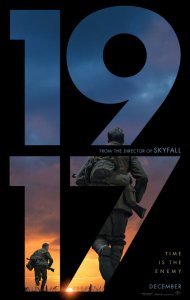 We all know what the immediate appeal for 1917 is and that is its bravura gimmick of making the entire two hours appear as if it is one long, unbroken film take. Long tracking shots have famously been used in films before, like Goodfellas and Atonement, and entire movies have been filmed through the illusion of a single take, from Hitchcock’s Rope to Russian Ark to Best Picture-winner Birdman. The difference between those one-take movies and 1917 is that none of them were a war movie that takes place primarily outdoors in very real elements. The sheer technical audacity of the feat demands that it be see on the big screen when able. It’s like a cinematic magic trick, allowing you to sit in awe at the sheer ambition and technical wizardry of the filmmakers and continue muttering, “How did they do that?” When done right, it can reawaken that magical feel of watching something impressively new, but is there any more than a gimmick?
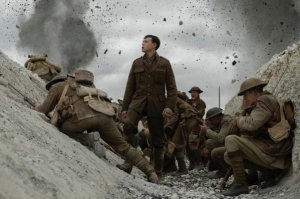 It’s 1917 and two ordinary British soldiers, Lance Corporals Blake (Dean-Charles Chapman, a.k.a. “Tommen” from Game of Thrones) and Schofield (George MacKay), are tasked with a life-saving mission. A military unit is walking into a trap, and if they do not deliver this dire message in mere hours, hundreds of men will die, including Blake’s older brother. They have only hours before the fateful attack is launched and must traverse into enemy territory that may not be as deserted as they have been lead to believe.
Whatever else you think about 1917, it is worth watching simply to witness the awe-inspiring technical vision from director Sam Mendes (Skyfall, American Beauty). The sheer scope of this movie is overwhelming when it comes to the logistics of being able to keep the camera roaming, which will go from handheld to crane to swooping lines above. It feels alive with that vitality of theater, knowing that if something were to go wrong that everyone would just adjust and move onward. When you see someone tip-toeing along the edge of a bridge, that’s them doing so. When you watch someone diving for cover, it’s really happening, and Mendes wants you to know. It brings an interesting verité feel to something that must have been planned within an inch of its existence. But was it? Did the actors meet the exact same blocking marks every take? Were the clouds aligned just so each time? I’m willing to credit legendary cinematographer Roger Deakens (Blade Runner 2047) with extra plaudits not just for arranging all the logistics of the busy camerawork but for finding pleasing visual compositions on the spot, using what was available. He deserves all the awards because this movie is nothing but brilliant photography and production design. A segment where we run through the ruins of a French village at night, with German flares providing momentary bursts of visible light above, is astounding. I think about the meticulous precision of the camerawork, the timing of the lighting cues, the practice of the actors and story decision to run in darkness and hide for cover in light, the pursuers giving chase, and it just makes my head hurt from all the daunting coordination. It might be dismissively viewed as a WWII video game and the characters as the avatars we urge onward, and I don’t disagree. I found the entire enterprise to be deeply immersive, visceral, and thrilling in its stunning sense of verisimilitude.
 However, I’ll admit, dear reader, that I was growing bored by the first ten minutes or so, and I even admit that this was in some part by design. Given its proximity to being in real time (the trek we are told should take 6 hours) it means early on there is a lot of walking. Before we venture out into No Man’s Land, it feels like we’re just watching people walk and walk and walk through the lengthy English trenches. It can become a bit repetitive and your mind may wander, but there is a rationale for this from Mendes and company. It communicates what the geography of battle and day-to-day life was like for the soldiers, to go from one supposedly safe section, snaking round and round to the front lines, noting the distance but also, in practical terms, how close life and death were from one another. It’s also a recognition of the reality of trench warfare and you can stop and think, “Wow, the production actually built this entire miles-long trench,” but then you can just as easily transition to, “Wow, people really dug in and built these structures back in 1912.” The long walk serves as the confirmation not just of a top-notch film production but also of the hardened reality of a soldier bogged down in a trench for months. The First Act is essentially them walking to the front line, crossing over into No Man’s Land, and approaching the German trench on the other side. On paper, that doesn’t sound like too much in the way of story events, but it’s our introduction as an audience into the life that these soldiers experienced. Each crater, each corpse strewn on the battlefield, it helps paint a larger picture of the unseen stories leading to this moment. It’s a very real equivalent of “show, don’t tell” storytelling, and the long walk better cements in our minds just how daunting this trial will be, especially since every step after the trench is fraught with danger.
I figured that 1917 was going to be more about its gimmick and that the characters would suffer under the weight of this setup, and it’s true that they could be sharper, but 1917 succeeds in ways that I found Christopher Nolan’s Dunkirk lacking. By focusing primarily on two characters and hinging success or failure on them alone, the film does a better job of providing me a personal entry point into the larger conflict. I have someone I can follow from the start, and that’s not just because the camera is confined to their immediate orbit. About halfway through, the movie makes a turn that really ups the stakes as well as my emotional involvement in a way that I never felt during 2017’s Dunkirk, which felt too removed with its interchangeable, faceless characters. With Dunkirk, it was a race against time but this was muddled by its non-linear, time-hopping structure. It’s a race against time but you were given three different sets of time that would crash into one another. It was too clever to feel the urgency. With 1917, it’s streamlined to the essential (get to point A before X time) and the urgency is alive in every moment. Not only do our characters not know what they’ll discover past the German lines, if they deviate too long, they may well arrive too late to stop a doomed attack. I assumed our characters would persevere, but as the film carried on, and the setbacks mounted, I began to doubt. Would this be another Gallipoli scenario of pointless death at the behest of arrogance, stubbornness, and bad information? By the end I didn’t know and that gnawing uncertainty provided a tremendous spark of tension.
 It can be episodic, it can feel more like a gimmick than a movie, but 1917 is a prime example of why we go to the movies. We go to be dazzled and transported through the magic and marvels of expert craftsmen and to throw ourselves into the complicated, messy, intriguing world of strangers that we get to cheer for, laugh with, and possibly cry over. The technical accomplishments will be heralded for years and studied long after. It’s a technical feat but, thankfully, the movie is more than merely its magic act. The human drama becomes personalized, universal, and engaging. There are several moments meant to breathe, including one gorgeous moment in hiding with a Frenchwoman and a baby that is beautiful in its cross-language connection on a human level. The suspense can be overwhelming and I was rocking back and forth whether or not characters would be caught, seen, or make it out alive, always remembering the stakes of failure. Watching 1917 is like holding your breath for two hours and then exhaling at long last upon the end credits. I feel that there are enough resonating elements that provide substance for the movie to stand on its own merits but it will forever be known for its long, coordinated feature-length tracking shot. Even if that is its lasting legacy, 1917 is still a thrilling and immersive achievement in filmmaking ambition.
Nate’s Grade: A-
Share this:

Shazam! (2019)
 It seems like the secret to the success of the DC movie universe is making fun, lower stakes adventures with the characters the public has the least knowledge about. Shazam actually begun as a “Captain Marvel,” and now comes on the heels of the MCU’s Captain Marvel. We follow Billy Batson (Asher Angel), a teenage orphan trying to find his missing mother. He stumbles into a wizard’s realm and is given a special power whereupon he turns into a square-jawed, broad-shouldered superhero (Zachary Levi) by saying “Shazam.” What follows is like a superhero version of Big and it’s goofy, charming, and reminiscent of an 80s Amblin movie, where children’s movies were allowed to be a little creepy and weird. The movie is light, cheerful, and heartfelt with its doling out of family messages to go along with the slapstick and personal growth. It’s very much envisioned from a young boy’s fantasy perspective of being a super-powered adult, where the first things to be done include buying beer, going to a “gentleman’s club,” in between testing out bullet invulnerability and flight. Levi (TV’s Chuck) is excellent at playing an adult version of a kid. I was initially dismissive of his casting but he’s perfect for this part. There’s a satisfying sense of discovery for Shazam and his excitable foster brother (Jack Dylan Grazer) that doesn’t get old. The movie is more concerned with how the superpowers are affecting Billy’s relationships and sense of self than any larger, planet-destroying danger. The film even sets up its villain (Mark Strong) by giving him a decent back-story and opening the movie to explain his crummy family. It’s not a three-dimensional villain by any means but the attention given to make him something more is appreciated. The other foster kids in Billy’s new family are more archetypes but amusing, and their involvement in the final act raises the joy level of the finale. Shazam! is a movie where people are genuinely excited to be superheroes or associated with them, and that gleeful, buoyant revelry is downright infectious.
Nate’s Grade: B+
Share this:

Kingsman: The Golden Circle (2017)
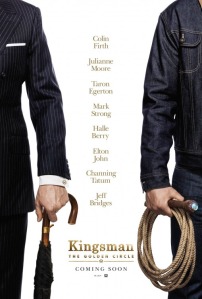 I’ve written before that director Matthew Vaughn is the best big screen filmmaker when it comes to making the most of studio money. This is the man who made Daniel Craig Bond, rejuvenated the dormant X-Men franchise, and gifted Fox a twenty-first century James Bond of its own. The first Kingsman movie was one of the best films of 2015 and was bursting with attitude, style, and perverse entertainment. It was my favorite James Bond movie that was never a Bond movie. Success demanded a sequel, and now Kingsman: The Golden Circle is upon us and proof that Vaughn may be mortal after all.
Eggsy (Taron Eagleton) is living a charmed life now that he’s earned his place within the ultra-secret, ultra-powerful Kingsman spy organization. In between battling villains and the riffraff, Eggsy tries to maintain some semblance of a normal life with his girlfriend Tilde (Hanna Alstrom), who, yeah, happens to be the princess of Sweden. Poppy (Julianne Moore) is a drug baron in the vein of Martha Stewart. She’s tired of lurking in seclusion in the jungles of Cambodia and wants the credit she deserves as the most successful businesswoman. She locates the homes of the remaining Kingsman and blows them up, leaving only Eggsy and Merlin (Mark Strong). Poppy takes aim at the war on drugs. She infects her own product with a deadly agent and holds the world hostage. Unless global leaders decriminalize drugs, millions of infected people will die. In the meantime, Eggsy and Merlin travel to Kentucky to seek out help from their American brethren, the Statesmen (Jeff Bridges, Channing Tatum, Halle Berry), a clandestine spy organization that also doubles as a gargantuan bourbon distillery.
 With Vaughn back at the helm I expected the best, and while Kingsman: The Golden Circle has plenty to like there is noticeably less to love. Being a sequel means that what once felt fresh will now lose some measure of its appeal and charm, and Vaughn and company do falter at times under the pressure to live up to what they established with their rip-roaring spy caper of an original. The brilliant structure of the first movie (mentorship, spy camp competition, class conflict themes) cannot be readily duplicated. There are interesting story elements here but Golden Circle doesn’t seem to know what to do with them, including with the titular Golden Circle. The villains never really feel that threatening. Poppy’s scheme is great and the 1950s diner iconography of her home is an eye-catching lair worthy of a demented Bond villain. It’s just that it feels like we never get a villain worthy of their wicked scheme. Where did she get all of this tech? Her henchmen are lackluster and a lackey with a cybernetic arm (Edward Holcroft) is no competition for Sofia Boutella (The Mummy) and her slashing blade legs. When the bad guys don’t feel like much of a challenge, it deflates the stakes and enjoyment factor of the big finale. It’s a series of ideas that need to be pushed further, refined, revised, and better developed. The first film was packed with surprises and payoffs both big and small, and the sequel feels lacking in payoffs of any kind.
The Statesmen are more a pit stop than integral plot element. You would think a majority of the film would be the international clash between Yanks and Brits, supplying some of that class friction that energized the first film. With the exception of Pedro Pascal (Narcos), you could eliminate them from the movie with minimal damage to the story. Channing Tatum (Logan Lucky) has gotten large placement in the advertisement but he is literally put on ice for a majority of the movie. The exaggerated cartoon nature of the Statesmen feels like Vaughn’s goof on American hyper machismo, but they stay at that same cartoon level throughout. They feel like parody figures, and Vaughn sidelines their involvement. The spy missions are a letdown. There’s an enemy compound atop a mountain in Italy, and all they do is walk inside, immediately grab the thing they need, and immediately run away. It all adds up to a two-hour-plus movie that’s still consistently enjoyable but also consistently unmemorable.
 There are things in The Golden Circle that feel like they’re here just because of fan response rather than narrative necessity. The biggest offender is the return of Harry (Colin Firth). He served his purpose bringing Eggsy into the clandestine yet dapper world of the Kingsman, modeling as a father figure, and dying to push our protagonist onward. Bringing him back to life doesn’t serve the story except to bring back a character we genuinely liked. In this sequel, his return and subsequent amnesia doesn’t force Eggsy to retrain his former mentor. Instead he’s mostly a tag-along as another character to shoot the bad guys. Harry simply shouldn’t be here, and resurrecting him takes away from the shock of his death and the weight of his loss. They even recreate the “manners maketh man” bar fight, except the inclusion is so contrived that I thought it was all some kind of Statesman plan to ease Harry back into fighting shape. Nope. Another aspect that feels forced is Eggsy’s relationship with the princess of Sweden. This feels like an apology for the crass joke from the first movie that upset people’s delicate sensibilities (apparently this was worse than a montage of people’s heads exploding). The relationship feels forced and every time the movie cuts back to his troubles with Tilde, they feel small and annoying. It’s like Vaughn is trying to salvage a risqué joke by turning them into a committed couple. Then again the “mucus membrane” moment in Golden Circle (you’ll know it when you see it) seems like a renewed attempt at being transgressive.
The action set pieces have their moments but like everything else there are few that stand out or will stand the test of time. The film starts off strong with a brutal fistfight inside a speeding car. Even with the cramped quarters, it feels easy to follow, creatively inventive, and exciting. As the fight continues, the sequence loses its creative verve and becomes indistinguishable from any other silly Bond car chase. The big finale where the remaining Kingsman storm Poppy’s jungle compound has some cool moments, like Eggsy taking cover behind a giant rolling donut. Regrettably, the action sequences lack the snap and imagination that have defined Vaughn’s films, proving to be yet another underdeveloped aspect. The hand-to-hand fight choreography is still strong and stylish. The final fight between Eggsy and the metallically armed henchman has the fluidity, vision, and fun that were missing from the other scuffles. I’ll credit Vaughn with finding ways to make a lasso and whip look badass and integrating it elegantly with fight choreography (no easy task, right, season five of Game of Thrones?). I kept patiently waiting for any sequence that grabbed my attention like the insane church massacre.
There are two elements in The Golden Circle that rise to the level of entertainment of the first film, and one of those is literally Elton John. It starts off as a cameo with John being kidnapped and forced to perform for Poppy’s private audience. Then he just keeps appearing. He passes over from cameo to downright supporting actor, and just when you think you’ve had enough and that Vaughn has overindulged his Elton John fandom, here comes a climactic solution that is inspired and completely justifies the repeated John appearances. I howled with laughter and wanted to clap in appreciation. It was the best setup-payoff combo in the entire film. The other creative highpoint is a treacherous left turn into the politics of the war on drugs. Poppy argues how legal consumables like alcohol and sugar are far more deadly and addictive. I’ve heard all those arguments before about the hypocritical nature of the war on drugs from every armchair philosopher. Where the film really surprised me was when it gave voice to a nasty perspective I’ve heard in response to the rising opioid crisis in America. Some view drug addicts more as criminals needing to be punished rather than victims needing a helping hand and treatment. When Poppy makes her demands, there are government representatives that openly cheer her ploy, believing they can wipe out the junkie scum. This unsympathetic yet eerily resonant response felt like Vaughn and company finding organic ways to raise the stakes and bring in more sinister forces.
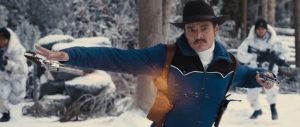 The movie never addresses one holdover from the original Kingsman that I think deserves at least a passing mention, and that’s the fact that every government leader or head of state in Western democracy had their head explode. That kind of public service vacuum would sow plenty of chaos and controversy, especially when people discovered that their elected leaders were complicit with the plan to kill the world’s remaining population. I feel like this was such a huge event that it at least deserves a cursory mention of some sort.
With the glut of disappointing and alternatively maddening action cinema this year, I’ll still gladly take Vaughn’s reheated leftovers. Kingsman: The Golden Circle feels like it’s succumbing to the bombastic spy hijinks it was satirizing before, losing some semblance of its identity and wit to crank out an acceptable though unmemorable sequel. It lacks the sense of danger and genre reinvention that powered the first film. Vaughn’s signature style is still present and there are fun and intriguing story elements available; however, the development is what’s missing. The cool stuff is there but Golden Circle just doesn’t know what to do with it, and so we gallop to the finale feeling a mild dissatisfaction. Apparently the studio execs at Fox want Vaughn to get started on a third Kingsman as soon as possible. I just hope he hasn’t lost his interest in the franchise he birthed. It would be a shame for something like this to become just another underwhelming franchise.
Nate’s Grade: B-
Share this:

Miss Sloane (2016)
 Miss Sloane is an intelligent and exacting political thriller that should appease fans of the genre who enjoy a good arm-twisting from a powerful manipulator, in this instance the towering and intimidating full force of Jessica Chastain. She plays the titular Sloane, the best lobbyist inside the beltway, and a woman who leaves the comfort of her firm for the challenge of taking on the gun industry to help pass a reform bill. From there it’s an underdog tale powered by the winds of moral righteousness and given a tough-talking yet flawed hero that will burn down whatever she can, including her own reputation, to win. The biggest draw is the performance from Chastain (Zero Dark Thirty) as she gets to yell at people for approximately two hours and look good doing it. It’s a game of persuasion and leverage and D.C. voter politics, and she makes the constant stream of information accessible while providing a focal point for our interest. It’s a pretty information heavy film with a minimal of supporting characters that stand out (Gugu Mbatha-Raw as a school shooting survivor-turned-team member is the notable exception). With her victory never in doubt no matter the odds, the movie establishes that it exists in a parallel world where actual gun control reforms can be advanced. In the wake of doing nothing from Sandy Hook, this must be a fantasy world. Director John Madden (The Debt) keeps the tone as cool and calculated as his heroine. The script by Jonathan Perera is plenty smart though the final act relies upon some unbelievable shenanigans that betray its sense of pragmatic realism. Still, the cunning gamesmanship of a pro working the levers of power for a worthy cause allows for some liberal fantasy indulgence. Miss Sloane is a suitably entertaining thriller that whisks you away and says even “bad people” have a purpose in our broken political system.
Nate’s Grade: B
Share this:

Kingsman: The Secret Service (2015)
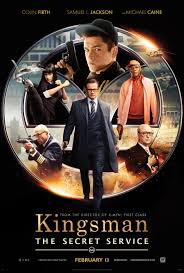 Director Matthew Vaughn’s Kingsman: The Secret Service is my favorite James Bond movie. It’s everything you’d want in a spy thriller while charting its own edgy direction. It’s a combination of Bond and My Fair Lady, and I never knew how brilliant that combination could be until Vaughn got his hands on the graphic novel source material. Newcomer Taron Egerton lays on plenty of star-making charm as a spy-in-training under the guidance of a dapper gentleman brawler Colin Firth. The spy hijinks are fun and stylish but what Vaughn does just about better than any other big-budget filmmaker is pack his movie with payoffs small and large so that the end result is a dizzying rush of audience satisfaction. The action sequences are exhilarating, in particular a frenzied church massacre made to appear as a single take. I never would have thought of the tweedy Firth as an action hero, but he sure plays the part well. There’s also an awesome villainous henchwoman who has blades for legs, and the film makes fine use of this unique killing apparatus. Kingsman explodes with attitude, wit, dark surprises, and knowing nods to its genre forbearers. Vaughn is a filmmaker that has become a trusted brand. He has an innate ability to fully utilize the studio money at his disposal to create daringly entertaining movies that walk to their own stylish beat. This is a cocksure adrenaline shot of entertainment that left me begging for more.
Nate’s Grade: A
Share this:

Zero Dark Thirty (2012)
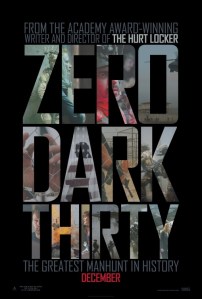 Director Kathryn Bigelow and journalist-turned-screenwriter Mark Boal, Oscar winners for 2009’s Best Picture-winner war film The Hurt Locker, were hard at work on their next movie when fate intervened. They were about to start production on a film about a 2001 incident where U.S. Special Forces almost nabbed Osama bin Laden, the notorious mastermind behind 9/11. Then on May 1, 2011, the world learned that Seal Team Six stormed bin Laden’s secret compound in Pakistan and executed the most wanted man in the world. Bigelow and Boal scrapped all plans and rewrote their movie from scratch. Now they had the ending we’d all demand; isn’t a movie where we get bin Laden way better than one where he narrowly escapes? Zero Dark Thirty (military terminology for well after dark) is the stunning result of Boal’s impressive reporting and condensing, Bigelow’s masterful direction, and a great supporting cast that brings history to vivid life. If you’re like me, you’ll walk out of the theater whistling to yourself, speechless at the spellbinding artistic achievement of the movie. This, ladies and gentlemen, is what essential, invigorating, quality filmmaking is all about.
We may know about Seal Team Six and the lead presented from tracking the courier, but few people know of the CIA analyst at the heart of the manhunt. Maya (Jessica Chastain) is a young agent stationed in Afghanistan who desires nothing more than to be the one who helps ensure that bin Laden gets killed. We follow her decade-long quest as she chases down leads, interrogates prisoners, and successfully presses the CIA brass for action, resulting in the fateful raid that took out bin Laden.
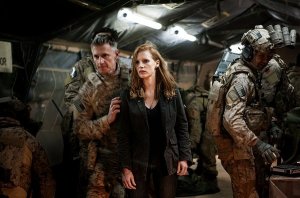 You can tell early on that Zero Dark Thirty is going to be an excellent film. Given the pedigree of is creators, my expectations were enormously high. I rated their previous collaboration as my top film of that year. I knew I was in capable hands when the film opens on September 11, 2001 but skips any visuals. We sit and watch a minute of a blank screen while the sounds of desperate 911 calls become a wall of sound. It’s enough to reassert the stakes while still being restrained. Bigelow’s directorial command is astonishing, pitting you in the thick of the action. There are a lot of moving parts with a movie like this, wheels within wheels, and Bigelow keeps everything moving and focused. It helps that the bigger manhunt is broken up into a series of mini-missions over the ten years. Bigelow and her talented production team have recreated the ends of the world to bring this story to life. That added sheen of verisimilitude gives every moment a sense of magnified power, an electric sense of relevancy. You’ll get goose bumps as they start circling the actual location of bin Laden. Bigelow, who won an Oscar for her virtuoso work on The Hurt Locker, still knows how to play every one of your nerves. There’s a clandestine meet up with a possible turncoat that is stuffed with dread. Every checkpoint, every safety procedure waved, you’ll be biting your nails, the voice in your head clearly saying, “Oh no, this isn’t going to go well.” Zero Dark Thirty is more crime procedural than the action thriller. Even so, Bigelow’s direction is top-notch and brings an intense, churning verve to the film, down to the smallest detail.
The film plays out like an absorbing, hard-hitting piece of investigative journalism, recreating the steps and false turns over the ten-year manhunt for bin Laden. There is a lot of information to process and over 100 speaking roles, and Boal and Bigelow do not stoop to pander to the less intelligent in the audience. You will be expected to catch up or fall behind. It can get confusing at points but Boal does an exceedingly articulate job of narrowing the particulars of the bin Laden case and presenting a clear through line. It’s a story that hops around the globe through a series of mini-missions, from a meet up with a possible al Qaeda spy to locking down a phone number to trace a courier in Pakistan. You see every step, every deal, and every effort that it takes to land the big break, namely tracking down bin Laden’s trusted courier to his Abbottabad compound. Boal even separates his narrative with titled sub-sections like a lengthy piece of journalism. We all know where the story is going to end up, but Boal’s supreme talent is making every step meaningful and tense leading up to that fateful raid May 1, 2011. The level of reportage detail is completely enthralling and will be relatively unknown to most filmgoers. Beyond 9/11 and the London bombings, I confess to being ignorant of the other al Qaeda attacks highlighted throughout. Therefore, not only is Zero Dark Thirty an exciting manhunt, it’s also an educational endeavor for most Americans.
 The proceeding two hours are an engrossing manhunt, but when Zero Dark Thirty gets to the raid sequence, that is when the movie ascends to a level of cinematic excellence unsurpassed this year at the movies. There is nothing else in 2012 that comes close to matching the 30-minute raid on bin Laden’s compound. My heart was in my throat the whole time. I was physically shaking. I was pinned to my chair. The conclusion, nabbing bin Laden, is one of the most riveting sequences in film I have ever seen. It’s like Bigelow has complete control of your senses, and even though we all know how this story ends, you’ll be glued to the screen, pulse racing, anticipating every step. After the film ended, I told my friend Eric that I felt like I needed to start smoking, thus was how exhilarated I felt leaving the theater (message to kids: don’t smoke, even if you see Zero Dark Thirty). My head was bustling afterwards. All I could think about was the masterful conclusion to a very good movie. The raid sequence is brilliantly recreated and just about portrayed in exacting real time; you feel like you’re right there along with the members of Seal Team Six. For a civilian, it’s fascinating jut to watch the minutiae of what went down, but under Bigelow’s taut direction, it’s the moment every American has been waiting for since September 11, 2001. Bigelow is also careful not to portray the death in any sort of jingoistic, fist-pumping context. She sticks with her docu-drama approach, avoiding sensationalism, and you don’t even see the shot that takes down bin Laden. The film is also very careful not to linger on bin Laden’s dead body or even reveal his face; she doesn’t, as President Obama said, “spike the football.” Bigelow deserves a second Oscar just for her superlative handling of those unparalleled 30 minutes of pure filmmaking bravado. Plus, it’s the best ending of the year at the movies.
Let me address the brewing controversy ensnaring the movie regarding its depiction of torture. Zero Dark Thirty does demonstrate torture but it never glorifies it or presents it as anything less than dehumanizing and morally repugnant. But torture did happen (I’m sorry Dick Cheney… “enhanced interrogations”) and to whitewash this regrettable period of time from the historical record is a disservice to the truth. This country, as well as any other, engages in extreme and detestable measures; we only hope that our leaders have the moral clarity to make these ethical lapses as few and far between as possible. Now, the politicians and bloggers have attacked Bigelow’s movie as tacitly condoning torture, indicting that it was successful in getting that big break. This is not the case. Zero Dark Thirty shows a variety of methods being used, and yes we get a heavy helping of torture and humiliation, but it’s when Maya and others start treating the detainee like a human being again, offering food and conversation, is when the progress is made. The film does not explicitly declare one interrogation method successful, however, I can see where people will draw their own (wrong) conclusion. If anyone wants to read my exact stance on torture, just check out my lengthy review of the 2007 Oscar-winning documentary, Taxi to the Dark Side. In short, torture does not work and Zero Dark Thirty does not purport that it does, though many may conclude otherwise. It seems to me that the critics don’t have enough faith in the audience to accept ambiguity.
2011’s breakout actress, Chastain (The Help), is the focal point of the movie and she delivers. Her character has no life outside of doggedly hunting for bin Laden. She’s completely driven by the goal of killing him, and as such she gets to uncork some dandy angry monologues dressing down her colleagues for their failing dedication. Chastian does a fine job of keeping a veneer around Maya, shrouding her emotions into a mysterious calm, which seems realistic given the nature of the character but also makes it tricky to connect with her emotionally. This movie is not the great character study that The Hurt Locker was, and so Maya gets some rather shrift characterization: she’s a workaholic fighting for credibility. The real star of the movie is the story so all the characters take a back seat to Boal’s journalism. While Chastain is quite good, I have to shrug my shoulders at the various critics groups throwing Best Actress accolades her way (go Jennifer Lawrence).
 The supporting cast doesn’t have a weak link amongst them, from Kyle Chandler (Super 8) as an outpost boss, Mark Strong (Tinker Tailor Soldier Spy) as a CIA superior screaming at the bin Laden team to “find me targets to kill,” Jennifer Ehle (Contagion) as Maya’s closest friend in a hostile land, James Gandolfini (TV’s Sopranos) as CIA director Leon Panetta, Stephen Dillane (Game of Thrones’ Stannis Baratheon) as a skeptical NSA head, and Chris Pratt (TV’s Parks and Recreation) as a member of Seal Team Six. That’s right America, TV’s Andy Dwyer helps cap bin Laden. But the real standout is Jason Clarke (Lawless) as an interrogator who eventually leaves the field for an office but still makes headway for Maya.
Much like The Hurt Locker, here is a movie that transcends politics and genre. Zero Dark Thirty is a nerve-wracking thriller, it’s an intelligent crime procedural, and it’s an engrossing and powerful work of relevant art. It operates on such a high level of artistic achievement that little else from 2012 even comes close. This thorough, intense, provocative, thought-provoking, morally ambiguous, thrilling, and generally tremendous movie is taken to a whole other level with its concluding act, brilliantly recreating the raid that took down Osama bin Laden, the most cathartic and satisfying ending of the year. You’ll be liable to whistle in awe at how accomplished Zero Dark Thirty is. Of course audiences should not accept every thing they see in the movie as unimpeachable gospel, as dramatic license is needed to help shape a formidable narrative. This is still a movie that desires to entertain and yea does it entertain. I look forward to the American public getting a chance to experience the same riveting theatrical experience that I had with my critical brethren, as well as the sense of catharsis and relief by film’s end. Zero Dark Thirty forgoes sensationalism for modulation, eschews moral righteousness for ambiguity, and expects the audience to keep up with its retinue of information. And you’ll be grateful to be given the chance to tag along. Run out and see this remarkable movie when you have the chance. Movies don’t get much better than this, folks.
Nate’s Grade: A
Share this:

John Carter (2012)
 John Carter has been in the longest development hell of any movie project in the history of cinema. If nothing else, that’s at least an accomplishment. Author Edgar Rice Burroughs first published his tale of interplanetary adventure in “A Princess of Mars” way back in 1912. It was his first published work, even before the phenomenon that would make him a star, Tarzan. Ever since 1931, filmmakers have been trying to realize Burroughs’ grandiose sci-fi vision but have never been able to finish. In the last decade, the movie has gone through different stages of development, with Robert Rodriguez, Kerry Conran (Sky Captain and the World of Tomorrow), and Jon Favreau attached as director at different points. Then Disney snatched up the rights and hired one of its own, Pixar director Andrew Stanton, to do what nobody has been able to do for 80 years –bring Burroughs’ vision to the big screen. It doesn’t hurt when Disney gives you a reported $250 million to spend.
John Carter (Taylor Kitsch) is a Civil War veteran haunted by his past. He’s chased by a group of bandits and stumbles into a cave that transports him to Mars, known as Barsoom to the natives. Carter discovers that he’s found himself in the middle of another civil war, this time between the cities of Zodanga and Helium. The Tharks are a race of 10-foot tall four-armed warrior creatures, and their leader, Tars Tarkus (Willem Dafoe), sees Carter as the turning point in getting his people’s lands back. Carter will also help solidify Tars Tarkus’ place as leader to his people. John Carter is a coveted free agent on the red planet. Princess Dejah Thoris (Lynn Collins) wants John to help her people survive against the Zodangans, lead by Sab Than (Dominic West). Dejah’s father (Cirian Hinds) has brokered a shaky peace on the promise that she and Sab Than will marry. The mysterious Therns, lead by Matai Shang (Mark Strong), are the real power players on Mars. They have offered a powerful new weapon known as the “ninth ray” to give Sab Than the upper hand. All John really wants to do is return home, but first he has to find a way back.
 John Carter is an amusing, entertaining throwback to old-fashioned B-movies. Even the depiction of life on Mars is charmingly retro, what a future would look like to a man from the early twentieth century perspective. As a result, the aliens fight with Bronze era weapons and guns that behave like trinkets from a Western. Even the minimalist alien design, the Roman-esque costumes, the fact that everyone can breathe air, and low-grade technology of these advanced species (flying machines that look like Da Vinci designed them) come across as nostalgic, vestiges of the past more so than insights into the future. It’s like watching those old sci-fi TV shows from the 1950s and how they predicted man would have colonized the solar system by now and already have a working lunar colony (Newt Gingrich is trying his best). The movie channels the spirit of old adventure serials and captures a certain gee-whiz, childlike sense of fun. There are moments where Stanton has a playful sense of storytelling, like a near montage of Carter’s determined escapes from officer Powell (Bryan Cranston? Why not?). While being PG-13, there is still a feeling of the Disney-fication of the tale, complete with tamer outfits for Dejah Thoris (do a Google image search) and an adorable alien “dog” sidekick that befriends John.
The best moments are easily the scenes where John integrates into the indigenous Thark tribes, finding a sense of community and a bonding with Tars Tarkas. If the movie had only featured this alien race instead of all those warring people-who-have-red-henna-tattoos-on-so-they-must-be-aliens-right, I think the movie would have succeeded better. One alien race focuses the narrative but instead we get four (three?). When our climax does come into view, the pieces have all fallen into place and the action is suitably thrilling. Stanton’s live-action debut isn’t the homerun that Brad Bird’s Mission: Impossible 4 was, but the large-scale action is satisfying and imaginative enough. The payoffs work and Stanton has nicely intertwined his storylines so that everything comes to a head. The Earthbound framing device, with Edgar Rice Burroughs (Daryl Sabara) reading the diary of his rich departed Uncle John, enriches the narrative once the full context is revealed, gearing up the audience for a long-awaited reunion to end the movie on a perfect high note.
What John Carter also has going against it is the pull of time. It’s hard not to see how derivative the story and characters are; Burroughs’ original novels were hugely influential to science fiction writers, and you can see similarities in Star Wars, Avatar, and other works. Scenes in this movie will feel like rip-offs from other movies, like an arena battle with giant alien hordes from Attack of the Clones, riling up a native alien species against its imperial antagonists in Avatar, Deja Thoris clearly has her DNA all over Princess Leia, and the dynamics of jumping through space travel via gateways made me think of how excellent a movie Stargate was (watch it again; it’s terrifically executed). Carter can easily be credited as the predecessor to superheroes. Now it’s unfair to say that John Carter rips off these other sci-fi movies when every one of them was released long after Burroughs’s novels had been widely published. It’s unfair, but you can’t help but feel the way you feel, and I was feeling a fairly resounding sense that I had seen much of this tale before and better. The actual terrain of Mars is a little less than inspiring. Its rocky vistas don’t make it feel too noticeably alien. We don’t ever really get a good view of alien culture outside of the Tharks. John Carter’s one big addition is that the character, given his physiological makeup and Mars’ gravity, can leap to impressive heights that were only previously known by Italian plumbers in video games. This means we get a lot of John Carter jumping up, jumping around, jumping like a Martian jumping bean. But just because you can jump really high, doesn’t that mean you’d be plummeting at a high rate of force? Wouldn’t John seriously break his legs leaping 500 feet in the air and then landing?
 The script, credited to Stanton, Mark Andrews (co-director of Pixar’s upcoming Brave), and Pulitzer Prize-winner Michael Chabon, is weighed down with expositional slog that it cannot break until the third act. I was expecting a better and more graceful story given Stanton’s previous film, WALL-E, which could be taught in film classes as a textbook example of elegant visual storytelling. With John Carter, it feels like we’ve been hit with the Martian phone book. We’re inundated with unfamiliar names and given scant time to adjust. While a gamble that the audience intelligence will catch up, it also makes for a confusing half of a movie. It’s hard to keep track of all the different names; Tharks this, Hellium that, Zodanga this, Jeddak that, Therns here, Barsoom there, etc. The movie doesn’t gradually expand its Martian history, it just plops us, along with Carter, right into the middle. The opening structure is also a bit confusing, as we’re jumping around time without any proper setup. Still, the movie cannot be accused of being stupid; hokey and convoluted, yes, but not stupid.
And boy do we get a lot of talking for an action movie set on Mars. The middle section is quite heavy with yapping. Kids who came thank to their trust of the Disney name will probably be bored as the movie explains to us things we already know and things we don’t care about knowing. For a two-hour plus film that has a lot of political infighting, I’m surprised that the movie is pretty pedestrian when it comes to its politics. It all really comes down to an arranged marriage to broker peace. That’s not very complicated. The main villains, the ghostly Therns, are completely incomprehensible when it comes to motivation. I have no idea what they stood to gain. If they have a gateway that can take them to Earth, or they have their own copies on Earth, why aren’t they using this to their advantage? Why aren’t they grabbing more Earthmen to form an army of jumping Jacks? Why the significance of the “ninth element” when we all know the fifth element is love? But more importantly, as last year’s Green Lantern proved, it hurts your movie when your hero can’t be bothered to be heroic. It takes far too long for John Carter to seem like he gives a damn about anything. I understand he’s a war-weary vet, but the movie feels like 90 minutes of him shrugging while everyone on Mars desperately pleads with him to save them.
Kitsch (X-Men Origins: Wolverine) is going to be having a fairly big breakout year given his mug appearing in several high-profile, high-budgeted movies. The guy has already proven with steady work on TV’s Friday Night Lights that he can act, though the results are not so convincing with John Carter. I think he was going for some sort of gruff, Clint Eastwood-esque loner but he just comes across as wooden. Add his character’s reluctant nature, and it makes for a pretty uninvolving hero. Fortunately for Kitsch (what an unfortunate last name), the supporting cast is there to pick up the slack. Collins (TV’s True Blood) is the real breakout star of the movie. She’s feisty and strong and passionate and altogether easy on the eyes she could give Leia a run for her money in a metal bikini competition. Collins’ performance is filled with urgency, like she’s compensating for our taciturn lead actor. When she’s on screen you feel engaged in the story. Dafoe (Spider-Man) finds the right mixture of humor and pathos as the leader of the Tharks. West (300) has such a slimy sneer to him, it’s magnificent to watch. I’m starting to think that Strong needs to take a break from playing villains (I count eight bad guy roles sine his breakout in 2008’s RocknRolla) except that he’s so good at playing them. I think if Mark Strong ever plays himself in a movie about his own life, he’ll inevitably be the bad guy.
John Carter is an entertaining throwback to the adventure serials of old, a retro sci-fi action film that falters somewhat from a talky, uneven, exposition-laden script. When this movie works, it works quite well. There’s just too much stuff in this movie, too many alien races, too much exposition, and too many other movies that make John Carter feel derivative. What was once amazing and imaginative in 1912 will not have the same effect on audiences in 2012, especially those who have grown up on pop culture inspired by John Carter. I don’t think anyone can say the final product was worth the wait, but John Carter is a modestly fun adventure. I wouldn’t mind taking another trip to Mars, just as long as it doesn’t take 80 years.
Nate’s Grade: B-
Share this:

Tinker, Tailor, Soldier, Spy (2011)
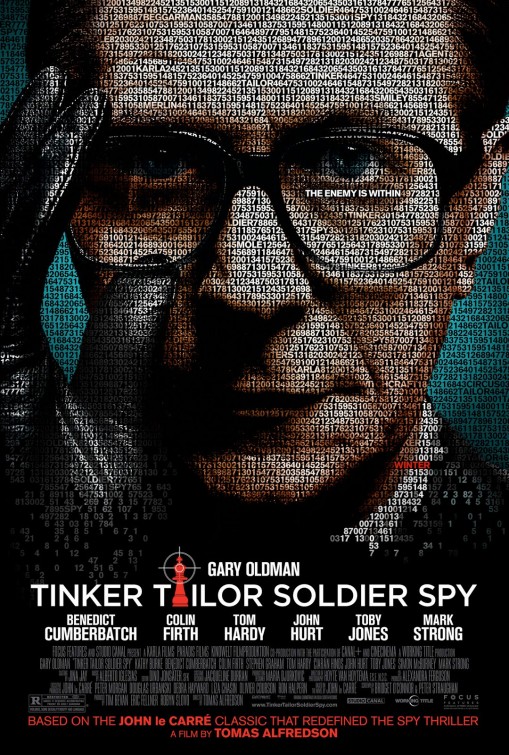 Billed as one of the most dense films of the holiday season, I was startled to discover that Tinker, Tailor, Soldier, Spy is not nearly as puzzling as people have protested. The adaptation of John le Carre’s famous novel follows retired British spy George Smiley (Gary Oldman) performing a clandestine investigation to flesh out a mole in the highest level of the agency. Directed by Tomas Alfredson (Let the Right One In), condensed form a 7-hour BBC miniseries, and stuffed with a wealth of terrific Brits, the movie is tricky, clever, and rather brainy, ultimately coming to the conclusion that these little communities of intelligence knew little. The movie has a rich array of characters and teases out back-story in flashbacks, meaning the film hops around time wise and will also take turns with different perspectives. It demands your attention but, honestly, I found it easy enough to follow. But in the end, what does all that narrative trickery and obfuscation get you? It’s a fairly dispassionate film about dispassionate people played out in a dispassionate manner. For some this will be hailed as a virtue, communicating the duty-first sacrifices and compartmentalization of these secret spies. For me, that just sounds like a cop out. Beyond the mystery, it’s hard to get involved in the movie. The reveal of the mole is anti-climactic, though the resolution, set to the tones of Julio Iglesias, is aces. The meticulous production design is stellar, including an agency meeting room that looks like it was wallpapered with checkerboards. The details of the ins and outs of the agency are absorbing. I’m debating whether I should watch the movie again, looking for nuance I must have missed. Tinker, Tailor, Soldier, Spy is an espionage thriller with a bit too many stiff upper lips.
Nate’s Grade: B


 nathanzoebl
You must be logged in to post a comment.