Blog Archives
Don Jon (2013)
 Joseph Gordon-Levitt, one of the most talented and, yeah I’ll say it, dreamy young actors working today is proving to be more than a pretty face. Don Jon is his assured writing and directing debut, and it shows that every man has one more reason to feel insecure compared to Gordon-Levitt. The titular Jon (Gordon-Levitt) is a New Jersey lothario who sleeps with lots of women but the real thing just can’t measure up to his porn. The schism between reality and sexual fantasy is too much. Jon tries to reform his porn-addiction ways when he meets a hot lady (Scarlett Johansson) but old habits are hard to break, especially when he has to wait before sleeping with a woman. The narrative isn’t terribly deep or that developed but remains entertaining throughout, buoyed by feisty performances and stylish direction. The editing, sound design choices, and smooth camerawork made me feel like I was watching a promising Scorsese student. I found Don Jon to be a far more successful look at sex addiction than the recent sex addict drama, Thanks for Sharing. The parallel between porn and Hollywood rom-coms, both an inflated fantasy of relationships, doesn’t really stick, and Jon’s family is a bunch of loud Italian stereotypes, but the lead guy is a self-possessed lunkhead anyway, so it makes sense for his family to follow suit. Don Jon is funny, sexy, and an enjoyable diversion at the movies. What it really does, though, is provide the first notch in what may prove to be an exciting directorial career for its star.
Nate’s Grade: B
Share this:

Short Term 12 (2013)
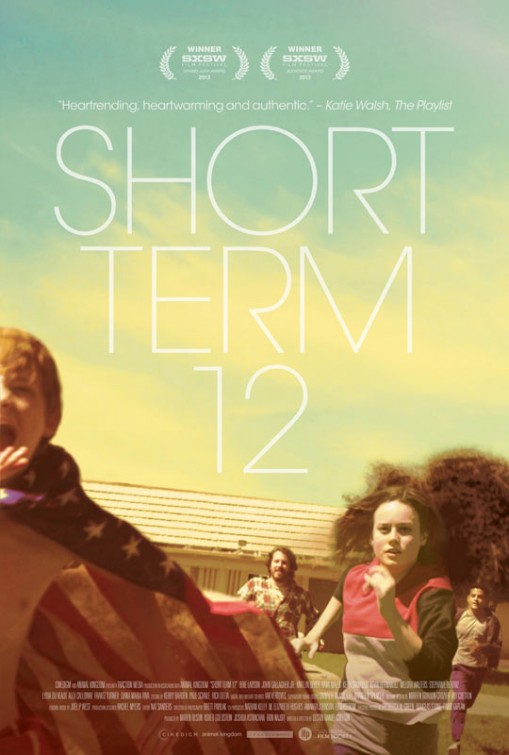 It’s rare for a movie to be emotionally devastating while also being overwhelmingly inspirational and hopeful, but Short Term 12 achieves the nigh impossible.
Short Term 12 follows the inhabitants of a small foster care center in Middle America. Many of the kids have been taken from their biological parents because of abuse, neglect, imprisonment, or death. Many have never known a stable home life. And many will age out of the system at 18 and be trusted to make something on the outside by their lonesome. Grace (Brie Larson) is the lead counselor for the center. She’s dating a co-worker, Mason (The Newsroom’s John Gallagher Jr.) and pregnant, unsure of where to go from here. As the center prepares for Marcus’ (Keith Stanfield) age-out departure, they welcome Jayden (Kaitlyn Dever) to their abode. Jayden’s well-connected father is getting his life in order for full custody, but it also becomes clear that her home life is a danger to her well-being. Grace fights to get Jayden to open up, then she fights to keep her safe, all the while forcing Grace to deal with her own long hidden pain.
 It’s so easy to get engaged in this movie. The very setting calls for plenty of drama and pain to be explored, and it will be, but that doesn’t mean that the film goes overboard with histrionics. The characters are written with such naturalistic ease, allowing an audience to understand them without judgment. These people, be they the foster kids or the counselors, feel refreshingly, exceedingly, magnificently like flesh-and-blood people. The characters feel lived in, their struggles feel real, and their responses are sincere. The foster care system in this country is grueling. A counselor needs a big heart, thick skin, and an immeasurable supply of patience. There are a lot of abused kids in the system, just hoping to find an adult who wishes to love them, to nurture them, to care. The kids don’t want pity; they are perturbed when they’re referred to as “underprivileged youth.” What they really want is respect and sincerity. Highly charged emotions are a given considering the circumstances of the characters, but what makes Short Term 12 exceptional is that they are fully earned. We don’t just feel for these kids because they’ve suffered, we feel for them because they are presented as characters instead of martyrs. I was emotionally moved throughout, tearing up several times, feeling heartbroken at turns and then brimming with buoyant hope at others. It’s a balancing act the movie masters.
Writer/director Destin Cretin (actually remaking his 2008 short film of the same name) explores these characters in gentle waves, allowing the characters to open up in ways that don’t feel forced. You learn about these characters and their history bit by bit, sometimes through creative expression where one must read between the lines. Marcus might seem to be one character, then his rap song he writes reveals an aching degree of personal pain, and then the revelation for why he wants to shave his head, which at first just seems like an average teenage compulsion, will break your heart all over again. You yearn for these kids beyond measure, wanting them to taste delayed happiness in this world, but you also understand why they’re so guarded, why the system grinds together as it does. This is no polemic overburdened with speechifying and soapboxes. It doesn’t really make any larger points about foster reform or the people who run the system. Instead Cretin gives every participant in the film complexity, empathy, and humanity. Even Grace’s supervisor, easily set up for quick blame about decision-making, is allowed empathy. You feel the man’s plight as he tries to make the best out of a bad situation, which is exactly what the counselors are trying to do themselves with their charges. Cretin’s emphasis is on his characters and not necessarily on making overt political attacks. I knew within minutes that I was in for something special. You can feel it with the dialogue, how easily Cretin is shaping character without splurging on exposition. These people come alive under Cretin’s watch, and you’ll be pulled in within mere moments.
This is also fundamentally a star-making performance for Larson. The young actress has had visible roles in Scott Pilgrim vs. the World, 21 Jump Street, and TV’s The United States of Tara, but nothing prepared me for the power of her performance. Larson’s character has plenty of personal pain and secrets and a gnawing sense of futility, but she pushes forward, trying to make a difference somehow in this world. You feel her intensity and determination but you also feel her setbacks and uncertainty. Larson never strays outside the emotional bounds of her character, staying true to her aims. Grace is no saintly and selfless figure. She’s paying a real price keeping her own pain bottled up, focusing completely on others so that she doesn’t have to assess her own damage, but Jayden forces her to examine her own history. Larson serves as the dependable emotional anchor of some very choppy waters. In a just world, Larson’s name would be bandied about come awards season, but the overall small, understated nature of Short Term 12 and its limited release leaves me in doubt. However, there is no doubt that Larson gives a deeply humane, gripping, heartfelt and marvelous performance.
 The character relationships are just as compelling and provide a rich texture to this world. The dynamics within the foster center are interesting, nothing as simplistic as slotting kids into staid high school types. There are divisions within the home, chiefly between Marcus and an antagonistic Luis, but it’s also invigorating when you witness the various kids come together in solidarity and community, when they look out for one another. Jayden is surly at first but won’t let on how truly hurt she is that her father missed her birthday. Marcus leads the other kids and they all make a slew of birthday cards to cheer her up, make her feel that someone out there cares. It’s a small gesture, and yet when it plays out it hits with a wallop. The relationship between Grace and Mason is sweet and frustrating, representing a romantic coupling of two people with an obvious connection but also enough baggage to derail potential long-term success. Gallagher Jr. is a nice fit for the part. I really enjoyed how Mason is developed as the film progresses. Initially he seems like a pseudo-cool authority figure, then a scruffy screw-up, then a sincere and grateful individual worried about Grace and aggravated by his inability to help her.
There are movies that feel true in a broad sense but clumsy with the fine details, and vice versa, but Short Term 12 is that rare movie that feels so authentic that it could have been a documentary. Sure there is convenient plot developments and a tidiness that life just doesn’t want to provide, but the overall impression is remarkably genuine. The characters feel like actual people, their world feels recognizable, and their struggles feel familiar and relatable and raw. Short Term 12 doesn’t glorify the counselors, nor does it demonize or sanctify the kids under their care. Here is an unblinking look at the sheer weight of the work of trying to provide for those in need. The movie is a potent drama with several heartbreaking incidents, but I don’t want to scare people off with the impression that Short Term 12 is all artsy doom and gloom. On the contrary, the film is resolutely hopeful in the face of such dire adversity. The perseverance of the counselors, as well as the kids striving for independent lives, is what I walk away with. Not the abuse, not the systematic neglect, but the indomitable perseverance of the human spirit to transcend damage and to succeed anew. This is the long-lasting impact of this superb movie. It’s not about the pain inflicted, rather the human connections forged and the optimism of recovery. Not everything will get its happy ending, but it is inspiring to watch people put it all on the line, thanklessly. Short Term 12 is the kind of movie you bug your friends until they finally watch it. Ladies and gents, commence bugging.
Nate’s Grade: A
Share this:

The Spectacular Now (2013)
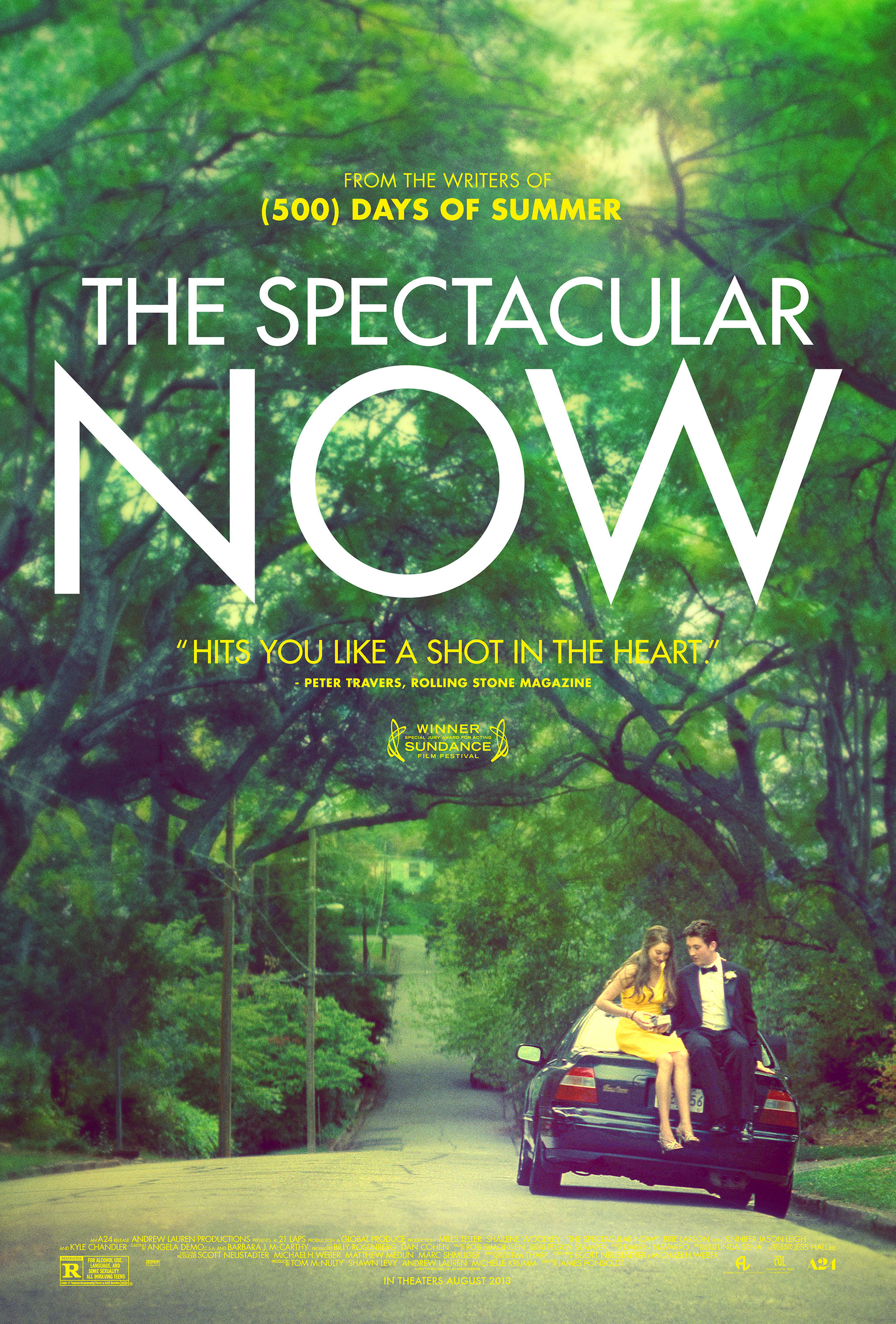 I say this as a fan but John Hughes was probably the best and worst thing that happened to the modern teen movie. He certainly brought an extra level of pathos and relatability to the genre, but then again he also dealt in stereotypes, often languishing his characters to stock archetype ghettos (the Jock, the Prep, the Nerd, etc.). In the ensuing decades, it’s been hard to break as many teen films, of those aimed at teenagers, have casually dealt in these easy labels. That’s why something like The Spectacular Now is such a welcomed respite. Here is a teen movie that aims to tell a story about people and their problems, not simply a regurgitation of high school cliques and clichés. This isn’t a film where all the pieces magically come together; this is a high school movie that more closely approximates real life. This is more Cameron Crowe than John Hughes material.
Sutter (Miles Teller) is the most popular guy in school, or so he’d tell you. He’s the life of every party, the kind of guy who everyone enjoyed, and the guy who could charm the pants off any girl. He’s recently broken up with his girlfriend Cassidy (Brie Larson), though still harboring serious feelings for her. Of course the best way to get over the old girl is with a new one, and Sutter sets his sights on Aimee (Shailene Woodley). She’s a smart, somewhat quiet gal that immediately takes a shine to the spotlight that is Sutter’s affections and attention. He’s not entirely over his old girlfriend, still angling to get back together, but also Sutter’s whole perspective could be summed up as an extreme case of carpe diem. The kid is partying like there’s no tomorrow because he’s convinced he has no real future, so he’s going to live it up while he can.
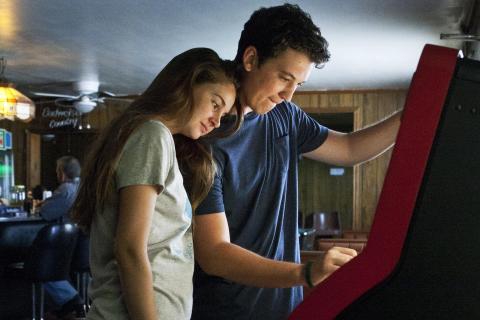 You’ve easily seen this movie before but it’s rare to see it given so much depth, maturity, and care. At heart, this is the story of Sutter learning he’s a screw-up and getting his life back in order, learning some self-control and responsibility, and winning over the good girl. But The Spectacular Now is so much more than that, and it’s especially sadder than you may have expected with its wise-talking, charming protagonist. This is the story of a teen coming to grips with parental abandonment, gaining insight into his own delusional detours to avoid pain, and the horrible realization that he is, in his present reckless condition, a bad influence dragging down the future of the girl he genuinely cares for. That’s a lot of heavy emotional drama and none of it revolves around the clichéd staples of teen movies, like those checkpoints such as prom and the Big Test. This is the story about one damaged man coming to terms with the state of his damage and gaining the courage to change his direction. He’s an alcoholic but the movie doesn’t ever put the narrative on hold for soapbox preaching. If anything, Sutter’s alcoholism is handled so subtlety, with most character silently acknowledging but unsure or indifferent to act, that it may strike a few chords with audience members. Then there’s the fact that none of this is heavy-handed; the filmmakers have done a fabulous job of giving each character credibility. They behave like real human beings. Even the easily slotted antagonists, namely Cassidy and Sutter’s deadbeat dad, are given shades of recognizable humanity and depth. Even though Cassidy waffles in her feelings for her ex, I cannot dislike her because her character portrayal is so honest. She’s struggling with her feelings for a screw-up with redeeming qualities. That’s fairly relatable, even if she’s not our winsome romantic lead. The filmmakers drag a typical teen movie story into our real world setting, adding depth and telling observance. You will recognize many of these characters.
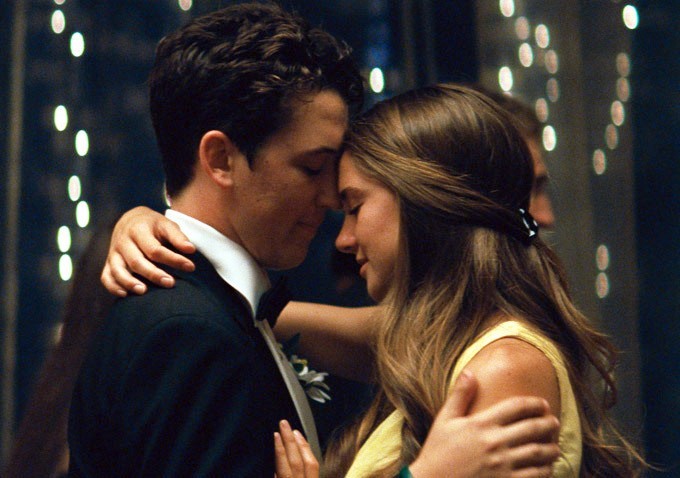
There are few superlatives to describe the cuteness of the blossoming relationship between Sutter and Aimee. It’s so smooth and relaxed yet completely believable, and the two actors have such a warm and natural chemistry with one another, enough that I seriously contemplated if they dated outside the film (rumored but nothing conclusive). You feel their budding affections, the sweet swoon of young love, and the hiccups along the way. Woodley (The Descendants) does an outstanding job with her mannerisms and affectations; her awkwardness around her feelings is adorable, but not in that prefabricated cutesy way often ascribed to the oft-mentioned Manic Pixie Dream Girl roles. She’s a fairly normal teenager on the fringes of high school, keeping her nose down and looking ahead. In movie terms, you couldn’t readily classify a gal like Aimee, and that’s because she’s a real character fully fleshed out by the screenwriters and the actress. Woodley’s performance is near invisible of acting tropes and constraints. She just dissolves into the character as all exceptional actors do.
But this is Sutter’s movie and, in accordance, Teller’s (Rabbit Hole) film. The young man puts on an acting camp in this film, shedding the various layers of armor from his sad clown of a character. As I said, we’ve seen this character before, but Teller and the screenplay are able to give Sutter such extraordinary depth. The carefree life-of-the-party character is turned into an introspective character study, essentially examining the darker side of Ferris Bueller. He’s using alcohol and his blithe attitude to blunt the pain that he fears he’ll end up like his old man, that his life has already peaked and he’s not even out of high school. Teller is such a successful charmer that he already wins you over to his side despite some boorish behavior because we see that the guy has a good heart. In the film’s opening, he’s propping up his friend to finally get the guy a girl, and the ensuing mess ends Sutter’s own relationship. The last act involves Sutter coming to grips with the negative impact of his actions, notably on Aimee. Teller is so effective at giving you glimpses of the sadness eating him whole. His concluding scenes when he finally breaks down feel like a hard-fought victory for the character as he confronts his doomed fate. At every turn, Teller impresses, and compounded with Woodley, they form an unbeatable team of sterling young acting talent.
 Special mention to Kyle Chandler (Super 8) for his pivotal walk-on roll as Sutter’s bad dad. He’s so pathetic and so desperate and so wonderfully realized by Chandler. He doesn’t get a Big Scene, he doesn’t get a Big Speech, he doesn’t even do anything out of the ordinary for a shifty, unreliable, selfish drunk, but those few minutes he’s onscreen, it all becomes so deeply sad and clear where Sutter’s life is headed without intervention.
The only depiction that I had trouble believing was Sutter’s almost consistent drinking and driving. Throughout the film, he has his trusty Styrofoam Big Gulp cup with him, spiked with booze. The man hasn’t graduated high school yet and is already a high-functioning alcoholic. Because of this I can believe that people would not be alarmed seeing him drive after imbibing a few drinks. However, the man is constantly drinking while behind the wheel of an auto and several times he appears completely trashed. I find it alarming as well as a bit far-fetched that not one character, not even Aimee, would raise objection to Sutter’s continued dangerous behavior. We also witness several scenes of Sutter drinking in bars. It’s conceivable he has a fake ID at his disposal, and it’s even more conceivable that he could talk his way into any establishment, but it’s more food for thought. Then again maybe this is just one of those towns where nobody cares about innocent lives being snuffed out by drunk drivers.
The Spectacular Now is an earnest film that doesn’t overdo it, providing challenging life lessons to fully formed, complex, believable characters. It doesn’t sugarcoat the heartache and harsh reality out there for vulnerable teens. It’s a charming romance tied up with an insightful character study of one young man hiding his sadness and anxiety of life’s disappointments with humor and booze. Thanks to the tremendous acting of its onscreen pair, you root for Sutter to turn his life around because you see value in him as a person, even if he doubts it himself. You’re on his side from the start, and you know how nicely he matches up with Aimee. You want this movie to pull off the spectacular, and for long stretches it feels just as if that will happen. The ending aims for ambiguity but is far more hopeful than its source material. I was charmed thoroughly by this film and its lead characters but even more I was thoroughly engaged in their dilemmas, moved by their struggles, and encouraged by their perseverance and growth. The Spectacular Now (extra points for never even having a character spout the title) is a funny, warmhearted, measurable restrained, knowing film that could open eyes. It may not be spectacular to some, but it’s surely a great film.
Nate’s Grade: A-
Share this:

You’re Next (2013)
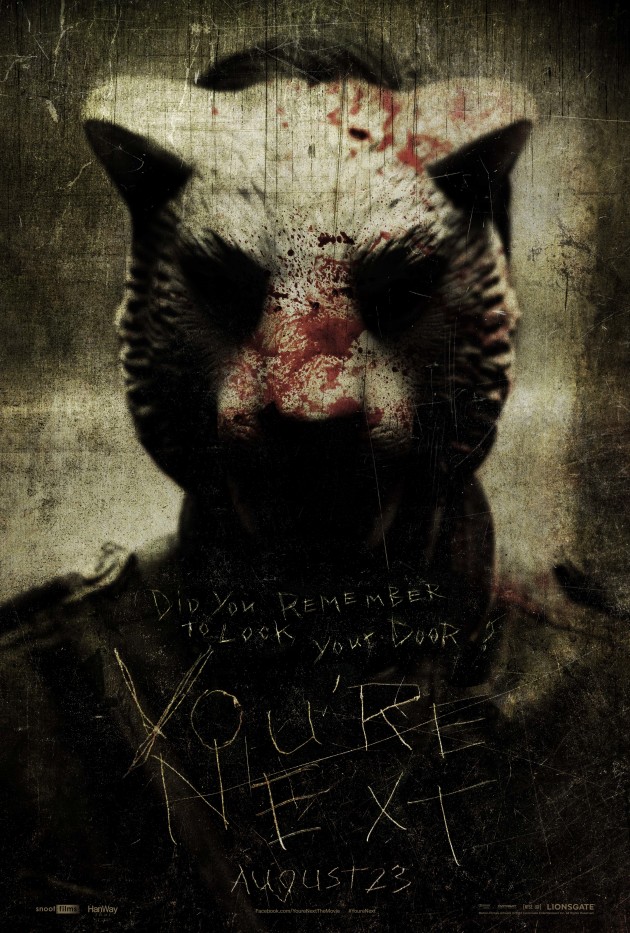 There has been a notable rise in home invasion thrillers in recent years but I am doubtful we’ve hit the crest just yet (this may also be hope speaking since I co-wrote one). Perhaps in an age of real-life anxiety on the news, the invasion of our personal sanctuary strikes an even more horrific chord. Whether you argue the upswing began with Panic Room, or Funny Games, or even the old Audrey Hepburn feature Wait Until Dark, the message is universal: nobody likes having their stuff messed with. This year we’ve already had The Purge make a splash at the box-office, and I’m sure Lionsgate is hopeful that their indie horror flick, You’re Next, which has been reaping great buzz along the festival circuit for years now, will make a similar splash. For me, You’re Next checked every box I would want in an effective horror film: good thrills, good humor, and a good ending. That adds up to one hell of a good time at the movies.
Crispian (AJ Bowen) is traveling all the way upstate for a family reunion at his parent’s palatial mansion in the woods. He’s also going to introduce his new girlfriend, Erin (Charni Vinson), an Australian graduate student that used to work as his teaching assistant at his college. Crispian’s rich family includes his excitable younger sister, his obnoxious older brother, his youngest detached brother, everyone’s boyfriend and girlfriend, and mom and dad. In between a lively family discussion/argument at the dinner table, arrows start flying through their window. Three mean wearing ominous animals masks are stalking outside, armed, and with every intent to kill everyone inside. The masked killers leave ominous messages painted in blood, noting, “You’re next” (I know they’re senseless murderers, but points for using the correct form of “you’re”). Erin snaps into survival mode and assembles a system of defenses but there are more threats than anyone imagined.
 To take nothing away from the artistic merits of You’re Next, the biggest selling point, and its greatest attribute, is that it knows how to properly work over an audience. While nowhere near the genre deconstruction that was last year’s Cabin in the Woods, nor as clever, here is a movie that knows it’s a horror movie, knows you’ve seen these movies before, and knows what you’re looking for as an audience member. And once the killing starts, the movie also gains a delightfully macabre sense of humor, an impish darkness that will leave you chuckling. I heartily recommend seeing this movie in a packed theater because the collective response will add to your enjoyment, or at least it did mine. Never have I experienced a movie where the audience cheered the plugging in of an ordinary kitchen appliance with such reckless enthusiasm. Thanks to director Adam Wingard and screenwriter Simon Barrett, the movie packs great payoffs in its second half, as our prototypical Final Girl outflanks her attackers. There are enough twists and turns to keep things interesting and the pacing swift. Once those arrows pop, this thing just flies by, moving at a speed that keeps you satiated with scares, thrills, and humor. In essence, You’re Next knows how to have fun with an audience, and for whatever reason, with the glut of dank home invasion horror thrillers, this is a surprise. With all the family trauma and killing, watching their loved ones cruelly slip away in horrific fashion, it’s worth praise that Wingard and Barrett find a happy tonal middle-ground that doesn’t blunt the horror or the comedy. The laughs don’t feel out of place with the screams. They make this work. And there are some really sick laughs to be had too.
My only familiarity with Wingard is from his involvement in the horror anthology series V/H/S and The ABCs of Death. It’s also somewhat entertaining to note that all three movies, both V/H/S and its sequel, have been released before You’re Next, a film that was completed two years prior. His anthology segments didn’t point to the same level of promise on full display with You’re Next. Wingard does a great job of orienting his audience to the geography of the play area, so to speak, while juggling different simultaneous threats and maintain a sense of clarity. He knows when to hold back, and he knows when the audience needs a peak of something gruesome. Initially, with the animal masks and the attack on the wealthy, I thought the film was gearing up for a dose of environmental social commentary, as if the killers were extreme defenders of Mother Nature. I’m actually relieved that the film never picks up any ham-handed political subtext.
 As a horror movie, it’s far more effective than most genre deconstructions that will undercut the terror for the chance at a good joke. Even Cabin in the Woods was like this. Again, You’re Next can be riotously funny, especially in the last act, but it can also, and often is, quite suspenseful as well. Once the game get sunder way, you start playing along as well, guessing which of our participants will indeed be next. They place themselves in precarious positions often, especially early, which makes it all the more suspenseful, because you’re suspecting anything can happen at any time. You’re lying in wait, and Wingard does an excellent job of drawing out that tension to a peak level before hitting the horror or gore. There are some gruesomely bloody moments in the film but it doesn’t lovingly linger on the deconstruction of the human body. And just when it seems like the number of housemates fighting for their lives has gotten so low that the thrills would have to be successfully all wrung out, You’re Next supplies a twist that changes gears, introducing a new threat and a new level of dramatic tension. When Erin assembles an ax to smash into the skull of whoever opens the front door, you’re eagerly waiting for that Chekov’s gun to fire (Can we rename it Chekov’s Ax to the Face?). The fact that the movie is almost designed as a Home Alone for demented adults is ingenious.
The acting is a bit hit or miss but the standout, by far, is Vinson (Step Up 3D). She’s our lead heroine, yes, but she takes charge in a way usually reserved for men in these types of movies. She has all sorts of crafty experience with wilderness survival and setting up traps, plus she is able to marshal the family from a bunch of WASPs screaming their guts out into something of a fighting force. And plus, Vinson just has an awesome screen presence to her. It’s a great role for her but credit the actress for knocking it out, giving the audience a strong, extremely capable, and empathetic hero. It’s satisfying to watch the masked killers be outfoxed by their prey. Many of the actors in the film are filmmakers themselves (Joe Swanberg, Ti West, Amy Seimetz), and they’ve collaborated on numerous projects, including other lo-fi horror features, the new Splat Pack if you will.
If you’re looking for a fun horror movie with a dark sense of humor, then You’re Next should be next on your list. It’s savvy, scary, and knows how to goose an audience at just the right moments. Wingard and Barrett know how to give an audience what they want without pandering, and that’s what elevates You’re Next from its peers. This is a horror film that can scare you one minute, make you laugh uncomfortably the next, and then ultimate leave you cheering the vengeful dismemberment of human life with kitchen appliances. It is a more than effectively put together horror thriller from beginning to end.
Nate’s Grade: B+
Share this:

The Way, Way Back (2013)
 A throwback to the youthful summer movies of the 80s, The Way, Way Back is a delightful coming-of-age film that manages to excel at both comedy and drama. Oscar-winners Jim Rash and Nat Faxon (co-writers of 2011’s The Descendants) graduate to directors, guiding the famous cast with ease yet squeezing enough satisfying emotional truth into the formula of a screwy, Meatballs-style comedy. We follow 13-year-old Duncan (Liam James) as he spends the summer with his mother (Toni Collette) and her bully of a boyfriend (Steve Carell). My one gripe is that the film spends far more time than it needs to establish just how unequivocally awkward Duncan is. You will likely cringe. When Sam Rockwell enters the picture as a charming goofball water park employee who takes Duncan under his wing is when the movie ascends to a new level of comedy. The Way, Way Back hums along with its own sense of charm, presenting familiar characters/scenes but giving them added texture and relatability. You will be surprised at how much you feel for these characters, you may get a bit misty at points, especially when they behave like people and not zany cartoons. Carell as a bad guy is a real eye-opener; he’s a passive aggressive bully rarely seen in movies. James is an authentically awkward teen but you also buy every step of his journey. It’s just such a sweet, enjoyable, and cute movie, exuding charm and sincerity. Here is a movie that just makes you smile. You’ll leave The Way, Way Back feeling warm and fuzzy, and Rash and Faxon have another winner on their hands.
Nate’s Grade: B+
Share this:

InAPPropriate Comedy (2013)
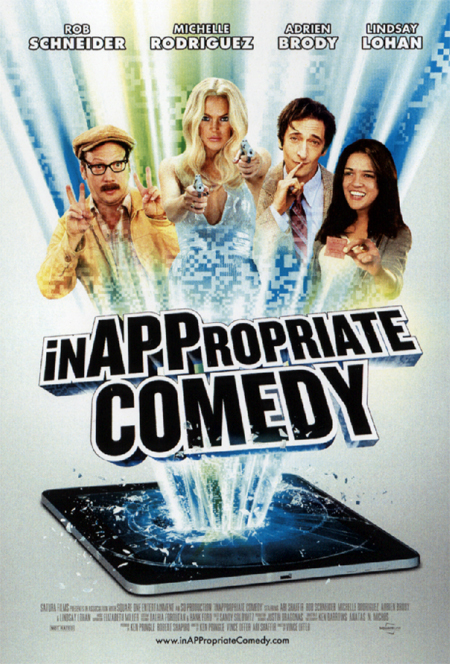 Vince Offer is best known as the successful pitchman for infomercial products like the Sham Wow and the Slap Chop. He’s less known as an amateur comedian. In 1999, he co-wrote and directed The Underground Comedy Movie, pooling all the favors he must have accrued with celebrities and struggling L.A. comics. You’d think after one resounding dud people would know better, but alas Offer and his friends have funded another sketch comedy movie, InAPPropriate Comedy. You see the title refers to the joke delivery system, namely Offer’s finger hitting apps on a tablet to start sketches. And if that inept setup doesn’t seem like a insightful indicator for the misery that is to follow, then allow me to confirm that InAPPropriate Comedy may be the least funny comedy I’ve ever seen.
I’m not saying that ALL people who find some measurable level of enjoyment from InAPPropriate Comedy are racist, homophobic, and sexist, but chances are, if you are all three things, you’ll probably enjoy the comedic abyss that is InAPPropriate Comedy. For the purposes of truly showcasing how comically bankrupt this enterprise is, overdosing on witless shock value and groan-worthy stereotypes, I will quickly dictate exactly what you get in this movie, sketch-wise. It’s really only about four reoccurring segments.
-Before the meat of the comedy begins we’re treated to the lamest, more obvious 127 Hours parody and the sight of tough-guy bikers riding around on bicycles. Does that mental image automatically make you laugh? If so, you’re in luck.
 -A parody of Dirty Harry called “Flirty Harry” where Oscar-winner Adrien Brody is a cop who speaks in nothing but overblown gay-centric double entendres (GAY JOKE #1). Is that half-assed twist on the name worth an entire ongoing series? It’s like you took one of the parody names from MAD magazine and then just called it a day. The second time around, Flirty Harry stops a robber and we see him in pink pants. He’s wearing pink pants. How could that not be hysterical? (GAY JOKE #2) The third segment doesn’t want to waste any time, so now Flirty Harry is getting his nails done at an Asian salon. You better believe these women are portrayed as nattering, horrendous, screeching caricatures (GAY JOKE #3, RACIST JOKE #1, SEXIST JOKE #1). Then Harry shoots a guy in the ass (GAY JOKE #4). Adrien Brody, why?
-The next ongoing sketch is a parody of MTV’s Jackass, and this one, with about as much wit as you’d expect, is called Blackass. It’s about a group of obnoxious, ignorant, lazy, foul-mouthed, angry black males engaging in rude and offensive behavior. These segments may be the most offensive in the whole movie because it is wall-to-wall negative stereotypes; the joke is that black men are not to be trusted and will harass white people, especially white women. The first time we see Blackass it has our characters running from the police. One of them even has a giant boombox over his shoulder because people still do that, right? (RACIST JOKE #2). These guys dress and behave exactly like the harmful misrepresentation your elderly grandmother has about black people. The sad part is that the festering stereotype of the black male up to no good can have serious and tragic consequences, coloring people’s judgments and assumptions.
Stepping down from the soapbox, the first segment involves the Blackass crew falling into a vat of raw sewage. The second segment involves them playing joust in shopping carts with lances made to resemble giant black penises (RACIST JOKE #3). The third involves the Blackass crew as the world’s worst babysitters, threatening a white woman in the process (RACIST JOKE #4). You see black people are terrible fathers, so this movie would argue. They talk about welfare checks and carry around 40s of malt liquor. The fourth segment has one of the Blackass guys and his white girlfriend antagonizing another couple in a hot tub before having anal sex (RACIST JOKE #5, SEXIST JOKE #2). The fifth segment has one of the Blackass guys in an abortion clinic waiting room. He harasses a young couple and offers to abort their pregnancy for cheap with a coat hanger (RACIST JOKE #6). The last segment involves the gang trying to lure a mouse by putting cheese on one of their penises. While it’s the closest in conception to an actual Jackass stunt, it’s still unfunny and much of the humor seems to rest on the enormous size of African-American phalluses (RACIST JOKE #7). Crap, I forgot about another segment where the guys blindfold a dude and have him get run over by a rhino. I don’t even get this one.
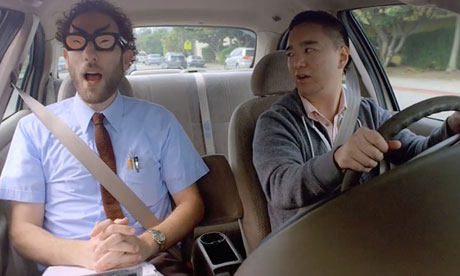
 -The longest and most painful of the reoccurring sketches is a parody of The Amazing Race dubbed The Amazing Racist. You might expect it to have something to do with the popular reality TV competition, perhaps people competing to see who is the bigger racist, racism across color, or even forcing two racists of different ethnicity to team up in competitions. Nope. It’s just co-writer Ari Shaffir and his unending improvisation. The first segment has him rant in front of the U.S.-Mexico border, and then he harangues a gas station owner and assumes any Hispanic present is an illegal alien (RACIST JOKE #8). The next involves him as an insulting driving instructor for Asian drivers (RACIST JOKE #9). The next involves him wandering a predominantly Jewish supermarket trying to gather signatures to apologize for killing Jesus (RACIST JOKE #10). The next segment involves Shaffir entreating black passerbyes on a beach to take a boat ride back to Africa (RACIST JOKE #11). Finally, Shaffir is abandoned in a Middle Eastern territory with armed Arabs. I guess it’s supposed to count as comeuppance but it sure doesn’t feel it. There’s a post-credit sequence where Shaffir is trying to lure Jews into a box to ship to Hitler from the future (RACIST JOKE #12). I later learned that the hidden camera aspect of Shaffir’s bits is another fallacy. The people onscreen are all actors, which makes The Amazing Racist even less amazing. It feels like Offer and Shaffir watched Borat and thought they could replicate what they saw.
-The only other repeating segment is a pair of film critics that specialize in reviewing pornography. The idea on itself actually has the most potential out of everything Offer throws onscreen. It’s got recognizable faces; Michelle Rodriguez and Rob Schneider are the critics. Their reviews, however, are just another excuse to make more racist and gay jokes. A porn they review is called “Sushi Mama” and it features two Asians engaging in over-the-top, badly dubbed sex (RACIST JOKE #13). Another porn they review is weirdly a parody of Swan Lake, with guys dancing around in tutus and eventually humping and ejaculating on a helpless victim (GAY JOKE #5).
There are two other sketches that have the luxury of not being repeat offenders, so to speak. Lord knows what Offer and company saw in the others. One involves Schneider as a sleazy therapist aroused by his client’s vigorous sexual history (SEXIST JOKE #3). Another is called “Things You’ll Never See” and purports that hot ladies would never date someone poor because all good-looking women care about is money (SEXIST JOKE #4). I haven’t even mentioned how all of these sketches are supposed to take place, literally, inside Lindsay Lohan’s vagina (SEXIST JOKE #5). It’s a nonsensical framing device. We zoom out in the end, meaning that Lohan has a treasure trove of unfunny sketches stuffed in her special place. She should probably consult an OBGYN.
And that’s it! That’s the movie, all 75 wretched, horrendous, soul-draining minutes. Did any of that, on the surface, seem funny to you, or, like most people with active senses of humor, did it seem overwhelmingly lazy and poorly thought out? The biggest problem with InAPPropriate Comedy is that it’s trying to be more inappropriate than funny. It’s confused shock value for actual humor. Having a troika of irresponsible black males playing into demoralizing stereotypes and fears isn’t comedy. Having a guy make fun of Asian drivers isn’t a sketch. Having a gay cop make forced double entendres isn’t a sketch. There’s no development here, no escalation, no twisting of the premise, no nothing. All Offer and his motley crew of comedic imbeciles do is take a one-joke premise and pummel it into submission, making the laborious sketches feel even longer. It just so happens that most of their one-joke ideas aren’t even ideas so much as mean slights against minorities, women, and gay people. There is no ironic distance to the joke telling; they are merely just being crushingly racist, sexist, and homophobic.
 I am by no means a comedy prude. I love a terrific vulgar joke as much as the next guy. I think when comedy is concerned that nothing is off limits. You can make anything, no matter how horrific and offensive, funny under the right circumstances, but it takes work and able skill. The problem with Offer’s movie is that there is no consideration to context, setup, developments, let alone surprise. You’ll see every dreadful joke coming before it arrives. That’s because all this movie does is trade in pained, outdated stereotypes. The scenes themselves feel like improv jags that just go on endlessly, like Offer was trying to replicate the process of a Judd Apatow comedy. His faulty reasoning may have been if people just say enough offensive things long enough, then something has to arrive at funny. Comedy doesn’t work like that, and as a comedy writer I find it personally insulting. This is just rampant and pointless vulgarity without any parameters, no point of view, nothing to mask the fact that it’s just cheap shock value. What are the jokes here? Asians are bad drivers? Black men are reckless? Women are superficial? Do these sound like jokes or merely groundless insults? If you removed all the ostensibly offensive elements, there would be nothing to this movie whatsoever.
As a longtime detractor of the duo Friedberg and Seltzer, the men responsible for cinematic crimes against humanity like Epic Movie (my worst film of 2007) and Meet the Spartans (my worst film of 2008), I’m torn. Friedberg/Seltzer don’t so much create jokes as they do lame pop-culture references with built-in expiration dates (go on, try and watch one of their past movies and see if you recall everything). Whatever jokes they do foster are mostly broad slapstick, but it could be classified, no matter how charitably, as a joke. After watching Offer’s InAPPropriate Comedy, I may have second thoughts about the intensity of my screeds against Friedberg and Seltzer. Their movies are still terrible, still the cannibalistic, cinematic watery discharge I dubbed them, but Offer’s comedy may even be worse. There’s no way any of InAPPropriate Comedy could ever be funny. It’s so obvious and desperate that it confuses offense for smashing taboos. This is a black hole of funny, where funny cannot escape and instead gets smashed down to an atomic level. How could anyone making this find it even remotely funny? If I see a worse movie in 2013 than InAPPropriate Comedy, it will make me reevaluate the existence of a loving God.
Nate’s Grade: F
Share this:

The Kings of Summer (2013)
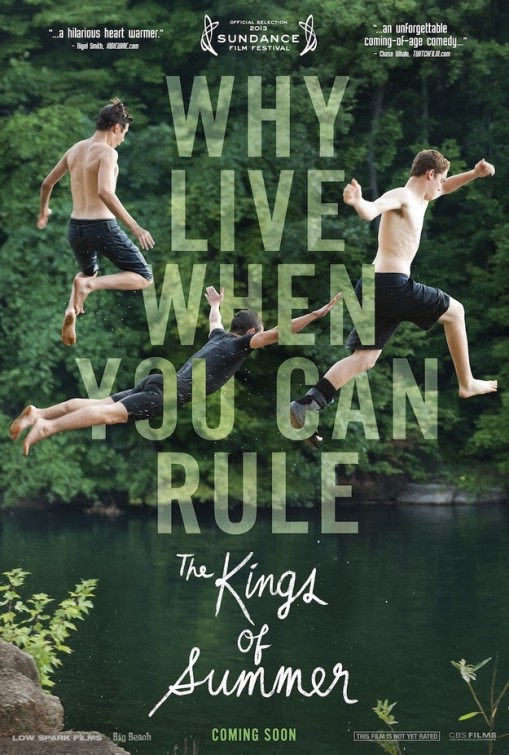 Working part-time at a movie theater in the summers, I come across, let’s say, an interesting selection of customers with… interesting opinions. One middle-aged woman openly opined, while looking at the poster for the coming-of-age comedy The Kings of Summer, that she’s had enough with movies told from a teenage male perspective. While this same woman had very specific and narrow demands for an acceptable movie, she got me thinking. Why do we get so many coming-of-age movies from a male perspective? Let’s forget the easy answer that Hollywood has a lot more male filmmakers than female. There’s always that sense of romance with coming-of-age films, a nostalgic look back at a supposedly simpler time that now seems better appreciated. Maybe men are just more prone to romanticizing the past while women look forward to the future. Or maybe there are really just more men calling the shots about films get made. Whatever the reason, the woman didn’t go see The Kings of Summer, and judging by her attitude, I don’t think she missed out.
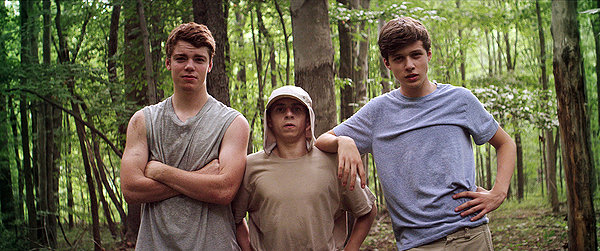 Joe (Nick Robinson) has just finished his freshman year in high school. He has a long summer ahead butting heads with his no-nonsense father (Nick Offerman). Then Joe gets the brilliant idea. He and his pal Patrick (Gabriel Basso), who is also sick of his annoying parents, will build their own home in the woods, a sanctuary where they can set the rules. Joe and Patrick pack up their belongings, find a quiet spot in the woods, and build that dream home. Biaggio (Moises Arias), a weird and gangly kid, takes an interest in the youthful declaration of independence and joins in. The guys invite girls over, explore the wilderness, grow patchy wisps of facial hair, and live out their fantasies of roughing it like real men. Of course it helps when a Boston Market is just down the road.
From start to finish, The Kings of Summer kept me laughing. I did not expect the comedy to be as consistent and thorough as it was, but writer Chris Galletta has a sure handed way of making the comedy derive from the situations and characters. Even with some outsized elements, notably Biaggio and the fact that the boys home-away-from-home is way too advanced for a kid who blundered through shop class, the humor never feels forced. That is an accomplishment, though the script also overly relies on Biaggio to say outlandish or weird lines. I especially enjoyed his one-scene pep talk with his father late in the movie. That confidant sense of humor goes a long way to relax an audience, allowing us to attune to the mellow waves of the film. It’s fun to watch the guys try to forage a life out in the woods, slowly learning how hard this whole survivalist lifestyle may actually be. The adults are viewed as blithe buffoons or hardasses, though they don’t come across as caricatures. Credit the attention paid to Offerman’s (TV’s Parks and Recreation) character as Joe’s father and credit Offerman’s uncanny ability to make gruff parenting endearing. This is an easy film to like, to go along with the flow, and to enjoy. It never really falters in entertainment and routinely has another joke at the ready to make you smile. It’s a sweet movie that does enough to keep you charmed.
While pleasant, I had to stop and reflect that there was absolutely very little to these characters. The boys all kind of blend together in their youthful romanticism of freedom and rebellion of lame parents, but you’d be hard-pressed to describe them beyond core physical descriptions. The moments that do supply character development are mostly broadly comedic or somewhat generic in their coming-of-age tropes, notably the broken heart administered by a guy’s crush. Example: Biaggio is essentially little more than a walking punchline machine. While quite funny and well acted, every line of his dialogue feels like a punchline. He comes from nowhere. At one point, Joe advises Biaggio that a girl may be interested in him, but Biaggio demurs and says that won’t work out. All right, here we go. Here’s where the movie sheds some light on him. Biaggio admits to being gay. The very next line involves him confusing gay with cystic fibrosis. It’s a funny joke but it turns a moment where a character was getting added dimension and just manufactures another punchline. Again, The Kings of Summer is a very pleasant film going experience, and one that made me laugh consistently, but objectively, the impact is too limited because of the lack of proper characterization.
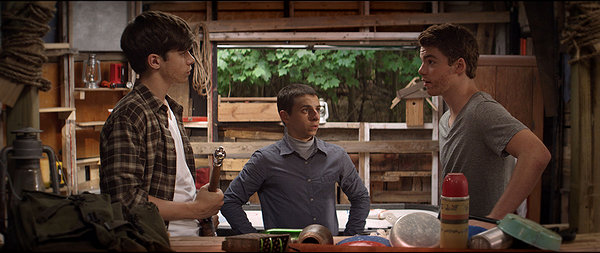 And I suppose this leads into a bigger question of whether this lack of substantial characterization even matters. Coming-of-age movies, like any subgenre in film, have their own expectations and conventions. We all have our different tolerance levels for narrative familiarity, and depending upon the genre, familiarity may be a necessity. Fans of coming-of-age films want to see those familiar elements. They want to see the bonds of friendship, the neglectful parents, the first crushes that lead to first heartaches. It’s just like fans of romantic comedies finding comfort in the two leads hating one another until, inevitably, they love each other, or the public sing-alongs. I think many coming-of-age films at some level tend to be somewhat broad or generic to make them more relatable. Perhaps I’m just being too generous to formulaic pictures. If you’re a fan of coming-of-age movies then you’ll probably be quite forgiving of the shortcomings in The Kings of Summer. Me, I prefer Jeff Nichols’ Mud and its more textured, empathetic look at adolescence in a working poor Missouri riverbed community.
Director Jordan Vogt-Roberts (TV’s Mash Up, Funny or Die Presents…) makes the film look beautiful. The romanticism of the youth running away to live in nature is improved with some spectacular looking natural settings and compositions. The film was primarily filmed in Cleveland and northern Ohio, and as a native Ohioan, I have to puff my chest. Vogt-Roberts is also skilled at handling his actors and balancing tone; while I criticize the over reliance on comedy at the expense of fleshing out characters, the tone is not divergent. It plays within the same cohesive wavelength throughout. If there is a breakout actor from this movie, it would have to be Arias (TV’s Hannah Montana, The Middle). The kid has a tremendous ability to tap into an oddball character, making him quirky rather than insufferable. He also has a unique look to him, and that’s got to be a plus for a working actor. Just ask Steve Buscemi.
Genial and undemanding, The Kings of Summer isn’t anything close to royalty in the coming-of-age genre but it’s consistently funny and enjoyable. The acting is good, the jokes work, and the movie’s out after 90 minutes. It’s a nice summer diversion but doesn’t contain the resonance to be considered more than that. The weak characterization and broad humor, while opening its wide appeal, also makes the film less substantial. It’s sweet and funny but little to distinguish it from other sweet and funny coming-of-age entries. If you’re a fan of the genre or looking for a mellow and pleasant evening at the movies, think of The Kings of Summer. Just don’t think it’s going to be anything more.
Nate’s Grade: B
Share this:

V/H/S/2 (2013)
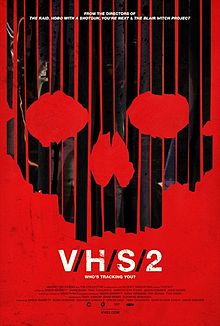 The second entry in the found footage horror anthology (and less than a year after the first to boot) is not as clever as V/H/S but more polished, better paced, and full of enough ingenuity to recommend, especially for horror fans. In my review of the first film I championed a shorter format, giving an audience the thrills they crave faster rather than slogging through an hour of slow buildup. The results are still fairly hit or miss, though none of the four segments is a misfire per se. The weakest is probably the last, “”Slumber Party Alien Abduction,” where the poor camera quality makes it hard to tell what is actually going on. The best, by far, is The Raid director Gareth Evans’ “Safe Haven” about a team of journalists picking perhaps the worst day to tour a creepy cult’s compound, notably during the apocalypse the cult predicted. This one takes a bit to wind up but when all hell breaks loose it goes nuts with glory. The wraparound segment tying everything together is more palatable and points to a promising mythology around the collection of these haunted VHS tapes that people keep watching and then dying over. All together, this is a concept that just works for horror and I’ll welcome presumed sequels as they come off the assembly line. This is found footage done right, with faster payoffs, more variety, and greater focus and ingenuity. If you enjoyed the first film, or are a fan of horror anthologies in general, then pop in V/H/S/2.
Nate’s Grade: B
Share this:

Before Midnight (2013)
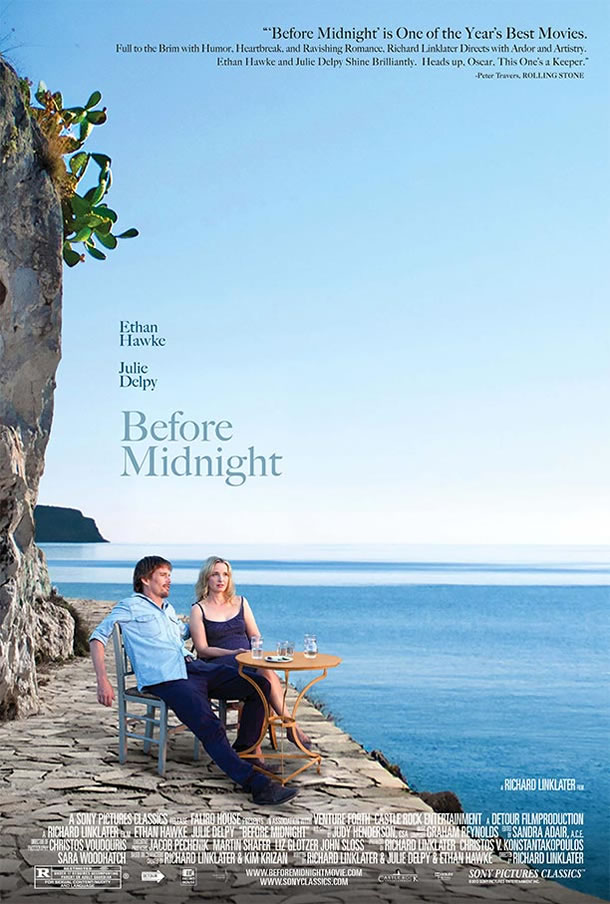 If you’re a fan of writer/director Richard Linklater’s previous movies (Before Sunrise and Before Sunset), as I am, then a new Before movie is a cause of celebration. It feels like we’re checking in with old friends. It’s fascinating to take stock of these characters and their new points in their lives, now approaching middle age. This series is becoming the dramatic equivalent to the 7 Up documentary series that periodically checks up on its subjects every seven years in their lives (56 Up came out this year). Individually, the films are wonderful, but when taken as a whole, the series becomes something truly special, something indelible and sweeping and transporting. Before Midnight is a wonderful movie, brimming with heart as well as ache. It’s also one of the best movies you’ll see this year and another touchstone to the impressive legacy of the series.
In 1995, 23-year-olds Jessie (Ethan Hawke) and Celine (Julie Delpy) met on a train and spent a magical day strolling through Vienna and essentially falling in love. In 2004, Jessie was touring Paris on his book tour, having turned the events of that Vienna night into a successful novel. Celine meets him and the two pal around, reconnecting, with Celine revealing how much that night meant to her as well. Now, in 2013, Jessie and Celine are together, though unmarried, and have twin seven-year-old daughters, Ella and Nina. They’ve been vacationing in Greece for a month while Jessie works on a new novel. Over the course of one long day, the couple will try and stir old passions and question whether they still share the same commitments.
 We’re watching the evolution of two human beings, and your response will vary depending upon your own life’s stopping point at the time of viewing. I must say, as a man now in his early thirties, that I enjoyed Sunrise and Sunset even more, finding greater thematic resonance to the characters, their anxieties, and the concern about faking your way through the “adult world.” I imagine I will find these movies even more emotionally engaging as I continue to age and cross similar hurdles as the characters do. For fans of the series, we’ve already invested 20 years and four hours of screen time with these characters. There’s more at stake when they fight. Watching the other movies beforehand, which I heartily recommend for multiple reasons, also provides stirring points of contrast, the romanticism of youth, the exuberance of promise. What Before Midnight does, and does so exceptionally, is take the romance of the earlier films and put it to the test. There’s a lovely dinner scene with several couples, and you realize that each one is an analogue for Jessie and Celine: the teenagers, the middle-aged couple starting out, the older couple discussing the demise of their previous spouses. It’s hard not to contrast the different stops and the different realities of love by the age.
Fair warning, Before Midnight is the least romantic of all three movies (I want a new movie every 9 years or so until the last one is essentially Amour). The first movie was them connecting. The second movie was about them reconnecting. The third movie establishes that they’ve been together for nine years and have a pair of twin daughters. The focus of Midnight is the struggle of maintaining a long-term relationship, something rarely given such thoughtful, perceptive, and compassionate depth on screen. We’d all rather watch lovebirds make goo-goo eyes at one another while we swoon appropriately, but Midnight’s many battles, small and large, new and ongoing, explore a relationship reality that many should find alarmingly relatable. While the particulars may be different, you may be surprised at how similar these conflicts can be. Exclude stuff like vacationing in Greece, the cushy jobs, and look to the mounting difficulty to retain that spark, a reminder of why you fell in love long ago, with the responsibilities of parenting and work stretching you in different directions. Routine can quickly transform into malaise. Jessie has a teenage son from a previous relationship, and this pushes him into great remorse when the kid departs, making him feel inadequate as a parent, which leads him to suggest unlikely relocation scenarios. Celine, being something of a worst-case scenario creature, notes the moment, saying this is when couples start falling apart. She’s worried he’ll resent her for choosing against a cross-country move. However, as the movie progresses, you realize there are already enough long-simmering resentments between the couple. This is a hard movie to watch at times because Jessie and Celine both go for broke when they argue, and it can get ugly (he dismisses her feelings as “crazy”; she vents about his lack of virility). Ending on a moment of ambiguity, like the other films, it’s perfectly reasonable to assume you just watched a two-hour breakup movie. Their problems don’t really seem resolved but I guess we’ll see in nine years, won’t we? Hopefully the next one isn’t called Before Divorce.
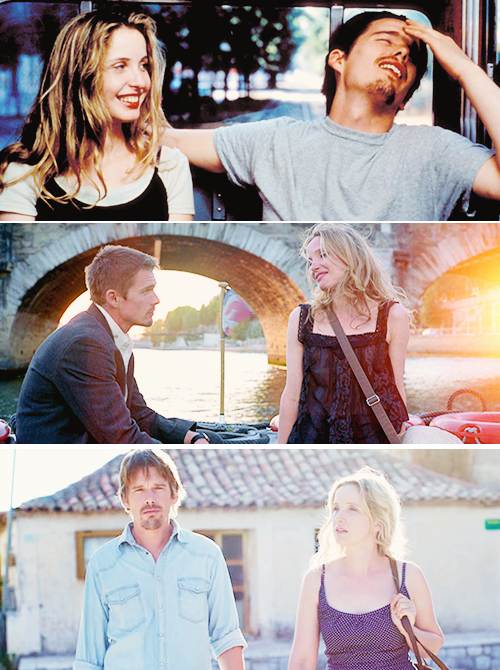 The hallmark of the series, its sparkling conversation, is alive and well, with added maturity and reflection. When you get dialogue this good, this fluidly natural, this engaging, I could listen to them talk for days. In my mini-review for Before Sunset I compared it to listening to birds sing. The shots can last upwards of ten minutes as the camera just slowly walks ahead of Hawke and Delpy as they converse. In the first film we got a foot-tour of Vienna, the second Paris, and now Greece. The sights, while nice, are incidental because I was consumed with the dialogue, which spills so effortlessly from Hawke and Delpy, relishing playing these characters once more. Their give-and-take is often breathless, with nary a pause between them, and it can become overpowering for the uninitiated (lots of old ladies, I have found, dislike this movie, though when asked, none have seen the previous two). But there’s such added dramatic subtext now that we’ve jumped ahead in time. Rather than yearn for the characters to get together, now we’re assembling what we can of their history together and the durable conflicts. The exposition never feels forced, and each new bit provides another prism to view the character actions. You’re studying the characters, parsing their words, sizing up their honesty, and analyzing the various tests and dodges they dole out to one another. It’s a more active experience than you might expect for watching people talk a lot.
Hawke (The Purge) and Delpy (2 Days in New York) are so exquisitely natural with these characters and together and never better. They know these people inside out, and they should because both are credited yet again as co-screenwriters with Linklater. I’d expect another Oscar nomination in their future, much like Before Sunset. Delpy has a wonderful faux youthful voice she uses for hilarious disdain to narrate Jessie’s female fans. Both actors go a long way to flesh out their characters, provide degrees of new wisdom and worry while making us care about their problems. One character does not have the moral high ground, which makes their arguments all the more challenging to process. I don’t want to make it sound like Before Midnight is some twenty-first century Whose Afraid of Virginia Woolfe? There are innumerous moments of humor and grace and compassion, but the louder ringing of the raging conflicts can swallow them up. I also found it intriguing that this is the first movie in the series with nudity from our couple. Granted, it would seem somewhat forward if it happened in Sunrise and Sunset considering the narrow timeframes. As presented in Midnight, it loses erotic context and becomes another indicator of the struggles of maintaining passion.
I want to reiterate that I really hope that Linklater and his stars continue to bless us with a new film every decade, checking back on the lives of Jessie and Celine. The next one, if we continue the nine-year tradition, will deal with them turning fifty, which seems like a grand opportunity for some existential ennui. Also, Jessie son from a previous marriage will be roughly the same age Jessie was in 1995’s Before Sunrise. That could provide another interesting perspective for dad. I’m just not ready to say goodbye to these characters yet. Much like the 7 Up documentary series, the movies provide a point to reflect on our own lives, how we’ve changed and grown, the setbacks and triumphs, surprises and sadness. Catching up with the series, I viewed the movies very differently than I did when I first watched them. The art remains the same but the frame changes; we change. The glorious aspect of Linklater’s series is that we get to chart that change, checking back with old friends we’ve grown with. The movie’s attention to character and the relatable problems of middle age and long-term relationships is rich, nuanced, and just about everything This is 40 should have been and wasn’t. Before Midnight may lack the idealistic romanticism of previous entries but it substitutes a soulfulness to a series that has always been mature beyond its years. Approaching half a life lived, the characters still have plenty of life in them, plenty of dreams worth pursuing, and plenty more hurdles to go. It has been an ongoing privilege to get to spend time with these two. I pray this is not the end but just another stop on what ends up being one of cinema’s definitive statements on love through the ages.
Nate’s Grade: A
Share this:

What Maisie Knew (2013)
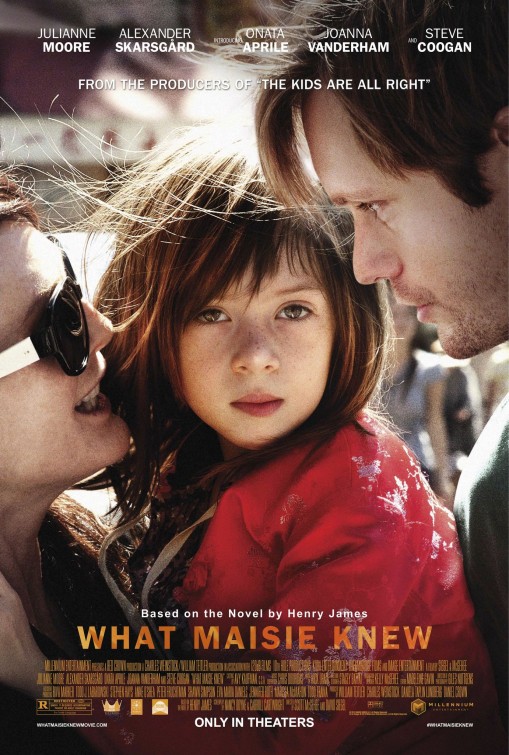 Did you know that What Maisie Knew is based on a novel by Henry James that was published in 1897? I sure didn’t, but then again my knowledge of Mr. James is somewhat limited. James’ tale of negligent parents passing off their daughter back and forth was controversial when the novel was first published. Updated to modern-day New York City, seven-year-old Maisie (Onata Aprile) is the pawn in her parents’ contentious divorce. Her father, Beale (Steve Coogan) is an art dealer who is constantly on his phone and making out-of-country trips. Her mother, Susanna (Julianne Moore), is an aging lead singer for a 90s alt rock band who also likes to party. Beale remarries Margo (Joanna Vanderham), a young woman who previously served as Maisie’s nanny. Not to be outdone, Susanna remarries Lincoln (Alexander Skarsgard), an affable bartender who’s somewhat clueless around kids. Everyone is trying to navigate the tricky new relationships and what they think is best for Maisie, though Lincoln and Margo seem to be the only ones who actually care.
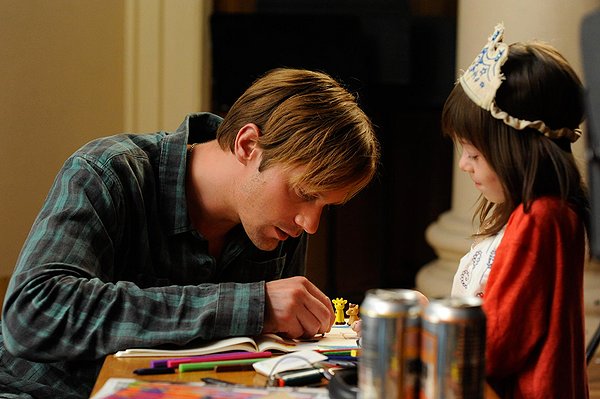 When it comes to divorce dramas, the easy way is to go big, to ramp up the emotions of such an emotionally distraught experience, and to tip into the overwrought territory of melodrama. I can already imagine the animated shouting fests and crying fests. Then there’s the impulse to go the bitterness route, like 2005’s The Squid and the Whale, where the movie takes a cue from its feuding parents and infuses the film with a dark, overpowering sense of acrimony. I credit directors Scott McGehee and David Siegel (The Deep End, Bee Season) for making arguably one of the most subdued movies about divorce I’ve ever seen. It’s certainly not flippant in the slightest, treating the subject, and mainly the toxic effect on Maisie, with sincerity and good taste. But as far as overblown shouting matches, they’re kept to a minimum and mostly comprise the first fifteen minutes of the movie, establishing the inevitable divorce of Susanna and Beale. The movie ignores the sensational and focuses on the ordinary, little moments of complete believability that serve to build, like brick by brick, the overall reality of the story. You’ll watch the film and think to yourself that, even with parents with completely outlandishly rich professions, that everything in this movie could realistically happen. Weird to think that James wrote his tale over 100 years ago and yet how relatable his conflicts still are to this day. However, because of this subdued, naturalistic approach, What Maisie Knew can’t quite find a proper ending. The one presented seems a tad too pat and tidy for this movie. It almost approaches a“happy ending,” though not quite. Still, knowing how thick-skulled both Susanna and Beale are, it’s hard to think that they will ever come to their senses and do what’s in the best interest of Maisie.
This can be an uncomfortable movie to watch because Maisie’s mom and dad are so destructively neglectful and self-involved. There’s a perverse rubbernecking draw to seeing the antics of truly awful parenting. You’ll find yourself getting very mad at how terrible these people are at being human beings. Susanna and Beale interrogate their daughter for ammo they can use against the other, twisting and manipulating the kid that we wonder if either truly cares about. Dad’s always full of excuses and mom’s looking to flee from responsibility at a moment’s notice, dumping her daughter on her latest boyfriend. You’ll find yourself easily sympathizing with Lincoln and Margo, the two people who love Maisie most and would make the best parents for her. I began rooting that they just abduct Maisie and start a new life as a family in a different country. The unchecked narcissism of both Susanna and Beale could serve as a clinical study. It’s a wonder that Maisie seems like a bright, playful, and relatively normal kid. For now.
Another aspect of McGehee and Siegel’s joint direction that I really enjoyed was how the movie takes on the perspective of little Maisie; she is our eyes and ears, and often the camera framing will instinctively mirror her own point of view, cutting off adults. It’s an interesting visual approach but it also further tethers us to this girl, forcing us to think even deeper about Maisie’s perspective, and how she’s interpreting the angry words. I suppose there is a valid argument to be had that a seven-year-old child is going to be a rather limited perspective on such a contentious conflict. There’s also the nature of Maisie. She’s a relatively quiet child, given to poking her head around corners and staring with those big glassy eyes of hers. Given the fact that she’s a child, and processing a painful life experience, don’t expect her to divulge too much about her thoughts and feelings. She’s an opaque presence and I realize that that can get frustrating for some. She’s not the kind of kid that’s going to burst into tantrums. This girl is internalizing all the pain and confusion. Having a passive prism for your movie might be akin to telling a love story from the point of view of a potted fern. Literally anchoring the camerawork to Maisie (I don’t want to oversell this as if it’s a stylistic gimmick) forces us to constantly think of every action through its impact upon Maisie. It’s not exactly a coming of age or loss of innocence tale but more a combination of the two.
 If you’re going to have a child be the star of your movie, you better choose wisely. I’ve found that as I grow older I have less tolerance for poor child actors. Perhaps it’s my inner Scrooge. Good thing that little Aprile (Yellow) is so effortlessly heartbreaking as she tries to find her way amidst her changing home life. One day she has a mom and dad, then she’s splitting time, then her daddy has a new mommy, who happens to be her old nanny, and then mommy has a new husband as well (Susanna admits she got remarried simply to improve her court standing). Aprile nicely underplays her character’s innate vulnerability while still reminding you of her youth. She’ll get scared and ask to go home, crying alone in her bed, and your heart will ache. I cannot say whether the strength of Aprile’s performance lies more with her legitimate skills as an actress, good direction, or the general reticence of the character, and thus the lesser demands for a child.
Moore (The Kids Are All Right) and Coogan (The Trip) give surprisingly textured performances, at least more so than the opening fifteen minutes would have you believe. They can both be monstrous and callously indifferent to their daughter’s well being, but as the movie concludes, each one of them has a small moment where they realize the damage they are inflicting upon their child, how poor a parent they have been (Susanna even lashes out at Lincoln’s encouragement to Maisie as “undermining her as a parent”). It’s much more than I was anticipating and both actors do good work at being unlikable without going overboard. Fans of TV’s True Blood might just swoon a little harder thanks to Skarsgard’s good-natured, humble, and mildly affecting performance as a man who becomes profoundly attached to Maisie. He may not know what he’s doing but isn’t that parenting as a whole? Skarsgard and the charming Vanderham make a great onscreen pair and their genuine affection for Maisie provide the most uplifting moments.
When it comes to parenting, there are no magic instructions to insure a responsible, loving, thoughtful, and independent human being. It’s a leap of blind faith. However, it’s much easier to predict the events that can screw up an impressionable child (do not misconstrue this as my declaration that children of divorce are, at heart, broken somehow). The thought of collateral damage is fresh in our minds as we track little Maisie trying to survive the reach of her terrible parents. The terse arguments can be painful but even more painful is the overall negligence of her rich and mostly absent, self-involved parents. What Maisie Knew isn’t a downer of a movie and its subject matter is given proper seriousness and reflection. You’ll likely cringe at points, may even grumble under your breath, but in the end it ends on a hopeful note, the possibility that Maisie, under the right guidance, could turn out to be the bright kid we see glimpses of at her school. There’s something quite moving about the resiliency of a child. This is, of course, just one interpretation of the movie, but What Maisie Knew is an emotionally engaging, subdued, sincere, and poignant film that trades on naturalistic waves of human interaction rather than cartoonish bluster, all the while forgoing cheap sentimentality or unpleasant bitterness. For the performances, the deft handling of sensitive material, and the quality direction, give What Maisie Knew a chance when able.
Nate’s Grade: B+


 nathanzoebl
You must be logged in to post a comment.