Blog Archives
Veronica Mars (2014)
 More people know the name Veronica Mars now than probably combined from its short-run on TV from 2004-2007, and that’s squarely because of its record-breaking haul brought in through the fundraising site, Kickstarter. Within hours, the project had already raised two million dollars, on its way to over five and a half million, enough for a long-awaited movie that fans have been teased with ever since the series cancellation. Creator Rob Thomas and his actors were beside themselves in gratitude to their fans (dubbed “marshmallows”). Fueled by the eager hopes of its fans, the movie went into production and is now available for digital download to many of its donors and in a handful of theaters.
Veronica Mars (Kristen Bell) has left behind her hometown of Neptune, California. She’s on the verge of signing with a major New York law firm, and an old friend comes calling. Veronica’s former flame, Logan (Jason Dohring), has recently lost his pop star girlfriend, also a Neptune graduate. He’s suspected of being the killer but he swears his innocence. With the promise of her assistance only lasting a few days, she flies back home and reunited with her old friends (Mac, Wallace, Weevil, Dick) and her father, private investigator Keith Mars (Enrico Colantoni). Veronica should go back to New York with her boyfriend Stosh “Piz” Piznarski (Chris Lowell), she should accept the job offer from the firm, but she can’t help herself fall back into old patterns. She misses the danger, the intrigue, and maybe enough, Logan himself.
 The curious case of Veronica Mars: The Movie is that it was truly made for the fans, those 90,000 people who contributed to their Kickstarter goal. It’s not made for the casual moviegoer who has no foundation with the television series. That’s not to say that Thomas doesn’t try and make the film more inclusive. The neophyte could reasonably follow along, and there is a fast-paced prologue to catch the audience up on the major developments of the series, though almost all from season one. A non-fan could watch this movie but I have no idea what they would get out of it because they would be missing all the connections and context that provide the depth. In a way, this situation reminds me of David Lynch’s Twin Peaks: Fire Walk with Me. Unless you were a fan of Lynch’s iconic thought short-lived TV series, there was no way you were going to follow along or be interesting in following along. It was a movie made for its fan base, and there’s nothing wrong with that though it always helps to provide enough entertainment to prove to the newbies why they should be fans in the first place. I don’t think the Veronica Mars film is able to achieve this. Sure, I enjoyed myself but that was because of my pre-existing fan club and my years-in-the-making desire to finally see proper closure to the characters I came to care about. I feel like someone without that devotion would watch the 105 minutes of Veronica Mars and question what all the fuss was about.
That’s because at feature-length, Veronica Mars is really more of an extended episode of the TV show, and not one of the top tier episodes. As a debut film director, Thomas does a serviceable job of recreating the series noir visuals. The mystery is sufficient if a little dull, lacking a strong sense of urgency throughout most since Logan is already walking around free of charges. The real anchor of the story is bringing Veronica back to Neptune and bringing her back into the family business. The class injustice was a hallmark of the TV series but it’s merely one more slightly malnourished storyline cluttering up the narrative. There are no real reasons to check in on so many characters beyond the fact that it provides resolution for fans. A ten-year high school reunion seems engineered just for this purpose, allowing the new old faces to all reappear again and catch us up. There are characters that appear in near-cameo form (though the surprise celebrity cameo is quite amusing). Even the romance feels mostly grafted onto the story because the core audience demands Veronica and Logan reunite, in all senses. It just becomes a matter of time waiting for the inevitable, as it is with all romantic comedies, except the romance is sidelined here until it isn’t. As a film, it doesn’t feel organically handled that Veronica would leap back into Logan’s arms, and so soon, unless, of course, you are one of those fans (I know MANY) who have been waiting seven years for that moment. Fan service is one thing but it shouldn’t detract from the internal logic of the featured story.
 What does still work are all the hallmarks of the TV show, even if they are less effectively showcased for first-timers. The plucky, sarcastic nature of Veronica still turns her into a heroine worth rooting for, a force of will that has her flaws as well. Bell (Frozen, TV’s House of Lies) can just about do it all, from goofy to heartfelt to ferocious. It’s clear how much she adores this character she helped bring to life ten years ago. The father/daughter relationship is warmly affectionate without dipping into sappy territory. The dialogue is still snappy, though having late twenty-somethings saying it rather than high schoolers has dulled some of the edge. There’s also the sleazy addition of older men hitting on Veronica now that she’s officially out of high school, so hooray. The season-long mysteries of the series, while satisfying and twisty, were secondary to the characters, and watching the overall jovial camaraderie of the cast, is a reminder at how much fans adore these people.
I can objectively critique the faults in the film, as I’ve tried to do for a couple paragraphs, but this is a movie where I set aside my critic hat and merge with the fans. I too contributed to the Kickstarter because I’ve been dying for a sense of closure for one of the best TV shows in the mid-aughts. The finale of season three left much of the show in doubt; Thomas was not counting on cancellation. While fan fiction can run rampant in these circumstances in order to cater to fan demands, it doesn’t compare to the creator being given a reprieve to tie up as many loose ends as possible. That’s the greatest accomplishment of the Veronica Mars movie is that it feels like a genuinely satisfying sense of closure for the fans. While not every storyline is wrapped up, like for instance Weevil’s path, it ends on a point where you can reasonably guess where the characters would continue from here onward if we were never to check in with them again. This is a good resting place. But given the runaway success of the Kickstarter campaign, maybe Warner Brothers could be convinced there are more stories to be told here. I’m cautiously optimistic but really Thomas has already given the fans just about everything they could want, unless they were the Veronica/”Piz” minority of shippers.
Whatever you think of the final product, Veronica Mars: The Movie has changed the way movies can get financed. Smaller boutique films with a passionate fanbase can now get the ball rolling, putting their money into a down payment on seeing their dream movie becomes a reality, convincing studio heads to roll the dice with less risk. I invite all newcomers to watch the series, since that is where it was best. As a film, it’s enjoyable enough and satisfying for the fervent fans, supplying needed closure. However, for people that don’t already have connections to these characters and this world, I don’t think there’s enough going on in the movie to attract a larger discipleship.
Nate’s Grade: B
Share this:

Nebraska (2013)
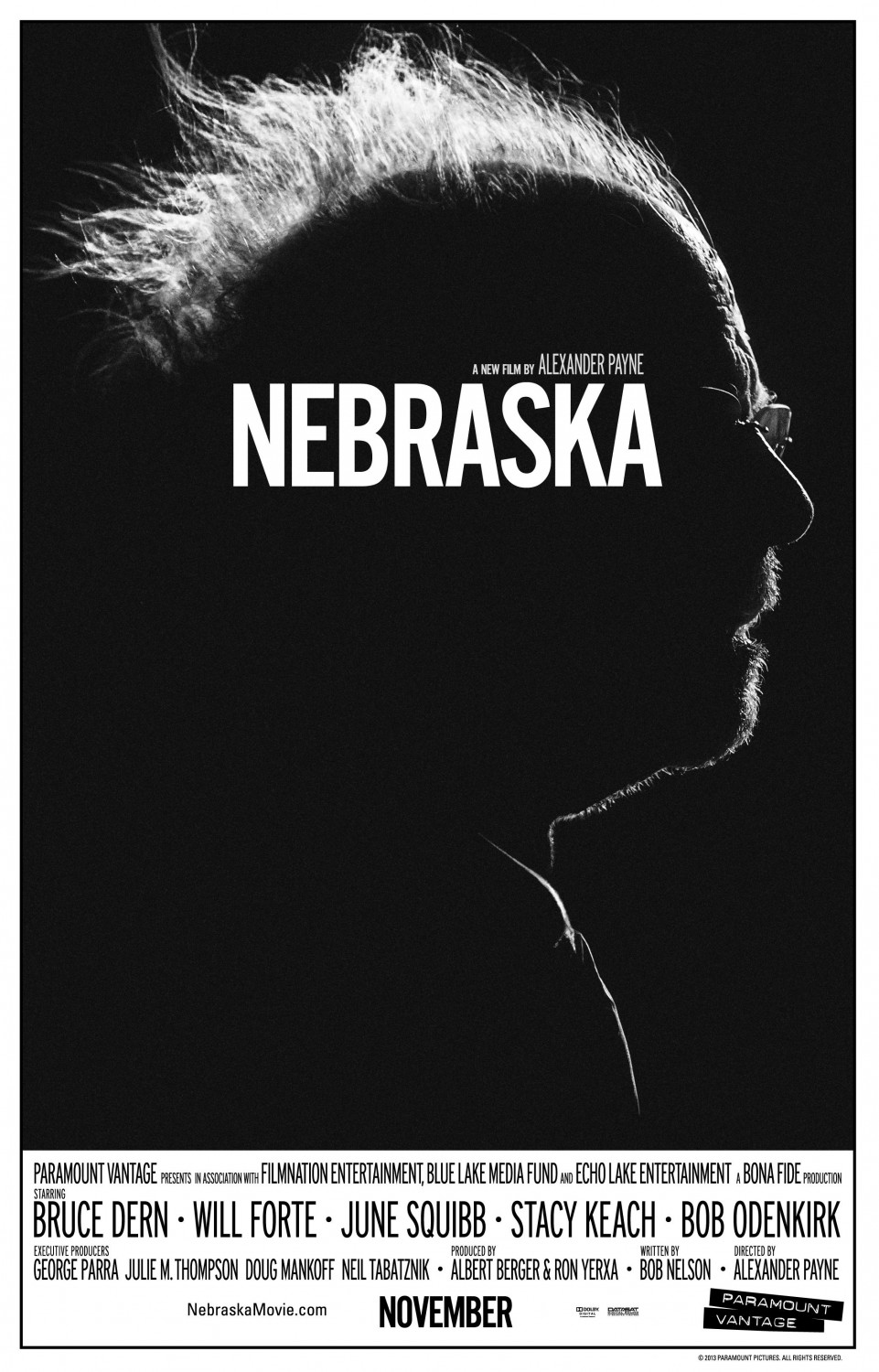 Nebraska is a slow burn, wryly-funny character study of understated proportions, highlighting Midwestern culture rarely given its big screen due. So, in essence, it’s an Alexander Payne movie.
Woody Grant (Bruce Dern) is an elderly man convinced he has won a million dollars and all he needs to do is travel to Lincoln, Nebraska to claim his loot. It’s one of those mass mailings really meant to get people to buy magazine subscriptions, but Woody will not be stopped, sneaking out to walk all the way to Nebraska from his home in Billings, Montana. David (Will Forte) is in a rut himself. He’s recently been dumped, his job is going nowhere, and his father refuses to accept his million dollars isn’t real. There’s a question of how lucid Woody is, and so to placate his old man, David decides to drive his father to pick up his winnings, to humor him before his mind may be gone for good.
 Despite the overtly sitcom machinations of the inciting incident, which even the characters dismiss, the film is really a drama about the relationship between a father and son and the culmination of our life choices. Woody and David are not close by any conventional means but over the course of their road trip, David begins to see his father in a different light; the old wounds are not forgotten, but David is learning about who his father is through others. He’s been so mad at his father for so long that it was the only identity he had for the man. Now in his deteriorating mental state and physical fragility, his father has a sense of vulnerability that brings about decidedly mixed emotions. In his fragile state, is he the same man or at least the same man David remembers? Then there are all the family revelations springing out from the situation. With a genuine millionaire in their midst, the family is coming out of the woodwork clamoring for their own pieces for all the unpaid assistance they’ve given Woody over the years. Initially, it makes Woody look like he’s been stuck trying to find his footing his whole life, as we learn about the lingering post-traumatic stress effects from his war service. Was he lazy, undiagnosed PTSD, or, as another character surmises, too ashamed to say no when others asked for help, and so he was taken advantage of in the guise of assistance from unscrupulous friends and family. The question remains who is Woody?
This is one of those observational slice-of-life films, and your enjoyment of it will depend on your threshold for the taciturn types. These are the strong silent types who keep most of their feelings to themselves. There’s a very funny sequence where Woody and his aged brothers have gathered around a TV, and to listen to the dry mostly car-related conversation bounce back and forth like a dead, floating wiffle ball, is a great comic moment but also a nice insight into an older generation and their communication. Given the perspective of the film, it’s hard to deduce whether the plainspoken people are being satirized or whether it’s a loving send-up of a specific culture. With Payne’s involvement, I lean more on the affectionate tweaking rather than a mean-spirited ridiculing of small town folk and their small town ways. There are funny situations, like David and Ross teaming up for some misplaced justice, and there are characters more broadly drawn for laughs, particularly Woody’s wife (June Squibb), but the overall interaction of the characters, their speaking vernacular, and how they viewed themselves, that is what made me laugh the most and appreciate the script. You feel like you’re dropping in on these people’s lives; every character feels like they could be a real person, not a stereotype. And boy does money really bring out the worst in people.
With Woody and his son visiting his old haunts, the movie inevitably becomes a reflection of a man taking stock of his life, regarding the choices he made and did not make. The pit stop in town opens up the character and David learns far more about his father, with old girlfriends, old business partners, and old rivals. What I appreciated further is that Nebraska doesn’t try and soften Woody; he’s not going to be some old curmudgeon who over the course of 90 minutes has his icy heart thaw and comes to realize the errors of his ways. Nope. Our views on the old man may soften when we get a fuller picture of who he is ad the life he’s lead, but the man himself is the same. He’s readily belittled, insulted, looked down upon, even by his own family members, especially his sassy wife. It’s easy for him to retreat into alcohol and wonder what if. As the family picture broadens and becomes more clear, the film approaches simply yet touching revelations about the family and the nature of legacy. There’s a father/son examination, but there’s also the discussion of what to do when your parents become too ill to take care of themselves. It’s not exactly The Savages, but there’s a circling sense of burdensome decision-making that provides an extra level of pathos to the sitcom setup. By the end, Nebraska squeezes out some earned sentiment without losing its edge or sense of identity. There’s a lot more going on then just some send-up of rubes.
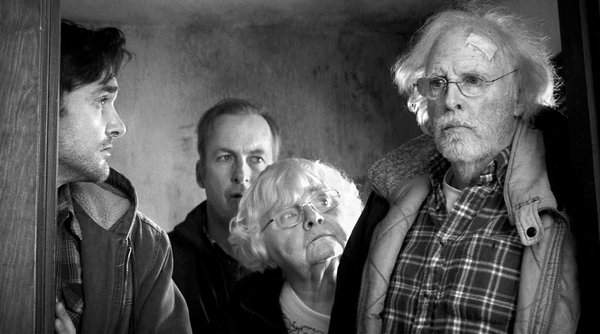 People have been raving about Dern (TV’s Big Love, Django Unchained) ever since the film’s Cannes premier, where the man earned top acting honors. The man deserves every positive words penned. He’s simply fantastic. The character vacillates between outward hostility, spacing out, and general Midwestern emotional reserve, and Dern is able to sell you on every emotional beat without breaking character. He’s unrepentant and demands to be taken for who he is, and his matter-of-fact bluntness has a certain charm to it, like when he admits to David that he never had any plans for kids. He just liked to “screw” and their mother was a Catholic (“You do the math”). I even appreciate that Woody would use the term “screw,” which seems more appropriate. As a two-man show, it’s a shame that Forte (TV’s 30 Rock, The LEGO Movie) doesn’t exhibit the dramatic chops to keep up with his onscreen pop. It’s nice to see him attempt something so different but his limitations are too evident; it’s just another gear that’s not present. At no point would I call Forte’s performance bad but he’s just unable to keep up. Squibb (About Schmidt, Meet Joe Black) is a hoot though the character seems to be permanently stuck in “wacky” mode. She’ll crack you up with her unrestrained commentary, but you may wonder if there’s any more to this character than saying outrageous, curt comments.
This was the last Best Picture nominee I’d failed to catch up with, and while it’s entertaining, funny, and unexpectedly touching thanks to terrific acting and a sharp script, but it also might be the weakest Alexander Payne film yet. This is the first film that the Oscar-winning director hasn’t written himself. Bob Nelson’s screenplay may never have even been glanced over by Payne had it not been for the state of its title (Payne’s films general take place in Omaha). It’s got Payne’s stamp, as would any film he directs, but it also feels like it’s missing something ephemeral, not to get too pretentious. This is a quality study of a cracked group of characters that, upon further review, aren’t as cracked as we may think. They’re just flawed people trying to get along as best they can. Even amidst the snide and antagonistic conversations, there’s gentleness here about the value of family that resonates above the din of the shouting. By film’s end, what started as a cockeyed sitcom transforms into a film that has more meaning and emotion, never betraying its guarded sense of self. When I say the weakest Payne film, this is not an insult but merely an observation. Even the weakest Alexander Payne film is going to be so much better than just about everything out there.
Nate’s Grade: A-
Share this:

The Hungover Games (2014)
 With so many dimwitted, half-baked, and often comically inept entries, it’s hard to remember when a spoof movie was actually something to be enjoyed. We’re beyond the era of Airplane and The Naked Gun, but even some of the early Scary Movie films had some merit, and then Walk Hard, Black Dynamite, and Wet Hot American Summer are shining examples of the best the comedy subgenre has to offer. We’ve become used to the Friedberg/Seltzer style of spoof, a machine-gun rattle of pop-culture references with no thought given to comedic instruction, just the soon-to-be-dated reference. With all of that established, I could not hate The Hungover Games. It doesn’t work well enough to recommend, but the joke-to-laugh ratio is higher than I would have thought, with about every one in five jokes landing, a few had me cracking up. Plus there’s actual critical content here, parodying the sources rather than just dull repetition. In the future, the public rises up against Hollywood because we have become sick to death of all their remakes, reboots, and unoriginal crap. And so, the twelve districts of Hollywood genres duke it out for our bloodthirsty entertainment (there’s a Johnny Depp district where even they have Depp fatigue). It’s a sharp contrast to Friedberg/Seltzer’s own inferior spoof, The Starving Games. The pacing is slippery, the content can be questionable, but with lowered expectations, you may be pleasantly surprised, or at least mildly less irritated with the results. The actors onscreen also do credible work, particularly Ben Begley, playing the Ed Helms Hangover role. He has nailed down Helms’ speech patterns, mannerisms, and he even looks like Helms. This guy deserves a better movie. With an R-rating, the film is afforded the opportunity to go weirder and dirtier than the lame brained spoofs from Friedberg/Seltzer, like the Gratuitous Nudity district or when they keep reminding us that Katniss is underage. Look, I haven’t hit my head all of a sudden; this still isn’t a good movie by conventional standards. However, spoof movie standards have gotten so low that The Hungover Games is passable. Again, grading on a curve.
Nate’s Grade: C
Share this:

Assault on Wall Street (2013)
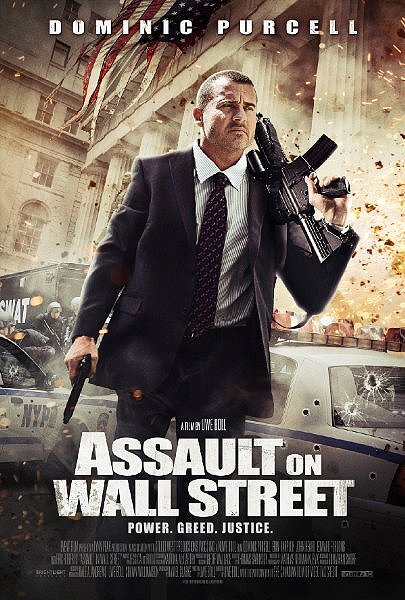 When it comes to notorious German director Uwe Boll, many are still waiting for what could be the man’s first genuinely good movie. The man has been prolific over the past ten years but sure-fire candidates for First Good Film, like Max Schmeling or Attack on Darfur, inevitably have some tragic flaw or approach that places them back in mediocrity, the company of many of Boll’s other movies. After reviewing more Boll films than a human should be allowed to willingly, I feel like I’ve been beaten down enough that when I find something that genuinely works, be it an actor or a sequence or plot turn, that I should be just as vocal as with the contingent of failure. So allow me to refreshingly applaud Boll for Assault on Wall Street, on coming up with a topic and a story structure that… actually… works. It not just works, it succeeds, and if a more polished professional screenwriter got a hold of this, I think it could actually impress the masses. If it weren’t for the surprisingly effective war drama, Tunnel Rats, I’d say without a doubt that Assault on Wall Street is the best work of Boll’s much-maligned career. And yet… it has just enough minor faults that hold it back.
Jim (Dominic Purcell) is a regular guy working as an armored security transport. His wife Rosie (Erin Karpluk) suffers from a rare tumor that requires an expensive series of injections to keep it at bay. Their insurance company won’t pay, and so they have to rely on Jim’s savings. Except those are gone as well. Jeremy Stancroft (John Heard) has ordered all his brokers to dump toxic assets, eliminating most investor savings but profiting the shareholders. Jim and Rosie are broke. Vowing vengeance, especially after some drastic decision-making by Rosie, Jim sets off to make the high-priced traders and corporate raiders on Wall Street feel the pain of what they have wrought.
 The setup is concise and Boll does a nifty job of compounding Jim’s problems and showing how all the industries are interconnected to put the squeeze on. Because of unscrupulous health insurers, his wife’s medical treatment, deemed experimental, is quite expensive and they’ve reached a cap. With the brokers pushing their clients assets into junk stocks, at the behest of the betters and for commissions, Jim loses his entire financial cushion. He hires a lawyer (Eric Roberts) but has to pay $10,000 just to retain him to fight the $60,000 penalty his broker says is owed. He goes into debt and refinances his skyrocketing mortgage (variable rate) to pay for his wife’s treatments. His employer takes notice of his perilous situation and is uncomfortable with enlisting someone in deep financial woes with guarding money. He loses his job. The bank is poised to foreclose on the house. His wife won’t get her treatments to save her life. All of this leads to a drastic and completely understood decision of desperation and sacrifice. Admittedly, Boll does a compelling job of connecting all the dots, making each new pitfall a result of the previous, each compounding the misery of Jim. It takes a little long to go through all these points, and I think Boll could have trimmed it down so that a key event happens at the Act One break point, but I was flabbergasted that the man found a story structure that succeeds.
The second half of the film is Jim planning his vengeance, and after all of the callous movers and shakers have bled him dry, you’re onboard for some sort of righteous payback. Boll takes on Wall Street and the healthcare industry (double the populist outrage). Jim as a character could be made much more compelling, but he’s really serving as a symbol for how the forces are ganged up against the little guy, how the fix is in. When confronted, the big CEO of the brokerage firm barks that it’s always the same old story, that the titans of industry were all crooks and manipulated the system to their advantage, and he’s no different. In short, the little guy always loses.
What holds back Assault on Wall Street, beside the fact that the titular assault is reserved for the last fifteen minutes of the film, is its too slick ending and Boll’s obvious transparency when it comes to his political message. After Jim suffers loss after loss, he puts together a plan pretty quickly, utilizing that Army training we’ve heard about. It’s actually too easy with little complications that can’t be solved in a David Fincher-style montage of death. It’s a full 70 minutes before he takes out his first Wall Street fat cat, and that’s just way too much dawdling. And then from there the climax involves Jim just going on a rampage in an office building, shooting several faceless employees who could very well be innocent for all we know. I think Boll is satisfied with a guilt-by-association catch-all for Jim’s fury, but it would be more satisfying just from a payoff standpoint if we saw these people in villainous lights prior, kind of like what Saw 6 did with its insurance characters before turning the tables on them. The last thing we need in our populist screed is to worry that the wrong people were dispatched. And what kind of office building fails to evacuate after a confirmed shooter has attacked?
 This storyline could have also worked in a Falling Down turn, where a man consumed with evening the scales of a system broken loses his moral bearing and lumps all guilty parties together and condemns them all. Perhaps it was meant to examine the slippery slope of vigilante justice and how this too can decay one’s sense of self, sort of like what Jodie Foster went through in 2007’s The Brave One. However, I don’t think Boll was intending this direction because he’s not very subtle about anything in the movie. Oftentimes the characters just become mouthpieces for ideological talking points: “We’re busy busting some homeless guy when the real criminals are on Wall Street.” The bad guys actually say, with no hint of self-awareness, “We all took a loss. When I told my wife we couldn’t vacation in Barbados any longer…” It’s all just a little too on-the-nose to remind you of the overall intent rather than the story. Therefore, I think Boll is just going for a sense of (misplaced?) justice in the end, in a ludicrous plan that somehow invalidates witnesses, forensic evidence, and security footage to pin the blame on someone else. It’s too clever by half that it undercuts the final payoff. It gets even worse with the Batman-esque voice over to close out the film with a promise to all evildoers.
With such a tight focus on the plot, the acting is a marked step up from previous Boll outings. Purcell (TV’s Prison Break, Killer Elite) doesn’t exactly come across as a regular Joe but he has enough onscreen presence to pull off his character’s anguish as well as the requisite badass stuff. And apparently Boll has become fond of him because Purcell is scheduled to appear in future Boll films. Karpluk, a Canadian actress best known for the TV show Being Erica, has a natural grace to her, forgoing big moments to concentrate on the gnawing guilt and concern her character feels. While she’s a bit too willfully ignorant early on, Karpluk makes you care and provides whatever depth can be applied to Jim. I’m actually curious to see her comic skills since she has a face tailor-made for romantic comedies. Heard (Sharknado, Home Alone) doesn’t seem to embrace his duplicitous CEO role with enough gusto, appearing to be annoyed when he should be menacing. This is not the kind of movie to hold back.
There are plenty of other Boll Players, including Edward Furlong (3 appearances), Lochlyn Munro (2 appearances), Tyron Leitso (5 appearances, also stars in Being Erica), Michael Eklund (8 appearances), Natassia Malthe (4 appearances), and the stalwarts of Clint Howard (6 appearances) and Michael Pare (13 appearances). It’s been 13 years since Eric Roberts (The Dark Knight) last appearance in a Boll film. Most of these are blink-and-you’ll-miss-them, but then there’s Keith David (The Thing, Cloud Atlas) in a thankless role that didn’t need to exist. But hey, I’ll take Keith David in anything.
A welcome surprise, for the most part, Assault on Wall Street is a finely structured revenge tale with clear and precise plot points and a natural buildup. It’s Boll on a soapbox and the naked transparency of his ire and populist messages limits the effectiveness of his storytelling, but you might not mind, especially if you are a person who has slogged through far less competent Boll ventures. There is a marked improvement in just about every facet of filming. It genuinely works, that is, until the pacing becomes lopsided and the end just reverts to celebratory action mode. A more professional writer could take this film and whip it into a crowd-pleasing populist thriller. It’s got so much that works, and genuinely works well, that I feel like a buzzkill to keep harping on the elements that do not succeed. But if Boll wants to earn an undisputed victory, he’s got to earn it without lowered standards. Assault on Wall Street is so tantalizingly close to being Boll’s First Good Film but it doesn’t capitalize enough.
Nate’s Grade: C+
Share this:

Mandela: Long Walk to Freedom (2013)
 One of the most important figures in the twentieth century, you’d expect Hollywood to give Nelson Mandela his well-deserved close-up, and in 2013 we got a biopic on his wife and the man himself, with Mandela: Long Walk to Freedom. It is a respectful, reverent, and relatively inspirational biopic boasted by a pair of great performances. Idris Elba (Pacific Rim/everything cool ever) nails the voice but also inhabits the courage of the man, the toll of his decisions, and the doubt that crept in at his darkest moments. Harris (Skyfall) gives a fiery performance as Winnie Mandela. You may be surprised, as I was, how active she was in South Africa’s rebellion against the government. The problem is that the film plays like a greatest hits collection without much more insight than we could glean from a cursory new report. Cramming the man’s life into 140 minutes is obviously going to be insufficient, but the speedy narrative does little justice to the man’s hardships and the complexities of South Africa’s civil rights movement. The cradle-to-grave approach in biopics is somewhat passé now. Rather movies like Lincoln and Invictus, also about Mandela, focus on pivotal moments that encapsulate the person. I think I have the perfect rewrite of this movie: adjust the focus squarely on the series of meetings in the late 1980s Mandela had with the South African government about political reform. Let’s dig deep into the political conflicts, the government’s fear to equal rights and possible recriminations, the smoothing of tensions, the building of trust, the fragility of a country in the balance. It may seem like more of a stage bound approach, but I think it has more immediacy, nuance, and works to summarize his lifetime of struggle and the change of his country. Oh well. Mandela is a respectful biopic but the man and his legacy deserved something better than a speedy run-through of his life’s checkpoints.
Nate’s Grade: C+
Share this:

Inside Llewyn Davis (2013)
 “There’s no success like failure. And failure’s no success at all,” Bob Dylan wrote. He could have been talking about any number of characters in the oeuvre of master filmmakers Joel and Ethan Coen. Losers and has-beens and could-have-beens fascinate the brothers, and their newest film certainly follows this model. Llewyn Davis (Oscar Isaac) is a struggling musician in the 1961 Greenwich Village, New York folk scene. He rotates crashing with various friends, unable to scrounge up enough money to ever pay his own way. His musical partner recently killed himself and Llewyn has been trying to get traction with his first solo record. His world gets even more complicated when Jean (Carey Mulligan) reveals that she’s pregnant; the baby’s father may be Llewyn or Jean’s husband and fellow performer, Jim (Justin Timberlake). Llewyn can’t catch a break.
Inside Llewyn Davis is a classic Coen creation, a character study of a misanthropic loser trying to find direction in a comical universe of indifference. I greatly look forward to every Coen picture and that’s because nobody writes characters like they do. There are no throwaway characters in a Coen universe. Even minor characters like the elevator Attendant or Manager’s Secretary are given sparks of personality, each fully formed figure creating a richer canvas. There is great pleasure in just listening to their characters speak, in natural cadences yet elevated with grace. Inside Llewyn Davis is no exception. Their storytelling is always rife with wonderful comic surprises and pit stops. The Coens are such brilliant technical craftsmen, that every shot is gorgeously composed, even without longtime cinematographer Roger Deakens (to give you an idea how old this movie was, Deakens was busy filming Skyfall). The music, supervised by O Brother maestro T. Bone Burnett, is impeccably performed and quite lovely to the ear, if you’re into folk music arrangements. If you’re not, well, it’s going to be a long movie experience.
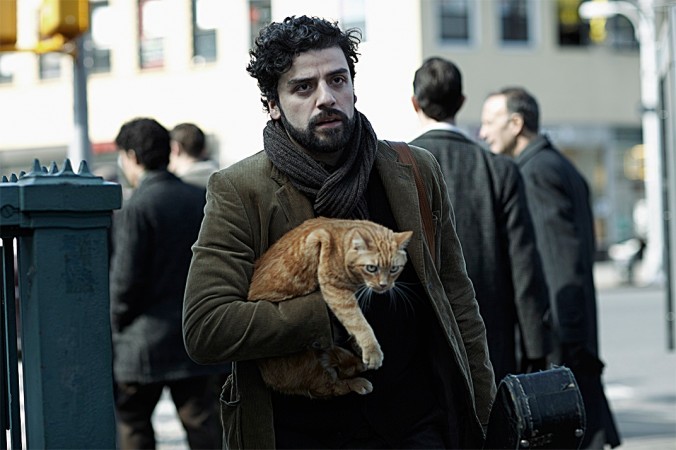 But here’s the problem with Inside Llewyn Davis: the film will likely turn off most people. It’s not a comforting movie by any means. We’re stuck following a self-destructive struggling musician bounce around couch-to-couch, chasing dreams that will never seem in reach. And Llewyn is a tough character to love. He’s surly, careless, selfish, egotistical, and also jaded. And he’s just about the only character in the movie. Most of the other famous faces are fleeting supporting players. Only Mulligan (The Great Gatsby) is given a plurality of scenes to expand her perturbed character, and even those may not be enough. Much like Llewyn’s musical direction, this is a one-man show, and he’s not cuddly. But an unlikable protagonist is not uncommon. The Coens tease so many different directions for Llewyn to go that it’s likely that audiences will feel some degree of disappointment where the film does end up. It’s a circuitous path, proving Llewyn is the architect of his own fate, but at that point audiences may not care. They may just be happy to watch Llewyn punched in the face. The plot is pretty light, running into a series of various self-contained scenes, and there isn’t much in the way of closure. I’ve watched the film twice and while I appreciate it more I’m certain that Llewyn Davis will leave a majority of people feeling cold, more so than even A Serious Man.
Unlike former Coen creations, notably in A Serious Man and Barton Fink, our titular character is the architect of his own misery. He is a musician that identifies with an older class of folk artists, something that strikes him as genuine and touching the soul. He cannot stand artistic compromise. He won’t even accept a winter coat from his music manager. He wants no handouts. He chastises Jean about her and Jim’s attitudes toward the business, calling them “careerist” and “a little bit square.” To Llewyn, to sell out is the worst crime. Jean says that they’re just doing what they can to raise up the musical ranks, and maybe the songs aren’t top-notch, like a catchy but instantly dated novelty song about the Space Race (the sure-to-be Oscar-nominated “Please Mr. Kennedy”), but they’re commercial, they’re finding an audience, they’re making inroads, partially as a husband/wife act and partially due to their own physically attractive appearances, and it frustrates Llewyn greatly. A great example is early in the film a young Army vet on leave performs a wonderfully pure song with a beautiful voice. Llewyn scoffs at the mawkish nature of the tune. “He’s a great performer,” Jim advises. Llewyn takes umbrage at the distinction; a performer is not the same as a musician. The people getting ahead are the performers, the sellouts. One of Jean and Jim’s rising hits, “500 Miles,” lyrically suggests it was an old slave song that has been repackaged and homogenized for safe consumption. Llewyn is going to stick to his guns and make it on his own terms, with expected results. Late in the movie, after Llewyn performs before a record exec (F. Murray Abraham), so aching and affecting as he puts it all into the song, the exec simply responds: “I don’t see a lot of money here.” However, the exec offers Llewyn a chance to be in a trio he’s putting together, if he cleans up and knows how to keep to the background. It’s a real opportunity. Just not for Llewyn.
It all comes down to legacy and Llewyn contemplating what his will be. His singing partner is now defined by his death, finding cruel irony in their song, “If I Had Wings.” His father is known for his long dedication to the Navy, but now he sits alone in a nursing home, a prisoner to his own infirmary and defeated mind. A road trip partner, the pompous jazz musician Roland Turner (a royally hilarious John Goodman), seems like a Ghost of Christmas Future visit from a possible future Llewyn, the artist who’s an iconoclast only in his own mind. Throughout the film, Llewyn is beset with choices, different options he could take, one in particular stemming from a revelation involving an old girlfriend. And yet, much like the thematic nature of folks songs, we’re told, Llewyn looks for something new with something old, be they routines, goals, or occupations. The folk music scene is on the cusp of change with a more commercialized pendulum swing, as evidenced by a surprise new performer at the Gaslight in the closing minutes. Llewyn is contemplating his life beyond the world of show business and where he goes next.
 And if there is a sad aspect to the Coens’ tale, it’s that Llewyn really is a talented musician. This is a breakout role for Isaac (Drive, Robin Hood) especially when you consider that he did all his own singing and guitar playing. It’s one of the most astonishing musical performances by an actor I’ve ever seen in a movie. The level of craft at command, the different slivers of passion he carefully puts into the performances, the trembling emotion, the merging of himself with the song. There’s a reason the Coens open the movie with Isaac performing the full rendition of “Hang Me, Oh Hang Me.” It crystallizes right away where the man’s talent level is, both the character and the actor. We’re left to then wonder why he hasn’t found his place in the industry, and the rest of the film is the explanation. This is the first film since perhaps 2007’s Once where full-length performances of songs really do move the story forward (I’m obviously excluding traditional musicals). Some have labeled the heavy use of song as lazy, distracting from an undercooked narrative, but I can literally go through every song in the film and justify its existence. Each tune, and the performance and performers, gives insight to character, plot, and state of mind.
Inside Llewyn Davis is an easy movie to admire but a harder one to love, unless you’re a fan of the Coen brothers or folk music in general. The protagonist is unlikable, his struggles his own doing either by hubris or integrity, the plot is rather loose with scattered supporting characters, and the film ends on a somewhat lackluster note that feels inconclusive. But then I keep going back to the richness of this world, the pop of the characters, the lyrical beauty to the unvarnished songs, and the concept of folk music as its own sense of purgatory (here me out, folk fans), the idea that we seek something new with something old, and so we follow in circles, like Llewyn’s onscreen journey. Isaac gives such a strong performance that you almost wish his character could catch a break. Almost. This is another technical marvel from the Coens, filled with their dark humor and their sense of cosmic melancholy, but Inside Llewyn Davis may ultimately find some strange sense of uplift as Llewyn continues to hold to his ambitions even as the world around him is changing, losing sight of artists like him. As long as we have the Coens, the Llewyn Davis’s of this world will get their due in one form or another.
Nate’s Grade: A-
Share this:

The Starving Games (2013)
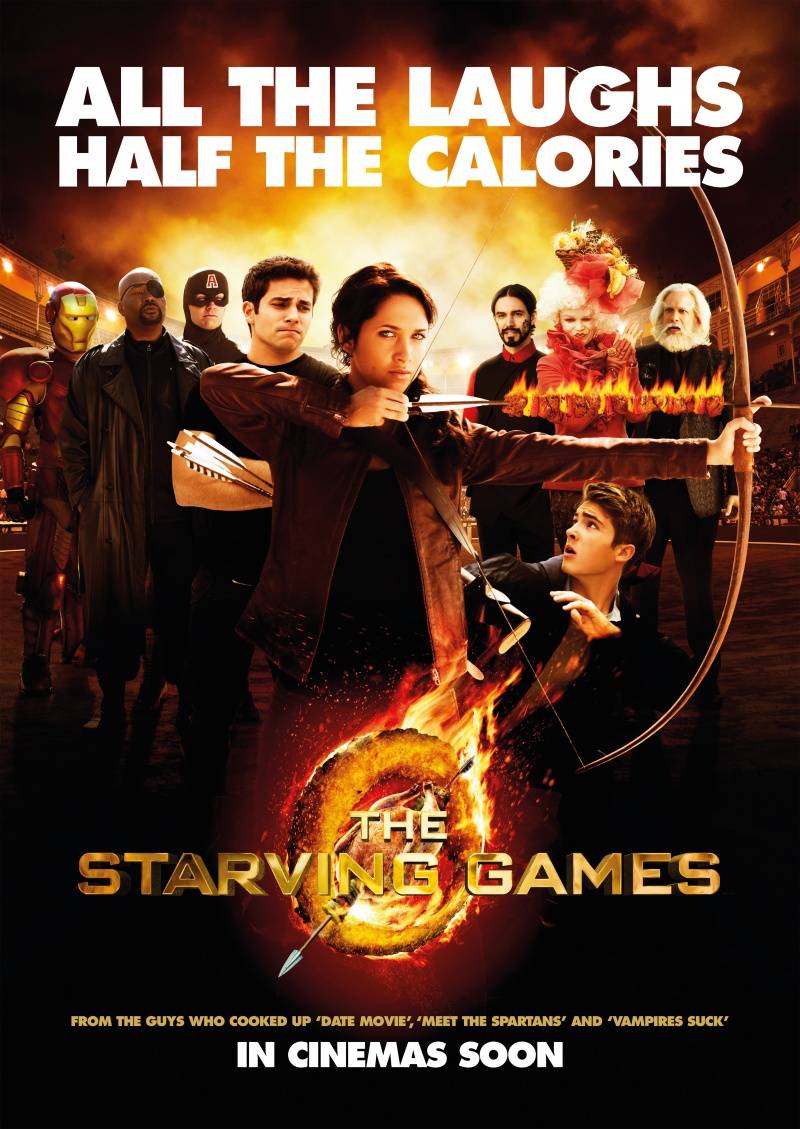 I feel like lambasting the duo of Friedberg and Seltzer has gotten to the point of beating a dead horse. I’ve been railing against their misbegotten sense of comedy (really just pointless and soon-to-be-dated pop-culture references) for years, declaring three of their terrible spoof movies as my worst film of that year. There is no love lost between me and these two men, and yet I feel the sense to restrain my ire when it comes to their latest, The Starving Games. It’s another witless comedy caper, this time using the popular Hunger Games series as its skeleton to hang its desperate jokes upon. These guys don’t know what parody is, don’t know the particulars of comedy and how to build and payoff a joke. It’s the same pattern of ineptitude that will never change. Yet while sitting through all 80 laborious minutes of Starving Games, I felt like Friedberg and Seltzer have come to the realization that the end is nigh for their spoof careers. This last movie didn’t get a theatrical release and the production values look chintzy even for them. They used to crank these lousy films out one a year; hell, in 2008 they gave us two. Now they’ve released two in the last five years. Usually they’ll pack a celebrity or, barring that, MadTV alums. Even those are absent. That’s right, even this movie couldn’t snag a MadTV alum or D-list celeb. Perhaps, as I’d long prayed, the public has grown sour on Friedberg and Seltzer’s misunderstanding of comedy and matured enough to realize that pointless references are not the same as parody. In all fairness, I did laugh two times in The Starving Games, both related to Diedrich Bader as President Snowballs. The lead actress, Maiara Walsh, displays a lot of potential. She’s a good comic actress, has a tremendous smile, a memorable face, and sturdy poise to slough through this mess. She deserves a better movie and more opportunities.
At this point, you know what you’re getting with Friedberg and Seltzer, and that’s all you’re going to get. However, I just looked online and discovered they have two movies scheduled for release next year, one a Fast and Furious parody (goody), and the other an honest to God spoof-free straight comedy. I’ll be fascinated to see what these two have to offer when it comes to non-spoof comedy, but their background fills me with equal parts dread and derisive excitement. Hey, it can’t be worse than InAPPropriate Comedy, could it?
Nate’s Grade: D
Share this:

Out of the Furnace (2013)
 The last time writer/director Scott Cooper looked at a rural, low-income, hand-to-mouth existence, he helped lead Jeff Bridges to Oscar gold with Crazy Heart. It would make sense then for Cooper’s follow-up, Out of the Furnace, to populate those same hills. It also makes sense why actors would flock to Cooper’s next project. It’s a film that strives to be a little of everything, a slow burn and artful revenge thriller, but ultimately will please few, the actors wasted here included.
In rural Pennsylvania, Russell Baze (Christian Bale) is a diligent steelworker who always has to be on the lookout for his younger brother, Rodney (Casey Affleck). Prone to impulsive decisions, Rodney routinely finds himself in debt to bad people. The situation magnifies when Russell is sent to prison for a few years due to a fatal car accident he was responsible for. When he leaves the penitentiary, life has only gotten worse. Russell’s ailing father passed away while he was locked up. His girlfriend, Lena (Zoe Saldana), has moved on with police chief Wesley Barnes (Forest Whitaker). Most distressing, Rodney has gone through four tours of Iraq and is deeply troubled. He’s fallen into old habits and gotten involved in an underground bare-knuckle fighting ring run by the ferocious Harlan DeGroat (Woody Harrelson). Rodney runs afoul of Harlan and disappears, and Russell goes on the warpath for vengeance.
 The problem is that Out of the Furnace doesn’t do enough to separate itself from the pack. We get little insight into the hard lives of these men. Both brothers are haunted by guilt and trauma, squeezed by few economic opportunities, and feeling like life itself is trapping them in corners. However, their path is already predetermined. Russell is destined to stay on the narrow path of responsibility, suffering slings and arrows, but striving to do the right thing. We see this time and again. And Rodney is destined to make poor decisions, desperately getting in over his head and reaching out to all the wrong people. We see this time and again. Each part is solidly locked in, and so we wait because we know their exact trajectory. We know something bad will happen to Rodney and we know Russell will be driven to seek justice his own way. Likewise, Harlan is a scary psycho without complexity. He’s just a drug-addled, violent, scary dude, but he’s so one-note. Lena, once she briefly reunites with Russell, is completely absent in the film, as if her unrequited position is all she serves for our purposes. Cooper displayed a terrific ear for lived-in characters with Crazy Heart, and the details of this world feel honest, it’s just that there aren’t enough of them. The storyline is engraved with little variation, and Cooper doesn’t take full advantage of his great cast, relying upon familiar scenes and elements to establish his loosely drawn characters. We’ve seen these burnouts and lowlifes and dignified blue-collar workers all before. This is a film that wants to be challenging but too often seems to take the easy road.
The very plot structure also seems amiss. As stated above, the journey seems set in stone, so then when something bad does happen to Rodney, it feels overdue. Rodney doesn’t meet his ultimate bind until halfway through Act II, and then when the plot shifts to vengeance, it becomes an uncomplicated straight line. And a streamlined plot with little variation or surprise, with characters that are customary, can get boring. Once Russell is on the warpath, there is little complications or obstacles, or even moments to contemplate the full extent of his actions. And then the movie is done. Because the final act plays out exactly as you anticipate, the movie leaves you feeling anticlimactic. The payoff is unsatisfying. Plot reorganization would have benefited the Russell vs. Harlan storyline. Rather than draw out Rodney’s ultimate screw-up, which everyone is just waiting for from minute one, why not have his screw-up be the Act I break, coming around the half-hour mark rather than more than an hour into the film? That sets the story forward and provides enough space for Russell to work upwards toward Harlan as well as examine what kind of man he is becoming. As it plays out, Harlan is crazy but also easy to access despite the threats of what the rural hill people will do to visitors. If a revenge story was the method that was going to test Russell’s character and redemption, then we needed to get to this crossroads sooner, especially since everyone is waiting for it to happen.
 The power of the acting goes a decent way to compensate for the film’s unresolved investment. Bale (The Dark Knight Rises) internalizes most of his character’s emotions, always trying to hold back a swell of anger and guilt, to just keep going one day at a time. He delivers another strong performance as a man struggling to do the right thing. In this day and age, even a passable Bale performance is going to be above average. Affleck (Ain’t Them Bodies Saints) is a go-to actor when you have a desperate character that is clearly outmatched. His volatile performance is laced with sadness, as you understand how cursed Rodney feels, how the universe hands him bad break after bad break. Affleck tinges his hopelessness with a resigned weariness, as if he’s just seeking a final release. Harrelson (Now You See Me) stews villainously, erupting with extreme violence. He’s a scary guide helped by Harrelson’s flicker of madness he imbues the character with. It’s too bad he doesn’t do anything memorable outside the opening minute. Whitaker (Lee Dainels’ The Butler) probably gets the worst of it, and I think he knows it, which is why the actor adopts a gravely speaking voice that sounds like he has a frog in his throat. Beyond the fact that he’s linked with Russell’s old flame, there isn’t anything important to mention about the character, nor is there anything for Whitaker to do other than make limp threats about letting the police focus on Harlan.
Out of the Furnace is one of those movies that gets details right but loses sense of the big picture. Its blue collar, working class characters are given the right clothes, posture, look, but they’re not given enough material to breathe as characters. The people in this movie end up becoming dispensable parts of the background, serving their strict plot purposes and then dissolving again, lacking complexity and personality. The characters aren’t strong enough for this to be character-driven; the plot isn’t given sufficient structure for this to be a searching moral exploration; the pacing and direction don’t provide enough thrills for the film to work as a revenge thriller. And so Out of the Furnace, while not being a bad film, falls short of truly working as a character study, as a moral examination, as a traditional pulpy revenge thriller. It’s got a great cast and some wonderful production values that convey the weight of low income America, but the movie just lacks an engaging story to justify the talent in use. A few more revisions would have helped, but Out of the Furnace ultimately comes up short because it lacks any sort of lasting heat.
Nate’s Grade: C+
Share this:

All is Lost (2013)
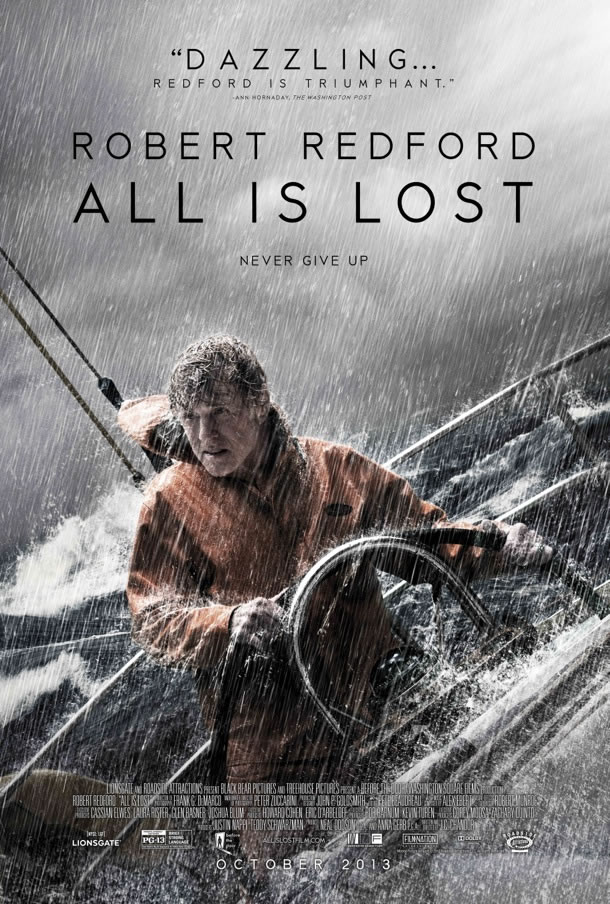 J.C. Chandor, nominated for an Oscar for writing Margin Call, chose a curious follow-up. In All is Lost, Chandor serves as writer/director and takes acting legend Robert Redford, strands him in the middle of the ocean, and watches him flounder. Considering Margin Call was heavily dialogue-driven, it’s an interesting detour to a nearly wordless film. Redford plays an older sea-faring gentleman who discovers one morning that his boat has been damaged by a floating shipping container. He has to repair the hole and take inventory of his remaining supplies. As his boat takes on more water, being battered by storms, Redford must strive to reach a shipping lane as his best bet to be rescued.
 Allow me to furor my brow at the reception All is Lost has gotten thus far. It’s not a bad movie but when you boil it down it’s a rendition of The Old Man and the Sea minus, you know, the giant fish. I knew going in that the film was going to be minimalist, but I didn’t think it would be this dull. It is literally a guy manning a boat for 90 minutes, patching things up, with the situation getting worse. Then he’s in a raft. Then he’s low on supplies. Then, well, it ends pretty much how you’d expect though with a flicker of ambiguity for the squeamish. The drama of human survival, of man against nature, can be plenty invigorating, but instead Chandor takes a more leisurely and studiously pessimistic approach, and so we watch Redford slowly fail. The filmmaking can barely keep your interest. He hoists the sale. He tends a hole in his boat. He salvages electronics. There are a couple of choppy storms that throw the ship around, but The Perfect Storm this isn’t. Nor is it Open Water. There is a certain brainy enjoyment from survival thrillers, thinking alongside the characters, but our opportunities are absent here unless you know a thing or two about sailing, otherwise I just kept thinking, “fix the hole in your boat.” It takes a good while, until the third act when Redford is forced to abandon his sinking vessel, before the perilous reality seems to settle in. Beforehand it feels like the film is dawdling, and I just found myself shrugging and growing restless. It feels callow of me to complain that not enough happens onscreen when I’m watching a man struggle to survive at sea, but that’s because the sense of urgency is nil. I watched Redford eat beans out of a can more than I saw him sweat over his predicament. I wish Redford had been paired with a tiger or a volleyball for decent screen company.
This is very much a one-man show with Redford ably holding the screen, but will you care about his character and his plight? The character is nonexistent, far more so than the similar charge against the other awards-friendly survival thriller, Gravity. I always felt like I was observing Redford from a distance, never fully emotionally engaged, and more so just studying his survival skills like there might be a test later. That’s because Redford serves as a metaphorical stand-in for all of humanity (the character’s listed name is “Our Man”); the movie feels replete with allegory, which makes the tedium all the more unbearable for me. I didn’t feel the man’s horror or nerves or despair or urgency. I didn’t feel much of anything. That’s because I believe that Redford’s acting history is meant to fill in for the absence of character. We’re not watching any man brave the dangers of the ocean, we’re watching the aging Hollywood screen idol dig into his own screen history and showcase what remains. It’s a fine performance that kept me watching but it felt too modulated, too controlled, too internalized to translate the myriad of emotions necessary. It’s 90 minutes of Redford standing in for himself standing in for humanity, named “Our Guy,” remember. That already sounds laborious.
 Chandor received notoriety for his smart, hard-hitting Mamet-esque dialogue, and deft handling of actors, but All is Lost showcases a whole other set of skills in his storyteller toolbox. Being nearly wordless, the movie is one giant exercise in visual storytelling. Chandor’s camera angles, editing, and in particular the use of sound and lighting, keep the audience oriented smoothly. While it may take a moment to gauge what Redford is doing, there is a logical connection to his actions. There’s a visual mastery here that was not even hinted at with Margin Call, which was mostly a stage play of boardroom conversations put on film. The special effects are seamlessly integrated into the film and having Redford perform many of his own stunts adds to the overall verisimilitude, the film’s calling card. I feel like Chandor the director outdid Chandor the writer.
All is Lost is a film I can better respect than support, an intellectual exercise in a deteriorating and seemingly doomed survival scenario, the anti-Cast Away. It’s probably as realistic as these things get, but does that make it interesting? The details of reality are there but the story and especially the character work is lagging. It’s nice to see Redford with such a meaty part, and obviously one he is connecting with, but I wish his talents were put to greater non-metaphorical purposes. With the plot and characterization stripped, it appears that Chandor’s film is rife for allegorical analysis, noting the struggle in the face of overwhelming odds, the futility of existence, etc. To me, that sounds like you’re doing the movie’s work for it. The overall lack of urgency just wrings out what entertainment there could have been with this tale of survival. When your main character doesn’t recognize the threat, then that transfers to the audience, and we too shrug. All is Lost is certainly well made from a technical standpoint, with Chandor showing impressive visual storytelling prowess, but it drags and offers little incentive to connect. What ends up being lost is your patience and attention.
Nate’s Grade: B-
Share this:

The Place Beyond the Pines (2013)
 Ambitious filmmaking is welcome, but usually ambition leads somewhere, which is the main problem with co-writer and director Derek Cianfrance’s unwieldy 140-minute multi-generational crime drama, The Place Beyond the Pines. First we watch Luke (Ryan Gosling) as a traveling motorcyclist enter a life of crime to support his infant son. Next the focus shifts to Avery (Bradley Cooper) as a cop with a conscience running into corruption on the force. Last, we jump ahead into the future and watch the dramatic irony unfold as the children of Avery and Luke interact, waiting for them to learn their paternal connection. I believe Cianfrance (Blue Valentine) and his team was attempting to tell a meditative, searching drama about children paying for the sins of their fathers, the lingering fallout of bad decisions and moral compromises. Except that’s not this film. By the end of the movie, while some secrets have been laid bare, there really aren’t any significant consequences. The film does an excellent job of maintaining a sense of dread, but it doesn’t come to anything larger or thought provoking. The entire structure of this film is geared toward a tragic accumulation, but it just doesn’t materialize. That’s a shame because it’s got great acting through and through, though I have grown weary of Gosling’s taciturn antihero routine that seems like a rut now. Avery’s portion of the plot was the most interesting and anxiety-inducing, but I found the movie interesting at every turn. The characters are given pockets of nuance and ambiguity as they traverse similar paths of desperation and conciliation. The Place Beyond the Pines is a perfectly good movie, albeit disjointed, that cannot amount to the larger thematic impact it yearns for.
Nate’s Grade: B-


 nathanzoebl
You must be logged in to post a comment.